Tag Archives: Jesus

Chayei Sarah: Oil for the Lamp

“Now Avraham was zaken / old, well on in days, and Hashem had blessed Avraham bakol / with everything.”

Genesis 24:1

Why does our verse say that Avraham was “well on in days” rather than “well on in years”? R’ Yaakov Yosef Hakohen z”l (1710-1784; foremost disciple of the Ba’al Shem Tov z”l; known by chassidim as “the Toldos” after one of his works) explains:

The Gemara (Shabbat 153a) teaches: Rabbi Eliezer said, “Repent one day before you die. But, since no one knows when he will die, repent every day.” King Shlomo likewise said (Kohelet 9:8), “At all times, let your clothes be white.” Rabbi Yochanan ben Zakkai said: “This may be likened to a king who announced that he would hold a feast, but did not announce the time. The intelligent ones among his entourage dressed-up so as to be ready on a moment’s notice, while the fools did not prepare.” [Until here from the Gemara]

-Rabbi Shlomo Katz
“Beginnings and Endings”
Hamaayan, Volume 26, No. 5
Commentary for Torah Portion Chayei Sarah
Torah.org

“Then the kingdom of heaven will be like ten virgins who took their lamps and went to meet the bridegroom. Five of them were foolish, and five were wise. For when the foolish took their lamps, they took no oil with them, but the wise took flasks of oil with their lamps. As the bridegroom was delayed, they all became drowsy and slept. But at midnight there was a cry, ‘Here is the bridegroom! Come out to meet him.’ Then all those virgins rose and trimmed their lamps. And the foolish said to the wise, ‘Give us some of your oil, for our lamps are going out.’ But the wise answered, saying, ‘Since there will not be enough for us and for you, go rather to the dealers and buy for yourselves.’ And while they were going to buy, the bridegroom came, and those who were ready went in with him to the marriage feast, and the door was shut. Afterward the other virgins came also, saying, ‘Lord, lord, open to us.’ But he answered, ‘Truly, I say to you, I do not know you.’ Watch therefore, for you know neither the day nor the hour.

Matthew 25:1-13 (ESV)

Ben Zoma says: Who is wise? The one who learns from every person…

-Pirkei Avot 4:1

Who is wise? The motto for the Boy Scouts is “Be prepared,” so, given the lessons we see above, it would seem that we would be wise if we learned from the sages who provided those teachings. We can learn from every person, but it is better to learn from those who have something useful and edifying to say.

And yet, how often do we ignore wise teachings until it is too late? How often do you put off changing the batteries in the smoke detectors in your home? How often do you let the needle on your car’s gas gauge get down to “E” before looking for a gas station? And while it’s impossible to predict an earthquake, if you knew a hurricane was coming, how long would you wait before trying to leave for a safer location or stocking up on food and water for yourself, and batteries for your radio, and then shuttering your windows against the coming storm?

No, I’m not taking a cheap shot at the victims of hurricane Sandy, but rather, I’m saying something about we Christians. How often do we take “being saved” for granted, even when we know that a “storm” is coming? How often do we take our relationship with God for granted and think we know everything we need to know about Him?

I saw this yesterday on Facebook:

Going to be a very interesting year ahead. I started going to a Bible study with a friend of mine, yesterday was our first class and let me just say complete shock. They are studying B’RESHEET (Genesis) and in the new members class the leader was telling us how she has been a Christian for over 40 years, joined this Bible study 5 years ago and it was the first time she ever read the ‘Old Testament’. Many of the other women commented that they too had not read anything other than the Psalms and had no idea where this thought of ‘twelve’ tribes came from. How very ,very sad.

Isn’t that a little like waiting until the last minute before getting oil for your lamps, and then getting locked out of the “marriage feast?”

OK, a lot of Christians don’t really consider the Old Testament to be that important. A lot of churches bill themselves as “New Testament” churches and that’s pretty much all they feel they need. However, since all of Christ’s “source material” from Scripture was before the Gospel of Matthew, it might be wise to study what he must have studied (We sort of assume that Jesus just “knew” the Bible forward and backward, but as a child and young adult, no doubt like other Jews, he attended synagogue on Shabbos, heard the sacred texts being read, and studied as would be expected of a young Jewish lad from a humble family in the Galilee).

We do know that he knew a few things and learned a few things growing up.

After three days they found him in the temple, sitting among the teachers, listening to them and asking them questions. And all who heard him were amazed at his understanding and his answers. And when his parents saw him, they were astonished.

Luke 2:46-48 (ESV)

It is true that studying does not automatically assure that a person will grow wise, but lack of study will almost certainly result in a person being ignorant. Christianity and Judaism have one core document that provides us with a connection to those who established our faith and who can tell us the story of man and God: the Bible (“Bible” has different definitions depending on whether you’re Christian or Jewish).

But it’s not that simple.

To define sola scriptura without academic terminology might sound something like this: The Bible is the only authority in the believer’s life; it is never wrong about anything; it touches on every aspect of life; it needs no outside help to be correctly interpreted; it never disagrees with itself; it can be understood by anyone of average intelligence; and it applies to everyone in every situation.

-Jacob Fronczak
“The Five Solas: Sola Scriptura”
Messiah Journal, Issue 111 (pg 47)

That sounds good as far as it goes, but let’s see what else Pastor Fronczak has to say.

I only use the example of translations to illustrate the fact that in a very practical sense, the Scriptures in their original languages are, for most Christians, not enough – tools such as translations, concordances, the Masoretic vowel points, and commentaries are required in order to understand the text. Of course, the goal is to understand the original text, which in itself is not an objection to the doctrine of sola scriptura – until one realizes that every translation, every commentary, and even the textual tradition itself are all based on traditions along with the divine written revelation. It is simply impossible to get away from these traditions and study the Bible in isolation. (Fronczak, pg 52)

It seems that studying the scriptures to acquire wisdom is getting harder or at least more complicated all the time.

I’ll probably write another “meditation” sometime soon expanding on other points in Fronczak’s article, but essentially, he is saying that we cannot study the Bible in any useful manner without employing (hold on to your hats) the “traditions of the (Christian) elders.”

“The traditions of the elders” has received a lot of “bad press” in Christianity because of the perception that both ancient and modern Jews allow “the traditions of men” to have authority equal to or even greater than the Bible. The Christian response, particularly among Protestants, is to say, “let scripture interpret scripture,” which is the short definition of sola scriptura. That means, “no traditions are allowed,” just the Bible itself. However, Fronczak’s article makes it abundantly clear that the early church fathers employed a great deal of tradition in even canonizing the books of the New Testament, and Catholicism, even to this day, states that the Bible can only be understood through its traditions.

Imagine the shock of realizing that the same is true among all modern-day Protestant churches as well. We just don’t choose to say it in those words.

Remember that quote from Pirkei Avot about a person being wise if they learn from everyone?

And what about the commentary on Abraham and its apparent companion lesson about the ten virgins? How can we learn from everyone and how can we be prepared to learn what we need to learn in order to comprehend what the Master is teaching us, and thus draw closer to God?

You must unlearn what you have learned.

-Yoda (Frank Oz – voice)
The Empire Strikes Back (1980)

In some sense, learning what’s important and what takes us on the path toward wisdom means “unlearning” concepts and doctrines that we discover aren’t useful in our lives. That isn’t always easy when such information is directly attached to words like “sacred” and “holy” and “divine revelation.” It would be like a person who learned as a child that God was a giant, old man with a long white beard who sits on a huge golden throne on a cloud in the sky. Now imagine that child is Jewish and then he grows up and learns that according to Rambam’s thirteen principles of faith, God doesn’t even have a body and is not to be considered a corporeal being? If the fellow was still young enough, that might come as quite a jolt.

Now imagine being a woman of middle age who has been a Christian for forty years reading from the book of Genesis for the first time. Taking it a step further, imagine the same woman in a group of women studying the Old Testament, accessing the classic interpretations for Genesis to try to understand anything at all about who Abraham was, where he came from, why God made a covenant with him, and what that covenant means to both Jews and Christians today.

If we are to take the lesson from Avot at face value, then our class of women might want to “unlearn” a few things about the Old Testament and learn, not only from extra-Biblical Christian commentaries about Genesis, but from a few Jewish ones as well.

Certainly Jesus understood Abraham from a completely Jewish context and framework. If we want to understand Jesus, we must understand what he understood.

Do not seek to follow in the footsteps of the wise. Seek what they sought.

-Matsuo Basho

So we unlearn what is not useful to us and then start learning from a wide variety of sources, seeking to understand God (as best we can) and who we are in Him. How do we know when we’re “prepared enough?” Five of the ten virgins kept “flasks of oil” with them for their lamps so that when the bridegroom came, they were ready to light them, even if it was at midnight. How do we know when we’ve studied enough so that we have “flasks of oil” at hand?

Let’s look at it another way. Studying, learning, understanding, are all active processes. You can’t bottle the stuff and put it on a shelf for a rainy day. It’s like continually replenishing the oil in lamps that continually must be burning. This makes sense when compared to another parable of the Master about we Christians being the light of the world (see Matthew 5:14-16) and how our light must be placed where everyone can see it burning all the time.

Our “lamps” will never be filled to 100% capacity where we can then stop tending to them. We are prepared when we’re always preparing; when we’re always studying, and learning, and discussing, and pondering, and repenting, and praying, and…you get the idea.

In each journey of your life you must be where you are. You may only be passing through on your way to somewhere else seemingly more important—nevertheless, there is purpose in where you are right now.

-Rabbi Tzvi Freeman
“Be There”
Based on letters and talks of the Rebbe
Rabbi M. M. Schneerson
Chabad.org

Or in the words of my generation, “Wherever you go there you are.” We should all consider ourselves “a work on progress.” We’ll never be complete. We’ll never be “finished” or “done” or “perfect.” As long as we live, we must move forward. As long as we’re breathing, there’s someplace else to go, something else to learn, another person we need to meet.

And God will always be with us, as long as we continually seek him, and walk by the light of our lamp.

Good Shabbos.

Long After the Storm

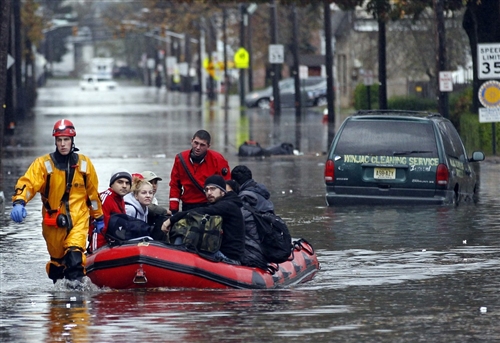
There are a plethora of websites, blogs, and news sites that have addressed the tragedy of the Sandy “superstorm” and the broken and struggling lives it has left behind in New York and New Jersey, so I didn’t intend on writing about it. I thought that I couldn’t say anything that hasn’t already been said and with far more eloquence and compassion by the many others who have already spoken.

But then I read “A Lesson From the Storm” on Shmarya Rosenberg’s blog FailedMessiah.com. I follow Rosenberg’s blog regularly but never comment and I am periodically dubious as to his bias against the Chabad community. Nevertheless, I couldn’t ignore the call for understanding and the challenge to extend myself beyond my usual limits.

One of the new facts of life in the aftermath of Hurricane Sandy is that tens of thousands of people are now reliant on some form of assistance, be that help from FEMA or the Red Cross or from smaller local organizations like churches and synagogues.

People who never before had to ask for or accept charity now are forced by circumstances to stand in lines at ad hoc soup kitchens and sleep at the homes of family, friends or even strangers or shelters while some form of temporary housing is found for them.

In some ways, they are now living the lives of America’s poorest citizens, never knowing if they will have a roof over their heads tomorrow or food to eat.

The very poor and homeless we are used to seeing are often mentally ill or drug addicted, and it is easy for us to blame their poverty on their own behavior or on being crazy.

But what we don’t see are the thousands of very poor Americans who have been priced out of the housing market and who sleep in shelters or on friends’ couches, go to work at low paying jobs with no benefits, and who rush back to those shelters before their early evening closing, often hungry, just so that they don’t get locked out.

We don’t see the very poor who became impoverished because of a severe illness, who had to choose between getting a very ill child to regular therapy appointments and their jobs.

We don’t see the families, ravaged by job loss, job erosion and by employers who cut or eliminate employee benefits, often by cutting employees’ hours to just below the full-time threshold, families whose regular dinners consist of ramen soup and whose breakfasts are often nonexistent.

As horrible as it is right now in some Jewish areas of New York City, just blocks away outside them it is often far worse, because these already poor communities lack the financial resources and fundraising expertise to supplement the assistance the government can give.

I’m politically and fiscally conservative and so I don’t believe that all social ills can be “solved” simply by creating a program and then throwing tax dollars at it. Also, having worked as a family counselor and social worker in both the San Francisco Bay Area and in Orange County (Calif.), I know about the struggles of the mentally ill and the limits of any social system in perfecting a “solution” for prejudice, homelessness, poverty, and the pull between the need for help and the illness that drives such a vulnerable population away from hope. In my time as a child abuse investigator for Child Protective Services in Southern Califonia, I met with many families on welfare (since they are disproportionately reported to “the system”), but in all that time, I found only one family who was using public funds as a temporary aid while they tried to remediate their circumstances. All of the others treated welfare like a multi-generational lifestyle and “worked” the system the way other people worked at jobs.

I say all of that to help you understand my perspective on the politics behind economic and social assistance programs and their relative effectiveness in changing “temporary” aid into a permanent institution. Often, those attitudes are in conflict with a greater imperative.

Then the King will say to those on his right, ‘Come, you who are blessed by my Father, inherit the kingdom prepared for you from the foundation of the world. For I was hungry and you gave me food, I was thirsty and you gave me drink, I was a stranger and you welcomed me, I was naked and you clothed me, I was sick and you visited me, I was in prison and you came to me.’ Then the righteous will answer him, saying, ‘Lord, when did we see you hungry and feed you, or thirsty and give you drink? And when did we see you a stranger and welcome you, or naked and clothe you? And when did we see you sick or in prison and visit you?’ And the King will answer them, ‘Truly, I say to you, as you did it to one of the least of these my brothers, you did it to me.’

Matthew 25:34-40 (ESV)

Decades ago, I read a statistic saying that most Americans are only one or two paychecks away from homelessness. Given the massive amount of debt most individuals carry, I don’t doubt the statement to be just as true today as it was back then. Probably more so.

I’m fortunate to have a job today. It has benefits including medical insurance. I live in a house with my family. I drive a car in good operating condition to and from work each day. I sleep in a comfortable bed and I don’t have to worry about not getting enough food, being too warm or too cold, or doing without all of the basic necessities and many of the comforts.

But I’ve also been unemployed. I’ve never been homeless, but I’ve been depressed, frustrated, angry, and desperate. I’ve worked low paying full-time jobs while going to school full-time just to support my family and try to rebuild my life. I’ve been hurt and sick with no medical benefits, so I just had to put up with being hurt and sick. There were months when I barely saw my family let alone talked to them. Sleep was all but an illusion. I was a middle-aged man burning the candle at both ends because I had to and there was no one to help me except me.

And God.

Which is why, in spite of the fact that I’m always dubious of a political solution to a human problem, I find that we must show compassion and render assistance to people who need assistance. If we are to err, let’s err on the side of generosity rather than stinginess. Consider the following, which is a comment made by a Katrina victim in response to Rosenberg’s blog post:

I can speak to this. One day I was comfortably (upper) middle class, living in a 2400 sq ft house filled with stuff, much of it of sentimental, as well as monetary, value: artwork, heirlooms, antiques, rare books, and so on. The next day I was homeless with only the clothes on my back and the contents of a small carry-on. Although I tried to, I got no help from the Federation or the Red Cross, and I did not get all that I was supposed to from FEMA. For months my job was wrangling on the phone with two insurance companies trying to get the reimbursements that my policies called for–with limited success. If I hadn’t worked in the insurance industry and didn’t know what my policies really provided, I would have gotten even less. Fortunately I had some assistance from my son (logistical, not financial) and some savings, or I do not know what would have become of me. With my own resources I was able to survive, have a roof over my head, food on the table and other necessities. In the general atmosphere of no help I do have to thank a group of Jewish volunteers from North Carolina who cleaned out the contents of my flooded house (a disgusting job) and another group of Southern Baptists who gutted my house–and the US tax code which allowed me to deduct portions of my $300,000 worth of uninsured losses. In addition I lost my whole circle of friends and acquaintances, health care providers, etc., etc. These social ties were extremely difficult, in some cases impossible, to reproduce in my new life.

In addition I have suffered psychological trauma that I don’t think will ever pass. A heavy rain (even here in the desert) makes me very nervous, and I am very distressed whenever there is a hurricane on the loose, although there are no hurricanes possible in Arizona. At an event marking the fifth anniversary of Katrina, I met a friend, neighbor, and colleague who also relocated to Arizona. She told me that she didn’t have enough clothes or furnishings because she was afraid that if she acquired anything, she would lose it. I told her that I have a ridiculously excessive wardrobe, because I am afraid of being left again with nothing but the clothes on my back. Eerily three weeks after this conversation, my friend’s new home was burned to the ground by an arsonist. One of my best friends was rescued by a Coast Guard helicopter just before a looter, carrying a gun, was about to enter her home. She continues to have post-traumatic emotional problems.

When we look at the news, we see unknown figures and hear nameless statistics. When we encounter the homeless and the mentally ill on our streets, we automatically think “bum,” or “panhandler,” “addict,” or “nutcase.” We don’t see the human faces. We don’t hear the human voices. But they’re there and they’re real. Like most of humanity, we tend not to care about a problem until it becomes our problem. It rarely has an emotional impact on us and even more rarely inspires us to offer assistance until it becomes personal; until it happens to us, or to a relative, or to a friend, or maybe because someone we care about also cares about the victims.

Five hundred years ago or so, a man named John Donne penned these words:

No man is an island,
Entire of itself.
Each is a piece of the continent,
A part of the main.
If a clod be washed away by the sea,
Europe is the less.
As well as if a promontory were.
As well as if a manor of thine own
Or of thine friend’s were.
Each man’s death diminishes me,
For I am involved in mankind.
Therefore, send not to know
For whom the bell tolls,
It tolls for thee.

No Man is an Island
MEDITATION XVII
Devotions upon Emergent Occasions
John Donne

If we are indeed “involved in mankind,” then whatever happens to another human being, happens to us. As Christ said, whenever we help the least of all human creatures, we have helped the author of our souls.

Most of all, and this is important, we don’t have to assume that once the initial crisis has passed that everyone is going to be fine and we can go about our usual lives. We don’t have to return to being unconcerned for those whose lives will take years to recover, if they ever will recover completely. Do you ever wonder about the victims of the earthquake in Haiti? Do you still recall those lives devastated by the earthquake and tsunami in Japan? Do you ever, ever wonder what all of those people are doing right now?

The victim of Katrina suffers years after the disaster. His heart, his feelings, his life is still being damaged by the storm. And yet, as painful as I can only imagine that might be, the greater injury is done by uncaring neighbors, by unfeeling humanity who asks “for whom the bell tolls,” and then not recognizing the name, shuts out the sound of a small shattered voice, softly crying in the background.

Only the hurricane has passed. The storm of anguish and need is still raging, its call, unanswered and unheeded.

EDIT: Unfortunately, the nor’easter that interrupted recovery efforts from Superstorm Sandy pulled away from New York and New Jersey Thursday morning, leaving a blanket of thick, wet snow, and triggering even more anxiety and despair among those people still in the first stages of trying to recover.

To help victims of Sandy, donations to the American Red Cross can be made by visiting Red Cross disaster relief, or you can text REDCROSS to 90999 to make a $10 donation.

57 Days: The Lord has Promised Good to Me

Peace of mind is essential for obtaining many virtues. Its absence leads to all types of shortcomings. When you have peace of mind, you can use your mind constructively. Lack of peace of mind breeds anger and resentment.

The quality of one’s prayers and blessings is dependent on the mastery of one’s thoughts. Above all else, one’s ability to study Torah properly is based on having peace of mind.

-Rabbi Zelig Pliskin
“Daily Lift #628, Peace of Mind is Essential for Growth”
Aish.com

Every Sunday, my daughter has to be at work at 5 a.m. That means I need to wake up at four and get ready to drive her so she can be at work on time. After that, when I get back home, I can get in bed again if I want to.

And that’s just what I did. But church services start at 9:30, so I set the alarm for 6:30. Makes sense to me. Gives me time to wake up leisurely, read, study, check my blog, have breakfast, and figure out if I have any semi-dress clothes that will fit. Haven’t had to “dress up” in quite a while, but fortunately I know how to use an iron and I don’t clean up half bad.

Both my wife and daughter were already at work when I was ready to leave for church, so there was no one around to wish me luck.

Made it there about ten to fifteen minutes early, which is early enough (I figured) to find a parking spot, but not too early that I’d have to conspicuously hang around a bunch of people I don’t know. Found the men’s bathroom, which is an important task in attending any public social event. About four people greeted me and shook my hand before I even got to the entrance of the sanctuary. Saw Pastor Randy who also cleans up pretty good. He was encouraging as was everyone else I met. He sent around the teacher for the class my son and daughter-in-law attends at the church. B.J. just wanted to say “hi” because he knew I was David’s Dad.

Because I told Pastor Randy that my wife is Jewish, other people seemed to know. One woman introduced herself (I didn’t hear her name because of all the background noise hundreds of people make when they’re talking all at once) and told me she was a Jewish believer. More than a few people, including the Jewish woman, said they hoped my wife would come to church with me soon.

Which is kind of what I was dreading, and that will sound odd to most Christians, but let me explain.

My wife wouldn’t receive the kindness of Christian contact and an invitation to come to church as a particularly positive thing. While she’s been to church in the past, her Jewish identity as it currently exists, does not accommodate going to church or attending Christian functions, even though she also doesn’t attend many Jewish functions. I just hope no one tries to contact her independently (I haven’t written my address and phone number down on anything at church, but I’m not that hard to find, either). I tried to explain this to Pastor Randy yesterday, but I’m not sure how he received it.

OK, one issue to be concerned about, but hopefully I’m making it a bigger deal than it really is.

Everyone was very friendly. Lot’s of handshakes and “glad your here.” I know that the “corporate greet your neighbors” handshaking is a normal thing in churches, but I’m still shy enough for it to make me a tad nervous.

The order of service and music was about what I expected. In fact, I was surprised that I remembered the tunes so readily. Nothing mysterious or too difficult. Words were on the screen at the front of the sanctuary.

One Pastor read the text from Acts 7 and then Pastor Randy gave the lesson from that chapter (they’re going through the book of Acts right now, pretty much dissecting it, but the series is slightly ahead of where I am in my Torah Club study on Acts, so I couldn’t leverage Lancaster while listening to the sermon). The bulletin contained a sheet for taking notes about Stephen’s defense to the Sanhedrin, which I used. I was interested in how Pastor Randy would frame Stephen relative not just to the Sanhedrin, but to the rest of the Jewish people, and the nation of Israel as a whole.

He very much acknowledged that Stephen was a Jew, just as his “fathers and brothers” were (Acts 7:2). I won’t go through my notes on what Pastor preached about, but it didn’t reflect the traditional Christian view of Stephen rejecting the Temple, Law, or the customs of the Jewish people in favor of the grace of Jesus Christ. Stephen was portrayed as “convicting” the Sanhedrin of going against the Torah of Moses and being faithless to God, which is more consistent with how I’d read these verses. The sermon was worded to be more accessible to a Christian audience and there were a few times that I thought the message might have been “toned down” a bit for the sake of the people listening (but I can’t be really sure, of course).

The Pastor made good use of his knowledge of Biblical Hebrew and Greek, gently suggesting that the NIV translation may not be entirely accurate. He spent a lot of time on the Abrahamic covenant, a favorite topic of mine lately. He also backtracked into Acts 6 and illuminated “trust and obey” to all of us. How do we know we trust God? How do we know our faith is genuine? Because if it is, we obey God. But what do we obey?

This is the $64,000 question from my point of view, since traditional Christianity usually says that works is dead and all we have to do is believe, while in Judaism, performing the mitzvot has center stage in a Jew’s life. The answer from the Pastor was, “good works.” Our faith is genuine if it produces “good fruit” (he didn’t actually say “good fruit,” but I thought I’d insert it here).

Pastor leveraged the Akediah (he didn’t say “Akediah,” but with his knowledge of Hebrew and having lived fifteen years in Israel, he must have been thinking it) to show us how faith, trust, and obedience are married concepts for someone who is truly righteous (he might have said, “for a tzaddik”). In going back to the original command God gave Abraham to leave Haran (Genesis 12:1), Pastor took the principle of obedience a step further in telling a story about some early Christian missionaries in India.

These missionaries were continually debating how they were to start out on their task, anticipating what might happen if they took this step or that. Finally, one of the missionaries said something like the following:

A Christian doesn’t have the right to demand to know where he is going. He must walk by faith.

Given everything I’ve been going through in anticipating “church,” he might as well have been talking to me.

Even as I wrote down the quote, I couldn’t help but marvel at how much of last week’s Torah portion had been inserted into Pastor’s message on Acts 7. He also included portions of Genesis 45 and Genesis 50, as he followed Stephen’s defense, which included references to the Patriarchs and the people of Israel.

Overall, the message was not only one of hope for Christians, that God is faithful and gracious even while we may have troubles in our lives, but that God has always been faithful and gracious to Israel and the Jewish people, even in the midst of their trials and suffering. God remains the constant for both Christians and Jews, and Abraham is the father for both the Christians and the Jews (and Pastor was careful to say that the Abrahamic covenant does not make the Christian “Jewish”).

After the sermon and closing song and prayers ended, it was time for Sunday school. I had chosen a particular class to attend, and Pastor Randy let Charlie, the teacher, know I was coming. Several handshakes later (I don’t mean to belittle this and actually, everyone was very friendly, but it will take me awhile to get used to so much human attention compressed into such a small space and time), I found where I could get a cup of coffee before class. The coffee ran out just as I was about to get a cup, so I didn’t have that delay before finding my classroom.

Consequently, I was the first to arrive. People trickled in and introduced themselves. The teacher and class members were mostly my age or older (I think one couple was a bit younger).  The first person to come in after me was an older gentleman named Dick. We got to talking and at one point he said something like, “It can be hard to find a church that gives you what you need,” and went on to say how fortunate they were to have a Pastor who preached the whole Word, including the Old Testament. He pretty much summed things up for me.

Class wasn’t as organized as I would have expected. I was glad it wasn’t heavily scripted, because that tends to stifle individual or creative response, but I saw that people struggled to respond when Charlie threw a question out among us.

I really, really had intended to be quiet, and just to listen and observe. That didn’t last very long and all of my old “reflexes” in addressing classroom questions and answers, built up over the years in my previous congregational experience, immediately took over.

In fact, I realized at one point, that instead of answering a question, I expanded on it and turned the question back to the rest of the class.

Oops.

I tried to tone it down after that, but I may have come close to crossing the line when I suggested that no matter how much God has chastised Israel, He has always brought them back, and will continue to fulfill His promises to them by bringing them back (not by restoring only a tiny remnant, but by redeeming Israel) to Him.

After class was over, I apologized to the everyone and particularly to Charlie for my being such a chatterbox. Not many of the other class members talked much, although during one of my monologues, I entered a dialog with one of the other fellows. Everyone was gracious about it and I hope I didn’t offend anyone. I didn’t think I’d get this “interactive” for weeks, but the wheels kept spinning in my head and once I opened my mouth, words started zipping out.

I was kind of interesting that all of the other students there were married couples except for one woman whose husband was on some sort of business trip in Turkey. I can see it’s going to be awkward to be going “stag” to church every Sunday.

Oh, both in the service and during Sunday school, I liked how the Jews weren’t blamed for rejecting Jesus or being bad examples, and in fact, the teachings emphasized how we Christians were expected to live up to the teachings of our Master.

At one point, Charlie, in discussing how Jesus dealt with faith or its lack as recorded in Mark 9 and 10, said, “If Jesus attended this church, what issues would he have to address here?” A little later he asked, “What would Jesus have to say to me” (about my failings)?

The experience wasn’t perfect, but then I expected that I’d feel out of place in an unfamiliar social environment. It was very “Christian” in all the ways I thought it would be, except that Judaism was treated much better relative to the Jewish Messiah and the Gentile disciples than I had imagined. The music lacked a certain punch, but that’s not really an issue for me compared to the other matters I’ve discussed, although they did introduce a bit of an “experiment” by having band sing “Amazing Grace” to the tune of The House of the Rising Sun (originally recorded by the Animals in 1964). It totally rocked.

Yes, I’ll go back next week for a variety of reasons, not the least of which is that I’m curious as to how far I can enter Christian fellowship and how much I will be able to integrate and still keep the core of who I am as one of the world’s most unusual Christians. At this point, my only real reservation, as I said before, is how far some of the folks in the church will try to press me to bring my wife to services. I don’t think that part would go over well at all.

Guess I’ll see how it all works out week by week, day by day, by God’s grace.

The Lord has promised good to me…
His word my hope secures.
He will my shield and portion be…
as long as life endures.

-John Newton (1725-1807)
Amazing Grace


Vayera: Miraculous

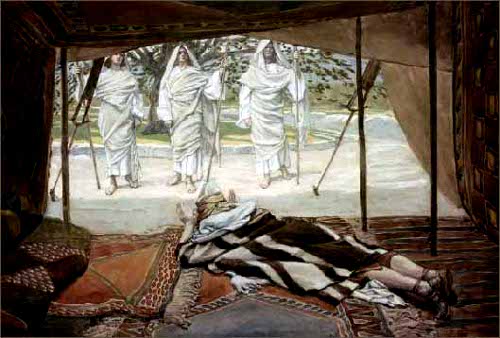
abrahams visitorsThe Lord appeared to him by the terebinths of Mamre; he was sitting at the entrance of the tent as the day grew hot.

Genesis 18:1 (JPS Tanakh)

When Rabbi Sholom DovBer of Lubavitch was a child of four or five, he entered into the room of his grandfather, Rabbi Menachem Mendel, and burst into tears. His teacher in cheder had taught the verse “And G-d revealed himself to Abraham…” “Why,” wept the child, “doesn’t G-d reveal Himself to me?!”

Rabbi Menachem Mendel replied: “When a Jew, a tzaddik, realizes at the age of 99 that he must circumcise himself, that he must continue to perfect himself, he is worthy that G-d should reveal Himself to him.”

-Rabbi Yanki Tauber
“The Tears of a Child”
Chabad.org

This is a well-known commentary on this week’s Torah Portion, Vayera and I’m hardly in a position to add to what a great many sages and spiritual luminaries have already stated regarding this portion of the Torah. But in studying the Torah Club commentary (volume 6) for this week on Acts 4:32-5:42, I discovered what could be a tangentially related issue.

Now many signs and wonders were regularly done among the people by the hands of the apostles. And they were all together in Solomon’s Portico. None of the rest dared join them, but the people held them in high esteem. And more than ever believers were added to the Lord, multitudes of both men and women, so that they even carried out the sick into the streets and laid them on cots and mats, that as Peter came by at least his shadow might fall on some of them. The people also gathered from the towns around Jerusalem, bringing the sick and those afflicted with unclean spirits, and they were all healed.

Acts 5:12-16 (ESV)

D. Thomas Lancaster’s lesson on these verses, both in the written text of his commentary and in the Torah Club audio teaching, speaks about “the age of miracles” and whether or not we have miracles today. As we read passages such as the one I quoted above, we Christians may be hard pressed to explain why 2,000 years ago, severely ill and disabled people could be cured simply by having Peter’s shadow fall across them, while today our most fervent prayers and petitions to God fail to prevent a loved one from dying of cancer. Why don’t we see miraculous signs, wonders, and healings in today’s church?

Some say that we do, but because we live in the 21st century, many events that a person 2,000 years ago would have called a miracle, today might be explained as some other phenomena. Even in the church, we are sometimes hesitant to say something is a miracle for fear of appearing foolish. On other occasions, the claims of miraculous events from some seem to be so common that the credibility of witnesses is brought into question.

While I do believe that sometimes miracles do happen today, they don’t seem to be “predictable,” which I guess stands to reason, but they also don’t seem to be predictably produced by an identifiable individual or group of individuals, such as the apostles. When we read about Peter, John, and the other apostles in the early chapters of Acts, it’s as if they’re doing miracles all the time.

One explanation, as Lancaster points out, is that the book of Acts compresses 35 years of history into about two hours worth of reading. It’s easy to get the impression that Peter was healing the sick through miracles every day and several times a day. This is probably untrue and only the “highlights” of the “Acts of the Apostles” were recorded by Luke. All of the other more mundane occurrences in their lives over three and a half decades went unchronicled and passed away into the shadows of history.

But there’s another reason we may not see miracles today the way we see them in Acts.

When the day of Pentecost arrived, they were all together in one place. And suddenly there came from heaven a sound like a mighty rushing wind, and it filled the entire house where they were sitting. And divided tongues as of fire appeared to them and rested on each one of them. And they were all filled with the Holy Spirit and began to speak in other tongues as the Spirit gave them utterance.

Acts 2:1-4 (ESV)

This is the day when the apostles of Christ (and only the apostles of Christ) received the Holy Spirit. Most Christians think this event is identical to what happens to all people everywhere when they receive Jesus Christ as Savior and Lord (although I’ve yet to hear a modern Christian tell me that they received the Spirit on tongues of fire). But what if this isn’t exactly true?

We know that in Acts 10:44-45 the Roman Centurion Cornelius and his entire household also received the Holy Spirit, but to the best of our knowledge, none of them went on, after the initial event, to perform miraculous healings, signs, and wonders. What’s the difference between Cornelius and Peter? Were the Jews the only ones with the Spirit able to perform miracles, or was something else going on?

It was declared at first by the Lord, and it was attested to us by those who heard, while God also bore witness by signs and wonders and various miracles and by gifts of the Holy Spirit distributed according to his will.

Hebrews 2:3-4 (ESV)

Take a closer look at this verse. According to Lancaster, “those who heard”, that is, those who were direct witnesses of the Messiah, were the apostles. Only the apostles were able to be witnesses of the validity of Jesus “by signs and wonders and various miracles and by gifts of the Holy Spirit distributed according to his (God’s) will.”

The idea, in this particular explanation, is that during the so-called “age of miracles,” God did not use everyone to perform miracles, and miracles did not occur for just any old reason at all. The miracles were a witness that occurred through those who actually walked and talked with the Master, that he is the Messiah, the Son of God.

The apostles could be compared to Abraham as we re-examine the brief Chasidic tale recorded by Rabbi Tauber above. They were “tzaddikim” (Righteous Ones) who were assigned by God to fulfill a specific mission and purpose; to witness to the Messiahship of Jesus of Nazareth. Their tools for doing so, in addition to what they taught, were signs and wonders.

I know this viewpoint could be questioned and disbelieved, but I think we should at least consider the possibility. It doesn’t mean that God doesn’t do miracles today, and it doesn’t mean that God doesn’t use “ordinary Christians” to perform said-miracles today. It does mean however, that God does miracles “according to His will” and not our will. It also may mean, as we see in Rabbi Tauber’s tale, that when someone, a tzaddik, realizes he must perform the equivalent of “circumcising himself at the age of 99 years, he is worthy that G-d should reveal Himself to him.”

It’s an imperfect theory and it certainly could be wrong, but we’re an imperfect people and God, and His reasons for doing anything, are perfect. Whether we understand the nature of miracles happening in the past as opposed to happening the present or not, we can certainly acknowledge that miracles seem to occur in the world from time to time, at the will of God and for His own purposes, but we must not depend on them. Should God choose to intervene in our lives with a miracle, it is good, but if He chooses not to, it is good as well.

We depend, not on miracles to sustain us or to be a witness to the Messiah, but on our faith and trust in God. These are the stones with which God builds the path we walk upon as we journey each day, as we follow Him, reaching out to touch the hem of his garment, flourishing in the glow of His holiness, and then reflecting that light into the world. Perhaps that is miracle enough, for the light of God is His healing of the world.

It is a Divine kindness that His mercies are endless.

Lamentations 3:22

Another way to translate this verse is, “It is a Divine kindness that we are never finished.”

The Maggid of Koznitz was extremely frail and sickly as a child. It was not thought that he would survive to adulthood. Much of his life was spent sick in bed, and he was so weak that he was often unable to sit up to meet visitors. Still, he lived to an advanced age.

The Maggid once revealed the secret of his longevity. “I never allowed myself to be without an assignment or a task to perform,” he said. “People are taken from this world only when their missions here are completed. Whenever I was just about to finish one task, I would start another; hence, I could not be removed from this world if my assignment was not completed.”

Even from a purely physiological aspect, the Maggid’s concept is valid. Some think that the healthiest thing for us is rest and relaxation. Not so. In reality, unused muscles tend to atrophy, while muscles that are exercised and stimulated are strengthened.

The same principle applies to the entire person. If we constantly stimulate ourselves to achieve new goals, we avoid the apathy that leads to atrophy.

Today I shall…

try to take on a new spiritual goal, and stimulate myself to greater achievement in serving God and being of help to other people.

-Rabbi Abraham J. Twerski
“Growing Each Day, Cheshvan 16”
Aish.com

I’ll be away from the computer for the day and won’t be available to respond to or approve comments. If I am unable to attend to them before Shabbat begins, then I will do so on Saturday after sundown.

Good Shabbos.

60 Days: There is Still a Light that Shines

Inner lightWhen you come to a place that seems outside of G‑d’s realm, too coarse for light to enter, and you want to run away—

Know that there is no place outside of G‑d, and rejoice in your task of uncovering Him there.

-Rabbi Tzvi Freeman
“Stay Put”
Based on letters and talks of the Rebbe
Rabbi M. M. Schneerson
Chabad.org

The soul above awaits the time it will be privileged to descend into a body. For the soul senses how much it can accomplish here below; it can attain the level of “delighting with G-d.” So what is everyone waiting for?

“Today’s Day”
Shabbat, Cheshvan 15, 5704
Compiled by the Lubavitcher Rebbe
Translated by Yitschak Meir Kagan
Chabad.org

Given what I’ve been writing about in these past few days, the quotes above seem rather fitting. There is no place we can go that God cannot enter with us, ironically including into the church.

I’ve been experiencing a little “push back” (no, not at home) about my decision to re-enter Christian fellowship, as if Christianity was a step backward and that some other philosophy or theology were more evolved for the non-Jewish believer. I can’t say that the path I’ve selected is for everyone, I can only say that it is right for me, at least the “me” who exists today and needs to face a certain set of challenges.

Jewish mysticism sees the soul in Heaven awaiting “assignment” to a physical body so it can enact the will of God in the world of human beings. In a sense, that’s sort of how I feel right now, waiting to enter into the world of the church to see if I have anything to contribute to the body of Christ. I also (and I’ve said this before) must be careful to communicate that I’m not entering the church with “ulterior motives” but rather, to add whatever uniqueness of expression and perspective God has gifted me with to the ekklesia of the Messiah as it exists in my own little corner of the planet.

One of the reasons some people choose to attend a particular church is that they are “fed” there. I’ve never been really sure of what that meant (I’m not very good at “Christianese”) but I suppose it has something to do with the teaching or the level of emotional or spiritual support provided by the Pastoral and teaching staff. I don’t think I’m going to church to be “fed” as such, but I do believe that Christian fellowship will give me something that I’ve been sorely lacking.

O, God, who will dwell in Your tabernacle, who will rest on Your holy mountain? … One who speaks the truth in his heart … who swears to his own hurt but will not retract.

Psalms 15:1-4

In their mind’s eye, people believe that they are acting as truthfully as possible. We all know, however, how easily we can deceive ourselves. Since truth may be elusive, how then can we know that we have the truth?

There is a useful litmus test. We can know that we have the truth when we have the courage to feel the pain of accepting the truth. People lie because they think the lie will be less painful or costly for them than the truth.

People often fail to grow because they are reluctant to face the painful truth that they have done wrong. We have an innate tendency to avoid pain, and therefore we are apt to conjure up rationalizations that justify our behavior. These rationalizations are nothing but lies ― sometimes clever and convincing, but lies nonetheless. Facing the truth and accepting the pain that comes with it requires courage.

People who “speak the truth in their heart,” says the Psalmist, do not retract their word even if it is to their own hurt. On the other hand, those who constantly seek to change everything to conform to their maximum comfort are only lying to themselves.

Today I shall…

try to be courageous and not automatically withdraw from everything that is painful. I shall try to examine my actions to make sure I am not sacrificing truth for comfort.

-Rabbi Abraham J. Twerski
“Growing Each Day, Cheshvan 13”
Aish.com

While I don’t experience the church or Christians as a “painful truth,” in fact, I most likely have been denying myself an experience that I need in order to grow spiritually. It’s easy to say that the church is “such-and-thus” in some negative sense, and to let that be the excuse to keep me away. It’s also easy (but not as easy) to visit a church, and to say to yourself (and others) that “these people aren’t me,” or “I can visit them, but I’m not one of them.” Playing the “superiority card” at the church is no way to contribute to the body of believers, even if you (or I) think that they are less than what they can be and should be.

In the “Today’s Day” lesson for Friday, Cheshvan 14, 5704, we find:

“From G-d are man’s steps established.” (Psalm 37:23) Every one of Israel has a spiritual mission in life – which is to occupy himself with the work of construction, to make a “dwelling-place” for G-d.

That statement doesn’t actually apply to the church or any body of worship so much as it does to the individual and how we establish a “dwelling place” for God within us and within the world, but it still fits. If the Messiah dwells among us when two or three are gathered in his name, (Matthew 18:20) then it behooves us…it behooves me to gather with others so that he may be with us…and with me. Serving God isn’t particularly being served by God, but serving others and summoning the Spirit so that it may dwell within those who need it. There are so many who would hoard the gifts of the Spirit for themselves, but that’s not what we were taught. We can only be who God made us to be by being together and by joining others.

“You are the light of the world. A city set on a hill cannot be hidden. Nor do people light a lamp and put it under a basket, but on a stand, and it gives light to all in the house. In the same way, let your light shine before others, so that they may see your good works and give glory to your Father who is in heaven.

Matthew 5:14-16 (ESV)

This teaching of the master is not unlike what we see presented from a more contemporary Jewish Rabbi.

G‑d did not give you light that you may hold it up in the middle of the day.

When you are given light it is in order to accomplish something, to do something difficult and novel.

Go take your light and transform the darkness that it may also shine!

It feels a little egotistical to say that I’m going to take my light and let it shine among my fellow Christians, but I feel as if the Master is commanding us to do just that; to share and to love and to be with each other. More than that, we are to place that light on a hill and let the rest of the world experience it as well. That’s pretty hard to do in isolation and I don’t think just “blogging light” cuts it. We have to uncover the light, we have to shine the light.

We have to be the light.

Let it be, let it be
Ah let it be, yeah let it be
Whisper words of wisdom, let it be
And when the night is cloudy
There is still a light that shines on me
Shine on until tomorrow, let it be…

-Paul McCartney
Let It Be (1970)

Let it be.

61 Days: Stars

I the Preacher have been king over Israel in Jerusalem. And I applied my heart to seek and to search out by wisdom all that is done under heaven. It is an unhappy business that God has given to the children of man to be busy with. I have seen everything that is done under the sun, and behold, all is vanity and a striving after wind.

What is crooked cannot be made straight,and what is lacking cannot be counted.

I said in my heart, “I have acquired great wisdom, surpassing all who were over Jerusalem before me, and my heart has had great experience of wisdom and knowledge.” And I applied my heart to know wisdom and to know madness and folly. I perceived that this also is but a striving after wind.

For in much wisdom is much vexation, and he who increases knowledge increases sorrow.

Ecclesiastes 1:12-18 (ESV)

The Voyager 1 spacecraft’s 35th anniversary is proving to be unexpectedly exciting, as scientists gathered this week to examine new hints that the spacecraft is on the verge of leaving our solar system.

Voyager 1 is now more than 11 billion miles away from Earth. It blasted off in September 1977, on a mission to Jupiter and Saturn. But it also carried a Golden Record filled with music and the sounds of our planet, in case it encountered intelligent life as it moved out toward the stars.

Scientists have been eagerly waiting for Voyager 1 to become the first human-made object to leave the solar system. And in recent weeks, the spacecraft has sent back intriguing signs that it might be getting close, to the delight of researchers who have been working on it for decades.

-Nell Greenfieldboyce
“After 35 Years, Voyager Nears Edge of Solar System” (Sept. 5, 2012)
NPR.org

Most weekday mornings, I get up early enough to leave home by five, pick up my son who lives nearby, and then go to the gym to workout together. This time of year especially, it’s still dark when I open the garage door. Usually, I step outside for a minute and look up at the sky. The front of my house faces south, so if the sky is clear, I can see a fair number of stars, including the constellation Orion.

I don’t know why I look for it, except I can remember different times in my life, different “eras” in decades gone by, when I would look up at the night sky and recognize that constellation. I suppose it gives me some sense of continuity across my personal history.

It also reminds me of how incredibly small I am.

I intellectually understand how far away the planets and stars are, (I once, very briefly, considered a career in Astronomy) from millions of miles to untold light years, but to actually, experientially grasp the distances, even for a moment, is a staggering feat. I know we have robots on the surface of Mars, and Mars is relatively close to Earth, but if I had to walk such a distance; if I have to travel across the emptiness of interplanetary space, how lonely and isolated I would feel. Imagine yourself somehow traveling with Voyager 1 as it prepares to exit the official confines of our solar system and, setting aside the fiction of Star Trek or Star Wars for a moment, try to comprehend just how far away you would be from everything you know and love…

…except God.

I was thinking all these thoughts this morning as I lay awake in bed around 3 o’clock. I don’t know what brought it to mind. I had a bit of a headache, which is unusual for me, particularly in the morning. Perhaps it was something I had dreamed that disturbed me in some way.

My blog and blog comments periodically come to the attention of a few Internet trolls and, in their self-importance, they find it necessary to be disagreeable (only excusing their rudeness and hostility by calling it “debating” or even some form of “loving”). It’s certainly unsettling to be treated badly by those who also claim the cause of Christ (such as being openly maligned by name on their blogs without so much as a “by your leave”) and I won’t pretend it doesn’t bother me, but then, I stop and realize that it doesn’t really matter.

Oh, of course people matter. I don’t want to suggest that I don’t care about others and their well-being, but what I realize is that there are a few unhappy, or grumpy, or insecure people out there who have to try to suck joy out of the lives of others in a quixotic quest for significance in the blogosphere. It’s their behavior that inspired my Days series where I have been examining the idea of abandoning this blog and perhaps all Internet social media by the end of the calendar year.

So far (and I haven’t made a final decision yet), I’m deciding against giving up. First of all, my trollish critics are few in number, even though they can occasionally make a loud “noise” (like a noisy gong or a clanging cymbal). Secondly, far more people have been encouraging of me, both publicly and “backchannel,” than these two or three “curmudgeons” have been discouraging of me (though they aren’t curmudgeons in terms of years, merely in attitude).

I had thought about making this particular “meditation” today’s morning meditation, but passed it off as random thoughts of the night, deciding that Re-entry was a more worthy topic. But since the trolls have been active today, I decided I’d write this to clear my head of them and to realize that, in our human smallness, what happens from day-to-day in a small collection of blogs among a minority expression of Christianity doesn’t really matter. It’s certainly not worth my peace of mind.

As I said, I’m currently leaning toward continuing this “morning meditation” blog past January 1st, but I also think I’ll institute a tighter set of controls for comments. There haven’t been any really rude comments here for a while, but I anticipate they may return. In the past, in the interests of being fair, I’ve allowed a significant amount of abuse (in the guise of “debate” or being “loving”) in the comments people have posted on my blog, but that is likely to change. Free speech doesn’t mean “free to abuse” and a blog owner is more of a “benign dictator” than a moderator of democratic speech.

No, I won’t immediately flip over into draconian mode and if I think someone has crossed the line, I’ll serve fair warning first, but beyond that, I feel perfectly content to remove specific comments if they cross the line I set for proper decorum. And on occasion, I will close comments on a specific blog post if things get too heated (I’ve done both in the past). Repeat offenders who are not willing to “take a hint,” or those to engage in severe personal attacks or who use obscenities will be immediately banned.

Consider this my version of putting a wall around the roof of my home so that the safety of my “guests,” (and my own safety) who I consider anyone visiting my blog, (and most visitors don’t post comments) can be ensured.

But as I also said, I haven’t made up my mind yet. I can still pull the plug on life support and consign “morning meditations” to a peaceful, dignified demise. Better that than allowing the trolls to abuse what started out as such a peaceful and uplifting vision to begin each day.

When you awake in the morning, learn something to inspire you and meditate upon it, then plunge forward full of light with which to illuminate the darkness.

There are those who insist in living in darkness and they are not satisfied unless they pull others down into their realm with them. I prefer to soar and glide in the heights, letting the light illuminate my mind, my emotions, and my spirit, like the light of the sun gracefully reflects off of the wings of a dove.

The best response to harsh people is how Buddha responded; with a smile, accepting what was good and uplifting around him and not accepting anything else. I can’t even aspire to be Buddha, let alone Jesus, but I am supposed to emulate my Master so far as it depends on me by “living peaceably with all men.” (Romans 12:18)

Infinite darknessAngry and dissatisfied people are not helpful and are not healthy, for themselves or anyone exposed to them, even over the Internet. To repeat a lesson I continually need to learn…

Today I shall…

…try to improve my response to other people so that I only accept and give gifts of kindness, and not of anger.

Everything that we fuss and feud and argue about won’t really matter in the end. Jesus isn’t going to judge us on who won this blogosphere argument or that, no matter how important we may think they are at the time. They don’t really matter. They aren’t significant. Most of what we do isn’t significant. Staring up at the stars at five o’ clock on a clear autumn morning in Idaho, I realize that against all that vastness, against the stars, the space between me and them, and whatever is beyond, I’m not significant at all…

…except to God.

O Lord, our Lord,
how majestic is your name in all the earth!
You have set your glory above the heavens.
Out of the mouth of babies and infants,
you have established strength because of your foes,
to still the enemy and the avenger.
When I look at your heavens, the work of your fingers,
the moon and the stars, which you have set in place,
what is man that you are mindful of him,
and the son of man that you care for him?
Yet you have made him a little lower than the heavenly beings
and crowned him with glory and honor.
You have given him dominion over the works of your hands;
you have put all things under his feet,
all sheep and oxen,
and also the beasts of the field,
the birds of the heavens, and the fish of the sea,
whatever passes along the paths of the seas.
O Lord, our Lord,
how majestic is your name in all the earth!

Psalm 8 (ESV)