Tag Archives: Jesus

61 Days: Preparing for Re-entry

I see church as a less than ideal environment for anyone who wishes to follow Torah…I see the need for rescue missions but for everyone in churches…I think they all need to be rescued — rescued from anti-Judaic doctrines…I see those anti-Judaic Christian doctrines as negatively affecting both Jews and gentiles. There is only one faith and it’s a Jewish faith — it’s the Judaism proposed by Yeshua and the authors of the New Testament.

-a comment from Peter
on Gene Shlomovich’s blog post
One Law Gentile Has a Change of Heart

I’m probably going to regret this, but I really can’t avoid writing this “meditation,” especially given the angst-filled missive I posted yesterday. But in having my conversation over at Gene’s blog, I realized that I’ve been just as guilty of misjudging Christians and been treating the church just as unfairly as I think Peter is. However, he’s right in that he can at least go to a church without writing a month’s worth of daily blogs exposing his every doubt and misgiving, as opposed to me dragging my heels every inch of the way between here and the nearest chapel.

Peter suggests that Christians need to be rescued out of the church and returned to…what?

Well, let’s go back a step. Rescued from what?

rescued from anti-Judaic doctrines…

So you get a small army together, raid a local church during Sunday services, scoop everyone up in a big net, and fly them via helicopter to…where? A late Second Temple era “ekklesia?”

But they don’t exist and frankly, we don’t know how to replicate one. Even if we did, is that our goal? To transport all 21st century Christians back in time twenty centuries to the first “churches” established by Paul in the diaspora? To what end?

OK, I get it. If the Gentiles never stopped worshiping the Jewish Messiah with the Jewish disciples, chances are supersessionism would never have developed and we’d all be hunky-dory together, Jews and Gentiles all praying to Jesus, right?

Well, maybe not.

So I ask, did they stumble in order that they might fall? By no means! Rather through their trespass salvation has come to the Gentiles, so as to make Israel jealous. Now if their trespass means riches for the world, and if their failure means riches for the Gentiles, how much more will their full inclusion mean!

Now I am speaking to you Gentiles. Inasmuch then as I am an apostle to the Gentiles, I magnify my ministry in order somehow to make my fellow Jews jealous, and thus save some of them. For if their rejection means the reconciliation of the world, what will their acceptance mean but life from the dead? If the dough offered as firstfruits is holy, so is the whole lump, and if the root is holy, so are the branches.

But if some of the branches were broken off, and you, although a wild olive shoot, were grafted in among the others and now share in the nourishing root of the olive tree, do not be arrogant toward the branches. If you are, remember it is not you who support the root, but the root that supports you. Then you will say, “Branches were broken off so that I might be grafted in.” That is true. They were broken off because of their unbelief, but you stand fast through faith. So do not become proud, but fear. For if God did not spare the natural branches, neither will he spare you. Note then the kindness and the severity of God: severity toward those who have fallen, but God’s kindness to you, provided you continue in his kindness. Otherwise you too will be cut off. And even they, if they do not continue in their unbelief, will be grafted in, for God has the power to graft them in again. For if you were cut from what is by nature a wild olive tree, and grafted, contrary to nature, into a cultivated olive tree, how much more will these, the natural branches, be grafted back into their own olive tree.

Romans 11:11-24 (ESV)

What picture is Paul painting here? This letter was addressed to a congregation of disciples in Rome that included both Jews and Gentiles. He’s “toggling” back and forth between each population in this letter, trying to keep each group from playing the “superiority card” against the other. He’s telling both the Jewish group of disciples and the Gentile group of disciples not to get too cocky, because God is the final judge of who will be on the root and who will knocked off, and for that matter, who will be put back on again. The “glue” was (and is) faith, not simply being Jewish or being non-Jewish.

But even this early in the history of “the church,” the friction between Jewish and non-Jewish disciples was evident…and this was a combined congregation, with Jews and Gentiles worshiping together, breaking bread, fellowshiping, davening together.

On the one hand, both the Jews and Gentiles in Rome would have been part of the Roman culture, but on a deeper level, Jews, no matter where they live, have their own culture, apart from the surrounding goyim. Chances are, the “Messianic” Jews lived in a Jewish section of Rome, apart from the Gentile disciples. Chances are, there were a thousand other cultural, ethnic, lifestyle and halalaic differences between the Jews and Gentiles that, while they were held together in their faith in the Messiah, they were also separated in these many other ways. Why do you think Paul had to write “neither Jew nor Greek” to other churches as we see in Galatians 3:28?

Often, we miss these matters when reading the New Testament, but the struggle to integrate the non-Jewish nations and the various cultures they represented into the worship of the God of Israel must have been an enormous task for the Jewish disciples who were, at that time, the leaders and mentors of the ekklesia of Christ. Friction between the Jews and the various people groups from the nations was inevitable from the beginning. Maybe that’s part of the reason Paul wrote to the Roman Gentiles, ” a partial hardening has come upon Israel, until the fullness of the Gentiles has come in.”

The partial hardening upon Israel has to come! If the Messianic (Christian) faith had remained exclusively or primarily Jewish at that point in history (and especially if the Gentile disciples were expected to take on the full yoke of the Law as a minority of Hebrew Roots practitioners believe today), then either the Gentiles would not have accepted Jesus in such great numbers or, they would have “reinvented” the faith anyway, alienating the Jews and recreating the Jewish Messiah as the Goyishe Jesus.

Does that mean that part of God’s plan for integrating the nations into faith and trust in God through the Jewish Messiah was a separation between Jews and Gentiles? It certainly could be seen that way. Does that mean we must always be totally separate and even hostile toward one another? Absolutely not. The budding Messianic Jewish movement of the past few decades, which is now gaining increasing traction, is evidence that we can interface and fellowship while retaining our national and cultural distinctions.

I’m quite familiar with the history of supersessionism in the church and the long centuries of enmity between Jew and Christian and thankfully, that is slowly ending. But is the “cure” for this supersessionism to remove the Christians from the church and to include them in a Jewish synagogue setting, attempting to integrate them into modern Jewish cultural and religious practices?

Or is there another way?

What about Christians who are not supersessionist staying in the church or returning to church? What about being members of a church so that the church can become more aware of its heritage and its connections to ancient Judaism; so it can begin to recognize the face of the Jewish Messiah King as the actual face of Jesus Christ?
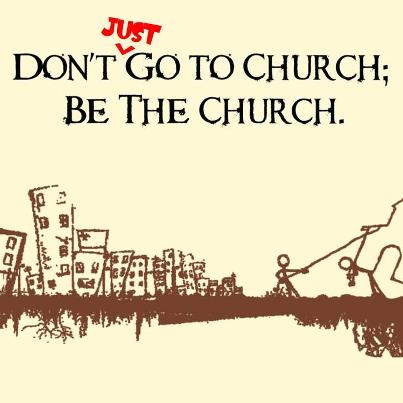
I launched Going Back to Ekklesia a day early because I needed to write this “sequel.” I needed to firm up my commitment to return to fellowship with other Christians and not treat them as an “alien other” that I’m just “visiting” but not actually a part of. If I am to champion the cause of Christianity to those “Christians” I encounter who disdain the name, then I must belong to the group of people, the church, who have faithfully followed the cause of Christ.

I apologize to anyone who I’ve offended by my previous comments, particularly in my hesitation at joining fellowship. I realize now, by seeing the church through another’s eyes, that I was being woefully unfair and unkind. I ask that you accept me as a fellow brother in the faith, though I probably won’t always talk as you’d expect a Christian to express himself (just read my blog posts to see what I mean). If my personal “wall of separation” is to come down, then I’m the one who has to remove it.

I have no illusions that I’m so powerful or smart or cool that my single contribution will be some sort of “big deal,” but if nothing else, I’ll remove any sort of dissonance from my statements and I’ll have something “real” to talk about.

Whatever comes your way today, whatever situation you walk through, you are safe in God’s hands. Any storm that swirls around you swirls around Him. He is your Shield, your Strength, your Rock, your Fortress. Nothing is getting through without His permission. We may not always understand why He allows what He allows, but we can cling to the blessed fact of His everlasting love.


Marie

Giving

Now the full number of those who believed were of one heart and soul, and no one said that any of the things that belonged to him was his own, but they had everything in common. And with great power the apostles were giving their testimony to the resurrection of the Lord Jesus, and great grace was upon them all. There was not a needy person among them, for as many as were owners of lands or houses sold them and brought the proceeds of what was sold and laid it at the apostles’ feet, and it was distributed to each as any had need.

Acts 4:32-35 (ESV)

Communal life was not new to the first century Jews. The Essenses lived in a communal fashion somewhat similar to Luke’s description of the Jerusalem community. The Essenses surrendered property and possessions to the common fund. The disciples’ economic model of common property, shared meals, and communal life might also be compared to the socialist, secular Kibbutz movement in the modern state of Israel.

from Torah Club, Volume 6: Chronicles of the Apostles
Torah Portion Vayera (“And he appeared”) (pg 92)
Commentary on Acts 4:32-5:42
Produced by First Fruits of Zion (FFOZ)

Periodically, religion gets dragged into the political arena (and after all, this is an election year) or it is thrust into such an arena by some of its adherents. Christianity and Judaism are no exceptions, and particularly fundamental Christianity often makes its presence known, for better or for worse, in support or opposition to issues and candidates. On the other hand, there are Christians who use the example of the early Jewish disciples in the passage we see quoted above as an illustration of how we should “redistribute wealth” so that those who have should give to those who do not, creating a balance of sorts, where everyone possesses exactly the same material goods as the next person, with no one having more and no one having less.

I mentioned the concept of “Christian communism” in last week’s study on Acts and suggested that this particular scenario was never meant to be the eternal model of the Christian church. In fact, according to D. Thomas Lancaster’s study on this week’s portion of Acts, this particular type of community was responding to a very specific set of circumstances.

What factors gave rise to the communal economy of the Jerusalem believers? The apostles were all Galileans. None of them owned property in Jerusalem. With them came their families, wives, and children and several more Galilean followers of Yeshua (Jesus). The entire community intended on staying in Jerusalem where they could meet daily in the Temple. The Temple anchored the believing community in Jerusalem. It became their place of assembly and prayer and the central hub from which they proclaimed the gospel. In addition, pilgrims from all over the world, present at Jerusalem for Shavuot, had become disciples. Many elected to relocate to join the community. They were without property or career in Jerusalem. The establishment of the Jerusalem community required a corporate economy. Those relocating to Jerusalem sold their possessions and contributed to the upkeep of the community.

So, taking the specific context into consideration, we don’t particularly see a case where Peter or John cried out, “Hey everybody! Jesus told us sell all our stuff and give it to all the people who don’t have anything!” We also have to keep in mind that all of this giving was totally voluntary. No one was forced to give up all their personal possessions nor was it actually a condition of being part of the community. It was simply a practical consideration, especially for those Jews (and all of the people we’re talking about here are Jewish) who were making “aliyah,” if I can borrow the modern term, and returning to the Land.

But I know you’re thinking about Ananias and Sapphira.

But a man named Ananias, with his wife Sapphira, sold a piece of property, and with his wife’s knowledge he kept back for himself some of the proceeds and brought only a part of it and laid it at the apostles’ feet. But Peter said, “Ananias, why has Satan filled your heart to lie to the Holy Spirit and to keep back for yourself part of the proceeds of the land? While it remained unsold, did it not remain your own? And after it was sold, was it not at your disposal? Why is it that you have contrived this deed in your heart? You have not lied to man but to God.” When Ananias heard these words, he fell down and breathed his last. And great fear came upon all who heard of it. The young men rose and wrapped him up and carried him out and buried him.

After an interval of about three hours his wife came in, not knowing what had happened. And Peter said to her, “Tell me whether you sold the land for so much.” And she said, “Yes, for so much.” But Peter said to her, “How is it that you have agreed together to test the Spirit of the Lord? Behold, the feet of those who have buried your husband are at the door, and they will carry you out.” Immediately she fell down at his feet and breathed her last. When the young men came in they found her dead, and they carried her out and buried her beside her husband. And great fear came upon the whole church and upon all who heard of these things.

Acts 5:1-11 (ESV)

But what was their great crime and why did they die? Was it because they held back some of their wealth from the community? Peter seemed to think it was because they lied to the Holy Spirit. What if they had said, “we are selling our property but are giving only half the proceeds to the community, keeping the other half for ourselves?” Would they have died for being “greedy;” for desiring to keep some of what was rightfully theirs (and Peter acknowledges this)?

Probably not. But Ananias and Sapphira wanted to appear as if they were giving everything to the community when in fact, they kept back some if the profits. They wanted to “look good” and still secretly keep more for themselves. They wanted to have their cake and eat it too, as the saying goes. So it wasn’t greed as such that resulted in their deaths, but greed that lead to lying to God and to the community.

Perhaps the following will help to illustrate what happened and of what sort of economic model the early Jerusalem community was using.

There are four types of people. There’s the man who says, “What’s mine is mine, and what’s yours is yours.” This kind of man is neither good, nor bad, but some say this is the type of person that lived in Sodom. There is the man who says, “What’s mine is yours and what’s yours is mine.” This kind of man is an ignoramus. There is the man who says, “What’s mine is yours and what’s yours is yours.” This is a righteous man. Finally, there is the man that says, “What’s mine is mine, and what’s yours is mine.” This is a wicked man.

m.Avot 5:10

Applying this principle to the Jerusalem community, Lancaster says:

The third expression, “What’s mine is yours and what’s yours is yours,” best expresses our Master’s ideal for His disciples and describes the type of economy practiced by the Jerusalem community. They sold their possessions and goods only to meet the needs of others as those needs arose.

Notice that the focus is not on everyone being compelled to give up everything for the sake of the community, but rather, while you understand the value of giving and hospitality to others, it is not contingent upon the other having the same values as you. You do not demand that the other consider his possessions as yours. You only accept upon yourself the value your possessions also belonging to the other as the other has need of them. (Notice too, that the one who believes that “What’s mine is yours and what’s yours is mine” is considered an ignoramus.)

But again, we need to remember that we are reading here applies specifically to the Jerusalem Community and isn’t necessarily the universal model for what all Christian communities should be like in the world today. There are also other, related principles to keep in mind.

Now we command you, brothers, in the name of our Lord Jesus Christ, that you keep away from any brother who is walking in idleness and not in accord with the tradition that you received from us. For you yourselves know how you ought to imitate us, because we were not idle when we were with you, nor did we eat anyone’s bread without paying for it, but with toil and labor we worked night and day, that we might not be a burden to any of you. It was not because we do not have that right, but to give you in ourselves an example to imitate. For even when we were with you, we would give you this command: If anyone is not willing to work, let him not eat. For we hear that some among you walk in idleness, not busy at work, but busybodies. Now such persons we command and encourage in the Lord Jesus Christ to do their work quietly and to earn their own living.

2 Thessalonians 3:6-12 (ESV)

But if anyone does not provide for his relatives, and especially for members of his household, he has denied the faith and is worse than an unbeliever.

1 Timothy 5:8 (ESV)

As far as Paul’s letters are concerned, we have to be careful to separate out what he intended to be universal principles of the faith vs. specific instructions to those individual churches with particular problems. However as far as the two above-quoted statements, it seems the ideal of being self-supporting and taking care of one’s family first is a good rule of thumb for any Christian. This certainly does not preclude charitable giving, and particularly providing care for the needy, and tzedakah is a long-established mitzvot among the Jews and was taught repeatedly by Jesus. However, none of that suggests we must give to charity before taking care of our families, nor that we should be compelled to give to what others consider a worthy cause at the cost of supporting our families.

But there’s another important example to consider, one presented to us by our own Master.

And he sat down opposite the treasury and watched the people putting money into the offering box. Many rich people put in large sums. And a poor widow came and put in two small copper coins, which make a penny. And he called his disciples to him and said to them, “Truly, I say to you, this poor widow has put in more than all those who are contributing to the offering box. For they all contributed out of their abundance, but she out of her poverty has put in everything she had, all she had to live on.”

Mark 12:41-44 (ESV)

In Judaism, the principle of giving tzedakah does not require that you give yourself into the poorhouse, so to speak, or require that you starve your family for the sake of others, even if those others appear more needy than you. Yet Jesus praises this poor widow who gave all she had to live on to the offering box. I don’t know if this was meant to be taken literally or as a parable to teach a lesson. For instance, the rich gave out of their wealth and thus sacrificed nothing of their own livelihood, so should they be as praiseworthy, giving thousands of dollars (this is just an example) as compared to one who sacrificed all that she had to live on, even though it was only pennies? What it seems Jesus is teaching is not spending yourself into poverty by giving to the poor, but that it is more praiseworthy for the poor to give little and yet have it be a significant impact on their livelihood, than for the rich to give much and to affect them not at all.

The Rebbe and the ChildIt would be like very small child giving everything in her piggy bank to a charity that supports needy children in disadvantaged nations, vs. Bill Gates giving millions to the same charity (although the child, of course, can depend on her parents to provide for her needs).

So what do we see in all of this that applies to Christians today? Christ does not expect us to do without personal possessions or to do away with belongings of our own. It seems the Christian principle of earning your own way and taking care of your own family is an important and even vital one. We are expected to give and give generously to those who are in need (as opposed to those simply in want who can provide for themselves), but Christianity does not require that literally no one has more than another person.

Also, and this is very important, giving is not mandatory and cannot be forced. If you say you are going to give a certain amount or value, then give it and don’t lie, just to be seen as more holy or more like a good guy. On the other hand, if you sell property, for example, and say you will give half the value to charity and keep the other half for yourself, there’s nothing un-Christian about that. Whatever you give, you give out of willingness, not because you were forced or coerced into it, either by your church, or by your government, or by pressure from a “politically correct” social group.

OK, I’m being maybe a little political here, but I’m trying to illustrate a point. Giving and sharing, as far as the Bible is concerned, cannot be defined by a social group, or a cultural value, or a political party, or a government. Charity is between you, those you give to, and God. It cannot be manipulated by any party or entity outside of those involved.

Blessings.

Lech Lecha: The Course of My Spiritual Travels

abrahams-servantIn the course of one’s spiritual travels, a person encounters situations which can only be overcome with a struggle, and which may even cause one to fall. Nevertheless, since all phases of life’s journey are guided by Divine Providence, we must realize that the purpose of every experience is positive. Even when we fall, we are being given an opportunity to borrow an expression from our Sages (Cf. Makkos 8a.) to descend in order to ascend.

Why must a person face such challenges? Two reasons are given:

a) To bring out the power of one’s soul. As long as a person remains untested, he can “get by” without having to tap his core. When, by contrast, one faces a fundamental challenge, it becomes necessary to call upon one’s spiritual resources in order to succeed.

b) In the process of overcoming a challenge, a person recognizes and thus elevates the sparks of G-dliness contained therein. For all existence is maintained by G-d’s creative energy; that energy is hidden within the world’s material substance. As a result of this “hiddeness,” challenges arise. By overcoming these challenges, a human reveals the true G-dly nature of existence.

Avraham’s spiritual journey contained such challenges. Shortly after he entered Eretz Yisrael, he was forced to descend to Egypt, described as “the nakedness of the land.” (Cf. Genesis 42:9, 12.) The very name of the land, mitzrayim, is related to the word meitzarim, meaning “boundaries” or “limitations.” (Torah Or, Va’eira, p. 57b ff.)

And yet even Avraham’s descent brought him blessing. He left Egypt “very rich in cattle, in silver, and gold.” (Genesis 13:2.) Moreover, this wealth came from spiritual effort; Avraham had elevated some of the sparks of G-dliness invested in that country.

-Rabbi Eli Touger
“A Journey To One’s True Self: Avraham’s Odyssey As A Lesson For His Descendants”
Commentary on Torah Portion Lech Lecha; Genesis 12:1-17:27
Chabad.org

Four mornings during the work week, I get up at 4 a.m. and by five, I’m picking up my son David at his place so we can go to the gym together and work out for 60 or 70 minutes before getting ready to commute to our jobs. Although that sounds like a really early hour to go through such exertion, we encourage each other and one of us always helps the other one to do the best we can. Some days are better than others, but we both know that only through hard work can we move toward our goals. David is suffering from a number of physical disabilities he incurred during his service in the Marines, and I’m just plain getting older. We both have our challenges to overcome, but thankfully we don’t have to go the course alone.

As Rabbi Touger’s commentary on this week’s Torah reading teaches, we also encounter a number of spiritual challenges in our lives, all of us. While working out physically is a choice (I could choose to be lazy, eat what I want, become ever larger, and damage the quality of my life as I continue to age), it really isn’t if I want to remain healthy and even to improve my physical condition as I get older. The same goes for spiritual growth.

But if you think getting up at four in the morning just so you can start sweating by five is no fun, imagine making yourself face, not just traditional Bible readings and devotionals, but challenges and conflicts both within yourself and your understanding of God, and outside of yourself in the world of religious dialog (to put it politely). Sometimes, I’d rather face any machine and any exercise I could possibly work with at my gym than spend five minutes wrangling with some “attitude” in the religious blogosphere.

As I mentioned though, those challenges don’t have to be externally driven. I’ve got enough internal challenges to last me for a good, long while. How exactly do the blessings in the Abrahamic covenant bind the Christian to God in covenant relationship? What effect does the New Covenant have on the Abrahamic for a Christian? Why does or doesn’t the Mosaic covenant factor into the line of other covenant blessings for the non-Jews in the church? Other people seem to think the Bible and what is says is a “slam-dunk” as far as what it all means. For me, it’s an endless adventure story wrapped in darkest mystery that has inspired me to the heights of ecstasy and driven me to miserable despair.

A person’s spiritual quest should not be a lonely journey. On the contrary, one of the hallmarks of personal development is an increasing capacity to inspire others. Avraham surely gained such an ability, as our Sages comment (Sotah 10a.) with regard to the verse, (Genesis 21:33.) “And he called in the name of the G-d of the universe”: “Do not read ויקרא (‘And he called’), read ויקריא (‘And he had others call’).”

This concept is also reflected in the changing of his name from Avram to Avraham. (Ibid. 17:5.) Rashi (In his commentary to that verse.) explains that Avram implies merely “father of Aram,” while Avraham alludes to the Hebrew words meaning “father of many nations.” The change implies that Avraham had been given the potential to inspire and influence all the nations of the world to begin striving toward spiritual goals.

“It is not good that..man should be alone.” (Genesis 2:18 ESV) Although Rabbi Touger suggests that the “not alone” part in Abraham’s case, was his ability to teach and to inspire others to call out to God, it implies (for most of us, I think) that we should seek out companionship, not just to inspire them, but so that they can inspire us, much like my son David and I inspire each other. Avraham Avinu was the father of many nations, not just the Hebrews, and according to Paul, this was through his seed.

Now the promises were made to Abraham and to his offspring. It does not say, “And to offsprings,” referring to many, but referring to one, “And to your offspring,” who is Christ.

Galatians 3:16 (ESV)

Paul explains that we Christians too can call Abraham our father because of our relationship with his seed, the Jewish Messiah, Jesus Christ. Jesus was never alone. He was always teaching. He was surrounded by his disciples. He was surrounded by multitudes of those who were desperate. He was the shepherd to the lost sheep of Israel. I can’t recall the source (and a quick Google search doesn’t reveal it), but I seem to remember a principle in some corners of Judaism saying that a teacher will learn as much from his students as they will from him. I don’t know if this could be applied to Jesus, but perhaps it can be to those who came after him.

As one who has taught (albeit in a rather small setting) before, I can certainly say it is true of me.

As you may know from my comments in my Days series, I have been inspired, or maybe challenged is the better word, to seek out a more traditional Christian fellowship venue. This is with the idea that I not only can learn and be supported by my fellow believers, but that I also have something of value to give back. What that is may be apparent to my blog audience, but it remains to be seen if a face-to-face group of Christians will agree.

There’s only so much encouragement I can give and receive via the web. At some point, like Abraham, I must leave, at God’s command, what is familiar and comfortable to proceed into the unknown. Abraham trusted God with everything he had, and it was accounted to him as righteousness. (Genesis 15:6, Romans 4:3) Abraham’s example teaches me that it is not good that I be alone and that risk is part of the “business” of faith and trust in God. Abraham took everything he had, his family, his entire household, and all his possessions, and followed God to a land he never knew.

What a person believes about himself and his abilities is a self-fulfilling prophecy. A person who does not consider himself “important” will not free himself from negative habits.

Believing you are inferior, untalented, unimportant or incapable, influences your abilities. If you view yourself as unable to do things, you will be unable to do them. On the other hand, if you see yourself as talented, capable, and important, your self-concept will open up powers and talents that would have otherwise remained dormant.

Hardly anyone utilizes his entire capabilities. We can accomplish much more than we realize. By raising the perception of your capabilities, you will accomplish more.

-Rabbi Zelig Pliskin
“Daily Lift #618”
Aish.com

A week from today, I begin the first step on a journey into a land that, while not entirely unknown, seems rather alien to me after so many years. One difference is that I don’t take with me everything I have. Certainly my family will not be accompanying me on the journey. Unlike Abraham, I walk alone, with only the promise that it will not always be this way.

Good Shabbos.

Stealing a Conversation About Ephesians, Jesus, and Being a Christian

The big problem in christianity and also messianic judaism is that there seems to be little knowledge on why Yeshua came an what His proclaimed Kingdom of Heaven / Kingdom of G-d meant and what the goal of entity for the Jews really was.

If everyone would see that, than there was not so much competition on to be or to be not Yisrael (though important still) and urge to take the law upon him or herself because of thinking that is the goal.

Did Yeshua come to bring the law? He certainly didn’t come to take it away! But why did he come and what was His message?

-Shmuel haLevi
October 15, 2012 11:52 am
Daily Minyan

This probably won’t be as organized or concise as I’d like it to be, but there was a terrific conversation on Gene Shlomovich’s blog post One-Law Gentile has a change of heart and I wanted to try and preserve some of the more helpful contributions. Most information about the New Testament and the purpose of Jesus in coming “first the Jew and then the Gentile” is interpreted by traditional Christian doctrine, with some “fringy” commentary by “edge case scholars,” so it’s difficult to get a more balanced perspective. I’ve recently been accessing Volume 6 of the Torah Club, which is a study on the book of Acts produced by First Fruits of Zion (FFOZ), to round out my education somewhat, but additional sources are most helpful.

I am attempting to put together the information I’ve gathered from the discussion at Gene’s blog in a way that not only presents it to readers visiting my blog in a meaningful way, but also to help clarify my understanding of some of the New Testament writings from a more Jewish perspective.

Above, Shmuel haLevi brings up an important issue. If the Torah was supposed to be generalized to the entire world as a “universal law” for everyone, and not exclusively to the Jewish nation in all its aspects, why couldn’t Israel have “evangelized” the nations at any time it wanted? Why was Jesus necessary to “spread the Torah” to his non-Jewish disciples, and yet not require that they convert to Judaism?

Unless, of course, the Jewish Messiah commanded his Jewish disciples to bring the nations into discipleship not specifically to turn them into “Jews without a circumcision,” so to speak.

The following is a collection of selected quotes from Gene’s blog post comments section. I’ve provided the links to the original source above so you can see all of the material in context.

That’s an excellent point, Shmuel. If people think that the goal of Yeshua’s coming was to give the Torah to the Gentles, so to speak, then the entire goal of their (our/my) faith will be in “keeping the (mechanics of the) Law” … Alternately, if he came to bring the nations into reconciliation to God and to allow us to become members of the Kingdom as the goal, then our entire focus changes. Love, grace, compassion, mercy all become our focus and the mitzvot of feeding the hungry, visiting the sick, and granting mercy and grace as it has been granted to us becomes the fabric woven into our lives as believers.

-me
October 15, 12:08 pm

…like many others you discovered there were geirim in TaNaCH. And there was the same law for them and for the inborn Yisraelites. But that was not the reason why Yeshua came. The Hebrews had already received the Torath Mosheh and Gentiles were welcome to join, becoming Jews in nationality. So, that could not have been the reason for the coming of the Mashiach. Gentiles already could be righteous, adhering to the Torath for Adam weNoach. That was enough. But if one insisted, felt drawn to join Yisrael and wanting to serve HASHEM in the same way, that was possible but certainly not obliged. Nor is it in the New Covenant.

-Shmuel haLevi
October 15, 5:05 pm

So if a Gentile could convert to Judaism to take on the Torah mitzvot, and if a Gentile could be considered righteous under the covenant God made with Noah, why indeed did Jesus come? Could the secret be somehow concealed with Cornelius the Roman (see Acts 10) as well as Nebuchadnezzer, King of Babylon and the King of the city of Ninevah?

“Every convert in history became part of Israel.” ???

But not every true servant of the Most High became part of Israel.

“Now I, Nebuchadnezzar, praise, exalt and honor the King of heaven, for all His works are true and His ways just, and He is able to humble those who walk in pride.”

Nebuchadnezzar remained King of Babylon.

The city of Nineveh sincerely repented in sackcloth, and remained Assyrian.

The Roman Centurian, who loved Israel, remained Roman.

The uncircumcised listed above were true servants of G-d and did not become part of Israel.

-benkeshet
October 15, 6:31 pm

This may seem kind of disjointed and please remember, I’m “cherry picking” the content to try and “copy and paste” the most relevant pieces of the conversation together, so there are obvious sections of the conversation that have not been included.

Except for Cornelius and his acceptance of discipleship under Jesus that we find at the end of Acts 10, we don’t see an apparent role for Jesus in the above examples. The Kings of Babylon and Ninevah (and in fact, the entire population of Ninevah) were considered “righteous Gentiles” and did not have to join the nation of Israel in any sense in order to be considered righteous. In fact, as we recall from Paul’s letter to the Romans, Abraham was considered righteous by faith before taking on the covenant sign of circumcision. (see Genesis 15:6, Romans 4:3)

But while this is a good argument that a non-Jew doesn’t have to become a Jew or a member of the nation of Israel to attain righteousness, where does Jesus come in?

Paulos said the be the Jews as a Jew, Greeks as a Greek. You cannot come in the same way with the Good Message to the Jews as to the Gentiles. So the way he spoke and the focus in the words of Yeshua before His last instructions where Yisraelite centered.

-Shmuel haLevi
October 16, 3:02 pm

So is there some sort of dual path to righteousness, one for the Jew and one for the Gentile?

…if Paulos meant here that they now became citizens of Yisrael. Also the Yisraelite had not jet reached their destination. Yeshua said, in the house of my Father are many mansions (John 14:2). The resemblance on earth of the Fathers House was the Temple, which had on each side the mansions of the Cohanim – the Priests. This was the promess that Yeshua disclosed since it was done and proclaimed in Shemoth 19:6. According to Yeshayahu 61:6 it would occur in the Messianic age. Making it possible to come to this status, the heavenly Heichal was disclosed for those, the Heichal (Temple) is were the King resides on His throne, so there is were the Kingdom is. That day that the heavenly Heichal will be joined with Yerushalayim, the Kingdom of HASHEM wil be established to rule over all the aerth. But we can chose to be part of it right know and spread the good message that was spread through our Mashiach to Tzion: That their G-d is King (Yeshayahu 52:7).

So it is my question if the focus was to only being brought near to Yisrael, or even something which was not jet reached by Yisrael itself: The Mamlecheth Cohanim – the Kingdom of Priests. This citizenship might be where Paulos pointed at. The higher plan that was promised! We Jews all know that the land of Yisrael is Holy, but Yerushalayim even more, and The Templecourt even more, and Holy place even more and and the Holy of Holies even more. It is because what they represent and are as, connected with it, as in Heaven also on Earth.

-Shmuel haLevi
October 26, 3:36 pm

Now here’s where the role of Jesus comes in for the Gentile.

The focus of Moshiach has always been the entire world.

“3 And many people shall go and say, Come ye, and let us go up to the mountain of the Lord, to the house of the God of Jacob; and he will teach us of his ways, and we will walk in his paths: for out of Zion shall go forth the law, and the word of the Lord from Jerusalem.”

Yeshayahu was speaking of Yeshua Rabbeinu. Yeshua didn’t change plans. His plans are consistent. His plans ALWAYS included the gentiles–even if it appeared as though He didn’t care about the gentiles.”

He came first to the Jews and than the maessage came to the Greeks as prophecied: Yeshayahu 49:3-6.

-Shmuel haLevi
October 16, 3:39 pm

So what we have so far is that Jesus has the focus of the entire world, Jew and Gentile alike, but while (and I’ve alluded to this previously) the Jews were already a covenant people under all of the prior covenants God made with Israel, the rest of the world could not access the same covenant closeness with God except through “Abraham’s seed,” the Messiah. The Messiah, Jesus, is required for the non-Jewish people of the world to come into covenant relationship with God in any way whatsoever!

benkeshet (at October 18, 4:32 pm) delivers an excellent analysis of Ephesians 2 which is too long for me to replicate here in its entirety. However, I’ll quote some of the relevant portions. Here’s a description of the non-Jewish races without Jesus:

And you were dead in the trespasses and sins 2 in which you once walked, following the course of this world, following the prince of the power of the air, the spirit that is now at work in the sons of disobedience—3 among whom we all once lived in othe passions of our flesh, carrying out the desires of the body and the mind, and were by nature children of wrath, like the rest of mankind.

Now here are verses 13-20 with additional emphasis by benkeshet:

13 But now in Messiah Yeshua you who once were far off [as children of wrath] have been brought near by the blood of Messiah. 14 For he himself is our peace, who has made us both [Israel and the Nations] one and has broken down in his flesh the dividing wall of hostility 15 by abolishing the law of commandments expressed in ordinances, that he might create in himself one new man [or one new Humanity] in place of the two [i.e. Israel at enmity with the Nations], so making peace, 16 and might reconcile us both [Israel and the Nations] to God in one body through the cross, thereby killing the hostility. 17 And he came and preached peace to you who were far off [Nations who had been children of wrath] and peace to those who were near [Israel]. 18 For through him we both [Israel and the Nations] have access in one Spirit to the Father. 19 So then you [Nations] are no longer strangers and aliens [or children of wrath], 4 but you are fellow citizens with the saints [Israel] and members of the household of God, [Genesis 22:18 and in your Offspring shall all the Nations of the earth be blessed – i.e. redeeming them from being children of wrath] 20 built on the foundation of the apostles and prophets, Messiah Yeshua himself being the cornerstone…

What we gather here is that Jews and Gentiles are both reconciled to God through Messiah but both groups retain their identity (i.e. Israel and the Nations). The “belonging” that we Gentiles become inserted in is not Israel; that is, we do not become Israel, rather, we become citizens of the Kingdom of God, but Israel is still Israel and the Christians from the nations are still citizens of their respective nations. The only shared citizenship between a Jew and a Christian under Messiah, is citizenship in God’s Kingdom. What Jews and Christians equally share in is that we have “access in one Spirit to the Father” (verse 18).

benkeshet describes it this way:

Israel and the Nations do not lose their distinctiveness. Rather, what was lost was the enmity between them, which has been destroyed by Messiah’s sacrifice. Both Israel and the Nations have access to the Father via ONE SPIRIT because of faith in Messiah.

This is just the best description of the whole “one man out of two” discussion of Ephesians 2 that I’ve read and I especially wanted to share it here. I’m thankful to Gene, Shmuel haLevi, and benkeshet for their contributions to not only the source discussion, but to my personal education.

There is quite a bit more discussion at Gene’s blog so again, please visit it for the entire content. I know I can be accused of “stacking the deck,” so to speak, by presenting only certain fragments of the conversation, but my goal was to illustrate how we can look at portions of the New Testament, and especially Ephesians 2, in a different and more “Jewish” way, to see a clearer picture of how we non-Jews are brought closer to God by Jesus and what that does to the relationship between Christian and Jew. As you can tell, this perspective is a bit different that what you may have been taught, and it’s different than what some people want to believe, but it’s important to at least consider the possibility that the traditional Christian viewpoint on Ephesians 2 isn’t sustainable, given not only modern Biblical scholarship, but a more authentic Jewish interpretation of (the Jewish) Paul’s understanding of the topic at hand.

Shmuel haLevi (October 18, 1:33 pm) re-enforced the citizenship issue.

Yeshu talks frequently of the Kingdom of G-d. That citizenship is Paulos talking about. Both Jews and gentiles have to go into there for the true government.

I have only covered a portion of the full length of the discussion and I could add more, but then this “meditation” would be ridiculously excessive.

I hope I’ve provided enough information to make some of you curious and perhaps even to inspire a few (friendly, please) comments. I’m not trying to steal Gene’s thunder, so to speak, or to rob from his blog (and I received his permission to copy the above-quoted content prior to publishing it), but a lot of very good information is lost in the comments sections of the endless number of blogs on the web, and I wanted some of the key parts of this conversation to survive Internet oblivion.

68 Days: Encouragement

I really, really needed this post today. Sent it to my husband and daughters. The story about Rabbi Schneur Zalman was wonderful. Thank you for writing. You are indeed a benefit to the body.

Blessings!

-Linda in a comment on
one of my blog posts

For God has not destined us for wrath, but to obtain salvation through our Lord Jesus Christ, who died for us so that whether we are awake or asleep we might live with him. Therefore encourage one another and build one another up, just as you are doing.

1 Thessalonians 5:9-11 (ESV)

Sometimes when I’m physically tired and haven’t had enough sleep, I irrationally become discouraged and “bluesy.” I was feeling that way last night, especially after reading some of the more recent and “cranky” responses on Gene Shlomovich’s blog. (Gene’s blog is fine and most of the respondents are too, but not all of them, alas.) This goes along very well with my “Days” series and my countdown to renewal or (virtual) oblivion.

But I’ve been receiving some encouragement. A lot of it is “behind the scenes” but some of it comes in the form of blog comments, such as the one I quoted above. I suppose it’s sort of ironic that I should be encouraged by someone telling me that I’m encouraging them. But isn’t that the point? One of the things I find greatly discouraging is all this bickering on the web between (supposed) brothers in Christ Jesus over who is right and who is wrong, as if this is some sort of twisted form of the recent Presidential debates, and God is the moderator who will decide who wins and who loses.

Really, if God is going to judge us on our actions, I seriously don’t think it will have much to do with our “debates” on all our blogs:

“When the Son of Man comes in his glory, and all the angels with him, then he will sit on his glorious throne. Before him will be gathered all the nations, and he will separate people one from another as a shepherd separates the sheep from the goats. And he will place the sheep on his right, but the goats on the left. Then the King will say to those on his right, ‘Come, you who are blessed by my Father, inherit the kingdom prepared for you from the foundation of the world. For I was hungry and you gave me food, I was thirsty and you gave me drink, I was a stranger and you welcomed me, I was naked and you clothed me, I was sick and you visited me, I was in prison and you came to me.’ Then the righteous will answer him, saying, ‘Lord, when did we see you hungry and feed you, or thirsty and give you drink? And when did we see you a stranger and welcome you, or naked and clothe you? And when did we see you sick or in prison and visit you?’ And the King will answer them, ‘Truly, I say to you, as you did it to one of the least of these my brothers, you did it to me.’

“Then he will say to those on his left, ‘Depart from me, you cursed, into the eternal fire prepared for the devil and his angels. For I was hungry and you gave me no food, I was thirsty and you gave me no drink, I was a stranger and you did not welcome me, naked and you did not clothe me, sick and in prison and you did not visit me.’ Then they also will answer, saying, ‘Lord, when did we see you hungry or thirsty or a stranger or naked or sick or in prison, and did not minister to you?’ Then he will answer them, saying, ‘Truly, I say to you, as you did not do it to one of the least of these, you did not do it to me.’ And these will go away into eternal punishment, but the righteous into eternal life.”

Matthew 25:31-46 (ESV)

I know in the church, we believe that we are saved, not through what we do, but by our faith in Jesus Christ. However, we see that self-same Jesus Christ judging by what we do or fail to do for our fellow human being (and ultimately, for him). I suppose there’s no contradiction here, since if our faith and trust is true and we are actual and authentic disciples of our Master, then our actions following that faith and trust should be almost automatic. We should naturally be found feeding the hungry, visiting the sick, comforting the grieving, extending hospitality to the homeless and lost, and much, much more.

I don’t think we’ll win the race (2 Timothy 4:7) by “winning” a blogosphere argument (and let’s face it, nobody ever changed their minds on the web because of someone else’s devastating argument or piercing witticisms).

So, in writing about what I always write about, that is, whatever’s on my mind and heart at the time, I managed, through God’s grace, to encourage another believer traveling her own path of faith. Fingers pressing keys on a keyboard, and electrons zipping across the Internet managed to communicate the will and kindness of God from one human being to another. How could I not feel honored that my small “service” has been accepted as it was intended?

But I truly believe that those who really have “fought the good fight, finished the race, and kept the faith” probably don’t even know how to create a blog, let alone have the time to write on one. They’re too busy feeding the poor, clothing the naked, making sure the homeless have shelter, opening their homes to the needy, and doing a thousand other things that serve God and provide His generosity to the very least of His servants.

I’m glad, in the middle of my own meager efforts, that I was able to encourage one human being. Thank you Linda, and everyone else who has commented kindly to me, for continuing to encourage me as well. For that’s what our Master, and Paul, his Apostle to the nations, have commanded us to do.

A new commandment I give to you, that you love one another: just as I have loved you, you also are to love one another. By this all people will know that you are my disciples, if you have love for one another.”

John 13:34-35 (ESV)

Community Snapshot: Lessons from Acts 2:42-4:31

Now Peter and John were going up to the temple at the hour of prayer, the ninth hour.

Acts 3:1 (ESV)

At Caesarea there was a man named Cornelius, a centurion of what was known as the Italian Cohort, a devout man who feared God with all his household, gave alms generously to the people, and prayed continually to God. About the ninth hour of the day he saw clearly in a vision an angel of God come in and say to him, “Cornelius.”

Acts 10:1-3 (ESV)

The disciples devoted themselves to “the prayers.” “Luke’s reference to ‘prayers’ rather than to prayer per se here may indicate observance of regular prayer times in the Temple – as well as the community’s own prayers.” (see Le Cornu and Shulam, “A Commentary on the Jewish Roots of Acts: Acts 1-15, 147.”) Most English versions obscure the meaning by not transmitting the definite article. The Greek says that they devoted themselves to “the prayers (tais proseuchais).”

“The prayers” should be understood in keeping with the common liturgical, daily prayers of Judaism, the synagogue, and the Temple. Six verses later, Luke depicts Simon Peter and John “going up to the temple at the ninth hour, the hour of prayer” (Acts 3:1).

This does not mean that early believers prayed out of a Siddur. Prayer books did not yet exist. It only implies that they prayed in concert with other Jewish people, following the same forms, conventions, modes, and times of prayer as the rest of the Jewish world. Their faith in Yeshua (Jesus) did not change their mode of worship. Their faith made their worship more intense and ardent.

Torah Club, Volume 6: Chronicles of the Apostles
from First Fruits of Zion (FFOZ)
Torah Portion Lech Lecha (“Go forth”) (pg 63)
Commentary on Acts 2:42-4:31

In my previous meditation about the Torah Club commentary on Acts, I tried to explain a couple of things. Based on Acts 2, I illustrated that those who were at the Shavuot (Pentecost) festival, and the 3,000 who received the Holy Spirit in Christ’s name, were all Jewish. Coupling what we read in Acts 2 with this week’s study of Acts 2:42-4:31, we can see that the very early days of “Christianity” with Peter and John in Jerusalem involved a completely Jewish religious community. In fact, this portion of Acts is devoted to the description of the early Jewish disciples of the Jewish Messiah in the weeks and months after his ascension.

I’m choosing to focus on that aspect of Jewish community involving “the prayers” for a couple of reasons. One is the obvious point that nothing about the practice of the Jewish disciples changed in the slightest because they were disciples of the Jewish Jesus. They still observed “the prayers” at the set times for prayer. They prayed together with other Jews, both disciples of the Master and any others who had gathered together, seemingly in the part of the Jerusalem Temple known as Solomon’s Portico.

However, you will notice that I again insert something from Acts 10 about the Roman Centurion Cornelius, the God-fearer, who at the beginning of that chapter, had not yet received the Christ; the Messiah, as Lord and Savior. And yet, he was praying at the ninth hour which was “the hour of prayer,” just as the Jews did, including Peter and John.

I also said in my previous missive that the non-Jewish God-fearers and later, the non-Jewish disciples of Jesus indeed took on some (or many) of the Jewish religious practices in order to imitate their mentors and in fact, at that point in history, the “Jewish model” for worshiping God was the only model available. This didn’t make Cornelius or any of the Gentile disciples suddenly Jewish or automatically obligated to a full Jewish lifestyle (otherwise, Paul wouldn’t have thrown such a “temper tantrum” in Galatians 5:1-5). However, it does mean that “Christian” worship looked a lot more Jewish, even after the first non-Jews began to be admitted as disciples, than we could ever imagine it being today.

I suppose that I’ll have a lot more material on Cornelius and the first non-Jewish “Christians” when I actually arrive at the Torah Club’s commentary on Acts 10 (which won’t happen for another six weeks or so) but I want to point out, for those of you reading this who may not already know, the discipleship under Jesus Christ for the early Jewish and Gentile believers did not entail some abrupt demarcation from what otherwise was considered “normal” Jewish religious practice. As D. Thomas Lancaster points out in this week’s study (pp. 61-62):

Notice that each of the four devotions (The Apostles’ Teaching, Fellowship, Breaking of Bread, and the Prayers) are hallmarks of Jewish practice. The new community that formed around the disciples of Yeshua did not adopt new customs or innovations that could be considered particularly Christian and distinct from Judaism. Instead, they devoted themselves to the same pursuits that might characterize any Jewish faith community. Today’s churches and communities of faith would look more like messianic synagogues if we committed ourselves to the four devotions of study, community, hospitality, and liturgy.

That recalls a question I asked not too long ago. Do Christians Practice Judaism? As we understand the concepts today, the answer must be “no.” However, as the “Messianic faith” began as a wholly Jewish expression of discipleship under the Master, what were the very first Gentiles doing when they were brought into discipleship with the Jews? For that matter, what did Cornelius think he was doing when he, as a God-fearer, prayed at the ninth hour and (presumably, though we can’t know for sure) gathered with the Jews in synagogue on Shabbat? Practicing Judaism?

Well, probably not, anymore than a modern-day Noahide could be said to be practicing Judaism by davening with Jews in a synagogue on Shabbat. But is the relationship between a Noahide and a Jew in the 21st century the same as that of a “Messianic” Jew and non-Jew in the mid-1st century? Noahides generally see themselves as bound by the covenant of Noah (see Genesis 9), while Jews claim the Abrahamic, Mosaic, and New Covenants, so strictly speaking, they are unlike members of God’s community, attached to God by different covenants.

I’ve said before that I believe we Christians have a relationship with God due to certain blessings included in the Abrahamic and New Covenants but that we are not attached to all of the same conditions within those covenants. Further, it is my belief (because there’s no evidence directly involving non-Jews) that we are not recipients of any blessings from the Mosaic covenant, which more than any of the other covenants, specifically identifies the Jewish people as a unique covenant people, even within the Messianic community of the 1st century and of the budding Messianic Jewish community of the 21st century.

But let’s wind back to the very early chapters of Acts again and take a look at the community as it existed after that first fateful Shavuot when the Spirit was given.

And they devoted themselves to the apostles’ teaching and the fellowship, to the breaking of bread and the prayers. And awe came upon every soul, and many wonders and signs were being done through the apostles. And all who believed were together and had all things in common. And they were selling their possessions and belongings and distributing the proceeds to all, as any had need. And day by day, attending the temple together and breaking bread in their homes, they received their food with glad and generous hearts, praising God and having favor with all the people. And the Lord added to their number day by day those who were being saved.

Acts 2:42-47 (ESV)

Here we see some of what Lancaster called “the devotions,” namely teaching/studying and fellowship through breaking of bread (which is just as it sounds, eating together, rather than some special sacrament). This passage is also sometimes referred to as “Christian Communism,” since everyone “re-distributed wealth” so that everyone shared everything. This brings up a point I want to make, not only about this passage but about the larger issue of community.

There are some who would isolate this part of the second chapter of Acts and say it’s the only way a Christian community should be run, and if any other Christians are “hoarding” material wealth for themselves through private ownership of a car, house, and so on, they are in violation of their Christian faith.

But we’re only talking about five verses in a single chapter of the Bible. Who develops an entire theology and Christian lifestyle based on a tiny handful of verses taken out of context?

Actually, quite a lot of people. I tend to think of Christians and Christian groups who insist on cherry picking verses to fit some arcane theology as “on the fringe” and I hope they are indeed in the minority, because it’s a dangerous practice. Focusing on just little bits and pieces of the Bible in an attempt to justify a “pet theology” and then to “sell” it to a wider audience as some form of “scholarship” is not only dishonest but potentially misleading to people who may actually believe it for lack of any better insights on their part.

Let’s take another example from Lancaster’s commentary. He defines the early Jewish Messianic community in terms of the larger context of 1st century Judaism in Jerusalem and Roman occupied Palestine. Let’s keep in mind that there was no one, monolithic Judaism then, anymore than there is one now (that goes for Christianity too, by the way). There were differing sects of Judaism and the sect that became known as “the Way” was what we see as the early Jewish disciples of Jesus in the beginning chapters of Acts. They were Jewish. They behaved in a way that was considered acceptable relative to Jewish religious and lifestyle practices. Except for their insistence that the man from Nazareth named Yeshua was indeed the Messiah, and that he was unjustly executed and three days later, rose from the dead, their Jewish lives and teachings wouldn’t have raised an eyebrow from any other Jew in the Holy Land.

Can we take a “snapshot” of their lives as we see them lived out in Acts 2 and 3 and say that’s how we Christians should live today? Is it any more valid to say that than to say that we must live a Christian lifestyle that exactly mirrors Acts 2:42-47? Probably not. It fails to take a great deal into consideration.

If the 1st century Jewish disciples of Jesus lived a lifestyle that was completely consistent with their Jewish peers and their surrounding Jewish culture, does that translate into a bunch of non-Jewish Christians in the 21st century doing the same thing? Remember, for the most part, Peter, John, and the rest of the disciples didn’t appear particularly unusual as they prayed at the ninth our in Solomon’s Portico. They didn’t appear particularly unusual as they met together to study the teachings of their Master. They didn’t appear particularly unusual when they met together for communal meals. Lots and lots of different groups of Jewish disciples of one Rabbi or another behaved in very similar ways.

But that wouldn’t necessarily translate to Christians twenty centuries later any more than it would translate to modern Jews. Our situations have changed drastically and on top of that, we don’t have a complete picture of what the early Messianic Jewish communities looked like. We can extrapolate based on whatever knowledge we possess of wider Jewish practices in the late Second Temple era, but we have even less knowledge of “normal” Christian practices among the newly minted Gentile disciples post-Acts 10. How could we ever figure out, assuming our goal was to imitate some portion of 1st century worship behaviors, how to replicate what that community (or those communities if we assume that once early non-Jewish churches were founded, their practices began to vary from those of the Jewish disciples in the synagogues) did way back in the first weeks, months, and years after the ascension of Jesus?

We can’t, at least not to a high degree of reliability and detail. What we can do is take what we understand of some of the general principles we see lived out and match them up with some of Christ’s teachings within a larger Biblical context and figure out some foundational points with which to connect.

Meeting together? Don’t we do that now? Don’t we have churches? Don’t we have home Bible studies? Don’t we serve food and eat together? Don’t we study together? Don’t we pray together?

Didn’t I just cover Lancaster’s four devotions in the previous paragraph?

Nothing in what we’ve seen in the first chapters of Acts necessarily tells us that the Gentile disciples (who didn’t exist during that time frame) where to behave exactly like their Jewish counterparts. It does tell us that the early Jewish disciples behaved very consistently with the Jewish religious and cultural practices in which they lived. Those Jews believed Jesus Christ was the Messiah and yet there was nothing at all to say that they ever stopped being Jews, stopped making sacrifices at the Temple, stopped celebrating the traditional festivals, stopped keeping kosher, stopped observing the Shabbat, stopped…you know what I’m getting at.

In the days when the Second Temple still stood and after the ascension of Christ, there was nothing to show us that the so-called “Jewish Christians” stopped being Jewish and started being “Christian” as we understand the term today.

But while I’m content to table what the later (from an Acts 3 point of view) Gentile disciples were supposed to do within what appears to be a wholly Jewish religious arena (I know I just left this question hanging, but I’ll pick it up again in subsequent studies of Acts via Torah Club), can we say that if the ancient Jewish disciples of the Master lived completely Jewish lifestyles and those lifestyles were totally consistent with their discipleship under Jesus Christ, could the same be true for the modern Jewish disciples of the Jewish Messiah?

Most of my regular readers (the ones who typically comment, anyway), already know that answer. But some of you, especially if you’re just surfing in here, may be a bit surprised. Food for thought.