Tag Archives: Jesus

The Lord’s Sabbath

ShabbatQuestion: According to Jewish Law and tradition, is it acceptable, discouraged or totally unacceptable for a Gentile to keep the Sabbath according to the regulations spelled out in the Torah and the Talmud and expounded upon by the Rabbis?

Answer: A non Jew is not allowed to keep Shabbos. Those that are in the process of converting make sure to do at least one thing on Shabbos that would normally not be allowed. For example they might carry something in their pocket.

The quotes above are part of a discussion group thread at judaism.stackexchange.com (and thanks to Judah Himango of the Kineti L’Tziyon blogspot for posting the link on his Facebook page). As you can see if you follow the conversation, it is generally discouraged for a non-Jew, Christian or otherwise, to attempt to observe the Shabbat in the same manner (if at all) as a Jew. The observations are apparently from the perspective of Orthodox Judaism, so Conservative and Reform Jews may have a somewhat more lenient viewpoint, nevertheless, the Shabbat is generally reserved for the Jewish people.

This doesn’t really upset most Christians since the Saturday Sabbath, as with most other aspects of “the Law,” was deemed done away with. While Christians generally worship on Sunday, it’s not really considered a “Sabbath” in the church, based on Pauls’ statement in Romans 14:5-6:

One person considers one day more sacred than another; another considers every day alike. Each of them should be fully convinced in their own mind. Whoever regards one day as special does so to the Lord.

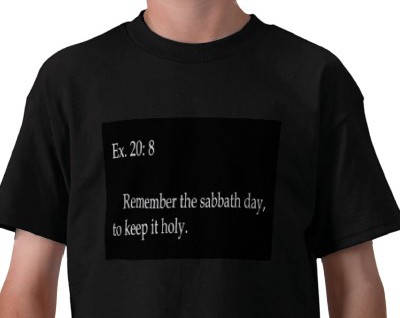
This effectively obliterates the fourth commandment to “Remember the Sabbath day by keeping it holy” for Ten Commandments believing Christians, but apparently, that can’t be helped. The result is that the vast majority of both Christians and Jews believe that Shabbat observance cannot and should not be applied to Gentiles and that is that.

Almost.

There is actually a lot of conversation going on in various circles about Gentles and the Shabbat, even as we’ve seen at judaism.stackexchange.com. In actuality, it doesn’t seem totally forbidden for a non-Jew to keep the Shabbat, they just can’t keep it in a way that is consistent with religious Judaism. AskNoah.org, a site created within an Orthdox Jewish context and dedicated to serving Noahides (righteous Gentiles), has this to say.

Question: I’ve been told that a Noahide must “mark” the Sabbath in some way. Could you give me examples of ways to mark Sabbath in the manner of a Noahide?

Answer: A Noahide is allowed to mark the seventh-day Sabbath in some types of ways. But there must not be a belief or conviction that he or she has – or is allowed to take on as a Gentile – any religious obligation to rest from all productive activity on the Seventh Day, or on any other day. (Although indeed, there must be an intellectual recognition that G-d assigns a special quality to the Seventh Day, since that is part of the Torah of Truth).

The answer continues by providing a number of suggestions for the Noahide as far as “marking” the Shabbat, but such marking must be done without making a vow of any kind in relation with the Shabbat, and with the understanding that “marking” the Shabbat is totally voluntary.

The world of Messianic Judaism, as seen from the point of view of Jews who accept discipleship under Jesus (Yeshua) as the Jewish Messiah, take a similar point of view. We can see one such illustration in a recent comment Derek Leman made in response to something I said on one of his blog posts at Messianic Jewish Musings:

So, I think a Divine Invitation exists for non-Jews. I don’t think (and the apostles didn’t think) it is a Divine Obligation.

My advice for non-Jews keeping Shabbat: learn the traditional prayers and songs. Make some modifications in parts where the wording is about God’s special relationship with Israel. Someone ought to make a Shabbat Seder (the Friday night prayers) for non-Jews which respects the wording of special relationship between God and Israel and pictures non-Jews coming into the sign between God and Israel as co-participants (not replacements, see Exod 31:13).

Shabbat candlesI’ve often said that I believe non-Jews who wish to honor God as sovereign Creator may do so based on Genesis 2:3, but AskNoah.org has a response for that as well:

Although it says in Genesis 2:1-3 that G-d designated the Seventh Day as holy and sanctified, don’t forget the basic principle that G-d did not limit Torah to always be a *chronological* account of events. In fact, G-d first dictated the book of Genesis to Moses shortly after the Israelites arrived at Mount Sinai. The first time there was any commandment about a special observance of a “Sabbath” was after the Israelites passed through the sea on dry land. When they ran out of the matzah they took out of Egypt, G-d provided them with mannah as food from Heaven. But no mannah fell on the Seventh Day. G-d instead provided a miraculous double portion on Friday afternoon, and He commanded the Israelites to remain in their camp on the Seventh Day. Moses explained to them that they were, from that time on, commanded to observe the Seventh Day as a day of rest and a holy Sabbath (Exodus 16:23). Thus, at the first mention of the Seventh Day in the text of Genesis, G-d told Moses to insert the information that He had blessed the Seventh Day (referring to the double portion of mannah that fell on Friday afternoon for the Israelites), and He made it holy (when He prohibited the Israelites from leaving their camp on that day).

It is true that in Judaism, the chronology of the writing and the order of events of and in the Torah aren’t considered to be strictly literal, so the authority answering the question about Genesis 2:1-3 may have a point. On the other hand, if we assume that there is a chronology to God’s creating the earth and that He actually “blessed the seventh day and made it holy,” relatively “soon” after He created the globe upon which we live, then the holiness of the Shabbat could precede the Sinai event by many hundreds or even thousands of years (or more).

Then we have another scripture which provides some illumination.

“And the foreigners who join themselves to the LORD,
to minister to him, to love the name of the LORD,
and to be his servants,
everyone who keeps the Sabbath and does not profane it,
and holds fast my covenant—
these I will bring to my holy mountain,
and make them joyful in my house of prayer;
their burnt offerings and their sacrifices
will be accepted on my altar;
for my house shall be called a house of prayer
for all peoples.”
The Lord GOD,
who gathers the outcasts of Israel, declares,
“I will gather yet others to him
besides those already gathered.” –Isaiah 56:6-8 (ESV)

This is very difficult to get around. While not a commandment, it certainly suggests that “foreigners” (non-Hebrews) not only may observe the Shabbat, but will derive some direct benefit for doing so, namely being brought to God’s “holy mountain”, which is probably the Holy Temple in Jerusalem, and having our offerings accepted by God in the Temple (and AskNoah.org does state that Gentiles will be able to worship at the Third Temple). Even the Master quotes the prophet Isaiah when he cries out that “‘My house will be called a house of prayer,’ but you are making it ‘a den of robbers” (Matthew 21:13).

I suppose Christians could say that the words of the prophet Isaiah were annulled when the Law was “nailed to the cross with Jesus”, but that hardly explains why Christ would quote prophetic words that would soon lose their power. Such a view also suggests that God’s Word is not eternal, so we have another puzzle when considering a traditionally Christian interpretation of scripture.

But if “Jewish” Shabbat observance is considered both by Christianity and by Judaism to be a dead issue for the Gentiles, why should the few of us who are not Jewish but who are drawn to the Shabbat care? Well, because we’re drawn and for whatever reason, God has written upon our hearts a desire to hold the seventh day as sacred.
As I’ve mentioned elsewhere, I don’t think Judaism has much to worry about as far as Christian or “Messianic Gentile” Shabbat observance goes. I’ve never met a person who was not Jewish who kept the Shabbat with anywhere near the level of sanctity and detail as an Orthodox Jew, so it can be truly said that we “mark” the Shabbat without ever actually “keeping it holy,” at least to the measure of accepted Jewish halachah.

But what does God think of the disciples of Jesus keeping the Shabbat? Even if we are not commanded, are we allowed and is our rest pleasing to Him? Or was that last question moot?

Then he said to them, “The Sabbath was made for man, not man for the Sabbath. So the Son of Man is Lord even of the Sabbath.” –Mark 2:27-28

If the Savior and Messiah is Lord of the Shabbat, what does that mean for we non-Jews who are his disciples?

The Embarrassing Murder

On today’s amud we find a decree was instituted to avoid publicly embarrassing a fellow Jew.

Many are unaware that Rav Chaim Kaplan, zt”l, was the son-in-law of the famous mashgiach, Rav Yeruchem Levovitz, zt”l. As can well be imagined, Rav Kaplan was a baal mussar in the full sense of the word.

One time, Rav Kaplan’s student, Rav Waxman, saw him crying his eyes out, obviously absolutely devastated. This was a very shocking sight since it was a regular day in the beis medrash and the young man had not heard that any tragedy had occurred. The student approached Rav Kaplan and asked him what was bothering him, but the latter was so heartbroken that it was a while before he could answer. When the student inquired a second time, the rav tearfully asked him to bring a gemara Bava Metzia.

When the young man brought it from the shelf, the rav opened to the sugya in Hazahav that discusses the seriousness of embarrassing a fellow Jew in public. He concluded with the statement on daf 59 that one should throw himself into fiery furnace instead of publicly embarrassing another, which we learn from Tamar.

“We see from here that embarrassing another is compared to murder,” Rav Kaplan said sadly. “Imagine you were here in this beis midrash in the middle of seder when one young man pulled out a gun in front of everyone and shot his fellow student in the heart. Surely, anyone with a drop of human feeling would be unable to hold back from crying bitter tears after witnessing such a tragedy! After I witness one young man approach a fellow student and publicly shame him, is it any wonder that I cry? It is a wonder how a person could fail to cry!?”

Mishna Berura Yomi Digest
Stories to Share
“A Tragedy in the Beis Medrash”
Siman 139, Seif 1-3

I periodically receive a little criticism for suggesting that the Talmud and various Rabbinic commentaries are appropriate lenses by which to view the teachings of Christ and my faith in Jesus. For example, we see above that for one Jew to embarrass another in public is compared with the act of murder. In this tale’s rather dramatic telling, Rav Kaplan is seen to be crying uncontrollably, as if he had witnessed a horrible act of violence, after seeing one student in the beis midrash publicly shame another. Whether this event actually took place or not, can we really say that embarrassing someone in public is the same as pulling out a gun and shooting them? Can we find anything that Jesus taught that can even approach this?

“If your brother sins against you, go and tell him his fault, between you and him alone. If he listens to you, you have gained your brother. But if he does not listen, take one or two others along with you, that every charge may be established by the evidence of two or three witnesses. If he refuses to listen to them, tell it to the congregation. And if he refuses to listen even to the congregation, let him be to you as a pagan and a tax collector. –Matthew 18:15-17

You’ve probably heard this before, but the reason you have to go through such a lengthy set of steps in confronting the brother who has sinned against you, is to avoid embarrassing him. You approach him alone first, so the nature of his sin and the confrontation is just between the two of you. If he repents, then no one else is the wiser and no one has to be embarrassed. If that’s not effective, then you next approach your brother with just two or three witnesses. Again, the information is contained and only a few people have to become aware of the incident. Only if the sinner doesn’t repent are you compelled to bring the matter before the entire congregation, thus causing your brother embarrassment which, at this point, is probably unavoidable.

While Jesus doesn’t say embarrassing your fellow is like killing him, he obviously felt that embarrassing someone was a serious matter and should not be taken lightly. Jesus also said this:

“You have heard that it was said, ‘You shall not commit adultery.’ But I say to you that everyone who looks at a woman with lustful intent has already committed adultery with her in his heart. –Matthew 5:27-29

Now is looking at a woman and having lustful thoughts about her really the exact same thing as actually having sexual relations with her? After all, the former is not a physical act, it’s just a thought and perhaps a feeling. Maybe you fantasize about what it would be like to have “relations”, but nothing actually happens. The latter requires that you arrange to enter into a relationship with her, at least enough of one to be able to get together with her alone and have actual, physical sex.

And yet Jesus said they were the same. So can’t publicly embarrassing someone be the same as actually killing the person, in the eyes of God?

I don’t have God’s point of view, so I can’t say that He equates embarrassment to death (although many human beings have felt so embarrassed that they wanted to crawl under a rock and die, euphemistically speaking), but if we take Christ’s teaching to heart and reflect back upon the tale of Rav Kaplan, perhaps we should act as if it’s that important a matter.

Could it hurt?

The Focus and the Lens

The Sichos HaRan, zt”l, explains how fortunate we are to have received the Torah. “Non-Jews who did not receive the Torah have no idea how to act. A non-Jew who wants to discover the meaning of life must search for the truth and has very little chance of finding it. Jews are very fortunate, since God gave us the Torah which reveals exactly how we should act in any given situation. We can focus all of our energies on fulfilling the Torah instead of squandering them in an attempt to determine what to do.”

Daf Yomi Digest
Stories Off the Daf
“God’s Charity”
Arachin 8

I have a difficult time understanding how the Sichos HaRan, zt”l can make such a statement and yet still call God charitable. After all, is God not the God of the Jew and the non-Jew alike? He makes it sound as if God left the Gentile people of the nations “hanging out to dry,” so to speak. In fact, even from a traditional Jewish point of view, it’s not that way at all.

Most religious Jews believe that God gave “the rest of us” the Seven Noahide Commandments which guide us along a path of Godly living. Of course, when you compare a mere seven laws to the 613 commandments that Jews believe comprise the Torah, it’s easy to believe that the Gentiles got the short end of the stick. After all, as the “story off the daf” points out, the level of detail in the Torah commandments, describe for the Jew “exactly how we should act in any given situation.” That’s not literally true of the written portion of the Torah, but once you factor in the Mishnah, Talmud, and Gemara, an astounding and even overwhelming amount of information is provided about every conceivable situation in which a Jew may find himself.

Even if you believe that the seven Noahide laws can be expanded out to 80 or 90 more detailed commentaries, it still seems like we don’t have nearly the same amount of Heavenly direction given to us as the Jewish people enjoy. If you’re an atheist, you probably couldn’t care less, and enjoy the type of freedom a secular world view provides. If you’re a traditional Christian, this only confirms what you’ve been taught about the freedom that the grace of Jesus Christ offers, and how the “chains” of the Law can no longer hold you (not that they ever applied to you in the first place).

Yet, as I have been reminded recently, for a number of Christians, the “grace of Christ” doesn’t seem to be enough. There’s a sort of “emptiness” some people feel in the church, as if a man starving for meat and potatoes is given only a can of soda pop for lunch. Lots of “fizz” but no substance. For these Christians, the substance seems to be found in Judaism and among some of these folks, Judaism becomes the focus, leaving God and faith in the Messiah in the dust.

I’m a Christian who, as you know if you’ve been following this blog for very long, chooses to view my faith in Christ through a Jewish lens (if such a thing is possible). However, it took me years to be able to distinguish the lens from the focus of the lens. The lens is the means by which I look at the Messiah and gaze at the image of God. The focus is the Messiah who leads me on the path of righteousness to the God of Abraham, Isaac, and Jacob. It’s important not to confuse the two.

I sometimes think even people in the traditional church suffer from this confusion. The theology, the music, the church programs, and even grace, all seem to substitute for the substance of God. Maybe that’s why people leave Christianity and either apostate completely or seek some aspect of Judaism onto which they can attach. However, since this type of confusion can strike at the Christian either in the church or in the synagogue, it’s not the religion that’s the problem, it’s the people. More specifically, it’s how people understand what they have faith in. Do you have faith in Christianity or in God? Do you have faith in Judaism or in God? Who or what do you worship and why? Do you even know if you are worshiping a thing rather than the Creator of the universe?

I’ve seen non-Jews in “Messianic” or Hebrew Roots groups who became totally enamoured with wearing a tallit gadol and kippah, praying with a siddur, and learning Hebrew. Nothing is necessarily wrong with using holy objects in the practice of your faith, but there is something terribly wrong if you wake up one morning and realize that its the objects you’re really worshiping. It’s even worse if you are worshiping the objects and never actually realize it.

There are non-Jews including some Christians, who convert to Judaism for various reasons and I am not here to question those decisions. However, I am concerned with those Christians who, in seeking the Jewish Jesus in the synagogue, lose sight of him completely, and convert because they have started worshiping Jewishness.

Any Christian who is worshiping and studying in a Jewish venue needs to periodically take one giant step backward and examine what they are doing and why. If you know your eyes need to be on the Messiah at all times but his “image” is becoming increasingly fuzzy, you may have allowed something to get in between you and him. If your lens has become your focus, stop everything, take a break, and get some fresh air. A life of study contains many details and a great deal of information, but at its core, a life of holiness is not complicated. It’s a simple as praying and can easily begin with the words, “Our Father Who is in Heaven…”

Never forget who you are and who He is to you.

Va’eira: Peace in the Valley of Landru

When the Torah names a place, the name describes not only a geographic location, but also a state of mind, and a spiritual set of circumstances. In this context, Mitzrayim, the Hebrew name for Egypt, serves as a paradigm, teaching us what exile is, and demonstrating the essence of the spiritual challenge which our people have confronted throughout history.

Mitzrayim relates to the Hebrew word meitzarim, meaning “boundaries,” or “limitations.” Material existence confines and limits the expression of G-dliness in the world at large, and the expression of the G-dly spark within our souls. This is exile, an unnatural state. For the true reality that the world was created to be a dwelling for G-d, and that a person’s soul is an actual part of G-d is concealed. In such a setting, a person becomes absorbed in the daily routine of his life. Spiritual values if he considers them at all are interpreted according to his own world view.

Moreover, exile naturally perpetuates itself. Our Sages relate that not one slave could escape from Egypt. Similarly, any setting in which a person lives creates an inertia that resists change. To borrow an expression from our Sages: “A person in fetters cannot set himself free.” Since every person’s thought processes are today shaped by the environment of exile, many find it difficult to see beyond that setting.

-Rabbi Eli Touger
In the Garden of Torah
“Seeing and Believing”
Commentary on Torah Portion Va’eira
Adapted from
Likkutei Sichos, Vol. XVI, p. 52ff; Vol. XXXI, p. 25ff;
Sichos Shabbos Parshas Va’eira, 5743;
and Sichos Chof-Vav Nissan, 5751
Chabad.org

Have you ever wondered how Aaron, the brother of Moses, was able to escape the land of Egypt in order to join his brother in Midian (Exodus 4:14)? After all, Aaron was a slave. Certainly there were people watching him while he toiled under his harsh labors. Certainly there were guards at the border of Egypt to make sure slaves didn’t just wander out. Moses had a very difficult time escaping and was almost killed in the process. How did Aaron leave with such apparent ease?

I don’t know if the slavery of Israel in Egypt is the way Rabbi Touger explains. After all, we see in this week’s Torah Portion that Moses and Aaron tried time and again to get Pharaoh, king of Egypt to release Israel, and time and again, Pharaoh refused, even after temporarily agreeing in order to end each plague. If Israel had basically enslaved themselves through their own limited spiritual awareness, why couldn’t they free themselves by just getting up and walking out? It would have been pretty difficult for even the entire army of Egypt to stop two or three million people if they decided to do something in a united fashion.

OK, Rabbi Touger’s analysis is more midrash and metaphor than historical fact, but it does teach us something about the nature of exile, slavery, and human nature. Often, we can be “enslaved” to something that is extremely unpleasant and even damaging and we beg God to release us from our captivity. Yet all the while, it is within our power to release ourselves. All we have to do is become aware of our freedom of spirit, take off our chains, stand up, and walk out of the “land of Egypt.”

But is it that easy? Rabbi Touger doesn’t seem to think so.

And yet, although man may not be able to free himself, G-d refuses to allow exile to continue indefinitely. The first step of redemption is a direct revelation of G-dliness. Since the fundamental characteristic of exile is the concealment of G-d’s presence, the nullification of exile involves a clearer revelation of G-dliness. This will shake people out of their self-absorption and open them to spiritual awareness.

This is the message of “Parshas Va’eira”. “Va’eira” means “And I revealed Myself.” The root of Va’eira is the word “re’iyah”, meaning “sight.” Va’eira refers to something that can be seen directly. This theme is continued throughout the Torah reading, which describes seven of the ten plagues open miracles which had a twofold purpose, as the Torah states: “I will display My power,… I will bring forth My hosts from Egypt…. And Egypt will know that I am G-d.”

So, it’s not that easy but we do have a roadmap in the realization of a revealed God. We can’t free ourselves from our own exile in “the land of sin,” but fortunately, God is not willing to allow us to suffer indefinitely. He will intervene on our behalf, sometimes even when we don’t want Him to. We may want to stay in our sin, in our specific problems, in our booze, in our drugs, in our depression, in our anger and frustration, maybe because we’ve lost hope. It’s at those times when God will come in and shake up our “status quo” and we might not feel too comfortable about it. While the plagues were aimed at Pharaoh and the Egyptians, what were the Israelites feeling? While they didn’t suffer the consequences of the plagues, were they worried about what would happen to them next? We see in future parts of the Torah how the Israelites, when encountering challenges along the road to Israel, rebelled against God and even longed to return to Egypt, as if slavery were better than freedom.

The rabble with them began to crave other food, and again the Israelites started wailing and said, “If only we had meat to eat! We remember the fish we ate in Egypt at no cost—also the cucumbers, melons, leeks, onions and garlic. –Numbers 11:4-5

Was the food given to slaves really so superior to what they got from God, or were they really having a difficult time separating themselves from a lifetime of servitude and the “comfort” of having Egyptian masters? It’s hard to imagine, but sometimes people who have been in prison for many years, once released, will commit a crime, just to go back to the relative “security” of the penal system. A person who has turned to God and found freedom from sin and degradation may abandon a life of holiness and return to their former world, even though they know they’ll suffer pain, hardship, and even potentially death. It’s hard to give up what we are familiar with, even when what we have become accustomed to hurts and degrades us.

The story of the Exodus from Egypt isn’t just a story of a population of slaves being redeemed in order to serve God and inherit the Land of Promise. It’s the story of personal and corporate redemption from slavery to sin and exile of the spirit in a place not inhabited by God. God can do all of the “heavy lifting”, defeat the plans of our “slave masters” (who are often ourselves), and open the door to freedom, but we must be willing to remove our chains, stand up, and walk out of prison and into freedom. Then, we must be willing to tolerate the “insecurity” of being free and have the courage to explore a life that is new with the presence of God. Our enemy in this endeavor doesn’t have to be some external, supernatural force. Most of the time, it’s the person we see whenever we look in the mirror.

The potential spiritual growth of a man about to be married who wants to be uplifted is certainly significant. When he marries, all of his sins are forgiven. The Chasam Sofer, zt”l, writes that a groom is compared to the tzaddik of the generation throughout the entire week of sheva berachos. Who can tell to what heights he can reach if he puts in the spiritual work necessary during these special days?

The Lev Simcha, zt”l, gives us an idea of what the spiritual potential of a chosson is like. “Our sages say that a groom is compared to a king. In Sukkah 52 our sages say that the tzaddikim see their yetzer hara as a mountain. And in Arachin 6 we find that a king has the power to uproot mountains. If a chosson workshard enough on this, he can literally uproot his yetzer hara!”

Daf Yomi Digest
Stories Off the Daf
“Uprooting Mountains”
Arachin 6

He said to them, “Because of your little faith. For truly, I say to you, if you have faith like a grain of mustard seed, you will say to this mountain, ‘Move from here to there,’ and it will move, and nothing will be impossible for you.” –Matthew 17:20

God gives us the power to move mountains. These may not be the snow-capped mountains we see in winter, that we ski upon, or that possess trails into the pine covered wilderness. These may be the mountains of the evil we have nurtured within us and that weigh us down, preventing our spirit from taking flight as does the eagle.

You may still feel as if you’re in jail, trapped behind a locked cell door. But stand up and look around. You’ve been Sitting on the Keys.

Good Shabbos.


Mistreating People

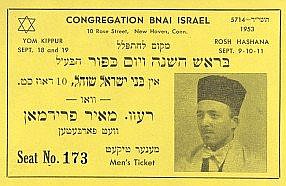
A few years ago, in a hilarious episode of “Curb Your Enthusiasm,” the comedian Larry David bought scalpers’ tickets to his congregation’s High Holy Day services, and was kicked out when his subterfuge was discovered. Nothing that dramatic happened to a friend of mine who wished to attend services last year, but he also had an unpleasant experience with a large congregation.

My friend, who moved to Westchester several years ago, is not a regular shul-goer, but had always gone to High Holy Day services in the city. In his first year in the suburbs, he called a large local Conservative congregation — his denominational preference — and was told that he could have tickets that year at a nominal fee, but if he wished to attend the following year he would have to join the congregation. He was out of the country the following year, so when he returned the year after that, he phoned to ask if he might pay a more substantial fee for his seats this time but not yet become a congregation member. He had not made up his mind about membership. The response he received was a snappish, “You cannot come here again without joining,” and a loud click of the receiver. One or two other large synagogues in his area also informed him in no uncertain terms that he had to be a member to get tickets.

-Francine Klagsbrun
Special to the Jewish Week
“Synagogues Should Be More Welcoming”
The Jewish Week

That sounds terrible. In fact, the whole process of buying tickets to the High Holy Days services probably seems strange and alien to most Christians. After all, it’s not like we have to buy tickets to get seats at Christmas or Easter services in a church (although I must admit, I haven’t commemorated either event or worshiped in a church setting for many years). And yet, the synagogue model raises funds in a very different manner than the church and purchasing an annual membership to a synagogue as well as buying tickets for special events like Passover or the High Holy Days is perfectly normal and reasonable.

But what about the situation described by Klagsbrun? Is this what God really intended? Is this how a synagogue welcomes a Jew into its midst for worship and to honor God? If the person in question had held a membership to the synagogue, it wouldn’t be a problem. But just as some Christians only attend church on Easter, some Jews only go to shul for the High Holidays. No one bars the door to the “annual Christian” but why should a “three day a year Jew” not be able to worship because of lack of “membership?”

Of course, there are always options.

Put off by those responses he called the local Chabad office, ordinarily a sect foreign to his liberal religious and social outlooks. The rabbi who answered the phone greeted him cordially and invited him to attend all the holiday services with no payment. When he did, he received a warm welcome from the rabbi and his assistant. And when he became ill and did not show up for Yom Kippur, the rabbi later called his home to inquire after him. Although my friend missed the more intellectual atmosphere of a Conservative synagogue, he enjoyed the enthusiasm and inclusiveness of the Chabad service. Needlessly to say, he sent an unsolicited check to Chabad after the holidays. It was the money he had offered to pay for tickets to the large suburban synagogue.

No, this isn’t my advertisement for the Chabad and that also was not Klagbrun’s intent when writing her article. For many Reform and Conservative Jews, entering the world of the Chabad is about as comfortable as a visit to the surface of the Moon without the benefit of a spacesuit. A large number of Jews consider the Chabad “cult-like, with its mysticism, messianism, and adulation of the Rebbe” (so if you as a Christian have issues with the Chabad, you’re not alone). But they are doing one thing right. They are welcoming the so-called “three days a year” Jew into their midst the way (forgive me if this next part offends you) that a church would welcome an errant Christian, seeker, or wandering atheist through their doors.

Klagsbrun suggests that it is time for “synagogues to rethink some of their policies, add flexibility, reach out to the unaffiliated, and then take more pride than ever in what a religious New Year really means.” I don’t often go out of my way to be critical of Judaism, but I am also aware that no people group and no religious faith is perfect or has the corner market on righteousness. To my way of thinking, the “welcomeness” of the church (whatever faults it may possess) is generally more aligned with the will and wisdom of God and the spirit of the Messiah than the examples of the synagogue Klagsbrun brings forth. And yet, even during some of Judaism’s darkest hours, God’s response to His “straying sheep” is not condemnation, but compassion.

By the time Moses returned to the scene, his people had hit an all-time low. They worshipped idols, spoke slanderously of each other, and had wandered very far from the path of their forefathers. Perhaps he should have told them off, saying, “Repent, sinners, lest you perish altogether!”

But he didn’t. Instead, he told them how G-d cared for them and felt their suffering, how He would bring about miracles, freedom and a wondrous future out of His love for them.

As for rebuke, Moses saved that for G-d. “Why have you mistreated your people?!” he demanded.

If you don’t like the other guy’s lifestyle, do him a favor, lend him a hand. Once you’ve brought a few miracles into his life, then you can urge him to chuck his bad habits.

-Rabbi Tzvi Freeman
“Rebuke”
Based on letters and talks of the Rebbe
Rabbi M. M. Schneerson
Chabad.org

I am sometimes treated to a view of our local Reform and Chabad synagogues, their members, and their Rabbis, as seen through my wife’s eyes and experiences. No one is perfect. Everyone has flaws. Some of the events that occur within the Chabad are less than attractive or appealing. And yet to read words of wisdom and beauty that are inspired by the Rebbe are a joy that reminds me of the grace of Jesus. As I mentioned in yesterday’s “morning meditation”, God is writing on all our hearts and there is something of the Divine in each of us. Rather than rebuking our neighbor for his shortcomings, we should show our love and grace, even as God has shown love, grace, and mercy to us.

“For God so loved the world, that he gave his only Son, that whoever believes in him should not perish but have eternal life. –John 3:16 (ESV)

Praying and the Pain of Thorns

Most of us expect prayer to inspire and comfort us. The grandeur of the synagogue, its architectural beauty and music, the peacefulness of the setting – all of these convey the sense that Jewish prayer is about feeling peace. We expect that participating in a service will touch us uniquely and deeply. So when we do not feel that peace, we feel let down.

But if Jewish life is about struggle, we should be suspicious of the assumption that prayer is entirely about peace or comfort. If prayer were designed only to provide comfort, would it contribute to our struggle? Probably not. If prayer were designed only to move and to touch us, if comfort and joy were its only goals, Jewish prayer would actually undermine the difficult effort involved in Jewish spirituality.

-Rabbi Daniel Gordis
“Prayer – Jewish Spirituality and the Struggle to Become” (pp 164-5)
God Was Not In The Fire

This is probably very mysterious to most Christians. Why shouldn’t prayer be about “comfort and joy” instead of struggle? Who wants to struggle with God and with themselves when they are hurt or sick or scared? We want peace when we’re in trouble and praying to God, and we want peace now!

And sometimes, God delivers.

And a lot of times, He doesn’t, at least in the immediate sense of providing instantaneous, overwhelming peace.

Not that I am speaking of being in need, for I have learned in whatever situation I am to be content. I know how to be brought low, and I know how to abound. In any and every circumstance, I have learned the secret of facing plenty and hunger, abundance and need. I can do all things through him who strengthens me. –Philippians 4:11-13 (ESV)

Does any of this mean that Paul never contended with God as Jacob contended with the angel (Genesis 32:22-32)? Here’s the answer.

So to keep me from becoming conceited because of the surpassing greatness of the revelations, a thorn was given me in the flesh, a messenger of Satan to harass me, to keep me from becoming conceited. Three times I pleaded with the Lord about this, that it should leave me. But he said to me, “My grace is sufficient for you, for my power is made perfect in weakness.” Therefore I will boast all the more gladly of my weaknesses, so that the power of Christ may rest upon me. For the sake of Christ, then, I am content with weaknesses, insults, hardships, persecutions, and calamities. For when I am weak, then I am strong. –2 Corinthians 12:7-10 (ESV)

Imagine the conversation (repeat three times):

Paul: Ouch, God! This hurts! Can you please take it away now?

God: No.

Paul: Why not? It’s not like I deserve this. Look at all the good I’ve done in the name of the Moshiach. Half the time, I can’t concentrate because of the pain. Think about how much better I could serve you if I didn’t have this distraction.

God: I’m thinking about how big an ego you’ve got and how much more you’d serve it if you didn’t have to put up with the messenger of Satan I’ve allowed to be jammed into your side.

Paul: That’s not fair.

God: Job said that same thing to me and you know how I answered him.

Paul: I guess I’m stuck for an answer, but it still hurts.

God: It’s not about living without the struggle, it’s about learning to live with it. If you can do that, your message to the disciples among the Goyim will be all the more powerful. You must remember my servant Jacob, as the Goyim will remember my servant Paul.

I have some friends in the Puget Sound area named Joe and Heidi. They’re about my age. They enjoy hiking and photography and they love God. They both have cancer and spend almost all of the time that they’re not climbing over mountains and valleys, in lengthy sessions of treatment and testing. The tumors never seem to abate and the news I hear is often more bad than good. Their faith is virtually without parallel, but at times, so is their suffering and sorrow. They ask for prayer frequently and I pray for them constantly. But what do I pray? What am I supposed to pray? Jesus, tell me how I’m supposed to pray!

The answer probably seems obvious to you. “Pray for their healing,” you say. “Pray that God will give them both a complete and perfect cure,” you say. “Pray that they experience total comfort and joy and peace.”

Is there something wrong with my prayers? I pray for all that, but it doesn’t happen. God is supposed to give us what we need and even what we want if we pray in the name of Jesus Christ, right? Why isn’t it working?

If you ask Me anything in My name, I will do it. John 14:14 (NASB)

In that day you will not question Me about anything. Truly, truly, I say to you, if you ask the Father for anything in My name, He will give it to you. –John 16:23 (NASB)

It’s not working out the way he promised. Instead of being given what I ask for in the name of Christ, I feel like I’ve wrestled with an angel all night long. It’s not easy, it’s exhausting. I’m worn out and no closer to experiencing “comfort and joy,” let alone “contentment,” than I was when I started praying. As far as I can tell, Joe and Heidi are no closer to be cured of cancer now than when I started praying, and it’s not only me. A lot of believers are praying for them all the time. God, where are You when we need You?

That is why Jewish prayer tries to evoke not only peace and comfort, but wrestling and angst as well. Despite our desire to feel beauty and the comfort that often accompanies it, it may be precisely when we feel somewhat disconcerted and not entirely at ease that Jewish prayer may be accomplishing its most central goal. Indeed, that ideal for prayer is communicated by the very word that Jews use for the act of praying.

The Hebrew term for the verb “to pray” is “le-hitpalel,” which means “to judge oneself,” or even “to struggle with oneself.”

-Gordis (pg 165)

Now that is what I experience when I pray!

Rabbi Gordis goes on to explain that prayer is not sending out “Santa’s wish list” up to God so that His miracles can be delivered to us in flashy wrapping paper and tied in a pretty ribbons. Jewish Prayer is not a “Catechism” of devotional statements about what we believe, but a struggle with God and with ourselves, with faith and trust hanging in the balance, along with human lives.

Adon Olam or “Master of the Universe” is a classic Jewish prayer that encapsulates faith, trust, and struggle. The beginning of this 11th century poem speaks of a Jew’s absolute trust in the God of his Fathers, but as Gordis teaches:

…suddenly, after line six, the tone changes. Beginning with the seventh line, the focus shifts. The poet moves away from broad theological claims about God’s grandeur, focusing instead on the speaker’s intimate feelings about God. No longer is God endless and majestic; now, the poet speaks of “my God…a Rock in my travail at the time of distress.” Gone are the claims that “even after all things have come to an end, God alone, awesome, will remain King”; in their stead we hear “to His hand I entrust my spirit, when I sleep and when I wake.” Just as the Mishnah we examined above abruptly switched its emphasis from keva to kavvanah from one line to the next, this text suddenly focuses not on what we believe about God, but on how we feel about God.

-Gordis (pg 173)

The struggle in our spiritual journey of discovery of both God and who we are in God, is contained, not only in Adon Olam, but in the contents of the siddur; in all Jewish prayer. Contrary to what most Christians believe, Jewish prayer contains both spontaneous and liturgical elements that create the structure in which a Jew prays, as well as allowing a Jew’s prayers to fly up free, returning to God as a spark returns to the flame. It also provides the arena in which we wrestle with God and our own spiritual struggle as we progress along the rough and rocky path that leads from earth into heaven.

How can there be misery and suffering in a world created by a perfect and loving God? That unanswered question has resulted in many falling away from the faith and many more never coming near a God they see as horrible and destructive. And yet, the current condition of our world is not God’s fault but man’s. God allowed us to play in our world as a child living in a tinderbox might play with matches. God could have protected us the way any responsible parent would have kept matches out of the reach of a four-year old, but we were meant to be the caretakers of this world, and as such, we were given autonomy over it (Genesis 1:28). We are responsible for our own messes and if the concept of Tikkun Olam has any meaning, we are responsible for preparing the world for the arrival of the Moshiach, who will help us repair the world we damaged so completely, including the world of our lives.

Yes, God answers prayer and sometimes people are miraculously healed, both for His glory and because of His kindness, but prayer isn’t like putting a coin in a vending machine, pressing a few buttons, and expecting a delicious soft drink to come popping out to quench our thirst. Each prayer is a fresh encounter with God where He challenges us to become a little more holy than we were before, often by facing those things about ourselves and our world that are most ugly and repellent. We meet both the best and the worst in ourselves, and in the midst of that battle, we encounter our desperation and our fears. We also encounter the miracle of meeting God on neutral ground, neither heaven or earth, and occasionally find the miracles of joy and comfort. We also encounter the thorn.

Prayer isn’t just a gift where we get what we want. It’s also a place where we share our joys and sorrows with God, and where we begin to realize that even if the conditions of our lives never really change, we come to know that God is always with us, no matter where we go, or what is happening to us.

If God entered the Egyptian exile with Jacob (Genesis 46:4) and even entered the death camps with six million Jews, He also goes into chemotherapy with those who have cancer, lives with the tumors, and climbs along the mountain trails, sharing our struggles, our tears, and even our joy.