Tag Archives: Jewish

Laughing with God

Deeper than the wisdom to create is the wisdom to repair.

And so, G-d built failure into His world, so that He could give Man His deepest wisdom. To repair.

-Rabbi Tzvi Freeman
“Repair”
Based on letters and talks of the Rebbe, Rabbi Menachem Mendel Schneerson
Chabad.org

How is repair deeper than creation?

-Posted by Avi

If you have unlimited resources–like G-d does–it’s much easier to throw out the broken pieces and start all over again than to keep them and get them to work.

That’s what Torah is–the ability to sustain the world while repairing it.

-Posted by Rabbi Freeman in response to Avi

God did that once. Destroy the world because it was easier than fixing it.

The Lord saw that the wickedness of man was great in the earth, and that every intention of the thoughts of his heart was only evil continually. And the Lord regretted that he had made man on the earth, and it grieved him to his heart. So the Lord said, “I will blot out man whom I have created from the face of the land, man and animals and creeping things and birds of the heavens, for I am sorry that I have made them.” –Genesis 6:5-7 (ESV)

Fortunately afterwards, God has told us that, even though it’s easier to destroy and start creation all over again, He will take another path from now on.

Then Noah built an altar to the Lord and took some of every clean animal and some of every clean bird and offered burnt offerings on the altar. And when the Lord smelled the pleasing aroma, the Lord said in his heart, “I will never again curse the ground because of man, for the intention of man’s heart is evil from his youth. Neither will I ever again strike down every living creature as I have done. While the earth remains, seedtime and harvest, cold and heat, summer and winter, day and night, shall not cease.”

And God said, “This is the sign of the covenant that I make between me and you and every living creature that is with you, for all future generations: I have set my bow in the cloud, and it shall be a sign of the covenant between me and the earth. When I bring clouds over the earth and the bow is seen in the clouds, I will remember my covenant that is between me and you and every living creature of all flesh. And the waters shall never again become a flood to destroy all flesh. When the bow is in the clouds, I will see it and remember the everlasting covenant between God and every living creature of all flesh that is on the earth.” God said to Noah, “This is the sign of the covenant that I have established between me and all flesh that is on the earth.” –Genesis 8:20-22; 9:12-17 (ESV)

And while the sign of God’s covenant with Noah has been appropriated for everything from rainbow ponies to the LGBT movement, it remains for me the promise that even though it is easier to destroy and recreate than to maintain, God has promised to continue to “sustain the world while repairing it.”

But what about individual human beings? Can and will God sustain us while we’re “under repair?”

Recently, I’ve commented about the seeming randomness of the purpose of individual lives as well as how faith can wane and leave each of us feeling isolated and alienated from God. While God may wait for us to return to Him, will He wait forever?

I guess since the human lifespan is finite, the literal answer must be, “No.”

On the other hand:

The Lord works righteousness
and justice for all who are oppressed.
He made known his ways to Moses,
his acts to the people of Israel.
The Lord is merciful and gracious,
slow to anger and abounding in steadfast love.
He will not always chide,
nor will he keep his anger forever.
He does not deal with us according to our sins,
nor repay us according to our iniquities.
For as high as the heavens are above the earth,
so great is his steadfast love toward those who fear him;
as far as the east is from the west,
so far does he remove our transgressions from us.
As a father shows compassion to his children,
so the Lord shows compassion to those who fear him.
For he knows our frame;
he remembers that we are dust. –Psalm 103:6-14 (ESV)

We rely on God’s mercy outweighing His judgment for if it didn’t, then how could anyone survive, even for an instant?

But that doesn’t really answer the question. It’s not as if sin doesn’t have it’s effect.

Behold, the Lord’s hand is not shortened, that it cannot save,
or his ear dull, that it cannot hear;
but your iniquities have made a separation
between you and your God,
and your sins have hidden his face from you
so that he does not hear. –Isaiah 59:1-2 (ESV)

If God doesn’t seem to be paying attention to us, it’s because we have shut the door between us, not Him.

On the other hand, does arguing with God cause a separation? We have seen times when confronting God has actually been beneficial, such as when Abraham interceded for Sodom, when Jacob wrestled with God, and when Moses pleaded for Israel after the sin of the Golden Calf.

And yet, when God told Abraham to sacrifice the life of Isaac, Abraham didn’t say a word.

So I’m at a loss. How do you know when it is appropriate to contend with God and when you should remain silent and accept what He has said as final?

I don’t know. I don’t know if anyone knows. I only know that a relationship between a human being and an infinite and Almighty God either requires the human to be completely terrified all of the time and to say and do nothing, or the human must have the freedom to interact and even challenge God at times for there to be a relationship at all.

We are awfully casual with God at times. I suppose we rely on not only His mercy, but on His desire to have intimacy with us. To be intimate requires the ability to not only converse, but to argue, debate, struggle, and even yell. But God isn’t a human being, so how we relate to Him can’t really be the same as how we relate to our spouse or other loved ones.

Yes, I know that not even a sparrow falls to the ground without God being aware and that people are worth more to Him than sparrows. I also know anything we ask in Christ’s name will be done for us (though not anything asked frivolously or against the will of God), so we have these as indications of God’s great love for us.

But exactly where is the line that you cannot cross without permanent and irreversible consequences?

Maybe these are questions that should be left unasked or at least unanswered.

Not too long ago, I wrote a blog post describing God as a teacher, a “bringer of light, wisdom, and understanding,” as opposed to a harsh and punitive judge who elicits only fear from us. Maybe we only receive from God that which we look for, or to put it another way:

Let the one who is taught the word share all good things with the one who teaches. Do not be deceived: God is not mocked, for whatever one sows, that will he also reap. For the one who sows to his own flesh will from the flesh reap corruption, but the one who sows to the Spirit will from the Spirit reap eternal life. And let us not grow weary of doing good, for in due season we will reap, if we do not give up. So then, as we have opportunity, let us do good to everyone, and especially to those who are of the household of faith. –Galatians 6:6-10 (ESV)

We can choose to fear God and obey Him out of that fear, and perhaps that’s where we all start out, or we can choose to see God as our great teacher who shows us the lessons for good. I suppose like in a yeshiva setting, we sometimes learn by debating our teacher, but only as a mechanism by which we burn away the inconsistencies and “dross” from our understanding.

In the end, we never doubt that what He says and does is for ultimate benefit. And we never doubt that even in our hottest anger or our darkest fears, that He always loves us. And He has taught us that we should always sustain the world while repairing it. That includes repairing who we are as individuals and repairing our relationship with God, sustaining it and not destroying it…and not destroying us.

Imagine a father tutoring his child, as any tutor will teach a student.

The child does well, and the father returns a smile of approval, as any good tutor would do.

Then the father laughs, slapping his child affectionately on the back, and they both laugh together, as only a father and child could do, the father saying in his laugh, “I always have this pride, this delight in you, that you are my child. Now is just my opportunity to show it.”

Above, our Father awaits His opportunity to laugh with us.

-Rabbi Tzvi Freeman
“Father as Tutor”
Based on letters and talks of the Rebbe
Rabbi M. M. Schneerson
Chabad.org

Imagine a God and teacher who so loves us that we can also laugh with Him.

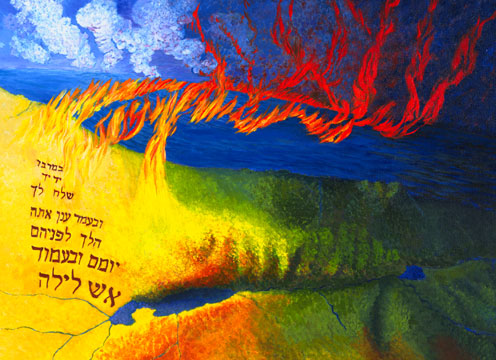
God Waits in the Desert

The Talmud also writes there that the mouth of a fetus is compared to a strand of hair. This teaches that one’s spiritual level depends on what he says. In Tehillim we find, “I believed as I speak” — words of emunah build one’s emunah and bitachon and draws him near to God. But speaking profane words distances one from the purpose of creation. How much more so do words of slander and falsehood! The verse commands, ‘‫ — מדבר שקר תרחק‬ Distance yourself from falsehood.’” Rav Zusia of Anapoli, zy”a, interpreted this phrase in a novel way: “If you speak falsehood, you will be distanced from God!”

Daf Yomi Digest
Stories Off the Daf
“The Eyes, the Nose and the Mouth”
Niddah 25

“They went down to the pit alive” (Bamidbar 16:30) – even in the grave they think they are alive. There is a blessing contained in “They went down to the pit alive,” as with “the sons of Korach did not die,” (Ibid. 26:11.) – “a place was established for them (In Gehinom “the pit,” Megilla 14a.) and they repented.” For teshuva, repentance, is effective only while one is still alive. This, then, is the blessing – that even in the pit they will live, and they will be able to effect teshuva.

“Today’s Day”
Tuesday, Sivan 26, 5703
Torah lessons: Chumash: Korach, Shlishi with Rashi
Tehillim: 119, 97 to end.
Compiled and arranged by the Lubavitcher Rebbe
Rabbi Menachem Mendel Schneerson, of righteous memory, in 5703 (1943)
from the talks and letters of the sixth Chabad Rebbe
Rabbi Yosef Yitzchak Schneersohn, of righteous memory
Translated by Yitschak Meir Kagan

I sometimes get kind of cranky about a life of faith. I sometimes forget about what I’ve already learned about faith and trust. I’ve recently been reminded of something I first read on Derek Leman’s blog, but the reminder didn’t come from Derek:

The call of faith is hard, the task seems impossible, the place we are called to seems desolate, the day of regeneration seems far in the future, but this faith is its own reward during the long delay.

I’m reminded that we’re to have faith in the desert. But while it’s easy to declare that the desert represents the faithless world we live in, in fact, the desert is inside of us each time we doubt.

Each time I doubt.

Ironically, the desert is a good place to be when I’m in doubt. There are few distractions. I imagine a sandstorm. The wind is hot. I have coverings over most of my body including around my eyes so I’m not blinded by the sand. The sun is obscured from my vision as a hazy, blurry ball of yellow and white but the power of its heat is oppressive.

And there is only me and the wind and the sand and the heat and somewhere beyond, the vast reaches of the desert, all but lifeless.

And there is God.

He’s not actually apparent. I talk to Him, though. I complain to Him. I wonder where He is. I imagine that He’s contracted Himself; He’s withdrawn from the part of the universe where I live, He’s left me to swing in the breeze or in this case, the wind and sand.

Not really, of course. The reality of His existence is that He’s always “standing at my shoulder” so to speak, never far away at all, no matter how transparent He seems to be to my failing perceptions. But it’s as if He has withdrawn, like a silent lover who has backed away in order to give me time to process some sort of quarrel between us.

Not that He’s ever argued with me. I do all the arguing. That is, until I realize He has left me and I am utterly alone and abandoned in the desert of my soul.

My God, my God, why have you forsaken me?
Why are you so far from saving me, from the words of my groaning?
O my God, I cry by day, but you do not answer,
and by night, but I find no rest. –Psalm 22:1-2 (ESV)

The wonderful thing about being alone is that you have time to think. There are no distractions, not even the presence of God (though He is still present). The desert is comforting, even the heat is welcome; the sweat, the smell of dry things. There is still rock beneath my feet so my footing is sound.

The quote from Derek’s blog says in part, “but this faith is its own reward during the long delay.” Faith is a companion in the desolation, a faint voice I can just barely hear over the banshee winds. Though I feel as if the God in whom I have faith is “far off and the road to reach him is long” and arduous, I am also reminded that my desert can be watered and flourish, but only when I’m ready to return. Only when I want to begin the journey again (or is this part of the journey?).

He leads me beside still waters.
He restores my soul.
He leads me in paths of righteousness
for his name’s sake.
Even though I walk through the valley of the shadow of death,
I will fear no evil,
for you are with me;
your rod and your staff,
they comfort me. –Psalm 23:2-3 (ESV)

But that’s only a mirage which has yet to arrive; an oasis that will only come when the Messiah does, or when my faith in the Messiah returns.

This week’s Torah portion records the failure of the Children of Israel to realize the promise and the dream. They lack faith and do not take possession of the land of Canaan. They are condemned to wander the vast wilderness for forty years, dying one by one along the way. Miriam, Aaron, and even finally Moses all perish. Only Joshua and Caleb from that generation survive and only because of steadfast faith and trust.

The very last verses of the Parashah say this:

The Lord said to Moses as follows: Speak to the Israelite people and instruct them to make for themselves fringes on the corners of their garments throughout the ages; let them attach a cord of blue to the fringe at each corner. That shall be your fringe; look at it and recall all the commandments of the Lord and observe them, so that you do not follow your heart and eyes in your lustful urge. Thus you shall be reminded to observe all My commandments and to be holy to your God. I the Lord am your God, who brought you out of the land of Egypt to be your God: I, the Lord your God. –Numbers 15:37-41 (JPS Tanakh)

The commandment of tzitzit is directly connected back to failure because man needs tangible reminders of an intangible God. Faith and trust are shadows in the mist as well, but the tzitzit are real enough. They are not faith, but for the Children of Israel, they serve as a visible reminder that God is as near as the four corners of their garments.

Christians don’t wear tzitzit since, among other things, the failure to possess the land and the subsequent possession of Israel by the Jewish people are commandments for the Jews, not for us. However, our need for faith and trust is the same. Our need to be reminded of God is the same. Where is God when we need Him? He’s standing apart, giving us time to realize we need to return to Him; letting us stew in our graves while we decide to repent and live.

A life of faith isn’t all that easy. It’s not even so much that the world around me thinks I’m a superstitious fool for believing in the providence of a God that I cannot see and touch and who allows horror and tragedy to abound on his earth while we believers declare His undying love for humanity. It’s the desert inside where the battle is fought. It’s where I fight with God. It’s where I fight with myself. It’s where I have one lover’s quarrel after another with the One who is the lover of my soul.

So He periodically leaves me alone in the desert with the wind and the sand and the heat. But he provides me with solid rock to walk on so I won’t lose my footing or my way.

The desert is a good place for me to ponder my lot and my fate. Occasionally the wind dies down a bit and I’m temporarily given a small sheep to tend, so I have something else to care for. This is God reminder that He cares for me in the same way.

And God waits at a distance, but always watching me, ready to return to my side in an instant should I but say the word.

And He waits.

Shlach: The Miraculous Messenger

The Torah portion of Shlach relates how the men sent to spy out Eretz Yisrael returned and reported that the country was unconquerable. The Jewish people, they said, would be unable to enter the land, since “The inhabitants of the land are mighty.” (Bamidbar 13:28.)

Furthermore, say our Sages, (Sotah 35a.) the spies went so far as to say that even G-d would not be able to wrest the land from its inhabitants. Their words caused great consternation among the Jews, who feared that they would be unable to enter Eretz Yisrael.

How was it possible for the spies to mislead the Jewish people and convince them that even G-d could not help them, when the Jews themselves had constantly witnessed the miracles performed on their behalf, e.g., G-d provided their daily food and drink in a miraculous manner — manna from heaven and water from Miriam’s well.

Commentary on Torah Portion Shlach
from “The Chassidic Dimension” series
Based on Likkutei Sichos Vol. XVIII, pp. 171-174
and the teachings of the Lubavitcher Rebbe
Rabbi Menachem M. Schneerson
Chabad.org

Like the logic applied in our initial conundrum, the spies argued that after God created the laws of nature, He ruled that even He Himself would not be able to change those laws. God bound His own hands, as it were, by means of the laws that He Himself instituted. Until now, God’s leadership in the wilderness had been one of supernatural miracles that defied the laws of nature again and again. It was clear though that entering thelandofIsrael, for all its holiness, meant entering the confines of nature and living by its laws. This was why the ten spies thought that the Jewish people could not overcome the giants who lived in the land. They believed that God had indeed created a rock that could not be lifted. Moses himself used this argument in his prayer asking for God’s forgiveness, saying that destroying the Jewish people, God forbid, for their sin, would be proof for the surrounding nations of the erroneous claim that “God lacked the ability to bring this nation to the land which He swore to them…” (Numbers 16:14-15).

Joshua and Caleb, the remaining two spies, also saw that conquering the land was a supernatural task, but they said, “Yes, God can create such a rock that He cannot lift, but He can still decide to pick it up if He wants to.” They realized that on entering theHoly Land, God could paradoxically empower the Jewish people themselves with supernatural powers and this would become their very nature.

-Rabbi Yitzchak Ginsburgh
“The Rock that God Can Carry”
Commentary on Torah Portion Shlach
Wonders from Your Torah

I hadn’t heard this particular perspective on the “sin of the ten spies” before and that they believed that there was “a rock that God Himself couldn’t lift,” so to speak. I did however, realize that anyone who is “sent out” for a particular purpose is called “shlach,” including us.

I know it doesn’t sound like these two things are connected, but I can explain.

Go therefore and make disciples of all nations, baptizing them in the name of the Father and of the Son and of the Holy Spirit, teaching them to observe all that I have commanded you. And behold, I am with you always, to the end of the age.” –Matthew 28:19-20 (ESV)

WalkingThat command was originally given by the Master to the “eleven disciples (who) went to Galilee, to the mountain to which Jesus had directed them.” (v16) However, it has been inherited by every disciple who is called by his name, Jew and Gentile alike, and we have carried that mission upon us for nearly 2,000 years.

How are we doing so far?

Actually, not that bad. But we could be better, especially in the present age. It’s not so much that the Good News of Jesus Christ isn’t being spread to the four corners of the earth and that the vast, vast majority of the human race hasn’t heard of God, the Bible, and Jesus. They certainly have heard the Good News, however many of those people; perhaps most of those people, don’t see it as “good news” at all. Many people experience Christianity as “bad news.” They see us as superstitious, as old fashioned, as out of touch, as bigots, sexist, racist, anti-gay, anti-political correctness, anti-progressive.

Some of that is true, whether we intend it to be or not. Where have we gone wrong?

In the days of Moses, the ten spies gave an “evil report,” not because they were dumb or evil or cowards, but because they believed that the supernatural power of God would not go with them when they entered the land of Canaan. They believed that without the power of God, in terms of mere human strength, they would have no chance at defeating the mighty giants of the land. They felt abandoned and afraid.

Every time I read the words of “the great commission” as recorded in Matthew 28:19-20, I always puzzled over Christ’s final statement:

“And behold, I am with you always, to the end of the age.”

Now I realize what he was trying to say. He was trying to say that his disciples would not be alone in the enormous mission of taking the word of the Jewish Messiah to the nations of the world. Remember, nothing like that had even been dreamed of before let alone attempted. In a world full of false gods and polytheistic idol worshipers, how would the Word of the One God of Israel and the Messiah King of the Jews be received by the Gentiles? Would they listen to the Gospel message at all, or listen and then merely incorporate God into their panthenon of other gods, worshiping the God of Heaven as if he were just another idol of stone, wood, or bronze?

The Bible didn’t record the reaction of Christ’s “great commission” but it would be another fifteen years or so before any one of them would attempt to respond. Even then, Peter needed the prompting of not only a vision on a rooftop (Acts 10:9-16), but that of a messengers sent by the God-fearing Roman Cornelius with an unusual request. (Acts 10:17-23). The rest of this chapter in Acts tells the tale of God showing just how possible it was to carry the message of the Messiah to the Gentiles and how indeed, many Gentiles were eager to hear it.

Receiving the SpiritAnd in seeing that the Gentiles could receive the Holy Spirit, even as the Jews had already done (Acts 10:44-48), it was confirmed that the supernatural power of the Spirit of Messiah was with them “always, to the end of the age.”

That age hasn’t expired yet and neither has our calling. Not all of us enter what the church calls “the mission field” in a formal sense, but in truth, we are all “missionaries” or “sent ones.” We are shlach in the way we live our lives. Every word we speak and every action we take tells the tale of our Lord and Master, for good or for ill. Every deed of honor and praise glorifies the Name of God, and every mistake and mean-spirited act we commit drags that Name through the mud.

Joshua and Caleb understood that God would enable the Israelites to take the land, not by a series of supernatural miracles, but by making the people of Israel the miracle. We see in the book of Joshua and beyond how true this was. They didn’t have to believe in the miracles. They just needed faith in God. That first generation out of Egypt couldn’t overcome their “slave mentality” and when faced with such challenges, they balked. They didn’t have faith in themselves, let alone a God they felt would cease to provide protection from Heaven (I know, I’m applying midrash here, but I think it fits).

As believers and disciples of the Jewish Messiah, our teacher, our Master, and our King, what have we learned, not only from his lessons but from the lesson of the Shlach among the Israelites? Jesus already said that he would continue to be with us for the amount of time it takes to fulfill the directive to spread the Word of hope. He asks us to have faith. Faith in our Master, faith in the One Holy God of Israel…and faith in ourselves.

We see from the Biblical record that the taking of Canaan and the forging of Israel was no easy task, even though God was with the Children of Jacob. We see from the record of Paul’s letters that even though he was personally comissioned by the Messiah to be the “shlach to the Gentiles,” his task was at times brutally difficult. Our tasks are not easy, either. Living a life of faith and swimming against the tide or a world determined to deny God never is. We are reviled, called foul names, laughed at, ridiculed, and that’s only in the western nations. In other parts of the world, Christians are raped, beaten, tortured, and murdered for the sake of Jesus Christ. Under such terrific pressure, our sin is never in doing our best and failing, but only in failing to try.

“In fact, the spies’ sin, in fact any sin, can be understood using the same principles just applied. Sin is like a rock that by nature cannot be “lifted,” that is forgiven…But we know that even after sin, God remains open to teshuvah (repentance and return to God).”

-Rabbi Yitzchak Ginsburgh

“You do not always succeed, but you always have to try.”

-Gutman Locks
“Tefillin After 72 Years”
Stories of the Holocaust series
Chabad.org

A life of faith and miracles isn’t begun by waiting for God to make the first move. He’s waiting for us. So is everyone else. You can be the answer to someone’s prayer. All you have to do is try.

Good Shabbos.

Mourning for the Great Mountain

There is an interesting, but somewhat misunderstood, halachah. It has to do with not filling one’s mouth with laughter now while we do not have a Beis HaMikdash. In the words of the Orchos Tzaddikim: “One should only feel joyous in that which brings to enhanced service of God. He should never feel joy from that which causes another pain. For example, one who has wheat should not feel happy if there is a famine and he will make a large profit, since this is bad for others. One should also never take joy in another person’s death, even if he was left a legacy and will profit handsomely from this. Regarding such situations, one who shows proper decency and does not feel joy fulfills the mitzvah of ואהבת ’לרעך כמוך. One should accustom his heart to feel joy at his friend’s success. Most especially one should feel great happiness when he see others doing God’s mitzvos, since this is God’s will.

“Nevertheless, one should not fill his mouth with laughter in this world, as we find in Berachos 31. Since the Beis HaMikdash was destroyed, all joy has been mixed with sorrow. We also find in Niddah 23 that Rabbi Yirmiyahu tried to make Rabbi Zeira laugh but did not succeed.

When someone learned that the halachah not to fill one’s mouth with simcha is actually in the Shulchan Aruch, he was shocked and wondered how this could be prohibited.

He decided to ask the Sdei Chemed, zt”l, who was certainly a true scholar and fulfilled in every detail of halachah without compromise. “The halachah not to fill one’s mouth with laughter due to the destruction of the Beis HaMikdash is a middas chassidus. But this should not be confused with mockery. One who mocks is in one of the four groups that will not receive the Shechinah, as we find in Sotah 42!”

Daf Yomi Digest
Stories Off the Daf
“Rejoicing in the Right Way”
Niddah 23

This isn’t going to resonate well with most Christians because Christianity isn’t focused on the Temple as the point of connection between man and God. We focus on the life and spirit of Jesus Christ for that connection and, for most Christians, the Temple is superfluous. For most Christians, the Temple is a cosmic “so what?”

That’s kind of a shame because we may have to try to relate to it at some point, especially if traditional Jewish thought is correct and the Messiah, that is Jesus Christ, actually rebuilds the Temple.

The mashiach will bring about the political and spiritual redemption of the Jewish people by bringing us back to Israel and restoring Jerusalem (Isaiah 11:11-12; Jeremiah 23:8; 30:3; Hosea 3:4-5). He will establish a government in Israel that will be the center of all world government, both for Jews and gentiles (Isaiah 2:2-4; 11:10; 42:1). He will rebuild the Temple and re-establish its worship (Jeremiah 33:18). He will restore the religious court system of Israel and establish Jewish law as the law of the land (Jeremiah 33:15).

Judaism 101

However even if you have a tough time with that perspective, our story off the Daf can tell us a few other things, such as not rejoicing under circumstances when we win but someone else loses. We have a tendency to do that as human beings, but when we lose, when we’re hurt, when we’re afraid, we certainly don’t want others to feel happy about it. Most of the time, when we’re under duress, we don’t want people around us to feel happy about anything. We want them to feel upset, compassionate, and then try to help us.

What if a Christian sees a Jew under duress over the destruction of the Temple? I know it happened almost 2,000 years ago and Christians tend to think the Jews should “get over it” but that’s because we don’t understand the significance of the Temple in Judaism. We want Jews to realize that Jesus Christ is their temple and that it’s going to be all right because Jesus loves them. But most Jews aren’t going to relate to oto ha’ish that way, at least not right now (and I consider it a miracle any time a Jewish person does recognize the Jewish Messiah through the Gentile disguise that we have put on Christ).

I found the following footnotes for Chapter 11 of the Rambam’s The Laws and Basic Principles of the Torah at history.hanover.edu:

The whole of the following passage was deleted from most of the editions published since the Venice edition of 1574.

“If he did not succeed to this degree or he was killed, he surely is not [the redeemer] promised by the Torah. [Rather,] he should be considered as all the other proper and legitimate kings of the Davidic dynasty who died. G-d only caused him to arise in order to test the multitude. As it is written [Daniel 11:35], “Some of the wise men will stumble, to purge, to refine, and to clarify, until the appointed time, for it is yet to come.”

“Jesus of Nazareth who aspired to be the Mashiach and was executed by the court was also spoken of in Daniel’s prophecies [Daniel 11:14], “The renegades among your people shall exalt themselves in an attempt to fulfill the vision, but they shall stumble.”

The rest of the text is equally uncomplimentary toward Christianity, but that’s less to do with Jesus as Messiah and more to do with the subsequent “development” of the Christian/Jewish relationship over the past 20 centuries or so. However the beginning of Chapter 11 also says the following:

In future time, the King Mashiach[1] will arise and renew the Davidic dynasty, restoring it to its initial sovereignty. He will rebuild the [Beis Ha]Mikdash and gather in the dispersed remnant of Israel. Then, in his days, all the statutes will be reinstituted as in former times. We will offer sacrifices and observe the Sabbatical and Jubilee years according to all their particulars set forth in the Torah.

Whoever does not believe in him, or does not await his coming, denies not only [the statements of] the other prophets, but also [those of] the Torah and of Moshe, our teacher, for the Torah attests to his coming, stating: [Devarim 30:3-5]

This is similar to something the Master said 1,200 years earlier:

Do not think that I will accuse you to the Father. There is one who accuses you: Moses, on whom you have set your hope. For if you believed Moses, you would believe me; for he wrote of me. But if you do not believe his writings, how will you believe my words?” –John 5:45-47 (ESV)

Perhaps we Christians shouldn’t rejoice too much, not because we’re mourning the Temple and lament its loss, but because our human lives and failures made it necessary for Christ to suffer and die. True, he was resurrected again, just as the Temple will be remade by him (my opinion), but that doesn’t absolve us of our crimes, nor does it repair our present broken and suffering world. To those Christians who rejoice over Jewish suffering, you are missing the point, not only of the lesson of the Sages but of God’s own teachings. If the Jewish people mourn the Temple, they will also mourn Messiah.

“And I will pour out on the house of David and the inhabitants of Jerusalem a spirit of grace and pleas for mercy, so that, when they look on me, on him whom they have pierced, they shall mourn for him, as one mourns for an only child, and weep bitterly over him, as one weeps over a firstborn. –Zechariah 12:10 (ESV)

While the prophet is most likely speaking directly to Israel, Christ was pierced for us as well, so we should also mourn and not overly rejoice at our Salvation. True, we thank God for our redemption from death and our adoption as sons and daughters of the Most High, but there is still a lot of work to be done and if we are only happy for ourselves, how can we strive to reach out toward others in their suffering?

For I could wish that I myself were accursed and cut off from Christ for the sake of my brothers, my kinsmen according to the flesh. They are Israelites, and to them belong the adoption, the glory, the covenants, the giving of the law, the worship, and the promises. To them belong the patriarchs, and from their race, according to the flesh, is the Christ, who is God over all, blessed forever. Amen. –Romans 9:3-5 (ESV)

As Maimonides said, “Whoever does not believe in him, (the Messiah) or does not await his coming, denies not only [the statements of] the other prophets, but also [those of] the Torah and of Moshe, our teacher, for the Torah attests to his coming.”

Israel awaits his coming but they do not know who he is. We who do know his name must not rejoice that we hold that knowledge and others do not. We must not be bitter that others refuse to accept his name as Messiah. We must live our lives with caring and compassion for everyone, shunning no man whether Jew or Gentile, but welcoming everyone in peace to our Temple and our Great Mountain of God.

But there is another way of understanding it. With the help of verses such as “I will lift up my eyes to the hills – From whence comes my help?” (Psalm 121:1), where the psalmist lifts up his eyes to the “mountains” (as the Hebrew has it), the following explanation is given: “You shall become a plain – this is Messiah Son of David. And why is his name called Great Mountain? Because he is greater than the fathers, as it says, ‘Behold, My Servant shall deal prudently; He shall be exalted and extolled and be very high’ (Isaiah 52:13). He shall be higher than Abraham, more exalted than Jacob and higher than Jacob. … more exalted than Moses … and higher than the angels. This is why it says, ‘Who are you, O great mountain?'” (Midrash Tanchuma W, Toledot 14).

-Tsvi Sadan
“Great Mountain” (har hagadol) pg 58
The Concealed Light: Names of the Messiah in Jewish Sources


The Pious Fraud

In a reply to a yechidus query in the winter of 5635 (1874-75), my grandfather said to my father: The yetzer hara, (the evil impulse), is called “animal soul,” not because it is necessarily a brute animal. At times it may be a fox, the most cunning of beasts, and great wisdom is needed to perceive its machinations. At other times it may clothe itself in the garb of an earnest, straightforward, humble tzadik, possessing fine traits of character.

The animal soul manifests itself in each person according to his individual character. One person may suddenly experience a powerful longing to study Chassidus or to meditate deeply on some chassidic concept. The truth is, however, that this is nothing more than the yetzer hara’s counsel and the animal soul’s machinations to prevent him from engaging in the avoda of davening or a similar activity.

Take this as a general principle and remember it always: Any matter that is effective towards or actually leads to active avoda, and is confronted with opposition of any sort, even the most noble, that opposition is the scheming of the animal soul. My father concluded: Until then I had not known that there can be a “pious” animal soul, let alone a “chassidic” animal soul.

“Today’s Day”
Shabbat * Sivan 23, 5703
Compiled and arranged by the Lubavitcher Rebbe
Rabbi Menachem Mendel Schneerson, of righteous memory, in 5703 (1943)
from the talks and letters of the sixth Chabad Rebbe
Rabbi Yosef Yitzchak Schneersohn, of righteous memory
Translated by Yitschak Meir Kagan

The nature of good vs. evil and the nature of the human soul is somewhat more complicated in Judaism than it is in Christianity. I’m not going to spend any time trying to delve into these explanations, since there are people much more knowledgable and wiser than I am who have already made those distinctions. I do want to talk about how as human beings, we tend to fool ourselves, though. I know a lot about that.

It’s interesting to consider that even a very righteous person who desires to study Chassidus (If you’re Christian, think of it as studying the Bible, though that is a woefully inadequate comparison) could actually be caving into his “evil impulse.” I mean, what’s wrong with studying the Bible, folks? Or, what’s wrong with praying, or going to your local house of worship?

According to the commentary, even the desire to do something praiseworthy may be masking something else we’re trying to avoid, including our own awareness that we’re not being forthright in our motivations.

Really?

Think about this.

I want to read and study the Bible or some online commentary on the Torah. Being who I am, I’ll probably start writing a blog about it just because it’s in my nature to turn Bible study into blogs. But the floor needs to be vacuumed. Or my daughter needs a ride to work. Or my grandson is visiting and wants me to play with him. Or something is bothering my wife and she wants to talk with me about it. Or…

Well, you get the idea.

There’s nothing wrong with studying. There’s nothing wrong with blogging about Biblical or faith-based topics…unless they get in the way of “the weightier matters of the Torah,” which almost always involves actually doing some sort of good deed for another human being.

Imagine an extreme case where a person studied the Torah to the exclusion of all other considerations, including earning a living and supporting his family.

For even when we were with you, we would give you this command: If anyone is not willing to work, let him not eat. –2 Thessalonians 3:10 (ESV)

But if anyone does not provide for his relatives, and especially for members of his household, he has denied the faith and is worse than an unbeliever. –1 Timothy 5:8 (ESV)

But most of us aren’t that extreme. We do however, know how to appear pious and holy to the outside world and still have defective motives though.

“Woe to you, scribes and Pharisees, hypocrites! For you are like whitewashed tombs, which outwardly appear beautiful, but within are full of dead people’s bones and all uncleanness. So you also outwardly appear righteous to others, but within you are full of hypocrisy and lawlessness. –Matthew 23:27-28 (ESV)

Jesus was addressing people who knew they were being hypocrites and they didn’t mind behaving that way. What about those of us who truly believe we’re doing the right thing, but are really serving our own interests? We may really tell ourselves that studying Torah is more important than getting a job or getting a better job so we can support our families. We may tell ourselves that studying the Bible is more important than doing the vacuuming, washing the dishes, making dinner for the kids, or helping our neighbor with her yard work. I suppose, on a certain level, we can make a convincing case for it, too. After all, what’s wrong with studying the Word of God? What’s wrong with being immersed in the Bible? What’s wrong with being consumed and even obsessed with a life of faith?

What? But doesn’t a life of faith involve actually doing something about it? Doesn’t mowing your neighbor’s yard override praying, at least sometimes? Should we always ignore people for the sake of something we consider a higher ideal?

It’s probably not clear-cut in every single situation, but often we are so clever, we convince ourselves to do what we want to do, something that is indeed praiseworthy, so we can get out of doing something we don’t want to do that is equally praiseworthy.

The ego of man is cannibalistic in essence. At worst, it destroys everyone and everything in its path in order to attain its selfish goals. At best, as in the case of a civilized, refined and tolerant individual, it acknowledges its status as one among many, avows its support of the “human rights” of its fellows and concedes the legitimacy of pursuits other than its own. But even the most liberal-minded of men cannot escape the trappings of the ego: he will always see his fellow through the prism of self. His (seemingly) objective mind will point out that he shares the planet with billions of others, that there exist countless perspectives and callings in addition to his own. Deep down, however, the self will remain the gravitational center of reality, its ultimate point of reference. He will see others as necessary, perhaps crucial, but always secondary cogs to the kingpin of self.

Commentary on Ethics of Our Fathers
“The Contemporary Cannibal”
Sivan 23, 5772 * June 13, 2012
Chabad.org

This is part of a direct commentary on the following:

Rabbi Chaninah, deputy to the kohanim, would say: Pray for the integrity of the sovereignty, for were it not for the fear of its authority a man would swallow his neighbor alive. Rabbi Chaninah son of Tradyon would say: … Two who sit and exchange words of Torah, the Divine Presence rests amongst them…

-Ethics of the Fathers, 3:2

On the surface, it doesn’t seem as if there’s a connection between our need for a sovereign in order to curb man’s aggressive nature and studying words of Torah, but with just a little thought, the link becomes apparent.

So anyone who views the universe as an ownerless, arbitrary existence will never transcend the moral and intellectual cannibalism of the ego. For without a supreme authority that creates, defines and gives direction to all of creation, the self and its perceptions are the sole judge of right and wrong; inevitably, one’s vision of others will be tinted with the color of self.

It is only through the fear of G-d, only through the acceptance of the sovereignty of the King Of All Kings, that man can grow beyond the prejudice and anarchy of the ego. It is only by sensing an Absolute Truth before which all are equally insignificant, but which grants significance to the countless individual roles that fulfill the Divine purpose in creation, that an individual can genuinely see his fellow as his equal.

And because the naturally self-centered consciousness of man is, by definition, incapable of truly seeing beyond itself, this truth it is not something that one can understand and feel with the contemporary tools of his mind and heart. One must therefore “pray for the integrity of the sovereignty” in his life. One must concede that the transcendence of self is beyond his humanly natural capabilities, and humbly request that he be granted a higher, ego-free vision of his fellow.

It is only by acknowledging the absolute sovereign of the universe and submitting to His will that we can stop, look at what we’re doing, and realize what is really important in our lives and in the lives of those around us. Studying the Bible is important. Praying is important. Playing with your three-year old grandson is more important. God’s Bible is always there and is vital in helping us understand the importance of our roles, but once a moment in a child’s life has passed, you never get it back again.

You need to decide what you are. If you believe yourself to be angel, be prepared for some disappointment. If you think of yourself as a beast, you may well become depressed.

Best to know you are human. Stay away from situations you can’t handle, and face up to the mess when you fall down. That’s even higher than the angels.

-Rabbi Tzvi Freeman
“Identity”
Based on letters and talks of the Rebbe
Rabbi M. M. Schneerson
Chabad.org

Forgive

“If your brother sins against you, go and tell him his fault, between you and him alone. If he listens to you, you have gained your brother. But if he does not listen, take one or two others along with you, that every charge may be established by the evidence of two or three witnesses. If he refuses to listen to them, tell it to the church. And if he refuses to listen even to the church, let him be to you as a Gentile and a tax collector. Truly, I say to you, whatever you bind on earth shall be bound in heaven, and whatever you loose on earth shall be loosed in heaven. Again I say to you, if two of you agree on earth about anything they ask, it will be done for them by my Father in heaven. For where two or three are gathered in my name, there am I among them.”

Then Peter came up and said to him, “Lord, how often will my brother sin against me, and I forgive him? As many as seven times?” Jesus said to him, “I do not say to you seven times, but seventy-seven times.

Matthew 18:15-22 (ESV)

This is a unprecidented third “meditation” in one day, but I saw the accompanying photo on Facebook and it just fit. It’s been a tough week in the Messianic blogosphere and I’ve got the (virtual) bruises to prove it (It’s been a tough week anyway, but that’s beside the point). Most people who give me a hard time for my specific beliefs and their accompanying statements are actually really nice people who love God and want to do good to others. The vast majority of them, I consider my friends and for those who I’ve never met before, I’d love to get together over coffee or a beer and get to know you better. Most of them actually do perform deeds of lovingkindness and have extremely generous hearts.

Just a tiny few however, seem to have a tough time “letting go,” as if what I’m saying is a direct challenge to the doctrine of salvation and the grace of Jesus Christ. I’m not making any such challenge, but for some believers, any suggestion of change or deviation from the norm, particularly in the arena of supersessionism and anti-Jewish rhetoric, is to be feared and even shunned. I admit that there are moments when I want to snap back (more than I already do) but I don’t because I know it wouldn’t be the right thing. How can I exemplify the teachings of my Master if I allow myself to get caught up in the rapid volley, tennis match exchange of angry and upset comments?

Sometimes, along with everyone else, I get caught up in arguing all of the little minutia of religion; all of the arcane details that would make most Rabbis and Pastors go nuts and want to toss in the towel on the human race, but really, God is very simple.

At the end of the day, when you look back at who you are, who you claim to be, what you’ve done with your time, and how you’ve treated other people, you have to say to yourself, “Stop being a jerk and just forgive.” As someone commented on another of my blogs (this isn’t an exact quote), “it’s more important to do right than to be right.”

How can we enter a Shabbat’s rest with anger and frustration tying our hearts and souls into something that looks like a design by M.C. Escher? Let go. Tell the people who you love, “I love you.” Cup a small child’s face in the palm of your hand. Forget all the words and actions that have caused you pain. Remember what’s important.

Forgive.

If you’ve hurt me, I forgive you.

May God go with us all on our journey of faith.

nightsky1