
 Rabbinic schools of tannaitic times are more accurately characterized as “disciple circles” than academies. There were no school buildings, hierarchies of positions, administrative bureaucracies, curricula, or requirements. Because study was oral, there was no need for books or libraries either. A few disciples gathered around a rabbinic master and learned traditions from him in his home or in some other private dwelling that could serve as a school. But such formal instruction in the memorization and interpretation of texts constituted only part of the educational experience.
It was supplemented on a daily basis as students served their master as apprentices, observing his daily conduct and emulating his religious practice as he passed through the market, journeyed to various villages, performed his personal hygiene, or ate his meals. After years of learning, having reached a certain level of proficiency and perhaps (though not always formal) “ordination” from their master, disciples might leave their master and strike out independently, attempting to gather their own circles of disciples. If their master died, they would have to seek a new master elsewhere as there was no institutional framework to provide continuity or replacement. As opposed to an academy, the disciple circle was not an institution in that there was no ongoing life or continuity of the group beyond the individual teacher. The “school” was essentially the master himself.
-Jeffrey L. Rubenstein
“Social and Institutional Settings of Rabbinic Literature”
from The Cambridge Companion to the Talmud and Rabbinic Literature (p. 59)
But blessed are your eyes because they see, and your ears because they hear. For truly I tell you, many prophets and righteous people longed to see what you see but did not see it, and to hear what you hear but did not hear it.
“Listen then to what the parable of the sower means: When anyone hears the message about the kingdom and does not understand it, the evil one comes and snatches away what was sown in their heart. This is the seed sown along the path. The seed falling on rocky ground refers to someone who hears the word and at once receives it with joy. But since they have no root, they last only a short time. When trouble or persecution comes because of the word, they quickly fall away. The seed falling among the thorns refers to someone who hears the word, but the worries of this life and the deceitfulness of wealth choke the word, making it unfruitful. But the seed falling on good soil refers to someone who hears the word and understands it. This is the one who produces a crop, yielding a hundred, sixty or thirty times what was sown.” –Matthew 13:16-23
I admit that I’m stretching things a bit. The Tannaitic period of Jewish learning didn’t formally begin until the destruction of the Second Temple in 70 C.E. (and extended to about 220 C.E.) but if you look at Rubenstein’s description, read the “sample teaching” from the Master, and recall other examples of how Jesus interacted with his disciples, you’ll see a lot of similarities. Although the Talmud talks about the “House of Shammai” and the “House of Hillel” (see Pirkei Avot), these ancient sages didn’t teach in formal institutions named after them but rather, in their own homes, or in rooms provided by wealthy patrons (and it should be noted that both Shammai and Hillel also taught during the Second Temple period and preceded Jesus by a generation or more).
Why am I telling you all of this?
I want to paint you a picture. It will be a portrait, actually. The portrait is of someone you believe you know very well, if you’re a Christian. The portrait will be that of Jesus Christ. There’s only one problem. When you actually see the portrait, it will look nothing like you expect. It will look like a middle-eastern man of Semitic heritage in his early thirties, the oldest son of a rural carpenter living in a tiny nation occupied by a vast foreign power. Don’t expect a picture of Jesus that you can buy in any Christian book store or the image of some non-Jewish actor with blue eyes and fair complexion you may be familiar with from the movies or television.
I want to put Jesus..uh, Yeshu or Yeshua, back where he belongs. I want to put him back in the early first century of the common era in what the Romans would one day call “Palestine” (to mock the Jews). He looks and sounds and moves and teaches like an itinerant Rabbi who has gathered a small group of men for disciples and who teaches in the same manner as the Tannaitic Rabbis would a few decades later.
Recall the example from Matthew I previously quoted. Jesus was teaching a group of “lay people” in a public area but later provided a more detailed interpretation privately to his inner group. This also is described by Rubenstein (pp. 67-8)
Rabbis and their students also interacted with non-rabbis in a teaching forum that the Bavli called a pirka. This seems to have been a sermon or lecture delivered by a sage to a lay audience: Several such descriptions being “Rabbi So-and-so expounded (darash) at the pirka”.. Some sources draw a distinction between that which should be taught at the pirka and that which should be made known only to sages.. Despite teaching his students in private that the law follows the lenient view, Rav taught the stricter position at the pirka due to his concern that non-rabbis in attendance might not behave scrupulously and violate the law.
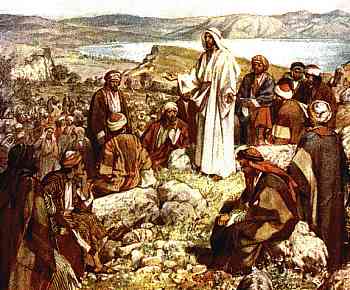 While the specific content of each of these two examples doesn’t match absolutely, the teaching dynamic of the Tannaitic rabbis and Jesus fits hand and glove. The master teaches one, less detailed and more conservative lesson to the public and provides the inner, more intricate details to his disciples. As you switch back and forth between your New Testament view of Jesus and the portrait of a Tannaitic period teacher, can you see the similarity between the two? If you can, does that mean the “inner portrait” of Jesus you carry around with you is beginning to change just a bit? Is he not quite the same man you first met in a church sanctuary or in a Sunday school class?
All I’m saying is that, to understand Jesus, we need to see him in action in his “native element”. We need to see him doing what he did, teaching his disciples as a Jewish master wherever he happened to be. His students followed him everywhere, watching his every move, listening to his vocal inflections, seeing how he treated others, imitating him in every way possible…just like students of a Tannaitic period Rabbi.
With one possible difference.
If their master died, they would have to seek a new master elsewhere as there was no institutional framework to provide continuity or replacement.
When Jesus died, his disciples did not seek a replacement. To be fair, only three days passed before he rose, so there really wasn’t any time, but I still doubt they could have cast the Master aside so easily. But after he rose, they still did not go elsewhere in search of a new teacher, but then again, he was no ordinary Rabbi.
Simon Peter answered, “You are the Moshiach, the Son of the living God.” –Matthew 16:16
Rubenstein wrote: “After years of learning, having reached a certain level of proficiency and perhaps (though not always formal) “ordination” from their master, disciples might leave their master and strike out independently, attempting to gather their own circles of disciples”, which the disciples did do. In fact, they were commanded to do so.
And Jesus came up and spoke to them, saying, “All authority has been given to Me in heaven and on earth. Go therefore and make disciples of all the nations, baptizing them in the name of the Father and the Son and the Holy Spirit, teaching them to observe all that I commanded you; and lo, I am with you always, even to the end of the age.” –Matthew 28:18-20 (NASB)
 Without realizing it, we are all struggling to become disciples, not just of the “Christian” Jesus Christ, but of a sort of “proto-Tannaitic” period Master. We are all in search of the true face and voice of Jesus. We long to sit at his feet under a fig tree listening to a parable, to walk along a hot and dusty road watching him heal the sick, to rest with him as guests in the home of a sinner and tax collector who amazes us by turning from his corrupt life to the God of his fathers. We want to be with him as he really was, and as he really is.
2,000 years removed, we have to work on it. We have to remove the mask that has been placed over his face. We have to get past the surprise at how different he looks; how “Jewish” he looks. But he is our Master, our guide, and our shepherd. If we are his, we already know his voice.


 Morning Meditations