Tag Archives: journey

Gateway to Eden

Gateway to EdenNow the serpent was more crafty than any of the wild animals the LORD God had made. He said to the woman, “Did God really say, ‘You must not eat from any tree in the garden’?”

The woman said to the serpent, “We may eat fruit from the trees in the garden, but God did say, ‘You must not eat fruit from the tree that is in the middle of the garden, and you must not touch it, or you will die.’”

“You will not certainly die,” the serpent said to the woman. “For God knows that when you eat from it your eyes will be opened, and you will be like God, knowing good and evil.”Genesis 3:1-4

We are all familiar with the story of Adam and Eve and their sin with the fruit of the Tree of Knowledge (Genesis 3). As the story goes, the Serpent, most “cunning” of all the animals, comes along and tempts Eve to taste of the fruit, promising that it would open the eyes of man, making her and Adam “as gods knowing good and evil” (v. 5). Eve decides that the Tree is tempting to behold and both eats of the fruit and gives her husband to eat.

This, however, presents a difficultly. If Adam and Eve themselves had no evil inclination, how could they have *wanted* to sin? How could they — entirely spiritual beings — desire anything other than goodness and closeness to G-d? Where could a desire to rebel against G-d stem from?

-Rabbi Dovid Rosenfeld
The Primordial Sin, Part I (2006)
Torah.org

Christianity and Judaism see “the Fall of Man” event in Genesis very differently, but there are obvious parallels. “In the beginning”, Adam and Eve are sinless beings, created by God and knowing an incredible intimacy with the Source as completely spiritual yet physical beings. In Judaism, people originally had no internal inclination toward evil but upon disobeying the one commandment given by God, the external temptation, represented by the Serpent, became internalized. Man separated himself from God and the nature of the world became broken.

Rabbi Rosenfeld goes on in Part III of the series to ask some difficult questions:

To this we explained that man sinned in order to make life more challenging. Before the Sin, man had only a single mitzvah (commandment) — not to partake of the fruit of the Tree. There was, it seemed, very little for him to accomplish. Now, as a physical being desiring evil, life would be so much more challenging. There would be so much more potential growth in store for man. Eventually mankind would require the rigorous and demanding 613 Commandments to curb the animal within and redirect him G-dward. Thus, man — *spiritual* man — *desired* the greater challenge that would now be in store for mankind.

This, however, still does not suffice. Why would man desire a greater challenge? So that he would have more opportunities for spiritual growth? But isn’t he basically just backing up in order to reach the same goal? The ultimate goal of life — self-evident to the spiritual person — is closeness to G-d. If man was created close to G-d, why not *stay* there — perform his single mitzvah and perfect himself? What was so enticing about making life more difficult?

From Christianity’s point of view, there was no justifiable reason for Adam and Eve to sin; to disobey God. It was a terrible, ghastly mistake that sent both humanity and the nature of Creation down a dark and dismal path, away from God and into the arms of darkness, requiring that God give “His one and only Son, that whoever believes in him shall not perish but have eternal life” (John 3:16).

Judaism says that, amidst what Christians can only view as a total spiritual disaster, there is something salvageable and even perhaps desirable to be gleaned:

The deepest, most profound desire a human soul has is to feel it exists — to feel it is not just a passive entity, acted upon and taken care of by others. A person needs to feel he is an independent being — what the Serpent called a “god” (and our mishna calls a “king”) — who can accomplish, grow and make a difference in the world. There is nothing more painful — *spiritually* painful — than feeling that one’s life makes no difference to anyone or anything, that he exists only as a person acted upon by others or by natural forces, and that he has done nothing to express his own existence.

This was man’s dilemma in the Garden of Eden. Man at first, as lofty as he was, was an almost entirely passive, “created” being. He was given existence by G-d. He was placed in the Garden of Eden with all his wants and needs satisfied and with only a single mitzvah to perform. Man wanted to feel he truly existed — that he was not just a plaything of the Almighty. He wanted to be a god himself. How could he do it? By forcing upon himself greater challenges. Adam and Eve would no longer be passive beings, practically created in G-d’s presence. They would now have to earn it. Spirituality would come only through the greatest of efforts — *their* efforts. It would be the challenge they would have to face to achieve their purpose — and in order to exist.

From what Rabbi Rosenfeld presents, man faced two options: live life close to God, obeying the single commandment provided by the Almighty, but never having the opportunity to truly carve out his own path and the ability to rise spiritually, or deliberately distancing himself from God, lowering his spiritual status, and then struggling back up the ladder, rung by rung, to drive himself ever closer to God and Eden.

I suppose a challenge like that would tempt the spiritual Sir Edmund Hillarys of the world, but for the rest of us, we see the “downside” to such a decision in terms of the pain, suffering, and anguished death of billions upon billions of human beings across the long march of millennia between the dawn of man and the current age.

And yet, here we are. “Our physical flesh (is) now a confused mixture of good and evil. We know the passing of the seasons as we age, and we know decay and death. We are separated from the infinite Spirit. The struggle against evil and the abyss is no longer an external enemy, but rather, it is part of who we are inside. Judaism longs for the coming of the Messiah and Tikkun Olam. Christianity looks to the day when Jesus will return and mankind will be redeemed from a fallen world.

But what if we don’t have to wait? Rabbi Yitzchak Ginsburgh says that we don’t:

After the primordial sin, Adam and Eve heard “the voice of God” walking through the garden. They heard God, He spoke to them, and they answered. This is the consciousness of “hearing,” the height of our consciousness of Godliness (God and His Divine Providence) is our lives subsequent to the primordial sin, the consciousness of the weekdays, the workdays (“By the sweat of your brow…”).

But on Shabbat we return to the pristine state of consciousness of God as it was prior to the primordial sin (and as it will be universally in the future). In the terminology of Kabbalah, during the weekdays our consciousness is at the level of understanding (“hearing” in Hebrew means also “understanding”) whereas on Shabbat our consciousness rises to the level of wisdom (direct insight into the mysteries of creation hidden within reality, and into the “mystery of mysteries,” the Creator of reality, the true and absolute Reality).

Throughout the week everything that happens around us, all that we see and hear, “tells” us about God and His Providence. On Shabbat we don’t have to be told about God, we experience Him directly.

ShabbatOne of the mistakes of the early (non-Jewish) Christian church was to casually discard the commandment, “Remember the Sabbath day by keeping it holy” (Exodus 20:8). The church alternately says that Jesus did away with Sabbath observance with the rest of the Law or that the “Sabbath” was mysteriously moved over one day, to coincide with the “Day of the Lord” and the resurrection of the Master. I personally think that the 2nd and 3rd century church found it necessary to separate themselves from anything “too Jewish” and simply shifted the “Holy Day” over by 24 hours to achieve this, and then used specific points of Scripture to justify the decision.

Today, Christians miss out on an opportunity, however limited, to return to Eden. For contained in the Shabbat isn’t just a day to go to church or synagogue, but in fact, we discover an opportunity to remove oneself from the other six days of the week, of the toil, of the work, of the worries, of the laboring, and to totally devote ourselves as spiritual and physical beings to the God of the Universe and the King of Righteousness, as in days of old.

Six days you shall labor and do all your work, but the seventh day is a sabbath to the LORD your God. On it you shall not do any work, neither you, nor your son or daughter, nor your male or female servant, nor your animals, nor any foreigner residing in your towns. For in six days the LORD made the heavens and the earth, the sea, and all that is in them, but he rested on the seventh day. Therefore the LORD blessed the Sabbath day and made it holy. –Exodus 20:9-11

Both Christians and Jews are going to disagree with me here, particularly since this mitzvot was directed at the Children of Israel, but I believe we Christians cheat ourselves terribly out of the experience to turn one-seventh of our lives into a time to walk personally with God. I think Rabbi Ginsburgh has a point to make, not only to Jews, but to Christians as well. But more gateways to Eden exist:

There are two exceptions to the above distinction between Shabbat and the weekdays, two times that we rise to the consciousness of Shabbat during the otherwise mundane time of the week. The Arizal teaches that our consciousness in the times of prayer, every day of the week three times a day, is at the level of Shabbat. The times of prayer, when we turn to God and address Him directly, are the Shabbat as its light shines into and permeates the week.

Also, a true Torah scholar is referred to in the Zohar as Shabbat. Continuously in communion with God through the means of His Torah (which ultimately in one with Himself) he experiences Shabbat-consciousness the entire week.

Whenever we immerse ourselves in the things of God, we are drawing closer. It happens when we pray, when we give to charity, when we help our neighbor with his yard work, when we hold a small child’s hand to cross the street, when we study the Bible, when we turn away from sin and turn, in obedience, to God.

While the mystic aspects of this process may be confusing or even a little frightening, it is clear that we are separated from God by the nature of humanity and the nature of the world, but we don’t have to be that way always. While waiting for the King of Kings to come to us, we do not have to wait helplessly. We can choose, whether commanded to or not, to observe a Shabbat where we are completely devoted to God. We can take one day of our week and separate it from the rest, separate it from the office, from phone calls, from the Internet, from worry, from work, from care. We can pray, study, speak of God and the Bible with others as we break bread together.

We can create isolated pockets of Eden in the Sabbath and even during the week when we pray and beg to come close to the Throne of Heaven. We can be like “little Messiahs”, helping to fix a broken world one dent and crack at a time by performing even one single act of kindness and humility.

Sin happened. Humanity fell. The world is a broken top spinning hopelessly off the table of existence. We can’t go back to fix it but we can choose to go forward toward God. We can choose to visit Eden on Shabbat. We can cross the threshold of the gates of Paradise every day, every time we pray. We can walk with God in the Garden every time we love our neighbor more than we love ourselves.

However you want to interpret these words, observe Shabbat, return to Eden, walk with God. You can never be lost as long as you are seeking God. You can never be lost as long as God wants you to find Him.

“Do not seek greatness for yourself and do not crave honor. Do more than you have studied and do not desire the ‘table’ of kings. For your table is greater than their table, and your crown is greater than their crown. And your Employer can be trusted to pay you the reward for your efforts.”
Pirkei Avot
Chapter 6, Mishna 5(a)

Waiting for the Dawn

Waiting for the dawn“Therefore I tell you, do not worry about your life, what you will eat or drink; or about your body, what you will wear. Is not life more than food, and the body more than clothes? Look at the birds of the air; they do not sow or reap or store away in barns, and yet your heavenly Father feeds them. Are you not much more valuable than they? Can any one of you by worrying add a single hour to your life? Matthew 6:25-27

Rav Yisrael Salanter, zt”l, provides an incisive explanation of a statement on today’s daf. “On Menachos 103 we find that the curse in the verse (Devarim 28:66) – ‘And you will not believe in your life’—refers to one who must purchase bread daily from a baker.

“On the surface this seems very difficult to understand. Surely during our sojourn in the desert when the manna came down each day we were not in this category. Yet wouldn’t a person who had children wonder about his livelihood for the next day, since he was relying on another miracle for his family’s food? How can we understand this? Is it plausible to say that God told us about a punishment which will happen in terrible times if it was a curse we suffered daily for forty years?”

Daf Yomi Digest
Stories off the Daf
“Daily Bread”
Menachos 103

Give us today our daily bread.Matthew 6:11

Despite the words quoted above, I still worry. Not all the time, but sometimes. To be fair, I don’t doubt that you worry, too.

Yesterday morning, I woke up with the realization that I now have no congregation with which to worship on Shabbat. For reasons too numerous to mention, I found it necessary to end my relationship with a congregation where I had fellowship and taught for many years (though I did mention something about it in the first post in this blog series). I do have a “plan” in mind for my future, but I am also acutely aware that my plans aren’t the deciding factor in what is going to actually happen:

And he told them this parable: “The ground of a certain rich man yielded an abundant harvest. He thought to himself, ‘What shall I do? I have no place to store my crops.’

“Then he said, ‘This is what I’ll do. I will tear down my barns and build bigger ones, and there I will store my surplus grain. And I’ll say to myself, “You have plenty of grain laid up for many years. Take life easy; eat, drink and be merry.”’

“But God said to him, ‘You fool! This very night your life will be demanded from you. Then who will get what you have prepared for yourself?’” –Luke 12:16-20

I find it somewhat ironic that after Jesus told this parable, he delivered a message to his audience saying not to worry (Luke 12:22-32, also related in Matthew 6:25-34). I suppose the irony goes away when you consider the overall message is that we should not trust in our own abilities and plans to take care of our needs but rather, we should rely on God. That said, I still invest in a 401K and other, similar plans with an eye on retiring someday.

For the past two years, and very specifically during the past year, I have been considering and pondering the decision I’ve just recently made. If you’ve been reading the other posts on this blog or any of my “essays” on my previous personal blog, you’ll realize that I don’t think “the church” would be a good fit for my worship and faith needs. My viewpoint on God, Jesus, the Bible, and Judaism is too out-of-step with Christianity’s perspective on such things. I don’t believe the Law is dead (for Jews, that is). I don’t believe God undid or took back all of the covenent promises He made to the Children of Israel and transferred them to “the church” (non-Jewish Christians). I certainly don’t believe that God now requires that all Jewish people who want to worship the Jewish Messiah and the God of Abraham, Isaac, and Jacob must renounce their religious, ethnic, and cultural Jewish heritage.

I’m an oddball.

But where does that leave me?

I have not be able to worship with my wife for many years due to the gulf that exists between her faith context and mine. Part of the reason I recently left my former congregation was in an effort to reduce that gulf and hopefully even to fully bridge the gap. While I’m not giving up my faith, I would be content to worship with her in the same “house of study” since after all, God is One.

But that’s not entirely up to me.

WorryingIn turning myself over to God’s mercy in part, I am also turning myself over to my wife’s. In the latter case, “mercy” is probably not the right word, but she will have to want to worship with me in the same way I desire to share worship and prayer with her.

If she makes the decision not to, or just never considers the possibility that we can share time in worship as a married couple, then I will remain a man adrift at sea without motive power or even a rudder by which to steer. I can hardly believe that God would allow this to continue perpetually, but I’ve been wrong before.

Should I be worried?

“The answer is that it all depends on one’s attitude. As our sages say, one who has sustenance for today yet worries about tomorrow is a person of little faith. For such a person, lacking food for the future is surely a terrible curse since he spends his time worrying. But for one who has faith, this is not a curse at all. Since he trusts in God he does not worry. Instead of being a curse, this situation will be a blessing since it forces him to turn his heart to God.” -Rav Yisrael Salanter

“And why do you worry about clothes? See how the flowers of the field grow. They do not labor or spin. Yet I tell you that not even Solomon in all his splendor was dressed like one of these. If that is how God clothes the grass of the field, which is here today and tomorrow is thrown into the fire, will he not much more clothe you – you of little faith? So do not worry, saying, ‘What shall we eat?’ or ‘What shall we drink?’ or ‘What shall we wear?’ For the pagans run after all these things, and your heavenly Father knows that you need them. But seek first his kingdom and his righteousness, and all these things will be given to you as well. Therefore do not worry about tomorrow, for tomorrow will worry about itself. Each day has enough trouble of its own. –Matthew 6:28-34

It’s easy to feel insignificant in God’s vast universe and to wonder how or even if God hears our prayers, but as Rav Salanter says, it all depends on one’s attitude and how we have prepared and nurtured faith and trust in our hearts.

That’s where I am right now. I’m looking down the road at a future, looking for a light in the darkness, turning my heart to God, and waiting for the dawn.

We are said to be studying Mussar when we delve into the descriptions of the human condition as they appear in the blueprint for the world, the Torah -Rabbi Ephraim Becker

The important thing is not to stop questioning. -Albert Einstein

Significance in the Vortex of God

The VortexThere we saw giants… and we were in our own eyes as locustsNumbers 11:33

Someone once asked Rabbi Shmuel of Lubavitch: “What is true learning?”

The Rebbe replied: “When one studies a section of Talmud or an idea in chassidus, one is there, together with its illustrious author. He is building upon the sage’s wisdom like a midget perched upon a giant – he is riding on the giant’s shoulders. “One must be grateful to the giant that he doesn’t fling the nuisance from his shoulders.”

-Rabbi Yanki Tauber
“The Irksome Burden”
Commentary on Parshah Shelach

Heaven above and the soul of man below are two halves of a single form, two converse hemispheres that fit together to make a perfect whole.

Attuned in perfect consonance, they dance a pas de deux of exquisite form, each responding to every subtle nuance of the other, mirroring and magnifying the most subliminal inner thought, until it is impossible to distinguish them as two.

Within the human being is the consciousness of G-d looking back upon Himself from within the world He has made.

We sit upon the vortex of Creation.

-Rabbi Tzvi Freeman
“Heaven Above, Man Below”
Chabad.org

We have this idea that we are connected to God. I wrote yesterday that part of the function of God’s commandments is to connect people with the Almighty. Yet, the two commentaries I quoted above seem to paint different pictures about the relationship between created being and Creator. Are we annoying gnats sitting on the shoulders of giants, or are we fully integrated into the very fabric of God’s eternity?

I have a hard time judging my relative position to God. Oh, I realize that in absolute terms, God is infinite and I am beyond insignificant by comparison. It is only through God’s mercy and grace that He’s even aware of me at all:

LORD, our Lord,
how majestic is your name in all the earth!
You have set your glory
in the heavens.
Through the praise of children and infants
you have established a stronghold against your enemies,
to silence the foe and the avenger.
When I consider your heavens,
the work of your fingers,
the moon and the stars,
which you have set in place,
what is mankind that you are mindful of them,
human beings that you care for them? –Psalm 8:1-4

Yet without human beings, what is the point of Creation?

As much as I try, there are days when I wonder how or why God would attend to any single individual. Yes, I know that “God so loved the world” and all of that (John 3:16), but does every single, specific person who is alive or who has ever lived really have a critical, irreplaceable part in God’s majestic, eternal, infinite plan?

Do I?

Someone once posed the following question to Rav Yechezkel Landau, the author of Teshuvas Noda B’Yehudah. He wanted to know whether it is permitted to place Sifrei Torah that are invalid and incapable of repair into the Aron Kodesh that was made to store valid Sifrei Torah. The questioner initially cited our Gemara as proof that it should be permitted. The Gemara relates that the broken set of Tablets was placed in the Aron Kodesh together with the second set of Tablets that was complete. Even though the Aron Kodesh was made for the second set of tablets, nevertheless, the broken Tablets were stored inside indicating that as long as an item had sanctity before it became broken or invalid it may continue to be stored in the place designated for intact and valid sacred items.

The questioner then rejected this parallel since it is possible that the broken Tablets were placed in the Aron Kodesh because they were made by God and that added sanctity allowed them to be stored in the Aron Kodesh even though they were broken. This would not allow for the storage of an invalid Sefer Torah to be stored in an Aron Kodesh since the Sefer Torah was not made by God. Noda B’Yehudah rejected this distinction and cited our Gemara to prove his point. After the Gemara teaches that the broken Tablets were stored in the Aron Kodesh the Gemara comments that this teaches that one must continue to treat a Torah scholar who forgot his learning with respect since he is similar to the broken Tablets. The Torah scholar was not the creation of God and yet the Gemara finds it to be a valid parallel to the broken Tablets and as such an invalid Sefer Torah could also be equated with the broken Tablets.

Daf Yomi Digest
Halacha Highlight
“Storing an invalid Sefer Torah in an Aron Kodesh”
Menachos 99

I’ve felt like an invalid Sefer Torah “incapable of repair”. My life has been like a “broken set of Tablets”. Am I worthy of being contained in a holy place just because I was made by God? Am I like a Torah scholar who has forgotten his learning? Once having been made holy, can my holiness be diminished?

Menachos 99 answers the latter question, “No”:

The Mishnah tells us that the lechem hapanim loaves were placed upon a marble stand as they were being brought to be placed upon the Shulchan in the Sanctuary. The set of loaves which were removed were placed upon a golden table after being taken out of the Sanctuary. This was a fulfillment of the adage, “we rise in holiness, and we do not descend.”

I admit to taking liberties with the interpretation and applying what is being said here to human beings , but I think this is a valid perspective (considering the Torah scholar with memory problems). If we are each made by God in His image, then individual people are sacred because we are His creations. If, as Rabbi Freeman states, “Heaven above and the soul of man below are two halves of a single form, two converse hemispheres that fit together to make a perfect whole”, then people enjoy a special unity with God that nothing else in Creation can possess. If this is true, then how can we dare to feel broken, or lost, or alone, or afraid?

And yet, we do. I know I do.

The Noda B’Yehudah is at odds with the parallel between the broken Tablets and the invalid Sefer Torah because:

…he maintains that the Aron Kodesh was built to store the broken Tablets and since that was the original intent it is permitted for them to be stored therein. An Aron Kodesh in a Beis HaKnesses was designed to store valid Sifrei Torah and as such one that is invalid and irreparable should not be stored in the Aron Kodesh. He observes, however, that common custom allows for the storage of invalid Sifrei Torah in an Aron Kodesh…

This seems to match up with Rabbi Tauber’s interpretation that we exist like insects riding the shoulders of giants every time we even learn one small section of Talmud or other holy lesson, building on the insights of those people much wiser and more righteous than we. We exist as a “convention” in the sense that broken pieces of the Tablet are stored in the holy ark simply because the ark was designed for that purpose and not because we have any intrinsic value of our own.

It’s more than a little puzzling. Are we important to God (or for that matter, other people) as individuals or not? Sometimes the answer seems to be “Yes” and at other times, “No”. Perhaps it’s the difference between allowing the full experience of connection between ourselves and God vs. the realization that God is amazingly, awesomely, vast, and my own presence on earth, by comparison, is like a hardly visible bit of flotsam barely staying above the waves of some expansive, turbulent, unfeeling sea.

“Come to me, all you who are weary and burdened, and I will give you rest. Take my yoke upon you and learn from me, for I am gentle and humble in heart, and you will find rest for your souls. For my yoke is easy and my burden is light.” –Matthew 11:28-30

I could use some of that “lightness of burden” right now. Contemplating the unimaginable intensity of God and sitting upon the vortex of Creation has become too much for me.

Good Shabbos.

Starting to Walk

WalkingThe Torah is a living document, to be applied to all societies and all generations of history. Thus, the Almighty entrusted the sages and Torah authorities of each generation with the responsibility of interpreting the Torah and implementing it in the specific conditions and circumstances of their time and place.

-from the Chabad.org commentary for
Avot Pirkei (Ethics of our Fathers) Chapter 1
“Barrier and Gateway”

First put on your right shoe, then your left shoe, then bind your left shoe, and finally bind your right shoe. That’s the way Jews do it. The Torah was given to sanctify the mundane.

-Rabbi Yitzchak Ginsburgh
Kabbalah and the Art of Tying Your Shoelaces

For the past several days, I’ve been blogging on topics related to the Torah and the meaning it has for not just the Jewish people, but for all of us. I’ve also been trying to describe that the Torah is more than just a document and in an almost mystic way, it transcends its own physical nature and becomes both the blueprint and container for Creation.

As the Chabad commentary I quoted above states, the Torah has an expansive mission to address all people everywhere and as Rabbi Ginsburgh suggests, part of that purpose is to help us understand that holiness and sanctity are infused in everything we encounter.

The Chabad.org commentary for Chapter 2 of Avot Pirkei introduces an additional mystery in how we are supposed to understand what the Torah, the book of instructions for living in a created world, is to be understood and lived out:

Rabbi [Judah HaNassi] would say: Which is the correct path for man to choose? Whatever is harmonious for the one who does it, and harmonious for mankind…
Ethics of the Fathers, 2:1

[Rabbon Gamliel the son of Rabbi Judah HaNassi] would say… Make that His will should be your will, so that He should make your will to be as His…
Ethics of the Fathers, 2:4

On the surface, Rabbi Judah HaNassi’s statement appears to go against the grain of the rest of the Ethics and, indeed, the essence of Judaism itself.

Simply stated, the basis of the Jewish faith is the belief that the Torah is G-d’s blueprint for existence. In the words of the Midrash, “An architect who builds a palace does not do so on his own. He has scrolls and notebooks which he consults how to place the rooms, where to set the doors. So it was with G-d: He looked into the Torah and created the world.”

So how can Rabbi Judah say that the “correct path” is defined by “whatever is harmonious for the one who does it, and harmonious for mankind”? Imagine the worker who consults the original state of his materials rather than the architect’s plan. “The blueprint calls for a square plank,” he muses, “but the log I have is round. Perhaps we can edit the plans a little?” This is what man is doing when he refers to the “way things are” in his own nature, in society or in the world at large for guidance as to how to live his life. Indeed, why labor to change the world if we can conform our moral vision to reflect it?

To the Jew, the “correct path for man to choose” is determined by the Divine revelation at Sinai, not by what is comfortable or what goes down well in the prevailing moral climate. To be a partner in creation means that one must, at times, contest the opinion polls as well as one’s own nature.

This is why the Ethics, which is the Talmud’s summarization of the Jew’s moral philosophy, opens with the words “Moses received the Torah at Sinai.” Morality, for the Jew, is not the product of man’s subjective thinking but of Divine revelation.

However, if “the Torah will go out from Zion, the word of the LORD from Jerusalem” (Isaiah 2:3), then this teaching and the ethics attached cannot be limited to the Jewish people. All of humanity becomes God’s partner in Tikkun Olam; the repairing of a broken world, and in the mission to prepare existence itself, starting with our own lives, for the coming of the Messiah. This effort at once requires that we submit to the demands of the Torah but also to interweave the Torah’s fabric with our own, fusing its life with our soul, resulting in a life made holy by God.

Antignos of Socho received the tradition from Shimon the Righteous. He would say: Do not be as slaves, who serve their master for the sake of reward. Rather, be as slaves who serve their master not for the sake of reward. And the fear of Heaven should be upon you. –Avot Pirkei 1:3

Paul, a servant (or slave) of Christ Jesus, called to be an apostle and set apart for the gospel of God – the gospel he promised beforehand through his prophets in the Holy Scriptures regarding his Son, who as to his earthly life was a descendant of David… –Romans 1:1-3

Here is a painting of “slaves” of God but not slaves who serve out of a desire for self-gain or reward, but out of “fear of Heaven”. This doesn’t necessarily mean fear of punishment but rather an intense awe of God, His Holiness, His purposes, and the immense task of which we are a part. An observant Jewish man wears a yarmulke or kippah on his head to cause him to be always aware of the One who is constantly over him. The Word of God reminds us of the God we serve and who we are in Him.

It’s that awareness that gives us the drive to learn how to serve God and then to devote our lives to that service. The renowned Torah sages Hillel and Shammai both commented on this:

Hillel would say: Be of the disciples of Aaron—a lover of peace, a pursuer of peace, one who loves the creatures and draws them close to Torah. –Avot Pirkei 1:12

Shammai would say: Make your Torah study a permanent fixture of your life. Say little and do much. And receive every man with a pleasant countenance. –Avot Pirkei 1:15

Many of the opinions recorded in the Mishnah seem inconsistent about whether or not it is praiseworthy to devote an entire life to Torah study. Is it better to study Torah, forsaking all other pursuits or should a person both study and practice the Torah, balancing life between student and “doer”? Torah scholars are still subsidized in Israel today and exempted from military duty and other societal responsibilities, but there is this principle to consider:

Rabban Gamliel the son of Rabbi Judah HaNassi would say: Beautiful is the study of Torah with the way of the world, for the toil of them both causes sin to be forgotten. Ultimately, all Torah study that is not accompanied with work is destined to cease and to cause sin. –Pirkei Avot 2:2

It is very similar to lessons we find in Christianity:

For even when we were with you, we gave you this rule: “The one who is unwilling to work shall not eat.” –2 Thessalonians 3:10

Anyone who does not provide for their relatives, and especially for their own household, has denied the faith and is worse than an unbeliever. –1 Timothy 5:8

A desire to serve God and to immerse oneself in His Word does not excuse a person from the mundane chores in life or the requirements of his family. In fact, it actually becomes a sin to study the Torah to the exclusion of all other activities and supposed acts of holiness can become an excuse for disobeying God:

But you say that if anyone declares that what might have been used to help their father or mother is Corban (that is, devoted to God) – then you no longer let them do anything for their father or mother. Thus you nullify the word of God by your tradition that you have handed down. And you do many things like that. –Mark 7:11-13

That brings us back to Rabbi Ginsburg and the art of tying our shoes.

Shoes allow us to walk the face of the earth, to contact physicality and move around as we wish freely. More than any other material artifact that we possess and utilize daily, shoes symbolize our involvement with the mundane. As we walk forward to achieve our goals in life they protect our feet from the stones and thorns that cover the ground upon which we tread.

But so long as we have not sanctified the earth in its entirety to be a sanctuary for God we need shoes to protect our feet, while continuously on the move, doing our utmost to make this world a better place – a meeting ground for us and our Creator.

Tying ShoesThe world is a work in progress and so are we. Everything we do is a transition from the mundane to the holy. We constantly are on a quest to see the holy in every ordinary object, act, and person. Even getting out of bed in the morning and getting dressed is both common and sacred. People often “get into a rut” by doing the same things in the same way day-in and day-out. We can become bored, numb, burned-out, and tired of life. As Rabbi Ginsburgh says though, the “Torah was given to sanctify the mundane.” Studying and living out God’s Word, God’s blueprint, God’s plan, opens our eyes so that we can see beyond the surface appearance of the world and people around us, and it enables us to see beyond the surface of the Torah itself.

In stripping off the outer layers or reality, we see the mystical substance which makes up the “truer reality” of everything. The world was created through more-than-natural processes in a manner that transcends human understanding and what we think of as “the laws of the universe”. In the Torah, is the lens by which we can take brief glimpses of that reality and from it, gain the strength to get out of bed for another day, get dressed, put on our shoes, and find holiness in tying our shoelaces.

Then we begin to walk on whatever road God sets before us.

“Which is exactly what he will not concede. As he sees it, the Jewish people possesses a unique religious truth, an unsurpassable morality of peace, mercy, justice and human equality-all indispensible to a man’s salvation-and, in addition, a Tradition or way of life in which they are embodied. It is for these and their communication to the nations of the world that we have been appointed. No sacrifice on our part can be too great for the fulfillment of so heroic a destiny. What is more, no power on earth can destroy us, provided always that we remain loyal to our purpose.”

-Pappas to Elisha
in Milton Steinberg’s book
As a Driven Leaf

Candle in Obsidian

Rising SparksFrom the moment that they were sundered apart, the earth has craved to reunite with heaven; physical with spiritual, body with soul, the life that breathes within us with the transcendental that lies beyond life, beyond being.

And yet more so does the Infinite Light yearn to find itself within that world, that pulse of life, within finite, earthly existence. There, more than any spiritual world, is the place of G-d’s delight.

Towards this ultimate union all of history flows, all living things crave, all of human activities are subliminally directed. When it will finally occur, it will be the quintessence of every marriage that has ever occurred.

May it be soon in our times, sooner than we can imagine.

-Rabbi Tzvi Freeman
“Cosmic Marriage”
Chabad.org

The 213th mitzvah is that we are commanded to acquire [by kiddushin] a woman before marrying her [n’suin]: either by giving her something [of sufficient value]; by giving her a document [of marriage]; or by having marital relations [for the purpose of kiddushin]. This is the mitzvah of kiddushin.

This mitzvah is hinted to in the Torah in the verse, “When a man acquires a woman and has relations with her….” This implies that he can acquire her through having relations.

-Rabbi Berel Bell
“Marriage: Positive Commandment 213”
Sefer Hamitzvot in English
Chabad.org.

Therefore what God has joined together, let no one separate.Mark 10:9

There are all kinds of “marital metaphors” in the Bible. In the Tanakh, Israel is often described as God’s bride (sometimes as a faithless lover) and in the Apostolic Scriptures, “the church” is referred to as the Bride of Christ. This language implies a special type of intimacy between God and his redeemed community (depending on your point of view regarding who is “redeemed”). While we’d like to think of ourselves as “intimate” with God, Rabbi Freeman points out that as long as heaven and earth are separate environments, man and God are like forlorn lovers, separated by a broad and dark sea, yearning for each other as if estranged paramours in a tale by Chaucer.

I once quoted Paul Philip Levertoff’s commentary on this from his work Love and the Messianic Age thus:

From this life and light proceeds the divine “spark” which is hidden in every soul. Not all men succeed in rising to this close union with God at prayer, because this spark is imprisoned in them. “Yea, even the Shechinah herself is imprisoned in us, for the spark is the Shechinah in our souls.

We are all made in the image of God and what He has placed in us yearns to return to the Source. Those of us who call ourselves “believers” are receptacles for His Holy Spirit and as such we find that we are with God and of God, yet still apart. It’s as if we can see each other and yearn for each other, but are still somehow separated. The Vine of David commentary on Levertoff says it this way:

Although every man has the divine potential of a godly soul planted within him, this is not a guarantee that every man will enter into a relationship with HaShem or even that every soul will be redeemed. Instead, the soul is separated from God by a wall of partition – sin and guilt. HaShem removes the wall of partition between man and Himself through the work of the Messiah. When the wall is removed, then the soul can connect with HaShem. Then He can “use it for the gathering of these ‘sparks’.”

But even after we confess our sin to God and receive forgiveness, redemption, and reconciliation, there is still a “wall of partition” between us. We live in a broken world and that “brokeness” in Creation and in the nature of man, mars the intimacy of who would otherwise be perfect lovers.

Rabbi Bell’s interpretation of the 213th positive commandment speaks of how Jews see the mitzvah of marriage. A man may join with a woman by presenting her with a gift, a document of marriage, or by being physically intimate with her for the purpose of marriage. In the case of the Children of Israel, God in the role of the groom, presented His gift, the Torah, to the entire assembly, His bride, at Sinai. For the nations of the world, the marriage document “became a human being and dwelt among us” (John 1:14) and the other document (of divorce) that condemned us and separated us from this gift was destroyed when “the Word made flesh” died on our behalf (Colossians 2:14).

We have access to an intimate relationship with God. So why do I often feel alone? Perhaps it’s because we don’t have such a relationship between ourselves or even within ourselves.

Candle in ObsidianWhile God is perfect, the human beings in the community of faith are not. We are as flawed and as broken as the world we live in. We seek to fly up like sparks into heaven while our feet are stuck in the mud and roots of a sullied earth. The Master said Therefore what God has joined together, let no one separate, yet we put barriers between each other and between us and God all the time. We may gather together all of the “Divine Sparks” in the world but still struggle to reunite them to Heaven:

At a certain point, each of us, through all our many journeys through life, will have found and redeemed all the Divine sparks in our share of the world. Then the darkness that holds such mastery, such cruelty, such irrational evil that it cannot be elevated—all this will simply vanish from its place, like a puff of steam in the midday air.

-Rabbi Tzvi Freeman
“Completion”
Chabad.org

Rabbi Freeman paints a very optimistic picture but the truth is, gathering together these sparks is easier said than done. If it weren’t, we would all be shining with God’s light and the darkness would not exist. Rabbi Freeman completes his thought:

All that we salvaged and used for good, on the other hand, will shine with a tremendous light beyond even the light of the G-dly realm. The world will have arrived.

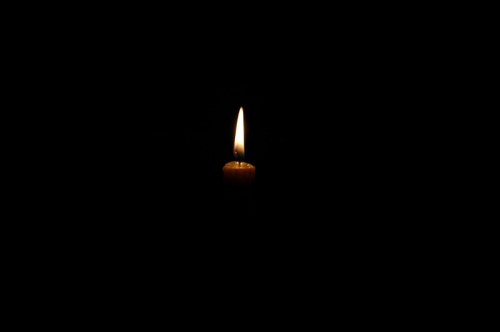
More’s the pity that we must await the Messiah to ignite the final bowl of the Menorah. Our own light is not enough to illuminate the abyss of a world shrouded in darkness. What should be the courtship of estranged but impassioned lovers burning like a forest fire has become a dim flame frozen in obsidian:

I sit before my only candle,
like a pilgrim sits beside the way
Now this journey appears before my candle
As a song that’s growing fainter, the harder I play
That I fear before I end, will fade away
I guess I’ll get there, but I wouldn’t say for sure

-from “Song for Adam”
by Jackson Browne

The Author

In the BeginningWhen someone asked the Radvaz, zt”l, why the Torah lacks vowels he gave an interesting response.

He said, “To understand this we must realize why the angels asked God not to give Torah to mankind, since they wanted God to give it to them. Moshe refuted them with an apparently simple reply, ‘What does it say in the Torah? Do not kill; do not commit adultery. Can angels murder? Is it possible for an angel to commit adultery? Why, then, do you need the Torah?’ ”

He continued, “Not surprisingly, the angels conceded this point. What is strange is what they had in mind in the first place. It seems clear that the angels had a very different way to read the Torah. When read in this manner it had much to teach them, and they wanted it so that they could receive it in the manner suited to them, on their level. Our sages tell us that the entire Torah is formed of Divine Names. The angels wished to read it spiritually at one time without interruption. In this manner, the Torah makes up one long name of God.”

Daf Yomi Digest
Stories off the Daf
No Wasted Letter
Menachos 87

Sometimes I think the Torah has a life of its own. It’s certainly easier and reasonable to think of the Torah as a document that we can examine and learn from, much like any other document. On the other hand, the Torah is also the foundation of our understanding of God, the Prophets, the Writings, Israel, and the Messiah. We cannot simply treat it as if it were a good book on philosophy. Then, there are its mystic properties, such as how the Torah was with God when He created the world:

In the beginning was the Word, and the Word was with God, and the Word was God. He was with God in the beginning. Through him all things were made; without him nothing was made that has been made. In him was life, and that life was the light of all mankind. The light shines in the darkness, and the darkness has not overcome it. –John 1:1-5

The Word became flesh and made his dwelling among us. We have seen his glory, the glory of the one and only Son, who came from the Father, full of grace and truth. –John 1:14

Reading John, the Torah does have a life of its own and a human life at that. No wonder the Angels were fascinated (though, it’s likely that the Radvaz, zt”l did not have Jesus in mind when he wrote his commentary).

The Torah seems to exist in a sort of “multi-dimensional” state, operating differently depending on who is using it and how it is being used. We very much can treat the Torah, and indeed, all of Holy Scripture, as a document to be examined and learned from. I recently reviewed an analysis of the Great Isaiah Scroll recovered from the Dead Sea Scrolls near the ruins of Qumran, and what scholars Steven Lancaster and James Monson reveal about the Messiah is fascinating.

But however illuminating a rational and literary approach to the Torah may be, there is so much more to be discovered if you just change your angle of approach, as the Radvaz, continues to state in our “Story off the Daf”:

“Moshe explained to them that this is not the purpose of the Torah. The point of the Torah is for us to fulfill its material reading, by keeping mitzvos: eating kosher, avoiding non-kosher, and the like. Since there are many ways to read the Torah it is obvious why it is written without vowels or notes—to leave it open to an infinity of possible readings.”

The Radvaz concluded, “This also explains why the oral Torah was not recorded within the body of the Torah itself. It also explains why some stories or statements appear unnecessary while other essentials are virtually left out. This apparent discrepancy is because the Torah has many levels. Believe me, there is not one superfluous letter in the entire Torah. Place this principle before you always and you will always succeed.”.

The Torah is an enormously flexible resource that serves different purposes and has different meanings depending on its audience and its context. I have sometimes wondered why the Torah seems to include information that doesn’t make sense or why other information that would seem absolutely vital to know was “omitted”. God is unchanging but He is also infinite. There is no limit to His being and ultimately, no knowing His objective essense and thus, He can and must contain everything. Since the Torah has to be accessible by human beings, it must be finite which limits what it can contain, but by the explanation presented on the daf, we see that the Torah was created in a manner that conceals how versatile it actually is. We can read the Torah year after year, study the Oral Traditions and the commentaries of the sages, and yet never grow tired of how it speaks to us of things even Angels want to know.

The Word of God calls to each of us in a unique way. Each man or woman hears something different and we respond to the Torah as who we are at the moment we’re listening. A year later, the Torah speaks the same words again, but what we hear is different because the Torah was designed to reach us in a different way as we change and grow.

I am not the same person today as I was a year ago. What the Torah of Moses and the Spirit of God whisper to me out of Heaven captures me in a different way each time I hear it. I don’t always understand what He’s trying to say, but as I draw nearer to God, it becomes impossible for me not to strain my hearing and strive to perceive every word, every sound, and every breath, as one might listen to a lover whisper secrets in the night.

Listening to God through His Torah and His Spirit tells us how to order our lives and more. As we draw closer to Him; as we draw closer to the One who loves us without limit, bit by bit, He shows us the inner nature of the author of our souls.

People think the Torah is all about laws and customs and quaint stories, with a mystical side as well.

In truth, the Torah is entirely spiritual. But when you cannot perceive the spiritual, all you see are laws and quaint stories.

-Rabbi Tzvi Freeman
“More Than Stories”
Chabad.org