Tag Archives: Judaism

Diminishing

Man alone in a caveThe one who has the bride is the bridegroom. The friend of the bridegroom, who stands and hears him, rejoices greatly at the bridegroom’s voice. Therefore this joy of mine is now complete. He must increase, but I must decrease.”

John 3:29-30 (ESV)

Behold, he will slay me; I have no hope; yet I will argue my ways to his face.

Job 13:15 (ESV)

I suppose this is a continuation of my previous meditation which, as I write this, hasn’t gotten a lot of attention (but it’s not exactly uplifting, so I imagine most people don’t know what to say about it).

I’m not experiencing a crisis of faith so much as a crisis of environment (if there is such a thing). I suppose I should consider this “normal” since it was predicted by the Master.

Brother will deliver brother over to death, and the father his child, and children will rise against parents and have them put to death, and you will be hated by all for my name’s sake. But the one who endures to the end will be saved. When they persecute you in one town, flee to the next, for truly, I say to you, you will not have gone through all the towns of Israel before the Son of Man comes. –Matthew 10:21-23 (ESV)

“I came to cast fire on the earth, and would that it were already kindled! I have a baptism to be baptized with, and how great is my distress until it is accomplished! Do you think that I have come to give peace on earth? No, I tell you, but rather division. For from now on in one house there will be five divided, three against two and two against three. They will be divided, father against son and son against father, mother against daughter and daughter against mother, mother-in-law against her daughter-in-law and daughter-in-law against mother-in-law.” –Luke 12:49-53 (ESV)

But before all this they will lay their hands on you and persecute you, delivering you up to the synagogues and prisons, and you will be brought before kings and governors for my name’s sake. –Luke 21:12 (ESV)

In other words, I should expect to be a minority in society and even in my own family. Well, that’s pretty much true. Not a day goes by that someone doesn’t take a shot at my faith on the world wide web and while my home life isn’t actively hostile, as I’ve mentioned before, there are certain conversations that just never take place for the sake of peace.

It’s interesting because I obviously can’t discuss Christianity in my home, but even bringing up conversations about Judaism can get a tad dicey. No, I never comment negatively about Jews and Judaism, but even being too “enthusiastic” about Jewish learning and concepts can elicit a “you’re a Jewish wannabe” comment or (at its worst) “you’re just a Goy, Daddy.” (that last comment admittedly was just a joke my daughter was making, but I have to admit, it did stab at me for a second or two).

But like the Master said, I should expect all this. Not sure about the following, though.

Count it all joy, my brothers, when you meet trials of various kinds, for you know that the testing of your faith produces steadfastness. And let steadfastness have its full effect, that you may be perfect and complete, lacking in nothing. –James 1:2-4 (ESV)

broken-crossI’m not sure because these tests are getting kind of old but beyond that, James, the brother of the Master, addressed his letter to “the twelve tribes in the Dispersion.” Last time I looked, as a “Goy,” I’m not a member of any of those tribes, so is the audience of this message confined to the Jewish disciples of the Jewish Messiah? Hopefully not.

Someone recently suggested on Facebook that I should “renounce idolatry” and convert to Judaism. I know the Jewish gentleman in question was very sincere and I don’t doubt that he meant to be helpful, but it’s not an option. Not that I haven’t toyed with the idea from time to time, but that door is ultimately closed to me. It would mean renouncing my faith in my Lord, which I cannot do. But while millions experience “the peace of God, which surpasses all understanding,” (Philippians 4:7) I continually face the daily wrestling match of faith (Genesis 32:22-32).

It’s easy to get one of two messages from Christianity. The first message seems to be the most prevalent in the modern church and it goes something like, “You’re saved, Jesus is great, no worries from here on in, the heck with the rest of the world as long as you have Jesus.” That’s pretty simplified and perhaps a tad cynical, but just listen to some of the stuff coming out of those megachurches and you’ll understand what I mean.

The second message is one that I think is more historical and perhaps some older Christians still relate to it. That message is sort of like, “You’re a sinner, you’re scum, if it wasn’t for Jesus, you’d be sliding down the gutter on your way to eternal damnation, the world isn’t worth anything, it’s just a slime pit, anyone not saved will fry in their own fat and grease.” OK, that one seems “over the top” as well, but sometimes Christianity is a study in extremes.

Returning to the source, the Bible says, “Hey, I never said it was a picnic. Quit whining and get back to work.”

There’s got to be a better way than this.

The weak link in any system, organization, philosophy, or religion is the people involved. Humanity is the weakest link because no matter how beautiful the system is, human frailty will inevitably screw up its implementation. This is why atheists and secular humanists have plenty of ammunition with which to shoot down people of faith. Of course, it doesn’t help that we Christians are supposed to have a higher standard than generic society, so any time we mess up in public, it gets the maximum amount of press coverage. It also doesn’t help that in its evangelical zeal, some churches use a big, nasty hammer to deliver the message of Christ’s love and salvation. The hammer has bruised and bloodied a lot of folks. Now they want to hit back.

The rest of us get painted (or tainted) by the same brush, whether we had anything to do with swinging the hammer or not. Worse, the author of our faith gets painted with that brush, and he had absolutely nothing to do with what we’ve done with his teachings over the past 2,000 years.

But all that is irrelevant, too. That is, it doesn’t matter because it doesn’t change anything. The teachings about division in families, division in society, and generally being the tail and not the head apply as much today as they did the instant Jesus uttered them back in the late second Temple period in Roman-occupied Judea.

Oh, and about Christianity being a sect of Judaism, you might want to pay attention to how non-Messianic Jews hear this message:

One conclusion I would come to after understanding these issues is that the claim that Christianity has Jewish roots is false. Christianity has Jewish characters involved in the foundation of it, but aside from that it has virtually nothing in common with Judaism.

Messianic Judaism has been useful in pointing out the value of Torah and establishing it as a high priority item within Christianity, however the logical conclusion of seeing Torah for what it is, is to realize that it does not work within Christianity. Torah stands in direct contrast to Christianity on many levels, some of which are mentioned above. Therefore one is forced to decide between Torah and Christianity.

Torah has obvious legitimacy, and is undeniably G-d’s revelation to man as witnessed by millions of people at mount Sinai, whereas Christianity must be an invention of man. It can be a convincing invention, but an invention nonetheless.

Anything which stands in such stark contrast to the Torah, and which teaches that the Torah is something to be set free from, rather than obeyed, is certainly not of G-d. The Holy One, blessed be He, does not issue laws, commandments, judgments, and teachings, only to nullify everything He has taught us at another point in history, especially when He declares that it is for us and our decendents forever.

“How Judaism and Christianity Compare on Fundamental Issues”
from the blog: Kibbitzing Corner

As I mentioned above, Job said, “Behold, he will slay me; I have no hope.” We are in the hands of God. I am in the hands of God. It seems, as John suggested, that for God to be magnified, people need to get really small. At least that’s how I’m seeing it. I know that Christianity’s many critics, including Judaism, would like to see Christians get smaller and smaller and eventually vanish from existence. Christ said that when such events occur, we should persevere, but he didn’t say we had to survive. Plenty of Christians (and Jews as well) have suffered and even died to preserve who they were as people of faith and to not abandon God.

According to the Rebbe, God never intended humans (or at least Jews) to cease to exist or to be rendered insignificant because of their faith:

The ego is not to be destroyed. It, too, is a creation of G-d,
and all that He made, He made for His glory.

Only this: that the ego must know that it is a creation, and that all He made, He made for His glory.

-Rabbi Tzvi Freeman
“Ego Preservation”
Based on letters and talks of the Rebbe
Rabbi M. M. Schneerson
Chabad.org

Dylan Thomas once wrote, “Do not go gentle into that good night,” and while he was talking about old age and inevitable death, catastrophic failure isn’t limited to biological systems. The human spirit can be oppressed from without and within until it finally extinguishes, its light goes out, and all that is left is a human being living in darkness, ironically unaware of its fate.

In writing this meditation and searching for some spark or glimmer of hope in the endless abyss, I came upon an unusual source, the 1957 science fiction film The Incredible Shrinking Man (adapted from the novel by Richard Matheson). At the end of the film, the character Scott Carey, (played by Grant Williams) having defeated a gigantic (to him) spider in order to obtain food, and now despairingly lost; trapped in the basement of his own home, continues to shrink in size, approaching the threshold of the microscopic. In his final moments, alone and without hope of ever regaining his former life, he comes to a realization about who he is ultimately.

I was continuing to shrink, to become… what? The infinitesimal? What was I? Still a human being? Or was I the man of the future? If there were other bursts of radiation, other clouds drifting across seas and continents, would other beings follow me into this vast new world? So close – the infinitesimal and the infinite. But suddenly, I knew they were really the two ends of the same concept. The unbelievably small and the unbelievably vast eventually meet – like the closing of a gigantic circle. I looked up, as if somehow I would grasp the heavens. The universe, worlds beyond number, God’s silver tapestry spread across the night. And in that moment, I knew the answer to the riddle of the infinite. I had thought in terms of man’s own limited dimension. I had presumed upon nature. That existence begins and ends in man’s conception, not nature’s. And I felt my body dwindling, melting, becoming nothing. My fears melted away. And in their place came acceptance. All this vast majesty of creation, it had to mean something. And then I meant something, too. Yes, smaller than the smallest, I meant something, too. To God, there is no zero. I still exist!

Jesus spoke of the humble, the meek, the persecuted. While I can hardly claim to have greatly suffered, should I allow myself to simply shrink below the world of significance, worth, and ultimately humanity because, like Carey, I am alone and outside the realm of “normal” society? Should I, as a person of faith, vanish from the landscape of my family because that faith is perceived as alien, prejudiced, and even idolatrous?

Mathematically, the concept of zero exists but can a human being become zero and yet be alive? Borrowing inspiration from the fictional Scott Carey, if I still mean something to God, then I am not zero. Though devalued by secular humanity, I am not wholly without worth. If God notices even the smallest sparrow as it falls from an infinite sky, won’t he notice me too as I shrink into shadows and dust?

In the darkness of my abyss, is the tiny light I see in the distance a dying spark, or a foretaste of the universe exploding with light?

Opting Out of Yiddishkeit?

On today’s daf we find halachos that apply to converts.

Converting is a huge sacrifice, which God values greatly—and so should we. But as is well known there is a halachah that a non-Jew who converted as a minor can recant his decision upon reaching majority. In that case, he reverts to being a non-Jew. How sad that he lost out on such a special distinction due to some passing whim!

There was a case where a family converted together; mother, father and children. When one son heard that he was allowed to opt out of Yiddishkeit, he honestly said that he wanted to let go of his conversion. “If I am obligated to be a Jew that is one thing, since God wants me to fulfill the mitzvos. But if I am able to be a non-Jew, why should I take on the obligation to do all the mitzvos? How can I know that I will fulfill them as I should? Isn’t it better for me to go the easier but more sure way?”

But when he expressed this wish, the dayan he spoke to wasn’t sure what to do. “I am not sure whether when an entire family converts one who was a minor at the time can opt out. This is a machlokes Rishonim and I am not certain how we rule.”

When this question reached the Chasam Sofer, zt”l, he ruled decisively. “We hold like the Rishonim who rule that a convert whose entire family converted with him cannot opt out of his Jewishness.”

Daf Yomi Digest
Stories Off the Daf
“The Convert’s Choice”
Niddah 49

I’ve been thinking a lot about religious observance recently. Actually, I’ve been thinking about it for a long time and wondering if I’d ever get up the nerve to actually blog about it.

So here goes.

It’s fairly common knowledge within the Messianic Jewish and Hebrew Roots communities that the status of non-Jews and their possible obligation to Jewish religious observance is a matter of some concern. Mark Kinzer’s book Postmissionary Messianic Judaism: Redefining Christian Engagement with the Jewish People is something of a blueprint of one end of the spectrum of Messianic Judaism that advocates for parallel but wholly separate conduits of Jews occupying Messianic Judaism and Gentiles occupying traditional Christianity. In theory, both groups relate to One God and to Jesus (Yeshua) as the Jewish Messiah, but their recommended approaches to religious practice are totally different, and the two groups rarely if ever, interact.

On the other side of the spectrum is the One Law group which states that there are no distinctions or differences between Jews and non-Jews in the Messianic movement. Except for a matter of DNA, Jews are no different from Gentiles in their obligation to the 613 commandments that define the modern understanding of the Torah. This brings up the uncomfortable reality that all Christians everywhere have the same obligation to the Torah, whether they realize it or not. The One Law position must come to the conclusion (though I’ve never heard them state it as such) that the vast majority of the Christian church is continually in sin because they don’t refrain from eating trief and work and play on Saturday.

The educational ministry First Fruits of Zion (FFOZ) has proposed a sort of “middle ground” in this arena with the idea of something called “divine invitation.” FFOZ has produced a number of books and other, similar materials presenting information from Jewish literary sources suggesting that historically, Gentiles were not always completely forbidden from certain Jewish observances. I won’t attempt to list the details here since they are too numerous, but the basic idea is that, while non-Jews are not obligated to fulfill the Torah mitzvot in the manner of Jews, they are, in many cases, permitted to do so.

This would no doubt fly in the face of more traditional Jewish viewpoints and certainly Orthodox Judaism would be in almost complete disagreement. Nevertheless, within the Messianic context, you will find many non-Jewish people voluntarily taking on board some of the Torah mitzvot as they feel led to do so, but with the understanding that refraining from any of the mitzvot does not constitute a sin on the part of a non-Jewish Christian.

Divine invitation is an opportunity for non-Jews in the movement who have become accustomed to keeping certain of the mitzvot to continue to do so without necessarily crossing the distinction barrier between Gentile and Jew and thus preserving Jewish distinction in Messianic Judaism.

But there’s a flip side to the coin. Divine invitation allows non-Jews in the movement or at least associated with the movement to not observe the mitzvot…at all…ever.

It’s been well over a month since I attended FFOZ’s Shavuot conference at Beth Immanuel Sabbath Fellowship in Hudson, Wisconsin. For several days, I was allowed to worship in what seemed to be the ideal Messianic Jewish religious environment. The Gentiles still outnumbered the Jews by quite a bit, but the model for worship was definitely that of the synagogue, though great accommodations were made for non-Hebrew speakers and readers.

There were a lot of non-Jews worshiping in the Jewish manner, though in that environment, they were not obligated to do so. We non-Jews were not obligated to eat the fine kosher food that was provided. We were not obligated to daven shacharit. We were not obligated to don tzitzit. And yet most of the non-Jewish worshipers did so and no one seemed to mind.

But what if we didn’t? I mean, if we’re not obligated and let’s say, we don’t feel led, so what if we didn’t worship in even a remotely Jewish manner? I suppose nothing bad would happen. But is there an expectation that even if we don’t have to keep the mitzvot, that we should, particularly if we are choosing to worship with Jews who are worshiping God as Jews in a (Messianic) Jewish synagogue?

It would be an interesting experiment in that environment to have a non-Jew observe absolutely none of the mitzvot, just to see what it would be like to decline a “divine invitation.” I suppose it would be like going to your high school senior prom and then continually refusing invitations to dance. What would be the point?

The point I suppose, is that the “prom” is where you feel you belong, where your friends and maybe your family are, and yet you feel you aren’t called to dance their dance because you believe you don’t really belong to that group of dancers.

OK, it’s a crummy metaphor, but you get the idea.

Of course, most of the time, I don’t worship with anybody. In fact, I don’t worship in a community at all. This avoids the whole problem of how I should worship, identity confusion, and the whole shooting match, but there’s a problem. I live with Jewish people. Do I do what they do?

Well, sort of.

Here’s the scary part.

The Jewish people I live with aren’t particularly observant.

There, I said it.

It’s true. At this point, my wife and daughter don’t even light the candles on Erev Shabbat. For a long time, I was the only one doing it, but it seemed absurd that I continue since I’m the only non-Jew in the house and a male and I’m the one lighting the candles. I kept asking my wife on Friday as sundown approached, “Do you want to light the Shabbos candles?” Her response was always something like, “You can if you want to.”

Like I said, it got kind of absurd. No one seemed to care if I lit the candles or not. So I stopped.

My wife hasn’t gone so far as to serve up pork chops for dinner and in fact, she’s rather studious about making sure we all continue to eat “kosher style” (see Leviticus 11), but our kitchen isn’t kosher and, strictly speaking, my wife doesn’t understand why I don’t choose to eat trief, since the kosher obligation doesn’t apply to me.

We also (gasp) work on the Shabbat. This part really bothers me, but there’s not a lot I can do about it. My daughter’s and my wife’s employers require that they work highly variable hours including the weekends, and they often work late Friday nights and on Saturday. The missus has made no bones about saying she would like me to keep my writing and editing schedules up on the weekends, though I’m able to refrain from household chores on Shabbos for the most part, deferring them to Sunday. I can’t remember the last time she went to shul, except perhaps to cook for some special occasions.

Yes, I do know that my Jewish family members are obligated to the Torah, though none of them are observant at the moment.

I suppose that makes me a bad husband and father for not compelling them to do so.

But I can’t really compel them to do anything. I have tried being supportive, but my children are all of adult age and my wife is of course, my wife, so she takes responsibility for her Jewishness and again, it seems rather absurd for a non-Jew and particularly a Christian to be telling her the business of being Jewish.

So having tried that and seeing that it didn’t work out so well, I stopped.

(I suppose at this point I should add that my wife subscribes to and reads the same (more or less) Chabad.org newsletters and tutorials that I do, which means her “morning meditations” are substantially similar to my own. I should also say that she anticipates leaving her current “slave job” at some point in the reasonably near but not clearly defined future, so what she does with her “free” Sabbaths after that is up in the air…but I can hope.)

The whole “divine invitation” and Christian identity thing means that I am not obligated to a Jewish lifestyle. I’m sure most Jews out there are relieved to hear that I’m not living like a Jew. But depending on your view of Jewishness and Jewish obligations to God, some of you may be distressed that my Jewish family members are not observant. Heck, there are members of the local Reform shul who are more observant than my family.

I can imagine that many Jews would blame me for all of this. After all, my wife and I are intermarried. Intermarriage is usually seen as the gateway for a Jew to leave Judaism and assimilate into Gentile secular culture or even into Christianity. While I can assure you that my wife has no attraction to Christianity on any level and I don’t believe she has become secularized, she doesn’t display a strong religious Jewish lifestyle.

More’s the pity.

(I’ll add here that my wife does keep up on events at the local synagogues and does have definite opinions about people at the Reform shul with a “questionable” Jewish background positioning themselves to lead services and teach [and that would never happen at the Chabad]. She’s “OK” with non-Jews and even Christians attending synagogue as long as they don’t talk about their faith, but she draws the line at “Messianics” or those who were formerly associated with the movement assuming any formal synagogue role.)

I have been trying to encourage my son David to return to the synagogue. His wife has recently rekindled her interest in attending church but I don’t think David would go with her on a regular basis. His basic internal template for religion is still Jewish and he remembers fondly some of his “debates” with the local Reform Rabbi. Actually, just last Sunday, my wife said she’d love it is David would visit the Chabad here in town, so she has her hopes as well.

The “religious identity” of my family continues to be in flux. I’m not even sure how much more my wife can tolerate my Christianity, so where I’ll end up in the months and years ahead is uncertain. I’d like my Jewish family to return to Judaism as an observant lifestyle. I hope they don’t see me as a barrier. I’m really anything but. In fact, in a recent conversation about conversion with my wife, (hence the quote at the beginning of this “meditation”) she said it would be ridiculous for a Gentile to try to convert to Judaism in Boise, (although a good friend of hers converted within the past year) since the convert wouldn’t have a strong Jewish community in which to live. So I don’t think my wife wants me to be “Torah observant” in any way, shape, or form. But what about her?

It would seem that for the sake of peace in the home, I must decline my “invitation,” and as a Christian, I would not only make a poor model of Jewish observance for my Jewish family, but I would actually be an annoyance if I tried. Thus, I cannot encourage them by my example since my example would be completely unwelcome.

I suppose if I were a Jewish husband and father, it might be different, but that’s not an option. Maybe the fears of Judaism are authentic fears and intermarriage is the path to slow death for the Jewish people. Even though it is not my intent, I certainly seem to be killing the Judaism in my home.

Across the long span of history, an untold number of Jews have suffered and died to preserve who they are as Jews. Given that realization, I wish I understood what was going on in my own home. But then, in this particular case, I don’t have a say. I only have to wait and pray that God, who has never abandoned His people Israel before, won’t abandon those who live in my household now.

My wife and children are Jewish. I want and even need them to live like Jews. May the God of mercy grant this for them and for the sake of Israel.

And Don’t Forget To Dance

Imagine there’s no heaven
It’s easy if you try
No hell below us
Above us only sky

-John Lennon
Imagine (1971)

And I heard a loud voice from the throne saying, “Behold, the dwelling place of God is with man. He will dwell with them, and they will be his people, and God himself will be with them as their God.”

“He will wipe away every tear from their eyes, and death shall be no more, neither shall there be mourning, nor crying, nor pain anymore, for the former things have passed away.”

Revelation 21:3-4 (ESV)

I hate to keep picking on Joe and Heidi, but their continual battle with cancer is a continual inspiration to me. More than that, it’s their courage, faith, and humor in the face of living a nearly impossible life that is the real inspiration. It puts to shame most of us who complain about our rather modest discomforts.

The first thing I thought of when I saw the photo of Joe and Heidi dancing, and knowing something about the hardships they face was, “this is what it must be like to watch people dancing in Heaven.” Then I thought about the “no more tears” portion from John’s Revelation. Then I thought about writing.

And here I am.

But what if, as John Lennon suggested, that there is no Heaven. What if we face insurmountable hardships, heartbreak, tragedy, and sorrow with no hope and no end except a black and empty death? How would that change us? What would it make human behavior like?

Or is this why the world is in the shape it’s in today? Because the majority of the world, as Lennon suggested, believes there is no Heaven…no accountability…no God?

I know I’m going to experience some serious “blowback” about that comment from secular humanists and atheists who see themselves as the greater moral force in the world and I can’t say they’re not. It doesn’t take a belief in God in order to do good. However, I think it takes such a belief to give it all a greater meaning beyond our temporal context. But some atheists cast themselves in the superior role because they don’t do good just to satisfy some abstract and alien being sitting in judgment on a throne. They do so because…um, why? Because it’s the right thing to do? But how do they know? How does anyone know?

Where do we get the idea that something is good and some other thing isn’t? What is “good” and what is “evil?” How do you know? If you’re an atheist, there is no moral structure attached to your belief since not believing in God isn’t value laden. It simply means you don’t believe a supernatural being created the universe and is involved in our lives.

What if there is no Heaven for Joe and Heidi? What would it mean in terms of the overwhelming fight they’ve been waging against cancer? Have they been praying to empty air? Has the courage they’ve gotten from faith been in vain?

Based on Lennon’s lyrics, he seemed to believe that if we deconstructed all human (and supernatural) infrastructures, organizations, groupings, and distinctions, the world of human beings would be a better place. Maybe it would be, I don’t know. It won’t happen because human beings absolutely need to identify, label, and organize their environment in order to make any sort of sense of it. All people groups use two basic names. One for themselves and the other for everyone else. Those names mean something to them and to us. Of course, they might not mean the same things.

When I say I’m a Christian, I mean a particular thing. Other people hear that label and perhaps comprehend it in a different way than I do. Some people hear that label and comprehend it in the most negative possible light. In their world, they have one name for themselves, which means they’re “good”, but the name “Christian” or “Jew” means something that bad, wrong, immoral, or evil (and where did the concepts of good and evil come from, anyway?)

But from inside my point of view and from inside my faith, I don’t perceive my faith to be evil. I know I am not a perfect person and I have made mistakes. I’ll make mistakes again. I don’t brag about it or enjoy it, but that’s part of what it is to be a flawed human being living in an broken world. And after all, human beings broke it.

I’m accountable not just to other human beings (my wife, my family, my employer, the government), but I’m accountable to a force that is larger than human institutions and an intelligence that comprehends the infinite mysteries of the universe. For me, there is a greater sense of morality and ethics that exists and One who is the origin of what it is to be good or to be evil.

What shall we say, then? Is the law sinful? Certainly not! Nevertheless, I would not have known what sin was had it not been for the law. For I would not have known what coveting really was if the law had not said, “You shall not covet.” –Romans 7:7 (ESV)

Sometimes it helps to have an external standard to help us define our role in life. For those of us who have faith, God is that standard. For those without faith, I suppose our government, or the news media, or a social organization will have to do. I can’t tell anyone else how to live their lives, but it would be wonderful if others would stop insisting they have the right to tell me to abandon my faith. But that’s the way of the world. If faith isn’t strong enough to withstand the winds of criticism from society, it will never stand up against the brutal storms of some disaster like cancer.

So Joe and Heidi showed me what it’s like to dance in Heaven this morning. As I looked at their photo, all of the sorrow and grief and hostility of the world surrounding me momentarily faded away. Imagine there is no Heaven if you want. But grasping hold of my faith not only gives me peace about the future, but the strength to carry on in the harsh and uncertain present and to try to do a little good in the world I live in every day. I pray, whoever you are reading this, that you can find the same.

In your worldly business, just do what needs to be done and trust in G-d to fill in the rest.

In your spiritual business, however, you’ll have to take the whole thing on your own shoulders. Don’t rely on G-d to heal the sick, help the poor, educate the ignorant and teach you Torah.

He’s relying on you.

-Rabbi Tzvi Freeman
“Make it Your Business”
Based on letters and talks of the Rebbe
Rabbi M. M. Schneerson
Chabad.org

And don’t forget to dance.

A Christian Regarding Judaism

Such autonomy was made possible by God’s readiness to limit His say in human decision making and to grant the Jewish community the right to decide for itself how it should understand the commandments that it had received from Him in the Torah. Human reason, employed in clarifying and elaborating the halakhah, was seen as sufficient for that, without any need for divine intervention. Human responsibility for the conditions of life, moreover, was not confined to the religious sphere in the narrow sense, but included mastering the sciences and establishing institutional frameworks for alleviating disease, poverty, illiteracy, and other social evils.

-Rabbi David Hartman
Chapter 10, “Two Competing Covenantal Paradigms”
A Living Covenant: The Innovative Spirit in Traditional Judaism

This may not seem like a typical description of a religious framework if you’re an atheist or an agnostic. Most atheists I interact with seem to believe that religion and science are mutually exclusive terms. Some atheists also seem to think that religion and the moral responsibility to alleviate “disease, poverty, illiteracy, and other social evils” are also incompatible concepts and practices.

If you’re a Christian, you may also take some exception to Rabbi Hartman, since he appears to be advocating for the idea that God gave human beings the ability to decide just how to apply the Word and Will of the Creator in the world. I mean, wasn’t all this stuff made absolute and set in granite the second God caused Moses to create the Pentateuch (Torah) and the other authors to write the rest of the Bible?

I ask that last question ironically.

I can’t even say what Rabbi Hartman is proposing represents the entirety of Jewish thought since, as we’ll see, there are differing opinions in Judaism on just about everything. That, by the way, is the point for today’s mediation, but we’ll get to it all by the by.

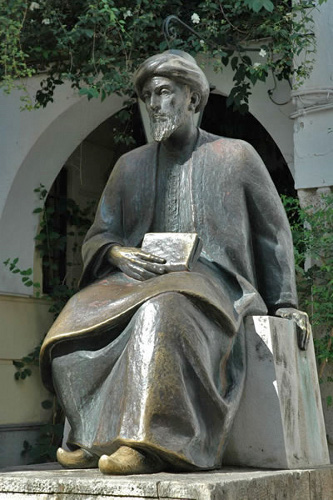
In this chapter of Rabbi Hartman’s book, he compares and contrasts the viewpoints of two of the great Jewish sages: Maimonides and Nahmanides. You can learn more about these two Jewish philosophical luminaries by clicking the links I’ve provided, but certainly studying the wisdom and writings of both of these gentlemen would not be a waste of your time or effort.

I won’t go into too many of the details Rabbi Hartman presents, but I do want to draw attention to one critical area of disagreement between Maimonides and Nahmanides that should resonate with some Christians:

Messianism in Maimonides is therefore simultaneously a heroic and a realistic principle of hope anchored in the eternal covenant of Sinai. It is important for him because it does not allow Judaism to become merely a private existential experience. Messianism counteracts the heresy of turning Judaism into a faith for isolated human individuals. It springs from the essential concern of Judaism with the sociopolitical drama of the community. It also expresses the dimension of Judaism that goes beyond the tribal and national framework, since it makes the Jewish community aware that Judaism’s fullest expression requires a changed world order if there is to be a reign of peace.

Nachmanides, on the other hand, uncompromisingly embraced the assumption that Maimonides resolutely sought to eliminate: in the messianic era human nature will be changed. It will be redeemed such that human freedom will no longer lead to sin…

Clearly for him, the messianic age will be characterized by a fundamental transformation of human nature. The problematics of human freedom will be overcome, as all will then yearn to live always in accordance with the will of God.

In reading this chapter from Rabbi Hartman’s book, I immediately found the perspective of Nahmanides very familiar because it seemed to echo the viewpoint of Christianity (and I’m sure Nahmanides never intended such a linkage). As least as I recall my own early days in the church, I was taught that in the Messianic Age, we would lose all desire to sin and would only long to please Jesus in a complete and perfect manner.

Maimonides, by comparison (at least as Rabbi Hartman presents him) believed that the Messianic era will be a time of social and political change. Israel will be the head of the nations and the Messiah will rule “with a rod of iron” such that the other nations of the world will obey his laws. Man will still have the ability to sin and perhaps even the desire, but the rule of King Messiah in Israel will be obeyed as God establishes His kingdom on Earth. Certainly Maimonides does not deny a supernatural reality, but understands that it works in concert with the natural mechanics of humanity and politics. For Nahmanides, the supernatural power of God simply overwhelms mankind and our very natures are changed such that it is His miraculous power alone that brings about His rule with no intervention by human institutions.

Why do I bring this up?

To throw a monkey wrench into the machine.

More accurately, to present the idea which may not occur to some Christians (or for that matter, atheists and everyone else), that there is more than one way Jews look at God, faith, Torah, halakhah, and the Messiah. Rabbi Hartman even confirms this:

To prevent misunderstandings, I must emphasize again that I am not claiming that Maimonides provides the only possible way whereby an observant Jew can participate in a return of the Jewish people to history such as has occurred in modern Israel.

Rabbi Hartman was talking specifically about the establishment of the modern state of Israel as part of the Messianic plan and the rather troublesome divide in Judaism as to whether Israel should even exist before his arrival (return) or not. I’m not competent to answer that question and, as I said before, my main point here is just to point out that Judaism isn’t a single, cohesive idea, concept, or religious movement. There are different focuses and perspectives in larger observant Judaism, many that contradict each other and occasionally seem wholly at war (sounds sort of like how different Christian denominations treat each other, don’t you think?).

Even though I am married to a Jewish wife, I am an outsider looking in. But if I can say that and live with a Jew every day, I can only imagine what it must be like for the traditional Christian with little knowledge of Judaism and Jews, beyond what is preached from the pulpit, to try to understand what it’s like on the other side of the fence. I think, as Christians, it’s important for us to make that attempt, though. We often “demonize” that which we don’t understand, and history has shown us that such “demonization” of the Jewish people has led to pogroms, exile, torture, and death.

I want to present this tiny slice of Judaism as an example that Jews are not a “type” or a “thing” or an object of any kind. They are a people. They are dynamic. Religious Judaism has many shades and colors and textures. It is even possible for Judaism to teach us a thing or two about our own Christianity. But in order for that to happen, we have to be willing to let ourselves become uncomfortable and to explore new territory.

I’m not talking about walking out of the church, far from it. I’m only suggesting that the next time you look at a Jewish person, try to see a person, a human being. If they are a religious Jewish person, try to see their faith, their relationship with God, their desire to serve Him, not just a collection of “dead” rules and regulations.

Judaism is alive. Jews are alive. It’s kind of cool, actually. It shows the rest of us that in spite of thousands of years of enmity between Jews and the rest of the world that ultimately led to the murder of six million Jewish souls, God kept His promise that the descendants of Jacob would always be a people before Him.

Jews will always be a people in the world and among us, the Gentile nations. If you love and laugh and hurt, so do they. Jesus commanded us to love our neighbors as ourselves (Matthew 22:39). Perhaps we should learn to do so with all of our neighbors, including our Jewish neighbors because of the ways of peace. If all people, religious and otherwise, could put that into practice as well, it would certainly be a plus.

Oh, I’m sure people who are more informed about the history of religious Judaism may point out my mistakes. But remember, I sometimes stick my neck out to try and make a point, and I don’t know everything (alas).

Randomly Covering Territory

Do you only believe when you can see with your eyes? When your prayers are answered and miracles carry you on their wings? Or do you also believe when circumstances fly in your face?

If it touches you to the core, if it is a belief you truly own, if it is as real to you as life itself, then it does not change.

And if it does not change, then you are bound up with the true essence of the One who does not change.

-Rabbi Tzvi Freeman
“Faith in the Dark”
Based on letters and talks of the Rebbe
Rabbi M. M. Schneerson
Chabad.org

I’ve said before that I don’t consider myself the “sharpest knife in the drawer.” In the world of faith, I think I have plenty of company, though. For instance, I don’t think most Christians consider the idea that there are two basic levels of knowledge in our religion (or probably most religions): the common worshiper’s view and the scholar’s view. For instance, New Testament scholar Larry Hurtado recently posted on his blog an article called An “Early High Christology”. I mean really. What in the world is high Christology and what’s the difference between high vs. low Christology?

I’ll let you click the links I provided since my discussion today isn’t focused on those topics. I’m just including them to illustrate that most people in the church don’t have the same view of God, Jesus, and the Bible as do theologians and Bible scholars. These people talk a different language than we do and conceptualize the Word of God in ways most of us can’t even imagine. I’m not even sure most of them could communicate their ideas and perspectives to a crowd of “regular Christians” at their local neighborhood church in any successful way.

Which is kind of a shame, because the information these people work with would almost assuredly challenge and perhaps even change the viewpoint and direction of most believers in most churches if we had access to it in a comprehensible way.

Well, they do publish popular books, some of them anyway, but most Christians don’t take advantage of that material (let alone anything more scholarly, such as a Ph.D Thesis). Most people who sit in the pew on Sunday are content to believe that they are being adequately “fed” by their local Pastor, who no doubt is doing a good job, but may feel constrained to offer only the “food” he or she believes the audience will comfortably tolerate.

I occasionally get “dinged” for including non-Biblical sources in my writings since they are, after all, non-Biblical and thus cannot carry the same weight of authority as the scriptures in the Bible. But I’m no Bible scholar and I do love a good metaphor, so I include things like Rabbinic midrash, Chassidic tales, and commentary about Kabbalah, largely for their cultural, metaphorical and symbolic meaning. I certainly can’t discuss them from the perspective of a Pastor, Rabbi, or someone else with an advanced education in Theology or Divinity.

That doesn’t keep me from being curious though, and curiosity often leads me down interesting if troublesome paths.

Here’s one such path:

Numbers 22-24: While the Numbers text itself is inconclusive, both rabbinic legend and the Apostolic Scriptures clearly paint Balaam as wicked through and through.

“The Error of Balaam”
Commentary on Torah Portion Balak
First Fruits of Zion

Um, what was that? The Torah was inconclusive about the nature and character of the “wizard” Balaam, but both the New Testament and midrashim agreed that he was evil? That seems like an odd combination. Of course, it’s not that the New Testament writers and the authors of midrash expected to agree with each other, but in this case, strangely enough, they did. Here’s the New Testament commentary on Balaam.

Forsaking the right way, they have gone astray. They have followed the way of Balaam, the son of Beor, who loved gain from wrongdoing, but was rebuked for his own transgression; a speechless donkey spoke with human voice and restrained the prophet’s madness. –2 Peter 2:15-16 (ESV)

But these people blaspheme all that they do not understand, and they are destroyed by all that they, like unreasoning animals, understand instinctively. Woe to them! For they walked in the way of Cain and abandoned themselves for the sake of gain to Balaam’s error and perished in Korah’s rebellion. –Jude 1:10-11 (ESV)

Admittedly, the opinions being rendered about Balaam in the New Testament text are rather brief. But what about the midrash?

Some say Balaam of Pethor (פתור) was called a money-changer (petor, פתור) because the kings of the nations rushed to him for counsel in the same way that people rush to a money-changer to change their currency. –Numbers Rabbah 20:7

This may not be the only Rabbinic commentary on Balaam, but it’s the only one I have access to due to my limited knowledge in this area.

Am I saying that we can compare the New Testament and Talmud, for example? Probably not, or at least, only very, very carefully, with lots of caveats attached (as a side note, can the New Testament and the later Rabbinic commentaries both be considered midrash?). On the other hand, there is just so much we don’t truly understand about the Bible, and there are so many other sources of information that we have access to that may provide additional perspective. We just need to be able to clearly delineate between the Bible and other information sources. We also need to remember that we don’t have to be so binary in our thinking that we always have to say, “Bible good! Everything else, bad!”

After pursuing my personal faith issues for the past few years, I’m slowly coming to the conclusion that the Bible doesn’t always tell us the “whole story.” Both Christian and Jewish scholars and sages have spent the past several thousand years trying to understand the mind of God by delving into the Word of God. They’ve produced an untold amount of commentary that their audiences judge to be of greater or lesser value in defining the faith. The fact that gentlemen like Larry Hurtado even exist as New Testament scholars tells us there is more to be learned about the New Testament than we already know or think we know. I’m sure the same is true for the rest of the Bible.

I’ve previously mentioned last Thursday’s conversation between me, my son, and two other believers that lead to quite an interesting theological discussion. One of the things I didn’t mention was that David asked me what the minimum amount of knowledge was that would still qualify a person as a believer in God and a disciple of the Master. I don’t recall the details of my answer, but I don’t doubt it’s a good deal less than what the scholars, sages, and experts possess.

I suppose we could limit ourselves to knowing just the basics.

And one of the scribes came up and heard them disputing with one another, and seeing that he answered them well, asked him, “Which commandment is the most important of all?” Jesus answered, “The most important is, ‘Hear, O Israel: The Lord our God, the Lord is one. And you shall love the Lord your God with all your heart and with all your soul and with all your mind and with all your strength.’ The second is this: ‘You shall love your neighbor as yourself.’ There is no other commandment greater than these.” –Mark 12:28-31 (ESV)

But people are curious creatures. We very rarely hold ourselves back to the basics, well, some of us, anyway. We want to know more and we push our limits. We push the limits of religious propriety, asking questions the church doesn’t want to answer. We push our intellectual limits, asking questions that have answers we may not have the ability to understand. We push the limits of what are considered viable information sources and methods of study and what are not, at least by those folks who are “in the know,” such as Hurtado or Timothy George.

But the alternative is to shut up, don’t ask questions, and do as we’re told. For some people, that’s the entire scope of their faith. For others, for people like me, that would be the end of my faith. It would die for lack of nourishment.

So I’ll probably keep asking questions, being rebuffed, offending people, entering areas that are “off limits” to mere mortals and those of us with a limited religious education (and IQ), and generally stubbing my toe every other step.

I feel like a person who is trapped in an endless, man-sized maze looking for the cheese. Problem is, the maze is completely blacked out. I can’t see a thing. So the only way to discover my path is to bump into a lot of walls as if I were a human Roomba. My path seems completely random. Hopefully, I’ll cover the necessary territory.

What else can I do?

You don’t need to move mountains.
You just need to know where to aim.
You can transform an entire family forever with one flickering Shabbat candle of one little girl.

-Rabbi Tzvi Freeman
“A Small Candle”
Based on letters and talks of the Rebbe
Rabbi M. M. Schneerson
Chabad.org

I recently read a very interesting blog post written by Jacob Fronczak called Every man is not a theologian which seems to give me a sort of “permission” not to pretend I know what a theologian knows. You might want to have a look and see what you think.

Being Married to the Girl with the Jewish Soul

“To get to the point, our daughter has informed us that she has fallen in love with a non-Jew, and that they intend to marry. We have tried everything to dissuade her, but our arguments, appeals, threats and tears have all been to no avail. She now refuses to discuss the matter with us at all, and has moved out of our home. Rabbi! You are our only hope! Perhaps you can reach her; perhaps you can impress upon her the gravity of the betrayal against her people, her parents and her own identity in what she intends to do!”

“Would she agree to meet with me?” I asked.

“If she knew that we had spoken to you, she’d refuse.”

“Then I’ll go speak to her on my own.”

I took her address from her parents, and rang her bell that very evening. She was visibly annoyed to learn of my mission, but too well-mannered not to invite me in. We ended up speaking for several hours. She listened politely, and promised to consider everything I said, but I came away with the feeling that I had had little effect on her decision.

For several days I pondered the matter, trying to think of what might possibly be done to prevent the loss of a Jewish soul.

-Aaron Dov Halprin
“A Jew in Brooklyn”
from “The Life and Teachings of Rabbi Menachem M. Schneerson”
Translated from the Hebrew by Yanki Tauber
Chabad.org

The loss of a Jewish soul.

Derek Leman recently posted a link to a discussion “between Messianic Jew David Brickner and John Piper” concerning “supersessionism.” From a supersessionist Christian point of view, the only way for a Jewish person to become reconciled to God and the Jewish Messiah is to forfeit his or her Jewish soul.

The loss of a Jewish soul.

Is that really what the God of Abraham, Isaac, and Jacob would want?

I know Christians who would answer “yes” so fast that it would make my head spin. But then you see, I have a Jewish wife. She is a Jewish soul.

I’m not going to go into the whole “is she saved or not” argument, which is probably way over my head (though I frequently wade into waters that are way over my head). Of course, it would gladden my heart if she would come to know, or at least be re-acquainted with (as she was in years past) the Jewish Messiah, but in her view of Judaism, which is not unlike that of the Chabad, a Jew does not believe the “Messiah of the goyim” is the Jewish Moshiach.

The local Rabbi consults the Rebbe and he presents a solution. The solution to the problem of the Jewish girl who intended to marry a non-Jew was to tell her that there was a Jew in Brooklyn who was deeply troubled and could not sleep at night because of her intentions. The Jew (whether this story is true or not, I have no idea) was named “Rabbi Menachem Mendel Schneerson, known as the Lubavitcher Rebbe.” Although the girl lived in Brazil and had never met the Rebbe or even seen a picture of him, when the local Rabbi showed her a photo of the Rebbe, she exclaimed, “this man has been appearing in my dreams and imploring me not to abandon my people.”

The story ends without telling us what the girl does, but presumably, she breaks off her engagement to the non-Jewish fellow and returns to her family. Not very much like the story between me and my wife, but then we were married for many years before she became determined to enter into the Jewish community and decided that a Jew would never believe that Jesus was the Messiah.

I’ve been pondering this story for several days but only read the following tale just a few minutes ago (as I write this):

Rabbi Zalman Serebryanski, a senior chassid from Russia and dean of the Lubavitch Rabbinical College in Melbourne, Australia, once brought a girl to Rabbi Chaim Gutnick. “Please, help this girl convert,” he asked.

Rabbi Gutnick listened to the girl’s story. She lived in Balaclava, and from her youth had felt a strong attraction to Judaism. Whenever she heard stories of the Holocaust, she was deeply touched. She had been reading and studying about Judaism for a long time, and now wanted to convert.

Rabbi Gutnick was moved by her sincerity. Nevertheless, he did not want to perform the conversion. The girl was still living at home with her non-Jewish parents. Would she be able to practice Judaism in her parents’ home? Would her interest continue as she matured into adulthood? Since he could not answer these questions, he decided to let time take its course. If the girl was still interested when she was older, she could convert then.

Rabbi Gutnick’s refusal plunged the girl into deep depression, to the extent that she had to be confined to a hospital. The elder Reb Zalman, stirred by the depth of her feelings, continued to visit her from time to time.

After several weeks, he called Rabbi Gutnick, telling him of the girl’s condition and asking him whether perhaps he would change his mind because of the strength of her feelings.

-Eli and Malka Touger
“The Girl Who Had To Be Jewish”
from “The Life and Teachings of Rabbi Menachem M. Schneerson”
Chabad.org

This appears to be the opposite of the previous story. Here, a non-Jewish girl is pursuing Judaism to the point that she becomes severely depressed when the option is denied her. On the surface, it seemed conversion was impossible because her family was Anglican, but appearances can be deceiving. In this case, the Rebbe is once again consulted and the results are surprising.

Rabbi Gutnick did not receive an immediate reply to his letter. But at a later date, at the end of a reply to another issue, the Rebbe added: “What’s happening with the Jewish girl from Balaclava?”

Rabbi Gutnick was surprised. The girl and Reb Zalman had both made it clear that her family was Anglican!

He and Reb Zalman went to confront the girl’s mother. At first, she continued to insist that she was Anglican, but as the sincerity of the two rabbis impressed her, she broke down and told her story. She had been raised in an Orthodox Jewish home in England. As a young girl, she had rebelled against her parents and abandoned Jewish life entirely, marrying a gentile and moving to Australia. She had not given Judaism a thought since. She loved her daughter, however, and would not oppose her if she wished to live a Jewish life.

Once the girl’s Jewishness was established, Rabbis Serebryanski and Gutnick helped her feel at home in Melbourne’s Lubavitch community. She continued to make progress in her Jewish commitment, and today is a teacher in a Lubavitch school.

But Rabbi Gutnick still had a question: How did the Rebbe know she was Jewish? At his next yechidut (audience with the Rebbe) he mustered the chutzpah to ask.

The Rebbe replied that, at Reb Zalman’s urging, the girl had also written him a letter. “Such a letter,” the Rebbe declared, “could only have been written by a Jewish girl.”

Again, I have no idea if this story is true, but it is compelling, especially to me.

My wife’s mother was Jewish and her father was a non-Jew (both of my in-laws passed away many years ago). My wife’s mother, as a young woman, rejected her family in Boston and her Judaism and walked away from both, about seventy years ago. My mother-in-law met my father-in-law on a blind date and they subsequently married and had five children. At no time did the fact that my mother-in-law was Jewish ever come up in the family.

True, my wife as a child, knew that her maternal aunt and cousin, who lived in Southern California where she grew up, were Jewish, but she never made the connection that her mother was Jewish (and thus, her children) until my wife was a young woman herself.

Of her two sisters and two brothers, only my wife was driven to self-identify as a Jew and decades later, to pursue a life as a Jewish woman.

The girl who had to be Jewish.

These two stories collide because the girl who had to be Jewish married the guy who ended up being Christian.

The thirty years of our marriage haven’t always been easy for one reason or another. I think any couple who has been married for decades will say that there have been trials in their relationship from time to time. It’s not all romance and flowers. But typically, at a foundational level, the couple is united in terms of their basic worldview. If the husband is a Christian, usually so is the wife. If the wife is an atheist, usually so is the husband. You get the idea.

Jewish/non-Jewish interfaith marriages are at an all-time high as far as I understand the statistics, and this is a crisis in the world of Judaism. Particularly Orthodox Jews see the marriage of a Jew to a non-Jew (and especially a Christian) as the loss of a Jewish soul.

There are plenty of books, guides, and advice blogs that address interfaith marriages, but usually the couples being targeted arrive at their wedding day as fully realized Jews and Christians. As far as I know, all interfaith couples at my local Reform/Conservative and Chabad synagogues are Jew/Goy (non-Christian). Some of the non-Jews who have married Jews convert to Judaism. The issues are complex and troublesome but not insurmountable.

A few weeks ago, I was talking to my wife about some of the things that had happened at the First Fruits of Zion (FFOZ) Shavuot conference in Hudson, Wisconsin. One of the issues was having Christians who are already in a church or who would be willing to return to a church, be sort of “messengers” and advocates for a positive relationship with Jewish people within the Christian community.

My wife’s response was something like, “Are you thinking of going back to church?” I wish I could remember her exact words. They could have been, You aren’t thinking of going back to a church, are you?” But I’m not sure. I’m also not sure if the tone of her voice registered any distress or not. It’s hard to tell with her sometimes. She plays her cards “close to the vest,” so to speak.

If we had entered our marriage with her as a fully realized Jew and me as a fully realized Christians (we were agnostics/atheists on our wedding day and for many years afterwards) and if we agreed to still get married, we probably wouldn’t be experiencing what we are today with each other. I’ve asked her about this aspect of our relationship point-blank, but she remains elusive.

As nearly as I can understand my options, the best thing for me to do is to let her be “the girl who has to be Jewish” and for me to be a low profile Christian at home. I don’t think we have a “typical” interfaith marriage, if there is such a thing. I don’t know if she sees my faith as somehow threatening to her, but it isn’t something that she’s comfortable discussing.

PrayingBut I don’t want the world to lose another Jewish soul. Supersessionist Christianity wouldn’t care, and would walk all over her Jewish soul without feeling the slightest pang of guilt or remorse. However, that Jewish soul is my wife. She gave birth to three other Jewish souls who are my children. Like any husband and father, when confronted with a threat to the family, I become defensive and protective. I cannot let their Judaism be extinguished for the sake of someone else’s theology…not even my own.

For I could wish that I myself were accursed and cut off from Christ for the sake of my brothers, my kinsmen according to the flesh. They are Israelites, and to them belong the adoption, the glory, the covenants, the giving of the law, the worship, and the promises. –Romans 9:3-4 (ESV)

Paul was in anguish over his Jewish brothers and sisters who did not understand the blessings of Jesus the Messiah and who would be temporarily “cut off.” He was sincerely willing to become accursed and cut off from his own salvation for the sake of other Jews. It meant that much to him; his Jewish brothers and sisters meant that much to him.

Although I am not a Jew, how much more should my Jewish wife and children mean to me?