Tag Archives: Judaism

Shine

Inner lightThey set out from Mount Hor by way of the Sea of Reeds to skirt the land of Edom. But the people grew restive on the journey, and the people spoke against God and against Moses, “Why did you make us leave Egypt to die in the wilderness? There is no bread and no water, and we have come to loathe this miserable food.” The Lord sent seraph serpents against the people. They bit the people and many of the Israelites died. The people came to Moses and said, “We sinned by speaking against the Lord and against you. Intercede with the Lord to take away the serpents from us!” And Moses interceded for the people. Then the Lord said to Moses, “Make a seraph figure and mount it on a standard. And if anyone who is bitten looks at it, he shall recover.” Moses made a copper serpent and mounted it on a standard; and when anyone was bitten by a serpent, he would look at the copper serpent and recover.Numbers 21:4-9 (JPS Tanakh)

And just as Mosheh elevated the serpent in the wilderness, so must the son of man be lifted up, so that none who believe in his will perish, but rather they will live eternal life…

This is the verdict: that the light came into the world, but the sons of men loved the darkness more than the light because their deeds are evil. For all who do injustice hate the light and will not come to the light, so that they may not be rebuked for their deeds. But one who does the truth comes to the light so that it may be revealed that his deeds are done with God.John 3:14-15, 19-21 (DHE Gospels)

What does all this have to do with Chanukah? I admit, not very much. The themes are only superficial in terms of “light” and “renewal”. Or are they?

No, Chanukah doesn’t tell the story of Jesus in any real way, but it’s all but unavoidable to make some sort of connection between Chanukah and Jesus because the Festival of Rededication occurs so close to Christmas in our December calendar. Many Jewish parents struggle to try to disconnect this “proximity” association in my minds of their children, especially as their Jewish children see their goyim and especially Christian friends and classmates having fun with all the lights and music and Santa Claus and particularly all of the Christmas “loot”. The Christian Christmas has become tremendously influenced by the commercial, secular Christmas among the children of the church, and I can appreciate how Jewish parents don’t want all that to spill over into the lives of the children of Jacob.

Blogger Justin Bond recently wrote an article called Chanukah and a kosher Christmas, so I suppose anything I write that somehow associates these two events is redundant. On the other hand, my purpose today isn’t to compare and contrast the two holidays but to try to express what a Christian like me (and I’m not exactly a typical Christian) can get out of lighting the Menorah.

Look at the original event involving Moses and the copper snake on the staff. People were dying. Lots and lots of people were dying and frankly, it was their own fault. They had pushed God and pushed God and pushed God and this time, God pushed back. I wonder why people ever imagine they can just flaunt God’s will, but then, human beings have always been notoriously short-sighted.

So God tells Moses to do something a little unusual. He tells him to construct “a seraph figure and mount it on a standard. And if anyone who is bitten looks at it, he shall recover.” That’s kind of strange. It’s like God told Moses to make some sort of graven idol for the people to look at and then they would live. The interesting thing is, later in history, people actually did worship the thing (2 Kings 18:1-4). Given the commandment not to make any such images (Exodus 20:4), why would God put such an obvious temptation in the midst of the Children of Israel? Certainly he recalled the “incident” of the Golden Calf; the sin in which the Israelites partook while Moses was still on the mountain with God (Exodus 32).

And yet, Jesus actually compares himself to the copper snake in that, all who look upon him, as they looked upon the copper snake, though bitten and fatally poisoned, would live. Talmud Rosh Ha-Shanah 29a states that the reason people lived is that, in looking up to the snake (the image of what was killing them), they actually raised their eyes to Heaven. Though the son of God, Jesus allowed himself to be compressed or reduced or humbled so that he could become a human being, just like we are…something “ordinary” rather than Heavenly, so that we could actually see him and through him, the Father, and thus live.

Yeshua (Jesus) spoke to them once more, saying, “I am the light of the world. Anyone who follows me will not walk in darkness, for he will have the light of life. –John 8:12 (DHE Gospels)

We live in a world of darkness. I suppose it’s appropriate that Chanukah comes at this time of year, when it’s cold outside and the morning sun rises so late in our day. Each morning when I get up, it is still black outside, and it’s still, and it’s even lonely. Then the day comes and is gone and by the time I get home from work, it is black outside again. I suppose I can’t blame my Christian brothers and sisters for putting so many lights on their homes to keep the night and the coldness it brings at bay. During Chanukah in my home, only the light of a few tiny, faint candles illuminate the obsidian abyss, but that is a fitting metaphor for living in a dark and broken world.

We are all stumbling in the dark, like a blind person feeling about, trying to find some familiar landmark by touch alone. We strain to see even the faintest glimmer of hope and when we do, we rush toward it, terrified by what might be just behind us, pursuing us in the invisible space just inches from the nape of our necks. God sent a light into the world so we wouldn’t have to live in darkness but faith feeds the light. Fear, despair, and hopelessness feeds the darkness and human beings are suspended between these two forces, longing for illumination but struggling with the gloom.

Though it’s only symbolic, we can choose to see Messiah and Savior in the lights of our life and very soon, in the lights of the Chanukah menorah. The first night, we light only one, and the next night two, and the next night one more than two and so on, until we have fulfilled all eight nights. Each night our homes and presumably our hearts glow a little brighter as we push back the darkness and let the light enter more freely into our lives.

This year, Chanukah begins at sundown on Tuesday, December 20th and will continue through the 28th. Light the candles or the oil in your home this year. Create a spark in your life and in your heart. As Christians, we know that Jesus is the light of the world and he pushes back against the darkness that threatens to engulf us. As Christians we also know that we are the light of the world (Matthew 5:14-16) and that, to extend my metaphor, we must shine that light into not only our homes, but into lives of those around us.

So also, shine your light before sons of men, so that they may see your good deeds and praise your Father who is in heaven. –Matthew 5:16 (DHE Gospels)

Shine.

Happy Chanukah.
Considering Replies

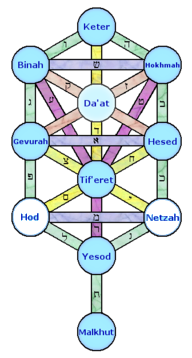
Hod is the counterpoint to Netzach. While Netzach strives to connect, Hod ensures that the power and energy in that striving is appropriate and acceptable. As we said earlier, it makes no sense to impress a student if the information is just too much to assimilate. Hod assembles the information to match the capacity of the receiver.

Hod tempers the force of Netzach, which, unchecked, can create distance rather than closeness. We have all experienced the colleague who is so effusive about his proposal that people simply stop listening. We have seen good ideas go ignored because an empathetic heart did not balance the Netzach exuberance. Empathy lies at the core of a caring relationship.

-Rabbi Laibl Wolf
“Hod: Creating Empathy” (pg 181)
Practical Kabbalah: A Guide to Jewish Wisdom for Everyday Life

If you’ve been reading my blog for the past week or so, you’ll know that I’ve been participating in an ongoing dialogue on the issue of Christmas trees and pagan practices in a number of online venues including Boaz Michael’s Facebook page, Jacob Fronczak’s Hope Abbey blog, and Judah Himango’s blog Kineti L’Tziyon. While the content on the blog pages themselves is reasonable (regardless of whether or not you or I may agree with that content), some of the comments made in response were not. I felt they represented an attack on Christianity or at least on those Christians who choose to put a Christmas tree in their homes, decorate it with tinsel, ornaments, and lights, and put gifts under it.

But I did’t write this “extra meditation” to talk about that again. I’m pretty much “talked out” as far as “Christmasphobia” is concerned and would just end up repeating myself if I tried to blog on it one more time. Instead, I’m here to talk about the communication dynamics I saw in those conversations and more in general, how methods of communication sell or sink our message as believers.

Most of the people who regularly read this blog probably aren’t interested in Kabbalah and some of you may be strongly opposed to its study, but in reading Rabbi Wolf’s discussion of Hod and Netzach, I recognized some of the common issues we all have when we want to get out point across.

Christians generally believe we have received a mandate from Jesus in what is called “the Great Commission.”

And you, go to all the nations. Make disciples; immerse them for the name of the Father, and the Son, and the Holy Spirit, and teach them to keep all that I have commanded you. And see, I am with you all the days until the end of the age. Amen. –Matthew 28:19-20 (DHE Gospels)

For nearly 2,000 years, Christians have, in one form or another, been attempting to tell the world about the Good News of Jesus Christ and the promise of salvation. We haven’t always done a good job at it, though. I’d say the various Crusades, Inquisitions, and Pogroms the church has lead can be described as a dismal failure of our evangelical directive. Even today, many non-believers cringe when a Christian asks them questions such as, “If you were to die tonight, do you know where your soul would go?” We are often depicted as judgmental, rigid, sexist, backward, superstitious “Bible-thumpers” and that description isn’t always particularly inaccurate.

It’s not so much the message we are trying to deliver that communicates such a dismal picture of the church, but how that message is transmitted. Christians really can be judgmental, inflexible, and insensitive to the needs of others, particularly of how people need to hear what we have to say (whether they choose to agree with us or not). We’ve gotten to the point where some folks want to run away when they think we’re about to try to convert them.

If you re-read the quotes I presented above, I’m sure you can immediately recognize that when we people of faith get such responses, we are likely leading with Netzach at the expense of Hod. This can especially be a problem with “text-only” communications on the Internet, such as in Facebook and blog comments, because most of what we use to communicate (body language, vocal tone and inflection) is completely absent. All we have is plain text and without anything to modify it, what we think we’re saying clearly can be terribly misunderstood. A message we think we’ve said with warmth and compassion can come across at hostile and uncaring. When confronted with such a message, it’s very easy to get worked up and fire back a response that is actually angry. The web conversation goes downhill from there, and I’m as guilty of such a transgression as anyone else.

Modeh AniWhat’s missing is illustrated by Rabbi Wolf in how he explains the Modeh Ani blessing which is recited by every observant Jew at the very moment when they realize they’re awake each morning.

The Kabbalah explains that this morning affirmation, known as Modeh Ani, provides the space to enter into the magical moments characterized by the transition from the unconsciousness of sleep into the light of day. The term Modah Ani is enunciated first thing in the morning. It means “I accept,” “I surrender,” or “I acknowledge,” or “I bow in front of you.” It is linked etymologically to the word for “thank you” in Hebrew (Todah)…

When we say “thank you” we are withdrawing and creating a comfort zone for another person. We touch their essence and draw it toward us. “Thank you” is a verbalization of the Hod flow. That is why it is so important to teach youngsters to say “thank you,” even if the deeper import is not yet fully understood. It trains children to express humility and an acknowledgment of others.

People who show humility invite more relationships into their lives.

-Rabbi Wolf (pp 185-7)

Putting Kabbalah and even the Modeh Ani aside, pay attention to the key phrase in Rabbi Wolf’s narrative: “we are withdrawing and creating a comfort zone for another person.” If we want someone else to hear us, regardless of our message, we must create a “comfort zone” for them, not for us. Yet we often do the exact opposite, creating a comfort zone for us and putting the listener on the defensive. This is especially easy to do on the Internet, even if it’s not our intent, because most of the elements of complete communication are not available. On top of that, we sometimes “pull rank” by explaining our abundant qualifications to be able to transmit our message. I don’t mind learned people and even “experts” in a particular field who have something to say, but a person who repeatedly has to outline their “quals” while making their point is an immediate turn off to me. The more you have to tell people, “I’m important and a big deal”, the more most people (me included) will believe that you’re not.

In one of the conversations I mentioned, one fellow responded like this:

I am a Hebrew. I am a Messianic Jew. A Kohen Levi. I am not one of the lost 12 tribes, nor do I believe in it.
My credentials…

I have no doubt all that is true for this person and you might say something like, “What’s wrong with what he said if it’s true? Is there a problem telling the truth?”

My answer: yes and no.

I don’t know how many conversations, both online and in person, I’ve been involved in (and where I was being put on the defensive) where the person talking to me responded to my resistence by saying, “well, it’s the truth!” Truth though it may be, if you can’t tell me the truth in a way that doesn’t drag me or other people through the mud (whether you really are or it just sounds that way), am I likely to listen? I’m not saying that you will or won’t convince me of your point of view, but there’s more than one way to present it. If you shove pure “Netzach” in my face while “Hod” has been left ten miles behind in the conversation, doesn’t this create a problem? It doesn’t matter what your family or cultural lineage is, how learned you are, how many languages you speak, and how much of a “Torah expert” you happen to be, if your message is delivered with all the tact of a barbarian horde riding madly across the seven hills of Rome, bent on the destruction, mayhem, and looting. No, I’m not saying that your intent is bad, just your delivery (OK, for some people, the intent is bad too, but it’s almost impossible to separate intent from inadequate communication over the web).

You Christians trying to fulfill your responsibility to share the Gospel with unbelievers, you are no different. Zeal is one thing and frankly, it is very important, but if you don’t create a space in the relationship where the person you’re talking to can feel comfortable, or at least a space where they don’t feel like they’re about to be spiritually jumped on and beaten up, you won’t “win a soul for Christ” (and I really hate the implications of that statement) or even convince the other person that you’re a half-way nice human being.

Being too empathetic makes you look wishy-washy and your message becomes completely ineffective. Being too zealous makes you look like a judgmental crusader out to bash someone’s head in with a Bible and your message becomes immediately disgarded by your audience.

Remember what I said a few days ago about being out of balance?

I’m not trying to bash anyone reading this or anyone who posted a comment in Facebook or on the blogs I mentioned. I’m imploring you to please, please look at the state of your intent and the balance of your Netzach and Hod. It doesn’t matter if you don’t use those terms. I doesn’t matter if you’ve never heard of Kabbalah or don’t like what you’ve heard about it. Take the labels off everything I’ve said and look at the dynamics of communication under the hood. That’s what matters. It matters a lot because we’re supposed to be God’s representatives in the here and now. I’ve already mentioned how it really matters what we “loose on earth” because it is also “loosed in heaven” (Matthew 18:18). Being careless about what we say and how we say it when presenting ourselves as people of faith, can elicit not only a poor response in the immediate circumstance, but create a long-term and even potentially eternal problem in the much larger spiritual realm.

One of the exercises Rabbi Wolf suggests in his book to help people develop Hod, is to participate in conversations where you wait three to five seconds to respond after your conversational partner says something. The exercise directs you to use the time to consider what to say and how to say it. Use the time to consider the impact of your response on your partner. What would happen if we did that all of the time? What would happen if we cared enough about other people to create a comfort zone for them in our conversations, if we listened to what they had to say, and if we stopped and considered their feelings and understanding before launching into our reply?

This probably isn’t true, but imagine this is the reason why God rarely answers our prayers immediately. Maybe He’s waiting until we are in our comfort zone with Him. Maybe He’s considerate enough to carefully craft His reply to us so it will be the most useful reply possible. Maybe God loves us that much. Imagine if we loved each other that much.

Freeing the Broken Heart

Then the chief cupbearer told his dream to Joseph. He said to him, “In my dream, there was a vine in front of me. On the vine were three branches. It had barely budded, when out came its blossoms and its clusters ripened into grapes. Pharaoh’s cup was in my hand, and I took the grapes, pressed them into Pharaoh’s cup, and placed the cup in Pharaoh’s hand.” Joseph said to him, “This is its interpretation: The three branches are three days. In three days Pharaoh will pardon you and restore you to your post; you will place Pharaoh’s cup in his hand, as was your custom formerly when you were his cupbearer. But think of me when all is well with you again, and do me the kindness of mentioning me to Pharaoh, so as to free me from this place. For in truth, I was kidnapped from the land of the Hebrews; nor have I done anything here that they should have put me in the dungeon.”

When the chief baker saw how favorably he had interpreted, he said to Joseph, “In my dream, similarly, there were three openwork baskets on my head. In the uppermost basket were all kinds of food for Pharaoh that a baker prepares; and the birds were eating it out of the basket above my head.” Joseph answered, “This is its interpretation: The three baskets are three days. In three days Pharaoh will lift off your head and impale’ you upon a pole; and the birds will pick off your flesh.”

On the third day — his birthday — Pharaoh made a banquet for officials, and he singled out his chief cupbearer and his chief baker among his officials. He restored the chief cupbearer to his cupbearing, and he placed the cup in Pharaoh’s hand; but the chief baker he paled-just as Joseph had interpreted to them.

Yet the chief cupbearer did not think of Joseph; he forgot him.Genesis 40:9-23 (JPS Tanakh)

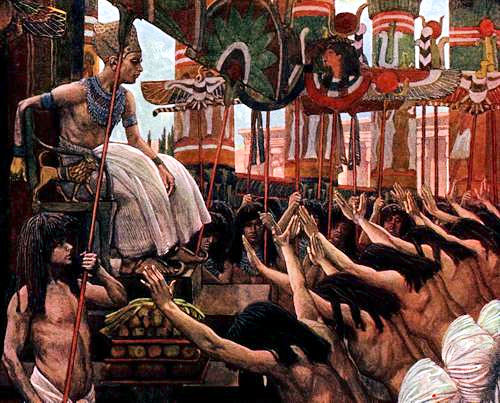
This story certainly makes for high drama, but why were all these farfetched developments necessary? Why didn’t divine providence manifest itself in a simpler way? Couldn’t Joseph’s release and rise to power have been effected through more commonplace events?

The commentators explain that Joseph’s release from prison is meant to serve as a paradigm of the ultimate in human emancipation.

-Rabbi Naftali Reich
“Freeing the Spirit”
Commentary on Prashas Vayeishev
Torah.org

I have a hard time understanding God sometimes. I suppose that’s quite an understatement and I imagine most people reading this “morning meditation” share my confusion on occasion. Take yesterday’s Torah Portion for example. I know Joseph’s brothers hated him, but did they really think they could get away with murder? Didn’t it hurt anyone besides Judah to see their father reduced to a mere shell of a man out of his heartbreaking grief at the loss of his favored son? What about the parallels between the wife of Potiphar trying to seduce Joseph and Judah’s “relationship” with his daughter-in-law Tamar?

And why, when sold into slavery and with no hope of ever being reunited with his family again, did Joseph, who started out as a spoiled and selfish 17 year old brat at the beginning of this narrative, eventually rise not only in stature and power, but in spiritual strength and holiness to be a savior to his family and the world? It seems obvious that his tenure as slave and prisoner was to train him for the role of a man who would all but rule the vast empire of Egypt, much like Moses had to live both as prince and as shepherd to finally take on the mantle of Prophet and “King” of the nation of Israel.

The First Fruits of Zion (FFOZ) commentary on Vayeishev draws the obvious comparision between Joseph and the Messiah, but it does something else.

Yet the story of Joseph is not an allegory, written merely to serve as type, shadow, and symbol. Too often believers have diminished the Torah’s literal reading for the sake of messianic interpretations. It is a story in its own right and a great story at that. Joseph is a real character; his adventures and misadventures are his own. If we are able to look into the Joseph story and perceive the person of Messiah, that is only to be expected, because God is the author of salvation both then and now. Joseph’s story is simply an example of what it looks like when God saves His people.

Sometimes Jewish scholars complain about how some Christian pundits tend to interpret every possible occurence in the Torah of a mysterious or symbolic figure as “the pre-incarnate Jesus.” As the joke goes, they say such Christians don’t engage in Biblical exegesis but rather, Biblical “I see Jesus.” FFOZ is saying something along those lines but in a much more platable way. Much of the Christian world looks at Joseph as a “type and shadow” of the Jesus to come without crediting Joseph to a life and purpose of his own. We also have a tendency to discount what people like Joseph can show us about ourselves and the larger context of our own “Messianic” role in the world.

Tikkun Olam or “Repairing the World” is one of my favorite themes because it not only empowers us to help others but requires us to enter into (junior) partnership with God in fixing our broken world. There are just tons of ways to do this, from promoting environmental causes to volunteering at your local homeless shelter. Even people with modest incomes can donate one can of soup a week to their community foodbank. Joseph fed the population of the entire civilized world for seven years. We can at least feed one person one simple meal once a week. We just have to realize that we are not the most helpless and downtrodden person on earth and to rise up and act on the behalf of someone less fortunate than we are.

The Satmar Rav, zt”l, spent one summer Shabbos in Ardiov, a city where many great tzaddikim and talmedei chachamim spent time during the summer. He ate the Friday night meal at the tisch of Rav Moshe of Shinova, zt”l, an exceptional tzaddik who only thought about doing God’s will. Many other luminaries were present at the crowded tisch which had an uplifted yet comfortable feel to it.

After singing some inspiring melodies, the kugel was served. It was a very scrumptious kugel. So much so that some of those at the tisch whispered to one another that they hadn’t tasted such a delectable kugel in a long time. To the surprise of all, Rav Moshe immediately got up and went into the kitchen. After a short time he returned.

Everyone wondered what the rebbe had been doing in the kitchen. When Rav Moshe noticed their wonderment, he told them where he had been. His deep sensitivity for others revealed by his unabashed statement completely astounded the Satmar Rav. “I heard people saying that the kugel is exceptional. Since the cook is a poor orphan girl, I immediately went into the kitchen to tell her. How could I wait until later to gladden her broken heart?”

Daf Yomi Digest
Stories Off the Daf
“Gladdening an Orphan’s Heart”
Bechoros 32

This story teaches two important and hopefully obvious lessons. The first is that, no matter how exalted and learned you are, you have a responsibility to gladden the heart of someone less fortunate. The second lesson is that you should do it as soon as possible.

Like Joseph, we have been slaves and prisoners, but in our case it is the imprisonment of our own humanity. Joseph had to be reduced down to about as low as you can go as a human being so that he could find out that freedom isn’t the absence of chains, but the presence of mercy. This is the answer to the mystery of Joseph and it is the answer to our mystery as well. As disciples of Jesus and believers in the God of Joseph, we have it within us to not only be free of our chains but to free others as well. All we have to do to escape our jail cells is to realize that we are sitting on the keys.

The scroll of Yeshayah the Prophet was given to him, and he opened the scroll and found the place where it is written,

The spirit of HaShem is upon me in order to anoint me to bring good news to the humble. He has sent me to care for the brokenhearted, to proclaim freedom for the exiles, and for the blind an opening release … to send the oppressed away free … to proclaim a year of favor for HaShem.

When he rolled up the scroll, returned it to the chazzan, and sat, the eyes of all who were in the synagogue were focused on him. –Luke 4:17-20 (DHE Gospel)

We don’t have to be Jesus or even Joseph to save the world. We can partner with them and be a “savior” too, one heart at a time.

Vayeishev: If I Were a Rich Man

If I were rich, I’d have the time that I lack
To sit in the synagogue and pray,
And maybe have a seat by the Eastern wall,
And I’d discuss the learned books with the holy men Seven hours every day–
That would be the sweetest thing of all…
Oy!

from If I Were a Rich man
written by Sheldon Harnick and Jerry Bock
for the musical Fiddler on the Roof

Now Jacob was settled in the land where his father had sojourned, the land of Canaan.Genesis 37:1

Rabbi Eli Touger’s commentary on Torah Portion Vayeishev says in part, that Jacob desired to live in prosperity, as do all righteous men, but was unable to (according to Rashi) because of his distress over the disappearance and apparent death of his son Joseph. I’ve written previously about the fallacy of “prosperity theology” in the church, so can we conclude (assuming Rashi is correct) that Jacob’s desire to live in prosperity is a problem for me? Rabbi Touger quotes Rashi’s response to this question.

Yaakov desired to dwell in prosperity, but the distress of Yosef’s [disappearance] beset him. The righteous desire to dwell in prosperity, but the Holy One, blessed be He, says: “Is not what is prepared for them in the World to Come enough for the righteous? Must they also desire prosperity in this world?”

Rashi’s statement is problematic, for a casual reading gives the impression that G-d does not approve of the righteous wanting prosperity. On the other hand, the fact that “the righteous” follow this path of conduct indicates that the desire for prosperity is a positive trait and not a character flaw. (Rashi’s apparent source is Bereishis Rabbah 84:3)

This difficulty can be resolved by focusing on the fact that Rashi speaks about a desire for prosperity expressed by the righteous. Why only the righteous? Everyone wants to enjoy an abundance of good without strife, contention, or difficulty.

On the surface, this interpretation seems to support the prosperity theology position that the righteous “should” want to have wealth and comfort in the present world as well as rewards in the world to come. But it’s amazing to me that Rashi, a French medieval Talmudic sage, should agree with a modern Christian doctrine. Is God so simple that he rewards the righteous with material wealth and punishes the less worthy with poverty and hardship? The history of both righteous Christians and Jews would seem to deny this, since many faithful men and women have suffered great difficulties and even died penniless for the sake of God.

And what does “Fiddler on the Roof” have to do with anything?

When a person is beset… with sickness, war, and hunger, he cannot occupy himself neither with wisdom nor with mitzvos. For this reason, all Israel and [in particular,] their prophets and sages have desired the Era of the Mashiach. (Mishneh Torah, Hilchos Teshuvah 9:2)

The Sages and the prophets did not yearn for the Era of the Mashiach so that [the Jewish people] would rule the world… nor to eat, drink, and celebrate. Rather, their aspiration was to be free [to involve themselves] in the Torah and its wisdom, without anyone oppressing or disturbing them. (Ibid., Hilchos Melachim 12:4.)

That sounds like Tevye’s wish as well. But as noble as this wish appears, it has a serious flaw. The righteous receive their reward in the Kingdom of Heaven (Matthew 6:20) and not on Earth (at least not always) and in fact, the Master said that:

“So when you give to the needy, do not announce it with trumpets, as the hypocrites do in the synagogues and on the streets, to be honored by others. Truly I tell you, they have received their reward in full. But when you give to the needy, do not let your left hand know what your right hand is doing, so that your giving may be in secret. Then your Father, who sees what is done in secret, will reward you. –Matthew 6:2-4

The Master is saying a couple of things. The first is that if we have the means, we should use them to benefit the poor. Nowhere does he say that our primary duty is to be occupied in study but rather the mitzvot related to helping the needy. He also says that if we receive our reward here in the form of wealth and prestige (maybe wealth, if used in secret to help others and not just to make ourselves look good is OK), it is in full and there may be no additional reward (which isn’t the same as salvation) in Heaven. Interestingly enough, his point finds its parallel in Rabbi Touger’s teaching:

Nevertheless, a distinction must be made. The World to Come represents G-d’s reward to man just recompense for man’s Divine service. This is a departure from the pattern of our present existence, of which it is said, “Today to perform them (the mitzvos); tomorrow to receive their reward.”

So was Jacob’s desire, as interpreted by Rashi, in vain? I still think the answer is still in Tevye’s song.

The righteous, by contrast, are not concerned with reward. On the contrary, to refer to the passage cited above, they long to involve themselves in the Torah and its mitzvos. Their aspiration is only that they be freed from external difficulties. They want to grow in understanding and personal development. Why must they be confronted with challenges from the outside? Let all their efforts be devoted to the internal challenges of spiritual growth.

I can’t say if this truly speaks to Jacob’s desire, but what we see here is that a righteous person, when desiring prosperity, isn’t thinking of reward in the conventional sense. They are thinking probably what you and I have considered at one point or another. If we could be freed from the constraints of a “normal” life of work and problems, we could spend more time serving God and ministering to people, even devoting our great material possessions to the well being of those around us. I think that would work for a truly righteous person, such as Joseph, who used the exalted position given to him by Pharaoh, King of Egypt (and ultimately God), to save his family and the world. For the rest of us though, we would be enormously tempted to use our wealth and “free time” for less than noble pursuits.

My opinion is that the toil and hardship of day-to-day life, though it limits the amount of time and energy we have to pray, to perform mitzvot (acts of kindness and righteousness), and to honor God, also focuses those few hours we do have through a lens whereby we can see God and do His will more effectively, without the temptations material prosperity brings. I tend to think that the truly righteous can manage extreme poverty and extreme wealth with equal grace as Paul said he had learned to do (Philippians 4:12-13).

Please understand that I’m not making a simple statement that the very rich and the very poor are always righteous. We know that wealth and poverty visit the just and the unjust alike. We know that God grants us what He chooses to grant us and doesn’t owe us an explanation for how things work out in our lives. Our circumstances aren’t a particularly accurate barometer of our state of holiness and relationship with the Almighty. But it is one type of challenge we may face as part of His plan for our lives.

In addition to our material state of being, we can also experience spiritual prosperity or poverty. Since God’s gifts are endless in this arena, I have to believe that we have the majority of control in this area of our existence. This has nothing to do with dollar signs or a “feeling” of peace inside, and everything to do with a burning desire to draw closer to Him and to do His will. The pursuit of “spiritual reward” is also fraught with problems because we poor, dumb, human beings have a tendency to get our priorities and desires mixed up with His. I can’t count the number of times I’ve heard Christians report that they prayed about a certain decision they had to make and then “felt a peace” about the decision they wanted to make anyway. Was that drawing closer to God or using God as an excuse to fulfill their personal wants rather than God’s requirements?

When Christians say that Jesus freed them from the Leviticus 11 food laws, I sometimes want to ask them, if God came to them right now and really told them to give up their ham sandwiches, and they really, really knew it was from God, would they give up the pork, or find an excuse not to? I use this as an example and not to say that I think the Torah kosher laws necessarily apply to the Gentile, but it’s a good illustration. In keeping with my theme for the past week or so, I might ask Gentile Messianics if God told them to be forgiving and tolerant of Christians who put up Christmas trees instead of reviling them and “standing their ground” against paganism, would they be truly forgiving and tolerant, or would they argue with God that the Christmas tree people deserved to be condemned?

I have to say at this point, that I am somewhat heartened how some of the detractors of Christmas on Boaz Michael’s Facebook page seem to be softening their approach and being clear that they are not actually attacking Christians. I’m also thankful to Jacob Fronczak for posting the very well researched article The Syncretism Boogeyman on his blog, which provides excellent information on the history of cultic practices in ancient times, including during the time of Moses. I’m stepping off my soapbox now. Back to the topic at hand.

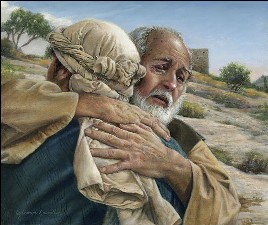
Wayward SonFrom my own personal experiences (humble though they may be), I’ve become convinced that when God actually speaks to me (rather than the voice of my own desires and ego in my head), He surprises me and frankly, asks me to say and do things that aren’t naturally easy for me. He asks me to take on duties I don’t feel comfortable with and requires that I surrender behaviors and even thoughts with which I am very at ease. That’s the nature of God, to push us forward, to urge us to move further on and in directions we would never consider on our own.

So be careful in the sorts of rewards you ask from God and in what role you seek to play in His service. He just may give you a type of reward and prosperity you don’t expect and require that you actually rise to the challenge. How many years was Joseph a slave and prisoner in Egypt before he became all but a king? How many years did Jacob live in grief and abject sorrow, though materially wealthy, before he was comforted by his son in Egypt?

Good Shabbos.

Invitation to a Point of Peace

From the time you begin to breathe, a war rages within.

From the time you attain citizenship of this world, you must struggle with your own frailties to stand upright, as a human being was meant to stand.

From the time you yearn to reach higher, you must engage the animal that comes dressed within this meat and bones, to carry it up with you. You must play its own game on its own turf, speak to it in its own language, meditate upon those matters that can inspire it, bear with it until you can bring it to the side of peace.

You must descend to a place of chaos and madness to redeem yourself from there.

And so this battle plays out not only in the spiritual arena of meditation and prayer, but also in the very human world of eating your meal, of raising a family, of worldly pursuits, infiltrating that world so as to conquer it, to rip away its veil and reveal the G-dly sparks it contains, as Jacob dressed in the clothes of Esau, wrestling with his angel on the cold, sodden earth of a night to which he does not belong.

Yet at all times and in every situation you retain access to a point of perfect oneness within, a place where there is no opposition to fight, no choices that could be made, no existence at all, nothing other than “the Creator of all things to whom I am bound as one.”

It is not the battle that defines you, nor the role in which you must invest yourself, nor the opponent with whom you fight. You are none of these. You are that point of peace within.

And so, even your battle is in peace.

—based on the Rebbe’s discourse on the verse “He has rescued my soul in peace,” 5739

-Rabbi Tzvi Freeman
“War and Peace”
Based on letters and talks of the Rebbe
Rabbi M. M. Schneerson
Chabad.org

The struggle with chaos and madness is very much how I see “the human condition” and particularly my own role in humanity, both in the world outside and the one inside of me. Over the past several days, I’ve engaged in a series of “battles” in this “meditation” venue with the various “religious wars” that spike during the month of December. It’s not pleasant to confront other people who have the same basic viewpoint on life and God as you do and to realize that you and they are still light years apart. It’s also dismaying to see people who claim to be speaking for God or at least of God, and to read words, not of encouragement, but of disdain and criticism disguised as “truth”.

But let me change the subject.

Some part of me likes science, particularly astronomy and physics. Alas, I don’t have a brain that likes math, and so a career in these fields was never an option for me, but I still like following news on these subjects. You probably have heard of the Large Hadron Collider (LHC) and particularly of its use in the recent search for the Higgs Boson particle (sometimes referred to as the “God” particle) which current science says must exist in order for anything to have mass. I found the following quote from the New Scientist article very interesting.

If our ideas about the Higgs boson turn out to be correct, then everything we see is a kind of window dressing based on an underlying fabric of reality in which we shouldn’t exist. The particles that make us up – which bind together to form protons, neutrons, nuclei and ultimately atoms – have mass. Without the Higgs, these particles would be massless, like photons.

Let’s take a closer look at part of that quote:

…then everything we see is a kind of window dressing based on an underlying fabric of reality in which we shouldn’t exist.

A reality in which we shouldn’t exist. Interesting. Now take a moment to notice your physical existence. Look in the mirror. Yep, you’re still there. Snap your fingers. Do a few jumping jacks. Still feel like you exist? Good. But if we discover that Higgs isn’t real, then we shouldn’t exist at all, at least if how we currently conceptualize the universe is in any way accurate.

Go back and revisit the quote from Rabbi Freeman and then re-read the New Scientist quote again. Existence, both physically and spiritually seems so complicated, confusing, and messy. There are all of these details we keep running up against that don’t quite fit together in our puzzle when we try to build what we think Creation looks and acts like. It’s like the Biosphere2 experiment in Arizona where people tried to create a completely self-contained biosphere, isolated from our actual environment, that would be totally self-sustaining. In essense, we tried to build a little Earth inside of a bubble that would work just like the big Earth that God created.

God holds the worldIt failed miserably. In fact, back in the early 1990s, Bioshpere2 was involved in a huge scandal where the project managers secretly bled out CO2 from inside the dome because the “natural processes” inside weren’t getting rid of the stuff (kind of like how climate scientists today describe the global warming process). We just don’t know enough about how Earth’s biosphere works to be able to recreate it in an enclosed environment. We just don’t know enough about long-term weather and climate patterns and systems to be able to accurately predict whether or not it will rain next week or next month or next year, let alone how to make effective and beneficial changes in Earth’s climate over the next several decades. We don’t know why things have mass and what really happened in the first few thousandths of a millisecond after the Big Bang when physics were really haywire.

I’m not saying we shouldn’t pursue the answers. God gave us a universe that runs by a system of rules and laws (which we don’t always understand) and I think that system is observable and understandable in the long haul, at least for the most part.

But…

What if we allow ourselves to turn all that stuff off just once and awhile. I think it’s why God sanctified the Seventh Day back in Genesis 2 and I think it’s why the Jewish people (and arguably the rest of the world) should observe the Shabbat. It’s a time when we can turn it all off, all the machines, all of the head-scratching puzzles, all of the mysteries and mazes, and just accept God’s invitation to join Him and to be at a point of peace.

The friendly looking guy offering his hand to you in the photo at the top of today’s “meditation” is a friend of mine who, in spite of the amazing challenges he and his wife face, continues to pursue God’s peace. His name is Joe Hendricks and both he and his wife Heidi are actively undergoing cancer treatment. God has given both of them the personalities and the spirits to be encouraging and to approach life with a zeal for living when people like you or I would want to just hide under our beds and curl up into a ball. Peace isn’t just emotional state.

I am not saying this because I am in need, for I have learned to be content whatever the circumstances. I know what it is to be in need, and I know what it is to have plenty. I have learned the secret of being content in any and every situation, whether well fed or hungry, whether living in plenty or in want. I can do all this through him who gives me strength. –Philippians 4:11-13

Peace is a way of life, like pursuing the Spirit, like pursuing God. We find what we look for and we are looking all our lives.

To our God and Father be glory for ever and ever. Amen. –Philippians 4:20

nightsky1

Out of Balance

In her book Kitchen Table Wisdom, Rachel Naomi Remen recalls the healing work she did with a Holocaust survivor, whose response to the enormity of the spiritual pain he lived with was to close off feelings toward people and to be “cautious with this heart.” Dr. Remen relates that he joined her on retreat after he was diagnosed with cancer. Initially he was belligerent to strangers, but through inner stillness exercises and introspection he had a transformational experience. One day, while meditating, he sensed a deep pinkish light emanating from his chest. He felt enclosed by a beautiful rose. Troubled by the experience, he took a walk on the beach and began a silent dialogue with G-d. He asked the Creator whether it is all right to love strangers. G-d’s answer jolted him: “You make strangers, I don’t.” In that instant, the Holocaust survivor’s feelings of interpersonal distance began to melt. Strangers were no longer strangers. It was all right to love a stranger.

-Rabbi Laibl Wolf
“Tif’eret: Growing a Wise Heart” (pp 154-156)
Practical Kabbalah: A Guide to Jewish Wisdom for Everyday Life

I’ve been feeling off balance lately. Most of it has to do with how I choose to react to what I see, hear, and read about in the world around me, both in real life, and via the Internet. I’m not encouraged by what I see, but if you’ve been reading my “meditations” for the past week or so, you already know that. I found I needed to write this “extra meditation” to try and re-establish a bit of balance and to reduce my desire to wad up the whole world of religion like a piece of tissue paper contaminated with dripping bile, and toss it in the nearest toilet.

For Christians, this is a time of year (ideally) when they re-attach to the true meaning of loving and giving, by expressing the will of God with their lives in the community around them. If God was willing to send His “only begotten son” to suffer and die for us so that we could be reconciled to the Father, then why shouldn’t a Christian “pass it on”, so to speak, and offer grace, kindness, and mercy to the next fellow, regardless of who they happen to be? After all, Jesus died for us while we were still enemies of God (Romans 5;10). Must we only show goodness to those people who look, act, and believe like we do? Why even “tax collectors” and “pagans” do that (Matthew 5:42-48). Nevertheless, the religious community, or some portions of it, confirm the belief in the secular world that we are all bigoted haters and want to force the whole world to be exactly like we are.

“The truth, the whole truth, and nothing but the truth, so help me, God.”

That’s part of the oath people used to take when swearing to tell the truth in court. They don’t make you say it anymore because someone was offended with God and we wouldn’t want to God to offend someone, would we (this is sarcasm)?

On the other hand, we shouldn’t go out of our way to be so dedicated to what we think of as “truth” that we automatically condemn, revile, disdain, and hate those people who apparently (perhaps by putting up a Christmas tree) don’t have “the truth”. After all, they must be evil and wrong and we have to stop them by telling them how lousy their cherished faith is, don’t we (that’s more sarcasm)?

OK, I’m still out of balance. Quickly, someone toss me one of those poles used by tightrope walkers, or better yet, another story from Rabbi Laibl’s book (pg 147):

Once upon a time a king had two close friends who rebelled against his kingdom. The king seemed to have no choice but to execute the law – the death penalty. But he could not bring himself to kill his friends. Instead, he erected a tightrope over the courtyard at a precarious height. Each prisoner was allowed to walk across the tightrope to freedom. The chances were slim, yet miraculously the first prisoner succeeded. The second prisoner called out to his friend for advice, and the freed man obliged. He called back, “Whenever I felt myself beginning to list to one side I didn’t wait until my weight was there but immediately compensated.

This Hassidic tale invokes many portions of the Bible, including how God sent His Son so that we might all have a chance to conquer the death penalty by “walking the straight and narrow”. Notice though, that in order to navigate the rope, you couldn’t be an extremist. If you went too far to the left or to the right, you would be killed. In fact, when you even thought you were starting to slip to one side, to survive, you had to immediately shift your weight in the opposite direction.

Also, notice that the freed man went out of his way to help his friend rather than taking his salvation and running away. Notice that even though the king (God) had every right to execute the rebels, because they were his friends and he had compassion, he tempered his justice with mercy. Justice was not thrown away, but he gave the rebels a chance, probably more of one than they deserved. Justice was balanced with mercy and grace.

We don’t do balance (or mercy and grace) very well in religion and yet, it’s all over our history. Moses Maimonidies (Rambam), as quoted in Rabbi Laibl’s book (pg 146) “counseled his disciples to take the middle path.” I know I talked on this exact same topic last week, but plenty of people still aren’t getting it (especially the majority who don’t read my blog, though they may not agree with me, even if they chose to read these “meditations”). It is one thing to say that you disagree with someone based on your convictions and your understanding of the Bible, but it’s another to condemn them and to believe God will destroy them. Some compare a Christian who celebrates Christmas to a husband to cheats on his wife (and there are plenty of marital metaphors in the Bible), but that metaphor breaks down at some point. A husband and wife are both human; both equals, while God is not human and we can not aspire to ever be His equal. A husband may come close to really understanding everything his wife is about, but we have absolutely no clue exactly what God is all about.

In the end, even if God chooses to condemn others and even if we were “right”, should we have treated those others negatively and with such extremist attitudes and even pride, or should we have balanced our approach to them as God did for us, tempering justice with mercy? Many religious people want to dump the justice onto others but covet the mercy all for themselves, not passing it along. Doing this, are we really God’s children?