Tag Archives: Judaism

Divergent Branches

Cutting BranchesThe Jewish people have no monopoly on G-d and spirituality. In fact, Judaism’s core desire is that the world perceive G-d’s presence in their lives, and grow spiritually. What’s curious then is the wording of what is arguably Judaism’s most famous expression: “Shema Yisrael… Listen Israel, G-d is our Master, G-d is One (Deut 6:4).” If this eternal message relates to all mankind, why is it addressed only to Israel? Would not the One who created and sustains all mankind, by definition, be the Master of all?

-Rabbi Mordechai Dixler
“Note from the Director”
Torah Portion Vaeschanan
Director, Project Genesis
Torah.org

This is part of a brief commentary that Rabbi Dixler wrote for a newsletter to which I subscribe. Previously, I wrote a blog post called The Sons of Noah which asked how non-Jews can develop a relationship with God from a Jewish point of view. A day later, I answered that question from a Christian perspective with the blog article Children of God. Still, there’s more to the issue than I’ve chronicled so far. Although Judaism and Christianity have a common root, we have developed into religions that are light years apart.

For instance, when the Rebbe, Rabbi M.M. Schneerson characterizes the Noahide laws for the Gentiles, (as recorded in Rabbi Tzvi Freeman’s book, Bringing Heaven Down to Earth), he expresses the first Noahide commandment this way:

Acknowledge that there is only One G-d who is Infinite and Supreme above all things. Do not replace that Supreme Being with finite idols, be it yourself, or other beings. In this command is included such acts as prayer, study and meditation.

Look at the Rebbe’s wording. He warns not to replace the One Supreme God with “other beings” and applies it to acts of “prayer”. But in traditional Christianity, Jesus is God as much as God the Father is, and God the Holy Spirit. Also, how many Christians pray directly to Jesus as opposed to God the Father? It’s actually confusing who we should pray to:

And I will do whatever you ask in my name, so that the Father may be glorified in the Son. You may ask me for anything in my name, and I will do it. –John 14:13-14

The Rebbe (and Judaism in general) characterizes God as One, the Unique and completely self-contained One that cannot be subdivided into any smaller parts or units. God isn’t a molecule that is one thing made up of many smaller components, He is an indivisible, irreducible, complete wholeness. There’s no way to turn that into the concept of the Trinity from a Jew’s point of view.

I’m bringing all this up because there may be an assumption running around out there that Jews can accept Christians as “righteous Gentiles”; as Noahides…but the Christian imperative to view God as both one and as three makes that impossible. Rabbi Dixler ended his letter last week emphasizing this very point:

Rashi’s classic commentary solves the puzzle: G-d might appear to be the Master of only the Jewish people, those who received and accepted the Torah at Mt. Sinai. The nation of Israel got direct instructions on how to live from the Master Himself — “Israel, G-d is our Master.” However, “G-d is One” — we wish and hope for the day when every soul universally recognizes the Al-mighty’s intimate involvement with all, when the spirituality hidden beneath every surface becomes abundantly clear.

I didn’t feel like Rabbi Dixler or Rashi, as his commentary was presented here, really answered the question, so, since there was the option to ask the Rabbi questions on the Project Genesis site, I posed this one:

Thank you for your insightful message, but I must admit to not quite seeing how Rashi’s commentary, as presented in your letter, solves the puzzle. G-d did indeed give direct instructions to the nation of Israel on how to live, but I don’t see where the rest of humanity receives the information that G-d is One.

I’m aware of the Noahide Laws as recorded in Genesis 9, but they don’t resonate from Noah to the rest of the nations in the same sense as the unbroken chain of Torah does from Moses and Sinai to the Jews of today. There’s a unified link between G-d, Moses, and the Israelites who stood at Sinai that can be traced from 3500 years in the past all the way to the present-day Jewish people. When you say that “we wish and hope for the day when every soul universally recognizes the Al-mighty’s intimate involvement with all”, how do you believe this will happen? Will we only become aware of the “spirituality hidden beneath every surface” when the Messiah comes?

I received Rabbi Dixler’s prompt reply thus:

James, You make a great point. He did give instructions to the rest of the world, but not to the level He gave to the Jewish people. It would seem that the discrepancy would give the appearance of Him acting as Master over the Jews, while exhibiting less mastery over the non-Jews. The point of the message was to say that He has as much a desire to have that relationship with the non-Jews, if they reach the required level of recognition of Him. While Jews may not always act at that level of recognition, they are the descendants of the Patriarchs and Matriarchs which gives them an advantage.

The recognition of the non-Jews has been happening throughout history and it will certainly reach it’s zenith at the time of the Messiah. The spread of the belief in monotheism to most of the civilized world was likely the greatest manifestation of this that we’ve seen so far.

Rabbi Dixler stopped just short of referencing Christianity and Islam when he mentioned the “spread of the belief in monotheism”, but without those two non-Jewish religious traditions, there would be no awareness of ethical monotheism, as Jews understand the concept, among any non-Jewish people.

ForebodingThis leads me to my next question. If in the first century, non-Jews were brought to an awareness of Jewish monotheism through the life, death, and resurrection of the Jewish Jesus of Nazareth (and certainly most Jews would take exception to my wording here) and that word of this “Good News” was spread in the diaspora to the Greek and Roman speaking peoples of that time by the disciples of the Jewish Jesus, why didn’t the “Universal Message”, as Rabbi Dixler calls it in the title of his missive, start and continue right then and there? Why didn’t the Jewish and non-Jewish worshipers of the Jewish God (and remember that the original worshipers of Jesus were almost all Jews) remain united? Why did a journey that started out with so much promise and light enter into such darkness?

OK, I know what you’re thinking. Most people are aware of the history of the first three centuries of the church and how a variety of events resulted in an ever-widening gulf between the Jewish and Gentile worshipers of Jesus, until what was once a Jewish sect with Gentile members became two separate and fully independent religions. On his blog yesterday, Derek Leman commented about the change in perception of Christianity from the martyr Stephen in Acts 6, to the Justin Martyr, who actively rejected the law of Moses for anyone, Jew or Gentile, who was a disciple of Jesus (Justin Martyr, Dialogue With Trypho the Jew, ch. 11).

It has occurred to me more than once that for Gentiles to be able to experience a fully-realized relationship with God, we couldn’t do it as a part of Judaism. It’s probably the same reason why the landscape isn’t flooded with “synagogues” of mostly Gentile Noahides who fully embrace the Seven Laws as their core “Torah” and worship the God of Israel on that basis. Rabbi Dixler’s commentary seems to suggest that it should work this way, but he doesn’t operationalize it; that is, he doesn’t say how to make it work this way, particularly since Judaism has no mandate to “evangelize” to Gentiles. The only such mandate that I’m aware of was issued in Matthew 28:19-20 and the program it instituted, as least as administered by Jews, lived and died at the end of the first century. Gentile worshipers of the Jewish Jesus were only able to carve out their own identity as worshipers of the God of Abraham by separating themselves from Judaism altogether.

Today, Christians bristle at the thought that they could learn anything from the Jewish people (especially since Jews reject Jesus) and many still hold fast to supercessionism or the theological belief that the church has completely replaced the Jews in the covenant promises of God. The idea of Jews and Christians co-existing as God’s people, albeit at different levels of responsibility, is abhorrent to many Christians and Jews. Judaism has Moses as the lawgiver and Christianity has Jesus as the “law-taker-away”. As they exist in the minds of their followers, trying to make these two religions work and play well together is like trying to get the National Organization of Women to endorse Sarah Palin for President.

It’s not going to happen. In fact, here are three of the comments people made in response to Rabbi Dixler’s letter that punctuate my point:

I’m a Chab Jew and I have experienced the disdain of other Orthodox jews, some Chassidim. If we cannot be one how can we expect to have the goyim in the boat?

For your remarks. Perhaps no issue is so easily misunderstood as that of particularity or election. As a stranger come into the faith, I still, occasionally, wonder if I have crashed the party. during my morning prayers, for the longest time I changed one to “Thank you for making me a goi.” Even now, every time I recite the prayer, I think that God has remade me. This, however, does not stop the occasional flinch that perhaps I was dissatisfied with the state of my original creation and that I did God a disservice by converting to Judaism.

There is no way to get around the particularism of Judaism. We are “Am Segulah” the special precious possession of Hashem. We are meant to be a light unto the nations, but the nations themselves have no part in the Torah. Non-Jews who feel that they are spiritually close to the Jewish people must go the way of Yitro and Ruth and become part of Am Yisrael.

Without Christianity (and short of having all the Goyim convert to Judaism), there would have been no mechanism for non-Jews to come to faith and trust in the God of Abraham, Isaac, and Jacob. And yet, as a result of Christianity, an enormous wedge has been hammered between Jews and Christians.

Another thing. The Rebbe, when responding to a question about secular and religious Jews, said…

You categorize them as religious Jews and secular Jews! How dare you make such a distinction! There is no such thing as a secular Jew. All Jews are holy.

The Rebbe’s words seem almost an echo of Paul when he said “and so all Israel will be saved” (Romans 11:16). You may still choose to debate this conclusion, but there’s no way around the inexorable unity that joins all Jews, even those who passionately disagree with each other, together at an extremely fundamental, “DNA” level. The Rebbe put it this way:

The Jewish people are one. A Jew putting on tefillin in America affects the safety of a Jewish soldier in Israel.
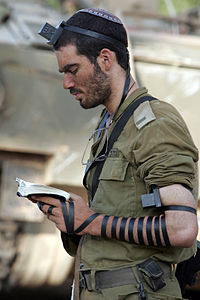
Soldier praying with TefillinI haven’t experienced this kind of unity within the church and doubt that even the most devout Christians can claim a bond with each other that is so complete as one Jew has for another. Is this what Sinai did? No one chooses to be a Jew unless you convert, but the vast majority of the world’s Jewish population were “born that way” (to quote a popular entertainer). No Christian is “born that way”, we all make the choice independently, even if we are born into Christian families.

Where did we go wrong? Why do we struggle between our two faiths when God is One? Rabbi Dixler tries to answer those commenting in his newsletter, and maybe even my own question, with these words:

An issue that has been raised by a few is that this message somehow dilutes the idea of the Chosen Nation and that the commandment to love is only towards others Jews. To be clear, the Jews were chosen by G-d to be the recipients of His Torah since they are the children of the the Patriarchs and Matriarchs – those who discovered G-d’s presence for themselves, devoted every ounce of their being to Him, and introduced the pagan world to what it means to have one G-d. At the same time, the mission of Jews that they’ve been chosen for is to spread the knowledge of G-d’s presence to all of humanity, by acting as a light to the nations. Built into this mission is the concern that all of humanity appreciate G-d and the spiritual relationship we have with Him.

Unfortunately, “all of humanity” appreciating God and the spiritual relationship the Jews have with Him has necessitated the separation of the Jews from those of us who were “first called Christians at Antioch” (Acts 11:26).

I had asked Rabbi Dixler if, in his opinion, the unity between the Jews and Gentiles under the One God would only happen when the Messiah comes (a second time, from the Christian viewpoint). He replied that while God has as much desire to have a relationship with non-Jews as he has with Jews, the recognition of God by non-Jews “will certainly reach it’s zenith at the time of the Messiah”. From Christianity’s vantage point, we already have that recognition through Jesus Christ. But it’s the Christian theology and dogma of 20 centuries that has been wrapped around the teachings of Christ and his early Jewish followers like a thick blanket that has both kept us warm in the love of God and isolated from the Jewishness of our Master.

Paul said in Romans 11 that Jewish branches were temporarily broken off the root to make room for Gentile branches but how long will it be until we can both be part of the root again? How long until the Jews and the Christians can share an awareness and a love for our common God and put aside 2,000 years of enmity?

How long?

When We Were Five

The Rebbe and the ChildIf you want to see the face of the Moshiach, just look at the children!

At Sinai, all men, women and children had to be present. All received the same truth, all at once.

In a simple commentary written for a five year old, great secrets of the Torah can be found. But only once you understand the simple commentary as a five year old does.

From the wisdom of the Rebbe
Menachem M. Schneerson
as compiled by Rabbi Tzvi Freeman in his book
Bringing Heaven Down to Earth

Perhaps in the Rebbe’s words, we find the keys to unlock this 2,000 year old mystery:

At that time the disciples came to Jesus and asked, “Who, then, is the greatest in the kingdom of heaven?” He called a little child to him, and placed the child among them. And he said: “Truly I tell you, unless you change and become like little children, you will never enter the kingdom of heaven. Therefore, whoever takes the lowly position of this child is the greatest in the kingdom of heaven. And whoever welcomes one such child in my name welcomes me. –Matthew 18:1-5

We sometimes make the mistake of imposing our assumptions when we read this teaching from Jesus. The first thing we imagine when we think of a small child is that, compared to an adult, he or she doesn’t know very much about the world. Children have an extremely simple understanding of how things work. They can see the moon in the sky, but not know what it is. They can play with their favorite stuffed toy and believe it is as alive as they are. They are easily convinced of the most outrageous suggestions and accept them as utter truth. How else could we get a child to believe that there is a fat guy who rides in a sled pulled by flying reindeer, and who delivers presents to every child on Earth in a single night?

Translating all of that back into the words of Christ, we imagine he means that we don’t need to know very much about the Bible, the history of the church, the wisdom of the great Sages, or most anything else in order to be saved and have a right relationship with God. It means that studying the Bible is a waste of time, because it doesn’t change the status of being saved. It means that Bible commentaries, the Talmud, and everyone who reads and tries to comprehend them, are just making your relationship with God too complicated. After all, once you are saved in Christ, the deal is sealed and nothing else matters at all. If you’re a Christian it’s only about you and Jesus.

Right?

That tends to illustrate one of the qualities of small children; the tendency toward being self-absorbed and the difficulty in seeing a world outside of our own small sphere. Being saved and becoming a disciple of the Master is the first step in our journey, not the last.

So what does Jesus mean? What does the Rebbe mean? How are great secrets possessed by little, uncomprehending children that elude perhaps some of the greatest scholars who have ever lived? Is Bible study; Torah study a waste of time? Here’s Rabbi Freeman’s response:

The Rebbe often repeated that through the study of Torah you could conquer the world. And from the way the Rebbe discussed Torah you could see he was doing just that: Every thought, every teaching was a new understanding of the entire universe. A simple story..became in his hands an insight to the workings of time and space.

Rabbi Freeman, who describes the Rebbe as one of the foremost Torah scholars of his age, also tells this story about him:

The child he (the Rebbe) saw as a lucid, glistening crystal vessel in which to find G-d. More than once the Rebbe pointed out how his own thoughts strove to attain the simplicity of those of a child. In that simplicity, he taught, can be found the simplicity of the Infinite.

The Rebbe formed a club for Jewish children called “Tzivos Hashem”. He told the children that with verses of Torah and good deeds they would fight the forces of darkness in the world and bring Moshiach.

The Children began to stand close to the Rebbe at public gatherings. Some went under the table near his feet. Legend has it that occasionally a small band would rise up from under the table to snatch a piece of the Rebbe’s cake.

For me, this really clarifies why Bible study and immersion in the Torah are vital to achieving and retaining the perspective of a small child who is contemplating God.

Remember what I said about how adults can cause a child to have an unswerving belief in the existence of Santa Claus? It’s not the child’s fault that he or she believes in a fantasy, it’s the adults who taught them. Children are open to those they trust and they believe their parents (in most cases) mean them nothing but good. Sure, they get mad at us temporarily when we discipline them for some misdeed, but they know with complete trust that we are the source of all good in their lives. This is how we saw the world when we were five.

We fail them when we don’t tell them the truth and prove unworthy of their trust.

TrustBut now let’s bump that concept up the ladder a bit. We, as adults, can question whether or not something is the truth. We no longer believe in Santa Claus and we can (most of the time) recognize the difference between fantasy and reality. We have a Father in Heaven who is the source of all good in our lives. He wants nothing but the best for us and He does not tell us tales of Santa Claus or the Easter Bunny, which we later find out are quaint lies. God tells us the truth. In essence, we are like children standing close to the Rebbe and sitting at his feet under the table. Now here’s where the “child” part comes in.

If we choose to believe and to trust God as completely as small children trust their parents, whatever God tells us, we will believe. Whatever He wants us to do, we will do, without questioning why. When we “snatch a piece of cake” (so to speak) from His table, He won’t mind, because He knows we’re going to do it and He put the cake there to share with us. If we want to know how to accept God in the manner He desires to be accepted, trusted, and loved, all we have to do is to look at the relationship between little children and their parents.

For me, one of the lessons I must learn about the little children is what the Rebbe says here:

With Torah, you don’t get all the answers all at once.

Why does the moon only come out at night? Why is the sky blue? How can a fish breathe underwater? How old is God? Have you ever tried to answer these questions? It’s hard to do. Even if you know why the sky is blue or how fish breathe underwater, you can’t always communicate the answer in a way a child will understand. It’s that way for me. I want to know so much. It seems as if there’s so little time. And yet I wait. You don’t get all the answers all at once. Sometimes you have to get older first before you can understand.

In the meantime, you trust and believe, because that’s what small children do best.

Now to finish the story about the children snatching the Rebbe’s cake:

Finally, one of the adults became fed up with this lack of decorum and attempted to escort some children away. The Rebbe turned to him and exclaimed, “You are only a civilian and they are soldiers – and you want to remove them?

As the Rebbe also said, “Wealth is not a mansion filled with silver and gold. Wealth is children and grandchildren growing up on the right path.”

May we all “grow up” on the right path, too.

Va’etchanan: Blessing God in Sorrow

Moses at NeboAnd you shall love the Lord your G-d. with all your ‘me’od’Deuteronomy 6:5

The word me’od has many meanings. It serves as the etymological root for ‘measure’ (midah), ‘thank’ ( modeh), and ‘very much’ ( me’od). Using all three meanings in its interpretation of the above verse, the Talmud states:

“A person is obligated to bless G-d for the bad just as he blesses Him for the good, as it is written: ‘And you shall love the Lord your G-d. with all your me’od’ – for every measure which He measures out to you, thank Him very, very much.” -The Talmud, Brachos 54a

The name of this week’s Torah Portion, Va’etchanan means “and he pleaded”, referring to Moshe’s (Moses’) pleading with God to allow him to live and to lead the Children of Israel into the Land of Canaan, even after God had decreed that Moses should die. We learn from the Mishnah on Va’etchanan, that we should bless God for everything that happens in our lives, the good and bad alike. As we see in the following example, that’s not an easy thing to even consider, let alone perform:

A man once came to Rabbi Israel Baal Shem Tov with a question: “The Talmud tells us that one is to ‘bless G-d for the bad just as he blesses Him for the good.’ How is this humanly possible? Had our sages said that one must accept without complaint or bitterness whatever is ordained from Heaven – this I can understand. I can even accept that, ultimately, everything is for the good, and that we are to bless and thank G-d also for the seemingly negative developments in our lives. But how can a human being possibly react to what he experiences as bad in exactly the same way he responds to the perceptibly good? How can a person be as grateful for his troubles as he is for his joys?”

-Rabbi Yanki Tauber
“A Matter of Perspective”
Chabad.org

It’s easy to imagine being the man who is trying to get a seemingly impossible answer from the Baal Shem Tov. Whenever good happens in our lives, if we have any sense of God in our lives at all, we thank Him with all our heart and being for His goodness and His providence. When tragedy and disaster strike on the other hand, blessing God becomes much more difficult. Most of us do not respond like Job, apparently, not even Moses.

I pleaded with the Lord at that time, saying, “O Lord God, You who let Your servant see the first works of Your greatness and Your mighty hand, You whose powerful deeds no god in heaven or on earth can equal! Let me, I pray, cross over and see the good land on the other side of the Jordan, that good hill country, and the Lebanon.” But the Lord was wrathful with me on your account and would not listen to me. The Lord said to me, “Enough! Never speak to Me of this matter again! Go up to the summit of Pisgah and gaze about, to the west, the north, the south, and the east. Look at it well, for you shall not go across yonder Jordan. Give Joshua his instructions, and imbue him with strength and courage, for he shall go across at the head of this people, and he shall allot to them the land that you may only see.” –Deuteronomy 3:23-28

When we pour out our heart to God, it would seem almost cruel for God to respond in this manner. Why does He treat His faithful servant Moses this way? Why is a rebuke God’s response to this type of prayer? The following is how the Rambam describes prayer, but it seems to contradict what happened between Moses and God:

The obligation [this] commandment entails is to offer supplication and prayer every day; to praise the Holy One, blessed be He, and afterwards to petition for all one’s needs with requests and supplications, and then to give praise and thanks to G-d for the goodness that He has bestowed.

The fundamental dimension of prayer is to ask G-d for our needs. The praise and thanksgiving which precede and follow these requests is merely a supplementary element of the mitzvah. A person must realize that G-d is the true source for all sustenance and blessing, and approach Him with heartfelt requests.

Often, however, we do not content ourselves with asking for our needs. We desire bounty far beyond both our needs and our deserts. We request a boon that reflects G-d’s boundless generosity. For every Jew is as dear to G-d as is an only child born to parents in their old age. And because of that inner closeness, He grants us favors that surpass our needs and our worth.

As quoted from
“Vaes’chanan: To Plead with God”
-Rabbi Eli Touger
Adapted from
Likkutei Sichos, Vol. XXII, pgs. 115-117;
Vol. XXIV, p. 28ff

SorrowHowever, Rabbi Touger goes on to say that pleading “is one of the ten terms used for prayer” and that “Moshe [approached G-d] in a tone of supplication, [asking] for a free gift” demonstrating that “no created being can make demands from its Creator”. It’s one thing to pour out your heart to God with your needs and your troubles, but no man is entitled to anything from God that God Himself does not will.

I don’t say this to be unkind to Moses. Certainly he was the greatest of all the Prophets, a man who spoke to God “face-to-face”, so to speak” and the most humble of men. However, he was a man and like all men, was less than perfect in the eyes of God, as we see in the incident at Meribah (Numbers 20:1-13).

But even then, it is not so wrong for Moses or for any of us to beg that God turn aside His wrath when we pray:

There is a difference of opinion among our Sages (Rosh HaShanah 17b) as to whether prayer can have an effect after a negative decree has been issued from Above, or only beforehand. The Midrash follows the view that prayer can avert a harsh decree even after it has been issued. Therefore Moshe was able to approach G-d through one of the accepted forms of prayer.

-from Rabbi Touger’s commentary

No, for all his humanity and doubtless, all his frustration, Moses prayed the way any of us would pray, that God would relent and spare him what he no doubt saw as the most anguished of consequences. In the end, did Moses bless God for not being allowed into the Land? For most of his address to the Children of Israel, Moses pleads with them, he warns them, he begs them not to disobey God. Only minutes from death, he continues to do what he has done for the past 40 years, protect the people from their own folly, from their own sin, from their own desire for destruction, with every bit of his effort. Deuteronomy 33 is his blessing to Israel and in the following and final chapter of the Torah, Moses quietly obeys, passing the mantle of leadership on to Joshua.

Then Moses climbed Mount Nebo from the plains of Moab to the top of Pisgah, across from Jericho. There the LORD showed him the whole land—from Gilead to Dan, all of Naphtali, the territory of Ephraim and Manasseh, all the land of Judah as far as the Mediterranean Sea, the Negev and the whole region from the Valley of Jericho, the City of Palms, as far as Zoar. Then the LORD said to him, “This is the land I promised on oath to Abraham, Isaac and Jacob when I said, ‘I will give it to your descendants.’ I have let you see it with your eyes, but you will not cross over into it.”

And Moses the servant of the LORD died there in Moab, as the LORD had said. –Deuteronomy 34:1-5

How very much like the one who came after him, how like the death of “The Prophet”.

He was oppressed and He was afflicted, Yet He did not open His mouth; Like a lamb that is led to slaughter, And like a sheep that is silent before its shearers, So He did not open His mouth. –Isaiah 53:7

“How can I,” he said, “unless someone explains it to me?” So he invited Philip to come up and sit with him.

This is the passage of Scripture the eunuch was reading:

“He was led like a sheep to the slaughter,
and as a lamb before its shearer is silent,
so he did not open his mouth.
In his humiliation he was deprived of justice.
Who can speak of his descendants?
For his life was taken from the earth.”

The eunuch asked Philip, “Tell me, please, who is the prophet talking about, himself or someone else?” Then Philip began with that very passage of Scripture and told him the good news about Jesus. –Acts 8:31-35

We can hardly blame Moses for his plea to God. We certainly don’t blame Jesus:

Going a little farther, he fell to the ground and prayed that if possible the hour might pass from him. “Abba, Father,” he said, “everything is possible for you. Take this cup from me. Yet not what I will, but what you will.” –Mark 14:35-36

Praising GodBut Jesus did not stop at pleading with God but rather bowed to His will in all things, even suffering and death.

But what about those of us who are less than Prophets; we “ordinary people”. What about the man and his question of the Baal Shem Tov?

In this matter, the Baal Shem Tov sent the man to his disciple, Reb Zusha of Anipoli for the answer to the man’s question. Here’s the remainder of Rabbi Tauber’s narrative and the lesson we can take from Va’etchanan:

Reb Zusha received his guest warmly, and invited him to make himself at home. The visitor decided to observe Reb Zusha’s conduct before posing his question and before long concluded that his host truly exemplified the talmudic dictum which so puzzled him. He couldn’t think of anyone who suffered more hardship in his life than did Reb Zusha. A frightful pauper, there was never enough to eat in Reb Zusha’s home, and his family was beset with all sorts of afflictions and illnesses. Yet the man was forever good-humored and cheerful, and constantly expressing his gratitude to the Almighty for all His kindness.

But what was is his secret? How does he do it? The visitor finally decided to pose his question.

So one day, he said to his host: “I wish to ask you something. In fact, this is the purpose of my visit to you – our Rebbe advised me that you can provide me with the answer.”

“What is your question?” asked Reb Zusha.

The visitor repeated what he had asked of the Baal Shem Tov. “You know,” said Reb Zusha, “come to think of it, you raise a good point. But why did the Rebbe send you to me? How would I know? He should have sent you to someone who has experienced suffering…”

The disciple of the Baal Shem Tov, many centuries later, demonstrated the lessons learned by the disciple of Jesus of Nazereth:

I am not saying this because I am in need, for I have learned to be content whatever the circumstances. I know what it is to be in need, and I know what it is to have plenty. I have learned the secret of being content in any and every situation, whether well fed or hungry, whether living in plenty or in want. I can do all this through him who gives me strength. –Philippians 4:11-13

In all of our circumstances God is there. He is the source of everything both good and bad. We can hardly fail to acknowledge Him, both in our utmost joy and in abject and bitter sorrow. Yet Rabbi Tzvi Freeman records the wisdom of the Rebbe, Rabbi M.M. Schneerson as perhaps the best way to look at how we may bless God no matter what is happening to us as he says in Open Eyes:

After 33 centuries, all that’s needed has been done. The table is set, the feast of Moshiach is being served with the Ancient Wine, the Leviathan and the Wild Ox—and we are sitting at it.

All that’s left is to open our eyes and see.

Regardless of our happiness or pain, let us strive to bless the Lord that we may one day take our places “at the feast with Abraham, Isaac and Jacob in the kingdom of heaven” (Matthew 8:11).

Good Shabbos.

Difficult Ascent

AscentAs impossible as it sounds, as absurd as it may seem: The mandate of darkness is to become light; the mandate of a busy, messy world is to find oneness. We have proof: for the greater the darkness becomes, the greater the confusion of life, the deeper our souls reach inward to discover their own light.

How could it be that darkness leads us to find a deeper light? That confusion leads us to find a deeper truth?

Only because the very act of existence is set to know its own author. That is the cosmic drama, its theme and its plot: That otherness should come to know oneness.

And we are the players in that drama.

-Rabbi Tzvi Freeman
Based on letters and talks of the Rebbe, Rabbi M. M. Schneerson
“The Mandate of Darkness”
Chabad.org

All the world’s a stage,
And all the men and women merely players;
They have their exits and their entrances,
And one man in his time plays many parts,
His acts being seven ages.

-William Shakespeare
“As You Like It”
Act 2, scene 7

I’m still trying to drag my thoughts and feelings out of Tisha b’Av and the time of mourning. I don’t know why I can’t shake this off. After all, life moves on. Tisha b’Av comes every year and it goes every year. Yom Kippur, the Day of Atonement, is going to arrive in less than two months and there will be ample opportunity to fast, pray, reflect on my short comings, make amends to those I have hurt, and attempt to pull myself up out of the mud and up to the heavens.

What am I waiting for?

Why do things sometimes seem like this?

If a man fathers a hundred children and lives many years, however many they be, but his soul is not satisfied with good things and he does not even have a proper burial, then I say, “Better the miscarriage than he, for it comes in futility and goes into obscurity; and its name is covered in obscurity. It never sees the sun and it never knows anything; it is better off than he. Even if the other man lives a thousand years twice and does not enjoy good things – do not all go to one place?” –Ecclesiastes 6:3-6 (NASB)

Rabbi Freeman says that the purpose of living in a deep darkness is to find a deeper light and the verses from Ecclesiastes say that a soul should be satisfied with the good things. If not, life itself is futile. Yet I continue to feel somewhat like this fellow:

How long, O LORD?
Will You hide Yourself forever?
Will Your wrath burn like fire?
Remember what my span of life is;
For what vanity You have created all the sons of men!
What man can live and not see death?
Can he deliver his soul from the power of Sheol? –Psalm 89:46-48 (NASB)

Christians cry out to Jesus to return and Jews bare their souls in anguish to God and ask how long until the Moshiach comes? As people of faith, we know that life is not lived in vain, but how long until the King reigns in full, O’ God, how long? How many people have been born, lived, and died waiting for you?

I quoted the following parable about two weeks ago in another of my blog posts:

A father answers the questions of his child and they are happy together, in joyful dialogue.

Then the child asks a question, and the father must think deeply—not just for the answer, but to reach to the essence of this answer so he may bring it to the world of his child. For a long while, the father is quiet.

And so, the child becomes anxious and begins to cry. “Father, where are you? Why do you no longer talk to me? Why have you deserted me for your own thoughts?”

And then the father begins to speak, but this time it is the deepest core of his mind that flows into the mind and heart of the child. Such a flow that with this the child, too, may become a father.

The child is us. The time of silence is now.

When the spirit of Man is dark, when the flow gates of Above seem all but sealed, prepare for liberation.

Rabbi Tzvi Freeman
From the wisdom of the Lubavitcher Rebbe, of righteous memory
“A Time of Silence”
Chabad.org

As difficult as it can be sometimes, a good portion of the nature of faith is to wait. I believe that while we are waiting, we aren’t supposed to be passive and inactive. We still have a life. The very first prayer an observant Jew says upon awakening is:

“I gratefully thank You, living and existing King
for restoring my soul to me with compassion.
Abundant is your faithfulness.”
Modeh Ani

Even if life doesn’t make any sense, and even if life seems cruel, unjust, and merciless, we are here by the will of God. If we believe He guides our steps, then even our existence isn’t a random event. Our purpose then, is not to surrender to futility, but to discover the reason we were created and then to live that reason out every day that we draw breath.

However, some days are better than others. We ask for mercy, God, when we seem only shallow characters reciting our lines in a badly written play. We know our lives must mean more than that. Struggling to ascend from the dark abyss, when will we find the deeper light?

The road

The road is long and often, we travel in the dark.

Hope and Ashes

MourningI remember with perfect clarity the sensation of waking up on the morning of March 9, 1990. In those first few fuzzy moments of consciousness, I oriented myself to where I was — in the spare bedroom of my parents’ New Jersey apartment, and what day it was — two days after my father’s death. As soon as I realized that I had woken up into a world without my father, my heart plunged into a fathomless grief, like waking up into a nightmare that will never end.

The world without my father was not simply the same world minus one; it was a totally different world. This altered, diminished world lacked the stability and goodness that was my father. This world wobbled on its axis; its gravitational pull was heavier.

The ninth day of the Hebrew month of Av — called Tisha B’Av — is to the Jewish people what March 9 was to me. We misrepresent the tragedy of the day by describing it as the destruction of the two Holy Temples, as if the catastrophe is the loss of a building. The American people do not mourn on 9/11 because of the destruction of the Twin Towers; they mourn the thousands of lives lost in the conflagration. Contrast a person who mourns the absence of the majestic towers to the New York skyline with a person who mourns the loss of his/her parents caught on the 98th floor.

Tisha B’Av is more like a death than a destruction, because on that day the world changed irrevocably.

Sara Yoheved Rigler
“Waking Up to a World Without God’s Presence”
Aish.com.

When Jonah’s warning reached the king of Nineveh, he rose from his throne, took off his royal robes, covered himself with sackcloth and sat down in the dust. This is the proclamation he issued in Nineveh:

“By the decree of the king and his nobles:

Do not let people or animals, herds or flocks, taste anything; do not let them eat or drink. But let people and animals be covered with sackcloth. Let everyone call urgently on God. Let them give up their evil ways and their violence. Who knows? God may yet relent and with compassion turn from his fierce anger so that we will not perish.”

When God saw what they did and how they turned from their evil ways, he relented and did not bring on them the destruction he had threatened.Jonah 3:6-10

Sara Yoheved Rigler characterizes the mourning of Tisha b’Av not for the lengthy series of hardships that have been inflicted on the Jewish people and not even for the loss of the First and Second Temples, but for the loss of God in the world. She describes how her son was born into a world without her father, his grandfather, and that he “will never know how the room lit up when my father entered, how secure and supported dozens of people felt because of the bedrock that was my father”.

For the past 2,000 years, Jews have been born into a world without the Holy Temple in Jerusalem, City of David:

In the same way, we who were born into a world without the Divine Presence have never experienced the spiritual luminosity that radiated through the aperture of the Holy Temple. We live in a dimmer, coarser world, where physical reality seems like ultimate truth while spiritual reality seems like a vague phantasm. We navigate in the nightmare without even knowing we’re in it.

It is true that the world is not without God. God is manifest in our world all of the time through the acts of His people, through His answers to prayer, and through His providence in the lives of each and every human being on Earth. Yet, as Rigler points out, the Divine Presence, the unique projection of the infinite God into a finite world through the “humbling” of His essence has not existed in our mortal realm for 20 centuries.

If you’re Christian, I know what you’re thinking. What about Jesus? True. We could say that Jesus was a manifestation of the infinitely Divine in finite moral form. He was the Word made flesh and the Divine Presence in the shape of a man (I say was because he is also our High Priest in the Heavenly Court and he sits at the right hand of the infinite, unknowable, all powerful Ayn Sof; who Christians call “God the Father”).

Candle burning outYet, in the same way that Rigler mourns in a world without the Divine Presence, we Christians can and probably should mourn being born into a world without a living Jesus walking among us. True, God is only a prayer away and He is with us even when we are too weak or ashamed to pray, but something…someone is gone. The world is created but it is damaged. There are pieces missing. We live in a house with walls and part of the roof “deconstructed”. It’s like being born into a world without a loving grandfather…like Sara’s son. It’s also like this:

“And I will pour out on the house of David and the inhabitants of Jerusalem a spirit of grace and supplication. They will look on me, the one they have pierced, and they will mourn for him as one mourns for an only child, and grieve bitterly for him as one grieves for a firstborn son. On that day the weeping in Jerusalem will be as great as the weeping of Hadad Rimmon in the plain of Megiddo. The land will mourn, each clan by itself, with their wives by themselves: the clan of the house of David and their wives, the clan of the house of Nathan and their wives, the clan of the house of Levi and their wives, the clan of Shimei and their wives, and all the rest of the clans and their wives. –Zechariah 12:10-14

Some Christians view this verse as the means to accuse the Jews of “murdering Jesus” and that someday “they’ll be sorry”, but in truth, Jesus died for the sins of all of us. The collective church never really mourns the loss (except perhaps when watching the 2004 film The Passion of the Christ) but only celebrates the resurrection joy on Easter. Where is our sorrow over being the cause of his suffering and death? In claiming the resurrection and everlasting life for our own, where is the agony and sorrow over needing to be saved by his death because of our willful sins?

We were born into a world without the Divine Presence among us because of what we did wrong. Something absolutely perfect is missing from the world, and this side of paradise, we will never fully experience it. Paul said that “we see through a glass, darkly” (1 Corinthians 13:12 KJV) and thus, we were born into the world half-blind, only barely able to see the image of the perfect God in the reflection of the Master. Sin distances us from God and the One who man once walked with in the Garden, though still with us, seems so very distant.

I recently read a story on the Arutz Sheva news website about a group of Christian churches that will, on August 13 and 14, read portions of the Torah in solidarity with the Jews and with Israel. We can fast and mourn with the Jews on Tisha b’Av for this reason as well.

From sundown last night until sundown tonight, Jews all over the world mourn destruction but hope for redemption. As Christians, we know our redemption is in Jesus Christ, and yet he has not returned. There are many who still don’t know him. We who are saved often take that status for granted and continue to sin. We have much to grieve over.

Today, we can fast, dining on ashes, and still hope for the coming of God’s glory back into the world. Sara Yoheved Rigler says something very important in her article:

In one essential way Tisha B’Av differs from death: the catastrophe is reversible. As Rabbi Avraham Isaac Kook declared: “The Temple was destroyed because of causeless hatred [among Jews]; it can be rebuilt only by causeless love.”

It can sometimes be difficult to rise Phoenix-like to embrace a life of “causeless love” from the ashes of grief, sorrow, failure, and “wanton hate” (as expounded upon so well at the Lev Echad blog). Rabbi Tzvi Freeman says the following based on the wisdom of the Rebbe, Rabbi M. M. Schneerson:

Your soul is in captivity when you know what is right and you allow the world to stop you.

Captivity begins by believing that you are small and the world is big. Once you believe that, next you are likely to believe it will step on you, and your fear it.

And then you come to obey it, then to run after it. And then you are it’s slave, thirsting for water for the soul but not even able to remember where to look for it.

To fear the world is to deny the Oneness of the Creator.

Don’t take the world and its darkness so seriously – it is not as real as it feigns to be. The only thing real about it is its purpose of being – that you should purify it.

I struggle to see the hope beyond the loss and yet, today especially, I sit in the darkness and mourn in ashes.

The road

The road is long and often, we travel in the dark.

A Time to Dance

MourningIt used to be that the soul fought with the body, until one conquered the other with force. Then the Baal Shem Tov came and taught a new path: The body, too, could come to appreciate those things the soul desires.

In the place of self-torture and fasting, the Baal Shem Tov showed his students the way of meditation and joy. Every need of the body, he taught, could provide a channel to carry the soul.

Rabbi Tzvi Freeman
Based on letters and talks of the Rebbe, Rabbi M. M. Schneerson
“Working With the Body”
Chabad.org

They said to him, “John’s disciples often fast and pray, and so do the disciples of the Pharisees, but yours go on eating and drinking.” Jesus answered, “Can you make the friends of the bridegroom fast while he is with them? But the time will come when the bridegroom will be taken from them; in those days they will fast.”Luke 5:33-35

Judaism and Christianity in general see the connection between the soul and the body differently. In Christianity, the “desires of the flesh” are seen as always in opposition to the desires of the spirit (“the spirit is willing, but the flesh is weak” from Matthew 26:41). In order for a person to become closer to God, they must deny anything to do with the physical world and strive for the intangible realm of spiritual things. However for Jews, it’s a bit different.

There’s not much of a history of asceticism among Jews the way we see among the Christian saints (there are exceptions). The world was created by God which includes the pleasures of the world. This isn’t to say that a person is permitted to do anything he or she desires, but those things that Christians blush at enjoying, even within proper confines such as sex between a married couple, aren’t considered shameful, as long as such desires are disciplined and only are expressed as God wills. In fact, within Jewish thought, it is believed that for every sinful impulse, God created an acceptable moral equivalent.

I suppose this is an odd topic to bring up, since the fast of Tisha b’Av begins today at sundown. This is the culmination of the Three Weeks of Mourning between the 17th of Tammuz and the Tisha b’Av commemorating the times of great suffering the Jewish people have endured throughout history. Yet God intends for us to mourn, not as a lifestyle, but only in its proper time and season:

There is a time for everything,
and a season for every activity under the heavens:
a time to be born and a time to die,
a time to plant and a time to uproot,
a time to kill and a time to heal,
a time to tear down and a time to build,
a time to weep and a time to laugh,
a time to mourn and a time to dance… –Ecclesiastes 3:1-4

The words of Jesus as recorded by Luke echo this quite strongly. We live in a broken world but we were given life, not only to serve God’s purpose, but to appreciate. Pleasurable things aren’t to be avoided, only enjoyed within the type of lifestyle we were provided by God. For the past three weeks, Jews all over the world have mourned. Tonight, many will fast and weep. Maybe even a few Christians will fast in solidarity with their Jewish brothers and sisters, and in acknowledgement of the fact that God mourns too over the suffering of His people.

Simchat TorahWhile the world has trouble and there is a time to fast, to repent, to cry, and to grieve, there are also times to celebrate, to dance, to laugh, to sing, and to praise God for life and the fact that He wants us to live it.

While we may long for Heaven or the life of the world to come, God did not intend for us to ignore where we are at and what we are doing right now. Rabbi Freeman expresses the Rebbe’s wisdom on the matter this way:

There is no moment more vital than the one right now. There is no space more crucial than the one in which you stand.

For this is the moment and this is the place from which Moshiach may come.

Tonight and tomorrow, we fast and pray and mourn. The day after, we may sing and laugh. God gave us life. God is good. There is a time to mourn and a time to dance.

Clap your hands, all you nations;
shout to God with cries of joy.
For the LORD Most High is awesome,
the great King over all the earth. –Psalm 47:1-2 (NIV)

In fact, we mourn and fast today because, for every descent, there is an ascent.

It is obvious that when Moshiach comes there will be no need to commemorate the Temple’s destruction and thus no reason to perpetuate these fasts. But why will they be celebrated as “holy days and days of rejoicing”?

The answer is that the four fasts are not just commemorations of tragic dates in Jewish history, but contain a hidden good of such magnitude that we will only be able to discern it when Moshiach comes. In fact, the fasts represent four stages in the progression toward Moshiach. We would never be able to attain the revelation of Moshiach were it not for the destruction and the exile. The entire exile may therefore be termed a “descent for the purpose of ascent.”

-from Merkos on Campus

Less than a week after Tisha b’Av, there is a day of dancing, quoting from Jewish Virtual Library:

“There were no better days for the people of Israel than the Fifteenth of Av and Yom Kippur, since on these days the daughters of Jerusalem go out dressed in white and dance in the vineyards. What they were saying: Young man, consider who you choose (to be your wife).” (Taanit 4:8).

L’Chaim! To life!