Tag Archives: learning

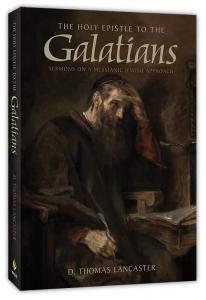
Book Review: The Holy Epistle to the Galatians

Galatians by D.T. LancasterThe passage contrasts two types of proselytes: the legal proselyte and the spiritual proselyte. The one becomes part of Abraham’s family by conventional conversion, the other through faith in Messiah, the promised seed of Abraham, in whom all nations find blessing. The passage does not contrast the Old Testament against the New Testament or the Old Covenant with the New Covenant. It does not equate Judaism and Torah with slavery, nor does it pit Christians against Jews.

It means that if you are a Jewish believer , you should be proud of being Jewish because you are a child of Abraham, legally, physically, and spiritually. It means that if you are a Gentile believer, you, too, are part of the people, a spiritual son of Abraham, and that is remarkable – miraculous even. You are a child of the promise that God made to Abraham so long ago.

-D. Thomas Lancaster
The Holy Epistle to the Galatians
“Sermon Twenty-Two: Sarah, Hagar, Isaac, and Ishmael (Galatians 4:21-31)”
pp 227-8

This is just a sample of how Lancaster’s view of Paul’s epistle to the Galatians presents a fresh and startlingly different understanding of the apostle’s message to the Gentile believers. This book takes Paul’s letter, virtually line-by-line, and re-interprets it from what most Christians would see as a radically different perspective. The book’s subtitle, “Sermons on a Messianic Jewish Approach” reveals the specific lens by which Lancaster views the letter and the stance from which he presents his argument: that Paul was supporting the unique covenant identity for the Jewish believer and at the same time, was instructing the non-Jewish disciples that they could have the same access to God, though the Messiah, without converting to Judaism.

But let me back up a minute.

Lancaster’s book is based on a series of 26 lectures or sermons he delivered in 2008 to Beth Immanuel, his community of faith, in Hudson, Wisconsin. It’s not unusual for Lancaster, a long-time contributor of books and other educational text to First Fruits of Zion (FFOZ), to “mine” his previous works for the sake of a new publication (for instance, Toby Janicki’s book Tefillin used some of Lancaster’s previous writing as a basis). Since each chapter represents one sermon in a series, I got an “episodic” feel as I moved from chapter to chapter, particularly in the first part of the book. I was also pleased that Lancaster’s ability to create the illusion that the reader is in the situation being described, was present in his current book. As I read through the chapters, I felt as if I were listening to Paul in one of the churches of Galatia, struggling with the issues he was trying to communicate, and experiencing the conflict between his teaching and the “influencers”.

As I mentioned before, this isn’t your typical Christian commentary on the Book of Galatians. Lancaster, using his knowledge of the Greek language, history, and accessing authoritative scholarly sources, “refactors” Paul’s letter into an almost completely different form, reflecting the Messianic Jewish viewpoint on Paul in general as well as FFOZ’s perspective in particular. There were a number of times when Lancaster would present the traditional Christian interpretation of a set of verses and then say something like, “this interpretation isn’t acceptable in Messianic Judaism”. I kind of wish he didn’t say it that way.

Sure, the focus of this book is to illustrate how Messianic Judaism views Paul’s letter in a dramatically different way, through its own “looking glass”, in order to understand his message in a way that makes more sense to both Jewish and non-Jewish disciples of the Jewish Messiah, but unfortunately, it could also be seen by a Christian reader as Lancaster just making the text say what he wants it to say to match his theology. The real value that I find in this book, (and many of FFOZ’s other materials) is in how it peels away almost twenty centuries of unchanging, set-in-stone, Christian theology and lets the reader see credible (and even very likely) alternatives to what Paul could have been saying. Questioning assumptions and courageously challenging dogma is not a property exclusively possessed by Messianic Judaism, Christianity, or any other religious movement. These qualities should be used by all people of honesty and faith when reading and studying our holy writings. These qualities should transcend denomination, movement, and sect, and be embraced by anyone who truly is a disciple of the Master and who seeks the truth of God and human existence.

The revelations Lancaster presents are too numerous to mention in this simple review (and I don’t want to give away too many “surprises”), but in reading this book, you will be introduced to a Paul and a Galatians letter that are completely new to you. This book offers a way of looking at Galatians, not as Paul’s anti-Jewish, anti-Torah rant, but as his answer to a complex dilemma facing the non-Jewish believers in the various churches in Galatia: does a “goy” have to convert to Judaism in order to be “saved”? The 21st century church would say emphatically “no” and in fact, would present the counter-argument that a Jewish believer would have to abandon Judaism and convert to Gentile Christianity in order to be a disciple of the Jewish Messiah. Conversely, Paul, at least as Lancaster understands him, would be appalled to hear that his letter had been so misappropriated by the modern church.

The book isn’t perfect. In general (and I agree with him), Lancaster uses various portions of Galatians to support his argument that Jewish believers (and non-Messianic Jews for that matter) were expected to obey the commands of God that He gave to the Children of Israel through Moses at Sinai, while at the same time, saying that the standard of non-Jewish “Torah” obedience to God was different…not non-existent, just different (see Galatians 5:13-26 for Paul’s interpretation of Gentile “Torah”). Unfortunately, there are any number of points in the book that, taken out of context, could be used to support the “One Law” argument (the position that states when a Gentile is “grafted in” to the Jewish root, they take on obligations to God absolutely identical to Jewish obligations). Other parts of the book make Lancaster’s position clearer, but I tended to stumble a few times when I encountered these ambiguous paragraphs.

Laying TefillinTo be fair, Lancaster is providing a detailed, in-depth analysis to a very difficult and wholly misunderstood piece of writing. Paul wasn’t easy to understand and trying to get into his head and into the culture and language in which he lived in the 1st century of the common era, let alone write an entire book about it, is a major undertaking. While I think the book succeeds overall, the reader is going to have to exercise a certain amount of patience and not jump to conclusions. Getting the entire message of Galatians means reading all of Lancaster’s book (I had to take copious notes) before coming to any sort of conclusion. Bringing an open mind as well as a notepad is also essential.

I don’t doubt that many of the people who read this book will either try to ignore it or start an argument about what it says. Lancaster completely disassembles the traditional Christian understanding of the letter and rebuilds it an atom at a time. That doesn’t make for comfortable reading if you’ve been taught for most of your life that the Torah is slavery for the Jews and grace is freedom for the Christians. For the One Law supporters in MJ, the book will also challenge many of their assumptions and at a few points, Lancaster even directly confronts the OL assumptions. Lancaster makes it clear in many of his comments that Paul never intended for the Gentile disciples to take on the entire “yoke of Torah” and that the “Torah” for the Gentiles was the “Torah of the Messiah”.

If you consider all that “the bad news”, I’ve also got “the good news”. The good news is that, if you set aside your preconceptions of what you think Galatians says, and by inference, many of the assumptions you have about what it means to be a Christian or to be “Messianic”, you’ll be able to read Lancaster’s book as an adventure in learning and an exploration of what it must have been like to be among the first Gentiles, having recently come out of pagan idolatry, entering a world and a relationship with God that had only previously been accessible to the Jewish people.

Who is Paul? Where did he get his “gospel”? Who did he see as his Master, Jesus or the Jerusalem Council? Who were the “influencers” who were disturbing the Gentile believers in Galatia? How did Paul see his fellow Jews and Jewish converts? What was Paul’s unique solution to the puzzle of integrating the people of the nations into the community of faith in the God of Israel?

The answers to those questions can be found in D. Thomas Lancaster’s new book, The Holy Epistle to the Galatians. Click the link to find out more. You may not believe it now, but there are answers in this book that you need to hear.

Besides the review you’ve just read, I’ve commented on different portions of Lancaster’s book in other recent blogs. They include Building Fellowship, Knowing, Intermediaries, and The Tefillin and the Shoemaker. These blog posts include mentions of Lancaster’s book within the context of other topics and resources, but taken together, I think this material provides a rich understanding of not only what the book says, but how it applies to a life of faith and to the wider contexts of Christianity and Judaism.

Enjoy.
Drawing Near

Kohen GadolThe name of this week’s Torah reading, Korach, provokes an obvious question: It is written: “The name of the wicked shall rot,” and on this basis, our Sages state that a person should not be named after a wicked man. Why then is an entire Torah reading named Korach? For with this title, Korach’s identity is perpetuated forever, since the Torah is eternal.

Among the explanations given is that Korach’s desire was, in essence, positive. Korach wanted to be a High Priest, to experience the absolute closeness with G-d that results from entry into the Holy of Holies. Indeed, when Moshe responded to Korach, he did not tell him this objective was unworthy. On the contrary, as Rashi relates, Moshe said he shared the same desire; he also wanted to be a High Priest.

Moreover, at Mount Sinai, G-d told the Jewish people that they are “a kingdom of priests,” and our Rabbis interpret this to refer to the level attained by a High Priest.

Rabbi Eli Touger
In the Garden of Torah
“Korach’s Positive Import”
Chabad.org

A third gentile wanted to convert so he could become the High Priest, and wear the Priestly garments. Shammai said no, but Hillel accepted him. After studying, he realized that even David, the King of Israel, did not qualify as a cohen, not being a descendant of Aaron…Hillel’s welcoming personality complements his saying: “Love people and bring them close to Torah.” (Avoth 1).

from -Hillel, Shammai and the Three Converts
Saratogachabad.com
citing Shabbos 31

“My job is not to distance anyone, but to draw them closer. If a person needs to be rebuked, let someone else take care of that.”

-from a letter of the Rebbe
quoted by Rabbi Tzvi Freeman
“Bringing Closer”
Chabad.org

I write a lot about praying, about reading Talmud, Chasidic stories, the Bible; and I write a lot about living out the life that God gave us, not just praying, reading, and studying. But what’s the point? Why do we do this? Why do I do this?

Why did the convert in the story about Hillel want to be a High Priest?

The motives are all the same. We want to draw closer to God. Even Korach, the subject of this week’s Torah Portion is said to have had good motives, though a bad way of expressing them. We all want to draw closer to God.

But what does that mean? I’m not sure anyone really knows.

What would we do if we were really close to God? You probably think you know the answer. You probably think it would the the most wonderful, peaceful, loving experience of your entire life. But do you know what you’re really asking for?

When the people saw the thunder and lightning and heard the trumpet and saw the mountain in smoke, they trembled with fear. They stayed at a distance and said to Moses, “Speak to us yourself and we will listen. But do not have God speak to us or we will die.” Moses said to the people, “Do not be afraid. God has come to test you, so that the fear of God will be with you to keep you from sinning.” –Exodus 20:18-20

When I saw him, I fell at his feet as though dead. Then he placed his right hand on me and said: “Do not be afraid. I am the First and the Last. I am the Living One; I was dead, and now look, I am alive for ever and ever! And I hold the keys of death and Hades. –Revelation 1:17-18

Do not be afraid? Are you crazy? who wouldn’t be afraid?

Sure, Abraham spoke with God “face-to-face” and Moses talked with God at the top of Mt. Sinai for forty days and forty nights, but that was Abraham and Moses. The Bible doesn’t relate tales of every one who encounters God having a perfectly comfortable and casual conversation and in fact, in the two scriptures from which I just quoted, we see that the more typical response of a meeting with the Divine was to expect to die in the next second or two. Why do we want to get closer to God?

We think we want to get closer to God when we imagine God is some sort of “cosmic teddy bear” who is all comfy and cozy and we can sit on His lap like kids telling Santa Claus what we want for Christmas. But it doesn’t work that way as we’ve seen in abundant measure. So why do we want to grow closer to God, abandoning all common sense and reason, desiring to have such an intimate and terrifying experience?

In Jewish mysticism, it’s believed that we contain a spark of the Divine; something of God, within each of us. That spark is always striving to return to the source. It’s like trying to hold a beach ball underwater in a swimming pool; the more you try to drive it downward, the more it pushes back toward the surface. The more darkness we pour into our being, the more sorrow and sin we find in the world, the more the Holy fire within us seeks out the conflagration of God.

From this life and light proceeds the divine “spark” which is hidden in every soul. Not all men succeed in rising to this close union with God at prayer, because this spark is imprisoned in them. “Yea, even the Shechinah herself is imprisoned in us, for the spark is the Shechinah in our souls.

-Paul Philip Levertoff
Love and the Messianic Age

Ezekiel's VisionIn yesterday’s morning meditation, I said that meeting God requires our “time, effort, and an unquenchable need to learn“. It’s that unquenchable, insatiable, unstoppable drive; like a spark seeking the fire, that pushes us forward, over the edge of the abyss, sometimes without our conscious will, pressing us across the threshold from our familiar world into the Presence of the Throne of God. This is what drives mystics to leave the universe and seek higher Heavens in vision and in spirit. This is what we see in the Merkabah or the Ezekiel’s chariot event and this is what John experienced in the vision he recorded in Revelation. Daniel’s visions all but drove him insane.

Most of us won’t have such intense encounters with God, but we seek something of Him nonetheless. It’s why we pray. It’s way we read the Bible. It’s why we study Talmud and Kabbalah. It’s why, night after night, we seek Him in our dreams and day after day, we call to Him to be with us along our way.

You shall teach them diligently to your children and you shall speak of them, while you sit in your home, while you walk on the way, when you retire, and when you arise. –Deuteronomy 6:7

This small portion of the Shema is part of what Jesus taught as one of the two greatest commandments; the commandments that are the “containers” for all of the Torah and the Prophets. Perhaps this is a clue telling us how we draw closer to God.

We know that Korach’s intentions were good, but intentions are not nearly as meaningful as the actions we take. His actions ultimately cost the lives of over 14,000 people. And while the actions of the convert who approached Hillel with the desire to become High Priest didn’t result in tragedy, he still was given the opportunity to learn a hard lesson in what it means to draw nearer to God.

Interestingly, the letter from the Rebbe quoted by Rabbi Freeman seems to speak somewhat of Hillel who, unlike his contemporary Shammai, did not rebuke the foolishness of the three converts but rather, welcomed them and gave them the time and the room to discover their mistakes. We make our own mistakes in trying to draw nearer to God. A lot of the errors we make have to do with arrogant presumption and the idea that the life, death, and life of Jesus Christ turned God the Father from a horrible, vengeful creature into everybody’s favorite uncle. Fortunately, God, like Hillel, gives us time and room to discover our errors.

It’s in our sincere attempts to encounter God that we actually discover when we’re walking the wrong path. Like Moses who saw only God’s “back” but not His “face”, when we’re ready, we realize just how vast and overwhelming even a momentary glimpse of God’s awesome glory is when it breaks into our world. However, to meet with God, we must make our humble efforts to seek Him out, in the pages of the Bible, in the halls of study, in the realms of prayer…and then we must wait.

From a mystic perspective, it is explained that Korach’s desires reflected the spiritual heights to be reached in the Era of the Redemption…The rewards of that age cannot, however, be attained prematurely, but only as a result of our Divine service. It is only through our selfless devotion to the Torah of Moshe and the directives of “the extension of Moshe in every generation” the Torah leaders of our people that we can elevate ourselves and the world to the point that “the world will be filled with the knowledge of G-d.”

-Rabbi Touger

Good Shabbos.

How Can We Pray?

PrayerThe mind will always find the answer most convenient for the mind.

Even in its search for spiritual enlightenment, the mind will only rest where there is enough room to remain a mind. Therefore, on its own, the mind can never grasp G-d.

To reach G-d takes a sense that is beyond the need to exist; the essential knowledge of the inner soul. Only once the mind has drunk from that fountain can it be trusted to see beyond itself. Only then can it see the place where mind ceases to exist.

Rabbi Tzvi Freeman
“The Convenient Mind”
Chabad.org

You desire but do not have, so you kill. You covet but you cannot get what you want, so you quarrel and fight. You do not have because you do not ask God. When you ask, you do not receive, because you ask with wrong motives, that you may spend what you get on your pleasures.James 4:2-3

We struggle all our lives to find our connection to God. Both Rabbi Freeman and James, brother of the Master, illustrate how we can get in our own way and inhibit that connection. We “settle” for a connection that we can understand and that fits with our “worldview”. We pray, but only to satisfy our desires and lusts and not to do His will. What do we know about God’s will for prayer?

“This, then, is how you should pray:

“‘Our Father in heaven,
hallowed be your name,
your kingdom come,
your will be done,
on earth as it is in heaven.
Give us today our daily bread.
And forgive us our debts,
as we also have forgiven our debtors.
And lead us not into temptation,
but deliver us from the evil one.’” –Matthew 6:9-13

If prayer seems difficult, it is only because we pray with the wrong motives and the wrong expectations. We pray to serve ourselves and not God, yet Jesus made it clear that, from His grace and mercy, God would take care of our needs too, if only we would pray:

Very truly I tell you, whoever believes in me will do the works I have been doing, and they will do even greater things than these, because I am going to the Father. And I will do whatever you ask in my name, so that the Father may be glorified in the Son. You may ask me for anything in my name, and I will do it. –John 14:12-14

If we know that God will meet our needs in the name of the Son, what else prevents us from “talking” to God? Certainly not God Himself, as we discover in this teaching from Chabad.org.

Once upon a busy life–maybe even two, three times or more–some of us are struck with a sense of being so small within something much larger and wouldn’t it be good for the two of us to have a chat. In other words, we would like to speak with G-d.

It’s not as outlandish as it seems; people do it all the time. Most never stop to think what is really going on, for if they did, they wouldn’t be able to open their mouths. But it is so essential to human life, so we continue on nonetheless.

We call it prayer, and we believe the second party of this dialogue is just as eager to join–if not yet more eager than ourselves.

To this lesson, Rabbi Naftali Silberberg adds:

Prayer comes naturally when a person, G-d forbid, experiences hardships. But passionate prayer when all is (relatively) well is, in a certain sense, a far more meaningful experience. Because our conversations with G-d serve a dual purpose: they are an opportunity to beseech our Provider for health, prosperity and nachas from our children; but more importantly, they are also moments when we connect with our beloved Father in Heaven. Indeed, to a certain extent, the content of our prayers is less significant than the experience itself–an opportunity to connect with G-d.

You have His attention; speak as long as you wish! The great sage Rabbi Yochanan summed it up with these words: “If only a person could pray all day long!”

Praying with TefillinGod is listening to you. He is always listening to you, waiting for you to make the connection. All you have to do is start talking. It doesn’t matter who you are. It doesn’t matter what you’ve done. No quality you possess or lack will prevent God from hearing your prayers. Even if you’ve turned away from Him, you can always turn back to Him, as illustrated by how Rabbi Freeman answered this question:

Question: “I don’t feel that that I have any right to pray to G-d. I’m not religious at all. Over the years, I’ve committed many sins. Since I’ve turned against G-d and transgressed His commandments, how can I approach Him in prayer?”

Answer: “Each morning, when we wake up, we say in our prayers, ‘My G-d, the soul You gave me is pure…’

No matter what you do with your life, your soul remains pure. Even at the time you are committing the worst crime, your soul screams inside like a captive woman, remaining faithful to her Beloved Above.

And now you want to take away from her that last opportunity to scream out loud for help?”

If God only heard the prayers of the righteous, God would hear no prayers at all. You do not have to be righteous. You do not have to be perfect. You do not have to say “magic” words or pray by a formula. All you have to do is start talking. God is waiting…and listening.

Gardening

GardeningThat same day Jesus went out of the house and sat by the lake. Such large crowds gathered around him that he got into a boat and sat in it, while all the people stood on the shore. Then he told them many things in parables, saying: “A farmer went out to sow his seed. As he was scattering the seed, some fell along the path, and the birds came and ate it up. Some fell on rocky places, where it did not have much soil. It sprang up quickly, because the soil was shallow. But when the sun came up, the plants were scorched, and they withered because they had no root. Other seed fell among thorns, which grew up and choked the plants. Still other seed fell on good soil, where it produced a crop – a hundred, sixty or thirty times what was sown. Whoever has ears, let them hear.”Matthew 13:1-9

A creative mind is a fertile field. But that may simply mean that the weeds are taller and grow faster.

First, soften your mind’s soil, plough its furrows. Open it to the wisdom that rains down from the heavens; let the dew of Torah sink into your soul, the seeds laid by tzaddikim enter your heart. Learn to lie still as they awaken and take root. Quietly await the spring.

In the place of thorns and a tangle of weeds will grow a bountiful garden. Where once wild and brazen delusions sprang forth, a tightly focused beam of light will shine.

-Rabbi Tzvi Freeman
“The Field of Your Mind”
Chabad.org

The parable of the sower being related by Jesus is interpreted as the different reactions people have when hearing the “message of the kingdom” (see Matthew 13:18-23), but this story of the Master is more than a little related to Rabbi Freeman’s commentary about how to prepare our minds for Torah study and spiritual learning. You may think that because you read the Bible, go to Sunday school, go to a Talmud study, or frequent online religious forums, that you are “studying the Word” and are well prepared to receive it. However, that’s not always the case.

You’ve heard the expression, “you can lead a horse to water…” and it’s true. You can take a person who has certain attitudes about the Bible, Jesus, God, and so forth, and introduce them to your scripture, your church, your synagogue, or another favorite religious context, but that doesn’t mean they’ll receive it in the way you are hoping. It’s not just the material, it’s the person and how they see the situation. Here’s a perfect example:

Rabbi Eliezer Silver zt”l was a leader and activist who saved thousands of Jewish lives during the Holocaust. After the liberation of the Nazi death camps, he tried to revive the spirit of Judaism among the survivors.

One of his many activities was organizing prayer services. A certain refugee refused to participate, explaining that he’d been turned off to Judaism forever. He said that there had been a religious Jew in this refugee’s camp who had smuggled in a Siddur (prayer book), and he would charge people half their bread ration to use his Siddur for ten minutes. After witnessing such cruelty, the refugee refused to have anything to do with Siddurim, prayer services, or anything Jewish.

Rabbi Silver approached him with great compassion and understanding, but offered him a new perspective. “You only see the Jew who was so cruel,” he said. “What about the holy Jews who were willing to give up half their meager rations for just 10 minutes with a Siddur?”

No one can blame the refugee for his feelings. After living through his hellish experience, who could say they would react any differently? Nonetheless, says Rabbi Shimshon Pincus zt”l, two people can hear the same story and one notices the cruelty, while the other notices the holiness and dignity.

The Sages say that what the eye sees depends on what the heart feels (Talmud Avoda Zara 28b), and in this week’s Torah Portion (Num. 15:39) we’re told “Don’t stray after your heart and after your eyes.” Our eyes will only see negativity and impurity if our hearts have already been corrupted. If we make the effort to turn our hearts towards positivity, giving to others, appreciating, then the world will transform before our eyes into a panorama of pleasures and joy, the constant gifts that G-d wishes upon us.

Commentary on Torah Portion Shlach
by Rabbi Mordechai Dixler
Program Director, Project Genesis – Torah.org

WateringIn my previous morning meditation, I was pretty discouraged. It passed, but sometimes the enormity of a life of faith, continually reaching out to God, trying to understand even the most elementary lesson of holiness, and trying to share my (what I hope are) unique perspectives with other people, can be really wearing. Yet, as we just saw in the story related by Rabbi Dixler, even the most difficult and excruciating circumstances can be viewed in more than one way. Or, to quote Hindu Prince Gautama Siddharta (Buddha), “The mind is everything. What you think you become.”

Simply put, you are (I am) what you think about habitually. If you think life is terrible, it is, more or less regardless of circumstances. I’m sure you can create some extraordinary situation that would be perceived as horrible (such as living in the camps during the Holocaust) beyond any ability to endure, but even here, Rabbi Dixler points out there is a difference between seeing the selfishness of a man who would exploit his fellow Jew to feed his own stomach vs. the Jew who would give up even his last morsel of bread to pray from a Siddur for just ten minutes. If we want a relationship with God, we must work to prepare for it:

Here is Paul’s interpretation:

Finally, brothers and sisters, whatever is true, whatever is noble, whatever is right, whatever is pure, whatever is lovely, whatever is admirable – if anything is excellent or praiseworthy – think about such things. Whatever you have learned or received or heard from me, or seen in me – put it into practice. And the God of peace will be with you. –Philippians 4:8-9

This is why we must study the Bible and study it regularly. This is why we attend the house of prayer regularly and frequently. This is why we spend time in prayer daily and associate with our companions in faith at every opportunity. Although it is easy to feel alone and misunderstood in a world that, above all else, worships pleasures and morals built on shifting sands, we are never alone unless we want to be. It takes discipline to feel God’s presence. If we can say that God sets appointments each day for us to meet with Him, it is up to us to keep those appointments and to become accustomed to His voice.

For as he thinks within himself, so he is. –Proverbs 23:7

My sheep listen to my voice; I know them, and they follow me. –John 10:27

Take a moment or two to review the state of your mind and your “garden”. What can you do better to make it grow?

The Panoramic Garden

I had said in my panic, “I am cut off from before Your eyes!” But in truth, You heard the sound of my supplications when I cried to You. Love Hashem, all His devout ones! Hashem safeguards the faithful, but He repays the haughtiness on one who acts with arrogance. Be strong, and let your hearts take courage, all who wait longingly for Hashem. –Psalm 31:23-25

You are a shelter for me, from distress You preserve me; with glad song of rescue You envelop me, Selah! I will educate you and enlighten you in which path to go, I will advise you with [what] my eye [has seen]. –Psalm 32:7-8

The Messianic Tale

The Ba'al Shem TovThe third goal of the hasidic story was to rouse its hearers into action for the service of God. Several compilers of hasidic stories quoted the dictum by R. Elimelekh that ‘it is an auspicious sign for a person if, when he hears what is related regarding the virtues of the tsadikim and their faithful holy service of the Lord, may he be blessed, his heart beats at that time with the desire and very great fervour that he also merit faithfully to serve the Lord, may he be blessed; this is a good sign that the Lord is with him.’

from The Hasidic Tale
by Gedaliah Nigal

As they approached the village to which they were going, Jesus continued on as if he were going farther. But they urged him strongly, “Stay with us, for it is nearly evening; the day is almost over.” So he went in to stay with them. When he was at the table with them, he took bread, gave thanks, broke it and began to give it to them. Then their eyes were opened and they recognized him, and he disappeared from their sight. They asked each other, “Were not our hearts burning within us while he talked with us on the road and opened the Scriptures to us?”Luke 24:28-32

Gedaliah Nigal relates to his audience the importance to the Chasidim of storytelling  about tzadikim (righteous ones), Chasidim (devoted disciples), and the deep and multi-layered influence these tales can have. As you’ve already seen, one of the purposes of Chasidic storytelling is to inspire the listeners to perform acts of righteousness and devotion for the sake of God. We also see in Luke’s Gospel, that the words of the risen Messiah did the same thing. That brings us to an interesting question: is one of the main purposes of the Bible to tell stories that inspire the reader?

I’m not really asking if the Bible is inspirational. I think most believers would say “yes”. What I’m asking is whether or not the Bible is a collection of stories designed to inspire its readers?

I’ve just implied that not everything in the Bible is literally true, a contention supported by many leading New Testament (NT) scholars, not the least of which is Bart D. Ehrman. You might be tempted to dismiss Ehrman based on the fact that he is a self-declared agnostic (though a former Christian), but other scholarly New Testament books address the question of how literally we can take the Bible, including whether or not the New Testament defines Jesus as God (see Maurice Casey’s From Jewish Prophet to Gentile God and Larry Hurtado’s How on Earth Did Jesus Become a God as examples).

If you believe that the Bible is 100% literally true and should be read as a history, I’ve no doubt just shocked you by suggesting otherwise, yet modern NT scholars readily confirm that the Bible is less a history book and more a set of stories (based on eyewitness accounts, at least to some degree) about the teachings of the Jewish Messiah and what they mean to the nations of the world in terms of access to God, forgiveness of sins, and a life beyond the one we know. The New Testament speaks to the Jewish people but it also speaks to the non-Jewish nations about the God of Israel and the Son of God, Jesus, the Messiah who brought the Good News of the Most High to all of mankind. These “stories” represent as much the perspectives and character of the  NT authors (who may not always be the people we attribute these stories to) as well as the nature of character of the Messiah.

That brings us to another purpose of these “stories”:

The very power of the hasidic tale wins adherents to hasidism. Many people, among them some outstanding individuals, have been drawn to hasidism by its stories. R. Menahem Mendel of Kotsk, one of the leading hasidic tsadikim, said of himself that ‘he was made a hasid by an old man who told stories about the holy tasdikim’. The Ba’al Shem Tov excelled in his ability to attract new followers by this means.

Teaching of the TzadikimWhile Nigal is speaking of Jews who turn toward the teachings of Chasidic Judaism, I will admit to being attracted, as a Gentile, to these teachings when I read some of the tales of the Chasidim. It’s difficult to disregard the wisdom and compassion of the inspirational stories about the Chasidic tzadikim, but it doesn’t stop there. This, I think, is also what is so attractive about the tales of the “tzadik” Jesus. In fact, there is one Chasid who, after thoroughly investigating the Gospels, found the “stories” of John especially to be reminiscent of the tales of the Chasidim and as a result, became a lifelong disciple of the “Maggid of Nazeret”.

He read the Gospels in German. Then he obtained a Hebrew version and reread them. Though he was in the midst of a Gentile, Christian city where Jesus was worshiped in churches and honored in every home, Feivel felt the Gospels belonged more to him and the Chasidic world than they did to the Gentiles who revered them. He found the Gospels to be thoroughly Jewish and conceptually similar to Chasidic Judaism. He wondered how Gentile Christians could hope to comprehend Yeshua (Jesus) and His words without the benefit of a classical Jewish education or experience with the esoteric works of the Chasidim.

Taken from Jorge Quinonez:
“Paul Philip Levertoff: Pioneering Hebrew-Christian Scholar and Leader”
Mishkan 37 (2002): 21-34
as quoted from Love and the Messianic Age

If a young Chasid named Feivel Levertoff (he later changed his name to “Paul Philip”) could discover the Messiah in Jesus in the late 19th century because John’s Gospel was so much like the powerful and mystic writings on which he was raised, is it so difficult to imagine that a passionate exploration of Jesus might lead a Christian to discover an extension of his faith in Chasidic tales?

What are you looking for? Wealth? Prestige? Position? You have all these right now. You should be altogether happy. And yet you are miserable – I can feel it for all your brave speech. Can you not be satisfied? And this way of living that fills you with restlessness and discontent – I am not a Jew but even I have sensed something lovely in Judaism, in its faith and in its morality with its emphasis on pity. Even its rituals are not without poetic grace. See how many Gentiles have been converted to your religion. Does that not prove that it possesses virtues which the Greek world lacks? These are at your disposal now. What more do you want?

-Nicholaus to Elisha in the novel:
As a Driven Leaf
by Milton Steinberg

In the days prior to and even after Christ’s earthly existence, it was somewhat common for non-Jews to see the beauty and wisdom in the teachings of the God of Israel, so in those days, many Gentiles converted to Judaism as the only means by which they could live a life of righteousness (though through the revelation of Christ, all people may be reconciled to God). While Christianity begins with Judaism as its root, two millennium of separation between Judaism and Christianity have made them two almost completely unrelated faiths, with only the spectre of a connection between them (most Jews would say that the term “Judeo-Christian” is a misnomer). However, if Christianity truly accepts that we follow the Jewish Messiah, who first came for the lost sheep of Israel and only afterwards for the nations, who never abandoned his people, and as the Apostle Paul taught, all of Israel will one day all be saved (Romans 11:26), then we cannot be so arrogant as to brush aside the natural branch just because we, the wild and alien olive shoot, have been grafted into the root (Romans 11:17).

Perhaps you’ve heard the story of Hillel, Shammai, and the Three Converts as related in the Ethics of the Fathers (Avot Pirkei). I won’t recount the entire story (you can click on the link I just provided and read it for yourself), but it does illustrate the drive and passion among some of the Gentiles to truly understand what it is to be a Jew and to have that special covenant relationship with God. While Hillel and Shammai died perhaps only within a few years of the birth of Christ, they each established great schools of Jewish learning and their disciples, native Jews and converts, carried on their teachings and traditions for generations and eventually, ensured that their stories would be recorded for all time so that we have them with us even today.

The “Chasidim” of Jesus also made sure the stories of their Master were passed on from generation to generation, eventually being recorded and passed on to the future…to us.

Paul Philip Levertoff thought that the teachings of Jesus read like a collection of Chasdic tales. Perhaps as Gentile Christians reading tales of the Chasidim, we can also find a connection to the Messiah, the Prophet, and the greatest Tzadik, whose own death atoned for not just a few, but for all.

Crossroads

Crossroads“Let me explain,” Demonax continued. “To you philosophy is science. To me it is art. To you it is a method of discovering the truth. To me it is a guide to noble living.”

Demonax to Elisha in
Milton Steinberg’s book
As a Driven Leaf

In my previous blog post Two Worlds, I compared my journey of faith to that of Elisha’s. Elisha is a Jewish man living in the first fifty years after the destruction of the Second Temple in Jerusalem. He is a man who had been trained as a Rabbi and who had served as a member of the great Sanhedrin. Yet, in a profound crisis of faith, he has abandoned his Jewish heritage and the Torah of Moses and fled to the Syrian city of Antioch to try to find the truth of his existence in the realms of Greek literature, science, and philosophy.

I, for my part, am a person who came to faith in Jesus sometime after my 40th birthday and after a few years not being satisfied by the answers of the church, proceeded into a “blending” of Christian and Jewish practices in a small, local congregation. However, in recent years, from the vantage point of a Christian man, I’ve been watching my Jewish wife on her journey of discovery to embrace her Judaism. I now find myself challenged by both the Christian and Jewish worlds to explore the value of my own faith through a Jewish lens.

But Elisha has the worst position of the two of us. He is trying to seek an objective method of proving the existence of God (or proving God doesn’t exist) and then determining, regardless of the result, how men are supposed to live based on scientific and indisputable evidence.

Good luck.

But look at how Demonax, the Greek moralist and cynic philosopher, differs with Elisha in even describing the task and the goal. Elisha is trying to understand the “meaning of life” by scrutinizing existence as an astronomer looks at a planet through a telescope. By contrast, Demonax sees the meaning of life not as an attempt to understand existence, but to live it out. The mechanic vs. the poet. While both perspectives are valid, here they are placed at odds with each other.

But should they be?

Think about why a person comes to faith, any sort of faith, in any religious structure. There are two approaches. The first is that a person concludes in their current system that life is random and without meaning. Why is the earth here? What is the purpose of existence? Is the universe the result of a blind, unreasoning accident or is there a conscious creativity at work? How am I supposed to understand the world around me?

The second approach is that a person concludes in their current system that their life is random and without meaning. The questions are similar but pregnant with a profound difference. Why am I here? What is the purpose of my existence? Am I just the result of a random joining of two reproductive cells or is my life special and meaningful? Then, the most important question is, if my life is special, meaningful, and unique, what am I supposed to do? “How am I supposed to live?”

The two questions generally lead to the same answer, for in discovering the meaning of the universe, you discover the meaning of yourself and how you are to live out the life you were given. Both Elisha and Demonax are traveling to the same city but they’re taking two radically different routes.

ChasidNow consider the Chasidic understanding of the Torah. You may look at a Torah scroll or a Bible and see words on paper, but that’s only the surface appearance and this only hints at its true purpose and meaning. In the following series of short quotes, Rabbi Tzvi Freeman brings to light some of the wisdom of the Lubavitcher Rebbe, Rabbi Menachem Mendel Schneerson to help us understand what we are really seeing:

They translate it as “The Bible,” or “The Law,” but that’s not what the word means. Torah means “instructions.”

Whatever piece of Torah you learn, you must find the instructions it is giving you. -from Instructions

Torah is the blueprint by which the world was designed. Everything that exists can be found in the Torah.

Even more: In any one concept of Torah you can find the entire world. -from Blueprint

At Mount Sinai, tradition tells, there was no echo.

Torah penetrates and is absorbed by all things, because it is their essence. There is no place where it does not apply, no darkness it does not illuminate, nothing it cannot bring alive. Nothing will bounce it back and say, “Torah is too holy to belong here.” -from Penetrating Wisdom

We find that the Torah is not only the blueprint for existence, but a set of instructions for our existence. Beyond that, we discover that every object and being within the created universe is a container, of sorts, for the “material” used for its creation: the Torah. I don’t mean to say that all of humanity should attempt to live a “Torah lifestyle” identical to the Jewish people, but it seems more than reasonable that we should study the Torah to learn the essential truths by which God intends for us to live. After all, God’s instructions to do so are here:

Many peoples will come and say,
“Come, let us go up to the mountain of the LORD,
to the temple of the God of Jacob.
He will teach us his ways,
so that we may walk in his paths.”
The Torah will go out from Zion,
the word of the LORD from Jerusalem. –Isaiah 2:3

Rabbi Freeman’s teachings are not far from what this early 20th century Chasidic scholar had to say:

Why has God created the world and mankind, and for what purpose? Why has the soul descended into the body? (The preexistence of the soul was assumed in Chasidism.) Is there a more ideal world than the divine world in which the soul previously existed? Is there a greater joy than when man rejoices in God?

-Paul Philip Levertoff
as published in “The Love of God”
Messiah Journal issue 107

Elisha considers philosophy and thus the search for meaning and ultimately for God, to be a science. Demonax believes the same journey is the art of learning how to live in a noble, and even in a holy manner. Yet Elisha’s personal doubts have blinded him to what he should have known, having been a student of the Torah from childhood. He should have seen that the Torah contains all the questions and all the answers. Greek science and philosophy, like our modern, western thought, seeks to compartmentalize and to segregate our objective environment, our physical bodies, and our souls, but the Torah is the maker and container of all these and indeed, we are a container for the Torah, as is the entire universe and everything in it.

Like a splinter in our minds, the questions drive us madly to seek the answers of why we’re here and why the world exists, and yet the answers are right in front of us and they have been right in front of me all along:

One of the teachers of the law came and heard them debating. Noticing that Jesus had given them a good answer, he asked him, “Of all the commandments, which is the most important?”
“The most important one,” answered Jesus, “is this: ‘Hear, O Israel: The Lord our God, the Lord is one. Love the Lord your God with all your heart and with all your soul and with all your mind and with all your strength.’ The second is this: ‘Love your neighbor as yourself.’ There is no commandment greater than these.”

“Well said, teacher,” the man replied. “You are right in saying that God is one and there is no other but him. To love him with all your heart, with all your understanding and with all your strength, and to love your neighbor as yourself is more important than all burnt offerings and sacrifices.” –Mark 12:28-33 (quoting Deut. 6:4-5 and Lev. 19:18)

Christ’s answer tells us both the meaning of the universe and the meaning of our lives, what Creation is, who we are, and what we are supposed to be doing.

The great sage Hillel once summed up the Torah as that which is hateful to you, do not do to your fellow. That is the whole Torah; the rest is the commentary; go and study” (Shab. 31a). While the “two greatest commandments” don’t give us every detail of the journey on which we must travel, it does provide a clear direction. Here I am, standing at a crossroads looking for a direction, just as Elisha was. May I make a better decision than he did. I pray we all do.

Well I looked into dream of the millions
That one day the search will be through
Now here I stand at the edge of my embattled illusions
Looking into you

-Jackson Browne
“Looking into You” (1971)

Chag Sameach Shavuot.