Tag Archives: messianic gentiles

What is the Romans 11 Olive Tree?

But if some of the branches were broken off, and you, being a wild olive, were grafted in among them and became partaker with them of the rich root of the olive tree, do not be arrogant toward the branches; but if you are arrogant, remember that it is not you who supports the root, but the root supports you. You will say then, “Branches were broken off so that I might be grafted in.” Quite right, they were broken off for their unbelief, but you stand by your faith. Do not be conceited, but fear; for if God did not spare the natural branches, He will not spare you, either. Behold then the kindness and severity of God; to those who fell, severity, but to you, God’s kindness, if you continue in His kindness; otherwise you also will be cut off. And they also, if they do not continue in their unbelief, will be grafted in, for God is able to graft them in again. For if you were cut off from what is by nature a wild olive tree, and were grafted contrary to nature into a cultivated olive tree, how much more will these who are the natural branches be grafted into their own olive tree?

Romans 11:17-24 (NASB)

I’m writing this “morning meditation” just to preserve something I know I’ll forget if I don’t document it (as I get older, I find that my memory is becoming somewhat “leaky”).

I want to talk about trees.

Actually, I want to talk about one specific tree, an olive tree, the one Paul mentioned in the above-quoted portion of his Holy epistle to the Romans.

What in the world does that tree represent? Some of the common responses are “Israel,” “Judaism” or the “Jewish people,” or maybe “Jesus,” although that last suggestion doesn’t exactly make sense from the Jewish point of view given that the tree has existed for as long as the Jews have existed if they are natural branches.
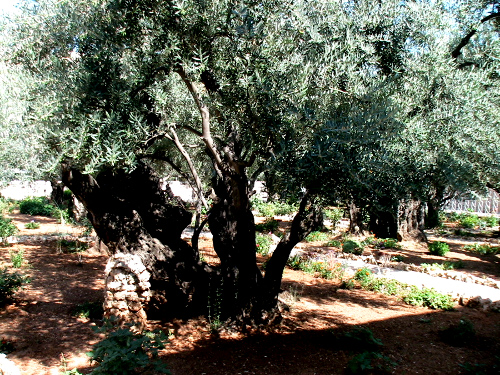
ancient_olive_treeI discovered (or maybe rediscovered, given the “leakiness” of my memory) a plausible answer, one that is in fact more plausible than any I’ve suggested above.

The first element to understand is that this tree represents all those who share faith in HaShem, who trust Him. Verse 20 is the key that shows the definition of this tree, because unbelief is the mechanism that breaks a branch off of the tree, and faith is the mechanism by which one remains on the tree. At one time, the only branches on that tree were the natural native ones, which is to say Jews. The cultivation of that tree represents the principles of the Torah covenant that inculcated faith into the entire culture of the Jewish people – thus Jews were a people who had been acculturated to the notion of faith or trust. Being broken off of the tree refers to a loss of faith or a rejection of it. Being grafted onto the tree represents acquiring faith (or regaining it if it had been lost or rejected). Wild branches represent non-Jews from cultures that were not acculturated to faith in HaShem. They were not naturally accustomed to it, but they could learn faith by means of the teachings of Rav Yeshua and thus be “grafted” onto the tree of faith to which they were not native, “contrary to nature” (meaning by means of deliberate intervention by a gardener). The sap of the tree must then represent the nourishment of Torah knowledge, perspective, and insight that Jews have cultivated for many centuries to elaborate the meaning of a life of faith. The root of the tree is thus the source of this nourishment, the Torah.

-a comment of Proclaim Liberty from
June 15, 2015 at 4:06 a.m on my blog post What am I, Chopped Liver?

That’s only part of PL’s rather lengthy missive, but it does serve to illustrate that, from his perspective, the Romans 11 tree isn’t Judaism, the Jewish people, or even Israel. The olive tree is a metaphor for faith and trust.

I provided a link above that points directly to PL’s comment so you can read the content in full (or re-read it given the current context). Frankly, I’ve puzzled over the nature of this tree for more hours than I care to think about without coming to a conclusion. I ended up setting the matter aside, figuring the answer would land in my lap eventually.

I think it finally has.

Of course, given the mention of the Torah being the nourishment the tree provides both to the natural (Jewish) and grafted in (Gentile) branches, what’s to prevent someone from concluding that both types of branches are equally obligated to the mitzvot?

PL responses to this in part:

Now, this analogy doesn’t quite answer the questions about Torah observance for non-Jews, though Acts 15 offers a starting point to differentiate between two discipleship types, and perhaps it also explains Rav Shaul’s reference to two different versions of gospel: one addressed to the circumcised, and the other to the uncircumcised (viz:Gal.2:7), neither of which is to be dismissed as merely so much “chopped liver”. [:)] It may be suggested, however, that an acculturation to faith certainly does occur as wild branches reside on the tree and absorb Torah nutrients, and receive treatment from the Gardener (e.g., pruning) comparable to that given the native branches. Moreover, by faith does it become possible to set aside insecurities, so as to enable facing the discomfort of working to distinguish between applications of Torah which apply to everyone (including wild branches) and those which apply only to someone else (i.e., only to the native ones). We can also consider what might be the implications for this analogy in the present era when so many wild branches come from cultures that have been already at least partially accustomed to the notion of faith in G-d, even if that faith has been contaminated with views that are contrary to Torah or Jews or Judaism or related notions.

James and the ApostlesActs 15:21 hints at the responsibility for non-Jews to learn Torah, even after it had just been clarified that their legal obligations to specific performance were very limited. Why then to learn? I would suggest that making the distinctions I described in the above paragraph requires a depth of Torah understanding, because even common principles of Torah might result in different praxis for Jews and for non-Jews to obey. For example, I recently was looking closely at the text of Is.56 (vs.2&6) to consider the characteristics of how the “foreigner”, who is being commended by HaShem for clinging to His covenant, actually approaches the Shabbat. He is described only as keeping from profaning it; whereas Jews are elsewhere commanded to actually sanctify it and guard it. This suggests some sort of difference in the specific behaviors associated with it. I’m still grappling with what that may mean, and how gentile obedience and compliance to this may thus differ from what I know as my Jewish responsibilities and praxis. But it does show that what constitutes obedience for one may be disobedience if another tries to do the same rather than what is appropriate to his or her categorical situation.

I know this is really long by Internet standards, but there is a lot of good information to absorb here. I think (my opinion) that PL is describing how complex and nuanced the Gentile’s “grafted-in-ness” is. There’s no easy black-and-white answer as to who we are and what we’re supposed to be doing as non-Jewish disciples, except that it’s not identical to what observant Jews are supposed to be doing.

We have clues, hints, and starting points, but I think it’s up to us to struggle with how we’re going to build our lives on the foundation of the Bible, and particularly how the Apostolic Scriptures present the lives of non-Jews in Messiah.

I just didn’t want to lose track of the very concept of the Romans 11 tree as a metaphor for Faith and Trust. Lack of faith may get a natural branch knocked off the tree temporarily, but it doesn’t turn a Jew into a non-Jew. Nothing can do that. Being grafted into the tree does not turn a Gentile into a Jew. We’ll always be Gentiles. It also doesn’t turn us into Israelites. Only Jews are Israel.

But being grafted in means we’ve come to faith in Hashem, the God of Israel, and we are nourished by the principles of Torah as applied to the Goyim.
faithI’m not writing this to present an answer or declare some amazing Biblical insight (particularly because the insight isn’t even mine). I’m just putting this here as another piece of the puzzle of our lives in God that may help to fill in the picture.

Oh, one more thing:

For I do not want you, brethren, to be uninformed of this mystery—so that you will not be wise in your own estimation—that a partial hardening has happened to Israel until the fullness of the Gentiles has come in; and so all Israel will be saved; just as it is written,

“The Deliverer will come from Zion,
He will remove ungodliness from Jacob.”
“This is My covenant with them,
When I take away their sins.”

From the standpoint of the gospel they are enemies for your sake, but from the standpoint of God’s choice they are beloved for the sake of the fathers; for the gifts and the calling of God are irrevocable.

Romans 11:25-29

Immediately after writing “if you were cut off from what is by nature a wild olive tree, and were grafted contrary to nature into a cultivated olive tree, how much more will these who are the natural branches be grafted into their own olive tree?”, Paul goes into how Israel’s “hardening” is only partial, that is, temporary, and will only last until “the fullness of the Gentiles has come in.” Then “The Deliverer will come from Zion” and “remove ungodliness from Jacob” so that “all of Israel will be saved.”

This is clearly New Covenant language and, as I’ve said many times before, I believe God will truly redeem all of Israel just as He promised. Paul was telling the Gentiles not to let being “grafted in” go to their (our) heads. The olive tree of faith has belonged to the Jews from the beginning. Any of the natural branches knocked off temporarily for the sake of the Gentiles, for our sake, will all be rejoined to the tree by Messiah. Even in being knocked off, temporarily losing the “faith connection,” it was done for the sake of the nations, so we owe a debt of gratitude, even to those Jews who currently reject the notion that Yeshua could possibly be the Messiah. That’s the majority of Jews across the past twenty centuries. Without their temporary absence from the root (and who is to say how absent they are since they cleave with great faith to Hashem), there would be no room for us.

Any Christian or non-Jew who calls themselves a “Messianic Gentile” or “Messianic whatever” who also disdains non-believing (let alone believing) Jews is guilty of ingratitude, not only to Israel but to God who arranged it all. Remember, the “promises are irrevocable.”

Let that sink in.

Are Messianic Gentiles Korach?

Korach, the son of Yitzhar, the son of Kehas, the son of Levi, separated himself.

Bamidbar/Numbers 16:1

This verse begins the passage that deals with the rebellion of Korach, who sought to overthrow Moshe and Aharon from their positions as leaders of the Jews. The verse stresses that Korach took himself apart — that is, he deliberately sought to develop machlokes, strife between the Jews and their leaders.

-from “A Torah Thought for the Day,” p.2
Sunday’s commentary on Torah Portion Korach
A Daily Dose of Torah

Over two weeks ago, I wrote a blog post called What Am I, Chopped Liver?, in which I attempted to illustrate that non-Jews who are somehow associated with the Messianic Jewish movement are not an afterthought of God or a devalued population without a role in God’s redemptive plan for Israel and the nations simply because we’re not Jewish.

I could never have predicted what happened next. As I write this (Monday afternoon) that fifteen day old blog post has collected 191 comments and counting. Apparently, I struck a nerve, a really sensitive one.

I’ve written several posts since then, but none has gained the traction of “Chopped Liver,” which is just fine.

But then I started studying for the coming week’s Torah Portion Korach.

Rashi explains that Korach wished to make the point that there was no reason for Moshe and Aharon to be seen as greater than the rest of the Jews, for all of them had been spoken to by God at Sinai. thus their assuming leadership represented a selfish act of self-promotion…

…No matter how holy the Jews, they still needed leaders — and Hashem had ordained that those leaders were to be Moshe and Aharon. Sadly, Korach refused to see the obvious answer, and came to his terrible end as a result.

ibid, pp.2-3

We need to look at Korach and his 250 followers in context. The failure of the ten spies had just occurred (see Shelah) and the Children of Israel, bewailing their fate, refused to enter the Land and conquer it. Instead, they begged for a new leader to guide them back to Egypt. Even the next morning when the people realized their error, it was too late. Hashem had already decreed that the current generation wander the desert for forty years, until the last one of them expired.

Not listening to Hashem again, the Israelites attempted to take the Land. Hashem was not with them and the local Canaanite armies easily routed Israel, sending her packing, so to speak.

From Korach’s point of view, this might all seem to be the fault of Moses and Aaron. Midrash states that Korach and his companions believed Moses had appointed himself and Aaron as leaders, and that their positions of authority did not come from Hashem. If Korach were right, then there was no absolute divine source that appointed Moses as the Leader and Prophet of Israel and he might be opposed, overthrown, and replaced. This was Korach’s intent.

Although Korach was dead wrong (literally as it turns out) and Hashem decreed his demise, I can’t think too harshly of Korach. Yes, he was misguided and confused, probably tortured by the humiliating defeat in Canaan, and the dreaded prospect of the Israelites spending the rest of their days wandering the desert of Sinai. But assuming he wasn’t just greedy for power, he probably thought he was doing the right thing, the only thing he could think of to save his people.

korach rebellionBut he lacked Moses’ perspective and his apprehension of the will of Hashem for Israel.

It is commonly thought that Korach’s sin was one of attempting to usurp the roles of Moses and Aaron and to make himself the leader and High Priest (a bit if hypocrisy if he really thought that all Israelites were complete equals).

But we “Messianic Gentiles” (or whatever you want to call us) are also trying to figure out our roles relative to Messianic Jews and within the context of Messianic Judaism. Can we Gentiles be compared to those involved in the Korach rebellion?

First of all, let’s understand how I’m using the term “Messianic Gentiles.” Why don’t I just call us “Christians?”

Well, in the most generic way of speaking, we are Christians. That is, anyone who follows Christ (Messiah) as a disciple can be called a Christian (and my Jewish wife calls me a Christian). I make the differentiation for two reasons.

The first is that, in modern times, there are a number of Jews who choose to follow the traditions of their Sages in how they observe the Torah, living like many, many other observant Jews all over the world…and yet they are also disciples of Yeshua, recognizing him as Moshiach and the coming Jewish King.

Calling them “Christians” would be a gross injustice because historically, Christianity has been directly opposed to Jews observing Torah, studying Talmud, gathering in synagogues on Shabbos, and honoring the traditions of the Sages.

The closest analog to modern Messianic Jews are the very early Jewish disciples of the Master we find in the Apostolic Scriptures, but we also have to remember that nearly two-thousand years of Judaism stand in between these two groups of Jews. And certainly by any comparison, those ancient and our modern Messianic Jews in no way resemble today’s Evangelical Christians.

The second reason is similar to the first. We Gentiles in Messiah, who associate ourselves with Messianic Judaism in terms of how we understand and study the Bible and the function of the New Covenant, are not opposed to Jews practicing Judaism in the manner of their forefathers. We have a different vision of the primacy of Israel in the current age and into the Messianic Era. We know that Yeshua is the center of God’s plan of redemption, that God’s redemption emanates from Yeshua to Israel, and only then, from Israel to the nations.

This understanding is only rarely found in any corner of mainstream Christianity, thus I refer to us as Messianic Gentiles to communicate the distinction, not to deliberately separate ourselves from the (much) larger ekklesia of Christ among the Gentiles, that is, the Christian Church.

So are we Messianic Gentiles guilty of the rebellion of Korach in seeking a role in Messianic Judaism?

Based on the initial criteria I cited at the top of this blog post, that Korach deliberately separated himself from his Israelite fellows in order to cause strife (at least according to Midrash), how can we say we have separated ourselves from Messianic Judaism if our intent is to join them, albeit as Gentiles and not Jews?

It seems more apparent that we’ve separated ourselves from the local church and from historical Christianity so it’s very likely if we are rebelling, it is against the Christian Church, not Messianic Judaism.

Mount SinaiBut what about the supposition I’m adapting from Korach, that we Gentiles are every bit as Holy to God as are the Jewish people, thus no role possessed by Jews should be denied us?

It’s difficult to make a direct comparison because Korach and his group were Levites and Israelites, so they had that in common with Moses and Aaron. We Gentiles don’t have tribe and ethnic identity in common with the Jews in Messianic Judaism. We can’t separate ourselves from something we never were in the first place.

That’s an important point because the Sinai Covenant, and for that matter the New Covenant, are both made exclusively with the Jewish people. The disciples from the nations aren’t named subjects to those covenants. It’s only by the mercy and grace of God that he has preordained “every knee will bow” and indeed, that Gentiles turning to Hashem en masse, is a rock-solid indication, based on scripture, that the coming of the Kingdom of Heaven into our world is imminent (but “imminent” in the timing of God, not necessary by the human calendar).

So if any Gentile were to claim equal rights to the Sinai and New Covenants as members and citizens of Israel, it would be the height of hubris, and indeed, pride and arrogance are things that Korach has been accused of throughout the ages. If any of we Messianic Gentiles made such a demand, we’d be on par with Korach, cut from the same cloth.

But that’s not what most of us are trying to do. We’re not claiming the Torah for our own. We are not calling Moses our Father and maybe not even our Teacher (apart from the veiled implications of Acts 15:21).

What we do want to know is, given our particular orientation as Gentiles standing on the foundation of the Jewish Bible, who are we, where do we belong, and what should we be doing?

Of course, as part of the exceptionally long dialogue on my aforementioned blog post and particularly my conversation with Rabbi Kinbar, our “place at the table” may have to be self-defined. The various leading organizations that can truly be termed “Messianic Judaism” have their hands far too full managing their own definition, identity, and role.

Korach disputed the validity of Moses and Aaron as God-assigned leaders of the Children of Israel. Are we Messianic Gentiles questioning the leadership of Jews in Messianic Judaism? Can there be a Judaism without Jews? If we non-Jews want to be part of Messianic Judaism, are the Jewish people our leaders and are we trying to “take over” Messianic Judaism from them?

Those are a lot of loaded questions.

If there are Messianic Jewish synagogues that are by and for Jews in Messiah only, then we don’t have a seat at that table and we don’t belong. If we don’t belong, they can hardly be our leaders.

If there are Messianic Jewish synagogues that welcome non-Jews as adjunct members or resident visitors and if those synagogues are led by a majority Jewish board of directors, then the board are our leaders.

synagogueThat gets a little complicated since, for instance, the local combined Reform/Conservative shul in my corner of Idaho has both Jews and Gentiles on the board, although, of course, the Rabbi is Jewish.

In a comment made by Rabbi Carl Kinbar recently:

At the same time, MJ leaders share the responsibility. It doesn’t take long for them to figure out that few congregations made up preponderantly of Messianic Jews will grow large enough to support their leader full-time.

Virtually all Messianic congregations where individuals (Jew or Gentile) simply walk in the door and stay, are largely (sometimes almost completely) Gentile in make-up. This is especially true of congregations in areas where there are few Jews to begin with. Jewish practices are usually, or perhaps inevitably, reconfigured to the point of being somewhat unrecognizable. Most MJs who take their Judaism seriously feel quite alienated in that kind of environment. They also feel the need to guard themselves lest they speak or act “too Jewish” and thus offend the Gentiles (and some other Jews, too). As a traveling speaker, I have experienced enough Messianic congregations to know what I’m talking about.

That said, no congregation that walls itself in can be spiritually healthy. Congregations that have a distinct vision must have a strong and persistent determination to maintain living relationships with those who have a different vision, theology, or idea of congregational fabric.

P.S., I also believe that it is not viable, in the long term, for largely MG congregations to restrict leadership positions to Jews even when there are equally or more qualified MGs. It will not work sociologically or psychologically. A large percentage of MG children who mature in that kind of environment will leave as soon as they can. (emph. mine)

I can only imagine the matter of leadership is managed on a community-by-community basis. Thus the question of who leads and who follows is highly variable depending on whatever congregation you are attending. Synagogues with a majority non-Jewish membership will likely have a significant Gentile presence on the board, while Messianic Jewish shuls made up of a majority of Jews with only a few Gentiles (non-Jewish spouses of Jewish members perhaps) might have few to no Gentiles on the board and most certainly a Jewish person in the role of Rabbi.

In any congregation, there has to be a method of leadership whereby the members feel they are represented by such leadership. In many churches and synagogues, board members are elected by popular vote, and it is the board that hires the Pastor or Rabbi, who then is an employee of the institution and who can even be fired by the board if necessary (or their contract can simply not be renewed once it becomes due).

I’ve been in a congregation, a very organizationally unsophisticated one, where there were multiple attempts, some successful, to lead a hostile takeover, a sort of bloodless coup, either deposing the previous leader out of hand or causing a split in the group.

This is not uncommon among small but growing Hebrew Roots congregations, but it’s also been known to happen in full-fledged Christian churches (I have no idea if splits happen in mainstream Jewish synagogues since I have no direct experience).

It’s always ugly and never serves to sanctify the Name of God.

messianic judaism for the nationsSo are we Messianic Gentiles rebels with or without a cause?

I would say no. Not if we aren’t intending to take control of something that isn’t ours, that is, the covenant inheritance of the Jewish people. We have a right to seek out our own identity and role as long as the identity and role we desire doesn’t already belong to another group.

I think this is why some within Messianic Judaism would rather the Gentiles all stay in the Church, because it solves this pesky problem by using the already existing identity for Gentile believers as Christians within the Church and Jewish disciples as Jews within Judaism.

But not all Jews in Messiah agree, and as far as my experience goes, most Messianic Jewish groups in the United States have a large if not a majority Gentile population.

So I suppose as long as we Messianic Gentiles aren’t plotting to overtly or covertly take over whatever Messianic congregations we are attending, then we aren’t rebels. Of course, any group in a congregation that attempts a takeover of said-congregation outside of the formal rules would be considered rebels, regardless of the ethnic make up of the house of worship.

So if we’re not taking over Jewish synagogues and we’re not claiming the Torah and Israel to be who we are equally along with the Jews, then no, we aren’t rebels, usurpers, or thieves. We are just pilgrims on a trail, traveling a path, searching for who we are in Hashem and in Messiah.

We may never find out who we are in Messianic Judaism or in direct relation with Messianic Jews. But as I wrote just recently, we have every likelihood of discovering who we are in Messiah, and then helping and supporting Jewish Torah observance and community in anticipation of the return of Messiah and the establishment of his Kingdom in Israel and among us all.

Connecting to the Tzaddik

“You ask how can you be bound (m’kushar)[1] to me when I do not know you personally…”

“…The true bond is created by studying Torah. When you study my maamarim, read the sichot[2] and associate with those dear to me – the chassidic community and the tmimim[3] – in their studies and farbrengens, and you fulfill my request regarding saying Tehillim[*]and observing Torah-study times – in this is the bond.”

-from “Today’s Day” for
Sunday, Sivan 24, 5703
Compiled by the Lubavitcher Rebbe; Translated by Yitschak Meir Kagan
Chabad.org

This sort of relates to the rather lengthy discussion taking place in the comments section of my What am I, Chopped Liver blog post. It speaks of one person being bound to another, even if they don’t personally know each other and even if they are separated by great distances (and maybe even by time).

In this case, it’s the bond between a Chassid and his (or her) Rebbe, and it’s established and maintained by the Chassid studying the informal and formal teachings of their Rebbe, as well as associating with current and former students of the Rebbe.

Yes, this is discussing a very specific relationship in the Lubavitcher community, however, I think I can adapt it for a somewhat different but related connection.

We’ve been discussing the status and halachah of non-Jews who are in some manner associated with the Messianic Jewish community, if only through how and what we study.

Mark Nanos
Mark Nanos

For instance, in reading, studying, and reviewing the Nanos and Zetterholm volume Paul within Judaism: Restoring the First-Century Context to the Apostle, I’m  attempting to gain a greater understanding of the Jewish Apostle Paul as applied to both the ancient and modern community of Jews and Gentiles in Messiah. In this, it can be said that I’m associated or connected to the Messianic Jewish community by my choice of study materials and how I’m allowing the essays in the aforementioned volume to modify and shape my understanding of the Apostolic Scriptures.

In other words, I’m a Gentile Christian who studies Messianic Judaism in order to stand on the Jewish foundation of the Bible.

Actually, it’s not just the foundation of the Bible that’s Jewish but the entire collection of books.

So what am I doing?

Adapting the quote above, I’m studying the teachings of my Rebbe (and all of the related teachings) in order to bind myself to my Master, even though he and I are separated by culture, nationality, history, and even death. Not that he’s dead of course, but I must go through death and resurrection one day as his disciple.

According to the second requirement, I must also associate with his students. That’s a tough one. Who do I associate with? The most obvious answer would be other Messianic Gentiles, but I only regularly see one in my little corner of Idaho and we don’t always speak to each other on matters of faith.

Can there be association via the Internet? If the answer is “yes,” then I regularly associate with Messianic Gentiles and a few Messianic Jews via conversations on this blog spot.

Again, this is a rather loose adaptation of a very specific process among the Chassidim.

Why do I bring this up?

MessiahBecause it gives us a loose set of guidelines as to how we are to relate to Yeshua and to each other. Chances are, just about everyone reading these words, or at least my regular readers, are already doing these things. We are already reading the Bible, including the Torah and the Prophets, studying the teachings of Yeshua in the Gospels, and of his disciples and apostles in the Epistles and Apocrypha. We also study related commentaries that offer additional insight into Jewish thought, not with the idea that we are obligated to take up all of the mitzvot, but to attain greater closeness to our own “Rebbe”.

In all likelihood, we are all, in some way, associating with other students of our Master, in the face-to-face or virtual worlds or both. Technically, we could go to a traditional church and associate with the Master’s students, but their understanding of his teachings are sometimes radically different from our own, so much so, that it seems as if we are speaking different languages to one another.

So I’m using some snippet of information from the Jewish world, applied very specifically to Chassidic Jews and adapting it for potential (or actual) use by Messianic Gentiles.

While periodically our bond with Messianic Jews, some of them anyway, can seem rather tenuous, based on the needs of the Messianic Jewish community, the bond between any disciples and their Rebbe, whether Jew or Gentile, should never come into question. It definitely should not come into question because we are “just” Gentiles.

After all:

For you are all sons of God through faith in Christ Jesus. For all of you who were baptized into Christ have clothed yourselves with Christ. There is neither Jew nor Greek, there is neither slave nor free man, there is neither male nor female; for you are all one in Christ Jesus. And if you belong to Christ, then you are Abraham’s descendants, heirs according to promise.

Galatians 3:26-29 (NASB)

Of course Paul is not obliterating the covenant distinctions between Jews and Gentiles anymore than he is destroying gender distinctions between men and women, but he is saying that we all have equal standing in the ekklesia of Yeshua. We are all “clothed in Messiah,” as it were, so that regardless of our social roles in the Messianic community, we can all consider ourselves as belonging to Messiah and descendants of Abraham’s based on God’s promise to Abraham that he would be the father of many nations.

AbrahamGentiles are not heirs of the Sinai covenant, as are the Jews, but we are all Abraham’s children spiritually, though the Jews are also physical descendants through Isaac, and then Jacob, and then all of Jacob’s offspring.

Even if you don’t always feel close to the Jews in the Messianic Jewish community, or for that matter, some of the non-Jews, the words of Paul attest that we can and are close to our Master, the mediator of the New Covenant promises, he who through God’s mercy and the Master’s faithfulness, brings those of us  who were once far off to be close to our Master for the glory of Hashem.

I just wanted you to know that.

Footnotes

1. The bond between Chassid and Rebbe is termed hitkashrut (see Elul 10).
2. Informal talks, as distinct from maamarim which are formal dissertations of chassidic philosophy.
3. Present as well as former students in the Lubavitcher yeshivot are known as “Tmimim.
*. “At the time this letter was written, it had not yet become widely known about the establishment of the practice to study Chumash with Rashi daily, and to study Tanya as apportioned for every day of the year.” Footnote 4, Page 328, Sefer Hamaamarim Basi Legani.

Book Review of Paul within Judaism, “The Question of Worship: Gods, Pagans, and the Redemption of Israel”

Paul’s convictions about the impeding dawn of God’s kingdom place him securely within the world of the late Second Temple Jewish apocalyptic hope. But Paul’s biblical tradition was Greek, not Aramaic or Hebrew. His audience–unlike that of Jesus and of the earliest disciples–was pagan, not Jewish. And he stretched his time-driven gospel over the spatial frame provided by antiquity’s map of the cosmos.

-Paula Fredriksen
from the beginning of her essay
“The Question of Worship: Gods, Pagans, and the Redemption of Israel”
Paul within Judaism: Restoring the First-Century Context to the Apostle (Kindle Edition)

I had a difficult time wrapping my head around Fredriksen’s essay at first but when I finally figured out where she was going, not only did everything click into place, but I saw the connections between what she was saying and what I wrote about not that long ago.

Fredriksen draws a sharp distinction between the teaching and mission of Jesus (Yeshua) and that of Paul. While Jesus operated almost exclusively within a Jewish context, speaking to Jews, drawing Jewish disciples, training Jewish apostles, Paul had an extremely different audience to contend with and an environment at odds with Jews and Judaism, the pagan arena of the diaspora.

While the message of Jesus, the repentance of the Jewish people and return to the Torah in preparation of the coming Kingdom of Heaven, was not particularly surprising, Paul’s role required him to do the astonishing. He had to bring Gentiles out of worshiping pagan gods and into exclusive devotion to the One God of Israel, while leaving them in their diaspora towns, cities, and countrysides, living among idol worshiping family, friends, and business associates.

The Church tends to take all this for granted, having Paul preached to them like any modern missionary they know or have read about, but in fact, he was charting a course through unexplored territory, doing what no one had ever done before, at least on such a large-scale, and dealing with Gentiles not only as different ethnicities, but as pagans.

Today, we separate one’s ethnic orientation from their religion, but in ancient times, no such distinction was made. Lifestyle, business, family life, everything tied together into one’s identity. So a Jew practiced Judaism and Gentiles practiced some form of pagan worship, although, as I said, it was really all a part of living your life as you had been born.

interfaithOccasionally, a non-Jew would undergo the proselyte rite and live among Jews as a Jew, but Paul was attempting to bring a large number of Gentiles into a form of Judaism, while having them remain wholly distinct from Jewish ethnicity and obligation to the Torah mitzvot.

What we think of as “religion” ancient people accordingly constructed as an inheritance: “mos maiorum, fides patrum, ta patria ethe, paradoseis ton patrikon (this last from Paul, Gal. 1:14). “Religion” as a category separable and separate from one’s “family”–household to empire–did not exist.

And…

Finally, gentile versus pagan masks the degree to which not only households but also cities were family-based religious institutions.

In some ways, what Jesus had attempted in the Jewish homeland among his own people was all but child’s play compared to the mission he gave to Paul. While Jesus was imploring the Jews around him to return to a Torah lifestyle that was their inheritance, Paul was directing pagan Gentiles to leave behind everything they had ever known to join with a foreign people, the Jewish people, in worshiping what for them would have been an alien God.

I suppose I’m leaving out the non-Jewish “God Fearers” who frequented synagogues in the diaspora nations, but according to Fredriksen, these “God Fearers,” while worshipping and praying to Israel’s God on Shabbos, also worshipped and prayed to the various pagan gods during the other days of the week. As long as they behaved themselves while in Jewish community, these “God Fearers” were not required to leave their other “gods” behind.

Changing gods “was tantamount to changing ethnicity” but without undergoing the formal rite of conversion, abandoning the pagan gods and worshiping the God of Israel only would seem not only bizarre, but an all but impossible act.

What was everyone, human and divine, so upset about? Paul (and others like him), in proclaiming the gospel, radically disrupted the long-lived and socially stable arrangements prevailing between synagogues, god-fearers, and the larger pagan community; and they disrupted relations within the pagan community itself, from those of immediate family right up through the larger family of fellow citizens and the cities’ gods.

It’s easy to see why just about everybody learned to hate Paul, from many of the Jews in the diaspora, to the citizens of the various pagan communities in which the Apostle operated. He was stirring up a hornet’s nest of trouble no matter who he talked to, Jew or Gentile. The Jews needed the good will of the Gentile community around them and the Gentiles needed to be able to live life as was expected of them by the self-same community. Paul threatened all of that.

Receiving the SpiritIt was a miracle that anyone bucked the system at all and came to faith, and yet it was a miracle God arranged.

But this, as I suggested above, put the Gentile disciples into an uncertain state:

But Paul’s pagans fell into neither category. Like converts, his pagans made an exclusive commitment to the god of Israel; unlike converts, they did not assume Jewish ancestral practices (food ways, Sabbath, circumcision, and so on). Like god-fearers, Paul’s people retained their native ethnicities; unlike god-fearers, they no longer worshiped their native gods. Paul’s pagans-in-Christ are neither converts nor god-fearers.

Then Fredriksen asked the poignant question:

So who and what are they?

The very same question I’ve been dealing with lately.

You may not like Fredriksen’s answer:

…they occupied a social and religious no-man’s land. Eschatologically, however, they represented a population long anticipated within centuries of Jewish restoration theology: they were pagans-saved-at-the-End.

Paul and the other apostles and elders in the ancient Messianic movement then known as “the Way,” would have seen these droves of Gentiles turning to Israel’s God through Jesus-devotion as the fulfillment of prophesy, that at the coming of the close of the present age, the Goyim would be redeemed as part of God’s overarching plan of redemption for Israel.

Seen from that perspective, it would have been a very exciting time for Paul. He couldn’t possibly have realized that nearly two-thousand years later, both Israel and the faithful among the nations would still be waiting for Messiah’s return. He may indeed have believed, as other Jews in Messiah did, that Yeshua’s coming back in power and glory was imminent.

I’ve mentioned in other blog posts, both related to this review series and otherwise, that in all likelihood, Paul had no idea how to fully resolve the social status of Gentiles in Jewish community, including the development of a complete and functional halachah for such a population.

If I’m reading Fredriksen right, he likely didn’t think this was a problem. If Messiah’s return was right around the corner, so to speak, why bother? The effort would be wasted and Yeshua would be back so quickly that he’ll be the one who will finish the job of establishing how Gentiles were supposed to be integrated.

Restoration
Photo: First Fruits of Zion

Or, given that all Jews were to be returned to Israel as part of the Messianic promise, all Israel’s enemies would be defeated and removed from the Jewish homeland, and all (or the vast majority) of Gentiles would reside in their own nations, the task of integration would be completely unnecessary. Except for events such as the moadim in which devoted Gentiles would come to Jerusalem to pay homage to God, Jews and Gentiles in the Messianic Kingdom might not do much mixing at all, at least as Paul may have seen things.

Here’s an important point Fredriksen made that I think should be shared:

What about Paul? Paul’s circumstances differed pointedly from those of the Baptizer and of Jesus. His “mission field” was the cities of the eastern empire. His hearers were not Jews but pagans. And these he called to repent not of “Jewish” sins (i.e., breaking the commandments), but of “pagan” sins (most especially idolatry and its perennial rhetorical companion, porneia).

I mentioned this above but here we see Fredriksen emphasizing the imperative of each population repenting of sins specifically connected to their own populations in terms of how they had come into relationship with God. For Jews, it was primarily the Sinai and New Covenants, and while the New Covenant blessings also could be applied to the Gentile believers in terms of the promise of the resurrection and giving of God’s Spirit, that overlap only covered just so much common ground.

One of the clearer commandments for the Gentiles was to worship the God of Israel only, but their/our lives were not so specifically defined and delineated as were the Jews.

The Gentiles were to practice righteousness and justice, but these concepts were less “about religious sentiment than about showing respect.”

So how were the Gentiles called to “fulfill the law” (Rom. 13:8-10; Gal. 5:14-15; 1 Cor. 14:34)?

The common translation of the Greek in Romans 5:1 is rendered “justified by faith” but Fredriksen suggests that this would better be understood as a directive for the non-Jewish disciples to practice piety toward God and justice (charity) toward others.

Piety toward God can be covered in commandments such as no other gods, no graven images (idols), and no abuse of God’s Name, while justice toward others is exemplified in no murder, no adultery (or other sexual sins), no theft, no lying, and no coveting.

So, reading Paul without anachronism, “fulfilling the law” for a Gentile means turning away from pagan idols and turning to God alone as the One God “through baptism into the death, resurrection, and impending return of his [God’s] son” and making “right toward each other by acting rightly toward each other–‘not like the ethne who did not know God’ (1 Thess. 4:5; cf. Rom. 1:18-32).”

JerusalemBut then “who enters the Kingdom,” as Fredriksen asks? This is also a question recently asked in the comments section of my aforementioned recent blog post.

Since approximately the second century, in part basing their view on their reading of Romans 9-11, most Christians have answered “only Christians.” This despite Paul’s insistence, in this very passage of Romans, that “the fullness of the ethne” and “all Israel” will be saved (11:25-26), and that God’s promises are “irrevocable” (11:29; cf. 15:8).

No, not “true Israel” or “new Israel” but “all Israel will be saved!” Exclamation point. End of story.

But Fredriksen says not just all Israel but “the fullness of the Gentiles”. That sounds like a lot, and that’s not a very Christian point of view.

God’s universalism, in short, is a very Jewish universalism. And his particular universalism is reflected in the ways that Paul imagines ethnicity in the eschatological community, both the proleptic one of the present ekklesia, before the Parousia, and the final community, once Christ returns.

In both present ekklesia and future Kingdom, Jews and Gentiles are “one in Christ” (Gal. 3:28) and yet Paul absolutely insisted that all those “in Christ” should and must remain Jew and Gentile, distinct from one another, and Paul “has no problem accommodating both difference and oneness.”

That may not have been a problem for Paul, especially as I said before, because he believed the present ekklesia was to be short-lived and Messiah would settle the matter once the Kingdom was established, but it’s a problem we struggle with today, if only for those of us who have left the anachronistic interpretive traditions of Christianity behind and who have chosen to engage with the Jewish scriptures on their own terms.

If the nations, through an eschatological miracle, now worship Israel’s god alone, then even though they remain ethnically distinct, they are spiritually joined to God’s family.

Even our ability to call God “Abba, Father” (Gal. 4:6; Rom. 8:15) is a deeply mystical mystery, one we may end up spending all of our lives exploring.

According to Fredriksen, the Jewish Paul believed “Eschatological Israel will stand together with but distinct from the other nations, for they are the nation long ago set apart by God.”

I completely and wholeheartedly agree, both with Fredriksen and with Paul (assuming Fredriksen’s understanding of Paul is correct).

The Jewish PaulIt may not seem so, but I’ve only scratched the surface of Fredriksen’s article regarding the connections between Gentile devotion to the God of Israel and the redemption of Israel herself.

So far, I’ve found all of the chapters I’ve read and reviewed to be very illuminating and edifying and I hope, if you choose to read the Nanos/Zetterholm volume, that you will as well.

There are only three essays left for me to consume, though it seems like I’ve gotten through little more than half the book.

I’ll post my next review soon.

Listening for the Spirit Within Us

Hashem descended in a cloud and spoke to him, and He increased some of the spirit that was upon him and gave it to the seventy men, the elders; when the spirit rested upon them, they prophesied, but did not do so again.

Two men remained behind in the camp, the name of one was Eldad and the name of the second was Medad, and the spirit rested upon them; they had been among the recorded ones, but they had not gone out to the Tent, and they prophesied in the camp.

Numbers 11:25-26 (Stone Edition Chumash)

When the day of Pentecost had come, they were all together in one place. And suddenly there came from heaven a noise like a violent rushing wind, and it filled the whole house where they were sitting. And there appeared to them tongues as of fire distributing themselves, and they rested on each one of them. And they were all filled with the Holy Spirit and began to speak with other tongues, as the Spirit was giving them utterance.

Acts 2:1-4 (NASB)

As at least some of you may know, the first quote is from Torah Portion Beha’alotcha, which was read in synagogues all over the world last Shabbos.

The second quoted scripture is the famous Pentecost event when the Apostles received the Holy Spirit of God and began speaking in many different languages, languages they did not normally know.

As Christians, we are taught that anyone who comes to faith in Yeshua (Jesus) immediately receives the indwelling of the Holy Spirit and that the Spirit will guide us in all things. Yeshua said something to this effect.

These things I have spoken to you while abiding with you. But the Helper, the Holy Spirit, whom the Father will send in My name, He will teach you all things, and bring to your remembrance all that I said to you. Peace I leave with you; My peace I give to you; not as the world gives do I give to you. Do not let your heart be troubled, nor let it be fearful.

John 14:25-27

However, in each and every scripture I’ve quoted, the objects of receiving the Spirit and the audience of Yeshua’s words are Jews. So far, all we know (if we knew nothing else) is that Jews receive the Holy Spirit under certain circumstances, perhaps like the seventy elders and the Apostles, to prepare a specialized population for a highly specific set of duties.

But then there’s this:

While Peter was still speaking these words, the Holy Spirit fell upon all those who were listening to the message. All the circumcised believers who came with Peter were amazed, because the gift of the Holy Spirit had been poured out on the Gentiles also. For they were hearing them speaking with tongues and exalting God. Then Peter answered, “Surely no one can refuse the water for these to be baptized who have received the Holy Spirit just as we did, can he?” And he ordered them to be baptized in the name of Jesus Christ. Then they asked him to stay on for a few days.

Acts 10:44-48

cornelius
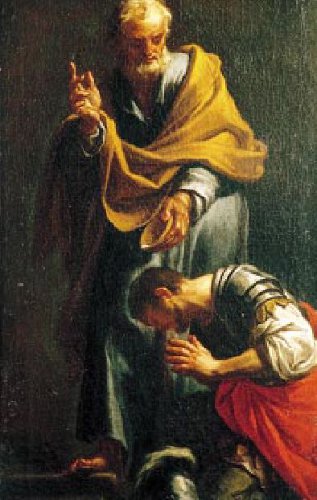
Peter and Cornelius

Obviously the Roman (Gentile) Centurion Cornelius and all those other Gentiles in his household received the Holy Spirit. Peter and the Jews who were with him were direct witnesses to the event and it was something that was obviously apparent to them in a physical manifestation.

“These six brethren also went with me and we entered the man’s house. And he reported to us how he had seen the angel standing in his house, and saying, ‘Send to Joppa and have Simon, who is also called Peter, brought here; and he will speak words to you by which you will be saved, you and all your household.’ And as I began to speak, the Holy Spirit fell upon them just as He did upon us at the beginning. And I remembered the word of the Lord, how He used to say, ‘John baptized with water, but you will be baptized with the Holy Spirit.’ Therefore if God gave to them the same gift as He gave to us also after believing in the Lord Jesus Christ, who was I that I could stand in God’s way?” When they heard this, they quieted down and glorified God, saying, “Well then, God has granted to the Gentiles also the repentance that leads to life.”

Acts 11:12-18

Peter reported all this to the “apostles and the brethren” in Jerusalem, and after hearing his testimony, they glorified God saying “Well then, God has granted to the Gentiles also the repentance that leads to life.”

This was even confirmed later by Peter at the legal proceeding held by James and the Jerusalem Council for formally establishing the status of Gentiles in Messianic Jewish community:

After there had been much debate, Peter stood up and said to them, “Brethren, you know that in the early days God made a choice among you, that by my mouth the Gentiles would hear the word of the gospel and believe. And God, who knows the heart, testified to them giving them the Holy Spirit, just as He also did to us; and He made no distinction between us and them, cleansing their hearts by faith.”

Acts 15:7-9

Clearly, God intended for non-Jews to enter into the community of faith and be saved in a manner identical to the Jews, receiving the Holy Spirit, just as the Jewish believers did.

More than that, it was foretold long before these events that many nations would turn to the God of Israel:

Many nations shall become a people unto Me, but I will dwell among you — then you will realize that Hashem, Master of Legions, has sent me to you.

Zechariah 2:15 (Stone Edition Chumash)

Every Knee Shall Bow
Photo credit: art.jkirkrichards.com

The Tanakh is replete with prophesies regarding the nations turning to God at the dawning of the Kingdom of Heaven, a Kingdom Yeshua’s advent inaugurated into our world, but I’ll only quote this one as it was part of last week’s Haftarah portion.

It seems my last blog post caused a disturbance among some of my non-Jewish readers relative to the uncertainty of our status in modern Messianic Jewish community. It was never my intension to upset or disturb anyone. Actually, quite the opposite.

I wanted to emphasize that even though, as we saw in the passage I quoted from Zechariah, God will dwell among Israel, even as He rules the entire world, Gentile lives matter, too. We’re not just an afterthought in God’s redemptive plan. We are not just God’s left-handed, red-headed step-children, the ones you hide in the closet when company comes over. We have a very specific purpose in the Kingdom.

But it’s sometimes easy to get the idea that Gentiles are indeed an afterthought given all the emphasis on Jews and Judaism on Messianic Jewish websites and blogs, and in such publications, and sermons.

However, I also brought up some uncomfortable ideas regarding our existence in my previous article: we don’t have a very exact roadmap regarding mitzvot or lifestyle, at least nothing as detailed as do the Jewish people.

I decided to focus on the Holy Spirit in today’s “morning mediation” for a few reasons:

I will give you a new heart and put a new spirit within you; I will remove the heart of stone from your flesh and give you a heart of flesh. I will put My spirit within you, and I will make it so that you will follow my decrees and guard my ordinances and fulfill them.

Ezekiel 36: 26-27 (Stone Edition Tanakh)

This is part of the New Covenant promises Hashem made to Israel, the giving of the Holy Spirit, which we saw fulfilled in Acts 2 when it was given to the Jewish Apostles, and in Acts 10 when Peter witnessed it being given to the faithful Gentiles in the household of Cornelius.

But it’s interesting that a promise made exclusively to Israel somehow was transmitted to those Gentiles who came to faith in Yeshua as the foretold Messiah.

Actually, we have another giving of the Spirit that needs to be included.

Then Yeshua came from the Galil toward the Yarden to Yochanan, to be immersed by him. But Yochanan tried to prevent him, saying, “I need to be immersed by you, and yet you come to me?” Yeshua answered and said to him, “Permit me, for so it is appropriate for both of us to fulfill the entire tzedakah,” so he permitted him. When Yeshua was immersed, he quickly came up out of the water. Heaven was opened to him, and he saw the spirit of God descending in the likeness of a dove, and it rested upon him.

Matthew 3:13-16 (Delitzsch Hebrew Gospels)

hebrews_letterPart of what I learned in listening to D. Thomas Lancaster’s sermons on the Holy Epistle to the Hebrews is that Yeshua, as the arbiter of the New Covenant, came, in part, to deliver “samples” of the New Covenant blessings to Israel, and apparently through them, to the Gentiles. This was to be evidence that God will indeed keep His promises to Israel (and somehow some of those promises also apply to the nations) at the appropriate time.

We see the New Covenant promise of the giving of the Holy Spirit in Ezekiel 36, we see Yeshua receiving the Spirit in Matthew 3, the Apostles receive the Spirit in Acts 2, and some faithful Gentiles receive it in front of Jewish eyewitnesses in Acts 10.

This should be pretty encouraging to some of the people who were dismayed at the content and discussion regarding my chopped liver blog post.

There’s just one problem:

The eunuch answered Philip and said, “Please tell me, of whom does the prophet say this? Of himself or of someone else?” Then Philip opened his mouth, and beginning from this Scripture he preached Jesus to him. As they went along the road they came to some water; and the eunuch said, “Look! Water! What prevents me from being baptized?” [And Philip said, “If you believe with all your heart, you may.” And he answered and said, “I believe that Jesus Christ is the Son of God.”] And he ordered the chariot to stop; and they both went down into the water, Philip as well as the eunuch, and he baptized him. When they came up out of the water, the Spirit of the Lord snatched Philip away; and the eunuch no longer saw him, but went on his way rejoicing.

Acts 8:34-39 (NASB)

The Ethiopian eunuch (a subject worthy of his own study), who was (in my opinion) most likely a Jew, did not receive the Holy Spirit, or at least Luke didn’t record it. But why, if he received the Spirit, would Luke have omitted this important point? If it was just assumed by Luke, then why did he include that the eunuch was baptized, which also could have been assumed?

Furthermore:

It happened that while Apollos was at Corinth, Paul passed through the upper country and came to Ephesus, and found some disciples. He said to them, “Did you receive the Holy Spirit when you believed?” And they said to him, “No, we have not even heard whether there is a Holy Spirit.” And he said, “Into what then were you baptized?” And they said, “Into John’s baptism.” Paul said, “John baptized with the baptism of repentance, telling the people to believe in Him who was coming after him, that is, in Jesus.” When they heard this, they were baptized in the name of the Lord Jesus. And when Paul had laid his hands upon them, the Holy Spirit came on them, and they began speaking with tongues and prophesying.

Acts 19:1-6

Apparently it’s possible to come to faith in Yeshua, to receive a water baptism, but not to receive the Holy Spirit.

tongues of fireI’m just shooting in the dark at this point, but as a believer for many years, while I can recall the moment I came to faith, no specific physical event occurred indicating that I had received the Holy Spirit. I was baptized in the Boise River along with my wife and children in August of 1999, but nothing like the Acts 2 or Acts 10 events occurred (although Acts 10 does not describe what Peter witnessed that told him Cornelius and his household had received the Spirit except that they spoke in tongues  and praised God).

Is it possible in the community of faith for some of us to possess the indwelling of the Spirit of God and others to not possess it? Further, with no physical evidence of the Spirit resting upon us as described in the multiple Bible quotes I’ve offered, how can we say the Spirit is on us or in us at all? Did you speak in tongues and utter prophesies? I didn’t.

I know that there’s a general consensus in Evangelical circles that the “age of miracles” ended when Christian Biblical canon was closed, but there are all sorts of anecdotal stories other Christians tell of spiritual manifestations and even miracles that happen all around us (though they seldom if ever make it into mainstream news reports).

I don’t have a definitive answer to all this. Maybe someone out there does. I have to take it on faith that I do possess the Holy Spirit, only because Christian tradition says I must if I’m a believer.

On the other hand:

Not everyone who says to me, “My master! My master!” will enter the kingdom of Heaven, but rather the one who does the will of my Father who is in heaven. It will be that on that day many will say to me, “My master, My master, did we not prophesy in your name and in your name drive out demons and in your name do many wonders?” Then I will answer them, saying, “I have never known you. Depart from me workers of evil!”

Matthew 7:21-23 (Delitzsch Hebrew Gospels)

That’s rather sobering.

Think about it. There’s a class of believers who are capable of performing actual supernatural acts, apparently in the name of Yeshua, and yet, the Master does not know them and even calls them “workers of evil”.

How about this?

But also some of the Jewish exorcists, who went from place to place, attempted to name over those who had the evil spirits the name of the Lord Jesus, saying, “I adjure you by Jesus whom Paul preaches.” Seven sons of one Sceva, a Jewish chief priest, were doing this. And the evil spirit answered and said to them, “I recognize Jesus, and I know about Paul, but who are you?”

Acts 19:13-15 (NASB)

I’m not sure this is an example of what Yeshua was talking about, but just paying the Master lip service, so to speak, doesn’t seem to be enough to get you “into the club,” as it were.

So what do we do as faithful Yeshua-followers?

Yeshua said to him, “Love HaShem your God with all of your heart, with all of your soul, and with all of your knowledge.” This is the greatest and the first mitzvah. But the second is similar to it: “Love your fellow as yourself.” The entire Torah and the Prophets hang on these two mitzvot.

Matthew 22:37-40 (Delitzsch Hebrew Gospels)

I know Yeshua was speaking to a Jewish audience, but I think that it is appropriate to consider this a commandment that also applies to us, that is, we non-Jews in Messiah. Why shouldn’t we also love God with all of our resources and love other human beings as we love ourselves? It would seem this “Torah” is one that also forms the core of our existence as disciples of the Master and worshipers of Israel’s God.

I still feel like I’ve opened a can of worms I can’t seem to close again. With all of this, what are we supposed to do next, particularly if we, in some way, exist either directly or tangentially in Jewish community?

That might take a long time to find out. Certainly an inventory of each and every instruction Paul gave in his epistles to the Gentile disciples, as viewed from a Paul Within Judaism perspective, would be in order.

109
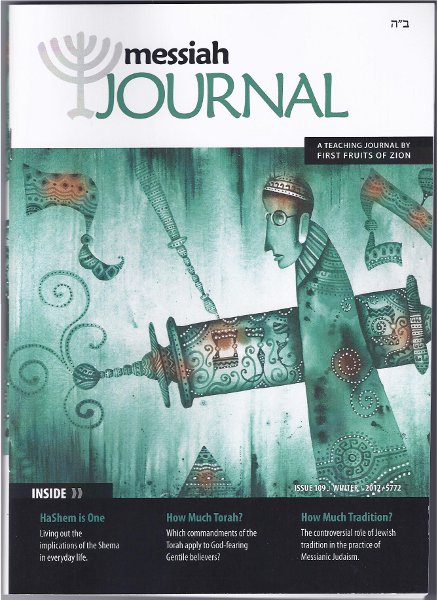
Messiah Journal 109

Actually, back in February 2012, First Fruits of Zion (FFOZ) published an article written by Toby Janicki in Messiah Journal issue 109 called The Gentile Believer’s Obligation to the Torah of Moses. Unsatisfied with my original review which I wrote at the time, I wrote another one over a year later (which was nearly two years ago now).

It doesn’t answer the conundrum regarding the Holy Spirit or how some people could sincerely believe they were serving Yeshua and yet be so horribly wrong, but as far as getting some sort of handle of who Gentiles are supposed to be in what is essentially, a Jewish religious form, it might be a good place to start, at least for those of you who are experiencing a crisis of community.

The rest will have to come along by the by.

What am I, Chopped Liver?

For the conductor with the neginos, a psalm, a song. May God favor us and bless us, may He illuminate His countenance with us, Selah. To make known Your way on earth, among all the nations Your salvation. The peoples will acknowledge You, O God; the peoples will acknowledge You — all of them. Regimes will be glad and sing for joy, because You will judge the peoples fairly and guide with fairness the regimes on earth, Selah. The peoples will acknowledge You, O God; the peoples will acknowledge You — all of them. The earth will then have yielded its produce; may God, our God bless us. May God bless us, and may all the ends of the earth fear Him.

Psalm 67 (Stone Edition Tanakh)

Forgive the somewhat whimsical title for today’s “morning meditation” along with the equally whimsical “featured image.”

When I read the above quoted Psalm on Shabbat, I was reminded that God has a redemptive plan, not just for Israel, the Jewish people, but for all the people of all the nations of the earth, that is, the Gentiles.

I suspect God has had this plan since before the creation of the universe, but we definitely know He had it when this Psalm was written, long before the birth of Yeshua (Jesus).

I strongly advocate Jewish return to the Torah mitzvot, whether they are Jews in the Messianic movement or otherwise. I strongly advocate for Jewish places of congregation and worship in Messianic Judaism, synagogues and communities by and for Jewish disciples of Messiah. I strongly believe in and advocate for the idea that without God’s plan of redemption for Israel, there can be no hope of redemption for the goyim.

All that said, there are times when I feel all of that Judaism weighing heavily upon me. In advocating for the Jewish right to cleave to their Messiah King and to have possession of their own Land and their own Torah, I don’t want to lose sight of the fact that God also recognizes and loves the rest of humanity, a non-Jewish humanity.

prayingGranted, there’s nothing in that Psalm that directly says “God so loved the world” (John 3:16), but it does say that the (Gentile) regimes will “be glad and sing for joy” because God will judge among us fairly. We will all acknowledge the God of Israel and the “earth will then have yielded its produce.”

The harvest is great, but the workers are few.

Matthew 9:38 (Delitzsch Hebrew Gospels)

Then those also who have fallen asleep in Christ have perished. If we have hoped in Christ in this life only, we are of all men most to be pitied. But now Christ has been raised from the dead, the first fruits of those who are asleep.

1 Corinthians 15:18-20 (NASB)

“Produce.” “Harvest.” “First fruits.” It seems that it is not only the Jews who are counted among the harvest, but the rest of us as well, all of us who trust in the promises of God as demonstrated by Messiah.

A person who comes to Torah on his own volition does so because of the beautiful and elevated ideas he hears about Torah principles. He made his decision on the assumption that those who follow the Torah will act towards him in accordance with all the Torah laws pertaining to interpersonal relations. If someone cheats him financially or in any other way wrongs him, he will not only suffer a monetary loss. Rather, he might also feel disillusioned with his decision to accept Torah as a way of life.

-Rabbi Zelig Pliskin
“Act with love and kindness towards converts,” discussing Bamidbar (Numbers) 5:6
Commentary on Torah Portion Naso, p. 312
Growth Through Torah

While Rabbi Pliskin is discussing converts to Judaism in this above-quoted statement, and while I don’t believe we “Messianic Gentiles” are called to Torah obligation in the manner of the Jewish people, I don’t think it’s entirely inappropriate or inaccurate to say that, in a way, we also come to the Torah, as it applies to us, “because of the beautiful and elevated ideas” expressed in the “Torah principles.”

I don’t feel put upon or mistreated by any Messianic Jews as such, but I do need to remind myself periodically that we non-Jews also have a role to play. More than that, I need to provide some much-needed perspective to who we non-Jews are in Messiah.

While I recently wrote that the identity of the Messianic Gentile, both in ancient and modern times, may be ill-defined by design, I’ve also offered my opinion on what I think we’re here for.

desert islandBut in addition, I believe that even one non-Jewish disciple of Yeshua could be stuck on a deserted island with nothing but his or her Bible, yes, adequate food, water, and shelter, but no other human companionship, Jewish or otherwise, and still have a relationship with a loving and caring God because of the faithfulness of Messiah. I think there are times when Messianic Jews should advocate for Gentile devotion to God and express the clear knowledge that God does cherish even the goyim. I believe the door should swing both ways within the ekklesia of Moshiach.

It is easy to focus on the differences among people and to consider yourself as separate from others. Truly no two people are exactly alike. But there are many common factors among people. By focusing on the fact that every human being is created in the image of the Almighty you will have greater identification with others and this will lead to greater unity.

-Rabbi Pliskin
“With unity there is a blessing,” p.316
Commentary in Torah Portion Naso, discussing Bamidbar (Numbers) 6:24

I suppose when Rabbi Pliskin wrote “differences among people,” he could and probably did mean “differences among Jews,” but in saying that “every human being is created in the image of the Almighty,” he opened the door to all of humanity, Jews and Gentiles alike.

While I have advocated for a strong recognition of the covenant distinctions between Messianic Jews and Gentiles, we also must counterbalance that knowledge with our unity in Messiah’s ekklesia. We may be in many ways separated from each other by those covenant distinctions, but while we are not a homogenous population, there aren’t two Messianic ekklesias, there is one, just as God is One and yet has many diverse names and many distinctive qualities.

Recently, Derek Leman wrote what I consider to be a pair of “bookends” on his blog: Why Non-Jews Are Drawn To Messianic Judaism and On Messianic Judaism As A Home For Jewish Believers.

Each blog post advocates for its named subject, Gentiles in one and Jews in the other.

In both Jewish and non-Jewish zeal to promote and elevate the Jewishness of Messianic Judaism, I’m glad to see some noteworthy Messianic Jewish writers and teachers specifically addressing both sides of the coin.

I think one of the reasons Gentile believers exited Jewish community nearly twenty centuries ago and why there are some Hebrew Roots promoters in the modern age who not only advocate but demand equal obligation to Torah as some sort of right, is as an attempt to create a significant and meaningful Gentile identity in the body of Yeshua-believers.

In the end, the first and second century believing Gentiles may not have been able to find that identity in Jewish community, so they made the worst possible decision and not only separated from the Jews, but “demonized” everything Jewish, reimaging the Jewish Messiah as the Gentile Christ, and warping everything ever taught by Yeshua and the Apostles, specifically Paul’s teachings.

the crowdI believe that many so-called “One Law” advocates cling to their views because the dissonance of differing and distinct roles and identities of Jews and Gentiles in the Messianic ekklesia is too difficult to bear. This probably also explains why a number of we Messianic Gentiles have mistakenly converted to some form of Judaism, Messianic and otherwise, in an attempt to find meaning and purpose in the service of God among Jewish community.

However, as a non-Jew and a devotee of the Jewish Messiah King, I do have meaning and purpose in the redemptive plan of God for our world. Yes, it’s first to the Jew and only afterward, to the Gentile, but it is to the Gentile at a specific point in that plan.

The plan has already entered our world and it has been slowly unfolding for the past two-thousand years. That plan has included an untold number of Gentiles and as important as Jewish Torah observance and devotion to Moshiach is, the plan will never be complete without the rest of us.

I just needed to remind you and especially me by saying all this. Thanks for reading.