Tag Archives: miracles

The Miracles You Make

There are two types of miracles: Those beyond nature and those clothed within it. The water of the Nile turning into blood was beyond nature. The victory of the Maccabees over the Greek army came dressed as a natural occurence—they had to fight to win.

Both types of miracles are necessary.

If we would see only miracles beyond nature, we would know that G‑d can do whatever He likes—but we might think He must break the rules to do so. We would know a G‑d who is beyond nature, but not within it.

If we would see only miracles that are clothed within nature, we would know a G‑d that is Master of all that happens within nature.

But we might think He is limited within it.

Now we know a G‑d that is at once both beyond all things and within them. In truth, there is nothing else but Him.

-Rabbi Tzvi Freeman
“Stereo Miracles”
Based on letters and talks of the Rebbe
Rabbi M. M. Schneerson
Chabad.org

Take note of any positive occurrence that happens to you and give thanks to the Almighty for it.

Some common examples: your eyeglasses fall to the ground and do not break, or you find something you’d been missing.

-Rabbi Zelig Pliskin
“Daily Lift #652: Watch for Positive Occurrences”
Aish.com

When most of us think about miracles, we think of those that wildly violate the laws of physics…the Sun standing still in the sky and that sort of thing. But as Rabbi Freeman points out, there are miracles that we must participate in for them to occur. The Maccabees wouldn’t have won over the Greek army if they didn’t fight. The Reed Sea wouldn’t have parted (according to midrash) if Moses and the Children of Israel hadn’t first stepped into the water. The woman with the issue of blood (Mark 5:25-34) would not have been cured if she had not believed in the power of Jesus to heal and then touched his garment.

These were all supernatural events, but they required the very natural and real participation of the human beings involved. Otherwise, they would never have occurred.

I guess that’s what faith and trust is. You know you have to do something. You believe God has told you to do something that is very difficult or, by your own estimation, impossible. And so you must do it or at least try.

But according to Jewish belief, we are not to depend upon miracles. That is, we’re not to get ourselves into a bad situation and then expect God to bail us out with a miracle.

Then the devil took him to the holy city and set him on the pinnacle of the temple and said to him, “If you are the Son of God, throw yourself down, for it is written,

“‘He will command his angels concerning you,’

and

“‘On their hands they will bear you up, lest you strike your foot against a stone.’”

Jesus said to him, “Again it is written, ‘You shall not put the Lord your God to the test.’”

Matthew 4:5-8 (ESV)

Even Jesus didn’t depend on God’s miracles when he was being tested and tormented. He just remembered God, remembered the Words of God, and had faith.

And at times when anything good does happen to us, whether it is an “obvious” miracle or not, Rabbi Pliskin says we are to give thanks. Sounds very similar to another good piece of advice:

Rejoice always, pray without ceasing, give thanks in all circumstances; for this is the will of God in Christ Jesus for you.

1 Thessalonians 5:16-18 (ESV)

Rejoice always, pray always, and thank God in every circumstance. Watch for positive occurrences because they indicate the presence of God. Rabbi Freeman also said:

There are open miracles that break the laws of nature as though they were meaningless—miracles any fool can perceive.

Then there are miracles that take some thought to realize that yes, something out of the ordinary occurred here.

And then there are miracles so great, so wondrous, that no one but G‑d Himself is cognizant of them. They are the miracles that occur continuously, at every moment.

Beyond the supernatural, laws of physics violating miracles, and the ones that happen when we cooperate with God, there are those that happen all of the time and exist beyond our awareness. Or perhaps these are the miracles that happen all the time and we’re just not paying attention. Miracles like a baby being born. Miracles like your heart continuing to beat in your chest. Miracles like the ability to take in a deep breath of air. Miracles like watching the first rays of the Sun shine over the dark horizon.

Miracles like just being alive. This is why observant Jews say upon awakening:

I gratefully thank you, living and existing King for returning my soul to me with compassion. Abundant is Your faithfulness.

Of prayer and miracles, it is also said:

We pray and He answers with blessings. But we ask, “If you are already giving us blessings, why in such clumsy packages with so many strings attached?”

And He answers, “If you are giving me your innermost heart in prayer, why in such thick layers of ego? Why with such cold words? Why do you hold back your tears?”

“I’ll make you a deal,” He says. “You bare your souls from their wrappings, and I will bare My blessings of their clouds.”

-Rabbi Tzvi Freeman
“Unwrapping”
Based on letters and talks of the Rebbe
Rabbi M. M. Schneerson
Chabad.org

May blessings and miracles continue in your life.
Vayera: Miraculous

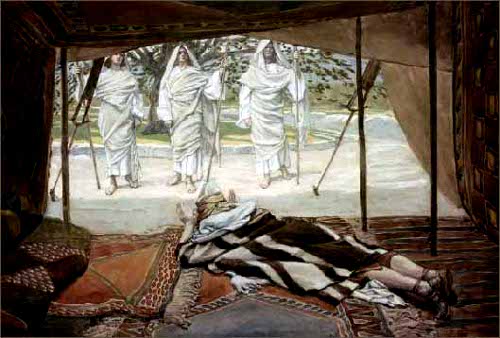
abrahams visitorsThe Lord appeared to him by the terebinths of Mamre; he was sitting at the entrance of the tent as the day grew hot.

Genesis 18:1 (JPS Tanakh)

When Rabbi Sholom DovBer of Lubavitch was a child of four or five, he entered into the room of his grandfather, Rabbi Menachem Mendel, and burst into tears. His teacher in cheder had taught the verse “And G-d revealed himself to Abraham…” “Why,” wept the child, “doesn’t G-d reveal Himself to me?!”

Rabbi Menachem Mendel replied: “When a Jew, a tzaddik, realizes at the age of 99 that he must circumcise himself, that he must continue to perfect himself, he is worthy that G-d should reveal Himself to him.”

-Rabbi Yanki Tauber
“The Tears of a Child”
Chabad.org

This is a well-known commentary on this week’s Torah Portion, Vayera and I’m hardly in a position to add to what a great many sages and spiritual luminaries have already stated regarding this portion of the Torah. But in studying the Torah Club commentary (volume 6) for this week on Acts 4:32-5:42, I discovered what could be a tangentially related issue.

Now many signs and wonders were regularly done among the people by the hands of the apostles. And they were all together in Solomon’s Portico. None of the rest dared join them, but the people held them in high esteem. And more than ever believers were added to the Lord, multitudes of both men and women, so that they even carried out the sick into the streets and laid them on cots and mats, that as Peter came by at least his shadow might fall on some of them. The people also gathered from the towns around Jerusalem, bringing the sick and those afflicted with unclean spirits, and they were all healed.

Acts 5:12-16 (ESV)

D. Thomas Lancaster’s lesson on these verses, both in the written text of his commentary and in the Torah Club audio teaching, speaks about “the age of miracles” and whether or not we have miracles today. As we read passages such as the one I quoted above, we Christians may be hard pressed to explain why 2,000 years ago, severely ill and disabled people could be cured simply by having Peter’s shadow fall across them, while today our most fervent prayers and petitions to God fail to prevent a loved one from dying of cancer. Why don’t we see miraculous signs, wonders, and healings in today’s church?

Some say that we do, but because we live in the 21st century, many events that a person 2,000 years ago would have called a miracle, today might be explained as some other phenomena. Even in the church, we are sometimes hesitant to say something is a miracle for fear of appearing foolish. On other occasions, the claims of miraculous events from some seem to be so common that the credibility of witnesses is brought into question.

While I do believe that sometimes miracles do happen today, they don’t seem to be “predictable,” which I guess stands to reason, but they also don’t seem to be predictably produced by an identifiable individual or group of individuals, such as the apostles. When we read about Peter, John, and the other apostles in the early chapters of Acts, it’s as if they’re doing miracles all the time.

One explanation, as Lancaster points out, is that the book of Acts compresses 35 years of history into about two hours worth of reading. It’s easy to get the impression that Peter was healing the sick through miracles every day and several times a day. This is probably untrue and only the “highlights” of the “Acts of the Apostles” were recorded by Luke. All of the other more mundane occurrences in their lives over three and a half decades went unchronicled and passed away into the shadows of history.

But there’s another reason we may not see miracles today the way we see them in Acts.

When the day of Pentecost arrived, they were all together in one place. And suddenly there came from heaven a sound like a mighty rushing wind, and it filled the entire house where they were sitting. And divided tongues as of fire appeared to them and rested on each one of them. And they were all filled with the Holy Spirit and began to speak in other tongues as the Spirit gave them utterance.

Acts 2:1-4 (ESV)

This is the day when the apostles of Christ (and only the apostles of Christ) received the Holy Spirit. Most Christians think this event is identical to what happens to all people everywhere when they receive Jesus Christ as Savior and Lord (although I’ve yet to hear a modern Christian tell me that they received the Spirit on tongues of fire). But what if this isn’t exactly true?

We know that in Acts 10:44-45 the Roman Centurion Cornelius and his entire household also received the Holy Spirit, but to the best of our knowledge, none of them went on, after the initial event, to perform miraculous healings, signs, and wonders. What’s the difference between Cornelius and Peter? Were the Jews the only ones with the Spirit able to perform miracles, or was something else going on?

It was declared at first by the Lord, and it was attested to us by those who heard, while God also bore witness by signs and wonders and various miracles and by gifts of the Holy Spirit distributed according to his will.

Hebrews 2:3-4 (ESV)

Take a closer look at this verse. According to Lancaster, “those who heard”, that is, those who were direct witnesses of the Messiah, were the apostles. Only the apostles were able to be witnesses of the validity of Jesus “by signs and wonders and various miracles and by gifts of the Holy Spirit distributed according to his (God’s) will.”

The idea, in this particular explanation, is that during the so-called “age of miracles,” God did not use everyone to perform miracles, and miracles did not occur for just any old reason at all. The miracles were a witness that occurred through those who actually walked and talked with the Master, that he is the Messiah, the Son of God.

The apostles could be compared to Abraham as we re-examine the brief Chasidic tale recorded by Rabbi Tauber above. They were “tzaddikim” (Righteous Ones) who were assigned by God to fulfill a specific mission and purpose; to witness to the Messiahship of Jesus of Nazareth. Their tools for doing so, in addition to what they taught, were signs and wonders.

I know this viewpoint could be questioned and disbelieved, but I think we should at least consider the possibility. It doesn’t mean that God doesn’t do miracles today, and it doesn’t mean that God doesn’t use “ordinary Christians” to perform said-miracles today. It does mean however, that God does miracles “according to His will” and not our will. It also may mean, as we see in Rabbi Tauber’s tale, that when someone, a tzaddik, realizes he must perform the equivalent of “circumcising himself at the age of 99 years, he is worthy that G-d should reveal Himself to him.”

It’s an imperfect theory and it certainly could be wrong, but we’re an imperfect people and God, and His reasons for doing anything, are perfect. Whether we understand the nature of miracles happening in the past as opposed to happening the present or not, we can certainly acknowledge that miracles seem to occur in the world from time to time, at the will of God and for His own purposes, but we must not depend on them. Should God choose to intervene in our lives with a miracle, it is good, but if He chooses not to, it is good as well.

We depend, not on miracles to sustain us or to be a witness to the Messiah, but on our faith and trust in God. These are the stones with which God builds the path we walk upon as we journey each day, as we follow Him, reaching out to touch the hem of his garment, flourishing in the glow of His holiness, and then reflecting that light into the world. Perhaps that is miracle enough, for the light of God is His healing of the world.

It is a Divine kindness that His mercies are endless.

Lamentations 3:22

Another way to translate this verse is, “It is a Divine kindness that we are never finished.”

The Maggid of Koznitz was extremely frail and sickly as a child. It was not thought that he would survive to adulthood. Much of his life was spent sick in bed, and he was so weak that he was often unable to sit up to meet visitors. Still, he lived to an advanced age.

The Maggid once revealed the secret of his longevity. “I never allowed myself to be without an assignment or a task to perform,” he said. “People are taken from this world only when their missions here are completed. Whenever I was just about to finish one task, I would start another; hence, I could not be removed from this world if my assignment was not completed.”

Even from a purely physiological aspect, the Maggid’s concept is valid. Some think that the healthiest thing for us is rest and relaxation. Not so. In reality, unused muscles tend to atrophy, while muscles that are exercised and stimulated are strengthened.

The same principle applies to the entire person. If we constantly stimulate ourselves to achieve new goals, we avoid the apathy that leads to atrophy.

Today I shall…

try to take on a new spiritual goal, and stimulate myself to greater achievement in serving God and being of help to other people.

-Rabbi Abraham J. Twerski
“Growing Each Day, Cheshvan 16”
Aish.com

I’ll be away from the computer for the day and won’t be available to respond to or approve comments. If I am unable to attend to them before Shabbat begins, then I will do so on Saturday after sundown.

Good Shabbos.

Return and Reconciliation

“We will thank You and declare Your praise for our lives, which are entrusted into Your hand; for our souls, which are placed in Your Charge; for Your miracles which are with us every day; and for Your wonders and favors at all times, evening, morning, and midday.”

Thanksgiving blessing
Shaharit for Shabbat
Koren Siddur, pg 488

I once heard it said, “Coincidences are miracles in which God prefers to remain anonymous.”

If we were to carefully scrutinize everything that occurs in our daily lives, we would find many such “coincidences.” Sometimes we may not be aware of the significance of a particular occurrence until much later, when we may have forgotten how or why we think it occurred, and so we just write it off to chance. Other times, we notice that things seem to “just happen at the right time.” And in some instances, the likelihood of the desired occurrence being chance is statistically so remote that it may penetrate the skepticism of even the most confirmed non-believer.

Why don’t people see the Divine hand in so many things? Could it be that being aware would require them to be thankful to God, because it is unconscionable to be an ingrate (and if one has difficulty with feelings of gratitude, it is simply easier to deny the awareness of the Divine favor)? Could it be that the awareness that God is looking after them would obligate them to live according to the Divine will, and since that might entail some inconveniences and restrictions on their behavior, it is more comfortable to believe that “God does not care”?

Psychologists have great respect for the human capacity to rationalize, to convince oneself of the absolute truth of whatever it is that one wishes to believe or not believe. How much wiser we would be to divest ourselves of such self-deceptions.

Today I shall…

scrutinize my daily happenings with an alertness to how many favorable “coincidences” have occurred in my life.

-Rabbi Abraham J. Twerski
“Growing Each Day, Elul 8”
Aish.com

You open your hand; you satisfy the desire of every living thing.

Psalm 145:16 (ESV)

It’s not just the miracles, signs, and wonders for which we should thank and praise God, but for every good thing we experience in our lives. As Rabbi Twerski said, those events we consider “coincidences” are most likely also from God, and even if they aren’t, we should thank Him anyway, for the very fact that we are alive to encounter all goodness.

Of course, we’re also alive to encounter “all badness,” too.

I form light and create darkness,
I make well-being and create calamity,
I am the Lord, who does all these things. –Isaiah 45:7 (ESV)

The word that the ESV translates as “calamity” is translated as “evil” by the King James Bible, the American Standard Version, and the Barby Bible Translation, to name a few. Not a comforting thought, but if God is to be considered sovereign over all, then He must create all.

Rejoice always, pray without ceasing, give thanks in all circumstances; for this is the will of God in Christ Jesus for you. –1 Thessalonians 5:16-18 (ESV)

Paul doesn’t say to give thanks to God only when things go your way and God gives you what you want and need, does he? That’s the tough part. We are always ready to thank God when good things happen, but true faith and trust thanks in all circumstances, good and bad alike. Being thankful doesn’t happen just when you’re happy and satisfied, but at all times, because good and bad both come from God, in all circumstances, God is with us.

I know. I must be crazy, right? I mean, who can thank God when disaster and calamity strike? Only a saint or a fool (or are they the same thing?). Not too long ago, I talked about trusting God, not just in good times or bad, but in uncertain times; during events or when pondering mysteries that you aren’t very sure about. Who is God? What is salvation? When we pray, is God listening?

Rabbi Twerski recommends “scrutinizing your daily happenings with an alertness to how many favorable “coincidences” have occurred in your lives.” I don’t necessarily disagree with this practice because it helps make us aware of all of the good God does for us that we take for granted, but that’s not the end of it. In every bad time, in every time of uncertainty or doubt, even when doubting God, give thanks that He remains with you and with me. Give thanks that, unlike a human being, He won’t abandon us or doubt us, just because we sometimes doubt Him and at least temporarily, withdraw from His presence. He is not like a person. He’s not like us, and for that, we should be infinitely grateful.

It is ridiculous how some people are concerned about trivial aspects of “honor.” For example, a person may refuse to visit a friend or relative, because they feel the other person should come to him first. Or they become angry if they visit someone and that person does not repay the visit.

Focus on being practical. If you would like to speak to someone, what does it matter if he did not come to you first?

-Rabbi Zelig Pliskin
“Today’s Daily Lift #559
Aish.com

As long as we’re thanking God for his faithfulness when we are faithless, we might as well take the next step and try to emulate Him just a bit. If there is a friend or family member who we have refused to speak with or visit because of our pride or a matter of “honor,” consider how God is not affected by how we’ve offended Him and remains with us, even in our most foul and dark moods. In the month of Elul, observant Jews make an effort to repair damaged friendships and to overcome the emotional barriers that have caused these rifts.

“The real art of conversation is not only to say the right thing in the right place but to leave unsaid the wrong thing at the tempting moment.”

-Lady Dorothy Nevill, British writer

You can do this, too. You can extend yourself in humility and in gratefulness to God and approach an estranged loved one. Remember, God is always waiting for you to return to Him as well.

Shemini: Ordinary Miracles

These concepts are reflected in this week’s Torah reading, Parshas Shemini. Shemini means “the eighth.” It refers to the first of Nissan, the day on which the Sanctuary was established. It is called “the eighth day” because it was preceded by seven days of dedication, during which Moshe erected and took down the Sanctuary each day, and taught Aharon and his sons the order of sacrificial worship…The Torah relates (Leviticus 10:1-2) that they brought an unauthorized incense offering and as a result, “Fire came forth from G-d and consumed them.”

Many explanations are offered as to why the brothers were punished by death. From a mystical perspective, it is said (Or HaChayim, commenting on Leviticus 16:1) that they died because their souls soared to such heights that they could no longer remain in their bodies. Nevertheless, their conduct is judged unfavorably because their spiritual quest ran contrary to G-d’s intent in creation: the establishment of a dwelling for Himself amidst the day-to-day realities of our existence. (See Midrash Tanchuma, Parshas Bechukosai) Their deaths show that our spiritual quest should not be directed towards the attainment of lofty rapture, but instead should remain firmly grounded in our actual lives.

This theme is also reflected in the conclusion of the Torah reading, which focuses on kosher food. For the establishment of a dietary code indicates that Judaism’s conception of Divine service involves living within the world.

-Rabbi Eli Touger
“Transcendence and Immanence”
In the Garden of Torah”
Adapted from
Likkutei Sichos, Vol. III, p. 973ff;
Vol. XVII, p. 92ff;
Sefer HaSichos 5749, p. 475ff
Commentary on Torah Portion Shemini
Chabad.org

All that walk on four… (11:21)

When Rabbi Shmuel of Lubavitch was a child of seven, he asked his father: Why does man walk upright, while animals walk on all fours? Rabbi Menachem Mendel replied: “This is a kindness from G-d to man: although man treads upon the material earth, he sees the sublime heaven. Not so those that crawl on four, who see only the mundane.”

-Rabbi Yanki Tauber
“The Rebbe’s New Clothes”
Once Upon a Chasid
Commentary on Torah Portion Shemini
Chabad.org

I suppose I’m being unfair when I accuse Christianity of focusing on the Heavenly at the expense of the here-and-now. After all, Christians perform many wonderful services of charity and kindness to those around them and to those in far-flung corners of the world. But as I recall my past when I used to sit in a pew in a church sanctuary on Sunday morning, it seems as if a great deal of time was spent touting the advantages of a “personal relationship with Jesus Christ” and that it’s all about “me and Jesus.” How many prayers have I heard offered up to the ceiling of the Sunday school classroom, asking for “a closer walk with thee” and thanking Jesus for the personal gift of grace and salvation?

There’s nothing wrong with any of that, of course, but now that our “ticket to Heaven” has been “punched,” so to speak, what are we supposed to do with the rest of our lives?

The commentaries I quoted from above may seem alien to most of you, but they do aptly illustrate the necessity of balancing the secular with the Divine. So many of the commandments given to the Israelites at Sinai were related to the world in which we live. There are commandments about food, commandments about clothing, commandments about marriage, commandments about farming, commandments about helping your neighbor, even if you don’t like him very much, commandments about…well, you get the idea.

Sure, there are also a lot of commandments about God, services of holiness, and acts of the Spirit, but there is an inseperable link between loving God and loving human beings (See Matthew 22:36-40). As far as I can tell, most or all of the commandments we see in the Torah that have to do with visiting the sick and feeding the hungry apply just as much to the Christian as they do to the Jew. That’s what I see in the Master’s teachings, anyway.

But many Christians still have this funny idea that we are only really serving God if we have some sort of formal “ministry” within the church, even as a lay teacher. Yet we see countless examples in the Bible of ordinary people who were devoted to God and who lived day-to-day lives that included acts of kindness and compassion to whomever they encountered who needed it.

Giving a jump start to the car of a guy who’s late for a job interview is just as holy as helping to build a new church on a mission trip to a foreign country. Where did we get the idea that we had to do something unusual and extraordinary; something way outside the normal boundries of our lives, in order to serve God and to obey the teachings of Jesus? As an “ordinary” person, you may be capable of committing more acts of holiness than even the greatest televangelist or Pastor of a “megachurch” you see on TV ( I suppose I’m employing more than a little tongue-in-cheek here).

And perhaps you are capable of even much greater miracles than these.

“Truly, truly, I say to you, whoever believes in me will also do the works that I do; and greater works than these will he do… –John 14:12 (ESV)

Miracles, by the way, don’t always have to be violations of the laws of physics. Sometimes, offering a momentary smile to a person who looks sad, or helping a lost person find the right address can be a miracle as great as moving a mountain.

Reading the Bible, praying, meditating on the acts of God, and worshiping with your fellows are all absolutely necessary acts of holiness and they bring much joy to God and to your own heart. But they are no more or less vital than helping change a flat tire for someone, donating a can of soup to your local food bank, or spending time with a neighbor who is in the hospital after surgery.

Today (as I write this), I’m going to take my son to work, deliver a Bible and some other books to a Chaplin who is going to deliver them to a sick and elderly Jewish gentleman who has just discovered the Messiah in Yeshua, and spend some time over coffee studying the Word of God with a friend. I don’t say these things because I think it makes me a better or special person. I say them because I’m an ordinary person doing ordinary things. But the ordinary and the holy are all intermixed in everything we do. We have our feet on the ground, but our eyes turned to Heaven.

And of all the ordinary things you and I are going to do today, who knows which one of them is a miracle?

Whatever we “offer” to God and to human beings, let it be who we are and not some “strange fire” we think we need to burn with in our hearts. God made us perfect as the people we are meant to be.

Good Shabbos.

Pointing Light to Miracles

Without miracles, we might come to believe that the laws of physics define reality. Once we witness the inexplicable, we see that there is a higher reality. And then we look back at physics and say, “This too is a miracle.” The miracle of a small flask of oil burning for eight days was this sort of miracle.

Then there are those small miracles that occur every day. Those acts of synchronicity we call ‘coincidence’ because, in them, G-d prefers to remain anonymous. But when we open our eyes and hearts, we see there is truly no place void of this wondrous, unlimited G-d. These were the sort of miracles the Maccabees saw in their battles against the mighty Greek army.

-Rabbi Tzvi Freeman
“Chanukah Miracles”
Based on letters and talks of the Rebbe
Rabbi M. M. Schneerson
Chabad.org

God is not a scientific problem, and scientific methods are not capable of solving it. The reason why scientific methods are often thought to be capable of solving it is the success of their application in positive sciences. The fallacy involved in this analogy is that of treating God as if He were a phenomenon within the order of nature. The truth, however, is that the problem of God is not only related to phenomena within nature but to nature itself; not only to concepts within thinking but to thinking itself. It is a problem that refers to what surpasses nature, so what lies beyond all things and all concepts. (page 102)

The object of science is to explain the processes of nature. (page 104)

-Abraham Joshua Heschel
God in Search of Man: A Philosophy of Judaism
As quoted in Searching by Ineffable Light

Chanukah, or any time when we see or hear of God’s miracles, forces us to try and understand the nature and character of God’s activity in the world we experience. 21st century western thought is almost wholly focused on the observable, the measurable, the quantifiable. We are dazzled by the possibility of discovering the Higgs Boson particle and what it would mean about our understanding of the universe. We are hopeful that our latest probe to Mars will show us definitive proof that the red planet once harbored life. We are astounded that we might actually be able to detect other Earth-like planets in the galaxy.

We are so amazed with our own seeming “miracles” that there is hardly room left in our world for the miracles of God.

For me, the short definition of a miracle is an event that we can observe in our universe that defies the working laws of said-universe. It is an event that has its origins outside our four-dimensional realm but that intrudes in that realm to make itself known to us. In fact, the point of a miracle is to make God known to us.

Jesus performed many “signs and wonders”, not to dazzle the crowds like some traveling magician, but to show that he was from God. Miracles also sometimes result in directly helping others, such as curing illnesses and healing injuries (see Matthew 11:1-6 as an example). Miracles are one of the ways that God makes Himself known to us. But while they seemed plentiful in the Bible, they are all too rare (and too well “explained” by scientific means, supposedly) in the present age. Even those miracles of the past are subject to significant “armchair quarterbacking” these days, as far as what natural phenomena “could” have caused such supposed miracles. The modern world wants no part in the supernatural, probably because it takes away from the wonder of man (and no wonder so many people give Tim Tebow a hard time for making his faith public on national television in front of millions of sports fans).

Rabbi Abraham Joshua Heschel, who I quoted above, doesn’t believe that science has the right tools to examine the miracles of God let alone God Himself. This sounds like a cop out to secular people who want independent validation of the existence of God before believing. But while demanding evidence of the reality of the Divine, these secular folks are confident such validation will not be forthcoming, thus “proving” that they’re right.

But miracles aren’t about proof, they’re about faith.

Then some of the Pharisees and teachers of the law said to him, “Teacher, we want to see a sign from you.” He answered, “A wicked and adulterous generation asks for a sign! But none will be given it except the sign of the prophet Jonah. For as Jonah was three days and three nights in the belly of a huge fish, so the Son of Man will be three days and three nights in the heart of the earth. –Matthew 12:38-40

I mentioned in yesterday’s meditation that part of the purpose of lighting the menorah during Chanukah is to declare the miracles of God. This is an act of faith as well as tradition, since we were not there to witness the miracle. Given the cynicism most people bear for the wonders of God, it’s also a miracle that anyone comes to faith, since to do so goes against the majority of rational human beings and the “idol” of popular opinion.

Faith is a miracle. Publicly demonstrating faith is a miracle, too. It just doesn’t seem “supernatural”.

I periodically get notices from AskNoah.org which is an organization dedicated to the support of Gentile Noahides. I just got an email pointing me to an article about the proper way for a Noahide to light the menorah. Lest you think it’s unusual for Jews to encourage non-Jews to celebrate Chanukah, the advice comes with caveats.

If you are a Noahide who is observant of the 7 Noahide Commandments, you may be interested in lighting Hanukkah candles. If so, you can buy or make a menorah lamp for yourself (very easy), or you can usually obtain one from your local Chabad Center. If your intention is to publicize the Divine miracles of Hanukkah, and thereby educate and remind your family and others about the greatness of G-d, the candle lighting may be done in the correct manner according to the Jewish custom – but without saying the Jewish blessings when lighting the candles. (For non-Jews, those would be false statements said in G-d’s Name, G-d forbid, because they testify that the person lighting the candles is commanded to “kindle the lights of Hanukkah”, and that G-d did those miracles for “our fathers”.) There are alternative readings and Psalms that a Noahide can say when lighting Hanukkah candles, and we have posted some suggestions below.

Thus, it is proper for a non-Jew to light the Chanukah menorah if “your intention is to publicize the Divine miracles of Hanukkah, and thereby educate and remind your family and others about the greatness of G-d” but only if you do so “without saying the Jewish blessings when lighting the candles”. This may sound restrictive, especially to those Gentiles who consider themselves “Messianic” and “grafted in” to the root of Israel, but while there are Christian applications to Chanukah, we must not lose sight of the primarily Jewish applications.

I was reminded of this when reading various commentaries on Siman 672 that I receive from Mishna Berura Yomi. The laws and halachah relative to the Birkat Kohenim (Priestly Blessing) recited during a synagogue service are delineated in these particular commentaries. One of the obvious pieces of information presented is that this blessing should only be recited by a Kohen. Yet, I’ve heard this blessing (in English) recited by Pastors (non-Jews) at the end of church services, and I’ve heard this blessing said by Gentiles in “Messianic” worship. I’m embarrassed to admit that I’ve delivered this blessing myself many times in my previous congregation (since I’m not Jewish let alone a Kohen).

Miracles, faith, and worship are funny things. They all open certain doors but not the doors we think might be open. Lighting a menorah doesn’t make a Gentile person Jewish or the direct recipient of miracles or messages meant by God for Jews. Chanukah candle lighting also doesn’t open up the world of Jewish worship to Christians in the same way that this door is available to Jewish people. We must be cautious to make sure we are walking the right path.

On the other hand, there is a level where God’s presence and miracles are available to everyone. A Noahide, and I believe a Christian, may light the menorah if the purpose is to announce God’s miracles and their faith in God, particularly if their faith is not based on miracles. The blessing of the Birkat Kohenim in Hebrew is beautiful to hear and a tremendous reminder of God’s providence to the Children of Israel, even if you are not a Jew. Asher at the Lev Echad blog reminds us that even though we are all unique individuals and belong to unique and distinct people groups, we all have a common foundation.

This Mishnaic excerpt provides the quintessential response to anyone who claims that certain types of people are superior or inferior to others. Since all people descend from the same person, we are all related. There is no moral justification for dividing people based upon race or prominence or wealth. All of creation can be traced back to one God, and all of humanity can be traced back to one person. The very word for people in Hebrew is bnei adam (lit. children of Adam) – a subtle reminder that we all descend from one man, the first human ever created by God.

Perhaps God’s greatest miracle is the human race after all, not because we are so terrific and so accomplished (though He gave us the ability to perform terrific acts of accomplishment), but because we can learn to love each other, to recognize that unique as we are, we were created in a common image (Genesis 1:26), and out of that image, we can learn to love Him who has loved us first.

“Therefore was a single man created, to teach us that whoever takes a single life it is as though he destroyed an entire world, and whoever saves a single life it is as though he saved an entire world. It is also meant to foster peace between people, because no one can boast to his neighbor: ‘My ancestor was greater than your ancestor.'” –Mishnah, Sanhedrin 4:5

Though the intent of this Mishnaic quote, which I borrowed from Asher’s blog, is to reference Adam, the first man, in my personal faith, I choose to interpret it as illuminating another man who Christians call the “light of the world;” a man who has shown us that we can also be a light pointing to miracles.

Addendum: This doesn’t have anything to do with today’s “meditation”, but I happened across an interesting looking web resource called Halachipedia. It’s where “Halachah meets Wiki”. Enjoy.

The Supernatural Life

SupernaturalWhen G-d makes a miracle, it is so that afterwards we may look at the natural order and say, “I recognize this. This is not what it appears to be. This, too, is a miracle.”

Rabbi Tzvi Freeman
from the wisdom of the Rebbe
Menachem M. Schreerson
Bringing Heaven Down to Earth

Shortly before dawn Jesus went out to them, walking on the lake. When the disciples saw him walking on the lake, they were terrified. “It’s a ghost,” they said, and cried out in fear.

But Jesus immediately said to them: “Take courage! It is I. Don’t be afraid.”

“Lord, if it’s you,” Peter replied, “tell me to come to you on the water.”

“Come,” he said.

Then Peter got down out of the boat, walked on the water and came toward Jesus. But when he saw the wind, he was afraid and, beginning to sink, cried out, “Lord, save me!”

Immediately Jesus reached out his hand and caught him. “You of little faith,” he said, “why did you doubt?”Matthew 14:27-31

What was the greater miracle, that Jesus walked on water or that Peter did? I’d have to say “Peter”. After all, we expect Jesus Christ to perform miracles. He is the Son of God, the living Messiah, our High Priest in the Heavenly Court. We’ve become quite used to Jesus performing miracles. Jesus turns water into wine. Jesus makes the blind see and the deaf hear. Jesus calms the raging storm. He does miracles. We expect it.

But miracles don’t happen today, do they? Why not?

Very truly I tell you, whoever believes in me will do the works I have been doing, and they will do even greater things than these, because I am going to the Father. And I will do whatever you ask in my name, so that the Father may be glorified in the Son. You may ask me for anything in my name, and I will do it. –John 14:12-14

So do you believe him? If so, what miracles have you done lately? Have you tried walking across a lake or even a swimming pool? If you tried, did you walk like Peter or sink like Peter once he got scared and forgot to have faith?

No miracles, huh? Then what was Jesus talking about? What was the Rebbe talking about when he said we’d look at the natural order of things and say, “This, too, is a miracle.”?

I’m not going to answer that question yet, but I will tell you another small story from Rabbi Freeman’s book about the Rebbe:

G-d can do anything. He could even, as the saying goes, “fit an elephant through the eye of a needle.”

So, how would He do it? Would He make the elephant smaller? Or would He expand the eye of the needle?

Neither. The elephant would remain big, the eye of the needle small. And He would fit the elephant through the eye of the needle.

Illogical? True. But logic is just another of His creations. He who created logic is permitted to disregard it.

That’s a little like saying that the world exists simply because we believe it exists. If we started doubting the reality of the world then, “poof”, the world goes away. Does the universe exist simply because God believes it does?

The Master had something similar to say about large animals and needles:

Again I tell you, it is easier for a camel to go through the eye of a needle than for someone who is rich to enter the kingdom of God.” –Matthew 19:24

Not very logical, is it?

Teaching of the TzadikimPeter made a miracle, but it went away when he started having doubts and became afraid. Miracles are hard for some people to understand because they aren’t logical or we spend time trying to figure out how they work or what they mean. I’ve heard some people say that when Jesus referred to “the eye of a needle”, he wasn’t being literal about the needle but rather, referencing a specific gate that is narrow and where it’s difficult to get a camel to pass through. Maybe he was and maybe he wasn’t. Who knows?

James, the brother of the Master, said we don’t have because we don’t ask God (James 4:2) but maybe we don’t have miracles because we don’t live life expecting them. When you read the miracles of Jesus, he does these incredible things that defy nature, transmute substances, performs the impossible by all known physical laws. Yet the Rebbe said that we have these outstanding miracles so that we will recognize the other miracles that are in our lives; miracles that are, so to speak, right under our noses.

What miracles? Look around.

Your life is a miracle. It is said that God wills each beat of your heart and that without His will, your life would come to an abrupt end. We speak of things like “the miracle of birth” and how miraculous it is that we can plant a seed and, with a little dirt, water, and sun, it turns into a plant. Yet these things happen every day.

I guess that means miracles happen everyday, all around us, in every corner of the world.

Why don’t we see them? Are we blind?

Maybe so.

We don’t see miracles because we don’t expect to see miracles in the world around us, occurring through ordinary, everyday events…and yet if we open our eyes, they’re there, right in front of us.

One last teaching of the Rebbe via Rabbi Freeman’s book in this morning’s meditation:

Lead a supernatural life and G-d will provide the miracles.

I based the purpose and philosophy of this blog on the following teaching of Rabbi Freeman:

When you get up in the morning, let the world wait. Defy it a little. First learn something to inspire you. Take a few moments to meditate upon it. And then you may plunge ahead into the darkness, full of light with which to illuminate it.

You can see an adaptation of this quote near the top of the blog. Now let those words to sink in for a bit. Pour yourself another cup of coffee and take a moment to meditate on living a supernatural life. Don’t move away from the computer too fast. Take an extra minute or two to imagine what life would be like if you thought you’d see a miracle today. Once you have that thought firmly in place, close your web browser and get up. Go over the list of what you plan to do today. Add one thing to the top of the list. Make it the first item, before you consider anything else.

Let that first item on your agenda today be, “Expect miracles.”

Live a supernatural life. It might not be as difficult as you imagine.