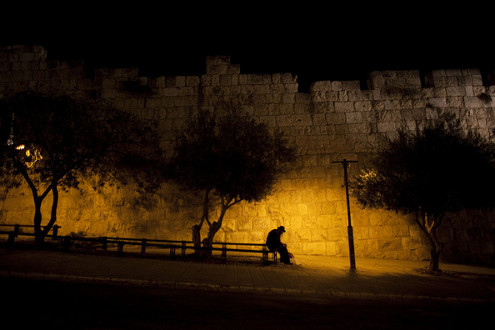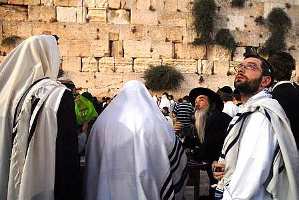
Tag Archives: mourning

Words and Drawn Swords

Tisha b'Av at the Kotel 2007Israeli Prime Minister Benjamin Netanyahu told President Barack Obama he’s willing to make some compromises to achieve peace in his nation, but that returning to Israel’s 1967 borders is not an option.

Netanyahu met with Obama in Washington, D.C., Friday, on the heels of the president’s public call to return Israel to the borders the state held before the 1967 Six Day War, as a concession for peace with the Palestinians.

CBN News Story
“Netanyahu Tells Obama 1967 Borders ‘Indefensible’
by Jennifer Wishon

My companion attacks his friends;
he violates his covenant.
His talk is smooth as butter,
yet war is in his heart;
his words are more soothing than oil,
yet they are drawn swords.
Psalm 55:20-21

On Tisha B’Av, five national calamities occurred:

  • During the time of Moses, Jews in the desert accepted the slanderous report of the 10 Spies, and the decree was issued forbidding them from entering the Land of Israel. (1312 BCE)
  • The First Temple was destroyed by the Babylonians, led by Nebuchadnezzar. 100,000 Jews were slaughtered and millions more exiled. (586 BCE)
  • The Second Temple was destroyed by the Romans, led by Titus. Some two million Jews died, and another one million were exiled. (70 CE)
  • The Bar Kochba revolt was crushed by Roman Emperor Hadrian. The city of Betar — the Jews’ last stand against the Romans — was captured and liquidated. Over 100,000 Jews were slaughtered. (135 CE)
  • The Temple area and its surroundings were plowed under by the Roman general Turnus Rufus. Jerusalem was rebuilt as a pagan city — renamed Aelia Capitolina — and access was forbidden to Jews.

-Rabbi Shraga Simmons
“Overview and laws of the Jewish national day of mourning”
Aish.com

I sometimes wonder what keeps the Jewish people going. I know, the “politically correct” answer is “God”, but think about it. You are Israel. You are surrounded by nations who have wanted to completely destroy you since the day you arrived in the modern world. Within your ancient and historic borders is a people group who demands that you give up more and more of your land and if you don’t, they’ll keep on killing your citizens. Even your biggest “ally”, the United States, for decades has continued to demand that you “give up land for peace”, even when you’ve already shown (think Gaza) that doing so only results in more terrorism; the opposite of peace.

Not only does the world hate Israel, the world hates Jews. Anti-Semitism is on the rise in Sweden, Anti-Semitism is on the rise in Canada, Anti-Semitism is on the rise all over the world.

If you’re a Jew, you’re not really safe anywhere. Sooner or later, someone is going to turn on you.

Why go on?

You can sort of see why assimilation has always been a forbidden but attractive alternative for Jews in the diaspora. Tisha b’Av is a reminder of just how much the world hates the Jews and how many times throughout history, everyone else has tried to kill the Jews; to wipe them out of existence.

Why go on? Why not either give in and let the world have their way, or assimilate and quietly disappear into the pages of history, as so many other ancient people groups have done (ever hear of a Canaanite, a Hittite, or an Edomite anymore)?

Why go on?

In the times of the First Temple lived very lofty souls. It was their thirst for spiritual ecstasy that led them to worship foreign gods.

Thousands of years later, the holy Ari taught, in the 500 years of forced conversions from the Crusades until the Spanish Expulsion, these souls returned so they could be repaired.

Many of the martyrs of that time were men of reason—and for a philosopher to give his life for the sanctity of G–d’s name is a very great test. Many did, and so they were healed.

When the Ari came, however, he revealed the secret wisdom and repaired the world so that all souls were healed and no repairs were left to be made. It follows that all the suffering of the Jewish people since the Ari are neither punishment nor repair. If so, what are they?

We do not know.

One thing we do know: That we do not know.

-Rabbi Tzvi Freeman
Based on letters and talks of the Rebbe, Rabbi M. M. Schneerson
“Beyond Punishment and Repair”
Chabad.org

Were you hoping for something more uplifting? So was I.

I’m not Jewish, so I lack any real understanding to be able to answer the question. The Hamasonly thing I know is that the Jews have endured and they continue to endure. Is it God’s will that the Jews should continue to exist and that they should also continue to suffer?

“I know, I know. We are Your chosen people. But, once in a while, can’t You choose someone else?” -Teyve from the film Fiddler on the Roof (1971)

There are times when individuals get so discouraged they want to give up. Some quit their jobs, some get divorced, some simply withdraw into themselves and we call that depression, and some do the ultimate “quitting” by committing suicide. In these cases, the people involved feel trapped and alone and hopeless. Whether it’s true or not, they feel like everyone is against them and that there’s no where to turn. They feel out of control of their environment and their lives and they want to make the pain stop.

They’re willing to do anything to make the pain stop because life doesn’t make any sense.

I know you’re reading this a day later, but I’m writing this on Tisha b’Av. I know that hope is supposed to be mixed in with mourning and loss, but mourning and loss are a vital and inescapable element on the 9th of Av. The hunger of fasting is a reminder of how empty the world is of justice and mercy:

“Blessed are the poor in spirit,
for theirs is the kingdom of heaven.
Blessed are those who mourn,
for they will be comforted.
Blessed are the meek,
for they will inherit the earth.
Blessed are those who hunger and thirst for righteousness,
for they will be filled.” –Matthew 5:3-6
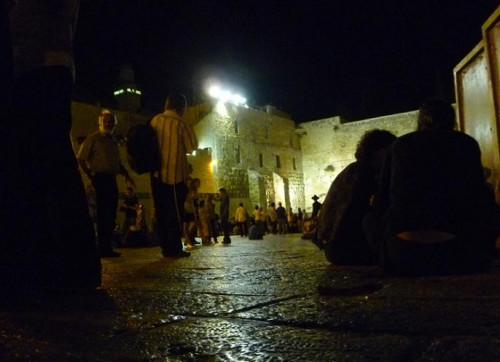
Tisha b'Av at the Kotel 2011The Master might as well have been talking about Tisha b’Av…or about life.

Maybe the only answer is the one provided by the Rebbe as interpreted by Rabbi Freeman at Chabad.org:

We are imprisoned because we have exiled our G-d.

As long as we search for G-d by abandoning the world He has made, we can never truly find Him.

As long as we believe there is a place to escape, we cannot be liberated.

The ultimate liberation will be when we open our eyes
to see that everything is here, now.

If the Jews are in exile, if the Jews suffer and mourn, God suffers and mourns with them. They aren’t alone. Even in torment, they are never alone. However, based on the words of Jesus quoted above, does that also apply to the rest of us? In mourning, where is our promised comforter? In sorrow, where is our peace?

Remember my affliction and my wandering, the wormwood and bitterness.
Surely my soul remembers
And is bowed down within me.
Therefore I have hope.
The LORD’S lovingkindnesses indeed never cease,
For His compassions never fail.
They are new every morning;
Great is Your faithfulness.
“The LORD is my portion,” says my soul,
“Therefore I have hope in Him.”
The LORD is good to those who wait for Him,
To the person who seeks Him.
It is good that he waits silently
For the salvation of the LORD. –Lamentations 3:19-26 (NASB)

As it is said, every descent is for the sake of an ascent, and so we have this Kabbalistic interpretation of Tisha b’Av from Rabbi Yitzchak Ginsburgh:

The Seer of Lublin passed away, at the age of 70, on the 9th of Av 5575 (1815), a day of national mourning, but also, according to the sages, the birthday of the Mashiach. Long before his passing he hinted to his followers that he would pass away on the 9th of Av.

The passing of the Seer of Lublin joins together with the “passing” of the Divine Presence from the Holy Temple in Jerusalem on the 9th of Av (the day of the destruction of the Temple – only its physical body “died” but its soul ascended to heaven) to arouse God to bring the Mashiach (who will permeate reality with Divine revelation, bringing redemption, peace and goodness to all) – now!


Hope and Ashes

MourningI remember with perfect clarity the sensation of waking up on the morning of March 9, 1990. In those first few fuzzy moments of consciousness, I oriented myself to where I was — in the spare bedroom of my parents’ New Jersey apartment, and what day it was — two days after my father’s death. As soon as I realized that I had woken up into a world without my father, my heart plunged into a fathomless grief, like waking up into a nightmare that will never end.

The world without my father was not simply the same world minus one; it was a totally different world. This altered, diminished world lacked the stability and goodness that was my father. This world wobbled on its axis; its gravitational pull was heavier.

The ninth day of the Hebrew month of Av — called Tisha B’Av — is to the Jewish people what March 9 was to me. We misrepresent the tragedy of the day by describing it as the destruction of the two Holy Temples, as if the catastrophe is the loss of a building. The American people do not mourn on 9/11 because of the destruction of the Twin Towers; they mourn the thousands of lives lost in the conflagration. Contrast a person who mourns the absence of the majestic towers to the New York skyline with a person who mourns the loss of his/her parents caught on the 98th floor.

Tisha B’Av is more like a death than a destruction, because on that day the world changed irrevocably.

Sara Yoheved Rigler
“Waking Up to a World Without God’s Presence”
Aish.com.

When Jonah’s warning reached the king of Nineveh, he rose from his throne, took off his royal robes, covered himself with sackcloth and sat down in the dust. This is the proclamation he issued in Nineveh:

“By the decree of the king and his nobles:

Do not let people or animals, herds or flocks, taste anything; do not let them eat or drink. But let people and animals be covered with sackcloth. Let everyone call urgently on God. Let them give up their evil ways and their violence. Who knows? God may yet relent and with compassion turn from his fierce anger so that we will not perish.”

When God saw what they did and how they turned from their evil ways, he relented and did not bring on them the destruction he had threatened.Jonah 3:6-10

Sara Yoheved Rigler characterizes the mourning of Tisha b’Av not for the lengthy series of hardships that have been inflicted on the Jewish people and not even for the loss of the First and Second Temples, but for the loss of God in the world. She describes how her son was born into a world without her father, his grandfather, and that he “will never know how the room lit up when my father entered, how secure and supported dozens of people felt because of the bedrock that was my father”.

For the past 2,000 years, Jews have been born into a world without the Holy Temple in Jerusalem, City of David:

In the same way, we who were born into a world without the Divine Presence have never experienced the spiritual luminosity that radiated through the aperture of the Holy Temple. We live in a dimmer, coarser world, where physical reality seems like ultimate truth while spiritual reality seems like a vague phantasm. We navigate in the nightmare without even knowing we’re in it.

It is true that the world is not without God. God is manifest in our world all of the time through the acts of His people, through His answers to prayer, and through His providence in the lives of each and every human being on Earth. Yet, as Rigler points out, the Divine Presence, the unique projection of the infinite God into a finite world through the “humbling” of His essence has not existed in our mortal realm for 20 centuries.

If you’re Christian, I know what you’re thinking. What about Jesus? True. We could say that Jesus was a manifestation of the infinitely Divine in finite moral form. He was the Word made flesh and the Divine Presence in the shape of a man (I say was because he is also our High Priest in the Heavenly Court and he sits at the right hand of the infinite, unknowable, all powerful Ayn Sof; who Christians call “God the Father”).

Candle burning outYet, in the same way that Rigler mourns in a world without the Divine Presence, we Christians can and probably should mourn being born into a world without a living Jesus walking among us. True, God is only a prayer away and He is with us even when we are too weak or ashamed to pray, but something…someone is gone. The world is created but it is damaged. There are pieces missing. We live in a house with walls and part of the roof “deconstructed”. It’s like being born into a world without a loving grandfather…like Sara’s son. It’s also like this:

“And I will pour out on the house of David and the inhabitants of Jerusalem a spirit of grace and supplication. They will look on me, the one they have pierced, and they will mourn for him as one mourns for an only child, and grieve bitterly for him as one grieves for a firstborn son. On that day the weeping in Jerusalem will be as great as the weeping of Hadad Rimmon in the plain of Megiddo. The land will mourn, each clan by itself, with their wives by themselves: the clan of the house of David and their wives, the clan of the house of Nathan and their wives, the clan of the house of Levi and their wives, the clan of Shimei and their wives, and all the rest of the clans and their wives. –Zechariah 12:10-14

Some Christians view this verse as the means to accuse the Jews of “murdering Jesus” and that someday “they’ll be sorry”, but in truth, Jesus died for the sins of all of us. The collective church never really mourns the loss (except perhaps when watching the 2004 film The Passion of the Christ) but only celebrates the resurrection joy on Easter. Where is our sorrow over being the cause of his suffering and death? In claiming the resurrection and everlasting life for our own, where is the agony and sorrow over needing to be saved by his death because of our willful sins?

We were born into a world without the Divine Presence among us because of what we did wrong. Something absolutely perfect is missing from the world, and this side of paradise, we will never fully experience it. Paul said that “we see through a glass, darkly” (1 Corinthians 13:12 KJV) and thus, we were born into the world half-blind, only barely able to see the image of the perfect God in the reflection of the Master. Sin distances us from God and the One who man once walked with in the Garden, though still with us, seems so very distant.

I recently read a story on the Arutz Sheva news website about a group of Christian churches that will, on August 13 and 14, read portions of the Torah in solidarity with the Jews and with Israel. We can fast and mourn with the Jews on Tisha b’Av for this reason as well.

From sundown last night until sundown tonight, Jews all over the world mourn destruction but hope for redemption. As Christians, we know our redemption is in Jesus Christ, and yet he has not returned. There are many who still don’t know him. We who are saved often take that status for granted and continue to sin. We have much to grieve over.

Today, we can fast, dining on ashes, and still hope for the coming of God’s glory back into the world. Sara Yoheved Rigler says something very important in her article:

In one essential way Tisha B’Av differs from death: the catastrophe is reversible. As Rabbi Avraham Isaac Kook declared: “The Temple was destroyed because of causeless hatred [among Jews]; it can be rebuilt only by causeless love.”

It can sometimes be difficult to rise Phoenix-like to embrace a life of “causeless love” from the ashes of grief, sorrow, failure, and “wanton hate” (as expounded upon so well at the Lev Echad blog). Rabbi Tzvi Freeman says the following based on the wisdom of the Rebbe, Rabbi M. M. Schneerson:

Your soul is in captivity when you know what is right and you allow the world to stop you.

Captivity begins by believing that you are small and the world is big. Once you believe that, next you are likely to believe it will step on you, and your fear it.

And then you come to obey it, then to run after it. And then you are it’s slave, thirsting for water for the soul but not even able to remember where to look for it.

To fear the world is to deny the Oneness of the Creator.

Don’t take the world and its darkness so seriously – it is not as real as it feigns to be. The only thing real about it is its purpose of being – that you should purify it.

I struggle to see the hope beyond the loss and yet, today especially, I sit in the darkness and mourn in ashes.

The road

The road is long and often, we travel in the dark.

A Time to Dance

MourningIt used to be that the soul fought with the body, until one conquered the other with force. Then the Baal Shem Tov came and taught a new path: The body, too, could come to appreciate those things the soul desires.

In the place of self-torture and fasting, the Baal Shem Tov showed his students the way of meditation and joy. Every need of the body, he taught, could provide a channel to carry the soul.

Rabbi Tzvi Freeman
Based on letters and talks of the Rebbe, Rabbi M. M. Schneerson
“Working With the Body”
Chabad.org

They said to him, “John’s disciples often fast and pray, and so do the disciples of the Pharisees, but yours go on eating and drinking.” Jesus answered, “Can you make the friends of the bridegroom fast while he is with them? But the time will come when the bridegroom will be taken from them; in those days they will fast.”Luke 5:33-35

Judaism and Christianity in general see the connection between the soul and the body differently. In Christianity, the “desires of the flesh” are seen as always in opposition to the desires of the spirit (“the spirit is willing, but the flesh is weak” from Matthew 26:41). In order for a person to become closer to God, they must deny anything to do with the physical world and strive for the intangible realm of spiritual things. However for Jews, it’s a bit different.

There’s not much of a history of asceticism among Jews the way we see among the Christian saints (there are exceptions). The world was created by God which includes the pleasures of the world. This isn’t to say that a person is permitted to do anything he or she desires, but those things that Christians blush at enjoying, even within proper confines such as sex between a married couple, aren’t considered shameful, as long as such desires are disciplined and only are expressed as God wills. In fact, within Jewish thought, it is believed that for every sinful impulse, God created an acceptable moral equivalent.

I suppose this is an odd topic to bring up, since the fast of Tisha b’Av begins today at sundown. This is the culmination of the Three Weeks of Mourning between the 17th of Tammuz and the Tisha b’Av commemorating the times of great suffering the Jewish people have endured throughout history. Yet God intends for us to mourn, not as a lifestyle, but only in its proper time and season:

There is a time for everything,
and a season for every activity under the heavens:
a time to be born and a time to die,
a time to plant and a time to uproot,
a time to kill and a time to heal,
a time to tear down and a time to build,
a time to weep and a time to laugh,
a time to mourn and a time to dance… –Ecclesiastes 3:1-4

The words of Jesus as recorded by Luke echo this quite strongly. We live in a broken world but we were given life, not only to serve God’s purpose, but to appreciate. Pleasurable things aren’t to be avoided, only enjoyed within the type of lifestyle we were provided by God. For the past three weeks, Jews all over the world have mourned. Tonight, many will fast and weep. Maybe even a few Christians will fast in solidarity with their Jewish brothers and sisters, and in acknowledgement of the fact that God mourns too over the suffering of His people.

Simchat TorahWhile the world has trouble and there is a time to fast, to repent, to cry, and to grieve, there are also times to celebrate, to dance, to laugh, to sing, and to praise God for life and the fact that He wants us to live it.

While we may long for Heaven or the life of the world to come, God did not intend for us to ignore where we are at and what we are doing right now. Rabbi Freeman expresses the Rebbe’s wisdom on the matter this way:

There is no moment more vital than the one right now. There is no space more crucial than the one in which you stand.

For this is the moment and this is the place from which Moshiach may come.

Tonight and tomorrow, we fast and pray and mourn. The day after, we may sing and laugh. God gave us life. God is good. There is a time to mourn and a time to dance.

Clap your hands, all you nations;
shout to God with cries of joy.
For the LORD Most High is awesome,
the great King over all the earth. –Psalm 47:1-2 (NIV)

In fact, we mourn and fast today because, for every descent, there is an ascent.

It is obvious that when Moshiach comes there will be no need to commemorate the Temple’s destruction and thus no reason to perpetuate these fasts. But why will they be celebrated as “holy days and days of rejoicing”?

The answer is that the four fasts are not just commemorations of tragic dates in Jewish history, but contain a hidden good of such magnitude that we will only be able to discern it when Moshiach comes. In fact, the fasts represent four stages in the progression toward Moshiach. We would never be able to attain the revelation of Moshiach were it not for the destruction and the exile. The entire exile may therefore be termed a “descent for the purpose of ascent.”

-from Merkos on Campus

Less than a week after Tisha b’Av, there is a day of dancing, quoting from Jewish Virtual Library:

“There were no better days for the people of Israel than the Fifteenth of Av and Yom Kippur, since on these days the daughters of Jerusalem go out dressed in white and dance in the vineyards. What they were saying: Young man, consider who you choose (to be your wife).” (Taanit 4:8).

L’Chaim! To life!

Days of Mourning

MourningDuring the 3 weeks from 17 Tammuz leading up to Tisha B’Av, the 9th of Av, the Jewish people mourn the loss of the Holy Temple. The Talmud attributes this loss to the prevalence of Sinas Chinam, baseless hatred, among the Jewish people. While hatred towards others is a serious offense, how does it explain the loss of the Temple, and sending the Jewish people into a bitter, arduous exile for nearly 2000 years? Surely there are much greater crimes!

Recall that our relationship with the Al-mighty is not simply servant to master — it’s much deeper. He’s not only Malkeinu, our King, but Avinu Malkeinu, our Father, our King. A mere servant follows orders, but a child does what he knows his father wants most. While G-d did not record baseless hatred in His Torah as a punishable crime, we know that the deep pain it causes the Al-mighty, as it were, far exceeds even the most cardinal of sins. (Nesivos Shalom, Bamidbar 146)

I encourage you to read the words offered in eulogy (pgs 1 & 16) by Rabbi Binyomin Eisenberg , spiritual leader of the synagogue attended by Leiby Kletzky’s family, and one who had a close personal relationship with the pure, innocent Neshama (soul) summoned back to heaven last week. While one can only speculate what G-d’s message is to us, and undoubtedly there are many amidst such a profound tragedy, Rabbi Eisenberg noted the outpouring of assistance, thousands of volunteers, who helped in the search for Leiby and eventually helped lay his body to its final rest. He then asked a painful question: “Why do we need a tragedy to provide water in the streets for strangers?” “Let’s help each other – always,” he said. “If you pick up the phone, it stops ringing. If we Daven (pray) and help each other, we hopefully won’t need tragedies.”

Rabbi Mordechai Dixler
Program Director, Project Genesis – Torah.org

The three weeks of mourning, which started on Tammuz 17, began on July 19th this year, and will culminate on August 9th; Tisha b’av. The 9th day of the month of Av observes a series of tragic events that have befallen the Jewish people throughout history. It is said that both the First and Second Temples were destroyed on the 9th of Av. The Bar Kochba revolt (133 CE) was ended with the slaughter of the Jewish rebels by the Romans on the 9th of Av. On this same date in 1290 CE, the Jews were expelled from England and Spain banished Jews from their land in 1492 on the 9th of Av. Chabad.org has more facts on this day, which holds so many harsh events for the Jewish people.

Why continue to mourn? What purpose could continuing to commemorate the three weeks serve except as a depressing reminder of so much suffering, pain, and death? Why would the Jewish people want to make this a permanent part of their religious calendar and to relive such terrible times?

What did Rabbi Dixler say?

The reminder isn’t what the world has done to the Jews. The reminder is how they failed God, defining the failure as “the prevalence of Sinas Chinam, baseless hatred, among the Jewish people”.

I don’t say this to insult or denigrate the Jewish people. In fact, we all fail God, each and every one of us, and on a rather frequent basis. What lessons can Christians take from the three weeks of mourning and the fast days of 17 Tammuz and 9 Av? Christianity often focuses on how we are saved from sin and death, which isn’t necessarily a bad thing, but we have a tendency to gloss over our own faults, mistakes, and errors, all because we are “saved”. In fact, our salvation seems to make some Christians a little cocky and even arrogant. For them, being “saved” means if you mess up, all you have to do is shoot a quick prayer of “I’m sorry, God” up to heaven and you’re good to go.

Really?

MourningI think not, but sadly, I do think a lot of Christians proceed on this rather self-satisfied and self-serving assumption. If Christians would take their failures a little more seriously, consider displaying a more contrite attitude toward God and other people they have failed, and humble themselves (ourselves) before God and those people, wouldn’t we be better servants of God and better disciples of Jesus? Jesus emptied himself of all glory and honor and humbly accepted an unjust and undeserved death on a stake as a criminal. Where is our fasting, our mourning, our prayers of sorrow for the failures of our lives?

Rabbi Yehudah Prero offers a description of what observant Jews practice during these three weeks:

We are now in the final days of the Three Weeks, the period of time between the fasts of the 17th of Tamuz and the 9th of Av. These three weeks are spent in a state of mourning. We do not conduct weddings, we do not cut our hair, and we refrain from enjoying music. During the last nine days, we do not eat meat, drink wine, nor do we bathe. The sorrow of our exile surrounds us at every moment during this time of the year. While we are to mourn the loss of the Holy Temple, the Bais HaMikdosh and the destruction of Jerusalem, and pray for the end of this lengthy exile, we must remember that Hashem is with us, watching us, ready to lift the burden of exile from upon us at the proper time.

Granted, this type of observance is more common among Orthodox Jews, but it does set a standard of behavior that includes solumn reflection and prayer among the Jewish people as well as the reassurance that God is with them and, at the right time, that He will rescue them. It commemorates the “incompleteness” of the redemption of the Jewish people from exile and the desire for the coming of the Messiah to accomplish the final return of the Jews to Israel and to God:

We have been in exile for a long time. Our families have been subject to spiritual and physical persecution. During the Three Weeks, our behavior reflects the sadness of this time period, the recognition of the great suffering which we still endure. Although we mourn and lament, we must still keep in mind that Hashem is watching over us. He has already put in place the mechanisms for our redemption. We cannot allow that spark of hope within us to be extinguished. We must recognize that the exile will end. That end has been planned for and provided for by G-d. With our striving to be better people, with our repenting, our studying of the Torah, the redemption, our light at the end of the tunnel, is clearly within sight.

Christians don’t consider themselves in exile, but perhaps we should. Although Christianity doesn’t have the same relationship to Land of Israel as the Jewish people, there is definitely something we are missing. We still live in a broken world. We still live in a world where sin and immorality reign and where the values of God and truth are treated with contempt. When will we be “returned” to our “homeland”, where we will live in peace and be ruled by our just and merciful King? When will Jesus come?

As long as we are waiting for him, we are also in exile. While we celebrate our salvation, let us mourn the fact that it was for our sins that Jesus suffered terribly and died. We share some measure of grief and sorrow for the destruction of the Temple and the exile of the Jews from Israel, because these are all events that are inexorably tied to the death of the Messiah and the spreading of the Gospel of Christ. The Prophet Micah said that someday, all people from the nations will stream to the mountain of God. For that reason, we too must long for the day of its return and for the restoration of the Jews to Israel, as we do for the return of Christ. Let us fast and mourn as for an only son who we have lost and pray for the day when he will come into the world again, in glory and honor and joy. One day, we will all be restored in the courts of our Father and our King.

In the last days
the mountain of the LORD’s temple will be established
as the highest of the mountains;
it will be exalted above the hills,
and peoples will stream to it.

Many nations will come and say,

“Come, let us go up to the mountain of the LORD,
to the temple of the God of Jacob.
He will teach us his ways,
so that we may walk in his paths.”
The law will go out from Zion,
the word of the LORD from Jerusalem.
He will judge between many peoples
and will settle disputes for strong nations far and wide.
They will beat their swords into plowshares
and their spears into pruning hooks.
Nation will not take up sword against nation,
nor will they train for war anymore.
Everyone will sit under their own vine
and under their own fig tree,
and no one will make them afraid,
for the LORD Almighty has spoken.
Micah 4:1-4