Tag Archives: prayer

Isaiah 56 and the Gentile

Thus says the Lord,
“Preserve justice and do righteousness,
For My salvation is about to come
And My righteousness to be revealed.
“How blessed is the man who does this,
And the son of man who takes hold of it;
Who keeps from profaning the sabbath,
And keeps his hand from doing any evil.”
Let not the foreigner who has joined himself to the Lord say,
“The Lord will surely separate me from His people.”
Nor let the eunuch say, “Behold, I am a dry tree.”

For thus says the Lord,

“To the eunuchs who keep My sabbaths,
And choose what pleases Me,
And hold fast My covenant,
To them I will give in My house and within My walls a memorial,
And a name better than that of sons and daughters;
I will give them an everlasting name which will not be cut off.
“Also the foreigner who join themselves to the Lord,
To minister to Him, and to love the name of the Lord,
To be His servants, every one who keeps from profaning the sabbath and holds fast My covenant;
Even those I will bring to My holy mountain
And make them joyful in My house of prayer.
Their burnt offerings and their sacrifices will be acceptable on My altar; for My house will be called a house of prayer for all the peoples.”
The Lord God, who gathers the dispersed of Israel, declares,
“Yet others I will gather to them, to those already gathered.”

Isaiah 56:1-8 (NASB)

I made a comment in one of my recent blog posts that having rendered a simple, basic definition for living a life of holiness, what else should I write about? After all, once the path is before me, my only job is to walk the path, not write endless commentaries about it.

But somewhere in my comments, I also mentioned the need to address, among other things, certain sections of Isaiah 56, from which I quoted above. I have largely defined a life of holiness for a non-Jewish disciple of Rav Yeshua (Jesus Christ) apart from the vast majority of Jewish lifestyle and religious observance practices. To live a life of holiness and devotion to God, it is my opinion that we non-Jews have no obligation observe the traditional mitzvot associated with religious Jewish people.

But we encounter a few “problems” in the above-quoted passage from Isaiah. Even leaving out the sections that relate to “eunuchs,” “the foreigner” is not to consider himself (or herself) as being separated from His people (presumably Israel). Further, foreigners who join themselves to the Lord do so, in part, by not “profaning the sabbath” (otherwise translated as “guarding” the sabbath) and by holding fast to “My [God’s] covenant.”

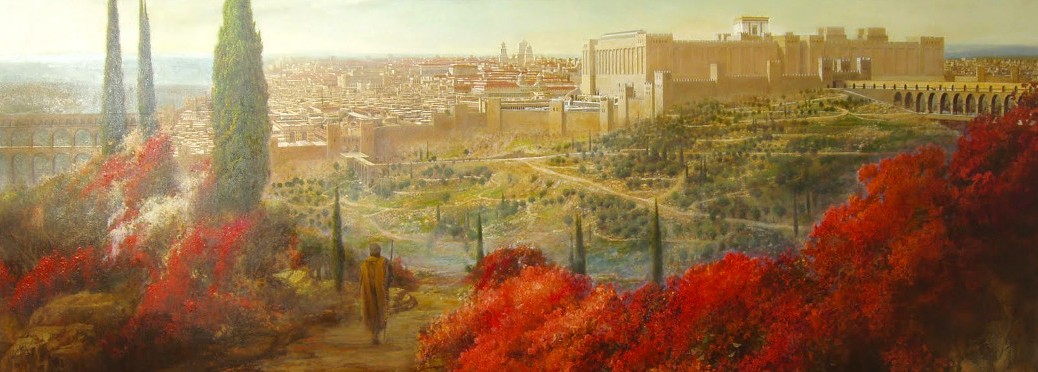
House of PrayerIn addition, the foreigner will be joyful in Hashem’s house of prayer (the Temple) and it will be called “a house of prayer for all peoples,” which seems to indicate the people of every nation.

In doing some research for today’s “meditation,” I discovered I’ve written about the Book of Isaiah before.

That was a sweeping panorama of the entire book (click the link to read it all), but of Isaiah 56, I wrote only this:

Isaiah 56 is the first time in the entire sixty-six chapter book that says anything specifically about how the nations will serve God. I was wondering if the word “foreigner” in verse 3 might indicate “resident alien” and somehow distinguish between Gentile disciples of the Messiah and the rest of the nations, which could bolster the claim of some that these “foreigners” merge with national Israel, but these foreigners, also mentioned as such in verse 6, are contrasted with “the dispersed of Israel” referenced in verse 8.

And…

And the foreigners who join themselves to Hashem to serve Him and to love the Name of Hashem to become servants unto Him, all who guard the Sabbath against desecration, and grasp my covenant tightly…

Isaiah 56:6

This is the main indication that foreigners among Israel will also observe or at least “guard” the Sabbath (some Jewish sages draw a distinction between how Israel “keeps” and the nations “guard”), and the question then becomes, grasp what covenant tightly? Is this a reference to some of the “one law” sections of the Torah that laid out a limited requirement of observance of some of the mitzvot for resident aliens which includes Shabbat?

I won’t attempt to answer that now since I want to continue with a panoramic view of Isaiah in terms of the relationship between Israel and the nations (and since it requires a great deal more study and attention).

I’m reminded that in very ancient times, the “resident alien,” a Gentile who intended for his/her descendants in the third generation and beyond, to assimilate into Israel, losing all association with their non-Israelite ancestors, had a limited duty to obey just certain portions of the Torah mitzvot in the same way as a native Israelite.

reading-torahThe “one law” didn’t cover all of the mitzvot, but only a small subsection, such as a limited guarding of the Shabbat, which I mentioned above.

Also, my understanding of the legal and scriptural mechanics behind the Acts 15 Jerusalem letter edict, is that the non-Jewish disciple of Rav Yeshua was to be considered, in some manner, a “resident alien” within the Jewish religious community of “the Way,” Jewish Yeshua-believers.

Putting all this together, we may infer some limited form of Torah observance for the non-Jew in Messiah, but beyond what we have before us so far, exactly what that entails may not be entirely clear.

Although the statement in Isaiah 56 saying that the foreigner was to “hold fast My covenant” seems general, there are only two specific areas mentioned: sabbath and prayer.

Regarding the Shabbat and Isaiah 56, I’ve written twice. The first mention is from My Personal Shabbos Project:

Of course, as I said before, I think there’s a certain amount of justification for non-Jews observing the Shabbat in some fashion based both on Genesis 2 in honoring God as Creator, and Isaiah 56 which predicts world-wide Shabbat observance in the Messianic Kingdom.

The second mention was from a companion blog post called Messianic Jewish Shabbat Observance and the Gentile where I mention using a particular Shabbat “siddur” that was specifically prepared for “Messianic Gentiles,” and this references Isaiah 56:7

This seems to bridge between the first specific item, Shabbat, and the second, which is prayer. I wrote of prayer and Isaiah 56 almost a year ago in this review of a sermon series:

Judaism makes a distinction between corporate and personal prayer, and man was meant to engage in both. Participation in the Jewish prayer services, at least in some small manner, is as if you have participated in the Temple services, which as Lancaster mentioned, is quite a privilege for a Messianic Gentile. It also summons the prophesy that God’s Temple will be a house of prayer for all nations (Isaiah 56:7, Matthew 21:13).
solomon
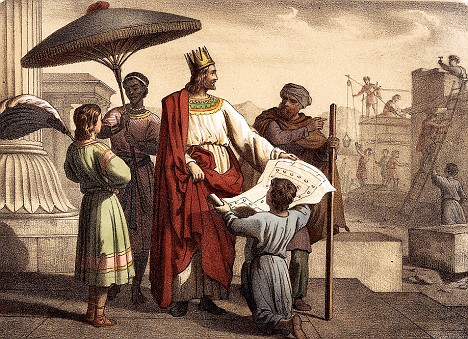
King Solomon supervises construction of his Temple

In addition to all of the above, we have this statement made by King Solomon as part of his dedication to the newly built Temple:

“Also concerning the foreigner who is not of Your people Israel, when he comes from a far country for Your name’s sake (for they will hear of Your great name and Your mighty hand, and of Your outstretched arm); when he comes and prays toward this house, hear in heaven Your dwelling place, and do according to all for which the foreigner calls to You, in order that all the peoples of the earth may know Your name, to fear You, as do Your people Israel, and that they may know that this house which I have built is called by Your name.”

I Kings 8:41-43

This doesn’t seem to be limited to the resident alien temporarily or even permanently dwelling among Israel, but includes any non-Jewish visitor who, for the sake of God’s great Name, comes to Jerusalem and prays toward (facing) the Temple.

Of all the commandments incumbent upon both the Jew and the Gentile believer, it seems that prayer is to be shared among all peoples.

But what about Shabbat or, for that matter, any of the other commandments?

I want to limit myself (mostly) to Isaiah 56 since it seems to be a sticking spot for many non-Jews who believe it acts as a “smoking gun” pointing toward the universal application of all of the Torah commandments to everyone, effectively obliterating everything God promised about Jewish distinctiveness.

Since non-Jews are so prominently mentioned in this chapter, I decided to see what (non-Messianic) Jews thought of this.

The easiest (though highly limited) way to do so was to look up this portion of scripture online at Chabad.org see read Rashi’s commentary on the matter.

Here’s verse 3:

Now let not the foreigner who joined the Lord, say, “The Lord will surely separate me from His people,” and let not the eunuch say, “Behold, I am a dry tree.”

rashi
Rashi

Here’s Rashi’s commentary on the verse:

“The Lord will surely separate me from His people,”: Why should I become converted? Will not the Holy One, blessed be He, separate me from His people when He pays their reward.

My best guess at the meaning of this statement is that the Gentile should not convert to Judaism since, when Hashem gives Israel its reward, won’t the convert be set apart from His people?

But I’m almost certainly reading that statement wrong. It makes no sense to me, since converts, according to the Torah, are to be considered as identical to the native-born. I don’t have an answer for this one.

The other relevant verses are 6 through 8, and here’s Rashi’s only commentary on them:

for all peoples: Not only for Israel, but also for the proselytes.

I will yet gather: of the heathens ([Mss. and K’li Paz:] of the nations) who will convert and join them.

together with his gathered ones: In addition to the gathered ones of Israel.

All the beasts of the field: All the proselytes of the heathens ([Mss. and K’li Paz:] All the nations) come and draw near to Me, and you shall devour all the beasts in the forest, the mighty of the heathens ([Mss. and K’li Paz:] the mighty of the nations) who hardened their heart and refrained from converting.

Referring to “foreigners” as proselytes or non-Jewish converts to Judaism is rather predictable and an easy way to avoid the thorny problem of Gentile observance of Shabbos or some other sort of association with Israel.

The last commentary seems to make some mention of “heathens,” possibly meaning that, in the end, Jews and non-Jews will turn to God, but ultimately, it seems, Rashi expects all non-Jews to convert to Judaism as their only means to become reconciled with Hashem.

My general knowledge of Jewish belief (and I suspect I’ll be corrected here) indicates that non-Jews will exist in Messianic days and those devoted to Hashem will be Noahides or God-fearers, just as we have those populations in synagogues today. They will have repented of their devotion to “foreign gods,” which from a more traditional Jewish perspective, will include (former) Christians.

interfaith prayerSo without further convincing proofs, I’m at an impasse. I can definitively state that part of a life of holiness for both a Jew and Gentile is prayer to the Most High God. Of course, that should be a no-brainer.

The Shabbat is a bit more up in the air. While I can’t see any real objection to a non-Jew observing a Shabbat in some manner, there doesn’t seem to be a clear-cut commandment. In Messianic Days, Shabbat may well be observed in a more universal manner, though the exact praxis between Jews and Gentiles likely won’t be identical.

As the discussion in How Will We Live in the Bilateral Messianic Kingdom indicated, while the vast majority of the Earth’s Jewish population may reside in the nation of Israel in Messianic Days, there may be some ambassadors assigned to each of the nations, and thus, there may be an application of the Shabbat in the nations for their sake and for the sake of Jews traveling abroad for business or leisure reasons.

I also can’t rule out a wider application of Shabbat observance for the Gentile in acknowledgement of God as the Creator of the Universe, which we see in Genesis 2:3:

Then God blessed the seventh day and sanctified it, because in it He rested from all His work which God had created and made.

That’s supposition on my part, but it’s not entirely out of the ballpark.

In any event, Isaiah 56 doesn’t give us as much detail about non-Jews in relation to the Torah as some folks might think. Pray? Yes. Pray toward the Temple in Jerusalem, even if you are outside Israel? Maybe. Couldn’t hurt.

ShabbatObserve the Shabbat? Maybe in some fashion. I think this part will become more clear once Messiah returns as King, establishes himself on his throne in Jerusalem, and then illuminates the world.

In terms of what I’ve written before, prayer should already be part of a simple life of holiness, so Isaiah 56 doesn’t add to this. Some form of Shabbat observance is allowable but may not be absolutely required for the Gentile in the present age. Isaiah 56 doesn’t make it clear that a Gentile “guarding”  or not “profaning” the Shabbat is also “observing” it, and even if we do observe, there’s still not an indication that such observance would be identical to current Jewish praxis.

Bottom line: when in doubt stick to the basics.

The Simplicity of a Life of Holiness

On the heels of writing yesterday afternoon’s meditation, I realized this whole “Judaicly aware Gentile on a deserted island in search of God” thing is really quite overblown.

That I have a relationship with God as an individual non-Jew is hardwired into every human being including me. It’s a matter of making teshuvah continually, repeatedly or constantly turning back to God, and then pursuing that relationship in whatever flawed and imperfect way I can, day by day, for the rest of my life.

There’s no complex praxis or ritual involved. We know that the Centurion Cornelius (Acts 10) prayed at the set times of prayer, which likely means he prayed three times a day. He also gave much charity to the Jewish people. His prayers and acts of charity were recognized by God, much as Abraham’s faith in Hashem was considered to him as righteousness.

Having a relationship with God, for anyone, is a matter of allowing your day-to-day life to reflect righteousness and holiness. How? It’s not that complicated. Do good things to other people.

Pick up a piece of litter. Hold a door open for someone trying to enter a building behind you. Be kind to everyone you meet. Give to charity. Volunteer to help others in some capacity, such as at a food bank.

Give thanks to God for all you have, whether in plenty or poverty. Be content with everything that comes to you, for it’s all from the hand of God.

As far as it’s up to you, live at peace with everyone.

kindnessReally, if you can’t figure out what you can do to be a good person and a good servant to people in your family, people in your community, and a good servant to God, you haven’t been paying attention to your faith.

This is what I mean about the practices of Messianic Judaism sometimes being a distraction to those non-Jews involved. Admittedly, Hebrew prayers spoken and sung by people who are fluent (and musical) sound incredibly beautiful to me…and are far beyond my linguistic and tonal abilities.

But will God not hear my prayers if they aren’t in Hebrew or if I can’t carry a tune in a paper sack?

Admittedly, many parts of the prayer service and Torah service on Shabbat appeal to me, but let’s face it. I’m not Jewish. As far as I know, there’s no commandment for the goyim to daven in a minyan. If I pray alone, in English, is God going to ignore me? He didn’t ignore Cornelius.

So many “Judaicly aware” Gentiles are worried about how to perform this mitzvah or that, but they are (and I have in the past) making their lives so much more complicated than they have to be.

If you don’t have your hands full just resisting your evil inclination and striving to follow your good inclination, then either you are a bonafide saint or you’re delusional.

But I’ve been casting myself as outside of community, just me, a Bible, and God. What if I should find myself in a church or synagogue (or where ever) on occasion?

No problem. Do what the locals do. Stand up when the congregation stands up, sing when they sing (or sing softly if you have a voice like mine), if some part of the service is in Hebrew and you don’t know Hebrew, don’t say or do anything.

loveIn Sunday school or some other social gathering, be polite and friendly, but don’t offer any opinions or otherwise shoot your big mouth off (this is one of the reasons I don’t belong in community, because I can’t keep my mouth shut).

The principles behind living a life of holiness before God as a Gentile aren’t particularly hard. The only really hard thing is actually living up to that life of holiness. That takes a lifetime of practice, and no one gets to be perfect at it…

…least of all, me.

Things That Matter

There was a time when God became so distant that we were almost ready to deny Him, had psychologists or sociologists not been willing to permit us to believe in Him. And how grateful some of us were when told ex cathedra that prayer is not totally irrelevant because it does satisfy an emotional need.

To Judaism the purpose of prayer isn’t to satisfy an emotional need. Prayer is not a need but an ontological necessity, an act that constitutes the very essence of man. He who has never prayed is not fully human. Ontology, not psychology or sociology, explains prayer.

-Abraham Joshua Heschel
“An Ontological Necessity,” p.78
Man’s Quest for God

I suppose a definition of Ontology is in order:

Ontology is the philosophical study of the nature of being, becoming, existence, or reality, as well as the basic categories of being and their relations. Traditionally listed as a part of the major branch of philosophy known as metaphysics, ontology deals with questions concerning what entities exist or can be said to exist, and how such entities can be grouped, related within a hierarchy, and subdivided according to similarities and differences.

That sounds very abstract and even cold, especially when applied to the intimacy of prayer, but I see where Heschel is coming from. Periodically, you may read about studies that say people who pray have less anxiety than those who don’t, or they (we) recover from illnesses faster than those who don’t pray. Prayer, from this perspective, is put in the same category as meditation, which doesn’t necessarily acknowledge the existence let alone the absolute necessity of God in our human lives. Thus prayer has value from the atheist’s point of view because it is a psychologically valid method of reducing stress or otherwise providing for a state of well-being.

Abraham Joshua Heschel

But Heschel is saying that prayer is the reality of our existence, providing vital linkage with the source of our lives and the very author of all creation. Prayer is what gives a sense of completeness to our being, which is probably why Heschel says (outrageously, from an atheist’s point of view) that he “who has never prayed is not fully human.”

So in prayer we realize our full humanity, but in doing so, we collide head on with our vulnerability, our frailty, our mortality, with everything that separates us from God as well as what binds us to him.

Prayer also brings us perspective:

God grant me the serenity
To accept the things I cannot change;
Courage to change the things I can;
And wisdom to know the difference.

You probably recognize the Serenity Prayer which is regularly said at Alcoholics Anonymous meetings around the world. This prayer connects rather nicely with the image I placed toward the bottom of today’s “morning meditation” (scroll down).

I saw that diagram taped near the desk of one of my co-workers and, in considering the ongoing process of teshuvah, it made a great deal of sense. In the effort of making that 180 degree turn away from sin and toward God, a lot of information and emotion is thrown up in the air, like a sandstorm obscuring vision. How can I see when I’ve made my complete turnaround and know when I’m facing the right direction so I can begin to proceed if I’m confused by all the things that matter that I can’t control and all the things that don’t matter that I can?

The Serenity Prayer seems to be how to ask God to let you see through the sandstorm and pick out only those specific details that are necessary for you (or me) to start walking toward Him.

Why do we need serenity?

I know how to get along with humble means, and I also know how to live in prosperity; in any and every circumstance I have learned the secret of being filled and going hungry, both of having abundance and suffering need. I can do all things through Him who strengthens me.

Philippians 4:12-13 (NASB)

I maintain that only a person who is highly elevated spiritually can possibly stand in the eye of the hurricane and dispassionately watch the tempest rage and completely surround him. The rest of us would be running for the storm cellar.

But that doesn’t mean it isn’t a goal to shoot for, even if achieving it is years or a lifetime in the making.

I’ve mentioned before the seven steps in achieving teshuvah (repentance) which interestingly enough, are sort of connected to the 12 steps that are fundamental to Alcoholics Anonymous. It would seem that the process of recovering from additions can be extended to the process of “recovering” from all manner of sins, at least from the Jewish perspective.

thingsA couple of days ago I commented on something written by Rabbi Tzvi Freeman or rather, one of the comments made in response to his writing:

And 12-Step groups call this “Willingness.”
Wow – I keep seeing how the 12-step recovery coincides with Judaism, it is beautiful.

Would it sound too crazy to suggest something called “Teshuvah Anonymous?”

God help me to accept the things I cannot control, understand all the things that matter, and focus on those things that matter I can control. For only there will my efforts be successful in changing my life so that I behave toward others with greater compassion, kindness, and care, and only there will I find my path to You in prayer.

He Who Fashions Our Hearts

Rambam cites the verse in Tehillim (33:15) as proof of this principle: “He who fashions all their hearts together, Who comprehends all their deeds.” According to Radak (Tehillim ibid.), this verse is explaining why Hashem has the power to see into men’s hearts; because He alone fashioned them, He alone has the ability to truly understand them.

-from “A Closer Look at the Siddur,” p.15
Monday’s Commentary for Parashas Shemos
A Daily Dose of Torah

I’ve always wondered just how much of human behavior God understands. After all, people can be afraid, but God is never afraid. People can be selfish, but God is never selfish. People can be weak, but God is never weak. How can God understand all of our faults and foibles when He has none of His own?

Of course, I always thought this was the answer:

For we do not have a high priest who cannot sympathize with our weaknesses, but One who has been tempted in all things as we are, yet without sin. Therefore let us draw near with confidence to the throne of grace, so that we may receive mercy and find grace to help in time of need.

Hebrews 4:15-16 (NASB)

That covers Yeshua (Jesus) understanding what it’s like to be tempted. The Master may not have sinned, but he did know what it was to be weak, put upon, exhausted, in need of help and comfort:

Then Jesus was led up by the Spirit into the wilderness to be tempted by the devil. And after He had fasted forty days and forty nights, He then became hungry.

Then Jesus said to him, “Go, Satan! For it is written, ‘You shall worship the Lord your God, and serve Him only.’” Then the devil left Him; and behold, angels came and began to minister to Him.

Matthew 4:1-2, 10-11

The Master even said this:

And He withdrew from them about a stone’s throw, and He knelt down and began to pray, saying, “Father, if You are willing, remove this cup from Me; yet not My will, but Yours be done.” Now an angel from heaven appeared to Him, strengthening Him.

Luke 22:41-43

These are very human words uttered by our Master in prayer to the Father. I wonder if he was afraid? I wouldn’t blame him if he were. Here too he needed help, and again, an angel come to comfort or “strengthen” him.

We always assume it was physically impossible for Jesus to sin but strictly speaking is that true? I mean, it’s not really a temptation unless there’s the possibility of giving in. It’s not a true victory unless you have overcome failure. I think the Master endured these things in part to show us that we can be tempted and overcome as well, even though we are broken down, faulty, lame, miserable human flesh.

No temptation has overtaken you but such as is common to man; and God is faithful, who will not allow you to be tempted beyond what you are able, but with the temptation will provide the way of escape also, so that you will be able to endure it.

1 Corinthians 10:13

This was one of the first verses I was encouraged to learn when I professed my faith many years ago, and I thought Paul was being rather smug and arrogant. Sure, it’s easy for him to say that God will provide a way of escape so we can endure temptation and not sin, but it certainly didn’t (and often still doesn’t) seem obvious to me which way led out of temptation.

father and sonBut going back to the first quote above, it never occurred to me before that God understands us completely because God made us, even though He is perfect and we are imperfect, even though He is immortal and we are passing away like grass in a blast furnace. I wonder if that’s why there are so many human-like metaphors for describing God in the Bible, not because He has a face, or arms, or hands, or breath, but so that we can, on some shallow level, relate to Him, even as He completely and totally understands us.

A person is constantly beset by warring impulses. Sometimes, he will succeed and triumph over his evil impulses; other times he may fail and succumb to his baser urges. To the human observer, this behavior may seem random and inconsistent. But Hashem “fashions all their hearts together;” He alone knows of the many components that make up a person’s mind and heart. Thus, it is possible for Him to “comprehend all of their deeds.”

I don’t think this means that God approves of all of our deeds, but He does understand, and hopefully, feels compassion for all of His children, including you and me.

Moreover, we must not overlook one of the profound principles of Judaism. There is something which is far greater than my desire to pray, namely, God’s desire that I pray. There is something which is far greater than my will to believe, namely, God’s will that I believe. How insignificant is the outpouring of my soul in the midst of this great universe! Unless it is the will of God that I pray, unless God desires prayer (See Exodus Rabba, 21, 5; Midrash Tehillim, 5, 7.), how ludicrous is all my praying.

-Abraham Joshua Heschel
“The Separation of Church and God,” p.58
Man’s Quest for God: Studies in Prayer and Symbolism

On the following page, Heschel wrote, “To live without prayer is to live without God, to live without a soul.”

At the heart of doing teshuvah, of repenting and returning to God, is prayer. While the seven points of doing teshuvah I posted at the top of this blog post make it seem as if teshuvah is largely a matter of exercising intellect and will, in fact even our ability to make the first step, to regret and be ashamed of our sins, is because God created us with an awareness of Him; we are made in His likeness.

Prayer is a requirement of repentance, for without God how can man repent at all, how can he turn away from evil and turn toward God and make a life-altering, permanent decision to abandon the way he previously walked?

But in the agony of teshuvah, being torn away from one life and struggling to achieve another, it’s easy to drown in prayers of petition to the point of begging.

But if You can do anything, take pity on us and help us!” And Jesus said to him, “‘If You can?’ All things are possible to him who believes.” Immediately the boy’s father cried out and said, “I do believe; help my unbelief.”

Mark 9:22-24

From God we need all of the building blocks necessary to make teshuvah, then we need help putting them together, and then we need help doing everything else we are responsible for doing to return to Hashem.

In the middle of all that, where do we find the will and the strength to praise Him?

For to Thee Lord our God, God of our fathers, are due songs and praise, hymn and psalm, power and dominion, victory, grandeur, might, homage, beauty, holiness, kingship, blessings, thanksgiving

-from the daily liturgy
quoted in Heschel, p.64

prayerWe can’t “flatter” God into responding to our requests and He certainly doesn’t need us to praise Him because He lacks anything, but as Heschel said before, we pray not because our prayers are powerful or worthy, but because God desires that we pray, and I might add, for our own sakes. For we need God more than He needs us, if He needs anything at all. God is waiting only for us to whisper our tiny prayers to Him so He can call out and draw us to Him.

As much as the human soul yearns to rise up and merge within the light of its Creator, so much more so does the Infinite Creator yearn to be found within the human soul.

If so, what force could stand between them? What could hold back the Creator’s infinite light?

Only His desire that this union occur with our consent, that we be the ones to crack open the door.

“Open for me just as wide as a pinhole,” G‑d pleads with us, “and I will open for you a vast, unbounded portal to My very core of being.”

-Rabbi Tzvi Freeman
“Open for Me”
Chabad.org

I know I’ve quoted this before but it’s a good quote. A number of people commented on these words (click the link above to read the comments) including someone named Harley A:

And 12-Step groups call this “Willingness.”
Wow – I keep seeing how the 12-step recovery coincides with Judaism, it is beautiful.

Someone named Ezra commented:

When G-d created the world he did it with the attributes of Mercy and Justice (female and male qualities). And if you look in Genesis 1:27 you see again that G-d created us in His image (male and female).

G-d made everything with its opposite, up down , left right front back, day night. We can not have one without the other, that’s just how G-d made everything.

We need the Shechina simple because without her, our lives would not only be incomplete but also out of balance. We would only know G-d as a god of vengeance and never have that opportunity to repent. That would be frightening. When G-d remembered our frailty He even gave us cities of refuge. HE IS SO GOOD!!

Enjoy His Sabbath and rest a while with Her.

Life is difficult. We are all fighting a hard battle every single day. God does not desire that we fight this battle alone. If we cry out to Him, if we repent, if we pray for the strength to repent and the endurance to see it through, He will respond in an instant, whether we’re always aware of it or not, and rescue us, and even if we aren’t aware of that either, we will merit a place in the resurrection in the Kingdom of Heaven where our sure reward is waiting:

“…and He will wipe away every tear from their eyes; and there will no longer be any death; there will no longer be any mourning, or crying, or pain; the first things have passed away.”

Revelation 21:4

Yes, Lord come. Maranatha.

Choose Hope Today

At each moment of every day, you choose your thoughts, words, and actions. You even choose your feelings by choosing your thoughts, words, and actions. So say, “Just choose wisely now.”

The more frequently you choose wisely, the more this choice will become second nature. You probably know what happens to a person who keeps making wise choices of thoughts, feelings, words, and actions. They live their life much more wisely.

“But what if I don’t always recognize the wisest choice?” Just saying, “Just choose wisely now,” won’t guarantee that you will always choose the wisest choices. But it will still be much better than saying, “Choose the stupidest choice!”

(from Rabbi Zelig Pliskin’s book: “Conversations With Yourself”, p.139) [Artscroll.com])

-Rabbi Zelig Pliskin
Daily Lift #185: Just Choose Wisely Now
Aish.com

As I’ve mentioned before, the path of repentance, forgiveness, and redemption is not a straight line where one walks along each day making steady progress. I’ve used metaphors to describe this process such as birds and ladders but it can also be a lot like one step forward and two steps back, or maybe like running on a string of spaghetti all curled and twisted in a bowl…in the dark. Sometimes you can’t even make heads or tails of where you are or how you’re doing. You just know you’re running (and sometimes, running scared).

But every step you take whether straight and narrow or to the left or right requires a choice, even if it doesn’t seem that way. As Rabbi Pliskin writes in the above quoted set of paragraphs, you may have made bad choices in the past but you can make a wise choice now. That doesn’t erase the past, but nothing can do that. You can’t change what has happened but you can change the future by acting in the present.

But it’s not easy. It is said (supposedly by Samuel L.Clemens [Mark Twain]) that “the best predictor of future behavior is past behavior.” This is true up to a point but it doesn’t acknowledge the possibility of change. It’s easy to tell yourself that your future will be what your past has been. But if that’s the case, is there hope?

“In whatever way a person chooses, therein is he led” (Makkos 10b).

We tend to disown those thoughts, feelings, and actions that we dislike. Something we saw, read, or heard upset us, we like to think, and caused us to think, feel, or act in a certain way. We forget that we have considerable say in what we choose to see or hear.

Psychiatry and psychology have contributed to this abdication of responsibility. Their emphasis on the impact of early-life events on our emotions has been taken to mean that these factors determine our psyche, and that we are but helpless victims of our past.

We forget that if someone puts trash on our doorstep, we do not have to take it in; even if it was put into the house and filled it with an odor, we have the option to throw it out and clean up. Similarly, even if early-life experiences have an impact, the effects are not cast in stone; we can take steps to overcome them.

A man once complained to his rabbi that alien thoughts were interfering with his prayer and meditation. The rabbi shrugged his shoulders. “I don’t know why you refer to them as alien,” he said. “They are your own.”

If we stop disowning feelings and actions, we may be able to do something about them.

Today I shall…

…try to avoid exposing myself to those influences that are likely to stimulate feelings and behavior that I think are wrong.

-Rabbi Abraham J. Twersky
Growing Each Day for Kislev 13
Aish.com

I guess that means the first step in the journey is to own up to the thoughts, feelings, and actions that resulted in our current situation and need for repentance. We can’t very well take out the trash if we don’t admit that we created it in the first place. Well, I guess we could, but we’d always by “mystified” by the fact that no matter how often we take out “someone else’s” garbage, more shows up in our trash can.

Rabbi Zelig Pliskin
Rabbi Zelig Pliskin

So connecting what Rabbi Twersky said to the statement made by Rabbi Pliskin, we need to make different choices, first by admitting that our prior choices are our own, and then changing the choices we make now, eliminating “those influences that are likely to stimulate feelings and behavior that” we think are wrong.

And if not now, then when? (Ethics of the Fathers 1:14).

Hillel’s famous statement is a bit enigmatic. The simple answer is, “Later.” Why can’t we take care of whatever it is some other time? Granted that procrastination is not a virtue, why does Hillel imply that if not now, then it will never be?

The Rabbi of Gur explained that if I do something later, it may indeed get done, but I will have missed the current “now.” The present “now” has but a momentary existence, and whether used or not, it will never return. Later will be a different “now.”

King Solomon dedicates seven famous verses of Ecclesiastes to his principle that everything has its specific time. His point comes across clearly: I can put off doing a good deed for someone until tomorrow, but will that deed, done exactly as I would have done it today, carry the same impact?

The wisdom that I learn at this moment belongs to this moment. The good deed that I do at this moment belongs to this moment. Of course I can do them later, but they will belong to the later moments. What I can do that belongs to this moment is only that which I do now.

Today I shall…

…try to value each moment. I must realize that my mission is not only to get something done, but to get things done in their proper time, and the proper time may be now.

-Rabbi Abraham J. Twersky
Growing Each Day for Kislev 14
Aish.com

You’ve probably heard the saying, “There’s no time like the present,” attributed to Georgia Byng and that seems to be what both of these esteemed Ravs are telling us. Once you’ve recognized that you are the one making decisions in your life, that they are bad decisions, and that they are causing harm, the next step is to determine what good decisions are and start making them right now.

Jeff stood before the Wall, and made up an atheist’s prayer. He looked at the stones and said:

“God, I don’t believe in You. As far as I know, You don’t exist. But I do feel something. So if I’m making a mistake, I want You to know, God, I have no quarrel against You. It’s just that I don’t know that You exist. But God, just in case You’re really there and I’m making a mistake, get me an introduction.”

Jeff finished his prayer, and one of the yeshiva students who happened to be at the Wall, saw Jeff and thought, “Perhaps he’d be interested in learning some Torah.”

He tapped Jeff on the shoulder, startling him so much that he jumped three feet in the air. Jeff whirled around and shouted,

“What in the blankety-blank-dash-bang do you want?!”

“I’m sorry. I just want to know if you’d like to learn about God.”

That question hit Jeff like a 2-by-4 right between the eyes. He had just finished asking God for an introduction, and immediately someone was offering to introduce him to God.

“Prayer of an Atheist”
from the Ask the Rabbi column
Aish.com

I encourage you to click the link above to get the full context of the article, but I included this quote to illustrate just how powerful prayer, even one uttered by an atheist, can be to remediate a person’s life.

The young Jewish fellow in question studied Torah in Jerusalem for the next six weeks following his encounter at the Kotel, continued his studies and coming to faith after returning to his home in the United States, and eventually married a devout Jewish woman.

But up until he prayed that one prayer at the Kotel, his life was heading in a very different direction.

Of course Jeff’s decision to pray at that moment wasn’t random:

Jeff had been in Norway, visiting his Norwegian fiancée. And he decided it was now or never: either he is going to come to Israel or he’ll never make it.

So he headed for Jerusalem and the Western Wall. He figured he would stop by the Wall to see some old stones. Yet upon his arrival he was amazed. He felt something heavy. He was moved.

Jeff stood before the Wall, and made up an atheist’s prayer. He looked at the stones and said…

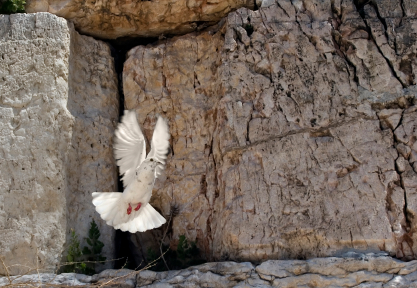
white-pigeon-kotelSomething about being a Jew in Jerusalem and at the Kotel got through to Jeff. More accurately put, God got through to Jeff using the holiness of Jerusalem as a catalyst.

God uses all manner of events and circumstances to motivate human beings, Jews and everyone else. Although I’ve been quoting from Jewish sources throughout this blog post, the advice is just as applicable to the rest of us. If the Jewish people are supposed to be a light to the nations, then this is one way they are accomplishing their mission.

Jesus (Yeshua) said that he was the light of the world (John 8:12), which I take to mean that he is the living embodiment of Israel’s mission to the nations, the best personal example of Israel shining a light on the path allowing the people of the nations to find God. But he also said to his disciples that they were the light of the world (Matthew 5:14-16) indicating that they were to assume his mission and continue to shine the light for the rest of us to follow. Eventually, we Gentiles become that light as well, but only once we have achieved a level of spiritual achievement and discipline to live a life worthy of that light.

It all comes down to the choices we make. It also means that even if we make bad choices, they don’t have to determine the course of the rest of our lives. We have free will. We can make different choices. We can choose differently now, today, this morning.

I always like the “I’ll be back” line because it is a great philosophy for life. Life isn’t all successes, it is also defeats. But you can always be back. No matter what, just like the Terminator. You’re not a loser when you fall. You’re only a loser if you don’t get up. Winners get up and come back.

Arnold Schwarzenegger

Get this straight: The secret behind success is knowing how to fail. Failures are people who fail once. Successes are people who fail thousands of times—and pick themselves back up each time. Like little kids learning to walk. Like Babe Ruth, who held the world record for home runs—and also held the record for strike-outs.

Rabbi Tzvi Freeman

For more on this topic, please read On Choosing God.

The Shabbat That Was

O Lord of Legions, God of Israel, you created the world by your word, and you separated the Sabbath as a memorial; for on it you ceased from your work in order to meditate on the words of your Torah. For the Sabbath is a rest from creation, a completion of the world, a seeking of words of Torah, an expression of praise to God, to thank him for what he has given to mankind. Blessed are you O Lord, who sanctifies the Sabbath.

Kiddush for Shabbat, p.17
from The Sabbath Table Prayer Book

If you’re familiar with the kiddush blessings, then you probably noticed this is a deviation from what is normally said. This particular blessing is the alternate wording recommended for Messianic Gentiles in the First Fruits of Zion (FFOZ) Shabbat siddur and was part of my Erev Shabbat devotions last Friday evening.

But as the hours of my preparations finally reached fruition and I lit the Shabbos candles and offered the traditional blessings and praises to Hashem and welcomed the Shabbat Queen into my home, I was also undergoing an educational and hopefully a transformational experience.

But why would a Gentile believer observe the Shabbat and in fact, why should a Gentile believer observe Shabbos? After all, it’s the sign of the covenant God made with Israel at Sinai. What does that have to do with us, the rest of humanity, when the covenant specifically set Israel apart as Holy from all the other nations of the world?

And the Lord said to Moses: Speak to the Israelite people and say: Nevertheless, you must keep My sabbaths, for this is a sign between Me and you throughout the ages, that you may know that I the Lord have consecrated you. You shall keep the sabbath, for it is holy for you. He who profanes it shall be put to death: whoever does work on it, that person shall be cut off from among his kin. Six days may work be done, but on the seventh day there shall be a sabbath of complete rest, holy to the Lord; whoever does work on the sabbath day shall be put to death. The Israelite people shall keep the sabbath, observing the sabbath throughout the ages as a covenant for all time: it shall be a sign for all time between Me and the people of Israel. For in six days the Lord made heaven and earth, and on the seventh day He ceased from work and was refreshed.

Exodus 31:12-17 (JPS Tanakh)

As the sign of the Sinai covenant, it would seem that only Israel, that is the Jewish people, should partake in observing the Shabbat, but there’s also acknowledgement of God as Creator in a seventh day rest. Even Hashem, Master of Creation, rested on the Sabbath day, according to midrash to contemplate His Torah. Since all of Creation, every living thing, was produced by the Word of God, and since all mankind was and is created in the Image of God, then there is sufficient precedence, in my opinion, to at least allow if not obligate “all flesh” to cease in our labors and on the seventh day, to bring honor, majesty, and glory to our Creator.

But there’s more. According to Kabbalistic tradition (see Zohar, Vayera 119a), each of the seven days of the week maps to the seven days of creation and they map to the seven millennia of creation. The Shabbat day then, corresponds to the seventh millennium which is thought of as the universal age of rest, the Messianic Era.

This was also mentioned in two of D. Thomas Lancaster’s sermons in his Holy Epistle to the Hebrews series: Enter My Rest and A Sabbath Rest Remains.

As part of my review of the latter sermon, I said:

The Sages liken the Shabbat to the Kingdom of Heaven and the World to Come. It’s as if the days of the week and Shabbat represent the different ages of creation with the seventh day, the end of time, being a grand, millennial Shabbat, an age of great rest, and our weekly Sabbaths are merely a periodic reminder, down payment, or foretaste of that ultimate rest in Moshiach.

This seems to resolve Lancaster’s mystery or cliffhanger, but in fact, he states that it was a trick question. Since the Messianic Age is future oriented, then Hebrews 3 and 4 are not only a rendition of history but prophetic. It may surprise you to realize that all of the prophesies in the Bible have to do with Israel and Jerusalem and for all prophesies to be fulfilled, there must be an Israel and Jerusalem. No Israel, no fulfillment of prophesy.

So a literal Sabbath, a literal Land of Israel, and the Messianic Age to Come all figure into God’s rest and the object of Lancaster’s sermon for the past couple of weeks.

Tree of LifeSo not only in Jewish mystical tradition but from the Epistle to the Hebrews in the Apostolic Scriptures, we see that there is direct linkage between the seventh day Shabbat and the prophesy of the Messianic Kingdom to come, a Kingdom upon which we all put our hope.

So we Gentiles in Messiah have two reasons for looking to Shabbat as also something we can participate in: to acknowledge God as Creator and as a foretaste of the Messianic Era to come, when our King Messiah, Yeshua our Master, will usher in an age of unparalleled peace, justice, and mercy, the age of the resurrection, and a bringing to completion of the New Covenant promises when we will all know God!

But the era of Messiah is yet to come although he has already opened the door a crack, so to speak.

It was a lonely Erev Shabbat. I skipped over the blessings for the children and the Woman of Valor for obvious reasons. It seemed like an interminable wait until 5:01 p.m. (candle lighting for my little corner of the world) on Friday, but once it arrived, everything went much too quickly. Even after the blessings and the meal, I think there was still some last moments of light in the sky. If this had been a meal in community or among family, there’d have been a lot more activity and sharing, but in the end, there was only me and God. But it was sufficient.

On Saturday, I did what I always do, well, sort of. I studied from A Daily Dose of Torah for Shabbos, read the Torah portion, Haftarah, and the associated readings from the Psalms and the Gospels. Then I studied the commentary for the Torah portion from Rabbi Zelig Pliskin’s book Growth Through Torah.

And I learned why Gentiles benefit from observing a Shabbat rest and from Torah study.

The quality of one’s life is not dependent on external situations. There are people whose lives seem to run quite smoothly. Nevertheless, they tend to evaluate minor frustrations as tragedies and therefore view their lives in negative terms. The Torah ideal is to be aware that the purpose of your life is to perfect your character and every life situation is an opportunity for growth.

This lesson is most important for us to internalize. See the growth possible in every life event. In each difficult situation ask yourself, “How can I become a better person because of what happened?”

-R. Pliskin
Commentary for Chayai Sarah
“See the good in every life situation,” p.52-3

I periodically encounter people (mostly online these days) who believe that only they obey God’s Torah perfectly as they completely reject the so-called “traditions of men,” or the Rabbinic commentary on and interpretation of the mitzvot. Unfortunately, this reduces the commandments of God to a lengthy but simple list of “do this” and “don’t do that” with no colors, nuances, or wonder. It’s like a child doing what his or her father commands, let’s say not running into the street, not because the child comprehends the intrinsic danger involved and perceives the value of life, but simply because they were told to.

The study of Torah is an exploration into the self, a journey of discovery and wonder as we investigate what it is, as an individual human being, to be a creation of God and indeed, to be made in His unique and marvelous Image. The Torah tells a story that involves each one of us, but not in identical ways. What I discover about myself in the light of Torah will be different from what another person discovers. What a Gentile finds revealed in his or her soul by Torah study and the Shabbat rest will be different from what a Jew unveils about his or her character.

Like it or not, God created each of us as individual and unique persons. No two of us are alike but that hardly means that, as individuals, we are excluded from community. Even though we are individuals and are distinct from one another, we also have commonality and based on that, we form groups and collective associations; assemblies, if you will.

For a non-Jewish disciple of the Jewish Messiah to observe the Shabbat in some fashion, and to study the Torah of Moses, the Writings, the Prophets, and the Apostolic Scriptures, unites us with our Jewish counterparts in the ekklesia of our Master, Messiah Yeshua. It doesn’t make us “cookie-cutter clones” of one another, but lacking absolute uniformity doesn’t automatically lead to division and isolation, anymore than my being a man and my wife being a woman means we have nothing in common and cannot be a family together.

In my own case, the fact that I’m a non-Jewish man married to a Jewish woman and the father of three Jewish children adds a dimension in Torah study and the Shabbat that only increases my understanding of both the commonality and distinctiveness between Gentile and Jew. The irony here is, in terms of the Shabbat, I could only make that discovery while spending a week apart from my Jewish family.

PrayingBut though I lacked, I also gained in abundance.

I said the Shacharit for Shabbat for the first time in a long time, and even donned my old kippah for the occasion, davening from my aging Artscroll Sefard Siddur (making some minor wording adjustments as necessary). I was reminded of the beauty of the prayers, particularly on Shabbat, including the blessings recited just before the Shema:

Our Father, merciful Father, Who acts mercifully, have mercy upon us, instill understanding in our hearts to understand and elucidate, to listen, learn, teach, safeguard, perform, and fulfill all the words of your Torah’s teaching with love. Enlighten our eyes in Your Torah, attach our hearts to Your commandments, and unify our hearts to love and revere Your Name, so that we may not feel inner shame nor be humiliated, nor stumble for all eternity. Because we have trusted in Your great, mighty and awesome Holy Name, may we exult and rejoice in Your salvation.

I believe those words can apply equally well when said by a Gentile as by a Jew with the understanding that what we are to understand, what we are to hear, to learn, to teach, to safeguard, to perform, to fulfill, is what has been set before each of us as our portion.

When a Gentile observes the Shabbat, when a Gentile studies Torah, it’s not a matter of rote imitation of Jewish tradition and ritual or worse, it’s not with the idea that Gentiles can “do it better” than Jews because only we know how to obey scripture without the “interference” of the Jewish sages and their “man-made laws,” arrogantly setting ourselves up as having superior knowledge of Torah and the commandments.

The Shabbat and the Torah provides a fourfold blessing for everyone but particularly for the Gentile believer. In these practices, we join with God in praising Him as our Creator. We also experience a foretaste of the future Age of Messiah in which we will have blessings and peace in abundance, as if every day was a Shabbat. Even studying alone or observing Shabbat individually, in praising God and saying the blessings, we are joined in Spirit with all those Jews and Gentiles who also adore Hashem and cleave to the hope of Messiah. Finally, the Shabbat and Torah reveals who we are as individuals, our unique identity that God assigned each and every one of us, and our individual and special role as servants of Messiah, may he come soon and in our day.