Tag Archives: prayer

I Will Awake the Dawn!

My heart is steadfast, O God! I will sing and make melody with all my being! Awake, O harp and lyre! I will awake the dawn!

I will give thanks to you, O Lord, among the peoples; I will sing praises to you among the nations. For your steadfast love is great above the heavens; your faithfulness reaches to the clouds. Be exalted, O God, above the heavens! Let your glory be over all the earth! That your beloved ones may be delivered, give salvation by your right hand and answer me!

Psalm 108:1-6 (ESV)

Wake up by your own body clock, before the alarm. King David said, “I will wake the morning”—not that the morning woke him. You see, if you are only awake because it is morning, you are not really awake—you are sleepwalking. If it is morning because you are awake, however, then you are truly awake and in control.

-Rabbi Tzvi Freeman
“How to Get Out of Bed…and really mean it”
from the Multimedia Guide to Jewish Prayer series
Chabad.org

I hadn’t noticed that David said, “I will awake the dawn” before. I think most of us, when we first get up, are “sleepwalking” for some period of time, as Rabbi Freeman describes. We are waiting for morning, or our first cup of coffee, to wake us up. In his article on getting out of bed from which I’m quoting, Rabbi Freeman provides rather detailed instructions on what to do, from the first moment you realize you’re awake, through the process of entering into morning prayer. These steps are traditional for a religious Jew and so may not be particularly adaptable for the Christian.

On the other hand, there may be a thing or two we can take into our own morning routine as we prepare to greet our Creator.

As I previously mentioned, the first thing a Jew does after waking up is to recite the Modeh Ani blessing, thanking God for returning his soul to him and restoring his life. Immediately afterwards comes the Netilat Yadayim or the traditional handwashing, followed by other specific routines to prepare for prayer.

You can read Rabbi Freeman’s article in full at the links I’ve already provided, so I won’t go into a step-by-step description of the awakening process of a Jew preparing for prayer. Frankly, I don’t believe most of it specifically applies to the Christian and that these are rituals uniquely Jewish in nature.

However, there are a few things we might want to pay attention to, especially activities that a Jew should avoid prior to tefillah (prayer):

  • Don’t eat a meal.
    Eat what you need to focus your mind in tefillah. Maybe that’s just a hot drink. Maybe a light snack. But stop there. First connect your soul, then feed the body.
  • Don’t check the news.
    Sure it’s important to know what’s going on in the world. Starting from the event of the greatest, earth-shaking import. And that is that you are about to talk to the Creator of the Universe. Keep your head clear. You’ll need it.
  • Don’t visit a friend.
    This is a classic, mentioned in Talmud. You’re about to greet your Maker, so it’s not good protocol to visit someone else first. If you do see someone you haven’t seen for a while, the custom is to not say, “Shalom Aleichem” or even “Shalom”. Shalom (peace) is a name of G-d, so we don’t use it for anyone else until we’ve spoken with Him personally. “Good morning, how are you?” is fine.
  • Don’t check your email or otherwise take care of business.
    Getting tough? Consider each day to be like a mini-week, and the late night and early morning comprise the mini-Shabbat.
  • Don’t get into distracting conversations.
    You don’t have to be rude. But once those conversations start, there’s no end. When you try to put your head into meditation before tefillah, everything you heard and said that morning keeps rattling around in your head. Why add noise, when it’s already so hard to quiet down the mind?

Do you pray in the morning before launching into your day? I must admit that I don’t do so very often. I have a morning routine, but while it contains time to read from the Psalms and the Gospels, it doesn’t accommodate itself to a specific and formal prayer time. I’m not saying that I’m right in this, only that I don’t feel really good about formal prayer while I’m still in my PJs or unshowered, and by the time I take a shower, it’s time to zoom out the door to work.

Would my day go better if I read from the Bible and regularly prayed in a formal manner to God? I can only assume it would. So why don’t I?

Habit, I suppose. Here’s what a typical (actually ideal) morning looks like for me during the week.

  • Wake up and recite Modeh Ani.
  • Use the bathroom.
  • Make coffee and drink a glass of water while I’m waiting.
  • Read various comic strips on the computer which helps my brain wake up.
  • Finish one cup of coffee and one glass of water and then (if I’m very good) head off to they gym.
  • Return home after the gym, drink more water, and publish the day’s “morning mediation” blog.
  • Eat breakfast.
  • Shower, brush my teeth, and shave.
  • Read from the Bible, usually a page of Psalms and a chapter from the Gospels.
  • Pack my lunch for the day and head out the door.

Believe it or not, including the workout at the gym, that covers from 4 a.m. to 7 a.m. and I make it to work by around 7:30 a.m. depending on traffic.

Pouring waterDoesn’t sound much like how Rabbi Freeman describes a morning for a traditional religious Jew.

I hate to make this sound dry, but in many ways, holiness is a habit. Like many people, I tend to do the same things each morning when I get up as a matter of routine, not because it’s better or worse than any other way of waking up. I suppose there are some very diligent Christians and Jews who have extremely disciplined morning routines that are infused with the presence of God. There may also be a large number of Christians and Jews who have a routine that is more or less like mine.

A Christian tends to think of prayer life, like most other aspects of the Christian lifestyle, as “free,” that is, you can pray pretty much any time you’d like. This is true and it’s true in Judaism as well. However, there is also a formal aspect to Jewish prayer that dictates specific times when one is to pray (ideally with a minyan) in a ritual manner. The morning prayer service is called Shacharit and is one of the three times a day a Jew is commanded to enter into prayer.

I mentioned in my last morning meditation that God desires we voluntarily enter into a relationship with Him, and this is true. However, I also mentioned that for the Jew, there is a certain set of connections, rituals, and traditions that are part and parcel of being a Jew. There is a “belonging” and a “commandedness” to being a Jew that few Christians truly understand. I don’t know if this is a good thing or a bad thing, only that it is a Jewish thing.

A few months ago, I wrote that the Roman Centurion Cornelius (see Acts 10) seemed to have adopted the Jewish tradition of fixed prayers, probably because having come to faith in the God of Israel, it was the only available model for his prayers. This suggests that fixed times of prayer are not forbidden to the Christian, even though they are not formally commanded of us by God.

I can find all kinds of reasons why I should pray in the morning, but it is entirely up to me to choose to initiate such prayer or to disregard it. To incorporate morning prayer as a daily routine, I will need to change my habits which, as I’m sure you’re aware (assuming you have habits, too) is easier said than done.

But having admitted a need to improve certain areas of my life, which includes a more intimate relationship with God, what else can I do but either take God seriously or discard His presence?

When I imagine other Christians or anyone who shares a faith in the God of Abraham, Isaac, and Jacob, I imagine them in the morning, entering into deep and meditative periods of prayer with God. But that’s my imagination and it can be used to fuel a sense of guilt, because I don’t have such a time in my morning, admittedly by choice. On the other hand, I’ve heard numerous Christians say they “share” their first cup of coffee with Jesus, praying to him in the morning (but even Jesus said we are only to pray to God the Father) as if they were talking to a neighbor or acquaintance sitting around the kitchen table.

I apologize if this sounds offensive, but I’ve always been put off by that image. One does not approach the throne of the King with a cup of coffee in one hand and a folding chair in another, sit down next to His Throne, and then address the King of the Universe in the same way as you’d chit chat with a casual acquaintance.

I think that’s one of the reasons I hesitate to pray in the morning. When am I really prepared to enter into the presence of the King? When am I clean enough? How should my hair be combed? Should I be hungry or full? Should I be sleepy or well “caffeinated?”

Is it just my own “hang up” that I think morning prayer or any formal, regular prayer should contain a sense of formality, respect, and awe of God? Is this something that only the Jews have retained and that the church has tossed in the gutter, in favor of a casual dip into the shallow pools of grace and freedom?

But I’ll never be “good enough” to actually enter into the august and majestic Throne room of the Almighty and All-encompassing King of Everything. How do you even do that? Is that why Christians “dumb down” prayer for the most part? Should I emulate the Jewish “style” even though I’m not a Jew, for lack of any better model?

I’m tossing this question out to you readers. What do you think?

You might think that the more lowly the created being, the lower the divine spark it contains.

Just the opposite: Only the highest of sparks could descend to the lowest of places and retain their power to sustain such an existence.

That is why the deepest truths are so often found in the darkest of places.

-Rabbi Tzvi Freeman
“The Taller They Are…”
Based on letters and talks of the Rebbe
Rabbi M. M. Schneerson
Chabad.org

How can I wake up the dawn?

Dream Not of Today

Yes, I know you’re exhausted. I also know about irresponsible roommates, colicky babies, infants with croup, calming kids with school anxiety, waiting up for teenagers at night, and sleeping with arthritis—and that’s only one thin slice of the gamut of life’s sleep disorders. What I’m trying to do here is present at least an ideal towards which, on those occasions that permit some degree of control, you can at least strive.

Study some Torah. Even if it’s late, just immerse yourself in some words of Torah, so that you will sleep with those thoughts. Maimonides writes that a person gains most of their wisdom from Torah studied at night. Fill your mind with it, so that it will process in your dreams. Often, solutions to Torah that you study at this time will come to you in your dreams.

A neat trick is to finish by marking the place from where you’ll start learning the next day. That primes your mind for productive learning in the morning.

Relax, maybe have a hot shower, or go for a walk so you will sleep well and wake up refreshed.

Review the day in your mind. Think of something that went well. Think of something that could be fixed or improved. Think of all the wonderful blessings you have in your life—friends, parents, children—all the things that have real value. Don’t beat yourself—this is not an exercise in self-blaming and guilt. The point is to get a clear perspective of yourself and your day, where you are coming from and where you are going to.

-Rabbi Tzvi Freeman
“Nighttime Activities”
from the series A Multimedia Guide to Jewish Prayer
Chabad.org

This is a direct continuation of yesterday’s “morning meditation” An Introduction to a Prayer. I mentioned that Rabbi Freeman believes the best way to start the day is to prepare yourself the night before. As such, the last thing a religious Jews does before he or she retires to bed is to recite the Bedtime Shema. Rabbi Freeman deconstructs and presents all of the elements of this blessing in his article on Bedtime Countdown, so not only do you have the text of this set of prayers but their purpose and meaning from a Chasidic perspective.

I’ve been told that many of the mitzvot in Judaism aren’t forbidden to the Gentile as long as the Gentile does not perform them in the manner of the Jew. This not only has to do with the specific “mechanics” of performing a mitzvah such as prayer, but also not considering oneself as obligated to performing the mitzvah as is the Jewish person. However, given the number of times Jesus and his disciples refer to prayer in their teachings, I hardly think it is forbidden, in general, for a Christian to pray. What is in question is how or if a Christian should perform anything that resembles the Bedtime Shema.

To answer the question for myself, I perform a truncated version of this blessing at bedtime:

A song of ascents. Praiseworthy is each person who fears HASHEM, who walks in His paths. When you eat the labor of your hands, you are praiseworthy, and it is well with you. Your wife shall be like a fruitful vine in the inner chambers of your home; your children shall be like olive shoots surrounding your table. Behold! For so is blessed the man who fears HASHEM. May HASHEM bless you from Zion, and may you gaze upon the goodness of Jerusalem, all the days of your life. And may you see children born to children, peace upon Israel.

Tremble and sin not. Reflect in your hearts while on your beds, and be utterly silent. Selah.

Master of the universe. Who reigned
before any form was created,
At the time when His will brought all into being —
then as “King” was His Name proclaimed.
After all has ceased to be,
He, the Awesome One, will reign alone.
It is He Who was, He Who is,
and He Who shall remain, in splendor.
He is One — there is no second
to compare to Him, to declare as His equal.
Without beginning, without conclusion —
His is the power and dominion.
He is my God, my living Redeemer,
Rock of my pain in time of distress.
He is my banner, a refuge for me,
the portion in my cup on the day I call.
Into His hand I shall entrust my spirit
when I go to sleep — and I shall awaken!
With my spirit shall my body remain.
HASHEM is with me, I shall not fear.

I do not believe it is forbidden for the Gentile to desire God to be with us during our nightly rest and to watch over us and, if your last thoughts before entering “the realms of Morpheus” are of God, perhaps your first thoughts upon awaking will be of Him as well (and I’ll cover those “first thoughts” in a subsequent “meditation”).

Like my comments in yesterday’s meditation, I wonder just how practical some of Rabbi Freeman’s suggestions are for late night activities. I know the sages would study Torah late into the evening and even all night, but much after 9 p.m., my head feels like it’s stuffed with cotton candy and rusty Brillo pads. Nothing really complicated “computes” very much, and if I try to read, I find myself in that situation where I read a few sentences and immediately forget what I’ve read, or I try to read the same few sentences over and over again. If I’m not feeling sleepy before reading, “cozying up” in my bed becomes my primary desire after about five minutes of pouring over the printed page, regardless of what I’m reading.

Sorry, I’m not a “night owl.”

I suppose that’s one of the reasons I say a short version of the Bedtime Shema, besides avoiding any appearances of trying to pray like a Jewish person. A few minutes of prayer is all I have brain power for before my mind starts wandering down random paths.

I can’t deny that Rabbi Freeman’s principles are sound, and I suppose if I had a lifetime of habit and training in this sort of prayer life behind me as a foundation, it would be second nature by now, but as the Master said, “Watch and pray that you may not enter into temptation. The spirit indeed is willing, but the flesh is weak.” (Matthew 26:41) As I recall, he was chiding his closest disciples and friends over falling sleep during prayer as well.

I must admit to being kind of glad the Rabbinic rulings don’t apply to non-Jews if, for no other reason, than the following:

The Talmud (Berachot 13b.) is adamant about not sleeping on your back or on your stomach, but only on your side. Maimonides, who was not only a great codifier and philosopher but also one of the great doctors in history, suggests that you get in the habit of sleeping the first part of the night on your left, and end off on your right.

I tend to fall asleep on my right side but also on my stomach. Once asleep, people move around in bed hundreds of times during the night, so how could I possibly have control of my position? This is certainly an area of Jewish thought that completely eludes me. I also wonder about this:

Best insurance for sweet dreams: read tales of tzaddikim in bed until you fall asleep.

Either the Jewish sages weren’t married or they didn’t sleep with their wives. Can you imagine reading late into the night when your wife is trying to sleep right beside you?

“Moshe! Turn out the light. Can’t you see I’m trying to sleep here?”

On the other hand, how many times have you gone to bed in defeat or disgust because some problem or argument could not be resolved and laid to rest before the end of the day? I have far too many nights just like that. What Rabbi Freeman suggests would be far better, it only it were possible.

Be confident that you’ve put this day behind you, cleared up any misdemeanors between you and G-d, and made peace in your heart with other people. Get ready to turn in a wonderful report of all of G-d’s kindnesses and wonders.

I know Rabbi Freeman’s teachings are generally optimistic and encouraging (otherwise, why would we read them), which includes this brief commentary, taken from the lessons of the Rebbe, Rabbi M. M. Schneerson, called Maturity of the Soul:

The ultimate elevation of the soul is to find it has purpose. To discover that it is not here simply to be, but to accomplish, to heal, to make better. In that moment of discovery, the soul graduates from being G-d’s little child to become His representative.

However, I’m not going to let Rabbi Freeman have the last word this time. Someone commented in response to his wee missive with something just as (or more) profound:

Perhaps our purpose is to “to be” G-d’s little child. It may be that we need to go through a life where we feel we need to accomplish, to heal and to make better, only to find ourselves coming full circle into simply “being” G-d’s child. Perhaps the journey of “finding” our purpose is needed to make this discovery …

“click your heels 3 times … you’ve always had the power … you just didn’t believe it”.

Walking in faith, sometimes you can stand up and actually take a step or two and sometimes you fall flat on your butt. Compared to actually walking with God in faith and trust, being a toddler learning how to take his first steps is child’s play.

Meditation, forgiveness, regret, and supernal compassion. Do night blessings always result in a blessed life? What will happen when I wake up tomorrow?

An Introduction to a Prayer

Skill testing question:

Which of these two will be better able to focus on tefillah, and thereby have a great day:

Activity

Goldstein

Goldberg

Retiring to bed Falls asleep watching a rerun of Brain Dead while washing down pizza with cola on the couch. Mentally reviews the day, says the Shema Yisrael, falls asleep in bed reading Baal Shem Tov stories.
Waking up Rudely awakened by e-mail alert. Checks more e-mail and stock report before falling back asleep. Repeats until resigning himself to getting off the couch. Wakes up by circadian rhythm. Says Modeh Ani as approaching consciousness. Smiles when recalling Baal Shem Tov dreams.
Washing up Jumps off the couch in frenzied panic. Grabs mug, car keys and cellphone charger. Runs frantically to the car. Gently slides out of bed to greet the sunrise. Washes, takes care of bodily necessities and gets dressed. Washes hands and says morning blessings.
Breakfast Stumbles into Starbucks on the way to shul to grab a hyper-caffeinated brew. Gets into a yelling match with the attendant over the bill / change / brew / temperature / politics / whatever. Sips a hot drink while engaged in a half-hour Tanya class with the rabbi.
Meditation Listens to news and traffic report on car radio while sipping coffee, texting clients and hurling imprecations at fellow drivers. Sits quietly, pondering the morning lesson. Visualizes the continuous act of creation unfolding about us.
Prayers Takes care of some business decisions by cellphone while the minyan “warms up.” Jumps in late but catches up in no time. Sticks around to chat, then runs out in yet another mad rush. Phone is on buzz. Starts with the minyan, saying each word out loud. Ignores the buzzes.

-Rabbi Tzvi Freeman
from the article “Prepare for Takeoff”
as part of the A Multimedia Guide to Jewish Prayer
Chabad.org

I have to admit that my first thought upon reading this comparison was, “Does Goldberg have a job?” My next question was, “Is Goldberg married?” Frankly, the way he starts his day seems absolutely wonderful and it goes along with the “mission statement” for my own blog:

When you awake in the morning, learn something to inspire you and mediate upon it, then plunge forward full of light with which to illuminate the darkness.

But as pleasant and ideal as those thoughts happen to be, they aren’t always compatible with my lifestyle.

No, I’m not all that much like Goldstein. I don’t fall asleep watching TV, but by the time I’m ready for bed, my mind feels numb and it’s difficult to make it through even a truncated version of the Bedtime Shema. I hate alarm clocks, but I don’t have the luxury of waking up by circadian rhythm either, since I have a schedule to keep, usually even on the weekends. I do recite the Modeh Ani when I’m ready to get out of bed, but it’s short and easy to memorize (at least in English). I don’t think I’ve ever dreamed about the Baal Shem Tov.

I do get out of bed and take care of “bodily necessities” but usually grab my first cup of coffee and read the funnies online as my initial entry into the day. Then, I’ll either eat breakfast in front of the computer or head for the gym to sweat for 45 minutes or so.

I hardly have the time for a half-hour Tanya class, even if I had access to such a resource, nor do I have the time to “sit quietly, pondering the morning lesson” and visualizing “the continuous act of creation unfolding about us.” It goes without saying that I don’t pray with a minyan.

I’m only sort of like Goldstein though, in that I’m not usually in such a hurry to get out of the house. I have my routine pretty well down, so I’m able to leave most mornings right on time at 7 a.m. I don’t stop for overpriced Starbucks swill, but I do listen to the radio, primarily for oldies rock and the traffic report. I’m not always happy with the other drivers I encounter on the morning commute.

And it looks like even Goldstein is able to pray with a minyan, although in his typical “rushed” fashion.

I know what Rabbi Freeman is saying and a lot of it is aimmed at Jews who live a religious Jewish lifestyle. There’s no reason why some of this couldn’t be adapted to a Christian morning routine, except I’d have to wake up at 3 a.m. instead of “by circadian rhythm” in order to have to time to meditate and pray in the measured and orderly fashion the Rabbi describes, and still have time for the gym and breakfast.

He’s right, though. If it were possible, the “Goldberg” style of going to bed and waking up is better for the body, the mind, and the spirit. If a person could establish and maintain such an evening and morning rhythm, they would be more likely to experience a sense of peace with themselves and with God.

But then, it would be much easier to accomplish if you lived alone and didn’t share the world with other people and other priorites. If you lived in a world that was ordered in complete consistency with such a spiritual lifestyle, it might work out. But for most of us, and particularly me, my world is not at all consistent with such a lifestyle, more’s the pity.

In the Mishna Berua Yomi Digest “Stories to Share” section for Shulchan Aruch Siman 447 Seif 8, the commentary “A Difficult Situation” describes such a person who is “out of sync” religiously with her husband, and much more than her peace of mind is at stake.

A woman who was a recent baalas teshuvah was approaching her first Pesach. Her husband absolutely refused to consider avoiding chometz, and she was at a loss as to how to proceed. Should she insist that she cannot live without him agreeing to no chometz in their home on Pesach, he was likely to divorce her, leaving her alone. She could try to convince him to let her leave for the holiday but was afraid he would refuse. She wondered if there was a halachic way to permit her to stay at home even if her husband had chometz there.

When she asked this question to her rabbi, he was baffled. “I have to admit that this is out of my league. I will take it to someone qualified to respond and see what he says…”

When this question reached Rav Yosef Shalom Eliyashiv, shlit”a, he ruled that there was a halachic way for the woman to live at home even though her husband kept chometz—which he ate—in their house. “The best thing is if she can stay away from home on Pesach. But if this is impossible she can make a neder not to eat chometz. There is a precedent that even when we don’t believe that someone will avoid a prohibition for whatever reason, we are certain he or she will not forget if it is also prohibited for another reason like a vow. If she makes a neder, she can stay in their home if there is no choice.”

A woman who has committed to a greater religious lifestyle than her husband faced the horrible choice of keeping her commitment to Judaism and to God and losing her husband or preserving her marriage and forsaking God. In an interesting way, her story is not unlike that of another woman who is trying to make a similar commitment.

I am Jewish. It is how I identify myself. My father is Jewish. My mother is Christian.

My Judaism is a beautiful challenge; one I happily accept.

But the faith of my forefathers, of my peers, and of my family often frustrates me on a level that I cannot capture in words. Judaism cuts to the essence of who I am and challenges my identity. Judaism brings me a lot of joy; it also brings me pain…

In a letter to Ovadiah, Maimonides writes, “There is no difference whatever between you [the convert] and us… do not consider your origin as inferior.”

Maimonides’ words are a small part of a larger Jewish tradition that teaches to love the convert as oneself. Yet, the convert is also often reminded of his or her non-Jewish heritage. For example, he/she cannot make the declaration during the Bikkurim ceremony that “G-d swore to our forefathers, and to us” [Mishnah Bikkurim1:4].

I recently stopped dating someone, not because we were incompatible as people, but because he is a Kohen and I am a convert. If my origin is not supposed to be considered inferior, and if I am supposed to be loved as oneself, how am I supposed to feel when I am told that I cannot marry a Kohen because as a convert I am considered promiscuous? I grew up in a world surrounded by Jewish people. I am no more likely to have slept with a non-Jewish man than many of my fully Jewish counterparts.

-by “Ruth”
“A convert in a strange land”
Sunday, March 18, 2012/Adar 24, 5772
The Times of Israel

All I’m trying to do is “uncomplicate” my life and to find a sense of peace within myself and within my relationship with God. What complicates my plan is not only the struggles inside of myself but the world around me, starting with my immediate household and the practicalities of relationships, schedules, and priorities. I am religiously incompatible with my wife and daughter, but it’s not nearly as extreme as we see in the examples I quoted above. Both of those Jewish women find themselves at odds with either their spouse or with Judaism as a faith and as a people. They are both alike in their desire to “be more Jewish” and to have a closer relationship with the God of Israel.

In that very last part, I’m like them, too. But like them, I’m also facing the realities of the world and the people around me. The world will not become perfect this side of the Messiah, nor can I wait for that event to occur before attempting to climb the first rung of the ladder and lift myself from the bottom of the abyss.

According to Rabbi Freeman, the secret to being awake to God is how you fall asleep and even how you dream. I’m still sitting at the bottom of my dusty but not uncomfortable well. I’m still contemplating the first rung to the ladder God has set before me. But maybe this too is just a dream, and I am perpetually waiting to wake up.

It will be Monday morning when you read this and the rush of the beginning of the work week will have already begun. How did I sleep last night? What did I dream? When I woke up, where was my spirit, and where is God?

Walking in the Shadow of God

Our sages tell us that one who mourns the destruction of the Beis HaMikdash will see its comfort. The Maharal, zt”l, was asked why this should be so. “What difference does it make if one mourns the destruction or not? If one is present in the ultimate future isn’t it obvious that he will experience the nechamah?”

The Maharal explained the need to mourn to attain the nechamah. “Before something comes to a new level, it first must decompose. In the creation of the world, God first made tohu va’vohu; only then could the world come into being. When a seed is planted in the ground, it decomposes. Only then can a tree sprout. The same is true with the gestation of a man or an animal. The seed must decompose before the embryo begins to grow. The same is true regarding an egg, as we find in Temurah 31. First the egg must decompose; then it can become a chick. The reason for this phenomenon is that there must be a lack for more perfection to fill. If there is nothing missing, it is impossible to come to a new level. Similarly, one who does not mourn the destruction of the Beis HaMikdash feels complete. He has no space for the nechamah, since he never experienced the lack in the first place!”

The Shem MiShmuel, zt”l, learns a practical lesson from this same statement. “One who wishes to start again and that his earlier sins should not be considered should make himself like dirt. He must completely nullify all of his senses and desires to God. In this way, he will become a completely new creation. The proof to this is from the case of a ger. Although a ger comes from a distant spiritual place, he is like a newborn baby by making just such a new start. He immerses in a mikveh to symbolize this, and if he is male he does a bris. Why should a Jew who makes a new start be any less?”

Daf Yomi Digest
Stories Off the Daf
“The Destruction before the Renewal”
Termurah 31

Therefore remember that at one time you Gentiles in the flesh, called “the uncircumcision” by what is called the circumcision, which is made in the flesh by hands – remember that you were at that time separated from Christ, alienated from the commonwealth of Israel and strangers to the covenants of promise, having no hope and without God in the world. But now in Christ Jesus you who once were far off have been brought near by the blood of Christ.Ephesians 2:11-13 (ESV)

Maybe the story off the Daf and Paul’s message to the Ephesians aren’t telling the exact same story, but they seem to be related, at least to me. We have two groups, Jews who have been distant from God and who need to “make themselves like dirt” in order to “become a completely new creation”, and Gentiles who were once far off from God but who have been brought near “by the blood of Christ.” The Shem MiShmuel even invokes the imagery of the convert to Judaism, a Gentile who goes down into the mikvah a goy and who rises out of the water “like a newborn baby…making a new start.”

That’s not much different than what I was describing in my previous meditation. As a new creation, we stumble and fall a lot, trying to get used to the new person we are trying to become. Sometimes we fall back and have to relearn skills and sometimes we are trying to advance spiritually and come to a point where we feel like infants again, rather than mature in the faith. Amazingly, having once felt secure in our relationship with God, we might find that we are no longer sure who we are in Him and how we are to serve Him.

I know that description fits me pretty well these days.

Despite the fact that human beings have free will and angels do not, we can still learn a great deal from their behavior. Like the angels, it’s important to acknowledge that there is more than one way to serve God. Whether you are an introvert or extrovert, teacher or rabbi, businessman or stay-at-home mom, there is a place for all of us among the Jewish people. For example, each one of the Twelve Tribes of Israel carried out different tasks. Some engaged in commerce or working the fields, others in religious study, and yet others in military or temple service – and all were essential to the survival of the nation as a whole. Quite frankly, we’re not all supposed to be doing the same kind of work or serving God the exact same way.

The Chofetz Chaim was once approached by a successful businessman who decided to scale down his business so that he could dedicate himself to Torah study. The Chofetz Chaim explained why his decision was wrong by way of a parable. During wartime, if a soldier unilaterally decides to leave his current post to fight in a different capacity, he will be court-martialed. A soldier must obey orders and man the position to which he was assigned. The Chofetz Chaim went on to say that this businessman’s responsibility was to support Jewish institutions and the poor. If he decided to go through with ending his business success, he would be jeopardizing the position God gave him within the Jewish community.

We have to give fellow Jews the space to become the individuals God intended them to be. Otherwise, we will be contributing to unnecessary tension and divisiveness.

-Asher
“Living Like the Angels”
Lev Echad

Blog writer Asher is addressing a primarily Jewish audience and is encouraging them to try not to “turn everyone into replicas” of each other. As much as Judaism is a unique kahal, like Christianity or any other faith or people group, it is made up of individuals, each with a unique purpose in life and over time, that purpose can even change. Asher continues:

Remember, those differences ultimately constitute the entirety of our people. Our strength can be found via our uniqueness as individuals.

Assuming I can apply all that to me, what does it mean for my life as a Christian? Who am I and who does God intend me to be? One thing is for certain…I don’t seem to be like any other Christian I’ve ever met. On the other hand, I have things in common with everyone else in the church.

Yet in some sense, because I claim the name “Christian,” I, like all other believers, have a lot to make up for in how we have treated the Jewish people.

For the one whom You smote they persecuted and they tell about the pain of Your mortally wounded. Add iniquity to their iniquity, and let them not have access to Your righteousness. May they be erased from the Book of Life, and let them not be inscribed with the righteous. –Psalm 69:27-29 (Stone Edition Tanakh)

While David isn’t writing about Christians as such, he is writing about those who have persecuted Israel, and the church has done this in abundance. Only through making ourselves (myself) like dirt and in sincere repentance, can we have any hope, through Christ, of being written in the Book of Life with the righteous.

I bet, as a Christian, you never thought that part of professing your faith and repenting of your sins would be repenting of Christian mistreatment of the Jewish people. If you want to learn more about this, I encourage you to read a post written by my friend Gene Shlomovich called A story of one Christian’s after-death regret about Israel and Judaism. A sobering and mystic tale of just how much we need to turn our hearts.

For God shall save Zion and build the cities of Judah, and they shall settle there and possess it. The offspring of His servants shall inherit it, and those who love His Name shall dwell in it. –Psalm 69:36-37 (Stone Edition Tanakh)

Lest you be wise in your own sight, I do not want you to be unaware of this mystery, brothers: a partial hardening has come upon Israel, until the fullness of the Gentiles has come in. And in this way all Israel will be saved, as it is written,
“The Deliverer will come from Zion,
he will banish ungodliness from Jacob”;
“and this will be my covenant with them
when I take away their sins.” –Romans 11:25-27 (ESV)

The prophesies regarding Israel are clear but what if we who, even calling ourselves Christian, have disdained God’s chosen and holy ones? Can it be that without repentance of our sins against Israel, we will ultimately be rejected by her King?

“Not everyone who says to me, ‘Lord, Lord,’ will enter the kingdom of heaven, but the one who does the will of my Father who is in heaven. On that day many will say to me, ‘Lord, Lord, did we not prophesy in your name, and cast out demons in your name, and do many mighty works in your name?’ And then will I declare to them, ‘I never knew you; depart from me, you workers of lawlessness.’ –Matthew 7:21-23 (ESV)

I’m probably stretching the interpretation of this verse out of its context, but it does illustrate that many of those who feel secure in their salvation have already been lost, even as they call themselves “Christian.” If this is their fate, then what of mine?

O God, You know my folly, and my guilty acts are not hidden from You. Let those who wait for You not be shamed through me, O Lord Hashem/Elohim, Master of Legions; let those who seek You not be humiliated through me, O God of Israel. –Psalm 69:6-7 (Stone Edition Tanakh)

Let not my mistakes, my errors, my sins, prevent another from turning to God through Jesus Christ, or to taint the name and reputation of the Messiah. For I know that…

The peoples will acknowledge You, O God; the peoples will acknowledge You – all of them. Regimes will be glad and sing for joy, because You will judge the peoples fairly and guide with fairness the regimes of the earth, Selah. –Psalm 67:4-5 (Stone Edition Tanakh)

But in verse 8 of that Psalm, when David says, “May God bless us, and may all the ends of the earth fear Him,” will only Israel be blessed, or will “the peoples;” the nations of the earth, including we non-Jewish Christians, have a blessing too?

Do not cast me off in time of old age; when my strength fails, forsake me not. –Psalm 71:9 (Stone Edition Tanakh)

Our hope is in Jesus Christ but we must never forget that part of that hope is attached to Israel, and Jesus is her first born son and King. He would never betray his own and would never tolerate those who do. In Romans 11, Paul was very clear about how we “grafted in” branches can be easily detached from the root should be become arrogant and self-serving, and should we consider ourselves superior to the natural branches, who after all, have only been removed temporarily.

I’ve been trying to write about my own condition, but I keep coming back to the church; her flaws, her scars, and her needs. I keep wanting to write “I” but I continue to stray into writing “we”. I wonder if God is trying to tell me something. As much as I feel detached from wider Christianity, I cannot divorce it entirely, for the body of Gentile disciples in the Messiah is part of who I am. Yet, I am also this.

Yochanan answered and said to him, “Rabbi, we saw a man driving out demons in your name, but he does not follow us, so we stopped him, on account of the fact that he did not follow us.”

Yeshua said, “Do not stop him, because no one who does an act of power in my name can quickly speak evil of me. For whoever is not for our foes is for us. For all who let you drink a cup of water in my name, because you belong to the Mashiach, amen, I say to you, he will not lose his reward.” –Mark (Markos) 9:38-41 (DHE Gospels)

I’ve never read this statement of the Master before as one that would allow someone not directly attached to the larger body of Christ as still belonging to him, but maybe I can hope that it represents me. Unfortunately, I think the following is also speaking of me.

Yeshua answered and said, “Amen, I say to you that there is no one who has left behind his home or his brothers or his sisters or his father or his mother or his wife or his children or his fields for my sake and for the sake of the good news who will not receive now at this time, with all the persecutions, a hundred times as many houses and brothers and sisters and mothers and children and fields, and in the age to come, eternal life. However, many of the first will be last, and the last will be first.” –Mark (Markos) 10:29-31 (DHE Gospels)

As much of a reward as there is in following the Messiah as his disciple, it is still a bitter thing to be separated from those whom you love. One day, Jesus cursed a fig tree (Matthew 21:18-19, Mark 11:12-14) as a lesson in lacking faith. We see in both Matthew 21:20-22 and Mark 11:20-21 that the fig tree subsequently withered from its roots. Jesus commented on the withered tree and perhaps on many a withered soul thus:

Yeshua answered and said to them, “Let the faith of God be in you. For amen, I say to you, any one who says to this mountain, ‘Be lifted up and moved into the middle of the sea,’ and does not doubt in his heart, bu trather believes that what he says will be done, so it will be for him as he has said. Therefore I say to you, all that you aks in your prayer, believe that you have received it, and it will be so for you. And when you stand to pray, pardon everyone for what is in your heart against them, so that your Father who is in heaven will also forgive your transgressions. But as for you, if you do not pardon, neither will your Father who is in heaven forgive your transgressions.” –Mark (Markos) 11:22-26 (DHE Gospels)

So, to return to the beginning of this meditation, I have made myself like dirt and humble myself before God and man. I turn away from my sins and ask forgiveness from all I have offended. May God wash me and clean me whiter than snow (Psalm 51:7). Then though I may walk alone among humanity and even be set apart from family and the larger community of Christ because of my faith, I ask that I be allowed to humbly walk in the shadow of God. May I never desecrate what is holy, even if the holy one happens to be me.

Building and Rebuilding the Tabernacle

Ever watch a child learning to walk? While strolling along confidently, albeit a bit wobbly, he’ll suddenly drop to the floor. With admirable persistence, he’ll usually pick himself right back up on his feet and continue on as if nothing had happened.

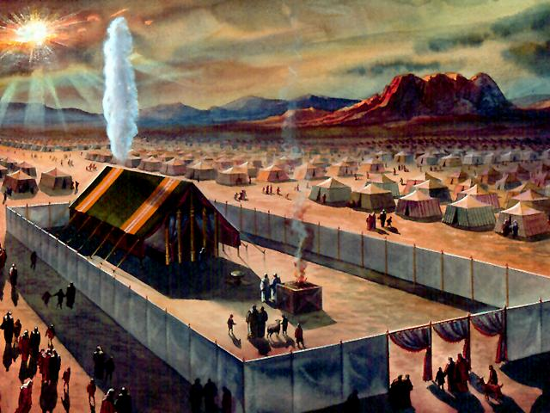
The Midrash (Tanchuma 11) says that throughout the seven inaugural days of the Holy Tabernacle, the portable dwelling place built for G-d’s Holy Presence, Moses would construct and disassemble it two or three times each day. The Tabernacle, of course, was a large and extremely heavy structure. Many of its parts were solid wood and gold, and it was tens of feet high. To build and dismantle the entire structure 14 times, or more, in one week must have been incredibly taxing to Moses! Why didn’t he just assemble it the first day, and then leave it standing until the next time G-d instructed the nation to travel?

There was a deeper meaning, however, to the construction of the Tabernacle, corresponding to the efforts of a person committed to spiritual growth. That person drafts a model of holiness, an ideal setting for rising above material and selfish pursuits, insuring the appropriate goals and safeguards are set. As he takes his first few steps of growth, he feels a sense of pride and serenity, assuring himself that he’s on the proper course. But soon, it all crumbles. The habits of the past return, and his best-laid plans for the future appear unattainable.

The continuous building and dismantling of the Tabernacle throughout the inauguration tells us that holy structures are designed to be built and rebuilt before they are completed. The nature of spiritual growth is to move forward and fall back, repeatedly, akin to the toddler’s efforts to walk. Although a toddler first falls immediately, after just a few steps, his strength, balance, and ability improve exponentially. Don’t be afraid when experiencing setbacks on the road to spiritual growth, because we are promised that the results will come — if we get right back up and keep trying!

-Rabbi Mordechai Dixler
Program Director, Project Genesis – Torah.org
“Pick Yourself Up, Brush Yourself Off”
Commentary on Torah Portion VayakhelPekudei
Based on Nesivos Shalom, Pikudei, 279
ProjectGenesis.org

In keeping with my previous blog posts based on Rabbi Tzvi Freeman’s A Multimedia Guide to Jewish Prayer series, I read the next installment in sequence, Climbing Jacob’s Ladder prior to writing this “morning meditation”. Unfortunately, the “Jacob’s Ladder” piece just didn’t inspire me as I had hoped. However, Rabbi Dixler’s commentary did.

Here I am, still sitting at the bottom of the dark, dusty abyss, looking at the ladder that has been placed before me by God, as an invitation to a dance, so to speak. As Rabbi Freeman commented in his Jacob’s Ladder article, What was that ladder? According to the Zohar, it’s the ladder of prayer. That’s what I thought when I wrote another of my morning mediations as well. But then how do I climb?

That reminds me of an old joke:

A tourist from an Iowa farm decides to visit New York City. He’s having fun seeing the sights, visiting the Statue of Liberty, stopping off at Times Square and such, but he’s bought a ticket for a Broadway play and it starts in an hour. Trouble is, he doesn’t know how to find where the play is going to be performed.

He stops a person who appears to be a local and asks, “How do I get to Broadway.”

The gruff New Yorker replies, “Practice.”

How do you climb the ladder of prayer? The answer is the same. Practice.

I know I’ve said something like this before but it can use repeating, which is also part of practicing.

Look at Rabbi Dixler’s story again. In a way, Moses needed the “practice” in putting up and taking down “holiness.” Chances are, the story isn’t literally true, but it is a metaphor that communicates something important to me. In fact, here’s the part that especially speaks to me.

There was a deeper meaning, however, to the construction of the Tabernacle, corresponding to the efforts of a person committed to spiritual growth. That person drafts a model of holiness, an ideal setting for rising above material and selfish pursuits, insuring the appropriate goals and safeguards are set. As he takes his first few steps of growth, he feels a sense of pride and serenity, assuring himself that he’s on the proper course. But soon, it all crumbles. The habits of the past return, and his best-laid plans for the future appear unattainable.

I have better days and worse days, probably just like everyone else. I have better days and worse days in relation to God, too. Sometimes reading the Bible is very uplifting and other times, the messages I read carry nothing but discouragement. The trick for me, in having fallen down again, is figuring out a way to keep discouragement from having the last word.

The nature of spiritual growth is to move forward and fall back, repeatedly, akin to the toddler’s efforts to walk. Although a toddler first falls immediately, after just a few steps, his strength, balance, and ability improve exponentially. Don’t be afraid when experiencing setbacks on the road to spiritual growth, because we are promised that the results will come — if we get right back up and keep trying!

Why does a toddler, who falls down more times than we can count, continue getting back up? Why does the child, who falls, and falls, and falls, keep trying to walk again? Why doesn’t he get to the point of saying, “I’ll never be able to walk,” and then just keep on crawling as a means of locomotion?

I don’t know.

I suppose there’s something built into every child, a sort of developmental “map,” that drives the boy or girl to keep on trying to walk, keep on building blocks, keep on learning their ABCs, keep on trying to read, to write, to count, to dress themselves, to reach a little higher, then a little higher, then a little higher…

You get the idea. If little kids gave up anytime something was difficult, they’d never develop, become bigger, more sophisticated kids, then teens, and finally adults. They’d always be stuck at being toddlers.

Somewhere along the line, we learn that it’s possible to give up. For most of us, that doesn’t prevent us from hitting all of the usual developmental milestones. Most of us keep on trying and today, we’re able to walk, talk, write, read, count, get dressed, feed ourselves, even drive, get a job, have friends, get married, and raise children of our own. But we also learn we can give up on things and sometimes we do. Some of us learn that we can have a relationship with God and other people give up without even trying, “reasoning” that God doesn’t exist.

I think we have a “developmental need” to seek out God, even as we have developmental needs to learn to walk, feed ourselves, and read. All of those developmental milestones I listed require enormous amounts of practice and the more we practice, the better we get at mastering those skills. The more you read (usually), the better reader you become. The same goes for driving a car, fixing a leaky faucet, or playing a musical instrument (it should be noted though, that some people can practice certain skills forever and still not get very good at them).

But while most of us won’t become world-famous classical guitarists, unless we have a significant disability, we will all learn how to walk, talk, read, count, eat, and get dressed, because (unlike playing a musical instrument or performing heart surgery) they are all basic human skills. But they still all take lots of practice. Is having a relationship with God a basic (rather than an advanced) human skill?

I think so. But it’s one that we are able to abandon even before we ever learn it. Even after learning the basic steps of that relationship, we can still lose skills through lack of practice or lack of confidence. We may at one point have climbed the ladder well and then later, for whatever reason, find we are even afraid of trying. Maybe we fell off the ladder and got hurt. Maybe we failed at some other related skill and we don’t have the nerve to face the ladder again.

So here I sit at the bottom of the well, looking at the first rung of the ladder. Perhaps I fell off the ladder or maybe I never started to climb in the first place. Regardless, here I am, like a toddler who tried to walk and landed on his butt. According to Rabbi Dixler, I need to stand and fall and stand and fall, like Moses building and unbuilding the Mishkan, hour after hour, day after day, until I can stand a little longer, walk a little further, and climb the first rung of the ladder.

Don’t be afraid when experiencing setbacks on the road to spiritual growth, because we are promised that the results will come.

PrayingThe mystical aspects of Jewish prayer are enormously complex and well beyond my limited comprehension and abilities. I’m still trying to climb onto the first rung of the ladder and not become discouraged when I fall back off. But just like a toddler learning how to walk, it’s not something someone else can teach me or even help me with. You can’t walk for someone else, they have to learn it on their own.

But after everything I just said about being able to pray and to forge a relationship with God being a “basic human skill” that anyone can learn, why do I still doubt that I’m ever going to be any good at it? Maybe I’ve just been “plain old me” for too long, sitting here staring at the ladder. It goes up awfully high…and you know what happened to Icarus.

Getting to where you need to be is an important step. But nothing is as important as getting out of where you’re at right now.

-Rabbi Tzvi Freeman
“Hit the Road”
Based on letters and talks of the Rebbe
Rabbi M. M. Schneerson
Chabad.org

He erected the Courtyard all around the Tabernacle and the Altar, and he emplaced the curtain of the gate of the Courtyard. So Moses completed the work.

The cloud covered the Tent of Meeting, and the glory of Hashem filled the Tabernacle. –Exodus 40:33-34 (Stone Edition Chumash)

May it ever be so for you…and for me.

My Thirsty Soul

alone-desertA psalm by David, when he was in the wilderness of Judah. O God: You are my God, I seek You. My soul thirsts for You, my flesh longs for You; in a parched and thirsty land with no water. Thus to have beheld You in the Sanctuary, to see Your might and Your glory. For Your kindness is better than life, my lips shall praise You. Thus shall I bless You all my life; in Your Name I shall lift my hands. It is as if my desire is sated with fat and abundance, when my mouth gives praise with joyous language. When I remember You upon my couch, in night watches I meditate upon You. For You have been a help for me; in the shelter of your wings I joyously sing. My soul cleaves after you; Your right arm has supported me. But they seek my soul for destruction; may they come to the depths of the earth. [The enemies] shall drag each one by the sword, the portion of foxes shall they be. The king shall rejoice in God; glorified will be everyone who swears by Him, when the mouth of the liars will be stopped.

Psalm 63 (Stone Edition Tanakh)

For G-d, the union He is seeking happens in three forms: through Torah, through a mitzvah, and through prayer. It’s much like a love affair.

When we perform a mitzvah, the One Above and the Shechinah (played by us) are united in a kinetic activity within the material world. Think of an embrace uniting two bodies.

When we study Torah, the words of the Shechinah (spoken through our lips) are the words of the One Above. Think of a kiss, uniting two mouths.

And when we pray to Him, the Shechinah and the One Above are in intimate union in the deepest recesses of the spirit, sharing their very souls with one another. Think of mental and soulful communion with another, uniting two spirits.

-Rabbi Tzvi Freeman
“Making Sense of It All”
From the “A Multimedia Guide to Jewish Prayer” series
Chabad.org

You’ll have to read the entire article by Rabbi Freeman to get all of the background associated with this message, but as I tried to explain in my previous entry in this series of “meditations,” a relationship with God through prayer has almost “romantic” implications in terms of the level of intimacy involved. When reading David’s psalm as I’ve quoted it above, I can certainly see how David describes his longing for God as a man longs for a lover who is far away.

And I realized something else:

When I remember You upon my couch, in night watches I meditate upon You.

This relationship isn’t necessarily forged by God but by David. David was consumed with God, day and night. He prayed to God, wrote and sang songs to God, told others of God’s glory, praised the might and splendor of God. As I read this Psalm this morning, I realized that, while reading it, I felt closer to God. I realized that God is accessible, as long as I remain accessible to Him. Strange as it may sound, I, a lowly mortal being, can either let God into my life, or shut Him out. Seems odd that a mere person can have such control over whether or not to have God present or absent, doesn’t it?

In the wider context of Rabbi Freeman’s commentary on prayer for today, he talks about God being both outside and above and within and below. He is both transcendent of the Universe and intimately involved in it. It is God’s desire not to be “just” the grand and overarching Sovereign of all existence, but to be completely interwoven within its very fabric, including within the fabric of each and every one of us. In some way, He already is, because we all are created in His fabulous image; we each contain his “breath” or Divine essence.

That aspect of G-d is what we call the Divine Presence — Shechinah in Hebrew. That’s a very important word when discussing prayer. The Shechinah is sometimes described as the feminine aspect of G-d, and all of tefillah is about the Shechinah bonding with the One Above, reuniting the last two letters of G-d’s name, vav and hei, with the first two letters.

There is no place where the Shechinah is not found, although there are places where the Shechinah shines with greater intensity than in others. There are places, we say, where the Shechinah must be — as a sort of self-imposed exile. And there are places where She is because that is where She wants to be. Obviously She is those places much more openly.

The pre-eminent manifestation of the Shechinah in this world is within the human consciousness. G-d made a being “in His image” —i.e. a self-conscious, ego-laden being — and breathed His own consciousness into it.

This reminds me of something I read on Derek Lemen’s blog this morning when he was trying to describe the “Mystic Messiah.”

But God is not only transcendent. He is also immanent, present, with us, in the song as well as being the singer. Even now he communes with us in the hills. All the more so he will commune with us in the world to come, when brokenness is healed…

So Messiah is the divine man, one like a man, a Son of Man, but not a mere man. He transcends humanity while also being human. Divinity took on humanity in what had to be an inevitable event. How could God, who made humanity in his image, not take up humanity himself to redeem humanity? The logic of a low view of Messiah is simply rationalism (making our intellect and sensory experience the end-all of knowledge) while the logic of a high view of Messiah is mysticism (an openness to the mystery that we intuit and experience in the world). I choose mysticism.

I suppose this is why I am attracted to Chassidism and Kabbalah to some degree, because it’s the only way I can begin to make sense of a “Divine” Messiah and Lord, both human and more than human. No, I don’t understand it all and frankly, I don’t believe anyone else really understands it all either (in spite of what others may say to the contrary).

But in reading about prayer and the Messiah and God and His “glory” (Shechinah), I see over and over again that God is trying very hard to reach out to us and to reach us as human beings.

In reading Rabbi Eli Touger’s commentary on this week’s Torah Portion, he speaks of something we tend to forget about the Jewish people:

The Hebrew language does not lack synonyms, and there are several other verbs which could have been chosen to begin the verse: (Exodus 35:1) “And Moshe gathered together the children of Israel.” The word employed, vayakhel, is significant, for it implies the fusion of the people into a kahal or communal entity, far more than a collection of individuals. (See Tzafnas Paneach, Klalei HaTorah VehaMitzvos, entry tzibbur.)

A group which gathers together can also move apart, and even while together, the union is not complete. A kahal, by contrast, represents an eternal (For “a collective can never die” [Temurah 15b].) entity that unites individuals in a new framework, highlighting the fundamental bond that joins them.

Extending the metaphor just a bit, we can say that God relates to His people Israel as if they were a single person…as if God were the bridegroom and Israel was his bride, adorned in holiness and loveliness. I’m not quite sure how to extend this into the realm of Christianity. Classic Judaism would say this is not only impossible, but on some level, offensive to Jews. However, if we consider that the “church” (which I have to believe includes we non-Jewish disciples of the Messiah) is “the bride of Christ,” then we too may be considered so incredibly loved by God that we have an intimate and precious relationship with Him.

Christians don’t have a “peoplehood” together in the same manner or fashion as the Jewish people, but we can still be adopted by God and united with Him through the blood, love, and grace of Jesus Christ. But in describing the “peoplehood” of the Jews and the unity of Christians under God, I am not denying that each of us as individuals also enjoy a love relationship with God. I’m not trying to be overly “mushy” or sentimental, and I think that the awesome majesty of God is often watered down by the church, who sees God as some sort of cuddly, cute, cosmic teddy bear. Nevertheless, I cannot deny that ever since the expulsion of Adam and Eve from Eden, God has been making efforts to reconnect and “rebond” with human beings; to restore to our world what was lost in antiquity.

While that level of closeness with God is yet to come, we can still…I can still enjoy a closeness and “personalness” with God, as long as we…as I make the effort to spend time with Him, pondering, searching, reading, studying, and praying.

Now pick up a Jewish prayer book — whichever version you want — and make a quick survey. What is the most common word in these prayers? No, it’s not G-d. Neither is it please. Or sorry. Look again: It’s You — with a capital Y. If your prayer book uses thou, I give you permission to change all such instances to You. Because all of Jewish prayer is about one thing alone: i commune with You.

If that is the only mental focus you have throughout your prayers, you’re doing fine. If it’s missing, the whole essence of prayer is missing. Prayer is a union of these two consciousnesses, that which you feel within you, and that which you feel transcends you.

Once that has occurred, once that union is made, everything is transformed. That is why, unlike studying Torah or performing mitzvahs, prayer has the power to actually change the material world — to heal the sick, to cause rain to fall, to alter the flow of commerce. It is because the union of prayer is so deep, so intimate, of such an essence-level, that it elicits radical, unprecedented change.