Tag Archives: religion

What Do You Know?

Man, like all creatures . . . possesses both a body and a soul. And just as there are those who are poor in body and bodily needs, so, too, are there paupers in spirit and spiritual needs. Thus, the mitzvah of charity includes both physical charity and spiritual charity. In the words of our sages: “[It is written:] ‘If you see a naked person, you should cover him.’ What is the meaning of this? If you see a person who is naked of the words of Torah, take him into your home, teach him to read the Shema and pray, teach him… and enjoin him regarding the mitzvot….”

Regarding material charity, the law is that the material pauper is also obligated [to give], for even the most impoverished person can find a way to help his fellow pauper. The same applies to spiritual charity. There is no man or woman in Israel who cannot, in some way, influence his or her fellow Jews and bring them closer to the fear of Heaven, the Torah and the mitzvot.

Freely translated excerpt from the very first “public letter” written by the Rebbe
dated Elul 18, 5710 (August 31, 1950)
Printed in Igrot Kodesh vol. 3, pg. 463-4.
As quoted from “A Poor Man’s Gift”
in the “What the Rebbe Taught Me” series
Chabad.org

When I attended my former One Law congregation, it used to bother me a little to teach. Don’t get me wrong, I absolutely loved to teach. I used to craft a lesson the way I write blogs. I’d find inspiration everywhere. I couldn’t read the Bible without getting ideas for future lessons.

But there’s a problem.

I have absolutely no formal educational or vocational background in teaching on Biblical and religious topics. I’m kind of a blockhead that way. I tend to teach as I write; not so much on the nuts and bolts facts, translations, and Greek or Hebrew “wordplay” you see on so many other religious blogs, but on the themes raised by the text and the moral and ethical lessons we can glean from the Word.

It still bothers me to blog for pretty much the same reasons it bothered me to teach. At least now, I’m only representing myself and not a congregation or organization. I don’t have to be worried that what I say and my personal opinions will reflect poorly on others. Now, when I (virtually) shoot off my big mouth, it only reflects poorly (or otherwise) on me.

Well, that’s not absolutely true. As a disciple of Jesus and a worshiper of the God of Abraham, anything I say or do, for good or for ill, reflects upon my Creator. That’s hardly to be taken lightly, but on the other hand, with so many religious bloggers out there, one or two others are probably going to make a few mistakes, too. That’s no excuse of course, but I have to plead that I’m only human. My mistakes are my own, not God’s.

Just in case you were wondering, just how many blogs and bloggers are out there, (I can’t drill down to the specific number of religious blogs, alas) according to nielsen.com, at the end of 2011, there were “over 181 million blogs around the world, up from 36 million only five years earlier.”

Wow!

That’s pretty humbling.

If you’re one of those bloggers and you think your blog is really cool beans, just remember that no matter what you write and how important it is to you, there are almost 200 million other bloggers out there who feel the same way about their messages. Talk about a drop in a bucket.

HumbleThere are a lot of reasons why I continually entertain the thought that I should just quit. Especially after a “bad day” online, I brood a bit and figure I’ll set a date to stop blogging, delete my Facebook and twitter accounts, and let the rest of the world duke it out in cyberspace. I’m sure there are a lot of other things I could do with my time besides blogging a ridiculous amount in the Christian/Jewish/Messianic blogosphere. Besides, it’s not as if my one little online contribution could possibly make any sort of difference in the greater scheme of things.

But remember that I quoted from the Rebbe’s letter at the start of this particular missive.

Often, I use my blog as a platform to encourage and support giving tzedakah in a variety of forms, including material, emotional, and spiritual. But Rabbi Mendel Kalmenson in this commentary presents another idea:

What is often overlooked, however, is the fact that charity not only means feeding empty stomachs, but also includes the nourishing of needy hearts, ignorant minds, misguided spirits, and stagnant souls.

While a now-famous Jewish teaching states, “Whoever saves a life, it is considered as if he saved an entire world,” according to one Talmudic master, “He who teaches Torah to his neighbor’s son is regarded by Scripture as though he created him.”

But wouldn’t that presuppose being a competent Torah teacher? I mean, it’s not like just anyone can teach Torah or, to put it in more “Christian” terms, it’s not like just anybody can be a Bible teacher.

According to our aforementioned commentary, the Rebbe was fond of quoting the following:

“If only you know aleph (the first letter of the Hebrew alphabet) – teach aleph!”

-Old Chassidic Proverb

I suppose that’s sort of like saying, “if you only know the ABCs, teach the ABCs.” But what does that have to do with teaching the Bible or blogging about religious topics, particularly if you are untrained and uneducated?

Herb Brin, a noted author and the editor of four newspapers, met with the Rebbe after becoming editor of the L.A.-based Jewish newspaper Heritage. The private audience lasted six hours. At some point, the following exchange took place:

“Rebbe, I recently became editor of a Jewish publication. The problem is, I know very little about my people and their heritage. Do I have the right to make sensitive editorial judgments as I do not understand Hebrew, my Jewish education was truncated, and I only know fragments of Yiddish?”

Looking him in the eye, the Rebbe said, “Do you have the right to withhold that which you do know?”

OK, that was only a longer and slightly more detailed commentary on what Rabbi Kalmenson said a moment earlier, so not much more was illuminated.

There are actually two problems here. The first is that you should teach only what you are competent to teach. That can be a tough one because human beings are notorious for grossly overestimating what they know and how far their skill sets can take them. The blogosphere is replete with self-appointed “experts” in their fields, particularly when the field is religion, so it would be easy for someone with limited qualifications, or even a reasonably well-educated person, but with a serious ax to grind, to use Rabbi Kalmenson’s lesson as tacit permission to rattle off whatever “teachings” they feel capable of presenting to a spiritually hungry and needy audience.

I can’t speak for all bloggers everywhere, but for my own part, I make every effort to teach and write within the boundaries of my knowledge. I also have a trusted friend or two who, behind the scenes, lets me know when I’ve gone a bit too far.

But what about the second problem?

Say that as a student, I have the right, even the obligation, to teach, to inform, to educate, to share information with those uninformed; but how dare I encourage others when it comes to Jewish observance? How can I promote the practice of a lifestyle that I myself continue to struggle with?

That is an absolutely excellent question, and one that we should all consider when consulting the various blogs out there (including mine) that suggest how to go about living a moral, ethical, and spiritual lifestyle. How can you know if the author is living up to the standards he or she is teaching to others?

The Rebbe had an answer for that one, too.

A college student once approached the Rebbe in the middle of a chassidic gathering to greet him with a l’chaim. The Rebbe turned and asked him if he was involved with encouraging and helping his fellow students to put on tefillin every day.”But Rebbe,” admitted the young man, “I myself don’t put on tefillin every day!”

“Why is that their fault…?” replied the Rebbe, with a smile.

In sum, Judaism teaches that you don’t have to be rich to give to the poor, you don’t have to be a scholar in order to teach the ignorant, and you don’t have to be perfect in order to help others perfect themselves.

That’s absolutely amazing and explains why the poor can give to the poorer or sometimes, even to the rich. You don’t have to be perfect. You don’t have to have a perfect religious or spiritual walk. Granted, I don’t think the Rebbe was suggesting that it’s OK to be a phony, a hypocrite, or a charlatan, but it is OK to be an honest and well-meaning person with a limited skill set and who struggles with their walk of faith and to still teach what they know and what you know to others. I guess on that basis, I’ll continue to blog for a bit longer. You never know what might happen as a result.

What can the poor man give? The answer is, whatever he has. Jesus talked about this too, but he used more concrete terms in his parable.

And he sat down opposite the treasury and watched the people putting money into the offering box. Many rich people put in large sums. And a poor widow came and put in two small copper coins, which make a penny. And he called his disciples to him and said to them, “Truly, I say to you, this poor widow has put in more than all those who are contributing to the offering box. For they all contributed out of their abundance, but she out of her poverty has put in everything she had, all she had to live on.” –Mark 12:41-44 (ESV)

Now imagine that instead of material funds, the Master was talking about what you know, how you encourage, and your example of living out your faith.

What do you have to give? What do I?
Blowing Out a Candle

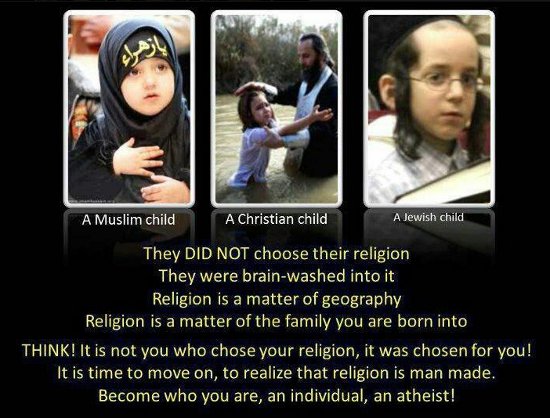
They DID NOT choose their religion. They were brain-washed into it. Religion is a matter of geography. Religion is a matter of the family you were born into.

THINK! It is not you who chose your religion, it was chosen for you! It is time to move on, to realize that religion is man made. Become who you are, an individual, an atheist!

From an image posted on Facebook
by Spread Logic and Reason

Disclaimer: This is a rant. This isn’t what I normally post here as a “meditation.” Frankly, I’m getting a little tired of being pushed around by a bunch of folks on the web who think they can take an image, manipulate it with some text, and use it to complain about how bad religion is. Today, I decided to push back.

I first saw this bit of Internet meme “shared” by a Facebook friend and a person I’ve known for many years. He’s a person I hold in high regard but we obviously have different viewpoints on religion. If I had seen this coming from almost anyone else, I would have ignored it, but I consider this person an actual friend, so naturally, it hurts.

Here’s my initial response to seeing this image:

I turn 58 tomorrow. I didn’t become a Christian until I was over 40. I used to be an atheist, primarily because the prevailing culture around me was atheist and it seemed to make sense at the time. Then I started thinking for myself. Why would I let the culture around me choose my religion and my identity for me? Why would I let an Internet meme choose my identity for me?

And what have I ever done to you that you should try to change my identity into what you think would be better for me? I’m not trying to change you.

Then I thought about it some more while doing my lawn, came back over lunch and expanded my answer:

It occurs to me that all cultures and people groups have their various values and customs that are passed on from one generation to another. Most liberal progressives don’t complain about cultural diversity, even if it radically differs from their own, because they recognize that people have the right to observe their native customs and certainly, in the vast majority of cases, liberal progressives and atheists don’t demand that other people groups who are not white, middle-class Americans, change their ways just because they are different than the white, middle-class American atheist’s ways.

Islam and Judaism are closely tied to national, ethnic, cultural, and racial identity. Why isn’t is considered racism, prejudice, and bigotry for you to demand that Jews and Arabs refrain from passing on their values and beliefs to their children? Are you (the general “you”…not naming anyone specifically) more equipped to tell the rest of the world to live your lifestyle? Don’t you pass on your values (atheism, progressive liberalism) to your children?

Why are you trying to control everyone else in the world?

To be fair, between my first comment and my second, my friend said:

Jim, if you had been born in Saudi Arabia and were atheist, assuming you survived to 40, the odds are more likely you would have become Muslim. This isn’t really about an Internet meme, but an historical fact. It exited loooooong before the Internet. 99% of people grow up believing what their parents did. Why did none of the natives in the Americas become Christian for 1500 year. That you decided to for a different belief system than your environment does not alter the facts. You are an exception.

I can see his point, but I think he (and a lot of people like him) are missing something. In making statements and posting photos such as the one I put at the top of this blog post, aren’t atheists trying to say that their viewpoint, lifestyle, and values system is superior to everyone else’s? I know that many religions, particularly Christianity, are accused of exactly the same thing and I know from personal experience (having once been an agnostic leaning toward atheism) that having to listen to a Christian evangelist can be really annoying.

But what about all that “diversity” stuff? If progressive liberalism and atheism supports generally being accepting of racial, cultural and ethnic diversity, then isn’t complaining about how different ethnic, cultural, and racial groups choose to raise their children and pass on their values a type of bigotry? While Christianity isn’t tied to a particular nationality, race, ethnicity, or culture, Islam and Judaism certainly are. How can the comments espoused by this group of people be seen as anything but prejudiced and even racist?

Yes, I’m coming on strong. Yes, today I’ve decided to feed the trolls. But it seems like everyone is supposed to have rights to this, that, and the other thing in this world…except religious people. Not only is this group of atheists guilty of the same acts they say religion commits: exclusivism and rejection of the values and lifestyles of other people groups, but they’re also guilty of what the rest of the world sees Americans as doing: attempting to spread our own values and lifestyle to the rest of the world and using our own cultural lens to judge the right and the wrong of other people, cultures, and nations.

How are these atheists any more morally correct than any religious person?

“Blowing out someone else’s candle does not make your’s burn any brighter.”

-Anonymous

Dear people who don’t like religion,

How does complaining about religious people make the world a better place? What do you gain by “going after” Muslims, Jews, and Christians? Do you plan on taking on Buddhists and Wiccans next? Has the Dalai Lama somehow offended you? If you really want to spend your time and energy being useful and helping others, please step away from the computer and actually do something for another human being. Volunteer at a homeless shelter. Give cans of food to the local food bank. Spend an hour picking up trash in the parking lot of your neighborhood park. Hold the door open at a public building such as the library for a disabled person or a single mother who is trying to manage five children. Heck, just smile at a stranger once in a while because it’s the right thing to do.

Don’t complain about me or people like me, saying we’re the problem. Go out into the world and be the solution. If you do that, the problems will take care of themselves.

Signed, a fellow human being, who has volunteered, donated, picked up trash, held doors open, and who smiles occasionally at strangers.

Thank you.

The Unmixing Bowl

Many MKs opened their mailboxes on Monday morning and were appalled to find a New Testament inside, sent to them by a messianic organization.

The Bible Society in Israel, a messianic Judaism institution for research, publication and dissemination of holy books, sent a “Book of Testaments,” which combines the Tanach and New Testament in one, leather-bound volume, published with references in Hebrew for the first time.

While the sect incorporates elements of religious Jewish practice, it holds that Jesus is the Messiah.

MK Tzipi Hotovely (Likud) sent a letter of complaint to Knesset Speaker Reuven Rivlin, writing that “it cannot be that missionary materials can be distributed in the Knesset.”

“Texts that were used to persecute and harass [Jews] cannot be distributed through the front door of the State of Israel,” Hotovely fumed.

Christian Allies Caucus chairman MK David Rotem (Yisrael Beytenu) said the mailing is “not missionary work, but an act of foolishness.”

Shas MK Nissim Ze’ev did not receive a package, but said the society had crossed the line between free speech and proselytizing.

-Lahav Harkov
“Missionaries in the Knesset?”
07/16/2012
The Jerusalem Post

Sending a bunch of “Christian Bibles” to all the Jewish members of the Knesset was, depending on the reaction you expected, predictably a bad idea. At best (as you read in the quote from the article), it would be seen as “foolishness.” At worst, it would be taken as Christians proselytizing Jews, which is deeply offensive. Think of how many Jews were tortured and even murdered by the church in the past thousand years in attempts to force Jews to convert to Christianity. So, do you think sticking a Christian Bible under the noses of a group of Jews is a good idea?

Anything that even hints of Christian “missionary work” among the Jews is going to trigger a hostile response. Even my attempt at discussing this issue on Facebook drew several passionate responses. After all, Judaism and Christianity are completely incompatible religions and lifestyles.

Or are they?

I’ve started reading Daniel Boyarin’s The Jewish Gospels, which has drawn its own “passionate responses” in the Amazon reviews section for the book. The fact that Boyarin is a Jewish educator and the Taubman Professor of Talmudic Culture and rhetoric at the University of California, Berkeley hasn’t helped calm the obvious emotional commentary this topic inspires from both Christians and Jews. After all, what Jew, let alone a noted and respected Talmudic scholar, would approach the Christian New Testament with anything but disdain?

I’m barely past the Introduction of the book, but while it is a short work at 224 pages, so far, it is extremely dense with content.

If there is one thing that Christians know about their religion, it is that it is not Judaism. If there is one thing that Jews know about their religion, it is that it is not Christianity. If there is one thing that both groups know about this double not, it is that Christians believe in the Trinity and the incarnation of Christ (the Greek word for Messiah) and that Jews don’t, that Jews keep kosher and Christian don’t.

If only things were this simple.

…The question was not “Is a divine Messiah coming?” but only “Is this carpenter from Nazareth the One we are expecting?” Not surprisingly, some Jews said yes and some said no. Today, we call the first group Christians and the second group Jews, but it was not like that then, not at all.

-Daniel Boyarin
from the Introduction of his book
The Jewish Gospels

Boyarin is suggesting the unthinkable to both Jewish and Christian readers. He’s suggesting that at one point, what we now call Christianity was a form of Judaism, and it was accepted among the different forms or sects of Judaism that existed in the late Second Temple period in Roman occupied “Palestine.” Rabbi Shmuley Boteach tried to reintegrate Christianity into its original Jewish framework in his recent book Kosher Jesus, but it wasn’t well received, either by Jewish audiences (and particularly the Chabad) or by Christians. In my opinion, not having even started Chapter 1 in Boyarin’s book yet, I think he does a much better job than Rabbi Boteach. Although Boyarin is hardly accepting of Jesus as the Messiah, he seems to be able to communicate that a non-trivial number of first century Jews could see that the son of a carpenter from Nazareth might possibly be the Moshiach. Many groups of Jews were divided on this issue in those days, but that’s not particularly unusual according to Boyarin.

Some believed that in order to be a kosher Jew you had to believe in a single divine figure and any other belief was simply idol worship. Others believed that God had a divine deputy or emissary or even a son, exalted above all the angels, who functioned as an intermediary between God and the world in creation, revelation, and redemption. Many Jews believed that redemption was going to be effected by a human being, an actual hidden scion of the house of David–an Anastasia–who at a certain point would take up the scepter and the sword, defeat Israel’s enemies, and return her to her former glory. Others believed that the redemption was going to be effected by that same second divine figure mentioned above and not a human being at all. And still others believed that these two were one and the same, that the Messiah of David would be the divine Redeemer. As I said, a complicated affair.

I would love to see Boyarin’s research from exclusively Jewish sources that supports his understanding of these different factions of Jews, some of whom held beliefs that so mirrored a Christian’s vision of Jesus as divine and as God’s son. You don’t typically hear that sort of viewpoint from Jewish scholars and sages, particularly in modern times.

In other parts of the book’s introduction, Boyarin indicates that he sees the final crystallization of Christ occurring in the church in the late 4th century, specifically at the Council of Nicaea, where the last few nails were driven into the coffin of “Jewish Christianity.” Prior to this, Boyarin believes there were groups of Jews who continued to honor Jesus as the Messiah and the sent one of the God of Jacob; that faith in Jesus was not inconsistent with being a halakhic Jew. In fact, quoting a letter of St. Jerome (347-420 CE) written to St. Augustine of Hippo, Boyarin thinks there where a few small “Christian Jewish” sects that survived into the early 5th century.

In our own day there exists a sect among the Jews throughout all the synagogues of the East, which is called the sect of the Minei, and is even now condemned by the Pharisees. The adherents to this sect are known commonly as Nazarenes; they believe in Christ the Son of God, born of the Virgin Mary; and they say that He who suffered under Pontius Pilate and rose again, is the same as the one in whom we believe. But while they desire to be both Jews and Christians, they are neither one nor the other.

Boyarin points out that sadly, Jerome was unable to reconcile Christianity and Judaism, even at this early stage in the history of the church, and yet these “minim” (sectarians) and “Notzrim” (Nazarenes) were Jewish people who lived halachically Jewish lives, keeping kosher, observing the Shabbat, and performing the other mitzvot according to the Torah of Moses…and lifting up this carpenter from Nazareth as the Messiah, who came once and will come again.

Anyone familiar with Christianity’s history and how it is intertwined (rather tragically) with the history of post-Second Temple Judaism, knows something of how the schism between Gentile Christians and diaspora Jews was formed, widened, and eventually ruptured across the pages of the Bible and the Talmud in a bloody, awful mess.

My wife and daughter (sometimes with the “help” of my three-year old grandson Landon) are avid bakers. They have their specialized tools and devices to assist them in their craft, much as an expert carpenter has his coveted power tools. A great deal is made of the mixing bowl and the various mechanisms and peripheral elements that stir delicious substances together, this way and that, in order to produce the correct result that is fit for baking (but first, fit for sampling, at least if it’s cookie dough, by the small “helper” in the kitchen…and occasionally by grandpa).

History has provided for us the converse; an “unmixing bowl” of something that was once an acceptable and perhaps even integral ingredient in the “dough” of ancient Judaism. The portions of that “dough” which eventually became Christianity are now as popular among the descendants of Jacob as a bowl of flour on the kitchen table of a Jewish home during Passover week.

And so, when a “Christian Bible” was sent to each of the Jewish MKs in Jerusalem a few days ago, all the wheels fell off the cart, so to speak, and the stories and letters telling the tales of the man who many Jews once believed was the Messiah is now treated as an object of scorn and insult.

And ultimately trashed.

But there are a few, very few Jews who are re-examining the mixing bowl to see if there is anything left over at the bottom or clinging to the rim, that may serve as a reminder of the “Maggid of Natzaret;” the one who may have been much more than a small town carpenter turned itinerant teacher, or a failed revolutionary who came to a bad end. What if the story of Jesus Christ is really a Jewish story? Could such a thing be possible? Can a modern Jewish Talmudic scholar breach the separating wall between Christianity and Judaism and find this man, or more than a man, waiting in the shadows?

That’s what I’m going to find out as I continue to read Boyarin’s book.

For in discovering the Jewish story of the Jewish Jesus, we may all find out who we really are as people created in His image. And by finding our own face in the mirror, we can find his face, and we can take ownership of the reality of the Lord, Savior, and Messiah, who was sent not just for Israel, but for the entire world.

You need to take ownership of those things important in life—the charity you give, the kind deeds you do, the Torah you learn and teach.

You can’t just say, “This is G‑d’s business, He has to take care of it.” It has to hurt when it doesn’t work out; you have to dance with joy when it does.

That is why G‑d created the “I”—so that we would do these things as owners, not just as workers.

-Rabbi Tzvi Freeman
“My Thing”
Based on letters and talks of the Rebbe
Rabbi M. M. Schneerson
Chabad.org

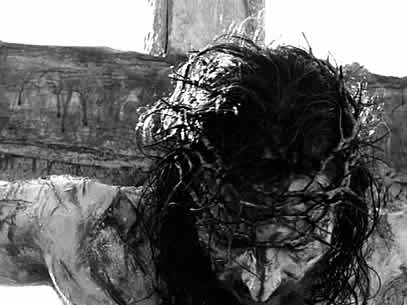
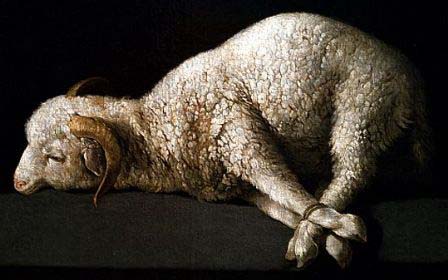
The Sacrifice at Golgotha

The Death of the MasterI am hoping you will be able to resolve a very important issue confronting the very foundation of Christianity.

God’s way of testing Abraham by calling for the sacrifice of Isaac…and then the abrupt staying of the knife…was intended to demonstrate that God abhorred human sacrifice and would not accept it (Gen 22.12). When the great central Law of Judaism (the TORAH) was revealed at Sinai, it called for animal sacrifices. The slaying of an animal and the offering of its blood according to certain prescribed rites, symbolized God’s mercy to the sinner, for this would have been his fate. Later in the Law, Moses gives warning to Israel not to worship God in the manner of the pagans (through human sacrifice) for it is an abomination unto the LORD in any way or form it is practiced (Deut 12.30-32).

Turning to the New Testament, Jesus states that he completely upholds the precepts of the Judaic Law until its complete spiritual enactment through-out the world. This great authorization of the central Law of Judaism renders it supreme (Matt 5.18). Nevertheless, here is where a trouble-some contradiction arises. According to Romans 5.6-11, Jesus’ death was a vicarious atonement. But this is a human sacrifice which is expressly forbidden by the very same Law sanctioned by Jesus.

True, Jesus is unique in being both human and Divine. But by sanctioning the Law He did not allow His uniqueness to detract from His subjection to the Law which is understandable since the Law is the perfect Word of God.

In sum, if Jesus was upholding the Law then His death cannot be sacrificial. Or, if His death is sacrificial, He has rejected the Law which He claimed to uphold. In either case, Christianity’s central doctrine of the sacrificial death of Jesus is proven to be scripturally untenable. Christianity is therefore in peril of crumbling away. The stakes are very high. If Christianity succumbs to an inner breakdown, the moral order in the world will soon follow….

This contradiction can only be satisfactorily resolved by reference to Scripture. Scripture is a single, self-consistent truth, but beginning to end. Each verse urges its own truth. When two verses appear to exhibit incompatible claims, a contradiction develops. We must then attempt to resolve this contradiction by reference to another verse(s) which will reconcile the two opposing viewpoints…

When reconciliation is not forthcoming, the contradiction remains and the verse(s) in question are not Divinely revealed facts, but have been spoken by the prophet out of his own authority…

The defensibility of Jesus’ sacrificial death has been troubling me for a long while. I am unable to resolve it according to Scripture. I would be very grateful to you if you could clear it up for me…

Quoted from christianthinktank.com

Have you ever been asked a question you were so sure you knew the answer to that you never even worried about it, and then, when you tried to answer the question, realized you didn’t really know how to respond?

That happened to me yesterday afternoon. Let me explain.

On most Thursdays after work, I meet with a couple of other guys for coffee and discussion. There’s no set agenda, but we usually talk about matters of faith and questions that come up in the Bible that sometimes drive us crazy. We are all reasonably comfortable questioning the traditional Christian assumptions and our coffee meetings give us an opportunity to ask questions we could never ask in church.

I commute to and from work with my son David. On Thursdays I usually drop him off at his place, then go to the coffee shop for my meeting. Yesterday, my daughter-in-law had an activity planned with some female friends at their place and asked if David and I could hang out together. I asked him if he wanted to join my meeting and he said, “OK.”

David was the first of my children to develop a sense of spirituality. When he was little, he went to church with my wife’s brother Steve whenever Steve was visiting from the Bay Area. After David went to church with Steve, he’d ask my wife and me why the rest of us didn’t go to church and believe in Jesus (this was years before my wife and I became religious). That was kind of awkward.

Somewhere between childhood and adulthood, David set his faith aside but it’s always been on the back burner, so to speak. Thursday allowed him to revisit old territory and to ask some of those questions that would drive most Christians nuts.

The four of us were having a fairly stimulating conversation when the question of human sacrifice came up. David sees the death of Jesus on the cross to atone for the sins of the world as a direct violation of the commandment not to sacrifice a human being.

So here we are, three guys from different backgrounds but who all have the same fundamental belief in Christ as Messiah and Savior trying to address this question.

I shot off my big mouth first.

Understand, that this is a very troubling question with no simple answer. Also understand that one of the reasons that I am attracted to Jewish mysticism and particularly the Chassidim, is because I don’t think that there is any other way to explain certain things about the Messiah, including his bloody, sacrificial death, outside of a deeply mystic framework.

Just how can a human sacrifice, even that of the Messiah, atone for the sins of the world? What’s the mechanism that makes it possible and that doesn’t violate God’s prohibition against human sacrifice?

My answer was based on the understanding of the death of a tzaddik being able to atone for the sins of a community or even of an entire generation. Of course, my answer was founded entirely on the Chassidic mystic understanding of this process; something which most Jews, particularly in modern times, do not agree with.

So where is this explained in the Bible?

My friend Russ offered David what I would consider the traditional Christian explanation for the sacrifice of Jesus Christ on the cross. As I listened to him answering David, I realized that I didn’t find the Christian viewpoint particularly satisfying. I know that I’ve had this explained to me before at some point, but my memory is a leaky container and a lot of stuff has dribbled away over time, so I don’t remember exactly what was said or when that conversation occurred.

This really bothered me.

The conversation ended with more questions than answers, which is fairly typical for our little group, but where was David now? He continues to focus on the Torah and the Prophets as the foundation of his understanding about God and the Jewish people, though I’m sure he would benefit from a review of his knowledge base, but the New Testament seems to him like so many exceptions and contradictions to his understanding of Torah. On the drive back to my place, David and I continued our conversation, and I decided to encourage David to start where he is. If the Torah and Judaism are the rock on which he now stands, then I will support him returning to and exploring the cornerstone of his faith.

But it still bothered me that not only could I not give a satisfactory answer to his questions about Jesus, but I couldn’t really answer my own questions. I can’t solely rely on the “mystic” explanation for how a tzaddik’s death provides atonement, and assuming the traditional Christian response to this query is also lacking, then what is the answer?

I don’t know.

I know that faith is sometimes the mortar that fills in the spaces in religious understanding, but I’m uncomfortable with it being the putty that replaces solid Biblical knowledge let alone logic.

OK, I know that logic is the beginning of wisdom and not its conclusion and that once we accept the existence of God, we also must accept the supernatural, but David did bring up what seems to be a huge disconnect between the Tanakh (Old Testament) and the New Testament in terms of death, atonement, and sacrifice. You’ve probably already clicked the link I provided above and read the christianthinktank.com reply to this question. I did too, but I’m not sure I’m buying it.

Do we see any example of the death of a righteous man providing atonement for the sins of other people in the Tanakh? Was any man in the Old Testament deliberately killed in order to turn away God’s wrath toward other human beings? We talk about men like Joseph, Moses, and David being “types and shadows” of the Messiah. But we don’t see that their deaths really did anything to illuminate the problem of Jesus being a human sacrifice to turn away God’s fatal judgment from all people everywhere across time who accept Christ as Lord and Savior.

I’m not that smart. Some people think I’m smart. My wife thinks I’m smart (except when she disagrees with me, then I’m not too bright at all *wink*). But it’s not really true. I suppose it’s more accurate to say that in this particular area, I’m not very well-educated. I feel ill-equipped to manage these sorts of questions. On some level, I think that it’s not very easy or maybe even not very possible to use human language and human logic to explain the mysterious, mystical way the death of the Messiah somehow atones for the sins of people.

And yet, that’s all we have to work with. Assuming extra-Biblical and particularly mystical (when my wife learned about this conversation, her response to me was to ask in an incredulous tone, “You talked to him about mysticism?”) sources are not considered valid in this discussion, then we must rely on scripture. But if the Old Testament and New Testament don’t agree that the Messiah must die to atone for sins, then what do we have?

A big, fat, furry mess, that’s what.

So I’m opening up yet another can of worms and throwing this topic out to the public via the Internet. I’m seeking out a greater imagination or at least a more scholarly believer. What’s the answer to how the death of Jesus isn’t human sacrifice? Is there an answer that doesn’t contradict the commandment to not sacrifice people?

The comments section is now open. What do you think?

Struggling with the World, Part 1

I’m not arguing for either the superiority or the necessity of a covenantal orientation to life for the realization of human responsibility and dignity. In thinking about Judaism, I cannot ignore the fact that atheists act with moral dignity and compassion in the world. I believe, in contrast to many contemporary religious thinkers, that secular humanism is a viable and morally coherent position. What I am claiming is only that neither the critique of halakhic Judaism found in the Christian tradition nor the moral critique found in Spinoza is convincing. There are many different approaches to human life that encourage initiative, intellectual freedom, responsibility, and the sense of personal adequacy and dignity. I am not arguing that faith is necessary in order to have these values, but only that faith in a covenantal God of Judaism does not have to contradict or undermine them.

The God of Sinai does not merely hand over responsibility for the mitzvot to Israel and then take His leave. He also commits Himself to permanent involvement in the history of the community…

-Rabbi David Hartman
Chapter 8: “Rabbinic Responses to Suffering”
A Living Covenant: The Innovative Spirit in Traditional Judaism

I hadn’t intended to turn this into a series, but I find myself continuing to compare the relative merits of the moral and ethical positions of Christianity and, if not atheism as such, progressive secular humanism, which is the predominant philosophy of modern western culture. My previous missives on this topic are Collision, which is my introduction into why atheism holds such animosity toward Christians and Repairing Life which suggests one possible response.

That should have been the end of my reflections on “Religion vs. Atheism,” and it was from a Christian point of view, but I neglected to discuss how Judaism considers this dynamic. As with many things, there’s no single Jewish viewpoint (and I’m probably not qualified to write about this but I will anyway) so I’ll try to offer two: one from Rabbi Hartman’s above-quoted book and the other from Rabbi Tzvi Freeman and Chabad.org.

Whenever someone asks me a question, I first have to think, “What kind of a box has this guy trapped me in?” Then I can deconstruct the box. If the box dissolves, there goes the question. If it doesn’t dissolve, I better listen up. The guy’s got a point.

Here comes one now:
“Rabbi, what was the Rebbe’s response to modernity?”

For at least two hundred years, Jews scrambled to find a response to modernity.

Today, there’s no longer much scrambling. Movements have stopped moving, firmly entrenched. But there was a time when Jewish creative genius generated a cacophony of responses to modernity: Reform, Orthodoxy, Zionism, Religious Zionism, Conservative, Ultra-Orthodoxy, Reconstructionism, Modern Orthodoxy, Renewal and more. Each movement had leaders who spent their years zealously articulating and re-articulating their particular response to the progressive, liberal, enlightened, modern world that came rushing down upon us, particularly after France beheaded its kings and smokestacks started belching into the sky.

Now, in Brooklyn sat a Jewish leader who built up a powerhouse movement that has transformed the face of Jewry worldwide. What was his response to modernity?

Gotcha. Neat little box. But it doesn’t work. What doesn’t work? The box: “Response.”

Again, as I mentioned in my other blog posts on this subject, I’m not trying to “prove” that religion is right and atheism is wrong or even to say that one group possesses an inherently greater moral response to life than the other (although from my point of view, religion should have the greater moral response).

I want to show that the issue can be as simple as how much or how little of themselves people choose to invest in their particular belief systems and and also demonstrate that these matters are far more complex than what we think of as mere “right and wrong.”

Rabbi Hartman’s position might be considered the more progressive of the two based on the quote I used to open this “extra meditation.” Rabbi Freeman represents the more conservative view. He suggests that historically, Judaism has responded to modernity by generating multiple variations of Judaism to adapt to the demands of progressiveness, but currently seems to be digging its heels in, so to speak, as representative of the Orthodox. But as we see from continuing to review Rabbi Freeman’s commentary, even this isn’t as two-dimensional as it appears.

Rabbi Freeman uses the dilemma of Children of Israel trapped between an advancing and vengeful Egyptian army and the uncrossable barrier of the Reed Sea (Exodus 14) as a metaphor for the struggle of Judaism to respond to liberal modernity.

The Children of Israel are stuck at the Sea of Reeds. The Egyptian army is closing in fast. The Jews divide into four parties—four opposing responses to one situation, perfectly summarizing the orthodox responses of the modern era: The Just-Go-Back-to-Egypt response, the I’d-Rather-Drown-Myself response, the Get-Up-And-Fight response and the Get-Down-And-Pray response.

Response Today
Self-Drowning Immerse in a ghetto of Torah, and pretend the world does not exist.
Back to Egypt Give up on the world, on the future, or on trying to change anything. Just do what you have to do because G‑d says so.
Fighting Prove that we are right and they are wrong.
Praying Rely on G‑d to bring Moshiach real soon.

G‑d’s response? You’re all wrong.

“Why are you crying out to me?” G‑d demands of Moses. “Speak to the Children of Israel and tell them to keep going forward!”

No response. No reaction. Proaction. Take charge. You have a purpose, you’re going somewhere. Keep going.

According to Rabbi Freeman, the response of Israel to the demands of progressionism is to progress. Of course, this doesn’t mean abandoning the covenant of Sinai and blending into the general cultural herd, which for a Jew would basically mean assimilation, but it doesn’t mean hiding or freezing in place, either. If the world moves, move with it, but don’t forget to take who you are with you and particularly, don’t forget to take God.

But the world of faith is always vulnerable, not just to tragedy and evil, but to how those elements of life are interpreted, and on some occasions, used against religious people by not only the atheists who blame all the world’s woes on religion (as if humanity weren’t capable of doing harm without a religious belief system to depend upon), but on our own doubts when “bad things happen to good people,” or when God is otherwise incomprehensible.

Rabbi Hartman continues on this point:

From the anthropological perspective on the problem of evil, therefore, the prime concern is not so much to defend the notions of divine justice and power. It is rather, as in other personal relationships, to determine what measure of continuity, stability, and predictability can enable the relationship with God to survive all shocks. It is to identify the cluster of beliefs that supports a person’s will to persist in the face of tragedy and suffering. If the world I live in requires that I become overly vigilant because of the threat of danger striking at any moment, then how can I sustain commitment to a way fo life predicated on God’s covenantal love and justice?

How do we respond to events that can call into question our whole identity as God’s relational partners?

An atheist can dismiss such questions by dismissing God. The presence of tragedy, suffering, and evil can be accepted as conditions of a natural world filled with imperfect human beings. It can also be a world that, while imperfect, is struggling to develop toward a higher moral and ethical reality as indeed, progressivism strongly believes. Human beings then, establish and revise the foundations of our own morality, sometimes radically, as time advances and the concepts of rightness, mercy, and justice continue to evolve in societal consciousness.

But what about the covenantal Jew? How does he resolve or at least address this problem? We’ll pursue the answer to that and other questions in Part 2.

Collision

Criticizing another person is not out of the question. It’s just that there are a few conditions to attend to before you start.

The first condition is to make sure this person is your close friend. Those are the only people worth criticizing—not just because they may actually listen, but also since you run a lower risk of making them into your sworn enemies.

If this person you feel an urge to criticize is not yet your close friend, you’ll need to spend some time with him. Find out everything that’s good about him, and go out of your way to help him out. Eventually, a real friendship will develop.

Also, you’ll need to ensure that this person has the same knowledge, understanding and perspective of right and wrong as you do before you can attack his decisions. If he doesn’t, you’ll need to spend some time learning and discussing together until you see each other’s point of view.

Once the two of you are in the same space in Torah and observance of mitzvot, and he’s your good friend to boot, then it’s okay to criticize—if necessary. And if you can remember what there was to criticize.

-Rabbi Tzvi Freeman
from How to Criticize and More on How to Criticize
Based on letters and talks of the Rebbe
Rabbi M. M. Schneerson
Chabad.org

“Any fool can criticize, condemn and complain and most fools do.”

-Benjamin Franklin

I was recently involved in a Facebook conversation started by a fellow who took exception to the King James Version of the Bible and, by inference, all of Christianity. He was very nice about it, but just because someone says “please” and kisses you on the cheek before punching you in the face doesn’t mean it doesn’t hurt.

OK, that’s a little unfair and he did say something about his motivation for “sharing” the photo criticizing the KJV Bible:

…if something can’t stand inquiry at every level, do we have any business basing huge belief systems on it?

I suppose that’s true and there are many people, both atheists and Christians, who spend a great deal of time examining the Bible and offering critical analyses of the text. I don’t mind serious scholars investigating the writings of Judaism and Christianity and providing illuminating and challenging questions, but at one point does the motivation of those who criticize people of faith become less than scholarly?

And then there’s reddit or more specifically, the sub-reddit on atheism. For those of you who don’t know, reddit is a social news website where the registered users submit content, in the form of either a link or a text “self” post. Other users then vote the submission “up” or “down”, which is used to rank the post and determine its position on the site’s pages and front page. (source: Wikipedia) Sub-reddits are pages within the larger whole that address specific topics of interest, such as music, movies, science, and atheism. However, the atheism sub-reddit isn’t defined so much by what atheists believe as by what they’re against which is, for the most part, Christianity (although the atheist sub-reddit page is probably doing it wrong).

I only bring up reddit because I read it daily and because they go out of their way to bash Christians daily. The fact that popular online social venues regularly criticize not only religious beliefs but religious believers shouldn’t exactly come as a shock. After all, atheism is probably the predominant “religion” in the west today (I say that last part somewhat ironically).

Besides, weren’t Christians told to expect this sort of behavior?

Blessed are you when others revile you and persecute you and utter all kinds of evil against you falsely on my account. –Matthew 5:11 (ESV)

Count it all joy, my brothers, when you meet trials of various kinds, for you know that the testing of your faith produces steadfastness. And let steadfastness have its full effect, that you may be perfect and complete, lacking in nothing. –James 1:2-4 (ESV)

However, I’d be remiss if I didn’t consider the other side of the coin. Just why is there so much criticism being directed at Christianity? There are a few reasons.

You can’t really be an atheist unless you are defining yourself against a theist, someone who believes in a god or gods of some sort. Since belief in a god or gods requires a belief in the supernatural, something you can’t examine objectively using the scientific method, atheists who are scientifically oriented define themselves in opposition to religious people who are considered irrational, superstitious, or just plain stupid.

Atheists who may or may not be scientifically oriented have another, wider motivation for not only refuting religion, but particularly being really angry at Christianity. Christians tend to be viewed (and not unjustly in many cases) as being pushy, self-righteous, opinionated, bigoted, hostile, narrow-minded, and generally “in-your-face” about what they believe.

The basis for some of this is “the great commission,” which we find in Matthew 28:19-20:

Go therefore and make disciples of all nations, baptizing them in the name of the Father and of the Son and of the Holy Spirit, teaching them to observe all that I have commanded you.

In other words, Christians are commanded to carry the “Good News of Jesus Christ” to everybody who will listen. That’s fine as far as it goes. If someone is curious about me and my faith, I’ll be glad to explain to them why I believe what I believe and to suggest (if they’re still willing to listen) that a life lived in relation with our Creator has many benefits.

But it doesn’t stop there for many believers.

I mentioned before that atheists tend to define themselves in relation to who they’re against. So does Christianity. Christianity defines itself against sin, or so it says. Christians pursue this definition to the degree that they can be very outspoken (depending on the denomination and how conservative they are) against the values and people currently held in high esteem by popular western culture.

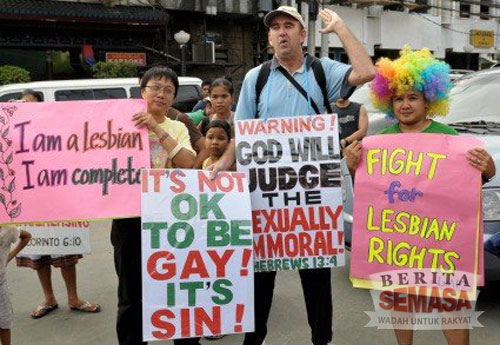
The current popular debates between Christianity often are not based on whether God exists or not, but on the so-called “culture wars” between what some consider Christian values and the more popular, progressive viewpoint. These topics tend to center around social issues such as the rights of women, people of color, and particularly (since it’s been in the news a lot lately) gay rights and what is referred to as “marriage equality.”  Each side accuses the other of heavy-handed tactics in promoting their agenda and attempting to manipulate the minds and beliefs of the next generation.

As an example, I’m presenting an interesting photo (no, not the one below, you’ll have to click the link) I found on the atheist sub-reddit page. Although there’s no explanation regarding the photo of this person’s facial bruise and his bumper sticker, since it is posted on the atheist sub-reddit page, I can only assume it’s meant to indicate that a person of faith, possibly a Christian, assaulted this man because the person of faith believed the man in the photo was gay.

This plays into the reputation Christians have in the secular world relative to gays (even though the Bible doesn’t specifically command a Christian to give a gay man a black eye). To say that this particular (assumed) example of “Christian hostility” is unfair and possibly inaccurate is obvious, but to be fair, we have been rather oppressive at times in our treatment not only of gay people, but of any person who doesn’t measure up to the particular standards of the church, however those standards are understood.

In other words, religious people and non-religious people are capable of being unfair and critical. Religious people and non-religious people are easily offended and need to strike back against the person or organization that offered the offense. Religious people and non-religious people believe their particular system of beliefs are right, correct, represent basic reality, and are not only fact but truth.

What do religious people and non-religious people have in common.

They’re all people.

It’s important to remember (curb your dogma for a second) that we all operate inside of systems. Having a particular religious orientation means you are operating within that system and are subject to all of the conditions imposed by that system. Having an orientation toward atheism means you are operating within that system and are subject to all of the conditions imposed by that system. Sure, religion tends to believe that it is a container for truth while atheism tends to believe that it is a container for fact, but both are systems and the people within them will go to great lengths to defend their beliefs including attacking people who hold differing beliefs.

If you’re a Christian and an atheist says or does something that offends you, hurts your feelings, or makes you angry, that happens because you are human. Your faith is important to you and when it’s attacked, it’s like someone has just jabbed you in the eye with a sharp stick. If you’re an atheist and a Christian says or does something that offends you, hurts your feelings, or makes you angry, that happens because you are human. Your beliefs are important to you and when they’re attacked, it’s like someone has just jabbed you in the eye with a sharp stick.

I’m not here to “prove” that Christianity is right or wrong or that atheism is right or wrong. I’m here to say that we are spending a tremendous amount of time defining ourselves by who and what we are against and going out of our way…all of us, to hurt as many people as we can in the process, whether we think that’s our motivation or not.

Since atheism has no formal moral or ethical code attached to it, I can’t hold atheists to any standard of right or wrong. If an atheist wants to go out of his or her way to hurt a Christian, Jew, Muslim, I can’t blame them too much. After all, they are only acting according to human nature.

However, Christianity does come with a formal moral and ethical code (which varies a bit depending on denomination) and I can (and will) hold Christians to a moral and ethical standard. If you’re a Christian and you’re going out of your way to hurt someone just because you can, I’m going call you on it. That’s not “church bashing,” that’s calling believers to return to behaving as we were taught by Jesus and his example.

As I recall, when Jesus became angry, he was usually criticizing the religious authorities around him, not unbelievers and sinners. He used to hang out with sinners, eat with them, talk with them, and provide charity for them. If he defined himself at all, it was in comparison to the standards of the One who sent him, not against the people around him.

So Jesus said to them, “Truly, truly, I say to you, the Son can do nothing of his own accord, but only what he sees the Father doing. For whatever the Father does, that the Son does likewise. –John 5:19 (ESV)

No one is born a Christian. Unlike Judaism, we don’t have a biological, genetic, inheritance from our “fathers.” We each come to know God through the example of our Master and teacher at some point in our existence. Then we spend the rest of our lives trying to figure out what that means by acting out of our understanding and Christ’s example. We don’t always do such a great job of it, unfortunately.

But since no one is born a Christian, that means anyone who isn’t a Christian might come to faith one day. If we are obligated to share our “good news” with everyone else, we need to make sure we are really sharing good news and not criticism, judgmentalism, hostility, and bigotry. We must remember that we have been taught to share the good news by feeding the hungry, clothing the naked, and visiting the sick and imprisoned, and there are penalties against us when we fail to do so. (Matthew 25:31-46)

Rabbi Freeman said, The first condition is to make sure this person is your close friend. Those are the only people worth criticizing—not just because they may actually listen, but also since you run a lower risk of making them into your sworn enemies. In other words, all of the time we (believer, atheist, whatever) spend on the web criticizing other people and their beliefs isn’t going to change anything. No one will listen let alone change their minds just because someone they’ve never met thinks they’re either godless or superstitious.

I have no hope of changing anyone as a result of today’s “morning meditation,” either. But who knows? Maybe by advocating that all parties put down their guns, knives, and boxing gloves, maybe we can temporarily arrive at an uneasy truce. In the end, we all want to know the same things.

Who am I and what am I doing here? Is this all there is, or is there something more?

I’m pretty sure bashing people who don’t share our belief system won’t answer those questions.

This is the first part of a series that continues in Repairing Life.