Tag Archives: Rosh Hashanah

Nitzavim and Rosh Hashanah: Renewing Covenants

…the word nitzavim the core of the blessing given by G-d does not mean merely “standing.” It implies standing with power and strength, as reflected in the phrase: nitzav melech, “the deputy serving as king,” i.e., G-d’s blessing is that our stature will reflect the strength and confidence possessed by a king’s deputy.

This blessing enables us to proceed through each new year with unflinching power; no challenges will budge us from our commitment to the Torah and its mitzvos. On the contrary, we will “proceed from strength to strength” in our endeavor to spread G-dly light throughout the world.

What is the source of this strength? Immutable permanence is a Divine quality. As the prophet proclaims: (Malachi 3:6.) “I, G-d, have not changed,” and our Rabbis explain that one of the basic tenets of our faith is that the Creator is unchanging; (See Rambam, Guide to the Perplexed, Vol. I, ch. 68, et al.) nothing in our world can effect a transition on His part. Nevertheless, G-d has also granted the potential for His unchanging firmness to be reflected in the conduct of mortal beings, for the soul which is granted to every person is “an actual part of G-d.” (Tanya, ch. 2) This inner G-dly core endows every individual with insurmountable resources of strength to continue his Divine service.

-Rabbi Eli Touger
“Standing Before G-d”
from the “In the Garden of Torah” series
Commentary on Torah Portion Nitzavim and Rosh Hashanah
Chabad.org

In just a few days, every religious Jew on earth, including many three day a year Jews, will be standing before the God of their forefathers and participating in events that are thousands of years old, and in a modern response to a very ancient commandment. Christianity has nothing like it. Not even Easter comes close. And yet, it’s not something that God “does” to the Jewish people, but rather, Rosh Hashanah is a fully interactive and participatory event, must like what Rabbi Touger describes in this week’s Torah Portion, where the Children of Israel stand before God and consciously, fully, willingly, and interactively accept upon themselves the Covenant of Sinai and the resultant conditions of the Torah.

What a strange God we have who wants to interact and participate with His people in such Holy rites.

There is a great secret in the drama of Rosh Hashanah. It is the mystery of a Creator asking His creations to participate in the birth of their own world and of themselves. He asks the created beings to ask Him to create them.

The wonder of Rosh Hashanah is between Him as He is Above and Him as He is in within us.

-Rabbi Tzvi Freeman
“The Mystery of Rosh Hashanah”
Based on letters and talks of the Rebbe
Rabbi M. M. Schneerson
Chabad.org

We ask to participate; we are expected to participate in the creation of our own world, of our own lives? How crazy is that? OK, how “mystic” is that?

But then again, how crazy is it to pray to an invisible, unknowable, all-powerful Supreme Being in His Heavens, and expect that He’ll even be willing to listen, let alone answer our humble and sometimes, not-so-humble requests?

For the entire month of Elul, the Jewish religious world has been doing a slow wind up to the High Holidays. Gradually at first, Jews have been praying, studying, repairing damaged relationships, treating people with just a little more respect. Then with more frequency, giving to charity, visiting a sick friend in the hospital, going to shul and davening with a minyan, joining a Talmud class. Finally, at a frenetic pace, making sure they have (if required) tickets for Rosh Hashanah and Yom Kippur services, preparing their homes, sending greeting cards, praying three times a day including the Bedtime Shema, and on and on and…

It’s almost here. Rosh Hashanah begins at sundown this coming Sunday. Erev Shabbat, the Shabbat before the Holidays, is just a few short hours away. It’s here, it’s here, it’s here! “Am I ready?” many Jews ask themselves. “Is my soul ready?” Who is ever really ready for such and awesome encounter with God at such a critical time of year?

In all of this, Jews, and maybe a few Christians, can’t help but think of “covenant connection,” “promises,” and “blessings” …and “curses” maybe. It’s very exciting and exhilarating…and intimidating.

But in spite of God’s “bigness” and “vastness” and “infiniteness,” He wants, He demands a relationship with His people Israel and through them, with the rest of us. After all, that’s the point of a covenant. Rabbi Touger’s Torah commentary continues:

Our Torah reading continues, stating that the Jews are “standing today before G-d” for a purpose: “To be brought into a covenant with G-d.” (Deuteronomy 29:11.)

What is the intent of a covenant? (See Likkutei Torah, Devarim 44b.) When two people feel a powerful attraction to each other, but realize that with the passage of time, that attraction could wane, they establish a covenant. The covenant maintains their connection even at times when, on a conscious level, there might be reasons for distance and separation.

Each year, on Rosh HaShanah, the covenant between G-d and the Jewish people is renewed. For on Rosh HaShanah, the essential G-dly core which every person possesses rises to the forefront of his consciousness. Thus the fundamental bond between G-d and mankind surfaces, and on this basis a covenant is renewed for the entire year to come, (See the essay entitled “At One with the King” (Timeless Patterns in Time, Vol. I, p. 3ff)) including the inevitable occasions when these feelings of oneness will not be experienced as powerfully.

We Christians don’t think of having a time when our covenant with God is renewed, since we consider coming to faith in God through Jesus Christ as a singular event in our lives. Jews, by comparison, are born into the covenants, and thus, even a completely non-religious Jew has no choice about being Jewish, even if they choose to disregard every single mitzvot. Then again, I suppose there’s a reason why some Jewish people are “three day a year Jews,” much like how some Christians only go to church on Easter. If you have an awareness of your relationship with God, even peripherally, He draws you back to Him at times like these.

We Christians don’t renew our covenant relationship with God annually, or at least we don’t think of our holidays as having that impact. On the other hand, as I’ve come to realize recently, our covenant relationship with God does not stand apart from the Jewish people. God made His covenants with Israel and through the Abrahamic and “New” Covenants, we among the nations are granted blessings. The blessings come from God, to the Jewish people, and from the Jewish people to us, by way of the Jewish Messiah King, so that no one has to perish but everyone can come to life eternal.

In our prayers, we say: (The conclusion of the Shemoneh Esreh prayer, Siddur Tehillat HaShem, p. 60.) “Bless us, our Father, all as one.” This implies that standing together as one generates a climate fit for blessing. (See Sefer HaSichos 5700, p. 157.)

May our standing before G-d “as one” on Rosh HaShanah lead to a year of blessing for all mankind, in material and spiritual matters, including the ultimate blessing, the coming of Mashiach.

May all mankind, every man, woman, and child, be blessed by God.

Good Shabbos and L’shanah tovah tikatev v’taihatem; May you be inscribed and sealed for a good year.

Rosh Hashanah: Are We Ready To Approach God?

The words we say are spoken in the heavens. And yet higher. For they are His words, bouncing back to Him.

On Rosh Hashanah, we say His words from His Torah recalling His affection for our world; He speaks them too, turning His attention back towards our earthly plane.

We cry out with all our essence in the sound of the shofar; He echos back, throwing all His essence inward towards His creation. Together, man and G‑d rebuild creation.

-Rabbi Tzvi Freeman
“The Cosmic Mirror”
Based on letters and talks of the Rebbe
Rabbi M. M. Schneerson
Chabad.org

The process of Tikkun Olam or “Repairing the World” is well understood in Jewish thought and I’ve blogged on this topic many times before. I think it is a perfect way for both Jews and Christians to understand our relationship with God, especially as Rosh Hashanah is nearly upon us, and God has His “cosmic finger” poised over the universal “Reset button,” so to speak.

And yet, during the most holy time on the Jewish religious calendar, the world is a very troubled place. The U.S. Consulate in Libya was recently attacked and Egyptian protesters mounted an assault on the U.S. Embassy in Cairo. And while the nuclear threat Iran poses against Israel seems terribly imminent, the U.S. citizens and government largely oppose intervening to defend Israel.

Even within the community of faith in Christ, there are many different voices who actively oppose one another and malign fellow believers, even as God urges us to establish peace with our brother and the Messiah’s law requires that we love one another.

How can we say that we are “partnering” with God in repairing His Creation when we can’t even resolve simple disagreements between ourselves?

The person who is truly fortunate in this world is the one who has authentic trust in the Almighty. He is able to sustain a feeling of well-being when things go well as well as when things are challenging. He experiences a sense of well-being whether he has a lot or a little. He experiences this well-being whether people meet his expectations or whether they don’t. His well-being is constant, because his trust in the Almighty gives him the awareness that his life has a plan that is specially designed for his welfare. The nature of that plan becomes clearer all the time. The reality of what occurs in his life is what Hashem in His infinite wisdom knows is ultimately best for his unique spiritual needs.

-Rabbi Zelig Pliskin
“Being Truly Fortunate, Daily Lift #575”
Aish.com

I’ve talked about trusting God before, but it’s a lesson that needs to be repeated since, after all, we human beings don’t trust each other very well, let alone an infinite and invisible God. How can we trust Him to provide us our every need when millions go hungry every day; when millions don’t even have access to clean drinking water; when millions are sick, starving, suffering under terrible oppression, raped, tortured, and murdered?

ForgivenessYet we people of faith who live comfortably in the United States or other well-fed Western nations, argue about our rights and our theologies and our doctrines while our stomachs are full, our homes are adequately warmed or cooled, we drive to and from our jobs in cars, and no one threatens to kill us because of the God we claim as our own.

Rabbi Freeman describes God and Heaven as a sort of “mirror” which reflects the holiness of the words of Torah back upon the faithful ones who utter them in the synagogues during these special “Days of Awe.” I’d like to suggest that God is also a mirror, not just of our holiness, but for everything else that we are, including the ugliness of our greed, selfishness, narcissism, envy, and hypocrisy. Dream not of today and your comforts, pleasures, and desires, but instead stare into that mirror and realize, like the beautiful and self-indulgent Dorian Gray, there is a consequence for every unkind word we speak, for every vengeful thought we allow to be expressed within us, for every time we seek our needs at the expense of another.

“Judge not, that you be not judged. For with the judgment you pronounce you will be judged, and with the measure you use it will be measured to you. Why do you see the speck that is in your brother’s eye, but do not notice the log that is in your own eye? Or how can you say to your brother, ‘Let me take the speck out of your eye,’ when there is the log in your own eye? You hypocrite, first take the log out of your own eye, and then you will see clearly to take the speck out of your brother’s eye.

Matthew 7:1-5 (ESV)

When they had finished breakfast, Jesus said to Simon Peter, “Simon, son of John, do you love me more than these?” He said to him, “Yes, Lord; you know that I love you.” He said to him, “Feed my lambs.” He said to him a second time, “Simon, son of John, do you love me?” He said to him, “Yes, Lord; you know that I love you.” He said to him, “Tend my sheep.” He said to him the third time, “Simon, son of John, do you love me?” Peter was grieved because he said to him the third time, “Do you love me?” and he said to him, “Lord, you know everything; you know that I love you.” Jesus said to him, “Feed my sheep. Truly, truly, I say to you, when you were young, you used to dress yourself and walk wherever you wanted, but when you are old, you will stretch out your hands, and another will dress you and carry you where you do not want to go.” (This he said to show by what kind of death he was to glorify God.) And after saying this he said to him, “Follow me.”

John 21:15-19 (ESV)

If I were to reword the last set of statements from the Master and address them toward all of us, I might say, “Disciples of the Jewish Messiah, do you love me more than your own theological baloney and self-serving doctrines?”

I wonder what we would answer if he caught us in one of the recent blogosphere “debates” arguing over which theology of ours is the “greatest” and he chastised us all for our unloving attitudes and lack of respect for one another?

For many Christians, Rosh Hashanah is just another day in the life and it does not register on the calendars of most churches and believers in Jesus. But for those of us among the nations who feel somehow connected to the “Jewishness” of Jesus and seek an affinity with the origins of our faith, we should be paying attention to God and our own frailty, not to our rights and our wants. We should be intensely aware that Rosh Hashanah begins at sundown this coming Sunday, and an accounting will be asked of us by God. God will ask us to explain why we failed Him so many times over the course of the year. He will not ask us our opinion of why we believe someone else we don’t like may have failed God. Pay attention to your own eyes and let God take care of the splinter in your brother’s eye.

With such an awesome and majestic encounter before us, how should we be preparing our spirits to enter the Presence of the King? We’ve had an entire month to soften our hearts toward God and our fellow human being. Are we ready or have we been wasting our time on futile pursuits?

God is waiting for us. How shall we approach Him?

The Ungrateful Servant

In the Ohr Somayach Yeshiva in Jerusalem, there was an elderly native of the city who prayed with the Yeshiva each morning. On the morning following the presidential election in the United States, before prayers began, he went to one of the American boys and asked him who had won.

I don’t know if the young student knew the answer, but he was struck by the question. Why would an old man from Jerusalem care about the elections, so much so that he would go out of his way to ask about the results before prayers? Doesn’t G-d come first?

Asked for an explanation, the man replied that he was about to say a blessing thanking G-d for giving him the opportunity to be part of the Jewish People. Although everyone is created in the image of G-d and every righteous person has a share in the World to Come, to be called to serve G-d through all His Commandments is unique privilege. And when making that blessing, he wanted to think about the greatest and most powerful non-Jew in the world!

To give the story a bit of deeper insight, consider that this elderly gentleman lived in poverty in a small Jerusalem apartment. If I’m not mistaken, the protagonist used to sit in the back of the Bais Medrash (study hall), tying Tzitzis (fringes on the corners of garments) for a living while he reviewed the Babylonian Talmud by heart. He was quite poor, yet considered himself blessed beyond the most powerful man in the world.

Every one of us has our own individual set of challenges and opportunities placed before us. Our Sages tell us that we must say, “the entire world was created for me.” Whatever our situation, we have incredible blessings which we often take for granted. Most of us have legs to walk on, are able to breathe the air around us, and are able to marvel at a sunset. But even those who are not able to do all those things have many others for which to be thankful.

-Rabbi Yaakov Menken
“A Moment of Thanks”
ProjectGenesis.org

I didn’t really intend to write additional blog posts that related to my The Equality Puzzle series, but as with so many of my other “meditations,” this one just sort of “happened.”

We see here a perfect example of how all people are considered equal in that we are all created in the image of God, and yet we also find that an elderly and impoverished Jewish man in Jerusalem, someone who barely manages to make a living, sees himself as more privileged than the (non-Jewish) President of the United States who is arguably, the most powerful single person in the world. The old man lives without many things, but he is honored “to be called to serve G-d through all His Commandments.”

This says several things. First, in the sense of being able to “serve G-d through all His Commandments,” we are not all the same. A poor old Jewish man may have this unique privilege, but even the President of the United States, if he or she is not Jewish, does not share this special honor from God. However, though this may represent a gross inequality to some, it also illustrates that we all have something to be thankful for and a wonderful role to play out in God’s Kingdom that was crafted just for us.

You could be an old Jewish man in Jerusalem who earns a meager living by tying tzitzit, the President of the United States, or anyone else, but no matter who you are, you are special, and you are unique, and there is something in your life that God gave you that you can be thankful for.

But if all that is true, then why is it so common for each of us to “look over the fence,” so to speak, and to long for the “greener grass” in someone else’s field?

A young man asked a sage how to go about finding riches.

“Would you give a leg,” asked the sage, “for a bagful of diamonds?”

“Yes, I would,” said the young man. “The pleasures riches bring would easily compensate for my loss of a leg.”

“Come with me,” said the sage, and he led him into the marketplace where a one-legged man sat leaning against a wall.

“My good fellow,” said the sage, “would you give me a bagful of diamonds if I could restore your leg?”

“I would give two bagfuls,” he replied, “even if I had to spend years stealing them. I would do anything to be relieved of my legless misery.”

The sage turned to the young man. “Would you still make that deal?”

The young man shivered and shook his head.

“Go home,” said the sage. “You don’t have to seek riches. You have it already.”

-Rabbi Naftali Reich
“Open Your Eyes”
Commentary on Torah Portion Ki Tavo
Torah.org

A young man in good health would give one of his legs in exchange for a bag of diamonds so he can be wealthy. A man with a missing leg would beg, borrow, or steal two bags full of diamonds and dedicate years of his life to the task if he could get his leg back. We want what we weren’t given by God for our lives but if we somehow acquire it, we find that we’d surrender our treasure in order to restore what we were naturally given by God.

Go figure. People are really peculiar. We will even squander what God gives us for our own benefit and to improve the quality of our lives.

There is a Midrash (a commentary on the Five Books of Moses in the form of a parable) about a successful businessman who meets a former colleague down on his luck. The colleague begs the successful business man for a substantial loan to turn around his circumstances. Eventually, the businessman agrees to a 6 month loan and gives his former colleague the money. At the end of the 6 months, the businessman goes to collect his loan. The former colleague gives him every last penny. However, the businessman notices that the money is the exact same coins he loaned the man. He was furious! “How dare you borrow such a huge amount and not even use it? I gave this to you to better your life!” The man was speechless.

-Rabbi Kalman Packouz
“Thoughts to Ponder before Rosh Hashana”
Shabbat Shalom Weekly for Torah Portion Nitzavim
Aish.com

How like the Parable of the Talents in which Jesus tells us something very much the same:

But his master answered him, ‘You wicked and slothful servant! You knew that I reap where I have not sown and gather where I scattered no seed? Then you ought to have invested my money with the bankers, and at my coming I should have received what was my own with interest. So take the talent from him and give it to him who has the ten talents. For to everyone who has will more be given, and he will have an abundance. But from the one who has not, even what he has will be taken away. And cast the worthless servant into the outer darkness. In that place there will be weeping and gnashing of teeth.’ –Matthew 25:26-30 (ESV)

God has given each of us so very much, and yet most of us are never satisfied with His providence. We always want more. We always want what God never intended to give us. Jews and Christians each possess many important and precious gifts from the Lover of our souls. Don’t be so quick to throw your’s away just because someone else’s looks more attractive. The consequences, as we have seen in abundance, can be disastrous.

Rosh Hashanah begins in less than a week. If you are a Christian whose heart is turned toward the Jewish traditions and the God of Israel, now more than ever, this is the time to appreciate who you are and what God has given you as a Christian. You are blessed. Give thanks.

When Judgment is an Opportunity

Shortly, it will be Rosh Chodesh Elul (August 18th and 19th), the beginning of the Hebrew month of Elul. This means that there is one month and counting to Rosh Hashanah (Sunday evening, September 16th). Many people might ask, “So, what?” or might think, “Thanks for the reminder to buy a brisket!” However, the answer to “So, what?” is that we have one month to prepare for Rosh Hashanah … and Yom Kippur. Why would one want to prepare for Rosh Hashanah? Rosh Hashanah is the Day of Judgment when the Almighty decides “Life or death, sickness or health, poverty or wealth.” Does it make sense to prepare for a day of judgment?

-Rabbi Kalman Packouz
from Shabbat Shalom Weekly for
Re’eh (Deuteronomy 11:26-16:17) 5772
Aish.com

Good question. Actually, for most Christians, the only “Jewish holiday” most of us are aware of is Passover. The rest of the Jewish religious calendar is something of a mystery to us and therefore has no particular impact.

Except for those of us who are married to a Jewish spouse or have some other reason to be aware of the annual “lifecycle” of Jewish religious observance and faith.

Also, Rosh Hashanah and Yom Kippur are rather moot to most Christians because we were all “saved” when we became believers and confessed Christ. We were all forgiven of our sins and never once looked back or considered our past sinful lives.

More’s the pity.

But why would I say that? Shouldn’t a Christian celebrate and even revel in the fact that, from God’s point of view, our sins are as far away from us as “the east is from the west?” (Psalm 103:12)

Yes and no.

Please don’t get me wrong. Salvation from our former lives as slaves to our own personal wants and desires and reveling in our isolation from God is a tremendous thing and the cornerstone upon which our faith is built. But I sometimes think we Christians gain a little too much mileage from our salvation. I think the result is that we think too little of our sins, at least some of us, and don’t consider that even though we are disciples of Christ and sons and daughters of the Most High God, we’re not perfect.

Far from it.

What shall we conclude then? Do we have any advantage? Not at all! For we have already made the charge that Jews and Gentiles alike are all under the power of sin. As it is written:

“There is no one righteous, not even one; there is no one who understands; there is no one who seeks God. All have turned away, they have together become worthless; there is no one who does good, not even one.” –Romans 3:9-12 (ESV)

OK, so we’re saved but not perfect. We have no righteousness of our own and we depend on the righteousness of Jesus in order to be reconciled with God. But what does that have to do with Rosh Hashanah and Yom Kippur?

The Jewish religious calendar is replete with times of preparation. Jews prepare themselves for their formal meeting times with God. Jews prepare for Passover, Shavuot, Sukkot, and of course, Rosh Hashanah and Yom Kippur.

But Jews formally meet with God every week on Shabbat and twice daily during formal prayer. And Jews prepare for each event, regardless of its scope and frequency.

What do Christians prepare for? The formality and august, immense, majesty of the Days of Awe seem to be without comparison. I’m not even sure if Christians approach Easter with the same solemn effort of preparation and anticipation (but it’s been a long time since I attended a church).

But maybe we should (after all, Easter comes only once a year). Maybe we should do something to remind ourselves of the price that Jesus paid so that the rest of us; the rest of the world could be redeemed. Maybe we should spend some time taking stock of ourselves, making an inventory of our spiritual lives, and determining where we have failed God in the various areas of our walk of faith.

This can include quiet introspection and prayer, but let’s have a look at what else Rabbi Packouz suggests (all this and more is at his Shabbat Shalom Weekly commentary):

  1. Take a spiritual accounting. Each day take at least 5 minutes to review your last year — a) your behavior with family, friends, associates and people you’ve interacted with b) your level of mitzvah observance.
  2. Attend a class or classes at a synagogue, Aish center, a yeshiva on how to prepare. Read articles on Aish.com and listen to world-class speakers on AishAudio.com.
  3. Study the Machzor (Rosh Hashanah prayer book) to know the order of the service and the meaning of the words and prayers. You can buy a copy of the The Rosh Hashanah/Yom Kippur Survival Kit, by Rabbi Shimon Apisdorf (possibly available at your local Jewish bookstore or at Amazon.com — about 26 left).
  4. Make sure that you have given enough tzedakah (charity) and have paid your pledges (One is supposed to give 10% of his net income). It says in the Machzor that three things break an evil decree — Teshuva (repentance), Tefilla (prayer) and Tzedakah (charity). Why not maximize your chance for a good decree?
  5. Think of (at least) one person you have wronged or feel badly towards — and correct the situation.
  6. Make a list of your goals for yourself and your family — what you want to work towards and pray for.
  7. Limit your pleasures — the amount of television, movies, music, food — do something different so that you take this preparation time seriously.
  8. Do an extra act of kindness — who needs your help? To whom can you make a difference?
  9. Read a book on character development — anything written by Rabbi Zelig Pliskin would be great!
  10. Ask a friend to tell you what you need to improve. A real friend will tell you … but in a nice way!

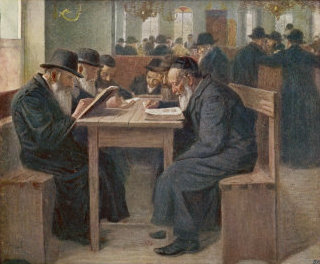
studying-talmudMany of these suggestions probably will seem strange or a poor fit for most Christians. But just look at the level of detail and organization that’s being suggested for Jews as they prepare for the single most holy time in their religious year. Imagine if we in the church were to go through such efforts in order to prepare for our own meeting with God.

I know that Christians and Jews differ on a fundamental level in how we see our service to God. For many Christians, service to God operates in an internal realm and is made up of faith, belief, and prayer. For most religious Jews, although those internal states are present, the main focus is behavioral, not conceptual. Giving to charity in preparation for a meeting with God is totally appropriate. So is taking a religious class, reading an inspirational book, studying relevant sections of the Torah, and reconciling with a friend from whom they have become estranged.

The month of Elul is an opportunity for Jews to review their lives and particularly their failings, and to generate efforts to make amends, to repair relationships, to turn away from sins, and to anticipate the future. In a month, Jews all over the world will approach the throne of God with fear, trembling, and rejoicing. Even on the Day of Judgment; on Yom Kippur, we can learn to dance with God, embracing His Awesome Holiness as both judge and teacher, knowing that we have prepared ourselves for the day of judgment and the day of forgiveness.

Did I say “we?”

The Days of Awe aren’t generally considered appropriate for Christians, but I don’t think it would actually hurt for us to accept Elul as a month of opportunity. Why can’t we use this time to prepare our hearts as well? Couldn’t just spending a little time learning about Rosh Hashanah and Yom Kippur benefit us? Might we not learn to feel just a tad bit more compassion for Jewish people if we learned how they see the God of Abraham and anticipate the Messiah?

We all fail. We all have shortcomings, even the best of us. We can either let that stand or we can do something about it. We can either maintain a “status quo” relationship with God or we can challenge ourselves to draw closer to Him. But that means we’ll have to go through the humiliating and painful process of making a detailed examination of who we are and what we have done to wrong God and to wrong other human beings. We will have to commit ourselves to fixing those damaged and broken relationships, as long as it is within our power to do so. (Romans 12:18)

The month of Elul is the month of reckoning. In the material world, if a businessman is to conduct his affairs properly and with great profit, he must periodically take an accounting and correct any deficiencies… Likewise in the spiritual avoda of serving G-d. Throughout the year all Israel are occupied with Torah, Mitzvot and (developing and expressing) good traits. The month of Elul is the month of reckoning, when every Jew, each commensurate with his abilities, whether scholar or businessman, must make an accurate accounting in his soul of everything that occurred in the course of the year. Each must know the good qualities in his service of G-d and strengthen them; he must also be aware of the deficiencies in himself and in his service, and correct these. Through this excellent preparation, one merits a good and sweet year, materially and spiritually.

“Today’s Day”
Shabbat, Menachem Av 27, 5703
Compiled by the Lubavitcher Rebbe
Translated by Yitschak Meir Kagan
Chabad.org

Failure is wasted if you return only to the place from where you fell. If your plans fail, think bigger, aim higher.

-Rabbi Tzvi Freeman
“Exploiting a Setback”
Based on letters and talks of the Rebbe
Rabbi M. M. Schneerson
Chabad.org

There is no higher goal to aim for than God.

Many Christians believe that devout Jews approach the Days of Awe only with fear of judgment and the almost panicky desire to avoid punishment by “doing things,” to appease an angry God. This couldn’t be further from the truth. Yes, acknowledging failures, confessing sins, and making amends is certainly very humbling and one should not approach an all-powerful God with a casual attitude, but (and my Jewish wife explained this part to me) this is also a wonderful opportunity. This is a wonderful opportunity for Jews to pick up what they’ve put off all year-long, to make their lives and the lives of others better, to improve their relationships, and to almost literally watch God punching the “reset” button on Jewish lives, making everything fresh and new.

While Christians (Jews, too) can do all these things at any time during the year, as human beings we tend to avoid difficult events and tasks. As I said before, the month of Elul is an opportunity to stop being lazy, to get into gear, and to make the effort to be better people that we’ve put off for so long. If this sounds like a terrific opportunity for Jewish people, why shouldn’t a few of us non-Jewish religious people take advantage of it, too?

God Have Mercy!

PleadIsn’t this strange, that a created being should take part in its own creation? Can a caricature hold the pencil in his artist’s hand? Can the characters of your own story edit your words? Can the figments of your own imagination tell you what to imagine?

Yet here we are, created beings pleading with our Creator, “Grant us life! Good life! Nice things! Be out there, in the open! Get more involved with your world!” Here we are, in the inner chamber of the Cosmic Mind, where it is determined whether we should be or not be, participating in that decision.

We are created beings, yet there is something of us that lies beyond creation.

-Rabbi Tzvi Freeman
“Pleading to Exist”
Based on letters and talks of the Rebbe
Rabbi M. M. Schneerson
Chabad.org

Earlier this week, I talked about how we are like plants in a garden that must cooperate with the gardener for our existence and well-being. Yesterday, I commented that we act as co-creators with God of the “rebooted” universe on Rosh Hashanah. In the words quoted from Rabbi Freeman above, we see that we are indeed unique created beings in that we participate in our own creation and continued development. We are the painting and God is the artist, but both God and man have their hands on the paints and brush. Yet, do we dare contend with God?

But who are you, a human being, to talk back to God? “Shall what is formed say to the one who formed it, ‘Why did you make me like this?’” Does not the potter have the right to make out of the same lump of clay some pottery for special purposes and some for common use? –Romans 9:20-21

Of course, God has the final say, as one of these men understood:

To some who were confident of their own righteousness and looked down on everyone else, Jesus told this parable: “Two men went up to the temple to pray, one a Pharisee and the other a tax collector. The Pharisee stood by himself and prayed: ‘God, I thank you that I am not like other people—robbers, evildoers, adulterers—or even like this tax collector. I fast twice a week and give a tenth of all I get.’

“But the tax collector stood at a distance. He would not even look up to heaven, but beat his breast and said, ‘God, have mercy on me, a sinner.’

“I tell you that this man, rather than the other, went home justified before God. For all those who exalt themselves will be humbled, and those who humble themselves will be exalted.” –Luke 18:9-14

Apparently, this is a lesson that the tax-collector knew all too well, but not so the Pharisee. The tax-collector wasn’t just asking God for goodness and favors, he was pleading for his very life. By comparison, the Pharisee was very confident in the status of his life and his relationship with God, but according to the Master, his confidence was very foolish. The Pharisee was depending only on his outward appearance and behaviors and assumed that if other people were impressed, God would be impressed, too. Not so.

“Woe to you, teachers of the law and Pharisees, you hypocrites! You clean the outside of the cup and dish, but inside they are full of greed and self-indulgence. Blind Pharisee! First clean the inside of the cup and dish, and then the outside also will be clean.

“Woe to you, teachers of the law and Pharisees, you hypocrites! You are like whitewashed tombs, which look beautiful on the outside but on the inside are full of the bones of the dead and everything unclean. In the same way, on the outside you appear to people as righteous but on the inside you are full of hypocrisy and wickedness. –Matthew 23:25-28

PrayingI’m not inditing all of the Pharisees and I don’t believe Jesus was either (consider Nicodemus), but he was declaring that many people in positions of religious authority were being hypocritical by behaving as if they were obeying God and harboring “hypocrisy and wickedness” inside.

It’s the same with us. Not only should we take the opportunity afforded by Rosh Hashanah to examine what we are doing, but what we have inside our hearts. Do we say we love our fellow man but curse him behind his back? Do we claim devotion to God but still deliberately sin in secret?

At sundown tonight, Rosh Hashanah begins and continues for two days. Like a certain tax collector, let us beg for God’s forgiveness, let us plead for a life with great dedication to God in the New Year ahead.

For the holiday, I won’t be submitting meditations on Thursday and Friday and because Shabbat begins when Rosh Hashanah ends, my next blog will be on Sunday morning.

L’shanah tovah tikatev v’taihatem. May you be inscribed and sealed for a good year.

New Genesis

New WorldOn Rosh Hashanah, G-d takes Himself to court. He looks down from above at this world and, as I’m sure you may realize, it doesn’t always look so good.

G-d is within this world as well. He is found in every atom of this world. It may sound strange, but this is what is happening: He as He is above takes Himself, as He is present within this world, to trial.

Only the soul of Man can argue on His behalf. So we do that, as lawyers for the defense. All that is required is to awaken the G-dliness within our own souls.

The spark of G-d within us below connects with the Infinite Light of G-d above. The circuit is complete and the universe is rebooted with a fresh flow of energy for an entire year.

-Rabbi Tzvi Freeman
“G-d’s Lawyers”
Based on letters and talks of the Rebbe
Rabbi M. M. Schneerson
Chabad.org

This is a very strange Rosh Hashanah meditation but then, Rosh Hashanah is a very strange time. I suppose you can look upon the quote from Rabbi Freeman as midrash, mysticism, or metaphor, depending on which one best fits your personality, but just how can God judge Himself? Isn’t He supposed to judge us?

Then I saw a great white throne and him who was seated on it. The earth and the heavens fled from his presence, and there was no place for them. And I saw the dead, great and small, standing before the throne, and books were opened. Another book was opened, which is the book of life. The dead were judged according to what they had done as recorded in the books. –Revelation 20:11-12

This image is very reminiscent of how Judaism pictures God during the High Holidays. According to the Talmud, the Book of Life is opened on Rosh Hashanah and closed again at the end of Yom Kippur. This event repeats on an annual basis. According to Christianity, the Book of Life is opened only once, as we see in the above-quoted passage from Revelation. While it may be difficult to imagine, I think that Christianity’s and Judaism’s different visions can be reconciled. I’ll get to that part in a minute. Back to my previous question.

How can God judge Himself? Isn’t He supposed to judge us?

When it was the sixth hour, there was darkness over all the land until the ninth hour. And during the ninth hour, Yeshua (Jesus) cried out with a loud voice, “Elahi, elahi, lemah shevaktani?” which is interpreted, “My God, my God, why have you abandoned me?”

Some of the men standing there heard and said, “Look! He is calling to Eliyahu!”

One of them ran and filled a sponge with vinegar. He placed it on a cane, gave it to him to drink and said, “Leave him alone, and let us see if Eliyahu will come to take him down!”

But Yeshua gave a loud cry and breathed out his life. –Mark 15:33-37 (DHE Gospels)

Here, perhaps we see God judging both Himself and us. If Jesus was meant to bear the sins of all mankind and to take the punishment that was upon us, this then is our judgment. That the judgment falls upon the King of Kings, the Son of God, he who is mortal and sent by the Divine, then in this, we can say that God judges “Himself”. That we are all created in God’s image and that the Divine spark resides in each of us can also be thought of as God “judging Himself”.

But didn’t all this happen only once? If so, why bother (at least from a Christian perspective) observing an annual Rosh Hashanah and Yom Kippur?

Time is not a train of cars hitched one to another, one year dragged along by the year preceding, the present hitched tightly to the past, the future enslaved to the present. Rather, every year arrives fresh from its Creator, a year that never was before and could never have been known before its arrival.

That is why we call Rosh Hashanah “the birthday of the world” in our prayers. The past has returned to its place, never to return. With the blowing of the shofar, the entirety of Creation is renewed. From this point on, even the past exists only by virtue of the present.

-Rabbi Tzvi Freeman
“Reboot”
Based on letters and talks of the Rebbe
Rabbi M. M. Schneerson
Chabad.org

Midrash, mysticism, or metaphor…take your pick. From the Lubavitcher Rebbe’s point of view, the Universe is recreated every year at Rosh Hashanah. The “reboot” opportunity for our lives isn’t just poetic imagery, it’s a metaphysical reality. Are you having trouble believing that? Then what about this?

For as high as the heavens are above the earth,
so great is his love for those who fear him;
as far as the east is from the west,
so far has he removed our transgressions from us. –Psalm 103:11-12

Then he adds:

“Their sins and lawless acts
I will remember no more.”

And where these have been forgiven, sacrifice for sin is no longer necessary. –Hebrews 10:17-18

Reboot t-shirtOnce redeemed, God not only forgives our sins, it’s as if our sins never existed in the first place. It’s as if our very lives have been “rebooted”, as if the person we were had died and in our redemption, we have become brand new (2 Corinthians 5:17). The Bible allows for a metaphysical reboot in the lives of human beings. Why not in the “life” of the Universe as well? Does the Universe have a “soul”? Rabbi Freeman seems to think so, along with an existence in space and time.

The universe has a soul. All that exists in the soul exists in space and in time.

In the cosmic soul there is a mind, a consciousness from which all conscious life extends.

In space, there is the Land of Israel, a space from where all space is nurtured.

In time, there is Rosh Hashanah, a time from which all time is renewed.

Rosh Hashanah, meaning Head of the Year. Not just a starting point, but a head. For whatever will transpire in the coming year is first conceived in these two days.

Midrash, mysticism, or metaphor…take your pick. From the Lubavitcher Rebbe’s point of view, Creation itself has a distinct and unique existence, not only as a physical reality, but as a mystic and metaphysical presence, expressed as a soul within a specific time and place. Existence is reset and a new life is begun at Rosh Hashanah and given a new heartbeat emanating from Israel and circulating its “blood” throughout the rest of the world. It’s as if Creation were a pool of water. Each year at Rosh Hashanah, God drops a pebble into the pool. The water is so disturbed that the ripples completely wipe away what had existed upon and within the water and everything becomes brand new again. A new universe, a new chance, a new life for each of us. A new relationship with God is offered if we want it. It’s as if salvation were given to us on Rosh Hashanah. For a Christian, it’s like being “saved” all over again.

Do we need to be saved each year? Maybe. I’m not saying salvation expires every year, but consider this, Christian. At some point in your life, you accepted the Lordship of Jesus over your entire being. Chances are, you had no idea what was going to happen next and how much you would have to change who you were and what you were doing. It was exciting at the time but, like your wedding day and the days afterward, what was once exciting and new can become an old, tired routine.

Rosh Hashanah is an opening of the door to the moment of salvation again. We can make a decision not to live within apathy or to settle for a second-best relationship with our Creator. We don’t even have to settle for a renewal of what once was. We can have it brand new, shining and perfect again.

God suspending the worldRosh Hashanah can be many things. When you are in a relationship with the One, Unique, Creative God, that relationship is not limited by physical and temporal boundaries. It exists on levels beyond which any human can experience. Nevertheless, those levels exist. We may not be acutely aware of them, but we can still take advantage of those places in time and space that man has not touched. God is there and God can do wonders. We can be His partner in those wonders and participate in recreating the Universe and recreating us. We can be new again, and the voices of God and man can echo back and forth between the Heavens and God’s footstool, upon which we dwell, as if reverberating between mirrors.

The words we say are spoken in the heavens. And yet higher. For they are His words, bouncing back to Him.

On Rosh Hashanah, we say His words from His Torah recalling His affection for our world; He speaks them too, turning His attention back towards our earthly plane.

We cry out with all our essence in the sound of the shofar; He echos back, throwing all His essence inward towards His creation.

Together, man and G-d rebuild creation.

Judgment is rendered and suspended. God and man together speak the Word in a shofar’s blast, and the Universe is again is new.

Rosh Hashanah begins at sundown on Wednesday, September 28th.

L’shanah tovah tikatev v’taihatem. May you be inscribed and sealed for a good year.