
 Question: According to Jewish Law and tradition, is it acceptable, discouraged or totally unacceptable for a Gentile to keep the Sabbath according to the regulations spelled out in the Torah and the Talmud and expounded upon by the Rabbis?
Answer: A non Jew is not allowed to keep Shabbos. Those that are in the process of converting make sure to do at least one thing on Shabbos that would normally not be allowed. For example they might carry something in their pocket.
The quotes above are part of a discussion group thread at judaism.stackexchange.com (and thanks to Judah Himango of the Kineti L’Tziyon blogspot for posting the link on his Facebook page). As you can see if you follow the conversation, it is generally discouraged for a non-Jew, Christian or otherwise, to attempt to observe the Shabbat in the same manner (if at all) as a Jew. The observations are apparently from the perspective of Orthodox Judaism, so Conservative and Reform Jews may have a somewhat more lenient viewpoint, nevertheless, the Shabbat is generally reserved for the Jewish people.
This doesn’t really upset most Christians since the Saturday Sabbath, as with most other aspects of “the Law,” was deemed done away with. While Christians generally worship on Sunday, it’s not really considered a “Sabbath” in the church, based on Pauls’ statement in Romans 14:5-6:
One person considers one day more sacred than another; another considers every day alike. Each of them should be fully convinced in their own mind. Whoever regards one day as special does so to the Lord.
This effectively obliterates the fourth commandment to “Remember the Sabbath day by keeping it holy” for Ten Commandments believing Christians, but apparently, that can’t be helped. The result is that the vast majority of both Christians and Jews believe that Shabbat observance cannot and should not be applied to Gentiles and that is that.
Almost.
There is actually a lot of conversation going on in various circles about Gentles and the Shabbat, even as we’ve seen at judaism.stackexchange.com. In actuality, it doesn’t seem totally forbidden for a non-Jew to keep the Shabbat, they just can’t keep it in a way that is consistent with religious Judaism. AskNoah.org, a site created within an Orthdox Jewish context and dedicated to serving Noahides (righteous Gentiles), has this to say.
Question: I’ve been told that a Noahide must “mark” the Sabbath in some way. Could you give me examples of ways to mark Sabbath in the manner of a Noahide?
Answer: A Noahide is allowed to mark the seventh-day Sabbath in some types of ways. But there must not be a belief or conviction that he or she has – or is allowed to take on as a Gentile – any religious obligation to rest from all productive activity on the Seventh Day, or on any other day. (Although indeed, there must be an intellectual recognition that G-d assigns a special quality to the Seventh Day, since that is part of the Torah of Truth).
The answer continues by providing a number of suggestions for the Noahide as far as “marking” the Shabbat, but such marking must be done without making a vow of any kind in relation with the Shabbat, and with the understanding that “marking” the Shabbat is totally voluntary.
The world of Messianic Judaism, as seen from the point of view of Jews who accept discipleship under Jesus (Yeshua) as the Jewish Messiah, take a similar point of view. We can see one such illustration in a recent comment Derek Leman made in response to something I said on one of his blog posts at Messianic Jewish Musings:
So, I think a Divine Invitation exists for non-Jews. I don’t think (and the apostles didn’t think) it is a Divine Obligation.
My advice for non-Jews keeping Shabbat: learn the traditional prayers and songs. Make some modifications in parts where the wording is about God’s special relationship with Israel. Someone ought to make a Shabbat Seder (the Friday night prayers) for non-Jews which respects the wording of special relationship between God and Israel and pictures non-Jews coming into the sign between God and Israel as co-participants (not replacements, see Exod 31:13).
 I’ve often said that I believe non-Jews who wish to honor God as sovereign Creator may do so based on Genesis 2:3, but AskNoah.org has a response for that as well:
Although it says in Genesis 2:1-3 that G-d designated the Seventh Day as holy and sanctified, don’t forget the basic principle that G-d did not limit Torah to always be a *chronological* account of events. In fact, G-d first dictated the book of Genesis to Moses shortly after the Israelites arrived at Mount Sinai. The first time there was any commandment about a special observance of a “Sabbath” was after the Israelites passed through the sea on dry land. When they ran out of the matzah they took out of Egypt, G-d provided them with mannah as food from Heaven. But no mannah fell on the Seventh Day. G-d instead provided a miraculous double portion on Friday afternoon, and He commanded the Israelites to remain in their camp on the Seventh Day. Moses explained to them that they were, from that time on, commanded to observe the Seventh Day as a day of rest and a holy Sabbath (Exodus 16:23). Thus, at the first mention of the Seventh Day in the text of Genesis, G-d told Moses to insert the information that He had blessed the Seventh Day (referring to the double portion of mannah that fell on Friday afternoon for the Israelites), and He made it holy (when He prohibited the Israelites from leaving their camp on that day).
It is true that in Judaism, the chronology of the writing and the order of events of and in the Torah aren’t considered to be strictly literal, so the authority answering the question about Genesis 2:1-3 may have a point. On the other hand, if we assume that there is a chronology to God’s creating the earth and that He actually “blessed the seventh day and made it holy,” relatively “soon” after He created the globe upon which we live, then the holiness of the Shabbat could precede the Sinai event by many hundreds or even thousands of years (or more).
Then we have another scripture which provides some illumination.
“And the foreigners who join themselves to the LORD,
to minister to him, to love the name of the LORD,
and to be his servants,
everyone who keeps the Sabbath and does not profane it,
and holds fast my covenant—
these I will bring to my holy mountain,
and make them joyful in my house of prayer;
their burnt offerings and their sacrifices
will be accepted on my altar;
for my house shall be called a house of prayer
for all peoples.”
The Lord GOD,
who gathers the outcasts of Israel, declares,
“I will gather yet others to him
besides those already gathered.” –Isaiah 56:6-8 (ESV)
This is very difficult to get around. While not a commandment, it certainly suggests that “foreigners” (non-Hebrews) not only may observe the Shabbat, but will derive some direct benefit for doing so, namely being brought to God’s “holy mountain”, which is probably the Holy Temple in Jerusalem, and having our offerings accepted by God in the Temple (and AskNoah.org does state that Gentiles will be able to worship at the Third Temple). Even the Master quotes the prophet Isaiah when he cries out that “‘My house will be called a house of prayer,’ but you are making it ‘a den of robbers” (Matthew 21:13).
I suppose Christians could say that the words of the prophet Isaiah were annulled when the Law was “nailed to the cross with Jesus”, but that hardly explains why Christ would quote prophetic words that would soon lose their power. Such a view also suggests that God’s Word is not eternal, so we have another puzzle when considering a traditionally Christian interpretation of scripture.
But if “Jewish” Shabbat observance is considered both by Christianity and by Judaism to be a dead issue for the Gentiles, why should the few of us who are not Jewish but who are drawn to the Shabbat care? Well, because we’re drawn and for whatever reason, God has written upon our hearts a desire to hold the seventh day as sacred.
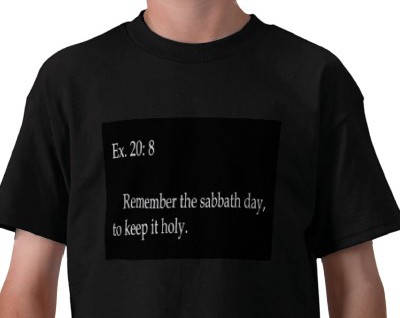 As I’ve mentioned elsewhere, I don’t think Judaism has much to worry about as far as Christian or “Messianic Gentile” Shabbat observance goes. I’ve never met a person who was not Jewish who kept the Shabbat with anywhere near the level of sanctity and detail as an Orthodox Jew, so it can be truly said that we “mark” the Shabbat without ever actually “keeping it holy,” at least to the measure of accepted Jewish halachah.
But what does God think of the disciples of Jesus keeping the Shabbat? Even if we are not commanded, are we allowed and is our rest pleasing to Him? Or was that last question moot?
Then he said to them, “The Sabbath was made for man, not man for the Sabbath. So the Son of Man is Lord even of the Sabbath.” –Mark 2:27-28
If the Savior and Messiah is Lord of the Shabbat, what does that mean for we non-Jews who are his disciples?
 Morning Meditations