Tag Archives: shabbat

Ki Tisa: Pursuing Tranquility

Inner lightThe Torah portion of Sisa contains an entire section (Shmos 31:13-18.) relating to Shabbos. It begins by stating that Shabbos is “a sign between Me and you for all generations, so that you know that I, G-d, am making you holy.” The section concludes: “And the children of Israel shall observe the Shabbos … as an everlasting covenant … for in six days G-d made heaven and earth, and on the seventh day He ceased working and rested.”

Why is Shabbos and its laws discussed here at such length, when it was already covered in detail (.Ibid., 20:8-11.) as part of the Ten Commandments?

Our Sages derive (Taanis 27b; Beitza 16a.) from the words “He ceased working and rested,” that “An additional [measure of] soul is granted [the Jew] on the arrival of Shabbos.

What exactly is meant by the statement that “an additional [measure of] soul is granted [the Jew] on the arrival of Shabbos”? According to the Zohar, this literally refers to an additional measure of spirituality that is granted from above as a gift on Shabbos.

“Shabbos and the Additional Soul”
Commentary on Torah Portion Ki Tisa
Based on the teachings of the Lubavitcher Rebbe
Rabbi Menachem M. Schneerson
Chabad.org

I sometimes have difficulty with the rather esoteric teachings of the Chasidic sages, and certainly imagining that an “extra soul” comes upon a Jewish person with the arrival of the Shabbat is a bit of a stretch for me. On the other hand, part of what is being communicated is that, for the Jew, Shabbat brings a special kind of peace and tranquility that cannot be found on the other days of the week. This could be more than simply choosing to refrain from normal work and focusing more on God, and contain a supernatural or even mystical component. After all, where God is involved, anything is possible.

Starting with my “morning meditation” Learning Acceptance, I have been attempting to “pursue peace” in a different manner or fashion than I have previously, making adjustments to my behavior and even my thoughts as I attempt to approach this goal. The arcane imagery of receiving an “additional Shabbat soul” is rather appealing, but the Chasidic teachings on Ki Tisa remind me of the demarcation line that is set between the Jew and the Gentile. According to the Chasidim, this “additional soul” of peace arrives on the Shabbat for the Jew and not for the Gentile, because only the Jew is set apart as holy (Exodus 31:13).

I suppose I could complain about this not being fair, but then I’m sure someone would remind me that life, and even God (although He is always just) are not always fair. But then, the Rebbe and the Chabad Rabbis are hardly taking the teachings of Jesus into consideration. Could there be a kind of peace we Christians can access as well?

Sometimes Christians don’t realize that Jesus, when he walked among men, observed the mitzvot of first century Judaism in the same manner as the other Jews in Israel, as did their fathers and their father’s fathers. The Shabbat was no stranger to Jesus, in spite of the fact that most Christians and Jews believe that Jesus actually taught breaking the Shabbat (which is untrue). His Jewish disciples would also have observed the Shabbat with their Master, and continued to do so in the manner of the Jews after the death, resurrection, and ascension of Christ. Paul, the Apostle to the Gentiles, and James, brother of the Master and leader of the Messianic council in Jerusalem, were also devout, Shabbat keeping Jews.

Although the exact form of the teaching from which I quoted above may not have been known to them, certainly the peace of the Shabbat would be all too familiar to the Jewish followers of the Way. In what manner, if any, would this special type of peace have been transmitted to the non-Jewish disciples, both in Roman occupied Judea and in the Greek diaspora?

There’s no way to know for sure, but it is likely that the Gentile disciples would have worshiped on Shabbat, if for no other reason, than because their Jewish mentors did so. It’s in the realm of the historians and the New Testament scholars as to whether or not the Gentile disciples attempted a form of Shabbat rest along with their Jewish counterparts, but usually, when someone is trying to learn a new type of worship, they do so by imitating an original model. This may be the reason the rather mysterious words of Acts 15:21 were recorded:

For from ancient generations Moses has had in every city those who proclaim him, for he is read every Sabbath in the synagogues.”

The Gentiles were assumed to learn the intricate details of the God of the Hebrews from hearing the readings of the Torah and the Prophets during Shabbat services, but that would presuppose that even a few Gentiles were in the synagogue for worship on Shabbat. Leaping forward twenty centuries, I know from my own experience, the beauty of witnessing the lighting of the Shabbos candles, and the sublime grace of welcoming the Queen into my home. I must admit that my family doesn’t keep the Shabbat as we’d like, but it remains an ideal and a goal toward which we strive.

Tranquility is also an ideal and a goal toward which I strive, even in a troubled world and in struggling with a troubled soul. I guess that’s what makes the idea of receiving an “additional soul” so appealing. But is receiving this “Shabbat soul” something the original non-Jewish disciples would have understood let alone attempted?

I don’t know. Maybe not.

I only know as an outsider looking in, the glow and warmth of Shabbat peace is attractive to me as well.

There are two aspects of Shabbat observance: outwardly, it is a day of rest, but inwardly, it is a time of soul-union with our Maker; in the same way the additional soul has an inner and outer purpose. This outer purpose is, as Rashi explains, an expanded heart, or in other words a sharpening of our sense perceptions comparable to the effect of mind-altering drugs which heighten the ability to see colors, taste food, appreciate sound, and the like. This outer purpose helps us fulfill the commandment of delighting in Shabbat.

From Rafael Moshe Luria; translated by Simcha H. Benyosef
“The Additional Shabbat Soul”
Kabbalah Online
Chabad.org

When Rabbi Eli Touger discusses the dynamics of the sin of the Golden Calf in his Ki Tisa commentary, he says:

Similarly, all the punishments suffered by the Jewish people throughout the centuries are connected to this sin (Sanhedrin 102b; Rashi, Exodus 32:35.). What place can such an event have in a portion whose name points to the Jews’ ascent?

To answer this question, we must expand our conceptual framework, for the state to which G-d desires to bring mankind is above ordinary human conception. This is indicated by the very expression: “When you lift up the heads”; “the heads,” human intellect, must be elevated.

Rabbi Touger shifts his focus from “the Jews’ ascent” to “G-d desires to bring mankind is above ordinary human conception.” That is, the focus shifts from Jews to everyone. Of course, it could just be assumed, given his context, that everything he presents is directed to Jews and that the nations are not to be considered, but how can we reconcile this with the concept that the Jews were to be a light to the nations, and that God so loved even the nations (John 3:16), who were also created in His own image (Genesis 1:27)?

Whatever the understanding of the Chasidim may be in relation to Gentiles, God, and peace, the emissary to the Gentiles had this to say:

Rejoice in the Lord always; again I will say, rejoice. Let your reasonableness be known to everyone. The Lord is at hand; do not be anxious about anything, but in everything by prayer and supplication with thanksgiving let your requests be made known to God. And the peace of God, which surpasses all understanding, will guard your hearts and your minds in Christ Jesus. –Philippians 4:4-7 (ESV)

While this doesn’t address a Shabbat peace, it is an encouragement from our ancient Jewish mentor for the Gentile disciples to also seek peace through “prayer and supplication” and that “the peace of God, which surpasses all understanding, will guard your (our) hearts and your (our) minds in Christ Jesus.” Tranquility for the non-Jewish disciple then, is not considered unattainable nor forbidden.

But what about this “extra soul?”

So Peter opened his mouth and said: “Truly I understand that God shows no partiality, but in every nation anyone who fears him and does what is right is acceptable to him.

While Peter was still saying these things, the Holy Spirit fell on all who heard the word. And the believers from among the circumcised who had come with Peter were amazed, because the gift of the Holy Spirit was poured out even on the Gentiles. For they were hearing them speaking in tongues and extolling God. Then Peter declared, “Can anyone withhold water for baptizing these people, who have received the Holy Spirit just as we have?” –Acts 10:34, 44-47 (ESV)

I know. I’m stretching the metaphor completely out of shape, but when we among the nations accept the Spirit of God as disciples of the Jewish Messiah, do we not also inherit the ability to seek the peace Paul describes in Philippians? I mentioned previously that peace was as much a matter of practice as it is a thing of the spirit, but I think the two need to go together.

This brings up a curious discussion I had in a series of private messages on a Christian forum not too long ago. A person suggested that not all Christians possess the “indwelling of the Holy Spirit.” His evidence (or at least part of it) was that not all (and maybe not most) Christians experience speaking in tongues and the (temporary) gift of prophesy, as we see described in Acts 2 and Acts 10, when they declare Christ as Lord and Savior (that is, convert to Christianity). We also see (Matthew 7:23, Luke 13:27) that not everyone who believes they belong to Christ really have that relationship, and will be rejected by Jesus when he returns. Is it possible for me to “believe” and yet not “belong?” After all, there is a precedence illustrating that people can “confess Christ” and yet experience a delay between that confession and the actual receiving of the spirit. What if a person declares Jesus as Lord but never receives the Holy Spirit? Would there be no peace? Would there be no salvation? Is that person’s faith in vain?

On the other hand, the Ethiopian eunuch was baptized in water and rejoiced without any outward evidence of receiving the Spirit.

And the eunuch said to Philip, “About whom, I ask you, does the prophet say this, about himself or about someone else?” Then Philip opened his mouth, and beginning with this Scripture he told him the good news about Jesus. And as they were going along the road they came to some water, and the eunuch said, “See, here is water! What prevents me from being baptized?” And he commanded the chariot to stop, and they both went down into the water, Philip and the eunuch, and he baptized him. And when they came up out of the water, the Spirit of the Lord carried Philip away, and the eunuch saw him no more, and went on his way rejoicing. –Acts 8:34-39 (ESV)

Or am I making this harder than it really is?

In spite of Jewish exclusivity in relation to the Shabbat in general and a special peace with God in specific, perhaps pursuing tranquility is as simple as setting the rules and commentaries aside and simply opening up the heart and accepting God. Faith is knowing God exists. Trust is knowing that when you open the door and invite Him in, He enters. His Word is a “lamp unto my feet” (Psalm 119:105) not only on Shabbat, but always. Or it’s supposed to be.

True happiness is the highest form of self-sacrifice.
There, in that state, there is no sense of self
—not even awareness that you are happy.

True happiness is somewhere beyond “knowing.”
Beyond self.

All the more so when you bring joy to others.

-Rabbi Tzvi Freeman
“The Highest Happiness”
Based on letters and talks of the Rebbe
Rabbi M. M. Schneerson
Chabad.org

Good Shabbos.

Slaves of Grace

On today’s amud we find that one should enter and leave shul in a manner that demonstrates that he cherishes his time there.

Once there was an extremely wealthy man who lived quite close to his synagogue. Although he could have easily walked the short distance, he would choose to ride on his very expensive mount to the Beit Knesset, since he felt it befitted his distinguished stature. Someone pointed out to this man that it may be preferable to walk the distance. The wealthy man enjoyed riding to synagogue but he wanted to go the best way according to halachah, so he consulted with the Ben Ish Chai, zt”l.

“It is better to go on foot,” the Ben Ish Chai ruled. “We see this in Sotah 22. The gemara there recounts that a certain widow used to pray in Rav Yochanan’s beis medrash even though she lived closer to a different beis medrash. When Rav Yochanan asked her why she went out of her way to come to her shul, she replied, ‘I come here to receive reward for each step!’ This implies that the reward for going out of one’s way is only if one troubles himself to walk on his own two feet, not if one rides!

The Ben Ish Chai continued, “We see this in Chagigah as well. A small child is not obligated to be olah l’regel because he can’t walk to the Beis Hamikdash himself. Beis Hillel rule that a child is not obligated until he is old enough to hold his father’s hand and walk on his own two feet from Yerushalayim to Har Habayis. Although those who were very distant from Yerushalayim would surely ride, clearly one should walk as much as possible, as implied on Chagigah 3… For the above reasons, you should walk to synagogue on your own two feet, regardless of your honor and status!”

Mishna Berura Yomi Digest
Stories to Share
“Reward for Every Step”
Shulcham Aruch Siman 151 Seif 5

Although the vast majority of Christians worship on Sunday, it isn’t really a “Sabbath” in the Jewish sense of the term. We don’t really rest because of the “freedom of Christ.” Grace not only allows us to mow the lawn, shop for groceries, pay the bills, and watch the news on Sunday, it fairly demands that we do, in order to “prove” that we’re not “under the Law.” Saturday, for most Christians, has nothing to do with God. Neither does Friday night. There is no candle lighting just before sundown. There are no hymns or prayers sung to welcome God into our homes on this special, holy day. We do not allow ourselves to rest from the mundane chores of life while partaking of an extra portion of the holiness in the Almighty. The church acts as one body for maybe a couple of hours on Sunday morning, but that’s about it for most of us. Then it’s business as usual.

But we’re free, unlike those poor Jewish people who can’t do hardly anything from Friday night until Saturday night. Poor people who are under the Law.

I say all of this with a sense of irony of course, because I believe it’s not the Jews who should be pitied in this instance, but the Christians. We have allowed ourselves to be robbed of one day of peace out of seven, where we can actually permit ourselves to stop in our wild pursuit of the “rat race,” crawl out of our mazes, and actually enjoy the freedom of worshiping God, not only in church, but in our homes, on our streets, in our parks, anywhere we are. But we don’t do that because we are “free.” We don’t do that because only those people who are “enslaved” to the Torah allow themselves to be confined with God within the walls of His holiness for a full 24+ hours.

Oh how awful for them.

I’m sure you see where I’m going with this. According to the sages, a non-Jew is forbidden from observing the Shabbat in the manner of the Jews. Part of this has to do with something I read just last Shabbat.

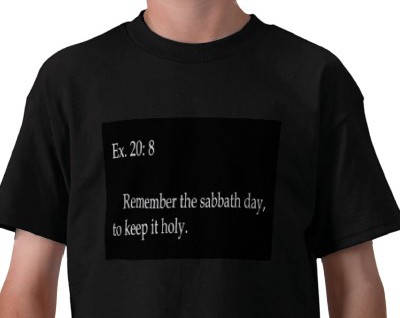
Remember the sabbath day and keep it holy. Six days you shall labor and do all your work, but the seventh day is a sabbath of the Lord your God: you shall not do any work — you, your son or daughter, your male or female slave, or your cattle, or the stranger who is within your settlements. For in six days the Lord made heaven and earth and sea, and all that is in them, and He rested on the seventh day; therefore the Lord blessed the sabbath day and hallowed it. –Exodus 20:8-11 (JPS Tanakh)

The Shabbat is considered a special commemoration of the deliverance of the Children of Israel from slavery in Egypt…something we non-Jews did not experience. It’s a special part of the Sinai covenant relationship between God and the Jews, even to this day. Yet, I “miss” it, not that I have ever fully been able to rest on the Shabbat. Even at my very best, there was always a number of ways I could have rested better. I rationalized my behavior saying that I had to drive to my place of worship, heat my coffee in the morning, edit the lesson I was going to teach, check my email in case someone needed some help with something right before services. It’s the diaspora, not Israel.

But then, I’m not Jewish, so maybe it doesn’t matter.

But I wonder. If resting and honoring God for a full day is good for Jews, why isn’t it good for Christians? If we are forbidden by the Rabbis from remembering and observing the Shabbat in a traditionally Jewish manner (not that most Christians acknowledge any authority of the Rabbinic sages over the life of a believer), can we not choose to still offer our rest and our worship in some manner or fashion? The Shabbat not only commemorates the freedom Jews enjoy from the bondage of Egypt, it acknowledges that God is Creator over all.

On the seventh day God finished the work that He had been doing, and He ceased on the seventh day from all the work that He had done. And God blessed the seventh day and declared it holy, because on it God ceased from all the work of creation that He had done. –Genesis 2:2-3 (JPS Tanakh)

It is said that a Jew who does not observe the Shabbat is denying God’s sovereign claim over Creation. But Creation exists for the Gentile and the Jew. The sun shines as much on us as it does them. The rain waters our fields as well as a Jew’s fields. The breeze cools both Jew and Gentile in the summer, and we both  experience heat, and cold, and wind, and all the manifestations of Creation. The stars look just as beautiful to us, and the moon rises and sets for us, too. Can the Gentile not acknowledge Creator and Creation along with the Jew? Should not the Gentile also acknowledge Creator and Creation along with the Jew?

Shabbat candlesI’m not suggesting that Christians everywhere should suddenly start donning kippot and singing in Hebrew every Friday night as they light Shabbos candles, but I am suggesting that some sort of observance wouldn’t be out of line, either. Why were we in the church taught that it’s a bad thing to give honor to God because He created the Universe? I know the answer, of course. But the answer isn’t a valid one. In separating ourselves from Judaism early in the history of the church, we didn’t just hurt our Jewish mentors, ignore the Jewish Apostles, and dishonor our Jewish Jesus, we hurt and dishonored ourselves. The Jews rest on Shabbat and are free to honor God. We work, both on the Christian “Shabbat” and on the Jewish Shabbos and we call ourselves free. Then we work Monday through Friday as well. So who’s free and who’s a slave?

We’ve come to expect instant results. Perhaps the speed of today’s latest “on demand” technology or the abundance of resources in our global community have trained us to feel this way, but it’s become natural to assume that most problems will be solved within 24 hours or less. This expectation obviously leads to disappointments, and we’re forced to learn the art of patience even when the answers seem but a click away.

One of the laws in the construction of the Holy Temple’s altar is that the ascent to the top must be upon a ramp and not a staircase “so that your nakedness will not be revealed on it” (Exodus 20:23). Unlike a staircase, a ramp’s incline is small and gradual, forcing a more gentle ascent for the Temple priest.

Personal growth follows the same pattern. When we’re inspired to change, we might expect a decision to change to be instantly transformational. Taking leaps and bounds towards the new behavior, we seem like new men. Then the “nakedness” is “revealed,” the surprising reality that change is not overnight, and we’re often discouraged and revert to the old habits. Often the result is that we become more deeply entrenched in our destructive patterns.

Inspiration to grow, to ascend the altar, is what starts the engine, but when going forward — beware of your speed limit!

Rabbi Mordechai Dixler
“Watch Your Speed Limit”
ProjectGenesis.org

Would it be such a bad thing for a Christian to slow down once a week and learn to really appreciate what God has done for us?

The Lord’s Sabbath

ShabbatQuestion: According to Jewish Law and tradition, is it acceptable, discouraged or totally unacceptable for a Gentile to keep the Sabbath according to the regulations spelled out in the Torah and the Talmud and expounded upon by the Rabbis?

Answer: A non Jew is not allowed to keep Shabbos. Those that are in the process of converting make sure to do at least one thing on Shabbos that would normally not be allowed. For example they might carry something in their pocket.

The quotes above are part of a discussion group thread at judaism.stackexchange.com (and thanks to Judah Himango of the Kineti L’Tziyon blogspot for posting the link on his Facebook page). As you can see if you follow the conversation, it is generally discouraged for a non-Jew, Christian or otherwise, to attempt to observe the Shabbat in the same manner (if at all) as a Jew. The observations are apparently from the perspective of Orthodox Judaism, so Conservative and Reform Jews may have a somewhat more lenient viewpoint, nevertheless, the Shabbat is generally reserved for the Jewish people.

This doesn’t really upset most Christians since the Saturday Sabbath, as with most other aspects of “the Law,” was deemed done away with. While Christians generally worship on Sunday, it’s not really considered a “Sabbath” in the church, based on Pauls’ statement in Romans 14:5-6:

One person considers one day more sacred than another; another considers every day alike. Each of them should be fully convinced in their own mind. Whoever regards one day as special does so to the Lord.

This effectively obliterates the fourth commandment to “Remember the Sabbath day by keeping it holy” for Ten Commandments believing Christians, but apparently, that can’t be helped. The result is that the vast majority of both Christians and Jews believe that Shabbat observance cannot and should not be applied to Gentiles and that is that.

Almost.

There is actually a lot of conversation going on in various circles about Gentles and the Shabbat, even as we’ve seen at judaism.stackexchange.com. In actuality, it doesn’t seem totally forbidden for a non-Jew to keep the Shabbat, they just can’t keep it in a way that is consistent with religious Judaism. AskNoah.org, a site created within an Orthdox Jewish context and dedicated to serving Noahides (righteous Gentiles), has this to say.

Question: I’ve been told that a Noahide must “mark” the Sabbath in some way. Could you give me examples of ways to mark Sabbath in the manner of a Noahide?

Answer: A Noahide is allowed to mark the seventh-day Sabbath in some types of ways. But there must not be a belief or conviction that he or she has – or is allowed to take on as a Gentile – any religious obligation to rest from all productive activity on the Seventh Day, or on any other day. (Although indeed, there must be an intellectual recognition that G-d assigns a special quality to the Seventh Day, since that is part of the Torah of Truth).

The answer continues by providing a number of suggestions for the Noahide as far as “marking” the Shabbat, but such marking must be done without making a vow of any kind in relation with the Shabbat, and with the understanding that “marking” the Shabbat is totally voluntary.

The world of Messianic Judaism, as seen from the point of view of Jews who accept discipleship under Jesus (Yeshua) as the Jewish Messiah, take a similar point of view. We can see one such illustration in a recent comment Derek Leman made in response to something I said on one of his blog posts at Messianic Jewish Musings:

So, I think a Divine Invitation exists for non-Jews. I don’t think (and the apostles didn’t think) it is a Divine Obligation.

My advice for non-Jews keeping Shabbat: learn the traditional prayers and songs. Make some modifications in parts where the wording is about God’s special relationship with Israel. Someone ought to make a Shabbat Seder (the Friday night prayers) for non-Jews which respects the wording of special relationship between God and Israel and pictures non-Jews coming into the sign between God and Israel as co-participants (not replacements, see Exod 31:13).

Shabbat candlesI’ve often said that I believe non-Jews who wish to honor God as sovereign Creator may do so based on Genesis 2:3, but AskNoah.org has a response for that as well:

Although it says in Genesis 2:1-3 that G-d designated the Seventh Day as holy and sanctified, don’t forget the basic principle that G-d did not limit Torah to always be a *chronological* account of events. In fact, G-d first dictated the book of Genesis to Moses shortly after the Israelites arrived at Mount Sinai. The first time there was any commandment about a special observance of a “Sabbath” was after the Israelites passed through the sea on dry land. When they ran out of the matzah they took out of Egypt, G-d provided them with mannah as food from Heaven. But no mannah fell on the Seventh Day. G-d instead provided a miraculous double portion on Friday afternoon, and He commanded the Israelites to remain in their camp on the Seventh Day. Moses explained to them that they were, from that time on, commanded to observe the Seventh Day as a day of rest and a holy Sabbath (Exodus 16:23). Thus, at the first mention of the Seventh Day in the text of Genesis, G-d told Moses to insert the information that He had blessed the Seventh Day (referring to the double portion of mannah that fell on Friday afternoon for the Israelites), and He made it holy (when He prohibited the Israelites from leaving their camp on that day).

It is true that in Judaism, the chronology of the writing and the order of events of and in the Torah aren’t considered to be strictly literal, so the authority answering the question about Genesis 2:1-3 may have a point. On the other hand, if we assume that there is a chronology to God’s creating the earth and that He actually “blessed the seventh day and made it holy,” relatively “soon” after He created the globe upon which we live, then the holiness of the Shabbat could precede the Sinai event by many hundreds or even thousands of years (or more).

Then we have another scripture which provides some illumination.

“And the foreigners who join themselves to the LORD,
to minister to him, to love the name of the LORD,
and to be his servants,
everyone who keeps the Sabbath and does not profane it,
and holds fast my covenant—
these I will bring to my holy mountain,
and make them joyful in my house of prayer;
their burnt offerings and their sacrifices
will be accepted on my altar;
for my house shall be called a house of prayer
for all peoples.”
The Lord GOD,
who gathers the outcasts of Israel, declares,
“I will gather yet others to him
besides those already gathered.” –Isaiah 56:6-8 (ESV)

This is very difficult to get around. While not a commandment, it certainly suggests that “foreigners” (non-Hebrews) not only may observe the Shabbat, but will derive some direct benefit for doing so, namely being brought to God’s “holy mountain”, which is probably the Holy Temple in Jerusalem, and having our offerings accepted by God in the Temple (and AskNoah.org does state that Gentiles will be able to worship at the Third Temple). Even the Master quotes the prophet Isaiah when he cries out that “‘My house will be called a house of prayer,’ but you are making it ‘a den of robbers” (Matthew 21:13).

I suppose Christians could say that the words of the prophet Isaiah were annulled when the Law was “nailed to the cross with Jesus”, but that hardly explains why Christ would quote prophetic words that would soon lose their power. Such a view also suggests that God’s Word is not eternal, so we have another puzzle when considering a traditionally Christian interpretation of scripture.

But if “Jewish” Shabbat observance is considered both by Christianity and by Judaism to be a dead issue for the Gentiles, why should the few of us who are not Jewish but who are drawn to the Shabbat care? Well, because we’re drawn and for whatever reason, God has written upon our hearts a desire to hold the seventh day as sacred.

As I’ve mentioned elsewhere, I don’t think Judaism has much to worry about as far as Christian or “Messianic Gentile” Shabbat observance goes. I’ve never met a person who was not Jewish who kept the Shabbat with anywhere near the level of sanctity and detail as an Orthodox Jew, so it can be truly said that we “mark” the Shabbat without ever actually “keeping it holy,” at least to the measure of accepted Jewish halachah.

But what does God think of the disciples of Jesus keeping the Shabbat? Even if we are not commanded, are we allowed and is our rest pleasing to Him? Or was that last question moot?

Then he said to them, “The Sabbath was made for man, not man for the Sabbath. So the Son of Man is Lord even of the Sabbath.” –Mark 2:27-28

If the Savior and Messiah is Lord of the Shabbat, what does that mean for we non-Jews who are his disciples?

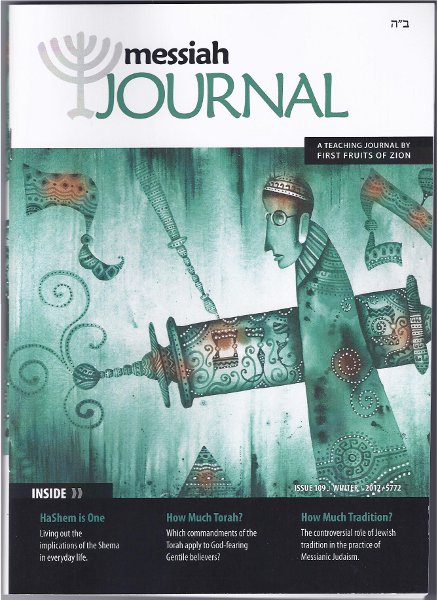
Messiah Journal: Excerpt from “Origins of Supersessionism in the Church”

Yeshua not only defined himself as the gateway to salvation, but commanded his Jewish disciples to do something that had never been done before. Yeshua commanded his Jewish disciples to make non-Jewish people disciples in a Jewish sect that followed the Messiah and worshiped the God of Israel. Yeshua identifies his Jewish disciple Peter as the rock upon which he will build the Messianic community (Matthew 16:18). Acts 4 shows us that thousands of Jews came to faith in the Messiah well before the time when Paul began to actively seek non-Jewish disciples. We also see in Acts 15 that the Jewish Jerusalem council exercised authority over the Gentile assembly of the Messiah. With the foundation of the early Messianic community being so thoroughly Jewish, how did a concept like supersessionism even come into being? Actually, the seeds of this rather ugly plant began to sprout early.

Excerpt from the article
“Origins of Supersessionism in the Church”
by James Pyles
Messiah Journal
Issue 109/Winter 2012

I just received my advance copy of the latest edition of Messiah Journal (MJ) and of course, as it contains my first article published in religious literature, I’m more than thrilled. I showed my wife and she said that she will have to read it, which is even more intriguing (as surprising as it may sound, she doesn’t often read my material). I hate to admit this, but like many authors, I really enjoy seeing my work in print. I suppose it is the same feeling a painter has when he or she sees their work on display in an art gallery.

But I shouldn’t forget everything else this issue of MJ has to offer. I haven’t had the opportunity to read it yet (so I can’t review its contents), but I’ve looked through this issue and there are definitely some submissions I’m anxious to dig into.

There’s an article written by Tsvi Sadan called “Halachic Authority in the Life of the Messianic Community”. Apparently, it was delivered as a lecture to Messianic leaders in Israel in September of 2008 as the “final chord of a debate between those Messianic Jews who teach to live according to Jewish tradition and those who view this tradition as ‘the leaven of the Pharisees and Sadducees.'” This discussion has taken place in the Messianic blogosphere fairly recently, such as in Judah Himango’s blog post Kosher Jell-O, and whether Messiah’s disciples need our own ruling body, as well as on my own blog in the write up Tradition! (and as always, some of the most interesting parts are in the comments sections).

I must admit, I will probably dive into Sadan’s article first, but I also want to read Russ Resnik’s “Shema: Living the Great Commmandment” (Part 1). I’m also very interested in Toby Janicki’s article “The Gentile Believer’s Obligation to the Torah of Moses”, which is also a topic of great interest among non-Jews who are attracted to Jewish religious lifestyle and worship. I believe MJ has had similar articles in the past and want to find out if this is just a reworking of material with which I’m already familiar or something entirely new. I know I’ve been challenged on this topic by comments made on my own blog very recently, both in Defining Judaism: A Simple Commentary and The Focus and the Lens, so I’m hoping for some “re-enforcement” to augment my own knowledge in this area.

For tomorrow’s “morning meditation,” I’m posting a blog on Gentiles and the Shabbat, and Aaron Eby has an article in the current issue of MJ called “Fire by Night: Lighting the Shabbat Candles” which (you should pardon the pun) should prove illuminating. That’s not all of the contents of issue 109 of MJ but those are the highlights. Of course, if you find all of that tantalizing, don’t forget my own article on the origins of supersessionism in the church, how the seeds were first planted, who the major players were, and how the history points to modern times.

If you don’t already regularly receive issues of Messiah Journal, go to the First Fruits of Zion (FFOZ) website and order issue 109 today. I’m really looking forward to reading it myself.

Vayetze: The Shabbat Heritage

In the Torah portion Vayeitzei , G-d blesses Yaakov, declaring to him: (Bereishis 28:14) “You shall spread out to the west, to the east, to the north and to the south.” The Gemara comments: (Shabbos 118a) “Whoever delights in the Shabbos receives an unlimited heritage, as is written: (Yeshayahu 58:14) ‘Then you shall delight in G-d… and I will nourish you with the heritage of Yaakov,’ of whom it is written: ‘You shall spread out to the west, to the east….’ ”

The reward for the performance of a mitzvah is, of course, measure for measure. (See Sotah 8b, 9b. See also Tanya ch. 39) What aspect of the mitzvah of Shabbos causes its reward to be “an unlimited heritage”?

Shabbos differs from all other mitzvos in that the performance of other mitzvos is achieved through labor and action. There are thus differences between the manner in which a very righteous individual will perform a mitzvah and the manner in which it will be performed by a simple person.

Observing Shabbos, however, consists of a cessation from labor. With regard to “not doing,” all Jews can be equal.

“Shabbos – An Unlimited Heritage”
Commentary on Torah Portion Vayeitzei
Based on Likkutei Sichos , Vol. XV, pp. 226-229
and the teachings of the Lubavitcher Rebbe
Rabbi Menachem M. Schneerson
Chabad.org

I know a discussion of Shabbat observance seems pretty far afield in relation to a plain reading of this week’s Torah Portion, but this is the association I found in the Chassidic Dimension’s commentary. Christianity has difficulty with some of the “linkage” offered by the Rabbis between specific events described in the Torah (the blessing God gives to Jacob in Genesis 28:14) and much larger and seemingly unrelated topics, but if you choose to look at them as metaphor, it’s a little bit easier to comprehend.

I’ve always had issues with reserving Shabbat to just the Jewish people. There are plenty of other commandments and blessings that I have no problem with being uniquely Jewish, but a weekly Shabbat rest in order to devote our thoughts and prayers to God? Why should only Jews do this? God sanctified the day at the end of Creation.

And God blessed the seventh day and declared it holy, because on it God ceased from all the work of creation that He had done. –Genesis 2:3 (JPS Tanakh)

OK, I’m not that naive. God also directly associated the Shabbat with the Exodus from Egypt, thus:

Remember that you were slaves in Egypt and that the LORD your God brought you out of there with a mighty hand and an outstretched arm. Therefore the LORD your God has commanded you to observe the Sabbath day. –Deuteronomy 5:15

In doing my research for this morning’s “meditation”, I came along an interesting forum discussion on the topic of Shabbat and the Exodus at judaism.stackexchange.com where a similar question was raised by one man’s four year old son:

Why do you say “Mitzrayim” in Kiddush every week? “Mitzrayim” is a Pesach word!

Minus the Hebrew (which I can’t reproduce here), the father added a follow up question:

Tack-on question: Once you’ve established that Shabbat is linked both to Creation and to the Exodus, why is the terminology in Kiddush for these links slightly different? Shabbat is called – “a memorial to the deed of Creation” and – “commemorating the Exodus from Egypt” (translations from Wikipedia; emphases mine).

You can go to judaism.stackexchange.com and read the entire thread. I can certainly see how the Shabbat is inexorably linked to the Jewish liberation from slavery in Egypt and how saying the kiddush on every Erev Shabbat commemorates the Exodus event for the Children of Israel.

But must the Shabbat observance be exclusively for the Jews?

The reason why all Jews are entirely equal with regard to the mitzvah of cessation of labor on Shabbos stems from the fact that the mitzvah of Shabbos touches the essence of the Jewish soul. Differences between one Jew and another exist only on an external level; with regard to their essence, they are all equal.

The Chabad commentary describes why all Jews are equal on the Shabbat, regardless of social status or other apparent divisions, because of their Jewish souls, but the Shabbat also separates Jews and Gentiles. Is the “essence” between Jewish and Gentile souls so incredibly different that we non-Jews cannot also connect to the Shabbat?

Some non-Jews, such as those associated with the “Messianic” movement, chafe when told by some Jews that the Gentiles, Christians or otherwise, are not commanded to observe the Shabbat and there is no penalty for a Gentile who fails to observe a Shabbat rest in the manner commanded for Jews. OK, I’ll buy that part, but what about Gentiles observing the Shabbat as a moral conviction and in acknowledgment of God’s creative sovereignty over the universe? We all live in Creation and God made the Gentile as He made the Jew. Is it so bad if a Christian were to rest on the Shabbat as “a memorial to the deed of Creation?”

Being married to a Jew, I have sort of a built-in reason for observing Shabbat, though my wife and I don’t do this as well as we would like. Christianity cast off the Jewish form of Shabbat observance and worship along with anything else in Christian practice that could even remotely be considered Jewish thanks to the birth and expansion of Supersessionist theology in the 2nd and 3rd centuries CE, but this has been more harm to us than to the Jews.

Rabbi Shmuley Boteach has, on various occasions, suggested that Jewish values, including the Shabbat, should be disseminated to the nations, at least in some fashion, which never fails to cause a stir, both in Jewish and in Christian circles. But while the Chabad commentary says that the Jewish people enjoy an “unlimited heritage” due to their Shabbos observance, can not the rest of us choose to at least honor God’s absolute rule of Creation by honoring the Shabbat? Do we dilute Jewish uniqueness if we quietly light the candles on Friday night as well, praising and thanking our King and our God?

There’s nothing higher than finding truth on your own.

All worlds were made, all barriers put in place, every veil over G-dliness hung, and the soul plummeted from its pristine height into the confusion of this harsh world—

—all for this one thing alone: That you should uncover truth on your own.

-Rabbi Tzvi Freeman
“The Highest High”
Based on letters and talks of the Rebbe
Rabbi M. M. Schneerson
Chabad.org

In spirit and in truth I wish you all Good Shabbos.

Ki Tavo: Blessings of the Soul

BikkurimOne of the major thrusts in Judaism is hakaras hatov, appreciation of the good which G-d constantly bestows upon us. And as with appreciation of our fellow man, the emphasis is on appreciating not only the material dimension of G-d’s kindness, but also the love and care which He showers on every person.

In this vein, we can understand the sequence of our Torah reading, Parshas Ki Savo. The reading begins by describing the mitzvah of bikkurim (Deuteronomy 26:1-11), the first fruits which the Jews would bring to the Beis HaMikdash, and shortly afterwards speaks of a covenant concerning the entire Torah (Deuteronomy 26:16)

What is the connection between these subjects?

The mitzvah of bikkurim was instituted to show that our gratitude for the good G-d has granted us (Rashi, gloss to Deuteronomy 26:3), and to display our appreciation to Him for “granting us all the blessings of this world.” (Sefer HaChinuch, mitzvah 606) And this appreciation is not expressed merely by words of thanks, but through deed.

-Rabbi Eli Touger
Ki Savo commentary: “Entering Deeper and Deeper”
In the Garden of Torah
Chabad.org

There’s a tendency among people of faith to separate their lives into the holy and the mundane. It is holy to pray in the morning before work, and it is mundane to commute to work. It is holy to worship in church or synagogue, but it is mundane and ordinary to have a meeting at work, have dinner with your family, volunteer at the food bank, and to give to charity. Yet we see in the example set in this week’s Torah Portion Ki Tavo that in the process of the bikkurim, there is an intimate connection between appreciating the gifts of the physical world and the loving providence of God.

The bikkurim is an illustration of the Jewish expression of appreciation to God for the gift of the Land of Israel and its bounty, but how else can such appreciation be expressed and experienced?

Our Sages teach (Bava Basra 9b): “A person who gives a coin to a poor person is granted six blessings; one who gratifies him is blessed elevenfold.” Now, gratifying does not necessarily mean giving more money. It means giving a positive feeling, showing the recipient that you care about him, and that he means something to you. When one so invests himself in another person, putting enough of himself into the stranger that the person feels appreciated, he has given something far greater than money. And so he receives a more ample blessing from G-d.

Our own sage, the “Maggid of Nazaret” teaches a similar lesson:

Jesus sat down opposite the place where the offerings were put and watched the crowd putting their money into the temple treasury. Many rich people threw in large amounts. But a poor widow came and put in two very small copper coins, worth only a few cents.

Calling his disciples to him, Jesus said, “Truly I tell you, this poor widow has put more into the treasury than all the others. They all gave out of their wealth; but she, out of her poverty, put in everything—all she had to live on.” –Mark 12:41-44

What is “value” in the eyes of God and “worth” in the economy of Heaven? It isn’t our ability to pay or to provide for others or even to God, but our intent, willingness, and expression in helping the unfortunate. A poor widow can donate a a very small amount (although it is great to her since it is all she has to live on) and have it be worth more than all of the gifts of the wealthy, even though what they give can feed multitudes of the impoverished.

To continue quoting from Rabbi Touger:

This leads to a deeper concept: Appreciation stems from involvement; the deeper the relationship between people, the more one appreciates the uniqueness of the other. When a person appreciates a colleague, he is motivated to do whatever he can for that other person.

These concepts apply, not only to our relationships with our fellow man, but also to our relationship with G-d.

What we do for others relates directly back to how we express our appreciation for all God has done for us. In fact, there is probably a closer connection between acts of charity to others and our appreciation of God than we might imagine:

“Then the righteous will answer him, ‘Lord, when did we see you hungry and feed you, or thirsty and give you something to drink? When did we see you a stranger and invite you in, or needing clothes and clothe you? When did we see you sick or in prison and go to visit you?’

“The King will reply, ‘Truly I tell you, whatever you did for one of the least of these brothers and sisters of mine, you did for me.’ –Matthew 25:37-40

HomelessIn Judaism, the first blessing offered to God, the Modeh Ani, is given before the person even gets out of bed, but it is performed while the person is not quite awake. Later in the day, observant Jews recite the Modim blessing of the Shemoneh Esreh, and offer a more complete expression of thanks, yet this is only part of offering our hearts to God. The physical acts of kindness to others and the illustration of the bikkurim are both tangible and concrete, yet representative of traveling into the greater depths of spiritual dimensions where prayers and blessings alone cannot take us. So even in giving to others as an expression of appreciating the life God gives to us, we also get something back; the opportunity to serve the table of the King.

Once the Chasam Sofer, zt”l, was riding in the same carriage as his rebbe, Rav Nosson Adler, zt”l. It was a very cold day and the Eastern European roads were filled with snow and slush. One wrong turn could land a person into a sticky quagmire from which he would not easily get out. During the first leg of the trip, the wagon driver managed to extricate them each time
the horses got stuck. Eventually, however, the horses enter a muddy pit from which they could not budge. Although they tried, they lacked the physical strength to get that wagon out of the mud.

After coaxing the team for an extended time, the wagon driver understood that his efforts were futile and that he needed help. He unhitched one of the horses and rode to a nearby town. After some time the wagon driver returned with reinforcements to remove the wagon. When Rav Nosson Adler saw them coming he left the wagon. He rushed out so quickly that he didn’t even put on his boots. In his silk socks he jumped down from the wagon and then—to the surprise of the Chasam Sofer—he began to dance. His face shone with a holy fire and he was obviously overjoyed.

The Chasam Sofer wondered what it was that had made his rebbe so happy that he spontaneously began to dance. “You know I spend most of my day in the beis midrash. I do as many mitzvos as I can, but there are many mitzvos which are virtually impossible for me to fulfill. One of these unusual mitzvos is to avoid kil’ayim.

“But now don’t you see? The wagon driver brought a team of oxen to help pull his wagon out of the mud. As a non-Jew, this is his right, but we are forbidden from sitting in the wagon while it is being towed out by a mixed team. If we would have sat in the wagon we would have violated the prohibition of kil’ayim. Now that I have finally merited to fulfill this rare mitzvah I feel filled with joy and cannot stop myself from dancing!”

Daf Yomi Digest
Stories Off the Daf
“A Mixed Team”
Chullin 79

While this example of gratitude and appreciation may seem obscure and even nonsensical to someone without the benefit of a traditional Jewish religious education, if you take a moment to think about it, this is a story of a rare opportunity. Bringing the illustration back to the present, those opportunities that God gives us to serve others, even when they significantly interrupt our otherwise orderly and scheduled lives, are really opportunities for our benefit. Helping someone else not only benefits the other person, and it not only lets us bless God for all He has done for us, it is also the act of God blessing us by letting us be of further service to Him. In committing even the smallest act of repairing the world, God is giving us His loving compassion by repairing us, for there is no difference between helping another person, honoring God, and receiving God’s blessings on our soul.

In every person, there lie all souls that ever were and will be.

After all, humanShabbat candles consciousness began in a single being, with a single breath of G‑d within that being.

And so, just as every cell of the human being contains the blueprint of every other cell and of the entire person from the synapses of his brain to the swirls of his fingerprints, so every single person contains the entire humankind.

In this way, our Creator has rendered each of us the master of human destiny. In the liberation of any one of us lies the liberation of us all.

-Rabbi Tzvi Freeman
“Any Soul”
Based on letters and talks of the Rebbe
Rabbi M. M. Schneerson
Chabad.org

Good Shabbos.