Tag Archives: shabbos

Being Kept By Shabbos

hillel_shammaiYou shall honor it [Shabbos] by refraining from your usual weekday practices, nor pursuing your business, nor speaking thereof.

Isaiah 58:13

The observance of Shabbos and the festivals is characterized by not only abstinence from work, but also from all types of “weekday” activities, including even how one converses.

“Your conversation on Shabbos should not be similar to your weekday conversation”

-Shabbos 113b

A personal incident illustrates that by properly honoring the Shabbos and festivals, one achieves the respect of others.

As a resident in psychiatric training, I explained to the program director that I was unable to work on the festival days, and that these should be considered vacation days and deducted from my allotted vacation time.

The director shook his head. “No need for that,” he said. “Non-Jewish people can do anything they wish on their holidays. If they can wash the car, paint the garage, or go to the theater, then they can just as well come to work. In your case, you are not permitted to do anything, so obviously you cannot come to work, and this need not affect your vacation time.”

It has been said, “Even more than Israel has kept the Shabbos, the Shabbos has kept Israel.” If we honor the Shabbos properly, the Shabbos will honor us.

Today I shall…

…dedicate myself to a full observance of Shabbos and the festivals.

-Rabbi Abraham J. Twerski
“Growing Each Day – Tammuz 24”
Aish.com

This, as much as anything, illustrates the difference between the Jewish Shabbat and the Christian Sunday or “Lord’s Day.” I don’t doubt that the very first non-Jewish disciples of the Jewish Messiah observed a Shabbat in the same or similar manner as the Jewish disciples. Frankly, they wouldn’t have known any better, and a Sunday “Lord’s Day” probably wouldn’t even have occurred to them. Why would it?

Shifting the primary day to gather for worship from Saturday (Friday night to Saturday night, actually) to Sunday was most likely one of those acts designed to create a definition between Judaism and a Gentile Christianity. I can understand, to some degree, the desire to honor the day of Messiah’s rising from the tomb (although in Jewish reckoning, Jesus rising on the first day of the week could have happened anytime after sundown on Saturday), there’s nothing clear cut in the New Testament that says it was God’s intent.

However, there are just tons of references in the Tanakh (Old Testament) that speak of the Shabbat being observed on the seventh day, and as I said, the fact that Messiah came, taught, died, resurrected, and ascended never caused a ripple in Jewish Shabbat observance, just as it never caused a ripple in Jewish observance of any other part of the Torah or the normative halachah of the day.

But even if Gentile Christianity intended to lift Shabbat as a unit and move it over by about twenty-four hours, that wasn’t the end result. As Rabbi Twersky’s commentary tells us, an observant Jew’s response to Shabbat is quite a bit different than how a Christian spends his or her time on Sunday.

According to Chabad.org, there are thirty-nine melachot or forms of work that are prohibited to a Jewish person on Shabbos. Besides just the raw list presented at that site, how they are interpreted adds to the understanding of what must be avoided. From a Christian point of view, it all seems terribly restrictive and burdensome, and most Gentile believers having read such a list no doubt would rejoice in their “freedom in Christ.”

shabbat-candle-lightingBut our “holy day” isn’t all that holy if we don’t actually set it apart by behaving and even speaking differently.

I’ve discussed this with my Pastor and he believes the Ten Commandments, which includes the commandment to observe Shabbat, have universal applications. However, he does not believe that the day of the week is strictly fixed. I’m not sure what his rationale is for such a belief. He is usually very exact in his thinking and his attitude about Shabbat seems a little “fluid.”

I know that most Jewish people would deny that there is any direct command from God to the Gentile believers to observe Shabbos, especially in the manner of the Jewish people. There are some Gentiles who believe they are commanded and, in some manner or fashion, they do observe Shabbat. I don’t believe there are many who do so exactly like a modern, Orthodox Jew, and I’ve had a conversation with one Gentile believer who observes the Shabbat but who told me he retains the right to not make it burdensome (for instance, he feels free to turn light switches on and off, drive his car, use elevators, and so forth).

I used to keep a “sort of” Shabbat, but it was nowhere near the level of observance of most religious Jews. My wife is Jewish and, sad to say, not particularly observant (for the moment…I’m hoping that will change), and so in our household we don’t have much of a Shabbat. If I have the opportunity, I try to spend most of my day reading the Bible or related texts but if the situation calls for it (including the “honey-do list” situation), I can be found violating quite a few of the melachot.

But I think there is something special about setting aside one day of the week as Holy to God and dedicating ourselves to observing that day, to using the time to draw closer to God and to withdraw somewhat from the world around us.

I can’t imagine the Messianic age not including a Shabbat observance for all of the disciples of Messiah. It would seem strange at that point to segregate such observance by Jewish and Gentile populations and, after all, even the Gentile nations will be commanded to observe Sukkot and to send representatives to Jerusalem.

Then it will come about that any who are left of all the nations that went against Jerusalem will go up from year to year to worship the King, the Lord of hosts, and to celebrate Sukkot. And it will be that whichever of the families of the earth does not go up to Jerusalem to worship the King, the Lord of hosts, there will be no rain on them. If the family of Egypt does not go up or enter, then no rain will fall on them; it will be the plague with which the Lord smites the nations who do not go up to celebrate Sukkot. This will be the punishment of Egypt, and the punishment of all the nations who do not go up to celebrate Sukkot.

Zechariah 14:16-19 (NASB)

I replaced the phrase “the Festival of Booths” with “Sukkot” in the above-quoted passage to emphasize the nature of what is being commemorated. “Festival of Booths” somehow puts a “Christian spin” on what is quite obviously Jewish.

And yet, the nations are commanded to commemorate Sukkot in Messianic Days. So too the Shabbat?

“Also the foreigners who join themselves to the Lord,
To minister to Him, and to love the name of the Lord,
To be His servants, every one who keeps from profaning the sabbath
And holds fast My covenant;
Even those I will bring to My holy mountain
And make them joyful in My house of prayer.
Their burnt offerings and their sacrifices will be acceptable on My altar;
For My house will be called a house of prayer for all the peoples.”
The Lord God, who gathers the dispersed of Israel, declares,
“Yet others I will gather to them, to those already gathered.”

Isaiah 56:6-8 (NASB)

Shabbat candlesIt would certainly seem, based on this passage, that the nations (foreigners) who are joined to God not only will be required to observe Shabbat, but will also be allowed to pray in the Temple and to even bring sacrifices.

I’m certainly in no position to go around pointing fingers at Christians about what they do with their time on Saturday or Sunday, but I do want to suggest that some day, our rather casual attitude about Shabbat will have to change. There are many passages in the New Testament telling us that the Master will return “like a thief in the night” and that we will have no idea the day or hour of his coming back to us. We are told to be constantly be prepared and ready, day and night, for the bridegroom’s return.

“Even more than Israel has kept the Shabbos, the Shabbos has kept Israel.”

If the Master’s return comes that suddenly and unexpectedly, then our only hope of being ready is to always be ready. Maybe it wouldn’t hurt for us to practice a more focused Shabbat or two before he gets here.

The Unintentional Shabbos Christian

Shabbat candlesIf a non-Jew lit a candle [for himself], a Jew may also benefit from it. If the non-Jew lit it for the Jew, this is prohibited.

-Shabbos 122a

The Mishnah discusses the case where a gentile lit a candle on Shabbos. If he lit it for himself, the Jew may sit in that illuminated area and benefit from the light. However, if the gentile lit the light for the sake of the Jew, the Jew may not benefit from the light.

There is a variance among the Rishonim in explaining the reason why it is prohibited for a Jew to benefit from labor which a gentile performed (on his own) on Shabbos for the sake of the Jew. Tosafos ( ד”ה ואם ) and Rambam (6:18) explain that if a Jew would be allowed to have this labor done for him, we are concerned that the Jew would then give outright instructions to the gentile to do the labor for him. Rashi and Ran (Beitza 24b) write that it is simply prohibited for the Jew to benefit from labor done for him on Shabbos.

Ritva writes that according to the understanding of Rambam and Tosafos, it might seem that we have arranged a rabbinic precaution (not to benefit from labor done by a gentile) to safeguard another rabbinic injunction (lest we come to give instructions to a gentile outright). This seems to be in violation of the general rule that we do not establish גזירה לגזירה . Nevertheless, the correct explanation is that this is simply a one-staged enactment. The sages set into motion protective measures to ensure that the Shabbos remain special. In order to set it aside and different from the other days of the week, it was necessary to disallow benefiting from the labor performed by a gentile, either when he does it for us by himself without being asked, or whether he does it when asked to do so. These guidelines are all part of the same approach to preserve the sanctity of Shabbos.

Daf Yomi Digest
Distinctive Insight
“Preserving the sanctity of Shabbos – through speech”
Commetary on Shabbos 122a

It’s been a particularly cold and icy winter here in Southwest Idaho. Fortunately, it’s warmed up some lately to near normal temperatures for this time of year, but in the past two weeks, lows have been in the single digits and into negative numbers while highs never got anywhere near above freezing. Ice on the roads and sidewalks has been particularly hazardous, and I know of many people, including several in my family, who have fallen and become injured.

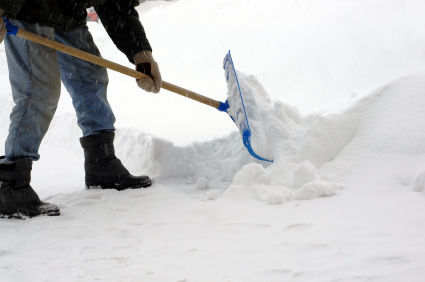
But most winters, it’s just the typical matter of shoveling snow off the driveway and sidewalks and being cautious when driving to and from work. I was remembering a typical “snow shoveling” winter of a few years ago that was like the one I just described while reading the above-quoted commentary. It was on a Sunday morning (before I went back to church) and I had some time on my hands. I had finished shoveling the snow off of my own drive and sidewalks, but on Sunday, it can be a chore for some of my “church-going” neighbors to shovel and get ready to go to services. So I decided to just keep going and to clear the driveways and sidewalks of a couple of other houses near me. I know one neighbor in particular whose family goes to church early and generally has a full day of it. I shoveled off their drive and walk while they were gone.

One of the things about me doing such things is that I don’t like to be noticed (kind of hard when you’re standing in the middle of someone’s driveway with a big, orange snow shovel, I must admit). But I thought I’d gotten away with it. I thought no one would figure out it was me. That is, until my neighbor came over later that afternoon to say “thanks.” He was appreciative because Sunday is indeed a very busy day for him and he didn’t know when he’d be able to get around to shoveling his snow. It was a big help.

I don’t say all this to make myself sound like a big deal, though, but I do have a point. Be patient.

Now imagine my neighbor is an Orthodox Jew and all this is happening on Saturday instead of Sunday. Further imagine that my neighborhood is within walking distance of an Orthodox synagogue (it’s not, but let’s pretend). Now let’s say I know my neighbor and his family are Jewish and I know that they walk to shul on Saturday morning. They’ve probably already left for services and I know they won’t be shoveling snow on Shabbos. As a Christian, it would be a nice thing for me to help them out and shovel their driveway and sidewalk.

But will they see it that way? Sure, they didn’t ask me to do it for them (which would be forbidden), but technically, they can’t benefit from my labor if I did it to benefit them. Could they even walk on the sidewalk and the driveway I shoveled for them upon their return from shul? Frankly, I don’t know, but in my eagerness to be “a good Christian neighbor,” I may have actually caused more of a problem than a help.

Why am I saying all this?

shoveling-snowLast week, I wrote a large number of “meditations” that addressed how Jews who are Messianic may view a life of halachah in relation to their discipleship under Messiah Yeshua, Christ Jesus. It’s a controversial topic, certainly for Christians and even for a number of Jewish people, but it’s one that needs to be discussed. In reading the commentary on Shabbos 122a just a few days ago, I started to wonder how “Christian generosity” and Jewish observance of Shabbos could unexpectedly collide, producing undesirable results. Granted, the Christian in my imagination was just trying to be a good neighbor and lend a hand, but especially an Orthodox Jewish neighbor might have a fundamentally different way of looking at such “help.” This is what happens when we don’t understand each other.

Granted, in this day and age, people who live in the suburbs next to each other or across the street from each other, don’t get to be friends or acquaintances the way we did when I was a child. Often people don’t even wave “hi” to each other when they are both out in their front yard or passing each other on the street.

But if part of being a Christian is loving your neighbor as yourself, and chances are you know a little bit about yourself, how can you be sensitive to your neighbor’s needs if you don’t know what those needs they are. Snow on a driveway and a sidewalk may seem to tell you want your neighbor requires, but you can’t really go by superficial appearances. Who is your neighbor? How can you help him?

If you, as a Christian, have a Jewish neighbor, and you want to be a good neighbor, it might help if you got to know him a little bit. However, we Christians have other Jewish “neighbors” who may not live near us, but who are connected because our “salvation comes from the Jews.” (John 4:22). Whether your Jewish neighbor is someone who lives near you or, in a more expansive sense, is your “neighbor” because he is a child of God like you, how can you become aware of his needs, and of Israel’s needs, if you don’t know what those needs are?

Addressing my last question, Boaz Michael recently posted a new blog article called Three Kinds of Churches pt.2. It includes a section called “Churches that align with Israel” and the description of such churches (and Christian people) may well be part of the answer we need.

Do not judge your fellow until you have stood in his place.

-Pirkei Avot 2:5

Adapting Hillel’s famous statement, we also can’t be a good neighbor, until he have stood in his place, or perhaps just started a conversation with him.

An Opinion of a Shabbos Goy

grandma-wheelchairQuestion: My granddaughter is becoming bat mitzvah, and my 92-year-old mom is saying she will not be able to go because she cannot drive on Shabbat. But is it allowable—for this special occasion—for her to violate Shabbat just this once? The way I see it, this is a once-in-a-lifetime situation, making it quite okay to drive. This is her first great-granddaughter to reach bat mitzvah, and unfortunately she probably will not be around to celebrate this milestone with any of her other great-grandchildren.

Answer: This is an important question, for it leads us to a central theme in Judaism.

It’s easy to relate to a mitzvah as tradition or symbolism. Perhaps, taking it one step further, a mitzvah is divine advice on how to live the best life possible—the most meaningful, the most blessed.

If we would accept either of those definitions, we would have to agree that fulfilling mitzvot depends on the situation. We would say that yes, tradition is important, living a meaningful life is important, but in this situation there is something else more traditional and more meaningful—so we would use our judgment as to what takes precedence.

But that isn’t so. A mitzvah is precious not just because it is a tradition and has meaning to us. A mitzvah is G‑d’s own will and infinite wisdom. If so, a mitzvah’s incredible power and the blessing it brings is infinite in nature. It’s a connection to an infinite G‑d, way beyond our own understanding. It goes beyond the benefits and meaning we sense—though that’s important as well—for it is part of the divine. And a G‑dly formula for living is not subject to man deciding whether it is or isn’t relevant in a particular situation. (It is only when the Torah itself instructs us to put aside Shabbat, as in to save a life, that Shabbat laws should be disregarded.)

We might feel that a hike to the top of a mountain will be a more spiritual experience than a trip to the synagogue. Or that the pastrami from the new “kosher style” delicatessen will make the bat mitzvah a more joyous experience. Or, in a far more subtle manner, the situation here: that a great-grandmother being at the family celebration outweighs the prohibition of driving. And that’s when we remember that a G‑dly mitzvah is eternal, and extends far, far past the benefits we happen to sense . . .

Your grandmother should most certainly be at this bat mitzvah. It is only that you will need to find a way for this to happen in a permissible manner. Have you looked into her staying within walking distance from the synagogue? If this is not a possibility, you can speak to the rabbi about having a non-Jew wheel her to the synagogue (a subject beyond the scope of this e‑mail).

Mazel tov, and may you have much nachas from the entire family!

-Rabbi Yisroel Cotlar
“Can We Drive Grandma on Shabbat?”
Chabad.org

I suppose, even if I were currently tempted to convert to Judaism, this is one of the reasons I could never be a Jew. I understand, at least to a degree, the principle that Rabbi Cotlar is trying to communicate, but from my point of view, human compassion has to take a back seat to obedience to the mitzvot regarding not driving on Shabbos (maybe saying that makes me a bad person, I don’t know). Worse than that, I don’t understand the Rabbi’s advice about having a non-Jew wheel her to the synagogue (if it would help and if this were happening now in my community, I’d be more than willing…but there seems to be a problem).

It is forbidden for us to tell a gentile to perform work on the Sabbath on our behalf, although they are not commanded [to observe] the Sabbath. [This applies] even when the instructions were conveyed to them before the Sabbath and we do not require [the products of] their work until after the Sabbath.

The above is forbidden as a Rabbinical prohibition to prevent the people from regarding the Sabbath lightly, lest they perform [forbidden] labor themselves.

On the other hand…

[The following rules apply] when a gentile performs a [forbidden] labor on the Sabbath on his own accord: If he performed it on behalf of a Jew, it is forbidden to benefit from that labor until one waits the amount of time necessary to perform the labor on Saturday night.

[The latter leniency is granted] provided the matter is not public notice – i.e., everyone knows that a particular task is being performed for a person on the Sabbath.

If [the gentile] performed [the labor] for his own sake alone, it is permitted to benefit from it on the Sabbath.

Halacha 1 and Halacha 2 from
Chapter six of Mishnah Torah, Sefer Zemanim, Shabbos
Translated by Rabbi Eliyahu Touger
Chabad.org

Shabbat candlesLacking the educational background (as well as an ethnic, cultural, and lived Jewish experience), I admit that I can’t really interpret what is being said here and whether or not a non-Jew would really be permitted to “wheel grandma” to the synagogue on Shabbos if asked by her Jewish relatives. It seems a little dodgy to me, but then again, admittedly the nuances of interpreting Mishnah Torah escape me.

On the other hand, what should we say…that man was made for the Shabbat rather than the Shabbat being made for man?

One Sabbath he was going through the grainfields, and as they made their way, his disciples began to pluck heads of grain. And the Pharisees were saying to him, “Look, why are they doing what is not lawful on the Sabbath?” And he said to them, “Have you never read what David did, when he was in need and was hungry, he and those who were with him: how he entered the house of God, in the time of Abiathar the high priest, and ate the bread of the Presence, which it is not lawful for any but the priests to eat, and also gave it to those who were with him?” And he said to them, “The Sabbath was made for man, not man for the Sabbath. So the Son of Man is lord even of the Sabbath.”

Mark 2:23-27 (ESV)

I included the entire section of scripture relevant to this situation rather than just quoting verse 27 because I’m aware that the circumstances Jesus was describing may not be directly associated with “driving grandma to synagogue.”

If grandma could stay Friday night within walking distance of the synagogue (assuming she can walk adequately at age 92), then I understand that would be acceptable. If grandma could stay the night within walking distance of the synagogue but could not walk, while I am “unclear” of the legitimacy of asking a “Shabbos Goy” to wheel her to shul, I’d accept that as an alternative from my Christian perspective. But if no halachically acceptable alternative were available, and grandma really, really wanted to attend her great-granddaughter’s bat mitzvah (and/or great-granddaughter really, really wanted great-grandma to be there for this once-in-a-lifetime event), then I’d drive grandma to shul (I know…she would be violating Shabbos by even accepting the ride).

I know this isn’t a life or death situation but I can’t set aside the feelings of the great-grandmother in question or her great-granddaughter either. Besides, according to one person’s comment on the matter, there is precedent for an alternative:

I think of the Rev that chopped wood and made soup for a helpless woman in her bed on Yom Kippur -she had just given birth) Sometimes it is necessary to hurt ourselves spiritually in order that another rmay grow or even live. However, I am loving ths suggestion of staying with her family for the entirety of Shabbat or the motor home. How important will the young ladies’ Bat Mitzvah be to her without Grandma there? How will that affect her walk with Hashem? We will never know. Some souls are mighty sensitive. Will this suck out all of the girl’s joy, what a sin that would be. Have her expectations been considered?

-Emily

I remember reading of this “Chasidic tale” so I think there is a value in Judaism that would allow an individual to violate Shabbos for the sake of another, even when their life is not at risk.

Here are a few more comments:

I proposed some questions to Rabbi Manis Friedman years ago relating to the halachot of shabbos. His answer? Shabbos is shabbos. End of story.

-Anonymous

I wasn’t raised Orthodox and don’t have a full understanding of this. But my argument would be that just because rabbis declared that driving, or even riding in a car, violates the Sabbath, doesn’t make it so. I don’t know, but my guess is that at the time, there were probably arguments going both ways.

-R. Baron

i’m a committed but not orthodox Jew and am fascinated by the question and your response.

The alternatives you gave were good; you may want to consider a nearby hotel for Friday night also. But to the heart of the matter, you mentioned consideration of what is ‘most meaningful, etc.’

I believe keeping the great-grandmother away from attending and participating would be cruel. since the question comes up –and Chabad is consulted –it implies she has done a great job in raising a Jewish family.

shabbat_walkI do not believe the divine would want her to miss it and this is not a question of climbing a mountain on shabbat or going to a ‘kosher style deli.’

-Oppie

Apparently, this isn’t a clear-cut issue for at least some Jewish people, either. I know. I’m probably going to “catch heck” from my Jewish friends who read this blog and maybe a few “Judaically-aware” Christians as well. I know that if someone who is shomer Shabbos is lenient on a rare occasion, it may lead to greater lenience and finally to habitually “cheating” on the Shabbat, but on the other hand, isn’t it possible to be too rigid? If a “hedge” is placed around the mitzvot to prevent a Jew from even coming near to violating Shabbos, isn’t it possible the hedge can become too extreme?

My perspective can be easily dismissed with a “you aren’t Jewish and so you don’t understand,” but as I mentioned (and demonstrated) above, even other Jewish people have a hard time with this one. My response (and this is quite a counterpoint to my Shabbat commentary from the other day), all other reasonable alternatives failing, is that I’d find a way to get grandma to shul for the bat mitzvah. I don’t think God would really mind, but then again, how am I to tell?

Tasting Chicken Soup

chicken-soup-with-matzah-ballsPicture the scene: Dead, feathered birds are lying on the kitchen counter; a bag of flour has spilled onto the floor, along with a orange juice—and so, the two-year-old is having a lovely time creating edible mud pies from the mix. From upstairs, a scream shakes the house—it’s the little one furious at the big one for making her bathtub too hot. Meanwhile, the big one is kvetching at the top of her voice because “there’s nothing for me to wear.” The father of the house is hiding somewhere, in full knowledge that if he shows his head, he’ll be sent out again on another urgent, last-minute errand.

At this point, the doorbell rings. It’s the nudnik guest, delivering his gift bottle of wine in advance, certain that the lady of the house has nothing better to do this afternoon than stand at the door and chat. She is careful to open the door only a slight 20 degrees, wedging herself into the space—first, so that the guest won’t see the state of affairs within; but also to prevent the little one who has just escaped from his hot tub from running out naked into the street.

The guest sniffs the air, and sighs, “Ahhh . . . Shabbos!”

Shabbos? Shabbos is a day of rest! Of peace! Of harmony! This is a total disaster zone!

But the guest smells what is coming. And the inhabitants of this house know as well. They know the dead birds will become a sumptuous chicken soup, the remainder of the flour will become fresh-baked challah, the children will be neatly dressed in their finest clothes, the father will turn up again, and they will all sit together at the table, singing in harmony and telling the stories and words of Torah they learned in school that week.

When you know the story, the scene becomes a different scene. The gadget in your pocket, the news on the tab before this one, the financial chaos and the promises of technological breakthrough, the void of leadership and the medical miracles that keep failing to come—think of those as the dead, feathered birds on the kitchen counter, soon to become a sumptuous chicken soup.

Science has opened our eyes to the awesome harmony of our world. The Kabbalah of the Ari, explained in the language of Chabad, can open anyone’s eyes to the G‑dliness behind that harmony. Shortly, we will sit at the Shabbos table with Moshiach, who will show how the earthly wisdom and the heavenly wisdom complement one another. While we are yearning for that knowledge, what is stopping us from tasting a spoonful of the soup right now?

-Rabbi Tzvi Freeman
“The Last Day of History”
Chabad.org

This is the climax to a rather lengthy and challenging article my wife shared with me the other day. I must admit to having skimmed over much of the content, but this portion is not only straightforward but rather the point of it all. I don’t mean that it’s the point of the article, although I suppose it is, I mean that it’s the point of everything.

For we who have believed enter that rest…

Hebrews 4:3 (ESV)

The writer of Hebrews and Rabbi Freeman seem to be drawing their respective audiences to the same point: that we will one day enter into that final rest with the Messiah. What is especially attractive about Rabbi Freeman’s perspective is that a foretaste of that rest exists right now. Jews experience a small sampling from the “menu” of the Messiah’s table every Shabbat. Some Christians who are attached to the traditional Jewish community, Messianic Judaism, or Hebrew Roots, also have the opportunity to experience that “rest” and sample from the “menu” to varying degrees.

As far as I can tell, most Christians don’t.

Shabbat-Made-Easy-paintingI think that “Christ’s rest” is something that is more conceptual within Christianity. Most Christians anticipate being “raptured” and going up to Heaven of course, but there’s no idea that you can get a preview of the event before the event, at least not very frequently. There’s no manner of experiencing such an event in the material world because the “Messiah’s rest” is thought to be wholly spiritual.

More’s the pity.

I miss even the tiniest sliver of Shabbos observance in which my family used to participate. Hopefully, by God’s mercy, my wife will desire to observe the Shabbat again as her life calms down, and our home will be illuminated and warmed by the Shabbos candles once more.

I’m sure what I’m saying seems totally alien to most Christians. How can we experience the return of Jesus Christ before he returns? It must seem ridiculous.

But think about it.

In the U.S., we’ve recently celebrated Thanksgiving and most Christians are anticipating Christmas in just a few weeks. One of my favorite parts of Thanksgiving is the aroma of delicious foods in the kitchen. I traditionally barbecue the turkey in a Weber on the back patio, so in tending to it, I get to enjoy the smells of the slowly roasting bird as the smoke curls into the air. These smells all by themselves are highly pleasurable and also herald the grand feast that is to come.

And that is Shabbat. We know the feast will come but we also have a role in preparing for the feast. How many “feast” metaphors did Jesus use to describe the preparations for his own return and King and Bridegroom? Here’s just one of them.

“Then the kingdom of heaven will be like ten virgins who took their lamps and went to meet the bridegroom. Five of them were foolish, and five were wise. For when the foolish took their lamps, they took no oil with them, but the wise took flasks of oil with their lamps. As the bridegroom was delayed, they all became drowsy and slept. But at midnight there was a cry, ‘Here is the bridegroom! Come out to meet him.’ Then all those virgins rose and trimmed their lamps. And the foolish said to the wise, ‘Give us some of your oil, for our lamps are going out.’ But the wise answered, saying, ‘Since there will not be enough for us and for you, go rather to the dealers and buy for yourselves.’ And while they were going to buy, the bridegroom came, and those who were ready went in with him to the marriage feast, and the door was shut. Afterward the other virgins came also, saying, ‘Lord, lord, open to us.’ But he answered, ‘Truly, I say to you, I do not know you.’ Watch therefore, for you know neither the day nor the hour.

Matthew 25:1-14 (ESV)

There’s preparation. There’s work to be done. There’s waiting. And then finally, sometimes unexpectedly, the Prince arrives and the feast begins.

But in cooking a meal, how many chefs manage to taste a bit here and a bit there, making sure the seasoning is just right, adding a spice or an herb to enhance the flavor?

I suppose that’s what Christmas is to most Christians…celebrating the birth of Jesus and his first entry into the world in anticipation of the second. That’s probably why Easter is also observed with such zeal (and a meal), to rejoice over the risen Jesus and to pray that he returns soon.

But while Judaism also has its great festivals, they also have Shabbos, the weekly reminder. Going to church on Sunday just doesn’t compare.

challahFor a Jew, six days of the week are spent in pursuit of the mundane, taking care of business, and sometimes letting life take over or overwhelm. Shabbos is bringing order to chaos and peace to turmoil. Even the preparations for Shabbos can seem maddening, much like life itself, but the result is wonderful, much like Messiah’s coming.

In God’s wisdom, He gave the Shabbat to the Jewish people as a sign of His covenant with them. Alas, it did not transfer to we Christians when we were brought into the fold. But sometimes you need rest and refreshment in order to summon courage for what is to come and to lay down the burden of what’s already happened. I don’t observe Shabbat these days, but I hope I will again. You may not observe Shabbat either, but it’s something you can access if you choose.

Messiah may come today, tomorrow, next year, or a thousand years hence. But Shabbos comes every week. Why wait? The Challah is rising in the oven and pots are steaming and bubbling on the stove. Have a taste of chicken soup now. It’s delicious.

70 Days: The Lost Shabbat

Shabbat candlesWhen Lemech named his new son (at the end of last week’s reading, Gen. 5:29), he called the boy “Noach”, saying “this shall comfort us (yeNaCHameinu) from our work and the difficult labor of our hands.” But the name Noach was prophetic in a different vein, as the name also means to be at rest (“NaCH”). The Zohar, the fundamental work of the Kabbalah, of Jewish mysticism, says that “Noach” is thus a hint to the Sabbath, the day of rest. “Shabbos” is derived from the word “SHeVeS,” which also means to be at rest: “for in [the seventh day] He rested (“SHaVaS”) from all His work.” [Gen. 2:3]

In this week’s reading, Noach is commanded to make sure there is a light in the Ark, using the unusual word “Tzohar” (found nowhere else in the Bible) to indicate brightness like midday (“Tzaharayim”). The Avnei Azel writes that when we combine the numerical value of “Tzohar” with that of the Ark, “Tayvah,” the sum is the value of “Shabbos.” The Sabbath encapsulates both the Ark, the shelter from the flood, and the brightness within it.

We live throughout the week with work and other responsibilities, building up (and sometimes crashing down) around us. Shabbos is quite literally a shelter from the storm, and opportunity to withdraw from all the distractions and focus upon what is truly important. It is the busiest executives who, when they decide to fully observe the Sabbath, and stop using all electronic devices and not do business on that day, frequently remark that they don’t know how they survived without it.

Viewed correctly, the Sabbath isn’t about restrictions, but is the opportunity to focus upon the light within.

-Rabbi Yaakov Menken
“The Light Within”
Commentary on Torah Portion Noah
ProjectGenesis.org

I usually “get in trouble” when I post anything mentioning mysticism or Kabbalah, and I want to assure you that I tend to see mystic writings metaphorically, since I am nowhere near being any sort of “mystic” myself. But in reading Rabbi Menken’s commentary on last week’s Torah portion, I can’t help but once again be captured by the “magic” of the Shabbat. I don’t think it’s so much the mechanics of the seventh day, but the idea that God has provided the Jews with a way to wrap themselves inside a comforting blanket of sorts, that provides peace and a special closeness with God for one day a week. It’s as if the week is a cold, winter’s day with an icy wind blowing, freezing you to the marrow as you make your way about your tasks, and Shabbat is staying in bed late in the morning, toasty warm and pleasantly relaxed inside and under your comforter, while that self-same icy wind blows impotently outside.

I have been told more than once that the Shabbat is the sign of the Mosaic covenant with the Children of Israel and as such, is not “transferable” to the rest of the world, but of all the blessings that God provided the Jewish people, I must admit, I continue to “covet” only this one. I find it a particular disappointment that when Jesus made it possible, through certain blessings of the Abrahamic and New covenants, and through his broken body and blood, for we non-Jews to also enter into covenant relationship with God as his disciples, he didn’t make it possible for us to also enter into a weekly Shabbat as well.

More’s the pity.

But then again, early Christianity, when it threw off its Jewish mentors and guides like old rags and “reinvented” itself in the centuries after the destruction of the Temple by the Romans in Holy Jerusalem, set aside many of the “Jewish” aspects of its own Messianic worship, including meeting with other like-minded Gentiles and Jews in the synagogue to daven on Shabbos. We abandoned the potential for such a “rest” in both God the Father and in Christ. We did it to ourselves.

I say all of this because I’ve contacted a Pastor and set up an appointment to meet with him in a little less than two weeks to discuss my “situation.” As I’ve said in other Days blogs, I pretty much have to “fish or cut bait.” I can try to sit on the edge of a razor blade forever, or pick a side and jump off into whatever awaits me below. So I picked a side and jumped. Now, I’ll be in free fall for the next week and a half or so, and then I’ll arrive at ground level and make the first “bounce” in my landing. Believe me, I’ll make sure you hear it when I go “thump.”

But the closer I move toward Christianity and the church, the further I feel I am distancing myself from Judaism and, in some aspects, particularly from my Jewish wife. And as I said, of all the Jewish practices and values I have been exposed to, the Shabbat is the one closest to my heart. Even though the Shabbos candles are no longer lit in my home on Friday evening, I do not abandon it in my heart. But with my body and everything else, having chosen a “course correction” for myself which is designed to increase my trust in God, what am I leaving behind?

In describing the Shabbos, the verse in Bereshis (2:3) writes: “For on it [the seventh day] Hashem rested from all His work which He created לעשות —to do.” This final word in the verse…does not complete the thought of the verse the thought of the verse smoothly, and it seems to even be an extra word altogether.

A cursory observation of the world indicates that Hashem continues to sustain the world on Shabbos just as on every other day. Plants grow and creatures thrive on Shabbos, with the ongoing providence of Hashem overlooking every detail just as on the weekdays. In what manner, then, is the seventh day a day of rest for Hashem?

The Bnei Yisasschar explains that when the world was created, it was set into place with the potential it needed to continue, and for nature to take its course. Creatures were given the instincts necessary to procreate, and plants were placed into their environment for survival and in order to prosper. As the world continues to exist on Shabbos, it is within the realm of work that was put into place before Shabbos, and the work takes place on Shabbos automatically without further input.

The verse tells that Hashem created the world “to be done.” Hashem continually renews the world every moment. Yet, from the day of creation and onward, this supervision of Hashem is manifest in a manner as if the world is set and conducts itself naturally.

Daf Yomi Digest
Gemara Gem
“A World Set in Motion”
Commentary on Shabbos 17

I’ve sometimes wondered about Creation, the Seventh Day, and entropy, that property of all systems including the universe, to go from a more to a less organized state, very slowly running down like an old clock worked by a mainspring (if you’re old enough to remember such clocks and watches). When God “rested” and He built-in to His Creation the ability to continually move forward under its own “momentum,” so to speak, is what we see of the universe’s expansion, and the general long-term decay of systems (including human being “systems”) part of His “rest?”

Jewish philosophy sometimes states that God is continually renewing the universe and if He was to cease, even for the briefest of moments, existence itself would fly apart. But I seem to notice (and I believe the scientific world will agree with me here) that the universe is rather very slowly, ponderously, “flying apart” anyway. Sort of a disturbing counterpart to the “warm, comforting blanket Shabbat’s rest” I described above.

FallingApartBut if God’s rest isn’t a literal, one-to-one model of Shabbat between Creator and creation, then perhaps it is a twist on the metaphor that we should regularly rest in Him, or otherwise “fly apart” for lack of any rest in God at all. However, I understand that we can also consider the Shabbat as a hint or foretaste of the Messianic era to come, when all of our current concerns and labors will come to an end and we will all perpetually rest with Him.

The Jewish people are compared to the stars twinkling in the high heavens. By their light, even he who walks in the darkness of night shall not blunder.

Every Jew, man or woman, possesses enough moral and spiritual strength to influence friends and acquaintances, and bring them into the light.

“Today’s Day”
Wednesday, Cheshvan 5, 5704
Compiled by the Lubavitcher Rebbe
Translated by Yitschak Meir Kagan
Chabad.org

God gave a good many gifts to the Jewish people, not the least of which is the Shabbat. Although both Judaism and Christianity tend to agree that we non-Jews don’t enter into a weekly Shabbat’s rest (no Christian ever treats Sunday like an observant Jew treats the Shabbat, so no, Sunday is not the “Christian Shabbat”), it is much to our own regret that we fail to do so. For we have robbed ourselves of not only a weekly renewal in God, but of a preview of what life will be like when the Jewish King and Lord will take possession of his kingdom, and rule the world in true justice and in peace.

And yet today and in the weeks ahead, I find myself deliberately walking on a path that leads away from that peace. I hope this is me trusting in God rather than me just being foolish.

Answering God

Many of us believe we will have an opportunity after our stint upon this earth to stand before a great mahogany desk in the sky and demand of G‑d, “If You are so kind and omniscient, why were You silent?” And then G‑d will show us the view as He sees things, and all will be answered.

Perhaps. Perhaps not. Perhaps at the end of all things, at the core of all wisdom, at the very essence of all being lies not an answer, but a question. Perhaps many questions. And who knows, perhaps this question is one of them.

Perhaps G‑d will simply counter our question with yet another and ask, “So what did you do to answer this question?”

And if we will say, “I did nothing, because I saw you did nothing,” then He will say, “So this that you asked, was it a question? Or was it just another answer?”

For that is the only bad question: the one that is not a question at all, but merely an inexpensive excuse to shrug our shoulders and scurry back to our holes, to do nothing.

-Rabbi Tzvi Freeman
“Is There Such a Thing as a Bad Question?” (And when do you get to ask it?)
from “The Freeman Files”
Chabad.org

I probably write a pretty strange blog, especially in the “religious space.” Most religious blogs are all about giving answers to tough (or not so tough) questions on theology, doctrine, history, Bible translations, and so on.

I don’t do any of that. The idea of being the “Bible answer man” just repels me if, for no other reason, than because we aren’t so sure of our answers. Watching just the Christian religion and all the opinions, denominations, sects, and cults out there should be enough to convince even the most casual observer that we’re all madly dancing on the head of a pin anyway. What the heck to we know?

OK, it’s probably not that bad, but even I, a self-avowed Christian (albeit an unusual one), get disgusted with all the confusion and chaos within my own faith at times. What disgusts me even more than the chaos, is the amazing audacity of some folks out there who seem absolutely sure they have all of the answers all of the time. On top of that, they plan to build churches, schools, Jerusalem councils, and whatnot on the foundation of their opinions, and then they turn around and trash anyone who doesn’t agree with their set of arbitrary absolutes.

I sound like a very strange Christian right now, don’t I?

But as Rabbi Freeman points out, if we expect God to lay it all out for us before we can do anything about anything, all we’ll end up doing is “scurrying back to our holes” and hiding in the dark.

I must admit there are times when that sounds terrifically appealing.

But no, I can’t.

No, really. One of my favorite bloggers, Asher closed up his Lev Echad blog and walked away from it all. His motives are his own and I’m sure they aren’t the same as mine, (when I’m tempted to throw in the towel) but he seems to have ended his stint on the blogosphere as an act of faith.

Look through the history of the Jewish people (especially Israel) and there is a simple conclusion that can be drawn: God is orchestrating events. Even when it’s difficult to understand certain events, we can still control our reaction to them. In fact, Jewish tradition has it that the Final Redemption will occur when we realize that we can only rely on God. If we but take our incredible history to heart, it shouldn’t be all that difficult to come to that conclusion.

I admired Asher’s writing because he had no ax to grind, no agenda (hidden or otherwise), no theological complaint to harangue the rest of us with. He just wanted (and probably still wants) to promote unity between one Jew and another.

As for me, I’m still working on that whole “be at peace” thing.

Feel intense empowerment as you have the strength to remain silent when silence is the wisest course of action. Your silence will not be passive, but an active silence that comes from self-mastery. As you remain silent, hear an inner cheer. Your silence requires as much skill as any Olympic athlete. It is a victory that deserves a standing ovation. Hear an inner voice saying, “I’m proud of your self-mastery to remain silent.” Your silence is the mark of a champion!

-Rabbi Zelig Pliskin
“Have the Strength to Remain Silent, Daily Lift #563”
Aish.com

I’ve been reviewing this past week’s “meditations” and even in my most benign missives, I find that I couldn’t help making a few comments on those people and movements (though, not by name) who I feel also “struggle” with walking out the path that Jesus meant for us to follow. Frankly, it’s tough not to want to push back when so much of what people are saying “out there” is designed to sting you.

But if I were to truly look at Asher as an example and to take Rabbi Pliskin’s advice, I’d delete this blog, my Facebook and twitter accounts, and shut down my online presence completely. I don’t doubt that a few people would be glad that I did.

Is there a point to these “morning meditations” or are they just the random ramblings of a mind that needs to be busy with other things? Am I saying anything unique or just parroting the quotes of people wiser than I am?

Yesterday, you were inspired. Today, that is all gone. And so, you are depressed.

But this is the way the system works: Everything begins with inspiration. Then the inspirations steps aside—to make room for you to do something with it. For fire to become deeds.

-Rabbi Tzvi Freeman
“Runaway Inspiration”
Based on letters and talks of the Rebbe
Rabbi M. M. Schneerson
Chabad.org

As I continue to wrestle with these questions and find no absolute conclusions, the only answer I can come up with is temporary. We were each given an individual voice with which to speak. How we view the world we live in and our place in it is different for each of us. No two of us walks quite the same path and all individuals have their own special vision. Those of us who blog, express that vision in words and the occasional picture. Others paint, or pray, or teach, or give to charity, or build houses for the homeless, or serve food to the hungry, or realize it’s more important to be kind than clever, or…

You get the idea.

Many paths, many people, One God.

But remember, One God means He is Lord of all. We aren’t. With over 181 million blogs in existence around the world, how can any one blogger claim to be so important? Many voices and each one is unique, but none of us is special.

Humility eliminates many of life’s problems. A humble person will not be bothered by life’s circumstances and will not envy what anyone else has. He will not become angry nor quarrel with others.

It is very pleasant to be in the presence of a humble person, therefore people will invariably like him. All of his interactions with other people will be serene and tranquil. Fortunate is the person who has acquired this attribute.

Today, imagine that a miracle has occurred and you suddenly have total humility. In what way does this enable you to free yourself from any anxiety you frequently experience?

-Rabbi Zelig Pliskin
“Humility Eliminates Many Problems, Daily Lift #564”
Aish.com

Many voices, One God. Many questions, no answers. But it’s not the answers that drive me but the questions. It’s not certainty of purpose that compels me to write the next blog and then the next one, it’s the puzzle of humanity and the mystery of God.

It’s Friday. Shabbat will arrive at the end of a tiny march of hours. If total humility is a miracle, then so is total peace. But for a small span of time, I will still my voice and cease my questions. Then I will listen. May it be His will to speak.

But if He asks me a question, how will I answer God? How would you?