Tag Archives: Strange Fire

The Challies Chronicles: Conrad Mbewe and the End of the First Day

Conrad-MbeweConrab [sic] Mbewe is a man who wears many hats and who fulfills many different responsibilities, but above all else he is a preacher of God’s Word. MacArthur introduced him by explaining that he wished to have Mbewe at the event because the charismatic movement has done devastating damage in Africa and he wanted an insider’s perspective. Mbewe titled his message “The African Import of Charismatic Chaos.” Here are some brief notes.

Mbewe decided to provide a brief overview of the charismatic movement in Africa. It is a movement he has observed for over thirty years and one that is of great concern to him. This is not something he has learned about by reading books, but something he comes across literally every day. He warned that some of what he would say would be somewhat foreign to a Western mindset, but he felt it necessary to speak from his African background.

-Pastor Tim Challies
“Strange Fire Conference: Conrad Mbewe,” October 17, 2013
Challies.com

Note: This was written before my meeting with my Pastor last night. More on this as developments occur.

I’ve been trying to figure out the logic of why certain presenters were scheduled and why their presentations were ordered as they were. I’m sure it was purposeful, but I don’t know enough about MacArthur and how he conceives of things to understand what the first day of the three-day Strange Fire conference was supposed to communicate beyond the obvious message that the Charismatic movement is undesirable and even dangerous.

Conrad Mbewe was the last of the speakers for the first day of the conference and he illustrated something for me that I’ve heard before. I used to think that when missionaries were sent to “the foreign field,” they transmitted a more or less generic message about Christianity to the unsaved in the various places on our planet. Now I realize that there is a sort of struggle between denominations and movements in Christianity to possess the minds and hearts of the people in all these nations and regions of the Earth. According to Mbewe, the Pentecostals pretty much “own” most of Africa.

As an African, there is a whole world in his mind that this invariably floods into. The word “breakthrough” is really saying to the common African man that if you are struggling in your marriage or struggling to conceive or struggling to maintain a job (and so on), it is because between you and God there are other layers that need to be dealt with. One of those layers is that of angels and demons and the other is that of your ancestral spirits. Until those layers are broken through, you will not get what you want. This is what the charismatic movement has taken on when dressed in African attire. The language that has already been there for centuries in Africa is given a thin veneer of Bible verses. You can understand, then, that if men and women are running in throngs to the witch doctor, they will rush in throngs to these so-called churches because it boasts the same power they are looking for.

I suspect that throughout the history of the Church, missionaries have encountered circumstances where what they preached, rather than replacing local beliefs and customs, have been integrated into existing beliefs, so that a sort of fusion occurs, as described above. The Pentecostal presentation of the power of the Spirit has been fused with local beliefs of ancestral spirits and witch doctors (or witch doctor substitutes), at least as far as what I can tell from this summary.

He proposes, “What’s to stop someone like me from coming up with irrational ideas because I’ve been empowered to do so?” He has counseled many, many people who are caught in these scandals—sexual scandals about spiritual husbands and wives, where a messenger from God, a pastor, steps in to be sexual partner with someone because of the authority that they have from God. These people keep God’s Word closed.

charismatic-prayerIf these events are indeed taking place, then serious abuse is occurring. The question is, should all Charismatics everywhere carry the blame, or only the people in those specific locations who are authoring this confusion? We have Mbewe’s commentary on what he’s witnessed in his area of the world. This is MacArthur’s building a case against Pentecostalism one brick at a time.

In no way do I defend the heinous practices Mbewe describes, and I can certainly support returning to scripture as a guide for right living. It very much seems, based on Mbewe’s report, that what many African people believe is “Christianity,” is a highly skewed and twisted version that has been heavily abused, to the detriment of many people. Unfortunately, that’s also a description of most of the history of Christianity, pre and post-reformation.

Sanctify them in the truth; Your word is truth.

John 17:17 (NASB)

He went to John 17:17 and said the charismatic chaos we see would never have been the case if this verse had been taken seriously.

As much as MacArthur and his peers, including Mbewe, tout the sufficiency and even primacy of scripture, I was a little surprised to see that Mbewe used only a single verse from John to support his presentation. It’s also true that all incarnations of Christianity (and most other religions) lay exclusive claim to “truth,” so isolating John 17:17 and serving it up can actually serve both sides of this debate.

His final remarks expresed [sic] his relief to see the Reformed movement growing on the African continent, though it is still in its infancy there. He exhorted us all: We have got to pray and get back to the Bible! Today we are not saying enough that this book is sufficient. It is sufficient!

This isn’t just a conference designed to expose the flaws and dangers MacArthur and others believe the Charismatic movement represents, but one that markets and promotes the Reformed movement as a replacement. The simple message I’m getting from the conference so far is that, “The Charismatic movement is wrong and I’m/We’re (MacArthur/Reformed movement) right.”

Challies wrote a separate summary of the first day of the conference which outlines the presenters and their messages, as well as the overarching message of that day. How Challies ended his summary told me how it was all impacting him, which showed he that he wasn’t entirely expecting to agree with everything being warmed up over this strange fire:

Until the day of the event, and really until the end of MacArthur’s opening address, I was unsure of whether or not I would give a lot of attention to the event. But I am glad I chose to blog about it as it really does seem to be making a big splash in the Evangelical world and especially among the Reformed crowd that tends to read this site. Like you, I am very interested to know what will come today and tomorrow.

What remains to be seen, and what may take quite a long time to see, is whether this event will call Christians to work to find greater agreement on the issue of the miraculous gifts, or whether it will polarize the camps even further. It is fast becoming my prayer that one way or another the Lord will see fit to use this event to bring greater maturity and greater unity to his church.

I’m reminded of the political polarization that has taken place in our nation, especially during the current Presidential administration. I’m also reminded of a prize-fight. I remember being very young and visiting my grandfather at his house in Omaha. I remember him watching professional boxing matches on a small, black and white television while smoking his pipe. I was more focused on visiting grandpa and my aunts and uncle than really watching the boxing, but it still left an impression.

boxing-matchYou have two sides battling it out, although the battle is actually happening in the blogosphere (it’s not happening in the conference because only one “boxer” is doing the swinging).

But is seeking truth and the Word and Will of God supposed to be combat? I suppose “spiritual warfare” sounds pretty dramatic and even heroic, but I don’t think MacArthur has that terminology in mind. If this were a legal case in court, then both parties would have a chance to present their evidence before a judge. There’s no way to truly burn away the dross and produce a pure product without all of the elements being present. A legal court has been called a crucible of fact. MacArthur is attempting to construct a crucible of truth.

But all of his critics, the “defendants,” are stuck outside the courthouse, looking in through the windows, with the Internet as their only means of response. Do the Charismatics ever get their “day in court?”

God’s Shadow

love-in-lightsGod is your shadow at your right hand.

Psalms 121:5

The Baal Shem Tov taught that God acts toward individuals accordingly as they act toward other people. Thus, if people are willing to forgive those who have offended them, God will similarly overlook their misdeeds. If a person is very judgmental and reacts with anger to any offense, God will be equally strict. The meaning of, God is your shadow, is that a person’s shadow mimics his or her every action.

At a therapy session for family members of recovering alcoholics, one woman told the group that she had experienced frustration from many years of infertility and tremendous joy when she finally conceived. Her many expectations were shattered, however, when the child was born with Down’s syndrome.

“I came to love that child dearly,” she said, “but the greatest thing that child has done for me is to make me realize that if I can love him so in spite of his imperfections, then God can love me in spite of my many imperfections.”

If we wish to know how God will relate to us, the answer is simple: exactly in the same way we relate to others. If we demand perfection from others, He will demand it of us. If we can love others even though they do not measure up to our standards and expectations, then He will love us in spite of our shortcomings.

Today I shall…

…try to relate to people in the same manner I would wish God to relate to me.

-Rabbi Abraham J. Twerski
“Growing Each Day, Kislev 3”
Aish.com

I just reviewed the First Fruits of Zion television program episode The Golden Rule, which illustrates that principle of “do unto others” from a first century Jewish perspective.

I’ve also been reviewing a series of blog posts written by Pastor Tim Challies recording his impressions of John MacArthur’s Strange Fire conference, which is MacArthur’s commentary and warning about Pentecostalism and the Charismatic movement.

In reading the concluding summary (yes, I read ahead), it wasn’t the information or the scriptures presented by MacArthur and company that bothered me. I didn’t feel the real argument was about whether Pentecostalism was better or Reformed theology was better. For me, the issue was whether or not God would have handled the situation the same way MacArthur did.

Who knows, maybe He would have (and you may also believe that MacArthur is God’s tool to do just that).

Then I read messages like the one I quoted from Rabbi Twerski. I guess I’m just a soft and “mushy” inspirational Christian as opposed to one who sees God as perpetually wielding a club and who is ready to bludgeon us the minute we get out of line.

God knows we’re imperfect. God knows we’re messed up. God knows that, all things being equal, we’d mess up a free lunch…which is what most of us have done with the blessings and gifts He’s provided us.

“I came to love that child dearly,” she said, “but the greatest thing that child has done for me is to make me realize that if I can love him so in spite of his imperfections, then God can love me in spite of my many imperfections.”

I know the hardcore “justice” fans on the blogosphere will say that’s no excuse for not standing up to error and proceeding forward with the sword of truth to smite everyone who has drifted from the “true” path…uh, but doing it in “love,” of course.

If all you are as a person of faith is someone who has to fix the mistakes or others, the errors in theology and doctrine (or at least those things you perceive as errors), then you’re basically a mechanic who is always using a wrench and a hammer to hunt down that funny noise the car’s engine makes periodically.

Or, like the woman Rabbi Twerski talks about, we can be like a mother of a child who will always be imperfect, but not beyond improving. We don’t beat such a child, we shouldn’t beat any child, just because they’re imperfect. We influence and promote change by loving, not condemning.

Before we relate to any other human being regardless of the experience, if we could imagine how we would want God to relate to us under similar circumstances, maybe we’d be better people of faith. If we want God’s love and forgiveness, we have to be loving and forgiving. If we are harsh and judgmental, even if we’re being technically and scripturally correct, how will God judge us? How will God treat us?

Forgive us as we forgive others.

Matthew 6:12 (God’s Word Translation)

By the standard we use to treat others…that is the standard God will use on us.

The Challies Chronicles: Steve Lawson and the Charismatic Calvinists

steve_lawsonJohn MacArthur opened the conference with broad statements about the purpose of the conference and what he perceives as the main challenges of the charismatic movement. Joni Eareckson Tada offered her unique testimony and this was followed by R.C. Sproul’s theological perspective. And now added to the mix is Steve Lawson and his perspective from church history.

With the recent resurgence of Calvinism there has been a strange merging of historic, biblical Calvinism with charismatic experiences and worship styles. It has pulled in an entire generation of young, restless, reformed people who believe in miracles, healings, words of knowledge, prophecies, tongues, and so on. They see no reason in the New Testament for why these gifts of the Spirit have ended since the first century.

-Pastor Tim Challies
“Strange Fire Conference: Steve Lawson,” October 16, 2013
Challies.com

This is a continuation of my Challies Chronicles series, an analysis of Pastor John MacArthur’s Strange Fire conference as “live blogged” by Pastor Challies. I guess I should just resign myself to the fact that I’m not going to know anything about the presenters at this conference, including Steve Lawson. I guess I’m just out of the loop as far as who is a popular Fundamentalist Pastor in modern Christianity.

Anyway, church history is a weak area of mine, so I can’t say this presentation was a complete waste. I learned a few things and even agreed with some of what Lawson said.

With the recent resurgence of Calvinism there has been a strange merging of historic, biblical Calvinism with charismatic experiences and worship styles. It has pulled in an entire generation of young, restless, reformed people who believe in miracles, healings, words of knowledge, prophecies, tongues, and so on. They see no reason in the New Testament for why these gifts of the Spirit have ended since the first century.

This merging has gone virtually unaddressed within the reformed community. I believe there is no one better to address these charismatic Calvinists than Calvin himself.

Calvin faced a charismatic crisis of his own in his own day. I want to look at how he addressed them. As the leading reformer in that day, whatever faced the church faced John Calvin. He had the dominant voice and people looked to him to address issues.

john-calvinI have real issues with Calvin (Calvinism is resurging? Oy!) and suspect there is a significant “dark side” to the Reformation, even though there were also obvious benefits (something I’ll have to explore in more detail at a later time). I didn’t even know you could be a “charismatic Calvinist” (or that you’d want to be), but as I said, church history isn’t something I know much (or anything) about.

Then there were the Libertines who were one of the subgroups under the Anabaptists. They were antinomians. They abused Christian liberty and proved themselves to be, most likely, unconverted. Calvin called them a sect one hundred times more dangerous than the Roman Catholic church itself. They were lead by fleshly impulses and believed the Holy Spirit was adding new revelation to the Bible. They set aside the Scripture and wanted to follow the inner impulses that they thought were the Spirit. They lived in open licentiousness. They wanted an easy moral path without having to fight sin or temptation.

These were the things Calvin faced in his day. So the charismatic chaos we see now, in our day, is nothing new. It was prevalent in Calvin’s day, as it has been in other eras as well. So Calvin was not silent about it.

Here’s the part I agree with (odd, that I should agree with Calvin on anything). I don’t think you can choose to set aside the Bible and pretend that all your emotional experiences are the Holy Spirit. I certainly don’t think your emotions should tell you how to live and what is Holy, especially in contradiction to what we read in scripture. I don’t think it’s just the Libertines of Calvin’s day who live like this, and I don’t think it has to involve “dramatic” behaviors we see in Charismatic churches today. Plenty of liberal denominations are following the emotional leading of what we call “progressive” or “politically correct” in telling themselves what is right and wrong. If your church looks, acts, and believes exactly the way we’re being told to look, act, and believe by CNN, MSNBC, and the New York Times, then you have no doubt set the Bible aside and are listening to another “spirit,” the “spirit” of the popular, mainstream news media.

But I digress.

In Calvin’s commentary on Matthew 10:1, he states that the office of apostleship was a temporary office. The apostles were the foundation of the church, and you only lay a foundation only once. They were given miracles to authenticate their authority as messengers of the revelation of God in Christ.

I’ll agree that, as far as I know, miracles from God are pretty rare in our day and age relative to what we see in the New Testament, but I’m not willing to draw a hard and fast line and say they’re impossible, either. Nor do miracles only have to exist to validate the original apostles. After all, there are miracles all through the Tanakh (Old Testament) and ultimately, when you take their “purpose” down to its core, all manifestations of the power of God in our world are for the glory of God. You don’t have to write a bunch of rules around them and try to put God in a box. In this case, Calvin (and probably Lawson) is drawing a conclusion he can’t possibly prove.

Institutes 1.9.3 – Word and Spirit belong inseparably together. If you take anything away from Calvin, take this. “For by a kind of mutual bond the Lord has joined together the certainty of his Word and of his Spirit so that the perfect religion of the Word may abide in our minds when the Spirit, who causes us to contemplate God’s face, shines; and that we may in turn embrace the Spirit with no fear of being deceived when we recognize him in his own image, namely, in the Word.”

Institutes 2.15.2 – “This, however, remains certain: the perfect doctrine he has brought has made an end to all prophecies. All those, then, who, not content with the gospel, patch it with something extraneous to it, detract from Christ’s authority.”

nadab-abihu-fireI don’t think we should fall into the trap of believing the Calvin was always right just because he was Calvin or because we (or some people) hold the Reformation in such high esteem. I think Calvin, at least from what I’m reading here, didn’t have a particularly “Judaic” view of the Bible and thus probably missed a lot of meaning and depth in the Gospel message because he didn’t try to tune in to the intent of the original writers of the New Testament or their first century Jewish and Greek audiences. I can agree that Word and Spirit must be in agreement, but I believe that the Tanakh and Apostolic Scriptures must also be in agreement without a lot of theological gymnastics being necessary. I’m not sure Calvin would agree with me on that.

A charismatic Calvinist is, to Calvin, an oxymoron. It can’t exist.

I almost don’t care about this statement (almost, but not quite), because I think that all manifestations of the church in our era or any other (apart from the first century Jewish stream of “the Way”) have “missed the mark” in some manner or fashion. We have the Bible, the record of God’s interaction with human beings, primarily Jewish human beings. Then we have all of the systems we’ve built around that document, and we use those systems to tell us what the Bible means. Those systems aren’t perfect and objective because people aren’t perfect and objective. The numerous variations of Christianity aren’t perfect. Only God is perfect. I don’t think we always understand God.

We are all aiming at achieving high fidelity to the original and probably aren’t doing a very good job at it. I agree with some of the things Lawson had to say, mirroring some of the things Calvin had to say. You can’t pretend your emotions are really the Holy Spirit and then do anything you want, especially in contradiction to the Bible. But let’s be clear, no one of us and no one religious group has the inside track on exactly what the Bible is saying all of the time.

So far, I get the feeling that “Strange Fire” is trying to say that Pentecostalism is wrong and Fundamentalism is right. However, even if MacArthur and Company can reasonably convince me that Pentecostalism is essentially flawed and non-Biblical, that does not automatically grant Fundamentalism a rating of being perfect and always correct. On a math test, two students can get two different answers for the same problem but just because one student is wrong, doesn’t mean the other student is right. They could both be wrong, but in different ways.

Glasses on Open BibleThat’s why we always study. That’s why we’re still trying to learn. That’s why we struggle. That’s why we try to understand but in the end, we keep “understanding” differently from one another.

One question remains from Lawson’s presentation. Is he making a direct comparison between the Libertines of Calvin’s day and the modern Pentecostal/Charismatic movement? If he is, then he’s saying Pentecostals are letting their emotions not only re-write the Bible, but that they’re disregarding the Bible in favor of their emotive states.

Is that a fair comparison?

The Challies Chronicles: R.C. Sproul and Pentecost

rc_sproulFor the third session at Strange Fire, John MacArthur introduced his good friend R.C. Sproul. Because of issues with his health, Sproul was unable to travel to California, so instead he sent along a video message. And his task was to speak about Pentecost.

He began by saying, “I want to look specifically today at the redemptive-historical significance of Pentecost.” We’re aware that the modern Pentecostal movement began at Azusa Street and that it occurred outside of the mainline denotations until the middle of the 20th Century. Then it moved into Catholic, Lutheran, Methodist, Anglican, etc. circles. Initially when it came into these various denominations there were several attempts to assimilate the theology into their creedal foundations. At the same time, Pentecostals were gathering their beliefs into a creed, which became Neo-Pentecostal theology.

-Pastor Tim Challies
“Strange Fire Conference: R.C. Sproul”
Challies.com

I’m not familiar with R.C. Sproul so I looked him up on Wikipedia. That didn’t help much, so I looked Dr. Sproul up at Ligonier.org. That was only slightly more enlightening. Oh well, I guess I just don’t know the population of presenters John MacArthur chose for his Strange Fire conference. But then, I’m an unusual Christian because I don’t know a lot of “famous names” in the Christian publication world.

I have to admit to being confused for the first part of Pastor Challies’s “live blogged” rendition of Sproul’s presentation. Dr. Sproul was supposed to be speaking about the Pentecost, the original event we see depicted in Acts 2, but then he launched into a brief history of the Pentecostal movement. Where’s the relationship?

Then Sproul said a few things that got me thinking.

The fundamental weakness of Neo-Pentecostal theology is that it understands the original Pentecost differently than the apostles, and that it considers this Pentecost too lowly.

I’m not sure most Fundamentalist Christians understand the original, Jewish context of Pentecost the way the apostles did either, but that’s not what got my attention. It was this.

The significance of the baptism of the Holy Spirit has to do principally with the Holy Spirit empowering Christians for ministry. When Jesus promised the Holy Spirit he was promising power and strength.

OK, I can buy that as far as it goes. Relative to Acts 2, the Holy Spirit was given to the apostles in preparation for their mission to spread the Gospel message to Israel, Samaria, and to the rest of the world. But that would mean only believers who have a specific mission would ever receive the Holy Spirit. Sort of like these guys.

So Moses went out and told the people the words of the Lord. Also, he gathered seventy men of the elders of the people, and stationed them around the tent. Then the Lord came down in the cloud and spoke to him; and He took of the Spirit who was upon him and placed Him upon the seventy elders. And when the Spirit rested upon them, they prophesied. But they did not do it again.

Numbers 11:24-25 (NASB)

Sproul actually mentioned this event in his presentation, and we see the Spirit God gave to Moses being “sub-divided” among the seventy elders who were to form the first Sanhedrin. The Spirit was preparing them for their mission and, like the later apostles of Acts 2, they prophesied once and then never again.

But what about this?

While Peter was still speaking these words, the Holy Spirit fell upon all those who were listening to the message. All the circumcised believers who came with Peter were amazed, because the gift of the Holy Spirit had been poured out on the Gentiles also. For they were hearing them speaking with tongues and exalting God. Then Peter answered, “Surely no one can refuse the water for these to be baptized who have received the Holy Spirit just as we did, can he?”

Acts 10:44-47 (NASB)

Receiving the SpiritIf, as in our previous examples, the Holy Spirit is only given to people who have a special mission or job to do for God as a method of empowerment, why was it also given to the Roman Cornelius and his non-Jewish household? The Bible records no subsequent information about them, so either they didn’t have a mission for God, or they did and Luke simply thought it not worthy of recording (or he was unaware of what happened next for Cornelius, his family, his servants, and so on).

Or there’s another reason we just haven’t gotten to yet.

As far as I can tell, universally in all Christian denominations, it is believed that everyone who comes to faith in Jesus Christ receives the indwelling of the Holy Spirit…except that we don’t see this event happening to the Ethiopian who receives Messiah in Acts 8:25-40, only that he is baptized by water. For that matter, we don’t see Spirit baptism happening today, at least not as it’s described in Acts 2 and 10. Christians I know today don’t say they prophesied or spoke in tongues when they came to faith. But then we also know (Acts 19:1-6) that historically, some believers weren’t even aware of the Holy Spirit, at least initially, only John’s baptism of water and repentance.

Sproul said:

It is admitted that some people can have conversion or regeneration simultaneously with their baptism by the Holy Spirit, but in the main there is a time difference between original conversion and the baptism of the Holy Spirit.

I can only assume this means Sproul too believes all people who come to faith in Christ receive the Spirit, although he seems to indicate that there’s some sort of difference between “original conversion” and “baptism of the Holy Spirit.” We see some indications of this in scripture, as I noted above, but I’m still not sure if Sproul is referring to these scriptures or something else.

In the Old Testament a person could only be a believer by being born again of the Holy Spirit. But the difference between the Old Testament and the New Testament with respect to Pentecost is that in the Old Testament the Spirit was only given by God selectively to isolated individuals, such as the prophets or the judges when they needed strength for the particular task.

OK, here’s the really interesting part. Sproul says that an Israelite could only become a “believer” (I find the term somewhat anachronistic, since being a “believer” isn’t mentioned let alone emphasized in the Tanakh or “Old Testament” as it is in modern Christianity) by receiving the Holy Spirit. I agree that the Biblical record only shows certain individuals receiving the Spirit (such as Prophets), so does that mean Sproul is saying only Old Testament Prophets were saved? Does that mean the vast, vast, majority of ancient Israelites who were born, lived, and died in a covenant relationship with God worshiped the Creator in vain and have no place in the World to Come?

I’m not sure Sproul meant to say it that way and even if he did, it’s not in line with scripture. If the faith of Abraham was counted to him as righteousness, and the Abrahamic covenant carried down to Isaac, and then Jacob, and then the twelve tribes, and then all of Israel, it would be difficult to believe that covenant faith being counted as righteousness somehow didn’t translate into salvation. After all, the Tanakh has tons and tons to say about Jewish faith in God.

It would make more sense to believe that the faith of the Israelites was counted as saving righteousness by God’s grace, and that only those individuals who required special empowerment to carry out the acts of God, such as the Judges and Prophets, would require the Holy Spirit.

ShavuotOf course, this brings up the question of why everyone who comes to faith post-Acts 2 receives the Holy Spirit, especially since the Strange Fire conference attempts to convince us all that no one has the gifts of the Holy Spirit, prophesy or anything else.

I certainly am not going to throw the ancient Israelites in the Torah and the Prophets under the bus because one presenter may have inadvertently suggested that the Holy Spirit has suffered a change in job description between the Old Testament and New Testament records, and that the “old” God only saved those Jews who were possessed of the Spirit of prophesy.

Here’s another interesting detail.

In Acts 8:14-17 we have the record of what happened among the Samaritans. There is a second Pentecost among the Samaritan believers when Peter and John lay hands on them. In Acts 10:44-48 the Spirit falls on the God-fearers, which Peter recounts in 11:13-18. This is Pentecost number three. Just as in the case of the first and second Pentecosts, all of those present received the Holy Spirit. In Acts 19:1-7 the Gentiles in Ephesus receive the Holy Spirit and are empowered for ministry.

So you have four separate Pentecosts, one for each people group in Acts. When Paul was dealing with the Corinthian church, he wrote in 1 Corinthians 12:12-14 that by one Spirit we were all baptized into one body. Here he speaks of the universality of the Sprit’s [sic] empowering of every believer. That’s the significance of Pentecost.

If I didn’t know what little I know about Sproul, I wouldn’t be so surprised by such statements. “Pentecost” just means “the fiftieth day” and is the Greek name for Shavuot or the Feast of Weeks. Shavuot or Pentecost only comes once a year on the Jewish (and Christian) religious calendar, so it’s a little odd (for someone who should know better) to say there were “four separate Pentecosts.” It’s also strange to believe in four separate events of the giving of the Holy Spirit to specific populations (however, he may have been waxing poetic).

If God was doing something new in the giving of the Spirit (but not entirely new it seems) to those requiring power to perform a ministry, I would interpret Acts 2 as the beginning of a continual process rather than the start of four separate and distinct “waves” of “Pentecost events” based on differences between people groups.

Maybe I’m “majoring in the minors” here, but it seems like Sproul’s presentation didn’t really amount to much, at least for me.

No, I don’t want to give up on Sproul’s presentation yet. Here’s how Challies ended it on his blog post:

In Ephesians 2:11-19 Paul again addresses this issues [sic] that threatened to divide the 1st century church, the issue of what role the Gentiles have in the body of Christ. Paul’s “mystery” in Ephesians and Colossians is that Christ has folded Gentiles into his body and indwells them. “Through Christ we both have access through one Spirit to the Father.” This is a Trinitarian work.

My concern with Charismatic friends is that they have a low view of Pentecost. They don’t see it as a signal of the outpouring of God on all Christians. They believe all Christians can have it and should have it, but they miss the point that the pouring of the Spirit at Pentecost means that all Christians already have the Spirit and have been empowered by him, and that they don’t need to be baptized by the Spirit again.

Pouring waterI think Sproul is saying that the giving of the Spirit to Christians is a one time event, like water baptism, and that Pentecostals have repeated events of accepting the Spirit, thus “cheapening” the gift of the Spirit. Also, it is the giving of the Spirit Acts 10 to Gentiles that indicates that we are also accepted into the redeemed body of Christ, and it is faith in Messiah that allows us to receive the Spirit and be saved in the same way as believing Jews.

That helps, but it doesn’t close the can of worms I think Sproul opened up in terms of Old Testament Jewish salvation. We seem to see though, that Sproul is saying the Spirit was only given for empowerment of prophets in the Old Testament, but that in the New Testament, the Spirit was given, not only to empower, but as a sign of induction into the body of Messiah. I’m still not willing to accept that only the Spirit-filled Prophets and Judges of ancient Israel were “saved.”

According to MacArthur’s viewpoint though, even if all believers after the Acts 2 event received the baptism of the Holy Spirit, post-closure of Biblical canon, whatever gifts a person once received from the indwelling of the Spirit simply ceased to exist. But we don’t know why.

The Challies Chronicles: John MacArthur and Joni Eareckson Tada

macarthur-strangefire-confJohn MacArthur opened the Strange Fire conference, and then, for the second session introduced Joni Eareckson Tada as a friend and former member of his church. She was at the conference to share her testimony of living as a quadriplegic who has prayed for, but not received, a miraculous healing. As MacArthur said in his closing comments, if anyone has the faith to be healed, it must be her. In a sweet and spontaneous moment, Joni called MacArthur to the stage and, hand-in-hand, the two sang a couple of stanzas of “O Worship the King” together. I have been to a lot of different conferences, but that will now rank as one of my all-time favorite moments.

-Pastor Tim Challies
“Strange Fire Conference: Joni Eareckson Tada,” October 16, 2013
Challies.com

This is the second part of my Challies Chronicles series, an analysis of Pastor John MacArthur’s Strange Fire conference as “live blogged” by Pastor Challies.

I’m also more or less “live blogging,” in that I’m writing as I’m reading, giving you my impressions as they occur. I want to be fair to MacArthur and I feel that, using Tim Challies as my source, someone who, as far as I know, should be sympathetic and supportive of MacArthur’s views, I am avoiding those bloggers and other pundits who tend to be “anti-MacArthur” to accomplish the purposes of this project.

All that said, being fair doesn’t mean I always have to agree with MacArthur or the other presenters at Strange Fire.

Joni Eareckson Tada

I assume that by having Ms. Tada present her testimony that MacArthur was attempting to refute faith healing in the present age. While I agree that there are just a boatload of charlatans out there who claim “the healing power of Jesus,” and who say they can cure anything from acne to brain tumors by the laying on of hands (and giving a bunch of money as a “love offering”), there seems to be more to Tada’s story:

Even today she often has well-meaning charismatics who come up to her and pray for her healing. Though she never says no, she does always ask them to pray for specific things and then highlights character issues. Will you pray for my bad attitude? Will you pray for my grumbling? She means to show them that she is far more concerned with indwelling, remaining sin than chronic pain and legs that do not work.

She went on to describe a trip to Jerusalem and going to the very place where Jesus had healed that paralyzed man so many years ago. And there, in a moment alone, she found herself praying to God to thank him for not healing her, because a “no” answer to her requests for physical healing had purged so much sin, selfishness, and bitterness. That “no” answer left her depending more on God’s grace, has given her greater compassion for others, has reduced complaining, has increased her faith, has given her greater hope of heaven, and has caused her to love the Lord so much more. She sees the joy of sharing in his suffering and would not trade it for any amount of walking.

What do we really want to be healed of, our physical problems or our spiritual problems? Do we need to be healed of cancer or given the “medical procedure” of a circumcised heart?

And they brought to Him a paralytic lying on a bed. Seeing their faith, Jesus said to the paralytic, “Take courage, son; your sins are forgiven.” And some of the scribes said to themselves, “This fellow blasphemes.” And Jesus knowing their thoughts said, “Why are you thinking evil in your hearts? Which is easier, to say, ‘Your sins are forgiven,’ or to say, ‘Get up, and walk’? But so that you may know that the Son of Man has authority on earth to forgive sins”—then He said to the paralytic, “Get up, pick up your bed and go home.” And he got up and went home. But when the crowds saw this, they were awestruck, and glorified God, who had given such authority to men.

Matthew 9:2-8 (NASB)

struggling_prayOnly God forgives sins and so I also believe only God can miraculously heal. Even if we say, as I can only believe MacArthur says, that the age of miraculous healing is done and that God does not heal anymore in a supernatural sense, I have a question. Why do we pray for people when they are hurt or sick?

Actually, I have no idea if MacArthur prays for the sick, although I certainly hope he visits them because I don’t think that type of kindness we see in the Bible was ended when New Testament canon closed.

I go to a fundamentalist Baptist church. I imagine MacArthur would be comfortable worshiping there. And yet, in the bulletin they pass out to me as I enter the doors of the church for services every Sunday morning, there is a multi-page paper containing many, many prayer requests.

At the top of the list, we are to pray for our President, our other Government representatives and so on. Then there’s a list of missionaries we should pray for. After that, there are multitudes of requests from people in the church about others in the church, family members, friends, and so on, most of whom suffer from terrible medical situations.

When I go to Sunday school after services, the teacher begins class by asking for prayer requests. Again, usually people’s medical problems are brought up, people facing surgery, people with chronic illnesses, people who are dying.

Why do we pray for them if we don’t, on some level, want God to heal them? Sure, sometimes we pray for someone’s salvation. Sometimes we pray for someone who is in a spiritual crisis of one kind or another, but most of the time, we pray for people who are sick.

I know from my own experience, that most if not all of the terminally ill people I have prayed for have died. I know that’s cruel to say, but that’s my experience. Why did I pray for them? What was the point?

I can see how the whole “faith healing” process has been hijacked and abused and I most certainly don’t advocate for frauds and hucksters who prey upon the illness and weakness of others for financial gain, but I do take exception to the idea that we aren’t supposed to pray for people who are hurt (and I’m not quite sure MacArthur would actually advocate that position). I also take exception to the idea that God can’t or won’t heal someone supernaturally.

I don’t say these healings occur regularly or we can predict when they will happen. If they happen at all, they probably do so infrequently and without any way to know when a person will or won’t be healed. And yet we hope. And yet we pray. And yet we rely on God to have mercy, and beg Him to heal, if not the loved one who we know is about to perish, but our grieving soul when we are left behind and alone.

Yes, as we read Matthew 9:2-8, above all, God desires to heal the soul, to forgive sin, to bring about redemption, to circumcise the heart of stone and give the sinner a heart of flesh.

None of that means we like to see our loved ones suffer physically. None of that means we aren’t compelled to pray for them, to ask and even to beg God to cure a four-year old little girl of leukemia or some other horrible, life-threatening ailment.

Then his servants said to him, “What is this thing that you have done? While the child was alive, you fasted and wept; but when the child died, you arose and ate food.” He said, “While the child was still alive, I fasted and wept; for I said, ‘Who knows, the Lord may be gracious to me, that the child may live.’ But now he has died; why should I fast? Can I bring him back again? I will go to him, but he will not return to me.”

2 Samuel 12:21-23 (NASB)

plead1It’s a terrible thing to think that God would cause a newborn baby to die because of the sins of his father. I’m not sure how else we can interpret the events about the child David and Bathsheba conceived together in the shadow of adultery and murder. But while the child was alive, David prayed and fasted and wept, but the child died anyway.

The Lord gave and the Lord has taken away, blessed by the name of the Lord.

Job 1:21

That has to be one of the most bitter prayers recorded in the Bible, and yet it is reflected in the grief of David and in the grief of anyone who has lost a loved one.

How can I not pray from the “brokenness” of my heart?

I think Ms Tada’s point was well made. I know that living with a long-term and severe medical problem can actually bring a person closer to God, can make the relationship stronger and more intimate. I’ve seen such a thing happen to a man I know. But it’s still a bittersweet thing. That doesn’t mean God doesn’t want to heal the injured or comfort the grieving. That doesn’t mean that sometimes, in accordance with His will, God doesn’t provide us with what we need, and even what we ask for out of His abundant grace, power, compassion, and pity.

I don’t know what MacArthur was trying to accomplish by presenting Ms. Tada on stage at his conference. What he accomplished, at least for me, is to remind me of how fragile life is and how we all rely on God to help us when our problems are so much bigger than we are. If MacArthur meant to indict the Pentecostal church for false advertising, I missed that part of the message.

The Challies Chronicles: MacArthur’s Strange Fire Keynote

elephant-in-the-living-roomIt’s the elephant in the room, isn’t it? We can’t all be right and we can’t both be right. Sooner or later we have to have a discussion about charismatic (continuationist) theology and whether or not the miraculous gifts of the Holy Spirit remain in operation in the church today (or, if you prefer, about cessationist theology and whether or not the miraculous gifts of the Holy Spirit have ceased in the church today). We have wanted to make sure New Calvinism is large enough for both, that it will not fracture along this particular line, and this has delayed the conversation. But at some point we just have to talk about it.

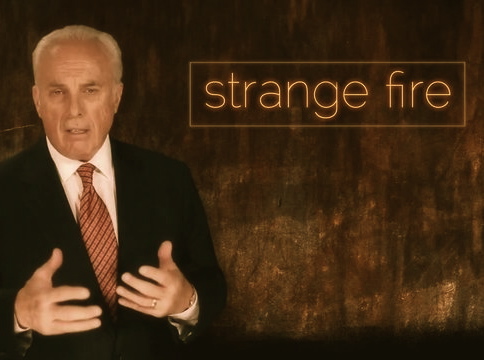
John MacArthur is forcing the issue with a book and a conference titled Strange Fire. The conference is still several weeks away and the book will not be widely available until a few weeks after that. However, I recently received an advance copy of the book and have read it a couple of times now. I want to begin a conversation today, and my purpose is really to get an idea of how people feel about the whole issue.

Tim Challies
“John MacArthur and Strange Fire” (September 26, 2013)
Challies.com

I want to be fair. I imagine that there are some of you out there who don’t believe me, who find me terrifically unfair because I don’t agree with you, but I really do want to be fair. That’s why I’m posting this.

Not to long ago, I aimed more than a little criticism at MacArthur, Strange Fire, and the battle to control the Christian mind on my blog. My Pastor felt I wasn’t giving MacArthur the benefit of the doubt or looking at the positive aspects of his conference. He recommended Pastor Tim Challies and his blog as a good counterpoint to MacArthur’s critics.

If found out that Challies had a lot to say about Strange Fire. As far as I can tell, I quoted from his first blog post on the topic, before the conference even took place. It helps to address this Pastor’s impressions of Strange Fire in a chronological order. I guess he attended the conference and live blogged the different speakers.

I won’t attempt to blog on everything Challies wrote, but I do want to try to get a representative sample, just to get the flavor of what was said. Of course (please forgive me), I don’t expect Challis to be entirely objective (who is?) so part of my analysis will be of Challies as well as of the conference and the presenters who offer their own “fire,” so to speak.

For me, the issue isn’t who is right and who is wrong, but whether or not MacArthur was “playing fair” for the sake of edification and education. Was he being fair or could there have been other motivations? It’s possible the “Challies chronicles” will reveal this, but I don’t know for sure.

Challies’s pre-conference intro to Strange Fire won’t reveal much except at the very end. After Challies wrote his missive, MacArthur reviewed it and asked him to append one brief statement:

Tempting as it might be for my Reformed continuationist friends to read the last chapter first, that would be a mistake. The points in that chapter might seem arbitrary to someone who has not read the preceding material. Those early chapters trace the roots of charismatic teaching; they show the biblical rationale for cessationist conviction; and they demonstrate why aberrant doctrines and practices are not minor, occasional anomalies but the inevitable fruits of charismatic presuppositions. Anyone predisposed to disagree anyway would probably find it easy to be dismissive if they skipped to the end first. The final chapter is simply the logical conclusion to the arguments set forth in all the others.

I suppose that’s also a matter of being fair to MacArthur.

John MacArthur’s Opening Keynote

john-macarthurIn reading Strange Fire Conference: John MacArthur’s Opening Address, I found out I was wrong. Challies did not attend, but listened via Strange Fire site. Unlike Challies, I don’t have time to listen to hours and hours of audio recordings, so I hope he took good notes.

When people ask MacArthur for his view on the biggest issue in the church, he always says it is the lack of discernment since, sadly, a great number of those who profess Christianity are lacking in discernment. The purpose of this conference is to be like the Bereans by looking at the work of the Holy Spirit through the lens of Scripture. He hopes to address it lovingly and compassionately, but in a straightforward way.

I can relate to that. I try to do a lot of studying and judiciously read the Bible. The interesting thing is that, even among people who all have the same intellectual and study emphasis, conclusions about what the Bible says vary, sometimes dramatically. And yet all parties say the same thing MacArthur said in his keynote. The desire to be like Bereans, using the Bible as a lens (then what lens do we use to look at the Bible?), addressing differences lovingly and compassionately…and in a straightforward way.

Why do the results of such words and intentions turn out badly so much of the time?

What is the scope of the issue? There are half a billion professed charismatics on the planet. He pointed out that we feel great freedom to confront Mormons and Mormonism, though there are merely 14 million of them. Yet we hesitate to address 500 million charismatics.

I live in Idaho and I used to live in Nevada. Both states have a large Mormon population. Even after I became a believer, I never felt drawn to confront every Mormon in my environment, which would be quite a lot. Is that what’s required?

He turned to Leviticus 10 to explain the name of the conference and the heart behind it, showing true and false worship from Leviticus 9 and 10.

The sons of Aaron had been given special privilege and were in line for the high priesthood. They seemed so godly and so secure, and yet God consumed them because they offered strange fire, worshipping in a way he did not sanction. What may have seemed like a minor matter was actually a serious and significant sin. This shows that the most serious crimes against God occur in corrupt worship.

I have to say that one thing about MacArthur that bothers me is that he seems so sure of conclusions he can’t possibly be that sure about. Look at his commentary on the sons of Aaron. Christian theologians have been trying to figure out exactly what happened with Nadab and Abihu (yes, they do have names) for ages, and Jewish sages have been studying the incident of these two sons of Aaron (he had four in all) a lot longer, but no one is sure what they did or didn’t do or what the “strange fire” was that resulted in such a dramatic and fatal response from God.

The fire they offered has been translated as “unauthorized,” “wrong kind of,” “strange,” and “unholy.” Most translations follow-up with something like, “which He had not commanded them,” indicating that whatever they did in making their offering, it was not what God asked of them…or maybe it was that they weren’t supposed to make any sort of approach at all right then. Maybe the problem was their timing was bad.

The Lord also said to Moses, “Go to the people and consecrate them today and tomorrow, and let them wash their garments; and let them be ready for the third day, for on the third day the Lord will come down on Mount Sinai in the sight of all the people. You shall set bounds for the people all around, saying, ‘Beware that you do not go up on the mountain or touch the border of it; whoever touches the mountain shall surely be put to death.

Exodus 19:10-12 (NASB)

nadab-abihu-fireThe long and the short of it is, “don’t get too close.”

I say all of this because MacArthur carefully chose the name of his conference and his book. In assessing intent, the symbolism involved and how it’s used can be revealing.

He paused to state that he is not discrediting everyone in the movement. He knows there are charismatics who desire to worship God in a true way. Yet the movement itself has brought nothing that enriches true worship.

That’s an important point. Naturally, discrediting anyone’s preferred method of worship is likely to elicit a harsh or hurt response, but that’s still preferable to naming names, so to speak.

In many places in the charismatic movement they are attributing to the Holy Spirit works that have actually been generated by Satan.

Invoking such a sentiment should be done with care because it’s only one small step from a statement such as that, to one saying anyone who is a charismatic is Satanic and even may be worshiping Satan. No, of course I don’t think MacArthur said that, but when addressing such an emotionally loaded topic, you have to pay attention, not only to what you are saying, but to how you know people will interpret (or misinterpret) your words.

I had to establish a comments policy on my blog recently in order to contain some otherwise negative statements being made. As part of my policy, I issued the following statement:

In Jewish religious tradition, Leviticus 25:17 which states “You will not wrong one another,” is interpreted as wronging someone in speech. This includes any statement that will embarrass, insult, or deceive a person or cause that person emotional pain and distress. Even statements believed to be true and factual but that cause another harm are considered wrongful speech.

You can’t hide behind, “but I’m only telling the truth” if you know that what you’re saying will directly result in injuring people. Something to keep in mind, although in both Judaism and Christianity, this mitzvah is not strictly observed for the sake of “truth.”

In the middle of recording the Keynote, Challies inserted his own commentary:

(Note: I am adding a clarifying note (3:57 PM EST). I do not take MacArthur to mean “nothing good has ever come out of the charismatic movement” but “nothing good has come out of the charismatic movement that is attributable to charismatic theology.”)

I found this part illuminating:

And despite this, Evangelicalism has thrown open its arms and welcomed this Trojan Horse, allowing an idol in the city of God. This idol has fast taken over.

MacArthur then contrasted Reformed theology with the charismatic movement and said that Reformed theology is not a haven for false teachers. It is not where false teachers reside or where greedy deceivers and liars end up.

charismatic-prayerCharismatics, Evangelicals, and Reforms all compared and contrasted in one fell swoop, with Reformed theology coming out on top. But then, anyone holding a conference is going to present their own point of view as advantageous, so I can hardly hold that against MacArthur. Although, being objective and outside of the Reformed theology framework, I wonder how MacArthur can know in absolute terms that there are no “false teachers” within his entire movement, right down to the last man? Also, what’s the difference between a “false teacher” and an erroneous one? Does he believe Reformed theology contains no teachers capable of making a mistake?

Once experience, emotion and intuition become the definition of what is true, all hell breaks loose.

In what seemed to be a brief aside, he called for the restoration of the true worship of the Holy Spirit in the church and said that it is zeal for God’s honor that consumes him here. As he sees and hears this false worship, he feels God’s own pain and wonders why the church won’t rise up to defend the Holy Spirit as it has done with the Father and the Son.

I was selected for jury duty in a drunk driving case many years ago. Part of the instructions the judge gave to the jury was to evaluate just the facts of the case without any emotional bias. And then both the prosecuting and defense attorneys did everything in their power to manipulate the emotions of the jury.

I put those two statements together in the quote just above (they don’t occur contiguously in the article) because I got the same feeling reading them as I did when I was on jury duty. Emotion can’t define truth (and I generally agree with this statement) but here, MacArthur seems to say, ” let me make an emotional appeal promoting my viewpoint by feeling ‘God’s own pain’ (I was also somewhat reminded of one of Bill Clinton’s iconic and often parodied statements) in order to evoke an emotional response from my audience.”

I’m sorry. I really didn’t intend to be this snarky and cynical when I started writing my blog post, but as I’m reading through the Challies report on MacArthur’s keynote, I’m “live blogging” my responses, which include emotional responses. I’ll try to end on an up note.

MacArthur concluded by saying we can see in Christ a picture of the perfect work of the Holy Spirit, for the Spirit has committed to do in us what he did in Christ. The Spirit was the constant companion of Jesus; Jesus was conceived by the Holy Spirit, matured by the Spirit, anointed by the Spirit at his baptism, sustained by the Spirit in his temptation, empowered by the Spirit for ministry, filled with the Spirit so he walked in perfect obedience while displaying the Spirit’s fruit, perfected by obedience wrought in the Spirit’s power, raised by the power of the Spirit, and even in his post-resurrection ministry was in the power of the Spirit. The Spirit is to us as he was to Christ. If you want to know how he works in us, look at Jesus. Ultimately, the work of the Holy Spirit is to take corrupted image bearers and to restore in them the likeness of Jesus Christ.

He ended with this challenge: “I will start believing that the truth prevails in the charismatic movement when I see the leaders looking more like Jesus Christ and I see that they really are partakers of the divine nature.”

tim_challiesKeep in mind that I’m receiving my impressions from a blogger who, as far as I can tell, should see the world in general and Christianity in particular in roughly the same way as MacArthur, so I’d expect his rendition of his experience to be positive and supportive of MacArthur.

At the same time, I keep wondering that if I found it necessary to challenge the Charismatic movement as a matter of principle and truth, and to try to prevent millions and millions of people from being swayed by what I thought was a harmful and error-filled theology, what approach would I take?

The next blog post in this series is The Challies Chronicles: John MacArthur and Joni Eareckson Tada.