Tag Archives: study

The Insurmountable Wall

freestyle1All the elaborate proofs, all the philosophical machinations, none of that will never stand you firmly on your feet. There’s only one thing that can give you that, and that’s your own inherent conviction.

For even as your own mind flounders, you yourself know that this is so, and know that you believe it to be so. It is a conviction all the winds of the earth cannot uproot, that has carried us to this point in time, that has rendered us indestructible and timeless.

For it comes from within and from the heritage of your ancestors who believed as well, back to the invincible conviction of our father, Abraham, a man who took on the entire world.

The doubts, the hesitations, the vacillations, all these come to you from the outside. Your challenge is but to allow your inner knowledge to shine through and be your guide.

Inside is boundless power.

-Rabbi Tzvi Freeman
“Conviction”
Based on letters and talks of the Rebbe
Rabbi M. M. Schneerson
Chabad.org

“Any intelligent fool can make things bigger, more complex, and more violent. It takes a touch of genius — and a lot of courage — to move in the opposite direction.”

Albert Einstein

It’s no small feat to try to understand God. In truth, we never will. Religion and theology is the interface by which we try to make some sense out of a God that exists in the realm beyond reason and comprehension. Even the systems we develop that allow us to build a religious interface can be exceedingly complex and practically impossible to navigate. For instance, take my situation. I’m trying to shift my focus from a traditional Gentile Christian perspective to one that includes at least some elements from Jewish wisdom and learning.

It’s not easy. Here’s what I mean.

As we will see shortly, not all rabbinic sources share the view that the Oral Torah was received as a discrete and finite set of traditions. Later controversies between the Rabbanites (early medieval inheritors of rabbinic tradition) and the Karaites (those who rejected the authority of the rabbinic tradition) made this view of Oral Torah particularly appealing to those who accepted the authority of rabbinic tradition.

-Elizabeth Shanks Alexander
“The Orality of Rabbinic Writing” (p. 42)
As published in The Cambridge Companion to the Talmud and Rabbinic Literature
Edited by Charlotte E. Fonrobert and Martin S. Jaffee

Here’s another example from the same source.

In contrast with the Talmud, the Mishnah itself nowhere advances the theory of the Oral Torah and, aside from the opening paragraphs of Avot, seldom calls itself “Torah” or associates itself with either Moses or Mount Sinai.

-Shane J.D. Cohen
“Judaean Legal Tradition and Halakhah of the Mishnah” (p. 122)

Not easy material for the non-Jew to wrap his brain around. Catherine Hezser, in her article for the same publication “Roman Law and Rabbinic Legal Composition” (pp 144-5) agrees.

Rabbinic texts are not easily accessible to modern readers with little exposure to classical rabbinic educations. Even a cursory glance will reveal the imposing compositional nature of these texts.

alone-desert
After three days, I had hoped to leave this topic and move on, but the concept of being an “intelligent fool” is something that I continue to dwell upon. And yet (if I dare to contradict Einstein), I don’t see how to make the vast body of Jewish religious and intellectual law, interpretation, and commentary into anything less than a dizzying conundrum. However, I take some comfort in Rabbi Freeman’s words since he not only describes the “doubts, the hesitations, the vacillations” of my mind in trying to grasp what is beyond me, but says that it’s conviction, not comprehension, that allows “inner knowledge to shine through and be your guide.”

Periodically in my journey of faith, I become lost in the maze of information and details, not just because of its vastness but because of its alien nature. God is alien to humanity and Jewish wisdom is alien to the Gentile (and yet tantalizingly familiar, somehow). I know somewhere there is a bit of cheese waiting for me at the end of the maze if I’m able to correctly trace my route, but I can’t quite figure out which turn to make next.

Yesterday, I quoted from the lyrics of the Jackson Browne song, “Looking into You” (1972) which include:

The great song traveler passed through here
And he opened my eyes to the view
And I was among those who called him a prophet
And I asked him what was true
Until the distance had shown how the road remains alone
Now I’m looking in my life for a truth that is my own

Compare what Browne is saying to Rabbi Freeman:

The doubts, the hesitations, the vacillations, all these come to you from the outside. Your challenge is but to allow your inner knowledge to shine through and be your guide.

I know. I tend to get in trouble when I compare information from vastly different sources, but both men seem to be saying that depending solely on outside information to define reality and meaning isn’t going to work. Yes, study is important, knowledgeable and insightful teachers are important, but while God does speak to us from those sources, He also speaks to us.

I said earlier that religion and theology is the interface by which we interact with God. That’s true. Without them, we could never be able to operationalize a life of faith. We wouldn’t have a starting point or any idea of what actions we should take to enact holiness. But we also need to own our end of the relationship. It has to be part of us and probably it has to be the core of us. Not understanding the complexities of Mishnah, Talmud, and Gemara isn’t a death sentence and particularly for the Gentile, there is nothing specific that commands us to adopt such comprehension and to define our relationship with God by its tenets. I pursue that path of learning because I feel driven to do so, but I also must stop and realize that, with or without that learning, God is here.

There is something of God in each of us, with or without the Bible, with or without the church and synagogue, with or without the wisdom of the sages and the writings of the church fathers. They provide vital context, but they are not God, nor are they the actual relationship, the conduit between man and Divine. It’s that relationship and what we can take from man-on-a-mazeit that is “the truth that is our own” and the “inner knowledge that shines and guides” us to God.

It’s at times like these, when I open my eyes and really see the immense vastness of what I am trying to understand, encounter it with awe, feel overwhelmed, and realize that I have no idea what I’m doing, that I have to close the books for a few minutes, find some quiet place where I won’t be interrupted, and begin, “Our Father who is in heaven.”

When We Were Five

The Rebbe and the ChildIf you want to see the face of the Moshiach, just look at the children!

At Sinai, all men, women and children had to be present. All received the same truth, all at once.

In a simple commentary written for a five year old, great secrets of the Torah can be found. But only once you understand the simple commentary as a five year old does.

From the wisdom of the Rebbe
Menachem M. Schneerson
as compiled by Rabbi Tzvi Freeman in his book
Bringing Heaven Down to Earth

Perhaps in the Rebbe’s words, we find the keys to unlock this 2,000 year old mystery:

At that time the disciples came to Jesus and asked, “Who, then, is the greatest in the kingdom of heaven?” He called a little child to him, and placed the child among them. And he said: “Truly I tell you, unless you change and become like little children, you will never enter the kingdom of heaven. Therefore, whoever takes the lowly position of this child is the greatest in the kingdom of heaven. And whoever welcomes one such child in my name welcomes me. –Matthew 18:1-5

We sometimes make the mistake of imposing our assumptions when we read this teaching from Jesus. The first thing we imagine when we think of a small child is that, compared to an adult, he or she doesn’t know very much about the world. Children have an extremely simple understanding of how things work. They can see the moon in the sky, but not know what it is. They can play with their favorite stuffed toy and believe it is as alive as they are. They are easily convinced of the most outrageous suggestions and accept them as utter truth. How else could we get a child to believe that there is a fat guy who rides in a sled pulled by flying reindeer, and who delivers presents to every child on Earth in a single night?

Translating all of that back into the words of Christ, we imagine he means that we don’t need to know very much about the Bible, the history of the church, the wisdom of the great Sages, or most anything else in order to be saved and have a right relationship with God. It means that studying the Bible is a waste of time, because it doesn’t change the status of being saved. It means that Bible commentaries, the Talmud, and everyone who reads and tries to comprehend them, are just making your relationship with God too complicated. After all, once you are saved in Christ, the deal is sealed and nothing else matters at all. If you’re a Christian it’s only about you and Jesus.

Right?

That tends to illustrate one of the qualities of small children; the tendency toward being self-absorbed and the difficulty in seeing a world outside of our own small sphere. Being saved and becoming a disciple of the Master is the first step in our journey, not the last.

So what does Jesus mean? What does the Rebbe mean? How are great secrets possessed by little, uncomprehending children that elude perhaps some of the greatest scholars who have ever lived? Is Bible study; Torah study a waste of time? Here’s Rabbi Freeman’s response:

The Rebbe often repeated that through the study of Torah you could conquer the world. And from the way the Rebbe discussed Torah you could see he was doing just that: Every thought, every teaching was a new understanding of the entire universe. A simple story..became in his hands an insight to the workings of time and space.

Rabbi Freeman, who describes the Rebbe as one of the foremost Torah scholars of his age, also tells this story about him:

The child he (the Rebbe) saw as a lucid, glistening crystal vessel in which to find G-d. More than once the Rebbe pointed out how his own thoughts strove to attain the simplicity of those of a child. In that simplicity, he taught, can be found the simplicity of the Infinite.

The Rebbe formed a club for Jewish children called “Tzivos Hashem”. He told the children that with verses of Torah and good deeds they would fight the forces of darkness in the world and bring Moshiach.

The Children began to stand close to the Rebbe at public gatherings. Some went under the table near his feet. Legend has it that occasionally a small band would rise up from under the table to snatch a piece of the Rebbe’s cake.

For me, this really clarifies why Bible study and immersion in the Torah are vital to achieving and retaining the perspective of a small child who is contemplating God.

Remember what I said about how adults can cause a child to have an unswerving belief in the existence of Santa Claus? It’s not the child’s fault that he or she believes in a fantasy, it’s the adults who taught them. Children are open to those they trust and they believe their parents (in most cases) mean them nothing but good. Sure, they get mad at us temporarily when we discipline them for some misdeed, but they know with complete trust that we are the source of all good in their lives. This is how we saw the world when we were five.

We fail them when we don’t tell them the truth and prove unworthy of their trust.

TrustBut now let’s bump that concept up the ladder a bit. We, as adults, can question whether or not something is the truth. We no longer believe in Santa Claus and we can (most of the time) recognize the difference between fantasy and reality. We have a Father in Heaven who is the source of all good in our lives. He wants nothing but the best for us and He does not tell us tales of Santa Claus or the Easter Bunny, which we later find out are quaint lies. God tells us the truth. In essence, we are like children standing close to the Rebbe and sitting at his feet under the table. Now here’s where the “child” part comes in.

If we choose to believe and to trust God as completely as small children trust their parents, whatever God tells us, we will believe. Whatever He wants us to do, we will do, without questioning why. When we “snatch a piece of cake” (so to speak) from His table, He won’t mind, because He knows we’re going to do it and He put the cake there to share with us. If we want to know how to accept God in the manner He desires to be accepted, trusted, and loved, all we have to do is to look at the relationship between little children and their parents.

For me, one of the lessons I must learn about the little children is what the Rebbe says here:

With Torah, you don’t get all the answers all at once.

Why does the moon only come out at night? Why is the sky blue? How can a fish breathe underwater? How old is God? Have you ever tried to answer these questions? It’s hard to do. Even if you know why the sky is blue or how fish breathe underwater, you can’t always communicate the answer in a way a child will understand. It’s that way for me. I want to know so much. It seems as if there’s so little time. And yet I wait. You don’t get all the answers all at once. Sometimes you have to get older first before you can understand.

In the meantime, you trust and believe, because that’s what small children do best.

Now to finish the story about the children snatching the Rebbe’s cake:

Finally, one of the adults became fed up with this lack of decorum and attempted to escort some children away. The Rebbe turned to him and exclaimed, “You are only a civilian and they are soldiers – and you want to remove them?

As the Rebbe also said, “Wealth is not a mansion filled with silver and gold. Wealth is children and grandchildren growing up on the right path.”

May we all “grow up” on the right path, too.

As If Considering Angels

Broken AngelFor this very reason, make every effort to add to your faith, goodness; and to goodness, knowledge; and to knowledge, self-control; and to self-control, perseverance; and to perseverance, godliness; and to godliness, mutual affection; and to mutual affection, love. For if you possess these qualities in increasing measure, they will keep you from being ineffective and unproductive in your knowledge of our Lord Jesus Christ.2 Peter 1:5-8

Said Rabbi Joshua the son of Levi: Every day, an echo resounds from Mount Horeb, proclaiming and saying: “Woe is to the creatures who insult the Torah.” For one who does not occupy himself in Torah is considered an outcast, as is stated “A golden nose-ring in the snout of a swine, a beautiful woman bereft of reason.” And it says: “And the tablets are the work of G-d, and the writing is G-d’s writing, engraved on the tablets” ; read not “engraved” (charut) but “liberty” (chairut)—for there is no free individual, except for he who occupies himself with the study of Torah. And whoever occupies himself with the study of Torah is elevated, as is stated, “And from the gift to Nahaliel, and from Nahaliel to The Heights.”Ethics of the Fathers 6:2

I know these two quotes may not seem to go together, but consider this. Peter says that we should add faith to goodness and then add goodness to knowledge. What knowledge? Where does this knowledge come from? Rabbi Joshua ben Levi implies that knowledge comes from Torah by expressing the inverse that one who does not occupy himself with Torah “is considered an outcast” and is like a “golden nose-ring in the snout of a swine, a beautiful woman bereft of reason”.

Sounds pretty harsh, but then, so does Peter:

This is especially true of those who follow the corrupt desire of the flesh and despise authority. Bold and arrogant, they are not afraid to heap abuse on celestial beings; yet even angels, although they are stronger and more powerful, do not heap abuse on such beings when bringing judgment on them from the Lord. But these people blaspheme in matters they do not understand. They are like unreasoning animals, creatures of instinct, born only to be caught and destroyed, and like animals they too will perish. –2 Peter 2:10-12

I’ve been involved in a series of online discussions lately that have been critical of Talmud study among Christians. Specifically, the allegation is that the sages who documented the Oral law and established a system of rulings for the Jewish people, were the inheritors of the tradition of the Pharisees and that Jesus had nothing good to say about the Pharisees, citing examples such as this:

Then Jesus said to the crowds and to his disciples: “The teachers of the law and the Pharisees sit in Moses’ seat. So you must be careful to do everything they tell you. But do not do what they do, for they do not practice what they preach. They tie up heavy, cumbersome loads and put them on other people’s shoulders, but they themselves are not willing to lift a finger to move them. “Everything they do is done for people to see: They make their phylacteries wide and the tassels on their garments long; they love the place of honor at banquets and the most important seats in the synagogues; they love to be greeted with respect in the marketplaces and to be called ‘Rabbi’ by others. –Matthew 23:1-7

This is just one of the examples in the Gospels which cast all Pharisees everywhere in a particularly bad light, but as I commented recently, Jesus is upset with this group of Pharisees, not because they taught bad things, but because they didn’t practice what they taught! Keep that in mind. If the Pharisees had behaved consistently with their teachings, Jesus wouldn’t have had a problem with them at all. His only beef with the Pharisees is that they were hypocrites, not false teachers.

Think about it. If, as some have stated, the Talmudic scholars and sages have inherited the mantle of the Pharisees and they behaved consistently with their own teachings, then it is quite possible that the “Rebbe of Nazaret” wouldn’t have any problem with them either.

I know there are a lot of variables to consider and we won’t know for sure until Jesus returns to us, but based on this small bit of simple logic, we cannot reasonably discard or disdain anything in the Talmud based on the behavior of a collection of hypocritical religious authorities that operated in Roman-Judea in the time of Jesus. We can’t also reasonably apply the following to the Rabbis of the Talmud:

The Lord says: “These people come near to me with their mouth and honor me with their lips, but their hearts are far from me. Their worship of me is based on merely human rules they have been taught. Therefore once more I will astound these people with wonder upon wonder; the wisdom of the wise will perish, the intelligence of the intelligent will vanish.” –Isaiah 29:13-14

I know it’s enormously tempting to apply the words of the Prophet not only to the Pharisees but to the Talmudic sages as well. Certainly, if we think of the Talmudic writings as only the rules of men with no Biblical source, then we might be justified in doing so, but taken out of context, we don’t know if Isaiah is even considering the Oral Law (which he would have seen as Torah) or the Rabbinic commentaries and rulings on said-Oral Law (and Written Law), which are recorded in the Talmud. The rulings of the Rabbis don’t overwrite and contradict Torah, but rather, are intended to interpret and make sense of the Written and Oral Law for each generation of Jews as they met new challenges in applying a Torah lifestyle in an ever-changing world.

Here’s something else to consider:

At that time Jesus said, “I praise you, Father, Lord of heaven and earth, because you have hidden these things from the wise and learned, and revealed them to little children. Yes, Father, for this is what you were pleased to do. –Matthew 11:25-26

Taken together with some portions of the quote from Isaiah 29:13-14, these words of the Master might suggest that it’s bad to be intelligent, well-read, and educated. Why bother to learn how to read at all if intelligence is not to be trusted and if it’s better to be ignorant and untaught? I don’t think this is what the Master means here, but rather, he’s saying you don’t have to be a scholar to have access to the grace of God. Of course, he’s not saying grace is denied the learned sage, either.

It’s been suggested that Rabbinic judgments and rulings are not to be trusted and that the wisdom of the average individual, as guided by the Spirit, reading the Bible in English and outside of its history, culture, and other contexts, is far preferable to trusting and learning from people who have spent all of their lives pouring over Scripture and striving to master the teachings of God.

And yet Peter was critical “of those who follow the corrupt desire of the flesh and despise authority”. Further, he said that “First of all, understand this; no prophecy of Scripture is to be interpreted by an individual on his own, for never has prophecy come as a result of human willing – on the contrary, people moved by the Ruach HaKodesh (the Holy Spirit) spoke the message from God”. (2 Peter 1:20-21 [CJB]).

Cutting BranchesWe could be tempted to say Peter is confirming that all a person; any person, needs is the Holy Spirit to interpret the Bible, but he’s also speaking of Prophets like Isaiah, not the average guy on the street. We read the prophecies of Isaiah because he was a prophet of God and we’re not. We read the teachings of Jesus because he’s the Messiah and we’re not. Also, lest we forget, Paul, the Apostle to the Gentiles, and the key to bringing the Gospel of Jesus Christ to the nations of the world, was a very well-educated man…in fact, far more educated than many of Christ’s inner circle who were what we would consider today as blue-collar workers and laborers.

There’s no problem with who Jesus chose to be close to him as being, relatively speaking, uneducated, because, as I’ve already mentioned, the love of Christ isn’t primarily accessed through “book-learning”. But on the other hand, the fact that Paul was chosen by Jesus says that education and authority isn’t a problem either. Certainly, being learned and possessing authority requires that such a position be used with justice, honor, and humility. The Ethics of the Fathers 6:5 speaks to this:

Do not seek greatness for yourself, and do not lust for honor. More than you study, do. Desire not the table of kings, for your table is greater than theirs, and your crown is greater than theirs, and faithful is your Employer to pay you the rewards of your work.

In fact, from the same chapter (Chapter 6:6), we find that study of Torah (which includes Talmud in this context) yields people who have qualities such as:

love of G-d, love of humanity, love of charity, love of justice, love of rebuke, fleeing from honor, lack of arrogance in learning, reluctance to hand down rulings, participating in the burden of one’s fellow, judging him to the side of merit, correcting him, bringing him to a peaceful resolution [of his disputes], deliberation in study, asking and answering, listening and illuminating, learning in order to teach, learning in order to observe, wising one’s teacher, exactness in conveying a teaching, and saying something in the name of its speaker.

As long as the teacher behaves consistently with these, and the other teachings in the Torah and Talmud, what problem could this present? What problem could it present for any person of faith and good will who wishes to devote time to pondering this wisdom?

We see that taking Scripture out of context and applying an overly simple interpretation to what may turn out to be very complex matters of principle actually results in a disservice to the Prophets and Apostles, as well as to the later sages, and finally to Jesus and to God the Father.

We should all be very, very careful how we interpret and apply Scripture, especially if we use it to malign our teachers and scholars and, by inference, every religious Jew who has ever lived or will live, for they too revere the sages and attempt to live their lives by the principles of Torah, which have been established and interpreted across the ages.

I will bless those who bless you, and whoever curses you I will curse; and all peoples on earth will be blessed through you.” –Genesis 12:3

I do not want you to be ignorant of this mystery, brothers and sisters, so that you may not be conceited: Israel has experienced a hardening in part until the full number of the Gentiles has come in, and in this way all Israel will be saved. As it is written: “The deliverer will come from Zion; he will turn godlessness away from Jacob. And this is my covenant with them when I take away their sins.” –Romans 11:25-27

All Israel has a share in the World to Come, as is stated: “And your people are all righteous; they shall inherit the land forever. They are the shoot of My planting, the work of My hands, in which I take pride.” –Sanhedrin 11:1

for there is no free individual, except for he who occupies himself with the study of Torah. –Ethics of the Fathers 6:2

Do not denigrate the root, lest your branch be cut off from it.

Who Are Our Teachers?

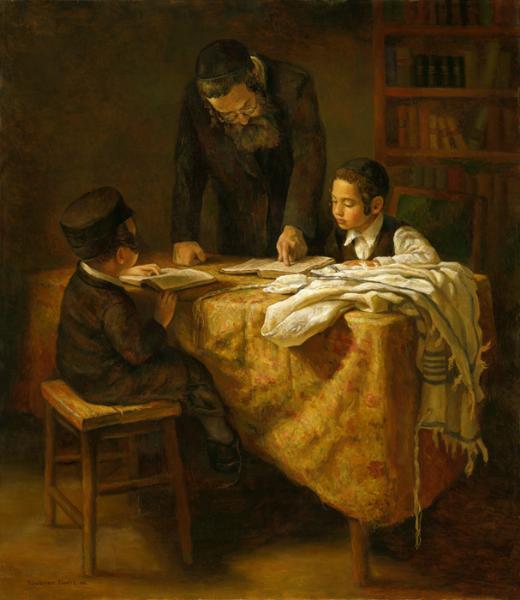
A Rabbi TeachingIf King David, who learned nothing from Achitofel except for two things alone, nevertheless referred to him as his “master,” “guide,” and “intimate,” it certainly goes without saying that one who learns from his fellow a single chapter, a law, a verse, a saying, or even a single letter of Torah, is obligated to revere him.

-Ethics Of The Fathers, 6:3

Our sages tell us, “There are three partners to the creation of man: G-d, his father, and his mother.” The capacity to procreate is, in essence, a distinctly Divine nature…The same is true regarding the “regenerative power” contained in a teaching: when G-d is a partner to their endeavor, the teacher-student relationship yields an infinite progeny.

Commentary on Ethics of Our Fathers: Chapter 6
Tammuz 11, 5771 * July 13, 2011
“Fertile Wisdom”
Chabad.org

I’ve mentioned before that the student-teacher relationship can yield enormous benefits, assuming an honest, knowledgeable, and inspired teacher and a student willing to be open. However, as we see from the quotes above, the teacher isn’t necessarily the most important partner in the transaction, which is good, since human beings are fallible. God is always present when Torah is taught and learned, which makes the act of study not only educational but holy. The Creator is the indispensable element in the room whenever people come together to learn the Word of God.

Rabbi Chalafta the son of Dosa of the village of Chanania would say: Ten who sit together and occupy themselves with Torah, the Divine Presence rests amongst them, as is stated: “The Almighty stands in the community of G-d.” And from where do we know that such is also the case with five? From the verse, “He established his band on earth.” And three? From the verse, “He renders judgment in the midst of judges.” And two? From the verse, “Then the G-d-fearing conversed with one another, and G-d listened and heard.” And from where do we know that such is the case even with a single individual? From the verse, “Every place where I have My name mentioned, I shall come to you and bless you.” –Ethics of The Fathers 3:6

“For where two or three have gathered together in My name, I am there in their midst.” –Matthew 18:20 (NASB)

But from who can we learn? It’s desirable to find a worthy teacher; one we can call our “Rebbe”, but there are problems with this. There are many unworthy teachers out there who are anxious to gather a following out of their own ambition, men and women who believe they have a special insight and who are entitled to share their particular “theological axe” which they desire to “grind”. From these “teachers” we learn there are those who are not to be trusted. Also, Christian tradition, unlike Judaism, doesn’t have a history of “Rebbes” or exalted teachers who pass their knowledge, wisdom, and compassion from one generation of disciples to the next. We are (often rightly) suspicious of gurus, cult leaders, and false teachers who ultimately lead people away from God. Christians even distrust the study of Torah and Talmud from valid and worthy Jewish Rabbis for fear this will lead the Christian away from Jesus.

And yet we are commanded to obey our leaders and teachers in the community of faith:

Have confidence in your leaders and submit to their authority, because they keep watch over you as those who must give an account. Do this so that their work will be a joy, not a burden, for that would be of no benefit to you. –Hebrews 13:17

We also see from David’s example with Achitofel that we are to honor a person who teaches us “a single chapter, a law, a verse, a saying, or even a single letter of Torah.” While we can seek to learn the teachings of an honored Rebbe such as Rabbi Menachem M. Schneerson, of blessed memory (and I’m learning much from his teachings as related by Rabbi Tzvi Freemen in the book Bringing Heaven Down to Earth), we see from the following that a good teaching can come from even a bad source:

It is possible to utilize for G-d’s service, [in a manner] according to Torah, all behavior-traits. This includes those traits that are unwholesome, and even those that are evil, as their names and descriptions indicate. For example, the tzadik Rabbi Meshulam Zushya of Anipoli, of blessed memory, learned [from his Rebbe, the Maggid of Mezritch] a number of ways of serving G-d from [the ways of] a thief:

  1. He works quietly without others knowing.
  2. He is ready to place himself in danger.
  3. The smallest detail is of great importance to him.
  4. He labors with great toil
  5. [and] Enthusiasm.
  6. He is confident and optimistic.
  7. If he did not succeed the first time, he tries again and again.

-[From HaYom Yom by the Lubavitcher Rebbe, translated by Uri Kaploun (Kehot)].
found at Chabad.org

This shouldn’t be so surprising, since the Master, our own great Rebbe in Christianity told us this:

Then Jesus said to the crowds and to his disciples: “The teachers of the law and the Pharisees sit in Moses’ seat. So you must be careful to do everything they tell you. But do not do what they do, for they do not practice what they preach. They tie up heavy, cumbersome loads and put them on other people’s shoulders, but they themselves are not willing to lift a finger to move them. –Matthew 23:1-4

Look at what Jesus is saying. He’s not telling his audience to ignore or disregard the teachings of the Pharisees. He’s saying “you must be careful to do everything they tell you”. What? Aren’t Pharisees hypocrites, liars, untrustworthy, and “under the Law”? Don’t they deny the true teachings of God and the grace of Jesus Christ? Why did Jesus tell his disciples to obey everything the Pharisees told them to do?

It’s because what the Pharisees taught was correct and consistent with the Torah, however the Pharisees of that day were corrupt and indeed, they were hypocrites who, under the Roman occupation, exalted themselves and did not “practice what they preached”, so to speak.

But what they actually taught was worthy of being learned and obeyed.

It’s also important to realize that not every single Pharisee was corrupt and no good. After all, Nicodemus was a Pharisee and he ended up becoming a disciple of Jesus. After the crucifixion of the Master, Nicodemus and Joseph of Arimathea, a wealthy member of the Sanhedrin, approached Pilate and asked permission to bury the Master’s body before the Sabbath began (we aren’t quite clear as to whether this was the eve of Passover or the weekly Sabbath). Not all Pharisees and members of the Sanhedrin were evil and corrupt, so we shouldn’t paint them all with the same broad brush.

KindergartenLook at the teaching of the Rebbe about how to learn from a thief. He doesn’t say the thief is a good and worthy teacher and that we must devote our lives to learning at the feet of a criminal. He says that, by simply observing the thief, there are habits we can learn and adapt to a life of holiness. The same is true of learning from anyone, even if they are unworthy, a hypocrite, or a thief, simply by watching them and listening to them, we can learn much, as long as we continue to use our powers of discernment and to view everything through the lens of the Bible and the Spirit of God.

Remember, in any transaction between two people, one being a teacher and the other being the student, God is there as the indispensable partner in the exchange. Being a student and disciple does not mean being a mindless sponge with no will of your own. In fact, your will, your judgment, and your questioning nature is as necessary to being a student as your attention, openness, and eagerness to learn. You cannot be taught corruption if you are paying attention and you do not have to take anything at face value without asking questions. Even the Bereans didn’t take Paul at his word and checked everything he taught against scripture (Acts 17:10-12). If you feel you have been lead astray by a teacher, look to yourself when asking the question, “how did this happen?”.

I’m sure you’ve heard or read the list compiled by Robert Fulghum, All I Really Need to Know I Learned in Kindergarten. From this, we learn that small children can teach us something. Even the Prophet Isaiah said “and a little child will lead them.” (Isaiah 11:6).

The Maggid also taught Rabbi Zushya, his disciple that we can learn three things from a child:

  • Never for a moment is he idle.
  • When he needs something, he demands it vigorously.
  • He is merry for no particular reason.

-[From The House of Rizhin by Rabbi Menachem Brayer [Mesorah].]

The Pirkei Avot; The Ethics of the Fathers teaches us that a life of learning and performing Torah yields many rewards:

The sages expounded in the language of the Mishnah (blessed is He who chose them and their learning):
Rabbi Meir would say: Whoever studies Torah for Torah’s sake alone, merits many things; not only that, but [the creation of] the entire world is worthwhile for him alone. He is called friend, beloved, lover of G-d, lover of humanity, rejoicer of G-d, rejoicer of humanity. The Torah enclothes him with humility and awe; makes him fit to be righteous, a chassid, correct and faithful; distances him from sin and brings him close to merit. From him, people enjoy counsel and wisdom, understanding and power, as is stated, “Mine are counsel and wisdom, I am understanding, mine is power.” The Torah grants him sovereignty, dominion, and jurisprudence. The Torah’s secrets are revealed to him, and he becomes as an ever-increasing wellspring and as an unceasing river. He becomes modest, patient and forgiving of insults. The Torah uplifts him and makes him greater than all creations. –The Ethics of the Fathers 6:1

Being a student, a disciple, and a person of faith is not a passive activity. Learning isn’t something you only do sitting at someone’s feet or taking notes in a classroom. It’s not always accomplished by reading a book or by visiting inspirational websites. A disciple is always moving, always asking questions, always observing, always sharing their insights with others and asking for feedback. Most importantly, in any learning situation (which is to say, in every waking moment of our lives), we are always turning to the “silent” voice in the room, the indispensable partner in the teaching of Torah. God is with us and He sent us a counselor who will teach us all things (John 14:26). Even when reading the Bible by ourselves at night, we are never alone.

Our teachers can be anyone. Our teachers can be anywhere. We just have to be paying attention to where we are and what we’re doing.

“A brilliant mind without faith is like a beautiful face without eyes.” -Shalom Cohen

Good Shabbos

Tasty Chazir

Plane FoodEach person is responsible to interpret and apply the Scriptures to their own lives.

No person standing before God will get a pass because he was just following the [big religious group X] interpretation of Scripture.

That isn’t being prideful toward either Jewish or Catholic traditions. Rather, it’s being responsible for your own walk before God.

Judah Gabriel Himango
from one of his comments on his blog post
A Warnng to Those Who Follow Yeshua
Kineti L’Tziyon

There’s a rather spirited debate going on over at Judah’s blog considering whether or not studying Talmud and other Jewish texts leads Christians and “Messianics” away from faith in Jesus. The Jewish texts are taking a rather heavy beating from some of the commenters (as I write this, there are 105 comments and growing) but a few defenders of Talmud study are weighing in, including me.

I’ve already commented on a number of occasions, but the question of authority has come up. While I agree that we, as individuals, are responsible to God for our behavior and how we have sanctified or desecrated His Name, I also believe we are not expected to be solely responsible for understanding God or His Bible. It’s OK to have teachers and authorities that we agree to follow and it’s OK to let ourselves learn from these teachers.

I found the following commentary on a Daf I was studying and I thought it was an appropriate illustration of the dynamic between an individual’s interpretation of the Bible (in this case, a Torah mitzvah) and a Rabbinic ruling that modifies the person’s beliefs. As a bonus, the story shows a typically human response to this new information, even after agreeing that we’ve changed our opinion.

Enjoy today’s “extra” meditation.

On today’s daf we find that even pork was permitted during the seven-year conquest of Eretz Yisrael.

Rav Shabsi Yudelevitz recounted that on one plane trip he was seated next to a well-known Israeli zoologist. While the two spoke, the airline meal came and the professor began to partake of his bacon with obvious relish.

Rav Yudelovitz painfully remarked, “How could you eat that? Aren’t you a Jew?”

The professor was nonplussed. “Why does what Moshe said four thousand years ago obligate me?”

Rav Yudelevitz was not impressed, however, with this answer. “Rasha! God said what is written in the Torah, and He is alive and well!”

The professor tried to mollify the offended rabbi. “Rebbi, don’t get upset. If you can prove that God said what meat to eat, I will do teshuvah. But I must say that I had an argument with a certain rav for four hours and he failed to convince me of anything.”

“Four hours? I only need about four minutes,” was Rav Yudelevitz’s confident reply.

The professor opened his eyes wide and said, “Four minutes? Really?”

“Yes. Just listen. The Torah tells us that there are only four species that have one sign of kashrus but not the other: they all either have split hooves or chew their cud, but not both. The Gemara in Chulin 60 wonders how Moshe could have possibly known this. It’s not as though he was a hunter or zoologist! He never went hunting and how could any human at that time possibly know all the many species of animals, even on the savannah of Africa? So how would he dare say that there are only four such anomalies unless God told him so?”

The professor turned white.

But a moment later he said, “I will just finish eating and then I will do teshuvah…”

Rav Yudelevitz commented later about the incident. “What a pity. The professor simply cannot wean himself away from his tasty chazir. He is convinced of the truth but will just wait to finish eating. Sadly, by then it is already too late…”

Daf Yomi Digest
Stories off the Daf
“Logical Inconsistency”
Chullin 17

What the Talmud Says About Gentiles, Revisited

Talmud StudyI originally wrote this article in October of 2009 for the Congregation Shema Yisrael blog. While I no longer am affiliated with that congregation (for many reasons previously stated), I wanted to “import” the article here, since there have been some recent conversations on the blogosphere issuing a “warning” that overly studying the Talmud or other Jewish writings could result in a Christian apostatizing from the church and abandoning faith in Jesus. Speaking for just myself, I find a great deal of value and wisdom in reading the Jewish writings and don’t find myself being drawn away from my faith. In fact, quite the opposite. I find many parallels between how the sages taught and the teachings of my own “Rebbe”.

The Talmudic sages are often depicted as being very much against non-Jews in general and Christians in specific. While I believe, given the long history of Christian persecution of Jews, that the tzadikim had good reasons to feel leery of the church, if we actually look at what the Talmud has to say about non-Jews, we see a more evenly balanced perspective. I wanted to inject the content from my almost three-year old article into my current blog to provide a reminder that Jews and Christians don’t have to be at odds with each other and particularly, that Christians don’t have to be at odds with the Talmud or avoid Jewish study. Here, for your illumination, is the content of my original article What Does the Talmud Say About Gentiles? in its entirety.

The Talmud contains many references to righteous gentiles whose behaviour is held up as a model for all people. The example of Dama ben Netina is known to all Jewish children (Kidushin 31a): ‘They asked R. Eliezer how far one should go in honoring parents. He said to them: Go and see how one idol worshipper in Ashdod honored his father, and Dama ben Netina was his name. The sages wished to purchase gems from him for the Ephod [for a tremendous profit] … but the key [to the box containing the gems] was under his father’s pillow [while his father was sleeping] and he did not trouble his father [by waking him even though he gave up a tremendous profit].’ Dama was rewarded for his virtue the next year when a red heifer [required for the Temple service] was born in his flock. When he sold it to the sages he told them that he knew that they would pay any price he asked for it, but he asked only for the amount he had not earned the previous year when he refrained from waking his father.

-quoted from a now defunct website

Messianics and many traditional Christian churches support Israel and the Jewish people as chosen and established by God. We seek to “honor the root” of our faith in Yeshua (Jesus) by honoring Jews; the only people who worshipped the one true God, and kept His Shabbat and Holy Torah for thousands of years, while the rest of the world was immersed in idolatry.

While many Messianics particularly, feel a close connection to the Jewish people though the keeping of the Shabbat, the prayers, and many other Hebraic practices, we sometimes we don’t realize that the door swings both ways. What does the Talmud and other writings teach Jews about Gentiles?

I’ve been interested in this topic for quite some time, but what made me dig a little deeper into the subject was a thread in a discussion forum at Arutz Sheva, an Israeli news service, started by a former Christian living in Israel, who had recently converted to Judaism (the non-Messianic kind). You can read her reasoning in the thread and the many responses her post elicited, but one of the main reasons she felt led to embrace Judaism and reject Yeshua as the Messiah, is that Judaism and Torah doesn’t teach that God can be a man. In that view, Yeshua as the earthly incarnation of the God of Heaven is impossible.

I’m not going to explore the view of the Christian Trinity through Jewish eyes, but I do want to take a more general look of how Gentiles are viewed in classic Judaism. Interestingly enough, some of the best sources I found on the topic are no longer available on the web or may soon become unavailable.

For instance, one of the best collections of Talmud quotes relevant to Gentiles was housed at The Talmud Exposed, formerly maintained by M. Gruda. Unfortunately, the site hadn’t been updated in almost a decade, and even worse, it was hosted at GeoCities. I came across it only days before Yahoo! permanently closed down all GeoCities sites. Fortunately, I copied the text content off of the page and will present it later in this blog for your review.

Another extremely helpful site is The real truth about the Talmud, hosted at angelfire.com. The angelfire hosted site is maintained by Gil Student and hasn’t been updated since 2000 (as far as I can tell). Since Angelfire is also a free web hosting service, it could also, in theory, disappear at any time, and so the content may not be as durable as if it resided at a more reliable (paid) host.

Before continuing, I want to emphasize why the Talmud is such an important information source in Judaism. For those of us without a classic Jewish education, we tend to look at the extra-Biblical Jewish writings as “mere commentary”, that we can either take or leave. The following from Daf Digest may help illuminate the Jewish perspective somewhat:

On today’s daf we find the unerring honesty of Rav Huna who explains why the halacha is like Rav Nachman, not himself.

Rav Wolbe, zt”l, once explained why absolute honesty must be attributed to the true chachamim of each generation. “Every Torah Jew must have absolute confidence in the great achronim of every generation. We must never suspect the Chofetz Chaim, zt”l, or the Chazon Ish, zt”l, of falsehood even in worldly matters and certainly not in the all-important area of halacha.

“When the Chofetz Chaim rules in a certain way it is as if he says this in the name of his teacher and his teacher’s teacher all the way back to Moshe (Moses) at Sinai. Someone who doubts this, doubts the veracity of Hillel and Rabi Akiva as well since what is the real difference? Even this confused person must concede that if the halachic process of our greatest authorities is based on falsehood, perhaps the same is true regarding the earlier authorities, chas v’shalom!

“When Hashem sent prophets to warn powerful kings that they would fall and their kingdoms would be destroyed, they did so fearlessly despite the terrible dangers involved. The word of Hashem burned in their hearts and they foretold these events without the slightest change. Even though some suffered blows or even imprisonment for telling people what they did not wish to hear, they would not falsify or even hold back their prophecy. “Like the prophets, the sages valiantly taught Torah whatever the consequences, since their only interest was to promulgate the truth. There can be no doubt that regardless of pressure or political considerations, the great sages of each generation remained true to the halacha which burned in their hearts. It is not for nothing that Chazal teach in Shabbos 138b, that ‘devar Hashem’ refers to both prophecy and halacha!”

From the Daf Digest
Bava Basra 65
Stories off the Daf
“The Halachic Process”

As you can see, Talmud commentary is considered in the same light as the writings and sayings of the ancient Prophets of God. To question Talmud, in some sense, is like questioning all of the Prophets, going all the way back to Moses. A Christian wouldn’t question something said by Jesus or Paul in the Apostolic Scriptures, nor of the Prophets in the Tanakh. Think of how Judaism sees the commentaries of the wise Sages. With that under our belts so to speak, let’s continue with how Judaism and Talmud speaks of Gentiles.

Talmud Study by LamplightAccording to the Judaism 101 site, “Judaism maintains that the righteous of all nations have a place in the world to come”, however, Jews are seen as especially chosen by God and the Jewish people possess a favored position, and very specific responsibilities to God. Only Jews are responsible for keeping of the entire Torah, while Gentiles, in order to merit a place in the World to Come, must only keep the Seven Laws of Noah.

Many Christians have the idea that Jews disdain or otherwise dislike Gentiles. I recall having an extended email conversation with one fellow who was actually angry at Jews for denying Gentiles access to God and Heaven, by not evangelizing Gentiles and attempting to convert them (us) to Judaism. From a Jewish perspective, it’s not necessary for the rest of the world to convert to Judaism, and Jews do not believe that God rejects the rest of the non-Jewish world. Being Jewish or non-Jewish is a matter of roles and responsibilities to God, not the presence or absence of God’s ultimate love and compassion.

This actually goes a long way to explaining the sudden shift in theology of the Messianic educational group First Fruits of Zion (FFOZ), who now state that only Jews are obligated to comply with the Torah commandments, while Gentiles are “divinely invited” to keep as many as they are called. This isn’t quite what Judaism teaches, as illustrated in my article up to this point, but it is a solid move in that direction.

As a Messianic or a traditional Christian, you might be asking yourself right now why any of this should be important to you. If you are a person who has visited, or is intending to visit a traditional synagogue to share Yeshua with your Jewish brothers and sisters, it might help to understand something of the Jewish perspective. It’s also important for us as Messianics to see where our worship and faith practice aligns with Judaism and where it deviates. Much of the theology of “Messianic Judaism”, at its core, is Christian rather than Jewish. Many in the Messianic movement haven’t explored the real “Judaism” part of “Messianic Judaism”, and I think it behooves us to become more knowledgeable in this area.

What does the Talmud say about Gentiles? From M. Gruda’s now non-existent site, here are the available quotes. This list is somewhat long and the text is verbatim:

“They said of Rabbi Yochanan ben Zakai that no man ever greeted him first, even idol worshippers in the market” [i.e., Rabbi Yochanan ben Zakai was the first to greet every person, even idol worshippers] (Berachot 17). At the same location the sage Abaye advocated soft speech and words of peace to everyone, especially including idol worshippers.

“[it is proper to] support the idol worshippers during the sabbatical year… and to inquire after their welfare [commentators: even on the days of the holidays of their idols, even if they do not keep the seven Noahide commandments] because of the ways of peace.” (Shevi’it 4,3)

The rabbis taught: ‘We support poor Gentiles with the poor people of Israel, and we visit sick Gentiles as well as the sick of Israel and we bury the dead of the Gentiles as well as the dead of Israel, because of the ways of peace.” (Gitin 61a)

The Talmud contains many references to righteous gentiles whose behaviour is held up as a model for all people. The example of Dama ben Netina is known to all Jewish children (Kidushin 31a): ‘They asked R. Eliezer how far one should go in honoring parents. He said to them: Go and see how one idol worshipper in Ashdod honored his father, and Dama ben Netina was his name. The sages wished to purchase gems from him for the Ephod [for a tremendous profit] … but the key [to the box containing the gems] was under his father’s pillow [while his father was sleeping] and he did not trouble his father [by waking him even though he gave up a tremendous profit].’ Dama was rewarded for his virtue the next year when a red heifer [required for the Temple service] was born in his flock. When he sold it to the sages he told them that he knew that they would pay any price he asked for it, but he asked only for the amount he had not earned the previous year when he refrained from waking his father.

Another example of righteous gentiles whose behaviour is held up as a model is to be found in the story of the King of Katsia and his subjects. One of his subjects purchased a ruin from his neighbor and found a treasure in it. He insisted on giving it back to his neighbor, claiming he had purchased only the ruin, and not a treasure. His neighbor refused to take it, insisting that he had sold the ruin and everything in it. The two litigants came to the King to decide the issue. When the King discovered that one neighbor had a son and the other one had a daughter he ruled that the children should marry and share the treasure. It is related that Alexander of Macedonia saw this judgement and was amazed by it. He told the King of Katsia that in his country the two neighbors would be executed (since in his land found treasure had to be delivered to the King at the pain of death). The King of Katsia is reported to have asked Alexander if the rain fell and the sun shone and if there were animals in the land of Alexander. When Alexander answered affirmatively the King of Katsia told him that the sun shone and the rain fell in the merit of the animals, not the people of his land. (Gen R 33 – further sources are referenced at this location).

Baba Kama 38a: “But we learned: R. Meir says – whence do we learn that a gentile who is occupied in the Torah [the reference is to those commandments which apply to gentiles] is like the High Priest? As it says [a proof text is given]…”

Kidushin 32 contains descriptions of the manner in which our sages honored and respected the elderly. The passage specifically refers to elderly gentiles who were honored in various fashions by the sages.

In TY Baba Metzia there are a number of descriptions of sages going out of their way to return lost objects to gentiles (Elu Metziot).

Avot 3,14: “He [Rabbi Akiva] was accustomed to say: Beloved is man [commentators: the reference is to all mankind], for he was created in G-d’s image ..”

Tosefta BK 10,8: “.. it is more grievous to steal from a gentile because of the desecration of G-d’s name ..”

Tosefta BM 2,11: “.. one who sees a lost donkey of an idol worshipper must take care of it exactly the way he takes care of the lost donkey of an Israelite ..”

At Avoda Zara 18a the Talmud relates the remarkable story of how a Roman guard of one of the sages who was brutally murdered by the Romans repented. It was made known to the sages that the guard and the sage were welcomed to the World to Come together.

At Hullin 7a there is a report of how the sage Pinchas ben Yair miraculously split a river in order to speed his way to carry out the commandment to redeem captives. He went out of his way to split the river again in order to allow a gentile who was accompanying his group to also cross the river to speed his way.

The TalmudFrom M. Gruda: This approach characterized sages throughout all generations. Some examples have been quoted in the earlier parts of this article. Two further examples of interest follow. Many more appear in the literature.

Maimonides (over 800 years ago) in Laws of the Sabbatical Year and Jubilee, Chapter 13, Halacha 13, writes .. “and not only the Tribe of Levy [merits special closeness to G-d] but every single person of those who walk the earth who … walks straight in the manner G-d created him … behold this person is sanctified as the Holy of Holies and [he will receive his reward in the World to Come] as the Priests and Levites.”

Tiferet Yisrael (Boaz) (approximately 150 years ago) on Avot 3,14 writes, ” … even if our sages had not explicitly taught [that righteous Gentiles have a place in the World to Come as we learn in Sanhedrin 105 and Maimonides Chapter 8 of the Laws of Kings] we would have understood this ourselves since G-d is righteous in all His ways … and we see many of the righteous Gentiles who not only recognize the Creator and believe in the divine origin of the Torah and also act charitably … we will say something which is a commandment to publicize … for behold, some of the them have done tremendous good for all mankind, such as Yenner who invented the … which saves tens of thousands of people from disease and death and deformities … and Draka (?) who brought the potato to Europe thus saving [people] from hunger … and Gutenberg who invented the printing press, and some who never received any reward in this world such as the righteous Reuchlin who risked his life [to prevent the burning of the Talmud] … Can anyone imagine that these great deeds are not repaid in the World to Come? ..”

As I mentioned earlier, another good source of information that remains available on the Internet is Gil Student’s The real truth about the Talmud:

In the Jewish worldview all gentiles who are ethical monotheists will achieve salvation. Judaism does not denigrate gentiles and does not see them as condemned to eternal damnation. Rather we see them as fellow human beings, from other nations, searching for G-d and for meaning in life. Judaism wishes them well with their search and celebrates those who succeed in becoming ethical monotheists. Jews are obligated in many rituals and ceremonies and those Jews who fail to fulfill these rituals are considered sinners. Gentiles, however, are not obligated in these commandments and are only obligated to be ethical monotheists. Those who fulfill this obligation receive their full reward in the world-to-come.

This article wasn’t written as a denial of faith in Yeshua, but as an attempt to offer some insight to Messianics/Christians on how traditional Judaism, using the Talmud, views the “ethical monotheistic” Gentiles. While our message about the Messiahship of Yeshua isn’t readily accepted in the Jewish world view, we are accepted as fellow creations of the God of Abraham. May we all find our home and our salvation in the arms of the God of Heaven, Jew and Gentile alike.

Blessings.