

Shabbat Shalom, everyone. And I know that the Orthodox way has its charm, its appeal, but the cost of living like the old days in this postmodern world is very high. This article is about the real price of being Orthodox in Atlanta and completely following the traditions.
-Derek Leman
as quoted from Facebook
I don’t mean to be unkind to Derek, but my impression of the above-quoted comment is that keeping an Orthodox lifestyle is “quaint, ” impractical, and largely unnecessary for Jewish living. Maybe I’m getting Derek all wrong, but I think he’s missing the point.
But first things first. Derek is commenting on an article written by Asher Elbein for Tablet Magazine called Grappling With the Rising Cost of Being Orthodox.
Here’s a sample:
For Orthodox Jews everywhere, the cost of being observant has always been high; day schools, kosher food, and housing have always been expensive. But those costs have risen dramatically in recent years. And for residents of Toco Hills (a Modern Orthodox enclave near Atlanta, GA), where housing costs have climbed even as the recession has lowered people’s incomes and reduced their savings—and many breadwinners have lost their jobs—the costs have become a major burden. According to Rabbi Ilan Feldman, leader of Congregation Beth Jacob, a grand shul at the center of the community, 100 of the 600 families living here are on federal or local assistance, a number that has risen gradually but consistently since 2010.
The article highlights Tzivia Silverstein, an Orthodox Jew and an unemployed single mother.
Her mother is helping out, Silverstein says, and she’s getting some child support from her husband, but making ends meet is a continuous struggle. Most of her time is now spent looking for work, preferably something steady, like bagging or cashiering at a local grocery store. But finding a position that doesn’t require weekend time has been difficult. “That’s been a classic challenge of American Jewry, you know?” she said. “Do you work on Shabbat or not? You have trouble earning money because you can’t work on Saturday, and you have to take off for holidays.”
In the Facebook conversation regarding this article, Derek commented that Conservative Judaism “is a good middle ground,” but is this really such an easy choice, like choosing which food items to put on your plate at the local Golden Corral restaurant? Although Tzivia was born into a Reform home, many Jews are born and raised in Orthodox Judaism. It is, for them, more than a “lifestyle.” It’s a life.
The Orthodox Jewish community has a certain mystique.
Whether it’s because we look, act or believe differently, people are intrigued by stories about the Orthodox Jewish community. Media outlets often oblige but whenever I read these stories, they don’t quite resonate with me. They don’t look like the Orthodox community I know. So I’d like to share a few things that happened to me over the last year that give a more accurate insight into the real Orthodox Jewish community.
-Shimon Rosenberg
“The Orthodox Community I Know”
Aish.com
Even in other branches of Judaism, the Orthodox (and there’s more than one expression of Orthodox Judaism, from Modern to Chasidic) are looked at somewhat askance. They are seen as rigid, judgmental, archaic, and even uneducated. Many hold to a very literal understanding that the Earth is 5,774 years old (the current year on the Jewish religious calendar is 5774).
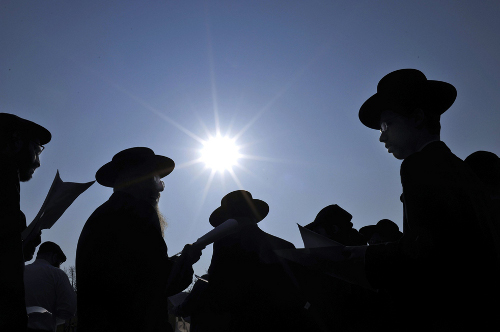 On top of that, the Orthodox are considered the most “rule heavy” expression of Judaism and, as the Tablet Mag article attests, being Orthodox and strictly observant is very expensive.
Contrary to popular belief, not all Jews are wealthy or even comfortably middle-class. Some Jews, like Tzivia Silverstein, are barely making it. But what else is Orthodox Judaism? Let’s return to Shimon Rosenberg’s answers:
My wife and I have experienced fertility problems. We thankfully had been blessed with two children but as they grew older we had been trying for some time to have another child to no avail. One day I was speaking with my rabbi about our situation and I conveyed to him that my wife and I wanted to pursue fertility treatments but because of the steep cost, we were having second thoughts. A few days later my rabbi said that he spoke with an anonymous individual with means in the Jewish community who had agreed to sponsor fertility treatment for young Jewish couples if they could not afford it. He would not know who we were and we would not know who he was. He was motivated purely out of a sense of loyalty to the continuity of the Jewish People.
That’s the Orthodox community I know.
I’ll admit to experiencing a certain amount of dissonance between the Tablet Mag and Aish articles, since you’d think Rosenberg’s Orthodox Judaism would somehow step in and help out Silverstein to the degree that she could acquire a job with an adequate income and not struggle so hard to make ends meet.
I also experienced the same dissonance with how Sue Fishkoff described the Chabad in her book The Rebbe’s Army in relation to some of the experiences my wife has had with the local Chabad Rabbi and Rebbitzen (no, they’re not bad people, but they are human, not the morally and ethically superhuman people Fishkoff often described in her book).
But the costs involved in living Orthodox in Toco Hills continue to rise and there’s only so much help available for lower-income Jewish families:
Many Orthodox families, especially those on the lower end of the economic ladder, simply can’t keep up with the prices. So, they turn to underground charities like Yad L’Yad, an Atlanta-based organization that works exclusively with the area’s Jewish community. According to Esther Pranskey, the organization’s head, the number of recipient families more than doubled when the recession struck and has continued to rise steadily. More than 30 families—including the Silversteins—currently receive provisions of flour, rice, pickles, and other essentials. While basic, the deliveries help ease the pressure. The Silversteins rarely go out to eat, and their meals aren’t extravagant affairs, but they stay fed and they stay kosher.
 But as Rosenberg attests in his continuing chronicle of his daughter’s birth, there are other occasional helpers:
The excitement began early Friday morning and as the day progressed I started thinking about Shabbat. What would we eat? How would I recite Kiddush? Light candles? I remembered hearing about an organization called Bikkur Cholim which means “visiting the sick.” It’s a volunteer-driven charity that looks after the needs of people in hospital. I called them and within a couple of hours someone came to our hospital room with literally bags of food, grape juice for Kiddush, electric candles to serve as Shabbat candles, even spices for havdallah. The food is free and the person delivering it is a volunteer. In the few moments I had to speak with him I learned that he was just a regular guy — an accountant — who takes off Fridays from work to volunteer for Bikkur Cholim. I asked him why he does it and he replied simply that it’s what God wants of us.
That’s the Orthodox community I know.
The Tablet Mag article doesn’t exactly end on an up beat, but it does describe why being Orthodox isn’t just a casual choice:
“I know it’s not the smart thing to do,” Wittenberg said. “I’d love to sell my house and move out somewhere cheaper. There’s not a day goes by when my wife and I don’t talk about it. But I’m a baal teshuvah. I’m choosing to be observant. And if I’m going to struggle through this Torah, then my kids need to have friends. They need to be in the community.”
For Silverstein, it comes down to value instead of cost. In terms of personal and spiritual fulfillment, she says, the neighborhood pays for itself. As heavy as the expenses are, they are necessary sacrifices for belonging to the community. “I see maybe one movie a year,” she said. “I choose to put my kids through religious school instead of buying a nicer car. It’s astounding, the amount of money that other people have, to spend on things like renovating their house or buying a bigger TV. To me, my most important relationship is with God. The material world is a means to an end.”
I’d love to copy and paste all of Rosenberg’s write-up here but I’ll restrain myself to its ending as well:
After two weeks in the hospital, the doctors told us we could go home. In the end, they said they would monitor her condition, but over time it would likely go away on its own.
Our two kids at home were delighted at the return of their baby sister. They helped her and cared for her and nurtured her. As a parent, there’s no better feeling than seeing your children care for one another. Likewise, when God watched how my community took care of my family in our time of need, I think He too had that parental pleasure, so to speak.
I wish I could thank my community publicly for everything that they’ve done but I am writing this under a pseudonym to protect the privacy of my family. But I know that my community doesn’t want a public thank you. They were just doing what they do.
That is the Orthodox community I know.

Getting back to the Facebook commentary, why would being Orthodox seem to be such as casual selection (and I apologize if I’m mischaracterizing the motives or intent of Derek and the others dialoging in the thread)?
One person made the following comment:
I think Yeshua will be a conservative Jew. Orthodoxy is more interested in keeping Torah( or the rabbinical interpretation of Torah) with rigidity. Creating it to be a burden, and simple works that do not bring us closer to Hashem . Reform is too liberal, and mostly a social club than a house of worship. I believe all Jews want to serve Hashem,they just have different interpretations on how to do it. The MJ I attend leans towards the conservative tradition.
I suppose we all have our own theories on what sort of Judaism Yeshua (Jesus) will advocate and teach upon his return (although Christians probably don’t imagine he’ll practice Judaism at all), but we are operating in a vacuum. We don’t know that Messiah will formally support a currently existing branch of Judaism. But if you read Matthew 23:1-3 as I do, you see Jesus not only agreeing with the teachings of the Pharisees but stating that they had the right to issue binding halachah (legal rulings) for their community, which apparently included Yeshua’s disciples.
That would at least hint that in the future Messianic Age, he will support a more strictly observant lifestyle which probably will include a variety of traditions such as Netilat Yadayim (ritual hand washing). That’s a guess, but I hope it’s an educated guess.
Of course modern Messianic Judaism, like all of the other more normative Judaisms, doesn’t represent a single, overarching identity or philosophy. Derek is affiliated with the Union of Messianic Jewish Congregations (UMJC) which he describes as “the oldest (and best) network of Messianic Jewish congregations in the U.S.” If you go to the Introduction page of the Standards section of the Messianic Jewish Rabbinical Council, which provides the oversight for the training and ordination of UMJC Rabbis such as Derek, you can find a PDF document called Standards of Observance which outlines in some detail the “worship, ethics, education, (and) halakhic standards” established by this body. Without going into exquisite detail, those standards seem largely to be Reform with some elements of Conservative Judaism.
I don’t doubt that those particular standards were selected with the majority Gentile attendance of UMJC synagogues in mind. Although I know more than a few non-Jewish people who have basically run out of their churches and into a Messianic Jewish lifestyle of one sort or another, almost all of them are not observing halachah to the level of an Orthodox Jew or anywhere near it.
Messianic Judaism is even now just beginning to emerge into its own as an authentically Jewish expression of Yeshua-faith, but it has a long way to go. As a relatively new branch of Judaism (I realize I’m going to receive a lot of “push back” by calling Messianic Judaism a Judaism at all), it’s still trying to “find its feet,” so to speak. UMJC is only one organization representing Messianic Judaism and its codified standards only apply to the affiliated Rabbis and synagogues under the UMJC banner. Other Messianic Jewish groups (as opposed to One Law/One Torah, Two House, Ephraimite, or Sacred Name groups) may follow different standards, either established by a different umbrella organization or at the level of the individual synagogue/congregation.
Even within those groups, Jewish individuals and families may hold to varying degrees of observance, some more stringent and some less than their faith communities. I’ve found that to be true of many of the Jewish families who attend the local Reform/Conservative shul. I’ve heard some people there comment that they think the Rabbi is “too religious”.
 I say all this not to be unkind to Derek, anyone who has conversed with him on Facebook, the UMJC in particular or Messianic Judaism in general. I am saying that religious Jews all over the world make decisions about what being observant means to them and what their duties to Hashem are in this world.
Both Wittenberg and Silverstein in the Tablet Mag article say they’ve made their choices and that being Orthodox, though sometimes a terrific financial struggle, is worth it to them. They seem to join with Rosenberg in saying that the community life of Orthodox Judaism is woven not just across the collective community, but in each of their individual lives, binding one Jew to another.
Even watching my Jewish wife, who has a fairly relaxed observance, particularly compared to Chabad, relate to other Jews and to the Jewish community (regardless of synagogue affiliation) testifies to this bond between Jews, a bond I can’t be a part of and admittedly don’t really understand. Although my wife wasn’t raised even as a secular/cultural Jew (long story), the “Jewish connection” seems to come from her very DNA and is firmly anchored to her soul. It just needed an expression which my wife has since discovered.
So while I can recognize, at least on the outside (far, far outside) looking in, that living as an Orthodox Jew can be a struggle, I can also see that it has many rewards. I certainly don’t see the justification in criticizing a Jewish person’s decision about how to be a Jew. I know if I tried that with my spouse, she’d promptly explain to me in no uncertain terms that she didn’t need my advice or permission on how to be Jewish (that happened exactly once and I’ll not cross that boundary again).
I apologize if I’ve ruffled feathers, but we must admit that in the present world, there seems to be more than one acceptable manner by which an observant Jew can live as a Jew. When Moshiach comes and teaches Torah, then we will know more.
In the meantime, we should not criticize the level of a Jewish person’s observance, especially if it’s more strict than our own (or rather than another Jew’s observance). The world, including the Christian world, has tried for thousands of years to destroy the Jewish people and Judaism using many and varied means. The current method of choice is assimilation by reducing the Jew’s observance and sense of Jewish identity to zero or close to it, thereby turning that Jewish person into a Gentile with Jewish genes.
I know no one has suggested this, but it’s the natural result of telling a Jew not to be so “religious.”
Utilize every opportunity to become aware of the Almighty’s kindness. This awareness will motivate you to emulate the Almighty and make the attribute of kindness an integral part of your personality.
-Rabbi Zelig Pliskin
 Morning Meditations