
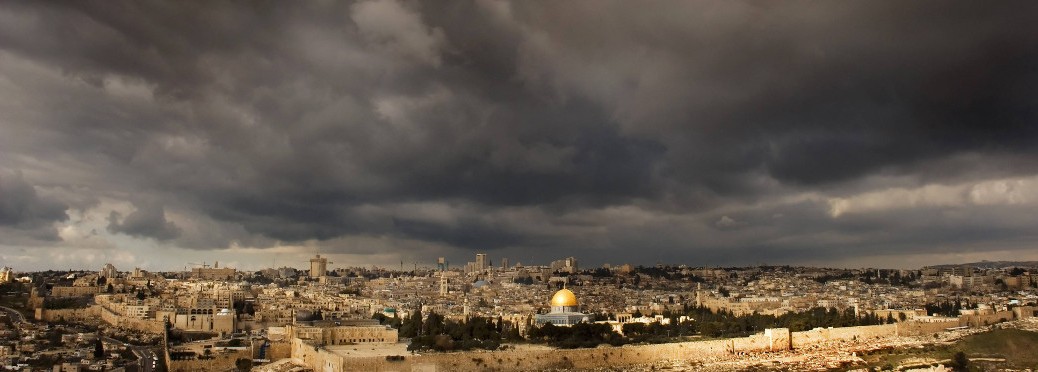
The Jewish people, the Almighty, the Torah and Eretz Yisroel (The Land of Israel). For more than 3,300 years we’ve been bound together. Did you ever wonder what the Sages taught us about how special is the Land of Israel? Here is a compilation from The Mitzvah to Live in Eretz Israel:
“There is no love like the love for the Land of Israel” — Bamidbar Rabba 23:7.
“There is no Torah like the Torah of the Land of Israel” — Bereshit Rabba 16,7.
“The air of the Land of Israel makes one wise” — Talmud, Bava Batra 158b.
“There are 10 portions of Torah in the world: 9 in the Land of Israel and 1 in the rest of the world” — Esther Rabba 1.
“If you desire to see the Shechina (Divine Presence) in this world, study Torah in the Land of Israel” — Midrash Tehillim 105.
“Living in the Land of Israel is the equivalent to all the mitzvot (commandments) in the Torah” — Sifrei, Parshat Re’eh, Tosefta Avoda Zara 5).
The Ramban, Nachmanides, writes that “We are commanded to take possession of the Land God gave to our forefathers, Avraham, Yitzchak and Ya’akov (Abraham, Isaac and Jacob). We must not leave it to others or in desolation, as God told them, ‘And you will take possession of the land, for I gave the Land to you to possess and you will settle the Land which I promised to your fathers’ (Deut. 17:14, 26:1).”
Israel is far more than just a country or a refuge for the Jewish people — it is an integral part of our spiritual destiny!
-Rabbi Kalman Packouz
Shabbat Shalom Weekly commentary for Torah Portion Bo (Exodus 10:1-13:16)
Aish.com
It’s quite clear Rabbi Packouz is addressing a Jewish audience. After all, what other people have ever been commanded to take possession of and live in the Land of Israel? Only the Jews, the modern descendants of the ancient Hebrews, the Israelites who wandered the desert for forty years prior to coming into their inheritance.
But I know more than a few non-Jewish Talmidei Yeshua who are envious and also desire the blessings listed above (I only quoted part of Rabbi Packouz’s article, so please click the link I provided above to read the full write-up).
I suppose we should be a little envious. After all there are tremendous blessings accorded the Jewish people for living in Israel that cannot be apprehended by anyone who isn’t Jewish. Further, except for maybe some exceptional cases, in Messianic Days, Israel will be filled with all or most of the world’s Jewish population. Imagine the prophesies finally being fulfilled.
“For I am the Lord your God,
The Holy One of Israel, your Savior;
I have given Egypt as your ransom,
Cush and Seba in your place.
“Since you are precious in My sight,
Since you are honored and I love you,
I will give other men in your place and other peoples in exchange for your life.
“Do not fear, for I am with you;
I will bring your offspring from the east,
And gather you from the west.
“I will say to the north, ‘Give them up!’
And to the south, ‘Do not hold them back.’
Bring My sons from afar
And My daughters from the ends of the earth,
Everyone who is called by My name,
And whom I have created for My glory,
Whom I have formed, even whom I have made.”–Isaiah 43:3-7 (NASB)
 According to Judaism 101:
The mashiach will bring about the political and spiritual redemption of the Jewish people by bringing us back to Israel and restoring Jerusalem (Isaiah 11:11-12; Jeremiah 23:8; 30:3; Hosea 3:4-5). He will establish a government in Israel that will be the center of all world government, both for Jews and gentiles (Isaiah 2:2-4; 11:10; 42:1). He will rebuild the Temple and re-establish its worship (Jeremiah 33:18). He will restore the religious court system of Israel and establish Jewish law as the law of the land (Jeremiah 33:15).
All of this is part of the Jewish argument that Jesus (Yeshua) couldn’t possibly be the Messiah because during his earthly life in the late Second Temple period, he did none of these things and then he died.
Christians believe that he was resurrected, ascended into Heaven, is our High Priest in the Heavenly Court, and in due time, will return.
Most Christians don’t believe Jesus will politically and spiritually redeem the Jewish people upon his return, although they probably would agree that if Jews converted to Christianity, they would receive spiritual redemption (I don’t think the Church would go for the idea of Israel being an actual political entity under Jesus, let alone the Kingdom that would rule all the other nations of the world, even though the Bible states this).
I know a lot of Christians who would vehemently oppose any idea that Jesus would rebuild the Temple and re-establish the Levitical priesthood and sacrifices, let alone restore the Sanhedrin court system.
But if we set aside Christianity’s traditions as they steer the Church’s doctrinal teachings, and if we accept the fact that non-Jews do not have a portion in the Land of Israel, just what do we Goyim have as far as Israel goes?
Thus says the Lord God,
“Behold, I will lift up My hand to the nations
And set up My standard to the peoples;
And they will bring your sons in their bosom,
And your daughters will be carried on their shoulders.
“Kings will be your guardians,
And their princesses your nurses.
They will bow down to you with their faces to the earth
And lick the dust of your feet;
And you will know that I am the Lord;
Those who hopefully wait for Me will not be put to shame.”–Isaiah 49:22-23
“Arise, shine; for your light has come,
And the glory of the Lord has risen upon you.
“For behold, darkness will cover the earth
And deep darkness the peoples;
But the Lord will rise upon you
And His glory will appear upon you.
“Nations will come to your light,
And kings to the brightness of your rising.
“Lift up your eyes round about and see;
They all gather together, they come to you.
Your sons will come from afar,
And your daughters will be carried in the arms.–Isaiah 60:1-4

It seems our job is to facilitate the return of the Jewish people to Israel, to not just “surrender” them from our lands, but to take an active part in the Messiah’s mission to return each and every Jewish man, woman, and child to the bosom of their nation Israel, for the Jews are the nation of Israel. I’ve tried looking for information regarding what, if any, inheritance Gentiles may expect regarding Israel, but there’s nothing clearcut.
But something called ElijahNet.net suggests that the Gentiles who join themselves to Israel will indeed have a portion:
Will the Gentiles who have joined themselves to the Lord be separate from His people? The God of Israel says, “No. They will be part of My household, My family.” Will the Gentiles who join themselves to the Lord be excluded from the holy place and service of the Lord? God says, “No. They will worship Me in My house, along with those of the dispersed of Israel whom I have gathered. They will be gathered to the remnant of Israel.”
“In the last days, the mountain of the house of the Lord will be established as the chief of the mountains, and will be raised above the hills: and all the goyim will stream to it. And many peoples will come and say, ‘Come, let us go up to the mountain of the Lord, to the house of the God of Jacob; that He may teach us concerning His ways, and that we may walk in His paths, for the law [Torah] will go forth from Zion, and the word of the Lord from Jerusalem.’ And He will judge between the goyim, and will render decisions for many peoples; and they will hammer their swords into plowshares, nation will not lift up sword against nation, and never again will they learn war.” (Is. 2:2-3, Mic. 4:1-3)
God gave Ezekiel visions of a time to come when living, healing water would flow out of Jerusalem. (Ezek. 47:1-12) The Lord told Ezekiel that the alien in the midst of Israel will be allotted an inheritance among the tribes of Israel. (Ezek. 47:21-23)
I should point out that from a Jewish point of view, Ezekiel 47:21-23 isn’t about giving Gentiles part of the Land of Israel.
A more apparently Christian source has this to say:
Question: Are we as “gentile Christians” part of Israel (Rom 11:17)? Do any of the promises made to Israel as a nation apply to us, for example Deuteronomy 28 (I’ve often heard this one used by prosperity teachers although they never read past the fourteenth verse).
Answer (in part): Regarding your first question, I would say that “no” we are not “part of Israel” as gentile Christians. Both Jewish and Gentile Christians today make up the “Church” the “body of Christ” or “one new man” which Paul discusses in Ephesians 2. We, as Gentiles, were aliens from the commonwealth of Israel and strangers from the covenants of promise (Eph. 2:12), but now we have been brought near through Christ. But notice that we are not said to be “part of Israel” or a “new Israel.” Instead, both Jews and Gentiles are said to be joined into a new spiritual body, the one new man (Eph. 2:15). Another evidence that we are not “part of Israel” is found by carefully examining Paul’s use of the term “Israel” in Romans 9-11, and especially chapter 11. There, it will be found that “Israel” still refers to Jews.
Regarding your second question, “Do any of the promises made to Israel as a nation apply to us, for example Deuteronomy 28 . . .”
While there are principles in Deu. 28 which apply in general (e.g., God will bless a nation which is devoted to Him and follows His will, He will turn away from a nation—such as ours—which forsakes Him), the context of the passage is very clearly specific to the nation Israel. It includes curses which make absolutely no sense when applied to Gentiles (believers or otherwise). For example, the promise of worldwide scattering in judgment of disbelief: yet Gentiles (non-Jews) have always been scattered all over the world.
Whereas all scripture is written for our learning (Rom. 15:4), it is not all written specifically to us—and this is the case in Deuteronomy 28. Both the blessings and curses stated there apply to Israel, as the phrase “wandering Jew” and history abundantly prove.
Concerning the blessings which come to believing Gentiles, this is best understood by studying the relationship between the New Covenant (given to Israel in Jeremiah 31) and the Church.

Of course, there are a seemingly endless collection of Jewish and Christian information sources on the web, so this is only a very tiny sampling.
I couldn’t find anything at AskNoah.org about what sort of connection there could possibly be between a righteous Gentile and the Land of Israel.
I did find something on their view of the New Covenant in Jeremiah 31, as well as whether or not Noahides will worship at the Third Temple. From the latter article:
Gentiles were welcomed to bring their sacrificial offerings for G-d to the First and Second Temples in Jerusalem, and they will participate even more at the Third Temple – especially during the festival of Sukkot (Zechariah 14:16).
Also…
In his commentary on the Torah section beginning with Genesis 12:1, Ramban (Nachmanides) wrote:
“Even in the time of Joshua, … the Gentiles knew that this place was the most august of all, that it was at the center of the inhabited world; and [Torah] Tradition had taught them that it corresponds in this world to the celestial Temple where Divine Majesty, called (righteousness), resides.”
And…
When the First Temple was inaugurated by King Solomon, he beseeched G-d with an eloquent prayer that included the following words (Kings I, 8:41-43) (which show that in the past, Gentiles were welcomed to the First and Second Temples, and that they will participate even more in the Third Temple)…
And finally, the article quotes from Isaiah 2:2-3 regarding the participation of Gentiles in the Temple:
“And it will come to pass at the end of days that the mountain of G-d’s House will be firmly established, even higher than the peaks, and all the peoples will flow toward it as a river. And many nations will go and will cry, ‘Let us go up toward the mountain of G-d’s House, to the House of the L-rd of Jacob, and we will learn from His ways and walk in His paths, for out of Zion goes forth Torah and the word of G-d from Jerusalem.’ “
Of course, participation in the Temple rites is not the same as having any portion in the Land. Isaiah 56 aside, I can’t find a legitimate Jewish commentary saying that any Gentiles will have a permanent home in the Land of Israel at all. It seems that we can certainly visit, and if intermarried, the Gentile would probably live in Israel with the Jewish spouse, but that’s about it.
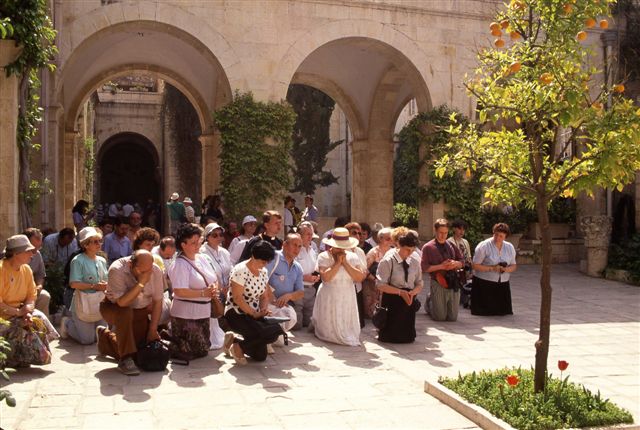
Is that such a bad thing? I know some people who operate in the Hebrew Roots space who most likely would think so. I think some of those non-Jews somehow believe they have “rights” not only to the Land of Israel, but to the Torah mitzvot as well. It’s been a long-standing argument. The relationship between Gentiles and the Land of Israel is probably something like how Jews traditionally accept Gentiles visiting the synagogue:
Non-Jews are always welcome to attend services in a synagogue, so long as they behave as proper guests. Proselytizing and “witnessing” to the congregation are not proper guest behavior.
When going to a synagogue, you should dress as you would for church: nicely, formally, and modestly. A man should wear a yarmulke (skullcap) if Jewish men in the congregation do so; yarmulkes are available at the entrance for those who do not have one. In some synagogues, married women should also wear a head covering. A piece of lace sometimes called a “chapel hat” is generally provided for this purpose in synagogues where this is required. Non-Jews should not, however, wear a tallit (prayer shawl) or tefillin, because these items are signs of our obligation to observe Jewish law.
During services, non-Jews can follow along with the English, which is normally printed side-by-side with the Hebrew in the prayerbook. You may join in with as much or as little of the prayer service as you feel comfortable participating in. You may wish to review Jewish Liturgy before attending the service, to gain a better understanding of what is going on.
Non-Jews should stand whenever the Ark is open and when the Torah is carried to or from the Ark, as a sign of respect for the Torah and for G-d. At any other time where worshippers stand, non-Jews may stand or sit.
When we non-Jews are in Israel, we are guests and we are expected to treat our hosts with proper respect, just as if we were visiting someone else’s house. You wouldn’t go into someone else’s home and act as if you lived there, would you?
In Rabbi Moshe Weiner’s Passover message to all Noahides, he states:
One of the wonders of the future redemption is the revelation of the Divine light that will shine onto the whole world, to all humanity (Isaiah 60:3). From the power of this light, all people will recognize the true existence of the Master of the world, Who fills the whole world, as stated by the prophet Isaiah (52:8-10): “with their own eyes they will see that G-d returns to Zion. Burst out, sing glad song in unison, O ruins of Jerusalem together, for G-d will have comforted His people; He will have redeemed Jerusalem. G-d has bared His holy arm before the eyes of all the nations; all ends of the earth will see the salvation of our G-d.”
Just as Moses our teacher at Mount Sinai began to repair the world, including all the Children of Noah by giving the Seven Commandments that were commanded to them, so too, the Messiah will teach and show the world (but in a more wondrous manner) the same recognition in the truth of the Creator of the universe which began to be revealed by Moses.
It is a great merit for each and every one of us to bring himself and his community to the faith and anticipation of this future freedom for the whole world. This will be freedom from evil and falsehood, and a redemption by which we will merit to go out from darkness to a great and true light.
 Certainly it seems, the righteous Gentiles are included in many of the blessings of Messiah and that both Jew and Gentile will “go out from darkness to a great and true light.”
But that’s as far as I can understand it. All of those blessings Rabbi Packouz mentions that are received by those living in the Land of Israel are only received by the Jews living in the Land of Israel. For the Gentiles, not so much.
I can only imagine that Gentiles are still blessed in some manner when they/we visit Israel, but we’re visitors and guests, not residents. We may be associated with Israel as citizens of the vassal nations, subservient to our King, and we may have been brought near to her (see Ephesians 2:13) so that there is to be peace between Israel and we people of the nations (although I suspect that peace won’t be truly realized until the Messiah establishes his reign as King in Israel over the world), but none of that means that we are Israel, nor that we have rights to any of her real estate (at least as far as I can discover).
I guess in the resurrection, just like right now, I’ll have to be satisfied with my own little corner of Idaho.
My (Jewish) wife did surprise me again the other day. Out of a proverbial “clear blue sky,” she asked me if I’d given up on any plans to visit Israel. I didn’t know what to say. One circumstance or the other has gotten in the way and I haven’t even been thinking of it lately. I also am concerned about expenses for a number of complicated (and private) reasons, so thought maybe my long-suffering wife would appreciate it if I didn’t spend thousands of dollars playing tourist in the middle east.
I don’t know.
Blogger Ro Pinto wrote multiple blog posts about her recent trip to Israel including this summary, and it is abundantly obvious that she has a tremendous love of and devotion to the God of Israel, His people, and their Land. Some of her spiritual insights border on spectacular, which is a realm that has always eluded me.
Compared to how she related to Israel during her trip, I can’t imagine achieving anywhere near such experiences and insights. I think a visit to Israel is supposed to be as much about what you bring to the table spiritually as what you expect to receive.
Visiting Israel as a Gentile is not like traveling to any other nation on Earth. Jerusalem is the only city on the planet where God has put His Holy Name. Every time I seriously think of traveling to the Holy Land, I feel humbled and chagrined. Who am I compared the men and women of the Bible who trod that ancient Land, the Prophets, the Kings, the warriors, the scholars?
Every time I read or hear from some non-Jewish person who lays claim to Israel or the Torah, I’m astonished at the “Obama-like” audacity they exhibit. The feeling of being able to do anything you want, regardless of the (in this case Biblical) Law, without so much as a “by your leave”. You can’t bypass the God of Israel with a pen and a phone.
Who among the Gentile Talmidei Yeshua hasn’t felt the call of Israel at one point of another in our lives? Who hasn’t, at some time in our existence, wanted to bathe in the glow of the blessings Rabbi Packouz outlined in his “Shabbat Shalom Weekly” article?
 But it’s like being a kid and watching the boy or girl next door receive a shiny new bicycle for their birthday. Just because you want to ride on that bike too, doesn’t mean it belongs to you.








 Morning Meditations