Tag Archives: Talmud

The Rabbinization of Abraham

When Abraham heeded G-d’s order he was already fully proficient in what was to become known as Kabbalah. He had even authored a major Kabbalistic text – Sefer HaYetzira (the Book of Creative Formation). He was an acclaimed astrologer and conversant in the magic of the East. In his youth, Abraham had turned his back on the negative forces of tum’ah (spiritual blemish) and adopted the pathway of spiritual monotheism.

-from Practical Kabbalah: A Guide to Jewish Wisdom for Everyday Life (pp 19-20)
by Rabbi Laibl Wolf

You shall not practice divination or soothsaying.Leviticus 19:26 (JPS Tanakh)

The word “se’onenu” in the verse cited above (Lev 19:26) can be a derivation of the root onah (time season) or of the root ayin (eye). Consequently, two different prohibitions are based on this verse. One, quoted by Rashi on the verse, is the prohibition against “calculating times and hours.” It is forbidden to employ astrological (Rambam Hilchos Avodas Kochavim 11:8) calculations in order to determine when to engage in or refrain from a certain activity.

-Rabbi Doniel Neustadt
“Selected Halachos relating to Parshas Kedoshim”
Torah.org

I don’t always understand what I’m reading in the Jewish teachings, or at least I don’t always understand it well enough to agree with what is being taught. For instance, Rabbi Wolf plainly states in his book that Abraham was “an acclaimed astrologer” and yet Rabbi Neustadt, referencing Rashi and the Rambam, interprets Leviticus 19:26 as prohibiting the use of astrology. Furthermore, practicing various types of sorcery and magic is forbidden in Torah as described here:

Let no one be found among you who consigns his son or daughter to the fire, or who is an augur, a soothsayer, a diviner, a sorcerer, one who casts spells, or one who consults ghosts or familiar spirits, or one who inquires of the dead. For anyone who does such things is abhorrent to the Lord, and it is because of these abhorrent things that the Lord your God is dispossessing them before you. You must be wholehearted with the Lord your God. Those nations that you are about to dispossess do indeed resort to soothsayers and augurs; to you, however, the Lord your God has not assigned the like. –Deuteronomy 18:10-14 (JPS Tanakh)

So where would Rabbi Wolf get the idea that Abraham was an accomplished astrologer and “conversant in the magic of the East?”

There are two ways to look at this. The first is that Kabbalah suggests many things that we can’t derive from the plain meaning of the Torah text. While proponents of Kabbalah believe that it has its origins as an oral tradition that predated Jesus and indeed, may have been practiced in some manner by Abraham and even by Noah and Adam, other Jewish scholars attribute the rise of Kabbalah to a much later time, with the writing of the Zohar (presumably by Moses de Lyon, although this is not firmly established) in the 13th century CE. Given the historical “uncertainty” about Kabbalistic teachings, not everything we read about figures such as Abraham in Kabbalah can be taken as completely factual.

The second is that Abraham lived in an age far earlier than Moses and the giving of the Torah at Sinai and he can’t be expected to have understood all of the prohibitions it contained (and thus, may have possibly practiced magic and astrology in his earlier days, although this is pure conjecture). Nevertheless, there is also a tradition in Judaism that says Abraham was certainly aware of everything in the Torah, even though it had yet to be written down.

The Talmud states that Abraham, Isaac, and Jacob all studied in the academies of Shem and Eber. The Talmud further proclaims that the Patriarchs kept the entire Torah before it was given. How was this possible? The Kabbalists explain that they kept the Torah in its spiritual form, for it was only subsequently through Moses that the Torah instruction became manifest in the physical observance of Mitzvot.

-Rabbi Nissan Dovid Dubov
“The Key to Kabbalah”
Chabad.org
But since this information takes us back to Kabbalah, we may tend to disregard it as a source of historical fact and relegate it to the status of almost legend.

But there are many observant Jews who consider everything I’ve just said about Abraham’s history as outlined in Kabbalah as absolutely true.

As a Christian who doesn’t have the benefit of a classical Jewish education, let alone a working knowledge of Kabbalah, how am I to interpret all this, as Rabbinic fiction or even fantasy? That seems a little harsh, but many of the statements about Abraham studying Torah in the House of Shem and practicing the magic of the East stretch credibility beyond the breaking point. Is it that I am just so ignorant of Jewish tradition and the Hebraic mindset that I am unable to grasp the deeper and hidden (Sod) meaning in Torah, or is there something else going on?

The process is evident even on the basis of a casual reading of Midrash Genesis Rabbah. The rabbinic ideal of “Talmud Torah” as the driving force in Jewish religious behavior is projected as a constant factor in the lives of the patriarchs: The children of the patriarchs study in the batei midrash of Shem and ‘Ever’ (e.g. Genesis Rabbah 63:10); Jacob strives to establish “a house of Talmud where he might teach Torah” in Egypt (Genesis Rabbah 95:3); Abraham was well versed in the prohibition of carrying on Shabbat without an ‘eruv’ (specifically an ‘eruv hazerot’ Bereshit Rabbah 49:2)…

-Isaiah Gafni
“Rabbinic Historiography and Representations of the Past” (pg 305)
The Cambridge Companion to the Talmud and Rabbinic Literature
Edited by Charlotte E. Fonrobert and Martin S. Jaffee

In his essay, Gafni speaks of the Talmud’s “Rabbinization of the past”.

If, indeed, we can assume that the contemporary rabbinic Judaism espoused by certain talmudic sages held up favorably when compared with earlier expressions of the faith, issues of past and present no longer suggest a one-directional regression from the glories of the past. With this in mind, we might better understand a well-documented phenomenon in rabbinic midrash, namely, the “rabbinization of the past.” (pg 304)

One way to establish and support an acceptance of Talmudic interpretation and judgment relative to Torah for post-Second Temple Judaism is to project the values and even the “reality” of Talmud (and later, Kabbalah) not only forward in time but backward. Peering at the Patriarchs through this lens, we can indeed “see” Abraham, Isaac, and Jacob studying Torah and Talmud in the study house of Shem when by historical knowledge and a plain reading of the Torah, such events seem very unlikely to have actually taken place.

However, the Rabbis may have had other motivations besides cementing the validity of Talmud for the Jewish people as Gafni points out.

But while the practical observation of the Law by pre-Sinaitic figures predates the rabbis, the more thorough rabbinization of the past by endowing it with a more focused stress on uniquely post-Destruction religious and social categories was clearly the work of talmudic sages, emerging primarily in amoraic (and not tannaitic) literature. The rabbis may have been motivated, at least in part, by a wish to avoid a type of supersession imagery embraced by the Church. However, in fact they were, to a certain degree, doing precisely what the Fathers had done, namely, applying to the patriarchs a more spiritualized behavior in manifesting their Jewish identity. (pg 308)

I find it more than a little ironic that the “rabbinization” of the ancient men and women of the Torah, which Christianity criticizes with great zeal, was possibly motivated in part, by the Jewish need to defend itself against early Christian supersessionism.

Viewed through the eyes of Gafni’s study, we can read many of the Talmudic and Kabbalistic “histories” of the patriarchs and matriarchs as, not exactly fiction, but a “rabbinization” process designed in the early centuries of the Common Era, to preserve the Jewish people as a people, which was a requirement in the face of the exile from the Land of Israel and hostile persecution by the official Church of the Roman Empire.

So we can hardly blame the Rabbis (well, I can’t anyway) when we read something like this.

But the children struggled in her womb, and she said, “If so, why do I exist?” She went to inquire of the Lord. –Genesis 25:22 (JPS Tanakh)

When she passed the academy of Shem and Ever, Jacob struggled to leave the womb, and when she passed a temple of idol worship, Esav fought to leave. – Rashi

It seems unlikely that a “Torah academy of Shem and Ever” really existed and even if somehow it did, that Jacob would struggle to escape his mother’s womb in order to study Torah (as an unborn child) there whenever she was near that place.

Strangely enough though, we have a sort of parallel in Christianity.

Miryam arose in those days and went quickly to the mountains, to a town of Yehudah. She entered the house of Zecharyah and blessed Elisheva. When Elisheva heard Miryam’s brachah, the child danced inside of her and Elisheva was filled with the Holy Spirit. –Luke 1:39-41 (DHE Gospels)

If the unborn John could dance in his mother’s womb at the sound of the blessing of Miryam (Mary) who was pregnant with Messiah and Savior, is this scripture a sort of “Christian rabbinization” of the Gospels or is it something more? If it is more, then what are we to make of the “rabbinization of the patriarchs?”

If we were prophets or people of vision, we would see what is important and what is not, what will bear fruits and what will remain barren.

But we are simple people in an age of confusion. Our lives are filled with uncertainties—anything could happen, we have no way of telling.

We cannot decide which mitzvah is important and which will bear fruit. Neither are we expected to make our decisions that way.

All that’s expected of us is to simply grab whatever G‑d sends our way, and do our very best at it. What will come of it? What is its purpose?

Only He needs to know.

-Rabbi Tzvi Freeman
“Un-Prophets”
Based on letters and talks of the Rebbe
Rabbi M. M. Schneerson
Chabad.org

The teachings of the Jewish masters are difficult for me to comprehend at times but then again, for the same reasons, so are the teachings of the Jewish writers of the Gospels.


The Insurmountable Wall

freestyle1All the elaborate proofs, all the philosophical machinations, none of that will never stand you firmly on your feet. There’s only one thing that can give you that, and that’s your own inherent conviction.

For even as your own mind flounders, you yourself know that this is so, and know that you believe it to be so. It is a conviction all the winds of the earth cannot uproot, that has carried us to this point in time, that has rendered us indestructible and timeless.

For it comes from within and from the heritage of your ancestors who believed as well, back to the invincible conviction of our father, Abraham, a man who took on the entire world.

The doubts, the hesitations, the vacillations, all these come to you from the outside. Your challenge is but to allow your inner knowledge to shine through and be your guide.

Inside is boundless power.

-Rabbi Tzvi Freeman
“Conviction”
Based on letters and talks of the Rebbe
Rabbi M. M. Schneerson
Chabad.org

“Any intelligent fool can make things bigger, more complex, and more violent. It takes a touch of genius — and a lot of courage — to move in the opposite direction.”

Albert Einstein

It’s no small feat to try to understand God. In truth, we never will. Religion and theology is the interface by which we try to make some sense out of a God that exists in the realm beyond reason and comprehension. Even the systems we develop that allow us to build a religious interface can be exceedingly complex and practically impossible to navigate. For instance, take my situation. I’m trying to shift my focus from a traditional Gentile Christian perspective to one that includes at least some elements from Jewish wisdom and learning.

It’s not easy. Here’s what I mean.

As we will see shortly, not all rabbinic sources share the view that the Oral Torah was received as a discrete and finite set of traditions. Later controversies between the Rabbanites (early medieval inheritors of rabbinic tradition) and the Karaites (those who rejected the authority of the rabbinic tradition) made this view of Oral Torah particularly appealing to those who accepted the authority of rabbinic tradition.

-Elizabeth Shanks Alexander
“The Orality of Rabbinic Writing” (p. 42)
As published in The Cambridge Companion to the Talmud and Rabbinic Literature
Edited by Charlotte E. Fonrobert and Martin S. Jaffee

Here’s another example from the same source.

In contrast with the Talmud, the Mishnah itself nowhere advances the theory of the Oral Torah and, aside from the opening paragraphs of Avot, seldom calls itself “Torah” or associates itself with either Moses or Mount Sinai.

-Shane J.D. Cohen
“Judaean Legal Tradition and Halakhah of the Mishnah” (p. 122)

Not easy material for the non-Jew to wrap his brain around. Catherine Hezser, in her article for the same publication “Roman Law and Rabbinic Legal Composition” (pp 144-5) agrees.

Rabbinic texts are not easily accessible to modern readers with little exposure to classical rabbinic educations. Even a cursory glance will reveal the imposing compositional nature of these texts.

alone-desert
After three days, I had hoped to leave this topic and move on, but the concept of being an “intelligent fool” is something that I continue to dwell upon. And yet (if I dare to contradict Einstein), I don’t see how to make the vast body of Jewish religious and intellectual law, interpretation, and commentary into anything less than a dizzying conundrum. However, I take some comfort in Rabbi Freeman’s words since he not only describes the “doubts, the hesitations, the vacillations” of my mind in trying to grasp what is beyond me, but says that it’s conviction, not comprehension, that allows “inner knowledge to shine through and be your guide.”

Periodically in my journey of faith, I become lost in the maze of information and details, not just because of its vastness but because of its alien nature. God is alien to humanity and Jewish wisdom is alien to the Gentile (and yet tantalizingly familiar, somehow). I know somewhere there is a bit of cheese waiting for me at the end of the maze if I’m able to correctly trace my route, but I can’t quite figure out which turn to make next.

Yesterday, I quoted from the lyrics of the Jackson Browne song, “Looking into You” (1972) which include:

The great song traveler passed through here
And he opened my eyes to the view
And I was among those who called him a prophet
And I asked him what was true
Until the distance had shown how the road remains alone
Now I’m looking in my life for a truth that is my own

Compare what Browne is saying to Rabbi Freeman:

The doubts, the hesitations, the vacillations, all these come to you from the outside. Your challenge is but to allow your inner knowledge to shine through and be your guide.

I know. I tend to get in trouble when I compare information from vastly different sources, but both men seem to be saying that depending solely on outside information to define reality and meaning isn’t going to work. Yes, study is important, knowledgeable and insightful teachers are important, but while God does speak to us from those sources, He also speaks to us.

I said earlier that religion and theology is the interface by which we interact with God. That’s true. Without them, we could never be able to operationalize a life of faith. We wouldn’t have a starting point or any idea of what actions we should take to enact holiness. But we also need to own our end of the relationship. It has to be part of us and probably it has to be the core of us. Not understanding the complexities of Mishnah, Talmud, and Gemara isn’t a death sentence and particularly for the Gentile, there is nothing specific that commands us to adopt such comprehension and to define our relationship with God by its tenets. I pursue that path of learning because I feel driven to do so, but I also must stop and realize that, with or without that learning, God is here.

There is something of God in each of us, with or without the Bible, with or without the church and synagogue, with or without the wisdom of the sages and the writings of the church fathers. They provide vital context, but they are not God, nor are they the actual relationship, the conduit between man and Divine. It’s that relationship and what we can take from man-on-a-mazeit that is “the truth that is our own” and the “inner knowledge that shines and guides” us to God.

It’s at times like these, when I open my eyes and really see the immense vastness of what I am trying to understand, encounter it with awe, feel overwhelmed, and realize that I have no idea what I’m doing, that I have to close the books for a few minutes, find some quiet place where I won’t be interrupted, and begin, “Our Father who is in heaven.”

On Considering Christian Halachah

birds“If, along the road, you chance upon a bird’s nest, in any tree or on the ground, with fledglings or eggs and the mother sitting over the fledglings or on the eggs, do not take the mother together with her young.”Deuteronomy 22:6 (JPS Tanakh)

Rural areas have both advantages and disadvantages, even in terms of observing mitzvos. One of the advantages is bonafide opportunities to fulfill the mitzvah of shiluach hakein, sending away the mother bird to take the eggs or chicks discussed in the last chapter of Chullin, which begins with today’s daf. One of the strange things about fulfilling rare mitzvos is that that one has no experience of exactly how to fulfill the mitzvah or various details relevant to it.

Daf Yomi Digest
Stories off the Daf
“A New Mitzvah Opportunity”
Chullin 138

The Beraisa teaches that there is no requirement to search for
a nest in order to fulfill the mitzvah of sending away the mother
bird from its nest. This mitzvah is only incumbent upon a person
if he happens to come across a nest.

Is there an obligation to pursue other mitzvos, or are we expected
to fulfill mitzvos only when they come our way?

Daf Yomi Digest
Distinctive Insight
“Is one required to pursue finding a nest, or does it apply only when one comes across a nest?”
Chillun 139

I often include quotes in my blog posts that no doubt seem strange, mysterious, or perhaps even ridiculous to a Christian. Comprehending Jewish Rabbinic teachings, opinions, and rulings is something that is generally disregarded in the church and considered the “wisdom of men” working in opposition to the Word of God. While I don’t want to debate such a broad topic in today’s “morning meditation”, I do want to see if we Christians can take away anything from some of these teachings (and I wouldn’t be writing about this unless I thought it was possible).

Christians believe that we should do good, as we were taught by Jesus. That we should give people who are hungry and thirsty food and drink, visit the sick and the prisoner, and clothe those without adequate clothing is clearly illustrated in teachings such as the one we find in Matthew 25:31-46. In fact, Jesus states that seeing a person in need and failing to help them will result in our being sent to “eternal punishment”, so just “believing in Jesus” in our minds and hearts is hardly enough to “save” us.

However, are we only to perform such acts of kindness if the opportunity comes our way, or are we, as Christians, to actively seek out situations where we can do what we have been commanded to do? Let me give you another example.

Therefore go and make disciples of all nations, baptizing them in the name of the Father and of the Son and of the Holy Spirit, and teaching them to obey everything I have commanded you. –Matthew 28:19-20

This directive of Jesus to his Jewish disciples is commonly referred to as “the Great Commission”. Entire churches and religious organizations are dedicated to fulfilling this commandment by evangelizing to not only people in our lives, but entire nations and people groups. There are specific missions devoted to evangelizing the Jewish people (much to the consternation of many Jews). Churches regularly send representatives to third-world countries to teach the Gospel of love and salvation to the people living there.

In other words, as far as “the Great Commission” is concerned, a significant percentage of the body of Christ deliberately and actively seeks to fulfill the commandment, rather than waiting for some opportunity to arise where we can perform evangelism.

While Christianity doesn’t provide an organized list of our duties, Judaism very specifically codifies the responsibilities of each Jewish person as 613 commandments. A few days ago, I quoted Rabbi Shmuley Boteach as saying:

There are 613 commandments in the Torah. One is to refrain from gay sex. Another is for men and women to marry and have children. So when Jewish gay couples tell me they have never been attracted to members of the opposite sex and are desperately alone, I tell them, “You have 611 commandments left. That should keep you busy.”

He seemed to be saying that, even if you cannot obey all of the commandments, there is much merit in obeying some or even most of them. This defies the common Christian criticism of “the Law” in that Torah obedience is supposed to be an all or nothing affair. Christians believe that no human being can always keep the Law and that no one, except Jesus, ever perfectly obeyed the mitzvot. It also appears to indicate that the various commandments stand alone or are contained in distinct “silos” of activity so that a Jew can be doing good by obeying some of the mitzvot while not obeying others. Additionally, there’s the idea that each mitzvah is unique and has some sort of individual value not carried by the others. Sort of like obeying the mitzvah of visiting the sick carrying a wholly different merit than the mitzvah of (for a Jew) praying with tefillin.

There is an excellent example of this in the Preface to The Concise Book of Mitzvoth: The Commnandments Which Can Be Observed Today as authored by Israel Meir Kagan and translated Charles Wengrov. Preface writer Ben Zion Sobel discusses the commandment to compensate a hired worker within a specific time frame:

Now, one who is not an employer might think that he has no opportunity to fulfill this commandment and be rewarded for it. But if he were to examine his everyday activities, he would realize that in fact, this mitzvah comes his way more often than he imagined.

For example, whenever one hires a painter to paint his house, or a handyman to build or repair something, or a plumber to fix a leak, he is required to pay the hired worker on time. Moreover, whenever one rides in a coach (or in our times, in a taxi), he has actually “hired” the driver to transport him to his destination, and he is thus responsible for seeing to it that the driver’s wages are paid promptly. Before paying, he is to take a momemt to say to himself, “I am about to perform the commandment of my Creator, Who instructed us to pay a worker on time.” Then he would deserve the full reward for having fulfilled a mitzvah of the Torah.

Pouring waterAs I mentioned before, this is a very different way for a Christian to think about performing acts of charity and righteousness, especially the “reward” part. And yet being rewarded for obeying God and doing good deeds is not alien to Christianity.

For I am already being poured out like a drink offering, and the time for my departure is near. I have fought the good fight, I have finished the race, I have kept the faith. Now there is in store for me the crown of righteousness, which the Lord, the righteous Judge, will award to me on that day—and not only to me, but also to all who have longed for his appearing. –2 Timothy 4:6-8

Paul was a Jew and he conceptualized the world around him, including God, the Messiah, and the mitzvot, as a first century Jew. It’s no mystery that what he wrote actually fits into how later, Talmudic period Jews conceptualized their role in relation to the Torah. As 21st century Gentile Christians, do we allow this “intersection” of the New Testament, the Torah, and The Concise Book of Mitzvoth to get in our way or to provide a lens of clarity? Was Paul’s statement in 2 Timothy 4 “too Jewish” for us to understand and thus do we ignore it, deferring only to NT writings that are more palitable to the non-Jew, or do we start to realize that there is something in Judaism that provides context, understanding, and focus to our lives as disciples of the Master?

Returning to the mitzvah of shiluach hakein, there are apparent contradictions in the interpretations regarding this particular commandment and on the whole, Christians would rather not be bothered with having to puzzle through our responsibilities to God and our duties to Jesus. When we think of ourselves as “free from the Law”, we imagine we are free from having to put much time and effort into understanding who we are and what our God desires from us.

However, maybe God has, in some way, built complexity into His desires for us on purpose. Maybe we are supposed to actually think and not just feel about a life of faith, compassion, and holiness. If we engage more of who we are and more of our internal and external resources into living a life conforming to God’s will, more of who we are is involved in that holiness. We are forced to consider even the most trivial of actions in relation to what God wants us to do and how He wants us to do them.

I’m not saying that Christians should emulate Jews in every small detail. Far from it. But I am saying that we can take the “light” that Judaism shines on God and His Word and use that light to see how we can be better disciples and servants of both our Creator and his beloved creations.

God, Bad, and Imperfect

joseph-and-pharaohOn today’s daf we find that when Rabbi Akiva heard a compelling argument, he changed his opinion and began to teach in accordance with Rabbi Yehudah’s view.

The Alter of Kelm, zt”l, explains the great importance of admitting one’s errors. “We find in Maseches Avos that there are seven attributes of the wise, one which is to admit the truth. Who was more evil than Pharaoh? Yet when he heard Yosef’s interpretation of his dreams, he was amazed…The Ramban explains that Pharaoh was very wise and could discern broad inferences from minor hints. From this one episode, he understood the great wisdom of Yosef and nullified his own understanding to that of Yosef. He saw that Yosef was the fittest person to rule the land, not him.

“We see that the nature of a true chacham is to admit to the truth. Nothing held him back from treating Yosef as was fitting…despite the Egyptian law that one who had been a prisoner was forbidden to rule. He didn’t even check why Yosef had been placed in prison. Instead, he understood what so few with his vested interests would have grasped: that Yosef is exceedingly wise. And that it would be fitting to learn from him as a young child learns from his father. It was clear to Pharaoh that Yosef deserved to rule.”

The Alter concluded: “I have written just a little of what is in my heart on this matter, but it is enough for a wise man to understand that failure to admit the truth reveals a lack of understanding.”

Daf Yomi Digest
Stories Off the Daf
“There is None as Wise as You”
Chullin 128

They were not perfect men. Abraham twice called Sarah his sister rather than rely on God for protection. He married Hagar rather than wait for God’s promise through Sarah. Isaac proved his fallibility by turning a blind eye to the wickedness of Esau. Jacob is remembered for his cunning and trickery. The consistent story of Scripture is not one of exceptional men, but an exceptional God. The Torah tells us their stories so honestly that we are convinced. We feel we know these men personally. We learn that even the greatest men of faith were human. We may take comfort in that, but we must not forget the unique, spiritual greatness of the Fathers.

-from “The Greatness of Our Fathers”
Torah Portion Lech Lecha commentary
FFOZ.org

No one is perfect. We all make mistakes. If we are truly wise, when we discover that we’re wrong, we’ll admit it and turn to what is right.

If you’ve been reading this blog for any length of time, you know that a recurring theme here is the relationship between Christianity and Judaism. Sometimes I lament of our inability to get along with each other, and sometimes I marvel at how amazingly similar the message of the Rabbinic sages is to that very special “Sage from Netzeret”. You really can’t understand Jesus unless you have some idea about Judaism, even post-Biblical Judaism.

However, there are a few pitfalls involved in “combining” Christianity and Judaism and they lead in opposite directions. Some non-Jews become so enamored with the beauty of Jewish prayer and worship, that they in effect, start worshiping Jews and Judaism rather than the God of Israel. The extreme opposite happens, too. Sometimes even intelligent and otherwise well-meaning people feel threatened by the “choseness” of the Jews and develop and deep and abiding “dislike”…OK, hatred for anything Jewish. I’m going to focus on this latter group today.

I was on Amazon a little earlier looking at a book written by Pastor Barry Horner called Future Israel: Why Christian Anti-Judaism Must Be Challenged. Here’s a bit of what the book is about:

Author Barry E. Horner writes to persuade readers concerning the divine validity of the Jew today (based on Romans 11:28), as well as the nation of Israel and the land of Palestine, in the midst of this much debated issue within Christendom at various levels. He examines the Bible’s consistent pro-Judaic direction, namely a Judeo-centric eschatology that is a unifying feature throughout Scripture.

I noticed that the book received some excellent reviews, but I also saw a significant number of rather “bad” reviews. I’m always curious when what otherwise seems like an excellent book is panned by some folks, so I took a look at the various “1-star” comments. Here’s a sample (I’ve represented the names of each reviewer with initials):

I want to be saved and how better to do that than by swearing my allegiance to the state of Israel, say shalom! While I’m at it I also promise to say nasty things about God’s natural enemies, those A-Rabs (obviously). Kudos to the author and also shout outs to Sharon, Dershowitz et al! At last I can be secure in my Christianity. –SR

Just another attempt to put together a piece of work that defends Christian Zionism. God has never been finished with Israel (His Church), no where in scripture does it speak of two different plans for the Jew and Gentiles, Christ died once for all, Jew and Gentile alike and the Church consist of both. Jesus Christ also has one bride, not two! He is married to His church, not to the physical land of Israel. Jesus Christ is the Head of the Church which is the Body of believers all throughout history which are Jew and Gentile alike. –SMP

The following reviewer seems the most “intense”:

This is another wicked deception which the Judeo-Churchian system puts out in favor of the saved-by-race thesis of the Talmud of the Pharisees as reflected in Churchianity.

It is most unfortunate that John MacArthur endorsed this propaganda, but in dealing with this please keep in mind the words of Scripture and be at peace: “The coming of the lawless one is by the activity of Satan with all power and false signs and wonders, and with all wicked deception for those who are perishing, because they refused to love the truth and so be saved. Therefore God sends them a strong delusion, so that they may believe what is false, in order that all may be condemned who did not believe the truth but had pleasure in unrighteousness.” 2 Thessalonians 2: 9-12.

If you refuse to love the truth, and if you take pleasure in unrighteousness, “Future Israel” is the book for you.

Jew-worship is poisonous to Judaics as well as everyone else. They are saved only through faith in Jesus Christ. Their supposed racial patrimony availeth them not, especially in light of recent scholarship which shows that the vast majority of contemporary so-called “Jews” are not descended of Abraham, Isaac and Jacob, but of the Khazars (cf. Prof. Shlomo Sand of Tel Aviv University, “The Invention of the Jewish People,” and Paul Wexler’s “The Ashkenazic Jews”). Hence, the concept of salvation through supposed sacred status as carnal Israel is a double dead-end and a form of Jew-hate since it gives false hope to those who fantasize that they are Jews, but are not (Rev. 2:9; 3:9). –MH

Oh my!

WalkingIt’s one thing to disagree with the position Horner takes but it’s another thing entirely to make it “personal” and to engage in sarcasm and blatant hostility. However, there has always been a lot of passion involved in the classic Christian vs. Jewish interplay across history. Although we like to think that, post-Holocaust, the church has been mending the damage and hurt in the relationship, we see that at least some individuals are continuing to nurse a heart-felt anger against Jews and Judaism, and continuing to use the New Testament as a blunt instrument in beating down the Jewish people.

Small wonder many Jews feel threatened by Christianity and, worst case scenario, see Christian outreach to the Jews as merely a disguised extension of “the final solution”. I can only hope and pray these “reviewers” don’t represent the majority of believers. They’re another reason why attending a church isn’t exactly appealing to me. I’m afraid I might actually run into one of them.

I commented on one of my recent blog posts that “Christians and Jews may be different relative to their covenant relationship with God but there are no second-class citizens in the Kingdom”, but that doesn’t mean some people can’t feel alienated or even oppressed by Jewish “choseness”. Yesterday, Derek Leman blogged on Gentile response to Jewish people based on such a sense of alienation, and while this feeling doesn’t always manifest as active hostility, it can breed an attitude of “theoretical” love for Israel while harboring suspicion and distrust of actual Jewish individuals.

It probably doesn’t help that Christians and Jews conceive of God and their duty to Him in fundamentally different ways. I’ve been reading The Cambridge Companion to the Talmud and Rabbinic Literature, which is a collection of scholarly essays on the “historical-interpretive and culture-critical issues” relative to the rabbinic texts. I can assure you that the spiritual and intellectual foundation for a Jew’s understanding of God and the mitzvot is dramatically different from anything a Christian will learn about in Sunday school.

We tend to be suspicious of, or even fear, what we don’t understand. Christians sometimes imagine that Jews are just like Christians, except they don’t believe in Jesus (yet). They become confused and disappointed when they discover that Jews actually think about things from a different direction than Christians, at least when it comes to God, the Bible, and particularly, the Messiah. When Christians enter into what we think of as “Messianic Judaism”, they can encounter a wide variety of experiences, ranging from a group of “Christians with Kippahs”, hardly distinguishable from any church, to (in some instances) a congregation that differs little from an Orthodox shul (and admittedly, this end of the spectrum is extremely rare).

If we could distill a “perfect” environment for believing Jews who were born, raised, and educated in a traditionally ethnic Jewish world and construct a religious and worship context where they could give honor to Yeshua (Jesus) as the Messiah; the “Maggid” who presented as a fully Jewish, Second Temple period, Rabbinic teacher, that environment would look very, very different from anything the church has ever offered Christian worshipers. It might, in some small sense, be reminiscent of a synagogue experience Paul or Peter may have had in worshiping with fellow disciples of the Master. Most Christians, if they could go back in time, walk into such a synagogue, and pray alongside Paul, Peter, and even James, would be rather put off. It would be “too Jewish”. It would “feel” wrong”. The modern Gentile Christians in a truly “Messianic” synagogue might even say that they don’t experience the “presence of the Spirit” among the Jewish worshipers.

So what do we do? Does the church continue to hammer away at the synagogue because they’re “too Jewish” and refuse to accept Jesus? Do Christians continue to reject even those Jews who are disciples of the “Netzeret Maggid” because they won’t toss “the Law” in the nearest trash can and live like “good Christians?”

Or do we take a good, hard look at what we’re doing and compare it to who Jesus really was and is, who Paul really was and is (God is a God of the living, not the dead), and realize that by disdaining and reviling the Jew, we are doing the same to Jesus Christ.

“Then he will say to those on his left, ‘Depart from me, you who are cursed, into the eternal fire prepared for the devil and his angels. For I was hungry and you gave me nothing to eat, I was thirsty and you gave me nothing to drink, I was a stranger and you did not invite me in, I needed clothes and you did not clothe me, I was sick and in prison and you did not look after me.’

“They also will answer, ‘Lord, when did we see you hungry or thirsty or a stranger or needing clothes or sick or in prison, and did not help you?’

“He will reply, ‘Truly I tell you, whatever you did not do for one of the least of these, you did not do for me.

“Then they will go away to eternal punishment, but the righteous to eternal life.” –Matthew 25:41-46

You may say that my quote does not fit the context but I think it does. If an Orthodox Jew, fully versed in the intricacies of the Talmud, and who had not the slightest desire to love Jesus as Messiah or God were sick or hungry or naked, would you visit him, feed him, or clothe him? If you are indeed a Christian, then you probably would. On the other hand, if you had a choice to feed a “good Christian” or a “good Jew”, then what would you do? Would you choose the starving atheist over the starving Jew because the non-Jewish atheist would be more likely to hear your witness about Christ?

Perhaps I’m being overly dramatic but I am trying to get a point across. We cannot judge modern Judaism on the basis of modern Christianity. Sure, Christianity was born out of First Century Judaism, but a lot has changed since then. Both religions have undergone a significant evolution over the past 2,000 years and trying to trace all of the various theological “morphings” would cross just about anybody’s eyes. I can’t keep up with it all.

judgingAs I was trying to say at the start of this morning’s blog, the people of God aren’t perfect. There are no perfect Jews and there are no perfect Christians. We all have our blind spots, our flaws, our personality quirks. We need to first acknowledge this in ourselves (Matthew 7:3) so we can stop being arrogant (Romans 11:22-24). Both Judaism and Islam have a proverb that says “before criticizing a man, you should walk a mile in his shoes.” This is something we don’t do nearly enough, mostly because the shoes don’t always fit and walking in them is uncomfortable.

I read a quote today that is attributed to Albert Einstein. Given the amount of misinformation available on the web, I don’t know if this is true or not, but I like the quote:

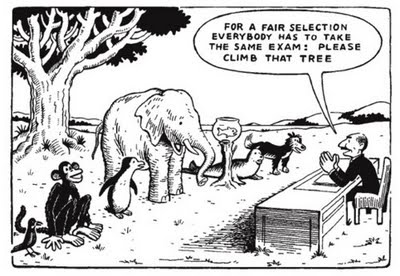
Everyone is a genius. But if you judge a fish on its ability to climb a tree, it will live its whole life believing it is stupid.

We cannot judge a person, Jew or Christian, on who they are not, but only on who they are. The problem is, we need to understand who they are before we can render an intelligent opinion and especially before we can offer a compassionate response.

For every power for good in your soul, a counter-force crouches within to oppose it.

There is only one place that stands beyond assault, as it also stands beyond reason or need. It is the simple power to choose good and not bad, and it is the place where the soul meets G-d and there they are one.

In that place, where that resolute decision is made, the counterforce dissolves and dissipates. Indeed, it was created from that place, with the purpose of returning you to there.

And you have returned.

-Rabbi Tzvi Freeman
“Force and Counter-Force”
Based on letters and talks of the Rebbe
Rabbi M. M. Schneerson
Chabad.org

The Conundrum Religion

conundrumNo matter how much you distrust your own sincerity or question your motives, there is no trace of doubt that at your core lives a G-dly soul, pure and sincere.

You provide the actions and the deed—just do what is good.

She needs no more than a pinhole through which to break out and fill those deeds with divine power.

-Rabbi Tzvi Freeman
“The Promise Inside”
Based on letters and talks of the Rebbe
Rabbi M. M. Schneerson
Chabad.org

Would that it was so simple. I guess it should be that simple to serve God. Really, I outlined the basic core of it a few days ago in my blog post Being Heaven on Earth. More than anything, if we want to serve God, we have a duty to serve other people in whatever way we can, great or small. It’s a very simple concept. No wonder people get it messed up all of the time.

I sometimes contribute to the confusion. In yesterday’s morning meditation I introduced a discussion of the relationship between the laws of Noah as chronicled in Genesis 9 and how they interact with the Mosaic and Messianic covenants (Sinai and the Cross respectively). While, as my friend Derek Leman pointed out to me, the concept of being a Noahide is post-New Testament, I still think the “theme” of a non-Jew, non-Israelite, non-Hebrew being able to have a covenant relationship with God in the post-diluvian world says much about God’s compassion for humanity.

Of course, I could be wrong.

Then again, there are still those in the Christian/Messianic world who insist that Christians are grafted into Israel to the degree that they become Israel. That is, they become Jewish in all but name only and are obligated to perform the identical 613 commandments as the Jewish people. This very much takes a long stick and stirs up the muddy, murky waters of “Judeo-Christian” (I use the term in quotes because it doesn’t exist in reality) religion.

It all seems so much easier when you look at it as just dedicating your life to performing 1000 mitzvot or feeding and caring for (video) people who can’t do these things for themselves.

We make religion out to be quite a mess when it doesn’t have to be.

I recently read a review of Talya Fishman’s book Becoming the People of the Talmud: Oral Torah as Written Tradition in Medieval Jewish Cultures which describes how the Talmud became a completely integrated element in the religious life of every observant Jew. It seems that integration wasn’t as seamless as I originally thought, nor is its acceptance completely uniform across all different populations of Jews (not to mention what non-Jews think of the Talmud). However, if you look at Judaism from a fundamentally Jewish perspective, you can’t really have Jewish religion without the Talmud.

But it contains all of these mind-bending puzzles, conundrums, and debates!

Christianity doesn’t have anything to compare to the Talmud so it would seem that Christianity, if you want a “simple” religion, would be the way to go, but that’s somewhat deceptive. At least in the west, Christianity is a religion of individuals. I’m oversimplifying here to make a point, but it’s as if becoming a Christian and developing your faith is as easy as declaring Christ as Lord and Savior, praying to God to give you discernment through the Holy Spirit, and then reading the NIV Bible while “allowing the Spirit” to tell you what it all means.

I was puzzling through something about the Seven Noahide Laws when I realized that Judaism conceptualizes these requirements for non-Jews in exactly the same way as it views the Torah for Jews. The view is that the requirements are imposed on a people rather than on individuals. To be sure, a Jew responds individually to commandments such as praying with tefillin and a tallit (although praying with a minyan requires 10 Jews), giving to charity, visiting the sick, and so forth, but it is obedience to the mitzvot that identifies the individual as belonging the the Jewish people (there’s debate here since there are a lot of secular Jews who feel no attachment to the Torah, but I digress).

Gentiles in the western nations don’t identify in the same way in terms of religion. We see religion as a personal responsibility only and we just happen to be loosely associated with a church where we agree on the theology being taught. This doesn’t make sense when a Jew looks at a Gentile. Here’s an example.

One of the Noahide commandments requires establishing courts of law. An individual doesn’t do this. I can’t personally obey this commandment. Only cities, counties, states, and nations establish courts. Political entities establish courts, not individual human beings. That means being a “righteous Gentile” to some degree, requires that you belong to a nation that establishes courts. That’s the personal part of the decision, but you still have to belong to “a people” or “nation” that obeys this directive to be said to have obeyed it yourself.

But it seems so involved and so much of the governmental establishment of justice is out of our control. This may be a fallacy in the Jewish application of the Noahide concept on Gentiles. We are not a people of God the way the Jews are a people of God. The Israelites (and an assorted group of non-Israelite freed slaves) stood at Sinai “as a single man” and accepted the Law of God He had designed and established for them. While the cross of Christ stands for anyone who accepts Jesus as Lord and Savior, there is no ” nation of Christians”. Thus, in respect to the concept of “peoplehood”, Jews and Christians are fundamentally different “things”.

studying-talmudI’m getting a headache.

What was I saying again? Oh yeah. Why is worshiping God so complicated. Why are there so many disagreements? What is the problem?

Theologians and philosophers have been debating those questions since man’s first awareness of God but the easiest answer I can come up with is that people are gumming up the works. Sure, God is hard to understand, the Bible isn’t exactly like a first grade reading text, and the Talmud doesn’t add up as easily as “two plus two”, at least not to me.

While I enjoy a good challenge and I delight in digging “deeper into the text” so to speak, it is too easy to lose myself in the complexities of religion while forgetting why I am here in the first place. It should be as simple as Adam and Eve standing in the Garden.

Anxieties, worries, feelings of inadequacy and failure — all these smother and cripple the soul from doing its job. You need to find the appropriate time to deal with them. But don’t carry them around the whole day.

During the day, you are Adam or Eve before they tasted the fruit of good and evil.

-Rabbi Tzvi Freeman
“Out From Under the Blanket”
Based on letters and talks of the Rebbe
Rabbi M. M. Schneerson
Chabad.org

We may argue and fuss with each other until the coming of the Moshiach and we may never see eye to eye on many issues but at the end of the day, if you managed to feed one hungry person, visit one sick person in the hospital, or even smile at a stranger you pass on the sidewalk, you’ve made the world a better place. God said it all here:

And what does the LORD require of you But to do justice, to love kindness, And to walk humbly with your God? –Micah 6:8

“The rest is just commentary, go and study.” -Hillel

Where to Find Jesus

Hasid AlleywayIt is important that before we dig into the Gospel texts themselves we understand some of the cultural background regarding ritual purity in the late Second Temple period. The Tosefta tells us that during this time “purity broke out among Israel.” Archeological evidence verifies that in the decades preceding the fall of the Temple in 70 CE ritual purity had become a major concern even among the common people throughout the land of Israel.

-Toby Janicki
“The Master and Netilat Yadayim”
Messiah Journal
Issue 108 – Fall – 2011/5772 p. 27

This isn’t the first time I’ve discussed netilat yadayim or the ritual handwashing, but I’m not making it my main focus this time. Rather, I want to address how Janicki supports his argument for Jesus advocating, or at least not dismissing this portion of First Century Jewish halacha. The clue is right in the quote that is just above. Not relying on the Bible alone to interpret the Bible.

That’s probably going to raise a few eyebrows among some people reading this. I’ve heard it said often enough that we should “let scripture interpret scripture”, which I take to mean using one part of the Bible to interpret another part. I wonder if that’s always possible or if we shouldn’t also take into consideration other information, such as the “archeological evidence” Janicki mentions. Of course, that’s not the only supporting data he cites.

While the washing of hands before eating bread is not specifically commanded in the Torah, the sages of the Talmud attempted to find a scriptural basis for it in various biblical passages. For example in Leviticus 15:11 there is the injunction, “Anyone whom the one with the discharge touches without having raised his hands in water.” They felt that the Torah made allusions to the entire scope of this practice in a roundabout way (citing Chullin 106a). -Janicki p. 27

I know that Mark 7 seems to be very clear that Christ disapproved of the hand washing ritual, but can we rely just on the text as translated into English without any contextual frame of reference to tell us the entire story? I know that Christians (and many “Messianics”) are rather squeamish when it comes to the Talmudic wisdom, especially since it was documented decades to centuries later than the events in Mark 7, but halachah did exist in Christ’s day, he was (and is) a Jew, and despite what supersessionist church teachings may say to the contrary, Jesus did not play fast and loose with his being a Jew.

I’m saying all this (and it’s not the first time) to illustrate that we cannot simply pick up a Bible, read a passage, and immediately know all of the details and subtle nuances that are being communicated. In fact, we don’t know what is being said and often, we don’t bother to try and find out. We, meaning Christians, tend to rely on the traditional church interpretation of the passage and believe that Jesus was talking about how all meats were clean and ham sandwiches were forevermore a really cool snack. However, a close reading of even the English text (minus Christian perspective) will reveal that he wasn’t talking about food at all.

Interestingly enough, from the Jewish point of view, scripture is interpreted by tradition as well, although the tradition points to the sages and the Mishnah. This is something completely foreign to Christians and many “Messianics” who say they embrace the “Jewish Jesus.” But from our early 21st century perspective, do we really know just how foreign Jesus would be to us if we could go back and meet him on the streets of his home village or in the courts of the holy Temple in First Century Jerusalem?

Connecting to the Master and thus to the God of our faith means entering worlds where we are considered strangers. We have to cross the barriers of time, culture, and education. We have to set aside our western preconceptions and look at the person Jesus as an ancient near-eastern man living in an occupied nation; a former carpenter turned itinerant Rabbi. This isn’t the Jesus you learned about in Sunday school or the European-looking actor you’ve seen portray him in half a dozen films.

To learn about the true “Maggid of Nazaret”, you’ll need to do what Toby Janicki did in researching the Master and the Netilat Yadayim. You’ll need to look for him in all of the ancient Jewish places, in all the traditional Hebrew texts. You won’t find him any place else.