Tag Archives: teacher

The Tefillin and the Shoemaker

Praying with TefillinAnd they (Korach and his following) converged upon Moses and Aaron and said to them: “Enough! Every one of the congregation is holy, and G-d is amongst them. Why do you raise yourself above the congregation of G-d?”Numbers 16:3

There are those who maintain that they have no need of a mentor to guide them through life. They claim, as did Korach, that each and every individual can forge his relationship with G-d unaided. They argue that since the Jewish faith rejects the concept of an intermediary between man and G-d, they have no use for a rebbe or master.

They fail to understand that the entire Jewish people are a single entity, that every individual soul is, in truth, but a limb or organ of the soul of Israel. Just as each limb and organ of the human body has its function at which it excels, so, too, every soul has its role and mission, as well as its limitations. The ‘loftiest’ of souls is dependent upon the ‘lowliest’ for the attainment of the single, unified goal. And were any limb to strike out on its own, detaching itself from the ‘head’ which provides the entire body with vitality and direction – the results are self-understood.

Said Rabbi Yosef Yitzchok of Lubavitch: “When an individual adapts the attitude that he can do it all on his own, he reminds me of the story told about the peasant and the tefillin. Once, a Jew noticed a pair of tefillin in the house of a gentile peasant. Upon seeing a holy object in such a place he began to inquire about the tefillin, wishing to purchase them from the goy. The peasant, who had looted the tefillin in a recent pogrom, grew agitated and defensive. “What do you mean, where did I get them?” he blurted out. “Why, I made them myself! I myself am a shoemaker!”

-Rabbi Yanki Tauber
Once Upon a Chasid
“Jack of all Trades”
Chabad.org commentary on Torah Portion Korach

Paul explained that he received the gospel through a revelation of Yeshua the Messiah (Jesus Christ). He claimed that the gospel message he preached to the Galatians was not man’s gospel. It was not the normal gospel message. He received a different gospel. This is an important point – a critical point – for understanding Paul. The message of the gospel that Paul proclaimed was not precisely the same message of the gospel that the rest of the apostolic community proclaimed. In other places, Paul specifically refers to this unique gospel as “my gospel” (see Romans 2:15-16, Romans 16:25, and 2 Timothy 2:8-9).

-D. Thomas Lancaster
The Holy Epistle to the Galatians
“Sermon Three: Paul’s Gospel (Galatians 1:11-24)”
pp 35-6

But even if we, or an angel from heaven, should preach to you a gospel contrary to what we have preached to you, he is to be accursed!Galatians 1:8 (NASB)

Reading Rabbi Tauber’s commentary on the previous week’s Torah Portion Korach, I saw an inevitable collision with the above-quoted portion of Lancaster’s “Galatians” book. Although Korach and his co-conspirators claimed authority because all of Israel was holy to God, while Paul claimed authority based on his personal revelation from Jesus (see Acts 9:1-19 and Acts 26:15-18), they both set themselves (apparently) in opposition to the established authority representing God, Moses in the case of Korach, and the Jerusalem Council, in the case of Paul.

We know that Korach, Dathan, Abiram, and the 250 who were with them came to a bad end (Numbers 16:28-35) and their story is sometimes told in congregations as a cautionary tale not to go against the established leadership, but what about Paul? Does Paul’s receiving a personal revelation and mission from Jesus exempt him from respecting and obeying properly established authority? Lancaster says, “no”:

Despite the dismissive air, Paul submitted to their authority. He had already conceded that, if they had rejected his gospel of Gentile inclusion, he would have been running his race in vain. They had the power to utterly discredit the gospel message he had been presenting. Therefore, he certainly did respect their authority. But he seems less than reverently respectful in Galatians 2:5.

-D. Thomas Lancaster
The Holy Epistle to the Galatians
“Sermon Seven: Remember the Pour (Galatians 2:6-10)”
pg 71

While Paul could be opinionated and “outspoken”, he nevertheless realized that he was a man under not only the Master’s authority, but under the authorities established by God in Jerusalem, which included James, Peter, and John. But he had to approach these “pillars”, present his position based on the Master’s revelation to him, and hope they’d see things his way. Fortunately for Paul (and the Gentiles), they did. Otherwise Christianity, as we understand it, probably wouldn’t exist today. In that case, any person not born a Jew who wanted to enter into a full covenant relationship with God would have to convert to Judaism (for the sake of this blog, I will define Gentile Noahides -in contrast to Christians – as meriting a place in the world to come but not enjoying a full covenant relationship with God on par with the Jews).

The example of Paul presents a problem, though. His experience was entirely subjective. No one else saw or heard the details of his visions and so no one could verify independently, that he was telling the truth. In theory, he could have made the whole thing up in order to further some personal agenda he had in relation to Gentiles becoming “Messianic” disciples. If we accept the Biblical record on faith as well as reason, we accept that his visions were real and his authority was real.

But what about “authorities” today?

Most mainstream churches and synagogues are lead by a Pastor or Rabbi (respectively) who has received the education required to be ordained by their branch of faith and they have been appointed to a specific congregation upon the approval of that congregation’s board of directors. The board, and its various committees, have the authority to set the specific duties of the clergy, approve and renew their contractual relationship, and even fire the clergyperson if necessary. While the Pastor or Rabbi is the “face” and “voice” of the congregation in many ways, he or she can hardly act with total autonomy or impunity and are held accountable to the standards and authority of the congregation and their overseeing denomination or sect.

Sadly, not all religious groups and leaders operate on this principle. Paul’s “example” of receiving a personal revelation can be and has been terribly misused and misappropriated by many so-called “leaders” and “prophets” to set themselves up as the sole and individual authority over their congregations. If anyone complains about the “leader” and his or her lack of accountability to others, Paul’s example is cited and then the dissenters are accused of being like Korach and his band (implying that the dissenters will suffer a similar fate if they don’t withdraw their objections).

I know such a ploy may sound improbable and even silly to some of you reading this blog post, but the power of cult leaders over large groups of “believers” can be formidable to those who have made a commitment and who believe their “leader” is the “real meal deal”; the one and only person anointed by God to spread a special “message” to the “remnant” of the faithful.

I’m sure you are thinking about some of the infamous and extreme examples of what I’m describing, such as Jim Jones, David Koresh, and Marshall Applewhite, but there are probably thousands of other religious groups out there that operate below our radar, so to speak. Certainly a number of groups loosely affiliated with the Messianic Jewish (MJ) movement, function under the sole authority of the “Rabbi” in charge, acknowledging only his (in the vast majority of these cases, the leader is male) “right” to make decisions and pronouncements for the congregation, based on the leader’s self-described “anointing” from God.

(I want to make it clear at this point, that there are many MJ congregations that do operate on a board of directors model and that do receive authority from a central, overseeing organization which does provide a series of checks and balances for congregational leadership – I’m not painting “Messianic Judaism” as such with a single, broad brush – however, because “the movement” is largely unregulated, some people -usually not Jewish- just put on a kippah and a tallit, declare themselves a “Messianic Rabbi”, and proceed to gather a “flock”. Then they go about sharpening whatever theological ax they have to grind, which much of the time, has only a faint resemblance to anything Jewish).

Everything I’ve said up to this point certainly could make you doubtful or concerned if you find yourself in a “one-man show” type of congregation or even one where you might suspect (correctly or not) that the the congregation’s board is pretty much “rubber-stamping” the clergy’s decisions. On the other hand, we are taught to respect authority:

Rabbi Ishmael would say: Be yielding to a leader, affable to the black-haired, and receive every man with joy. -Pirkei Avot 3:12

It’s confusing. However, anyone, leader or otherwise, should recall this:

Rabbi Akavia the son of Mahalalel would say: Reflect upon three things and you will not come to the hands of transgression. Know from where you came, where you are going, and before whom you are destined to give a judgment and accounting. -Pirkei Avot 3:1

There is a Heavenly authority who holds us all accountable for what we say and do. Examples like Paul’s vision are extremely rare. They were extremely rare in Paul’s day and perhaps they may not even occur in the common era. Judaism has a long tradition of centralized authority but generally, that authority is not held by a single individual. The great sages often disagreed and it was through those debates and dialogues that justice and mercy was distilled throughout the centuries and applied to the devout in response to the unique needs of their communities and the time in which they lived.

Some respond to religious leadership concerns by refusing to affiliate with any faith group, but we all come under some sort of authority, including our employers, and local and national governments. Meeting with our congregations is how we prevent ourselves from entering into individual error (though I’m hardly one to talk at this point):

Rabbi Shimon would say: Three who eat at one table and do not speak words of Torah, it is as if they have eaten from the slaughter of the dead, as is stated, “Indeed, all tables are filled with vomit and filth, devoid of the Omnipresent.” But three who eat at one table and speak words of Torah, it is as if they have eaten at G-d’s table, as is stated, “And he said to me: `This is the table that is before G-d.’ ”

Rabbi Chanina the son of Chachina’i would say: One who stays awake at night, or travels alone on the road, and turns his heart to idleness, has forfeited his life. -Pirkei Avot 3:3-4

We are charged to test the validity of a leader as the Bereans tested the validity of Paul’s teachings (see Acts 17:10-12). We also know that valid and righteous leaders are established by God for the good of the world:

It was for this reason that actual peace in the world was brought about through Aharon, who descended to all creatures and elevated them to Torah.

-From the teachings of the Lubavitcher Rebbe, Rabbi Menachem M. Schneerson
Based on Likkutei Sichos, Vol. VIII, pp. 103-107

The LORD gives strength to his people; the LORD blesses his people with peace. –Psalm 29:11

Faith and history have established the relative authority of Korach and Paul and God’s justice and mercy was enacted in both lives in accordance with the actions of these men. Our lives are the same. We serve the same God. We all benefit from His providence. We are all accountable to His justice and we all rely on His mercy. We should not take the Name of God or His authority lightly. In the end, God prevails:

If you play for your own glory and not God’s you have no place here. -a Maggid

Rabbi Akivah would say: Beloved is man, for he was created in the image [of G-d]; it is a sign of even greater love that it has been made known to him that he was created in the image, as it is says, `”For in the image of G-d, He made man.” -Pirkei Avot 3:14

A man’s soul is the light of God. –Proverbs 20:27

Knowing

ReachingNo longer will they teach their neighbor, or say to one another, ‘Know the LORD,’
because they will all know me, from the least of them to the greatest,”
declares the LORD. “For I will forgive their wickedness and will remember their sins no more.” –Jeremiah 31:34

If you really know me, you will know my Father as well. From now on, you do know him and have seen him.” –John 14:7

Just as wisdom is not something you can touch with your hands,
so G-dliness is not something you can grasp with your mind.
The mind cannot experience G-d.
G-d is not an idea.
G-d is real.
G-d is better found in inspired deeds than in inspiring thoughts.

Rabbi Tzvi Freeman
“Mental Limits”
Chabad.org

How do we “know” God? A Christian might answer that we know the Father through the revelation of His Son, and Jesus said this about himself. Yet, there’s a danger in “anthropomorphizing” the infinite, ever-present, all-powerful, ultimately creative God of the Cosmos, and reducing Him to an old man with long white hair, a bushy beard, and a comfortable lap. It’s like taking God and turning Him into your kindly grandfather who used to give you little treats when you were a child and let you stay up past your bedtime.

This isn’t to say I dispute the words of the Master, I only understand them as illustrating both what we can know about God from Jesus when he walked among men, and what we can’t know. We can’t know the infinite, but we can know how our lives intersect with the Holy through the teachings and example of the Master. Our duty then, is to spend the rest of our lives living out that understanding with “inspired deeds”, as Rabbi Freeman says, as our understanding grows and as it sometimes twists, bends, and warps.

Excuse me, what did I just say?

Isn’t God eternal? Isn’t God’s truth unchangeable? Well, “yes” and “no”.

OK, in an absolute sense, yes, God is God and God is unchangeable. Nothing we can do can alter the nature, character, and qualities of the Creator of the Universe (not that we can perceive the vast, vast majority of those qualities). But while God may be unchanging, human beings change all the time. What we understand changes all the time. If not, if we couldn’t go beyond the Sun circling the Earth and the Moon being made of green cheese, then modern Astronomy would be a lost cause.

I know, it’s not a surprise to understand that as children grow and as people age, they learn new information to replace old data, but it’s also true (at least potentially) of humanity over time. Believe it or not, at one point in history, things like microwave ovens, DVDs, iPads, and the Internet didn’t exist. Even bound books haven’t been available forever (never mind eBooks on Kindle). Gutenberg didn’t invent the printing press until around 1440 and the vacuum tube, which was used in early 20th century technologies such as radios, the first generation commercial computers, and televisions, first saw the light of day in 1904.

Why am I telling you all this? Because what we understand about a concept or a technology may be one thing at a certain point in time but later on, we may amend or change what we believe to accommodate new information, discoveries, and inventions.

This is also true of the Bible and thus what we know about God.

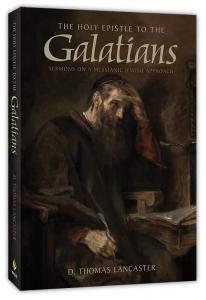
I’m currently reading the book The Holy Epistle to the Galatians by D. Thomas Lancaster. This isn’t another typical Christian commentary on what most believers consider Paul’s “anti-Torah”, “anti-Judaism” rant. Rather, it’s a fresh perspective on how to understand Paul as a Jewish man, declared the “Apostle to the Gentiles” by Jesus in a vision, and who through that incredible and unprecedented role, had to make some hard decisions about how to bring non-Jewish God-fearers and former pagans into the community of faith. One principle decision was the controversial choice of not demanding Gentile believers convert to Judaism in order to become disciples of the Jewish Messiah.

Much of what Lancaster states in his book (and I haven’t finished reading it yet) won’t be universally accepted by the church and perhaps just a decade or two ago, such a book might not have been published. However, it’s important to understand there’s a difference between God’s eternal, unchangeable knowledge and how human beings acquire new data and adjust our understanding based on that information.

About a month ago, I reviewed a scholarly article called Isaiah’s Exalted Servant in the Great Isaiah Scroll written by Steven P. Lancaster (D. T. Lancaster’s brother) and James M. Monson. Based on new information acquired through a study of the Dead Sea Scrolls, how we understand the prophet Isaiah’s description of the Messiah has been significantly changed (and please feel free to read that review by clicking on the link I just provided…it’s fascinating stuff). The information Lancaster and Monson provide in their conclusions almost literally re-writes the “suffering servant” Messiah to “the appointed one”. Who could have known about this, even five years ago?

AnointingI’m not trying to undo the ties of Christian faith and the scriptures upon which that faith is based, but I would like to suggest that those ties can be untangled. We labor, without realizing it, under the yoke of centuries-old assumptions, bad translations, and misinformation founded on prejudice. Some of that misinformation, as recently presented by Derek Leman on his blog, is how the church declares rather boldly, that a Jewish person who has come to faith in the Jewish Messiah, must surrender their entire Jewish identity. Galatians, and other sections of the New Testament, seem to give this impression, but we can also be courageous enough to go back to our time-honored texts and read them with a fresh eye, consider them in the original Greek language and “refactor” them in the Jewish/Hebraic mindset of the people who wrote them. We can challenge what we think we know and see if our knowledge stands up to the test.

I’ll leave you with a tangible example of how knowledge changing over time affects not only our day-to-day life, but how we comprehend God, our duties to Him, and our obligations to each other:

The Chazon Ish, zt”l, explains, “Rashi records when he is unsure, to teach that admission of uncertainty is also Torah. One should always be clear of what he knows and what he does not know.”

Rav Yosef Yitzchak Lerner, shlita, contacted Rav Shlomo Zalman Auerbach, zt”l, regarding a correction the latter had added to the “Lev Avraham.” In this work, Professor Avraham Avraham, shlita, brought the opinion of Rav Avraham ben HaRambam, zt”l, and Rav Sherirah Gaon, zt”l, as conclusive. Both luminaries hold that Chazal’s teachings regarding medicine are not Torah; they merely reflect medicine as understood in their time. If contemporary science disagrees the halacha follows the medical experts. Rav Shlomo Zalman maintained that since other authorities disagree, this opinion should be prefixed with “some say.”

Daf Yomi Digest
Stories off the Daf
“Admitted Ignorance”
Menachos 105

Some of the rulings of the honored sages were based on the best medical knowledge available to them in their day, but as we see, modern medicine has rendered many of their judgments out-of-date. Being open to new information about the Bible and how to read it, can help us understand that some traditional Christian interpretations of the Bible need to be updated as well. I read and review articles like Isaiah’s Exalted Servant in the Great Isaiah Scroll and books such as Lancaster’s Galatians for exactly that reason. Knowledge and faith is a garden which yields only the fruits of our labors. Like prayer, meeting God and understanding more about Him requires our time, effort, and an unquenchable need to learn.

Rabbi Chalafta the son of Dosa of the village of Chanania would say: Ten who sit together and occupy themselves with Torah, the Divine Presence rests amongst them –Pirkei Avot 3:6

“Again, truly I tell you that if two of you on earth agree about anything they ask for, it will be done for them by my Father in heaven. For where two or three gather in my name, there am I with them.” –Matthew 18:19-20

Soul on the Altar

Meal offeringWhen a person presents an offering of meal to the Lord, his offering shall be of choice flour; he shall pour oil upon it, lay frankincense on itLeviticus 2:1 (JPS Tanakh)

The word “soul” is not used in reference to any voluntary offerings except for the meal-offering. Yet, here, the verse (Vayikra 2:1) begins, “And when a soul will bring a meal-offering…” Whose practice is it to dedicate a meal-offering? It is the poor person. The Holy One, blessed is He, said: “Although the poor man’s offering is modest, I consider it as if he offered his soul.”

Daf Yomi Digest
Gemara Gem
“The precious offering of the poor”
Menachos 104

Who are you? What do you have to offer God? What is your worth to other human beings? Why does what you do matter?

We tend to judge ourselves in comparison to others. When we see that our accomplishments are better or more abundant than someone else’s we feel better about who we are. When another person has more money, more prestige, lives a more righteous life than we do, we tend to feel bad about ourselves.

That’s not a universal response among people, but it’s common and all too human. Yet, we’re not the same. How are we to understand this? Continuing the “Gemara Gem” commentary, we discover:

Two students sat in the same class. They heard the same lectures from their rebbe, and they each tried to record notes to summarize the lessons. After a week, the rebbe announced that an exam on the material would be given.

One student, who was quite bright, relied upon his memory and he exerted minimal effort in studying, but he managed to score a relatively high grade. The other student had a weaker ability. Despite great efforts in preparing, he scored quite low.

Surprisingly, the rebbe called the stronger student to his classroom after grading the tests, and he rebuked him. The rebbe expressed his disappointment in the score that he had earned, even though it was a relatively high grade, and he pointed out how that with a consistent effort, the student was certainly capable of achieving much more. The boy defended himself and pointed out that the weaker boy had scored even lower. The rebbe refused to accept his excuses, and he demanded that the strong student produce an effort commensurate with his abilities.

It is obvious that the excuse of the more capable student was without merit. It is clear that each person has his own talents and abilities, and, at least in spiritual matters, every individual must work and produce to meet his own potential. Some people are blessed with greater intellect, while others are emotionally charged and motivated to action. Every person is expected to achieve the maximum that he is capable of attaining.

We see that we don’t all come equipped with the same passions and identical skills, yet we’re expected to utilize what we have been given to the best of our efforts. This works well for the rich and the richly gifted if they apply themselves, but the poor cannot offer Rising Incensethe same abundance to other people and to God as the rich. How can a poor man dare to hold a banquet for a King? How can a person deep in sin ever hope to entertain the Righteous One?

The Ben Ish Chai, zt”l, explains…”A certain great king visited a large city in his kingdom. In the city were many noblemen and wealthy people, all of whom hoped to host the king for his first meal in their city. Obviously such wealthy people offered to prepare a banquet that would literally be fit for a king. But the king wished to go to his friend who was a poor shepherd and could never afford a repast approaching what is fitting for the king. If the king refuses the noblemen and wealthy to go to his poor friend, they can protest that eating such simple food is not honorable for the king.

“When it comes time for a meal and the greatest citizens are vying for his company – each with a feast prepared in case the king acquiesces to him – the king explains that he cannot eat any heavy food at all. ‘I am not feeling so well and must have a repast composed solely of light foods. I need sheep’s milk, yogurt, light cheese, butter and similar fare. Since the place where I will find these foods freshest is at a shepherd’s abode, I will take my meal with my poor friend.’”

Daf Digest Yomi
Stories off the Daf
“The King’s Special Meal”
Menachos 104

Once again Jesus went out beside the lake. A large crowd came to him, and he began to teach them. As he walked along, he saw Levi son of Alphaeus sitting at the tax collector’s booth. “Follow me,” Jesus told him, and Levi got up and followed him.

While Jesus was having dinner at Levi’s house, many tax collectors and sinners were eating with him and his disciples, for there were many who followed him. When the teachers of the law who were Pharisees saw him eating with the sinners and tax collectors, they asked his disciples: “Why does he eat with tax collectors and sinners?”

On hearing this, Jesus said to them, “It is not the healthy who need a doctor, but the sick. I have not come to call the righteous, but sinners.” –Mark 2:13-17

Rich man or poor, righteous tzadik or a person heavy with sin, we each are not called to offer God everything in the world but only our very best, even though our best may be the meal offering of the poor. While you may envy what the rich and the righteous can offer God in their abundance, out of the depths of despair and poverty, what you offer, though it seems small, is the most splendorous gift of all…your very soul on the altar of God.

May my prayer be set before you like incense; may the lifting up of my hands be like the evening sacrifice. –Psalm 141:2

Building Fellowship

Galatians by D.T. Lancaster“We ourselves are Jews by birth and not Gentile sinners; yet we know that [whether Jewish nor Gentile] a person is not justified by the works of the law [i.e., conversion, circumcision, etc.] but through faith in Jesus Christ, so we [the Jewish believers] also have believed in Christ Jesus, in order to be justified by faith in Christ and not by the works of the law, because by the works of the law no one will be justified. But if, in our endeavour to be justified in Christ, we too were found to be sinners [by eating and fellowshipping with Gentiles], is Christ then a servant of sin? [In other words, does becoming a believer mean we forsake Torah? Is eating and fellowshipping with Gentiles really a sin against Torah?] Certainly not! For if I rebuild what I tore down, I prove myself to be a transgressor. –Galatians 2:15-18

That is to say to Peter, “If you of all people, Peter, rebuild a sharp division between Jew and Gentile by removing yourself from table fellowship with Gentiles, you are rebuilding the barrier that you originally tore down. If you refuse to eat and worship with them, you rebuild the barrier that you originally tore down. You yourself were the first of the apostles to tear that separation down. If now you are putting it back up, then you are admitting that you were wrong in the first place, and you are proving yourself to have been living in sin and transgression.”

-from D. Thomas Lancaster’s book

The Holy Epistle to the Galatians

I received an advance copy of Lancaster’s book from First Fruits of Zion (FFOZ) yesterday and have since been eagerly devouring it. I’m not ready to write my full review, but Sermon 8: The Antioch Incident (the book is a compilation of 26 sermons, with each sermon organized as a chapter, given by Lancaster at Beth Immanuel Fellowship in 2008) brought up some interesting questions, and perhaps even a few answers.

For those of you who may not know, FFOZ is an educational ministry which produces informational materials, including books, audio lectures, and such, to both Jewish and non-Jewish believers in Jesus (Yeshua) in Messianic Judaism (MJ), although they have a wider audience in more traditional Christian (and perhaps more traditional Jewish) circles. One of the ongoing discussions in different branches of MJ is the relationship between Jewish and non-Jewish believers and the relationship those two groups have to the commandments of the Torah.

Without going into a lot of detail, some advocate for Gentiles in MJ to be obligated to the same 613 commandments that observant Jews are taught to obey, while others believe that Gentiles are only obligated to a small subset of those commandments (see Acts 15). The latter group believes that Gentiles who state that they are obligated to the full “yoke of Torah” obliterate Jewish covenant distinctiveness and “blend” Jews and Gentiles in Jesus into one, featureless mass. How Jewish and Gentile believers are supposed to interact given “distinctiveness boundaries”, including in matters of table fellowship, common observance of the Shabbat and the Festivals, has at times become hotly debated.

In reading Lancaster’s “Galatians”, we find this is not a new issue.

Lancaster (and FFOZ) support maintaining distinctions between Jewish Messianics and the Gentiles in MJ and Lancaster states:

We are one body, many parts. The foot is not the eye; the eye is not the foot. Oneness is not sameness. We can be one in the body but not have the same function or calling. Oneness is not sameness. There is one faith, one baptism, and one body, but that body has many parts.

D.T. LancasterLancaster is obviously referencing 1 Corinthians 12:12-31, but what is typically interpreted as a commentary on the struggles between different members of the Christian body sorting out the diversity of their spiritual gifts, Lancaster applies to the distinctions between Jewish and Gentile believers in Christ. I think his application is valid since it holds water in the Galatians context as Paul presents his argument, but that may come as a bit of a surprise if you do not believe that Jewish observance to the covenant of Moses was upheld by the early Jewish apostles for Jews and not for non-Jewish Christians. In other words, you may have a problem with Lancaster’s conclusions if you were taught that the law was done away with for Jews as well as for non-Jewish believers.

My primary interest in this subject, and in Lancaster’s book as a whole, is not from the perspective of Messianic Judaism. At this stage of my spiritual journey, I see myself as a Christian,married to a (non-believing) Jewish wife, who in immersing myself in Jewish Talmudic, mystic, and storytelling sources and traditions in order to better understand Christ who lived, died, and was resurrected a Jew and who taught, spoke, lived, and breathed in a completely Jewish manner and lifestyle. I don’t think you can understand who Jesus is unless you understand not only the Judaism of his day, but Judaism and Torah as they wind their way back to the beginning of Creation and forward to the current age.

This is the lens by which I look at the book and the pen by which I chronicle my thoughts, feelings, and the cries of my spirit.

I have friends who are Jewish believers in Christ and who are fully observant Jews, while I am a Gentile Christian. How are we to interact? Can we eat together? Can we pray together? In what manner may I observe the Shabbat, Passover, Shavuot, and Sukkot? How may I fast and pray on Yom Kippur (and does this offend Jesus who died to remove my sins once and for all)?

These are the questions that underlie “The Antioch Incident” and the entire “Galatians” book. These are the questions that, if you don’t consider them important to you now as a Christian or believing Jew, you definitely will when the Messiah comes.

So what are the answers? I believe I know them and I try to live them out as best I can. Paul worked with great effort as the apostle to the Gentiles to create and support communities where believing Jews and non-Jews freely interacted. Here is how Peter responded to Paul:

After much discussion, Peter got up and addressed them: “Brothers, you know that some time ago God made a choice among you that the Gentiles might hear from my lips the message of the gospel and believe. God, who knows the heart, showed that he accepted them by giving the Holy Spirit to them, just as he did to us. He did not discriminate between us and them, for he purified their hearts by faith. Now then, why do you try to test God by putting on the necks of Gentiles a yoke that neither we nor our ancestors have been able to bear? –Acts 15:7-10

Paul struggled with James, the Jerusalem Council, and other believing Jews as to whether or not Gentiles, once they came to faith in the Jewish Messiah, should be circumcised and convert to Judaism. Indeed, history records that some did, but Paul, who received his “Gospel” from the Messiah and Heaven and not from men, understood that it wasn’t necessary. Jesus is the gateway for the people of the world to enter into the Kingdom of Heaven and yet remain non-Jewish. All who are in the Messiah are One and God’s Name is One, but the members of the Messiah’s body, though one in baptism and spirit, are diverse in type and function. Just as my wife and I are different (being female and male, Jew and Christian) and yet “one flesh”, Jews and Gentiles in the Messiah are two and yet one.

I look forward to continuing this book and will post my full review when I finish.

Blessings.

Addendum: The full book review is now available.

Gardening

GardeningThat same day Jesus went out of the house and sat by the lake. Such large crowds gathered around him that he got into a boat and sat in it, while all the people stood on the shore. Then he told them many things in parables, saying: “A farmer went out to sow his seed. As he was scattering the seed, some fell along the path, and the birds came and ate it up. Some fell on rocky places, where it did not have much soil. It sprang up quickly, because the soil was shallow. But when the sun came up, the plants were scorched, and they withered because they had no root. Other seed fell among thorns, which grew up and choked the plants. Still other seed fell on good soil, where it produced a crop – a hundred, sixty or thirty times what was sown. Whoever has ears, let them hear.”Matthew 13:1-9

A creative mind is a fertile field. But that may simply mean that the weeds are taller and grow faster.

First, soften your mind’s soil, plough its furrows. Open it to the wisdom that rains down from the heavens; let the dew of Torah sink into your soul, the seeds laid by tzaddikim enter your heart. Learn to lie still as they awaken and take root. Quietly await the spring.

In the place of thorns and a tangle of weeds will grow a bountiful garden. Where once wild and brazen delusions sprang forth, a tightly focused beam of light will shine.

-Rabbi Tzvi Freeman
“The Field of Your Mind”
Chabad.org

The parable of the sower being related by Jesus is interpreted as the different reactions people have when hearing the “message of the kingdom” (see Matthew 13:18-23), but this story of the Master is more than a little related to Rabbi Freeman’s commentary about how to prepare our minds for Torah study and spiritual learning. You may think that because you read the Bible, go to Sunday school, go to a Talmud study, or frequent online religious forums, that you are “studying the Word” and are well prepared to receive it. However, that’s not always the case.

You’ve heard the expression, “you can lead a horse to water…” and it’s true. You can take a person who has certain attitudes about the Bible, Jesus, God, and so forth, and introduce them to your scripture, your church, your synagogue, or another favorite religious context, but that doesn’t mean they’ll receive it in the way you are hoping. It’s not just the material, it’s the person and how they see the situation. Here’s a perfect example:

Rabbi Eliezer Silver zt”l was a leader and activist who saved thousands of Jewish lives during the Holocaust. After the liberation of the Nazi death camps, he tried to revive the spirit of Judaism among the survivors.

One of his many activities was organizing prayer services. A certain refugee refused to participate, explaining that he’d been turned off to Judaism forever. He said that there had been a religious Jew in this refugee’s camp who had smuggled in a Siddur (prayer book), and he would charge people half their bread ration to use his Siddur for ten minutes. After witnessing such cruelty, the refugee refused to have anything to do with Siddurim, prayer services, or anything Jewish.

Rabbi Silver approached him with great compassion and understanding, but offered him a new perspective. “You only see the Jew who was so cruel,” he said. “What about the holy Jews who were willing to give up half their meager rations for just 10 minutes with a Siddur?”

No one can blame the refugee for his feelings. After living through his hellish experience, who could say they would react any differently? Nonetheless, says Rabbi Shimshon Pincus zt”l, two people can hear the same story and one notices the cruelty, while the other notices the holiness and dignity.

The Sages say that what the eye sees depends on what the heart feels (Talmud Avoda Zara 28b), and in this week’s Torah Portion (Num. 15:39) we’re told “Don’t stray after your heart and after your eyes.” Our eyes will only see negativity and impurity if our hearts have already been corrupted. If we make the effort to turn our hearts towards positivity, giving to others, appreciating, then the world will transform before our eyes into a panorama of pleasures and joy, the constant gifts that G-d wishes upon us.

Commentary on Torah Portion Shlach
by Rabbi Mordechai Dixler
Program Director, Project Genesis – Torah.org

WateringIn my previous morning meditation, I was pretty discouraged. It passed, but sometimes the enormity of a life of faith, continually reaching out to God, trying to understand even the most elementary lesson of holiness, and trying to share my (what I hope are) unique perspectives with other people, can be really wearing. Yet, as we just saw in the story related by Rabbi Dixler, even the most difficult and excruciating circumstances can be viewed in more than one way. Or, to quote Hindu Prince Gautama Siddharta (Buddha), “The mind is everything. What you think you become.”

Simply put, you are (I am) what you think about habitually. If you think life is terrible, it is, more or less regardless of circumstances. I’m sure you can create some extraordinary situation that would be perceived as horrible (such as living in the camps during the Holocaust) beyond any ability to endure, but even here, Rabbi Dixler points out there is a difference between seeing the selfishness of a man who would exploit his fellow Jew to feed his own stomach vs. the Jew who would give up even his last morsel of bread to pray from a Siddur for just ten minutes. If we want a relationship with God, we must work to prepare for it:

Here is Paul’s interpretation:

Finally, brothers and sisters, whatever is true, whatever is noble, whatever is right, whatever is pure, whatever is lovely, whatever is admirable – if anything is excellent or praiseworthy – think about such things. Whatever you have learned or received or heard from me, or seen in me – put it into practice. And the God of peace will be with you. –Philippians 4:8-9

This is why we must study the Bible and study it regularly. This is why we attend the house of prayer regularly and frequently. This is why we spend time in prayer daily and associate with our companions in faith at every opportunity. Although it is easy to feel alone and misunderstood in a world that, above all else, worships pleasures and morals built on shifting sands, we are never alone unless we want to be. It takes discipline to feel God’s presence. If we can say that God sets appointments each day for us to meet with Him, it is up to us to keep those appointments and to become accustomed to His voice.

For as he thinks within himself, so he is. –Proverbs 23:7

My sheep listen to my voice; I know them, and they follow me. –John 10:27

Take a moment or two to review the state of your mind and your “garden”. What can you do better to make it grow?

The Panoramic Garden

I had said in my panic, “I am cut off from before Your eyes!” But in truth, You heard the sound of my supplications when I cried to You. Love Hashem, all His devout ones! Hashem safeguards the faithful, but He repays the haughtiness on one who acts with arrogance. Be strong, and let your hearts take courage, all who wait longingly for Hashem. –Psalm 31:23-25

You are a shelter for me, from distress You preserve me; with glad song of rescue You envelop me, Selah! I will educate you and enlighten you in which path to go, I will advise you with [what] my eye [has seen]. –Psalm 32:7-8

Significance in the Vortex of God

The VortexThere we saw giants… and we were in our own eyes as locustsNumbers 11:33

Someone once asked Rabbi Shmuel of Lubavitch: “What is true learning?”

The Rebbe replied: “When one studies a section of Talmud or an idea in chassidus, one is there, together with its illustrious author. He is building upon the sage’s wisdom like a midget perched upon a giant – he is riding on the giant’s shoulders. “One must be grateful to the giant that he doesn’t fling the nuisance from his shoulders.”

-Rabbi Yanki Tauber
“The Irksome Burden”
Commentary on Parshah Shelach

Heaven above and the soul of man below are two halves of a single form, two converse hemispheres that fit together to make a perfect whole.

Attuned in perfect consonance, they dance a pas de deux of exquisite form, each responding to every subtle nuance of the other, mirroring and magnifying the most subliminal inner thought, until it is impossible to distinguish them as two.

Within the human being is the consciousness of G-d looking back upon Himself from within the world He has made.

We sit upon the vortex of Creation.

-Rabbi Tzvi Freeman
“Heaven Above, Man Below”
Chabad.org

We have this idea that we are connected to God. I wrote yesterday that part of the function of God’s commandments is to connect people with the Almighty. Yet, the two commentaries I quoted above seem to paint different pictures about the relationship between created being and Creator. Are we annoying gnats sitting on the shoulders of giants, or are we fully integrated into the very fabric of God’s eternity?

I have a hard time judging my relative position to God. Oh, I realize that in absolute terms, God is infinite and I am beyond insignificant by comparison. It is only through God’s mercy and grace that He’s even aware of me at all:

LORD, our Lord,
how majestic is your name in all the earth!
You have set your glory
in the heavens.
Through the praise of children and infants
you have established a stronghold against your enemies,
to silence the foe and the avenger.
When I consider your heavens,
the work of your fingers,
the moon and the stars,
which you have set in place,
what is mankind that you are mindful of them,
human beings that you care for them? –Psalm 8:1-4

Yet without human beings, what is the point of Creation?

As much as I try, there are days when I wonder how or why God would attend to any single individual. Yes, I know that “God so loved the world” and all of that (John 3:16), but does every single, specific person who is alive or who has ever lived really have a critical, irreplaceable part in God’s majestic, eternal, infinite plan?

Do I?

Someone once posed the following question to Rav Yechezkel Landau, the author of Teshuvas Noda B’Yehudah. He wanted to know whether it is permitted to place Sifrei Torah that are invalid and incapable of repair into the Aron Kodesh that was made to store valid Sifrei Torah. The questioner initially cited our Gemara as proof that it should be permitted. The Gemara relates that the broken set of Tablets was placed in the Aron Kodesh together with the second set of Tablets that was complete. Even though the Aron Kodesh was made for the second set of tablets, nevertheless, the broken Tablets were stored inside indicating that as long as an item had sanctity before it became broken or invalid it may continue to be stored in the place designated for intact and valid sacred items.

The questioner then rejected this parallel since it is possible that the broken Tablets were placed in the Aron Kodesh because they were made by God and that added sanctity allowed them to be stored in the Aron Kodesh even though they were broken. This would not allow for the storage of an invalid Sefer Torah to be stored in an Aron Kodesh since the Sefer Torah was not made by God. Noda B’Yehudah rejected this distinction and cited our Gemara to prove his point. After the Gemara teaches that the broken Tablets were stored in the Aron Kodesh the Gemara comments that this teaches that one must continue to treat a Torah scholar who forgot his learning with respect since he is similar to the broken Tablets. The Torah scholar was not the creation of God and yet the Gemara finds it to be a valid parallel to the broken Tablets and as such an invalid Sefer Torah could also be equated with the broken Tablets.

Daf Yomi Digest
Halacha Highlight
“Storing an invalid Sefer Torah in an Aron Kodesh”
Menachos 99

I’ve felt like an invalid Sefer Torah “incapable of repair”. My life has been like a “broken set of Tablets”. Am I worthy of being contained in a holy place just because I was made by God? Am I like a Torah scholar who has forgotten his learning? Once having been made holy, can my holiness be diminished?

Menachos 99 answers the latter question, “No”:

The Mishnah tells us that the lechem hapanim loaves were placed upon a marble stand as they were being brought to be placed upon the Shulchan in the Sanctuary. The set of loaves which were removed were placed upon a golden table after being taken out of the Sanctuary. This was a fulfillment of the adage, “we rise in holiness, and we do not descend.”

I admit to taking liberties with the interpretation and applying what is being said here to human beings , but I think this is a valid perspective (considering the Torah scholar with memory problems). If we are each made by God in His image, then individual people are sacred because we are His creations. If, as Rabbi Freeman states, “Heaven above and the soul of man below are two halves of a single form, two converse hemispheres that fit together to make a perfect whole”, then people enjoy a special unity with God that nothing else in Creation can possess. If this is true, then how can we dare to feel broken, or lost, or alone, or afraid?

And yet, we do. I know I do.

The Noda B’Yehudah is at odds with the parallel between the broken Tablets and the invalid Sefer Torah because:

…he maintains that the Aron Kodesh was built to store the broken Tablets and since that was the original intent it is permitted for them to be stored therein. An Aron Kodesh in a Beis HaKnesses was designed to store valid Sifrei Torah and as such one that is invalid and irreparable should not be stored in the Aron Kodesh. He observes, however, that common custom allows for the storage of invalid Sifrei Torah in an Aron Kodesh…

This seems to match up with Rabbi Tauber’s interpretation that we exist like insects riding the shoulders of giants every time we even learn one small section of Talmud or other holy lesson, building on the insights of those people much wiser and more righteous than we. We exist as a “convention” in the sense that broken pieces of the Tablet are stored in the holy ark simply because the ark was designed for that purpose and not because we have any intrinsic value of our own.

It’s more than a little puzzling. Are we important to God (or for that matter, other people) as individuals or not? Sometimes the answer seems to be “Yes” and at other times, “No”. Perhaps it’s the difference between allowing the full experience of connection between ourselves and God vs. the realization that God is amazingly, awesomely, vast, and my own presence on earth, by comparison, is like a hardly visible bit of flotsam barely staying above the waves of some expansive, turbulent, unfeeling sea.

“Come to me, all you who are weary and burdened, and I will give you rest. Take my yoke upon you and learn from me, for I am gentle and humble in heart, and you will find rest for your souls. For my yoke is easy and my burden is light.” –Matthew 11:28-30

I could use some of that “lightness of burden” right now. Contemplating the unimaginable intensity of God and sitting upon the vortex of Creation has become too much for me.

Good Shabbos.