Tag Archives: The Rebbe

When We Were Five

The Rebbe and the ChildIf you want to see the face of the Moshiach, just look at the children!

At Sinai, all men, women and children had to be present. All received the same truth, all at once.

In a simple commentary written for a five year old, great secrets of the Torah can be found. But only once you understand the simple commentary as a five year old does.

From the wisdom of the Rebbe
Menachem M. Schneerson
as compiled by Rabbi Tzvi Freeman in his book
Bringing Heaven Down to Earth

Perhaps in the Rebbe’s words, we find the keys to unlock this 2,000 year old mystery:

At that time the disciples came to Jesus and asked, “Who, then, is the greatest in the kingdom of heaven?” He called a little child to him, and placed the child among them. And he said: “Truly I tell you, unless you change and become like little children, you will never enter the kingdom of heaven. Therefore, whoever takes the lowly position of this child is the greatest in the kingdom of heaven. And whoever welcomes one such child in my name welcomes me. –Matthew 18:1-5

We sometimes make the mistake of imposing our assumptions when we read this teaching from Jesus. The first thing we imagine when we think of a small child is that, compared to an adult, he or she doesn’t know very much about the world. Children have an extremely simple understanding of how things work. They can see the moon in the sky, but not know what it is. They can play with their favorite stuffed toy and believe it is as alive as they are. They are easily convinced of the most outrageous suggestions and accept them as utter truth. How else could we get a child to believe that there is a fat guy who rides in a sled pulled by flying reindeer, and who delivers presents to every child on Earth in a single night?

Translating all of that back into the words of Christ, we imagine he means that we don’t need to know very much about the Bible, the history of the church, the wisdom of the great Sages, or most anything else in order to be saved and have a right relationship with God. It means that studying the Bible is a waste of time, because it doesn’t change the status of being saved. It means that Bible commentaries, the Talmud, and everyone who reads and tries to comprehend them, are just making your relationship with God too complicated. After all, once you are saved in Christ, the deal is sealed and nothing else matters at all. If you’re a Christian it’s only about you and Jesus.

Right?

That tends to illustrate one of the qualities of small children; the tendency toward being self-absorbed and the difficulty in seeing a world outside of our own small sphere. Being saved and becoming a disciple of the Master is the first step in our journey, not the last.

So what does Jesus mean? What does the Rebbe mean? How are great secrets possessed by little, uncomprehending children that elude perhaps some of the greatest scholars who have ever lived? Is Bible study; Torah study a waste of time? Here’s Rabbi Freeman’s response:

The Rebbe often repeated that through the study of Torah you could conquer the world. And from the way the Rebbe discussed Torah you could see he was doing just that: Every thought, every teaching was a new understanding of the entire universe. A simple story..became in his hands an insight to the workings of time and space.

Rabbi Freeman, who describes the Rebbe as one of the foremost Torah scholars of his age, also tells this story about him:

The child he (the Rebbe) saw as a lucid, glistening crystal vessel in which to find G-d. More than once the Rebbe pointed out how his own thoughts strove to attain the simplicity of those of a child. In that simplicity, he taught, can be found the simplicity of the Infinite.

The Rebbe formed a club for Jewish children called “Tzivos Hashem”. He told the children that with verses of Torah and good deeds they would fight the forces of darkness in the world and bring Moshiach.

The Children began to stand close to the Rebbe at public gatherings. Some went under the table near his feet. Legend has it that occasionally a small band would rise up from under the table to snatch a piece of the Rebbe’s cake.

For me, this really clarifies why Bible study and immersion in the Torah are vital to achieving and retaining the perspective of a small child who is contemplating God.

Remember what I said about how adults can cause a child to have an unswerving belief in the existence of Santa Claus? It’s not the child’s fault that he or she believes in a fantasy, it’s the adults who taught them. Children are open to those they trust and they believe their parents (in most cases) mean them nothing but good. Sure, they get mad at us temporarily when we discipline them for some misdeed, but they know with complete trust that we are the source of all good in their lives. This is how we saw the world when we were five.

We fail them when we don’t tell them the truth and prove unworthy of their trust.

TrustBut now let’s bump that concept up the ladder a bit. We, as adults, can question whether or not something is the truth. We no longer believe in Santa Claus and we can (most of the time) recognize the difference between fantasy and reality. We have a Father in Heaven who is the source of all good in our lives. He wants nothing but the best for us and He does not tell us tales of Santa Claus or the Easter Bunny, which we later find out are quaint lies. God tells us the truth. In essence, we are like children standing close to the Rebbe and sitting at his feet under the table. Now here’s where the “child” part comes in.

If we choose to believe and to trust God as completely as small children trust their parents, whatever God tells us, we will believe. Whatever He wants us to do, we will do, without questioning why. When we “snatch a piece of cake” (so to speak) from His table, He won’t mind, because He knows we’re going to do it and He put the cake there to share with us. If we want to know how to accept God in the manner He desires to be accepted, trusted, and loved, all we have to do is to look at the relationship between little children and their parents.

For me, one of the lessons I must learn about the little children is what the Rebbe says here:

With Torah, you don’t get all the answers all at once.

Why does the moon only come out at night? Why is the sky blue? How can a fish breathe underwater? How old is God? Have you ever tried to answer these questions? It’s hard to do. Even if you know why the sky is blue or how fish breathe underwater, you can’t always communicate the answer in a way a child will understand. It’s that way for me. I want to know so much. It seems as if there’s so little time. And yet I wait. You don’t get all the answers all at once. Sometimes you have to get older first before you can understand.

In the meantime, you trust and believe, because that’s what small children do best.

Now to finish the story about the children snatching the Rebbe’s cake:

Finally, one of the adults became fed up with this lack of decorum and attempted to escort some children away. The Rebbe turned to him and exclaimed, “You are only a civilian and they are soldiers – and you want to remove them?

As the Rebbe also said, “Wealth is not a mansion filled with silver and gold. Wealth is children and grandchildren growing up on the right path.”

May we all “grow up” on the right path, too.

Light in the Darkness

Man in the DarknessAs impossible as it sounds, as absurd as it may seem: The mandate of darkness is to become light; the mandate of a busy, messy world is to find oneness.

We have proof: for the greater the darkness becomes and the greater the confusion of life, the deeper our souls reach inward to discover their own essence-core.

How could it be that darkness leads us to find a deeper light? That confusion leads us to find a deeper truth?

Only because the very act of existence was set from its beginning to know its own Author.

As it says, “In the beginning . . . G-d said, ‘It shall become light!’”

Rabbi Tzvi Freeman
From the wisdom of the Lubavitcher Rebbe, of righteous memory
“Mandate Unmasked”
Chabad.org

When God began to create heaven and earth – the earth being unformed and void, with darkness over the surface of the deep and a wind from God sweeping over the water — God said, “Let there be light”; and there was light. God saw that the light was good, and God separated the light from the darkness.Genesis 1:1-5 (JPS Tanakh)

When Jesus spoke again to the people, he said, “I am the light of the world. Whoever follows me will never walk in darkness, but will have the light of life.” John 8:12

Yesterday’s morning meditation borrowed from the daf for Chullin 29 in describing a person who has fallen far from the light of God. Yesterday, I also quoted from Rabbi Freeman’s interpretation of the Rebbe’s wisdom in which he says, among other things, that we “only fall down in order to bounce back even higher”. It is said that every descent we must make is for the sake of an ascent. Every fall brings us to the point where we will rise. Drop a heavy chunk of ice into a swimming pool. First, it will sink under the surface, but then it will rise back up.

The words of Rabbi Freeman quoted above are taken from a collection called Meditations on Moshiach (Messiah). Both Christians and Jews long for the coming (or return) of the Messiah and the day when he will heal our injured, bleeding world and us along with it. Put another way, lock anyone in utter and complete darkness and they will search, perhaps in vain, for even the tiniest glimmer of light.

That’s what we’re doing. We are people in the dark, straining our eyes and our spirits, seeking to glimpse a spark of the Moshiach and a sign of his Kingdom come.

Whenever things got worse, Jews would say, “This is a sign! Moshiach is coming!”

But in those days, a messianic era would have meant a radical change in the natural order of things.

Today, though the human soul sleeps a deep slumber of materialism, the material world itself is prepared.

Rabbi Freeman’s Good Signs commentary reminds me of many in the church or even some self-styled “Messianics”. There seems to be an obsession about the “end times” and “end time prophesy”, as if people are looking for secrets and conspiracies worthy of some sort of “spiritual X-Files”. Every earthquake, every flood, every war is “a sign” that vaguely and tenuously points to some scripture confirming that the Messiah’s coming is just around the corner. However, as we see from history, our world is replete with signs and with would-be Messiahs, and yet the world is still here and we’re still waiting in the dark.

Rabbi Freeman’s interpretations of the Rebbe continue:

The final war is not fought on battlefields, nor at sea, nor in the skies above. Neither is it a war between kings or nations. It is fought in the heart of each human being, with the armies of his or her deeds in this world.

Holding onto the lightIndeed, the final battle or in my point of view, our “daily battle”, is not one of great wars, terrible disasters, or supernatural and miraculous events taking place in the larger world or in cosmic realms, but rather, it is fought moment-by-moment, hour-by-hour, in the heart and soul of each individual who professes trust and faith in God.

We are still in the dark, but it is a mistake to look to the future or to the outside, or to mystic prophecies of epic, panoramic events to see the Messiah. To find him, we must look to the light within and be mindful of where we are and what we are doing at this very moment:

At that time if anyone says to you, ‘Look, here is the Messiah!’ or, ‘There he is!’ do not believe it. For false messiahs and false prophets will appear and perform great signs and wonders to deceive, if possible, even the elect. See, I have told you ahead of time. –Matthew 24:23-25

While Christians sit passively, seeking signs of his coming in the world outside or in arcane interpretations of scripture, Jews understand that people, all people, have an active part in bringing the Messiah. Not that we can control the day or hour of his coming, but we can prepare the way, by ordering our lives, turning more fully to God, and helping to repair the world, fixing one small, broken piece at a time. The Rebbe knew this when he said:

There is no need to tell a Jew what he or she must do to bring Moshiach. Our job is only to wake them up. Once awake, every Jew knows what he or she must do.

If it is not evil, we must use it for good.
If it can be raised higher, we cannot leave it in the dirt.
For everything He made, He made for His glory.

Do not leave yourself in the dirt, pining for what may be coming outside of your senses. Stand up now. Act in God’s Name to make the world a better place, no matter how small or seemingly insignificant your efforts. Who knows? Even the most humble prayer of a sincere and righteous disciple could make the difference. Your actions may be modest, but the cause you join is magnificent:

When journeying upon the path of wisdom, do not seek to follow in the footsteps of the wise. Seek what they sought. –Matsuo Basho

A Jew never gives up. We’re here to bring Mashiach, we will settle for nothing less. –Harav Yitzchak Ginsburgh

Brilliant Light

BrillianceDescribing the joy of the Rebbe is something like describing the majesty of the Rocky Mountains to a prairie dweller. We think of happiness as all the outer trappings of smiley faces and the “having-a-good-time” look. But what we saw on the Rebbe was an inner joy – the sort you feel when a sudden, brilliant light bulb flashes inside – except continual and constant. Not a joy that dissipates and burns itself out, but a tightly contained joy of endless optimism, power and life, waiting the special moment when it would burst forth like an unexpected tsunami, sweeping up every soul in its path.

The Rebbe once confided that he himself was by nature a somber and introspective person. With hard work, he said, he was able to affect his spirit to be full of joy.

Rabbi Tzvi Freeman
from the wisdom of the Rebbe
Menachem M. Schreerson
Bringing Heaven Down to Earth

Last March I wrote about Failing Joy 101, mainly because I don’t go around all smiley and happy all the time. I have my moods. I can be “down”. People who are perpetually perky and “up” kind of annoy me. But that’s not what joy is all about.

Yesterday’s “morning meditation” was in part, about the murder of 8-year old Leiby Kletzky and how his death affected his parents, his Borough Park (Brooklyn) community, and ultimately, everyone with a conscience. I lamented at one point that it will be a long time or never, before Leiby’s parents, an Orthodox Jewish couple, will ever experience joy again. After all, how can they?

The words I quoted from Rabbi Freeman’s book at the beginning of this blog post are from a chapter called “From Despair to Joy”. It’s easy, under the circumstances, to imagine the despair being experienced by Nachman and Itta Kletzky, but how can any reasonable and compassionate person expect them to go from “despair to joy”? Certainly it won’t happen very quickly and only a cad would suggest that people who are in severe emotional and spiritual pain should just “pull themselves up by their boot straps” and “get on with life”.

But what can you do when soul-numbing grief steals your last crumb of joy and all you’re left with is a life in the emotional shadows of depression and loss?

Depression is not a crime. But it plummets a person into an abyss deeper than any crime could reach. -The Rebbe

If you stare into the Abyss long enough the Abyss stares back at you. -Friedrich Nietzsche

The Rebbe could easily have been talking about little Leiby’s murder and Nietzsche could have well been describing the consequences of the crime, or at least, the consequences if we allow ourselves to stare too long into that deep, dark place. The Rebbe “responded” to Nietzsche thus:

Fight depression as a blood sworn enemy. Run from it as you would run from death itself.

I don’t think the Kletzkys can run from death just yet. Death is what surrounds them as they sit shiva for their son. And yet, they can’t sit there forever staring into the darkness, and neither can we, unless we want to be consumed.

The Rebbe anticipated our question, “how can I be happy if I am not?” and suggests an answer:

True, you can’t control the way you feel, but you do have control over your conscious thought, speech, and actions. Do something simple: Think good thoughts, speak good things, behave the way a joyful person behaves – even if you don’t fully feel it inside. Eventually, the inner joy of the soul will break through.

Sounds a lot like some of the things the Apostle Paul taught:

…and we take captive every thought to make it obedient to Christ. –2 Corinthians 10:5

Finally, brothers and sisters, whatever is true, whatever is noble, whatever is right, whatever is pure, whatever is lovely, whatever is admirable – if anything is excellent or praiseworthy – think about such things. Whatever you have learned or received or heard from me, or seen in me – put it into practice. And the God of peace will be with you. –Philippians 4:8-9

Paul suggested thinking of wholesome things and putting them into practice and the Rebbe asks that we start with our thoughts, if necessarily, set our feelings to one side temporarily, and then behave as if we are experiencing joy. The antidote of both Paul and the Rebbe to despair is to do joy.

To be healthy, a person needs to be affecting his surroundings, uplifting those about him and bringing more light.

InfiniteI’ve heard this teaching of the Rebbe more than once. Even when everything has been taken from us and we feel completely empty inside, unable to fill the void in our very being, we still have something we can offer someone else. In bringing another person light, we may discover some of that light is being nurtured within us, dispelling the darkness of the abyss.

The Rebbe tells us that God created the natural state of human beings to be one of joy. That is hardly apparent as we look around us, watch the news, drive through traffic, and otherwise co-mingle with other people, but as his proof, he says, “look at children and you will see”. He also offers us this:

People imagine a place of G-dliness as serious, awesome and intrepidating. That fact is, where G-d is, there is joy. -The Rebbe

How good and pleasant it is
when God’s people live together in unity!
It is like precious oil poured on the head,
running down on the beard,
running down on Aaron’s beard,
down on the collar of his robe.
It is as if the dew of Hermon
were falling on Mount Zion.
For there the LORD bestows his blessing,
even life forevermore. –Psalm 133 (A song of ascents)

There are times when we feel very small, and afraid, and alone, even in the midst of our loved ones. You’ve probably felt this way in the middle of the night, when it’s quiet and dark and when everyone else is asleep, but your private pain and anguish will not give you up to rest. You may feel tormented by a world far larger than you are and you feel yourself shrinking into the night, into the abyss, and you fear in your tininess, that you will be swallowed alive and disappear altogether.

But even at that moment, when you feel as if you are about to vanish from God’s universe, there is something you own that no one can ever take away from you. It will anchor you and safeguard you. Here’s the secret:

A person is happy when he knows something worthwhile belongs to him. A person is very happy when he feels he is small and yet he owns something very great.

We are all finite owners of the Infinite.

We could argue with the Rebbe that we belong to the Infinite and not the other way around, but that’s the secret. He also belongs to us and as long as He does, we can never disappear. It’s not just that we are small and He is large. If God were only big, He would have limits, He could be eclipsed by something even bigger, God could be measured, God could be quantified. God wouldn’t be God.

But God is not big, He is Infinite. He has no limits. He cannot be measured. He does the eclipsing. In fact, being Infinite means God is not like anything or anyone we have experienced or can experience. That’s the secret. That’s the miracle. In our tininess, in our smallness, in our minuscule existence, we own something more than worthwhile, something very great, something Infinite! And belonging to Him and having Him belong to us, we can never truly be lost. Our breadcrumbs can never be consumed. We always know the way home, even in the darkest night.

Jesus answered, “I did tell you, but you do not believe. The works I do in my Father’s name testify about me, but you do not believe because you are not my sheep. My sheep listen to my voice; I know them, and they follow me. I give them eternal life, and they shall never perish; no one will snatch them out of my hand. My Father, who has given them to me, is greater than all; no one can snatch them out of my Father’s hand. I and the Father are one.” –John 10:25-30

Who Are Our Teachers?

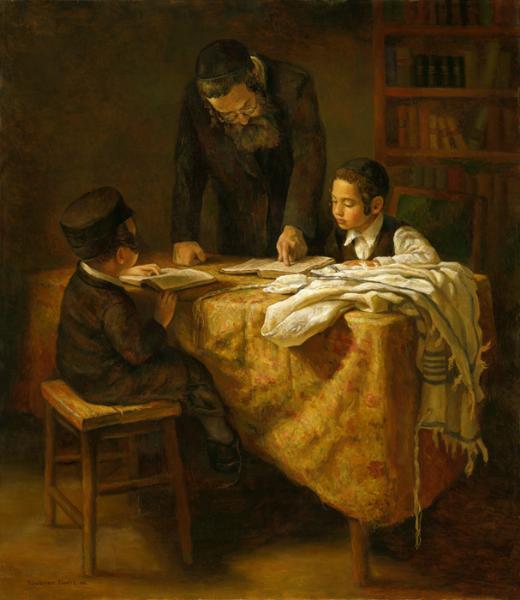
A Rabbi TeachingIf King David, who learned nothing from Achitofel except for two things alone, nevertheless referred to him as his “master,” “guide,” and “intimate,” it certainly goes without saying that one who learns from his fellow a single chapter, a law, a verse, a saying, or even a single letter of Torah, is obligated to revere him.

-Ethics Of The Fathers, 6:3

Our sages tell us, “There are three partners to the creation of man: G-d, his father, and his mother.” The capacity to procreate is, in essence, a distinctly Divine nature…The same is true regarding the “regenerative power” contained in a teaching: when G-d is a partner to their endeavor, the teacher-student relationship yields an infinite progeny.

Commentary on Ethics of Our Fathers: Chapter 6
Tammuz 11, 5771 * July 13, 2011
“Fertile Wisdom”
Chabad.org

I’ve mentioned before that the student-teacher relationship can yield enormous benefits, assuming an honest, knowledgeable, and inspired teacher and a student willing to be open. However, as we see from the quotes above, the teacher isn’t necessarily the most important partner in the transaction, which is good, since human beings are fallible. God is always present when Torah is taught and learned, which makes the act of study not only educational but holy. The Creator is the indispensable element in the room whenever people come together to learn the Word of God.

Rabbi Chalafta the son of Dosa of the village of Chanania would say: Ten who sit together and occupy themselves with Torah, the Divine Presence rests amongst them, as is stated: “The Almighty stands in the community of G-d.” And from where do we know that such is also the case with five? From the verse, “He established his band on earth.” And three? From the verse, “He renders judgment in the midst of judges.” And two? From the verse, “Then the G-d-fearing conversed with one another, and G-d listened and heard.” And from where do we know that such is the case even with a single individual? From the verse, “Every place where I have My name mentioned, I shall come to you and bless you.” –Ethics of The Fathers 3:6

“For where two or three have gathered together in My name, I am there in their midst.” –Matthew 18:20 (NASB)

But from who can we learn? It’s desirable to find a worthy teacher; one we can call our “Rebbe”, but there are problems with this. There are many unworthy teachers out there who are anxious to gather a following out of their own ambition, men and women who believe they have a special insight and who are entitled to share their particular “theological axe” which they desire to “grind”. From these “teachers” we learn there are those who are not to be trusted. Also, Christian tradition, unlike Judaism, doesn’t have a history of “Rebbes” or exalted teachers who pass their knowledge, wisdom, and compassion from one generation of disciples to the next. We are (often rightly) suspicious of gurus, cult leaders, and false teachers who ultimately lead people away from God. Christians even distrust the study of Torah and Talmud from valid and worthy Jewish Rabbis for fear this will lead the Christian away from Jesus.

And yet we are commanded to obey our leaders and teachers in the community of faith:

Have confidence in your leaders and submit to their authority, because they keep watch over you as those who must give an account. Do this so that their work will be a joy, not a burden, for that would be of no benefit to you. –Hebrews 13:17

We also see from David’s example with Achitofel that we are to honor a person who teaches us “a single chapter, a law, a verse, a saying, or even a single letter of Torah.” While we can seek to learn the teachings of an honored Rebbe such as Rabbi Menachem M. Schneerson, of blessed memory (and I’m learning much from his teachings as related by Rabbi Tzvi Freemen in the book Bringing Heaven Down to Earth), we see from the following that a good teaching can come from even a bad source:

It is possible to utilize for G-d’s service, [in a manner] according to Torah, all behavior-traits. This includes those traits that are unwholesome, and even those that are evil, as their names and descriptions indicate. For example, the tzadik Rabbi Meshulam Zushya of Anipoli, of blessed memory, learned [from his Rebbe, the Maggid of Mezritch] a number of ways of serving G-d from [the ways of] a thief:

  1. He works quietly without others knowing.
  2. He is ready to place himself in danger.
  3. The smallest detail is of great importance to him.
  4. He labors with great toil
  5. [and] Enthusiasm.
  6. He is confident and optimistic.
  7. If he did not succeed the first time, he tries again and again.

-[From HaYom Yom by the Lubavitcher Rebbe, translated by Uri Kaploun (Kehot)].
found at Chabad.org

This shouldn’t be so surprising, since the Master, our own great Rebbe in Christianity told us this:

Then Jesus said to the crowds and to his disciples: “The teachers of the law and the Pharisees sit in Moses’ seat. So you must be careful to do everything they tell you. But do not do what they do, for they do not practice what they preach. They tie up heavy, cumbersome loads and put them on other people’s shoulders, but they themselves are not willing to lift a finger to move them. –Matthew 23:1-4

Look at what Jesus is saying. He’s not telling his audience to ignore or disregard the teachings of the Pharisees. He’s saying “you must be careful to do everything they tell you”. What? Aren’t Pharisees hypocrites, liars, untrustworthy, and “under the Law”? Don’t they deny the true teachings of God and the grace of Jesus Christ? Why did Jesus tell his disciples to obey everything the Pharisees told them to do?

It’s because what the Pharisees taught was correct and consistent with the Torah, however the Pharisees of that day were corrupt and indeed, they were hypocrites who, under the Roman occupation, exalted themselves and did not “practice what they preached”, so to speak.

But what they actually taught was worthy of being learned and obeyed.

It’s also important to realize that not every single Pharisee was corrupt and no good. After all, Nicodemus was a Pharisee and he ended up becoming a disciple of Jesus. After the crucifixion of the Master, Nicodemus and Joseph of Arimathea, a wealthy member of the Sanhedrin, approached Pilate and asked permission to bury the Master’s body before the Sabbath began (we aren’t quite clear as to whether this was the eve of Passover or the weekly Sabbath). Not all Pharisees and members of the Sanhedrin were evil and corrupt, so we shouldn’t paint them all with the same broad brush.

KindergartenLook at the teaching of the Rebbe about how to learn from a thief. He doesn’t say the thief is a good and worthy teacher and that we must devote our lives to learning at the feet of a criminal. He says that, by simply observing the thief, there are habits we can learn and adapt to a life of holiness. The same is true of learning from anyone, even if they are unworthy, a hypocrite, or a thief, simply by watching them and listening to them, we can learn much, as long as we continue to use our powers of discernment and to view everything through the lens of the Bible and the Spirit of God.

Remember, in any transaction between two people, one being a teacher and the other being the student, God is there as the indispensable partner in the exchange. Being a student and disciple does not mean being a mindless sponge with no will of your own. In fact, your will, your judgment, and your questioning nature is as necessary to being a student as your attention, openness, and eagerness to learn. You cannot be taught corruption if you are paying attention and you do not have to take anything at face value without asking questions. Even the Bereans didn’t take Paul at his word and checked everything he taught against scripture (Acts 17:10-12). If you feel you have been lead astray by a teacher, look to yourself when asking the question, “how did this happen?”.

I’m sure you’ve heard or read the list compiled by Robert Fulghum, All I Really Need to Know I Learned in Kindergarten. From this, we learn that small children can teach us something. Even the Prophet Isaiah said “and a little child will lead them.” (Isaiah 11:6).

The Maggid also taught Rabbi Zushya, his disciple that we can learn three things from a child:

  • Never for a moment is he idle.
  • When he needs something, he demands it vigorously.
  • He is merry for no particular reason.

-[From The House of Rizhin by Rabbi Menachem Brayer [Mesorah].]

The Pirkei Avot; The Ethics of the Fathers teaches us that a life of learning and performing Torah yields many rewards:

The sages expounded in the language of the Mishnah (blessed is He who chose them and their learning):
Rabbi Meir would say: Whoever studies Torah for Torah’s sake alone, merits many things; not only that, but [the creation of] the entire world is worthwhile for him alone. He is called friend, beloved, lover of G-d, lover of humanity, rejoicer of G-d, rejoicer of humanity. The Torah enclothes him with humility and awe; makes him fit to be righteous, a chassid, correct and faithful; distances him from sin and brings him close to merit. From him, people enjoy counsel and wisdom, understanding and power, as is stated, “Mine are counsel and wisdom, I am understanding, mine is power.” The Torah grants him sovereignty, dominion, and jurisprudence. The Torah’s secrets are revealed to him, and he becomes as an ever-increasing wellspring and as an unceasing river. He becomes modest, patient and forgiving of insults. The Torah uplifts him and makes him greater than all creations. –The Ethics of the Fathers 6:1

Being a student, a disciple, and a person of faith is not a passive activity. Learning isn’t something you only do sitting at someone’s feet or taking notes in a classroom. It’s not always accomplished by reading a book or by visiting inspirational websites. A disciple is always moving, always asking questions, always observing, always sharing their insights with others and asking for feedback. Most importantly, in any learning situation (which is to say, in every waking moment of our lives), we are always turning to the “silent” voice in the room, the indispensable partner in the teaching of Torah. God is with us and He sent us a counselor who will teach us all things (John 14:26). Even when reading the Bible by ourselves at night, we are never alone.

Our teachers can be anyone. Our teachers can be anywhere. We just have to be paying attention to where we are and what we’re doing.

“A brilliant mind without faith is like a beautiful face without eyes.” -Shalom Cohen

Good Shabbos

Searching for Sparks

Holding SparksAt one time there were tzaddikim who would look into the soul of a disciple, see the place where the G-dly sparks were awaiting this soul and tell the disciple to go to that place to liberate those sparks.

All that has changed is the perception of the disciples. If you are where you are with the blessing of the Rebbe, you are where you belong. And you are there with a profound purpose.

Rabbi Tzvi Freeman
from the wisdom of the Rebbe
Menachem M. Schreerson
Bringing Heaven Down to Earth

Well, I – I think that it – it wasn’t enough to just want to see Uncle Henry and Auntie Em – and it’s that – if I ever go looking for my heart’s desire again, I won’t look any further than my own back yard. Because if it isn’t there, I never really lost it to begin with! Is that right?

Dorothy
The Wizard of Oz (1939)

It is said that we contain Divine Sparks from our Creator and those parts of us that belong to Him yearn to return to the Source. It’s what causes people to search for something beyond themselves; sometimes not even knowing what they are looking for or how to find it. It’s the part of us that brings some people to God and others to less than noble destinations, believing some false teaching is the answer they need.

It’s also believed that there are other sparks in the world that correspond to those we contain and that finding and liberating those sparks defines the purpose of our lives. Put in less mystic terms, we all have a purpose that gives meaning to our lives. We only need to discover that purpose in order to experience accomplishment, fulfillment, and to understand why we were created by God.

Some people search for this all their lives and die with the truth about themselves still undiscovered. While Hamlet calls death the undiscovered country, I think that “country” is rather the truth of our existence which we must discover while we are still alive. Even David said that once dead, we can offer nothing:

Among the dead no one proclaims your name.
Who praises you from the grave? –Psalm 6:5

It is not the dead who praise the LORD,
those who go down to the place of silence;
it is we who extol the LORD,
both now and forevermore.
Praise the LORD. –Psalm 115:17-18

Continuing with this theme, Vine of David’s commentary on Levertoff’s Love and the Messianic Age tells us:

“Although every man has the divine potential of a godly soul planted within him, this is not a guarantee that every man will enter into a relationship with HaShem or even that every soul will be redeemed. Instead, the soul is separated from God by a wall of partition – sin and guilt. HaShem removes the wall of partition between man and Himself through the work of the Messiah. When the wall is removed, then the soul can connect with HaShem. Then He can “use it for the gathering of these ‘sparks’.”

We journey near and far looking for and gathering sparks in order to fulfill the script of our lives written by God on our souls. But must we necessarily travel to distant and strange lands to find what we seek? Rabbi Freeman gives us part of that answer as he again relates the Rebbe’s wisdom:

People want to run away from where they are, to go to find their Jerusalem. Wherever you are, whatever you are doing there, make that a “Jerusalem”.

I wonder if the Rebbe ever saw The Wizard of Oz?

Hide and SeekGod is mindful of the days of our lives, where we go, what we are doing. He watches us as a father might watch his small son take his first, halting steps. We watch our children as they learn to walk, almost willing them in how to take the next step and in which way they should go. We cannot interfere unless they are about to be hurt, because otherwise, they’d never discover how to walk on their own. God is like that with us. The difference is, we should know that we are learning how to walk and be paying attention to the path. We should know that our Father is watching over us and that He’s ready to keep us from harm. Often, we don’t:

A certain chassid who had suffered a major financial loss stood before Rabbi Schneur Zalman of Liadi and lamented over his debts. “All you are telling me,” Rabbi Schneur Zalman replied, “is what you need. Who needs you, you don’t say much about. Do what G-d expects from you, and He will provide what you want from Him.”

Lest you think that God only expects us to serve and that He doesn’t care about who we are, our fears, our needs, and our concerns, we have two messages that console us; one from the Rebbe, and the other from “the Maggid of Nazaret”, Jesus:

The teaching of the Baal Shem Tov: Not only is the movement of a leaf as it falls off a tree, the quivering of a blade of grass in the wind-each and every detail of existence directed, vivified and brought into being at every moment from above-but beyond that: Every nuance is an essential component of a grand and G-dly scheme, the gestalt of all those vital minutiae.

Meditate on this. And then think: How much more so the details of my daily life.

-The Rebbe
as related by Rabbi Tzvi Freeman

“Therefore I tell you, do not worry about your life, what you will eat or drink; or about your body, what you will wear. Is not life more than food, and the body more than clothes? Look at the birds of the air; they do not sow or reap or store away in barns, and yet your heavenly Father feeds them. Are you not much more valuable than they? Can any one of you by worrying add a single hour to your life?

“And why do you worry about clothes? See how the flowers of the field grow. They do not labor or spin. Yet I tell you that not even Solomon in all his splendor was dressed like one of these. If that is how God clothes the grass of the field, which is here today and tomorrow is thrown into the fire, will he not much more clothe you—you of little faith? So do not worry, saying, ‘What shall we eat?’ or ‘What shall we drink?’ or ‘What shall we wear?’ For the pagans run after all these things, and your heavenly Father knows that you need them. But seek first his kingdom and his righteousness, and all these things will be given to you as well. –Matthew 6:25-33

Finally, in our little game of “hide-and-go-seek” with the Divine in ourselves and in the Universe, Rabbi Freeman presents the Rebbe’s teachings on this matter, again from his book Bringing Heaven Down to Earth:

G-d is not something of a higher realm that you cannot reach Him. Nor is He made of stuff ethereal that you cannot touch Him. G-d is “That Which Is” – He is here now, everywhere, in every thing and in every realm – including that realm in which you live. The only reason you do not perceive Him is because it is His desire that you search for Him.

Life is a game of hide and seek. G-d hides, we seek.

God does not play “hide the ball” with the Universe. He means for us to not only find Him, but everyday, to find who we are in Him. Start gathering the sparks. He’s there. And so are you.