
 In the Torah portion Vayeitzei , G-d blesses Yaakov, declaring to him: (Bereishis 28:14) “You shall spread out to the west, to the east, to the north and to the south.” The Gemara comments: (Shabbos 118a) “Whoever delights in the Shabbos receives an unlimited heritage, as is written: (Yeshayahu 58:14) ‘Then you shall delight in G-d… and I will nourish you with the heritage of Yaakov,’ of whom it is written: ‘You shall spread out to the west, to the east….’ ”
The reward for the performance of a mitzvah is, of course, measure for measure. (See Sotah 8b, 9b. See also Tanya ch. 39) What aspect of the mitzvah of Shabbos causes its reward to be “an unlimited heritage”?
Shabbos differs from all other mitzvos in that the performance of other mitzvos is achieved through labor and action. There are thus differences between the manner in which a very righteous individual will perform a mitzvah and the manner in which it will be performed by a simple person.
Observing Shabbos, however, consists of a cessation from labor. With regard to “not doing,” all Jews can be equal.
“Shabbos – An Unlimited Heritage”
Commentary on Torah Portion Vayeitzei
Based on Likkutei Sichos , Vol. XV, pp. 226-229
and the teachings of the Lubavitcher Rebbe
Rabbi Menachem M. Schneerson
Chabad.org
I know a discussion of Shabbat observance seems pretty far afield in relation to a plain reading of this week’s Torah Portion, but this is the association I found in the Chassidic Dimension’s commentary. Christianity has difficulty with some of the “linkage” offered by the Rabbis between specific events described in the Torah (the blessing God gives to Jacob in Genesis 28:14) and much larger and seemingly unrelated topics, but if you choose to look at them as metaphor, it’s a little bit easier to comprehend.
I’ve always had issues with reserving Shabbat to just the Jewish people. There are plenty of other commandments and blessings that I have no problem with being uniquely Jewish, but a weekly Shabbat rest in order to devote our thoughts and prayers to God? Why should only Jews do this? God sanctified the day at the end of Creation.
And God blessed the seventh day and declared it holy, because on it God ceased from all the work of creation that He had done. –Genesis 2:3 (JPS Tanakh)
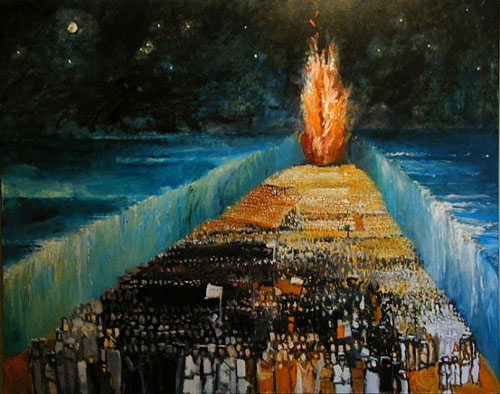
OK, I’m not that naive. God also directly associated the Shabbat with the Exodus from Egypt, thus:
Remember that you were slaves in Egypt and that the LORD your God brought you out of there with a mighty hand and an outstretched arm. Therefore the LORD your God has commanded you to observe the Sabbath day. –Deuteronomy 5:15
In doing my research for this morning’s “meditation”, I came along an interesting forum discussion on the topic of Shabbat and the Exodus at judaism.stackexchange.com where a similar question was raised by one man’s four year old son:
Why do you say “Mitzrayim” in Kiddush every week? “Mitzrayim” is a Pesach word!
Minus the Hebrew (which I can’t reproduce here), the father added a follow up question:
Tack-on question: Once you’ve established that Shabbat is linked both to Creation and to the Exodus, why is the terminology in Kiddush for these links slightly different? Shabbat is called – “a memorial to the deed of Creation” and – “commemorating the Exodus from Egypt” (translations from Wikipedia; emphases mine).
 You can go to judaism.stackexchange.com and read the entire thread. I can certainly see how the Shabbat is inexorably linked to the Jewish liberation from slavery in Egypt and how saying the kiddush on every Erev Shabbat commemorates the Exodus event for the Children of Israel.
But must the Shabbat observance be exclusively for the Jews?
The reason why all Jews are entirely equal with regard to the mitzvah of cessation of labor on Shabbos stems from the fact that the mitzvah of Shabbos touches the essence of the Jewish soul. Differences between one Jew and another exist only on an external level; with regard to their essence, they are all equal.
The Chabad commentary describes why all Jews are equal on the Shabbat, regardless of social status or other apparent divisions, because of their Jewish souls, but the Shabbat also separates Jews and Gentiles. Is the “essence” between Jewish and Gentile souls so incredibly different that we non-Jews cannot also connect to the Shabbat?
Some non-Jews, such as those associated with the “Messianic” movement, chafe when told by some Jews that the Gentiles, Christians or otherwise, are not commanded to observe the Shabbat and there is no penalty for a Gentile who fails to observe a Shabbat rest in the manner commanded for Jews. OK, I’ll buy that part, but what about Gentiles observing the Shabbat as a moral conviction and in acknowledgment of God’s creative sovereignty over the universe? We all live in Creation and God made the Gentile as He made the Jew. Is it so bad if a Christian were to rest on the Shabbat as “a memorial to the deed of Creation?”
Being married to a Jew, I have sort of a built-in reason for observing Shabbat, though my wife and I don’t do this as well as we would like. Christianity cast off the Jewish form of Shabbat observance and worship along with anything else in Christian practice that could even remotely be considered Jewish thanks to the birth and expansion of Supersessionist theology in the 2nd and 3rd centuries CE, but this has been more harm to us than to the Jews.
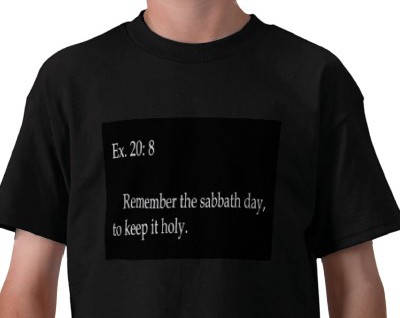 Rabbi Shmuley Boteach has, on various occasions, suggested that Jewish values, including the Shabbat, should be disseminated to the nations, at least in some fashion, which never fails to cause a stir, both in Jewish and in Christian circles. But while the Chabad commentary says that the Jewish people enjoy an “unlimited heritage” due to their Shabbos observance, can not the rest of us choose to at least honor God’s absolute rule of Creation by honoring the Shabbat? Do we dilute Jewish uniqueness if we quietly light the candles on Friday night as well, praising and thanking our King and our God?
There’s nothing higher than finding truth on your own.
All worlds were made, all barriers put in place, every veil over G-dliness hung, and the soul plummeted from its pristine height into the confusion of this harsh world—
—all for this one thing alone: That you should uncover truth on your own.
-Rabbi Tzvi Freeman
“The Highest High”
Based on letters and talks of the Rebbe
Rabbi M. M. Schneerson
Chabad.org
In spirit and in truth I wish you all Good Shabbos.






 Morning Meditations