Tag Archives: Torah

Searching for the Writer of Life

writer-of-lifeThe Jews recognized that God no longer spoke to them in the same way as in the past. The prophets who persisted in seeing heavenly visions and hearing heavenly voices saw and heard in a manner very different from those of earlier times. As a consequence (cause?) of the cessation or permutation of prophecy, the Jews began to seek the word of the Lord not from people but from texts. The sacred traditions of the past were compiled and redacted, and the Torah was created. The words of the great prophets of the past were similarly compiled and redacted. This process, whose ultimate result was the formation of the Bible, raised two important questions. First, which books were to be considered canonical? Second, how were the canonical books to be interpreted, and who was authorized to interpret them?

-Shaye J.D. Cohen
Chapter 5: Sectarian and Normative, pg 126
From the Maccabees to the Mishnah, 2nd Ed

It is one of the oldest puzzles in the world. Investigators have been wrestling with it practically since the Bible was completed. As it happens, it did not start as an investigation into the authorship of the Bible. It simply began with individuals raising questions about problems that they observed in the biblical text itself. It proceeded like a detective story spread across centuries, with investigators uncovering clues to the Bible’s origin one by one.

It began with questions about the first five books of the Bible: Genesis, Exodus, Leviticus, Numbers, and Deuteronomy. These books are known as the Pentateuch (from Greek, meaning “five scrolls”) or the Torah (from Hebrew, meaning “instruction”). They are also known as the Five Books of Moses. Moses is the major figure through most of these books, and early Jewish and Christian tradition held that Moses himself wrote them, though nowhere in the Five Books of Moses themselves does the text say that he was the author. But the tradition that one person, Moses, alone, wrote these books presented problems.

-Richard Elliott Friedman
Introduction: Who Wrote the Bible? pp 15, 16-17
Who Wrote the Bible?

Yes, this is a continuation of yesterday’s morning meditation. I was prompted by the mention of Friedman’s book on Derek Leman’s blog post to check and see if my local public library had a copy available. It did and so I checked it out over my lunch hour (I work about a ten minute walk from the Boise Public Library’s main branch).

Depending on your thoughts and feelings about the origins of the Bible we have today, this could be dangerous stuff. In fact, questioning the traditions we have about the Bible has historically been very dangerous stuff.

At the first stage, investigators still accepted the tradition that Moses wrote the Five Books, but they suggested that a few lines were added here or there. In the eleventh century, Isaac ibn Yashush, a Jewish court physician of a ruler in Muslim Spain, pointed out that a list of Edomite kings that appears in Genesis 36 named kings who lived long after Moses was dead. Ibn Yashush suggested that the list was written by someone who lived after Moses. The response to his conclusion was that he was called “Isaac the blunderer.”

-Friedman, pp 18-19

But that’s not the half of it.

He (Bonfils) still thought that the passages in question were written by “one of the later prophets.” He was only concluding that they were not written by Moses. Still, three and a half centuries later, his work was reprinted with the references to this subject deleted.

Van Maes suggested that a later editor inserted phrases or changed the name of a place to its more current name so that readers would understand it better. Van Maes’ book was placed on the Catholic Index of Prohibited Books.

De la Peyrere’s book was banned and burned. He was arrested and informed that in order to be released he would have to become Catholic and recant his views to the Pope. He did.

Spinoza had been excommunicated from Judaism. Now his work was condemned by Catholics and Protestants as well. His book was placed on the Catholic Index, within six years thirty-seven edits were issued against it, and an attempt was made on his life.

Simon was attacked by other Catholic clergy and expelled from his order. His books were placed on the Index. Forty refutations of his work were written by Protestants. Of the thirteen hundred copies printed of his book, all but six were burned.

-Friedman, pp 18-21
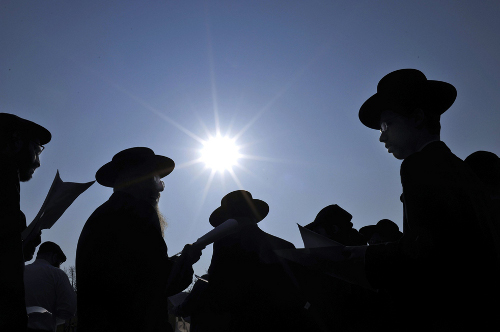
jewish-traditionAt least up to the 17th century, it was worth your life to suggest that Moses didn’t literally write every single word that appears in the first five books of the Bible. Jewish, Catholic, and Protestant tradition vehemently defended this viewpoint and if you were a scholar who studied such matters, it was better to keep any opinions that deviated from tradition strictly to yourself.

But what about now? Are we as a body of believers more tolerant of serious, scholarly study of the Bible?

The answer is probably yes and no. I don’t believe that anyone in the modern era has ever been put in prison or (gulp) executed for having non-traditional beliefs about the Bible, but you rarely hear controvertial views on scripture spoken of in a Sunday morning sermon. For that matter, how much controversy about the Bible makes its way into the Rabbi’s discussion of the Torah portion on Shabbat?

In addition to the written scriptures we have an “Oral Torah,” a tradition explaining what the above scriptures mean and how to interpret them and apply the Laws. Orthodox Jews believe G-d taught the Oral Torah to Moses, and he taught it to others, down to the present day. This tradition was maintained only in oral form until about the 2nd century C.E., when the oral law was compiled and written down in a document called the Mishnah.

-from “Torah: Oral Torah, the Talmud”
Judaism 101

Within these four methods of understanding Torah, there exist countless possible avenues of understanding. For example: There are many different ways to understand the Torah according to Peshat. That’s why there are many Torah commentators who concentrate on Peshat — Rashi, Ibn Ezra, Rashbam and many more – and they will very often (it seems, more often than not…) disagree on the literal meaning of a verse. In fact, according to Kabbalastic teachings there are 600,000 ways to understand Peshat, 600,000 ways to understand Remez, 600,000 ways to understand Drush, and 600,000 ways to understand Sod!

Any insight in Torah is acceptable as long as it (makes sense and) does not contradict any of our fundamental beliefs.

-Rabbi Naftali Silberberg
“How is the Torah Interpreted?”
Chabad.org

My wife tells me that in Judaism, one does not interpret Torah outside of tradition, so at least from an Orthodox point of view (her perspective was likely learned from the local Chabad Rabbi), it would be unacceptable practice to consider interpreting Torah from any viewpoint other than established Jewish halachah.

But what about Christianity?

The Bible is God’s Word. But some of the interpretations derived from it are not. There are many cults and Christian groups that use the Bible, claiming their interpretations are correct. Too often, however, the interpretations not only differ dramatically but are clearly contradictory. This does not mean that the Bible is a confusing document. Rather, the problem lies in those who interpret and the methods they use.

We need, as best as can be had, the guidance of the Holy Spirit in interpreting God’s Word.

Because we are sinners, we are incapable of interpreting God’s word perfectly all of the time. The body, mind, will, and emotions are affected by sin and make 100% interpretive accuracy impossible. This does not mean that accurate understanding of God’s Word is impossible. But it does mean that we need to approach His word with care, humility, and reason. Additionally, we need, as best as can be had, the guidance of the Holy Spirit in interpreting God’s Word. After all, the Bible is inspired by God and is addressed to His people. The Holy Spirit helps us to understand what God’s word means and how to apply it.

On the human level, to lessen the errors that come in our interpretations, we need to look at some basic biblical interpretive methods. I’ll list some of the principles in the form of questions and then apply them one at a time to a passage of Scripture.

-Matt Slick
“How to Interpret the Bible”
Christian Apologetics and Research Ministry

You can click on the link I provided to read Mr. Slick’s ten principles for interpreting the Bible and everything else he has to say. I selected this resource basically because it was at the top of the Google search results for the “how do christians interpret the bible” search string. However, Mr. Slick and the carm.org web site don’t address the role of tradition in interpreting the Bible (except unintentionally by mentioning more than once that in Christian tradition, the Holy Spirit is required and considered always available to interpret the Bible).

How the Bible is translated from its ancient languages to English, for example, is driven by theology and tradition. Consider how Christian and Jewish translators address the text of the “Old Testament” let alone how they interpret its meaning. Sure, for the most part, reading a Christian Old Testament and a Jewish Tanakh will produce a similar experience, but it won’t be identical. Also consider, for example, how the text of Isaiah 56 is interpreted between Christians and Jews. Christianity largely believes that the Messiah, that is, the Christ, is being described, while its traditional in Judaism to say that Israel itself is the “suffering servant.”
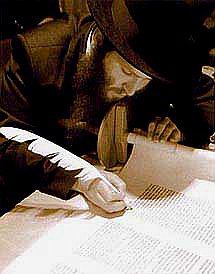
Sofer-Sefer-TorahNot only is the origin of the Bible understood by various traditions, but what the text is supposed to mean is also interpreted in that manner, at least for the most part. I don’t doubt that there are certain individuals who are willing to take a wider look and a less dogmatic approach to the Bible, and certainly there are numerous scholars who will broach the subject of the authorship of the Bible, but how many of us, the “rank and file” of the church (or synagogue) are willing to take such a risk?

I say “risk” because if we aren’t able to detach our traditions from our faith, at least temporarily, in the study of the Bible, then we are likely to find ourselves approaching the edge of a very steep precipice and risk falling into the abyss of crisis. For some people, faith hangs in the balance.

But so does enlightenment. Frankly, if your faith can’t stand being shaken up a time or two, it probably isn’t very strong. Also, no one grows spiritually by playing it safe. Sure, it’s comfortable, and nice, and warm, and cozy inside the cocoon of tradition and pre-programmed belief systems, but who we are as disciples of the Master requires a modicum of courage at a minimum. Paul commended the Bereans (Acts 17:11) for examining the scriptures daily in order to verify what Paul was teaching. Can we do any less when addressing the scriptures themselves, including their sometimes mysterious authors?

Some people who do this, exit faith completely, unable to reconcile their relationship with God with the dissonance about the Bible. Some people abandon critical examination of the Bible and retreat into their former comfort zone, manufacturing some explanation about why such an examination is in error if not heretical. But some people actually grow.

I’m finding that Cohen’s and Friedman’s books seem to work well when read in parallel. However, it is important (to me, anyway) to stay grounded in the world of faith and not to stray too far into the area of objectification of the Bible. I still “just plain read” the Bible every day and more recently, I go to church every week. Every other week, I meet with a friend who has been a Christian for forty years. All this acts as an anchor on the shore as I also choose to explore deep (well, deep for me) waters.

In his book (Chapter 5), Cohen writes:

Judaism is a relativistic construct of human beings, and no variety of Judaism is any more correct or authentic than any other. This is the perspective of the historian.

Judaism is a body of absolute truths revealed by God and/or sanctioned by tradition, and those interpretations of Judaism that are more nearly approximate these absolute truths are truer and more authentic than those that do not. This is the perspective of the believer.

Following those definitions, of himself, Cohen writes:

In this book, I write as a historian.

I can see how the above definitions can be applied to how we view Christianity as well as Judaism, so it is possible to look at the Bible and its origins from either the historian’s or the believer’s point of view. I’m a believer but it is my opinion that my life as a believer can be enhanced by also looking at the Bible as a historian (with the aid or real historians and scholars such as Cohen and Friedman). It’s an adventure and as such, it presents a set of challenges and dangers.

If that doesn’t scare you off, I invite you to participate in the adventure along with me as I continue to read and comment upon Cohen and Friedman and their revelations about the Bible, tradition, history, and faith. May we all learn together and may we all draw closer to the One who is the Author of our lives and the Lover of our souls.

Missing Author

empty-bibleWho wrote the Torah? Most people you ask — depending on your circle of friends — will answer, “A group of very wise men got together and wrote it.” For the past 3,300 years the Jewish people have lived with the consciousness that the Almighty dictated the Torah to Moses who wrote it down word for word, letter by letter. Every Torah-educated Orthodox Jew believes that. Are they fools, fantasizers, misguided religious fanatics?

It will surprise some people to know that for the past 3,300 the Jewish people have taught their children the evidence for the belief that there is a God and that He dictated the Torah to Moses. Actually, I am sure that for the first hundred or two hundred years after the giving of the Torah at Mt. Sinai the authorship of the Torah was not even a question. For generations all a Jewish child had to do was to ask his father if he was at Mt. Sinai or if his father or grandfather was there. Even Moses himself tells all generations to “Go and ask … has a people ever heard the voice of God speaking … as you have heard and survived?” (Deuteronomy 4:32-35).

-Rabbi Kalman Packouz
“Shabbat Shalom Weekly”
Commentary on Torah Portion Vaeira
Aish.com

This post may trouble some readers. It really shouldn’t. Religious leaders in some circles have sought to suppress the overwhelming evidence that something like the Documentary Hypothesis is true. Attacks against this idea usually claim that those who believe this theory simply disbelieve God. Such attacks also tend to refer to Julius Wellhausen and his views, which actually do not represent what is essential about the Documentary Hypothesis. The Documentary Hypothesis (DH) has many forms and is better known as JEDP. In my opinion, the best developed understanding of the DH is found in Richard Friedman’s work, including the very readable Who Wrote the Bible? (which was a bestseller).

-Derek Leman
“Exodus 6:2-3 and the Documentary Hypothesis”
Messianic Jewish Musings

I haven’t revisited this topic in a long time and even after I read Derek’s blog post, I was determined not to regurgitate it again from the murky depths so that it could come back up into the cold light of day. Then I read Rabbi Packouz and I was reminded that there is a fair distance between the stories we tell ourselves about the Bible and the story that the Bible tells us about itself (I know these gentlemen are specifically discussing the Torah, the Five Books of Moses, but I’m choosing to expand the discussion to the Bible as a whole).

I don’t mean the story the Bible tells in the actual text, but the history and evolution of the creation of the Bible as we have it today. I’m no scholar, but even I’ve read enough to realize that the Bible has lots and lots of warts, bruises, wrinkles, and other imperfections. No reliable and trustworthy Bible scholar would suggest that God literally dictated the Bible word-for-word to its various human authors.

So where is God in the Bible? No I don’t mean where is God mentioned, but is there anything of God in the actual composition of the Bible? Or is the Bible just the stories we tell ourselves about it? Frankly, we have told ourselves some pretty interesting stories about the Bible.

One way to establish and support an acceptance of Talmudic interpretation and judgment relative to Torah for post-Second Temple Judaism is to project the values and even the “reality” of Talmud (and later, Kabbalah) not only forward in time but backward. Peering at the Patriarchs through this lens, we can indeed “see” Abraham, Isaac, and Jacob studying Torah and Talmud in the study house of Shem when by historical knowledge and a plain reading of the Torah, such events seem very unlikely to have actually taken place.

-from my blog post:
The Rabbinization of Abraham

study-in-the-darkI periodically wrestle with this issue. Back on my previous blog, I wrote such articles as Reading the Bible in the Dark, The Bible is a Mystery Novel, and Who to Believe. I manage to “tame” the questions and conundrums by reading the Bible as if it were a series of Chassidic, or in my case, Messianic Tales. Maybe that’s the only way to make sense of the Bible, and especially the Gospels.

He read the Gospels in German. Then he obtained a Hebrew version and reread them. Though he was in the midst of a Gentile, Christian city where Jesus was worshiped in churches and honored in every home, Feivel felt the Gospels belonged more to him and the Chasidic world than they did to the Gentiles who revered them. He found the Gospels to be thoroughly Jewish and conceptually similar to Chasidic Judaism. He wondered how Gentile Christians could hope to comprehend Yeshua (Jesus) and His words without the benefit of a classical Jewish education or experience with the esoteric works of the Chasidim.

Taken from Jorge Quinonez:
“Paul Philip Levertoff: Pioneering Hebrew-Christian Scholar and Leader”
Mishkan 37 (2002): 21-34
as quoted from Love and the Messianic Age

But this presents a problem. During last Sunday’s sermon, Pastor said (I don’t have my notes with me, so what I’m about to write isn’t an entirely accurate quote) that the only way to show an unbeliever how to encounter God and come to faith in the Father through Jesus Christ is by reading and using scripture.

Um…whoa. Waitaminute.

Given everything I’ve said above, plus Derek’s commentary, plus just a boatload of Biblical scholars , scripture is not and cannot be the literally dictated words of the God of Heaven as whispered into the little, shell-like ears of the prophets and other writers of the books of the Bible.

In fact, I’m hard-pressed to tell you what the Bible is and who actually wrote it. Even portions of the New Testament weren’t in all likelihood, written by the people whose names are attached to them. Not all of the epistles written by Paul? Probably not. Did the Apostle John who (supposedly) wrote the Gospel of John also write Revelation?

Once you stop taking the Bible for granted, a lot of new territory opens up in front of you…in front of me.

In defense of the Bible (the Torah actually), Rabbi Packouz has this to say:

Perhaps the most powerful example is Shmitah (the Sabbatical year for the land). Modern agriculture science has taught us the value of letting the land rest and replenish itself. A sensible law would be to divide the Land of Israel into 7 regions and each year let one region lie fallow while people eat from the crops of the other 6 regions. However, that’s not the law of the Torah! The Torah writes, “For six years you may plant your fields … but the seventh year is the Sabbath of the land in which you may not plant your fields nor prune your vineyards (Leviticus 25:36).

The WHOLE land is to rest all at the same time! What happens to an agrarian society that stops farming for one year? Starvation! And how long does a religion last that advocates letting the whole land rest in the 7th year? My guess … about 6 years!

Perhaps they could avoid starvation by buying food from surrounding countries? A good idea and a reasonable idea … but the Torah has other plans. The Almighty says, “I have commanded My blessing to you in the sixth year and you will have produce for three years” (Leviticus 25:20-22).

Either one has to be God to have the “audacity” to make a law for the whole land to rest and then to promise a bounty crop 3 times as large as usual in the sixth year — or a stark raving mad lunatic!

Yet, the Jewish people neither starved nor abandoned the Torah! 3,300 years later a sizable portion of our people still adhere to the laws of Torah and still trust in the promises of the Almighty!

How could any human being promise in writing something that requires powers totally beyond his control?

And furthermore, why would anyone be willing to risk his own credibility and the legitimacy of his religion, when it would be easier to present a more rational solution and avoid the credibility issues.

Going to GodCan we accept that somewhere in the pages of the Bible we might actually be able to encounter the Divine? If so, where and how (apart from Shmitah)? If we can’t take the Bible as literally, page-by-page, the Word of God, then what do we consider it? If God is in there somewhere, then is it an intellectual and scholarly race to discover the secret location of the well of God’s Spirit?

Derek Leman seems to think that it’s possible to have a very questioning view of the Bible and yet still have faith:

People get from their religious background the idea that “Moses wrote all” or “Moses wrote almost all” of the Torah. For example, people will say “Moses wrote Genesis.”

This is complicated by things like Yeshua referring to “Moses and the prophets.” People take this to mean that Yeshua, who they suppose was omniscient during his earthly sojourn (but he was not) affirmed that Moses wrote all of Gen-Deut. He did not. His references to Moses actually writing all concern commandments, not narratives. With Moses as the originator of the commandments (or original vessel through whom they were revealed), all the five books are called “of Moses” but this need not mean authorship.

Anyway, because some of the earliest people to doubt Moses as the final author of Torah were skeptics, it is common for people to think anyone with a more complicated view than “Moses wrote it” are doing so because of a small faith or a lack of faith or a dislike of faith.

But I’ve never heard a satisfactory explanation of how other people do it. I only have how I do it and my “method” requires usually suspending disbelief for the sake of faith. I have encountered God before, so in an extraordinarily subjective way, I know He is real, He is alive, and He is God. I’m not going through the crisis of faith I had when I first faced this particular realization, but I do allow myself to periodically become aware of just how fragile a knowledge of God is if based solely on the Bible. On the other hand (and I’ve alluded to this already), basing knowledge of God solely on our experiences with the Holy Spirit can be just as hazardous, because most human beings have very little ability to tell the difference between an emotional experience and a spiritual one (barring the occasional saint or tzaddik).

I may not be able to take everything I read in the Bible and everything that Christianity and Judaism says about those events as actual, factual events (though some of them probably are), but I can still take what I read and what I study and try to apply them so that I can learn to live a better life.

The Patriarch Abraham was tested (by God) ten times and withstood them all. This proves Abraham’s great love for God.

-Ethics of the Fathers 5:3

Abraham was tested with ten trials of progressively increasing severity, ultimately culminating in the test of sacrificing his beloved son Isaac if God so willed.

Abraham successfully passed all the tests. Still, while he did demonstrate his intense loyalty and devotion to God, how did it prove his love for God?

In yesterday’s message we learned that God does not challenge people beyond their capacities. It follows, then, that as they advance in spiritual growth and strength, they actually render themselves vulnerable to trials of greater intensity. In the course of his many trials, Abraham detected this pattern. He could have logically decided to avoid any further spiritual progression, because it might subject him to even greater ordeals than those he had already sustained.

Abraham decided otherwise. He desired so much to come closer to God that he was willing to pay any price. Thus, when he was put to the ultimate task – to sacrifice Isaac – Abraham was not taken aback. He had fully anticipated such an eventuality.

We are not of the mettle of Abraham, and we pray every day, “Do not put us to test.” While we indeed wish to advance spiritually, we ask to be spared the distress of trial. Yet, should we experience adversity in life, we would do well to realize that this may be a testimony to our spiritual strength.

looking-upToday I shall…

try to advance myself spiritually. Although I pray to be spared from distress, I will try not to recoil if adversity does occur.

-Rabbi Abraham J. Twerski
“Growing Each Day, Tevet 26”
Aish.com

Thomas Gray once penned the famous words, “Where ignorance is bliss, ’tis folly to be wise” (in the poem “Ode on a Distant Prospect of Eton College,” 1742). I suppose many “Bible-believing Christians” feel very blissful as long as they don’t consider the rather troubling questions I’m bringing up this morning. On the other hand, once the “bliss bubble” is popped, then we can only face the painful trial of reality, if not the wisdom, of whatever we have left.

Chances are, Abraham never faced the ten challenges, at least as we see chronicled in Pirkei Avot (but not the Bible). Chances are Abraham, Isaac, and Jacob never studied Torah in the academies of Shem and Eber as we learn from the Talmud. Maybe the only place we really encounter God is in our prayers. Or maybe we encounter God everyday, as long as we continue to seek Him.

According to Gedaliah Nigal’s book The Hasidic Tale, some of the goals of the hasidic story are to “rouse its hearers into action for the service of God” and to win “adherents, among them some outstanding individuals, to hasidim.” In relation to this, I’ve said:

The “Chasidim” of Jesus also made sure the stories of their Master were passed on from generation to generation, eventually being recorded and passed on to the future…to us.

Paul Philip Levertoff thought that the teachings of Jesus read like a collection of Chasdic tales. Perhaps as Gentile Christians reading tales of the Chasidim, we can also find a connection to the Messiah, the Prophet, and the greatest Tzadik, whose own death atoned for not just a few, but for all.

Having gone through all this again, I feel reassured.

Shemot: Trusting God

trust2In this week’s Torah portion the Torah tells us “There arose a new king over Egypt who did not know Joseph.” There is a disagreement whether it was truly a new king or whether the king (Pharaoh) chose to ignore any debt of gratitude to Joseph and his people for saving Egypt and the world from the 7 year famine. Obviously, trusting in people — especially heads of governments — is problematic. Who do you trust? Who can you trust?

In my youth there was a television show entitled, “Who Do You Trust?” The show was not entitled “Is There Anyone You Trust?,” because, in the end all of us trust in someone or something. People trust in their intelligence, their power, their charm, their knowledge, their connections, their political candidate, and in their wealth. For those who trust (or trusted…) in their wealth, it is ironic that on the American dollar bill it advises “In God We Trust.”

Ultimately, what will help all of us to weather these difficult times is strengthening our trust in God. Trust in God gives a person peace of mind, the ability to relax and to be free of stress and worry. It helps one to deal with frustrations and difficulties.

Like all intelligent discussions, we first have to start with a definition. Trust in God is believing, knowing, internalizing that all that the Almighty does for us if for our good. It is knowing that the Almighty loves us greater than any love one human being can have for another person. He totally knows and understands us and our personal situations. Only the Almighty has the power to impact your situation. He has a track record. You can rely on Him. Everything the Almighty does for you is a gift; there are no strings attached.

-Rabbi Kalman Packouz
“Who Do You Trust?”
Commentary on Torah Portion Shemot
Aish.com

That sounds fine as far as it goes, but it’s not as simple as all that. Trusting in God does not mean that you are guaranteed a problem-free life. In fact, as we’ve recently seen, Many people suffer horrible tragedy and tremendous loss regardless of their trust, or lack thereof, in God. The hurricane devastates the righteous and unrighteous alike and loss of a child will break anyone’s heart.

However, Rabbi Packouz provides a handy list of 7 Principles for Trusting in God for our review. Here they are:

  1. The Creator of the universe loves me more than anybody else in the world possibly can.
  2. The Almighty is aware of all my struggles, desires and dreams. All I need is to ask Him for help.
  3. The Almighty has the power to give me anything I want.
  4. There is no other power in the universe other than the Almighty. Only He can grant me success and give me what I want.
  5. The Almighty has a track record for giving me more than I am asking for.
  6. The Almighty gives with no strings attached. I don’t need to earn it or deserve it. He will give it to me anyway.
  7. The Almighty knows what is best for me and everything He does is only for my good.

Although Christianity and Judaism are two different religions (with a common root), I think the list above can be applied just as well to the non-Jewish believer as to the Jewish person.

Does God love you more than anybody else in the world can? The New Testament is full of comments about God’s love, the most obvious being John 3:16. Yes, God does love you and He loves me, and He loves all Christians, and all Jews, and all Muslims, and all Buddhists, and all human beings who have ever lived and who will ever lived.

And yet disaster can strike at any moment and human history is replete with tragedies and disasters. The road of our lives and the lives of all who came before us is littered with broken bodies and broken hearts and broken spirits.

Certainly God is aware of all our needs and struggles since nothing is hidden from Him, but point two suggests that all we have to do to be relieved of our pain is to ask Him for help. Does everyone who has a sincere faith and prays to God receive immediate relief from suffering? Ask the parents of those children who were murdered at Sandy Hook Elementary school.

God really does have the power to give you, me, and everyone else anything we want, but that doesn’t mean He will grant us anything we want. In fact, it is very likely that God will not grant us anything we really want most of the time.

From a Christian’s, Jew’s, or Muslim’s point of view, there is only one power in the universe: God. Only God can grant success and comfort. But as I already said, there’s a difference between what He can do and what He will do.

Does God have a track record of giving us more than what we ask for? I’m not even sure how to measure such a thing. I think that’s probably true in some cases, but not in others. Ask six million Jews who died during the Holocaust while praying for God to grant them mercy. Was death the only mercy He decided to give?

no-strings-attachedGod gives with no strings attached. Hmmm. Is that true? Probably in more cases than not, but there’s a presupposition that even in giving, God is trying to get our attention, especially if those receiving His gifts do not have faith. On the other hand, referring back to John 3:16, God is the grand master of unconditional love, so who am I to talk?

God knows what is best for me. I can’t argue against that and this seventh point could be used to explain the other six. We may ask for something and not get it and then conclude that we didn’t get what we wanted because it wasn’t good for us. On the other hand, the parents of 26 murdered children only want this all to be a bad dream and for their precious little ones to be restored to them. Is that not “good for them?”

No, I’m not trying to be a downer and “diss” trusting in God, but such an abiding trust is difficult to come by.

Blessed are You, O God … Who has provided me my every needs.

-Siddur

One of the great tzaddikim lived in abject poverty, yet always had a happy disposition. He was asked how he managed to maintain so pleasant an attitude in the face of such adverse conditions.

“Each day I pray to God to provide all my needs,” he said. “If I am poor, that means that one of my needs is poverty. Why should I be unhappy if I have whatever I need?”

Tzaddikim are great people and we are little people who may not always be able to achieve the intensity of trust in God that would allow us to accept adversity with joy. But even if we cannot attain it to the highest degree, we should be able to develop some sincere trust.

When our children are little, we as parents know what they need. They might prefer a diet of sweets, but we give them nourishing foods. They certainly despise receiving painful injections that immunize them against dreadful diseases, but we forcibly subject them to these procedures because we know what is good for them.

Some people do not believe in God. But to those that do, why not realize that He knows our needs better than we do, and that even some very unpleasant experiences are actually for our own betterment?”

Today I shall…

try to bear adversity with less anger and resentment, remembering that God is a compassionate Father, and that He gives me that which He knows, far better than I, that I truly need.

-Rabbi Abraham J. Twerski
“Growing Each Day, Tevet 20”
Aish.com

The Hebrew word bitachon is typically translated as “trust” in English, but that hardly does it justice. Trusting God isn’t about God always giving us what we want or us experiencing God as always doing what we think of as good. It’s the realization that God is always good regardless of our experiences.

Consider any of the “holy men” you may admire and revere from the Bible. From Abraham to Paul, they all led less than perfect lives. Yes, God granted them many gifts, but He also allowed much hardship. Abraham and Sarah were childless and without an heir for most of their lives and into extreme old age until God granted them Isaac. Jacob was hated by his brother Esau, kept in virtual slavery by his relative Laban for twenty years, his daughter was raped and held captive, his favorite son Joseph was lost and presumed dead. Another son Judah married outside of the Hebrews and two of his three sons died. Joseph was a slave and a prisoner for years in a strange land before being elevated to great power, but only on the condition that he conceal his identity, even from his own brothers. When Joseph died, every one of his descendants for generations was kept as slaves in Egypt. Even their rescuer Moses was unable to lead his people into Canaan and instead wandered with them in the desolate wilderness for forty years until finally dying with almost everyone else in his generation without walking in Israel for himself.

Dietrich BonhoefferThe “saints” of the New Testament fared no better. Consider the stoning of Stephen, the harsh life of Paul leading only to death in Rome, and the martyrdom of Peter and every other Apostle. No, trust and faith did not result in comfort of life.

No, trust in God cannot be based on experience with God because if it were, none of these people would have been able to trust Him. In fact it seems that one must trust God in spite of our life experience. Rabbi Packouz’s list does little good, since God does not perform good on command. Knowing that God can spare us pain and suffering doesn’t help and is a bitter irony when God doesn’t spare us pain and suffering. Job’s most famous line (for me) illustrates what it is to trust in God.

Though he slay me, I will hope in him; yet I will argue my ways to his face.

Job 13:15 (ESV)

This gives us a picture of the Jewish method of trusting God, since it doesn’t preclude telling God how we feel about what’s happening to us.

Rabbi Twerski tells us that only a great tzaddik, a very holy and spiritual person, can truly trust God at the level I’m talking about here. But he also says that it’s not impossible for we “ordinary folk” to trust God, either. In his own declaration on the matter, Rabbi Twerski states, Today I shall try to bear adversity with less anger and resentment, remembering that God is a compassionate Father, and that He gives me that which He knows, far better than I, that I truly need.

In our own times of hardship and anguish, maybe this is the best we can do as well.

For what we proclaim is not ourselves, but Jesus Christ as Lord, with ourselves as your servants for Jesus’ sake. For God, who said, “Let light shine out of darkness,” has shone in our hearts to give the light of the knowledge of the glory of God in the face of Jesus Christ. But we have this treasure in jars of clay, to show that the surpassing power belongs to God and not to us. We are afflicted in every way, but not crushed; perplexed, but not driven to despair; persecuted, but not forsaken; struck down, but not destroyed; always carrying in the body the death of Jesus, so that the life of Jesus may also be manifested in our bodies. For we who live are always being given over to death for Jesus’ sake, so that the life of Jesus also may be manifested in our mortal flesh. So death is at work in us, but life in you.

2 Corinthians 4:5-12 (ESV)

Good Shabbos.

Where Do We Find God?

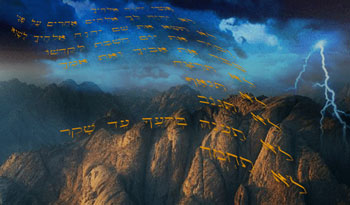
Torah at SinaiWhere is the Torah?

-Shabbos 89a

It seems incredulous that Satan was unaware that Moshe had received the Torah and had taken it down to earth. Tosafos answers that at that moment, Hashem caused the Satan to become confused and confounded in order to avoid the risk of having Satan interfere with the giving of the Torah.

Maharsha notes that the Gemara had earlier reported that when Moshe came to the heavens, all the celestial angels presented Moshe with various gifts, and among those who gave Moshe a tribute was Satan himself. (This interpretation is based upon the fact that Satan and the Angel of Death are one and the same. It was the Angel of Death that divulged the secret of the incense to Moshe, and that it had the power to interrupt a raging plague.) Satan, we see, clearly was aware of the events surrounding Moshe’s mission and that his coming to the heavens was specifically in order to receive the Torah and to bring it back for the Jewish people. Why, then, asks Maharsha, was Satan surprised when Moshe took the Torah back to earth?

Daf Yomi Digest
Gemara Gem
“To where did the Torah go?”
Commentary on Shabbos 89a

This is midrash and as such, it’s not a good idea to try to take it literally, but perhaps there is something we can learn here. If we indeed have an Adversary who seeks to divert us from a life of holiness and an awareness of God and if this Adversary has the ability to succeed in his task, then how is a life of holiness possible at all?

Maharsha responds that…

Satan realized that the Torah was going to be given to Moshe. However, due to its extreme holiness and spiritual nature, Satan was certain that this was valid only as long as Moshe remained in the heavens. It did not seem possible that the Torah had any purpose in being taken to earth, to be shared with men who are made up of physical elements. When Moshe took the Torah to the Jews, Satan was shocked, and he asked, “What happened to the Torah? How could it be fitting for man to have?”

The truth is, though, that the purpose of Torah is indeed for man to have.

There are certain voices in Judaism who believe the Torah is far more than a document; a scroll with words that communicate information. They see the Torah as having a life of its own, it is wisdom and it is also part of God and thus it is the embodiment of God. Interestingly enough, Christianity’s perception of “the Word” is not far from this.

In the beginning was the word, and the word was with God, and the word was God. He was in the beginning with God. Everything was made to exist through him, and nothing that was made to exist was made to exist except by him.

John 1:1-3 (DHE Gospels)

But of course, there’s more.

The word was made flesh and dwelled in our midst. We have beheld his glory, like the glory of a father’s only son, great in kindness and truth.

John 1:14 (DHE Gospels)

The Bible exists between two “bookends,” between two instances wherein we see God dwelling among His people. In Genesis, we see that He walked in the Garden with man and in Revelation, we see God once more among those who love Him. And in between, the Torah was brought to earth by an emissary of God and given to men, both as the Torah from Sinai and the Word made flesh in Israel.

While midrash may ponder how the Adversary could allow the Torah to be brought down from Heaven to become accessible to man, the Bible tells us that he challenged such an action in the days of the second temple.

Then the spirit carried Yeshua into the wilderness so that the satan could test him.

Matthew 4:1 (DHE Gospels .. see Matthew 4:1-11 for more)

everlastingBut testing isn’t the same thing as stopping or preventing or defeating. As the midrash says…

The goal of the Torah is that it be studied and applied by man, in order for him to incorporate it into his unique blend of being made up of both physical and spiritual aspects.

And as told to us by John…

And from his fullness we all have received kindness upon kindness. For the Torah was given by Mosheh and the kindness and truth came through Yeshua the Mashiach. No one has ever seen God; the only son who is in the Father’s lap has made him known.

John 1:16-18 (DHE Gospels)

God has always desired to dwell among His special creation; among humanity. He has done so before, however briefly, and He will do so again in eternity. He has sent His messengers and His emissaries to us to give us gifts of Himself, the Torah of Moses and the Mashiach, the Christ. The means to know God and to be with God are within our grasp. As the sages say, the Torah is not in Heaven. As the Apostles of the Messiah say, the Spirit of God is with us in our hearts.

Blessings to you and all who are yours, and blessed be God who so loved the whole world that he gave us His only son.

Amen.

A Line as the Unending Horizon

horizon-at-nightWe live as exiles. We’re called to be pilgrims.

As he sent Adam and Eve into exile, God promised redemption and offered protection. But toil, pain, relational struggle, sin and death went with them as well, marking them and their descendants as refugees from Eden. Consider the ways in which your everyday life is not at all like the perfect paradise of that Garden. Take a few moments to list the markers of your existence as an exile by naming the broken things in your world, the brokenness in you.

The sorrow or anger that you may have felt as you named those broken things? The sinking recognition that things aren’t the way they’re supposed to be?

Those are marks of the exile experience, but they also contain a clue, a compass of sorts. Deep in our DNA, beyond rational thought or extravagant imagination, is a longing for home. Adam and Eve had it or it wouldn’t have taken sword and cherubim to protect Eden. We have it, too. This longing contains our invitation into the new identity and life direction God longs to give to his beloved exiles. This longing is designed to transform us into pilgrims.

Which word resonates with your life experience more: exile or pilgrim? Why do you say so?

-Michelle Van Loon
“Pilgrim’s Road Trip #1”
MichelleVanLoon.com

Since becoming aware of the reality of God, my existence has been one of searching, traveling on a journey, walking along a path, striving toward a destination…God doesn’t promise that we’ll always be well or even safe, just that regardless of what happens to us, he will be with us, as he was with Jacob when Jacob and his family descended into Egypt. Sometimes we’re slaves. And we wait until God lifts us up again. Even if he doesn’t, blessed be the name of the Lord. I’m still walking as a pilgrim on the trail.

my (edited) response

I’ve admitted before feeling abandoned by God, an exile in the desert, but I suppose in reality, I was the one pushing God away and not the opposite. Frankly, encountering God is scary and there have been long periods of time when I thought I’d rather not hear from Him. Ultimately though, once a person has become aware of God’s presence, avoiding such encounters is impossible. God has ways to get our…my attention and He calls us…me out of exile and into relationship.

O God before Whom my forefathers Abraham and Isaac walked – God Who shepherds me from my inception until this day…

Genesis 48:15 (Stone Edition Chumash)

Although Jacob suffered greatly over his lifetime, and before Pharaoh, King of Egypt, Jacob said of his life that “few and bad have been the days of the years of my life,” (Genesis 47:9) yet he calls God his “shepherd” who has guided the steps of Jacob “from my inception until this day.”

We Christians have a shepherd, the same shepherd actually, though we access God through the “good shepherd” who once walked among men and who will walk among us again.

I am the good shepherd, and I know what is mine, and I am known to those who are mine, just as the Father knows me and I know the Father and I give my life for the flock. I have other flocks that are not from this sheepfold, and I must lead them as well. They will hear my voice, and there will be one herd and one shepherd.

John 10:14-16 (DHE Gospels)

While Jesus admittedly came for the “lost sheep of Israel,” (Matthew 15:24), the “good shepherd” verses are widely believed to express his desire to also bring in the people from the nations, that is non-Jews, into his “flock,” though this wouldn’t begin to occur until some years after his death, resurrection, and ascension. While Israel has many covenants with God that establish their relationship with Him, it is only through Israel’s first-born son, the Moshiach, the “Notzri,” Jesus that we who are from outside Israel have been brought near to Israel and to God.

I don’t mean to imply that there are two roads to salvation, one for the Jewish pilgrim and one for the Gentile, and in fact, as he was dying, Jacob explained everything to his sons about the centrality of Messiah, and because of the Torah, we hear his voice, too.

The scepter shall not depart from Judah nor a scholar from among his descendants until Shiloh arrives and his will be an assemblage of nations.

Genesis 49:10 (Stone Edition Chumash)

Perhaps a slightly different translation will be more illuminating.

The scepter shall not depart from Judah, nor the lawgiver from his descendants, until the Moshiach comes . . .

king-davidThese words are widely believed in Judaism to be the primary source indicating that the Messiah will come to restore justice and that even the nations will pay homage to him with gifts. As the midrash states:

…the word Shiloh is a composite of the words “a gift to him” (in Hebrew), a reference to the King Messiah, to whom all nations will bring gifts. This verse is the primary Torah source for the belief that the Messiah will come, and the rabbis always referred to it in the Middle Ages…

…the sense of the verse is that once Messiah begins to reign, Judah’s blessing of kingship will become fully realized and go to an even higher plateau (Sh’lah). At that time, all the nations will assemble to acknowledge his greatness and pay homage to him.

This is quite similar to how Christians believe that Jesus will return and establish his Sovereign rule over all the earth. Remarkable how none of this paints a portrait of the faithful in exile but rather a people who are following a King.

They led the boat to the land, and they left everything and followed him.

Luke 5:11 (DHE Gospels)

Our existence is one of searching, traveling on a journey, walking along a path, striving toward a destination. Although most of us don’t literally leave everything behind, home, family, job, to follow him, when we commit our lives to pursuing holiness by walking in the footsteps our Master left in the dust, who we are and how we live are never the same again. Our every sin is illuminated by a stark, white light, our imperfections are covered in dripping scarlet, we are always aware of our faults and our shortcomings, and maybe it is out of that awareness we sometimes feel exiled from God’s presence, for how can the pure and the impure co-exist?

But through repentance, we are offered a way out of the darkness, through teshuvah we are once more made clean. God offers us a path that we may journey from the mundane to the magnificent. Each day we have the opportunity to travel with a companion. He is only far off when we push him away, and he draws near the instant we call with sincerity.

…but there is a friend who sticks closer than a brother.

Proverbs 18:24 (ESV)

…the LORD is near to all who call upon Him; to all who call upon Him with sincerity.

Psalm 145:18 (from the siddur; weekday morning and afternoon prayers)

Although many times when we desire God the most, we don’t get a sense of His presence. But putting the limitations of our perceptions aside, God is as near to us or as far from us as we want Him to be. If what we want most in our lives is God, He is there. If we have other more pressing priorities, God will stand aside. If we are in exile, it is one of our own making. God has already made the path for us to be with Him. All we have to do is decide to walk on it.

Vayechi: Being Strong Until the End

Lion of JudahThe scepter shall not depart from Judah, nor the lawgiver from his descendants, until the Moshiach comes . . .

Genesis 49:10

Every soul possesses a spark of the soul of Moshiach

—Rabbi Israel Baal Shem Tov

After the passing of Rabbi DovBer of Mezeritch in 1772, Rabbi Menachem Mendel of Horodok led a group of chassidim to settle in the Holy Land.

One day, a somewhat deluded individual climbed the Mount of Olives in Jerusalem and sounded a shofar. Soon the rumor spread that Moshiach had arrived, setting off a great commotion in the street. Rabbi Mendel went to his window and sniffed the air. “No,” he said, “unfortunately, the redeemer has not yet arrived. On that day, ‘the world shall be filled with the knowledge of G‑d as the waters cover the sea,’ and ‘all flesh will perceive’ (Isaiah 11:9 and 40:5) the reality of the Creator. I do not sense the divine truth that will permeate the world in the era of Moshiach.”

Said the renowned mashpia, Rabbi Grunem Estherman: “Why did Rabbi Mendel need to go to the window to sniff for the presence of Moshiach? Because the all-pervading truth of G‑d was already a tangible reality within the walls of Rabbi Mendel’s room.”

-Rabbi Yanki Tauber
“Moshiach in the Air”
Chabad.org

I know this commentary seems rather fanciful and not particularly realistic (can you smell Moshiach in the air?), but as I read it, I was reminded of how in certain corners of Christianity, the topic of the end times and the second coming are very prominent, almost to the point of obsession. It’s as if we haven’t read the Gospels in our own Bibles.

Then if anyone says to you, ‘Look, here is the Christ!’ or ‘There he is!’ do not believe it. For false christs and false prophets will arise and perform great signs and wonders, so as to lead astray, if possible, even the elect. See, I have told you beforehand. So, if they say to you, ‘Look, he is in the wilderness,’ do not go out. If they say, ‘Look, he is in the inner rooms,’ do not believe it. For as the lightning comes from the east and shines as far as the west, so will be the coming of the Son of Man. Wherever the corpse is, there the vultures will gather.

Matthew 24:23-28 (ESV)

Why are we so worried about the coming Messiah? He gave us great advice about what worry is all about.

But if God so clothes the grass of the field, which today is alive and tomorrow is thrown into the oven, will he not much more clothe you, O you of little faith? Therefore do not be anxious, saying, ‘What shall we eat?’ or ‘What shall we drink?’ or ‘What shall we wear?’ For the Gentiles seek after all these things, and your heavenly Father knows that you need them all. But seek first the kingdom of God and his righteousness, and all these things will be added to you.

“Therefore do not be anxious about tomorrow, for tomorrow will be anxious for itself. Sufficient for the day is its own trouble.

Matthew 6:30-34 (ESV)

But as I said before, it’s very difficult for us to change our thinking and to rise up out of the darkness as a light. It is very difficult to let the world be the world, to just do our best, and to have faith and trust that everything will work out according to God.

And will not God give justice to his elect, who cry to him day and night? Will he delay long over them? I tell you, he will give justice to them speedily. Nevertheless, when the Son of Man comes, will he find faith on earth?”

Luke 18:7-8 (ESV)

Who is Moshiach?Is waiting and rumor a test of faith? It’s been nearly 2,000 years since the ascension and we’ve been waiting ever since. Jews cry out “Moshiach now” but Moshiach has yet to come. Rabbi Mendel said that the world will be filled with the knowledge of God before the Messiah’s coming (return) but that’s just one of many different thoughts about what must happen beforehand. We can’t be that sure of our facts. In many ways, the Bible is a mystery containing clues we struggle all our lives to interpret.

This Shabbos is called Shabbos Chazak, “the Shabbos of reinforcement,” because of the custom of declaring, Chazak, Chazak, Vinischazaik (“Be strong, be strong, and may you be strengthened”) at the conclusion of the Torah reading, in acknowledgment of the completion of the Book of Genesis.

The awareness nurtured by the reading of Vayechi generates strength. When a Jew knows he has been granted a heritage of life expressed through a connection with the Torah, and that there will come a time when this connection will blossom, he will acquire the inner strength to confront the challenges presented by his environment.

By heightening the expression of this potential in our people as a whole, we hasten the coming of its fruition in the Era of the Redemption. May this take place in the immediate future.

-Rabbi Eliyahu Touger
“True Life”
Adapted from
Likkutei Sichos, Vol. X, p. 160ff; Vol. XV, p. 422ff;
Sichos Shabbos Parshas Vayechi, 5751
Commentary on Torah Portion Vayechi
Chabad.org

So Joseph and his father’s household remained in Egypt. Joseph lived one hundred and ten years. Joseph lived to see children of the third generation of Ephraim; the children of Machir son of Manasseh were likewise born upon Joseph’s knees. At length, Joseph said to his brothers, “I am about to die. God will surely take notice of you and bring you up from this land to the land that He promised on oath to Abraham, to Isaac, and to Jacob.” So Joseph made the sons of Israel swear, saying, “When God has taken notice of you, you shall carry up my bones from here.”

Joseph died at the age of one hundred and ten years; and he was embalmed and placed in a coffin in Egypt.

Genesis 50:22-26 (JPS Tanakh)

chanukah-josephs-tombThe final verses of this Torah Portion and the book of Genesis find Jacob and Joseph dead and Jacob’s descendants continuing to live in Egypt. This sets the stage for the birth of Moses and the centuries of slavery of the Jewish people under a “new king who arose over Egypt and who did not know Joseph.” If Jacob understood prophesy, he must have known what was going to come after his death, just as Joseph did. True, he was reassured by God that He would go down into Egypt with Jacob and his family, and that God would bring Jacob’s descendants back out of Egypt (Genesis 46:4), and yet what a bitter thing to go to your grave knowing your children and your children’s children will suffer.

As Rabbi Touger states, at the end of this Torah portion, it is customary to declare “Chazak, Chazak, Vinischazaik (“Be strong, be strong, and may you be strengthened”).”

Where ever you are in your life and whatever your experiences are, however you anticipate your future, whether it be long or brief, you…we…all of us must be strong.

But that can be so very hard. Seek first the kingdom of God and His righteousness.

God be merciful, and may Moshiach come soon and in our days. Amen.

Good Shabbos.