Tag Archives: Torah

Forgetting God

Praying with tefillinChumros are not a simple matter at all. Rav Pinchas of Koretz, zt”l, points out that a person can easily get so wrapped up in chumros that he forgets about Hashem. His hyper-focus on the minutiae makes him forget the goal.

As the Sichos HaRan, zt”l, pointed out two hundred years ago, there are those who spend inordinate amounts of time in the bathroom to ensure that they are clean for davening. Meanwhile, they are obsessively pursuing a goal that wastes a great deal of time and risk missing the zeman tefilah. Is this to the purpose when the only halachic requirement is that one check himself for a short time in the bathroom to ensure basic cleanliness before prayer?

Although chumros can propel someone on a high spiritual level even higher, they can be counterproductive for someone not really on the level. The entire idea of “levels” can be confusing, though, since sometimes a person chooses the path of chumrah not from genuine piety, but because he wants others to see him as such.

The Chazon Ish, zt”l, was known for his chumros, yet he did not advocate taking on extra chumros unless one is on the level. Interestingly, he once illustrated this rather common imbalance of priorities with a statement on today’s daf. “How can one who is not holding by them assume extra chumros? This can be compared to the statement in the Mishnah in Bechoros 40. There we find that having one eye bigger than the other is a halachic blemish. Similarly, one who acts like someone of great spiritual stature in certain regards but is not in others has a skewed view of reality. It would be better if he were to act in accordance with his real level!”

Daf Yomi Digest
Stories Off the Daf
“Balanced Vision”
Bechoros 40

This sort of behavior may be difficult for many Christians to understand. I believe that the Catholic church has a tradition of taking on greater acts of penance to draw closer to Christ, but I don’t believe this is something common among mainstream Protestants except perhaps for fasting and offering additional prayers. However, as noted above, we can become so involved in our “religious practices” that we can forget all about actually serving God. This is a case when our actions take on a life of their own and become divorced from the underlying motivation. It would be as if you took it upon yourself to give to the needy, but your acts of charity became the driving force of your life, along with the thanks and praise of men, rather than the God who commands you to have compassion for the poor.

Of course, regardless of motivation or even if you consider God at all, the poor are fed and cared for by your charity, so it’s not a complete loss. But let’s look at something else for a moment that also isn’t clearly understood by many Christians.

The Lord spoke to Moses, saying: Speak to the Israelites and say to them: If anyone, man or woman, explicitly utters a nazirite’s vow, to set himself apart for the Lord, he shall abstain from wine and any other intoxicant; he shall not drink vinegar of wine or of any other intoxicant, neither shall he drink anything in which grapes have been steeped, nor eat grapes fresh or dried. Throughout his term as nazirite, he may not eat anything that is obtained from the grapevine, even seeds or skin.

Throughout the term of his vow as nazirite, no razor shall touch his head; it shall remain consecrated until the completion of his term as nazirite of the Lord, the hair of his head being left to grow untrimmed. Throughout the term that he has set apart for the Lord, he shall not go in where there is a dead person. Even if his father or mother, or his brother or sister should die, he must not defile himself for them, since hair set apart for his God is upon his head: throughout his term as nazirite he is consecrated to the Lord. –Numbers 6:1-8 (JPS Tanakh)

This is the beginning of the conditions for an Israelite who has taken a Nazarite vow, the purpose of which was to bring the person closer to God. It’s an interesting condition at the end of the vow (which could last for several months) that the Nazir would bring a sin offering. One interpretation of this is that, since God had provided sufficient means in the Torah for any Jew to draw near to Him, there was an actual component of “sin” in becoming a Nazir, as if God’s Torah wasn’t good enough. And yet the Torah itself provides the conditions by which one may become a Nazir. Further, we know that both the Prophet Samuel and Samson the Judge were life-long Nazirs. We also know that the Apostle Paul took upon himself a Nazarite vow (Acts 18:18) and paid the price at the end of the Nazarite vows for four other Jews (Acts 21:20-26).

Today, it’s impossible for a Jew to take a Nazarite vow because there currently is no Temple in Jerusalem and no active Levitical priesthood. We see that taking such a vow has many benefits and perhaps a few liabilities, but one of the dangers of such a vow is that the conditions of the vow may become more important than God Himself. Again, Christianity doesn’t understand this, but maybe we can understand something else.

I remember being in Christian Bible studies. At some point during some of these studies at church, the teacher would ask the class to all close our eyes and to offer up prayers for one reason or another. Knowing that you’re going to speak your prayer to God out loud in front of a bunch of other Christians creates a strange situation. At least for me, I considered what sort of prayer would sound acceptable or even meritorious to the people around me. It was very hard to actually talk to God without worrying what my fellow believers might think. I can promise you that my public prayers were somewhat different and perhaps really different when spoken aloud in front of witnesses than they would have been if it were just God and me.

There are non-Jews who choose to take some of the Jewish mitzvot upon themselves and even a little halachah as they understand it. I’ve known many of these people and while most of them are sincere in their motivations and have hearts sincerely turned toward God, some of them have become diverted by their practice and have all but lost sight of why they are performing the various commandments. I’ve heard such people argue about the proper way to tie tzitzit, whether or not a blue cord should be included, the pronunciation of some of the Hebrew prayers, whether or not a minyan can include women, and on and on and on. The irony mixed in with this tragedy, is that these people who are so consumed with obeying what they see as their obligations to God, have no true understanding of how and why Jews perform these mitzvot. Further, they reject the Jewish traditions associated with the mitzvot and substitute their individual interpretations for the commandments. Somewhere in the shuffle, God becomes forgotten.

The Mishna Berura Yomi Digest for Siman 128 Seif 24 explains that drawing near to God doesn’t have to be all that complicated and that God desires both the scholar and the “simple” man of the earth to have the opportunity to come closer. Judaism provides a solution that might seem unusual to the Christian.

On today’s amud we find that even those simple people who are not present during birchas kohanim are also included in the blessing. Perhaps one of the most important contributions of the Baal Shem Tov was to build up the downtrodden masses. The simple folk who couldn’t learn much are also an integral part of the chosen people. They, too, have a spiritual mission here on earth.

During one of the many times that Rav Meir Arak, zt”l, met with the Imrei Emes, zt”l, of Gur, he asked the rebbe a question that was troubling him. “I do not understand why our sages draw a distinction between the wine libations and other sacrifices. Regarding other sacrifices our sages teach that anyone who learns the laws of the sin or guilt offering is considered to have brought that sacrifice. Clearly the same is true regarding other sacrifices. And presumably, this is also the case regarding one who learns the laws of the libations.

“Strangely, when the sages mention a person who wishes to bring nesachim they do not recommend studying the halachos.

“Instead, they say that one who wishes to pour libations on the altar should fill the throats of Torah scholars with wine. Why is this second point necessary?”

The Imrei Emes replied in an inspiring manner. “Telling people that learning the laws of sacrifices is likened to bringing a sacrifice is only helpful to those who can learn. What about the simple folk who are unable to delve into the complexities of kodshim? It was for them that our sages said that one who supports Torah scholars by providing them with wine is considered to have poured libations on the altar. Doesn’t a simple person also need a way to draw near to Hashem while there is no beis hamikdash?”

Again, the solution presented here probably seems unnecessarily complicated to most Christians, but in a religious world that’s driven by tradition and specific acts crafted to comply with what is believed to be the desires of God, this process works quite well. A man who is no scholar and whose Hebrew is just so-so can still fulfill the mitzvot equivalent to offering the sacrifices and learned study of Torah. Please keep in mind though that any religious activity that involves a sufficient amount of complexity can, if allowed to do so, become more important than the reason for performing it. The solution for the church is to do away with this danger by doing away with the Law. No Torah, no halachah, no complexity equals just you and God, right?

Maybe. Maybe not. It all goes too far in the opposite direction if you believe God does not expect you to change anything in what you do and how you do it in daily and religious living. On the other hand, with the Law completely absent, Christians have found other ways to stray.

I’ve seen Christians focused intently on pleasing God who completely lost their path and who became enamoured with things such as how to teach the best Bible study, how to offer the best public prayers, how to dress with just the right amount of modesty for church services, and just how often to invite the Pastor over for dinner. The activities themselves aren’t bad, but when they take the place of a simple desire to connect to God through behavior, then these acts become almost meaningless. If God is not there in what you do, what’s the point?

The Mishna Berura Yomi Digest for Siman 128 Seif 26-29 provides a different point of view of drawing nearer to God, this time, not from the perspective of the less learned Jew, but from the position of exalted Torah scholars.

We find on today’s daf that sometimes it is preferable to refrain even from saying pesukim.

When the Imrei Emes of Ger, zt”l, returned from his first voyage to Eretz Yisroel, the Rav of Kalish, zt”l, tried to elicit some details about his journey. The Imrei Emes, however, did not seem to be willing to engage in conversation.

“Nu?” prodded the Kalisher Rav. “How does the rebbe feel after his visit to the holy land? Don’t chazal say that even the air of Eretz Yisroel makes one wise?”

The Imrei Emes nodded. “Yes, it’s true,” he answered. “And chazal also said: the protective fence for wisdom is…silence!”

This can also mean that silence is sometimes the best defense, because with it, one can avoid an argument altogether.

A delegation of sefardic rabbis once came to visit the Maharil Diskin, zt”l, the illustrious Rav of Brisk.

As soon as they arrived, the group of sages began to weave a number of intricate arguments about certain Torah subjects, while the Maharil simply sat quietly and did not participate.

Eventually they tired of this, and decided to take their leave. As they left, the members of the delegation shook their heads in dismay and lamented to one another, “What a pity—to see such a great scholar who has gotten old and forgotten his learning!”

What the group didn’t realize was that the gaon of Brisk was just as much a master of silence as he was a master of Torah!

Maybe your religious study and practice is devoted solely to the glory of God or maybe you have accidentally strayed into an area where you glorify yourself above your Master. It’s all too easy to wander away from the true path in the face of fulfilling the minutiae of the various commandments and obligations you believe are important to you. However, if you realize one day in the middle of your prayers, or while reading a Bible commentary, or in the process of delivering a devastating retort to someone’s argument on religious blog comment, that what you are doing is more important to you than to God, please stop. This is like driving your car down the freeway at 80 mph and suddenly realizing you’ve forgotten how to operate a motor vehicle. Under such circumstances, the safest thing to do is to slow down, pull over, come to a stop, and exit the vehicle.

Then wait for help, because you really need it.

It’s like a man who wakes up one morning and discovers that he’s forgotten how to read. He feels fine otherwise, but books, magazines, and newspapers now contain only these cryptic markings that yesterday were words, sentences, and paragraphs. What can be done? In this person’s case, he can go back to the basics of learning his ABCs, then learning to read from a simple primer, and then working up from there. What do we do when our religion has become more important than God? We can stop our religious practice temporarily, return to a simple reading of the Bible and extemporaneous prayer, and learn to love God all over again. I’ve heard many Christians in public prayer saying, “We give you all the glory, Jesus.” I don’t doubt that most of these people are sincere, but if they were to stop suddenly and listen to their own voice, would any of them realize that they were giving more glory to how they sounded in front of a group?

Take time occasionally to unplug from the way you try to connect to God and just connect to God.

If you play for your own glory and not for God’s you have no place here. -A Maggid

Why I Can Eat a Cheeseburger and Not Feel Guilty

A friend of mine mentioned to me via Facebook, that the so-called Dr. Laura letter is making the rounds on the Internet by way of email again. For those of you lucky enough to have escaped this collection of errors up until now, this letter was supposedly sent to Dr. Laura Schlessinger, probably sometimes around the year 2000, in response to “anti-gay” comments she made on her radio show. According to snopes.com, which uses their report on the letter to take various shots ar “Dr. Laura” but not to correct the letter’s obvious fallacies, the letter refuted the general argument of “homosexuality is wrong because the Bible says so” by illustrating how “ridiculous” other so-called “eternal truths” of the Bible cannot possibly apply in this day and age. The idea here is that, if many of the commandments given to the Israelites at Sinai are unobservable today, why shouldn’t that include any prohibitions regarding homosexual behavior?

Since Snopes created their web page in such a way to not allow copy and paste, I’m taking the letter from another source:

Dear Dr. Laura:

Thank you for doing so much to educate people regarding God’s Law. I have learned a great deal from your show, and try to share that knowledge with as many people as I can. When someone tries to defend the homosexual lifestyle, for example, I simply remind them that Leviticus 18:22 clearly states it to be an abomination. End of debate.

I do need some advice from you, however, regarding some other elements of God’s Law and how to follow them.

1. When I burn a bull on the altar as a sacrifice, I know it creates a pleasing odor for the Lord – Lev.1:9. The problem is my neighbors. They claim the odor is not pleasing to them. Should I smite them?

2. I would like to sell my daughter into slavery, as sanctioned in Exodus 21:7. In this day and age, what do you think would be a fair price for her?

3. I know that I am allowed no contact with a woman while she is in her period of menstrual uncleanliness – Lev.15: 19-24. The problem is how do I tell? I have tried asking, but most women take offense.

4. Lev.25:44 states that I may indeed possess slaves, both male and female, provided they are purchased from neighboring nations. A friend of mine claims that this applies to Mexicans, but not Canadians. Can you clarify? Why can’t I own Canadians?

5. I have a neighbor who insists on working on the Sabbath. Exodus 35:2. The passage clearly states he should be put to death. Am I morally obligated to kill him myself?

6. A friend of mine feels that even though eating shellfish is an abomination – Lev.11:10, it is a lesser abomination than homosexuality. I don’t agree. Can you settle this? Are there ‘degrees’ of abomination?

7. Lev.21:20 states that I may not approach the altar of God if I have a defect in my sight. I have to admit that I wear reading glasses. Does my vision have to be 20/20, or is there some wiggle room here?

8. Most of my male friends get their hair trimmed, including the hair around their temples, even though this is expressly forbidden by Lev.19:27. How should they die?

9. I know from Lev.11:6-8 that touching the skin of a dead pig makes me unclean, but may I still play football if I wear gloves?

10. My uncle has a farm. He violates Lev.19:19 by planting two different crops in the same field, as does his wife by wearing garments made of two different kinds of thread (cotton/polyester blend). He also tends to curse and blaspheme a lot. Is it really necessary that we go to all the trouble of getting the whole town together to stone them? – Lev.24:10-16. Couldn’t we just burn them to death at a private family affair like we do with people who sleep with their in-laws? (Lev.20:14)

I know you have studied these things extensively and thus enjoy considerable expertise in such matters, so I am confident you can help. Thank you again for reminding us that God’s word is eternal and unchanging.

How do I know that the writer of this letter believes they are more clever than they actually are? First some general info.

And God spoke all these words:

“I am the LORD your God, who brought you out of Egypt, out of the land of slavery. –Exodus 20:1-2 (NIV)

Who is God talking to? Moses? No, He’s talking to the Children of Israel, the descendants of Abraham, Isaac, and Jacob who were enslaved in the land of Egypt for centuries and who Moses, at the direction of God, freed from servitude with the intent on fulfilling God’s promises to the Israelites.

He also said to him, “I am the LORD, who brought you out of Ur of the Chaldeans to give you this land to take possession of it.” –Genesis 15:7

That’s the core scripture but for the full context, including that it is all of Abraham’s descendants through Isaac and Jacob who will inherit, you probably want to read all of chapter 15. You’ll also want to see Genesis 26:1-6 for God’s confirmation that Isaac’s descendants will inherit the Land, and Genesis 35:11-13 for God’s confirmation that it is Jacob’s descendants who will inherit Israel. This leaves out inheritance by Ishmael’s descendants (Isaac’s brother) and Esau’s descendants (Jacob’s brother).

Now you might be asking “what land” did God promise Abraham and his descendants?

Then Moses climbed Mount Nebo from the plains of Moab to the top of Pisgah, across from Jericho. There the LORD showed him the whole land—from Gilead to Dan, all of Naphtali, the territory of Ephraim and Manasseh, all the land of Judah as far as the Mediterranean Sea, the Negev and the whole region from the Valley of Jericho, the City of Palms, as far as Zoar. Then the LORD said to him, “This is the land I promised on oath to Abraham, Isaac and Jacob when I said, ‘I will give it to your descendants.’ I have let you see it with your eyes, but you will not cross over into it.” –Deuteronomy 34:1-4

This is only one of the places in Torah where the borders of ancient Israel are defined (they aren’t always defined in exactly the same way, however).

So we’ve established that God promised Israel specifically to the descendants of Abraham, Isaac, and Jacob, and that at Mount Sinai, God, through Moses the Prophet, gave the specifications of the Torah to those very descendants, the Children of Israel. But what does all this have to do with the Dr. Laura letter? Plenty. I have to “set the stage” so to speak, in order to explain why the points brought up in this letter are utter foolishness, written by someone who has absolutely no idea about how to study the Bible (actually, the letter writer may be deceptively clever, but I’ll get to that).

All of the points in the Bible are specifically drawn from the Torah which in this case means, the Pentateuch or the first five books of the Bible. They’re also called the Books of Moses because supposedly God “dictated” their contents to Moses for him to record in a series of scrolls. The validity of this being literally true is hotly contested in religious and scholarly circles, but regardless of how you weigh in on this issue, the Torah is considered the foundation for Jewish (and arguably Christian) religion and theology.

I want to say at this point, that no modern religious Jew would rely on just the Torah, the Prophets, and the Writings (otherwise known in Judaism as the “Tanakh”, which Christians call “the Old Testament”) as the sole arbiter of their religion. For an observant Jew, it would be impossible to understand what the Bible is saying without close and careful study of the Mishnah, Gemara, and the Talmud. These learned rulings and opinions are the interpreters of the meaning of the various portions of Torah and define how a religious Jew is to respond to its commandments in what has become known as the 613 mitzvot. I’m not scholar enough to present my counter argument from this perspective, but I can tell you that in Judaism, the full response to the fallacy of the Dr. Laura letter could not be given apart from a Talmudic understanding. That said, I believe I can effectively refute the points of the letter without resorting to Talmud.

(For those of you who are clueless about the Talmud but want to understand a little more about it, an excellent and easily read beginner’s guide is The Complete Idiot’s Guide to the Talmud by Rabbi Aaron Parry.)

To cut to the chase, so to speak, I propose that the reason the Dr. Laura letter is a waste of everyone’s time as far as a serious criticism against God’s commands in the Torah is that the writer of the letter completely failed to take it in its context (I realize that the writer’s main purpose was not to defame the Bible in general, but that’s the letter’s secondary effect). The vast majority of Torah commandments are meant to only be enacted in the ancient Nation of Israel! Is that enough emphasis for you? In other words, the Torah comprised the full body of civil and criminal laws as well as ethical and moral guides for all of the Israelite citizens in the Land. It’s like the U.S. Constitution, except that covers not only the legal basis of national sovereignty, rights, and freedoms, but all aspects of religious and social living. For Israel, there was no “separation of church and state” and originally, until Saul was anointed as King by the Prophet Samuel (1 Samuel 10), God was King of Israel in the world’s first and only functioning Theocracy.

Where do we find this? I don’t want this blog to be a thousand pages long. Here are a few examples:

“Honor your father and your mother, so that you may live long in the land the LORD your God is giving you. –Exodus 20:12

Worship the LORD your God, and his blessing will be on your food and water. I will take away sickness from among you, and none will miscarry or be barren in your land. I will give you a full life span. –Exodus 23:25-26

I will send the hornet ahead of you to drive the Hivites, Canaanites and Hittites out of your way. But I will not drive them out in a single year, because the land would become desolate and the wild animals too numerous for you. Little by little I will drive them out before you, until you have increased enough to take possession of the land. –Exodus 23:28-30

“I will establish your borders from the Red Sea to the Mediterranean Sea, and from the desert to the Euphrates River. I will give into your hands the people who live in the land, and you will drive them out before you. Do not make a covenant with them or with their gods. Do not let them live in your land or they will cause you to sin against me, because the worship of their gods will certainly be a snare to you.” Exodus 23:31-33

In these few examples, we see obedience to God’s Torah being applied to the Children of Israel taking possession of and living in the area then known as Canaan and subsequently as Israel and Judea centuries hence. A full inventory of each of the connections between Torah obedience and the context of Israel are beyond the scope of his blog post, but I think you get the idea. The Torah commandments, including those referenced in the Dr. Laura letter, were only meant to be enacted within the national borders of ancient Israel and not outside of those borders nor even in the modern age (HINT: This is the letter writer’s real point).

Now let’s take each point one at a time.

1. When I burn a bull on the altar as a sacrifice, I know it creates a pleasing odor for the Lord – Lev.1:9. The problem is my neighbors. They claim the odor is not pleasing to them. Should I smite them?

The Stone Edition Chumash commentary for Leviticus 1 outlines the specific conditions for the various offerings that were first enacted in the Mishkan (Tabernacle) in the desert, and later in both Solomon’s Temple and Herod’s Temple in Jerusalem. In general, these offerings could only be made where “God had placed His Name”.

You must not worship the LORD your God in their way. But you are to seek the place the LORD your God will choose from among all your tribes to put his Name there for his dwelling. To that place you must go; there bring your burnt offerings and sacrifices, your tithes and special gifts, what you have vowed to give and your freewill offerings, and the firstborn of your herds and flocks. There, in the presence of the LORD your God, you and your families shall eat and shall rejoice in everything you have put your hand to, because the LORD your God has blessed you. –Deuteronomy 12:4-7

Here we see that burnt offerings, and any of the other offerings, could not be sacrificed just any old place, not even within the borders of Israel. They had to be offered in either the Tabernacle (prior to the Israelites taking the Land) or in the Temple in Jerusalem. The fellow who wants to have a barbecue in his backyard might cook up a mean steak, but it has no relationship to Leviticus 1:9. Dr. Laura letter fail. Next.

2. I would like to sell my daughter into slavery, as sanctioned in Exodus 21:7. In this day and age, what do you think would be a fair price for her?

According to the Chumash commentary for Exodus 21, this set of laws deals primarily with civil and tort law within the nation of Israel. Right here, we see that our fellow in point 2 who wants to sell his daughter is out-of-bounds, because he doesn’t live 3500 years ago in ancient Israel. Also, slavery in ancient Israel is not the entity we understand it to be in a larger context. Israel had no welfare system or other means to take care of the poor, so people could sell themselves into indentured servitude as a means of satisfying their debts or to avoid starvation. The Chumash specifically states regarding Exodus 21:7-11:

Until a girl reaches puberty, the Torah gives her father the right to “sell” her as a bondswoman, but, as the passage itself and the teachings of the Sages makes clear, this right is given him for her benefit. He is permitted to “sell” her because the sale is expected to result in her marriage to either her master or his son. In fact, if neither of the two marries her, the Torah regards it as a betrayal of the girl.

If the marriage contract is not fulfilled, then the girl goes free upon reaching puberty, at the end of six years, or upon the advent of the Jubilee year. This is a commandment that cannot be understood by the plain text alone and that must be interpreted through additional sources (in this case, the relevant sections of Talmud are Kiddushin 18b and Kiddushin 41a). When the writer of the Dr. Laura letter asks, in “this day and age, what do you think would be a fair price for her?” he immediately disqualifies himself from being able to sell his daughter, for such a thing isn’t possible in this day and age outside the confines of ancient Israel and without a proper court system established by God (Numbers 11:16-30).

It should be noted that the Chumash commentary says a father should not enact this particular right but sometimes may to ensure a proper “match” for his daughter. This form of “slavery” amounts to an arranged marriage, and such arrangements are known across history and in many cultures up until modern times (hasn’t anyone ever seen Fiddler on the Roof?). They may not be politically correct in our day and age, but they’re not effectively slavery and in any event, this particular form of slavery cannot be enacted and enforced in even modern Israel, let alone anywhere else in the world.

Sorry. Dr Laura Letter fail #2.

3. I know that I am allowed no contact with a woman while she is in her period of menstrual uncleanliness – Lev.15: 19-24. The problem is how do I tell? I have tried asking, but most women take offense.

Oh brother. This one seems amazingly ridiculous to me, but let’s have a look at the source text. In fact, let’s see what happened when a man in ancient Israel did come in contact with a woman’s “impurity”.

“‘When she is cleansed from her discharge, she must count off seven days, and after that she will be ceremonially clean. On the eighth day she must take two doves or two young pigeons and bring them to the priest at the entrance to the tent of meeting. The priest is to sacrifice one for a sin offering and the other for a burnt offering. In this way he will make atonement for her before the LORD for the uncleanness of her discharge. –Leviticus 15:28-30

This sort of contact was only a problem if the man intended to offer a sacrifice or otherwise enter into the Temple. He was considered ritualistically unclean and unable to perform various religious rites. As far as his day-to-day life, it had no impact. Obviously, if the writer of the Dr. Laura letter is living in modern times and thus (even if he’s a Jew, and if he is, he should know better than to engage in such a foolish letter) sitting on the same sofa where a menstruant woman recently sat has absolutely no effect on his life. In modern times, the only issue a Jewish man would have with a menstruating woman would have to do with the niddah or law of separation. This forbids a husband from having sexual relations with his wife during her period. This is observed primarily within the Orthodox Jewish community and may not even be observed by Reform or non-religious Jews. This restriction is not binding on Christians or anyone else in any way, so Dr. Laura letter fail for point #3.

4. Lev.25:44 states that I may indeed possess slaves, both male and female, provided they are purchased from neighboring nations. A friend of mine claims that this applies to Mexicans, but not Canadians. Can you clarify? Why can’t I own Canadians?

The Chumash commentary for Leviticus 25:44-46 states:

Having said that an owner’s rights over his Jewish slaves are severely limited, the Torah states that one may purchase slaves from among the surrounding nations. Such slaves become the property of their owners.

Again, context, context, context. We are talking about ancient Israel and the surrounding nations. In the ancient near-east, slavery was common and legal. We’ve already seen an example of how “slavery” was more a matter of indentured servitude when one Jew owned another, but when an Israelite bought a slave from a neighboring country, they indeed were a slave. They had certain rights, but not nearly the rights of a born Jew. Having said all that, nothing in the context of this passage gives our (supposedly American) writer the legal leverage to buy a Canadian. In this case, the various laws of the U.S. and Canada apply and if said-writer ever seeks to buy another human being, he’ll end up doing a long stretch in prison. Letter fail for point #4.

5. I have a neighbor who insists on working on the Sabbath. Exodus 35:2. The passage clearly states he should be put to death. Am I morally obligated to kill him myself?

According to the Chumash commentary for this verse, violation of the Shabbat was the equivalent of idol worship, which also carried the death sentence. However, it’s not a matter of a mob grabbing the offender and doing away with him as many people seem to imagine. The offender had to be observed violating the Shabbat by at least two reliable witnesses (Deuteronomy 19:15). The case was adjudicated in front of a court system and once the witnesses testified, the court considered the matter and issued a verdict. If the verdict was guilty, then the primary witnesses were obligated to “cast the first stones” (Deuteronomy 17:7).

Barbaric? Sure sounds that way. Stoning was a horrible way to die. Notice though that (again) this particular law only applied to Jews (non-Jews were and are not obligated to observe the Shabbat) in ancient Israel. Even modern Israel as a nation, does not have a unified law obligating all of its citizens to observe the Shabbat, though some sects within religious Judaism are lobbying for this. Our supposedly American letter writer has no legal right to enforce an ancient penalty out of its context, even if his “Shabbat breaking neighbor” happens to be Jewish. Dr. Laura letter Fail #5.

6. A friend of mine feels that even though eating shellfish is an abomination – Lev.11:10, it is a lesser abomination than homosexuality. I don’t agree. Can you settle this? Are there ‘degrees’ of abomination?

This is the real reason the Dr. Laura letter writer submitted his wee missive; to illustrate that homosexuality cannot be considered an “abomination” by God according to the Bible unless all of the other Torah commandments remained equally valid. So who shouldn’t eat shellfish? The Leviticus 11 kosher laws are specific to the Children of Israel. This set of laws is a tad different, because it applies to Jews regardless of where they live and regardless of when in history they live. Modern observant Jews keep kosher within both the confines of Leviticus 11 and the specific rulings of the Talmudic sages. This additionally specifies how meat animals are to be slaughtered in a kosher manner. Observant Jews can’t just buy a pound of ground round from Albertsons to satisfy their dietary requirements. There are also rulings that require that the kitchen used to prepare food must be kosher (kashering a kitchen is a rather involved process), and meat and dairy products cannot be served and eaten together.

These restrictions are observed mainly in the Orthodox Jewish community and varying degrees of kosher are kept by Conservative and Reform Jews. Most secular Jews do not keep any form of kosher, just as Christians do not and certainly no other people group (actually, Muslims have their own kosher laws which closely mirror the Jewish dietary restrictions). For the rest of us, it’s OK to eat a cheeseburger and not feel guilty. Bon appetit.

I don’t know how to compare the “degree of abomination” of eating a pork chop to performing a homosexual act relative to the Torah, so I have no response for this. Orthodox Jews still declare homosexual acts as immoral but Reform Jews are fully accepting of gays including the ordination of gay Rabbis and having gay members of the synagogue board and their various committees.

Greenberg_steve_rabbiThe attitude of Orthodox Judaism toward homosexuality may be changing, although rather slowly. About six weeks ago, I wrote a blog post called At the Intersection of Intolerance and humanity in response to what I understand is the first ever wedding of two gay Orthodox Jewish men by a gay Orthodox Rabbi. The story and the blog comments in response are very illuminating and I encourage you to have a look. As far as the letter writer’s query, it isn’t stated in such a way that a response is possible. I’m sure a Talmud scholar could render an answer as a matter of degree of offense, since both the kosher laws and restrictions against homosexual behavior remain observed in Orthodox Judaism, but I lack the qualifications to render an opinion. As far as my analysis is concerned, we’ll call it a draw on point #6.

7. Lev.21:20 states that I may not approach the altar of God if I have a defect in my sight. I have to admit that I wear reading glasses. Does my vision have to be 20/20, or is there some wiggle room here?

The Chumash commentary for this section of Torah states in part, “This verse forbids the blemished Kohen to perform the service…”. OK, the blemished Kohen. Kohenim (plural for Kohen) are a subset of the tribe of Levi and direct descendants of Aaron (the brother of Moses). By definition, they’re Jewish, so unless our letter writer is Jewish, a Levite, and a Kohen, he doesn’t have anything to worry about. Also, no Temple exists, thus no altar exists. This question is a red herring (they all are). No sale. Dr Laura letter fail on point #7.

8. Most of my male friends get their hair trimmed, including the hair around their temples, even though this is expressly forbidden by Lev.19:27. How should they die?

I’m getting a little tired of writing long responses to silly questions. Remember the part in my response to #5 about the death sentence, court, judges, Israel, context, context, context? Apply that. Only the ultra-Orthodox and Chabad communities observe these restrictions in the modern age. If they violate them and try to remain within their communities, it’s up to the local Beit Din or rabbinic court to adjudicate the matter and their authority is only over their communities. The rest of us are free to have whatever haircut we choose. Dr. Laura letter fail on point #8.

9. I know from Lev.11:6-8 that touching the skin of a dead pig makes me unclean, but may I still play football if I wear gloves?

“You shall not touch their carcass.” Here’s the Chumash commentary on this verse.

This prohibition applies only during the festival visits to the Temple, when everyone must be pure. At such times, no one may touch a contaminated carcass, because everyone is commanded to remain uncontaminated during the festival visits to the Temple.

While Jews around the world continue to celebrate festivals such as Passover, Shavuot, and Sukkot, because there is no Temple or priesthood, it’s impossible to celebrate in accordance to the descriptions we find in the Torah. Even if our letter writing friend were Jewish, unless he was planning on using his time machine to celebrate Sukkot in the days of Herod, he has no problem. Certainly as an American non-Jew, he can play football anytime he wants. Dr. Laura letter fail on point #9.

10. My uncle has a farm. He violates Lev.19:19 by planting two different crops in the same field, as does his wife by wearing garments made of two different kinds of thread (cotton/polyester blend). He also tends to curse and blaspheme a lot. Is it really necessary that we go to all the trouble of getting the whole town together to stone them? – Lev.24:10-16. Couldn’t we just burn them to death at a private family affair like we do with people who sleep with their in-laws? (Lev.20:14)

Is his uncle Jewish? If so, does his uncle live in the land of Israel around 1000 B.C. or so? No? Then this, like the other points in this letter, is a “non-event”. Fail #10.

That’s 9 for 10 fails with a draw for point #6 and that’s only because of the way the question is worded and the failure of a consensus in even the Orthodox community.

Now here’s the real point. I realize that the letter writer is not really being so foolish as to think you can take bits and pieces of the Bible out of context and try to apply them to a modern, non-Jewish world. His (or her) real point was to attempt to illustrate that the Bible cannot be viewed as an absolute and timeless source of truth, since some any of its conditions have indeed changed across time, if for no other reason than the Temple in Jerusalem no longer exists (but reading the book of Ezekiel, we can expect a third Temple to be built at some future time). Thus the Torah prohibitions against homosexual behavior should not apply outside of the Torah context as well. I get that. Of course, since particularly Orthodox Jews do keep the kosher laws (and most religious Jews of the different sects do so to varying degrees), it’s up to each Jewish community to determine their tolerance level for homosexuals in their midst. I also realize that the letter (supposedly) was aimed at Dr. Laura in response to her comments against gays based on the Bible. If we keep the letter in that context, then the ten points I’ve just belabored have nothing to do with the rest of us.

However, if we were to believe that the letter writer were also attempting to discredit the Bible (and the Christians and Jews who consider it holy) because it commands behaviors that don’t apply in the modern world, then he (or she) has failed miserably. As I previously said, I can’t say the letter is a 100% failure only because of the ambiguity of how point #6 is worded, though there is probably an answer out there somewhere. Still, the letter is a 90% failure and even if I give it 10% credit for point #6, that’s still an “F” in any teacher’s gradebook.

I know this is a very long write-up and it could have been much, much longer if I had gone into exquisite detail, but frankly, I think I’ve proved my point. All that stuff in the Bible doesn’t apply to you if you don’t want it to apply to you. Any part of the New Testament only starts applying once you decide you want to be a Christian (God will sort it all out at the final judgment, so if you’re not worried, neither is God). If you’re not Jewish and don’t live in ancient Israel, you don’t have to give the Dr. Laura letter a second thought. If you’re Jewish and religious, any questions you may have about the proper level of your observance need to be directed to your Rabbi.

As a parting note, I apologize for all of the typos you’ve found in my rather long “meditation”. I haven’t had the time to properly edit it but will do so in the hours and days ahead (so if the wording changes here and there, no worries). If you have a comment or rebuttal (please be nice), feel free to chime in. To my friend Leo, I hope this fits the bill.

Miketz: Dreams and Consequences

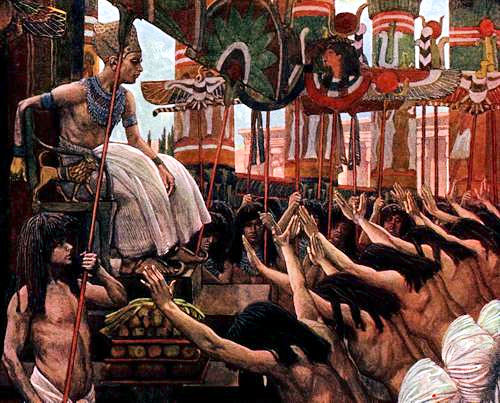
Joseph’s imprisonment finally ends when Pharaoh dreams of seven fat cows that are swallowed up by seven lean cows, and of seven fat ears of grain swallowed by seven lean ears. Joseph interprets the dreams to mean that seven years of plenty will be followed by seven years of hunger, and advises Pharaoh to store grain during the plentiful years. Pharaoh appoints Joseph governor of Egypt. Joseph marries Asenath, daughter of Potiphar, and they have two sons, Manasseh and Ephraim. Famine spreads throughout the region, and food can be obtained only in Egypt. Ten of Joseph’s brothers come to Egypt to purchase grain; the youngest, Benjamin, stays home, for Jacob fears for his safety. Joseph recognizes his brothers, but they do not recognize him; he accuses them of being spies, insists that they bring Benjamin to prove that they are who they say they are, and imprisons Simeon as a hostage.

from The Parasha in a Nutshell
Mikeitz: Genesis 41:1-44:17
Chabad.org

A significant part of our parshah (Mikeitz-Genesis 41:1–44:17) is taken up with a pair of dreams dreamt by the king of Egypt. These dreams are actually recounted not once, but three times: first we read an account of the dreams themselves; then comes a more detailed version, as we hear them described by Pharaoh to Joseph; and then comes Joseph’s reply to Pharaoh, in which he offers his interpretation of the dreams’ various components.

And these are but the last in a sequence of dreams detailed by the Torah in the preceding chapters. Joseph is in Pharaoh’s palace interpreting his dreams because of another set of dreams, dreamt two years earlier in an Egyptian prison. Back then, Joseph was incarcerated together with two of Pharaoh’s ministers, each of whom had a dream which Joseph successfully interpreted.

“The Cosmic Fantasy”
From the Chasidic Masters
Based on the teachings of the Lubavitcher Rebbe
Rabbi Menachem Mendel Schneerson
Adapted by Rabbi Yanki Tauber
Chabad.org

We see that the first of Joseph’s dreams (Genesis 37:5-11), though long in coming to fruition, are now rapidly taking shape. Though scorned, hated, almost murdered, and finally sold into slavery because of these dreams, they were nevertheless dreams from God. The only reason those dreams were perceived as a reason to hate Joseph was because of Joseph’s teenage arrogance. Now look at him. Older, wiser, shrewder. After all, when Joseph was finally “remembered” and taken into the presence of Pharoah, King of Egypt at the beginning of Torah Portion Miketz, don’t you think he knew exactly what he was doing?

“Accordingly, let Pharaoh find a man of discernment and wisdom, and set him over the land of Egypt. And let Pharaoh take steps to appoint overseers over the land, and organize the land of Egypt in the seven years of plenty. Let all the food of these good years that are coming be gathered, and let the grain be collected under Pharaoh’s authority as food to be stored in the cities. Let that food be a reserve for the land for the seven years of famine which will come upon the land of Egypt, so that the land may not perish in the famine.”

The plan pleased Pharaoh and all his courtiers. And Pharaoh said to his courtiers, “Could we find another like him, a man in whom is the spirit of God?” So Pharaoh said to Joseph, “Since God has made all this known to you, there is none so discerning and wise as you. You shall be in charge of my court, and by your command shall all my people be directed; only with respect to the throne shall I be superior to you.” Pharaoh further said to Joseph, “See, I put you in charge of all the land of Egypt.” And removing his signet ring from his hand, Pharaoh put it on Joseph’s hand; and he had him dressed in robes of fine linen, and put a gold chain about his neck. He had him ride in the chariot of his second-in-command, and they cried before him, “Abrek!” Thus he placed him over all the land of Egypt. –Genesis 41:33-43 (JPS Tanakh)

I call Joseph “shrewd” but please remember, that isn’t necessarily a poor trait to have when in “enemy territory”.

“I am sending you out like sheep among wolves. Therefore be as shrewd as snakes and as innocent as doves. Be on your guard; you will be handed over to the local councils and be flogged in the synagogues. On my account you will be brought before governors and kings as witnesses to them and to the Gentiles. But when they arrest you, do not worry about what to say or how to say it. At that time you will be given what to say, for it will not be you speaking, but the Spirit of your Father speaking through you. –Matthew 10:16-20

Returning to the Torah portion, I’m not saying that Joseph is being entirely self-serving here. After all, he spent years as a slave and more years as a prisoner (though in fairly exalted roles for each position) and that time served to teach the young dreamer humility, but who could blame him for wanting to “butter his bread” a little? Who wouldn’t want to get out of prison? Besides, it’s not like Joseph used his appointment as Viceroy to take advantage of others. Joseph didn’t even retaliate against the chief cupbearer who promised to remember Joseph to Pharaoh after Joseph had interpreted the cupbearer’s dream in his advantage, but who then “forgot” him completely for two years.

Although we see Joseph certainly “challenging” his brothers in this week’s Torah portion as well as in next week’s Parashah, he isn’t “taking revenge” upon them. He could have chosen to have them killed, or make them slaves, or have them rot in prison, yet he refrains.

Joseph’s first dream comes to realization in this week’s parsha. His brothers come down to Egypt and prostrate themselves before him. The dream of the sheaves of the brothers bowing to Joseph’s sheaf is at last fulfilled. But strangely, Joseph does not feel himself satisfied. It is human nature that the expectation of the realization of events is always greater and more exciting than the fulfillment of the realization itself. No vacation or event that we plan for ourselves can live up to our imagination and expectation regarding it. And Joseph is further burdened by the enormity of what has transpired. He has the brothers, who sold him as a slave and were deaf to his shouts and tears and pleas for mercy, in his hands. But what is he to do with them now? And what of his beloved father, the old man, broken in grief, whom he has not seen or communicated with for twenty-two years? Are the brothers telling him the truth about his father’s condition? And what about Benjamin, his younger brother? Is he like the other brothers in attitude and belief or is he different? Does he mourn for his lost brother Joseph or is he sanguine about his fate, as his ten older brothers seem to be? All of these questions plague Joseph at the moment of his seemingly great triumph when his brothers are in his power and abjectly bow before him. His triumph therefore seems somewhat hollow to him at that moment.

-Rabbi Berel Wein
“Vengeance vs. Conciliations”
Commentary on Parashas Miketz
Torah.org

If, as Rabbi Wein suggests, the realization of Joseph’s earlier dreams seems all too hollow, what about our dreams?

I’m not saying that the typical dreams we all experience during sleep are prophesies from God, nor do I believe that the vast majority of people have any Divine gift to interpret prophetic dreams as Joseph certainly did, but when I say “our dreams,” I really mean “our ambitions.” What about the things we want? If we get them, how wisely is our stewardship over them?

In a sense, the 17-year old Joseph’s boasts about this first dreams were acts of “poor stewardship”. He utilized his knowledge to “lord it over” his brothers and father and the result was a wreaked life for Joseph, Jacob, and ultimately (though they didn’t realize it at the time) for all of Joseph’s brothers. When Joseph stood before Pharaoh, we can say that he exercised “good stewardship” of his ability to interpret dreams, which resulted in him not only being released from prison, but being placed in an extremely high position of authority over Egypt. This gave him the unprecedented ability to save everyone in Egypt, Canaan, and the rest of the civilized world, including his entire family, from a seven-year famine.

How we manage our “dreams” and ambitions makes a difference, too. Most of us don’t exercise authority to the same scope as Joseph, but what we want, even if benign and charitable, can have dramatically different results depending on our attitude, intent, and execution. Judaism has the concept of kavanah which generally means “intention”. In Kabbalah, kavanah modifies the sefirot allowing them to be directed, and depending on that direction, a person’s activities, both in the world we experience and in the spiritual realms, can have wildly different consequences. How dreams are managed in Joseph’s early life vs. his later experiences is dramatic proof of this statement.

If the teachings of Kabbalah and Talmudic Judaism are a little difficult for you to swallow, Jesus told many parables on good and bad stewardship including Luke 12:35-48 and Luke 16:1-15 that tell the same story. I think “The Parable of the Talents”, is particularly illuminating.

“Again, it will be like a man going on a journey, who called his servants and entrusted his wealth to them. To one he gave five bags of gold, to another two bags, and to another one bag, each according to his ability. Then he went on his journey. The man who had received five bags of gold went at once and put his money to work and gained five bags more. So also, the one with two bags of gold gained two more. But the man who had received one bag went off, dug a hole in the ground and hid his master’s money.

“After a long time the master of those servants returned and settled accounts with them. The man who had received five bags of gold brought the other five. ‘Master,’ he said, ‘you entrusted me with five bags of gold. See, I have gained five more.’

“His master replied, ‘Well done, good and faithful servant! You have been faithful with a few things; I will put you in charge of many things. Come and share your master’s happiness!’

“The man with two bags of gold also came. ‘Master,’ he said, ‘you entrusted me with two bags of gold; see, I have gained two more.’

“His master replied, ‘Well done, good and faithful servant! You have been faithful with a few things; I will put you in charge of many things. Come and share your master’s happiness!’

“Then the man who had received one bag of gold came. ‘Master,’ he said, ‘I knew that you are a hard man, harvesting where you have not sown and gathering where you have not scattered seed. So I was afraid and went out and hid your gold in the ground. See, here is what belongs to you.’

“His master replied, ‘You wicked, lazy servant! So you knew that I harvest where I have not sown and gather where I have not scattered seed? Well then, you should have put my money on deposit with the bankers, so that when I returned I would have received it back with interest.

“‘So take the bag of gold from him and give it to the one who has ten bags. For whoever has will be given more, and they will have an abundance. Whoever does not have, even what they have will be taken from them. And throw that worthless servant outside, into the darkness, where there will be weeping and gnashing of teeth.’ –Matthew 25:14-30

It’s not just what you’re given, but what you do with it that matters. What you do with your resources depends on your character and your intentions. As we see from the example of Joseph, even what you are given depends on how you have managed other, lesser jobs. That’s also the lesson taught by Jesus in his parables. One who was responsible for a lesser task will be given much greater authority. Imagine that, once you were saved, you never told anyone else about the Gospel of Jesus Christ, but instead, horded this treasure for yourself?

So when you dream, it’s not so much whether you dream big or small that is the key factor. It’s what you do with your dreams and how you treat other people when your dreams come true. For if you manage well when one dream comes true, much bigger dreams will also be granted you. However keep in mind that such responsibility can come at a price as Rabbi Wein’s commentary points out.

Joseph comes to the great realization that his ultimate triumph over his brothers lies not in punishing them – though he will certainly cause them great anguish on their road of repentance – but rather to eventually conciliate them. Vengeance is momentarily more satisfying than is conciliation. But in the long run, vengeance lies not in human hands. And it will only continue to widen the rift within Jacob’s family. Joseph’s greatness and heroism lies in the fact that he chose the road of healing and conciliation rather than that of punishment and vengeance. Joseph, out of all of the avot and the brothers is called tzadik – righteous and holy. This is certainly due to his behavior in escaping from the clutches of Potiphar’s wife. But Joseph’s righteousness and piety is exhibited not only in that incident. It is apparent in his treatment of his brothers after his dream of their bowing down to him has been realized. He will protect his brothers from the Pharaoh and the ravages of Egyptian society. He will support them physically, financially and spiritually for the rest of his life. He still weeps at the gulf of suspicion that yet exists between him and the brothers. Conciliation is a long and difficult road to traverse. But Joseph realizes that it is the only hope for his family’s continuity and purpose.

Being wise stewards, we should use our gifts to repair relationships rather than destroy them. When we reconcile with even one person who was formerly estranged from us, we also reconcile them and ourselves with God.

Good Shabbos.

Working Out Love

The 251st prohibition is that we are forbidden from verbally wronging another person by telling him things that will distress and humiliate him, and make him discouraged. For example, when a person has sinned in his youth, but changed his ways, and someone tells him, “Thank G-d who has taken you away from that path to this good path,” or similar indirect references to faults that cause him pain.

The source of this prohibition is G-d’s statement (exalted be He), “V’lo sonu one another and you shall fear your G-d.” Our Sages said that this refers to verbally causing him pain (ona’as devarim).

Sefer Hamitzvot in English
“Hurtful Words”
Negative Commandment 251
Translated by Rabbi Berel Bell
Chabad.org

I receive daily emails on the commentaries of Maimonides on the 613 commandments as outlined in his classic work Sefer Hamitzvot, but I rarely use them as the basis for any of my “meditations”. The simple reason for this is that the vast, vast majority of these commandments aren’t considered to be applicable to the lives of non-Jewish people. Traditional Christianity considers the “Law is dead” and thus would tend to disregard these lessons in any case, and only some non-Jews in the “Messianic” movement feel that they share an equal obligation with the Jewish people to fulfill the full “yoke of Torah”. However, I’m not writing to address that issue, but because I believe we do have a parallel commandment in Christianity.

“If your brother or sister sins, go and point out their fault, just between the two of you. If they listen to you, you have won them over. But if they will not listen, take one or two others along, so that ‘every matter may be established by the testimony of two or three witnesses.’ If they still refuse to listen, tell it to the church; and if they refuse to listen even to the church, treat them as you would a pagan or a tax collector. –Matthew 18:15-17

You may be wondering why Jesus suggests that you go through all of these steps in trying to reconcile with a fellow believer who has sinned against you. Let’s review the process again. First you go to the person alone. If they don’t listen, take two or three witnesses (referencing Deuteronomy 19:15, which suggests that there is a legal component to these actions). If all else fails, bring the matter before the entire congregation and if the situation still can’t be resolved, only then must the offender be expelled from the body of believers.

The way I learned how to interpret this passage (you may have heard this before, too) is that you first go to the person alone so you don’t embarrass them. If you can take care of the problem just between the two of you, without bringing anyone else into it, you can avoid the other person digging their heels in, so to speak, because you have publicly humiliated them. Even if you can’t resolve it in that context, your next step is to bring in just two or three other trusted (that’s my interpretation) brothers and sisters to help mediate the problem. It still doesn’t have to be dragged in front of the entire congregation. The offender can still “save face”.

Why is this important? From a “common sense” point of view, we know that people are more likely to listen to criticism about themselves in a private rather than a public setting. An old adage in management says to “praise publicly and criticize privately.” If you’ve ever been yelled at by your spouse for something you did or gotten a good “dressing down” by your boss, you know it isn’t quite as painful if it’s just the two of you than if it’s in front of family, friends, or co-workers. People are more likely to listen to criticism privately and are more open to discussing their “issues” in a private setting than if it’s all happening in front of a crowd.

Is the “common sense” approach Biblical? I think it is.

If a person commits a sin punishable by death and is executed, and you hang the corpse on a tree, his body must not remain all night on the tree; instead you must make certain you bury him that same day, for the one who is left exposed on a tree is cursed by God. You must not defile your land which the Lord your God is giving you as an inheritance. –Deuteronomy 21:22-23

The idea behind the phrase cursed by God seems to be not that the person was impaled because he was cursed but that to leave him exposed there was to invite the curse of God upon the whole land. Why this would be so is not clear, though the rabbinic idea that even a criminal is created in the image of God may give some clue (thus J. H. Tigay, Deuteronomy [JPSTC], 198). Paul cites this text (see Gal 3:13) to make the point that Christ, suspended from a cross, thereby took upon himself the curse associated with such a display of divine wrath and judgment (T. George, Galatians [NAC], 238-39).

Commentary from net.bible.org

The phrase we need to key in on is “the rabbinic idea that even a criminal is created in the image of God may give some clue.” I tend to agree with the Talmudic interpretation of Deuteronomy 21:22-23. We are all created in the image of God, great and humble alike. On a very basic level, we are all entitled to a certain amount of care and dignity befitting the image of our Creator and in that sense, we should avoid going out of our way to embarrass or humiliate a person, even if we think “they deserve it”.

This brings me back to a “meditation” I wrote a few days ago called Considering Replies. Maybe you’re thinking that I’m beating a dead horse, but the Internet is a “rough neighborhood” and a lot of people get hurt out here. It’s not enough to say that we’re “telling the truth in love” when telling the truth can have devastating results. This is like embarrassing a “former sinner” by saying you are so glad they gave up their horrible lifestyle to come to Christ. If you make a person feel like dirt by “telling them the truth in love” you probably didn’t consider “love” before you opened your mouth or typed something on someone’s blog and then pressed “Publish”.

According to Rabbi Berel’s commentary on Maimonides, the Sages taught that uttering hurtful words is a worse sin than defrauding someone of money. I know someone out there will say that this teaching means we can never confront someone who is doing wrong for fear of embarrassing them, but look back at Matthew 18:15-17. There is a process for confronting a fellow believer if it’s necessary that is still compassionate and respectful. 1 Timothy 5:19-20 even describes how to address a church or congregational leader who has sinned, so your leaders are not “criticism proof” (I’ve seen congregational leaders falsely use the example of Korach and the “evil report” against Moses and Aaron in Numbers 16 as “proof” that no one is allowed to criticize a leader) but can be approached in a way that addresses the problem and truly shows respect and love.

The truth isn’t enough, even when we have a “loving” intent. Long before speaking the truth, we must bring love into the picture and make love and truth work together. We must consider the teachings of the Master and his close disciples before launching into any sort of action, especially if we’re emotionally involved in the conflict. The so-called “love passage” in 1 Corinthians 13 (which has nothing to do with weddings and marriage as such), is a very good map to consider when we need to talk to someone about any of their shortcomings. It’s also the guide I’m sure you’d like someone to use if or when you need to be confronted.

If I speak in the tongues of men or of angels, but do not have love, I am only a resounding gong or a clanging cymbal. If I have the gift of prophecy and can fathom all mysteries and all knowledge, and if I have a faith that can move mountains, but do not have love, I am nothing. If I give all I possess to the poor and give over my body to hardship that I may boast, but do not have love, I gain nothing.

Love is patient, love is kind. It does not envy, it does not boast, it is not proud. It does not dishonor others, it is not self-seeking, it is not easily angered, it keeps no record of wrongs. Love does not delight in evil but rejoices with the truth. It always protects, always trusts, always hopes, always perseveres. –1 Corinthians 13:1-7

Love does not dishonor others. It always protects and always trusts. Christians can choose to interpret the lights of Chanukah as representing the light of the world. As I’ve mentioned before, Jesus said that we are also supposed to be lights to the world. Christ gave us a new command to love each other (John 13:34). Let’s start there and then work out way out.

Happy Chanukah. Follow the light. Pass it on.

Vayeishev: If I Were a Rich Man

If I were rich, I’d have the time that I lack
To sit in the synagogue and pray,
And maybe have a seat by the Eastern wall,
And I’d discuss the learned books with the holy men Seven hours every day–
That would be the sweetest thing of all…
Oy!

from If I Were a Rich man
written by Sheldon Harnick and Jerry Bock
for the musical Fiddler on the Roof

Now Jacob was settled in the land where his father had sojourned, the land of Canaan.Genesis 37:1

Rabbi Eli Touger’s commentary on Torah Portion Vayeishev says in part, that Jacob desired to live in prosperity, as do all righteous men, but was unable to (according to Rashi) because of his distress over the disappearance and apparent death of his son Joseph. I’ve written previously about the fallacy of “prosperity theology” in the church, so can we conclude (assuming Rashi is correct) that Jacob’s desire to live in prosperity is a problem for me? Rabbi Touger quotes Rashi’s response to this question.

Yaakov desired to dwell in prosperity, but the distress of Yosef’s [disappearance] beset him. The righteous desire to dwell in prosperity, but the Holy One, blessed be He, says: “Is not what is prepared for them in the World to Come enough for the righteous? Must they also desire prosperity in this world?”

Rashi’s statement is problematic, for a casual reading gives the impression that G-d does not approve of the righteous wanting prosperity. On the other hand, the fact that “the righteous” follow this path of conduct indicates that the desire for prosperity is a positive trait and not a character flaw. (Rashi’s apparent source is Bereishis Rabbah 84:3)

This difficulty can be resolved by focusing on the fact that Rashi speaks about a desire for prosperity expressed by the righteous. Why only the righteous? Everyone wants to enjoy an abundance of good without strife, contention, or difficulty.

On the surface, this interpretation seems to support the prosperity theology position that the righteous “should” want to have wealth and comfort in the present world as well as rewards in the world to come. But it’s amazing to me that Rashi, a French medieval Talmudic sage, should agree with a modern Christian doctrine. Is God so simple that he rewards the righteous with material wealth and punishes the less worthy with poverty and hardship? The history of both righteous Christians and Jews would seem to deny this, since many faithful men and women have suffered great difficulties and even died penniless for the sake of God.

And what does “Fiddler on the Roof” have to do with anything?

When a person is beset… with sickness, war, and hunger, he cannot occupy himself neither with wisdom nor with mitzvos. For this reason, all Israel and [in particular,] their prophets and sages have desired the Era of the Mashiach. (Mishneh Torah, Hilchos Teshuvah 9:2)

The Sages and the prophets did not yearn for the Era of the Mashiach so that [the Jewish people] would rule the world… nor to eat, drink, and celebrate. Rather, their aspiration was to be free [to involve themselves] in the Torah and its wisdom, without anyone oppressing or disturbing them. (Ibid., Hilchos Melachim 12:4.)

That sounds like Tevye’s wish as well. But as noble as this wish appears, it has a serious flaw. The righteous receive their reward in the Kingdom of Heaven (Matthew 6:20) and not on Earth (at least not always) and in fact, the Master said that:

“So when you give to the needy, do not announce it with trumpets, as the hypocrites do in the synagogues and on the streets, to be honored by others. Truly I tell you, they have received their reward in full. But when you give to the needy, do not let your left hand know what your right hand is doing, so that your giving may be in secret. Then your Father, who sees what is done in secret, will reward you. –Matthew 6:2-4

The Master is saying a couple of things. The first is that if we have the means, we should use them to benefit the poor. Nowhere does he say that our primary duty is to be occupied in study but rather the mitzvot related to helping the needy. He also says that if we receive our reward here in the form of wealth and prestige (maybe wealth, if used in secret to help others and not just to make ourselves look good is OK), it is in full and there may be no additional reward (which isn’t the same as salvation) in Heaven. Interestingly enough, his point finds its parallel in Rabbi Touger’s teaching:

Nevertheless, a distinction must be made. The World to Come represents G-d’s reward to man just recompense for man’s Divine service. This is a departure from the pattern of our present existence, of which it is said, “Today to perform them (the mitzvos); tomorrow to receive their reward.”

So was Jacob’s desire, as interpreted by Rashi, in vain? I still think the answer is still in Tevye’s song.

The righteous, by contrast, are not concerned with reward. On the contrary, to refer to the passage cited above, they long to involve themselves in the Torah and its mitzvos. Their aspiration is only that they be freed from external difficulties. They want to grow in understanding and personal development. Why must they be confronted with challenges from the outside? Let all their efforts be devoted to the internal challenges of spiritual growth.

I can’t say if this truly speaks to Jacob’s desire, but what we see here is that a righteous person, when desiring prosperity, isn’t thinking of reward in the conventional sense. They are thinking probably what you and I have considered at one point or another. If we could be freed from the constraints of a “normal” life of work and problems, we could spend more time serving God and ministering to people, even devoting our great material possessions to the well being of those around us. I think that would work for a truly righteous person, such as Joseph, who used the exalted position given to him by Pharaoh, King of Egypt (and ultimately God), to save his family and the world. For the rest of us though, we would be enormously tempted to use our wealth and “free time” for less than noble pursuits.

My opinion is that the toil and hardship of day-to-day life, though it limits the amount of time and energy we have to pray, to perform mitzvot (acts of kindness and righteousness), and to honor God, also focuses those few hours we do have through a lens whereby we can see God and do His will more effectively, without the temptations material prosperity brings. I tend to think that the truly righteous can manage extreme poverty and extreme wealth with equal grace as Paul said he had learned to do (Philippians 4:12-13).

Please understand that I’m not making a simple statement that the very rich and the very poor are always righteous. We know that wealth and poverty visit the just and the unjust alike. We know that God grants us what He chooses to grant us and doesn’t owe us an explanation for how things work out in our lives. Our circumstances aren’t a particularly accurate barometer of our state of holiness and relationship with the Almighty. But it is one type of challenge we may face as part of His plan for our lives.

In addition to our material state of being, we can also experience spiritual prosperity or poverty. Since God’s gifts are endless in this arena, I have to believe that we have the majority of control in this area of our existence. This has nothing to do with dollar signs or a “feeling” of peace inside, and everything to do with a burning desire to draw closer to Him and to do His will. The pursuit of “spiritual reward” is also fraught with problems because we poor, dumb, human beings have a tendency to get our priorities and desires mixed up with His. I can’t count the number of times I’ve heard Christians report that they prayed about a certain decision they had to make and then “felt a peace” about the decision they wanted to make anyway. Was that drawing closer to God or using God as an excuse to fulfill their personal wants rather than God’s requirements?

When Christians say that Jesus freed them from the Leviticus 11 food laws, I sometimes want to ask them, if God came to them right now and really told them to give up their ham sandwiches, and they really, really knew it was from God, would they give up the pork, or find an excuse not to? I use this as an example and not to say that I think the Torah kosher laws necessarily apply to the Gentile, but it’s a good illustration. In keeping with my theme for the past week or so, I might ask Gentile Messianics if God told them to be forgiving and tolerant of Christians who put up Christmas trees instead of reviling them and “standing their ground” against paganism, would they be truly forgiving and tolerant, or would they argue with God that the Christmas tree people deserved to be condemned?

I have to say at this point, that I am somewhat heartened how some of the detractors of Christmas on Boaz Michael’s Facebook page seem to be softening their approach and being clear that they are not actually attacking Christians. I’m also thankful to Jacob Fronczak for posting the very well researched article The Syncretism Boogeyman on his blog, which provides excellent information on the history of cultic practices in ancient times, including during the time of Moses. I’m stepping off my soapbox now. Back to the topic at hand.

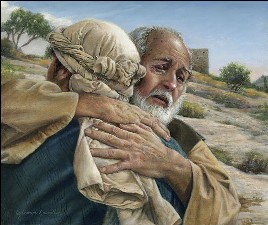
Wayward SonFrom my own personal experiences (humble though they may be), I’ve become convinced that when God actually speaks to me (rather than the voice of my own desires and ego in my head), He surprises me and frankly, asks me to say and do things that aren’t naturally easy for me. He asks me to take on duties I don’t feel comfortable with and requires that I surrender behaviors and even thoughts with which I am very at ease. That’s the nature of God, to push us forward, to urge us to move further on and in directions we would never consider on our own.

So be careful in the sorts of rewards you ask from God and in what role you seek to play in His service. He just may give you a type of reward and prosperity you don’t expect and require that you actually rise to the challenge. How many years was Joseph a slave and prisoner in Egypt before he became all but a king? How many years did Jacob live in grief and abject sorrow, though materially wealthy, before he was comforted by his son in Egypt?

Good Shabbos.

Something New

When Reuben returned to the pit and saw that Joseph was not in the pit, he rent his clothes. Returning to his brothers, he said, “The boy is gone! Now, what am I to do?” Then they took Joseph’s tunic, slaughtered a kid, and dipped the tunic in the blood. They had the ornamented tunic taken to their father, and they said, “We found this. Please examine it; is it your son’s tunic or not?” He recognized it, and said, “My son’s tunic! A savage beast devoured him! Joseph was torn by a beast!” Jacob rent his clothes, put sackcloth on his loins, and observed mourning for his son many days. ALL his sons and daughters sought to comfort him; but he refused to be comforted, saying, “No, I will go down mourning to, my son in Sheol.” Thus his father bewailed him. The Midianites, meanwhile, sold him in Egypt to Potiphar, a courtier of Pharaoh and his chief steward.Genesis 37:29-36 (JPS Tanakh)

Beginnings are hard. For good reason. If they were easy, we would prowl into each new venture like a snug fat cat.

When you begin pent up in an iron cage, a tiger comes out. A tiger that breaks through the door of its cage and pounces with a vengeance.

Bless those cages, those impossible brick walls, those rivers of fire that lie at the outset of each worthwhile journey. Without them we would be only as powerful as we appear.

-Rabbi Tzvi Freeman
“Release”
Based on letters and talks of the Rebbe
Rabbi M. M. Schneerson
Chabad.org

As we see in the example from this week’s Torah Portion Vayeishev, making a new beginning, even in something that will ultimately turn out to be very worthwhile, can be very hard. Of course, when Joseph was stripped and thrown into a pit by his brothers, then kidnapped and sold into slavery, he hardly thought this was a good “new beginning”. In fact, it was the lowest point of his life up until then. He had no idea of the grandeur he would eventually attain as Viceroy in Egypt and savior of the civilized world.

I can hardly compare myself to Joseph, but I know what it’s like to make a new beginning. We all do, really. Anyone who has gotten married, who has had a child, who has moved to a new city, who has taken a new job knows what it is like to make a new beginning. Even when what you are achieving is ultimately good and desirable, it can still be difficult and stressful. Change always is.

I also know what it’s like to make a new beginning spiritually. I’ve done this more than once. Of course there was the moment when I came to faith in Jesus. I like to “joke” that almost immediately afterward, my life fell apart. I went through some very difficult times after coming to faith which is the exact opposite of what I’d expected, but then, God had to step in and help me make some significant changes once I declared my faith and was baptized. He’s still doing that work and sometimes, it really hurts.

During the past couple of years, I put myself through another significant spiritual change. For a year, starting in the summer of 2010, I started challenging all of my long-held religious assumptions, began studying new materials, and ultimately, at the end of that year, took my religious worship life in a very different direction. It wasn’t easy. I had to leave a congregation where I had been a trusted leader and teacher and where I had many friends (they’re still my friends) because of the new convictions at which I had arrived. I started a journey that still has no definitive destination and where I encounter uncertainty often. I believe this is the right thing to do for me, but doing the right thing is often disturbing and disconcerting.

Sometimes, even when you know that a new beginning is required, you don’t know what to do first. In fact, right after I had come to faith, the first question I asked my Pastor was, “What do I do now?”

Today’s daf discusses teaching Torah. Rav Moshe Shapira, shlit”a, explains that today’s world of kiruv is a new chapter that needs to be understood in its own context. For example, although the Shulchan Aruch writes that a rebbe must instill fear in his students—for this purpose he may not eat with them or be overly familiar with them—today is very different. When dealing with young people who need to be drawn closer, following such halachos will only cause an unhealthy distance between student and rebbe.

Another example of a complex kiruv issue was faced by a certain maggid who would travel around Eretz Yisrael encouraging our estranged brothers to draw closer to God. He wondered what to do with those who are distant but could be persuaded to take on some new religious practice. Most would only be willing to take on a single mitzvah, and pushing for more would only serve to destroy any willingness to advance. The question was: which mitzvah comes first?

When he brought this question to Rav Yosef Shalom Eliyashev, shlit”a, he replied concisely. “It doesn’t matter too much what they start with. But try to find a d’oraisa mitzvah that you think will make the greatest impact on them. Speak and encourage them to take on this mitzvah.”

The heads of Hidabrut, the famous Belzer kiruv organization in Eretz Yisrael, also had a kiruv conundrum. When a person is at the point where he will either take on wearing a kippah or tzitzis, which is more important?

Rav Eliyashev’s response will surprise many. “It is better to convince him to begin wearing a kippah. Although tzitzis is obviously a Torah commandment, wearing a yarmulke is superior since a man who wears a yarmulke feels especially Jewish since he publicly associates himself with religious Jews.”

Daf Yomi Digest
Stories Off the Daf
“New Students”
Bechoros 29

Truth be told, one of the reasons why some Christians are attracted to the “Messianic” movement is that worship and faith is demonstrated in so many physical ways. The wearing of a yarmulke and tzitzit is very compelling and even a little addictive. I tend to believe that non-Jews in the movement go through a set of developmental steps, not all of them beneficial, but all of them seem to be necessary. One of the first steps is to become enamored with all the “Jewish stuff”. Sometimes the “stuff” is so seductive, that the non-Jewish participants never get past the “physicality” of their worship and dig into the spiritual context and meaning. They also get “sucked into” the idea that their “stuff”, because much of it can be found in Bible commandments, is better than the “Christian stuff” (and Christians don’t have nearly as much symbolic physical paraphernalia so they don’t seem as “cool”). Fortunately most people get past this stage. Some sadly, don’t.

However, if you’re immature in your faith, often the very first step onto a path of maturity is a material object, such as giving a child their very first Bible or cross necklace. The object takes on a transitional value, if seen and used properly, to escort the newly spiritual person into a faith that doesn’t require material objects to validate their relationship with God.

For an observant Jew, a siddur, talit gadol, kippah, and tefillin all are a part of daily prayer and worship and only under unusual circumstances will a Jew pray without obeying the mitzvot attached to these holy artifacts. But for a Christian and especially for the Gentiles in the Messianic movement, sometimes it’s helpful to put all of the “stuff” away, go off someplace where you can be alone, and just let it be you and God.

Try something uncomfortable and new. See how it works out. When Joseph did it (although it wasn’t his idea), it turned out pretty well. But it wasn’t easy and it wasn’t quick.