Tag Archives: Torah

Eikev: Bringing the Moshiach

And I will put enmity between you and the woman, and between your offspring and hers; he will crush your head, and you will strike his heel.Genesis 3:15

Because (eikev) you listen to these laws and safeguard and keep them, G-d your L-rd will keep His covenant and kindness that He swore to your fathers.Deuteronomy 7:12

The Hebrew word eikev not only means “because,” but also “heel.” Thus Midrash Tanchuma explains that “these laws” refers to mitzvos that seemingly lack significance, so that people tend to “ignore them and cast them under their heels.”

-from “The Chassidic Dimension” series
Commentary on Torah Portion Eikev
“The Healing Effect of Heeling”
Based on the teachings of the Lubavitcher Rebbe
Rabbi Menachem M. Schneerson
Chabad.org

This play on words would completely bypass anyone who doesn’t understand Biblical Hebrew or anyone who doesn’t read traditional or Chassidic Torah commentaries. But now that you know about it, what does it matter?

As it turns out, it matters a lot. Here’s more from the “Chassidic Dimension”:

Eikev alludes to the time just before the coming of Moshiach — “On the heels of Moshiach.” The verse is thus telling us that close to Mashiach’s coming Jews will surely obey G-d’s commands. This is in keeping with the Torah’s assurance that prior to Mashiach’s coming the Jews will return to G-d. (Or HaTorah beginning of Eikev ; ibid. p. 491; ibid. p. 504.)

Recall the quote from Genesis that starts this blog post. This is the first Messianic prophesy in the Bible, and here we see a clear association with the enmity between man and God that only the Messiah can heal, and the words of Moses as he is about to send the Children of Israel on their ordained mission to fulfill God’s promises to Abraham, Isaac, and Jacob, and take possession of the Land.

Somehow, Christianity imagines that Jesus will return and then everyone will repent and turn their hearts, minds, and hands back to God, but this is exactly the opposite of what Judaism expects. In the last days, we will all turn to God and obey His commands and His desires and only then the Messiah will come.

This rather flies in the face of traditional Christian doctrine that says we are saved by grace and not by works, as if God’s grace and our behavior were mutually exclusive concepts. While it is true that we can’t work or buy our way into heaven, it is also true that once saved, we aren’t to sit idly by, read a magazine and wait for the bus to the clouds of glory.

We were given life for a reason. We’re supposed to be doing something with it and what we do or fail to do, will make a difference in the eyes of God.

I know I’ve talked about all this before, but since Moses brought it up, I felt I should go follow his lead, so to speak.

In Deuteronomy 10:20, Moses says, “You shall fear the Lord your God; you shall serve Him and cling to Him…” Here, according to the First Fruits of Zion (FFOZ) commentary for this Torah Portion. “to cling to”:

is actually the same Hebrew word which is used of Adam in the garden when it says, “a man shall leave his father and his mother, and shall cleave to his wife, and they shall become one flesh.” (Genesis 2:24)

But how can we cling to God in the sense that one person can cling to another person with whom they have an intimate bond? In Judaism, the traditional way of interpreting the fulfillment of this command is for a person to cling to a tzadik (Holy person) or Torah teacher. It’s the act of a disciple learning from and following in the footsteps of their Master or Rebbe. The FFOZ commentary continues:

Chasidic Judaism believes that through clinging to one’s rebbe (spiritual leader), one is brought into union with his rebbe. Because the rebbe is in union with God, the disciple is also elevated into union with God by virtue of that connection. In the same way, our Rebbe, Yeshua, taught us that in order to cling to God we must cling to him (John 15:1-7) and by clinging to him, we cling to God. “In that day you will know that I am in my Father, and you in me, and I in you.” (John 14:20)

Cleaving to a Rebbe, honoring him, and learning from him, and then passing what you’ve learned to others and particularly down to the next generation in response to the desire to cling to God. When we cling to our “Rebbe”, to Jesus, we are fulfilling God’s desire.

One of the most important parts of the Shema appears in this Torah Portion (Deut. 11:1): “Love, therefore, the Lord your God, and always keep His charge, His laws, His rules, and His commandments. Moses continues to comment on this theme thus:

Therefore impress these My words upon your very heart: bind them as a sign on your hand and let them serve as a symbol on your forehead, and teach them to your children — reciting them when you stay at home and when you are away, when you lie down and when you get up; and inscribe them on the doorposts of your house and on your gates — to the end that you and your children may endure, in the land that the Lord swore to your fathers to assign to them, as long as there is a heaven over the earth. –Deuteronomy 11:18-21

For the Children of Israel, the concepts of God’s favor and the obedience of the nation are inexorably intertwined along with clinging to God and the promise of the Messiah’s coming. The fulfilling of the promise to give the Holy Land to the Children of Israel and the promise of the coming of the Messiah to bring universal peace to the world go hand-in-hand for the Jewish people, and obedience and living in Israel is a form of joining with the Creator for the Jewish people.

ShemaWhy don’t we have such a clear picture in Christianity?

It’s as if we’ve been told that it doesn’t matter what we do. We’re covered by the grace of Jesus Christ. We’re already saved; we’re already “clinging” to Jesus, so now all we have to do is sit on our thumbs and wait for him to come back and everything will be hunky dory.

Where did we get such a disconnect between the Torah and the Gospels? Who says we just get to sit around? Who says that the minute we were saved that our obligations to God were completed? Certainly not James, the brother of the Master:

What good is it, my brothers and sisters, if someone claims to have faith but has no deeds? Can such faith save them? Suppose a brother or a sister is without clothes and daily food. If one of you says to them, “Go in peace; keep warm and well fed,” but does nothing about their physical needs, what good is it? In the same way, faith by itself, if it is not accompanied by action, is dead.

But someone will say, “You have faith; I have deeds.”

Show me your faith without deeds, and I will show you my faith by my deeds. You believe that there is one God. Good! Even the demons believe that—and shudder.

You foolish person, do you want evidence that faith without deeds is useless? Was not our father Abraham considered righteous for what he did when he offered his son Isaac on the altar? You see that his faith and his actions were working together, and his faith was made complete by what he did. And the scripture was fulfilled that says, “Abraham believed God, and it was credited to him as righteousness,” and he was called God’s friend. You see that a person is considered righteous by what they do and not by faith alone. –James 2:14-24

I know I quote a lot from this passage too, but it says something that we aren’t told very often. It says that Jesus agreed with Moses (and you don’t hear that said in church very much) that a passive faith means nothing. The Children of Israel would draw closer to God and cling to God and they would succeed on their mission to take the Holy Land as long as they obeyed God and taught their children to do the same. We Christians, you and I, have a mission, too. Not just to spread the good news of Jesus and to live lives conformed to our Master, but we have individual missions based on who we are, where we live, and the opportunities God provides for us.

We have a road to walk. God set us upon a path. He has provided us with a light (Psalm 119:105) so we can see the path. Many times He has admonished us to turn neither left nor right, but to keep our eyes on the goal, not only the ultimate goal of existence as believers, but the immediate goals of helping others, feeding the hungry, visiting the sick, and performing whatever special mission and purpose God assigned to us from before the Creation of the world.

We can choose to stand still. We can choose to take God’s words and His purpose for us, throw them under our heels and walk all over them. Or we can choose to start walking and then see where the path leads. Along the way, we’ll meet people and encounter circumstances. How we manage them matters to God and to the people we interact with.

In this week’s Torah portion, Moses is trying to prepare the Israelites for a journey of fresh challenges full of promise and perils. God is doing that with us every day starting when we wake up each morning. Because somewhere out there in what we do today, tomorrow, next week, and into the future, not only affects our lives and the lives of who knows how many others, but each step we take along the path brings the footsteps of the Messiah one step closer to us. To bring the Moshiach, we must cling to our Rebbe who is close to God.

“If you love me, you will keep my commandments. –John 14:15

“A Jew never gives up. We’re here to bring Mashiach, we will settle for nothing less.” -Harav Yitzchak Ginsburgh

Later this afternoon, I’ll be posting another commentary on this week’s Torah Portion called “Eikev: Blessing God”, probably a few hours before Shabbat begins.

When We Were Five

The Rebbe and the ChildIf you want to see the face of the Moshiach, just look at the children!

At Sinai, all men, women and children had to be present. All received the same truth, all at once.

In a simple commentary written for a five year old, great secrets of the Torah can be found. But only once you understand the simple commentary as a five year old does.

From the wisdom of the Rebbe
Menachem M. Schneerson
as compiled by Rabbi Tzvi Freeman in his book
Bringing Heaven Down to Earth

Perhaps in the Rebbe’s words, we find the keys to unlock this 2,000 year old mystery:

At that time the disciples came to Jesus and asked, “Who, then, is the greatest in the kingdom of heaven?” He called a little child to him, and placed the child among them. And he said: “Truly I tell you, unless you change and become like little children, you will never enter the kingdom of heaven. Therefore, whoever takes the lowly position of this child is the greatest in the kingdom of heaven. And whoever welcomes one such child in my name welcomes me. –Matthew 18:1-5

We sometimes make the mistake of imposing our assumptions when we read this teaching from Jesus. The first thing we imagine when we think of a small child is that, compared to an adult, he or she doesn’t know very much about the world. Children have an extremely simple understanding of how things work. They can see the moon in the sky, but not know what it is. They can play with their favorite stuffed toy and believe it is as alive as they are. They are easily convinced of the most outrageous suggestions and accept them as utter truth. How else could we get a child to believe that there is a fat guy who rides in a sled pulled by flying reindeer, and who delivers presents to every child on Earth in a single night?

Translating all of that back into the words of Christ, we imagine he means that we don’t need to know very much about the Bible, the history of the church, the wisdom of the great Sages, or most anything else in order to be saved and have a right relationship with God. It means that studying the Bible is a waste of time, because it doesn’t change the status of being saved. It means that Bible commentaries, the Talmud, and everyone who reads and tries to comprehend them, are just making your relationship with God too complicated. After all, once you are saved in Christ, the deal is sealed and nothing else matters at all. If you’re a Christian it’s only about you and Jesus.

Right?

That tends to illustrate one of the qualities of small children; the tendency toward being self-absorbed and the difficulty in seeing a world outside of our own small sphere. Being saved and becoming a disciple of the Master is the first step in our journey, not the last.

So what does Jesus mean? What does the Rebbe mean? How are great secrets possessed by little, uncomprehending children that elude perhaps some of the greatest scholars who have ever lived? Is Bible study; Torah study a waste of time? Here’s Rabbi Freeman’s response:

The Rebbe often repeated that through the study of Torah you could conquer the world. And from the way the Rebbe discussed Torah you could see he was doing just that: Every thought, every teaching was a new understanding of the entire universe. A simple story..became in his hands an insight to the workings of time and space.

Rabbi Freeman, who describes the Rebbe as one of the foremost Torah scholars of his age, also tells this story about him:

The child he (the Rebbe) saw as a lucid, glistening crystal vessel in which to find G-d. More than once the Rebbe pointed out how his own thoughts strove to attain the simplicity of those of a child. In that simplicity, he taught, can be found the simplicity of the Infinite.

The Rebbe formed a club for Jewish children called “Tzivos Hashem”. He told the children that with verses of Torah and good deeds they would fight the forces of darkness in the world and bring Moshiach.

The Children began to stand close to the Rebbe at public gatherings. Some went under the table near his feet. Legend has it that occasionally a small band would rise up from under the table to snatch a piece of the Rebbe’s cake.

For me, this really clarifies why Bible study and immersion in the Torah are vital to achieving and retaining the perspective of a small child who is contemplating God.

Remember what I said about how adults can cause a child to have an unswerving belief in the existence of Santa Claus? It’s not the child’s fault that he or she believes in a fantasy, it’s the adults who taught them. Children are open to those they trust and they believe their parents (in most cases) mean them nothing but good. Sure, they get mad at us temporarily when we discipline them for some misdeed, but they know with complete trust that we are the source of all good in their lives. This is how we saw the world when we were five.

We fail them when we don’t tell them the truth and prove unworthy of their trust.

TrustBut now let’s bump that concept up the ladder a bit. We, as adults, can question whether or not something is the truth. We no longer believe in Santa Claus and we can (most of the time) recognize the difference between fantasy and reality. We have a Father in Heaven who is the source of all good in our lives. He wants nothing but the best for us and He does not tell us tales of Santa Claus or the Easter Bunny, which we later find out are quaint lies. God tells us the truth. In essence, we are like children standing close to the Rebbe and sitting at his feet under the table. Now here’s where the “child” part comes in.

If we choose to believe and to trust God as completely as small children trust their parents, whatever God tells us, we will believe. Whatever He wants us to do, we will do, without questioning why. When we “snatch a piece of cake” (so to speak) from His table, He won’t mind, because He knows we’re going to do it and He put the cake there to share with us. If we want to know how to accept God in the manner He desires to be accepted, trusted, and loved, all we have to do is to look at the relationship between little children and their parents.

For me, one of the lessons I must learn about the little children is what the Rebbe says here:

With Torah, you don’t get all the answers all at once.

Why does the moon only come out at night? Why is the sky blue? How can a fish breathe underwater? How old is God? Have you ever tried to answer these questions? It’s hard to do. Even if you know why the sky is blue or how fish breathe underwater, you can’t always communicate the answer in a way a child will understand. It’s that way for me. I want to know so much. It seems as if there’s so little time. And yet I wait. You don’t get all the answers all at once. Sometimes you have to get older first before you can understand.

In the meantime, you trust and believe, because that’s what small children do best.

Now to finish the story about the children snatching the Rebbe’s cake:

Finally, one of the adults became fed up with this lack of decorum and attempted to escort some children away. The Rebbe turned to him and exclaimed, “You are only a civilian and they are soldiers – and you want to remove them?

As the Rebbe also said, “Wealth is not a mansion filled with silver and gold. Wealth is children and grandchildren growing up on the right path.”

May we all “grow up” on the right path, too.

Va’etchanan: Blessing God in Sorrow

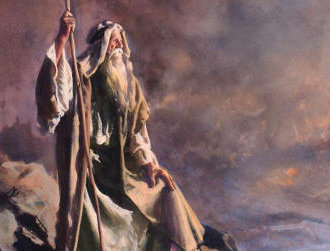
Moses at NeboAnd you shall love the Lord your G-d. with all your ‘me’od’Deuteronomy 6:5

The word me’od has many meanings. It serves as the etymological root for ‘measure’ (midah), ‘thank’ ( modeh), and ‘very much’ ( me’od). Using all three meanings in its interpretation of the above verse, the Talmud states:

“A person is obligated to bless G-d for the bad just as he blesses Him for the good, as it is written: ‘And you shall love the Lord your G-d. with all your me’od’ – for every measure which He measures out to you, thank Him very, very much.” -The Talmud, Brachos 54a

The name of this week’s Torah Portion, Va’etchanan means “and he pleaded”, referring to Moshe’s (Moses’) pleading with God to allow him to live and to lead the Children of Israel into the Land of Canaan, even after God had decreed that Moses should die. We learn from the Mishnah on Va’etchanan, that we should bless God for everything that happens in our lives, the good and bad alike. As we see in the following example, that’s not an easy thing to even consider, let alone perform:

A man once came to Rabbi Israel Baal Shem Tov with a question: “The Talmud tells us that one is to ‘bless G-d for the bad just as he blesses Him for the good.’ How is this humanly possible? Had our sages said that one must accept without complaint or bitterness whatever is ordained from Heaven – this I can understand. I can even accept that, ultimately, everything is for the good, and that we are to bless and thank G-d also for the seemingly negative developments in our lives. But how can a human being possibly react to what he experiences as bad in exactly the same way he responds to the perceptibly good? How can a person be as grateful for his troubles as he is for his joys?”

-Rabbi Yanki Tauber
“A Matter of Perspective”
Chabad.org

It’s easy to imagine being the man who is trying to get a seemingly impossible answer from the Baal Shem Tov. Whenever good happens in our lives, if we have any sense of God in our lives at all, we thank Him with all our heart and being for His goodness and His providence. When tragedy and disaster strike on the other hand, blessing God becomes much more difficult. Most of us do not respond like Job, apparently, not even Moses.

I pleaded with the Lord at that time, saying, “O Lord God, You who let Your servant see the first works of Your greatness and Your mighty hand, You whose powerful deeds no god in heaven or on earth can equal! Let me, I pray, cross over and see the good land on the other side of the Jordan, that good hill country, and the Lebanon.” But the Lord was wrathful with me on your account and would not listen to me. The Lord said to me, “Enough! Never speak to Me of this matter again! Go up to the summit of Pisgah and gaze about, to the west, the north, the south, and the east. Look at it well, for you shall not go across yonder Jordan. Give Joshua his instructions, and imbue him with strength and courage, for he shall go across at the head of this people, and he shall allot to them the land that you may only see.” –Deuteronomy 3:23-28

When we pour out our heart to God, it would seem almost cruel for God to respond in this manner. Why does He treat His faithful servant Moses this way? Why is a rebuke God’s response to this type of prayer? The following is how the Rambam describes prayer, but it seems to contradict what happened between Moses and God:

The obligation [this] commandment entails is to offer supplication and prayer every day; to praise the Holy One, blessed be He, and afterwards to petition for all one’s needs with requests and supplications, and then to give praise and thanks to G-d for the goodness that He has bestowed.

The fundamental dimension of prayer is to ask G-d for our needs. The praise and thanksgiving which precede and follow these requests is merely a supplementary element of the mitzvah. A person must realize that G-d is the true source for all sustenance and blessing, and approach Him with heartfelt requests.

Often, however, we do not content ourselves with asking for our needs. We desire bounty far beyond both our needs and our deserts. We request a boon that reflects G-d’s boundless generosity. For every Jew is as dear to G-d as is an only child born to parents in their old age. And because of that inner closeness, He grants us favors that surpass our needs and our worth.

As quoted from
“Vaes’chanan: To Plead with God”
-Rabbi Eli Touger
Adapted from
Likkutei Sichos, Vol. XXII, pgs. 115-117;
Vol. XXIV, p. 28ff

SorrowHowever, Rabbi Touger goes on to say that pleading “is one of the ten terms used for prayer” and that “Moshe [approached G-d] in a tone of supplication, [asking] for a free gift” demonstrating that “no created being can make demands from its Creator”. It’s one thing to pour out your heart to God with your needs and your troubles, but no man is entitled to anything from God that God Himself does not will.

I don’t say this to be unkind to Moses. Certainly he was the greatest of all the Prophets, a man who spoke to God “face-to-face”, so to speak” and the most humble of men. However, he was a man and like all men, was less than perfect in the eyes of God, as we see in the incident at Meribah (Numbers 20:1-13).

But even then, it is not so wrong for Moses or for any of us to beg that God turn aside His wrath when we pray:

There is a difference of opinion among our Sages (Rosh HaShanah 17b) as to whether prayer can have an effect after a negative decree has been issued from Above, or only beforehand. The Midrash follows the view that prayer can avert a harsh decree even after it has been issued. Therefore Moshe was able to approach G-d through one of the accepted forms of prayer.

-from Rabbi Touger’s commentary

No, for all his humanity and doubtless, all his frustration, Moses prayed the way any of us would pray, that God would relent and spare him what he no doubt saw as the most anguished of consequences. In the end, did Moses bless God for not being allowed into the Land? For most of his address to the Children of Israel, Moses pleads with them, he warns them, he begs them not to disobey God. Only minutes from death, he continues to do what he has done for the past 40 years, protect the people from their own folly, from their own sin, from their own desire for destruction, with every bit of his effort. Deuteronomy 33 is his blessing to Israel and in the following and final chapter of the Torah, Moses quietly obeys, passing the mantle of leadership on to Joshua.

Then Moses climbed Mount Nebo from the plains of Moab to the top of Pisgah, across from Jericho. There the LORD showed him the whole land—from Gilead to Dan, all of Naphtali, the territory of Ephraim and Manasseh, all the land of Judah as far as the Mediterranean Sea, the Negev and the whole region from the Valley of Jericho, the City of Palms, as far as Zoar. Then the LORD said to him, “This is the land I promised on oath to Abraham, Isaac and Jacob when I said, ‘I will give it to your descendants.’ I have let you see it with your eyes, but you will not cross over into it.”

And Moses the servant of the LORD died there in Moab, as the LORD had said. –Deuteronomy 34:1-5

How very much like the one who came after him, how like the death of “The Prophet”.

He was oppressed and He was afflicted, Yet He did not open His mouth; Like a lamb that is led to slaughter, And like a sheep that is silent before its shearers, So He did not open His mouth. –Isaiah 53:7

“How can I,” he said, “unless someone explains it to me?” So he invited Philip to come up and sit with him.

This is the passage of Scripture the eunuch was reading:

“He was led like a sheep to the slaughter,
and as a lamb before its shearer is silent,
so he did not open his mouth.
In his humiliation he was deprived of justice.
Who can speak of his descendants?
For his life was taken from the earth.”

The eunuch asked Philip, “Tell me, please, who is the prophet talking about, himself or someone else?” Then Philip began with that very passage of Scripture and told him the good news about Jesus. –Acts 8:31-35

We can hardly blame Moses for his plea to God. We certainly don’t blame Jesus:

Going a little farther, he fell to the ground and prayed that if possible the hour might pass from him. “Abba, Father,” he said, “everything is possible for you. Take this cup from me. Yet not what I will, but what you will.” –Mark 14:35-36

Praising GodBut Jesus did not stop at pleading with God but rather bowed to His will in all things, even suffering and death.

But what about those of us who are less than Prophets; we “ordinary people”. What about the man and his question of the Baal Shem Tov?

In this matter, the Baal Shem Tov sent the man to his disciple, Reb Zusha of Anipoli for the answer to the man’s question. Here’s the remainder of Rabbi Tauber’s narrative and the lesson we can take from Va’etchanan:

Reb Zusha received his guest warmly, and invited him to make himself at home. The visitor decided to observe Reb Zusha’s conduct before posing his question and before long concluded that his host truly exemplified the talmudic dictum which so puzzled him. He couldn’t think of anyone who suffered more hardship in his life than did Reb Zusha. A frightful pauper, there was never enough to eat in Reb Zusha’s home, and his family was beset with all sorts of afflictions and illnesses. Yet the man was forever good-humored and cheerful, and constantly expressing his gratitude to the Almighty for all His kindness.

But what was is his secret? How does he do it? The visitor finally decided to pose his question.

So one day, he said to his host: “I wish to ask you something. In fact, this is the purpose of my visit to you – our Rebbe advised me that you can provide me with the answer.”

“What is your question?” asked Reb Zusha.

The visitor repeated what he had asked of the Baal Shem Tov. “You know,” said Reb Zusha, “come to think of it, you raise a good point. But why did the Rebbe send you to me? How would I know? He should have sent you to someone who has experienced suffering…”

The disciple of the Baal Shem Tov, many centuries later, demonstrated the lessons learned by the disciple of Jesus of Nazereth:

I am not saying this because I am in need, for I have learned to be content whatever the circumstances. I know what it is to be in need, and I know what it is to have plenty. I have learned the secret of being content in any and every situation, whether well fed or hungry, whether living in plenty or in want. I can do all this through him who gives me strength. –Philippians 4:11-13

In all of our circumstances God is there. He is the source of everything both good and bad. We can hardly fail to acknowledge Him, both in our utmost joy and in abject and bitter sorrow. Yet Rabbi Tzvi Freeman records the wisdom of the Rebbe, Rabbi M.M. Schneerson as perhaps the best way to look at how we may bless God no matter what is happening to us as he says in Open Eyes:

After 33 centuries, all that’s needed has been done. The table is set, the feast of Moshiach is being served with the Ancient Wine, the Leviathan and the Wild Ox—and we are sitting at it.

All that’s left is to open our eyes and see.

Regardless of our happiness or pain, let us strive to bless the Lord that we may one day take our places “at the feast with Abraham, Isaac and Jacob in the kingdom of heaven” (Matthew 8:11).

Good Shabbos.

Devarim: One Man’s Story

MosesThis week’s Torah reading begins: “These are the words that Moshe spoke to the entire Jewish people.” Noting the distinction between this book and the previous four, which are all “the word of G-d,” our Sages explain that Moshe recited the Book of Deuteronomy “on his own initiative.”

Rabbi Eli Touger
Commentary on Torah Portion Devarim
“A Mortal Mouth Speaking G-d’s Word”
Adapted from Likkutei Sichos, Vol. IV, p. 1087ff; Vol. XIX, p. 9ff
Chabad.org

For most Christians, who don’t have a conservative evangelical view like the one I had, these textual facts can be interesting, but there is nothing in them to challenge their faith, which is built on something other than having the very words that God inspired in the Bible. And I certainly never intended to lead anyone away from the Christian faith; critics who have suggested that I myself stopped being a Christian once I realized there were differences among our manuscripts are simply wrong and being ridiculous.

Author and New Testament Scholar
Bart D. Ehrman in his book
Jesus, Interrupted

Today’s “extra” meditation and my commentary on this week’s Torah Portion Devarim.

Occasionally people ask why most of the book of Deuteronomy (in Hebrew, “Devarim”) even exists. It seems to do little more than repeat and summarize the events in the first four books of the Torah. The answer can be a little disturbing to some Christians and even to some Jews. Our understanding is that the first four books of the Bible were the words of God as dictated to Moses and Deuteronomy is in Moses’ own words.

Does that mean Deuteronomy is completely human in origin and without the influence of God? Let’s return to Rabbi Touger’s commentary:

This does not…mean that the Book of Deuteronomy is merely a mortal invention. Our Rabbis immediately clarify that Moshe delivered his words “inspired by the Holy Spirit.” Similarly, when the Rambam defines the category of “those who deny the Torah,” he includes: “a person who says that the Torah even one verse or one word does not emanate from G-d. If one would say, ‘Moshe made these statements independently,’ he is denying the Torah.”

Not a single commentator maintains that there is a difference in this regard between the Book of Deuteronomy and the four preceding books.

For the Book of Deuteronomy are merely Moshe’s words. Moshe’s identification with G-dliness was so great that when he states: “I will grant the rain of your land in its season,” he speaks in the first person although the pronoun “I” clearly refers to G-d. “The Divine Presence spoke from his mouth.”

The origin of the Bible and exactly how it was written and codified is complex and more than a little mysterious. The simple belief among many Christians is that each author wrote under the influence and guidance of the Holy Spirit and what they wrote originally is exactly what we have in our Bibles today (translated into the language we prefer to read). I included the quote from Bart Ehrman’s book to illustrate that even among modern Bible scholars, there is some doubt as to whether or not we can read the Bible as if it were a history book, newspaper, and court reporter’s record all rolled into one. In fact, we can’t.

The Bible is as much a human document as a document of the Divine. It’s a series of “stories” that illustrate something about God and His interactions with humanity. That it contains internal inconsistencies and historic flaws in no way disqualifies its moral and mystic significance among the community of faith. The stories tell us what we need to know, not as a history lesson, but as a guide to righteous living and as a doorway into domains that leave our mortal plane and allow us to glimpse the Throne of God.

In referring to Midrash Tehillim to 90:4; Bereishis Rabbah 8:2, we see that the Sages believe that “The Torah preceded the world” and when we read John 1:1, we see that “In the beginning was the Word, and the Word was with God, and the Word was God”. From this, we understand that only part of the Bible’s function is to act as a record and a document. Beyond the scroll in the Ark or the book on our hand, it exists in transition between our world and the next.

Rabbi Touger continues:

Here, the concept of precedence is not chronological, for time like space is a creation, relevant only after G-d brought existence into being. Rather the intent is that the Torah is on a level of spiritual truth which transcends our material frame of reference. Although the Torah “descends” and “enclothes itself” in our world, speaking of seemingly ordinary matters such as agricultural laws, codes for fair business practice, and the proper structure for marriage and family relations, this is not its essence. The essence of the Torah is “G-d’s will and His wisdom,” united with Him in perfect unity (see Tanya, ch. 4).

The Amazon.com product description for Ehrman’s book states that “the New Testament is riddled with contradictory views about who Jesus was and the significance of his life”, yet from a mystic point of view, this doesn’t present a problem.

The Ba'al Shem TovWhen I was reading The Hasidic Tale by Gedaliah Nigal, I wrote several commentaries about what I gained from the text including The Messianic Tale and Stories are Miracles. From these, we see that the stories of the Chasidim are less a series of historical facts and more a collection of mystic and allegorical tales designed to reveal something about ourselves, about holiness, and about God. How much of each story is factually accurate isn’t particularly relevant, because one does not approach the tales of the Chasidim that way. What we are looking for is something that will peel away the covers from the world of the supernatural and give us a peek at what lies around the next bend on our path of faith.

We can apply that commentary back to the Bible thus.

Jorge Quinonez, in his book “Paul Philip Levertoff: Pioneering Hebrew-Christian Scholar and Leader” Mishkan 37 (2002): 21-34 (quoted in Love and the Messianic Age) describes Levertoff, a Chasidic Jew and devoted disciple of Jesus, this way:

He read the Gospels in German. Then he obtained a Hebrew version and reread them. Though he was in the midst of a Gentile, Christian city where Jesus was worshiped in churches and honored in every home, Feivel felt the Gospels belonged more to him and the Chasidic world than they did to the Gentiles who revered them. He found the Gospels to be thoroughly Jewish and conceptually similar to Chasidic Judaism. He wondered how Gentile Christians could hope to comprehend Yeshua (Jesus) and His words without the benefit of a classical Jewish education or experience with the esoteric works of the Chasidim.

This perhaps, is what scholars like Bart Ehrman miss when they study and criticize the Bible for not reading like a story posted at CNN. Divinity and humanity collide, meld, mesh, and blend within the pages of the Bible and we are not always meant to be able to tell where one leaves off and the other begins…or if that division is even possible.

Rabbi Touger states:

But why is the Book of Deuteronomy necessary? Enclothing the Torah in human intellect seemingly does nothing but lower its spiritual content. What purpose is served?

Nevertheless, this is G-d’s intent in giving the Torah: that it permeate mortal thought and thus elevate man’s understanding. Whenever a person studies Torah, regardless of his spiritual level, he is making its infinite truth part of his personal nature.

Were there to have been only four books in the Torah, it would have been impossible for our powers of understanding to unite completely with the Torah. It was only by having the Book of Deuteronomy pass through Moshe’s intellect that this goal accomplished. Moreover, Moshe’s review of the Torah in he Book of Deuteronomy gives us the capacity to understand the previous four books in a similar fashion.

Enclothing the Torah in mortal intellect does not merely grant man the opportunity for advancement, it also introduces a higher quality to the Torah itself, as it were. For clothing limitless spirituality in the confines of mortal intellect represents a fusion of opposites that is possible only through the influence of G-d’s essence. Because His essence transcends both finiteness and infinity, it can weld the two together, bringing the spiritual truth of the Torah within the grasp of mortals.

TranscendentWho we are and who God is in us requires that we leave behind some of our attachment to what we call “reality” and allow ourselves to stand transcendent at the uncomfortable and mystic threshold between Heaven and Earth. We don’t have to rely on the Bible to be a book of facts but rather a book of truth.

Consider this:

These are the words which Moses spoke to the children of Israel, across the Jordan, in the desert, in the plain, opposite Suf, between Paran and Tofel, Lavan, Chatzeiroth, and Di-Zahav –Devarim 1:1

All these “places” are allusions to sins committed by the Jewish people during their forty years of wandering in the Sinai Desert. Moses rebuked them only by insinuation so as not to embarrass them.

-Rashi’s commentary

Rabbi Menachem Mendel of Lubavitch once delivered a scathing critique of a certain type of outlook and behavior. Later, one of those present complained to him: “Rebbe, why did you rebuke me in public? Could you not have privately made me aware of my negative traits, without embarrassing me in front of everyone?”

Replied Rabbi Menachem Mendel: “Did I mean you? Obviously, I did. You see, I am a hat-maker. The hat-maker fashions a hat and places it in his window. People come in and try it on, until someone finds that it suits his head perfectly. Whom did he have in mind when he made this hat? Why, he made it precisely for the very customer who finds that it fits him!”

-Rabbi Yanki Tauber
Commentary of Torah Portion Devarim
“The Discreet Hatter”
Chabad.org

The Bible serves many purposes in our lives, not the least of which is to reveal the nature of who we are, for good or for ill. It is a book that condemns but also encourages. It shows us the goodness of God and where we fall short of that goodness (Romans 3:10). Let the Bible be what God intended it to be and let God be who He is. Listen to the words of Moses and his “Chasidic” tale of the wanderings of the Children of Israel, of his own journey with God, of the approach to the end of his life, and in listening to him, learn something about yourself.

Good Shabbos.

Overcoming Evil

Primordial SnakeThe vilna gaon, rabbi Eliyahu Kramer of Vilna, 1720-1797, one of the most influential Rabbinic figures since the Middle Ages, wrote on this topic in Even Shelaima. In commenting about how it was possible for Adam and Eve to sin if the evil inclination hadn’t fully be incorporated within humankind, he insists that indeed they did have an evil inclination. However, since they were fashioned from the “Hand of God,” their God-consciousness was so strong that it was axiomatic they would do the correct thing. As long as their inner-voice and spiritual essence radiated, it subdued any outside influences that may challenge this level of connection.

The primordial snake turned out to be just the agent to stimulate the notion of rebellion, ignite a spark of doubt in the divine command to refrain from eating of the Tree of Knowledge, and from the moment they imbibed in that forbidden fruit, their “eyes were opened.” From now on the possibility for allowing external stimuli to penetrate their inner-core of the soul’s sanctity and disturb their cleaving to God was activated. Humankind is constantly being tested with how much light their souls (inner essence) can muster to dispel the darkness associated with the myriad temptations of the world, which every moment attempts to suppress the sublime luster of that soul.

-Rav Aaron Perry
found at VirtualJerusalem.com

Despite everything, I believe that people are really good at heart.Anne Frank

Although I didn’t intend it this way, this “morning meditation” is Part 1 in a 3-Part series. See the bottom of this article for information on Part 2.

Given Anne Frank’s brief and tragic life, I’ve always wondered how she could say that. Living in the shadow of Nazi oppression and the horror of the Holocaust, I would imagine she’d see people as anything except “good at heart”.

Christianity teaches that created man was initially good and obedient to God but, thanks to the temptation of the serpent and Eve and Adam subsequently giving in to temptation, the fundamental nature of all human beings throughout time became evil. In other words, all people are inherently evil beings and only through the saving grace of Jesus Christ can we overcome our evil nature (“more than conquerors” as in Romans 8:37) and do good. According to the church, Anne Frank is wrong.

Actually, looking at the bloody and cruel history of humanity, it is easy to agree with Christianity’s viewpoint of man’s grim nature, and to conclude that Ms. Frank was a good but rather naive person. Yet Judaism has a very different take on the “primordial sin” of Adam and Eve.

Depending on who you talk to, Judaism believes that man was essentially operating under a “good inclination” (that’s just like it sounds, man was inclined to do good which in this case means obeying God) internally. Evil existed in the world in the form of the serpent (and at no time in this early Genesis narrative is the serpent equated with Satan) but as an external influence. According to this view, man had an internally good nature but could be impacted by external evil forces.

Rabbi Perry gives us a slightly different view of this, saying that man possessed an internal good and evil inclination. Referencing the Vilna Gaon, he states that, “…indeed they did have an evil inclination. However, since they were fashioned from the “Hand of God,” their God-consciousness was so strong that it was axiomatic they would do the correct thing. As long as their inner-voice and spiritual essence radiated, it subdued any outside influences that may challenge this level of connection.”

In other words, it was possible, but highly unlikely for man to give in to his evil inclination, because his “God-consciousness” overwhelmed the evil within him and generally dampened external evil influences. Once man sinned against God, the barriers inhibiting man from sinning were breached and now, humanity struggles between the two internalized inclinations for good and evil.

BurningDoes that mean, from a Jewish point of view, that Anne Frank is right? Are we really “good at heart” but with our goodness inhibited by our inclination for evil? If so, why is human history so dismal and corrupt? Why don’t we see a more “balanced” expression of human motivations, illustrating whole people groups who were essentially good and righteous vs. others who were dark and monstrous?

I’ve already addressed the issue of the “primordial sin” once before in my blog post Gateway to Eden and suggested that the way we can return to intimacy with God, at least to some degree and for a brief time, was to embrace Shabbat keeping. However, I didn’t try to directly confront the nature of humanity, although I did find this helpful quote:

After man ate from the Tree of Knowledge, however, he acquired the intimate knowledge of and desire for evil. The evil inclination was no longer an external force, represented by the Serpent. It was within. Our physical flesh was now a confused mixture of good and evil. Death was introduced into the world: human flesh, separated from the spirit, was a creature of the finite, physical realm — one which must ultimately decay and die. Man would now face a much greater challenge than before. He would no longer battle a Serpent from without. He would have to battle his own sluggish yet desirous flesh within.

Rabbi Dovid Rosenfeld
The Primordial Sin, Part II
Pirkei Avos Chapter 6, Mishna 5(b)
Torah.org

There is a drive among people, particularly people of faith, to rise above the mud and slime of thousands of years of war, crime, and misery, and to reach out for the heavens and the Throne of God. The Divine spark within us seeks out its Source and cannot be buried, no matter how depraved a people we become. God once chose to destroy all but a tiny handful of human beings and flooded the Earth because we had become so totally immersed in evil, but every time we see a rainbow, we can recall the promise that God will not repeat this action.

God gave the Children of Israel the Torah to establish a nation of mercy and justice and with the intent of sending the Torah from Zion and into the nations. God sent his “only begotten Son” so that everyone could be saved and none should perish for lacking the ability to have a relationship with the Creator.

We’ve previously encountered the question of how man could do evil if he was essentially good. Now we must ask ourselves, if man is essentially evil, why would he even desire to do good? Why would man seek God? For it seems “…man is born for trouble, As sparks fly upward” (Job 5:7 NASB).

Bending the verse just a little bit, I rather prefer, “For man is born to trouble but our sparks fly upward.” None of the translations available present the verse in such a way, but I think my version paints a truer picture of humanity…we battle between the inclinations of good and evil within us, but always present is the image of God in which we were created, and the slender, illuminated thread that inexorably attaches us to Him and leads us upward and back toward home.

All we have to do is resist the evil and seek the good within ourselves.

Do not repay anyone evil for evil. Be careful to do what is right in the eyes of everyone. If it is possible, as far as it depends on you, live at peace with everyone. Do not take revenge, my dear friends, but leave room for God’s wrath, for it is written: “It is mine to avenge; I will repay,” says the Lord. On the contrary:

“If your enemy is hungry, feed him;
if he is thirsty, give him something to drink.
In doing this, you will heap burning coals on his head.”

Do not be overcome by evil, but overcome evil with good. –Romans 12:17-21 (Deut. 32:35 Prov. 25:21-22)

It is not so much that we need to be taken out of exile. It is that the exile must be taken out of us.

-Rabbi Tzvi Freeman
“Inner Exile”
Based on letters and talks of the Rebbe, Rabbi M. M. Schneerson
Chabad.org

We are in the last nine days of the three weeks of mourning between 17 Tammuz and 9 Av, which commemorates the destruction of the First and Second Temples. It is believed that the Second Temple was destroyed and the Jewish people were sent into a 2,000 year exile due to their display of “wanton hatred” among each other. Right now, Jews all over the world are observing a period of intense mourning and prayer as they seek to put aside the desires of the evil inclination and turn to the God of their Fathers.

May we all pray for the courage and strength to do the same.

Part 2 of this series will be published in tomorrow’s morning meditation: The Primordial Serpent.

Children of God

Children of GodYou foolish Galatians! Who has bewitched you? Before your very eyes Jesus Christ was clearly portrayed as crucified. I would like to learn just one thing from you: Did you receive the Spirit by the works of the law, or by believing what you heard? Are you so foolish? After beginning by means of the Spirit, are you now trying to finish by means of the flesh? Have you experienced so much in vain – if it really was in vain? So again I ask, does God give you his Spirit and work miracles among you by the works of the law, or by your believing what you heard? So also Abraham “believed God, and it was credited to him as righteousness.”Galatians 3:1-6

Lancaster identifies the influencers in Galatia (called by most Christian commentators “judaizers”, though “judaize” is derived from an intransitive Greek verb – that is, you can judaize [yourself], but you can’t judaize someone else, cf. Nanos, The Irony of Galatians [Minneapolis, Fortress, 2002], 116) as Gentile proselytes to Judaism who are anxious to secure their status in the Jewish community by influencing believing Gentiles to also become proselytes. His thesis makes more sense than Nanos’s (in which unbelieving Jews are the influencers) due to Nanos’s difficulty with Galatians 6:12.

Lancaster writes that the “different gospel that is not really a gospel” being peddled by these influencers is the message that Jewish identity and full Torah observance were necessary conditions for entrance into the believing community and access to the World to Come. This message was attractive for the Galatian Gentile believers because as liminals, they existed between two worlds.

from the review of
D. Thomas Lancaster’s book
The Holy Epistle to the Galatians
from the Hope Abbey blog.

This is the second part of a blog I wrote on Gentiles, Christians, and Noahides. Please read yesterday’s “morning meditation” called The Sons of Noah before continuing here. Things will probably make more sense if you do.

I wrote my own review of Lancaster’s Galatians book about a month ago, but once picked up, it’s hardly a book or a subject that can be casually laid down again. As much as any of his other letters, Paul’s words to the Galatian non-Jewish disciples of Jesus have a great deal to say to those of us who are Christians today.

In yesterday’s “morning meditation”, I introduced the concept of Gentiles and the Noahide Laws. In Judaism, it is understood that all Jews will be “saved” (to put it in the Christian vernacular), however, non-Jews are not expected to convert to Judaism in order to also attain a “saved” status. Jews are obligated to a very high standard of conduct toward God and other people, but the “nations” (i.e. everybody else)  are not expected to comply with these obligations (and in many cases, Gentiles are forbidden to obey the mitzvot as a matter of halachah). According to Judaism, the obligations of the Gentiles are outlined in Genesis 9 as the Divine code God gave to Noah which today are called Noahide Laws.

But who is a Noahide?

At Caesarea there was a man named Cornelius, a centurion in what was known as the Italian Regiment. He and all his family were devout and God-fearing; he gave generously to those in need and prayed to God regularly. –Acts 10:1-2

When Paul and his companions had passed through Amphipolis and Apollonia, they came to Thessalonica, where there was a Jewish synagogue. As was his custom, Paul went into the synagogue, and on three Sabbath days he reasoned with them from the Scriptures, explaining and proving that the Messiah had to suffer and rise from the dead. “This Jesus I am proclaiming to you is the Messiah,” he said. Some of the Jews were persuaded and joined Paul and Silas, as did a large number of God-fearing Greeks and quite a few prominent women. –Acts 17:1-4

No, I can’t draw a direct connection between the God-fearing Gentiles of the Second Temple period and the later Gentile Noahides, but I can make a suggestion that they are related and then explore that possibility. Both groups are considered “righteous Gentiles” in the sense that they have abandoned pagan idol worship and polytheism and have attached themselves to the One God; the God of Abraham, Isaac, and Jacob, without abandoning their Gentile ethnic and cultural identity (that is, by not attempting to convert to Judaism).

That said, the God-fearers in the day of Peter and Paul, though not attempting to become Jewish, did have only one model on which to draw to describe and practice a life of faith in the God of Israel:

Cornelius answered: “Three days ago I was in my house praying at this hour, at three in the afternoon. Suddenly a man in shining clothes stood before me… –Acts 10:30

Cornelius is describing performing the Minchah prayers or the afternoon prayers that are required in Judaism. Observant Jews pray three times a day: morning (Shacharit), afternoon (Minchah), and evening (Maariv). We can infer from this brief passage in Acts 10 that as a God-fearer, Cornelius did the same, though probably not in a manner identical to his Jewish mentors.

But Peter, in his encounter with Cornelius, saw something amazing take place:

While Peter was still speaking these words, the Holy Spirit came on all who heard the message. The circumcised believers who had come with Peter were astonished that the gift of the Holy Spirit had been poured out even on Gentiles. For they heard them speaking in tongues and praising God.

Then Peter said, “Surely no one can stand in the way of their being baptized with water. They have received the Holy Spirit just as we have.” So he ordered that they be baptized in the name of Jesus Christ. Then they asked Peter to stay with them for a few days. –Acts 10:44-48

Receiving the SpiritThis certainly recalls the events of Acts 2:1-4 when the core group of Christ’s Jewish disciples received the Spirit on Shavuot (Pentecost) and definitively establishes that both non-Jews and Jews have equal access to God through the Covenant of the Messiah.

Now let’s explore a few ideas. Let’s say that Cornelius and his fellow God-fearing Gentiles were the First Century equivalents of today’s Noahides, that is, they were righteous Gentiles who had a relationship with God but not on the same level as the Jewish people (Noahide Covenant vs. Mosaic Covenant). Now we see these God-fearing “Noahides” undergo a startling transformation by receiving the Holy Spirit in just the same manner as the Jewish disciples of Jesus. The status of the God-fearers changes to become more alike with the status of the Jewish disciples.

So in Christ Jesus you are all children of God through faith, for all of you who were baptized into Christ have clothed yourselves with Christ. There is neither Jew nor Gentile, neither slave nor free, nor is there male and female, for you are all one in Christ Jesus. If you belong to Christ, then you are Abraham’s seed, and heirs according to the promise. –Galatians 3:26-29

Paul is saying that in relation to access to God and the love of Jesus Christ, all people of faith are equal. Men are no greater than women in God’s eyes and Jews are no greater than Gentiles in God’s grace and compassion. Does this mean that Jews and Gentiles are absolutely equal in terms of role and function? Of course not, no more than men and women existing in unity as non-gendered, androgynous beings. The Jerusalem Council ruled on this when they issued their now famous edict to the Gentile believers (Acts 15:22-35).

Jewish and non-Jewish equal access does not mean we have identical responsibilities nor identical identities.

It also means that God-fearers or “Noahides” are not equivalent to Gentile Christians. The Covenant of Noah and the Covenant of Christ are not the same, otherwise why would God-fearing Gentiles need to be brought to faith in Jesus by Paul? The non-Jewish people of the world, even those who choose to comply with the Noahide obligations, do not possess the same status as those who take on the greater responsibility of the Messianic Covenant.

2,000 years later, we’re still trying to understand what this all means since, depending on who you listen to, both Noahides and Christians serve God and merit a place in the world to come. I suppose that’s why we have books such as Lancaster’s Galatians and a plethora of blogs on the web such as mine (and of course, in Jewish thought, a Noahide is “saved” by what he does and in Christian thought, a believer is “saved” by what he believes).

So as Christians, if we are no longer simply “Sons of Noah”, who are we?

Yet to all who did receive him, to those who believed in his name, he gave the right to become children of God – children born not of natural descent, nor of human decision or a husband’s will, but born of God. –John 1:12-13

See what great love the Father has lavished on us, that we should be called children of God! And that is what we are! The reason the world does not know us is that it did not know him. Dear friends, now we are children of God, and what we will be has not yet been made known. But we know that when Christ appears, we shall be like him, for we shall see him as he is. All who have this hope in him purify themselves, just as he is pure. –1 John 3:1-3

Paul said that “Therefore, be sure that it is those who are of faith who are sons of Abraham” (Galatians 3:7 [NASB]), which does not undo the status of the Jews as Sons of Abraham, but allows the Gentiles who come to faith to attain equal status in terms of access (though not of Legal obligation and ethnic status). Christians are not Noahides and we are not Jews. Christians are both alike and unlike their Jewish counterparts who have come to faith in Jesus as Moshiach. The Hope Abbey blog provided the following quote illustrating this:

What [Paul’s opponents] evidently failed to appreciate is that Paul made a distinction between Jewish Christians and Gentile Christians… while he saw it as perfectly legitimate for Jewish Christians to express their faith in Jesus through traditional Jewish practices, he strenuously opposed the imposition of these practices on Gentile Christians either for full acceptance by God or as a normative way of life. (Galatians, WBC 41 [Dallas: Word, 1990], xcviii)

While it may be compelling for Christians who are specifically attracted to Judaism and Jewish studies to pursue the status of Noahide (or in some extreme instances, to convert to Judaism) so that they can better associate with the Jewish synagogue and cultural community, in terms of our relationship to God, it’s a step backward. We have a clear record in the Apostolic Scriptures of God-fearers drawing closer to the Almighty by accepting the Messianic Covenant and placing their trust in Jesus Christ as Lord, Savior, and Jewish Messiah. We have been given the right to call ourselves children of the Most High God.

Raising HandsI don’t think that it’s inconsistent for a Christian to pray the three times daily or to observe a Shabbat rest in a manner similar to the Jewish model. We see these practices in the early (non-Jewish) church. I don’t believe Cornelius gave up the “Jewish” pattern of his prayers after he received the Spirit and perhaps becoming a “Christian” enhanced the meaning of coming into the Presence of God. But keep in mind that as a non-Jew, taking up faith in Jesus, becoming “Messianic”, becoming Christian, enables us to be true children of God and not merely servants. We have a greater duty and intimacy to the Father as sons and daughters. We must not lose that. We must not discard that. Like the prodigal son (Luke 15:11-32), if we desert our Father, we are throwing away “sonship” but perhaps “servanthood” as well”.

Cling to your faith. He’s coming.