
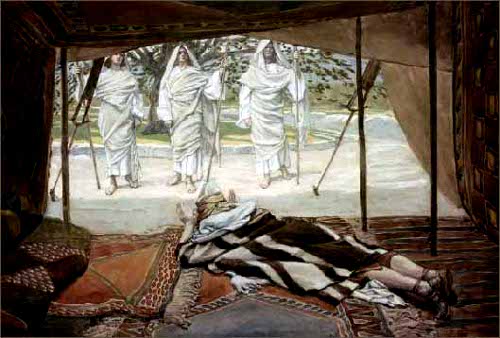
 When G-d told Noah to build an ark before the world would be destroyed, Noah built an ark.
But when G-d told Abraham He was about to destroy the cities of Sodom and Gomorrah—cities corrupt and evil to the core—Abraham argued. He said, “Perhaps there are righteous people there! Will the Judge of All the Earth not do justice?”
Abraham felt a sense of ownership for the world in which he lived. If there was something wrong, it needed to be changed. Even if it had been decreed by the will of G-d.
-Rabbi Tzvi Freeman
“Noah and Abraham”
Based on letters and talks of the Rebbe
Rabbi M. M. Schneerson
Chabad.org
I have to admit, I was a little disturbed by how Rabbi Freeman illustrates the difference between Noah and Abraham. It makes it seem like Abraham cared more for the world he lived in than Noah. Of course both Jewish and Christian commenators generally agree that it took Noah about 120 years to build the ark and that, during that period of time, Noah was trying to convince the people around him to repent of their wickedness (he wasn’t successful). So it’s not as if God told Noah that he was going to drown everyone and Noah immediately blew off humanity, only caring that he and his family would be saved.
Still, we have a tendency, no matter how much we are otherwise instructed (Matthew 7:1-6), to judge others. Once we become aware that a person has sinned, especially a type of sin we are personally offended by (maybe because it’s a type of sin we are particularly tempted by), we cut them loose from our “this person can be saved” list and let them sail away into the spiritual darkness.
No wonder the church is called the only army that shoots its own wounded.
OK, I’m probably being unfair to the church and I’m sure that there are many, many forgiving and compassionate Christians who have great love for even the most immoral of human beings. Apparently, the Rabbis teach the lesson of compassion and love for the sinner as well.
It is human nature to believe in one’s potential to destroy, but not his ability to repair. This is especially true regarding a person who transgressed a sin which is punishable by kareis (being cut off from his people). Naturally, the sinner figures that it no longer matters what he does since he has completely severed his soul from its source. The Ohr HaChaim, zt”l, explains that the error of this attitude from a verse brought on today’s daf. “Even a person who transgressed a sin punishable by kareis must never give up. This is the deeper meaning of the verse regarding leaving pe’ah in the corner of one’s field. ‘— When you reap the harvest of your land.’ This can also be understood to refer to one who violated a sin for which the punishment is kareis. Although he has uprooted his soul from its source, this does not mean that he has uprooted his soul completely. The verse continues: ‘— you shall not reap the entire corner of your field.’ Do not continue ripping out your neshama’s connection to God by transgressing further. Even one who has violated a sin punishable by kareis has only uprooted the connection forged by acting—or refraining to act—in a certain manner which caused the cut off. But his soul is definitely still connected.
“This is clear from the Arizal’s teaching about holiness. He explains that the nature of holiness is to leave an eternal trace wherever it was. We see that every mitzvah acts to strengthen one’s bond to God, regardless of his negative behavior. The Gemara explicitly writes that teshuvah helps even for kareis—or worse. This is why teshuvha reaches the throne of glory. One who does teshuvah renews the connection of his neshmaha which was hewn out from beneath the throne of glory.”
Daf Yomi Digest
Stories Off the Daf
“Not Excised Completely”
Chullin 131
 Except for the sentence of death, there was no worse consequence for a sin than to be cut off from your people (“kareis,” see examples in Genesis 17:14, Exodus 12:15, and Leviticus 23:29). There is debate on exactly what was supposed to happen if someone were worthy of kareis, but it is often thought to be some form of exile of the person from the community of Israel. It’s easy to read into this consequence a state of complete hopelessness and despair. If you are cut off from your people and from your God, what else is there? You have no place to go and there is no way back. Why continue living?
But the commentary on Chullin 131 doesn’t say there’s no hope. It does say that the person involved is in an extremely difficult and dire situation, but the “Gemara explicitly writes that teshuvah helps even for kareis—or worse. This is why teshuva reaches the throne of glory.” Even in the aftermath of the worst of all possible sins and failures, you are uprooted, but never completely cut off from God. Forgiveness is still possible. You can still turn back to Him.
The people in Noah’s time were given 120 years, as Noah built the ark, to become aware of the fatal judgment that was heading their way. They had time. They could have repented. They still chose not to. Abraham saw that God was going to destroy Sodom very soon and pleaded for whoever remained in there and who might repent and be saved (Genesis 18:16-33). In the following chapter of Genesis, you see the level of sin and depravity the inhabitants of Sodom exercised and it’s easy to imagine that the “outcry against Sodom and Gomorrah is so great and their sin so grievous” (Genesis 18:20) that they deserved complete and absolute destruction. Yet, Abraham still argued with God.
That’s a rather novel concept for a Christian. We’re generally told that God is always right and we should never argue. This has gotten us through plenty of moral puzzles in the Bible, such as those times when God has ordered the Children of Israel to completely destroy an entire people group, down to the last man, woman, child, and farm animal, because their sin was so great. But not only does Abraham question God’s judgment (very politely, though), but so does Moses, when God wants to destroy the Israelites (Exodus 32:9-10). When Jacob wrestled with the angel and won (Genesis 32:22-32), an interpretation of the event is that he was having a “moral struggle” with God. These are pictures that support humanity interacting with God on the plane of righteousness, questioning God and thereby struggling, not with God’s perfect righteous judgement, but with our own understanding of right and wrong.
Notice that in none of these examples is Abraham, Jacob, or Moses chastised or punished by God for their “effrontery” toward Him. I don’t think this means we can be casual in our relationship with God, but I do think we’re expected to be more than passive spectators in history and in life. If we can be considered “junior partners” with God in repairing the world, can we also not be involved, to some small degree, in the struggle to determine right and wrong and how justice shall be acted out in the world around us?
As people of faith, our sense of right and wrong is shaped by the Bible and how we understand its message. If some part of the Bible seems to be immoral by modern Christian or Jewish standards (or modern societal standards), what are we to do? Are we to blindly accept that the Bible is a static document with only one, static interpretation across time? Maybe we are expected to do what Jacob did and to “wrestle” with God and the text, struggling to take the underlying principles of what we are being taught and somehow apply them to a world that is far, far apart from the world in which the Bible was written.
 The more we develop as religious people, the more we must realize that we don’t have all the answers. The Bible doesn’t provide canned and complete responses for every possible moral and practical question. Like Abraham, we sometimes have to stand up and ask God if He really means something the way it’s written in the Bible or if there is some other alternate available. This is a very uncomfortable thing to do because we have to question matters of right and wrong in the world around us and in ourselves, rather than be satisfied that we’re right and “the other guy” is a hopeless sinner.
The next time you think the Bible is telling you to judge someone and that they deserve to be cut off from all civilized humanity or even to die for something they’ve done, or because of the person they are, it might be one of those times when you should be arguing with God (or perhaps yourself). That soul you are so willing to cut off may not be entirely uprooted from God and instead of casting it away, you may want to consider trying to replant it in more fertile soil.
For God loved the world with an abundant love, to the extent that he gave his only son so that all who believe in him will not perish, but will rather live eternal life. –John 3:16 (DHE Gospels)
 Morning Meditations