Tag Archives: Yeshua

How To Choose Life Over Death

The other day I read an article written by Rabbi Noah Weinberg of blessed memory called “Free Will – Our Greatest Power” originally published over 15 years ago at Aish.com. I only casually mentioned it on this blog post, and thought Rabbi Weinberg’s understanding of free will was worth sharing more in detail.

“How precious is man, created in the image of God.”

Talmud – Avot 3:18

What does it mean to be created in the image of God?

Unlike other creations, the human being has free will. Within this divine spark lies our potential to shape and change the world.

Proper use of free will beautifies and perfects. Misuse of free will plunders and destroys.

It is a uniquely human endeavor to learn how to use free will properly.

-Rabbi Weinberg

I know that R. Weinberg was writing for a Jewish publication, envisioning a primarily Jewish readership, and probably not considering non-Jewish readers at all, but it does say man (humanity) was created in God’s image, not just the Jewish people and not just Israel, so this should apply to the rest of us too, right?

Actually, according to the article, God did us two favors, not just one. He gave us free will and He told us what He did. That is, we are aware we have free will and can exercise it.

This is somewhat different from what you’ll hear in certain Christian circles, especially those that favor Calvinism (for the record, I don’t subscribe to either Calvinism or Arminianism, because I think this false dichotomy was constructed by people who didn’t interpret the Bible very well). Supposedly we have no free will or only a very limited form of it, because we cannot have consciously chosen God. Only God can choose us. If we had free will, say the Calvinists, it would undermine God’s total sovereignty over the entire universe.

Baloney.

So let’s cut to the chase. What is free will? R. Weinberg tells us:

It is a sweltering summer day. You trudge past the ice cream parlor. Wow – 10 new flavors! Special of the day! Frozen yogurt, too! You go inside and proclaim: “I’ll have double-fudge chocolate, please.”

Is picking chocolate over the vast array of other flavors a “free will choice?” No. It is simply the exercise of a preference, just as a cow chooses to eat hay instead of grass.

“Free will” refers to the type of decision which is uniquely human: a moral choice.

But don’t mistakenly think that morality is the choice between “good and evil.” Everyone chooses to be “good” – even the most evil, immoral people. Hitler rationalized that the Jews were the enemies of the world, so in his mind he justified that as doing “good.”

Rather, free will is the choice between life and death. As the Torah says: “I have put before you, life and death… Choose life so that you may live.” (Deut. 30:19)

Now before we go crazy making all kinds of assumptions, let’s take a look at Deuteronomy 30:19 in context.

“See, I have set before you today life and prosperity, and death and adversity; in that I command you today to love the Lord your God, to walk in His ways and to keep His commandments and His statutes and His judgments, that you may live and multiply, and that the Lord your God may bless you in the land where you are entering to possess it. But if your heart turns away and you will not obey, but are drawn away and worship other gods and serve them, I declare to you today that you shall surely perish. You will not prolong your days in the land where you are crossing the Jordan to enter and possess it. I call heaven and earth to witness against you today, that I have set before you life and death, the blessing and the curse. So choose life in order that you may live, you and your descendants, by loving the Lord your God, by obeying His voice, and by holding fast to Him; for this is your life and the length of your days, that you may live in the land which the Lord swore to your fathers, to Abraham, Isaac, and Jacob, to give them.”

Deuteronomy 30:15-20 (NASB)

So who’s speaking? Moses. Who’s he addressing? The Children of Israel. Is anyone else there? Arguably, there’s a mixed multitude of non-Israelites, Egyptians and people from other nations who left Egypt with Moses and the Children of Israel.

So, to whom do these verses apply? In their original context, they apply only to the people present and their descendants, but let’s drill down into that a little bit.

Some would argue that because of the (supposed) presence of a “mixed multitude” who had attached themselves to Israel, that the words of Moses, along with the Torah of Moses, is as appropriately accessed by the non-Jew as the Jew, particularly the non-Jew who is a disciple of Rav Yeshua (Jesus), that very specific population I sometimes call Talmidei Yeshua.

But is this so?

Probably not. Here’s why.

Whatever happened to the mixed multitude? If you clicked the link I posted above and read the blog post, you have your answer. It was always understood that the non-Israelites would fully assimilate into Israel by the third generation. The words of Moses applied to these non-Israelites because they had made a multi-generational commitment to attach to Israel and for their grandchildren and great-grandchildren to intermarry and become part of the tribes.

In other words, there were no Gentiles who intended for their descendants to remain Gentiles, though attached to Israel in some matter, resident aliens perhaps, who bore the same covenant obligations to Hashem as did the Children of Israel.

However, when Rav Weinberg cites Deut. 30:19 as the definition of free will, the choice between life and death, does that apply, not only to Jews, and not only to Christians, but to all human beings across time?

Everyone who has ever been born, lived, and died will one day stand before God to be judged. Both Christians and Jews believe this. So it would seem that all of us, each and every one, must have free will because we were all created in the image of God and because, based on the fact that we will one day be judged, we all have the ability to consciously choose between life and death.

Yes, the situation we see in Deut. 30 is a specific case and it attached highly specific covenant responsibilities onto Israel (or rather it re-states those commitments as they were originally given at Sinai), but in a much broader sense, Israel and the nations choose between life and death all the time.

Does anyone really choose death over life?!

We all want to be great. But achieving our goals takes a lot of effort. So we get distracted and take the easy route instead. The escape route.

I agree. No one would deliberately, meaningfully choose death instead of life. Rav Weinberg says that even Hitler believed in his own twisted mind that he was doing good and choosing life. He just (grossly) misunderstood what good and life happen to be.

So how do we choose death? Hint: we do it all the time, most of us, anyway.

It’s Sunday afternoon. You’re bored. You grab the remote and slump down into the couch. You could be using your time to learn and grow. But instead you choose the easier option of painlessly passing the afternoon… escaping into the world of TV.

Each day we are confronted with many escape routes. Daydreaming, drugs, checking our email for the seventh time this hour…

Killing time is suicide on the installment plan. And suicide is the most drastic and final form of escape.

Basically, any decision that takes us away from God and puts our personal desires ahead of Him is a form of choosing death, and as R. Weinberg put it, every time we choose death, we’re committing suicide an inch at a time.

Whenever we consider our pain or our desires or our cravings first and then act upon them, we are choosing death.

So just how does one live a life that is flawlessly pious? I mean, it sounds really difficult, and probably pretty boring, right?

R. Weinberg believed he had the answers in five stages.

Stage One: Self-Awareness

You aren’t going to be able to correctly choose life over death unless you start becoming aware of the decisions you’re making and why you’re making them. Choosing to watch a football game over studying the Bible isn’t an accident. It’s a decision. Start monitoring each decision you make. Start watching yourself exercise free will.

Stage Two: Be Your Own Person

What does that mean? I’m “me,” right? Well, maybe. R. Weinberg wrote:

Don’t accept society’s beliefs as your own unless you’ve thought them through and agree with them. Live for yourself, not for society.

Oh man, I could really go off here. I recently quoted Israeli writer Naomi Ragen when she said:

I suddenly remembered something my Harvard-educated son recently told me: “Many American Jews will blindly follow any agenda created by the Liberal establishment because it makes them feel virtuous and like part of the in-crowd.”

Also, in the past several months, the news and social media have been highlighting groups of college and university students who are apparently “majoring in the minors” by complaining about everything from the potential for offensive Halloween costumes to culturally insensitive food on campus.

As Dr. Everett Piper, President of Oklahoma Wesleyan University quipped, This is not a day care, it’s a university.

I know I’m hammering away pretty hard on political and social liberals, and especially very young ones, but I must admit that putting your own wants first isn’t just a liberal trait. It’s a human trait, and one we are all very capable of exercising, every single one of us.

I don’t object to someone being liberal, or conservative, or Christian, or an atheist, or any other alignment or orientation. I object to people selecting an orientation or alignment without thinking it through and making a conscious and informed decision.

So many people simply follow the herd because it’s the path of least resistance (and because they think it makes them virtuous, part of the in-crowd, and “cool”). I think that’s what R. Weinberg is talking about.

Check your assumptions and make sure that they are really yours and not someone else’s. Don’t be a puppet of society.

Stage Three: Distinguish Between Body and Soul

Weinberg calls this a “raging battle”:

BODY: Gravitates toward transitory comforts and sensual pleasures. Desires to quit, to dream, to drown in passions, to procrastinate. Says: “Give me some food, warmth, a pillow – and let me take life easy.” Looks for the escape of sleep… slipping away into death

SOUL: Seeks understanding, meaning, productivity, accomplishment, permanence, greatness. Confronts challenges. Embraces reality and truth.

Which plays out as:

Soul: “Let’s set some goals.”
Body: “Leave me alone, I’d rather sleep.”
Soul: “Come on, let’s be great!”
Body: “Relax, what’s the big deal if we wait til tomorrow?”

Do you ever feel like this? I do all the time. One example is when I realize I have to get up by 4 a.m. to make it to the gym when it opens at five so I can work out. This is the only time during the weekday I can do this, and I think particularly because it’s winter and cold and dark, I don’t want to do it.

I make myself but it’s never easy. Once I get to the gym and get moving, I’m OK, but that five or ten minutes when I first wake up, I’m arguing with myself about getting up vs. staying in bed and taking a “rest day”.

That plays into the next level.

Stage Four: Identify With Your Soul

This is sort of like saying I’m a soul that has a body rather than a body that has a soul. Instead of saying, “I’m hungry,” realize the soul means “My body needs food.” I know. It’s not that easy. That’s why using your free will to choose life takes discipline and practice, like learning to play a musical instrument (although this also takes innate talent) or working out at a gym.

In his article, R. Weinberg outlines specific strategies for how to train yourself to favor the viewpoint of the soul over the body and thus to more consistently choose life over death.

However, the final battle isn’t between your body and your soul.

Level Five: Make Your Will God’s Will

Weinberg wraps up his missive by stating:

The highest stage of free will is not when you ask yourself, “What does my soul want?” It’s when you ask yourself, “What does God want?” When that is your prime interest, you will have achieved the highest form of living. You are using your free will to merge with the most meaningful and powerful force in the universe: the transcendental.

Free will is the choice between life and death. Attach yourself to God and you will be attached to eternity – the ultimate form of life itself.

Make your will His will. If you do, you’ll be a little less than God Himself. Partners in changing the world.

The final battle is won (or continually being won) when you choose God’s will over your own day after day. As Weinberg said, it’s the highest form of exercising free will and choosing life. You are consciously, deliberately choosing God and life in abundance.

Once you embrace and fully integrate God’s will into your own, any concerns about life being difficult and boring seem rather silly.

Yes, and I will rejoice, for I know that this will turn out for my deliverance through your prayers and the provision of the Spirit of Jesus Christ, according to my earnest expectation and hope, that I will not be put to shame in anything, but that with all boldness, Christ will even now, as always, be exalted in my body, whether by life or by death.

For to me, to live is Christ and to die is gain.

Philippians 1:18-21

Non-Jews have no covenant standing before God, except perhaps the covenant God made with Moses. However, through the mediator of the New Covenant, through Rav Yeshua and through God’s infinite mercy and grace, we have been permitted to partake in the blessings of the New Covenant, even though only Judah and Israel are named participants.

Hence our devotion to our Rav.

Every Jewish person is born into a covenant relationship with God whether they want to be or not. Yet they all still have to make a conscious decision to choose life or death. No one else has ever been born into such a relationship with God, and yet we are still given the option to choose life over death by choosing to make God’s will our will.

It is said that no one comes to the Father except through the Son (which takes a bit of explaining which is why I’m linking to another blog post), and if we believe that, particularly as non-Jews, then choosing to become disciples of Rav Yeshua, whether you call that being a Christian or a Talmid Yeshua, is making that choice.

Every morning when we wake up, that choice is before us. “So choose life in order that you may live.”

When you awake in the morning, learn something to inspire you and mediate upon it, then plunge forward full of light with which to illuminate the darkness.

-Rabbi Tzvi Freeman
The Spiritual Responsibility of the Church to Israel

In a closed Facebook group, someone mentioned recently that the Noahide Siddur completely omits the Mussaf, probably because the wording is so closely associated with the exclusive relationship of the Jewish people to Hashem and the avodah of the Temple.

And while I’ve said in the past that Gentile Talmidei Yeshua are not Noahides (though I have been since corrected that a better title would be “more than a noahide”), this does bring up a boundary line between non-Jewish disciples of Rav Yeshua and the Jewish disciples (and Jewish people in general). There are just some things we can’t claim to share with Israel because they are the exclusive property of Israel.

Very recently, I wrote a blog post about a Christian’s duty to support and defend Israel and the Jewish people, even from the “war” being waged against them by our nation’s current administration.

It’s not always easy to do.

No, we’re not Israel. We’re not Jewish. But we still have a duty.

But what is the duty we Christians and/or Talmidei Yeshua have relative to the Jewish nation and her people?

The Jewish people are considered as one “organism.” What happens to one limb affects the entire body.

Every Jew recognizes that all the Jewish People are bound together. When there’s a terrorist attack in Israel, we all feel it. The Talmud says “Kol Yisrael areivim zeh la-zeh” – Every Jew is responsible one for another.

The story is told of the religious man who died and went to heaven. There, he appeared before the Heavenly Tribunal to hear a listing of his good deeds and bad. The man was quite satisfied to hear of all his mitzvahs. But he was shocked to have included amongst his transgressions the prohibition of eating pork.

“What?!” the man protested, “but I never once ate pork!”

“True,” spoke the Tribunal, “but for 20 years you lived next door to a man who ate pork, and you never made an effort to discuss it with him. For that, you are responsible.”

from the article “Responsible One for Another”
posted in the “Ask the Rabbi” column at
Aish.com

OK, that’s the responsibility of one Jew for another, but what about the rest of us?

“Then the King will say to those on His right, ‘Come, you who are blessed of My Father, inherit the kingdom prepared for you from the foundation of the world. For I was hungry, and you gave Me something to eat; I was thirsty, and you gave Me something to drink; I was a stranger, and you invited Me in; naked, and you clothed Me; I was sick, and you visited Me; I was in prison, and you came to Me.’ Then the righteous will answer Him, ‘Lord, when did we see You hungry, and feed You, or thirsty, and give You something to drink? And when did we see You a stranger, and invite You in, or naked, and clothe You? When did we see You sick, or in prison, and come to You?’ The King will answer and say to them, ‘Truly I say to you, to the extent that you did it to one of these brothers of Mine, even the least of them, you did it to Me.’”

Matthew 25:34-40 (NASB)

MessiahI once knew a Christian who had a unique interpretation of these verses. While on the surface, it seems as if the disciples of Yeshua (Jesus) are commanded to provide assistance for people who are hungry, thirsty, without clothing, or who are otherwise in distress or disadvantaged, this older Christian gentlemen (and one of the most steadfast doers of what Jesus commanded that I ever met) said he believed that we merit the reward spoken of by our Rav (he didn’t word it this way, of course) when we provide this sort of care specifically to the Jewish people, not just to people in general.

I’m not sure that’s likely, considering that Yeshua’s audience consisted of Jewish people and that Matthew’s Gospel is widely considered to have been written specifically to Jews, but on the other hand, it makes a sort of sense.

The Rav himself said that “salvation comes from the Jews” (John 4:22), and if Israel can be said, particularly through our Rav, to be a light to the nations (Isaiah 49:6), then we owe that light a great debt.

The Apostle Paul (Rav Shaul) believed that there were many advantages to being a Jew, as he chronicled in his Epistle to the Romans (Romans 3:1-2). Paul also commended the largely non-Jewish communities (“churches” if you will) in the diaspora for donating charity (tzedakah) to the Holy Ones in Jerusalem (see 1 Corinthians 16 and 2 Corinthians 8 for examples), as if the Gentiles owed it to the impoverished Jews in the Holy City.

Of course, there are other reasons we owe the Jewish people a debt:

On this day in 1601, Hebrew books that had been confiscated by Church authorities were burned in Rome. This was an unfortunate theme throughout the Middle Ages: In 1592, Pope Clement VIII had condemned the Talmud and other Hebrew writings as “obscene,” “blasphemous” and “abominable” — and ordered them all seized and burned. Centuries earlier, Pope Gregory IX persuaded French King Louis IX to burn some 10,000 copies of the Talmud (24 wagon loads) in Paris. As late as 1553, Cardinal Peter Caraffa (the future Pope Paul IV) ordered copies of the Talmud burned in the Papal States and across Italy. Yet despite all attempts to extinguish our faith, the light of Torah shines brightly till today.

from “This Day in Jewish History”
for Shevat 11
Aish.com

OK, you might say that you’re not Catholic or that this happened a long time ago and we don’t do this to Jewish people anymore, but the inherit memory of the Jewish people and the history of the Church’s “relationship” with the Jews is very long lived.

And sadly, even to this day, we can often find the spirit of Haman in the Church.

It’s so easy to wallow in the mud, to get tangled up in Israel’s final redemption and the current political landscape. It’s easy for non-Jews in Yeshua to experience jealousy over the advantage of the Jews (Romans 3:1-2), which I suppose is why Christianity developed the doctrine of supersessionism (or cryptosupersessionism as the case may be).

Rabbi Noah Weinberg of blessed memory wrote an article over 15 years ago called Free Will – Our Greatest Power. It’s somewhat lengthy, but here’s a summary of his five main points:

  • Level One: Don’t be a sleepwalker. Make decisions actively.
  • Level Two: Don’t be a puppet of society’s goals, or a slave to your old decisions.
  • Level Three: Be aware of the conflict between the cravings of your body and the aspirations of your soul.
  • Level Four: Identify with your soul, not your body.
  • Level Five: Make your will God’s will.
Rabbi Weinberg
Rabbi Noah Weinberg

If you read the entire missive, you’ll see that having free will and making Hashem’s will our will results in an intersection between the mundane and the Divine. We learn to see past the physical reality of our world and the things (and people and nations) we often fight against, and perceive them (things, people, nations) through a spiritual lens.

By the way, this isn’t an either-or affair:

Given that we live in a physical world, much of the goal of Judaism is to infuse the physicality with holiness. We say a blessing before eating our special kosher food, we have a framework for sanctifying our marital relations, etc.

from the article “What is Holiness?”
posted in the “Ask the Rabbi” column
Aish.com

In the western mindset, we tend to think of things in binary terms. Something is either this or that, we turn left or right, we can choose this one or that one. But that mindset, including within the Christian Church, is based on ancient Greek philosophy.

Judaism and Hebrew thought is much more comfortable with dynamic contradictions in which seeming opposites can live together, if not at peace, then at least under a flag of truce.

Observant Jews don’t choose between the material and spiritual worlds, they infuse the physical with the spiritual. In my own dim little way, I can see Israel as both the present political reality and the Holy Nation of God given to the Jewish people as their perpetual heritage.

I think if we choose to put on that pair of lenses and see the many aspects of our world, and particularly Israel and the Jewish people, the way God sees them, we would have no doubt in our minds (or hearts) at all that we should be doing all we can to assist an Israel under siege, or at the very least, not to get in Israel’s way.

I said that the physical and the spiritual can co-exist in dynamic tension, but looking at Level Four of Rav Weinberg’s summary, it seems like that co-existence isn’t exactly 50/50. If we can perfect our vision, it means being biased somewhat toward the spiritual side of our sight. In this context, that means seeing more of Israel’s spiritual reality than her current physical and political reality. It means seeing Israel more as what she’ll be when her full redemption arrives.

For when Israel’s redemption arrives, ours will arrive with him.

If your bread fell out of heaven, you might be afraid to make a diet of it. Sure, it’s convenient, but most people would rather sink their teeth into a steak, or at least a potato—something that feels like a part of their world.

That’s also the way many people feel about any topic that touches on the spiritual. It is the unknowableness of it—that you can’t grasp it in your hand or tally it up with your assets—that causes people to shun it, to run from it, to even deny it exists.

These people are running from who they are. Far more than we are a body with a bank account, we are spiritual beings. Without nourishment for our souls, we are plagued by insatiable cravings—like a body lacking essential nutrients.

For the human being, inner peace is achieved by first surrendering to the unknown.

-Rabbi Tzvi Freeman
“Grasping Bread from Heaven”
Chabad.org

If we don’t feed ourselves with “bread from Heaven,” not only will our spiritual self be starved, we won’t be able to recognize what is truly, spiritually real, and then act upon it in the present world.

Talmidei Yeshua

Actually Questor made the suggestion for a proper term by which to call Judaicly-aware non-Jewish disciples of Rav Yeshua in coining the phrase תָלְמִדִם שׁל יֵשׁוּע – Talmidim shel Yeshua – Disciples of Yeshua, however ProclaimLiberty suggested:

Nice label suggestion, “Q”, but the phrase requires the possessive contraction as: “תָלְמִדִי יֵשׁוּע” (Talmidei Yeshua) rather than as merely a descriptive or explanatory phrase.

Of course, referring to people like me as “Talmidei Yeshua” is going to draw a lot of blank stares from Christians or just about anyone else.

Just the other day, I got a knock on my door, and when I answered, the fellow asked if I was a Christian. I said “yes,” but pointing at the mezuzah on the door frame, I said my wife was Jewish. If I had told him something “I’m Talmidei Yeshua,” he might have given me a much less predictable response.

For as many years as I’ve been involved in the Hebrew Roots and Messianic Jewish movements, there’s been a struggle as to what to call ourselves. OK, Jewish disciples of Messiah can call themselves Messianic Jews, but even early on, there was some resistance to applying the word “Messianic” to non-Jews, the idea being that “Messianic” belonged to the Jewish people.

church?A lot of Gentiles in Messiah don’t like being referred to or like calling themselves “Christians” because of the implications of replacement theology, denial of the applicability of the Torah as a requirement of God’s for Jews in general and Messianic Jews in particular, and the whole church on Sunday, Christmas, Easter, eating ham at the drop of a hat deal that seems so anti-Jewish and thereby anti-Messiah.

Some folks hedge their bets and say they’re “believers” which is acceptable as an alternate “Christian-ese” word that still doesn’t peg the non-Jewish Messianic as “Christian” specifically.

However, in spite of all this, Messianic Gentiles as a proper term, has risen to the top of the list in being the most accurate representation of who we rather odd non-Jewish disciples of the Jewish Messiah King are in our theology, doctrine, and praxis.

That said, Q and PL may have a point in addressing us as “Talmidei Yeshua” since “Yeshua’s disciples” is both accurate and generic. I even mentioned to PL that we could refer to both Jews and Gentiles in Messiah by that title and still be correct.

Except that he reminded me of something:

Yes, it could refer to both, though Jewish disciples might prefer ‘Hasidei Yeshua. Or, as someone in my local ‘havurah suggested last week, Jewish disciples might do well to forego any distinctive label altogether, being satisfied to be simply Jews without any such label that could suggest separatist factionalism or “minut”. Just as Rav Shaul was content to identify himself simply as a Pharisee or a Binyamini (tribal designator), without any other qualifier specifically associated with Rav Yeshua, so could modern Jewish disciples do in modern terms. Distinctive terms such as “Nazarene” did not appear until later, and were used primarily to distinguish Jewish messianists as individuals to be avoided or forced out of the Jewish community. That sort of social dis-interaction needs to be countered as Jewish messianists re-integrate within the wider Jewish community, bringing what they’ve learned from Rav Yeshua with them.

For gentile disciples, on the other hand, a label could have a positive function to emphasize that such individuals have “drawn close” to the Jewish community and embraced the principles and values of the Torah covenant.

Stuart Dauermann
Rabbi Stuart Dauermann

And that Reminded me of Rabbi Stuart Dauermann’s article “The Jewish People are Us — not Them,” published in Messiah Journal, which I reviewed a couple of years back.

Historically, converting to Christianity has been seen as drawing the convert out of his or her former life and associations and into the Church. This has been true whether the convert were a Jew or anyone else. Sometimes, the convert’s Jewish family and friends don’t even acknowledge this person as Jewish anymore.

However, as Dauermann correctly pointed out and as I interpret him, being Messianic is a very Jewish thing to do. All religious Jews eagerly await the coming of Messiah. The only difference between a Messianic Jew and any other religious Jew, is that the Messianic acknowledges the specific revelation of Messiah as Rav Yeshua (I’m sure there are Jews who would strongly debate this point).

Accepting the revelation of our Rav as Moshiach, if anything, should increase and enhance the observance of a Jew and ideally, draw the Jew nearer to his/her fellows and to Jewish devotion and praxis.

That’s why there probably isn’t any real need to call a Messianic Jew anything other than a Jew. PL rightly points out that Paul didn’t create a special designation for himself after the events of Acts 9. So why should any other Jewish disciple of the Rav do so?

However, it always seems to come back to “what do we do with the Gentiles?” If being “Messianic” is such a Jewish thing to do, then it must be a pretty strange thing for a non-Jew to do. Who are we? What do we call ourselves? How do we define our praxis? Once we enter this world, as distinguished from the more traditional Church, we find ourselves in an indistinct, foggy, no-man’s-land, being neither fish nor fowl, still Gentile but located, even tangentially, in Jewish space because we have declared ourselves as disciples of the Jewish Rav.

One of these things is not like the othersCalling ourselves Talmidei Yeshua may not change a great deal, but it does give us some small sense of identity, or at least what to call ourselves, that shouldn’t be objectionable in Jewish religious and social space. Of course, it’ll rather put off most Christians who consider the title “Christian” to be more than sufficient, but then again, anyone who’s been reading this blog for a while knows that people like me don’t think, speak, teach, write, or believe in precisely the same things you’ll find preached in the average Evangelical Church on Sunday morning.

Of course, those other pesky questions remain unanswered for the most part. Yet I think each person has created his or her own answers out of necessity. Some let themselves be defined by the standards of accepted praxis for Gentiles in their congregations. Some, like me who have no congregation or group, self-define. However, there remains no single standard to which the Talmidei Yeshua can consult and emulate.

This is probably why so many of the non-Jewish Talmidei Yeshua look to their Jewish counterparts with envy since Jewish halachah is well-defined.

My Jewish wife would be perplexed by all this. From her point of view, and from the point of view of the Jews attending the two synagogues in my community, I’m considered a Christian and that’s that. All the little spins and twists that I derive from Jewish literature in understanding my faith are moot to them.

human beings
Photo: theshirtlist.com

This isn’t a problem really if we don’t factor community into the equation. Besides my name, I have no idea how God refers to me, how He categorizes me (besides “human” or “Goy”), how He thinks of me, if He has to have categories at all. None of this probably matters to Him. He doesn’t see titles or labels, He sees the heart and the relationship.

In the end, that’s all there is. Maybe we live in community or at least family, but we die alone and only God receives us. He calls us by whatever name He wills.

Tipping Point to the End of Days

Question:

With the world appearing more and more a dangerous place, I’m wondering what Judaism has to say about the possibility of an apocalyptic final event. Does such a concept exist, and how will that play out?

The Aish Rabbi Answers in Part:

The other path is described as Messiah coming “humble and riding upon a donkey” (Zechariah 9:9). In this scenario, nature will take its course, and society will undergo a slow painful deterioration, with much suffering. God’s presence will be hidden, and his guidance will not be perceivable.

According to this second path, there will be a valueless society in which religion will not only be chided, it will be used to promote immorality. Young people will not respect the old, and governments will become godless. This is why the Midrash says, “One third of the world’s woes will come in the generation preceding the Messiah.” (Rabbi Aryeh Kaplan, “Handbook of Jewish Thought”)

“End of Days”
from the Ask the Rabbi column
Aish.com

I know a lot of religious pundits, both online and in various congregations and study groups, have tackled the question of the “end times,” so I’m probably being ridiculously redundant. On the other hand (and I’m sure I’ll get in trouble for this), as I was reading this column, I was thinking about how I, from my own (somewhat) unique point of view, see the matter.

According to the Jewish sages, the coming of Messiah can occur in one of two ways (the Aish Rabbi outlines both). The first is that the world becomes filled with love and kindness and all people everywhere bow down to and swears obedience to King Messiah. All the world has to do is engage in teshuvah (repentance) en masse and perform Tikkun Olam (repairing the world).

I don’t see that scenario taking place any time soon.

The other path is as you see quoted above. Instead of Messiah entering this world and establishing his Kingdom in honor and glory, he humbly emerges on the scene riding upon a donkey. This event happens if the people of the world never get their act together, and we allow society to “undergo a slow painful deterioration, with much suffering.”

moshiach ben yosefSo there has to be a “tipping point,” so to speak, where the decision is made, when the fate of the planet is determined by worldwide human behavior and intent.

According to the sages, this tipping point occurs in the future.

But what if it has already happened?

In addition to Zechariah 9:9, consider the following:

When they had approached Jerusalem and had come to Bethphage, at the Mount of Olives, then Jesus sent two disciples, saying to them, “Go into the village opposite you, and immediately you will find a donkey tied there and a colt with her; untie them and bring them to Me. If anyone says anything to you, you shall say, ‘The Lord has need of them,’ and immediately he will send them.” This took place to fulfill what was spoken through the prophet:

“Say to the daughter of Zion,
‘Behold your King is coming to you,
Gentle, and mounted on a donkey,
Even on a colt, the foal of a beast of burden.’”

The disciples went and did just as Jesus had instructed them, and brought the donkey and the colt, and laid their coats on them; and He sat on the coats. Most of the crowd spread their coats in the road, and others were cutting branches from the trees and spreading them in the road. The crowds going ahead of Him, and those who followed, were shouting,

“Hosanna to the Son of David;
Blessed is He who comes in the name of the Lord;
Hosanna in the highest!”

When He had entered Jerusalem, all the city was stirred, saying, “Who is this?” And the crowds were saying, “This is the prophet Jesus, from Nazareth in Galilee.”

Matthew 21:1-11 (NASB)

The crowds seeing “the prophet Jesus, from Nazareth in Galilee” couldn’t possibly have missed the symbolism. No wonder they were filled with joy. The Messiah had arrived.

But here’s what was also necessary, at least as I interpret the sages:

“Jerusalem, Jerusalem, who kills the prophets and stones those who are sent to her! How often I wanted to gather your children together, the way a hen gathers her chicks under her wings, and you were unwilling. Behold, your house is being left to you desolate! For I say to you, from now on you will not see Me until you say, ‘Blessed is He who comes in the name of the Lord!’”

Matthew 23:37-39

If the Talmudic sages are right (and I’m taking a big leap here), then when Rav Yeshua (Jesus) entered Jerusalem on a donkey, the tipping point had already arrived and the decision had been made that the world would slowly degenerate and degrade into moral chaos.

I think Yeshua’s lament over Jerusalem was his expression of sorrow of what the Jewish people would have to suffer in a world that has always hated them. No matter what they had suffered up to this point, the world was going to become so evil, that it would become progressively worse for all Jews everywhere.

hiddenMaybe this is why we don’t have prophets and miracles anymore, at least not like we saw them in the Bible including as illustrated in the Apostolic Scriptures. Because “God’s presence” is “hidden, and His guidance” is “not…perceivable.” This differs from why the “age of miracles” is believed by many Christians to have ended.

The Aish Rabbi continues (I’m repeating some of what I quoted above for emphasis):

According to this second path, there will be a valueless society in which religion will not only be chided, it will be used to promote immorality. Young people will not respect the old, and governments will become godless. This is why the Midrash says, “One third of the world’s woes will come in the generation preceding the Messiah.” (Rabbi Aryeh Kaplan, “Handbook of Jewish Thought”)

According to the Talmud, as the Messianic era approaches, the world will experience greater and greater turmoil: Vast economic fluctuations, social rebellion, and widespread despair.

Isn’t that much of what we see happening around us today? Isn’t our society “valueless” (though it doesn’t refer to itself as such) in which the faithful are not only chided, but we also see religious groups, including churches and synagogues as well as our own government, promoting godlessness?

Of course the world of the past nearly two-thousand years has been filled to abundance with chaos, lack of ethics, cruelty, moral abandon, and our religions, including Christianity, have stood many times against the will of God rather than for it, especially in the historic treatment of the Jewish people.

But then again, if the tipping point regarding how Messiah would come was made in the early years of the First Century C.E., then from that moment on, we should have known that collective humanity wasn’t going to spontaneously repent and join together under the one Jewish King.

Of course, this only makes sense if my creative blending of scripture and Talmud actually works. I know many Jews chafe whenever a non-Jew such as myself appropriates Jewish literature and adapts it to “point” to the revelation of Rav Yeshua as the coming Moshiach.

They state that the Messiah is understood to come only once and not twice, but even though we consider him our High Priest in the Heavenly Court, in some metaphysical way, perhaps he is also still with us, humbly riding that donkey in the degenerate alleys and byways of our many cities in the world, suffering along with his people, waiting for the proper moment when the world finally collapses under the weight of its own iniquity, and then a world war of “immense proportion led by King Gog from the land of Magog” will trigger the final battle between good and evil (Ezekiel ch. 38, 39; Zechariah 21:2, 14:23; Talmud – Sukkah 52, Sanhedrin 97, Sotah 49).

The Aish Rabbi states:

What is the nature of this cataclysmic war? Traditional Jewish sources state that the nations of the world will descend against the Jews and Jerusalem. The Crusades, Pogroms and Arab Terrorism will pale in comparison. Eventually, when all the dust settles, the Jews will be defeated and led out in chains. The Torah will be proclaimed a falsehood.

Then, just when we think the story is over, the Messiah will come and lead the Jewish redemption. He will inspire all peoples to follow God, rebuild the Temple, gather in any remaining Jewish exiles to Israel, and re-establish the Sanhedrin. (Maimonides – Melachim ch. 11-12)

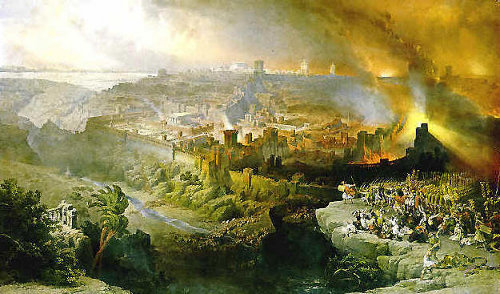
fall of jerusalemIt’s telling that one of the predictions, according to the sages, is that the nation of Israel will ultimately be defeated, the Jewish people will once again be in chains, and the “Torah will be proclaimed a falsehood.”

I can imagine that a good many Christians and Jews will have their faith crushed when Israel is vanquished in the final war and yet the Messiah does not come (or Jesus doesn’t come back). However, the Church has already declared the Torah as a falsehood, at least the way Jews understand it, as has Islam, so it’s not hard to imagine that Israel’s enemies won’t just be the secular governments, but Muslim nations and Christians as well.

That’s a rather sobering thought. That means any of us who continue to support Israel through these times will be enemies of many nations, probably including our own.

It means that even those Jews who make aliyah and those Gentile believers who are family members accompanying them or who otherwise manage to reside in the Land, are voluntarily painting a huge target on their backs, one that will bring the wrath of the entire planet down upon them and their loved ones.

“But when you see the abomination of desolation standing where it should not be (let the reader understand), then those who are in Judea must flee to the mountains. The one who is on the housetop must not go down, or go in to get anything out of his house; and the one who is in the field must not turn back to get his coat. But woe to those who are pregnant and to those who are nursing babies in those days! But pray that it may not happen in the winter. For those days will be a time of tribulation such as has not occurred since the beginning of the creation which God created until now, and never will. Unless the Lord had shortened those days, no life would have been saved; but for the sake of the elect, whom He chose, He shortened the days. And then if anyone says to you, ‘Behold, here is the Christ’; or, ‘Behold, He is there’; do not believe him; for false Christs and false prophets will arise, and will show signs and wonders, in order to lead astray, if possible, the elect. But take heed; behold, I have told you everything in advance.”

Mark 13:14-23

I know there are some who believe Rav Yeshua was predicting the downfall of Jerusalem in 70 C.E., and perhaps he was, but then again, it’s possible to use a good prophesy twice. This could as well be applied to the coming destruction of Jerusalem in the final war. To my few readers in Israel, depending on when this war comes, this prophesy could well apply to you.

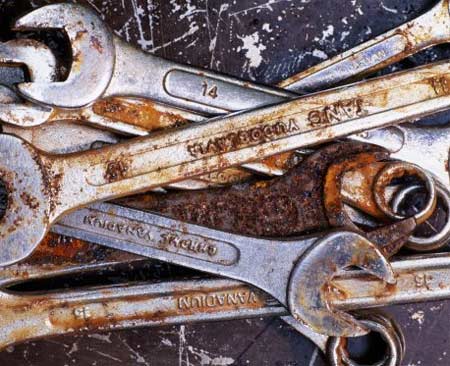
rusty toolsI encourage you to click the link I provided above and read what else the Aish Rabbi has to say about Messianic redemption. As I read him, it seems clear that he still believes things could go either way. Either the world still has time to come together and summon the Messiah in peace, or we could still plunge into darkness, war, and chaos.

Assuming the Jewish sages are correct, I believe the decision was made long ago, and that for the past twenty centuries, the world has been slowly eroding, like the banks of a river being gradually washed away, or a collection of tools abandoned in some workshop and crumbling into rust as the years pass.

For the coming of the Son of Man will be just like the days of Noah. For as in those days before the flood they were eating and drinking, marrying and giving in marriage, until the day that Noah entered the ark, and they did not understand until the flood came and took them all away; so will the coming of the Son of Man be.

Matthew 24:37-39

Just as it was in the days of Noah as the flood approached, so it is today, and so has it been for almost two-thousand years. Life has seemed “ordinary,” but there are days ahead when we will dispair.

Rabbi Abraham J. Twerski wrote a commentary on Psalm 51:5 about King David and making teshuvah, even for sins which may be the result of some in-born character trait. If David was born with the biological nature to have great passion, and that passion led him to sin with Batsheva, it was still his responsibility.

In making teshuvah before Hashem, David takes personal responsibility for his sins rather than blaming other people or circumstances. Granted, he goes through many things, including the death of his first child by Batsheva, before arriving at this point, but he did arrive.

The same can be said for you and me. Moshiach is not here yet. We still have time. However, time may be very short. We don’t know, of course, but why wait? Make teshuvah now and serve God as if the war will begin tomorrow and you will lose time and your life.

The Aish Rabbi finishes his essay this way:

Despite the gloom, the world does seem headed toward redemption. One apparent sign is that the Jewish people have returned to the Land of Israel and made it bloom again. Additionally, a major movement is afoot of young Jews returning to Torah tradition.

By the way, Maimonides states that the popularity of Christianity and Islam is part of God’s plan to spread the ideals of Torah throughout the world. This moves society closer to a perfected state of morality and toward a greater understanding of God. All this is in preparation for the Messianic age.

MessiahThe Messiah can come at any moment, and it all depends on our actions. God is ready when we are. For as King David says: “Redemption will come today – if you hearken to His voice.”

While we may not be able to avert the disaster of a morally decaying world and an impending and catastrophic world war which will destroy Jerusalem, we can prepare ourselves for those times by learning the Torah as it applies to each of us, whether as a Jew or a non-Jewish disciple of the Rav. When the horrors have finally passed, as the Rabbi states quoting King David, then there will be redemption for us, if we have hearkened to His voice.

The Illusion of the Unified Body of Messiah

In the article, I tackled the now-familiar “trajectories” model of early Christian developments proposed influentially by James Robinson and Helmut Koester, showing examples of how it has involved dubious results. The trajectories model does reflect the sense of diversity in early Christianity, but I contend that it is inadequate as a model in allowing for the complexity of that diversity. For it seems to me that all our evidence points to a rich and vibrant interaction of the various early Christian groups.

Sometimes this was of a hostile nature, as in the well-known conflict of Paul and certain other Jewish Christians whom Paul refers to as “false brothers,” and even agents of Satan. Sometimes, however, perhaps more typically, this interaction was of a more positive nature, as reflected in the appropriation of “Q material” in the Gospels of Matthew and Luke, or the implicit affirmation of Peter in John 21.

-Dr. Larry Hurtado
discussing the presentation of his paper,
Interactive Diversity: A Proposed Model of Christian Origins,” Journal of Theological Studies 64 (2013): 445-62
on his blog post “Interactive Diversity SBL Session”
Larry Hurtado’s Blog

I suppose it would be naive to consider that there was a single, uniform expression of Christianity in the mid-to-late first century CE. As Dr. Hurtado points out, both on this blog and in his paper, there are multiple different theories to describe these varying expressions including the “trajectories model.”

However, in his paper, Dr. Hurtado suggests a different viewpoint he calls “Interactive-Diversity”.

As early as the Jerusalem church, there was linguistic diversity, as likely reflected in the Acts depiction of ‘Hebrews’ and ‘Hellenists,’ terms which probably designate respectively those Jews in the Jerusalem church whose first language was Aramaic and those whose first/primary language was Greek. Also, Paul’s deployment of the little ‘Marana tha’ formula in 1 Corinthians 16:22 is commonly taken as reflecting his acquaintance with Aramaic-speaking circles of Jewish believers, as distinguished from the Greek-speaking (gentile) congregations to whom he wrote.

I should note that regardless of believers being Jewish or Gentile, Dr. Hurtado refers to them as Christians.

In this first example, the diversity is linguistic and between Greek speaking and Aramaoic speaking Jewish disciples of Rav Yeshua (Jesus), as well as distinguishing them from the Greek speaking Gentiles.

However…

Moreover, remarkably early there was also a trans-local diversity. In Acts we have reports of the young Christian movement quickly spreading from Jerusalem and other sites in Jewish Palestine, to Damascus, Antioch and Samaria, and through the activities of Paul and others (often anonymous) spreading through various locations in Asia Minor, Greece, Rome and elsewhere. Though the historicity of some features of
Acts has been challenged, it is commonly accepted that there was an early and rapid trans-local spread of the young Christian movement to locations such as these. It is to
be expected that this remarkably rapid spread of the Christian movement would have been accompanied by diversity, Christian circles taking on something of the character of
the various locales, and also the varying ethnic groups and social classes from which converts came.

Larry Hurtado
Larry Hurtado

There was, as we might expect, also diversity among the Gentiles based on “trans-local diversity,” or distinctions of geography, nationality, ethnicity, and custom.

All this seems to suggest that there were different interpretive traditions of not only the Jewish scriptures (remember, at this time there was no such thing as the “New Testament”) but how these differing groups understood the letters of Paul as well.

The different attitudes toward ‘food sacrificed to idols’ (8:1-13) comprised another potentially serious difference in Corinth that may well have reflected different social groups. Likewise, Paul’s exhortations in Romans 14:1—15:6 are widely thought to address differences that likely reflect a diversity of a social or ethnic nature.

But along with the evident diversity, a well-attested ‘networking’ was another feature of early Christianity. This involved various activities, among them the sending
and exchange of texts, believers travelling for trans-local promotion of their views (as, e.g., the ‘men from James’ in Gal 2:11, or Apollos’ travels to Corinth in 1 Cor 1:12; 3:5-
9; 16:12), representatives sent for conferral with believers elsewhere (as depicted, e.g., Acts 15:1-35), or sent to express solidarity with other circles of believers (as, e.g., those accompanying the Jerusalem offering in 1 Cor 16:3-4).

For that matter, Paul wasn’t the only one establishing “churches” in the diaspora. There were others, most or all of whom were anonymous, who were also “planting” faith communities and apparently establishing differences in teaching and praxis.

However, it wasn’t because these communities were isolated from each other geographically that allowed the rise of diversity. In fact, according to Hurtado’s paper, they were quite interactive, sometimes uncomfortably so.

On the other hand, there are also indications of far more adversarial interactions as well, and at a very early date. Paul’s letter to the Galatians will serve to illustrate this. Exegetes are agreed that this epistle reflects Paul’s exasperation over unidentified other Christians (probably Jewish) who have visited the Galatian churches calling into question the adequacy of Paul’s gospel and urging his gentile converts to complete their conversion by circumcision and a commitment to Torah-observance. Paul represents these people as proclaiming ‘a different gospel . . . confusing you and seeking to pervert the gospel of Christ’ (Gal 1:6-7), and he thunders an anathema on anyone who proclaims a gospel contrary to that which he preached (1:9).

And…

This is rather clearly an example of early Christian diversity of a more hostile variety! But it is also indication of the interaction that I emphasize here, with non-Pauline teachers visiting Corinth (with intent!) and Paul reacting with an uncompromising vigour.

It can result in some exchange and adaptation or in a hardening of previous positions. But my point is that early Christian diversity was often (even typically?) of a highly interactive nature.

Apostle Paul preachingDoesn’t sound terrifically different than how different Christian denominations “get along” in the 21st century CE.

You can read the full 16 page document as a PDF to get all of Dr. Hurtado’s message on this topic. My point in bringing all this out on my own blog is somewhat similar to what I pointed out in one of my reviews of the Nanos and Zetterholm volume Paul within Judaism: Restoring the First-Century Context to the Apostle.

Various articles within “Paul within Judaism” put forth the idea that Jews and Gentiles “in Christ” not only did not share a single, uniform identity and role within the faith, but that the identity and role of the Gentile within the first century Jewish movement of “the Way,” was ill defined and incomplete.

Paul and others may not have thought this was a problem if they believed that the Messiah’s return was imminent. If Messiah was coming back in a year or two, or a decade or two, he would straighten things out as he completed establishing his Kingdom.

That may also be one way to view the diversity between various diaspora congregations and their differences in interpretation, doctrine, and praxis. While it’s compelling to imagine that in the beginning of the Yeshua movement within Judaism, and as it was being exported to the diaspora Gentiles, the conditions operating within the overall movement and trickling down to specific “churches” were uniform, representing a single, complete unity, perspectives such as “Interactive-Diversity” paint a much different portrait.

What we think of may never have been unified, at least not since Rav Yeshua lead his small inner circle of apostles and disciples through the Galilee or taught from Solomon’s Portico at the Holy Temple in Jerusalem. His teachings wouldn’t be documented and widely disseminated for decades, and even then, they would likely have been interpreted differently by the numerous congregations and house fellowships of Jews and Gentiles in both Israel and the diaspora nations.

I remember during my early days in the Hebrew Roots movement (some fifteen years ago or more) I thought what I was experiencing in my local, little “One Law” group was something akin to what the Gentiles experienced in their congregations in the days of Paul.

I was really inexperienced and unstudied.

I’m not exactly a genius now, but as time has passed and I’ve accessed a wider variety of information sources, I’ve come to realize that we aren’t particularly certain of what was normative practice for Gentiles in Messiah while Paul was on his journeys and writing his letters. Here we see that there probably was no one normative practice, but that not only were the teachings and praxis of the different groups of Gentiles highly variable and even competitive, but that their very identities and roles as disciples of our Rav were probably indistinct and variable as well.

Granted, I’m drawing a great deal out of a few small examples, but it does possibly mean we do have one thing in common with the earliest non-Jewish followers of Yeshua. Our variability or interpretation and practice and even the competition and (sometimes) hostility between differing factions within both the Hebrew Roots and Messianic Jewish movements is normal.

Like Paul, we too may have to wait until Messiah comes so he can sort everything out.

Christian CoffeeAlmost a week ago, I had coffee with a friend, and we were discussing this topic. He believes that as the time of Messiah’s return draws near, the variability between all the denominations of Christianity, let alone those of us who, at least in name, don’t call ourselves “Christians” (well, we do and don’t…long story), will begin to erode and a clearer vision and more stable platform will emerge for Messiah’s disciples.

I disagree.

In fact, I think the opposite will happen. I think we’ll all become increasingly fragmented and confused. Sure, there will be a remnant that will maintain a stable perception of God, Messiah, Israel, and the Bible consistent with God’s redemptive plan for His Jewish nation, and through them, the people of the nations, but a lot of “nutsiness” will emerge and thrive as well.

I even think there will be scores of churches that will reject the resurrected Messiah and ascended King because he’s too Jewish, because he rebuilds the Temple in Jerusalem, because he rules from Jerusalem instead of Heaven, and because the “raptured” will join him in Jerusalem instead of Heaven…

…and because Israel will rule the nations of the world with King Messiah instead of “the Church”.

I’m not saying we should just sit on our laurels and wait around for Messiah to come back. I’m not saying we shouldn’t continue to study the scriptures, to teach, to go to teachings, to seek out greater truth, to improve our walk, or any of that.

I’m saying it’s expected if we don’t know everything right now. It’s normal not to get everything right. We should accept that, when Messiah does come and when he teaches, that he will point out where we made mistakes, even as we were (and are) sincerely seeking him and searching out the face of God.

Fortunately, Hashem is patient. He understands us, even though we don’t always understand Him or what He’s trying to tell us. We may have the Spirit of God, but that doesn’t mean we always listen to the Spirit either, no matter how much we think we want to.

We aren’t one candle, but many, yet all burning for our God.

Who Delivers the Consequences for Sin?

Fortunate is the person who fears God, and has a great desire for His mitzvos.

Psalms 112:1

We think of fear as a negative emotion, so we try to eliminate it. We therefore lose sight of the fact that fear can also be constructive. Fear motivates us to drive cautiously even when in a great hurry, and fear makes a diabetic adhere to his diet and take his insulin daily.

Religion has often been criticized for advocating the fear of God. This criticism may be justified if we were conditioned to think of Him as an all-powerful Being holding a huge club, ready to beat a sinner to a pulp for doing something wrong. All ethical works discourage the use of this type of fear as motivation. Rather, fear of God should be understood to mean the fear of the harmful consequences that are inherent in violating His instructions. The Psalmist says that wickedness itself destroys the wicked person (see Psalms 34:22).

“Fortunate is the person who fears God,” in the sense that “he has great desire for His mitzvos” (Psalms 112:1). It is only natural for one to desire the very best, and the realization that observing the mitzvos is indeed in one’s best interest should constitute the “fear” that should deter someone from transgressing the Divine will.

Today I shall…

…try to realize that observance of the mitzvos is in my best interest, and that I should fear transgressing the mitzvos in the same way I fear any injurious act.

-Rabbi Abraham J. Twerski
from “Growing Each Day”
Aish.com

I blame myselfI’ve been thinking about this in terms of my own shortcomings, my own fears, and my own relationship with God and with other people.

In the Church, there’s this implicit idea that God punishes sin, and if you step out of line, you will be struck down by God in some manner. Keep stepping out of line, and you’ll be sent on a one-way trip to Hell without an electric fan.

That’s a really good reason to be afraid of God.

But as Rabbi Twerski describes it, the “fear” of God should take the form of a deep respect for the Creator of the Universe and a corresponding desire to obey Him. In fact, to repeat part of the above-quoted passage:

This criticism may be justified if we were conditioned to think of Him as an all-powerful Being holding a huge club, ready to beat a sinner to a pulp for doing something wrong. All ethical works discourage the use of this type of fear as motivation. (emph. mine)

While in traditional, fundamentalist Christianity, the “fire and brimstone” approach is supposed to be our prime motivator for not sinning and walking the straight and narrow, in Judaism, it is ethically unsustainable to use fear of harm and punishment from God to drive us to proper behavior.

Instead, what we “fear” is the natural consequences of our misbehavior.

Afterward Jesus found him in the temple and said to him, “Behold, you have become well; do not sin anymore, so that nothing worse happens to you.”

John 5:14 (NASB)

It would seem that Rav Yeshua (Jesus) agrees with this perspective. How about the Apostle Paul?

In the name of our Lord Jesus, when you are assembled, and I with you in spirit, with the power of our Lord Jesus, I have decided to deliver such a one to Satan for the destruction of his flesh, so that his spirit may be saved in the day of the Lord Jesus.

1 Corinthians 5:4-5

consequences
Credit: NPR.org

So is Paul advocating for the sinner to literally be dragged to the gates of Hell and handed over to the Adversary to be physically destroyed? Probably not. This is just a guess on my part, but it sort of sounds like Paul is willing to give the sinner enough rope to hang himself with, so to speak.

It comes back to consequences. Drink enough alcohol or do enough drugs, and you’ll destroy your body. View enough “adult material,” and you’ll destroy your marriage. Spend enough money gambling or even just binge buying a bunch of stuff you don’t need and can’t afford, and you’ll destroy your family’s finances.

Or as the Psalmist said, “…wickedness itself destroys the wicked person.”

In most cases, you won’t have to wait for some sort of supernatural intervention. You’ll turn your life into a pile of doggy doo all by yourself…

…or myself.

But if you have the power to destroy your own life, you also have the power to save it.

I’ve always been mystified when I hear Christians saying things like “I turned it all over to the Lord,” or “The Lord released me from my bondage to [fill in the blank].”

How in the world did they perform an action that sounds like a symbolic or even a hypothetical concept?

I think it means that the person finally trusted God so completely that he/she was willing to endure the consequences of making teshuvah (repentance or turning away from sin and back to God), believing that those consequences, no matter how difficult in the short run, would be ultimately beneficial in the long run.

wheelbarrowI suppose “I turned it all over to the Lord” is “Christianese” for expressing an act of great trust in God that, no matter what the consequences, teshuvah will always be the better course of action than living with the consequences of sin.

So God isn’t a mean old man with a club waiting to beat us half to death the second we step out of line. He’s a Father and a Teacher, guiding us in a particular direction and letting us know the consequences of each action we take. What He won’t do is override our free will. We have to choose the right path because, right or wrong, we are responsible for the consequences.

The longer we sin, the greater the consequences, or as our Rav put it so long ago, “do not sin anymore, so that nothing worse happens to you.”