Awakening Messiah

AriseIn each one glows a spark of Moses. He is our teacher. A teacher’s job is to open a small window for the inner knowledge to pour down into the conscious mind.

How do you awaken Moses? By waking yourself.
How do you awaken yourself? By finding someone in whom Moses is awake.

Only the awakened can waken others.

Rabbi Tzvi Freeman
“Moses Inside”
Chabad.org

In Judaism, none like Moses has ever appeared upon the earth again; a man who spoke to God “face-to-face”. In Christianity, only one person has appeared who is greater than Moses:

When Jesus came to the region of Caesarea Philippi, he asked his disciples, “Who do people say the Son of Man is?”

They replied, “Some say John the Baptist; others say Elijah; and still others, Jeremiah or one of the prophets.”

“But what about you?” he asked. “Who do you say I am?”

Simon Peter answered, “You are the Messiah, the Son of the living God.” –Matthew 16:13-16

If we extend Rabbi Freeman’s statement into the life of a Christian, what can we say? Perhaps the clue is in a commentary from this week’s Torah Portion Balak:

The Torah portion Balak relates how Balak, king of Moav, hired the prophet Bilam to curse the Jewish people. G-d, however, frustrated the king’s scheme and caused Bilam to utter praises and blessings of the Jewish people.

Among Bilam’s words of praise and blessing, we find the following: “I see him [Israel] from the peak of flintrocks, and gaze upon him from the heights; it is a nation dwelling alone, entirely dissimilar to other nations.”

In explaining the words: “I see him [Israel] from the peak of flintrocks,” Rashi comments: “I gaze upon their beginnings and their roots, and see them braced and as strong as these flintrocks and rocky heights, on account of their Patriarchs and Matriarchs.” Bilam’s statement was thus allegorical.

The true power of a Jew lies not in his physical might but in his spiritual prowess, particularly his power of mesirus nefesh , a submission to the Divine that is so profound that he is willing to lay down his life if necessary for the realization of G-d’s will. The soul that possesses the power of mesirus nefesh is referred to as “the peak of flintrocks.” This power emanates from a Jew’s mighty, firm and immutable faith in G-d, a faith so powerful that a Jew will offer his very life in order not to renounce G-d.

The Alter Rebbe thus explains that the power to act with mesirus nefesh is a byproduct of G-d’s shining within every Jewish soul, for mesirus nefesh flies in the face of nature; a living creature doesn’t do things that cause its own negation.

-Based on the teachings of the Lubavitcher Rebbe, Rabbi Menachem M. Schneerson for Torah Portion Balak
“A View from Above”
Chabad.org

This fits very well with what Rabbi Freeman wrote earlier and illustrates that strength comes from the presence of the Divine within each individual and within the community as a whole. We see something similar in the writings of Paul:

I know what it is to be in need, and I know what it is to have plenty. I have learned the secret of being content in any and every situation, whether well fed or hungry, whether living in plenty or in want. I can do all this through him who gives me strength. –Philippians 4:12-13

Among his many blessings upon the Children of Israel, Balaam prophesied the coming of the Messiah (Numbers 24:17-19). This is a hope that both the Jewish people and Christianity looks to, though each with a different understanding:

In writing about Moshiach (Messiah), the Rambam states in his Code of Law, Yad HaChazakah : “Whoever does not believe in him or does not await his coming, denies not only [the statements of] the other prophets, but also [those of] the Torah and of Moshe, our teacher, for the Torah attests to his coming, stating: ‘And the L-rd your G-d will bring back your captivity and have compassion upon you.’

-Based on the teachings of the Lubavitcher Rebbe, Rabbi Menachem M. Schneerson for Torah Portion Balak
“The Prophecies of Bilam”
Chabad.org
Arise and ShineWe see that failing to have faith in the coming of the Messiah is failing to have faith in all the Prophets that came before him and indeed, the entire record of the actions of God among mankind. The twelfth of Rambam’s Thirteen Principles of Faith states this message clearly, and we are to make our trust and hope a centerpiece in our life of faith:

I believe with complete faith in the coming of the Messiah. And even though he may delay, nevertheless, every day I anticipate that he will come.

It is in that hope that Jews and Christians sustain themselves, regardless of hardship and the struggles of our lives. In addition to what we’ve read so far, Christians look to the following:

As it is written:

“For your sake we face death all day long;
we are considered as sheep to be slaughtered.”

No, in all these things we are more than conquerors through him who loved us. For I am convinced that neither death nor life, neither angels nor demons, neither the present nor the future, nor any powers, neither height nor depth, nor anything else in all creation, will be able to separate us from the love of God that is in Christ Jesus our Lord. –Romans 8:36-39 (quoting Psalm 44:22)

Three times I pleaded with the Lord to take it away from me. But he said to me, “My grace is sufficient for you, for my power is made perfect in weakness.” Therefore I will boast all the more gladly about my weaknesses, so that Christ’s power may rest on me. That is why, for Christ’s sake, I delight in weaknesses, in insults, in hardships, in persecutions, in difficulties. For when I am weak, then I am strong. –2 Corinthians 12:8-10

To awaken the Messiah within us, we must find someone in whom the Messiah is awake. If the Messiah is awake in you, awaken him in others. Make his power perfect.

Arise, shine, for your light has come,
and the glory of the LORD rises upon you. –Isaiah 60:1

Good Shabbos.

Not in Heaven

HeavenThe Torah is not in heaven [i.e. though the Torah is of heavenly origin, it was given to human beings to interpret and apply].

from The Hasidic Tale
by Gedalyah Nigal
pp 148-9

This small snippet from Nigal’s book touches on something I’ve been pondering for quite some time. It’s a concept that’s common in Judaism but almost completely escapes Christianity, including many of the Jewish and non-Jewish believers of Jesus as the Jewish Messiah commonly referred to as “Messianic”. Here’s another example with more detail:

As a result of testimony by R’ Yehoshua b. Zeiruz, Rebbe ruled that fruits and vegetables which grow in Beis Shan were exempt from terumah and ma’aser gifts. Rebbe’s extended family members rose up against his ruling, and they wondered how he could release the obligation for tithing from items grown in Beis Shan, an area which his ancestors had deemed to be obligated in these halachos. Rebbe responded and said that this was an area of halacha which his ancestors had left for Rebbe to rule and to thereby be credited with this decision. Rebbe illustrated that a similar scenario is recorded in Tanach, where we are told that King Chizkiyahu ground up the copper snake made by Moshe Rabeinu to alleviate a devastating plague that threatened the nation. Later, this copper image was abused by the people, as they began to offer incense to it for idolatrous purposes. This is why Chizkiyahu had it destroyed. The Gemara notes that it is wonderous to think that this image which was being used for idolatrous purposes was not destroyed much earlier. Why would Assa and Yehoshafat, both righteous kings, not have destroyed this statue earlier? Rather, it must be that they left it intact in order for Chizkiyahu to take care of the matter.

Daf Yomi Digest
Distinctive Insight
“Leaving room for later generations to make their mark”
Chullin 7

There are a couple of things going on here. One is that the tzadikim (righteous people) and the sages in each age were given authority to make rulings about the Torah commandments and that these rulings were and are binding. The other thing is that rulings on the same Torah laws could be applied differently based on the demands of each generation.

Most Christians believe in “the Word” (i.e. the Bible) as the only authority (and certainly the absolute authority) over the believer’s life and consider the rulings of the Jewish sages to be “merely” the opinions of men and thus, they have no authority over a person’s day to day existence. The following is considered something of a “proof text” of this opinion in the church:

The Pharisees and some of the teachers of the law who had come from Jerusalem gathered around Jesus and saw some of his disciples eating food with hands that were defiled, that is, unwashed. (The Pharisees and all the Jews do not eat unless they give their hands a ceremonial washing, holding to the tradition of the elders. When they come from the marketplace they do not eat unless they wash. And they observe many other traditions, such as the washing of cups, pitchers and kettles.)

So the Pharisees and teachers of the law asked Jesus, “Why don’t your disciples live according to the tradition of the elders instead of eating their food with defiled hands?”

He replied, “Isaiah was right when he prophesied about you hypocrites; as it is written:

“‘These people honor me with their lips,
but their hearts are far from me.
They worship me in vain;
their teachings are merely human rules.’

You have let go of the commands of God and are holding on to human traditions.” –Mark 7:1-8

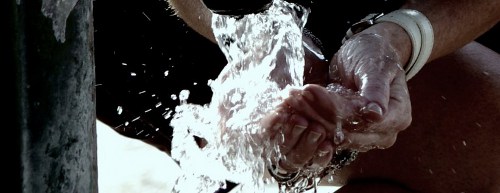
Jesus was most likely referring to Netilat Yadayim or the ritual of hand washing, which is performed by observant Jews even today. This practice is considered to be a method of purifying the person after awakening and before eating and re-dedicating his or her life to the service of God.

It’s unlikely Jesus was speaking against the practice as such in Mark (see the full text of Mark 7 for the details) but rather, he was criticizing the Pharisees for focusing on what might be considered a matter of “lesser” priority and ignoring the more “important” duty (kaloh vs. chamurah or minor vs. major mitzvos) of caring for impoverished and elderly parents (and one of these days, I’d love to research how Jesus probably did practice the halacha of his day).

For the vast majority of Christians, what I’m saying now probably seems like so much nonsense. Christianity tends to put a great deal of value on being “Spirit-led” when trying to understand the Word and the Will of God in their lives and will only rely on local authorities (for the most part) such as a trusted Pastor or teacher to help interpret the Bible. In other words, the Bible is understood on an almost exclusively individual level, though most Christians in the same church or denomination probably share many of the same opinions about what the Bible says. Interpretation for the person though, remains primarily part of the relationship between the individual and the Spirit of God (though this has rather obvious potential pitfalls).

By contrast, Judaism has a vast repository of knowledge commonly referred to as the Talmud, that contains the discussions, arguments, and rulings of a long list of sages stretching back across the centuries to before the time of Jesus. Christianity, with the exception of branches such as Catholicism, has no such tradition. The dictates of the Church fathers and the commentaries of renowned teachers and spiritual leaders, both historical figures and modern men and women, while highly valued, are not considered perpetually binding legal rulings over the lives of the devout of Christ. Rulings, authorities, and judgments in Judaism, particularly among the Orthodox, are much more defined and delineated.

Even for those parts of Christian theology that are considered binding (belief in the Trinity, belief in the resurrection of Christ, belief that people who are “saved” go to Heaven when they die, and so on), it’s hard for the collective church to imagine that “legal rulings” could continue to be issued across the passage of time and into the modern era. What new interpretation of the Bible would be necessary today that didn’t already exist in the time of Jesus and the Apostles (and I know I might be unfair in saying this since “progressive revelation” is part of the Christian belief structure)?

Consider the following:

Do not light a fire in any of your dwellings on the Sabbath day. –Exodus 35:3

Based on this commandment in the Torah, observant Jews, to one degree or another, do not light a flame on the Shabbat. Back in the days of the Exodus, this was understood in a particular way. No candle lighting, no lighting a fire in a home or at a camp, and so on.

Netilat YadayimBut no one ever thought of things like the invention of the automobile, the electric light bulb, and the microwave oven. How does the commandment to not light a flame apply to these technologies? Can an electric spark be considered “igniting” something? Once the question comes up, who gets to answer the question and decide how it is applied and to whom? After all, if you’re a devout Jew who doesn’t want to violate the Shabbat, you’ll need to know if you can start your car, warm up a cup of coffee in the microwave, or pop on a reading lamp when it gets dark on the Shabbat (and as it turns out, the ruling is that an observant Jew can do none of these things without violating the commandment).

In religious Judaism, your life is orchestrated in a beautiful but somewhat complicated dance as you progress through the days and months and years. The Torah is both instruction book and part of the mystic presence of God in your life, but who can understand the Torah and all that it instructs? The average Jew may not have the time, the mental discipline, or the necessary intellectual capacity to study the Torah and the sages in depth and thus understand his or her responsibilities to God in all matters of living. Yet there is halacha and tradition upon which a Jew can count to guide his or her steps in this dance with God and with life. These traditions, rulings, and judgments have provided continuity and consistency in Jewish communities all over the world for thousands of years. Perhaps the Torah and the Talmud have been the instrument by which God has preserved the Children of Israel, when many other people groups from the days of Moses and before have simply ceased to exist.

The Torah may be from heaven but it is not in heaven. God gave it to the Children of Israel from the hands of angels to Moses, not because God wants to control the actions of each individual Jew, but because God loves his Chosen People and wants to take care of them. And while the Mosaic covenant and thus much of the Torah is not applied to the “grafted in” Christian, the Torah was always intended to “go forth from Zion” (Isaiah 2:1-4) and to be a guide and a protector, not only of the Jewish people, but for all the people of the Earth, if they will only turn to and walk with God in faith and trust.

Why am I saying all this? Why should you care?

Perhaps, as a Christian, you don’t care and you don’t think it matters and you believe that the Torah and the Talmud is best left to the Jews. If you happen to be Jewish, you may not care about the potential applications of Torah and Talmud to Christianity. For my part, as a Christian married to a Jew, I can see great value in studying not only the Bible, but the judgments, rulings, and insights of the sages, from Hillel and Shammai to Rambam and Rashi. Unless we understand how Jewish Rabbis and learned scholars read and understand the Torah and God, how can be begin to comprehend the Jewish sage and apostle Paul and what he wrote and taught? Indeed, how can we begin to comprehend the mind, the teachings, and the actions of the Jewish Messiah, the Christ…Jesus, as he was on Earth and as he is in heaven?

Without this understanding, while we may think we understand the sacred writings of the New Testament as they are “in plain English”, we eventually must face the reality that when we Christians read the Gospels, the Epistles, and the Apocalyptic writings, we are reading a deep mystery with very few clues, and peering into a wine-dark glass, seeing only dim shapes of what God is trying to illuminate on the other side. The Talmudic scholars can be our guides into ways of seeing God and His Word that would otherwise be missing hues in our color palettes. What might we perceive if we only chose to open our eyes and look?

A true master of life never leaves this world
—he transcends it, but he is still within it.

He is still there to assist those who are bonded with him with blessing and advice, just as before, and even more so.

Even those who did not know him in his corporeal lifetime can still create with him an essential bond.

The only difference is in us:
Now we must work harder to connect.

-Rabbi Tzvi Freeman
“Connecting”
Chabad.org

He Who Desires Repentance

BalaamThe angel of the Lord then stationed himself in a lane between the vineyards, with a fence on either side. The ass, seeing the angel of the Lord, pressed herself against the wall and squeezed Balaam’s foot against the wall; so he beat her again. Once more the angel of the Lord moved forward and stationed himself on a spot so narrow that there was no room to swerve right or left. When the ass now saw the angel of the Lord, she lay down under Balaam; and Balaam was furious and beat the ass with his stick.

Then the Lord opened the ass’s mouth, and she said to Balaam, “What have I done to you that you have beaten me these three times?” Balaam said to the ass, “You have made a mockery of me! If I had a sword with me, I’d kill you.” The ass said to Balaam, “Look, I am the ass that you have been riding all along until this day! Have I been in the habit of doing thus to you?” And he answered, “No.”

Then the Lord uncovered Balaam’s eyes, and he saw the angel of the Lord standing in the way, his drawn sword in his hand; thereupon he bowed right down to the ground.Numbers 22:24-31 (JPS Tanakh)

This villain was going to curse an entire nation which had not sinned against him [merely by the power of his speech], yet he has to smite his donkey [with his hand] to prevent it from going into a field! …the donkey spoke to Balaam saying, “You need a sword in your hand to kill me? How then do you intend to uproot an entire nation with only your words?” Balaam could not think of an answer, so he kept silent.Numbers Rabbah 20:14

This week’s Torah Portion Balak could easily be called “Don’t make an ass out of yourself”. Balaam, the wicked prophet, who referred to himself as “the man whose eye is opened” (Numbers 24:4), wasn’t seeing so well when God sent an angel to stop him, three times, from cursing the Children of Israel. But lest you consider yourself superior to this ancient wizard, consider that you too have been blind when it comes to God. Paul said, “as it is written: “None is righteous, no, not one” (Romans 3:10), and his words certainly must apply to you and me. There is a difference between what we think we see and know and what we truly perceive and understand. In our arrogance and “self-confidence”, we can be humbled, even by a lowly ass.

A few months ago, I wrote a small missive about the difference between faith and trust in God. Many have faith, but trust is much more rare. Few souls attain that truly exalted level of holiness we all desire:

To one whose self is his body, death of the body is death of the self. But for one whose self is his love, awe and faith, there is no death, only a passing. From a state of confinement in the body, he makes the passage to liberation. He continues to work within this world, and even more so than before.

The Talmud says that Jacob, our father, never died. Moses, also, never died. Neither did Rabbi Judah the Prince. They were very high souls who were one with Truth in an ultimate bond—and since Truth can never die, neither could they.

Yes, in our eyes we see death. A body is buried in the ground, and we must mourn the loss. But this is only part of the falseness of our world. In the World of Truth, they are still here as before.

And the proof: We are still here. For if these high souls would not be with us in our world, all that we know would cease to exist.

-Rabbi Tzvi Freeman
“High Souls”
Chabad.org

What do you really see and who do you really trust? God?

On the 3rd of Tammuz on the Jewish religious calendar (sundown July 4th to sundown July 5th this year) is the seventeenth yahrtzeit of the Rebbe, Rabbi Menachem M. Schneerson, of righteous memory, and the yahrtzeit of an exalted sage or tzadik is traditionally a day for reflection, learning, prayer, positive resolutions and acts of loving-kindness. It is an opportunity to humble ourselves before God and before men, set aside an overabundance of confidence in our ability to “see” God and to instead, seek Him with a contrite heart and a desire to rise to a higher level of trust and spirituality.

For this occasion, Rabbi Ezra Schochet writes of Joyful Remorse; the act of repenting or making teshuvah, not with tears and anguish, but with gladness and rejoicing in our hearts.

The Rebbe continued saying that, in fact, repentance is greater than every mitzvah. Its purpose is to correct the transgression of all other commandments, it must fill the spiritual “gap” that the lack of observance engendered. Teshuvah’s ability to do so stems from the fact that it emanates from a higher spiritual source than all the others (as explained at length in the chassidic texts). And “the greater the mitzvah, the greater the joy.”

It would seem that tears and sorrow would be the more appropriate response when repenting of our sins and short-sightedness, but we see here that in performing teshuvah, we are clearing the barriers away that stand between us and God. What could be a better time to celebrate, to lift our spirits high, and to cry out and give thanks to God for desiring that we return to Him?

Blessed are you O Lord our God, King of the Universe, who desires repentance.

-from the daily prayers

Their Father’s Magic Carpet

The City of New OrleansAnd the sons of pullman porters
And the sons of engineers
Ride their father’s magic carpets
made of steel.
Mothers with their babes asleep,
Are rockin’ to the gentle beat
And the rhythm of the rails is all they feel.

-from The City of New Orleans
by Steve Goodman and Michael McCurdy

If you’ve spent much time driving on the freeway, traveling for business or vacation, sooner or later, in those expanses between city and town, you’ve seen a train or two traveling along the tracks parallel to the road. This past weekend, my niece was married at Cannon Beach, Oregon, so to attend, I left Boise on Friday morning to join my family for the event.

I was driving alone (my wife and daughter went ahead a few days before), so I had a lot of time while driving to listen to music and to think. I have a vague memory of loving trains as a boy but I’m too far away from my childhood to clearly recall any event associated with that feeling. I do remember once, many years ago, when my sons were quite young, traveling across the midwest with the family during the summer. We had stopped at a campground somewhere in Nebraska for the evening. A railroad track ran near the campground and there was a railroad museum nearby. I remember standing by the track with my boys as a train very slowly, very stately, moved down the line. We waved at the engineer and I could see a sense of wonder in the eyes of my sons as they watched something so amazingly large travel past them. From the eyes of two four-year olds, the engineer must have seemed almost like God; controlling such vast power from so lofty a height.

Then it was gone.

Once, the railroad system was the backbone of American transportation and, since the days of the Old West, it was the artery that transferred life blood from one end of our nation to another. Then, in pursuit of faster ways to travel, faster connections, faster lifestyles, and faster Internet speeds, we pulled away from the past and have hardly looked back at what we left behind. I know the refrain of “the good ol’ days” also hides some of the uglier times in our country’s history, but with the bad, and with our need to become more “progressive”, we’ve also abandoned those things that were good.

Not too long ago, I wrote a blog article about how what we know about the Bible is advancing with new literary studies and archeological finds, adding to and correcting our understanding and our database about the Word of God and what it means in our lives. While all that is certainly valid, the past and the knowledge it holds, once we leave it, doesn’t have to fade away, nor should it. If you’ve been reading this blog for any length of time, you know I quote frequently from the ancient Jewish sages and I find their wisdom as alive and fresh today as it was when their thoughts and insights were first recorded and preserved.

Steve Goodman’s lyrics (sung famously by Arlo Guthrie, son of the renowned folk singer, Woody Guthrie) relate a tale of the fading glory of the railroad, like a species from another era, once mighty, once dominating, now slowly going extinct and being replaced by something much less grand. When the “sons of pullman porters and the sons of engineers ride their father’s magic carpets made of steel”, they begin to realize that the time of the railroad is coming to an end. They will never experience what their fathers’ did; a sense of the endlessness of an epoch of romance, adventure, and tradition that seemed to stretch into infinity, as if looking at the tracks extending ahead to the edge of the horizon and beyond.

Too much of our lives get left behind for the sake of expediency and to make room for other priorities. Our faith, our religion, how and when (or if) we approach the Bible, all suffer in the same way. When we first “discover God” we are filled with a child-like wonder at the thrill of seeing the “engineer” in the cab of this massive, diesel machine, slowly crossing in front of us, allowing us just a taste of the power and rumbling majesty He controls.

Then we get older, more experienced, more used to seeing trains, more used to ignoring them, until we hardly notice when they start to fade away, maybe not as an overall presence, but in their sense of importance. Once the shine and luster begins to fade, it takes a lot of effort to get it back. Sometimes it never returns and all we have are half-memories that are more like vague feelings than the recall of what we actually said or did.

Who is God to us then?

I know. Odd thoughts for a person just having returned home from a wedding and three days of celebrating with family. But after visiting family in Portland and Cannon Beach and visiting relatives at their home outside of Washougal, Washington, I find myself thinking more of what has been lost than anything that’s been gained. I don’t know why I started hearing Arlo Guthrie singing “The City of New Orleans” in my head. He just started as I was driving home this morning, while I was leaving the Columbia Gorge behind, and I started writing this blog in my imagination as I listened to the lyrics.

And all the towns and people seem
To fade into a bad dream
And the steel rails still ain’t heard the news.
The conductor sings his song again,
The passengers will please refrain
This train’s got the disappearing railroad blues.

Good night, America, how are you?
Don’t you know me I’m your native son,
I’m the train they call The City of New Orleans,
I’ll be gone five hundred miles when the day is done.

Beyond Reason

Out of the darknessA mind directed entirely by its own reasoning will never be sure of anything.

As good as the mind is at finding solutions and answers, it is even better at finding questions and doubts.

The path of Torah is to ponder its truths, so that your mind and heart will resonate with those truths, until all your deeds are guided by a voice that has no second thoughts.

-Rabbi Tzvi Freeman
“Certainty”
Chabad.org

How many of us ever take the time to stop and think about our theology, our deeply cherished and hard fought over arguments? Recently a popular blogger I know expressed a concern about even entertaining opposing arguments lest one lose one’s faith as a result of sown doubts – to him it wasn’t a good idea to engage the opposition in a non-polemic way, that is in a way that actually allows that other peoples arguments may, by some odd chance, hold water. And then I came across the following poignant remark that puts all this into better focus.

Gene Shlomovich
Ever thought you may be wrong about your cherished theology?
Daily Minyan blog

Questioning your own faith is a horrible thing. I know. I’ve been there. I spent an entire year, actually two, questioning the assumptions of my faith in virtually every detail. Eventually, I came to a crisis and fortunately passed through it with my faith in God intact. I recall the day I discovered what this person has just mentioned at Christian Forums:

wow, I never considered that 2 Peter was not written by Peter. Some say it was, some say it wasn’t. Hmff. Is there like a guarunteed listing of who wrote what or who didn’t write what?

Actually, most New Testament scholars acknowledge that not all of the Gospels and Epistles were written by the people to whom they are attributed. I discovered this reading Bart D. Ehrman’s Jesus, Interrupted (a challenging book which I highly recommend). Once I got past this, and the fact that there actually are inconsistencies in the Bible (compare the different Gospel versions of the day Jesus died and then try to figure out which day it was…the accounts conflict), I recovered my balance a bit. Then I realized that I didn’t have to depend on the Bible reading like a history book or a court deposition in order to gain wisdom and understanding from the stories the Bible tells us.

Questioning our assumptions isn’t a disaster and in my case, it resulted not only in a “course correction”, but in a greater zeal in returning to the Bible and seeing God in the writings of the Jewish prophets, apostles, and sages. However, in Judaism, the Torah isn’t simply a document or a way to try to grasp the essence of God through study. It is so much more and to understand this, we must step outside of what we consider a “rational reality”, for God doesn’t manifest in only the material world:

The answer depends on insight into the nature of the Torah. The Torah is one with G-d, an expression of His essential will. Therefore, just as His will is above intellectual comprehension, so too is the Torah. Nevertheless, G-d gave the Torah to mortals, not because He desires their obedience, but because He is concerned for their welfare. He wants man to develop a connection with Him, and for that connection to be internalized within man’s understanding, so that G-dly wisdom becomes part of his makeup. And with that intent, He enclothed the Torah in an intellectual framework.

This intellectual dimension is, however, merely an extension of the Torah. The Torah’s essence remains transcendent G-dliness, and cannot be contained within any limits even the limits of intellect. To relate to this essence, man must approach the Torah with a commitment that transcends wisdom or logic.

-Rabbi Eli Touger
“Beyond the Ken of Knowledge”
Parshas Chukas; Numbers 19:1-25:9
Adapted from
Likkutei Sichos, Vol. XVIII, p. 229ff

Christianity doesn’t even imagine the Bible being more than the Bible; a book written under the Divine inspiration of the Holy Spirit and recorded by many different people across thousands of years. It’s hard for me to imagine that the church misses this, since it’s stated quite plainly here:

In the beginning was the Word, and the Word was with God, and the Word was God. He was with God in the beginning. Through him all things were made; without him nothing was made that has been made. In him was life, and that life was the light of all mankind. The light shines in the darkness, and the darkness has not overcome it. –John 1:1-5

Path of TorahCertainly “the Word” is not just “the word” printed on a page in a book and in fact, this particular Word “became flesh and made his dwelling among us” (John 1:14). Of the four Gospels, John’s is considered the most “mystic” and it reads more like a chasidic story, which was a large part of what attracted a young Chasidic Jew named Feivel Levertoff at the end of the 19th century, to become a Chasid (a “devoted disciple”) of the “Maggid of Nazeret”, Jesus of Nazareth.

There’s a special depth in how Jews look at the Torah and find not only information about God but actually find God inhabiting the pages that are not just pages. There, they also find devotion and longing for the coming of the Moshiach (Messiah):

Yad HaChazakah is a book of laws, not a history book. What difference does it make from the perspective of Jewish law how many Parah Adumos were offered in previous generations? Moreover, why does the Rambam go on to add a prayer for the coming of Moshiach?

With regard to the obligation to believe in the coming of Moshiach, the Rambam states: “Whoever does not believe in him, or does not await his coming, denies not only [the statements of] the other prophets, but also [those of] the Torah and of Moshe, our teacher.” In other words, mere belief in Moshiach’s coming does not suffice, we are also obligated to hope for and await his arrival.

Moreover, this anticipation is to be in accordance with our thrice-daily recitation of the Amidah prayers: “Speedily cause the scion of David Your servant to flourish. for we hope for Your salvation all day.”

-Based on the teachings of the Lubavitcher Rebbe, Rabbi Menachem M. Schneerson
A Commentary on Torah Portion Chukas

For those of us who have faith and trust in Jesus as the Moshiach, who came once and will come again, we should take even greater comfort and meaning in the insights the Rambam and Rabbi Schneerson share with us. If we depend on “knowing God” through a Bible that must be completely internally consistent and absolutely a record of historical fact, we will become confused and disappointed or we will be forced to “bend reality” and make the text to fit our needs and preconceptions. As Rabbi Freeman says, the purpose of Torah (and the Bible as a whole) is so that we can “ponder truths” (not facts), not the least of which is the truth of the Messiah in our lives, allowing God’s Word to become intertwined into the fabric of who we are and letting all our deeds become “guided by a voice that has no second thoughts”

Good Shabbos.