
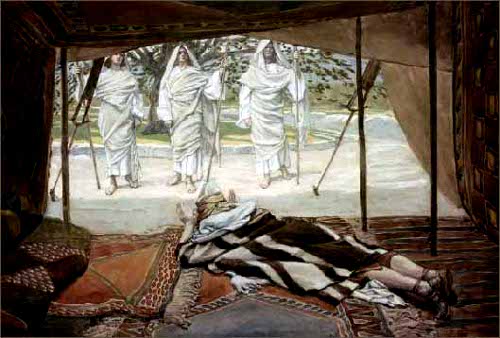
 When G-d told Noah to build an ark before the world would be destroyed, Noah built an ark.
But when G-d told Abraham He was about to destroy the cities of Sodom and Gomorrah—cities corrupt and evil to the core—Abraham argued. He said, “Perhaps there are righteous people there! Will the Judge of All the Earth not do justice?”
Abraham felt a sense of ownership for the world in which he lived. If there was something wrong, it needed to be changed. Even if it had been decreed by the will of G-d.
-Rabbi Tzvi Freeman
“Noah and Abraham”
Based on letters and talks of the Rebbe
Rabbi M. M. Schneerson
Chabad.org
I have to admit, I was a little disturbed by how Rabbi Freeman illustrates the difference between Noah and Abraham. It makes it seem like Abraham cared more for the world he lived in than Noah. Of course both Jewish and Christian commenators generally agree that it took Noah about 120 years to build the ark and that, during that period of time, Noah was trying to convince the people around him to repent of their wickedness (he wasn’t successful). So it’s not as if God told Noah that he was going to drown everyone and Noah immediately blew off humanity, only caring that he and his family would be saved.
Still, we have a tendency, no matter how much we are otherwise instructed (Matthew 7:1-6), to judge others. Once we become aware that a person has sinned, especially a type of sin we are personally offended by (maybe because it’s a type of sin we are particularly tempted by), we cut them loose from our “this person can be saved” list and let them sail away into the spiritual darkness.
No wonder the church is called the only army that shoots its own wounded.
OK, I’m probably being unfair to the church and I’m sure that there are many, many forgiving and compassionate Christians who have great love for even the most immoral of human beings. Apparently, the Rabbis teach the lesson of compassion and love for the sinner as well.
It is human nature to believe in one’s potential to destroy, but not his ability to repair. This is especially true regarding a person who transgressed a sin which is punishable by kareis (being cut off from his people). Naturally, the sinner figures that it no longer matters what he does since he has completely severed his soul from its source. The Ohr HaChaim, zt”l, explains that the error of this attitude from a verse brought on today’s daf. “Even a person who transgressed a sin punishable by kareis must never give up. This is the deeper meaning of the verse regarding leaving pe’ah in the corner of one’s field. ‘— When you reap the harvest of your land.’ This can also be understood to refer to one who violated a sin for which the punishment is kareis. Although he has uprooted his soul from its source, this does not mean that he has uprooted his soul completely. The verse continues: ‘— you shall not reap the entire corner of your field.’ Do not continue ripping out your neshama’s connection to God by transgressing further. Even one who has violated a sin punishable by kareis has only uprooted the connection forged by acting—or refraining to act—in a certain manner which caused the cut off. But his soul is definitely still connected.
“This is clear from the Arizal’s teaching about holiness. He explains that the nature of holiness is to leave an eternal trace wherever it was. We see that every mitzvah acts to strengthen one’s bond to God, regardless of his negative behavior. The Gemara explicitly writes that teshuvah helps even for kareis—or worse. This is why teshuvha reaches the throne of glory. One who does teshuvah renews the connection of his neshmaha which was hewn out from beneath the throne of glory.”
Daf Yomi Digest
Stories Off the Daf
“Not Excised Completely”
Chullin 131
 Except for the sentence of death, there was no worse consequence for a sin than to be cut off from your people (“kareis,” see examples in Genesis 17:14, Exodus 12:15, and Leviticus 23:29). There is debate on exactly what was supposed to happen if someone were worthy of kareis, but it is often thought to be some form of exile of the person from the community of Israel. It’s easy to read into this consequence a state of complete hopelessness and despair. If you are cut off from your people and from your God, what else is there? You have no place to go and there is no way back. Why continue living?
But the commentary on Chullin 131 doesn’t say there’s no hope. It does say that the person involved is in an extremely difficult and dire situation, but the “Gemara explicitly writes that teshuvah helps even for kareis—or worse. This is why teshuva reaches the throne of glory.” Even in the aftermath of the worst of all possible sins and failures, you are uprooted, but never completely cut off from God. Forgiveness is still possible. You can still turn back to Him.
The people in Noah’s time were given 120 years, as Noah built the ark, to become aware of the fatal judgment that was heading their way. They had time. They could have repented. They still chose not to. Abraham saw that God was going to destroy Sodom very soon and pleaded for whoever remained in there and who might repent and be saved (Genesis 18:16-33). In the following chapter of Genesis, you see the level of sin and depravity the inhabitants of Sodom exercised and it’s easy to imagine that the “outcry against Sodom and Gomorrah is so great and their sin so grievous” (Genesis 18:20) that they deserved complete and absolute destruction. Yet, Abraham still argued with God.
That’s a rather novel concept for a Christian. We’re generally told that God is always right and we should never argue. This has gotten us through plenty of moral puzzles in the Bible, such as those times when God has ordered the Children of Israel to completely destroy an entire people group, down to the last man, woman, child, and farm animal, because their sin was so great. But not only does Abraham question God’s judgment (very politely, though), but so does Moses, when God wants to destroy the Israelites (Exodus 32:9-10). When Jacob wrestled with the angel and won (Genesis 32:22-32), an interpretation of the event is that he was having a “moral struggle” with God. These are pictures that support humanity interacting with God on the plane of righteousness, questioning God and thereby struggling, not with God’s perfect righteous judgement, but with our own understanding of right and wrong.
Notice that in none of these examples is Abraham, Jacob, or Moses chastised or punished by God for their “effrontery” toward Him. I don’t think this means we can be casual in our relationship with God, but I do think we’re expected to be more than passive spectators in history and in life. If we can be considered “junior partners” with God in repairing the world, can we also not be involved, to some small degree, in the struggle to determine right and wrong and how justice shall be acted out in the world around us?
As people of faith, our sense of right and wrong is shaped by the Bible and how we understand its message. If some part of the Bible seems to be immoral by modern Christian or Jewish standards (or modern societal standards), what are we to do? Are we to blindly accept that the Bible is a static document with only one, static interpretation across time? Maybe we are expected to do what Jacob did and to “wrestle” with God and the text, struggling to take the underlying principles of what we are being taught and somehow apply them to a world that is far, far apart from the world in which the Bible was written.
 The more we develop as religious people, the more we must realize that we don’t have all the answers. The Bible doesn’t provide canned and complete responses for every possible moral and practical question. Like Abraham, we sometimes have to stand up and ask God if He really means something the way it’s written in the Bible or if there is some other alternate available. This is a very uncomfortable thing to do because we have to question matters of right and wrong in the world around us and in ourselves, rather than be satisfied that we’re right and “the other guy” is a hopeless sinner.
The next time you think the Bible is telling you to judge someone and that they deserve to be cut off from all civilized humanity or even to die for something they’ve done, or because of the person they are, it might be one of those times when you should be arguing with God (or perhaps yourself). That soul you are so willing to cut off may not be entirely uprooted from God and instead of casting it away, you may want to consider trying to replant it in more fertile soil.
For God loved the world with an abundant love, to the extent that he gave his only son so that all who believe in him will not perish, but will rather live eternal life. –John 3:16 (DHE Gospels)
 Morning Meditations
Content is of extraordinary quality in terms of raising our consciousness to this very meaningful concept. I applaud the author. I’m a little bit of a cynic mixed probably in equal parts with a shin kicker. Can’t help thinking that Abraham had his ulterior motive for wanting Sodom saved; his nephew resided there. Save the city, save your nephew. There is much weight however to the argument that Perhaps Abraham did have a sense of owner ship of the world, after all he was to inherit it fathering many nations.
In terms of offering God council about matters. That’s exactly the purpose for which he created us. If as with Adam you are going to exercise dominion over the world it doesn’t hurt that you care one iota. God was reconciling the world working through Jesus and has in his absence left that ministry to we who believe to continue doing that same reconciliation ministry works. It translates into the same charge as with Adam, hence Jesus is called the last Adam.
As did Adam when God brought all that he had created to Adam to see what Adam would call them and whatsoever Adam named it, that was the name thereof; we have received the mind of Christ that we may instruct God…..( 1 Corinthians 2:11—For who hath known the mind of the Lord, that he may instruct him (give counsel to God as Adam)? But we have the mind of Christ. God is never at a loss for what to do, but it is to his credit, and marvelous that he should have a sentient entity that he has created as his image tell him what to do without being in conflict with his will.)
In Christ we are subsumed into God’s vast immeasurable entity, gaining access to his measureless reach, so that all things become possible with us in him. Now when we look, we see out of God’s eyes with unlimited visibility. Isaiah 46:1—To whom will ye liken me, and make me equal, and compare me, that we may be like: (Answer: …as he is, so are we). Isaiah 40:18— 18 To whom then will ye liken God? or what likeness will ye compare unto him? (Answer: …..In the likeness of man made he them, male and female…He is to be compared to his image…that’s why we have mirrors, we want to see what we are like: we are God’s mirror “image” and his word is our mirror for comparison to what we are like…made in his likeness). We often think of what God is going to do in terms of we being separate from him. If we can overcome that crisis of identity via transformation into sons of God, we would see where, as with Adam when God brought what he had created to Adam to see what Adam would called them, and then received Adam’s council, God seeks our council, because in Christ we have a shared mind, and would have no problem with it.
My only comment to this is that I’m going to think about it for awhile. This gives me lots of food for thought.
@newgenesisres: Greetings and welcome.
Abraham is human and of course he cared about Lot and his family. Perhaps he was hoping that Lot’s family were among the righteous of Sodom and he was pleading with God for their lives. On the other hand, as you say, as a righteous man himself, Abraham would have cared for the fate of others in the world and in God demonstrating justice. This is the challenge we all face when we (apparently) see God “behaving” in a manner that seems to counter our understanding of Him. It is a challenge to who we are as people of faith, not to stand idly by, but to become involved in our world and in people, just as God is involved.
@Dree: I know this is an uncomfortable topic, but Abraham did what he did in his relationship with God. So did Jacob and so did Moses. How can we reconcile that God told each of these prophets one thing and yet they turned to God and said, “Are you sure you want to do that?”
James: your first reader said it well: ‘Content is of extraordinary quality in terms of raising our consciousness to this very meaningful concept. I applaud the author.” Seconding that….
Man is indeed fearfully and wonderfully made, in terms of how we can commune with our CREATOR it defies description. GOD actually commands us to talk to Him, to pray without ceasing. Abraham, Noah, Jacob…they were doing just that, without havingt the Bible verses we are familiar with now…
In addition, Jesus tells us in the ‘sermon on the mount’ that it is a good thing to hunger for truth and righteousness.And in scriptures like Isaiah and Psalms it tells us that the very foundations of God’s throne are truth and righteousness.
Justice for what appear to be un-Godly sinners who seem beyond redemption is certainly a part of that seeking for Justice and Righteousness, emulating our Father who is merciful. But that justice also involves the heart-rending conversations we have with Him for our own loved ones –like a nephew Lot. Surely i am not the only mother who has cried her eyes out because something has happened to a beloved child who is so ‘good’ compared to other ‘more sinful’ people who never seem to have such awful things happen to them.
But God strengtens and comforts us, He does not abandon us. David has a Psalm ( cannot recall which one right now) about this issue also, ‘Why do bad things happen to ‘good’ people, and the ‘bad’ people just seem to go on their merry way? God comforts David when he goes to the sanctuary, our sanctuary is Jesus.
What is the point in all this? It is that i think you are absolutely right, assuming i am getting the correct drift. God DOES want us to talk with Him, really really really talk to Him, like Jacob wrestling with that strange Man/Angel all night and being allowed to prevail. We were not meant to be robots in either body or mind or heart, were we?
Hi Louise,
I think most Christians and Jews see praying to God as “normative” of our faith and our relationship with God but the actual idea of “arguing” with God, and really disagreeing with what we see as a decision of His is quite another matter. God informed Abraham that He was going to destroy Sodom and Gomorrah because their sin was so great and Abraham essentially tried to talk him out of it. God informed Moses, after the incident of the Golden Calf, that He wanted to destroy the Children of Israel and start over with Moses and his family and Moses responded by saying if God was going to destroy the Israelites, He should destroy Moses, too.
We also have the example of Job who, after being put through a series of terrible trials, apparently for no reason as far as Job could see, questioned God saying, “Was that really necessary?” In the latter case, God’s response was to tell Job that, until Job became God, he had no right to question God’s judgment. Why didn’t God tell Abraham and Moses the same thing? Instead, God seemed to do what we don’t imagine God ever doing. He seemed to change His mind.
The question is, did God really alter His decision making process, or was each situation put in place to get the prophets to stand firm by what they thought of as right or wrong, even in the face of God? I admit that the topic is complex and there are probably no pat answers available, but sometimes one really good question is worth more than a thousand canned answers we hear each week from the pulpit.
My problem is rather one of too much argument with God. I’m living far too much in my own head, and rarely can I settle down enough to silence my stray thoughts and pray earnestly.
thank you, James, for clarifying the message for me. it is a helpful message ….and another day is here for opportunities for application.
Beautiful challenge. Turn that evil inclination to judge into something positive!
There’s a type of prayer that some Jews, particularly in Israel, subscribe to that suggests a person go to someplace alone, preferably out in the wilderness, or woods, or forest somewhere, and basically talk, yell,and scream our hearts out to God. I wish I could remember the name of this type of prayer. I’ve seen a 30 minute video about this type of prayer, complete with interviews, that was very illuminating. It takes a lot of the structure and formality out of Jewish prayer and inject a tremendous amount of our personality in how we talk to God.
I think there are times when we need to pray within the format of the siddur since it structures us to honor God more and express our needs less, but there are other times when we need to be who and what we are completely and I think it can create a sense of intimacy between us and our Creator. It’s not like He doesn’t know who we are anyway. People spend most of their time trying to control how other people see us, but we should be completely transparent to God.
“I wish I could remember this type of prayer.”
Hitbodedut
On Hitbodedut:
Rebbe Nachman of Breslov taught his disciples to go out to a private place, as if talking to one’s closest friend, recommending this practice for at least an hour a day. I don’t know about you, but I find it hard to engage in solitary extemporaneous prayer for more than just a few minutes.
Daniel Lancaster said that when Rebbe Nachman taught on prayer, it was as if he was pulling his teaching straight from the Gospels. Yeshua, too, taught that the best way to pray is to go in a secluded, private place, to avoid being seen by men. The gospels often have him doing just this. And Yeshua saw his relationship with God as one of a child with a father, which is not so different from conversing with Him as a “close friend.” Perhaps he was not too supportive of prayer in a minyan, if that halakha was even common in his day (I’m not sure). I don’t think he recommended the undermining of the traditional Hebraic liturgy, but that is exactly what happened in Christianity in no time at all.
Thanks Marko and Andrew for shoring up my failing memory.
Any time!
(now if I can only find my glasses…)