 Had the Hebrew roots movement started off on a different trajectory, there would never have been a need for me to say this. To most Christians, saying that “the Church is good” will sound ridiculous in its self-evidence. Yet the Hebrew roots movement’s rhetoric against Christianity and the church as been escalating for years and shows no signs of abating. For someone who is just learning about the movement, this rhetoric is often an immediate turn off – and rightly so. There is nothing anti-Christian or anti-church about the authentic core message of the Jewishness of Jesus.
-Boaz Michael,
President and Founder of First Fruits of Zion (FFOZ)
from an early manuscript his forthcoming book “Tent of David”
I had only been a Christian for a few years when I was introduced to the Hebrew Roots movement. I probably wouldn’t have entered the movement at all if not for my wife’s involvement (which she has long since exited). I was just finally getting comfortable in my church. I was just beginning to feel like I was fitting in. I was more at ease about participating in discussions in Sunday school. I had been asked to be one of the ushers during services. I was making friends. I felt like I belonged.
But through a long string of circumstances (not unlike the long string of circumstances that resulted in me becoming a Christian after the age of forty), I started attending a “Messianic Jewish” congregation. This was in the late 1990s and frankly, I didn’t know Messianic Judaism or Hebrew Roots (related concepts, but not the same thing) from anything else. But it was new and exciting and they said and taught such amazing things about Jesus, or rather “Yeshua” as he’s referred to in Hebrew. Everyone was nice (just like at church) and it was a small enough venue to where I could meet and get to know everyone fairly quickly.
But among the things I learned about was that our hands are stained with blood. More to the point (and I’m borrowing that phrase from Michael Brown’s somewhat famous book on the topic), the church is stained with blood; Jewish blood.
I won’t take this opportunity to recount to you the long and troubling history of the Christian church, especially in how it treated the Jewish people, the pogroms, the inquisitions, the spreading of the vast net of supersessionism across the world, the frightening twists of such a theology that in part, made the Holocaust possible. Others have chronicled all of this information exacting detail. I have no need to do so here.
But back then, I had no idea.
I began to realize that although I maintained my faith in Jesus, the method of my introduction to the Jewish Messiah occurred in a place that was actively opposed to his being Jewish. It was actively opposed to the Jewish people. It taught that the Jews were no longer the chosen ones of God and that they had been replaced by the Gentile Christians. How could I possibly stand for that? My wife and three children are Jewish.
It was a horrible realization.
So I went to a “congregation” and not a church. I was a “Messianic Gentile,” not a Christian. I only called the Jewish Messiah “Yeshua,” never Jesus. I wore a kippah when I went to worship and donned a tallit gadol when I entered into prayer. I haltingly prayed in very bad Hebrew using photocopied pages of a transliteration of the prayers. I only read the Apostolic scriptures (never calling it the “New Testament”) using David H. Stern’s The Complete Jewish Bible. I read the Tanakh, not the “Old Testament.”
My departure from my old church wasn’t clean. We still attended both congregations. My kids were very well-integrated into the church’s youth group and it would have been difficult to just abruptly detach them from the relationships they had there. I started to talk to my Christian friends about Yeshua, and the Torah, and Moshe, and how Paul was really “Rabbi Shaul” who taught the Gentile disciples to obey Torah.
I was treated politely but the distance began to grow between me and the people who I had just started to feel comfortable around. It didn’t help that the church was going through an upheaval at the time. The board had dismissed the Pastor for not “growing” the church to their ambitions (I still remember Pastor Jerry very fondly) and they hired a dynamic (but not nearly as personable) Pastor who had a degree in “church growth” or something like that. I disagreed with their methods and their reasoning and the rift between me and the church I had come to faith in expanded, finally to the breaking point.
This did nothing but add to the rather negative impression of Christianity I was learning from the Hebrew Roots congregation I was also attending.
I want to make it clear at this point that no one in the Hebrew Roots congregation was hostile or aggressive in terms of Christians, Christianity, or “the church.” They were (and are) all people of good will and faith who sincerely believed everything they were saying. But part of what they were saying is that traditional Christianity had gone astray and was leading many innocent people down the wrong path. The only hope was to leave the church and to form Hebrew Roots congregations that were more in keeping with Torah and the teachings of Yeshua, our Master.
I learned a great deal about Yeshua, Torah, Moshe, and my responsibilities to the mitzvot of God from FFOZ’s Torah Club as it existed back in those days (a lot has changed since then).
I won’t try to describe everything that’s happened in the last twelve years or so. Suffice it to say, I’ve changed quite a bit. I’ve spent a long decade plus investigating, examining, and growing in my faith. At this point in my life, just a few years shy of sixty, I realize how very little I really understand.
 Christianity is slowly changing. I know several Pastors of Christian churches who have realized that the replacement theology that has typically been represented and taught in churches is not a sustainable doctrine. They are, much like Anglican priest Andrew White, realizing that we cannot be Christians without knowing that the root of our faith resides in the Jewish people and in Judaism. But that doesn’t mean we have to abandon our churches and our Sunday schools and “reinvent” our faith by creating new congregations which borrow from Jewish religious practices, customs, and identity markers.
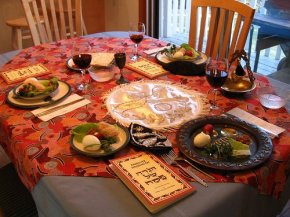
I don’t disdain the people in my former Hebrew Roots congregation. I still am friends with them, though we don’t often see each other. I continue to believe that they are pursuing their faith, the Messiah, and the God of Israel in an honest, sincere, and holy manner. The congregation as I left it and as it was every day I attended, never spoke against the church or against Christians. For virtually its entire existence, the congregation met in rooms rented from local churches. One church, which occasionally loaned us the use of their youth building for no cost, felt that helping us was their outreach to the Jewish people (though we had virtually no one attending who was halachically Jewish). All of our High Holiday and other festival celebrations took place in churches. Many Christians, including several Pastors, attended our Passover seders each year.
The church was good to us.
The church is good.
As I’m sure you’re aware, I not only write frequently on topics involving Hebrew Roots and Messianic Judaism, but I visit and occasionally comment on related blogs. I don’t comment on all of them because sadly, some are rather uncomfortable with my opinions and beliefs and some actively speak against the church, Christianity, and Christians. While not all Hebrew Roots congregations (as I’ve mentioned) are characterized by a specific rejection of Christianity, the movement as a whole (and the movement is diverse in the extreme, ranging from highly organized congregations, to fragmented Bible studies and small family living room worship groups) has an identity based on a sense of being victimized by the church.
In my time in the Hebrew Roots movement, I’ve met many people who felt betrayed by their churches and their Pastors. They were (and probably still are) angry and hurt, and their outlook on Christianity is fueled primarily by their emotions and in some cases, by what their Hebrew Roots congregational leaders are teaching to reenforce those feelings.
Again, I want to be extremely careful and say that many, many Hebrew Roots groups are not like this at all, but many, many more are, and the wedge separating Hebrew Roots believers and the traditional church of Jesus Christ is getting wider every day.
Ironically, this doesn’t mean that the relationship between Hebrew Roots as a whole and the traditional Jewish synagogue is getting any closer. Having ties in both the local Reform and Chabad groups, I can tell you that it’s much more likely for a traditional Christian to visit and be accepted in a Shabbat service or Hebrew class than it is someone from the Hebrew Roots movement, especially if the Hebrew Roots person begins “explaining” to the Rabbis what they’re doing wrong, criticizing the Talmud, or otherwise appearing to denigrate (even without meaning to) how Jews practice and understand Judaism.
So where is Hebrew Roots today and what exactly went wrong?
I haven’t sent out questionnaires or performed a scientific survey of the entire Hebrew Roots movement as it currently exists, but based on everything I’ve said so far (and over a decade of experience within the movement, including contact with dozens of congregations), I’d have to say that Hebrew Roots is wholly isolating itself both from Christianity and from Judaism.
Startling, I know. I’m sure I’ll get some “pushback” for saying that.
Again, this isn’t absolutely true of each and every Hebrew Roots congregation, but the movement as a whole, including all of the highly diverse and mixed groups, families, and individuals involved, is drifting further away from unity with both its “Hebrew” root and its “Apostolic” root.
How can this be fixed?
 There are two basic populations in Hebrew Roots. The first population, and in fact, the vast, vast majority population, is Gentile Christian. That is, people who are not Jewish who came into Hebrew Roots from the church. Only a tiny minority could be considered authentically Jewish, according to accepted halachah, by having a Jewish mother. Most of the “Jewish” members may have a Jewish grandparent or more distant relative and by virtue of that relationship, consider themselves Jewish, but they were never raised in a Jewish home, never had a traditional Jewish education, and otherwise, never experienced anything “Jewish” until entering the movement.
(I should say at this point that the Hebrew Roots movement has been around long enough to where there are young adults who have been raised in Hebrew Roots, so their background, family experience, and education comes from that source…but that’s not the same as being raised by two Jewish parents who are observant in any form of religious Judism).
How this can be fixed depends on who you are, where you come from, and what you are willing to tolerate. To prevent this blog post from growing beyond all reasonable bounds, I’ll continue this presentation in tomorrow’s “morning meditation.”
There’s hope. There’s a way out of this mess, I promise you. The path leads to our being able to serve God, both Jew and Christian alike. There is a resolution between the church and the synagogue and between Christianity and true Messianic Judaism.
That’s the journey we will continue tomorrow with Part 2.

 Moshe was going to die before entering Eretz Yisroel. Yet, his tefillos were answered, and he was given permission to view the holy land, and to see a vision of the land and the history of the Jewish people. When this consent was granted, the verse seems to use a double expression. First, Moshe was told “lift up your eyes”. This directive was followed with the instructions “and see”, which apparently is the obvious purpose of his having lifted up his eyes.


 Morning Meditations