Collapsing the Tent of David

Then the LORD God said, “It is not good for the man to be alone; I will make him a helper suitable for him.”

Genesis 2:18 (NASB)

Then Paul took the men, and the next day, purifying himself along with them, went into the temple giving notice of the completion of the days of purification, until the sacrifice was offered for each one of them.

Acts 21:26 (NASB)

One person regards one day above another, another regards every day alike. Each person must be fully convinced in his own mind. He who observes the day, observes it for the Lord, and he who eats, does so for the Lord, for he gives thanks to God; and he who eats not, for the Lord he does not eat, and gives thanks to God.

Romans 14:5-6 (NASB)

You’re probably wondering what those different portions of scripture have in common. Actually, relative to my experiences last Sunday, quite a lot.

The topic of both the sermon and the Sunday school class at church was Acts 21:15-26. It was a source of a great deal of frustration for me, but I have to be thankful to Pastor Randy for cluing me in about something first.

He reminded his audience of the great accomplishments of the Jewish people and Israel across the centuries, and made sure that we all got the idea that God didn’t do away with the Old Testament (Tanakh), the nation of Israel, and the Jewish people.

He also let us know that, in the debate over whether or not Paul did the right thing by paying the expenses of the four men under a vow at the Temple and offering sacrifices, over half of those historic and modern scholars upon whom Pastor depends for his research strongly believe that not only did Paul make a mistake, but that he sinned by participating in the Temple rites.

Fortunately, Pastor doesn’t agree with that opinion (and neither do I) and in listening to various people conversing after the sermon, I was relieved to hear that most (but not all) of the people around me have the same opinion as Pastor.

But Pastor kept repeating that offering sacrifices doesn’t atone for sins, it never did. This reminded me of time after time during our previous private discussions, when talking about the continuation of Torah observance for the Jewish people including Jewish believers, he kept stressing the same point.

However, while listening to the sermon, I had something of a minor revelation similar to the one that resulted in me writing The Two-Thousand Year Old Christian Mistake.

You see, I agree with Pastor that the sacrifices in and of themselves have no power to atone for sins and to save a human being from the consequences of God’s justice. We are only saved through faith and out of that faith, we obey God. That’s what Paul and every other Jew who sincerely participated in the Temple rituals was doing. Obeying God out of faith.

So why beat up the Torah by saying it doesn’t save when I fully agree that simple, mechanical performance of the mitzvot with no intent or faith behind it is just going through the motions?

Some men came down from Judea and began teaching the brethren, “Unless you are circumcised according to the custom of Moses, you cannot be saved.”

Acts 15:1 (NASB)

This has alway puzzled me because circumcision (that is, the physical act of being circumcised and then observing the Torah commandments) isn’t what saves a person, and these gentlemen from Judea should have known that. Of course, they should have known that.

But that’s not what they meant.

When an Evangelical Christian reads that verse he or she thinks the Jews involved are saying that performing the mitzvot including the sacrifices in the Temple is what saves. But they were never meant to save. They are the conditions of the covenant relationship with God and that relationship in covenant, through faith, is what saves.

Oh duh.

Why didn’t I see this before?

Irony of GalatiansThe big hang up Christians have with the Torah is because of a misunderstanding of what the folks they call “Judaizers” were saying (Nanos more aptly refers to them as “influencers” since New Testament scholars can’t seem to agree on exactly who these people were. See The Irony of Galatians).

The “influencers” Paul refers to in his epistle to the Galatians and the Jews we hear from in Acts 15:1 weren’t saying that obeying the mitzvot and making the various sacrifices at the Temple would save the Gentile. They were saying that the Gentiles needed to be in a covenant relationship with God in order to be saved.

Especially for non-Jesus-believing Jews, the New Covenant times weren’t even on the horizon. How could they be? From their perspective, Messiah had not yet come. Thus, the Gentiles had no standing before God unless they became proselytes and entered into the Sinai covenant with God as converts to Judaism. Being a God-fearing Gentile might have been a step in the right direction, but it wasn’t a covenant relationship.

But Paul and many of the disciples of Yeshua (Jesus) knew that the New Covenant had been inaugurated with the death and resurrection of the Master, so through faith in Messiah, the Gentiles could be grafted in and benefit from the blessings of that covenant, which had begun to enter the world but had not yet completely arrived.

If you miss the distinction, that it’s being in a covenant relationship with God through faith that saves rather than just the literal behaviors of the conditions of a covenant, you completely misunderstand the Jews advocating for Gentile conversion.

These “Judaizers” or “Influencers” weren’t bad, awful, evil people. They may have had genuine concern for the Gentiles who had attached themselves to the Jewish religious movement of “the Way”. These Jews, some of whom could have been Jesus-believers with an incomplete understanding of the New Covenant blessings upon the Gentiles, may have been authentically puzzled why Paul was treating the Gentiles as if they were equal co-participants, both socially and in covenant, in Jewish religious life. They may have felt that the Gentiles couldn’t participate in covenant blessings without conversion, because they didn’t see any other way to reconcile the Gentiles to God.

Paul understood, but his viewpoint wasn’t always terribly popular with Jewish populations who didn’t apprehend his vision (figuratively and literally).

Once you figure it out, you realize the issue was never that the mitzvot saved, it was Covenant relationship. It always has been and it’s still the issue we struggle to comprehend today. Jews are the focus of almost all of the covenants we see in the Bible including the Sinai and New Covenants. Gentiles are included under a single provision of the Abrahamic covenant and by faith in Jesus, in the blessings of the New Covenant.

And that’s what I got out of last Sunday’s sermon, not that Pastor explained it that way, but by his preaching, I finally made the connection.

Things didn’t go so well in Sunday school. I was determined to make only one statement in class. I could have talked all day long about the Christian traditions that were being imposed on the text resulting in quite a few (in my opinion) erroneous assumptions being made by most of my classmates. One fellow pointblank told me Paul did sin because when Jesus was crucified, the sacrifices ended. I disagreed of course, and gave him a mini-explanation of what the Epistle to the Hebrews was really about, but I knew it was for nothing.

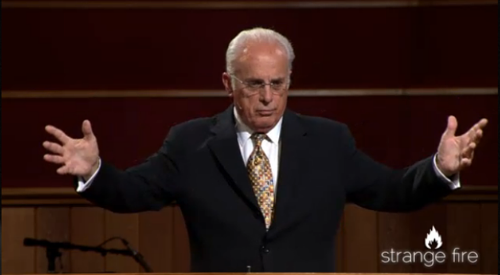
My Sunday school teacher heavily favors the sermons of John MacArthur and it is MacArthur’s opinion that the practice of Judaism by Jesus-believing Jews as we see it in the Book of Acts, was a transitional period between Jewish practice being within the will of God, and it being replaced by the grace of Jesus Christ, effectively extinguishing the “ceremonial laws” in the Torah.
MacArthur
John MacArthur

Teacher said it was MacArthur’s opinion that God was being patient and tolerant of the Jesus-believing Jews, including Paul, who continued in devotion to Hashem by davening at the set times of prayer, offering sacrifices in accordance to the commandments, observing Shabbos, keeping kosher, and all of the other portions of the Law that had been “nailed to the cross with Jesus.”

But there’s an apparent contradiction. In Acts, Luke depicts Paul as very pro-Torah, pro-Temple, pro-Jewish people, and pro-Judaism. However, a number of Paul’s letters, principally Galatians, seem to cast Paul in the role of being anti-Torah. That was the foundation for my comment in class when the issue of Romans 14 and the identity of the “weak” and “strong” (basing my opinion on Nanos in The Mystery of Romans) came up.

It was like I was talking in a language no one in the room understood. I saw quite a few blank stares, like no one could figure out what the heck I was talking about. One fellow, who is quite intelligent and well-read (and who holds a highly traditional Evangelical Christian view on the Bible) referenced Romans 14:5-6 to explain that it was (at that time) OK to either observe the Law or not observe the Law as long as it was for the sake of the Lord.

In other words, no one even understood my question and so they had no idea they had completely missed my point.

I let it go rather than continue to be a source of confusion and aggravation and after all, teacher said this was a lesson about unity.

Unity. That totally baffled me until I realized he meant Paul agreed to undergo the Temple ritual and humble himself to James and the Elders in Jerusalem as kind of “going along to get along.” They saw Paul as compromising in order to keep the peace, rather than standing his ground about the lack of validity in Jewish tradition, custom, and observance.

There was no way anyone in the classroom could have possibly imagined that Paul might have wanted to offer sacrifices and looked forward to participating in the Temple ritual, especially during the Holy Festival of Shavuot (although they all acknowledged why Paul should have totally been jazzed about Pentecost…the Acts 2 Pentecost, not the Greek word for the Jewish moed).

I spent the rest of the class time in a forced silence, so I was in a “terrific” mood when I left church and made the ten or fifteen minute drive back home.

When I walked in the kitchen trolling for lunch, my wife made the mistake of asking me how church went, and I made the mistake of telling her.

Then she reminded me of her role according to God:

And the Lord God said, “It is not good that man is alone; I shall make him a helpmate opposite him.”

Beresheet (Genesis) 2:18

IntermarriageThe translation I found at Chabad.org is a bit different than you’ll find in most Christian Bibles, and as I understand it, implies that God created woman to oppose her husband under certain circumstances.

Women can often cut through the fog that surrounds a man’s mind and get to the core of a matter, whether we like it or not.

My wife told me I was being arrogant if I thought I was going to change anyone’s mind, especially if that was any part of the reason I was going to church.

I got mad at first, but spending some time in the backyard pulling weeds gave me time to think.

I have been arrogant. I’ve walked into someone else’s religious and social space with the assumption that I had anything to offer them; that I had anything they wanted at all.

As it turns out, I have nothing to offer and certainly nothing anyone at church wants to hear or learn. I may think what I’m learning and how I understand the Bible is worthwhile and illuminating, but obviously I’m in a world of people who don’t see things like I do.

I kind of thought that was the point, but I’m realizing I’ve been wrong. I have no right to impose my point of view or to disagree with the people who are running the show at church. It’s their church. I’m just a glorified guest. I’m not a member and I couldn’t become a member with my current perspectives and attitudes.

My Sunday school teacher’s emphasis on unity is really the Church’s (big “C”) attitude about community. People must agree with each other for the sake of peace and unity because Christians believe certain things.

Whenever I make some sort of theological statement that conflicts with how my wife sees her convictions, she tells me “what Jews believe,” which largely comes from the local Chabad Rabbi. He tells her what Jews believe and helps orient her to a Jewish religious perspective (not that she in any way is Orthodox). So I should have realized there are certain things Christians believe too, and making some sort of theological statement that conflicts with how people in Sunday school see their convictions elicits the same response from them as I get from my spouse.

I have been arrogant, and naive, and just plain stupid.

I feel like an idiot and I feel ashamed.

I also have to question why I’m going to church, any church. In his book Tent of David, Boaz Michael emphasized that the “Messianic Gentile” must have the right attitude, one of humility and fellowship, when returning to (or staying in) church and being a sort of “light to the nations…uh, Christians.”

I blame myselfBut there’s a light you shine to help people see the path, and then there’s the really bright, annoying light you shine in people’s faces until they yell at you to turn the darn thing off.

If the “Tent of David” were inflatable, then I’d be guilty of letting at least some of the air out. I certainly feel deflated.

The Internet went out at my home on Sunday afternoon (long story) so I wasn’t able to write this blog post when my emotions were running high. That’s a good thing. I’ve had a day or so to mull things over and to cool off.

I know I disagree with most (or all) of the people at church about many things, and I have good reasons (whether anyone agrees with those reasons or not) why I believe what I do, but the people around me every Sunday morning are under no obligation whatsoever to care what I think and feel, particularly when it flies in the face of their Biblical and world view.

So I’ve got one of three options as I see it: Do what I’m doing now and continue to be an irritant not to mention desecrating the name of God, continue to go to church while keeping my big mouth shut and not participating in discussions, or leaving church and let bygones be bygones.

Frankly, in the eighteen months or so I’ve been going, I may have contributed a few positive things in church, but for the most part, no one knows what to do with me, or if they’ve made up their minds (and some have), they know they want nothing to do with me.

I’ve ruined more relationships, both face-to-face and online, by spewing my opinions and putting people off.

I’ve been letting the air out of David’s Tent or maybe I’ve been taking tools of mass destruction to it. I was supposed to be inflating it, constructing it, building it up, but now the thing is beginning to collapse around my ears. Maybe it should collapse around my mouth.

No, it’s not my mouth, it’s my attitude. I just got so caught up in what I know, that I forgot about what’s most important.

Any dispute which is for the sake of Heaven will ultimately endure, and one which is not for the sake of Heaven will not ultimately endure.

-Pirkei Avot 5:20
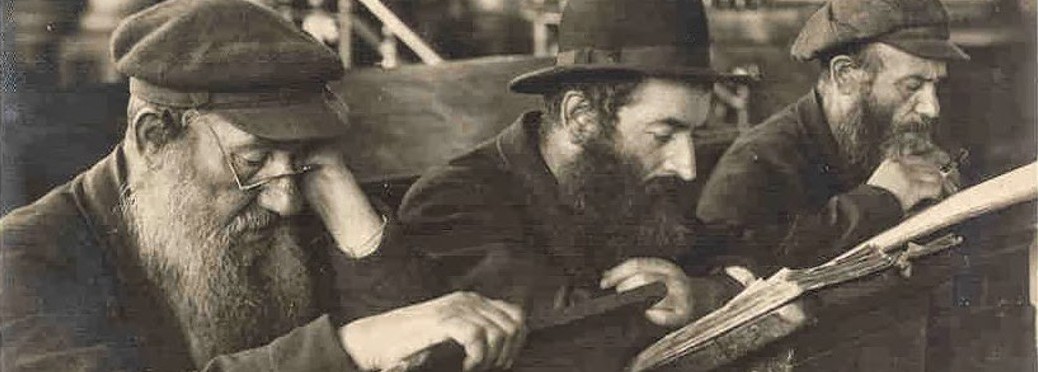
Hitler’s Final Solution, the Oral Torah, and its Meaning to Christianity

These are the statutes and the judgments and the teachings (Toros- plural of Torah) that HASHEM gave between Himself and the Children of Israel at Sinai through the hand of Moshe.

Vayikra (Leviticus) 26:46

Toros: One (Torah) Written and one (Torah) Oral. This informs that both were given to Moshe at Sinai.

-Rashi

This is a critical and oft underappreciated nugget of information. Not one Mitzvah in the entire Torah is capable of being carried into action given only the parameters provided in the text. There are almost 30,000 details that comprise phylacteries and 5,000 in the ubiquitous mezuzah with little information to guide to their uniform completion. What’s called “killing”? When does life begin? When does it end? What one person calls “family planning” another may legitimately define as “murder!”

The Torah cries out for explanation. There must, by definition, have been a concomitant corpus of information that accompanied the giving of the laws and that is what we call the “Oral Torah”. Rabbi Samson Raphael Hirsch uses the analogy that the Written Torah is like the notes to a scientific lecture. Every jot and squiggle has significance. If properly understood it can awaken the actual lecture. The notes remain useless to someone who has not heard the lecture from the Master. Therefore in the Oral Torah is the sum of the lecture while the Written Torah is merely a shorthand record. Without an Oral Torah that book the whole world holds in such high esteem, the Bible is rendered in-actionable. It becomes a frozen document that cannot be lived. Unfortunately, so many over the ages have become lost due to a failure to appreciate this single point and its significance for our very survival as a people.

When my wife and I were engaged, at the party there was a cousin of hers that has written voluminously about the holocaust. He himself survived, somehow, seven concentration camps. One of the Rabbis encouraged him to speak. He claimed to be unprepared and not a good English speaker. He spoke amazingly well.

-Rabbi Label Lam
“Understand it Very Well” (2007)
Torah.org

Rabbi Lam got my attention when he wrote, ”Not one Mitzvah in the entire Torah is capable of being carried into action given only the parameters provided in the text.” Most of what I hear about the Oral Torah from Evangelical Christians is that it’s all a bunch of made up rules and cannot be considered the valid Word of God. Many in the Christian Hebrew Roots world say the same thing, believing it is possible to observe the mitzvot based on the Written Torah alone.

And yet Rabbi Lam says this is impossible.

Moses received the Torah from [G-d at] Sinai and gave it over to Joshua. Joshua gave it over to the Elders, the Elders to the Prophets, and the Prophets gave it over to the Men of the Great Assembly. They [the Men of the Great Assembly] would always say these three things: Be cautious in judgment. Establish many pupils. And make a safety fence around the Torah.

-Pirkei Avot 1:1

Talmudic RabbisOrthodox Judaism generally believes that the Oral Torah was handed down in an unbroken chain as described above. Given the history of Israel’s exiles, that seems difficult to believe.

Even the written Torah was lost for a great deal of time and when it was found (2 Kings 22:8-13), King Josiah ”tore his clothes” because ”great is the wrath of the Lord that burns against us, because our fathers have not listened to the words of this book, to do according to all that is written concerning us.” If the words of the Torah had been lost even though written, how much more so can it be true that the original Oral Torah given to Moses could have been forgotten?

But that doesn’t mean Oral history didn’t accompany the written Torah in some matter or fashion across the many centuries. The Oral tradition just might not have survived intact from its earliest inception. That is, what Judaism understands to be Oral Torah now may not be entirely traceable back over three-thousand years.

I’ve repeatedly suggested that the “Jerusalem letter” we saw crafted in Acts 15 as a set of instructions for new Gentile disciples of Jesus, had to have been accompanied by oral instructions because the “four essentials” of the letter are so barren. It’s quite possible that the Didache is the documentation of the original oral instructions for the Gentile disciples, so oral information being transmitted across time to explain written instruction isn’t foreign to early Christian tradition.

Just recently, I said I thought later Christian commentary was a refactoring of the original Jewish understanding of the scriptures, and my statements were inspired by comments made by New Testament scholar Larry Hurtado on his blog, including this paragraph:

But I suspect that if Paul were asked whether Jesus was the “second person of the Trinity,” he would likely have responded with a quizzical look, and asked for some explanation of what it meant! Were the patristic texts and creedal statements saying something beyond or distinguishable from what the NT texts say? Certainly. Does that invalidate those later creedal discussions and formulations? Well, if you recognize the necessity of the continuing theological task (of intelligently attempting to articulate Christian faith meaningfully in terms appropriate and understandable in particular times and cultures), then probably you’ll see the classic creedal statements as an appropriate such effort. (emph. mine)

-Hurtado, Jesus, “Pre-existence,” etc: Responding to Questions

Rabbi Label Lam
Rabbi Label Lam

Put all together, we can paint a picture of an Oral set of instructions accompanying the written Torah, perhaps changing over time to respond to the differing demands and requirements of ”particular times and cultures.” If Judaism is guilty of this process, so indeed is Christianity. We just don’t talk about it.

I’m including the rest of the quote from Rabbi Lam’s article because it includes important points from history, and we ignore history at our own peril.

First he looked out at a room filled with newly observant Jews and wondered aloud, “Where do you people come from?” He then quoted the Talmudic principle, “Torah returns to those who have hosted it.” He explained, “If you are sitting here today then it’s probably because you have some great ancestors who were willing to and did give blood to keep this Torah alive.” He went on to talk about my wife’s and his illustrious family tree.

Then he said that had he known he was going to speak he would have brought with him a document he held in his hands that morning that answered a question that had been nagging him for almost four decades. “We all know Hitler’s “final solution” for European Jewry. What was his global scheme? Where was his plan to eliminate the rest of world Jewry?” He then paraphrased what he had learned from that document. Here is a printed transcript with a partial English translation:

“This document transmits a memorandum dispatched by I.A Eckhardt from the chief of the German Occupation Power. It is an order dated October 25, 1940 from das Reichssicherheitshauptamt-the central office of the German Security Forces to the Nazi district governors in occupied Poland, instructing them not to grant exit visas to Ostjuden- Jews from Eastern Europe. The reason behind this order is clearly spelled out: the fear that because of their “Othodoxen einstellung” their orthodoxy, these Ostjuden would provide “die Rabbiner und Talmudleher” – the Rabbis and the teachers of the Talmud, who would create “die geistige Erneuerung” the spiritual regeneration of the Jews in America and throughout the world.”

The Oral Torah is essential for our existence as a people. It is our most vital organ and instrument for survival. Without it we are immediately lost. It makes sense that those who plan our demise understand it very well!

Even the reprehensible Nazis understood the power of the Talmud and Rabbinic rulings and traditions to save the Jewish people, particularly in the face of certain disaster. We see here that beyond the extermination of the six million Jewish victims of the Third Reich, the Nazis had plans to prevent the rest of world Jewry from learning of the so-called “final solution,” for fear that the Jews in America wouldn’t be easy targets if prepared (assuming the Reich was victorious in conquering the world, which, Baruch Hashem, they were not).

Holocaust survivor David Faber

Oral Torah, which was eventually recorded in writing and then adapted repeatedly as circumstances required, was responsible for Jewish survival during a two-thousand year history where the world was continually trying to destroy them. For this reason alone, we should be thankful for the Jewish adherence to Talmud, but as I’ve already stated, in many ways, Christianity in its various forms including Protestantism, has a parallel set of “oral law” upon which it relies to define Biblical application across the changing historical and cultural landscape.

I only ask that the Evangelical Church “come clean” and admit that we have our own oral traditions that were eventually written down and upon which we continue to depend to define our faith. Just don’t let our traditions diminish the Jewish people and national Israel in any sense, or we might find ourselves “on the wrong side of God.”

If You Had to Choose Between Jesus and Your Spouse…

If someone comes to me and does not hate his father and his mother and his wife and his children and his brothers and his sisters and even his own life, he is not worthy to be my disciple.

Luke 14:26 (DHE Gospels)

I know I’m quoting this verse out of context, but I find it hard to reconcile with the following.

Have you not read that from the beginning the Maker “created them male and female,” and it says, “Therefore a man shall leave his father and mother and cling to his wife, and the two will become one flesh”? If so, they are not two any longer, but one flesh. Thus, what God has joined, man must not divide.

Matthew 19:6 (DHE Gospels)

On the one hand, Jesus seems to value marriage quite highly (what God has joined) but on the other hand, we are to reject (hate) our family including our wives, presumably if our family opposes our becoming disciples of Jesus.

As an intermarried husband, this is particularly difficult for me, especially when I see my marriage through this scripture:

But to the rest I say, not the Lord, that if any brother has a wife who is an unbeliever, and she consents to live with him, he must not divorce her. And a woman who has an unbelieving husband, and he consents to live with her, she must not send her husband away. For the unbelieving husband is sanctified through his wife, and the unbelieving wife is sanctified through [h]her believing husband; for otherwise your children are unclean, but now they are holy. Yet if the unbelieving one leaves, let him leave; the brother or the sister is not under bondage in such cases, but God has called us to peace. For how do you know, O wife, whether you will save your husband? Or how do you know, O husband, whether you will save your wife?

1 Corinthians 7:12-16 (NASB)

Also, Ephesians 5:22-33 says many fine things about marriage and how a husband and wife are to love one another. How can God join us together, tell us how to love, say that it is acceptable for a believing spouse to be joined with an unbelieving spouse if both are willing, and then tell the husband he is not worthy of being a disciple is he does not hate his wife?

intermarriageThis is one of those “difficult sayings of Jesus” that isn’t easy to answer.

Messianic or “Jewish-friendly” Christian commentaries on such specific topics aren’t always readily available, but I did find a conventional Christian response by Pastor Mark Driscoll. I know nothing about him, but he did write something detailed on this particular verse.

Jesus’ call to discipleship can be difficult. Contrary to common practice today, Jesus was not in the business of getting anyone and everyone he could in the door of his discipleship program. Instead, he took painstaking measures to clarify the costs of following him. Those who heard him often abandoned their pursuit after hearing his messages (John 6:52–71). In keeping with this truth, Jesus’ requirements for discipleship set out in Luke 14:26 are hard for us to hear.

Thankfully, there is another sense for the word “hate,” as it pertains to this passage. When it’s used in the Old Testament, particularly in the Wisdom Literature, the word loses its psychological force (Michel, “μισεω,” in TDNT, 4:687.). Instead, it carries a sense of intensified choice. For instance, in Proverbs, the writer often instructs the reader to choose righteousness over evil, often worded in terms of love and hate. The call is to reject (= hate) evil and to embrace (= love) righteousness. In Jesus’ statement here in Luke 14:26, the same principle is at play.

-Driscoll, “Tough Text Tuesday – Luke 14:26”
pastormark.tv

That helps a little but not as much as you might think. Still, the suggestion of a choice between two paths reminded me somewhat of a Kal va-chomer or “lighter to heavier” argument. If I reword the passage from Luke 14, I could say, “If you love your wife whom God has joined with you, how much more should you love Messiah, who God brought for the sake of the world?”

I suppose that could be worded better, but you get the idea. No, I’m not rewriting the Bible, far be it from me to do so. But I am suggesting in my own wee commentary (call it a small midrash, for what it’s worth) that, even if my wife is an unbeliever, I don’t have to hate her so I can love Jesus. I can love my wife, and I can also apprehend the great requirement to love and be devoted to Messiah, Son of David, who is the living embodiment of God’s promises for atonement, redemption, salvation, and the resurrection. He is the hope, not just for me, but for everyone. He is the hope that someday my wife will be saved, so in a way, by choosing him, I am also choosing her, for if I should choose her by rejecting Jesus, then how do I know I’m not dooming us both? Loving Jesus then, is also loving my wife.

Did Paul Know Jesus was the Second Person in the Trinity?

First, a quote: “The Church cannot indefinitely continue to believe about Jesus what he did not know to be true about himself,” J. W. Bowman, The Intention of Jesus (London: SCM, 1945), p. 108.

This is not really a historical claim but a theological one, and it reflects a common assumption: The assumption that the theological/religious validity of claims about Jesus rest upon what Jesus believed and taught about himself. In my book, Lord Jesus Christ (pp. 5-9), I’ve noted the irony of how this assumption has been shared by critics and advocates of Christian faith, and also how it has worked mischief in the historical investigation of Christian origins.

-Dr. Larry Hurtado
“Questioning a Common Assumption,” May 13, 2014
Larry Hurtado’s Blog

Dr. Larry Hurtado has been prolifically writing on something rather compelling over the past few days. Did Jesus know he was Divine during his “earthly ministry?” Did Jesus know he was to be an object of worship?

I think most Evangelicals would assume the answer to those questions is a resounding “yes,” but here we have one of the most preeminent New Testament scholars in the world drawing that assumption into question. I think Hurtado’s comments deserve further scrutiny.

(NOTE: I should mention here that I have no intention of matching my meager brain power and limited knowledge of New Testament scholarship with Dr. Hurtado’s. I merely want to bring this issue to my readership in order to explore what he presents on his own blog and to see what responses his viewpoints elicit here.)

Looking at the evidence in the New Testament, Hurtado concludes that the “high” view of Jesus as Divine Messiah didn’t emerge until what he calls “post-Easter.”

But I’d like to make two observations. First, the earliest extant Christian texts themselves make it perfectly clear that the “high” notions about Jesus sharing in divine glory, exalted to heavenly status, worthy of worship, etc., all erupted after Jesus’ ministry, not during it, and that the crucial impetus for these notions was what earliest believers saw as God’s actions, particularly their belief that God had raised Jesus from death to heavenly glory. (See, e.g., Philippians 2:9-11; Acts 2:36).

To underscore the point, the remarkable escalation in the status/significance of Jesus to the “right hand” of God, to sharing the divine name and glory, and to the central and programmatic place he held in earliest Christian devotional practice all rested on the fundamental conviction that God has exalted him and now required that Jesus’ exalted status be recognized, and that he should be reverenced accordingly.

My second observation is this: Why should this be taken as some kind of threat to the theological legitimacy of traditional Christian faith?

-Hurtado, ibid

Larry Hurtado
Larry Hurtado

This sounds like it was only after the resurrection that it was known to anyone else including Jesus that he was indeed the Divine Son of God the Father.

I think a lot of people would find that startling, but as Hurtado says above, why should that be a threat? And yet on the aforementioned blog post and two others, many, many comments were generated, some of them rather “impassioned.”

Indeed, more explicitly than any of the other Gospels, GJohn makes it clear that the author saw and accepted a distinction between what he regarded as the level of understanding of Jesus among his followers during his earthly life and the subsequently enhanced level of understanding in the “post-Easter” period.

But my point here is that even GJohn doesn’t make the high Christological claims affirmed by the author rest simply (or even particularly) on demands and teaching of the earthly Jesus. Instead, the text fully affirms that the realization of Jesus’ glorified/glorious status came subsequently, through the revelations of the Spirit.

-Hurtado, Jesus and Christology: The Gospel of John as a Case Study, May 14, 2014

Hurtado wrote this as a follow-up to his prior missive, which continued to inspire passionate discourse, and based on those comments, he wrote a third blog post, Jesus, “Pre-existence,” etc: Responding to Questions on May 15th.

He breaks his response down into four points to which he comments on his blog at length:

  1. His response to his emphasis that the NT makes God’s actions (esp. in raising Jesus from death and giving him glory) the basis for the “high” Christological claims and the remarkable devotional practice in which Jesus was included with God.
  2. His position about texts such as John 1:1-2, where, of the “Logos” (here, the “pre-incarnate” identity/form of the incarnate Jesus), we read: “he was with God and he was God”.
  3. What we are supposed to make of statements ascribing “pre-existence” to Jesus (to use the typical theological buzzword). If you entertain these, how could Jesus not have known this and spoken of it?
  4. What about subsequent creedal controversies and formulations? E.g., the three “persons” (or “hypostases”) that comprise the “Trinity,” etc.?

I don’t want to re-create the full content from Hurtado’s blog and reader comments, but I do want to draw attention to one particular paragraph (for full context, please use the links I provided and read all three of Hurtado’s posts):

But I suspect that if Paul were asked whether Jesus was the “second person of the Trinity,” he would likely have responded with a quizzical look, and asked for some explanation of what it meant! Were the patristic texts and creedal statements saying something beyond or distinguishable from what the NT texts say? Certainly. Does that invalidate those later creedal discussions and formulations? Well, if you recognize the necessity of the continuing theological task (of intelligently attempting to articulate Christian faith meaningfully in terms appropriate and understandable in particular times and cultures), then probably you’ll see the classic creedal statements as an appropriate such effort. But that’s a historical judgement about that later period, and/or a theological judgement. And my emphasis is on the historical question of what the NT texts say and how to understand them in their own historical context.

-Hurtado, Jesus, “Pre-existence,” etc: Responding to Questions

This goes not only to what Jesus thought of himself prior to his crucifixion and resurrection, but what Paul and the Jesus-believing Jews (and Gentiles) believed about the nature of Christ relative to God during the Biblical period.

The Jewish PaulDid Paul believe in the Trinity? Again, an Evangelical wouldn’t miss a beat in saying, “Yes, of course,” but again, we have Hurtado, who we have every reason to believe is presenting a credible case from current NT research, saying that Paul wouldn’t have a clue about the Trinity.

I should mention that Derek Leman at Messianic Jewish Musings has been writing a great deal about the Divinity of Jesus lately, and a lot of his perspectives are based on Hurtado. His own research and conclusions will be presented in his forthcoming book Divine Messiah, which should be available for digital download from Amazon as early as May 23rd, so maybe Leman’s text will offer some insights.

In addition to my recent commentary on Zetterholm and the implications of his research on our view of the Church, I’ve recently read an article at Bible History Daily called The Origin of Christianity by Noah Wiener, which is a review of Geza Vermes’ work, From Jewish to Gentile: How the Jesus Movement Became Christianity (November/December 2012 issue of Biblical Archaeology Review).

By contrast, the early second century Epistle of Barnabas shows a distinctly gentile Christianity in its presentation of the Hebrew Bible as allegory instead of covenantal fact. The clearly divinized Jesus in this document is distanced from the Jewish Christians and the divide between the Christian communities continued to widen over time. Geza Vermes writes that after Hadrian’s suppression of the Second Jewish Revolt, the Jewish Christians quickly became a minority group in the newly established church. At this point we can see the origin of Christianity as a distinctly non-Jewish religion; late in the second century, the Jewish Christians either rejoined their Jewish peers or become part of the newly gentile Christian church.

-Wiener

The implication here, as I’m reading it, is that many of the Biblical truths we hold onto as Christians were conceptualized and codified after the Gentiles formed the Christian Church and left Jesus-worship within the Jewish context. In other words, the Jewish apostles and disciples wouldn’t have imagined many of the theologies developed later by the Gentiles in relation to their own understanding of scripture (the Tanakh/Old Testament) and of the teachings of Messiah. In fact, Jesus himself, even “post-Easter,” may not have seen/see himself as “the second person of the Trinity,” at least not using that particular language.

This isn’t to deny the Divine nature of Messiah, the profound mystery of him being “the visible image of the invisible God,” (Colossians 1:15) or his sitting at the right hand of the Father in all exalted honor and glory, but exactly how we see the nature of Jesus may be based more on Evangelical assumptions and long-cherished traditions than how the original authors of the Gospels and Epistles actually understood the nature and character of Messiah.

It seems clear then, that the origin and development of Christianity as a completely separate entity from the ekklesia we see recorded in the Bible, departed from the original theological and doctrinal template taught by the apostles, and I imagine Paul, witnessing the Evangelical Church of the twenty-first century CE, would find little if anything to relate to or even recognize as devotion to Messiah, Son of David.

Any thoughts?

Zetterholm, Nanos, Ancient Antioch, and Some Implications

…and the disciples were first called Christians in Antioch.

Acts 11:26 (NASB)

I mentioned in my previous blog post, Zetterholm, Ancient Antioch, and “Honey, I Want a Divorce”, that I wanted to discuss the implications of the final chapter in Magnus Zetterholm’s book The Formation of Christianity in Antioch on a number of different religious communities.

Obviously, there are implications for the modern Church, but also I see how ancient and modern Judaism is significantly impacted, as are the Messianic Jewish and Hebrew Roots movements. I’ll take each one in turn.

Christianity

Based on what Zetterholm concluded regarding the forced separation of Gentiles and Jews in the Jesus-believing communities which resulted in Gentiles forming their (our) own brand new religion called “Christianity,” we can see that we weren’t kicked out of Jesus-believing Judaism. We rebelled like a petulant teenager and walked out the door. Certainly if Saint Ignatius of Antioch can make a statement such as, “[i]t is monstrous to talk of Jesus Christ and to practise Judaism” (Magn. 10:3 quoted by Zetterholm on pg 203), we aren’t talking about a “no-fault divorce.” The “Church Fathers” went out of their way to “demonize” Judaism and separate any “valid” worship of Jesus Christ from anything related at all to the Jews.

We noted above that Ignatius in Phld. 6:2 connected Judaism with the activities of “the prince of this world,” and that he in Magn. 8:1 probably used popular prejudice against the Jews in describing Judaism as being based on myths and fables.

It is well known that, in the decades after the death of Ignatius, Christian literature abounds in developing anti-Semitic themes.

-Zetterholm, pg 210

It is likely, as Schoedel states, that the identification of Christ as the word from silence refers to the supposed inability of the Jews to understand their own religious tradition: the appearance of Christ from silence brings the divine hidden purpose to light. The radical “Christianization” of the prophets is one indication of how profound this inability is, and how extensive the hostility is between Judaism and Christianity.

-ibid, pg 220

I know I’ve quoted these passages from Zetterholm’s book previously, but they’re important for context. As the history of the Church attests, these attitudes weren’t isolated to the first few centuries of the Common Era, they’ve echoed down the corridors of time from Ignatius of Antioch to the modern Christian Church with predictable results on Jews and Judaism. True, we no longer torture Jewish people in order to force them to convert or exile them from our nations, but we aren’t always “safe,” either.

Sarah (not her real name) is a young Jewish woman, an academic, raised in Orthodox Jewish life, who came to believe in Yeshua in a remarkable manner some years ago. Having been greatly sheltered in her upbringing, and knowing nothing about either Protestants or Messianic Jews, she wanted to serve Yeshua in an academic setting. She therefore joined the Dominicans, a teaching order of the Roman Catholic Church. She reasoned that they would allow her to teach freely in her field. In this she was right: as an excellent teacher, she was allowed to freely teach. She also assumed, on the basis of her limited knowledge of the early Yeshua movement, that she would be allowed to live as a Jew while she served Yeshua amongst the Dominicans. In this, she was wrong. Her superiors were at first amused at her adherence to Jewish life, then annoyed, and then intolerant. She was thrown out for her unacceptable adherence to Jewish life. This is a true story, and really, nothing new. It should not have surprised Sarah, but it did. And it shouldn’t surprise the rest of us either.

-Rabbi Dr. Stuart Dauerrman
“Signals: The Interfaithfulness Newsletter”
from May 12, 2014

St. dominic
Saint Dominic

I know Evangelicals are going to point out that Dominicans (Roman Catholics) were responsible for rejecting Sarah’s Jewish observance, but imagine how a Jewish believer would be received in a Protestant church if she were to continue significant Jewish observance such as kashut and Shabbat.

You might not think it would be an issue, but consider. Should “Sarah” show up at your church for a communal meal, how would you feel if she passed up the ham and took a salad instead? What if she kept an even more strict form of kosher and wouldn’t eat unless the meal had been prepared in a kosher kitchen (which church kitchens and Christian homes would not possess)? How would you feel if “Sarah” visited your home for a Bible study on Friday afternoon but after sunset, chose to walk back to her home and even refused a ride from you because it was Shabbat? You might be amused for a while but I suspect, like the Dominicans in the tale above, amusement would give way to annoyance and finally, intolerance. We haven’t come so far from the writings and attributes of Ignatius after all.

The Church has much to repent of.

Note: For those who feel I’m being overly hard on the Christian Church, especially the modern community of Christ, please continue to read. I’ll address this matter further at the end of today’s blog post.

Judaism

It is likely, as Schoedel states, that the identification of Christ as the word from silence refers to the supposed inability of the Jews to understand their own religious tradition: the appearance of Christ from silence brings the divine hidden purpose to light. The radical “Christianization” of the prophets is one indication of how profound this inability is, and how extensive the hostility is between Judaism and Christianity.

-Zetterholm, pg 220

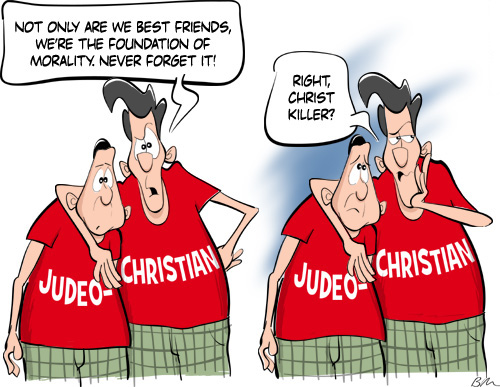
Dovetailing on my previous statement, the modern Church still gives religious and even secular Jews reason to question their (our) motivation for any form of approach to them. My experience tells me that most often, Jews are politely cautious when a Christian enters Jewish religious or social space or conversely, invites them into our space. We speak of “interfaith relationships” or “interfaith events” but there really is no such thing as a “Judeo-Christian” shared experience. The minute those two concepts entered the world, they existed in opposition to one another.

Why should Jews trust Christians? Why shouldn’t organizations such as Jews for Judaism believe there is a (perceived) threat represented by the Christian Church, including organizations like Jews for Jesus?  I’m not saying Jews for Jesus is a bad organization and that the Church is necessarily an active threat against Jewish faith and practice, but the best predictor of future behavior is past behavior. If you want to know how the Church is going to act toward Jews in the future, look at Church history.

I’m saying that Jewish people have a reason to be dubious about Christianity and that all began nearly two-thousand years ago. Sadly, Jews and Christians really do have a shared history but it’s not a positive one.

The Church has much to repent of.

Note: This doesn’t mean that Judaism in all its expressions is perfect or hasn’t made it’s mistakes, but rarely is Judaism in a position as an extreme minority in our world to “throw its weight around,” so to speak. Through the vast majority of the history of the Jewish people, they’ve been much too busy just trying to survive.

Hebrew Roots

This is an “umbrella category” designed to cover just about any Gentile Christian organization, small group, or fellowship that specifically identifies itself as seeking the “Hebrew roots” of the Christian faith and who adopt an altered theology, doctrine, and practice based on some sort of “Hebraic” perspective on the Bible.

It’s probably unfair of me to treat Hebrew Roots as a single entity given what I’ve just said, since it is comprised of so many divergent groups and attitudes, but then, that’s pretty much true of Christianity and Judaism as well.

Praying with tefillinOne of the (more or less) commonalities within Hebrew Roots is the belief that Hebrew/Jewish practices are also incumbent upon any Gentile who is a believer in Jesus. This usually includes some sort of practice based on modern synagogue worship including praying with a siddur, donning of a tallit gadol (for men, usually), wearing a kippah (again, usually for men), and other acts that superficially create the impression that these Hebrew Roots practitioners may be Jewish.

We saw in Zetterholm’s book that Gentiles participating in the ancient Jewish synagogue of “the Way,” were sometimes mistaken as Jews due to their association with Jews and likely many of their practices and lifestyle behaviors, so it’s possible to extrapolate that situation into modern Hebrew Roots. But there’s a problem. In ancient times, Gentiles adopted some Jewish practices and behaviors because they were operating within a Jewish religious and social context and were being mentored by Jewish teachers and synagogue leaders. Hebrew Roots operates in total separation from Jewish community and often is denigrating of much of Rabbinic Judaism.

Hebrew Roots tends to believe they practice a form of “Biblical Judaism” as opposed to “Rabbinic Judaism,” and as a result, they reject many of the practices and conceptualizations that are associated with modern or historic Judaism. In this, they somewhat mirror the original Church Fathers who separated their own practice from Jewish authority and community, creating a self-sustaining entity that by necessity, operated in opposition to the normative Judaisms of its day.

Like many Evangelicals, many Hebrew Roots groups have sort of “love/hate” relationship with modern Judaism, mainly because of Rabbinic Judaism’s insistence that they have the right to make internally binding rulings and the ability to govern their own communities.

Note: Hebrew Roots has a lot of different expressions, some of which are truly serving God, helping others, and teaching the good news of Messiah. I worshipped with one such group for many years and my companions were Godly and humble people. But Hebrew Roots is kind of like the “wild west,” where anything can happen and where anyone with a kippah and a theological ax to grind can dub themselves a “Messianic Rabbi” and draw a following. Be cautious.

Messianic Judaism

Like the other groups I’ve discussed above, there is no single, monolithic organization called “Messianic Judaism”. All Messianic Jewish groups have certain things in common, but the details of their theology, doctrine, and practice are variable.

One thing all Messianic Jewish groups (at least in the U.S.) have in common is the majority of their members are not Jewish. The ancient Antiochian Synagogue of the Way, while “owned and operated” by a Jewish leadership and Jewish teachers, was also inclusive of Gentiles, though there’s no way to determine the ratio of Jews to Gentiles in their midst.

Messianic Judaism, for this reason, faces some or even most of the same challenges as did the apostle Paul’s mixed Jewish/Gentile Jesus-believing communities, principally the issue of integration. As my previous blog posts on Antioch, Zetterholm, and Nanos attest, the issue of integration was of paramount importance and at the same time, hotly contested (see Galatians 2 for example).

That the Gentile Jesus-believers were included in the New Covenant blessings and part of the soteriological system of Judaism was not in question, especially to Paul, but the nature of their role and participation in a Jewish community and religious stream was still problematic. The Acts 15 ruling aside, we don’t really know how day-to-day life in the Messianic synagogue among Jewish and Gentile co-participants was negotiated.

That’s a question Messianic Judaism is trying to answer today as well.

We see from Zetterholm that, given the right social and political pressures, this could all blow up in their (our) faces (again). It’s one of the arguments in support of a concept Rabbi Mark Kinzer introduced called Bilateral Ecclesiology. Zetterholm seems to believe that James the Just, the brother of Messiah and leader of the Council of Apostles and Elders in Jerusalem supported an ancient version of Bilateral Ecclesiology, the establishment and maintenance of separate communities of Jews and Gentiles in Messiah.

Ironically, that’s exactly what happened historically, but with disastrous results.

judeo-christianBut that’s unfair and untrue. That’s not exactly what happened. Kinzer’s Bilateral Ecclesiology (and presumably James’) assumes that the separate Jewish and Gentile communities exist in a complementary fashion, sharing a common theology and doctrine (but not identical practice), maintaining a cordial but distant relationship with one another, while supporting the right of each group to maintain their own identity within an exclusive space. History has shown that the relationship between ancient Christianity and Messianic Judaism was anything but complementary and cordial, although distance was created, maintained, and expanded, usually due to animosity.

We noted above that Ignatius in Phld. 6:2 connected Judaism with the activities of “the prince of this world,” and that he in Magn. 8:1 probably used popular prejudice against the Jews in describing Judaism as being based on myths and fables.

It is well known that, in the decades after the death of Ignatius, Christian literature abounds in developing anti-Semitic themes.

-Zetterholm, pg 210

Zetterholm believes Paul opposed James’ view on separate Jewish and Gentile space in Messiah and that he believed in a shared community of Jewish and Gentile Jesus-believers. That said, shared space and social community doesn’t equal shared identity, role, and responsibility and that’s the rub. Did Paul have a clear vision of exactly how Jews and Gentiles were to exist in community with each other in all the details?

The Didache might be one possible answer to that question since one suggested origin for this teaching is with the apostles or those close to the apostles. The Didache may have started out as an oral teaching that accompanied the spread of the “Jerusalem letter” (Acts 15) among the diaspora Gentiles in community with Jesus-believing Jews.

Note: As I’ve mentioned above, Messianic Judaism includes a variety of different approaches to how a Jew may be a disciple of the Jewish Messiah and continue to be an observant Jew. In the days of Peter and Paul, this was a given. No one wondered how this was possible, it was simply understood. The problem was how to integrate Gentiles. That’s the problem today as well, and responses run the gamut from Jews-only Messianic groups to full social inclusion of Jews and Gentiles in the synagogue. I think of Messianic Judaism as a work in progress. Also, keep in mind that many Hebrew Roots groups call themselves “Messianic Judaism,” however once in, the distinction is obvious.

Conclusion

So here we are. The Church, if possessing any belief that it somehow has replaced the Jewish people and national Israel in the covenant promises, continues to have much to answer (to God) for. The Church has much to answer for if it continues to oppose Jews who have faith in Messiah and continue to observe the mitzvot of the Torah of Moses. Thankfully, an increasing number of churches are accepting Jesus-believing Jews who are Torah observant Jews, but we have a long way to go.

Hebrew Roots, while a noble effort to attempt to recapture what Jesus-believing Gentiles lost with the ascension of Gentile Christianity and the (ultimate) collapse of Jewish Jesus-faith, often chooses to throw the baby out with the bath water, so to speak. In trying to recapture and apprehend ancient Hebraic practices and implement them in the modern era, they many times utilize modern Rabbinic worship practices while rejecting historic and modern Rabbinic Jewish rulings and even fail to acknowledge the Jewish community’s right to self-govern and self-define. Gentile Christians seeking the Hebrew Roots of the faith might find a better model in those who have become known as Messianic Gentiles, but there are still many challenges involved when traveling that path, as I can personally attest.

Messianic Judaism continues to struggle forward toward not only its own identity, but the identity of the Gentiles in its midst and as the Apostolic record and Zetterholm’s research indicates, Messianic Judaism is characterized, in part, by the communal inclusion of the Gentiles. Perhaps they would have eventually developed a “bilateralness” in relationship with each other, but that doesn’t seem to have been what Paul was trying to create.

I offer no solutions to any of this, but if you think you have any, I invite you to comment. We may never know what would have happened if Paul’s vision of the mixed Jewish/Gentile ekklesia had been realized, but given our current situation, we’re obligated to take the next step forward, whatever that might be.

Notes on the Church

ChurchI know I’ve laid the lion share of the responsibility for the Jewish/Gentile split within the body of Jesus-believers at the feet of the then new religion called “Christianity.” Further, I continue to assign responsibility to the modern Church for its long history of abuses against Jewish people and Judaism. Am I being unfair? I suppose you could say so.

And yet, next Sunday at the church I attend, the Bible class being held after services will be teaching on Acts 21:15-26 and the class study notes pay special attention to the following verse:

You see, brother, how many thousands there are among the Jews of those who have believed, and they are all zealous for the Law… (emph. mine)

Acts 21:20 (NASB)

To me, this speaks of the thousands of Jesus-believing Jews in Jerusalem who all gave glory to God and were zealous for the Torah of Moses. But my teacher quotes John MacArthur in saying:

“Nowhere in the New Testament are the Jewish believers condemned for observing them (the so-called “ceremonial” aspects of the law). Paul nowhere taught Jewish Christians to abandon their Jewish heritage. God Himself was tolerant during this period of transition, knowing how difficult it was for them to break with their past.”

It never occurs to MacArthur, or to any of the Evangelical church Pastors or their lay staff, or to the congregations of all those churches, that the reason they don’t see God being critical of Jewish Jesus-believers performing the Torah mitzvot wasn’t “tolerance.” It was because God expected Jewish Torah observance as a matter of covenant obedience. It wasn’t an aberration or some quaint set of customs that Jewish people had a tough time letting go of, it was their very lifeblood, the linkage between God and the Jewish people, more so than ever with the realization that the Messiah was the inauguration of the living fulfillment of all of God’s promises to Israel.

Even in the most Israel-friendly, Jewish people loving churches, this attitude still remains, in spite of a great deal of scholarly evidence to the contrary. This is what the Church yet has to repent of and so far, they don’t even see the problem.

More’s the pity.

If “Sarah” were to show up in my Bible class next Sunday and give her interpretation of Acts 21:20, how would she be received? I don’t know how far to push in class over the troubling interpretation of this single bit of scripture (and it’s wider implications), but how can I remain silent in the face of everything I’ve just written?

Addendum: And then there are rather disturbing current trends in Christianity, such as the one presented at the Rosh Pina Project about who is expected to speak at Bristol Baptist College.

Sermon Review of the Holy Epistle to the Hebrews: The Evangelical Gospel

Introduction to the Six Elementary Teachings of Messiah with a look at Evangelicalism and the Evangelical Gospel, citing Scot McKnight’s book The King Jesus Gospel.

-D. Thomas Lancaster
Sermon Seventeen: The Evangelical Gospel
Originally presented on May 25, 2013
from the Holy Epistle to the Hebrews sermon series

Therefore let us leave the elementary doctrine of Christ and go on to maturity, not laying again a foundation of repentance from dead works and of faith toward God, and of instruction about washings, the laying on of hands, the resurrection of the dead, and eternal judgment. And this we will do if God permits.

Hebrews 6:1-3

As Lancaster began talking about Shavuot, about Pentecost, about what the Evangelical Church calls “the birthday of the Church,” I wondered where his lectures on the Book of Hebrews went. I knew that he was going to spend some time on the six basic foundations of the faith, but I didn’t know this would entail exiting the Epistle to the Hebrews altogether.

He did quote the following Psalm, which is a Psalm about Shavuot, however:

The Lord announces the word, and the women who proclaim it are a mighty throng…

Psalm 68:11 (NIV)

No, that doesn’t seem to have anything to do with Hebrews either, but we’ll get to that.

Lancaster spent a lot of time talking about, really reviewing Scot McKnight’s book The King Jesus Gospel. This sermon was given right after First Fruits of Zion’s 2013 Shavuot conference (although that link takes you to info about this year’s conference). It’s always held at Lancaster’s home congregation, Beth Immanuel Sabbath Fellowship.

I attended the conference in 2013 and also went the previous year. I didn’t spend a lot of “face time” with Lancaster, usually because he’s pretty busy and in demand, but last year we talked for a bit and he recommended McKnight’s book. I formally reviewed the book as well as mentioned it elsewhere, and found it reassuring if not illuminating.

Like Lancaster, I didn’t agree with everything McKnight said, but it was refreshing to read an Evangelical teacher and author saying that Evangelical Christianity is serving up a hopelessly truncated gospel message.

I’ll skip over Lancaster’s history of the Evangelical Church but I will mention that Lancaster started out his ministry as an Evangelical Pastor and he’s the son of an Evangelical Pastor.

But as a teenager, Lancaster said he got so frustrated with trying to find the Evangelical Gospel message spoken by Jesus in the scriptures, that he threw his Bible across the room.

Here’s a summary of the Gospel message according to, not Matthew, Mark, Luke, or John, but according to Evangelicalism.

Imagine Jesus saying this:

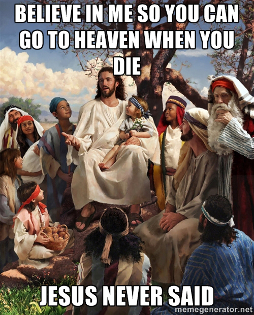
Believe in me for the forgiveness of your sins so you can go to Heaven when you die.

Jesus never saidThat’s the Evangelical message of the Gospel in a nutshell but Jesus never said it…ever. For that matter, neither did Paul, Peter, James, or any of the other apostles.

In fact, Jesus rarely spoke of personal salvation and when he did, the teenage Lancaster thought it sounded…legalistic:

And someone came to Him and said, “Teacher, what good thing shall I do that I may obtain eternal life?” And He said to him, “Why are you asking Me about what is good? There is only One who is good; but if you wish to enter into life, keep the commandments.” Then he said to Him, “Which ones?” And Jesus said, “You shall not commit murder; You shall not commit adultery; You shall not steal; You shall not bear false witness; Honor your father and mother; and You shall love your neighbor as yourself.” The young man said to Him, “All these things I have kept; what am I still lacking?” Jesus said to him, “If you wish to be complete, go and sell your possessions and give to the poor, and you will have treasure in heaven; and come, follow Me.” But when the young man heard this statement, he went away grieving; for he was one who owned much property.

Matthew 19:16-22 (NASB)

The traditional Evangelical interpretation is that Jesus was playing a little game with this fellow to help him realize that he needed to leave his wealth behind and learn to trust Jesus, but I don’t see how the fellow in question could come to that conclusion when Jesus was speaking of the commandments and merit, a very Jewish message.

But the Evangelical message of the plan of salvation, although it’s some part of the Gospel message, is not only a small part of that overall good news, it’s terrifically misleading. It only teaches that you have to confess Jesus as Savior and believe in him. That’s it. In fact, Lancaster says Evangelicals shouldn’t really be called Evangelicals but rather “Salvationists” because of the narrow focus of their message.

They’re not even replacement theologists but rather displacement theologists, because the plan of personal salvation, as the length, breadth, and depth of their doctrine, displaces all of the Old Testament, the resurrection, a literal Israel, and the establishment of the Kingdom of Messiah on Earth. Why would you need an Earthly Kingdom if you go to Heaven when you die to be with Jesus?

What was the central message of the Messiah?

From that time Jesus began to preach and say, “Repent, for the kingdom of heaven is at hand.”

Matthew 4:17 (NASB)

Gates of HeavenThe NIV and other translations use the word “near” rather than “at hand.” The Kingdom of God is near. How near is it? Lancaster says it’s so near that the Messiah has even been named. He’s Jesus of Nazareth. He’s teaching repent of your sins, return to God, be immersed in the name of Messiah for the forgiveness of sins (after you fully repent), then you will participate in the building of the Kingdom, the restoration of national Israel, the return of the Jewish exiles to their Land, the raising of Israel as the head of all the nations.

Lancaster spoke too quickly for me to capture all of his points, but at the end, he said Peter’s message in Acts 2:37-42 is a much better representation of the actual Biblical Gospel message than what Evangelicals preach.

And at the culmination of the Kingdom, all of humanity, each and every individual, will stand before the throne of judgment. The Evangelical message of salvation is only included in bits and pieces of the total Gospel, and it’s still an anti-Jewish people and anti-Judaism message if only because it wholly denies the centrality of Israel and the Jewish people in its own salvational plan.

It gets worse. Jesus preached:

And someone said to Him, “Lord, are there just a few who are being saved?” And He said to them, “Strive to enter through the narrow door; for many, I tell you, will seek to enter and will not be able.

Luke 13:23-24 (NASB)

This is not what Evangelicals preach about salvation. For example, how can you “strive to enter the narrow door,” when there’s nothing you can do to merit salvation? Evangelicals say to “accept” and “make a decision for Christ” which are quite passive. Striving is active and implies you must do something to enter the narrow gate. Also, how can the gate be so narrow if whole stadiums and auditoriums of people are “getting saved” by some big name evangelist preacher at a huge revival?

milkThat last part is a little tongue-in-cheek, but you get the idea. Jesus didn’t teach that the Gospel message or even the salvational part of it was “believe in me and be saved.” He taught, “repent, have faith, become a disciple, for there will be a resurrection of the dead, and the living and the resurrected will participate in final redemption.” Lancaster says the actual Gospel message isn’t news to Messianic Judaism but it must be quite a shock to most of the world’s 100 million Evangelical believers. Most Evangelicals don’t even know about the “milk” being taught in the Bible, let alone the “meat,” and this is where we re-engage the Book of Hebrews.

Therefore leaving the elementary teaching about the Christ, let us press on to maturity…

Hebrews 6:1 (NASB)

Lancaster ended here a few weeks ago and this is the place where we have come to again. This is also the heart of Lancaster’s new book Elementary Principles: Six Foundational Principles of Early Jewish Christianity, which is available as a special promotion (sorry to sound like a commercial, but it’s a pretty good deal) until June 3rd.

Lancaster wound down his sermon with another summary of the six foundations of the faith and said starting next week, he’s going into each of them in detail, with repentance being the very first step.

What Did I Learn?

As I mentioned, I’ve read and reviewed McKnight’s book last year, so this was more like a review than a revelation. I’ve also been going through my own study of repentance or teshuvah, so his comments on repentance operated in parallel to my own thoughts.

I don’t think that all Evangelicals have quite such a narrow view of the message of the Gospel, but I agree that even the most enlightened Evangelical is missing at least part of the picture. I know Evangelical Christians who strongly preach repentance of sins and who even lament there are many people in the pews on Sunday, who in all probability, are not saved because all they know is to passively believe.

I don’t doubt that some and hopefully many Evangelicals are indeed saved and are faithfully serving God, but it’s not my place to say who is and who isn’t. It’s my place first and foremost to care for my own relationship with God, for without love of God how can I love my fellow human being in the manner my Master commands?

Elementary PrinciplesLancaster doesn’t recommend McKnight’s book to his congregation, probably because he believes they are more tuned in to the actual message of the Gospel because of their involvement in Messianic Judaism (and being consumers of Lancaster’s prolific teachings and writings). I do recommend McKnight’s book to Evangelical Christians as a means of understanding that what Lancaster is teaching isn’t “Evangelical bashing,” but rather a startling wake up call.

Do you really want to know what Jesus taught as the good news of Christ? You may not get the full message from your Pastor’s sermons or from popular books by Christian authors. You probably won’t even get it in Sunday school or at a Wednesday night Bible study. If you read McKnight’s book, please open your mind and heart and be prepared for a shock. If you survive the book intact and want to learn more, continue with Lancaster’s book and see where that takes you.