All posts by James Pyles

James Pyles is a published Science Fiction, Fantasy, and Horror author as well as the Technical Writer for a large, diversified business in the Northwest. He currently has over 30 short stories published in various anthologies and periodicals and has just sold his first novella. He won the 2021 Helicon Short Story Award for his science fiction tale "The Three Billion Year Love" which appears in the Tuscany Bay Press Planetary Anthology "Mars."

I’m Not Who I Was

changing-courseDo not be dismayed by the hypocrisy of others, nor by your own inconsistencies. Our lives are all journeys through hills and valleys—no person’s spiritual standing is a static affair.

But the good each person achieves is eternal, as he connects to the Source of All Good, Who is infinite and everlasting. The failures, on the other hand, are transient and superficial, fleeting shadows of clouds, as stains in a garment to be washed away.

-Rabbi Tzvi Freeman
“Hypocrisy”
Based on letters and talks of the Rebbe, Rabbi M. M. Schneerson
Chabad.org

I’ve written over 900 blog posts for “morning meditations” and 214 for my previous blog (which stopped being active in 2011) called Searching for the Light on the Path. That’s over 1100 blog posts that record my progressive journey of faith, attempting to discover my position along the trail that leads to God.

In all that time and in all those blog posts, my opinions and beliefs have shifted a bit; perhaps more than just a bit in some areas. I’ve explored and opened myself up to some concepts and investigated and shut down others. Some people who were my friends or who were at least friendly to me have dropped me like a hot rock as I’ve developed my understanding of God, the Messiah, and the Bible in directions that oppose their belief systems. Other people have opened up to me and shared their highly valuable insights when seeing that I am not trying to impose my will on others, but seeking to discover God’s will for me and the world around me.

I suppose that last part sounds a bit narcissistic but then again, no one blogs except from their own perspective and as a means of presenting that perspective to anyone with Internet access.

I haven’t been directly accused of this, but I remember one blogger accusing another of hypocrisy based on the changing of the second blogger’s perspectives over time.

But aren’t we supposed to change? Aren’t we supposed to grow? What would happen if you learned basic arithmetic but never progressed beyond that point? What would have happened if no one anywhere across history ever developed algebra, calculus, or trigonometry? What would have happened if the best telescope we had in the world was still on the level of the one created by Galileo? What if our best medical technology for curing fevers and multiple other ailments was to apply leaches to human beings?

Are you a hypocrite if you learn something new and it changes how you see things and how you think?

As Rabbi Freeman said above, “Our lives are all journeys through hills and valleys—no person’s spiritual standing is a static affair.”

It’s interesting that a religious person should be the one to say that because, at least in Christianity, after achieving a certain level of knowledge, the expectation (this is just my opinion, of course) is that we should stay “static” with “the truth.” I’m not denying that there is Divine and eternal truth in our universe. Our universe was created by such truth. But that hardly means we know everything that there is to know about God or faith or that we even know enough. Is it enough to answer some altar call or to raise your hand in church as a profession of your faith in Jesus Christ? Is it enough to be saved?

It seems that a lot of Christian Bible studies and Sunday school classes aren’t really designed to teach people new ideas or to help people explore uncharted territory in theology, but to continue confirming what everyone already knows. Earlier today, I reviewed a television episode produced by First Fruits of Zion describing the meaning behind the name “Jesus.” However, the information presented, though very basic from my point of view, was designed to be new and even a tad bit “revolutionary” to the traditional conservative Christian audience targeted by these programs.

iam-not-a-numberIf someone who had been raised and educated spiritually in a “typical,” “ordinary” American church saw this or some other episode of FFOZ TV, they would very likely encounter what for them would be brand new information about topics they thought they knew completely.

I recently reviewed Scot McKnight’s book The King Jesus Gospel: The Original Good News Revisited. In the book, McKnight recounts a conversation he had with another Pastor about the meaning of the gospel. That Pastor too had stopped learning a long time ago and if he was studying at all, it was for the purpose of maintaining the pattern and level of knowledge he already possessed:

I replied, “A book about the meaning of gospel.”

“That’s easy,” he said, “justification by faith.” After hearing that quick-and-easy answer, I decided to push further, so I asked him Piper’s question: “Did Jesus preach the gospel?”

His answer made me gulp. “Nope,” he said, “Jesus couldn’t have. No one understood the gospel until Paul. No one could understand the gospel until after the cross and resurrection and Pentecost.” “Not even Jesus?” I asked.

“Nope. Not possible,” he affirmed. I wanted to add an old cheeky line I’ve often used: “Poor Jesus, born on the wrong side of the cross, didn’t get to preach the gospel.”

In my weekly conversations with my Pastor, I find myself challenged by a person who does study a great deal and who presents me with information I don’t possess which, in my case, is how traditional Christian theology, doctrine, and dogma works. For a Christian, I don’t know very much about how the formal “church” conceptualizes things. I often reference Jewish sources for my studies, both because I’m drawn to them and because they challenge my “Gentile” way of understanding God and faith. Both my Pastor and my studying help me grow, at least a little bit at a time.

We’re supposed to grow and we’re supposed to help other people grow. In the church (and in other Gentile-driven religious contexts based on the Bible), we have adopted a philosophy, not of growth, but of comfort. We want to be comfortable in what we think, feel, and believe. We don’t want to be challenged. Our day-to-day lives are challenging enough. We want to spend our Sunday services and Bible studies with people who think just like us, discussing things that we all understand in exactly the same way.

I know that sounds cynical, but it’s actually very human. All people who identify with a group that thinks, feels, and acts in a particular way relative to the larger environment want that. Christians want that, and religious Jews want that, and Hebrew Roots people want that, and progressives want that, and atheists want that, and everyone else wants that, too.

God is transcendent. He doesn’t fit in the little boxes we try to put Him in (if we are people who believe that God exists at all). Our hope, our goal, our journey should all be pointed in the direction of transcendence. We can never completely know the infinite God all in all, but we are tasked with approaching Him as closely as we can, knowing that it won’t be incredibly close.

Instead, we’ve reached an area of comfortable equilibrium and there we stay. It’s like two married people who behave more like roommates, including sleeping in separate bedrooms. It may be comfortable, but you’ll never experience passion that way.

The Rebbe would sit down with his students and say, time and time again:

The Baal Shem Tov taught that from every thing a person hears or sees in this world he must find a teaching in how Man should serve G‑d. In truth, this is the whole meaning of service of G‑d.

-Rabbi Tzvi Freeman
“All the World is My Teacher”
Based on letters and talks of the Rebbe, Rabbi M. M. Schneerson
Chabad.org

icarus-seeking-lightIn Greek mythology, the wings of Icarus melted when he flew too close to the Sun and he fell, but we will freeze into complete inaction and be totally ineffectual if we stay away from the flames of wisdom and knowledge. Challenge involves risk and risk feels dangerous. Sometimes we accept a challenge and the danger and then we (seemingly) fail and fall, ending up not getting what we want. Moses accepted the challenge of leading the Jewish people through a desert for forty years at the behest of God, and in the end, he was denied entry into Israel. He failed the challenge.

Or was it a failure?

Chassidic teaching explains that this is the deeper reason why Moses was not allowed to enter the Land of Israel. If Moses would have settled us in the Land, we could never have been exiled from it. If Moses would have built the Holy Temple, it could never had been destroyed. If Moses would have established the people of Israel in their homeland as a “light unto the nations,” that light could never have been dimmed.

If Moses would have crossed the Jordan, that would have been the end: the end of the struggle, the end of history.

G-d wasn’t ready for the end yet. So He decreed that Moses remain in the desert. But He did allow him to see the Land. And because Moses saw it, and because the effect of everything Moses did is everlasting, we, too, can see it.

At all times, and under all conditions, we have the power to ascend a summit within us and see the Promised Land. No matter how distant the end-goal of creation may seem, we have the power to see its reality, to know its truth with absolute clarity and absolute conviction.

We are still in the midst of the struggle. It is a difficult, oft-times painful struggle; but it is not a blind struggle. Moses has seen to that.

-Rabbi Yanki Tauber
“Land and See”
Based on letters and talks of the Rebbe, Rabbi M. M. Schneerson
Chabad.org

building-the-templeAll that isn’t in the Bible, but let’s go with it for now. If Moses had entered the Land, would the Messiah have come? What would have happened to the people of the nations of the world? Would we all have been drawn to the light of Israel in the days of Moses? What would that have meant? Becoming gerim, “resident aliens” and then having our descendants being assimilated and absorbed into tribal Israel? That would mean anyone outside of the original Israelites and their descendants would have had to ultimately become part of tribal Israel to become Holy unto God. But what about the rest of us?

God wasn’t ready for the end, perhaps not because of what it would have meant for Israel but because of what it would have meant for the majority of the world. All those things midrash says Moses would have done will actually be performed by Messiah, Son of David. But Israel had to suffer because Moses didn’t enter the Land and instead died in the desert. That’s a horrible realization; not comfortable at all.

We won’t come to learn the reality of our existence in a world created by God if we allow ourselves to remain in a comfortable place. Moses died, and Joshua was challenged with conquering a nation. David founded Jerusalem but the task of building the Temple was left to Solomon. Israel fell into exile on multiple occasions, her Temple destroyed, her Land lost for centuries. The Messiah came and died. Then he rose. Then he ascended. And then he didn’t come back. Human history has been spinning out of control ever since, or so it appears.

What can we do? We can stop being comfortable. “Comfortable” is not the condition of our current world. We need to read, to study, to challenge ourselves, to change as we encounter each new spark of the Divine that has been left here for us by the Source of that fire. We’re meant to grow, to develop, and to act. How else can we prepare the way for the return of the King?

FFOZ TV Review: Call His Name Yeshua

ffoz_tv1Episode 03: It may be shocking to learn, but the fact is that many people were named Jesus in first century Israel. So how is it then that his name is the name above all names? In episode three the name of Jesus is explored in depth in order to gain a better understanding of the significance of not only Christ’s name but his mission. The name Jesus means “salvation” and it was preordained in the prophecies of the Hebrew Scriptures that the messiah would bring salvation not only to Israel but to all mankind.

From the intro to the episode: Call His Name Yeshua
FFOZ TV: The Promise of What is to Come

The Lesson: What does the Name “Jesus” Mean?

I know I’m a little late with this one, two weeks late actually, but my weekend viewing of FFOZ TV has been short circuited by weekend yard projects. I was finally able to carve out some free time to view Episode 3: Call His Name Yeshua.

This episode builds on the basics learned in Episode 1: The Good News and Episode 2: Messiah. Both of those shows focused on presenting a definition of a very basic concept in the Bible, except that in each case, the traditionally Christian audience discovered that the concepts weren’t quite so basic.

Episode 3 focuses on the meaning of the name “Jesus.” I suppose there are Christians in the world who actually believe that “Jesus” was the original name used by the Messiah, that his disciples, his friends, his mother called him “Jesus.” This isn’t possible when we consider that they would all be speaking in Hebrew or Aramaic and in those languages, it’s impossible to make a hard “J” sound.

As always, teacher Toby Janicki offers up the lesson as a mystery that must be solved using three clues. Today’s mystery is “The Mystery of the Name Jesus.” The first verse that leads into the first clue is this one.

But as he considered these things, behold, an angel of the Lord appeared to him in a dream, saying, “Joseph, son of David, do not fear to take Mary as your wife, for that which is conceived in her is from the Holy Spirit. She will bear a son, and you shall call his name Jesus, for he will save his people from their sins.”

Matthew 1:20-21 (ESV)

After using a translation with which most Christians would be familiar, Toby read the same verses again using the Delitzsch Hebrew Gospels:

He was thinking this way, but then an angel of HaShem appeared to him in a dream, saying, “Yosef son of David! Do not be afraid to take Miryam, your wife, for what has been formed within her is from the Holy Spirit. She is giving birth to a son, and you are to name him Yeshua, because he will save his people from their sins.”

As Toby pointed out, many Christians are fond of a hymn called “Jesus, Name Above All Names.” Have they gotten it wrong all these years? Is the true name of Messiah “Yeshua?” Is he offended when we call him “Jesus?” For that matter, how do we know “Yeshua” was/is his original name?

We’ll get to all that in a minute. Toby points to the first clue:

Messiah is named Jesus by direct command of God.

There’s something else. There seems to be a connection between the name Yeshua and what the angel said about him saving his people from their sins.

aaron-ebyThe scene shifts to Aaron Eby in Israel who provides the episode’s language lesson. As it turns out, we get the name “Jesus” from the Latin and Greek translations of the Hebrew word Yeshua. In Latin, his name is translated as “Iesus” and from the Greek, it’s “Ἰησοῦς”. Aaron says that we know Messiah’s name was Yeshua because it was actually a common name for Jewish men at that point in history in Israel. It’s actually a shortened version of Yehoshua which we translate into English as “Joshua.” Yehoshua means “The Lord is Salvation.”

Also, the name Yeshua, when it occurred in the Old Testament, was translated in the Septuagint as we see it also translated in the New Testament, so we can confidently say that Yeshua is the Hebrew name of Jesus.

And from what Aaron presented in his portion of this episode, the definition of the longer version of Yeshua’s name seems to be the connection in the angel’s words to Joseph. Name him “Jesus” (salvation) because he will bring salvation to his people.

Going back to Toby, we hit the second clue:

Jesus means salvation.

Since Jesus was such a common name at the time, it was important to differentiate the Messiah from all of the other Jewish boys and men called Yeshua, so he was referred to as “Yeshua of Nazareth.”

But we need one more clue and it comes from the Old Testament (Tanakh). Actually there are a lot of prophesies in the Old Testament that speak of the Messiah bringing salvation to Israel. Probably one of the oldest is in Genesis 49 when Jacob, before he dies, blesses his sons.

For Your salvation do I long, O Hashem!

Genesis 49:18 (Stone Edition Tanakh)

Toby says that according to the Jewish sages, right before Jacob uttered this exclamation, he had a vision of the end times and was longing for the coming of Messiah and his salvation.

Toby quoted from a number of prophesies, and you can find out what they are by viewing the episode, but he also spent some time using word substitution to illustrate his point: salvation = Yeshua and salvation = Jesus. Here’s a couple of examples. First, the original verse in the NASB translation:

Behold, the Lord has proclaimed to the end of the earth, Say to the daughter of Zion, “Lo, your salvation comes; Behold His reward is with Him, and His recompense before Him.”

Isaiah 62:11

Now with the first word substitution:

Behold, the Lord has proclaimed to the end of the earth, Say to the daughter of Zion, “Lo, your Yeshua comes; Behold His reward is with Him, and His recompense before Him.”

…and then the second:

Behold, the Lord has proclaimed to the end of the earth, Say to the daughter of Zion, “Lo, your Jesus comes; Behold His reward is with Him, and His recompense before Him.”

I know this program is written for a traditional Christian audience, so these verses are designed to make the greatest impact on them, but if there are any traditional (non-Messianic) Jewish viewers, they might have a hard time with the name “Jesus” being directly inserted into the Tanakh as an equivalent term for God’s salvation.

But the prophesies that Toby quotes also lead to the third and final clue:

The Prophets predicted that Messiah would bring salvation.

The lesson in this episode is as simple as that. The name “Jesus” is an English translation of the Greek and Latin translations of Messiah’s name from Hebrew, which is “Yeshua.” Yeshua relates to the Hebrew word for “salvation” and basically means that Messiah brings salvation. This was prophesied many times by many Old Testament prophets, so his name would have meaning to the Jewish people when linked with his Messianic mission.

What Did I Learn?

DaveningI learned that there is a liturgical prayer said by devout Jews three times a day that includes the phrase, …”whose horn will be raised with your salvation.”

Interestingly enough, we find something like it directly referring to Yeshua:

Blessed is HaShem, God of Yisrael, for he has taken note of his people and sent them redemption. He will cause a horn of salvation to sprout for us in the house of David his servant…

Luke 1:68-69 (DHE Gospels)

This is the blessing said over the infant Yeshua by Zecharyah the prophet at the Temple. As Toby points out, this isn’t Zecharyah asking for God to provide salvation for Israel, it’s the prophet thanking Hashem for having sent salvation in the form of the new-born Messiah Yeshua. Messiah and salvation had come.

I hadn’t made the connection between these verses and the daily prayers of Jews all over the world, all of whom are asking for one who has already arrived and who will come again: Yeshua of Nazareth, the Messiah and King of Israel.

I hope to review the next episode very soon.

Consider the Days of Old

New WorldOn the verse, “Consider the days of old, the years of the many generations (Deut. 32:7),” the 13th century scholar Nachmanides explains that “Consider the days of old” refers to the Six Days of Creation and “The years of the many generations” refers to the time from Adam forward.” Many leading rabbis who lived centuries before Darwin understood that when Adam appeared on the scene, the universe might have already been much older. Most notably, this is the opinion attributed to Rabbi Nechunia Ben Hakana who lived some 2,000 years ago, which is quoted by many mainstream, medieval commentators such as Rabbenu Bechaya, the Recanti, Tzioni, and the Sefer HaChinuch. Rabbi Yitzhak M’Acco, a student of Nachmanides, suggested based on kabbalistic calculations that the universe is thousands of millions of years old.

With regard to humans arriving on the scene, the Talmud (Chagiga 13b) states clearly that there were 974 generations prior to Adam. The famous Tifferes Yisrael commentary to the Mishnah wrote in 1842 (prior to publication of Darwin’s Origin of Species): “In my opinion, the prehistoric men whose remains have been discovered in our time and who lived long before Adam are identical with the 974 pre-Adamite generations referred to in the Talmud, and lived in the epoch immediately before our own.”

Of course, the key point where Torah and evolutionists diverge is on the question of “accident versus design.” Evolutionists say that life happened by accident; Judaism says that God made it happen.

from the “Ask the Rabbi” column
“Evolution and the Bible”
Aish.com

I know I’m going to get “heck” for this, at least from conservative Christians and Orthodox Jews. Evolution and Creation are supposed to be incompatible in both religion and science, but the Aish Rabbi crafts a response to the question of Evolution that allows for both.

Up to a point.

I just finished re-reading Gerald L. Schroeder’s book Genesis and the Big Bang (and just started reading his more recent book The Hidden Face of God ) and Schroeder seems to believe something similar (also, see my previous blog post For God Rolled the Dice and the Universe Came to Be for more).

One of the problems comes along with trying to reconcile the six days of Creation in the Bible with the 13.7 or so billion years science says the universe has been around. According to present scientific theory, the Earth has been in existence for about 4.5 billion years.

How do six days fit into billions of years and vice versa?

Schroeder suggests a rather complicated interplay involving time dilation and relativity to explain that, from the Earth’s point of view, billions of years passed, but from God’s perspective, it was only six days. Schroeder spent an entire chapter laying the foundation for his belief and I can’t find any way to compress it into a paragraph or two in this blog post and still have it make sense. Suffice it to say that both science and the Bible are right as Schroeder sees it.

But what about life and evolution? According to the Bible, God created all living things as they are known today, including human beings, in just a few days. There were no previous and less developed forms of life, that became more complicated over time as they adapted to environmental changes, resulting in the creatures we have on our planet right now.

The Aish Rabbi refers to the Talmud which states that “there were 974 generations prior to Adam” and that those generations describe the lives of those beings we refer to as “prehistoric man.” Presumably, during that time, other creatures were also created, existed, and faced extinction.

It all makes a sort of sense, but I’m still struggling with seeing Genesis as being able to wholly map to the observations and interpretations we have about our universe based on astronomy, geology, and paleontology.

ancient_skyI admit, that whether you believe the Earth is ten thousand years old or 4.5 billion years old, devotion to God and love and charity to human beings shouldn’t be impacted to any degree in the life of a Christian or observant Jew. Still, it’s a compelling issue because the extreme literal stance on Creation taken by conservative Christians is one of the barriers to evangelizing more educated secular atheists. Educated unbelievers can’t be past the “Christians are ignorant buffoons” factor and I myself feel embarrassed when I hear a Christian trying to convince someone that Earth is a mere ten thousand years of age.

Christians aren’t likely to take the Talmud as an authority but it’s telling that “the famous Tifferes Yisrael commentary to the Mishnah” was written in 1842, prior to the publication of Darwin’s famous “Origin of Species.” Darwin, like the stream of Judaism the Aish Rabbi represents, believes in some sort of evolutionary process but that it was not random. God was always the causal agent, the Master Designer.

According to Dr. I. Prigogine, recipient of two Nobel prizes in chemistry: “The statistical probability that organic structures and the most precisely harmonized reactions that typify living organisms would be generated by accident is zero.”

Darwin himself wrote in Origin of Species: “…If it could be demonstrated that any complex organ existed which could not possibly have been formed by numerous, successive, slight modifications — my theory would absolutely break down…”

The jury is still out regarding the sequencing of how life developed, over what time period, and the mechanics God employed. I believe God made human beings independently and as we are now without prior evolutionary forms, but what about animal life, which was never intended to have the unique position of man?

The Bible is well aware of evolution, although it is not very interested in the details of the process. All of animal evolution gets a mere seven sentences (Genesis 1:20-26). Genesis tells us that simple aquatic animals were followed by land animals, mammals, and finally humans.

That is also what the fossil record tells us, albeit with much more detail than these few biblical verses provide. The Bible makes no claims as to what drove the development of life, and science has yet to provide the answer.

In paleontology’s record of evolution, first came the discovery that life appeared on Earth almost 4 billion years ago, immediately after the molten globe had cooled sufficiently for liquid water to form. This contradicted totally the theory of gradual evolution over billions of years in some nutrient-rich pool. The rapid origin of life remains a mystery.

Then we learned that some 550 million years ago, in what is known as the Cambrian explosion, animals with optically perfect eyes, gills, limbs with joints, mouths and intestines burst upon the fossil scene – with nary a clue in older fossils as to how they evolved. It is no wonder that Darwin, in his “Origin of the Species,” repeatedly implored his readers (seven times by my count) to ignore the fossil record if they were to understand his theory.

The overwhelming weight of evidence tells us that something exotic certainly happened to produce life as we know it. Historically one of the most compelling arguments regarding the existence of God comes from the precision design found in nature. Design implies a designer, and Darwin’s proposal that evolution could have occurred without a Designer (by means of natural selection through random mutations) changed things.

The Aish Rabbi’s opinion is certainly controversial when considered from a fundamentalist Christian position and likely when seen from an Orthodox Jewish viewpoint (my wife says the local Chabad Rabbi believes the Earth is roughly 12,000 years old).

world-of-extinct-mammals

I’m writing all this, not to yank anyone’s chain (though I’m sure it will) but to explore my own thought processes on this matter. I didn’t become a believer until I was past forty years old, so all of my educational foundation is based on Earth being very old and that the basic process of scientific examination of our environment is sound and designed to produce more or less reasonable results (although history has shown that those results aren’t always correct upon subsequent examination).

Religion, for its part, has had to make up some rather fanciful stories to explain the fossil record, to explain our understanding of the size and therefore the age of the universe, to explain our understanding of the age of various geological formations on our own planet, and to explain a myriad of other findings from the world of science that seems to radically contradict an absolute literal reading of the Bible’s Genesis account.

I really enjoy reading about the sciences, though I’m quite the amateur. I enjoy astronomy. I like hearing about the latest “adventures” of the various robotic probes on the surface of Mars. I have an interest in reading about the journey of Voyager 1 at the edge of interstellar space. I think God created us with an insatiable curiosity about the universe around us and a drive to explore it with the intelligence he created in us.

Then the Lord God took the man and put him into the garden of Eden to cultivate it and keep it. The Lord God commanded the man, saying, “From any tree of the garden you may eat freely; but from the tree of the knowledge of good and evil you shall not eat, for in the day that you eat from it you will surely die.”

Genesis 2:15-17 (NASB)

It is said that there was no death before the Fall (which happens in Genesis 3) so how could there have been life on a long-term scale before Adam and Eve? How could life in some form or another have existed for hundreds of millions of years before Adam and there not be death?

When God describes the consequences of eating from the tree of the knowledge of good and evil, how did Adam know what “die” meant? How could the serpent convince Eve she wouldn’t die (Genesis 3:1-5) from eating the fruit if dying was unknown to her? Why would she fear death and why would she have to overcome that fear in order to eat?

Reading the various consequences God visited upon Adam, Eve, and the rest of Creation as listed in Genesis 3, none of them say that all life was immortal before the Fall and suddenly became mortal afterward.

Then the Lord God said, “Behold, the man has become like one of Us, knowing good and evil; and now, he might stretch out his hand, and take also from the tree of life, and eat, and live forever”

Genesis 3:22 (NASB)

Gateway to EdenIt seems as if the two humans in the Garden were mortal (along with all other forms of life) and only by taking and eating from the tree of life would they become immortal! The presence of death wasn’t dependent upon the Fall. All life in the Garden was mortal.

Why couldn’t any life that may have existed as created within the span (as the Aish Rabbi suggests) described in Genesis 1:20-26 (the millions and millions of years prior to the creation of modern human beings) have been born, lived, and died, and born, lived, and died, and born, lived, and died?

Yeah, I expect to get some static over this blog post, but I’m writing it to explore my own thinking process in this area and also to (hopefully) inspire others to think as well. We need to take a look at the evidence presented by our environment, take a look at the Bible, take a look at our dogma, and struggle with what all that is supposed to mean.

I believe God created us to think, to explore, and to struggle with the meaning of everything we see. I think He wanted us to wonder and to experience wonder. I don’t think He wanted the Bible to be some sort of cosmic solution machine spitting out all the answers to all the questions in bite-sized chunks, like eating from a bowl of Christian-Jewish fortune cookies.

We don’t have to get all the answers from the Bible. God gave us other tools to use as well. Telescopes, microscopes, and the Large Hadron Collider aren’t the enemies of the Bible. They complement it. They are the lens through which we examine the world which reveals God, just as the Bible is the story of the relationship between God and human beings.

The Truncated Gospel

bible_read_me“The shortest and easiest route home for the two missionaries would have been to continue following the imperial highway through the mountain pass of the Cilician Gates east and then branch right southward to Syria. Surely they might have felt that they had done enough and suffered enough and could now take the easy way home! But Paul was not satisfied with doing a work ‘somehow.’ Always he was constrained to do God’s work ‘triumphantly’ – to finish God’s work with joy on each occasion.

“True shepherds know that it takes time to get a new convert rooted and built up in Christ. This involves sacrifice and hardship for the leader, but there is no eternal fruit without the Cross.”

-from the Sunday School Bible Study notes for Acts 14:21-28
“What Makes a Good Missionary?”

The Sunday School class I go to after church services directly addresses the topic of the Pastor’s sermon and gives the students the opportunity to dig deeper and to comment on the message for the day. Pastor Randy has been in California for the past several weeks but will be back next Sunday when he will be teaching on the aforementioned portion of Acts. My Sunday School teacher hands the study notes out a week early so we have time to review and answer the questions on its pages.

A number of Pastor’s messages about Paul and Acts are mapped to the modern concept and activities of Christian missionaries. This has always bothered me and I never understood why until I took a look at the title of next Sunday’s notes: “What Makes a Good Missionary?” Then it just hit me. Using Paul, beyond a certain point, as a model of the modern missionary is anachronistic. It doesn’t fit. The foundation is different.

Here’s what I mean.

In Paul’s day, he and other Jewish apostles and disciples were attempting to spread the good news of the Jewish Messiah to Jews in Israel, Samaria, and in the diaspora and also to give that news to the Gentiles. Jews had been waiting and waiting for the arrival of the Messiah for centuries, and the need for him to come was especially acute during periods of exile and occupation. Israel was a land occupied by a foreign army and desperate to realize its own liberation and redemption. The news of an arrived Messiah who would be King and who would redeem national Israel would be beyond good news…it would be immense in its impact among world Jewry.

From that point of view, explaining why news of the arrived Messiah would be good news to the Jewish people is a no brainer, but we have to work a little harder (which Paul does) to explain why it is also good news to the people of the nations.

Today, we’ve gotten it somewhat backwards. Not that modern Christian missionaries are doing it wrong. Missionary work is the source of great spiritual and material blessings all over the world. But they are missing a few things.

As I mentioned in my book review of Scot McKnight’s The King Jesus Gospel, and as McKnight correctly points out, the plan of salvation is only part of the gospel message. Sadly, modern Christian missionaries believe the salvation plan is the only part of the gospel message.

The more complete message is contained in my review of the First Fruits of Zion television series episode The Good News. What teachers Toby Janicki and Aaron Eby make seem incredibly easy and obvious has actually eluded Gentile Christianity for nearly two thousand years.

What missionaries do today doesn’t map well to what Paul was doing. Paul was delivering the good news that the Messiah had come, had offered salvation from sins for both Jews and Gentiles (and this part was huge since the Jewish people had not anticipated salvation for Gentiles) and that he would return to liberate the captives among Israel, gather the scattered Jewish exiles to their Land, and he would bring peace to Israel and to the nations of the world. The nations would be blessed through Israel, particularly as Israel was made the head of the nations in God’s Kingdom.

I seriously doubt too many Christian missionaries are spreading around that kind of gospel message today. That’s why Paul is used anachronistically as a model for modern Christian missionary work. Most Gentile Christians lack Paul’s vision and emphasis. We don’t exactly preach a different gospel, but it certainly is a truncated one. It’s also kind of upside down.

Apostle-Paul-PreachesPaul always visited the synagogues first and appealed to the local Jewish authorities in whatever place he was visiting. The good news of Messiah would make the most sense to the Jewish people. It would only make sense to Gentile God-fearers because they were spending time in synagogues being immersed in Torah and thus, in the knowledge of Messiah. It wouldn’t make sense at all to pagan Gentiles who had no knowledge of Jewish history or teachings about God (see Acts 14:8-20).

Ok, your counter-argument is that times have changed. Gentiles are largely “in charge” of the worship of the Jewish Messiah and disseminating the information about his birth, death, resurrection, ascendance, and ultimate return (as strange as it sounds for Gentiles to be “in charge” of the iconic Jewish message and King). But does it make sense to strip out what’s going to happen upon the Messiah’s return and why that’s good news for Jewish people and Israel?

Much of the history of the church has been based on the idea that Gentile Christianity has replaced Jewish Israel in all of the covenant promises of God. This is patiently untrue and I’ve discussed it in more blog posts and magazine articles than I can count. But it does make sense for the supersessionistic church to remove the good news of Jewish ascendency and Israel’s national supremacy since it reverses the roles upon which the Gentile church has historically been based. As I’m sure you realize at this point, I think that historical foundation is dead wrong.

…these I will bring to my holy mountain, and make them joyful in my house of prayer; their burnt offerings and their sacrifices will be accepted on my altar; for my house shall be called a house of prayer for all peoples.

Isaiah 56:7

Thus says the Lord of hosts: In those days ten men from nations of every language shall take hold of a Jew, grasping his garment and saying, “Let us go with you, for we have heard that God is with you.”

Zechariah 8:23

I was glad when they said to me, “Let us go to the house of the Lord!” Our feet are standing within your gates, O Jerusalem.

Psalm 122:1-2

I realize that Psalm 122 isn’t a Messianic prophesy and is addressing the tribes of Israel, but I believe it also speaks to the spirit of the Messianic age, when we will all be glad to hear the call to go up to Jerusalem and to the House of God, the Holy Temple.

jerusalem_templeEverything in the Jewish message of the gospel points to Messiah, to the Temple, to Jerusalem, to Israel, and to the Jewish people. The mystery of that message isn’t how the Jews will be saved but how everybody else will be saved. From a Jewish point of view, as much today as when Paul was on his “missionary journeys,” the good news of Messiah was a Jewish message aimed straight at the Jewish people and at Israel. It was a given. The big shocker and the mystery of the gospel was how the Gentiles could be saved and redeemed by God as well.

While Peter was still speaking, the Holy Spirit fell upon all who heard the word. The circumcised believers who had come with Peter were astounded that the gift of the Holy Spirit had been poured out even on the Gentiles, for they heard them speaking in tongues and extolling God (emph. mine).

Acts 10:44-46

Given how the Gentile God-fearers and even the pagans (who were probably told what to expect by their God-fearing neighbors and relatives) reacted to Paul’s gospel message in the synagogue at Pisidian Antioch (see Acts 13:48) we can see that they too were amazed at the graciousness of the God of Israel.

We’ve lost how amazing it is that Gentiles can be saved by the God of the Jews. We’ve lost how the message of the gospel is not just about a plan of salvation but about the return of the King and how his Kingdom will be established, restoring Israel to her rightful place, and elevating the people who were chosen by God at Sinai.

It’s time for us to remember and to teach all of the gospel message, as Paul once did. It shouldn’t be hard. Paul’s sermons, some of then anyway, are preserved in our Bibles. It’s all right there in front of us. We just need to take off our blinders and learn how to see and read the message again. Then we can spread the word, not of a truncated gospel, but of overflowing good news to all, good news first and foremost to Israel and yes, then to the rest of the nations.

Praying Where God Has Placed His Name

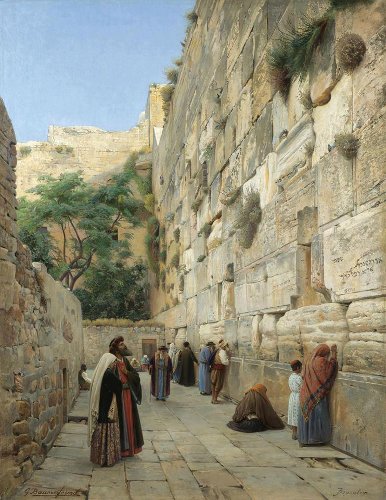
ancient-kotel-prayersWhen responding to the question, “Why do Jews pray at the Western Wall in Jerusalem,” Rabbi Tzvi Freeman had this to say.

I think what you’re really asking is: If G‑d is everywhere, why should prayer be more effective in one place than another? In truth, the same can be asked regarding praying in a synagogue vs. praying at home.

The question has been asked many times before in classical Jewish literature. Since this is a Chabad site, I’ll provide the answer given by Rabbi Schneur Zalman of Liadi (1745–1812), the first rebbe of Chabad.

The essence of his answer is that although G‑d is everywhere, His light shines stronger in some places than in others. He compares this to the human body: You are everywhere in your body, yet you are far more conscious of your mind than of your toes. So too, in the universe that G‑d created, there are places, times and states of being where we are able to be more aware of Him—and it is from those places/times/states that our prayers can fly best.

Any person is able to create for himself a time of day and a special place from which he or she reaches out to G‑d. And we all should—somewhere in our homes or gardens, set aside a place of prayer and meditation, along with a time of day or week that we sit there and connect. Even more special is a place that was chosen not just by us, but by G‑d as well. And that is the Temple Mount, which G‑d chose as His dwelling place in the time of King David.

Ever since then, that specialness has never left the Western Wall, the only remnant left standing.

The Talmud tells us that every synagogue is a “minor Holy Temple.” Thus the above also applies—in smaller measure—to any location designated to be a house of worship for G‑d.

I’ve probably mentioned this before, but one item on my bucket list (not that I have a well-defined bucket list) is to pray at the Kotel, otherwise called the Western Wall. I’m not even entirely sure that, from a Jewish point of view, it would be considered appropriate for a Christian to pray at the Kotel. After all, there is a certain controversy associated with some Jewish women davening at the Kotel, and I’m not even Jewish.

On the other hand, American Presidents and Catholic Popes have prayed at the Kotel, so I suppose it could be permissible for me to do so as well.

Why do I want to?

The Jewish person querying Rabbi Freeman was confused by the significance of even Jews davening at the Kotel. What’s the difference between praying there, in synagogue, at home, or, for a Christian, in church?

Rabbi Freeman answered the question from a Jewish point of view, but can any of that be applied to someone like me?

I think so.

So Abraham rose early in the morning and saddled his donkey, and took two of his young men with him and Isaac his son; and he split wood for the burnt offering, and arose and went to the place of which God had told him. On the third day Abraham raised his eyes and saw the place from a distance.

Genesis 22:3-4 (NASB)

So Jacob rose early in the morning, and took the stone that he had put under his head and set it up as a pillar and poured oil on its top. He called the name of that place Bethel; however, previously the name of the city had been Luz.

Genesis 28:18-19 (NASB)

But you shall seek the Lord at the place which the Lord your God will choose from all your tribes, to establish His name there for His dwelling, and there you shall come. There you shall bring your burnt offerings, your sacrifices, your tithes, the contribution of your hand, your votive offerings, your freewill offerings, and the firstborn of your herd and of your flock. There also you and your households shall eat before the Lord your God, and rejoice in all your undertakings in which the Lord your God has blessed you.

Deuteronomy 12:5-7 (NASB)

And every day, in the temple and from house to house, they kept right on teaching and preaching Jesus as the Christ.

Acts 5:42 (NASB)

Jacobs_LadderIt is said in midrash that the place where the Akedah (binding of Isaac) occurred was at the future Temple Mount in what would be Jerusalem. This is also supposed to be the identical site where Jacob experienced God at Beth El (literally, “House of God” in Hebrew). We also know from the Torah, that God intended to place His Name in a specific geographic location, which is also understood as the Temple Mount. Further, we see that the early Apostles of Messiah regularly taught and prayed at the Temple, specifically at Solomon’s portico (see Acts 3:11).

All of this seems to indicate that not only Jerusalem, but the site of the Temple, has a special significance to God. Yes, God is everywhere and we are not inhibited from praying to God anywhere, but no other place on Earth seems to hold the presence of God in such a way as Jerusalem and the Holy Temple.

And the Kotel is all that is left of the Temple, at least for now.

Also, if it is true that the Temple will be rebuilt and especially if Messiah, Son of David, will rule from Jerusalem and that his throne will be placed there, then any disciple of the Master should be drawn to the Holy City and to the location where Hashem’s Temple has and will once again be established.

Christians have to be careful though, because any attachment we show to Jerusalem and the Kotel can easily be misunderstood by Jewish people as our “taking over” Jewish Holy sites. The church as a long history of supersessionism, so it’s important to respect the overwhelming Jewish history and ownership of Jerusalem and Israel. However, many religious Jews believe that the people of the nations will one day be drawn to Messiah and worship God in Jerusalem, so in that context, we can present ourselves as desiring to honor Hashem at the Kotel. Even Solomon understood this from days of old.

“Also concerning the foreigner who is not of Your people Israel, when he comes from a far country for Your name’s sake (for they will hear of Your great name and Your mighty hand, and of Your outstretched arm); when he comes and prays toward this house, hear in heaven Your dwelling place, and do according to all for which the foreigner calls to You, in order that all the peoples of the earth may know Your name, to fear You, as do Your people Israel, and that they may know that this house which I have built is called by Your name.”

1 Kings 8:41-43 (NASB)

In desiring to pray at the Kotel, I am only responding to the prayers of the King.

I was glad when they said to me, “Let us go to the house of the Lord.”

Psalm 122:1 (NASB)

But again, Christians must not forget that it is Jewish eyes that are constantly looking toward Jerusalem and Jewish hearts that “sigh” for Messiah.

“Notwithstanding all this, the Jew … has his heart fixed upon Jerusalem, praying and sighing a waiting, and longing for the coming of the Messiah King, the promised Redeemer of the House of David.”

Rabbi Isaac Lichtenstein

The Evidence of Love

love-in-lightsThe Alter Rebbe repeated what the Mezritcher Maggid said quoting the Baal Shem Tov: “Love your fellow like yourself” is an interpretation of and commentary on “Love Hashem your G-d.” He who loves his fellow-Jew loves G-d, because the Jew has with in himself a “part of G-d Above.” Therefore, when one loves the Jew – i.e. his inner essence – one loves G-d.

“Today’s Day”
Friday, Menachem Av 12, 5703
Compiled by the Lubavitcher Rebbe; Translated by Yitschak Meir Kagan
Chabad.org

One of the scribes came and heard them arguing, and recognizing that He had answered them well, asked Him, “What commandment is the foremost of all?” Jesus answered, “The foremost is, ‘Hear, O Israel! The Lord our God is one Lord; and you shall love the Lord your God with all your heart, and with all your soul, and with all your mind, and with all your strength.’ The second is this, ‘You shall love your neighbor as yourself.’ There is no other commandment greater than these.”

Mark 12:28-31 (NASB)

I would hardly suggest that the commentary I found in an email I received from Chabad.org was intended to map back to the teachings of Yeshua (Jesus), but the comparison really stands out. Perhaps it is one of those lessons that is equally apparent from a Jewish and Christian point of view, except that Jesus was a Jewish teacher talking to a Jewish scribe within a wholly Jewish context. We non-Jews get that point (or should get it) somewhat after the fact, so it would be wise of us not to do away with the Jewish framework in which the Master was teaching. That’s what gives his lessons their full meaning.

The “Today’s Day” commentary is specifically addressing a Jewish audience as well, which is obvious since it discusses one Jew loving another Jew as being equal to loving God, rather than one human being loving another. The interesting question is, when Jesus was teaching the two greatest commandments, did he mean that loving your neighbor is loving your Jewish neighbor?

That could very well have been the case, if you look at who Jesus was addressing and where this conversation was taking place. I don’t mean that Jesus was unconscious of the larger application of his teaching, but it hadn’t gotten that far yet. He came for the lost sheep of Israel not the lost sheep of planet Earth…well, not at that time. He assigned that job (gathering the lost sheep from the nations) to Paul on the road to Damascus some time later.

As impossible as it sounds, as absurd as it may seem: The mandate of darkness is to become light; the mandate of a busy, messy world is to find oneness.

-Rabbi Tzvi Freeman
“The Mandate of Darkness”
Chabad.org

It’s important to remember that Rabbi Freeman is also addressing a Jewish audience, so don’t go crazy and assume he believes that Jews and Gentiles (particularly Christians) should all be “one.” Except that in Judaism, it is believed that Messiah will unite humanity in peace, not as a homogeneous body of human beings, but as Jews and Gentiles who are all subject to the King, who will come (return) and rule with a rod of iron. We will all be “one” in the sense that we will all be subjects of the King.

Even in the Messianic age though, as I understand it, people will still have the choice as to whether or not to acknowledge and obey the King. On the other hand, it does say that every knee shall bow. But there will still be Israel that is blessed by God and the people of the nations who are blessed through Israel; the people of the nations who are called by His Name.

But what is to be learned from this? Not that those of us who put ourselves under the authority of the King will all be cookie-cutter, carbon copies of one another. What is to be learned is that we will love one another and in fact, all disciples of the Master are commanded to love one another right now.

A new commandment I give to you, that you love one another, even as I have loved you, that you also love one another.

John 13:34 (NASB)

arguing-with-godWithin the context of being disciples of Jesus, both Jewish and non-Jewish followers are commanded to love each other, regardless of our differences. That’s a rather tall order. I once heard a retired Pastor say that he’s seen churches split over what color to paint the walls of the Fellowship Hall. We don’t get along easily, let alone love one another. But if the Baal Shem Tov is correct and loving your fellow human being (I’ll adapt his teaching to be more generalized) is equivalent to our inner essence loving God, then the reverse must be true. Hostility, envy, anger, and hatred toward our “neighbor” must also be the expression of those emotions toward God.

That’s a horrible thought.

I don’t know if it’s true or not but if we were to even pretend it is, our motivation to love should become a great deal more plain. If we say we love God with all our heart and with every fiber of our being (most people tend to exaggerate the extent of their ability to love, but let’s say we are capable of this), then the evidence of our statement is how we treat other people, particularly within the community of faith.

By this all men will know that you are My disciples, if you have love for one another.

John 13:35 (NASB)

See? Love (or lack thereof) of our fellow believer is evidence of whether or not we actually do love God. People will know us as disciples of the Master by how we love each other. God, of course, already knows.