All posts by James Pyles

James Pyles is a published Science Fiction, Fantasy, and Horror author as well as the Technical Writer for a large, diversified business in the Northwest. He currently has over 30 short stories published in various anthologies and periodicals and has just sold his first novella. He won the 2021 Helicon Short Story Award for his science fiction tale "The Three Billion Year Love" which appears in the Tuscany Bay Press Planetary Anthology "Mars."

What Else Could We Possibly Need?

the-teacher2The unique quality of Mashiach is that he will be humble. Though he will be the ultimate in greatness, for he will teach Torah to the Patriarchs and to Moshe Rabeinu (alav hashalom), still he will be the ultimate in humility and self-nullification, for he will also teach simple folk.

“Today’s Day”
Monday, Menachem Av 1, Rosh Chodesh, 5703
Compiled by the Lubavitcher Rebbe; Translated by Yitschak Meir Kagan
Chabad.org

I agree that through the Abrahamic Covenant we are to understand that the New Covenant is also a way of understanding God’s relations with Gentiles in the coming age. Though not stated directly, when Israel is living the New Covenant promises the nations will be part of expanded Israel (Ephesians 2 language) and the parts of Torah that are for everyone will be the ways the nations follow.

from Derek Leman’s comment to me in his blog post
The New Testament is Not the New Covenant (Updated)

This is about the closest I’ve ever gotten to reblogging someone else’s blog post. I generally prefer to be inspired by the work of others and to add my own commentary, but I couldn’t think of anything to add to what Derek already wrote. He’s offered his audience a nice, neat, concise description of the role the New Testament writings play in the lives of believers and why the written Apostolic Scriptures are not equivalent to the New Covenant as mentioned in Jeremiah 31 (please click the link I’ve provided above to read Derek’s excellent article, including the comments section where Derek responds to Scot McKnight and 2 Corinthians 3:14-18).

This has important implications for Christianity and particularly churches that still cling to the old, outmoded doctrine of supersessionism, which is also sometimes known as replacement theology or fulfillment theology. If Christianity is supposed to replace Judaism in the covenant promises, we need something with which to replace the Law…and it’s not in the NT documentation.

I know what you’re going to say. Grace replaced the Law. Except that isn’t true. Grace is all over the Tanakh (Old Testament) starting with Adam and Eve in Eden and beyond. It was faith and grace that brought Abraham near to God. It was grace that followed Jacob and his children on their journeys and down into Egypt. It was grace that brought Moses close to God and grace that sent Moses down into Egypt to bring up the Children of Israel.

And in spite of all of their failures, it was grace that constantly brought Israel back to God when she strayed after other “lovers” like an unfaithful mate.

It was grace that brought the Messiah down to us from Heaven, the Divine in the form of flesh and blood, to announce the good news of redemption and salvation for Israel and through Israel, even for the people of the nations.

So grace didn’t “replace” the Law. In terms of its function in the life of humanity, it likely preceded the Law, at least in the form of a document, but at Sinai grace and Torah co-existed; two sides to the same coin. In fact, I’ll make a case that the Torah was one of God’s greatest gifts of grace to Israel rather than a puzzle that was always too hard for the Israelites to solve.

The law of the Lord is perfect, restoring the soul;
The testimony of the Lord is sure, making wise the simple.
The precepts of the Lord are right, rejoicing the heart;
The commandment of the Lord is pure, enlightening the eyes.
The fear of the Lord is clean, enduring forever;
The judgments of the Lord are true; they are righteous altogether.
They are more desirable than gold, yes, than much fine gold;
Sweeter also than honey and the drippings of the honeycomb.
Moreover, by them Your servant is warned;
In keeping them there is great reward.

Psalm 19:7-11 (NASB)

Many Christians think God only gave the Law to illustrate how tough it was to keep and to show, by comparison, how easy the yoke of Messiah was to uphold.

But again, that implies replacement, and we don’t see the Messiah bringing a different and better gift. Everything he taught and the entire way he lived was all built on what happened at Sinai. However, if Messiah is the culmination of the promises, what Torah always points to as the model of Holiness for Israel before the Father, then where do the Gentiles come in?

lifting-torahI’ve already answered that question. If you put that together with Derek’s commentary on the Old and New Covenants, you get a fairly complete picture of the history of how God works with human beings and the nature of salvation and redemption. You need only make the Jewish Gospel (part 1) and (part 2) more explicit, and you pretty much have the whole enchilada, so to speak.

How Christians have been taught to read and understand the Bible has missed some very important points and as a result, the church has felt well justified in walking all over Judaism and the Jewish people for many centuries. We are just now coming out of a very dark period and beginning to learn to take seriously the words of Messiah when he said “salvation comes from the Jews” (John 4:22). Gentile believers have not replaced the Jews in the covenant promises nor have we taken them over so that we too must look and act “Jewish” thereby eliminating the Jewish people as distinct and chosen.

It is human nature to want what you don’t have. We always want to acquire more.

A person is both wise and wealthy when you master the art of appreciating what you already have. View all that you have as a personal gift to you from our Father, our King, Creator and Sustainer of the universe. The outcome of mastering this is that you will live a joyous life. (Guaranteed!)

-Rabbi Zelig Pliskin
“Daily Lift #874”
Aish.com

We who were once far away have been brought near by grace through faith, just as Abraham was brought close. As Paul shows us (Galatians 3:16), it is through his “seed,” that is, Messiah, that we non-Jewish disciples of Christ are brought into a relationship with God alongside the Jewish people, the inheritors of Sinai. It is through Israel’s Messiah that we Gentiles are also gathered by God, all of us who believe and are willing.

With such good and gracious gifts of God being given to mankind, what else could we ask for? What else could we possibly need? If we think we’re missing something, as the Chabad commentary about Mashiach states at the beginning of today’s “meditation,” a wise and humble Messiah will teach us all Torah as it applies to our roles and our lives, and the finger of God will complete the job of writing that Torah upon our hearts.

God Within Us

pillaroffireThey shall make for Me a Sanctuary and I shall dwell among them.

Exodus 25:8

The Midrash notes that God did not say, “I shall dwell within it” (the Sanctuary), but “I shall dwell among them” (the Israelites), i.e. the Divine Presence will be within each person.

There are two types of possible relationships. A person may relate to an object, which is a one-way relationship, since the object cannot reciprocate, or a person may react to God and to people, which should be a two-way relationship. Another difference between relating to objects and to beings is that things should be used, whereas God and people should be loved. Unfortunately, the reverse may occur, wherein people fall in love with things but they use God and people. People who behave this way perceive God and people as if they were objects. Inasmuch as the love of oneself is an inevitable fact, love of God and people can occur only when they are permitted to become part of oneself, because then one loves them as one does one’s own eyes and ears.

If my relationship to God is limited to going to the Sanctuary and praying for my needs, then I am merely using Him, and God becomes an external object. But when I make His will mine, then His will resides within me and He becomes part of me. This is undoubtedly what the Zohar means by, “Israel, the Torah, and God are one unit,” because the Torah, which is the Divine will, is inseparable from God, and when one incorporates the Torah with one’s own code of conduct and values, one unites with God.

Today I shall…

…try to make my relationship with God more than an object relationship, by incorporating the Torah to be my will.

-Rabbi Abraham J. Twerski
“Growing Each Day, Tammuz 26”
Aish.com

The midrash suggests something about Judaism that most Christians don’t see…the idea that there is something of God’s essence or spirit inside each Jewish person and within Israel, the Jewish nation. We tend to think of the Holy Spirit as being given only at Acts 2 to the apostles and subsequently to each Jewish and non-Jewish person who comes to faith in Christ. In Jewish midrash, this event, or something like it, would have occurred at the end of the book of Exodus.

OK, midrash isn’t scripture, so I can’t say that indeed, a portion of the Divine Presence really did inhabit each and every Israelite who lived during the time of the Mishkan (Tabernacle) and beyond. But at least in post-Biblical times, if not before, Judaism had the concept of a personal “indwelling” of God as well as God’s general presence among corporate Israel.

No, I’m not forgetting this:

So Moses went out and told the people the words of the Lord. Also, he gathered seventy men of the elders of the people, and stationed them around the tent. Then the Lord came down in the cloud and spoke to him; and He took of the Spirit who was upon him and placed Him upon the seventy elders. And when the Spirit rested upon them, they prophesied.

Numbers 11:24-25 (NASB)

Not literally every Israelite had this Spirit, only Moses and the seventy elders. But this event is remarkably similar to the event of the giving of the Spirit in Acts 2 and the Spirit in both scriptures is given for the same reason: empowerment. The seventy elders required the Spirit of Hashem in order to judge with fairness and wisdom that matched God’s standards, and the apostles needed wisdom and empowerment to exceed their own human limits and to boldly go forth as emissaries of Moshiach to Jerusalem, Samaria, and beyond.

But Christianity tends to sell the average Israelite in the Tanakh (Old Testament) short. Some Christians hold themselves up as superior spiritually and personally to the Israelites because of the belief that the Holy Spirit automatically inhabited them when they confessed Christ during an altar call or other similar circumstance.

AbrahamI’m having a tough time believing that I have a closer relationship with God than men like Abraham (who we have no record of a Spirit coming upon) or Moses, both of whom spoke with God personally. What was the experience of an Israelite farmer or shepherd who brought a sacrifice to the Mishkah, who brought a Todah (thanksgiving) offering, who approached a God who actually, physically inhabited the Tabernacle as the Divine Presence? What was it like to actually see the pillar of cloud by day and the pillar of fire by night?

Can we say that the hearts and souls of the Children of Israel were empty of God as He dwelt among them in an incredibly tangible form?

In Torah-study the person is devoted to the subject that he wishes to understand and comes to understand. In davening the devotion is directed to what surpasses understanding.

In learning Torah the Jew feels like a pupil with his master; in davening – like a child with his father.

-“Today’s Day”
Thursday, Tammuz 26, 5703
Compiled by the Lubavitcher Rebbe; Translated by Yitschak Meir Kagan
Chabad.org

Sometimes Christians believe they are more “spiritual” than religious Jews, but one of the reasons I tend to read and quote from sources such as Chabad.org and Aish.com is that they show me a spirituality in Judaism that I don’t always find in Christianity. This isn’t to say that there isn’t great spirituality in the church, far from it. It’s just that I don’t believe we have to make an “either/or” selection. I think that God dwelt among and within His people Israel in the desert of Sinai. I think He did so in a very physical and human way during the days when Jesus walked the earth.

And I believe that God is among His people Israel, the Jewish people even today. This does not undo the fact that God is also among and within the Gentiles who are called by His Name in the church as well.

No man can claim to have reached the ultimate truth as long as there is another who has not.

No one is redeemed until we are all redeemed.

Ultimate truth is an unlimited light—and if it is unlimited, how could it shine in one person’s realm and not in another’s?

-Rabbi Tzvi Freeman
“All or No One”
Based on letters and talks of the Rebbe, Rabbi M. M. Schneerson
Chabad.org

messiah-prayerI’m not saying that coming to faith in the Messiah doesn’t mean anything, quite the opposite. I’m also not saying there are two paths to salvation, one for the Gentile and one for the Jew (although very soon, I plan on expanding the definition of the “good news” of Messiah considerably in one of my blog posts). I am saying that God didn’t leave His people Israel to save the Gentiles, since we Gentiles only have access to God through the Abrahamic covenant, which comes to us only through Israel; the Jewish people.

I’m also saying this:

The Lord is not slow about His promise, as some count slowness, but is patient toward you, not wishing for any to perish but for all to come to repentance.

2 Peter 3:9 (NASB)

This fits with what I just quoted from Rabbi Freeman (though I doubt the Rabbi would have applied it as such). In Christianity, we evangelize to take the good news of Messiah to all people. Judaism doesn’t evangelize but believes that all will be drawn to God through the Messiah, both Jews and Gentiles. From both points of view, God must be present and active in the lives of everybody everywhere, not just “special people.”

A friend of mine sent me a link to a commentary on last week’s Torah reading and pointed me to the last paragraph in the article:

The Midrash of Rav Yitzchak concludes that even today Elijah and Moshiach are still recording accounts of all our deeds to be included in future holy books. These works are sealed and affirmed by God Himself. From this we learn that our actions are not something between us and God alone, but must be done in such a way as to bring the respect and admiration of the surrounding society so as to promote the observance of Torah.

Again, this is midrash and not scripture, but it suggests something that “either/or” literalists may never consider. That the names of the “elect” in the book of the Lamb were written and sealed from before creation, and that names and acts are continually written inside the sealed book. If time were linear for God, words like “before,” “during,” and “after would mean something, but God exists quite outside of linear time. So when something was written before creation, since it is written outside of the linear stream of time and outside the bounds of a created universe, does our concept of “before” that exists within the universe even apply?

Who knows?

Inner lightI was talking earlier to some people at work about genius and “thinking outside the box.” Smart and clever people can be creative and even occasionally brilliant within their own “box” or how they conceptualize the world around them. Only a true genius or arguably a mystic can see themselves, how they think, and what they think about, from outside their own box, observing themselves, observing what they are considering, and realizing that there is an entirely different set of situations and circumstances outside of the box we continually are trying to put God in.

God’s Divine Presence was “contained” in the Tabernacle because God chose to allow it, but God also said that “Heaven is My throne, and the earth is My footstool” (Isaiah 66:1, Acts 7:49).

There are great mysteries about the nature of salvation, who is saved, and the role of Messiah in the salvation of Israel and the nations. While it is important for us to examine the meaning of all this, it is arrogant for us to assume that we can come to an understanding equal to God’s.

There are more things in heaven and earth, Horatio, than are dreamt of in your philosophy.

-Hamlet, Act 1, Scene 5

How is God with the Jewish people today? When God approaches us, are we able to respond to Him? Can we change our mind about God? How does God indwell human beings? I’m not convinced we should be absolutely sure how to answer any of those questions. All I know is that we should all sincerely seek God, and we should all sincerely seek peace, mercy, and justice by performing them day by day.

As it is said, when we study, we are a student and God is our Teacher. When we pray, we are a child and God is our Father. As it has also been said, “A disciple is not above his teacher, nor a slave above his master” (Matthew 10:24). Whether we see ourselves as students, as disciples, as children, or as slaves, we can only humbly turn to God, walk before Him, and wait His good pleasure to reveal what He will.

And only He will judge.

Addendum: See Rabbi Carl Kinbar’s comments below for some corrections to what I’ve written and quoted from in this blog post.

Schrödinger’s Free Will and God’s Sovereignty

quantum-mechanics-weirdAnyone who ventures more than ankle deep into the weirdness of quantum mechanics quickly realizes that reality is not what we once thought it was. From the time it was introduced, its most respected scientists have groped for new understandings of the nature of reality, often turning to mysticism and religion for answers.

Max Planck, who planted the first seed of the quantum model, was convinced by his studies that “There is no matter as such…the mind is the matrix of all matter.” Erwin Schrodinger, who established the basis of the wave mechanics behind QM, theorized that individual consciousness is only a manifestation of a unitary consciousness pervading the universe. Wolfang Pauli, another of QM’s most significant pioneers, turned to Carl Jung for clues of the mysteries with which he was dealing, writing essays about “the mystic experience of one-ness.”

In case you were hoping for a consensus, Nick Herbert (“Quantum Reality,” Random House, 1985, Chapter One) counts no less than eight diverse versions of reality generated by quantum physicists, several of them quite mystical, all of them—including the most pragmatic and most realist—exceptionally weird.

The real problem is that all of them seem to work.

-Rabbi Tzvi Freeman
“Quantum Reality and Ancient Wisdom”
Originally written for a symposium on the works of the Rebbe, Rabbi Menachem M. Schneerson, held at Brandeis University in the summer of 2000.
Chabad.org

I know that Quantum Mechanics (QM) and mysticism tend to turn people off, especially when you try to put them together, but for the way my mind works, this actually makes a lot of sense. I recently read John A. Sanford’s book Mystical Christianity: A Psychological Commentary on the Gospel of John, which applied Jungian psychology heavily to the symbolism in John’s gospel. While I thought Sanford’s attempt to do so was anachronistic, reading how QM pioneer Wolfang Pauli consulted Carl Jung in attempting to understand the “weirdness” of what Pauli was addressing makes me realize something else was going on.

I’m not going to attempt the creation of some grand literary treatment of mysticism and QM, but I do want to revisit an old mystery and attempt to use aspects of QM, not necessarily as a solution, but as a proposal.

I’ve written a number of blog posts on the Calvinism vs Arminianism debate, thanks to my discussions with my Pastor. This includes The Bible as a Quantum Cookbook, which tries to put QM, Calvin, Schrödinger’s cat, and Talmud in the same hypothetical room together.

But I’ve wanted to write this sequel for a few weeks now and the opportunity presented itself.

I’m not the first to have this idea, though. There’s even a comment on a blog post providing a parody on TULIP that is relevant:

In a quantum universe i don’t see why one can’t be 100% Calvinist and 100% Arminian. Even closer to home, I don’t see why one can’t be both a post- and a pre-millenarian. OK, I’ll confess I don’t know anything about physics or even whether Schrodinger’s cat is alive or dead. But I do know that human language is not adequate to frame propositional statements about eternal realities. This isn’t relativism…things which occured in time (and in the scripural account of time) like the resurection are subject to the law of non-contradition. It either happened or it didn’t. But we can’t be led into bad metaphysics by the soterological speculations of the 16th and 17th centuries…Calvin and Arminius respectively.

-Mark Sunwall

So what have I got?

Schrodingers_catProbably nothing new, except that I have the need to write this if, for no other reason, than to get a few things out of my head and into the blogosphere.

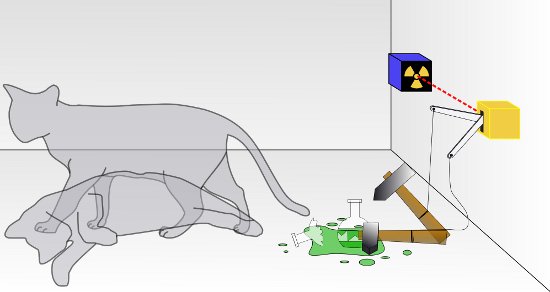
You can find out pretty much anything you want to know about Schrödinger’s cat at Wikipedia, but in short, Schrödinger’s cat is a thought experiment, sometimes described as a paradox, devised by Austrian physicist Erwin Schrödinger in 1935. That means no actual cat was killed or allowed to live simultaneously or in separate states as a result.

Schrödinger’s cat: a cat, a flask of poison, and a radioactive source are placed in a sealed box. If an internal monitor detects radioactivity (i.e. a single atom decaying), the flask is shattered, releasing the poison that kills the cat. The Copenhagen interpretation of quantum mechanics implies that after a while, the cat is simultaneously alive and dead. Yet, when one looks in the box, one sees the cat either alive or dead, not both alive and dead. This poses the question of when exactly quantum superposition ends and reality collapses into one possibility or the other.

What does that have to do with the Calvinism and Arminianism debate? As you probably already know, the debate centers around whether man has free will to choose salvation or if God’s sovereignty forces us to have no choice. Can man participate with God in his salvation or must God unilaterally choose for man?

When you come to a fork in the road, take it.

-Yogi Berra

If I apply Schrödinger’s thought experiment to the conflict, I come up with a resounding “I don’t know.” It’s the difference between Classical and Quantum physics.

For the Jew with traditional leanings, this could be welcome news. The old determinist view of reality accepted by Newtonian mechanics was certainly at odds with the classic Jewish worldview. Could QM allow once again for a world of divine providence, miracles and free choice, a world in which the creatures interact with their creator? Could it perhaps even provide us a better understanding of that legacy perspective?

-Rabbi Freeman

The heavens are telling of the glory of God; And their expanse is declaring the work of His hands. Day to day pours forth speech, And night to night reveals knowledge. There is no speech, nor are there words; Their voice is not heard. Their line has gone out through all the earth, And their utterances to the end of the world. In them He has placed a tent for the sun, Which is as a bridegroom coming out of his chamber; It rejoices as a strong man to run his course. Its rising is from one end of the heavens, And its circuit to the other end of them; And there is nothing hidden from its heat.

Psalm 19:1-6 (NASB)

Under heavenAccording to David, there is no inconsistency with our observation of the universe around us and our understanding of God. God made the universe and everything in it to point to the knowledge of Him. In other words, God doesn’t play “hide the ball” with the universe. What you see is what you get. Paul said the same thing in Romans 1:20, which is why no one has any excuse for a lack of knowledge of a Creative God.

But if Classical Mechanics doesn’t map to the Jewish view of the universe, is Judaism wrong or were the classical physicists? Again, that’s too big a question for me to answer, but I’m liking QM more and more all the time.

OK, no one really thinks that if you actually tried Schrödinger’s thought experiment with a real cat (which would be cruel) that you’d end up with a cat that is dead and alive at the same time. At the macro level, the cat would either be dead or alive. But Copenhagen interpretation of quantum mechanics works pretty well, at least in theory, at the subatomic level. What does it do when you enter into the realm of the supernatural and the mystical?

Chassidic thought doesn’t have a problem with incorporating mysticism into its internal map of how man journeys with God, but that’s not going to satisfy the either/or literalist. The problem is, the either/or literalist is probably going to have trouble with the uncertainty of existence proposed by QM and thus the latest models for how we think things work in the universe around us.

And if you think QM is strange and even bizarre, imagine how things would look to you if you could actually experience God the way Ezekiel did, the way Paul did, or the way John did in each of their mystic experiences as recorded in the Bible. Those events make the puzzle of Schrödinger’s cat seem as simple as riding a bicycle.

Need one remind our orthodox Jewish scientists, who still feel embarrassed about some old-fashioned Torah truths, in the face of scientific hypotheses, that Heisenberg’s principle of indeterminacy has finally done away with the traditional scientific notion that cause and effect are mechanically linked, so that it is quite unscientific to hold that one event is an inevitable consequence of another, but only most probable? Most scientists have accepted this principle of uncertainty (enunciated by Werner Heisenberg in 1927) as being intrinsic to the whole universe. The 19th century dogmatic, mechanistic, and deterministic attitude of science is gone. The modern scientist no longer expects to find Truth in science. The current and universally accepted view of science itself is that science must reconcile itself to the idea that whatever progress it makes, it will always deal with probabilities; not with certainties or absolutes.

-Rabbi Freeman quoting the Rebbe, Rabbi Menachem M. Schneerson

I’m sure this or any other part of Rabbi Freeman’s article won’t convince anyone who thinks in either/or terms to entertain the idea that, from a human being’s point of view, man has total free will and God is totally sovereign at the same time, and yet that’s the only reasonable answer that I can see. Until we actually look in the box, the cat is both dead and alive. Until we can acquire God’s point of view of the free will/sovereignty process, we have total free will and God is totally sovereign at the same time.

The thing is, Schrödinger can look inside the box anytime he likes and that sets the status of the cat on one side or the other: it’s either dead or alive once the box is opened. People can’t access God’s point of view directly. When we “lift the lid of the box,” we are opening the Bible. But the Bible is God’s viewpoint turned into human language. In the moment of “translation” from God’s thoughts to text on paper, we lose a great deal of meaning. We shift from perfection to sufficiency. We open the Bible and the cat is either dead or alive. But the state of the cat depends on which part of the Bible we’re reading.

Torah at SinaiHuman free will or a totally sovereign God? Somehow the answer is both. But if QM experts are weirded out by their own work, how much more should we be weirded out by the universe that God created us to live in?

If you absolutely have to come down on one side or the other of this debate, go right ahead. That means you are picking and choosing those parts of the Bible that either support man’s free will or that support God’s absolute sovereignty. That means you are dragging God and the Bible down into the mud with you. OK, Deuteronomy 30:11-14 says that the Torah is in the mud with us, so to speak, but I believe God, through Moses, was telling the Children of Israel that observing the mitzvot wasn’t an impossible task, not limiting the nature and character of the Word of God itself.

I think the Bible acts as sort of a “translation” of the Divine thought of God as filtered through the personalities and lives of the human writers. By definition, God and human beings had to enter into a partnership to create the Bible. Sure, God could have written it all by Himself without any human involvement, but he chose to let us participate. Does that make God any less sovereign and His Word any less perfect because people were also involved in the Bible’s creation?

The Copenhagen interpretation of quantum mechanics implies (if I may take some liberties) that Calvinism and Arminianism are simultaneously correct and incorrect. Yet, when one “looks in the box,” so to speak, it seems to be one or the other. Only God knows what’s going on in the box without lifting the lid.

The Christian faith is kaleidoscopic, and most of us are color-blind.

-N.T. Wright
from his Forward to the book
The King Jesus Gospel by Scot McKnight

Being Kept By Shabbos

hillel_shammaiYou shall honor it [Shabbos] by refraining from your usual weekday practices, nor pursuing your business, nor speaking thereof.

Isaiah 58:13

The observance of Shabbos and the festivals is characterized by not only abstinence from work, but also from all types of “weekday” activities, including even how one converses.

“Your conversation on Shabbos should not be similar to your weekday conversation”

-Shabbos 113b

A personal incident illustrates that by properly honoring the Shabbos and festivals, one achieves the respect of others.

As a resident in psychiatric training, I explained to the program director that I was unable to work on the festival days, and that these should be considered vacation days and deducted from my allotted vacation time.

The director shook his head. “No need for that,” he said. “Non-Jewish people can do anything they wish on their holidays. If they can wash the car, paint the garage, or go to the theater, then they can just as well come to work. In your case, you are not permitted to do anything, so obviously you cannot come to work, and this need not affect your vacation time.”

It has been said, “Even more than Israel has kept the Shabbos, the Shabbos has kept Israel.” If we honor the Shabbos properly, the Shabbos will honor us.

Today I shall…

…dedicate myself to a full observance of Shabbos and the festivals.

-Rabbi Abraham J. Twerski
“Growing Each Day – Tammuz 24”
Aish.com

This, as much as anything, illustrates the difference between the Jewish Shabbat and the Christian Sunday or “Lord’s Day.” I don’t doubt that the very first non-Jewish disciples of the Jewish Messiah observed a Shabbat in the same or similar manner as the Jewish disciples. Frankly, they wouldn’t have known any better, and a Sunday “Lord’s Day” probably wouldn’t even have occurred to them. Why would it?

Shifting the primary day to gather for worship from Saturday (Friday night to Saturday night, actually) to Sunday was most likely one of those acts designed to create a definition between Judaism and a Gentile Christianity. I can understand, to some degree, the desire to honor the day of Messiah’s rising from the tomb (although in Jewish reckoning, Jesus rising on the first day of the week could have happened anytime after sundown on Saturday), there’s nothing clear cut in the New Testament that says it was God’s intent.

However, there are just tons of references in the Tanakh (Old Testament) that speak of the Shabbat being observed on the seventh day, and as I said, the fact that Messiah came, taught, died, resurrected, and ascended never caused a ripple in Jewish Shabbat observance, just as it never caused a ripple in Jewish observance of any other part of the Torah or the normative halachah of the day.

But even if Gentile Christianity intended to lift Shabbat as a unit and move it over by about twenty-four hours, that wasn’t the end result. As Rabbi Twersky’s commentary tells us, an observant Jew’s response to Shabbat is quite a bit different than how a Christian spends his or her time on Sunday.

According to Chabad.org, there are thirty-nine melachot or forms of work that are prohibited to a Jewish person on Shabbos. Besides just the raw list presented at that site, how they are interpreted adds to the understanding of what must be avoided. From a Christian point of view, it all seems terribly restrictive and burdensome, and most Gentile believers having read such a list no doubt would rejoice in their “freedom in Christ.”

shabbat-candle-lightingBut our “holy day” isn’t all that holy if we don’t actually set it apart by behaving and even speaking differently.

I’ve discussed this with my Pastor and he believes the Ten Commandments, which includes the commandment to observe Shabbat, have universal applications. However, he does not believe that the day of the week is strictly fixed. I’m not sure what his rationale is for such a belief. He is usually very exact in his thinking and his attitude about Shabbat seems a little “fluid.”

I know that most Jewish people would deny that there is any direct command from God to the Gentile believers to observe Shabbos, especially in the manner of the Jewish people. There are some Gentiles who believe they are commanded and, in some manner or fashion, they do observe Shabbat. I don’t believe there are many who do so exactly like a modern, Orthodox Jew, and I’ve had a conversation with one Gentile believer who observes the Shabbat but who told me he retains the right to not make it burdensome (for instance, he feels free to turn light switches on and off, drive his car, use elevators, and so forth).

I used to keep a “sort of” Shabbat, but it was nowhere near the level of observance of most religious Jews. My wife is Jewish and, sad to say, not particularly observant (for the moment…I’m hoping that will change), and so in our household we don’t have much of a Shabbat. If I have the opportunity, I try to spend most of my day reading the Bible or related texts but if the situation calls for it (including the “honey-do list” situation), I can be found violating quite a few of the melachot.

But I think there is something special about setting aside one day of the week as Holy to God and dedicating ourselves to observing that day, to using the time to draw closer to God and to withdraw somewhat from the world around us.

I can’t imagine the Messianic age not including a Shabbat observance for all of the disciples of Messiah. It would seem strange at that point to segregate such observance by Jewish and Gentile populations and, after all, even the Gentile nations will be commanded to observe Sukkot and to send representatives to Jerusalem.

Then it will come about that any who are left of all the nations that went against Jerusalem will go up from year to year to worship the King, the Lord of hosts, and to celebrate Sukkot. And it will be that whichever of the families of the earth does not go up to Jerusalem to worship the King, the Lord of hosts, there will be no rain on them. If the family of Egypt does not go up or enter, then no rain will fall on them; it will be the plague with which the Lord smites the nations who do not go up to celebrate Sukkot. This will be the punishment of Egypt, and the punishment of all the nations who do not go up to celebrate Sukkot.

Zechariah 14:16-19 (NASB)

I replaced the phrase “the Festival of Booths” with “Sukkot” in the above-quoted passage to emphasize the nature of what is being commemorated. “Festival of Booths” somehow puts a “Christian spin” on what is quite obviously Jewish.

And yet, the nations are commanded to commemorate Sukkot in Messianic Days. So too the Shabbat?

“Also the foreigners who join themselves to the Lord,
To minister to Him, and to love the name of the Lord,
To be His servants, every one who keeps from profaning the sabbath
And holds fast My covenant;
Even those I will bring to My holy mountain
And make them joyful in My house of prayer.
Their burnt offerings and their sacrifices will be acceptable on My altar;
For My house will be called a house of prayer for all the peoples.”
The Lord God, who gathers the dispersed of Israel, declares,
“Yet others I will gather to them, to those already gathered.”

Isaiah 56:6-8 (NASB)

Shabbat candlesIt would certainly seem, based on this passage, that the nations (foreigners) who are joined to God not only will be required to observe Shabbat, but will also be allowed to pray in the Temple and to even bring sacrifices.

I’m certainly in no position to go around pointing fingers at Christians about what they do with their time on Saturday or Sunday, but I do want to suggest that some day, our rather casual attitude about Shabbat will have to change. There are many passages in the New Testament telling us that the Master will return “like a thief in the night” and that we will have no idea the day or hour of his coming back to us. We are told to be constantly be prepared and ready, day and night, for the bridegroom’s return.

“Even more than Israel has kept the Shabbos, the Shabbos has kept Israel.”

If the Master’s return comes that suddenly and unexpectedly, then our only hope of being ready is to always be ready. Maybe it wouldn’t hurt for us to practice a more focused Shabbat or two before he gets here.

Matot-Massei: Crossing the Street

bsa_cross_street1And Nobah went and captured Kenath and its dependencies, renaming it Nobah after himself.

Numbers 32:42 (JPS Tanakh)

Why did the Almighty include this verse in the Torah?

Rabbi Samson Raphael Hirsch elucidates: Throughout the world powerful leaders have wanted to leave monuments to themselves through statues and buildings named after them. Kings and conquerors have even named large cities after themselves. However, names can very easily be changed and then nothing is left, as happened to Novach. (Neither Novach nor the city he named after himself are remembered to history.) The good deeds of a person and his spiritual attainments are the only true everlasting monuments.

When you view the good that you do as your eternal monument, you will feel greater motivation to accomplish as much as you can. A life of spiritual attainments is everlasting. Feel joy in every positive act you do, for it gives greater splendor to your monument!

Dvar Torah for MatotMassei
based on Growth Through Torah by Rabbi Zelig Pliskin
as quoted by Rabbi Kalman Packouz in “Shabbat Shalom Weekly”
Aish.com

Rabbi Packouz also tells a story about the consequences of doing good.

It reminds me of the story of the father asking his son, the Boy Scout, if he did his good deed for the day. The boy says, “Sure, I helped an old lady cross the street. It took 12 of us.” “Why did it take 12 boys to help her across the street?” asks the father. Answers the son, “Because she didn’t want to cross!”

Every act of kindness has the possibility of a personal benefit. We must work to divest ourselves from our personal interest and to do kindness just to help someone.

Often, we choose to do the good deed or act of kindness that we want done for us or that we define as “good.” This is like the small boy who chooses to buy a toy he’s always wanted for a Mother’s Day gift. It would certainly seem like a kindness if he received the toy, but his mother might have other ideas about what she wants.

Forcing a “kindness” on someone who doesn’t want it is not only failing in your attempt to do good to another person, but it’s actually causing them harm. Imagine how the poor elderly woman felt in Rabbi Packouz’s story, when she found herself forced by twelve well-meaning but misguided boys, across the street. She is now where she didn’t want to be and, if she has difficulty crossing the street unaided, may not be able to easily get back home or to some place safe. And what if, in attempting to re-cross the street (without the aid of twelve “helpful” Boy Scouts this time), she is hit and injured by a car? Is that kindness?

I sometimes feel this way about sharing the gospel or the “good news” of Jesus, particularly with people who haven’t asked for such “news”. I remember the conversation that eventually led me to accept that Jesus is Messiah and Savior. I’d heard the same spiel many times before, and each time it was unwelcome and uncomfortable. I never wanted to be rude, but I also didn’t want to have to listen to someone tell me that I needed to be saved from my sins.

Fortunately, it wasn’t the spiel all by itself that resulted in my decision. A series of highly unlikely “coincidences” occurred over a period of six or more months finally resulted in getting me inside a church and then it took months and months more before I felt uncontrollably drawn (dragged kicking and screaming, metaphorically speaking) toward a life of faith and across the threshold into that life.

Almost immediately afterward, my life fell apart in more ways than I want to describe. Then, every time I thought I was starting to get a handle on what I was doing and why, another roadblock or explosion occurred. In more recent days, I tend to experience fewer explosions and more detours and frustrations on my journey.

intermarriageWhen my wife and I first married, neither one of us were religious, so her being Jewish and me being a Gentile didn’t make it seem like we were “intermarried.” There really weren’t any Jewish members of her family on our side of the country, so I never experienced Jewish in-laws. Faith and religion wasn’t an issue then as it is today.

I’ve been a believer for over fifteen years now, and if I could find the youth pastor who first shared the “good news” of Jesus Christ with me and started this ball rolling, I don’t know if I’d shake his hand or hit him.

No, I wouldn’t hit him and I don’t regret my decision.

But if I were a secular Gentile instead of a Christian, who I am wouldn’t be such an issue for my wife as a religious Jew. There are plenty of intermarried couples who freely attend the local synagogues in my community. Certainly the Reform shul doesn’t have difficulties with intermarried Jewish members. There are even non-Jews on the synagogue’s board. And the Chabad’s mission is to bring secular or assimilated Jews back to the Torah. As part of that effort, their non-Jewish spouses are welcome within their walls.

I once told my Pastor that one of the reasons I stopped any sort of overt “Messianic” worship or lifestyle was that my wife found it embarrassing. He asked something like, “She isn’t embarrassed about you being a church-going Christian?”

Actually, I strongly suspect she is. She doesn’t invite Jewish friends over to our house. She doesn’t go to shul anymore. She hasn’t even volunteered at either synagogue in a quite a while. She and my daughter used to spend a lot of time helping the Chabad Rebbitzin with various projects.

Was it a kindness to my wife that I became a Christian? Does that seem like a good deed to her? Is it what she asked for in a husband, or is it the moral equivalent of twelve overly zealous Boy Scouts forcing a helpless old lady across a busy city street?

Someone recently said to me that love does not see religion but people do. Another person has said to me not to seek any religion but to seek an encounter with God.

I trust I speak in charity, but the lack in our pulpits is real. Milton’s terrible sentence applies to our day as accurately as it did to his: “The hungry sheep look up, and are not fed.” It is a solemn thing, and no small scandal in the Kingdom, to see God’s children starving while actually seated at the Father’s table.

from the Preface of A.W. Tozer’s book
The Pursuit of God

I would hope one thing my wife and I have in common is the pursuit of God. Our paths are quite different, but perhaps not as different as you might imagine. While I would not abandon my faith in Jesus as Messiah, I would enter into her world in a heartbeat. As awkward as it might be for me (I don’t know Hebrew and the liturgical service would present quite a learning curve), I know now that I would strive to be a good and productive member of her community for her sake. But she’s told me that she would never, ever enter mine and, for the life of her, she can’t imagine why I would want to enter hers.

So would it be a kindness to try to introduce her to my world? She wouldn’t experience it that way and in fact, quite the opposite. She would feel like I was trying to drag her kicking and screaming into a place she never wanted to go. And whenever I’ve tried to enter her world, she’s always seen me as an intruder.

Rabbi Isaac Lichtenstein and many other Jewish people like him were not dragged kicking and screaming into faith in Yeshua as Messiah. They each followed the paths Hashem placed before them and by faith, they walked those paths, though it was always difficult and hazardous.

Rabbi-Isaac-LichtensteinNone of those Rabbis became Christians and none of them believed in “Jesus Christ.” They simply examined the Hebrew scriptures and what the church calls “the New Testament” and discovered the clues to the truth of Moshiach in their pages. If some missionary had tried to “convert” them, maybe some would have become “Christians” but Judaism would have lost great leaders and Messiah would have lost devoted Jewish disciples.

I don’t know that it is a kindness to cause a Jewish person to convert to Christianity. No, let me change that. I know it’s not a kindness. It’s not a kindness to destroy someone’s identity and purpose, especially if that identity and purpose was given to them directly by God. It is a kindness to help them on the next step on their journey, but they have to want to go. If they don’t want to start that part of the journey, you can’t force them to, even if you think it’s the best thing in the world for them. All you can do is open the door.

If they don’t go in, that doesn’t mean you’ve failed. If they don’t go in, that doesn’t mean you stop loving them. Kindness, compassion, and love, like all other things, are expressed by you and by me, but they are always from God.

God sets the course, He provides the path, He charts the journey. He does all this in love and compassion and kindness.

We can ask the elderly woman if she wants to cross the street and if she says, “no,” then we must let the answer be “no.” If the answer is “yes,” then it is a kindness to help her. If she wants to cross the street and asks for our help, we have a responsibility to be available, receptive, and then to escort her.

Kindness consists of loving people more than they deserve

-Jacqueline Schiff

God creates the street, but it is up to each person to ask for help crossing it. Then we can start walking and continue our journey.

Good Shabbos.

82 days.

Prophesies of the Master

jewish-revolt-against-romeDo the prophesies of Jesus Christ about the final tribulation really mean what we think they mean?

By the time the Jewish revolt against Rome began, only a few of the Master’s original twelve disciples remained alive. Most had already fallen asleep in various places throughout the world. Thomas continued his work in India; tradition says he died in 70 CE. Simon the Zealot followed up on the work of Thaddeus in Armenia and Parthia, but according to “The Golden Legend,” he did not escape martyrdom, and he may have already been dead by the outbreak of the war with Rome. John continued his labors in Asia Minor where he kept a low profile through the years of the Jewish revolt. James the Less appears to have been still alive in Galilee near the end of the Jewish revolt.

-D. Thomas Lancaster
“War in Perea and Judea,” pg 1037
Torah Club, Volume 6: Chronicles of the Apostles
First Fruits of Zion (FFOZ)

This is how Lancaster begins the study of the “Acts of the Apostles” for the week of Torah Portion Balak. This part of Volume 6 of the Torah Club covers the time of the Jewish revolt against Rome, which leads up to the siege of Jerusalem and culminates in the destruction of the Holy Temple and the dispersion of most of the Jewish inhabitants of Israel into the diaspora.

I thought it was appropriate, since we are currently in the three weeks of mourning between 17 Tammuz and Tish’a B’Av, that I cover a little bit of that “territory” in the history of the Jewish people.

Actually, what captured my interest in the Torah Club study, were the prophesies of the Master regarding this period in Israel’s history. Within this particular lesson, Lancaster recounts several prophesies of the Messiah that not only provide a direct revelation regarding this tragic time for the Jewish people, but which, in my opinion, tells us something new about the words of Christ. For the sake of length, I’m only going to comment on three of the prophesies.

“Therefore, behold, I am sending you prophets and wise men and scribes; some of them you will kill and crucify, and some of them you will scourge in your synagogues, and persecute from city to city, so that upon you may fall the guilt of all the righteous blood shed on earth, from the blood of righteous Abel to the blood of Zechariah, the son of Berechiah, whom you murdered between the temple and the altar. Truly I say to you, all these things will come upon this generation.”

Matthew 23:35-36 (NASB)

The Zealous implemented a state of martial law in the city. They positioned guards at all the exits and allowed no one to leave as they rounded up men culpable in the uprising against them.

-Lancaster, pg 1041

Lancaster recounts the general circumstances in Jerusalem during the Shevet-Tevet, 68 CE time period as recorded by Josephus in Jewish War. In describing the events associated with the above-quoted prophesy of the Master, he relates how the original Sanhedrin was executed by the Zealots and an illegal court was created in its place. But at the “trial” of Zecharyah ben Baruch, a wealthy citizen in Jerusalem who was thought to be a Roman collaborator, Zecharyah’s defense was so convincing, that the Zealot’s puppet court found him innocent of the charges.

But the Zealots were not out for justice and their response fulfilled the Master’s prophetic words:

The Zealous rose up in fury. Two of the Zealot leaders unsheathed their swords and ran the plaintiff through. They said, “You also have our verdict. We acquit you too.” Then they dragged his body into Solomon’s Colonnade and threw it from that height into the valley below. The other Zealots struck the seventy legislators with the flats of their swords and drove them from the Temple. That was the last trial a Sanhedrin conducted in the city of Jerusalem.

The incident fulfills a word spoken by Yeshua in reference to the murder of Zecharhiah the son of Jehoiada in the Temple.

-ibid, pg 1042

The second of the prophesies of Jesus I’m citing here is even more illuminating and perhaps controversial.

I tell you, on that night there will be two in one bed; one will be taken and the other will be left. There will be two women grinding at the same place; one will be taken and the other will be left. [Two men will be in the field; one will be taken and the other will be left.”] And answering they said to Him, “Where, Lord?” And He said to them, “Where the body is, there also the vultures will be gathered.”

Luke 34-37 (NASB)

nyc-sandy-aftermathMost Christians believe they have a complete understanding of the meaning of these verses, and it provides a great deal of theological comfort to them. But notice that the section in brackets is not contained in the oldest manuscripts, which may hint at something about the meaning of what Luke is trying to communicate.

The Zealots kept the city under their martial law. They punished all crimes with death, regardless of how serious the offense. They refused to allow anyone to leave lest he defect to the Romans. They struck down those they discovered escaping and left them unburied. Corpses lay along the roadways into the city. They refused to allow burial for any man they put to death.

To the people of Jerusalem, it seemed as if the Zealots had declared war against Rome and God both. They left the dead bodies to putrefy in the sun. They put to death anyone who dared to bury one of their victims. Josephus says, “He that granted the favor of the grave to another soon stood in need of a grave himself.” In those days, the words of the Master were fulfilled.

-Lancaster, pg 1043

This is a very different interpretation of the Master’s prophesy I quoted above than what we are used to hearing. There is no relation to “the rapture” at all (and I know I’ll probably “get in trouble” for even quoting Lancaster’s interpretation). One is taken by the Zealots for various crimes, real or imagined, and the other, who is not a suspect, is left behind. And where the dead bodies are left in the street, there the vultures gather.

You may have heard stories of Hitler’s Gestapo kidnapping political enemies in the middle of the night from their homes and from their beds. Similar stories have been told of the KGB in the Soviet Union. Under any despotic rule, citizens can be taken away without due process, imprisoned, or killed. There is no justice and no mercy. Why then could this not be the fate of many in Jerusalem during the Roman siege against the city as the Zealots ruled inside the city’s walls with brutality and force?

For then there will be a great tribulation, such as has not occurred since the beginning of the world until now, nor ever will. Unless those days had been cut short, no life would have been saved; but for the sake of the elect those days will be cut short.

Matthew 24:21-22 (NASB)

This is another prophesy that is attributed, in Christian tradition, to “the rapture,” stating that “the elect” will be whisked into Heaven before things get too bad on earth in the last days before the Messiah’s return.

However, according to Lancaster’s commentary, this prophesy may well have been fulfilled during the Fall of Perea in the month of Adar, 68 CE. Again, Lancaster’s source is Josephus’ Jewish War.

As the springtime drew near, Vespasian commenced his campaign. The rebels in Perea held the city of Gadara (or Gedora), which Josephus called “the capital of Perea and a city of some strength.” The leading men of Gadara had sent ambassadors to Vespasian urging him to come and liberate their city from the rebels. Vespasian took the tenth legion from Scythopolis (Beth-shan) and marched them to Gadara. On the fourth day of Adar, the legion came within sight of the city. At the sight of the approaching legion, the rebels abandoned the city and fled. Gadara surrendered immediately.

Vespasian left his tribute Placidus and five hundred cavalry and three thousand footmen to pursue the fleeing rebels. He returned to Caesarea.

-Lancaster, pg 1043

Placidus pursued and harassed the rebels, killing them as they ran and eliminating the populations of any hapless villages the rebels happened to take refuge in. Finally the rebel forces were trapped, hemmed in between the rain-swollen Jordan river and Placidus and his men.

By the time it was all over, more than fifteen thousand corpses floated down the Jordan and washed into the Dead Sea. Placidus continued his assault all the way to the Dead Sea, taking all the villages and towns of Perea except the fortress Macherus.

This slaughter happened just south of Pella where the Jewish believers had taken refuge inside the walls of that city. From their perspective in the city, it seemed as if the Master’s words had come to pass.

They prayed ardently for the coming of the Son of Man to cut the days of tribulation short. They looked for a sign of the Son of Man in the sky, and they listened for the sound of His shofar, but He did not come.

-ibid, pp 1043-44

Broken FaithLancaster presents more prophesies of Jesus as applied to the says that preceded the fall of Jerusalem, verses that most Protestant churches attribute to a final tribulation in which the faithful will be taken up and those who are not chosen are “left behind.”

Can I say what these prophesies mean? No, of course not. I present this interpretation from the Torah Club for two reasons. The first I’ve already mentioned, to recount and commemorate these three weeks of mourning in solidarity with the Jewish people. The second is to illustrate that prophesy is one thing and theology and doctrine based on long-held Christian tradition is something else entirely.

I’ve often wondered what would happen in the final days of tribulation, before the return of Christ, if we all finally realized that there is no rapture…what would happen to us…what would happen to the faithful?

However, when the Son of Man comes, will He find faith on the earth?”

Matthew 24:8 (NASB)

If there is no rapture, if terrible times arrive and we are not rescued, if like the believing Jews who sought refuge in Pella, we look to the sky and pray, if like those devout ones, we gaze up to in the air and the Master does not come in the clouds when we expect him to, what happens to us? What will become of our faith if we fail to hear the sound of his shofar? Then, when Messiah does come at the time appointed by the Father, will he find that we still have faith…or will it have fled along with our courage as our theological expectations and the traditions of the church turn to dust?