All posts by James Pyles

James Pyles is a published Science Fiction, Fantasy, and Horror author as well as the Technical Writer for a large, diversified business in the Northwest. He currently has over 30 short stories published in various anthologies and periodicals and has just sold his first novella. He won the 2021 Helicon Short Story Award for his science fiction tale "The Three Billion Year Love" which appears in the Tuscany Bay Press Planetary Anthology "Mars."

The Miracles You Make

There are two types of miracles: Those beyond nature and those clothed within it. The water of the Nile turning into blood was beyond nature. The victory of the Maccabees over the Greek army came dressed as a natural occurence—they had to fight to win.

Both types of miracles are necessary.

If we would see only miracles beyond nature, we would know that G‑d can do whatever He likes—but we might think He must break the rules to do so. We would know a G‑d who is beyond nature, but not within it.

If we would see only miracles that are clothed within nature, we would know a G‑d that is Master of all that happens within nature.

But we might think He is limited within it.

Now we know a G‑d that is at once both beyond all things and within them. In truth, there is nothing else but Him.

-Rabbi Tzvi Freeman
“Stereo Miracles”
Based on letters and talks of the Rebbe
Rabbi M. M. Schneerson
Chabad.org

Take note of any positive occurrence that happens to you and give thanks to the Almighty for it.

Some common examples: your eyeglasses fall to the ground and do not break, or you find something you’d been missing.

-Rabbi Zelig Pliskin
“Daily Lift #652: Watch for Positive Occurrences”
Aish.com

When most of us think about miracles, we think of those that wildly violate the laws of physics…the Sun standing still in the sky and that sort of thing. But as Rabbi Freeman points out, there are miracles that we must participate in for them to occur. The Maccabees wouldn’t have won over the Greek army if they didn’t fight. The Reed Sea wouldn’t have parted (according to midrash) if Moses and the Children of Israel hadn’t first stepped into the water. The woman with the issue of blood (Mark 5:25-34) would not have been cured if she had not believed in the power of Jesus to heal and then touched his garment.

These were all supernatural events, but they required the very natural and real participation of the human beings involved. Otherwise, they would never have occurred.

I guess that’s what faith and trust is. You know you have to do something. You believe God has told you to do something that is very difficult or, by your own estimation, impossible. And so you must do it or at least try.

But according to Jewish belief, we are not to depend upon miracles. That is, we’re not to get ourselves into a bad situation and then expect God to bail us out with a miracle.

Then the devil took him to the holy city and set him on the pinnacle of the temple and said to him, “If you are the Son of God, throw yourself down, for it is written,

“‘He will command his angels concerning you,’

and

“‘On their hands they will bear you up, lest you strike your foot against a stone.’”

Jesus said to him, “Again it is written, ‘You shall not put the Lord your God to the test.’”

Matthew 4:5-8 (ESV)

Even Jesus didn’t depend on God’s miracles when he was being tested and tormented. He just remembered God, remembered the Words of God, and had faith.

And at times when anything good does happen to us, whether it is an “obvious” miracle or not, Rabbi Pliskin says we are to give thanks. Sounds very similar to another good piece of advice:

Rejoice always, pray without ceasing, give thanks in all circumstances; for this is the will of God in Christ Jesus for you.

1 Thessalonians 5:16-18 (ESV)

Rejoice always, pray always, and thank God in every circumstance. Watch for positive occurrences because they indicate the presence of God. Rabbi Freeman also said:

There are open miracles that break the laws of nature as though they were meaningless—miracles any fool can perceive.

Then there are miracles that take some thought to realize that yes, something out of the ordinary occurred here.

And then there are miracles so great, so wondrous, that no one but G‑d Himself is cognizant of them. They are the miracles that occur continuously, at every moment.

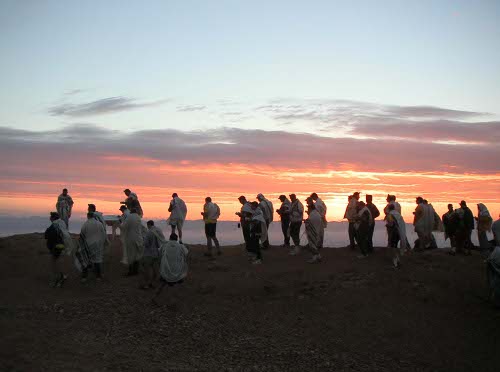
Beyond the supernatural, laws of physics violating miracles, and the ones that happen when we cooperate with God, there are those that happen all of the time and exist beyond our awareness. Or perhaps these are the miracles that happen all the time and we’re just not paying attention. Miracles like a baby being born. Miracles like your heart continuing to beat in your chest. Miracles like the ability to take in a deep breath of air. Miracles like watching the first rays of the Sun shine over the dark horizon.

Miracles like just being alive. This is why observant Jews say upon awakening:

I gratefully thank you, living and existing King for returning my soul to me with compassion. Abundant is Your faithfulness.

Of prayer and miracles, it is also said:

We pray and He answers with blessings. But we ask, “If you are already giving us blessings, why in such clumsy packages with so many strings attached?”

And He answers, “If you are giving me your innermost heart in prayer, why in such thick layers of ego? Why with such cold words? Why do you hold back your tears?”

“I’ll make you a deal,” He says. “You bare your souls from their wrappings, and I will bare My blessings of their clouds.”

-Rabbi Tzvi Freeman
“Unwrapping”
Based on letters and talks of the Rebbe
Rabbi M. M. Schneerson
Chabad.org

May blessings and miracles continue in your life.

Experiencing Prayer

Rabbi DovBer, the Maggid of Mezeritch, used to pray at great length. Sometimes his prayers would take hours. Near Mezeritch there lived a learned man who, like the Maggid, also used to pray according to the kavanot (mystical intentions) taught by the holy Ari (Rabbi Yitzchak Luria) of Safed, but whose prayers did not take so long. When he heard about how much time the Maggid spent, he was perplexed, and wanted to know the reason. He decided to ask the Maggid himself.

Once a year this learned man, who also happened to be quite wealthy, would travel to the great fair in Leipzig. There he would invest some of his capital in merchandise, which he would then sell in his hometown upon his return at a good profit. He was able to live off the proceeds from these transactions for the rest of the year, while he devoted his time to Torah study and prayer. On his next such business trip, he made a point to pass through Mezeritch and stop there.

Witnessing for himself the Maggid’s lengthy prayers, he was amazed. At his first opportunity to speak privately to the Maggid, the wealthy scholar said, “I also pray according to the special mystical intentions taught by the holy Ari, yet I don’t find the necessity to extend my prayers for so long.”

Instead of answering directly, the Maggid expressed interest in how his guest made a living. The man explained how it was enough for him to travel once a year to Leipzig to invest in merchandise, which he then sold for a good profit in the area where he lived.

“But how do you know that you have made a profit?” inquired the Maggid.

“Simple. I enter all my capital expenditures and traveling expenses in my ledger, and subtract their sum from the total amount of income from sales. The remainder is my profit,” replied the merchant, wondering why the rebbe was so interested in the details of his business.

“But why,” the Maggid asked innocently, “do you waste all that time and money traveling to Leipzig and back? Why don’t you just write all the credit and debit figures down in your ledger and calculate your profits that way, without fuss?”

“Ha, ha, ha!” laughed the merchant. “Is it possible to think that from writing numbers can come a profit without bothering to do anything else? Ha, ha, ha. Of course, you have to travel and buy and sell before the profit can be real, not just theoretical.”

“Well,” said the Maggid, “the kavanot are like merchandise: if they are not fully possessed in your mind and heart as if you were ‘there,’ it is like writing profit figures on a piece of paper without doing the business work. On the other hand, if you are firmly attached ‘there,’ you can then acquire some excellent ‘merchandise’ and make a handsome profit with the kavanot.

“But that,” concluded the Maggid to his astonished visitor, “requires extended time and investment in prayer.”

Translated/retold from Reshimas Devarim, vol. 4.
“The Prayer Business”
-Rabbi Yerachmiel Tilles
Chabad.org

Man should ponder thoughtfully how great are the kindnesses of the Creator: Such a puny insignificant being, Man, can bring great delight to the “Greatest of all great”‘ of Whom it is written, “There is no delving into His greatness.” (Psalm 145:1) Man ought therefore always be inspired, and perform his avoda with an eager heart and spirit.

“Today’s Day”
Sunday, Kislev 8, 5704
Compiled by the Lubavitcher Rebbe
Translated by Yitschak Meir Kagan
Chabad.org

I’m not really a “mystic” sort of guy. I enjoy reading (I don’t seriously study mysticism) mystic commentaries and texts because I find they work wonderfully as metaphors of moral and spiritual concepts and ideas. Mysticism is a very good way to tell stories about people and God, which is why I’m fond of the writings of the Chassidim and Chabad.

So try not to take the commentary about prayer I quoted above as if I think this is a literal truth, although for some, I imagine it is. I latched onto it mainly because it makes me think about prayer and what it’s supposed to mean. Hopefully, it’ll make you think more about prayer, too.

DaveningIn yesterday’s morning meditation, I spoke a bit about my use of the Modeh Ani and Bedtime Shema blessings in my own life. Prayer is difficult for me, at least lengthy prayer, because I find that so many random thoughts and emotions creep in when I’m trying to talk (and listen) to God. Since the Modeh Ani is fairly short and I recite it from memory, there isn’t time for anything else to interfere, and since I recite the ending portion of the Bedtime Shema from my siddur, the fact that I’m reading from text helps focus my thoughts and my intention.

I actually have been thinking more about prayer since I read a friend’s commentary on his own experiences recently:

Early this morning before my flight had left the gate, I was quietly (and discreetly) praying Birchot Hashachar (morning blessings) from my pocket siddur when suddenly the woman sitting next to me asked me, “What language is that?” “Hebrew,” I replied. “Oh, I thought it was Greek,” she said.

“Well, I actually know that, too,” I said, which then led into an extensive conversation that unfortunately I was too tired to engage in and, B”H, managed to escape shortly after takeoff by falling asleep for the duration of the flight. (A window seat and foam earplugs are always my best friends on a flight.) Then after landing, I went to the airport chapel to pray Shacharit. I must have prayed Shacharit there countless times while travelling, and I usually have the chapel all to myself. Sometimes other people enter the chapel for some quiet moments while I’m there and they see me wearing my tallit and tefillin, which I can only imagine how that might look to them if they’re unfamiliar with Judaism. Usually they only stay for 30 seconds—one minute at most—and then they promptly leave. (I can always sense their feelings of uncomfortability and awkwardness.)

However, this morning while I was donning my tefillin, a clean cut, black gentleman dressed in a suit and tie entered the chapel and sat down a few seats behind me. I politely said “Good morning” to him, then began quietly praying Pesukei d’Zimra and continued with my usual morning prayer routine as quietly and discreetly as possible. Amazingly, however, he actually stayed. A few minutes later, when I was between the Shma and Amidah, he began walking toward the exit, but then quickly turned around, boldly approached me, and asked me forthright, “Do you believe in Jesus Christ?” I was a bit taken aback by his question and it took me a few seconds to process it. “Yes, I do,” I responded, although somewhat apprehensively. “Oh, praise the L-RD,” he said, and reached out to shake my hand. “Something in my heart told me to ask you that. I’ve heard of you guys. Yeshua Ha-ma-shee-ah?” “Yeshua Hamashiach,” I affirmed. And then he suddenly walked out with this big smile on his face while I was left there wondering what that was all about.

Depending on who you are and how and where you pray, you aren’t always praying alone and your prayer life may have some sort of impact on others. Of course, even when I prayed with a siddur, I rarely prayed in public (unless it was at a worship service where everyone was using a siddur), so I never had these sorts of encounters. But in reading the comments of my friend about his own experiences, I was reminded of the beauty of the Jewish prayers and how the early Jewish believers gathered daily to recite the prayers at Solomon’s colonnade at the Temple in Jerusalem.

I’ve probably mentioned this before, but last spring, when I was attending the First Fruits of Zion Shavuot Conference at Beth Immanuel Shabbath Fellowship in Hudson, Wisconsin, I had a wonderful experience. One morning, I arrived at the congregation early and was sitting in the main sanctuary waiting for services to begin. In the distance, I heard men davening Shacharit in Hebrew. I followed the sound into the library and discovered the men were praying together in an upper room. Not wishing to disturb them (and my Hebrew is more than abysmal), I chose to stand underneath the room and just listen.

If you’ve ever heard men praying the Hebrew prayers before, you know it is a beautiful sound and even without understanding all of the words (I’ve been around the prayers enough to be able to generally follow them), I felt myself transported in a sense, lifted up into the spirit of the prayer, and found myself drawing closer to God.

I don’t think you have to pray in Hebrew to draw closer to God, but there’s something about a minyan davening (not that I can qualify to pray with a minyan) that brings me into communion with God in a way I’ve never found when praying or singing hymns in a church.

Be that as it may, we are each responsible for our own prayer life and thus our relationship with God. And yet for me, prayer is one of the most difficult parts of my relationship with God. I receive great joy in reading the Bible and various commentaries and studies, but spending time alone with God is so difficult, again because my brain keeps getting in the way. I think that’s why I like praying with a siddur because it helps me focus my intention upon God and praising His Name. Praying “alone,” that is, without a siddur, allows the noise and static of my own thoughts to completely take over, and I find myself drowning in the sound that my brain generates rather than rising above my own existence and approaching the Creator.

When I go to church, we pray, but it somehow isn’t the same. When I go to Sunday school, we pray, but it’s not like we’re praying together. This too I think is one of the “weaknesses” of Protestantism.

I don’t really have an answer to my conundrum, but I think Rabbi DovBer has an answer that works, at least for some Jewish people (or people of faith), in that you have to invest in your prayers rather than just use praying as a “remote control” method of communication. Prayer requires time, discipline, and an investment of purpose. I haven’t attempted such a thing for a very long time. For me, Modeh Ani and the Bedtime Shema are a beginning, but unlike my friend, I haven’t extended myself to pray at set times, and particularly wouldn’t do so if I was in a public place such as an airport (and I didn’t even know airports had chapels).

Is my experience common or am I an oddball in his area of faith as well? What are your experiences like? Is anyone willing to share?

The Early Christian According to Cohen

In order to maintain their distinctiveness and identity, most Jews of the ancient world sought to separate themselves from their gentile neighbors. In the cities of the East, they formed their own autonomous ethnic communities, each with its own officers, institutions, and regulations. Some cities, notably Alexandria and Rome, had neighborhoods inhabited mostly by Jews. (These were not “ghettos” but “ethnic neighborhoods.”) Following the lead of Ezra, the Jews of the Second Temple period grew more and more intolerant of marriages with foreigners.

Shaye J.D. Cohen
Chapter 2: Jews and Gentiles
Social: Jews and Gentiles, pg 37
from the book
From the Maccabees to the Mishnah, 2nd Ed

I quoted this portion of Cohen’s book in a recent extra meditation and I want to continue discussing the theme of early Jewish and Christian (and Gentile) identity as we can apply it to today’s community of Jewish and Gentile believers. As I also mentioned in my previous missive, there is a group within Hebrew Roots that is invested in believing that for a time, both the Jewish disciples of the Messiah and the non-Jewish disciples brought into the faith, primarily by Paul, were completely of one accord and shared a completely uniform identity as “Messianics,” being “neither Jew nor Greek” (Galatians 3:28), but rather “one new man” (Ephesians 2:15) in Christ, with all distinctions of cultural, ethnic, national, and covenant identity as established by God, completely obliterated.

In traditional (supersessionist) Christianity, this takes on the form of Jews no longer being Jews but rather, “converting” to Christianity. Anyone who has read this blog for any length of time knows that I reject this suggestion and I do not believe it can be sustained from even a casual reading of the Bible. The chronicles of the Jewish disciples recorded in the early chapters of the book of Acts clearly shows them continuing to live lifestyles completely consistent with the other Judaisms of their day. There is nothing to say that Peter, James, or Paul ever surrendered being Jewish and while the Temple stood, ever forsake the festivals or the sacrifices.

However, the aforementioned movement within Hebrew Roots, sometimes referred to as “One Law” takes the same approach from the opposite end of the spectrum. Instead of demanding that Jews stop being Jews, they demand that Gentiles have the right and obligation to be “Jews” in all but name (sometimes referring to themselves as “Israel” or “Spiritual Judaism”). They cite a number of passages in the Bible to support their claim, primarily the “one law for the Jew and the Stranger” in various parts of the Torah (for example, see Leviticus 24:22, Numbers 15:16, and Numbers 15:29) as well as Acts 15:21 to establish the suggestion that God and the Jerusalem Council required the Gentile disciples to more or less “convert” to a form of Judaism without actually converting to Judaism. Further, assuming these suppositions are correct, they state that this practice must be carried forward and established among Gentile Christians today, using the modern synagogue worship model as the template for Gentile practice of what they refer to as “Messianic Judaism.”

In reading Cohen, I’ve become more convinced than ever that the foundation upon which One Law is built is a soggy sandcastle rather than a rock. One Law, by definition, must require the ancient Israelite to share national and tribal identity with the (non-Israelite) “ger” (stranger, alien, sometimes convert) among them and also, that the Second Temple era Jews must surrender their halakhic, ethnic, cultural, national, and covenant identity to the Gentile disciple due to their grafted in (see Romans 11) status. In both cases, the unique people group established by God must become “un-unique.” For this to be true, it must mean that God lied to the Jewish people when He established them as His splendorous treasured people (Exodus 19:5) among all the nations of the earth.

I know there’s a danger is relying on a single source of information (Cohen) for doing any sort of research, so I’ll say right now that my conclusions can’t be considered definitive. On the other hand, I think Cohen’s work does indicate that a number of historical factors related to the ancient Israelites and the Second Temple era Jews have been ignored by One Law proponents and I’d like to briefly bring some of those factors into the forefront.

Let’s take ancient Israel and the status of the “ger” first. According to One Law supporters, the various “one law for the native, etc…” passages indicate that God originally intended for Israelites and non-Israelites (who have attached themselves to the God of Abraham) to operate identically in terms of covenant and identity.

When discussing Conversation to Judaism in Chapter 2 of his book, Cohen states:

In preexilic times, conversion to Judaism did not yet exist because birth is immutable. An Ammonite or an Aramean could no more become an Israelite in preexilic times than an American can become a citizen of Liechtenstein in our own. Mere residency in the land does not confer citizenship, and a social system that defines a citizen solely as a child of a citizen has no legal mechanism by which to assimilate a foreigner.

This seems to support the general supposition of One Law, that Gentiles did not “convert” to Judaism in preexilic times (before the Babylonian exile), and if taken out of context, may be construed as meaning that Gentiles who lived in the land would be under the same law (Torah) and have the same legal status as the native of the land…even though they didn’t have citizenship. But does that make sense?

Biblical law frequently refers to the “resident alien” (ger in Hebrew) who is grouped with the widow, the orphan, and the Levite. All of these are landless and powerless, and all are the potential victims of abuse. (An American analogy to the ger is the Chicano (specifically, undocumented alien) farmworker; a European analogy is the Turkish laborer in Germany.) The Bible nowhere states how a ger might ameliorate his status and become equal to the native born, because there was no legal institution by which a foreigner could be absorbed by a tribal society living on its ancestral land. Resident aliens in the cities of pre-Hellenistic Greece fared no better.

Cohen soundly torpedoes the suggestion that “one law” gerim were equal to the native Israelites in the Land in all aspects of Torah and other covenant status. There was no legal avenue that would allow a non-member of an Israelite tribe to enter into a tribal society that was established by heredity and covenant. There was no way for the ger to become equal to the Israelite in terms of the Mosaic covenant, at least according to Cohen. Any legal requirement for the ger to become circumcised or to not eat from an animal killed by a wild creature was not an indication that the ger was in anyway equal to the native of the land in covenant status, anymore than an undocumented immigrant in the U.S. shares equal status to  U.S citizens.

After the exile of 587 BCE, the Israelite tribal structure was eliminated and the Jews who returned to Judea from Babylon were organized as clans, according to Cohen, not tribes. The ritual organization was specifically “Priest,” “Levite,” and “Israelite.” Further, it became possible to consider the idea that foreigners could somehow be “joined” to Israel and to God. Cohen continues:

But these centuries saw the creation of an institutionalized method for the admixture of gentiles. Ezra was still unfamiliar with the notion of “conversion,” but some of his contemporaries were discussing the idea. One prophet assured the “foreigners who join themselves to the LORD, to minister to him, to love the name of the LORD, and to be his servants” that they would not be excluded from the rebuilt temple but would be gathered to God’s people (Isa. 56:6-8). Several prophets predicted that in the end of days foreigners would join in the worship of the true God in Jerusalem, either as servants of the Israelites or as independent worshipers.”

The mechanism by which all this would occur was not spelled out as far as Cohen is concerned, but Christians believe that it is through our being brought into the New Covenant through faith in the Messiah, Jesus Christ, that we are joined to the God of Israel. Of course, that still doesn’t mean we become identical to the Jewish people in every conceivable detail, particularly if, as we’ve already seen, Gentile residents of ancient, tribal Israel were not included equally in citizenship or covenant, but rather, relegated to the status of alien residents with few, if any rights.

However, as the history of Israel progressed, the concept of conversation to Judaism for the Gentile began to become more formalized. Cohen cites three essential elements of conversion to Judaism: belief in God, circumcision, and joining the house of Israel. Again, this is a definition of a convert to Judaism, not conditions required for the Gentile to join “the Way” as disciples of Christ. Cohen even references the difference:

For Paul, circumcision represents subjugation to the demands of the Torah (Gal. 3-5).

In other words, while Paul did not see circumcision and thus full obedience to the mitzvot as a requirement for the Gentile Christians, he did see it as a necessary step for full conversion to Judaism. The natural conclusion then is that a Gentile becoming a disciple of the Jewish Messiah in the time of Paul was not the same as a Gentile converting to Judaism.

If we take the message of the Book of Galatians as a unit, then we must conclude that Paul is arguing for the sufficiency of faith in Christ for the Gentile. The non-Jew does not have to convert to Judaism in order to be justified before God.

We tend to take the concept of God-fearers as they existed in the late Second Temple era as a sort of stepping stone between Gentile paganism and Christianity, but according to Cohen, these Gentiles were just as likely to be attracted to another form of Judaism (one without the involvement of the Messiah) and perhaps to even convert to one of the many Judaisms of the day.

Even more numerous, however, were those gentiles who accepted certain aspects of Judaism but did not convert to it. In polytheistic fashion, they added the God of Israel to their pantheon and did not deny the pagan gods…In the city of Rome, many gentiles observed the Sabbath, the fasts, and the food laws; in Asia Minor, many gentiles attended synagogue on the Sabbath. Although these gentiles observed any number of Jewish practices and venerated in one form or another the God of the Jews, they did not see themselves as Jews and were not seen by others as Jews.

Cohen does not specifically state that any of these God-fearers were associated with “the Way” nor do we have any indication that the Gentile God-fearers saw themselves as obligated to the Torah or having “rights” of observance. Just as they would have observed any number of other religious practices associated with other “gods,” these God-fearers also observed a number of religious practices associated with the God of Israel. Cohen goes on:

They resemble the polytheists of the preexilic period who feared the Lord but who never changed their identity.

For One Law proponents, the good news is that there is a record of early first century C.E. gentiles observing some of the mitzvot. The bad news is that they were polytheists who did not truly “convert” to any form of Judaism (or necessarily what we now think of as “early Christianity”) nor did they forsake polytheism, which is in direct opposition to fiercely monotheistic Judaism.

Cohen does reference the New Testament (specifically sections of Acts) in further describing these God-fearers.

The book of Acts calls these people “those who fear” (phoboumenoi) or “those who venerate” (sebomenoi) the Lord (Acts 13:16, 26; 16:14; 17:4, 17; 18:7). Modern scholars call them “sympathizers” or “semi-proselytes,” but these terms lack ancient attestation…After all, how can a gentile become a “little bit Jewish?” And why would he want to?

The explanation goes back to Cohen’s description of God-fearers as polytheists who considered the God of Israel as “just another god.” But there may have been other reasons.

Rather than look upon God-fearers as gentiles interested in Judaism, perhaps we should see in the phenomenon the contribution of Judaism to the cultural mix we call Hellenistic. Greco-Roman culture provides various analogies to Jewish ideas and practices.
In other words, gentile interest in Judaism was not for Judaism’s sake per se, but for the sake of multi-culturalism within Greek society, the way that many different religious and cultural practices are integrated into modern Japanese life. My daughter lived in Japan for almost a year with a Japanese family. At one point, she attended the wedding of a Japanese couple who practiced Buddhism but who were married by a Swedish Catholic Priest. When my daughter tried to find out the reason for such an interesting mix, about the best answer she could get was, “In Japan, it’s all good.” Maybe that was also true in some corners of Greek society.

Continuing to read Cohen, I began to wonder if, from the Gentile point of view, converting to Christianity was viewed in the same light as how Gentiles were converting to other forms of Judaism.

Josephus insists that Judaism has no mysteries, no secrets that it keeps hidden from curious observers. This claim may not be entirely true (note, for example, how secretive Jesus is according to the Gospel of Mark), but it is essentially correct. Some Jews even engaged in missionary work. The Pharisees travel about land and the sea in order to make even one proselyte (the Greek word for convert to Judaism; Matt. 23:15). Josephus narrates that in the middle of the first century CE, the royal house of the kingdom of Adiabene became Jewish under the tutelage of itinerant Jewish merchants…

Some scholars have suggested that much of the Jewish literature written in Greek had as its goal the propagation of Judaism among the gentiles, since the literature often emphasizes those elements of Judaism that would make it attractive to outsiders.

Seen from this perspective, Paul and his mission to convert the Gentiles to faith in the Jewish Messiah may have well been just one Jew among many who were attempting to mine the same population of Gentiles and convert them to one of the various forms of Judaism that existed in that era. So it wouldn’t be unusual at all for “Christian” Gentiles to practice various Jewish religious and cultural behaviors in the same manner as other “converts” to Judaism, although as I previously stated, a Gentile converting to Christianity was not converting to Judaism. But at that point in history, the “Judaism” we consider “early Christianity” was considered a Judaism and it had not yet adopted a trajectory that caused it to deviate from Jewish practice and finally to not be considered a Judaism at all.

Apparently that took some time.

Many Christians, generally called “Judaizers” by modern scholarship, were drawn to Jewish practices. For some of these Christians, Judaism was attractive because of Christianity. Through Christianity they learned the Jewish scriptures and became familiar with Jewish observances. Many Christian groups, for example, insisted that Easter must coincide with the Jewish Passover and that it be celebrated with rites similar to those of the Jewish Passover.

It’s interesting that Cohen, although acknowledging a close Christian association with Judaism, continues to differentiate between the Gentile Christians and the Jewish people, presumably even those Jews who followed Jesus as Messiah. Note that early on, the concept of Easter was born and was to be treated in a similar manner to the Passover, but not as if they were the exact same festival or celebration. Nevertheless, according to Cohen, the Jewish-Christian connection endured for a number of centuries, even through the schism began most likely within the lifetime of Paul and John.

In Antioch in the late fourth century, John Chrysostom was shocked that many Christians were doing what pagan God-fearers had been doing in other parts of the empire three centuries previously: they were attending synagogues and observing the Jewish festivals.

It seems as though Christianity and Judaism maintained a “mix” for hundreds of years after the fall of Jerusalem but were never quite “in synch,” making Christianity a unique experience for the Gentile disciples, since they never adopted an actual Jewish identity the way that other proselytes did when they completed an actual conversion to one of the other Judaisms. This seems to indicate a bond between Gentile and Jewish disciples of the Master but not a fused cultural, national, or ethnic identity.

What may have driven a further wedge between Gentile Christianity and the Jewish “Messiah” movement was this:

What did change after 70 CE was that Jews, or at least the rabbis, were no longer as eager to sell their spiritual wares to the gentiles.

There is also some indication that post-Second Temple, Gentile Christianity began to gain some traction independent of the other Judaisms, possibly including the Judaism of “the Way.”

Perhaps (and this is the common explanation) the rabbis saw the growing power of Christianity and decided not to try to compete with it. Outside of rabbinic circles, perhaps some Jews still actively attempted to interest gentiles, especially Christians, in Judaism, but the evidence for this activity is minimal.

The picture Cohen paints of Gentiles in relation to the Judaism most of us call “Christianity” is incomplete, but we can draw some conclusions. First, the historical figure of the “ger” in ancient, preexilic times, is not a model for modern One Law Christians in adopting equality with Messianic (or any other sort of) Jews. The ger’s observance of Torah was for the purpose of having them obey “the law of the land” the way that even an undocumented alien worker would obey some or most of the laws in the U.S., but it didn’t make them citizens of a tribal nation nor did it confer anything even approaching equality between the gerim and the native-born Israelite. There were laws to protect the gerim in the manner of widows or orphans, but they were most definitely “second-class inhabitants” in Israel. The final blow to the “gerim” argument of One Law is that in post-exilic times, the status of the ger ceased to exist because Israel had shifted from a tribal-driven to a clan-driven society.

We see that in the time of Jesus and following, God-fearers were in evidence and they did practice synagogue worship and a number of the other mitzvot but primarily in the manner of polytheists who practiced the religions of multiple Gods. They did not forsake all other gods for the sake of the One God or become equal to the Jewish people in any covenant sense. As far as a Gentile converting to “Christianity” goes, they were not actually converts to Judaism in that they did not enjoy the full covenant benefits of converts to the other Judaisms and full obligation to Torah (which required circumcision as a covenant sign). It is acknowledged that the Gentile disciples of the Way did practice many of the Jewish religious customs including Shabbat and the festivals, even into the fourth century C.E., but the Roman authority never recognized these “Christians” as having legitimate legal rights to these observances the way that the Jews did and Cohen indicates that Gentile observance, particularly of Easter, was similar to but not identical with Passover.

And as the centuries passed, the trajectories of Christianity and Judaism continued to diverge until any “quasi-Jewish” observance by Gentile Christians simply ceased to exist.

Today, Christianity can be said to have its origins in Judaism but it has not been even remotely associated with Judaism for nearly 2,000 years.

I am not saying that there are not Christians today who maintain an attraction to Jewish practices, theology, and philosophy, but there is nothing that we can pull forward across from the time of Paul, and absolutely nothing we can draw forth from the time of Moses, that would suggest that a Gentile Christian today has any right or obligation whatsoever to observance of any aspect of the Jewish Torah mitzvot, except perhaps those that are common with kindness, compassion, and decency toward other human beings (feeding the hungry, and so forth).

While Cohen cannot be considered the final word in the history of Gentiles in the early movement of “the Way,” he certainly gives us a perspective we must pay attention to, and he helps us to realize that whatever the early Christians were in the days of Peter, Paul, and John, we are not the same as they were. They never were Jewish and neither are we.

Blessings at Night and Morning

A song of ascents. Praiseworthy is each person who fears HASHEM, who walks in His paths. When you eat the labor of your hands, you are praiseworthy, and it is well with you. Your wife shall be like a fruitful vine in the inner chambers of your home; your children shall be like olive shoots surrounding your table. Behold! For so is blessed the man who fears HASHEM. May HASHEM bless you from Zion, and may you gaze upon the goodness of Jerusalem, all the days of your life. And may you see children born to children, peace upon Israel.

Tremble and sin not. Reflect in your hearts while on your beds, and be utterly silent. Selah.

Master of the universe. Who reigned before any form was created,
At the time when His will brought all into being —
then as “King” was His Name proclaimed.
After all has ceased to be, He, the Awesome One, will reign alone.
It is He Who was, He Who is, and He Who shall remain, in splendor.
He is One — there is no second to compare to Him, to declare as His equal.
Without beginning, without conclusion — His is the power and dominion.
He is my God, my living Redeemer, Rock of my pain in time of distress.
He is my banner, a refuge for me, the portion in my cup on the day I call.
Into His hand I shall entrust my spirit when I go to sleep — and I shall awaken!
With my spirit shall my body remain. HASHEM is with me, I shall not fear.

-Portion of the Bedtime Shema

My father said that the reciting of sh’ma before retiring at night (p. 118-124) is, in miniature form, like the Confession before death. But then one leaves the marketplace permanently, and the commerce of “Today to perform them” is finished. With the Bedside Sh’ma every night, however, one is still in the middle of the “market” and can still accomplish and achieve.

“Today’s Day”
Friday, Kislev 6, 5704
Compiled by the Lubavitcher Rebbe
Translated by Yitschak Meir Kagan
Chabad.org

It is said in Jewish wisdom that one should repent one day before his death. But how can you know when the day of your death will come? You can’t. Therefore repent every day as if it is your last day of life.

I sometimes have bouts of insomnia for a variety of reasons. As I write this though, I slept very well last night. In fact, I recall that I was engaged in a rather compelling dream when the alarm went off, jarring me into consciousness.

But the night before, just prior to retiring, I recited the portion of the Bedtime Shema I quoted above. I can’t necessarily credit the Bedtime Shema with my restful sleep, but I suppose it didn’t hurt. On the other hand, you’d think, given recent events, that I’d have a lot on my mind.

And so I do, but that apparently didn’t disturb my sleep.

I also recite the Modeh Ani when I wake up in the morning. Even if I do not offer God any other prayers during the day, considering Him, even for a few moments as I end my day and again as I start the next one acts like “bookends,” with God on either side of my waking experience and me existing in the middle.

But what about the middle? That’s where we spend our lives or at least the conscious portion of them. It’s where we “feel” we’re alive, it’s where we are aware of being alive. What do we do with that time?

Lots of things. Many of us have jobs where we do our work and earn our pay. Sometimes our thoughts turn to God, but most of the time we are too distracted with our work to consciously consider Him. While a tzaddik, a righteous person, is constantly aware of God, most of us aren’t. Most of us struggle to remind ourselves of God, except at certain times such as when we need God or during a scheduled time of prayer or worship.

Fortunately, God doesn’t need anything to remind Him of us. One of the blessings He gave the Jewish people, and I wish Christianity would adopt such a practice, are set times for prayer. Muslims also have set times to turn away from their common activities and to turn toward God. We in the church tend to just “wing it,” which isn’t necessarily bad, because we should all be free to pray at any moment, but it isn’t necessarily good because we typically ignore God until something comes along to remind us of Him.

Imagine if we handled our human relationships that way. Imagine that we ignored our spouse, our children, our parents, until some external factor came along to remind us of their existence and that we needed something from them. I guess some of us do handle our human relationships that way. More’s the pity. But then, what is the state of those relationships? If you ignore someone long enough, they will eventually ignore you, too.

Pain, loneliness, fear, anxiety, the spectre of death all remind us of God and how much we need Him. While we shouldn’t wait for those reminders, being human, we often do. The troubles in our lives act as God’s messengers, coming to us and telling us we shouldn’t wait too much longer. Why wait for pain or fear to tell you that God is waiting for you?

And may Heaven help us all if even then, we still ignore God.

And if not now, then when? (Ethics of the Fathers 1:14).

Hillel’s famous statement is a bit enigmatic. The simple answer is, “Later.” Why can’t we take care of whatever it is some other time? Granted that procrastination is not a virtue, why does Hillel imply that if not now, then it will never be?

The Rabbi of Gur explained that if I do something later, it may indeed get done, but I will have missed the current “now.” The present “now” has but a momentary existence, and whether used or not, it will never return. Later will be a different “now.”

King Solomon dedicates seven famous verses of Ecclesiastes to his principle that everything has its specific time. His point comes across clearly: I can put off doing a good deed for someone until tomorrow, but will that deed, done exactly as I would have done it today, carry the same impact?

The wisdom that I learn at this moment belongs to this moment. The good deed that I do at this moment belongs to this moment. Of course I can do them later, but they will belong to the later moments. What I can do that belongs to this moment is only that which I do now.

Today I shall…

try to value each moment. I must realize that my mission is not only to get something done, but to get things done in their proper time, and the proper time may be now.

-Rabbi Abraham J. Twerski
“Growing Each Day, Kislev 14”
Aish.com

When I go to sleep — and I shall awaken! With my spirit shall my body remain. HASHEM is with me, I shall not fear.

God allows us to awaken at the proper time, feeds us when we are hungry, gives us rest when we are tired. He is waiting for us now to do something. Tomorrow is too late.

Past and Future Holy

There is a graphic example of this at the beginning of the book of Job. In a series of blows, Job loses everything: his flocks, his herds, his children. Yet his faith remains intact. Satan then proposes subjecting Job to an even greater trial, covering his body with sores (Job 1-2). The logic of this seems absurd. How can a skin disease be a greater trial of faith than losing your children? It isn’t. But what the book is saying is that when your body is afflicted, it can be hard, even impossible, to focus on spirituality. This has nothing to do with ultimate truth and everything to do with the human mind. As Maimonides said, you cannot give your mind to meditating on truth when you are hungry or thirsty, homeless or sick (Guide for the Perplexed 3:27).

-Chief Rabbi Lord Sacks
“Eternity and Mortality”
Commentary on Torah Portion Emor (Leviticus 21-24)
Aish.com

Once I would have believed that but now I’m not so sure. I think that when you are sick, you can and in fact, you must consider, ponder, and meditate upon the Spirit and the ultimate truth, because in the process of dying, you are preparing to meet that truth.

Let me explain.

Last night, as you read this, I renewed my relationship with an old friend. I don’t have his permission to discuss the details here, so I must be deliberately vague. But he’s sick. He’s quite ill. We haven’t spoken in several years, even though he lives very close to me. When I heard that he was ill, I asked a mutual friend if he would like to visit this person with me. Our mutual friend lives in another state but was in town visiting relatives.

So for several hours on Sunday afternoon and going into Sunday night, our mutual friend, me, my friend who is ill and his wife sat in their living room and visited. We talked about many things including what we have been doing with our lives, where we’re living and working, and what else we’ve been doing, and movies we’ve seen, and trivia and science and families.

And we talked about doctors and illness and exams and families and trying to make plans when you know the future won’t be traveling as far ahead of you as you once thought it might.

Have you ever wondered about how God works? I don’t know either, but occasionally, God lets you see how He plays “connect the dots.”

My daughter “coincidentally” ran into the ill gentleman’s wife and one of his daughters in the same store in two separate events on the same day. That’s when my daughter found out that my friend was ill. Then my daughter told my wife. Then my wife and daughter told me. Then my wife said that maybe some other old friends and I should visit this friend. So I contacted a couple of old friends. Only one replied and he lives in another state. But the other state friend was coming into town to spend Thanksgiving with is family who lives locally, so I asked him to let me know when we could get together.

And so he called me on Sunday in the early afternoon and we made plans.

And we got together and drove over to our friend’s place.

And that’s when we got to talking about all kinds of things, especially the stuff no one likes to talk about but that will happen to each and every one of us.

I wonder if that’s why we don’t talk about getting sick and about dying?

Because it will happen to every one of us.

Whether we want it to or not.

Whether we’re rich or poor or black or white or any other color or where we live or anything else about us.

And whether or not we believe in God, we’re all still going to die.

And then we’ll know.

I can’t say this from personal experience (yet), but when you know you’re going to die, not in some distant, hypothetical future, but in a more or less predictable time frame, and you have a relationship with God, assuming the relationship with God survives the terminal news, you start thinking about Him a lot.

I wonder if He starts thinking about you more, too?

That’s probably a stupid question since God is infinite and so are His thoughts, but as I was sitting there talking and listening, I was thinking about God and I was wondering if He was thinking a lot more about my friend, too.

I hope so.

PrayerI know that I want and probably need a lot of attention from God. Just read my blog for a few days and you’ll figure out why. But I’m not so self-absorbed that I don’t realize there are a lot of other people who need God’s attention much more than I do. I know God’s resources are limitless, but if they weren’t and if each of us only got so much from God, then I’d ask God to take some of mine and give it to my friend. He needs more attention right now. So does his wife. So does the rest of his family.

I don’t have a lot to give that’s really valuable in a practical sense. I’m not a good handyman. I’m a lousy plumber and a worse carpenter. I barely know a car’s battery from its distributor cap, and electrical wiring is a complete mystery.

But I do have time. And I do have attention. And I can listen. I can talk, too. I can even read out loud.

And I can pray. I can visit. I can have a discussion with another person. So I have a few things to give.

I’ve been pondering about church and church attendance and community and having conversations with like-minded Christians.

Have you ever wondered about how God works? I don’t know either, but maybe He works just like He worked on Sunday afternoon, re-creating an old friendship and building a new one.

Good morning God. I gratefully thank you, living and existing King, for returning my soul to me with compassion. Abundant is your faithfulness. Thank you for making all things holy, including this past Sunday afternoon and past and future friendships.

The holy is the point at which heaven and earth meet, where, by intense focus and a complete absence of earthly concerns, we open up space and time to the sensed presence of God who is beyond space and time. It is an intimation of eternity in the midst of life, allowing us at our holiest moments to feel part of something that does not die. The holy is the space within which we redeem our existence from mere contingency and know that we are held within the “everlasting arms” (Deut. 33: 27) of God.

36 Days: Backing Away from the High Dive

For the most part they were willing to support the state and to partake of the cultural bounty of the Hellenistic world, but they were unwilling to surrender their identity. They wished to “belong” but at the same time to remain distinct.

Shaye J.D. Cohen
Chapter 2: Jews and Gentiles
Social: Jews and Gentiles, pg 37
from the book
From the Maccabees to the Mishnah, 2nd Ed

This statement of Cohen’s describing the early diaspora Jews who were living in Greek society also reminds me of some halachically, ethnically, and cultural Jews who have come to faith in Yeshua (Jesus) as Messiah and who “belong” to the “body of believers,” “but at the same time (wish) to remain distinct” as Jews. Not an easy task, considering how both mainstream Christianity and the Christian Hebrew Roots offshoot movement want to “equalize” the Jews by making them like the rest of the Gentile community (in the former case, by making all Jews give up their Jewish religious and cultural practices, and in the latter case, by requiring all Gentiles take up Jewish religious and cultural practices).

But that’s not the main thing I want to talk about right now.

I had a most interesting dream last night. It went something like this:

I was sitting in a chair in some sort of waiting area at church with a bunch of other people. I think we were waiting to get into the Sanctuary so services could begin. I was looking through a notebook where I was trying to sort out some sort of theological puzzle. I had lots of notes written in pencil from the day before. I thought I had pretty well figured out what the answer was, but a fellow who knew what I was working on said I got it all wrong. I tried to explain my point of view, but I couldn’t find the right words.

As we were talking, another man approached me. I was still sitting down and had to look up at him. He wanted to invite me to a different Sunday school class than the one I had been attending and asked if I had a “Jesus of Nazareth Bible,” whatever that is. I looked in my right hand and was embarrassed to discover that I was holding the Jewish New Testament Commentary by David H. Stern, which I knew would never be accepted in a traditional Christian Bible study (and I thought I had given up Stern’s works many years ago).

The book was filled with a lot of loose pieces of paper that contained many of my notes. I guess it was good enough for him (though he seemed displeased), because the man told me to stand up and follow him. I looked down and discovered I was barefoot. By my feet were a pair of socks and the sandals I use to put something on my feet when I want to step out on my back patio for a few minutes (not exactly appropriate for church).

That’s when I woke up. My daughter has to be at work at 5 a.m. on Sundays, so I have to get up fairly early to drive her there.

That’s also when I knew I wouldn’t go to church today. It’s been a really active holiday week and weekend and I feel like I need just a little bit of space for a while.

But I can’t go back to sleep and I’m too tired to do much else, so I decided to write. I haven’t actually written anything for days since my family has been visiting, so I feel a little like an animal that has spent too much time in a cramped kennel. The gate has been opened and I’m able to run around in the park again. Feels good, but I wish my brain wasn’t full of cotton candy and iron filings.

In order to maintain their distinctiveness and identity, most Jews of the ancient world sought to separate themselves from their gentile neighbors. In the cities of the East, they formed their own autonomous ethnic communities, each with its own officers, institutions, and regulations. Some cities, notably Alexandria and Rome, had neighborhoods inhabited mostly by Jews. (These were not “ghettos” but “ethnic neighborhoods.”) Following the lead of Ezra, the Jews of the Second Temple period grew more and more intolerant of marriages with foreigners.

-Cohen, “Social: Jews and Gentiles”

I’ve written before that I’ve suspected the schism between Christianity and Judaism occurred fairly early, perhaps within a hundred years or less of the beginning of Paul’s “mission to the Gentiles.” But my opinion has been rudely ridiculed by members of the Hebrew Roots movement who are heavily invested in the notion that early Gentile and Jewish “Christians” were completely equal and uniform members of a single religious movement following Jesus of Nazareth, with the Gentiles adopting all of the Jewish cultural and religious practices.

But according to Cohen, particularly the Jews in the diaspora (where Paul was doing much of his work bringing the good news of the Messiah to the Gentiles) were still strongly driven to maintain their ethnic, cultural, and national identity as Jews. Thus, even the Jews who were involved in that early sect of Judaism called “the Way” were unlikely to surrender their unique identity to a non-Jewish population. In fact, the problem of how to integrate the non-Jewish people groups into a Jewish movement must have seemed an almost insurmountable task, both for the leaders of the Way (the Jerusalem Council) and for the Gentiles who were attracted to this form of Judaism. This is probably why the Acts 15 letter limited the requirements of Gentile disciples to just a few of the mitzvot.

The response of the Gentiles receiving the letter confirms that they neither needed or wanted to actually convert to Judaism (although there was an effort among other Jews to convert Gentiles to Judaism) and were overjoyed to become disciples of “the Christ” without having to be Jewish.

So when they were sent off, they went down to Antioch, and having gathered the congregation together, they delivered the letter. And when they had read it, they rejoiced because of its encouragement. And Judas and Silas, who were themselves prophets, encouraged and strengthened the brothers with many words.

Acts 15:30-32 (ESV)

Cohen comments that Judaism wasn’t something that was thought to be easily accessed, and that even the Gentiles respected its exclusiveness:

Even those Greeks and Romans who despised Judaism respected its exclusiveness as an ancestral usage that the Jews themselves were not free to change.

Immediately following the above-quoted sentence, Cohen makes a statement that seems to also confirm those Christians (non-Jewish followers of the Way) who adopted some of the Jewish practices were treated remarkably different by the Roman authorities than their Jewish counterparts.

The Christians, too, were accused of atheism, and since they could not defend their refusal by appeal to ancestral custom, they were persecuted.

I want to write more about what all this means in terms of Jewish and Christian relationships today, especially relative to Messianic Judaism and Hebrew Roots, but my main emphasis for this “meditation” is my own issues in “integration,” specifically into the church.

While my parents were visiting for Thanksgiving, my mother and I talked about this issue (she’s been trying to encourage me in going to church). She mentioned that she had been born and raised in a Lutheran family and for most of her life, she didn’t really think much about what that meant. She worshiped as a Lutheran because that’s what she had always done. She married and raised two sons as a devout Lutheran, but even after we grew up and left home, and even after she and my Dad retired and relocated to Utah, she still didn’t think much about what being a Lutheran meant.

Then, when my Dad and Mom moved to Kanab and they had to look for a church (not too many Lutherans in that part of Southwestern Utah), she got involved in different groups and started to study the Bible and consider what her faith meant, particularly in the area of religious community. The same thing happened as they got older and moved from Kanab to St. George. Mom and Dad had to visit a number of churches and attend just about every service and activity the church had to begin to discover if they “fit in.” In part, through that process, their faith and understanding grew. To become part of something, you have to dive in all the way and only when you’re drowning in it, do you find out if you are part of it and it is part of you.

Unlike the Jewish people of ancient or modern times, I don’t have a distinct cultural, ethnic, and faith identity that defines who I am in terms of God. But church is a culture and an identity and to belong to church, that’s an identity I have to adopt. To adopt it, I have to be part of it in every sense of the word, not just popping in for a few hours on Sunday morning.

Frankly, I hate the idea, primarily because I hate having to change my behavior patterns that much. Like most people, I’m a creature of habit. I go to work at the same time each morning and I come home at the same time each evening. I have my routine and my comfortable activities. Being part of a community, especially if you’re trying to “break in,” means changing all that; it means change.

I hate change.

But what happens if I don’t change?

Spiritual slumps are a natural part of spiritual growth. There is a cycle that people go through when at times they feel closer to God and at times more distant. In the words of the Kabbalists, it is “two steps forward and one step back.” So although you feel you are slipping, know that this is a natural process. The main thing is to look at your overall progress (over months or years) and be able to see how far you’ve come!

This is actually God’s ingenious way of motivating us further. The sages compare this to teaching a baby how to walk. When the parent is holding on, the baby shrieks with delight and is under the illusion that he knows how to walk. Yet suddenly, when the parent lets go, the child panics, wobbles and may even fall.

At such times when we feel spiritually “down,” that is often because God is letting go, giving us the great gift of independence. In some ways, these are the times when we can actually grow the most. For if we can move ourselves just a little bit forward, we truly acquire a level of sanctity that is ours forever.

Here is a practical tool to help pull you out of the doldrums. The Sefer HaChinuch speaks about a great principle in spiritual growth: “The external awakens the internal.” This means that although we may not experience immediate feelings of closeness to God, eventually, by continuing to conduct ourselves in such a manner, this physical behavior will have an impact on our spiritual selves and will help us succeed. (A similar idea is discussed by psychologists who say: “Smile and you will feel happy.”)

That is the power of Torah commandments. Even if we may not feel like giving charity or praying at this particular moment, by having a “mitzvah” obligation to do so, we are in a framework to become inspired. At that point we can infuse that act of charity or prayer with all the meaning and lift it can provide. But if we’d wait until being inspired, we might be waiting a very long time.

“Spiritual Slump”
Ask the Rabbi
Aish.com

stop-timeThis metaphor doesn’t completely apply to me since I’m not Jewish and don’t have the same spiritual relationship to the Torah as a Jew. One of the things I regret about Christianity is that is eliminated the structure of the mitzvot for the “freedom” of grace. More’s the pity.

Part of me wants the next five weeks or so to zip by so that January 1st will roll around and I can completely and finally spiritually “slump,” thus avoiding change altogether. Then I just pull the plug on most of my Internet presence, step out of the blogosphere, and then what happens to me is between me and God, with no accountability to or commentary by other human beings (and no one in the family is going to care if I go to church or not apart from my Mom).

However, as I’ve been reminded, self-improvement seems to be an expectation of God.

The Chazon Ish (20th century Israel) described the level a person is potentially capable of attaining if he has a long term goal for self-improvement: “If a person constantly strives to improve his character traits, it is possible he will eventually reach a level that he no longer gets angry, will not feel hatred or resentment, will not take revenge nor bear a grudge, will not have ambitions of seeking honor, and will not desire mundane pleasures.”

Today, view every person you find difficult as your partner in character development. View every encounter as an opportunity to develop your positive qualities.

-Rabbi Zelig Pliskin
“Our Potential for Self-Improvement”
Daily Lift #645
Aish.com

I keep wondering if Jewish philosophy can ever be applied to a Christian, but a recent blog post quoting Max Lucado reminded me why I prefer Jewish writings over Christian commentaries:

If God had a refrigerator, your picture would be on it.

If He had a wallet, your photo would be in it.

He sends you flowers every spring.

He sends you a sunrise every morning.

Face it, friend – He is crazy about you!

God didn’t promise days without pain, laughter without sorrow, sun without rain; but He did promise strength for the day, comfort for the tears, and light for the way.

I’m sure Lucado is a wonderful human being, but reading his stuff for more than a few seconds gives me the same type of headache I get between my eyes as the last time I swallowed a mouthful of cotton candy.

I’m taking the day off of church. I think I’ll even take a nap now since the sky is finally getting lighter and I woke up at around 3:30 a.m. (It’s coming up on eight as I write this)

I much prefer Jewish teachings and wisdom, but Judaism isn’t my identity. As a disciple of Jesus, I’m considered a Christian, but so far, the thought of jumping into the deep end of the “church swimming pool” doesn’t seem appealing. I’ll sleep on it, read the church bulletin online later on today, and see if there’s some sort of class or activity I can take a dip into later on in the week.

Maybe.