All posts by James Pyles

James Pyles is a published Science Fiction, Fantasy, and Horror author as well as the Technical Writer for a large, diversified business in the Northwest. He currently has over 30 short stories published in various anthologies and periodicals and has just sold his first novella. He won the 2021 Helicon Short Story Award for his science fiction tale "The Three Billion Year Love" which appears in the Tuscany Bay Press Planetary Anthology "Mars."

49 Days: Changing into a Stranger

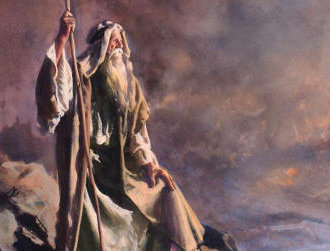
“When he was forty years old, it came into his heart to visit his brothers, the children of Israel. And seeing one of them being wronged, he defended the oppressed man and avenged him by striking down the Egyptian. He supposed that his brothers would understand that God was giving them salvation by his hand, but they did not understand. And on the following day he appeared to them as they were quarreling and tried to reconcile them, saying, ‘Men, you are brothers. Why do you wrong each other?’ But the man who was wronging his neighbor thrust him aside, saying, ‘Who made you a ruler and a judge over us? Do you want to kill me as you killed the Egyptian yesterday?’ At this retort Moses fled and became an exile in the land of Midian, where he became the father of two sons.

“Now when forty years had passed, an angel appeared to him in the wilderness of Mount Sinai, in a flame of fire in a bush. When Moses saw it, he was amazed at the sight, and as he drew near to look, there came the voice of the Lord: ‘I am the God of your fathers, the God of Abraham and of Isaac and of Jacob.’ And Moses trembled and did not dare to look. Then the Lord said to him, ‘Take off the sandals from your feet, for the place where you are standing is holy ground. I have surely seen the affliction of my people who are in Egypt, and have heard their groaning, and I have come down to deliver them. And now come, I will send you to Egypt.’”

Acts 7:23-34 (ESV)

As I write this, it’s early Sunday afternoon and not too long ago, I got home after church services and Sunday school. The Pastor’s sermon was on Acts 7:20-43 and focused on Moses. This is part of Stephen’s defense presented to the Sanhedrin in response to (false) allegations that he spoke against Moses, the Torah, and the Temple. But Pastor Randy didn’t really present it like a legal defense. He was teaching the congregation the story of Moses and he taught it using interesting tools.

OK, for the most part, he told it using Acts and we also read from Hebrews 11:23-27 as well as Joshua 1:5-9. But he also twice referred to the Talmud. Pastor didn’t cite the specific references, but he did point out something about how Jews see Moses and the Exodus, not just how Christians see Moses. I was favorably impressed. How many Baptist Pastors refer to Talmud and the Jewish perspective regarding anything we learn in church?

I was also impressed that he took the time to explain those paintings and statues of Moses that have him wearing horns on his head as the result of a translation error, and he described Moses returning from his encounters with God on Sinai as glowing so brightly that no one could bear to look at the light. He did refer to the giving of the Torah as “delivering the scriptures” but he also called those scriptures “living words.” In referring us to Joshua 1:5-9 he re-enforced (I don’t know how many people picked up on the implications) this high view of Moses and the Torah:

No man shall be able to stand before you all the days of your life. Just as I was with Moses, so I will be with you. I will not leave you or forsake you. Be strong and courageous, for you shall cause this people to inherit the land that I swore to their fathers to give them. Only be strong and very courageous, being careful to do according to all the law that Moses my servant commanded you. Do not turn from it to the right hand or to the left, that you may have good success wherever you go. This Book of the Law shall not depart from your mouth, but you shall meditate on it day and night, so that you may be careful to do according to all that is written in it. For then you will make your way prosperous, and then you will have good success. Have I not commanded you? Be strong and courageous. Do not be frightened, and do not be dismayed, for the LORD your God is with you wherever you go.”

Joshua 1:5-9 (ESV)

Verse 8 says, This Book of the Law shall not depart from your mouth, but you shall meditate on it day and night, so that you may be careful to do according to all that is written in it. For then you will make your way prosperous, and then you will have good success.

A Baptist Pastor is saying that it’s a good thing for God to tell Joshua that he is to meditate on the Torah day and night, to be careful to obey what is written in it, and that doing so will bring success.

Wow.

Both the Pastor’s message and the Sunday school class based on that message focused on how Moses was denied by God entry into Israel because of his disobedience and for that to serve as a warning to us to be careful to obey God’s will for our lives.

If you recall, last Sunday I was more than a little “chatty” in Sunday school class and this past Sunday, I was much more restrained. I did directly answer one of the teacher’s questions, but other than that, I only spoke when engaged in light conversation, fulfilling my desire to listen and learn.

So far, the message I’m getting is one of humility, submissiveness to God, and love for other human beings. This message was consistently presented, even when the Sunday school teacher brought up the recent elections and even when he asked what our proper response should be if two gay people came into the church.

Like I said…wow.

People continue to be friendly. Complete strangers come up to me, introduce themselves (they apparently know who I am somehow) and tell me they’re praying for me. I was asked for my last name in Sunday school this time around (I think for attendance purposes), so now, in theory, I’ve become more “findable” if anyone decides to “Google” me. That means they can potentially find this series of “meditations,” which speaks a lot more about what goes through my head than I’ve exposed in the church community.

I know this is only my second week, but I was very aware of how “disconnected” I felt in church. Like I said, everyone is friendly and all, but I don’t actually know anyone, and they don’t know me. I’m not (yet) a part of the community. They aren’t really “friends” (let alone family) yet. I suppose that comes with time, and I haven’t had to enter into a completely new environment like this in a good, long while. After Sunday school class was over, all I had to do was leave. For me, there was no conversation, no activity, no relationship that was available that would have kept me at church five, ten, or twenty minutes longer.

I’m not sure what to do except keep going every Sunday (or most Sundays) and see what develops. For the first time, someone mentioned the kids rehearsing for the Christmas program, and I realized that a few of the Sundays coming up, I won’t be attending. I guess that’s one of the limits I’m putting on “community.”

Part of what we discussed in Sunday school (well, Charlie, the teacher, did most of the talking) was how Moses’ different experiences, particularly as a shepherd, changed him and prepared him for what he needed to do to lead the Children of Israel. Charlie asked if any of us had any experiences that were as drastic as going from a “prince” in a King’s palace to being a shepherd (I have, but I kept them to myself). He asked how the experiences God put in our lives changed us and prepared us for fulfilling our role in doing God’s will.

In remembering the lesson and looking at myself, I realize that in order to fit in and become a part of this community, I’ll have to change. I’m not sure how or into what or who, but something will need to progress within me that will be for my own good, even if I can’t see what it is right now.

May we have life in which God fulfills our hearts’ desires for good.

-Siddur

The followers of Rabbi Uri of Strelisk were all poor. When another Chassidic master visited him, he asked Rabbi Uri why he did not pray that his congregants become more prosperous.

Rabbi Uri called in a follower whose shabby clothing attested to his poverty. He said to him, “Now is a special moment of grace, and you will be granted anything your heart desires. Ask for whatever you wish.”

Without a moment’s hesitancy, the man said, “I wish to be able to say Baruch She’amar (the opening prayer of the morning service) with the same fervor as the Rabbi does.”

Rabbi Uri turned to his friend. “You see now for yourself!” he said. “They do not want riches. Why should I intercede to get them something they do not want?”

We ask God for many things, but most importantly, we should pray that He enlighten us what it is that we should pray for, lest we waste our prayers by asking for things that are not to our ultimate advantage and fail to ask for what is really essential.

Today I shall…

try to think about what it is that I really need and that is in my best interest, instead of focusing on things that may seem desirable but are really inconsequential.

-Rabbi Abraham J. Twerski
“Growing Each Day, Cheshvan 25”
Aish.com

This is where the “trusting God” part comes in (again). I have to trust that being here, in this church and with these people (who by and large, remain strangers to me) is the right thing to do and is what God wants me to do. I have to trust that whatever way I am to change, that I do so in God’s will and that I will change into more of who I’m supposed to be and not into a stranger to myself.

Moses was a “stranger in a strange land,” and God helped him to become more of who he needed to be, ultimately resulting in Moshe, the most humble man on all the earth, and the greatest prophet in Judaism. I am also a “stranger in a strange land.” Who am I going to be?

50 Days: Lessons in Acts and Patience

Then some of those who belonged to the synagogue of the Freedmen (as it was called), and of the Cyrenians, and of the Alexandrians, and of those from Cilicia and Asia, rose up and disputed with Stephen. But they could not withstand the wisdom and the Spirit with which he was speaking. Then they secretly instigated men who said, “We have heard him speak blasphemous words against Moses and God.” And they stirred up the people and the elders and the scribes, and they came upon him and seized him and brought him before the council, and they set up false witnesses who said, “This man never ceases to speak words against this holy place and the law, for we have heard him say that this Jesus of Nazareth will destroy this place and will change the customs that Moses delivered to us.”

And the high priest said, “Are these things so?”

Acts 6:9-14, 7:1 (ESV)

When Caiaphas asked Stephen “Are these charges true,” he in effect asked, “Are you and your sect speaking against Moses, against the Torah, and against the Temple?

The charges were serious, and the trial had ramifications for the entire Yeshua (Jesus) sect (of Judaism). As a community leader over the assembly of Yeshua’s disciples, Stephen represented the beliefs of the whole community. If the court found him guilty of blasphemy or apostasy, they might turn against the whole sect.

Torah Club, Volume 6: Chronicles of the Apostles
from First Fruits of Zion (FFOZ)
Torah Portion Toldot (“Generations”) (pp 141, 143)
Commentary on Acts 7:1-60

Last Sunday, at the local church I attend, Pastor Randy’s sermon, as he covers the book of Acts, was specifically on Acts 7:1-19. Since the portion of Acts covered by Volume 6 of the Torah club for this coming week’s Torah reading is Acts 7, I thought it would be a good opportunity to compare what is being taught about Stephen and his defense to the Sanhedrin in my church vs. FFOZ’s viewpoint on the same event to see the similarities and differences. I didn’t get what I was looking for. Here’s why as outlined in the printed conclusions of the Pastor’s sermon last week:

Conclusion: Stephen’s sermon helps us to remember…

  1. The sovereign activity of God in choosing people, places, and timing in all things.
  2. The sovereign, abundant grace of God toward rebellious sinners always.
  3. The danger of hardening our hearts against God’s grace.
  4. The error of going through outward motions where our hearts are far from God.

While D. Thomas Lancaster in his Torah club study and Pastor Randy in his sermon series are covering identical material from Acts, the purpose and focus in each of their teachings are not at all the same. Lancaster is addressing the issue of whether or not the charges against Stephen were true; was he really speaking against Moses, the Torah, and the Temple as he had been accused of? Pastor Randy, on the other hand, was using Stephen’s “sermon” (it was actually a legal defense and not a “sermon” as we understand the term in the church) as an illustration of God’s grace and mercy to sinners who repent and turn back to God.

Kind of like trying to compare apples and oranges.

Maybe that’s a good thing, because the Sunday school class I go to after services addresses (though tangentially) the content of the lesson from the Pastor. What if the Sunday school teacher asked if the charges against Stephen were true and I answered based on Lancaster?

Of course, the allegations were not true, but was there any basis at all to the charges?

Stephen presented a pro-Temple, pro-Torah apologetic which, in essence, affirmed his orthodoxy within normative Judaism. He cited the biblically based origin for the authority of Moses and the Torah, and he told the story of the origin of the Temple. He went on to make a case for Yeshua, declaring Him to be the “prophet like Moses” who, like Moses himself, suffered His people’s rejection. In the same way, he drew in the Temple theme as he pointed out that Israel’s historical compromises with paganism contrasted against the sanctity of the true Temple. By the end of his defense, he turned the tables around. The accused became the accuser. He claimed that just as the nation of Israel historically rejected Moses, broke the Torah, and compromised with idolatry, the Jewish leadership had committed a similar crime by rejecting the appointed Messiah. (Lancaster, pg 143)

Notice that Lancaster says that Stephen accused the “Jewish leadership” of rejecting the appointed Messiah, not the “Jewish people.” Since thousands upon thousands of Jews in Jerusalem had accepted Jesus as the Messiah in the weeks and months following Pentecost, it would be very difficult to say that the Jews en masse had rejected Jesus.

Lancaster says that the charges against Stephen were absolutely false, but we tend to hear a different message in Christianity (although no such message was presented in last week’s sermon at my church):

Commentators regard it…as an ironic twist that the so-called “false charges” were actually true. For example, F.F. Bruce (from Bruce’s book, “The Book of Acts,” 1988, pg 126) says, “They are called ‘false witnesses’ because, although their reports had a basis of truth, anyone who testifies against a spokesman of God is ipso facto a false witness.” Numerous Christian commentaries insist that, contrary to what Luke tells us, the witnesses were not really false nor were their allegations really lies. From a traditional Christian point of view, Stephen must have taught against the Temple with its obsolete sacrifices, against the Torah with its cancelled ceremonial laws, and against the customs, i.e., the traditions of men. (Lancaster, pg 142)

Remember that I said not too long ago, quoting Pastor Jacob Fronczak’s article, The Five Solas: Sola Scriptura:

Even with the Masoretic traditions, though, many English readings of the Scripture can be divined from a single Hebrew text. Translation committees have to pick one. Many times readings are chosen to emphasize some Messianic prophecy which appears to point to Jesus Christ, while a Jewish translation committee might choose a different readings for the exact opposite reason. Both readings might be technically correct. However doctrinal presuppositions dictate which reading is chosen. In effect, then, when Christians have only an English Bible and no other tools, they are completely unable to interact with the Scripture – the original Greek and Hebrew texts. They are completely dependent on the work of the translator.

If our doctrinal presuppositions dictate how a passage in scripture is rendered from its original language into English (or any other modern language), the same can be true for how we interpret scripture. Even reading the ESV Bible’s translation of Acts 7:1-60, there’s nothing in the plain meaning of the text that indicates Stephen must have been speaking against Moses, the Torah, and the Temple. In fact, the vast majority of his defense reads like a simple history lesson, compressing the relevant sections of the Tanakh (Old Testament) into a few paragraphs. Stephen doesn’t appear to be denigrating the Jewish Torah and traditions but rather defending them. He only accuses the Sanhedrin of going against the Torah and teachings of Moses, in violation of what Jesus himself taught and defended.

You can see why I might be a little hesitant to speak up in Sunday school later today as I did last week.

It’s another Sunday (as you read this) and church services start at 9:30 this morning. I’ll be there again, and I’ll go to Sunday school again, and I don’t really know what I’m going to say or do. Hopefully, nothing stupid, but there are no guarantees. I’ve said and done stupid things before, even when I knew better. Telling what I understand to be “the truth” is not always defensible if I know in advance that the result will be upsetting or harmful to others. Even if I chose to speak, I would have to do so in a way that was not accusatory or offensive to others.

There is a major difference between being critical, and having a positive influence on others by saying things with compassion and true caring. When you sound critical, the person on the receiving end is likely to deny your words, which will be perceived as an attack. And then you won’t accomplish anything.

-Rabbi Zelig Pliskin
“Daily Lift #634, Correct Without Being Critical”
Aish.com

So far, the only person at church who even knows this blog exists is Pastor Randy, and I don’t even know if he has visited here since our first meeting last week. Since it’s not likely anyone else at church knows I write these “morning meditations,” I’m more at liberty to express my thoughts and opinions here than I should be when in Sunday school.

Of course, this is only the second Sunday I will be back in church. I really need to learn to be more patient and not “shoot off my big mouth” just because the Sunday school teacher asks a question and no one answers. Silence isn’t always in invitation for me to “make noise” nor is it a reason to think that I can “correct” anyone else in their beliefs.

Maybe I should be paying more attention to what the Bible is telling me about what I need to do to make me a better person than what I think it says about making others better.


Learning the Traditions of Our Fathers

Talmudic Rabbis“We keep the customs of our forefathers.”

Shabbos 35b

The Gemara here notes that we keep the customs of our forefathers, even when the rationale behind the custom no longer applies. One such custom is the recitation of Kedushah in U’va LeTzion. Why do we repeat Kedushah if it has already been recited during Birkas Kri’as Shema and Chazaras HaShatz?

The origin of this recitation is recorded in Shibolei HaLeket (ch. 44). There was a time when the gentiles banned the Jews from reciting Kedushah and would send a representative to sit in shul through Chazaras HaShatz to guarantee that it was not recited. Once Chazaras HaShatz was completed, the representative felt confident that his job was finished and he would leave. Only later, when the gentiles left, were the Jews able to say Kedushah. They therefore inserted Kedushah into U’va Letzion, in Hebrew and Aramiac, to replace the two times they were not able to say Kedushah, in Birkas Kri’as Shema and Chazaras HaShatz. Although we are now able to say Kedushah without fear of being harmed by gentiles, we continue to recite Kedushah in U’va Letzion based upon the principle of “Minhag Avoseinu Biyadeinu” — “The custom of our forefathers remains in our hands.”

Daf Yomi Digest
Stories Off the Daf
“Keeping the customs of our fathers”
Commentary on Shabbos 35b

All denominations or sects of Christianity of which I’m aware have a problem with the relationship between religious Judaism and its traditions and customs. As we see from a Christian point of view, the function of traditions in Judaism seems to exceed what we would consider practical utility and common sense. Certainly all cultures and groups engage in various traditions and as such, there’s no problem in this, but why participate in a custom or tradition that has outlived its usefulness and may well (though not in this case) contradict the Word of God?

Christianity, and particularly the Protestant church, sees itself as relying solely on the Word of God as we have it in the Bible without the “traditions of men” getting in the way (Sola scriptura), while we tend to see Judaism as relying primarily on their traditions (which we see growing and growing, even when some of them have outlived their original purpose) as equal or even superior in authority to what God has said to Israel. But does that really reflect the reality of what we do (and you probably know where I’m going with this)?

To define sola scriptura without academic terminology might sound something like this: The Bible is the only authority in the believer’s life; it is never wrong about anything; it touches on every aspect of life; it needs no outside help to be correctly interpreted; it never disagrees with itself; it can be understood by anyone of average intelligence; and it applies to everyone in every situation.

I only use the example of translations to illustrate the fact that in a very practical sense, the Scriptures in their original languages are, for most Christians, not enough – tools such as translations, concordances, the Masoretic vowel points, and commentaries are required in order to understand the text. Of course, the goal is to understand the original text, which in itself is not an objection to the doctrine of sola scriptura – until one realizes that every translation, every commentary, and even the textual tradition itself are all based on traditions along with the divine written revelation. It is simply impossible to get away from these traditions and study the Bible in isolation.

-Jacob Fronczak
“The Five Solas: Sola Scriptura”
Messiah Journal, Issue 111 (pp 47, 52)

If you read my recent blog post, Chayei Sarah: Oil for the Lamp, you recognize the quotes from Pastor Fronczak. You also remember the meaning behind those words: that Catholic and Protestant Christianity does not understand what the Bible is saying apart from our own traditions. That is to say, no one of us has raw, unfiltered, unmediated, uncommentaried access to anything the Bible is telling us. We all read the Bible while wearing the moral and intellectual equivalent of “rose-colored glasses.”

Not only do we find that we must accept the wisdom of the “traditions of the Christian elders,” but we must also accept the wisdom of the “traditions of the Jewish elders.” Why?

Consider the Old Testament. About two-thirds of the Christian Bible is made up of the Old Testament. Who wrote the Old Testament? Jews (It’s important to realize that Jews also wrote the New Testament, but that’s a discussion for another time).

The organization of books, chapters, verses, and insertion of vowels and punctuation all come from Jewish sources, and have been altered very little if at all by Christian translators in most cases. Without realizing it, the vast majority of Christians, when reading nearly any part of the Old Testament, are tacitly accepting Jewish tradition in how it is translated and presented to us.

Right now, you might be saying, “So what. I still believe the Bible is the highest written authority and no Rabbi, Pastor, or scholar is going to have an opinion or judgment that overrides scripture.” Well, that’s not exactly true.

Translating dead languages (ancient Hebrew, Aramaic, and Greek are all dead languages and only somewhat associated with the modern-day “living” counterparts) into the land of the living so that English speakers (for example) can read the Bible is no small thing and it’s hardly an exact science. The art of Biblical analysis and translation is highly specialized and it’s not a matter of simply saying, Word A in Hebrew means word B in English.

Even with the Masoretic traditions, though, many English readings of the Scripture can be divined from a single Hebrew text. Translation committees have to pick one. Many times readings are chosen to emphasize some Messianic prophecy which appears to point to Jesus Christ, while a Jewish translation committee might choose a different readings for the exact opposite reason. Both readings might be technically correct. However doctrinal presuppositions dictate which reading is chosen. In effect, then, when Christians have only an English Bible and no other tools, they are completely unable to interact with the Scripture – the original Greek and Hebrew texts. They are completely dependent on the work of the translator.

-Fronczak (pg 52)

Let’s go through that again. Two separate translations of the Hebrew (or Greek) text can both be technically correct, but actually render opposite meanings, depending on the doctrinal presuppositions of the translation committees involved.

I’d love to just copy and paste the entire text of Fronczak’s article into this blog post because I think every Christian (and Jew) should read it, but that’s highly impractical. You’ll just have to purchase a copy of Messiah Journal to read all of his write up (and even if you disagree with Fronczak, you’ll still have to read the complete content in order to craft a rebuttal that contains any validity at all).

But beyond apparently trying to shoot down the doctrine of sola scriptura, why am I bothering to write this and why should you care?

The vast majority of Christians do not interact with the rabbinic tradition at all. As a consequence, it is poorly understood and even attacked. Modern Jews have not forgotten the Christians who burned copies of the Talmud in Europe. Even many in the Hebrew roots movement disparage the teachings of the rabbis and ancient sages, without realizing that in many ways, we rely on these very teachings in order to interpret the Bible.

First Fruits of Zion has been vehemently attacked for this very reason – we rely on rabbinic traditions and other extra-biblical literature to illuminate and explain the text of the Scripture. Like any reputable translation committee or research institution would do, we consider a lot of evidence before coming to a conclusion on what a Bible passage means. Unfortunately, people who do not understand the importance and usefulness of this literature continue to disparage the ministry of First Fruits of Zion, even though they, as explained above, are equally reliant on traditions and extra-biblical evidence for their own interpretations of the Scripture. The continuing attacks on traditional Jewish literature such as the Talmud and Zohar betray anti-Judaic and perhaps even an anti-Semitic spirit on the part of many of our detractors.

-Fronczak (pg 53)

The focus of my point for this blog post and for the existence of my blog in general, overlaps Fronczak’s and First Fruits of Zion’s (FFOZ’s) message, but my overall scope is beyond the confines of Messianic Judaism and Hebrew Roots (and all of the variants those two groups contain). This is a message that should concern every Christian and every church, regardless of denomination or affiliation. We all share a common Bible (relative to translation), a common Jesus, and a common God. The origin of the core faith in Christ of the church can be traced directly back to ancient Israel and the Second Temple period, and the origin of everything Jesus taught as we have it recorded in the New Testament, every bit of it, travels deeply back into the Old Testament, to David, to Moses, to Jacob, Issac, and Abraham, and indeed, back to before Adam and the creation of the world by God. Not one word of what Jesus said wasn’t Jewish, nor was any of it disconnected from the Jewish reality of the Bible.

Add to that the fact that we in the church rely just as much on our traditions (and some Jewish traditions) to understand all of what God is saying, and we have a very poor case for tearing apart Jewish reliance upon tradition to understand themselves and God.

It is really, really important to view the struggle of Christianity trying to comprehend Judaism as not a specialized or niche perspective or movement. It’s not just for those few people who are affiliated with those entities we call “Messianic Judaism” or “Hebrew Roots.” This is the struggle, the mission, the challenge for everyone who calls themselves a Christian.

If the church has any hope of understanding itself, it (we) must come to terms with not only where we came from, but the people and nation God granted the ability to give us life in Him, the Jews. We cannot afford to keep living in an isolated silo pretending that those connections are forever severed or relating to our “Jewish roots” as if the last 2,000 years of Jewish and Christian history, culture, custom, and tradition simply never happened.

Not long ago, I wrote another blog post called Intersection. There are a small group of Christians and Jews who are approaching a point of intersection where we going to realize we are, in some mysterious or even mystic way, interdependent on one another for the sake of the Kingdom of Heaven (which has nothing to do with “going to Heaven” and everything to do with enacting and progressing God’s plan for humanity on Earth). What may now appear as minority religious groups, variant Christian and Jewish sects, and even (Heaven forbid) cults, may well actually be part of the resurgence, the restoration, and the re-establishment of God’s intentions and design for His people Israel and the other nations of the Earth.

I believe when those Jewish and Christian people arrive at the intersection, this will happen.

“Thus says the Lord of hosts: Peoples shall yet come, even the inhabitants of many cities. The inhabitants of one city shall go to another, saying, ‘Let us go at once to entreat the favor of the Lord and to seek the Lord of hosts; I myself am going.’ Many peoples and strong nations shall come to seek the Lord of hosts in Jerusalem and to entreat the favor of the Lord. Thus says the Lord of hosts: In those days ten men from the nations of every tongue shall take hold of the robe of a Jew, saying, ‘Let us go with you, for we have heard that God is with you.’”

Zechariah 8:20-23

No, I don’t believe Christians will be turned into Jews or Jews will be turned into Christians (and a Jew being Messianic is not the same as being “Christian” as we comprehend the concepts and lifestyles), but we will all flow to “the mountain of the house of the Lord” and the people of many nations will say, “Come, let us go up to the mountain of the Lord, to the house of the God of Jacob, that he may teach us his ways and that we may walk in his paths.” (see Micah 4:1-2)

Many Christians, including those in the Hebrew Roots movement, are fond of quoting from Ephesians 2 (particularly verse 15) and saying that differences and distinctions between Jews and Christians were all obliterated (along with the Torah, Talmud, shabbat, Passover, and anything even remotely referring to a Jewish identity and life) in Christ, “nailed to the cross,” so to speak.

And yet the unity that we see described in Zechariah 8 and Micah 4 requires no melding into uniformity between Gentile and Jew in order to achieve the prophesied unity between Israel and the nations. What is required is a sense of humility and recognition, the humility to “take hold” of the tzitzit on the tallit of a Jew, and to ask him to guide us to the mountain of the house of the Lord, the holy Temple in Jerusalem (which apparently will exist again) so that even we non-Jewish disciples of the Jewish Messiah King may be taught his ways and walk in his paths. (Zechariah 8:23 “says take hold of the robe of a Jew.” Is that any Jew or only one, the firstborn son of Israel…Moshiach?)

We’re all doing our best right now to do that; to walk in his paths. But we can do better. We must do better. Let us hurry to the intersection and meet together, Christian and Jew, we who share the Messiah and honor the One God. Time is short. There’s a lot of work to be done, starting with learning how to listen to one another, and comprehend the wisdom of the customs of our fathers, both the Jewish and Christian fathers.

Chayei Sarah: Oil for the Lamp

“Now Avraham was zaken / old, well on in days, and Hashem had blessed Avraham bakol / with everything.”

Genesis 24:1

Why does our verse say that Avraham was “well on in days” rather than “well on in years”? R’ Yaakov Yosef Hakohen z”l (1710-1784; foremost disciple of the Ba’al Shem Tov z”l; known by chassidim as “the Toldos” after one of his works) explains:

The Gemara (Shabbat 153a) teaches: Rabbi Eliezer said, “Repent one day before you die. But, since no one knows when he will die, repent every day.” King Shlomo likewise said (Kohelet 9:8), “At all times, let your clothes be white.” Rabbi Yochanan ben Zakkai said: “This may be likened to a king who announced that he would hold a feast, but did not announce the time. The intelligent ones among his entourage dressed-up so as to be ready on a moment’s notice, while the fools did not prepare.” [Until here from the Gemara]

-Rabbi Shlomo Katz
“Beginnings and Endings”
Hamaayan, Volume 26, No. 5
Commentary for Torah Portion Chayei Sarah
Torah.org

“Then the kingdom of heaven will be like ten virgins who took their lamps and went to meet the bridegroom. Five of them were foolish, and five were wise. For when the foolish took their lamps, they took no oil with them, but the wise took flasks of oil with their lamps. As the bridegroom was delayed, they all became drowsy and slept. But at midnight there was a cry, ‘Here is the bridegroom! Come out to meet him.’ Then all those virgins rose and trimmed their lamps. And the foolish said to the wise, ‘Give us some of your oil, for our lamps are going out.’ But the wise answered, saying, ‘Since there will not be enough for us and for you, go rather to the dealers and buy for yourselves.’ And while they were going to buy, the bridegroom came, and those who were ready went in with him to the marriage feast, and the door was shut. Afterward the other virgins came also, saying, ‘Lord, lord, open to us.’ But he answered, ‘Truly, I say to you, I do not know you.’ Watch therefore, for you know neither the day nor the hour.

Matthew 25:1-13 (ESV)

Ben Zoma says: Who is wise? The one who learns from every person…

-Pirkei Avot 4:1

Who is wise? The motto for the Boy Scouts is “Be prepared,” so, given the lessons we see above, it would seem that we would be wise if we learned from the sages who provided those teachings. We can learn from every person, but it is better to learn from those who have something useful and edifying to say.

And yet, how often do we ignore wise teachings until it is too late? How often do you put off changing the batteries in the smoke detectors in your home? How often do you let the needle on your car’s gas gauge get down to “E” before looking for a gas station? And while it’s impossible to predict an earthquake, if you knew a hurricane was coming, how long would you wait before trying to leave for a safer location or stocking up on food and water for yourself, and batteries for your radio, and then shuttering your windows against the coming storm?

No, I’m not taking a cheap shot at the victims of hurricane Sandy, but rather, I’m saying something about we Christians. How often do we take “being saved” for granted, even when we know that a “storm” is coming? How often do we take our relationship with God for granted and think we know everything we need to know about Him?

I saw this yesterday on Facebook:

Going to be a very interesting year ahead. I started going to a Bible study with a friend of mine, yesterday was our first class and let me just say complete shock. They are studying B’RESHEET (Genesis) and in the new members class the leader was telling us how she has been a Christian for over 40 years, joined this Bible study 5 years ago and it was the first time she ever read the ‘Old Testament’. Many of the other women commented that they too had not read anything other than the Psalms and had no idea where this thought of ‘twelve’ tribes came from. How very ,very sad.

Isn’t that a little like waiting until the last minute before getting oil for your lamps, and then getting locked out of the “marriage feast?”

OK, a lot of Christians don’t really consider the Old Testament to be that important. A lot of churches bill themselves as “New Testament” churches and that’s pretty much all they feel they need. However, since all of Christ’s “source material” from Scripture was before the Gospel of Matthew, it might be wise to study what he must have studied (We sort of assume that Jesus just “knew” the Bible forward and backward, but as a child and young adult, no doubt like other Jews, he attended synagogue on Shabbos, heard the sacred texts being read, and studied as would be expected of a young Jewish lad from a humble family in the Galilee).

We do know that he knew a few things and learned a few things growing up.

After three days they found him in the temple, sitting among the teachers, listening to them and asking them questions. And all who heard him were amazed at his understanding and his answers. And when his parents saw him, they were astonished.

Luke 2:46-48 (ESV)

It is true that studying does not automatically assure that a person will grow wise, but lack of study will almost certainly result in a person being ignorant. Christianity and Judaism have one core document that provides us with a connection to those who established our faith and who can tell us the story of man and God: the Bible (“Bible” has different definitions depending on whether you’re Christian or Jewish).

But it’s not that simple.

To define sola scriptura without academic terminology might sound something like this: The Bible is the only authority in the believer’s life; it is never wrong about anything; it touches on every aspect of life; it needs no outside help to be correctly interpreted; it never disagrees with itself; it can be understood by anyone of average intelligence; and it applies to everyone in every situation.

-Jacob Fronczak
“The Five Solas: Sola Scriptura”
Messiah Journal, Issue 111 (pg 47)

That sounds good as far as it goes, but let’s see what else Pastor Fronczak has to say.

I only use the example of translations to illustrate the fact that in a very practical sense, the Scriptures in their original languages are, for most Christians, not enough – tools such as translations, concordances, the Masoretic vowel points, and commentaries are required in order to understand the text. Of course, the goal is to understand the original text, which in itself is not an objection to the doctrine of sola scriptura – until one realizes that every translation, every commentary, and even the textual tradition itself are all based on traditions along with the divine written revelation. It is simply impossible to get away from these traditions and study the Bible in isolation. (Fronczak, pg 52)

It seems that studying the scriptures to acquire wisdom is getting harder or at least more complicated all the time.

I’ll probably write another “meditation” sometime soon expanding on other points in Fronczak’s article, but essentially, he is saying that we cannot study the Bible in any useful manner without employing (hold on to your hats) the “traditions of the (Christian) elders.”

“The traditions of the elders” has received a lot of “bad press” in Christianity because of the perception that both ancient and modern Jews allow “the traditions of men” to have authority equal to or even greater than the Bible. The Christian response, particularly among Protestants, is to say, “let scripture interpret scripture,” which is the short definition of sola scriptura. That means, “no traditions are allowed,” just the Bible itself. However, Fronczak’s article makes it abundantly clear that the early church fathers employed a great deal of tradition in even canonizing the books of the New Testament, and Catholicism, even to this day, states that the Bible can only be understood through its traditions.

Imagine the shock of realizing that the same is true among all modern-day Protestant churches as well. We just don’t choose to say it in those words.

Remember that quote from Pirkei Avot about a person being wise if they learn from everyone?

And what about the commentary on Abraham and its apparent companion lesson about the ten virgins? How can we learn from everyone and how can we be prepared to learn what we need to learn in order to comprehend what the Master is teaching us, and thus draw closer to God?

You must unlearn what you have learned.

-Yoda (Frank Oz – voice)
The Empire Strikes Back (1980)

In some sense, learning what’s important and what takes us on the path toward wisdom means “unlearning” concepts and doctrines that we discover aren’t useful in our lives. That isn’t always easy when such information is directly attached to words like “sacred” and “holy” and “divine revelation.” It would be like a person who learned as a child that God was a giant, old man with a long white beard who sits on a huge golden throne on a cloud in the sky. Now imagine that child is Jewish and then he grows up and learns that according to Rambam’s thirteen principles of faith, God doesn’t even have a body and is not to be considered a corporeal being? If the fellow was still young enough, that might come as quite a jolt.

Now imagine being a woman of middle age who has been a Christian for forty years reading from the book of Genesis for the first time. Taking it a step further, imagine the same woman in a group of women studying the Old Testament, accessing the classic interpretations for Genesis to try to understand anything at all about who Abraham was, where he came from, why God made a covenant with him, and what that covenant means to both Jews and Christians today.

If we are to take the lesson from Avot at face value, then our class of women might want to “unlearn” a few things about the Old Testament and learn, not only from extra-Biblical Christian commentaries about Genesis, but from a few Jewish ones as well.

Certainly Jesus understood Abraham from a completely Jewish context and framework. If we want to understand Jesus, we must understand what he understood.

Do not seek to follow in the footsteps of the wise. Seek what they sought.

-Matsuo Basho

So we unlearn what is not useful to us and then start learning from a wide variety of sources, seeking to understand God (as best we can) and who we are in Him. How do we know when we’re “prepared enough?” Five of the ten virgins kept “flasks of oil” with them for their lamps so that when the bridegroom came, they were ready to light them, even if it was at midnight. How do we know when we’ve studied enough so that we have “flasks of oil” at hand?

Let’s look at it another way. Studying, learning, understanding, are all active processes. You can’t bottle the stuff and put it on a shelf for a rainy day. It’s like continually replenishing the oil in lamps that continually must be burning. This makes sense when compared to another parable of the Master about we Christians being the light of the world (see Matthew 5:14-16) and how our light must be placed where everyone can see it burning all the time.

Our “lamps” will never be filled to 100% capacity where we can then stop tending to them. We are prepared when we’re always preparing; when we’re always studying, and learning, and discussing, and pondering, and repenting, and praying, and…you get the idea.

In each journey of your life you must be where you are. You may only be passing through on your way to somewhere else seemingly more important—nevertheless, there is purpose in where you are right now.

-Rabbi Tzvi Freeman
“Be There”
Based on letters and talks of the Rebbe
Rabbi M. M. Schneerson
Chabad.org

Or in the words of my generation, “Wherever you go there you are.” We should all consider ourselves “a work on progress.” We’ll never be complete. We’ll never be “finished” or “done” or “perfect.” As long as we live, we must move forward. As long as we’re breathing, there’s someplace else to go, something else to learn, another person we need to meet.

And God will always be with us, as long as we continually seek him, and walk by the light of our lamp.

Good Shabbos.

Long After the Storm

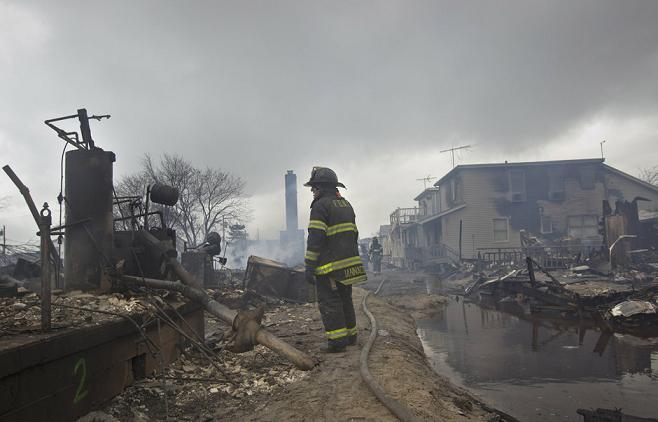
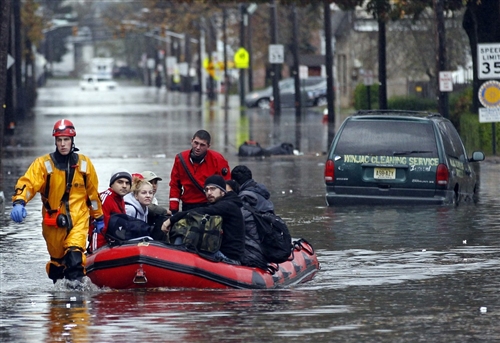
There are a plethora of websites, blogs, and news sites that have addressed the tragedy of the Sandy “superstorm” and the broken and struggling lives it has left behind in New York and New Jersey, so I didn’t intend on writing about it. I thought that I couldn’t say anything that hasn’t already been said and with far more eloquence and compassion by the many others who have already spoken.

But then I read “A Lesson From the Storm” on Shmarya Rosenberg’s blog FailedMessiah.com. I follow Rosenberg’s blog regularly but never comment and I am periodically dubious as to his bias against the Chabad community. Nevertheless, I couldn’t ignore the call for understanding and the challenge to extend myself beyond my usual limits.

One of the new facts of life in the aftermath of Hurricane Sandy is that tens of thousands of people are now reliant on some form of assistance, be that help from FEMA or the Red Cross or from smaller local organizations like churches and synagogues.

People who never before had to ask for or accept charity now are forced by circumstances to stand in lines at ad hoc soup kitchens and sleep at the homes of family, friends or even strangers or shelters while some form of temporary housing is found for them.

In some ways, they are now living the lives of America’s poorest citizens, never knowing if they will have a roof over their heads tomorrow or food to eat.

The very poor and homeless we are used to seeing are often mentally ill or drug addicted, and it is easy for us to blame their poverty on their own behavior or on being crazy.

But what we don’t see are the thousands of very poor Americans who have been priced out of the housing market and who sleep in shelters or on friends’ couches, go to work at low paying jobs with no benefits, and who rush back to those shelters before their early evening closing, often hungry, just so that they don’t get locked out.

We don’t see the very poor who became impoverished because of a severe illness, who had to choose between getting a very ill child to regular therapy appointments and their jobs.

We don’t see the families, ravaged by job loss, job erosion and by employers who cut or eliminate employee benefits, often by cutting employees’ hours to just below the full-time threshold, families whose regular dinners consist of ramen soup and whose breakfasts are often nonexistent.

As horrible as it is right now in some Jewish areas of New York City, just blocks away outside them it is often far worse, because these already poor communities lack the financial resources and fundraising expertise to supplement the assistance the government can give.

I’m politically and fiscally conservative and so I don’t believe that all social ills can be “solved” simply by creating a program and then throwing tax dollars at it. Also, having worked as a family counselor and social worker in both the San Francisco Bay Area and in Orange County (Calif.), I know about the struggles of the mentally ill and the limits of any social system in perfecting a “solution” for prejudice, homelessness, poverty, and the pull between the need for help and the illness that drives such a vulnerable population away from hope. In my time as a child abuse investigator for Child Protective Services in Southern Califonia, I met with many families on welfare (since they are disproportionately reported to “the system”), but in all that time, I found only one family who was using public funds as a temporary aid while they tried to remediate their circumstances. All of the others treated welfare like a multi-generational lifestyle and “worked” the system the way other people worked at jobs.

I say all of that to help you understand my perspective on the politics behind economic and social assistance programs and their relative effectiveness in changing “temporary” aid into a permanent institution. Often, those attitudes are in conflict with a greater imperative.

Then the King will say to those on his right, ‘Come, you who are blessed by my Father, inherit the kingdom prepared for you from the foundation of the world. For I was hungry and you gave me food, I was thirsty and you gave me drink, I was a stranger and you welcomed me, I was naked and you clothed me, I was sick and you visited me, I was in prison and you came to me.’ Then the righteous will answer him, saying, ‘Lord, when did we see you hungry and feed you, or thirsty and give you drink? And when did we see you a stranger and welcome you, or naked and clothe you? And when did we see you sick or in prison and visit you?’ And the King will answer them, ‘Truly, I say to you, as you did it to one of the least of these my brothers, you did it to me.’

Matthew 25:34-40 (ESV)

Decades ago, I read a statistic saying that most Americans are only one or two paychecks away from homelessness. Given the massive amount of debt most individuals carry, I don’t doubt the statement to be just as true today as it was back then. Probably more so.

I’m fortunate to have a job today. It has benefits including medical insurance. I live in a house with my family. I drive a car in good operating condition to and from work each day. I sleep in a comfortable bed and I don’t have to worry about not getting enough food, being too warm or too cold, or doing without all of the basic necessities and many of the comforts.

But I’ve also been unemployed. I’ve never been homeless, but I’ve been depressed, frustrated, angry, and desperate. I’ve worked low paying full-time jobs while going to school full-time just to support my family and try to rebuild my life. I’ve been hurt and sick with no medical benefits, so I just had to put up with being hurt and sick. There were months when I barely saw my family let alone talked to them. Sleep was all but an illusion. I was a middle-aged man burning the candle at both ends because I had to and there was no one to help me except me.

And God.

Which is why, in spite of the fact that I’m always dubious of a political solution to a human problem, I find that we must show compassion and render assistance to people who need assistance. If we are to err, let’s err on the side of generosity rather than stinginess. Consider the following, which is a comment made by a Katrina victim in response to Rosenberg’s blog post:

I can speak to this. One day I was comfortably (upper) middle class, living in a 2400 sq ft house filled with stuff, much of it of sentimental, as well as monetary, value: artwork, heirlooms, antiques, rare books, and so on. The next day I was homeless with only the clothes on my back and the contents of a small carry-on. Although I tried to, I got no help from the Federation or the Red Cross, and I did not get all that I was supposed to from FEMA. For months my job was wrangling on the phone with two insurance companies trying to get the reimbursements that my policies called for–with limited success. If I hadn’t worked in the insurance industry and didn’t know what my policies really provided, I would have gotten even less. Fortunately I had some assistance from my son (logistical, not financial) and some savings, or I do not know what would have become of me. With my own resources I was able to survive, have a roof over my head, food on the table and other necessities. In the general atmosphere of no help I do have to thank a group of Jewish volunteers from North Carolina who cleaned out the contents of my flooded house (a disgusting job) and another group of Southern Baptists who gutted my house–and the US tax code which allowed me to deduct portions of my $300,000 worth of uninsured losses. In addition I lost my whole circle of friends and acquaintances, health care providers, etc., etc. These social ties were extremely difficult, in some cases impossible, to reproduce in my new life.

In addition I have suffered psychological trauma that I don’t think will ever pass. A heavy rain (even here in the desert) makes me very nervous, and I am very distressed whenever there is a hurricane on the loose, although there are no hurricanes possible in Arizona. At an event marking the fifth anniversary of Katrina, I met a friend, neighbor, and colleague who also relocated to Arizona. She told me that she didn’t have enough clothes or furnishings because she was afraid that if she acquired anything, she would lose it. I told her that I have a ridiculously excessive wardrobe, because I am afraid of being left again with nothing but the clothes on my back. Eerily three weeks after this conversation, my friend’s new home was burned to the ground by an arsonist. One of my best friends was rescued by a Coast Guard helicopter just before a looter, carrying a gun, was about to enter her home. She continues to have post-traumatic emotional problems.

When we look at the news, we see unknown figures and hear nameless statistics. When we encounter the homeless and the mentally ill on our streets, we automatically think “bum,” or “panhandler,” “addict,” or “nutcase.” We don’t see the human faces. We don’t hear the human voices. But they’re there and they’re real. Like most of humanity, we tend not to care about a problem until it becomes our problem. It rarely has an emotional impact on us and even more rarely inspires us to offer assistance until it becomes personal; until it happens to us, or to a relative, or to a friend, or maybe because someone we care about also cares about the victims.

Five hundred years ago or so, a man named John Donne penned these words:

No man is an island,
Entire of itself.
Each is a piece of the continent,
A part of the main.
If a clod be washed away by the sea,
Europe is the less.
As well as if a promontory were.
As well as if a manor of thine own
Or of thine friend’s were.
Each man’s death diminishes me,
For I am involved in mankind.
Therefore, send not to know
For whom the bell tolls,
It tolls for thee.

No Man is an Island
MEDITATION XVII
Devotions upon Emergent Occasions
John Donne

If we are indeed “involved in mankind,” then whatever happens to another human being, happens to us. As Christ said, whenever we help the least of all human creatures, we have helped the author of our souls.

Most of all, and this is important, we don’t have to assume that once the initial crisis has passed that everyone is going to be fine and we can go about our usual lives. We don’t have to return to being unconcerned for those whose lives will take years to recover, if they ever will recover completely. Do you ever wonder about the victims of the earthquake in Haiti? Do you still recall those lives devastated by the earthquake and tsunami in Japan? Do you ever, ever wonder what all of those people are doing right now?

The victim of Katrina suffers years after the disaster. His heart, his feelings, his life is still being damaged by the storm. And yet, as painful as I can only imagine that might be, the greater injury is done by uncaring neighbors, by unfeeling humanity who asks “for whom the bell tolls,” and then not recognizing the name, shuts out the sound of a small shattered voice, softly crying in the background.

Only the hurricane has passed. The storm of anguish and need is still raging, its call, unanswered and unheeded.

EDIT: Unfortunately, the nor’easter that interrupted recovery efforts from Superstorm Sandy pulled away from New York and New Jersey Thursday morning, leaving a blanket of thick, wet snow, and triggering even more anxiety and despair among those people still in the first stages of trying to recover.

To help victims of Sandy, donations to the American Red Cross can be made by visiting Red Cross disaster relief, or you can text REDCROSS to 90999 to make a $10 donation.

Intersection

Due to the sin of murder the Beis HaMikdash was destroyed.

Shabbos 33a

Maharal points out that man is distinct and loftier than all other creations. Only man is infused with a heavenly spirit from above. Similarly, the Beis HaMikdash is on a separate plateau in function and purpose above all other places on Earth.

Furthermore, man himself functions as a type of Beis HaMikdash, in that he carries the shechinah with him, and he serves as a vehicle from which kedushah emanates and spreads throughout the world.

This is the underlying principle which our Gemara is presenting. The taking of human life, aside from the tragic aspect of the personal loss, also represents a destruction of a human Beis HaMikdash. A person, while he lives, has the ability to accomplish worlds of achievement in the realm of kedushah and in the service of Hashem. With the loss of this life, this person’s contribution to the world in this regard has been ended.

Daf Yomi Digest
Gemara Gem
“The holy human”
Commentary on Shabbos 33a

This is a rather remarkable Jewish commentary from a Christian point of view. We Christians tend to believe that only we possess the “indwelling of the Holy Spirit” as a consequence of our faith in Jesus Christ. We tend to believe that no other people group or religious tradition, especially Judaism, has this concept, let alone possesses this reality.

But what if we’re wrong?

Here we see that the Jewish sage writing this believes that “only man is infused with a heavenly spirit from above.” And just as Christians believe that each of us is a Temple housing the Spirit of God, (see 1 Corinthians 6:19 and 1 Peter 2:5) the Rabbinic commentator states, “man himself functions as a type of Beis HaMikdash, in that he carries the shechinah with him, and he serves as a vehicle.”

For those among you who may not know, the Beis HaMikdash can refer to the Temple in Jerusalem (which currently doesn’t exist) or the Heavenly Temple.  In the days of Solomon,  the Temple housed the shechinah or the Divine Presence, which Christian Bibles call “the glory of God” (this is also true of the Tabernacle in the days of Moses). While we can’t make a direct comparison between the shechinah and the Holy Spirit, we see that both Christian and Jewish concepts of how God “indwells” the faithful are all but identical.

Imagine that.

But why do I say such a thing and why should you care?

Shmuel only crossed a river on a bridge together with a gentile. He said that misfortune would not occur to two nations simultaneously.

Shabbos 32a

Shmuel crossed the river only on a ferry boat upon which gentiles were riding with him. He determined that the Destroyer cannot punish Jew and gentile together, so he would be safe and secure that the boat would not capsize.

-Daf Yomi Digest commentary

This is a less than complimentary Jewish commentary about we Gentiles, since it implies God will not visit a tragedy upon the Jew that is going to occur to the non-Jew for the sake of the holiness of the Jewish people. It elevates the Jewish people above the other peoples of the earth in a spiritual way due to the perception of a Jew’s higher awareness of God. Actually, the commentary may well be true of many non-Jewish nations and people who neither fear Hashem nor honor the God of Israel.

But what about Christians? Can’t we be said to have an awareness of God through our devotion to Jesus, the Jewish Messiah? I would say “yes,” but we must remember that said-awareness and devotion originated with the Jewish people, and did not spring forth fully grown among the Gentiles, independent of Israel.

Many Christians reading this may get the wrong idea about what I’m trying to say. Some may even feel threatened, as if I’m subordinating Christianity to Judaism in a manner that makes we non-Jewish believers into “second-class citizens” in the Kingdom of God.

I’m not saying that at all.

But I do want to say that the church has a tendency to reverse causality. We often view Jesus as wholly owned and operated by Gentile Christianity and completely divorced from (if he was ever “married” to) Judaism in any way or form. That’s pretty tough to do since Jesus was born to a Jewish mother, was circumcised on the eighth day, was raised as a Jew, was granted the power of the Spirit as the Jewish Messiah, walked like a Jew, talked like a Jew, only had Jewish disciples, ordered his Jewish disciples to only minister to the “lost sheep of Israel” in only Jewish communities, barely spoke to a Gentile, and after death and resurrection, promised to return to establish Jewish self-rule of Israel and over the nations.

Tsvi Sadan, who authored what I consider a landmark book, The Concealed Light: Names of Messiah in Jewish Sources, wrote an article recently published in Messiah Journal, issue 111 called “You Have Not Obeyed Me in Proclaiming Liberty.” It’s a unique article in that it takes to task the missionary efforts of the church to convert Jews to Christianity. But Sadan is a “Jewish believer.” More accurately, he’s a “Messianic Jew” living in Israel, and that makes all the difference in the world.

What I have described up to this point means that much of what calls itself Messianic Judaism is in fact an exotic Christian sect. One can argue until blue in the face that the Israeli Supreme Court was wrong when in 1989 it ruled that Messianic Jews are people who belong to “another religion.”

I imagine that there are more than a few Christians reading this who are quite puzzled. After all, isn’t Messianic Judaism just another form of Christianity? What’s wrong with Jews converting to Christianity? Jesus is “Jewish,” isn’t he?

Of course, when most Christians say that “Jesus is Jewish,” it’s like how they view the occasional Jewish Christian in their church…someone who is Jewish in name only and who, in terms of any identity markers, has surrendered cultural, ethnic, experiential, and halalaic Judaism for a completely Gentile Christian identity and lifestyle. This is what I mean by reversing causality. In the early days of the ministries of Peter and Paul, masses of non-Jewish people came to be reconciled with the God of Israel through the Jewish Messiah, embracing religious practices and concepts that were completely Jewish and totally foreign to them. Today, we in the church expect Jews to abandon all of their Judaism and to worship a Lord and Savior who, from our point of view, is totally foreign to Jews.

But Sadan has more to say:

Yet the judges were no fools. Long ago the Jewish people reached a firm decision to reject the kind of good news described above. The refused the gospel which in the name of Jesus called them to convert to another religion. They refused the gospel which in the name of Jesus called them to break their unique covenant with God. They refused the gospel which forced them to identify with the culture of their oppressors. They refused the gospel which called them to compromise Jewish monotheism and reject the Talmud, their tradition, and their cherished customs.

That’s got to be a tough paragraph for most Christians to read and accept, but remember that I’m pulling it out of the context of the entire article. Sadan is criticising what I call “reversing causality.” Why should Jews have to stop being Jewish and join “another religion” (other than Judaism) in order to become disciples of the Jewish Messiah and to worship the God of Israel; a God they have been worshiping since the days of Abraham, Isaac, Jacob, and Moses?

You’ll have to pick up a copy of Messiah Journal (and I highly encourage you to do so) and read Sadan’s entire write-up in order to fully comprehend where he’s coming from, but he does have a “happy ending” for how Jews can be authentically approached in order to be brought near to Moshiach and to return to the Torah.

For the sake of we Christian readers, he does quote from New Testament scholar Scot McKnight’s little-known book A New Vision for Israel (1999) in order to substantiate Sadan’s viewpoint from a Christian perspective.

The most important context in which modern interpreters should situate Jesus is that of ancient Jewish nationalism and Jesus’ conviction that Israel had to repent to avoid national disaster. Jesus’ hope was not so much the “Church” as the restoration of the twelve tribes…the fulfillment of the promises of Moses to national Israel, and the hope of God’s kingdom. (pg 10)

Definitely a book I need to read.

I don’t blame you if you think I’ve gone off the deep end or have lost my mind as a Christian. It’s taken me a very long time to see from this particular vantage point and it may take “the church” just as long or longer to reach the same spot. But I believe we’re all getting there. I know several Christian pastors who share my vision about the relationship between Jews and Christians. I believe that God is involved and guiding us along a series of paths on journeys that will finally intersect.

Jews and Christians have interactive purposes in relation to each other whereby, as children of God, we are interdependent. The Jewish role is to return to the Torah and to embrace the holiness of God and we in the church are responsible for standing alongside the Jew and supporting that…not “mission” but “keruv,” bringing Jews near “to God and to one another, first and foremost through familiarity with their own religion and tradition…the Jewish people, as taught be Jesus, cannot comprehend his message apart from Moses (John 5:46)…Keruv is all about reassuring the Jewish people that Jesus came to reinforce the hope for Jews as a people under a unique covenant.”

For hundreds of years, perhaps since the beginning of Creation, a piece of the world has been waiting for your soul to purify and repair it.

And your soul, from the time it was first emanated and conceived, waited above to descend to this world and carry out that mission.

And your footsteps were guided to reach that place.

And you are there now.

-Rabbi Tzvi Freeman
“Now”
Based on letters and talks of the Rebbe
Rabbi M. M. Schneerson
Chabad.org

The Christian “mission” isn’t just to “get saved” and then wait for the “bus to Heaven.” Although vitally important, it isn’t just spreading the Gospel of Jesus Christ to an unbelieving world, to give everyone, everywhere hope that God loves them and will never forsake them, even in the darkest nights of our souls. The Christian mission is also one of “keruv,” of bringing Jews to the Messiah in a way that is Jewish and in a way that would be completely recognizable to the apostles as they began their message to the Jewish people after the events recorded in Acts 2.

Keruv is probably not a task for all Christians. It’s probably not a task for me, at least not in a direct sense. But we can all participate by recognizing our role and the role of Israel and by welcoming and espousing the unique purpose, identity, and lives of Jewish Israel under their King and ours, Yeshua HaMashiach..Jesus the Christ.

For nearly twenty centuries, the people who Jesus drew to him, either directly or through the apostles, the Jewish people and the people of the nations, were first torn apart through much strife, and then continued to drift away from each other, one treating the other as strangers and aliens. While we may not experience it overtly today, the church and the synagogue in relation to each other are so wounded and isolated. Only by each one finding our true and unique purposes and roles in the kingdom of God can we both be healed, can we both be granted the gift of transmuting grief into joy, can we both have our loneliness be turned into joy and fellowship.