All posts by James Pyles

James Pyles is a published Science Fiction, Fantasy, and Horror author as well as the Technical Writer for a large, diversified business in the Northwest. He currently has over 30 short stories published in various anthologies and periodicals and has just sold his first novella. He won the 2021 Helicon Short Story Award for his science fiction tale "The Three Billion Year Love" which appears in the Tuscany Bay Press Planetary Anthology "Mars."

Genesis: Learning Beginnings

And G-d said: “Let there be a firmament…”

Genesis 1:6

It is written: “Forever, O G-d, Your word stands firm in the heavens.” (It is written: “Forever, O G-d, Your word stands firm in the heavens.” (Psalm 119:89) Rabbi Israel Baal Shem Tov, of blessed memory, explained the verse thus: “Your word” which you uttered, “Let there be a firmament…,” these very words and letters stand firmly forever within the firmament of heaven and are forever clothed within the heavens to give them life and existence. As it is also written, “The word of our G-d shall stand firm forever” (Isaiah 40:8) and “His words live and stand firm forever.” (From the morning prayers) For if these letters were to depart even for an instant, G-d forbid, and return to their source, all the heavens would become nought and absolute nothingness, and it would be as if they had never existed at all, exactly as before the utterance, “Let there be a firmament.”

And so it is with all created things, down to the most corporeal and inanimate of substances. If the letters of the “ten utterances” by which the earth was created during the six days of creation were to depart from it for but an instant, G-d forbid, it would revert to absolute nothingness.

This same thought was expressed by the Ari (Famed kabbalist Rabbi Isaac Luria, 1534-1572), of blessed memory, when he said that even in completely inanimate matter, such as earth and stones and water, there is a soul and spiritual life-force – that is, the letters of Divine “speech” clothed within it which continually grant it life and existence.

-Rabbi Schneur Zalman of Liadi

One year, following the Rosh Hashanah prayers, Rabbi Schneur Zalman of Liadi asked his son, Rabbi DovBer: “What did you think of during your prayers?”

Rabbi DovBer replied that he had contemplated the meaning of the passage, “and every stature shall bow before You” (From the “Nishmas” prayer received on Shabbos) – how the most lofty supernal worlds and spiritual creations negate themselves before the infinite majesty of G-d. “And you, father,” Rabbi DovBer then asked, “with what thought did you pray?”

Replied Rabbi Schneur Zalman: “I contemplated the table at which I stood.”

-Rabbi Yanki Tauber
“Wooden Thoughts”
from the “Once Upon a Chasid” series
Commentary on Torah Portion B’reisheet

“I contemplated the table at which I stood” seems an odd way to begin a commentary on Genesis and the beginning of a new Torah cycle, but it tells us something about how Jews see life and, to some degree, the differences in generations. Maybe it also teaches us something about different levels of learning. Rabbi Zalman’s son, who was undoubtedly at a relatively early stage of his education, was focused on “the most lofty supernal worlds and spiritual creations negate themselves before the infinite majesty of G-d,” which is not such a bad thing to contemplate during prayers. But why then, would his father contemplate the table at which he stood?

What was God creating at the beginning of all things?

“Firmament” has also been translated as “expanse” (JPS Tanakh, NIV Bible, ESV Bible) or “space” (New Living Translation Bible) and can also be rendered as “canopy.” Although we may think of this as “sky” or “heaven,” there is an apparent “physicality” and “permanency” to God’s creating of everything. And why should God have to create the physical and permanent? For us.

Neither Rabbi Zalman nor his son was wrong about what they were contemplating during their prayers, but this also tells us something about the nature of God, man, and this week’s Torah Portion. Heaven and Earth aren’t necessarily the separate things we consider them in Christian thought. Everything, the physical and the spiritual, are from God, so we should consider them equally as eternal (or at least extremely long lasting) gifts from our Creator.

But I mentioned before about the differences between generations and the different levels of learning. The younger learner strives to reach up to God and the spiritual realm, and the older, more experienced Rabbi, has learned to see Him, even in a wooden table. I guess that tells us to relax a little when we think we can’t see God. He’s all around us anyway and in many ways. Even in the humble wooden table we’re standing next to when we pray. However, this isn’t always the traditional experience parents, Jewish or otherwise, have when trying to pass their traditions and culture from one generation to the next.

I also am not scoring high on the Jewish parent scale these days: my older daughter, who turned 9 in August, recently decided she hates all worship services and doesn’t want to go to Hebrew school. Even though she likes her teachers. My response, for now at least, is that she doesn’t have a choice about Hebrew school, so she might as well try to enjoy it. (Yes, I know, that sounds like the horrifically insensitive comment some clueless people make about rape.)

From toddler-hood until now was like a Jewish identity honeymoon; Ellie loved Hebrew school and her only complaint about services — they are a regular part of Hebrew school each week — was that she didn’t always get called up to the bima to read.

In fact, the first year we belonged to the temple it was my younger one — then 4 — who put up a fuss about Hebrew school, wanting instead to hang out with me on Sunday mornings. But after a few months of conflict, Sophie decided she adored her teacher and the teenage assistant teachers. Two years later, she has nary an objection (although I fear I’ll jinx that now), but Ellie complains constantly.

-Julie Wiener
“Tweens and Torahs”
from her “In the Mix” series
TheJewishWeek.com

Wiener’s experience is probably more “normal” in terms of religious parents trying to make sure their children receive a “proper education.” I imagine Christian parents have similar struggles getting their “tweens” to go to Sunday school or some Wednesday night Christian kids meeting.

Last year, for this Torah portion, I talked about rerolling the Torah scroll as, in part, a way to reset the clock and turn everything back to the beginning. In the beginning, we not only find the familiar, but we look at it in new and different ways. That’s why I can write a commentary on Genesis from one year to the next and have them be quite different from one another.

But that’s a mature attitude. For a child, it might be, “Not Genesis again,” as if they were having meatloaf for dinner the third time this week. At a certain age, when children are in-between independence and childhood, they navigate a difficult course between parental priorities and their own.

For Jews, the additional layers aren’t just the religious but the cultural. While Julie Weiner is a Jewish agnostic and thus does not transmit a strong religious tradition down to her two daughters, the fact that she is Jewish means she must transmit a strong Jewish cultural identity to her two daughters. The fact that she’s also intermarried adds another wrinkle to the fabric, but that’s what her blog is all about.

It’s also what my blog is all about. It is sometimes incredibly interesting to be intermarried. There was a time when I attended Shabbat services at the local Reform-Conservative synagogue with my wife and kids (who are all Jewish). I felt pretty out of place at the time, but in my heart, I was worshiping the God of Abraham, Isaac, and Jacob. If I had it to do over again, I would have become much more involved in the synagogue community, but I wasn’t in the right place mentally and spiritually back then.

I had no intention of evangelizing or making a nudnik (pest) out of myself. I tried to fit in as best I could but it wasn’t my culture or my identity. I followed the service and spoke to God, but none of that made me a Jew and really, I wasn’t practicing Judaism. I was worshiping alongside the Jews in the congregation (and since it was Reform, I wasn’t the only non-Jew present). I was “in the mix” to borrow from Weiner’s blog, in a group fraught with “mixes,” but I still was and am a Christian.

Rolling the Torah ScrollI mentioned quite recently that I see the mission of Christianity, and particularly those Christians who have an affinity for Judaism, is to support, promote, and encourage a return to the Torah for the Jewish people in our midst. An extension of that mission is to communicate to other Christians what our mission means and how we see it fitting in to the expansive plans of God.

Julie Weiner is trying to pass down Jewish identity from her generation to her children’s. That presupposes Weiner, as a Jew, having ownership over her Jewish identity. That would seem like a no-brainer for the vast majority of people including the vast majority of Christians and Jews, but as I said before, there are some Christians out there who seem just a little confused about who is Jewish and who isn’t. That question extends outward into the larger, “What is Judaism?” which includes What is Messianic Judaism?

The answers aren’t easy, but we can start at a basic foundation. We can see that being Jewish isn’t just a “religious” thing. Wiener (remember, she’s agnostic) can take her two daughters to Simchat Torah with encouraging results.

For Simchat Torah, I dragged the whole family to services, because I remembered how much fun it had been two years earlier (we had to miss it last year), and both girls love dancing. When I was invited to carry one of the Torah scrolls around the sanctuary, I asked Ellie if she wanted to join me, assuming she’d roll her eyes and say absolutely not. To my surprise, she not only came along (eagerly trailed, of course, by Sophie) but then, when offered a small Torah scroll of her own to carry, proudly took it. To her delight, someone took a picture of her marching around the temple with the Torah. (Yes, it’s a Reform temple, we take pictures on Jewish holidays. Go ahead and judge, judgmental reader.) And she danced with gusto for the rest of the night.

There are a lot of Jews in my area who attend Erev Shabbat services at our local Reform-Conservative shul largely for social, cultural, and community reasons as opposed to “being religious” (the Saturday service is thought as “too religious” by many of the Friday night folks).

Those of us who find Jewish cultural and religious practices attractive for whatever reasons, must strive to remember that attraction does not equal ownership. Julie Wiener and her daughters own their Jewish identity, religious and otherwise, because they’re Jewish. Chances are, most of you reading this blog are not. Chances are, most of you reading this blog have no problem with not being Jewish and thus not claiming Jewish identity, either conceptually or by behavior.

We are at a beginning point in the Torah reading cycle. Jewish children are at a beginning point in understanding and establishing a Jewish identity at the levels of religion, culture, ethnicity, and spirituality. It can be very hard to grant someone something that you don’t understand. How can we give the Torah and Jewish identity back to Jews and Judaism? We may think the Bible has told us all we need to know to comprehend what it is to be a Jew, but unless we grew up in a Jewish home and were raised by Jewish parents, in a lived, experiential sense, we don’t have a clue. We just have a little knowledge and a lot of imagination.
In Genesis, God creates the world and its various components and life forms and He creates man and woman. In Abraham, He created the first Hebrew by covenant relationship. At Sinai, by covenant relationship, He created the people and the nation of Israel, who were separated in perpetuity from the rest of the nations; the rest of humanity, in order to serve God in a very, very specific way.

While we Christians were also “created” in covenant relationship to God through the blood and death and life of Jesus Christ, and we are equal in God’s heart and God’s love to the Jewish people, we are not the same as the Jewish people. How all that will work out after the Messiah comes and after all things that are supposed to come to pass, have long since come to pass, I don’t know. I just know that right now, I’m a Christian. People like Julie Wiener and my wife are Jewish. Being Jewish means a whole lot of things and maybe not exactly the same things to all Jews. On the other hand, when you’re not Jewish, it’s pretty obvious, or it should be. For kids in intermarried families, it can be confusing, but the world has done away with enough Jews over the last 3,500 years or so and we need to stop. We need to make it easier for Jewish kids with intermarried parents to recognize what it is for them to be Jewish and not “muddy the waters” for them, so to speak.

Let the Jewish children have their beginning and discover who they are. We Christians should be busy discovering who we are and then teaching that to our children. May the Jewish and Christian children one day find out who they are in relationship to each other, and may all of our generations on that day, stand before the Throne of God and worship the One.
Doing Joy

Rejoice always, pray without ceasing, give thanks in all circumstances; for this is the will of God in Christ Jesus for you.

1 Thessalonians 5:16-18 (ESV)

Therefore, first of all, man ought to be happy and joyous at all times, and truly live by his faith in the Lord who animates him and is benignant with him every moment. But he who is grieved and laments makes himself appear as if he has it somewhat bad, and is suffering, and lacking some goodness; he is like a heretic, Heaven forbid.

Igeret HaKodesh 11 (Kehot)

Apparently, I struggle with joy. I suppose it’s part of my nature or my personality to do so, just like I struggle with everything else, including God. I don’t have an easy relationship with joy. It’s like my relationship with all those religious and spiritual people who seem to be so happy and carefree all the time. I just don’t see how they can be perpetually “warm and fuzzy” (kittens, puppies, John Lennon quotes) and still manage to relate to those of us who seem to need to keep a toe or a foot in the real world.

Was that cynical?

While I have recently acknowledged joy, I have even more recently mourned its lack in my life. But I have still managed to say something hopeful about joy.

I can only conclude that joy, like love, is a verb; it’s something you do, not something you feel. We can love by performing acts of love, such as feeding the hungry, hugging a crying child who just skinned his knee, helping an elderly, infirm person across the street, or visiting a sick person in who is in the hospital. But how to you do joy?

This morning (as I write this), I realized that last night I actually did joy. I just didn’t know that’s what I was doing at the time. That means I actually do joy more often, much more often than I thought I did.

Here’s what happened.

On Tuesday evenings, my son and daughter-in-law take a class and they ask my wife and I to watch our grandson Landon while they’re out. Last Tuesday night, my wife had to work late, so when I dropped off my son at his place after work (we commute to and from work together), I took Landon home with me (oh, he’s three-and-a-half years old, just so you know). My daughter was home and cutting up lots and lots of organic and recently picked apples on the back patio as part of her latest culinary masterpiece project (cider, I believe). The sukkah was still up, which should help set the scene for you.

Oh, one more thing. Rabbit and Alley. We have two hand puppets that we acquired (I don’t remember the details) when our own children were small. One is a rabbit and the other is an alligator (hence, “Rabbit and Alley”). Landon adores Rabbit and Alley (or “Raddit and Alley” as he calls them). They are his very close friends, almost as close as “Baby” which is his favorite stuffed toy (a giraffe).

When we got to my place, he saw that his aunt was out back and he wanted us all (Grandpa, Rabbit, and Alley) to play outside so we could be with her. My grandson is a picky eater, so he didn’t want to have dinner with me. He did sit beside me and we chatted while I ate. After my hunger was sufficiently assuaged, we proceeded out back.

Landon consumed a lot of (Auntie provided) fresh apples between periods of playing in the sandbox. Rabbit and Alley (and I) watched him as he transferred sand almost endlessly from one container to another. He put sand in a small bucket and pretended that he was planting (alternately) “pretty flowers” and tomatoes. Rabbit received the honor of watering the “plants” (pouring more sand in the bucket). He gave Rabbit and Alley “flowers” to put in their “pockets” and fed them imaginary tomatoes, since Rabbit and Alley like their vegetables (Landon, not so much).

When the sun went down sufficiently, I turned the lights on that are mounted on the sukkah, and we went inside. Landon ate more apples and asked me to read the Hebrew that is on two walls of the sukkah. I can’t read Hebrew, but was able to point out the names of Abraham, Isaac, Jacob, Moses, Aaron, Joseph, and David. Landon was a little confused when I mentioned that David played a harp because his Dad (also David) plays the drums. I had to explain that one is a King and the other is his Daddy.

We ran around the outside of the sukkah “hiding” from each other. He hid behind bushes. He picked up a “pretty rock” and carried it around for a while. I’m pretty sure I was wearing Rabbit and Alley on my hands the whole time. I tend to forget they’re actually on my hands when I’m playing with him, unless I need to take them off to turn the pages of a book I’m reading to him, or some similar activity.

In fact, when the sun went down, we did go in and I read him two books, one about an adventurous young penguin, and the other about a duck who likes to make soup.

His parents came to pick him up and, as is true with most children who are in the middle of having a good time, he didn’t want to go. So, to encourage Landon to go to the car, Rabbit, Alley, and Grandpa went out to the front to see him off. After he and his parents left, I went back inside and only then remembered to take off Rabbit and Alley and place him in their seat of honor near the fireplace.

I woke up this morning and realized that playing with my grandson was “doing joy”. It’s not that I had been emotionally ecstatic and overwhelmed with mind-bending happiness, but I recalled, looking back on the evening, that I had been quietly, pleasantly happy. I’ve mentioned before that one of the acts of love we are able to perform is to hug a crying child who has just skinned his knee. If that’s love, then joy must be playing “Rabbit and Alley” with a small child who on some level (even though he sees me put the puppets on and take them off) believes that Grandpa, Rabbit, and Alley are his best friends.

Love and joy are playing with your grandson. The next time you can’t find the Spirit of God within you and you feel lost, abandoned, and arid inside, play with someone you love. There, you’ll find joy and every other gift that God provides.

When man has moved away from the Divine, the only rectification is for man to move back toward God. Therefore the Zohar concludes that repentance is the key to heal the rift, which caused the destruction of the second Temple. This would also explain the Midrash cited at the outset — Moses knew that the absence of the Temple necessitated man’s movement toward God; therefore, Moses instituted thrice daily prayer, in order to remind man constantly, in all his experiences, that he must not forget God, rather he should take every opportunity to stand in front of God.

Furthermore, prayer is described as “service of the heart.” Evidently the heart, the emotions are crucial for this return.

But the Zohar insists that repentance coming from the heart full of love is needed to return the Jews to the level which should have been reached via the first fruits offerings. When this happens, joy will become a reality — everlasting and complete joy.

-Rabbi Ari Kahn
“Joy: Commentary on Torah Portion Ki Tavo”
(Deuteronomy 26:1-29:8)
Aish.com

I’m beginning to think that Moses should have instituted thrice daily play times with small children to remind us constantly that we must not forget God.

Turn away from feeling lost and lonely by cherishing whoever God gives you to play with, and your heart will return to Him. Go do love and joy.

Returning the Torah

“I didn’t know what to say, but I certainly appreciated his incredible gift. I realized that this was a Torah that had been basically homeless for the past 50 years. There was no one to read it, hold it or keep it properly, and now God gave the Torah a home, and would hopefully bring this lonely Jew back in the near future as well.

“Now, what about an ark? That’s a story of its own. I found an online ad for an old Jewish artifact, a Jewish chest. The sellers weren’t Jewish, but they had bought it from a priest who told them it was of Jewish origin.

“When I opened the online pictures of the chest, I saw before me what seemed to be a beautifully crafted ark. It was small, so it wouldn’t be able to hold a regular sized Torah, but would be perfect for the Torah we had. But when I viewed a picture of the top of the ark, I almost fainted. There was a large cross attached to it. All of a sudden, I was not at all sure that this was an item of Jewish origin.

Suddenly I noticed a small plaque at the bottom of it. I asked the sellers to send me a photo of the plaque which appeared to have Hebrew writing on it. They sent me a picture where there was a clear inscription in Hebrew that said “Behold, the guardian of Israel neither sleeps nor slumbers Psalms 121), which proved that the item must be Jewish.

-Rabbi Binyomin Pruzansky
“The Lost Torah Scroll”
Commentary on Shmini Atzeret and Simchat Torah
Aish.com

Rabbi Pruzansky tells a story about regularly hosting 30 or 40 young Jews in his home for Shabbos meals. These are young people who are Jewish but who have never experienced a Shabbat in their own homes. They would be uncomfortable in a traditional synagogue setting, but feel comfortable as guests of Rabbi Pruzansky. So he set out on a quest to acquire a Torah scroll and ark for his home to give these young Jews an opportunity to make aliyah in a Jewish environment where they could feel more at ease.

While the scroll he eventually acquired was purchased from a Jew, although one who had fallen away from practicing Judaism for many years, the ark was another story.

The cross upon closer examination, they said, was a separate piece that had been attached. I realized that the priest who bought this ark must have made that addition. I was deeply moved, and was certain that the hand of God was clearly guiding me.

“I bought the ark and had it delivered to my home. The cross was removed and I marveled at the verse that was inscribed. I have never seen this particular verse inscribed on an ark before. And I realized that there was a message here. It was as if God were saying that although this ark was lost for many years, He would never forget about it. He didn’t rest until it finally was brought home to Jewish hands.

“My dear friends, look at what we have here. A Torah that was neglected for so many years was finally given a home in an ark that had been used by a priest. Yet the message was clear that God would never give up on them. He had not forgotten about this lost ark and Torah scroll, and finally the two of them were brought together and can now be used to bring young men and woman back to their Father in Heaven as well.

In reading Rabbi Pruznasky’s “adventure,” I couldn’t help but be reminded of another tale of the struggle to return Torah scrolls to Jewish hands:

Another thing happened as a result of Saddam’s demise. Iraqi mobs looted his crown jewel of culture, the national museum. The majestic Iraq Museum is still on Nasir Street but it’s under new management – the elected Iraqi government. A museum director, Dr. Donny George, was appointed to restore the museum in 2005.

Soon after, Canon White was invited for a private tour.

Dr. George and Canon White strolled through the grand halls. Eventually the priest was led down to the basement level. Dr. George opened the heavy doors of a vault.

Canon White couldn’t believe what he was looking it – rows and rows of Torah scrolls.

“There are 365 of them,” declared Dr. George.

Canon White’s surprise turned into horror. “The Torah scrolls were all at risk. Rats were eating some of the parchment. They were not properly preserved or displayed, just stacked up on the dirty floors,” he says.

Canon White wanted to rescue them, but he decided to try to obtain just one. He had a destination in mind.

-by Ari Werth
“Struggle for the Scrolls”
Aish.com

As I wrote in my blog post Hope and Love, “Andrew White is an Anglican priest risking his life helping Christians in Iraq. Even more dangerous, however, is what he volunteers to do – protecting the last few Iraqi Jews.”

He is also a Christian who is dedicated not just to protecting the Jews and Christians in Iraq, but to returning to the Jews that which rightfully belongs to them: the Torah scrolls held in Iraqi possession.

But there’s another way of looking at this. Although supersessionism is slowly declining in the Christian world, there is a very small subset of Christianity where a rather odd form of replacement theology is apparently on the rise. A group of non-Jewish believers holds to the theory that all of the contents and conditions of all of the covenants God made with the Children of Israel also belong to them. That means, except for a small strand of Jewish DNA, these Christians believe they are just as “Jewish” as Jewish people.

That’s an oversimplification of their beliefs, generally referred to as “One Law,” but I’m rather struck by the odd parallel (or “anti-parallel”) between their stance and the stories of Rabbi Pruzansky and Canon White. Both of these men, within their differing contexts, have worked very hard to return to the Jews something of the Torah, whether it’s hundreds of scrolls in danger of being destroyed in a sub-basement of a museum in Baghdad, or a Torah ark that had once belonged to a priest.

Traditional Christian supersessionism effectively recast the Jewish Torah into a dying or dead Law that had been replaced with Christ’s grace and “nailed to the cross”. Subsequent generations of Christians have been guilty of incinerating Torah scrolls, siddurim (Jewish prayer books), volumes of Talmud, and actual synagogue buildings.

While thankfully, the church has abandoned such heinous acts against God’s covenant people, a very tiny group of them (us) have taken on a different tactic. The tactic is subtle and for the vast majority of “One Law believers,” it is completely unconscious and innocent, as their leaders insist to them that God wants and even requires that they possess the full yoke of the Torah mitzvot as their very own. It’s not a matter of stealing it from the Jews and saying that the Torah is now “Christian.” Rather, it’s a matter of saying (in effect) that Judaism and everything that is distinctly Jewish is completely irrelevant, because Jesus made us all exactly the same. It’s the ultimate expression of equality and political correctness as applied to this minority Christian viewpoint.

(At this point, I want to say that for many years, I was a One Law believer and in my heart of hearts, I honestly believed I was doing God’s will by (poorly, in my case) imitating Jewish religious and identity practices. I still have many “One Law” friends, both locally and on the web, and they are doing what they believe they must in obedience to God. I pray that God will show them one day that while their desire to obey God is very sincere, a course correction is required. For some One Law Christians though, in spite of being presented with evidence and arguments to the contrary, they insist, as a matter of pride, that the Torah belongs to them. More’s the pity.)

In my blog posts Redeeming the Heart of Israel, Part 1 and Part 2, I tried to describe that a large part of our duty as Christians to the Jewish people is to help them return to the Torah. To bend that last sentence to fit the theme of this “meditation,” we Christians should be returning the Torah to the Jews, not claiming it for our own.

If Jesus had intended to include the rest of the world in covenant relationship with God using all of the conditions of all of the covenants God had made with Israel, in Matthew 28:18-20, he would have just commanded his Jewish disciples to make converts of the nations, not disciples. While one possible interpretation of this command would be for the non-Jewish disciples to directly imitate their Jewish mentors in all of their behaviors, including those that uniquely identify Jewish people as Jews, we don’t actually ever see that happening.

We do see, as in the example of Cornelius in Acts 10, how we non-Jews receive the Spirit the same as the Jews, and we’re baptized in water, the same as the Jews, but while many of the “God-fearers” of Peter’s and Paul’s day did pray three times daily, keep some or all of the dietary laws, and perhaps even keep a weekly Shabbos, they likely did not see becoming carbon copies of their Jewish teachers or (at that point in history) view becoming greater than the Jewish inheritors of Sinai as the desired result of their reconciliation to God.

Jesus and his Jewish Apostles lead and the Gentile disciples followed.

Now, we have a greater purpose. Rabbi Pruzansky’s story is just one small example of how modernity, moral relativism, intermarriage (and I say that as an intermarried Christian husband), and assimilation have grievously depleted the ranks of Jews who are culturally and religiously Jewish. There are so many people (my wife was once one of them), who are halachically Jewish but estranged from the synagogue, the siddur, and the Torah. We Christians who find ourselves drawn, often inexplicably, to Judaism have a great opportunity to, after our own fashion, do what Rabbi Pruzansky and Canon White are doing. We can return the Torah to the Jews or more accurately, we can encourage Jews to return to the Torah.

There is an idea in some corners of Judaism that says the Messiah will only come (or from a Christian point of view, “return”) when all Jews everywhere observe a single Shabbat. I don’t know if that’s true or not, but I believe that God will find favor in His Jewish people, as increasing numbers of them return to Him in obedience to the mitzvot. For a Jew, this means returning to the Torah. For a Jew, it means the Torah is returned to him. It does not mean, “the Torah is now for we Christians but we’re willing to share it with the Jew.” It does not mean, “the Torah is now for everyone and, strictly speaking, it isn’t Jewish anymore.”

Speaking to my Christian brothers and sisters who are not Jewish, whether you or I observe the Torah commandments that specifically identify Jewish people as Jews won’t make much of a difference to God, in my opinion. After all, the vast majority of the Torah speaks of those things that we Christians already do, such as feeding the hungry, visiting the sick, and comforting the grieving. We already do everything that our Master and Savior Jesus commanded his disciples to do.

But in a world that has always been opposed to the Jewish people, we can do something for them and for God. We can give them back what we have taken from them. We can allow them, without resisting any further, to be Jewish and to do Jewish. At Sinai, God created a unique and treasured nation that was never intended to be “xeroxed,” diluted, or deleted.  But through repeated acts of disobedience by the Israelites, God (temporarily) dispersed that nation to the four corners of the earth.

Rolling the Torah ScrollNow He is bringing them back to their peoplehood, to their Land, and God is bringing the Jewish people back to Himself. The mission of the Christian church is to serve God and to obey our Lord, and part of that service is to return the Torah to the Jews and to recognize that Israel will one day (I pray soon) be restored as the head of all nations.

Boaz Michael, the President and Founder of the educational ministry First Fruits of Zion (FFOZ) has written a soon-to-be published book called Tent of David (available January 2013) which outlines this mission for us from a Messianic Jewish perspective. These are exciting times for the church and we all have vital roles to play in the plan of God.

We just need to remember our roles. We just need to remember that our job is not to take, but to restore.

May the Messiah come soon and in our day.

Amen.

Let It Rain Joy

Restrain the festival by bonds to the corners of the altar.

Psalms 118:27

The Talmud states that if a person celebrates the day after the holiday with a festive meal, it is considered as though he had built an altar and had brought sacrificial offerings upon it.

Succah 45b

Rashi states that the reason for the eighth day, Shemini Atzeres, can be explained with the parable of a king who invited his children for several days of feasting. When the time came for them to leave, the king said, “Your departure is so difficult for me. Please stay with me for yet one more day” (Rashi, Leviticus 23:36). Similarly, after seven days of Succos, in His great love for Israel, God asks us to stay with Him for yet one more day before returning to our mundane activities, which so often distract us from Him.

To indicate that we cherish our closeness to God just as He does, we add a day of festivity after the last day of the holiday, to extend even further the intimate companionship with God. This testimony, that we value our intimacy with Him and that we leave the Sanctuary only because we must tend to our obligations, is held equivalent to building an altar and bringing votive offerings.

Indeed, God wants us to engage in work – Six days shall you work (Exodus 20:9) – but our attitude toward the workweek should be that of a person who is away from home on an assigned duty, and who longs to return home to his loved ones. The importance of our closeness to God should be manifest not only on the day following the festival but all year round as well.

Today I shall…

try to maintain the closeness with God, that I achieved during the festival, even when I am involved with the activities of everyday life.

-Rabbi Abraham J. Twerski
“Growing Each Day – Tishrei 24”
Aish.com

While for Christians, today is just another day of the week, for observant Jews all over the world, the party’s over. The festivals that have received so much build up over the past month or two have all ended. If they haven’t done so already, it’s time for Jewish families to dismantle their sukkot and put them away (assuming they use a kit like I do) for another year. The dancing is over and the Torah scrolls have been returned to their arks. This coming Shabbat’s reading is Genesis 1:1. The cycle of life begins once again.

It can either be a build up or a let down.

Or, as I mentioned yesterday, it can simply be another reminder for me that time is passing and there is no definite direction set for the next step of my journey. I suppose I could just keep walking and wait to see what turns up, but what if nothing turns up? Everybody hits a “dry spell” in their faith, but I feel positively arid.

Joy is supposed to be a mitzvah, but over the past year and a half or so, I’m still failing Joy 101.

If we have no joy in our hearts, we deny the love of God. We should not say, “Our heart is the dwelling place of lust, jealousy, anger; there is no hope for us.” Let us realize that we have another guest in us who desires to give us life and joy, notwithstanding our sin.

-Paul Philip Levertoff
Love and the Messianic Age

alone-desertLevertoff isn’t the only one to make such an observation:

The natural state of a human being is joy. Joy is a healthy state – healthy for us spiritually, emotionally, and physically. Lack of joy comes from thinking in ways that block your joy. Different people have different obstacles to their joy. It is easy to blame other people, circumstances, or situations for one’s lack of joy, but the only reason that other people, circumstances, and situations might cause a lack of joy is because of the way that one views those factors. The one who views everything in his life as an integral part of his service to the Almighty, will experience joy in dealing with whatever arises. “This, too, is part of my mission in this world.”

-Rabbi Zelig Pliskin
“Joy: The Natural State, Daily Lift #601”
Aish.com

Oh, and there’s this rather well-known scripture:

Count it all joy, my brothers, when you meet trials of various kinds, for you know that the testing of your faith produces steadfastness. And let steadfastness have its full effect, that you may be perfect and complete, lacking in nothing.

James 1:2-4 (ESV)

And then, according to Tsvi Freeman in his book The Concealed Light, Joy is one of the names of the Messiah (pp 240-1):

HaGra, the Gaon of Vilna, explained, “‘They shall obtain joy and gladness’ (Isaiah 35:10). Joy (sason) and Gladness represent the two Messiahs, the core of Joy being Messiah son of Joseph, about whom the verse speaks” (Kol HaTor 74). This understanding is based upon the Talmud, where Joy and Gladness are personified in a discussion about the highly significant practice of pouring water on the altar during the Feast of Booths (Sukkot).

And speaking of Sukkot:

With joy you will draw water from the wells of salvation.”

Isaiah 12:3

I can only conclude that joy, like love, is a verb; it’s something you do, not something you feel. We can love by performing acts of love, such as feeding the hungry, hugging a crying child who just skinned his knee, helping an elderly, infirm person across the street, or visiting a sick person in who is in the hospital. But how to you do joy?

Or has that question already been answered?

Simchat Torah means “the rejoicing of the Torah,” for the Torah rejoices on this day. The Torah is the stuff of the Jew’s life: his link to his Creator, his national mandate, the very purpose of his existence. But the Jew is no less crucial to the Torah than the Torah is to the Jew: it is he and she who devote their life to its study, teaching and practice; he and she who carry its wisdom and ethos to all peoples of the earth; he and she who translate its precepts and ideals into concrete reality.

So if we rejoice in the Torah on Simchat Torah, lifting its holy scrolls into our arms and filling the synagogue with song and dance, the Torah, too, rejoices in us on this day. The Torah, too, wishes to dance, but, lacking the physical apparatus to do so, it employs the body of the Jew. On Simchat Torah, the Jew becomes the dancing feet of the Torah.

“Torah in the Winter”
Based on the teachings of the Lubavitcher Rebbe
Adapted by Rabbi Yanki Tauber
Chabad.org

But James, the brother of the Master, didn’t say to “count it all joy” when you’re dancing around with the Torah scroll, but when “you meet trials of various kinds.” And Rabbi Pliskin said, “The one who views everything in his life as an integral part of his service to the Almighty, will experience joy in dealing with whatever arises,” so anything that happens, regardless of its nature, if it is part of us serving God, should be a source of joy.

What’s the connection, or is there a connection between Jewish tradition, Jewish philosophy, and Christian scripture?

I suppose this is where having a mentor might come in handy, but I can’t see that happening.

Of course, James didn’t say “feel joy when you meet trials of various kinds,” he just said “count it all joy,” as if it were joy, but it isn’t really. Rabbi Pliskin’s advice is harder, because he tells us to “count it all joy” no matter what, and to actually experience joy. I like James’s advice better. Maybe in the arid times, we’re supposed to just “count it all joy” not expecting to really experience joy, but knowing that someday, once the water starts to pour again, joy will be forthcoming with the rain.

Let it rain joy.

Where Did the Last Mentor Go?

In grammar school, you had a new teacher every year. Just when you became familiar with one teacher, it was time to move up a grade and meet the next one. As adults, we need to take a different approach. Ideally, you should find one mentor to use throughout your life.

To find the right mentor, don’t just take the nearest expert, the one on the block. “Shop” intelligently. Get references. Check credentials. See if he lives honestly and consistently with his knowledge. Test his wisdom with questions. Find out who his own mentors are. Make sure he’s part of a respected community.

The key to a good mentor is to develop strong trust and communication. Criticism is difficult to swallow, but it’s a less bitter pill when it comes from someone you trust, someone who has insight and wisdom, someone who you believe is only out for your own good. Choose someone who understands you, and who knows your background and family history.

Above all, make sure the mentor is available. Because you can have the greatest mentor in the world, but if you can’t speak with him/her, what good is it?

If you can’t find the right person, make an “interim mentor” to bounce ideas off of and be accountable to. King Solomon was the wisest person who ever lived, yet he still had a mentor. Tradition says that as long as Solomon’s mentor was alive, he never made a mistake; once the mentor died, Solomon erred. Having an objective advisor is so crucial that even if you choose someone who is “less wise” than yourself, it’s still worth it.

Always be on the lookout and don’t give up until you find the right one.

-Rabbi Noah Weinberg
“Honor the Wise Person”
Way 10 of 48 Ways to Wisdom
Aish.com

Who is wise? One who learns from every man.

-Pirkei Avot 4:1

That doesn’t help.

OK, let’s look at this suggestion.

The idea is that, rather than expecting to learn what you need to learn about life, God, and everything by some sort of trial and error process, you should seek out one or more (ideally one) SMEs (Subject Matter Experts) in your fields of interest and consult them. More accurately, you should serve them in some capacity, observe them, listen to them, and learn from them.

That’s a short description of a discipleship process, but how many of us are in a position to dedicate a few decades (or more) to disciple under a Master of some sort?

(To get a better idea of what discipleship means in both Christianity and Judaism, see Jacob Fronczak’s excellent blog post, Discipleship in Christianity and Judaism, expanded edition.)

I know what you’re thinking. You’re thinking that I very often refer to us, to Christians, as “disciples of the Master,” meaning disciples of Jesus. You’re right, I do. But we don’t actually have the opportunity to sit at our Master’s feet and absorb his wisdom as did the original Apostles nearly 2,000 years ago.

The discipleship model usually requires that the Master’s wisdom is passed from teacher to student across multiple generations. Students of a Master become teachers themselves and eventually gather disciples of their own, teaching them in their own Master’s name.

That didn’t happen in Christianity because of the break between the Gentiles and the Jewish mentors of old. Christianity, as we understand the term today, has experienced a distinct disconnect from the original method, style, and interpretation of the teachings of our Master. We certainly do not have an unbroken line of teachers extending from the present all the way back to the founder of our faith, to Jesus Christ.

So what do we do?

Rabbi Weinberg also said:

Human beings like independence. We hate to admit that we need others. Most people would rather learn from their own mistakes, than learn from others. We imagine we’ll just “figure it all out” as we go along. “I know I’m smart. I can work it out.”

It is an American value to be self-reliant (that is coming under question in the current political and social climate, but I digress), independent, and to pull ourselves up by our own bootstraps, so to speak. If we want to learn something, we buy a self-help book or take a class. I suppose the author or teacher could be considered a mentor, but not in the way Rabbi Weinstein suggests. A mentor is more than just a temporary teacher, he or she is a guide to life, a source of not only knowledge, but of wisdom, which I would take to mean the proper application of information and experience.

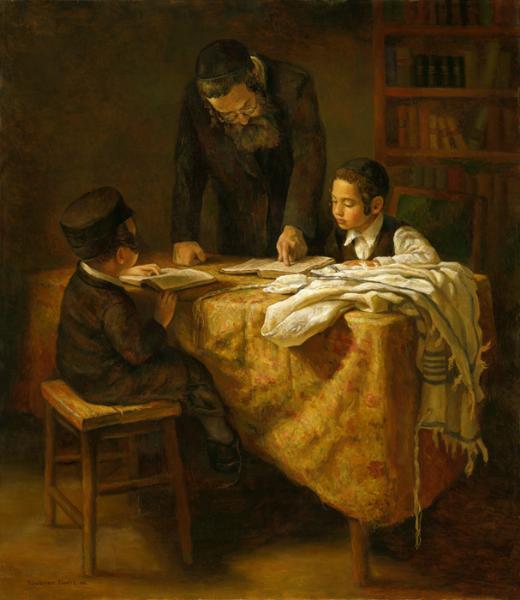
A Rabbi TeachingIt’s not really a bad idea, it is just a difficult model to find actually being practiced in the modern, western world.

In the world of the Chassidim for instance, it is probably a lot more common. A Jewish yeshiva student may consider the Rosh Yeshiva or one of the other Rabbis to be their mentor. However, a life of learning in that particular context is foreign to most of us, including the vast majority of Christians. Even if we wanted to find a mentor, where would we go and who would we seek out? I doubt most Christian Pastors would want such a role. Yes, they teach, but the teaching model is more akin to the modern school classroom and is limited in time, scope, and relationship. Teaching is time-limited, on a specific subject, and the students don’t achieve anything like the intimacy required in a mentorship or discipleship relationship.

On top of that, it’s been suggested recently that religious instruction doesn’t really change human beings.

“Religion,” novelist Mary McCarthy wrote, “is only good for good people.” Weigh the violence of the Inquisition against the humanity of Martin Luther King or homicidal fanatics against Oxfam, and you have to suspect that religion supplies a context for justifying or motivating moral choices rather than a reason for them.

-Philip Ball
“Morals don’t come from God”
Nature.com

If we are believe that statement, then a good person in a religion would have been just as good in either a different religion or no religion at all. That would mean religious teaching imparts the specific mechanics of the religion (doctrine, dogma, and such) but not the underlying moral fabric that induces fundamental human change.

Ball’s article continues:

Thousands of people — varying widely in social background, age, education, religious affiliation and ethnicity — have taken the tests. Pyysiäinen and Hauser say the results (mainly still in the publication pipeline) indicate that “moral intuitions operate independently of religious background”, although religion may influence responses in a few highly specific cases.

The authors’ paper may annoy both religious and atheistic zealots. By taking it as a given that religion is an evolved social behaviour rather than a matter of divine revelation, it tacitly adopts an atheistic framework. Yet at the same time it assumes that religiosity is a fundamental aspect of human psychology, thereby undermining those who see it as culturally imposed folly that can be erased with a cold shower of rationality.

Of course, this scientific investigation discounts any possibility that a supernatural influence could be involved, and so can hardly claim that “the leading of the Spirit” is, in any way, related to the moral behavior observed within any religion’s framework. People are good or not good, not because of what they’re taught, but because of who they are, perhaps because of an evolutionary imperative.

That would mean, by extension, that mentorship also would not be a significant factor in imparting moral change in disciples or students. So even if you find a mentor, it won’t really matter. You’ll learn a great deal about the “nuts and bolts” of your religion or philosophy, but that’s only information, not wisdom and not moral instruction and guidance.

Do you believe that?

As a person of faith, I can’t really go for it, but I certainly have to consider that it’s a possibility for a certain collection of people who only take their faith so far. We like to think that our faith makes us, not the other way around, but for some, entering a religious life is just a matter of confirming who they already are as people. In that case, they (we) don’t really want to learn anything, at least anything that would contradict their (our) already established basic moral understanding.

PrayingBut what if we really could find a true mentor, one who could take us beyond the perceptual world and into one where we are actually challenged on a fundamental level. At my age, finding a mentor is an increasingly diminishing probability, but for a much younger man or woman, it is at least still a possibility.

I know some of you Christians reading this will say that “the Lord is my mentor” or “I am guided by the Holy Spirit,” but chances are, those experiences aren’t the same as actually talking to another human being. You don’t really hear an audible voice outside of your head telling you specific information and providing concrete answers to discrete questions.

What if acquiring a mentor as Rabbi Weinberg defines the person (please read the entire article for all of the details) were indeed a possibility and even a likelihood? Let’s assume the person has to be alive today and reasonably accessible (I suppose email and instant messaging would do, but face-to-face meetings would be preferable). Who would you choose and why? I don’t mean as far as a temporarily set of interactions to learn a single topic, but an extended relationship to learn not knowledge, but wisdom, to learn about life from someone who has lived, to experience God through a true tzadik or saint.

Who would you go to? Where would you find this person? Is there anyone left who is so wise, honest, and honorable, and also who is accessible?

Being Strong

Question: I am a lay leader at my temple. Since our rabbi is away, I will be leading this week’s Shabbat service. I have beginner-intermediate skills for chanting Torah. Your pasha page was very helpful. Could you define the words “Chazak Chazak Venis-chazeik,” so that I can explain it to the congregation?

The Aish Rabbi Replies: Upon completing a public reading of one of the Five Books of Moses, everybody stands up and shouts “Chazak! Chazak! Venis-chazeik!” which translate as “Be strong! Be strong! And may we be strengthened!”

Rabbi Hayim Halevy Donin (in To Pray as a Jew) explains that this is a cry of encouragement to continue with the reading of the next book, and to return to this one again in due course. The triple use of the word “Chazak” may symbolize past, present and future.

Be strong and may you be strengthened!

“Completing a Book of Torah”
from the “Ask the Rabbi” series
Aish.com

Simchat Torah is the occasion in religious Judaism on which the very last portion of the Torah is read before immediately proceeding back to the beginning and starting another annual cycle. As was explained in the quote above, at the end of the reading of each book of Torah, it is customary to say, “Chazak, chazak, venitchazek” which translates as “Be strong, be strong, and may you be strengthened.”

But be strengthened for what?

Synagogues throughout the world will reverberate this Shabbat with the communal outcry of “Chazak, chazak, venitchazek” as the final words of Chumash Shemot are read.

This rallying cry to strengthen ourselves as we move from one Chumash to another is especially relevant to Jews living in Israel. Faced by the relentless terror from our enemies and the complacence of a world towards those who wish to destroy the Jewish State, there is truly an urgent need to remain strong in spirit as well as in defensive capability.

But this strength must have its source in our Torah, which gives us an undeniable right to our Land. The more that Jews see that there is a direct relationship between loyalty to Torah and security there will be a strengthening of our ability to enjoy Israel forever.

-Rabbi Mendel Weinbach
“Chazak, Chazek, Venitchazek”
Ohr Somayach

We see that this cry of encouragement isn’t just to gather strength to continue with the reading of the next book of Torah. For Jews, this is summoning the strength to continue to face adversity, crisis, and the seemingly perpetual efforts of the nations of the world to exterminate the Jewish people and their state.

I recently read an article about Cyber attackers targeting Iranian oil platforms. My attention was drawn to a particular quote in the article, which was originally published by the British news agency Reuters.

Mohammad Reza Golshani, head of information technology for the Iranian Offshore Oil Company, told Iran’s Mehr news agency that a cyber attack had targeted the offshore platforms’ information networks.

“This attack was planned by the regime occupying Jerusalem (Israel)…

So now the Jews are the regime occupying Jerusalem.” Even this quote from a seemingly innocuous news story takes pot shots at the legitimacy of the Jewish state and the right of the Jewish people to the Land of Israel. Yes, it takes a great deal of strength to be Jewish and particularly to be Jewish in the Middle East.

But what about the rest of us? More specifically, what about we Christians? Is there any relevancy for us in “Chazak, Chazek, Venitchazek?”

I suppose not specifically, since the traditional reading of the Torah cycle is foreign to most churches. Still, if we widen our focus, I think we can consider the principle behind the statement of encouragement to have some meaning for us.

A life of faith is not an easy one. While unlike the Jews, the rest of the world isn’t actively seeking to destroy Christians and Christianity (although there are some parts of the world where Christians are directly persecuted), we aren’t exactly well-loved, either. That’s to be expected, even of the best of us, since holding to a moral standard isn’t exactly a popular sentiment in a world that worships relativity in its morals and ethics.

But then again, what we are most often criticized for is our faults, not our virtues. We are criticized for our hypocrisy, our hostility, our judgmentalism, our bigotry, our sexism, and so on. Much of the time, our critics are right about us. When we compare our actual behavior to our stated values, we come up short. How often are we “caught” feeding the hungry, visiting the sick, providing water to the thirsty, showing respect for the aged and infirm, comforting the grieving, and so on?

Oh, it’s not that we don’t perform the deeds taught to us by our Master. It’s that we don’t make them central to our lives. It’s embarrassing when we see atheists who outshine us at actually behaving with “Christian values.” Where is our strength under these circumstances?

For me though, the need for strength is in trying to sort out my own unique role and place in the world around me and in the Kingdom of Heaven. To employ a well-known aphorism, I’m “neither fish nor fowl.” My self-declared identity is as a Christian, but if I actually showed up in a church, ten seconds after I opened my mouth, I’d fit in about as well as a square peg in a room full of round holes. The same would go for me attending a synagogue, since I’m only marginally familiar with the actual Hebrew prayers and customs and in any event, my presence would make the missus far more uncomfortable than it would me.

I keep toying with the idea of going back to a church. I’ve got one picked out as a likely candidate, but then, given how embarrassed my wife is at the mere fact that I’m a Christian, my actually attending a church would likely add insult to injury. There are a variety of barriers involved which I won’t go into, but if my wife feels uncomfortable in inviting Jewish friends to our home, how would she feel if I joined a church and then invited a few Christians over?

I frankly don’t see a way around all of this and hence the need for personal encouragement. Be strong, be strong, and may we (or rather I) be strengthened. For that matter, may my wife be strengthened so that she can return to the Jewish community and participate in worshiping God among her people.

If the encouragement is generally for a Jew to continue from one book of Torah to the next, then I’ll interpret it for myself (an arrogant conceit, I must admit) as the encouragement to continue as an individual person of faith from one day to the next. I’ll consider it the strength to continue writing meditations from one day to the next.

Joshua was encouraged by God to be strong and courageous, and he had both God and the Children of Israel to support him in taking the Land of Israel for the Jews as was promised by the God of Abraham. Most married couples who are religious are religious in the same direction, attending the same house of worship, and adhering to the same basic expression of faith, whether that is Christian, Jewish, or anything else. Even many intermarried couples will attend both his house or worship and hers, at least on occasion.

Like I said, I’m neither fish nor fowl. This is a season of beginnings for religious Jews. For me, it’s another day, another morning. How many more should I anticipate? How many more should I plan for? Where is the end of the trail and upon reaching it, will God and I part company or is there a future for both of us together?

Some people mistakenly think they have a natural need for approval and there is nothing they can do to overcome it. The truth is that the adult need for approval is based on demand. If a person decides he needs only his own approval and not that of others, he is able to focus on the question, “What is the proper thing for me to do now?” He does not ask himself, “How will other people look at me?”

This change in focus can be difficult, but once you accept it is possible, you will be able to change your attitude.

-Rabbi Zelig Pliskin
“Focus On What’s Right, Daily Lift #602”
Aish.com

Good question, Rabbi. “What is the proper thing for me to do now?”