All posts by James Pyles

James Pyles is a published Science Fiction, Fantasy, and Horror author as well as the Technical Writer for a large, diversified business in the Northwest. He currently has over 30 short stories published in various anthologies and periodicals and has just sold his first novella. He won the 2021 Helicon Short Story Award for his science fiction tale "The Three Billion Year Love" which appears in the Tuscany Bay Press Planetary Anthology "Mars."

The Equality Puzzle, Part 2

Part 2 in a four-part series. Go to Part 1 before continuing here.

While Christians and Jews rarely get hung up on who is obligated to what under usual circumstances, there is a “middle area” where Christians and Jews meet and sometimes enter into conflict. Of course I’m talking about Messianic Judaism which, in its ideal, is a form of normative Judaism (modern traditional Judaism and the traditional church will disagree with me here) that allows halakhic Jews who have come to faith in Jesus as the Jewish Messiah, to give him honor and to worship God in a wholly religious Jewish context and environment. It could be thought of as a Judaism like other sects of Judaism in the 21st century, but one acknowledging that the Messiah has already come and will come again.

As I said, the rest of normative Judaism in our world completely rejects any suggestion that Jesus could possibly have been (or will be) the Jewish Messiah King and thus (for the most part) rejects all Jews who “believe in Jesus.”

Christianity sometimes struggles with Messianic Judaism as well, since the phrase “under the Law” is virtually a curse word in most churches. “Jewish Christians” who continue to observe the mitzvot are considered to be a slap in the face to Jesus Christ and his bloody, sacrificial death on the cross, which, after all, was supposed to have freed all men from the Law.

OK, not all churches believe in such supersessionist ideas and many churches are slowly progressing forward, but for a large number of “average Christians,” Messianic Judaism is at least a mystery if not an actual affront to their concept of the work of Christ.

Somewhere in the midst of all this is a group of Gentiles who believe in Christ as Lord, Savior, and Messiah, but who disdain not only the church as a whole, but even the name “Christian,” preferring to refer to themselves as “One Law” or “Messianic Gentile” or some other circumlocution.

Last week in Journey to Reconciliation, Part 1 and Part 2, I said that many people who make up the Hebrew Roots/One Law movement became disillusioned with the traditional church and feel that some form of “Judaism” is the key to returning to the true intent of Christ and the “grafting in” of non-Jewish believers into the Hebraic root. However, it becomes amazingly confusing when large groups of Gentile Christians start attempting to absorb and live out Jewish religious customs and identity markers, often without a very good understanding of the underlying traditions, definitions, and methods of operationalization of a Jewish religious lifestyle.

In other words, many One Law practitioners are only “quasi-Jewish” in appearance and otherwise don’t typically conform to actual Jewish religious behaviors. In any event, a group of Christians practicing modern Jewish Halacha is not the same thing as the first pagan goyim abandoning idolatry and starting to worship in a First Century church established by the Apostle Paul.

It gets even more confusing when, confronted with hundreds of years of Jewish Rabbinic judgments, rulings, and education, some Hebrew Roots Christians either decide to toss the Talmud out altogether or reinvent it for their own purposes. However, any attempt to live out even the semblance of a Jewish lifestyle, either without the Talmud or using it in a drastically altered version, is ultimately doomed to failure.

The ability to even understand how to enact the basics of Torah doesn’t exist without some form of interpretation. Whether you choose to believe in the authority of the Rabbis to make halakhic rulings or not, they did establish a standard of Biblical interpretation and behavior that has served to safeguard the Jewish people for the past 20 centuries. Granted, the Rabbis never intended the vast majority of the Talmud to ever apply to non-Jewish people, but once you commit yourself to a Jewish lifestyle, it becomes impossible to avoid significant encounters with the Talmud.

Any Gentile who chooses to pray with a Siddur has encountered the Talmud and probably the Zohar. Any Gentile who dons a tallit gadol has encountered the Talmud. Any Gentile who attempts to “keep kosher” beyond the limits of Leviticus 11 has encountered the Talmud. The Rabbinic Sages and their rulings are so integrated into modern Judaism that for all intents and purposes, they are modern Judaism. You cannot adopt any item or element from modern Jewish religious and worship life without encountering and adopting some aspect or ruling of the Sages.

There’s no such thing as a “Bible-only” Jewish life (there’s no such thing as a “Bible-only” Christian life either, since we too have a rich history of tradition and ritual…we just pretend their is). Any understanding and implementation of the mitzvot at all is heavily interpreted and filtered through hundreds of years of Rabbinic commentary.

I mentioned in another blog post that, while Rabbis discourage non-Jews from taking on Jewish identity customs such as wearing kippot, they also recognize that we non-Jews may want to adopt the underlying intent of those markers. There are some Gentiles who refrain from wearing a kippah outside of an authentic Jewish synagogue setting, but who honor God by covering their heads with a hat or similar article when in public. There’s nothing wrong with that.

The Messianic educational and publishing ministry First Fruits of Zion has written an overwhelming number of books and articles outlining the appropriateness and desirability of Christians keeping significant portions of the Torah, including the correct Halacha involved, so it’s not as if we Gentile believers are cut off from the beauty of wonder of the traditions and prayers. However, it is one thing to be a grafted in branch being nurtured by the “civilized” root, and another thing entirely to say that we now own that root and that it is totally ours to do with as we please.

We cannot throw out the Jewish lifestyle without exterminating the historic link that connects Judaism (and thus any Jewish application to Christianity) back 2,000 years to the days of the Messiah’s earthly existence. We cannot take the Jewish lifestyle and morph it into something that pleases we Christians better without destroying the authenticity and the “Jewishness” of that link. In our ignorance or our arrogance, (or both) we are continuing to do what we did in the darkest days of the history of the church; invalidate and destroy the history of the Jewish people and claim its “first fruits” as belonging only to us.

If anyone in Christianity desires to address some form of “Torah observance,” it hardly makes sense for us to reinvent the wheel by redesigning Halacha. If we want to “keep kosher,” for example, the standards for keeping kosher are well established. We don’t need to “fix” them or rewrite them. How could we do better? Where do we get the authority to try to take Jewish life and “Gentilize it?” If some Christians want to pray with a siddur, then you will have to get used to the idea that most of the prayers were written post-Second Temple, and a significant portion of the content originated with the ancient Jewish Sages.

Actually, I don’t blame “One Law” Christians and even the more moderate “Messianic Gentiles” (a category to which I probably still belong, although I think of myself as “Christian”) for being confused as to what aspects of Torah are allowable and which are considered “forbidden” to Gentiles by the Jewish people.

(I suppose now would be a good time to mention that Judaism can’t actually walk into some Gentile’s home or congregation and say, “You can’t do that. Only we can do that.” If any non-Jews refrain from Jewish dress or practices that uniquely identify the Jewish people, it would have to be out of respect for the Jews and the desire to honor the Jewish forefathers who brought the first Gentiles into faith and discipleship under the Jewish Messiah King. If you choose not to show that type or level of honor, then I guess you’ll do as you please.)

For people who are intermarried and interfaith like me, it’s a little simpler in that, having a Jewish spouse, whatever Jewish practices the Jew in the home performs, the non-Jew is involved. Thus if my wife should choose to light the Shabbos candles and say the blessing, I, as her husband, would be able to enjoy the full flavor of the Shabbat entering our home. Of course, I’ve blogged many times in the past about the conflicts and dissonance that can also be involved in an intermarried home, so in some sense, a husband and wife who are either both Christians or both Jews (or both Messianic Jews) have certain advantages.

In the home, there is no problem for the Christian who loves welcoming in the Shabbat, praying with the Siddur, and even wearing tzitzit and tefillin in prayer since, in privacy, it is between the Christian and God. In public, it becomes more “dicey” as I’ve already mentioned, especially once the Gentile individual or group purposefully adopts Jewish practices and dress and then deliberately alters time-honored Halacha and tradition because they believe they have the “right,” and what the Jewish people have established either doesn’t fit, or isn’t “good enough” somehow.

As I said, this issue is already hopelessly confused, which is one reason why I simply put the brakes on my own “One Law” religious practice, put my tallit, my kippah, and everything else “Jewish” in a box, and hit the “Reset” button. If a Christian has to adopt Jewish practices in order to feel religiously significant, spiritually closer to God, or validated in their faith in Jesus, then something is terribly wrong.

O foolish Galatians! Who has bewitched you? It was before your eyes that Jesus Christ was publicly portrayed as crucified. Let me ask you only this: Did you receive the Spirit by works of the law or by hearing with faith? Are you so foolish? Having begun by the Spirit, are you now being perfected by the flesh? Did you suffer so many things in vain—if indeed it was in vain? Does he who supplies the Spirit to you and works miracles among you do so by works of the law, or by hearing with faith – just as Abraham “believed God, and it was counted to him as righteousness”? –Galatians 3:1-6 (ESV)

Some people get so involved in adopting or adapting the “mechanics” of modern Judaism into their lives that they effectively forget that Jesus does matter. In fact, they forget that he matters more than anything because without the Messiah, we Gentiles could never become Christians and as such, enter into a covenant relationship with the God of Abraham.

But if the Torah is not our “keys to Heaven” so to speak, and if focusing on the mitzvot or our own adaptations of Halacha are not the most significant things in our lives, then on what do we base our hope? Where does our treasure lie? Are we always, as Christians, the “little brother” tagging along behind the older and “cooler” Jewish Messianics?

Absolutely not! But if not, then who are we and, in terms of anything “Messianic,” where is our significance, our role, our purpose in God’s Kingdom. We’ll cover that in Part 3.

The Equality Puzzle, Part 1

“For all that You created to revive the soul of all that live…” Tosafos – For example, apples. – 37a

One motza’ei Shabbos, one of the chassidim of R’ Aharon Karliner came to visit him. During their conversation, the gabai brought a plate of fruit before them. The Rebbe picked up an apple, and fervently recited the appropriate brochah, thanking Hashem for the fruit of the trees, and he cut off a slice. He then proceeded to eat the apple.

The chossid sat across the table from the Rebbe, watching his every move. He had always thought of the rebbe as akin to one of the angels, and yet, here was his rebbe, eating a mundane apple just like everyone else would. For a fleeting moment, a thought flashed through the mind of the chossid, “We both eat apples, and we both recite brachos. True, the rebbe recites the brochah with a bit more concentration than I do, but we are both essentially the same.”

The rebbe was quick to notice the subtle change of demeanor from reverence to careful appraisal, and he said to his guest, “Tell me, what indeed is the difference between you and me? I eat apples, and you eat apples. I recite blessings, and you recite blessings. So how are we different?”

“I was just wondering the same thing,” the chossid admitted, somewhat startled and embarrassed.

“I’ll tell you,” the rebbe said. “When I get up in the morning, I look around and see all the beautiful things Hashem has created. I am overwhelmed with the splendor of creation, and the mastery of the universe. I am enthralled and I crave to praise Hashem, but I know that it is forbidden to say Hashem’s name in vain. So, I reach for an apple, which gives me the opportunity to praise Hashem as I say a brochah.

“But when you arise in the morning, the first thing you think is that you are hungry, and you want to eat an apple. You cannot eat it without saying a brochah, so you do so to allow yourself to eat. You say your brachos in order to eat, but I eat in order to say a brochah and to talk to Hashem.”

Daf Yomi Digest
Stories Off the Daf
“Eating to Bless”
Berachos 37

Part 1 in a four-part series.

I mentioned just the other day that we believers who grew up in the west, particularly in the United States, seem to be all about our “rights” and all about “equality.” We have a philosophy that is even built into our Declaration of Independence (although at the time this document was written, it really only applied to white landowners), so it is difficult to even conceive of essential “inequalities” between different groups of human beings unless we invoke the terms “racism” or “bigotry.”

But is inequality between peoples true in terms of the Bible’s intent and more importantly, is it true in terms of God’s intent for humanity? On the surface, it would seem the answer is “no.”

For as many of you as were baptized into Christ have put on Christ. There is neither Jew nor Greek, there is neither slave nor free, there is no male and female, for you are all one in Christ Jesus. And if you are Christ’s, then you are Abraham’s offspring, heirs according to promise. –Galatians 3:27-29 (ESV)

It would seem then, that the Christian ideal is for anyone who has been “baptized into Christ,” there is “neither Jew nor Greek, there is neither slave nor free, there is no male and female.” We indeed are all equal before the throne of our King and no one is superior or inferior in relation to each other in the eyes of God.

That doesn’t mean we don’t have differences, of course. It would be foolish to believe that men and women are completely identical right down to their physiology and biochemistry. Also, in terms of social status, duties, and responsibilities, in the day of Paul, there were still slaves and masters, equal in the love of God, but still a master held authority over the slave. The Galatians 3:28 “equality” didn’t “whitewash” humanity. There are still differences in biology and in social roles and status.

Which tends to chafe at some people, particularly those who are more politically liberal. After all, no one wants to support or commit acts of discrimination or injustice which lowers one human being in relation to another. If we’re all equal in God’s eyes, shouldn’t our identities, practices, and roles relative to the faith be identical, too?

Not necessarily.

I quoted the commentary on Berachos 37 above to illustrate that on the level of spiritual development, we can exist on very different planes of accomplishment. A tzaddik like the Rebbe obviously has a more highly developed perspective on spiritual matters than the Chassid who was observing him. Their transaction reminds me of another “Rebbe” relating to his own “Chassidim.”

An argument arose among them as to which of them was the greatest. But Jesus, knowing the reasoning of their hearts, took a child and put him by his side and said to them, “Whoever receives this child in my name receives me, and whoever receives me receives him who sent me. For he who is least among you all is the one who is great.” –Luke 9:46-48 (ESV)

Jesus knew “the reasoning of their hearts” even as the Rebbe in the story above noticed “the subtle change of demeanor from reverence to careful appraisal” of his Chassid. He was also just as quick to point out that there we indeed differences between a Rebbe and his Chassid, just as there were differences between Jesus and his disciples. We are also the disciples of Jesus and just like his students of ancient days, we have a long way to go in our learning and understanding. We are not equal to our Master.

Truly, truly, I say to you, a servant is not greater than his master, nor is a messenger greater than the one who sent him. –John 13:16 (ESV)

I don’t think any Christian, regardless of denomination, tradition, or sect, would seriously consider themselves as equal to Jesus Christ, but do we consider ourselves always equal to one another?

Given the nature of human beings, probably not. That is, people have a tendency to elevate themselves at the expense of others. But is this always unjustified? It wasn’t in terms of the Rebbe and his Chassid. But what about between different groups of believers.

In traditional Judaism, Jews do not see themselves as superior to Christians or any other group of Gentiles. They only see themselves as functionally different based on the covenant requirements that were specified at Sinai. This viewpoint is illuminated by a response to an “Ask the Rabbi” question about why Jews don’t proselytize.

It would be discriminatory for Judaism to proselytize and try to convert those not of the religion. That would imply that everybody needs to be Jewish in order to make a relationship with God, participate in the Torah’s vision of repairing the world, and “get to heaven.” Yet this is not so.

The idea of demanding that everyone to convert is probably familiar to you as a Christian ideal. For example, a Baptist group in Florida recently spent over $1 million to distribute a video entitled “Jesus” to every household in Palm Beach County. It’s no coincidence that 60 percent of these homes are Jewish.

Be that as it may, the Jewish idea is that the Torah of Moses is a truth for all humanity, whether Jewish or not. The Torah (as explained in the Talmud – Sanhedrin 58b) presents seven mitzvot for non-Jews to observe. These seven laws are the pillars of human civilization, and are named the Seven Laws of Noah, since all humans are descended from Noah.

Maimonides explains that any human being who faithfully observes these laws earns a proper place in heaven. So you see, the Torah is for all humanity, no conversion necessary.

As well, when King Solomon built the Holy Temple in Jerusalem, he specifically asked God to heed the prayer of non-Jews who come to the Temple (1-Kings 8:41-43). The Temple was the universal center of spirituality, which the prophet Isaiah referred to as a “house for all nations.” The service in the Holy Temple during the week of Sukkot featured a total of 70 bull offerings, corresponding to each of the 70 nations of the world. In fact, the Talmud says that if the Romans would have realized how much they were benefiting from the Temple, they never would have destroyed it!

Of course, anyone wanting to take on an extra level of responsibility can voluntarily convert to become Jewish. But that is not a prerequisite for having a relationship with God and enjoying eternal reward.

From “Jewish Proselytizing?”
Ask the Rabbi
Aish.com

interfaithYes, all men are equal in the sense that all men are descended from Noah, and thus the wisdom and truth of the Torah is for all humanity, but how the responsibilities of the Torah are to be expressed are a function of covenant responsibility from a Jewish point of view. Jews are obligated to the full 613 mitzvot as modern Judaism understands the Torah commandments today, while most Jews consider Gentiles obligated to a subset of the Torah as defined by the Seven Noahide Laws.

Christianity disputes this, not in terms of thinking that we believers are obligated to the full weight of the Torah, but that Jesus removed the Torah obligations for everyone, and replaced them with grace, love, and forgiveness. I don’t believe the Bible supports this particular theology and maintain that while we non-Jewish Christians are not obligated to the full yoke of Torah, the Jewish people do remain a people of the full Torah in response to God and Sinai.

Christians and Jews don’t particularly believe that one group is better than the other and equality between the two groups is less of a concern than incompatibility. They simply see each other as completely different religious entities. Jews are Jews and Christians are Christians.

But if Christians and Jews traditionally don’t struggle over issues of equality or superiority, then where is the problem? We’ll address that in Part 2 of this series.

What’s Important Now?

When you try to help others and they don’t listen to you, you have a choice. You can say “it’s impossible to help them” and blame them for not being more open. Or you can view the situation as your own lack of proficiency at influencing and motivating others.

A blame-free attitude is the best path to choose. This can motivate you to develop your skills and talents on how to persuade, influence, and motivate. It could be that what you said is exactly what this person needs. As you enhance your presentation skills, in the future you will influence others to follow your beneficial suggestions.

-Rabbi Zelig Pliskin
“Develop your Motivational Skills”
Daily Lift #570
Aish.com

Oh my! This could be applied to every blogger who has ever tried to convince (often in vain) an audience why their point of view is correct and why his/her audience should change their minds and adopt the blogger’s perspective/belief/faith/whatever.

Really, how many blogs and how many comments on those blogs are specifically dedicated to the blogger blaming the audience (or at least those people in the audience who disagree with him/her) for being blockheaded, stubborn, ignorant, and “impossible to help?”

More than I can count, I’m sure.

So what should we do with this piece of advice? Should we redouble our efforts as bloggers, assume that our presentation skills are lacking somehow, and focus on how better to “influence others to follow our beneficial suggestions” in future blog posts?

Is Rabbi Pliskin’s advice here the answer?

A person who feels joy when performing mitzvahs will forget all his suffering and misfortunes. In comparison to becoming closer to the Almighty, of what import is pettiness and trivialities?

A person who experiences joy in doing good deeds will feel greater joy than a person who finds a large sum of money. Why should a person expend his efforts trying to find happiness in areas where the basis is transient and ultimately meaningless, when he has a far better alternative?

I suspect it is the answer, if we were to take Rabbi Pliskin seriously and actually apply his suggestion to our lives in a consistent manner. Unfortunately, we who continue to participate in the blogosphere, either as active bloggers or the observers who don’t blog but who frequently comment on the blogs of others, take ourselves way too seriously (me included). This is true in spite of the fact that there are probably well over 181 million blogs in the world right now. As far as U.S. bloggers are concerned, our “right” to have our say and express our opinion seems to have reached crazy, chaotic, out-of-control proportions, thanks to cheap, high-speed Internet access and the ability to create a blog for absolutely no cost in just a few minutes.

So what’s the answer, what’s the answer, what’s the answer?

I’d like to say “turn it all off,” but I know how difficult that would be in my own case, so I can hardly make that suggestion to others. But Rabbi Noah Weinberg, of blessed memory, makes that exact suggestion, at least in part.

Imagine someone calling you an idiot. Or that you’re stuck in traffic. Or that the boss is hassling you.

When this happens, you can become angry and caught up in the pettiness of life.

The remedy? Take a moment to go outside and walk under the stars. When you witness the vastness of the universe, it puts things into perspective. When you come back inside, you won’t be starry-eyed. You’ll be energized. You’ll say, I’m sorry. Let’s forget it and move on.

Awe helps release you from the limits of the body. You are suddenly in a world of different dimensions, transported into the eternity of beauty, power, majesty. You’ve got an expanded perspective. It’s no longer me versus you. We’re all one. So why be aggravated?

Awe carries us beyond ourselves. In times of war and tragedy – as well as prosperity and joy – people get “bigger.” They treat each other nicer. Pettiness is forgotten.

Anytime you’re in a rut, blast yourself out. Take a walk under the stars. This will unleash the power. You cannot be bored or petty when you are in awe.

The ultimate source of awe is, of course, God. Since we often can’t directly experience God, we usually must “settle” for experiencing the reminders of Him that He has left for us; that is, His universe, His creation.

It’s ironic that when we compare ourselves to the vastness of God and His Glory, we feel very small, and humbled, and yet at the same time, grateful and even exhilarated. We don’t feel jealous that God is so big and we are so tiny. We don’t resent God for being omnipotent while we are so powerless.

And yet let another human being or another group of people claim some heritage, some experience, some relationship that we ourselves don’t have access to, and suddenly we’re deeply envious, hurt, and outraged. We feel victimized. We feel as if our “rights” have been violated. Why can’t we have the same access to what “those people” claim is uniquely theirs?

Yes, of course I’m talking about the current (and seemingly endless) debate between certain corners of Christianity which can be thought of as “Hebrew Roots” or more specifically “One Law” and the various Judaisms, including “Messianic Judaism.”  The struggle is fueled by those who find in the Bible the justification for “One Law” Christians to have the “right” to everything that God granted Israel as a perpetual gift at Sinai, which is the heritage of every Jew on earth today. Naturally, when Jewish people hear such rhetoric, they tend to “push back.”

I suppose this too is an “issue” that we people who were born and raised in the West and specifically in the U.S. have to deal with, since “our rights” are all we tend to think about (or is that “our entitlements?”) relative to what other people have that we want.

But what should we have learned by now as people of faith? What did Jesus teach? To claim our rights? To take what wasn’t given to us? What did he teach that we seem to be forgetting?

“When the Son of Man comes in his glory, and all the angels with him, then he will sit on his glorious throne. Before him will be gathered all the nations, and he will separate people one from another as a shepherd separates the sheep from the goats. And he will place the sheep on his right, but the goats on the left. Then the King will say to those on his right, ‘Come, you who are blessed by my Father, inherit the kingdom prepared for you from the foundation of the world. For I was hungry and you gave me food, I was thirsty and you gave me drink, I was a stranger and you welcomed me, I was naked and you clothed me, I was sick and you visited me, I was in prison and you came to me.’ Then the righteous will answer him, saying, ‘Lord, when did we see you hungry and feed you, or thirsty and give you drink? And when did we see you a stranger and welcome you, or naked and clothe you? And when did we see you sick or in prison and visit you?’ And the King will answer them, ‘Truly, I say to you, as you did it to one of the least of these my brothers, you did it to me.’ –Matthew 25:31-40 (ESV)

Did Jesus “teach Torah?” Absolutely! What else would a Second Temple period itinerant Rabbi teach to the “lost sheep of Israel?” Did he expect his disciples to take his teachings and pass them on through imitation and active “preaching?” Absolutely! That’s what disciples do. Do we see Jesus overtly teaching Jewish covenant signs and identity markers to his Jewish audience? Not as such, since each Jew in Roman-occupied “Palestine” would have been raised from birth to know all these things. In other words, for a Jew in that place at that time,  knowing how to tie tzitzit would have been a “no-brainer.”

So what did he teach and what did he expect his Jewish disciples to pass on to the disciples from the nations? (Matthew 28:18-20) What were his most important commandments?

A new commandment I give to you, that you love one another: just as I have loved you, you also are to love one another. –John 13:34 (ESV)

Jesus replied: “‘Love the Lord your God with all your heart and with all your soul and with all your mind.’ This is the first and greatest commandment. And the second is like it: ‘Love your neighbor as yourself.’ All the Law and the Prophets hang on these two commandments.” –Matthew 22:37-40 (ESV)

That takes us right back to what Rabbi Pliskin said earlier:

A person who feels joy when performing mitzvahs will forget all his suffering and misfortunes. In comparison to becoming closer to the Almighty, of what import is pettiness and trivialities?

It’s pointless to fuss and argue over God and His special relationship with the Jewish people. After all, God gave the nations of the world the most precious gift possible; the life of His one and only son, the unique one, the Messiah, who died so that our sins could be forgiven and who lived so that we could have eternal life with the Father as His own sons and daughters.

The next time someone says something outrageous about religion (or anything else) on the Internet and you want to fight back and stand up for your rights, step away from the keyboard. Go outside. Experience the awesomeness of a thunderstorm or the magnificence of the starry, starry night. Perform a mitzvah such as visiting a sick friend in the hospital or donating a few canned goods to your local food bank. Retire into a quiet place and pray, turning your heart away from your own small concerns or hurt feelings and turning your spirit toward God.

After you have done that, ask yourself, “What’s important now?”

Do I need to take my own advice? Yes. Fortunately, Shabbat is coming up. When sundown approaches, I can put away the Internet and return my heart and spirit more fully to the God of all creation, may His Name be blessed eternally and without end.

Ki Tavo: Loving and Honoring God

BikkurimOur Sages teach: (Bava Basra 9b.) “A person who gives a coin to a poor person is granted six blessings; one who gratifies him is blessed elevenfold.” Now, gratifying does not necessarily mean giving more money. It means giving a positive feeling, showing the recipient that you care about him, and that he means something to you. When one so invests himself in another person, putting enough of himself into the stranger that the person feels appreciated, he has given something far greater than money. And so he receives a more ample blessing from G-d.

This leads to a deeper concept: Appreciation stems from involvement; the deeper the relationship between people, the more one appreciates the uniqueness of the other. When a person appreciates a colleague, he is motivated to do whatever he can for that other person.

These concepts apply, not only to our relationships with our fellow man, but also to our relationship with G-d.

-Rabbi Eli Touger
“Entering Deeper and Deeper”
Commentary on Torah Portion Ki Tavo
Chabad.org

“Teacher, which is the great commandment in the Law?” And he said to him, “You shall love the Lord your God with all your heart and with all your soul and with all your mind. This is the great and first commandment. And a second is like it: You shall love your neighbor as yourself. On these two commandments depend all the Law and the Prophets.”

Matthew 22:36-40 (ESV)

I’ve commented more than once that there is an inseparable relationship in the life of a believer between our relationship with other people and our relationship with God. We see here that not only does Jesus teach this lesson as the two most important commandments to learn and obey, but that both ancient and modern Judaism also cherishes this teaching. It resides at the heart of the Torah Portion for this week and should reside at the core who we are as people of God.

Rabbi Touger expands on his commentary and illuminates us further:

One of the major thrusts in Judaism is hakaras hatov, appreciation of the good which G-d constantly bestows upon us. And as with appreciation of our fellow man, the emphasis is on appreciating not only the material dimension of G-d’s kindness, but also the love and care which He showers on every person.

In this vein, we can understand the sequence of our Torah reading, Parshas Ki Savo. The reading begins by describing the mitzvah of bikkurim, (Deuteronomy 26:1-11.) the first fruits which the Jews would bring to the Beis HaMikdash, and shortly afterwards speaks of a covenant concerning the entire Torah. (Op. cit.: 16ff.)

What is the connection between these subjects?

The mitzvah of bikkurim was instituted to show that our gratitude for the good G-d has granted us, (Rashi, gloss to Deuteronomy 26:3.) and to display our appreciation to Him for “granting us all the blessings of this world.” (Sefer HaChinuch, mitzvah 606.) And this appreciation is not expressed merely by words of thanks, but through deed.

Rabbi Touger goes on to describe the deeds of ancient times, were to offer first fruits to God in deep appreciation for all that he bestowed upon the people of Israel, but that appreciation would be incomplete if we didn’t also offer gifts to our fellow human beings. I don’t mean just material goods, although these are important, but the gifts of compassion, mercy, kindness, and justice. From those gifts flow food for the hungry, comfort for the widow, provision for the bride, and spending time with the sick.

If we say we love God, how are we to express this today? Even a Jew cannot offer sacrifices without a Temple. As we approach the High Holidays, many Jews are giving abundantly to charity, offering impassioned prayers, and seeking to repair damaged relationships. In “offering” to God, we have no choice but to give to the people in need around us, for loving people is indeed loving God, just as He loves us.

If anyone truly intends to repent, either because of the approach of Rosh Hashanah and Yom Kippur or because of our imperative as Christians to continually repent before God through Jesus Christ, it would be foolish to imagine we didn’t have to repent and ask forgiveness of those we may have hurt with our careless words and actions.

But it goes beyond repentance and forgiveness and giving to charity. We have a perpetual responsibility to honor others as God honored Christ, for only in seeking the honor of our friend as if it were our own, can we truly become honorable before God and show the world that God deserves much great honor.

Let the honor of your friend be as dear to you as your own.

-Ethics of the Fathers 2:15

Pride, honor, and acclaim have an attraction all their own, but our Sages warn us that these may be destructive (Ethics of the Fathers 4:28). The frustration people may experience when they feel they did not receive due recognition may be extremely distressing.

People who crave honor may sometimes attempt to achieve it by deflating others, thinking that their own image is enhanced when others are disparaged. The truth, however, is just the reverse: when one deflates another, one’s own image is diminished.

Rabbi Nechunya’s students asked him, “By what merits did you achieve long life?” He answered, “I never accepted any honor that was at another person’s expense.” As an example the Talmud tells that when Rav Chana Bar Chanilai visited Rabbi Huna, he wanted to relieve the latter of carrying a shovel on his shoulder. Rabbi Huna objected, saying, “Since it is not your custom to be seen carrying a shovel, you should not do so now” (Megillah 28a). Rav Chana was willing to forgo his own honor for Rabbi Huna’s sake, but Rabbi Huna would not hear of it.

Why does such an attitude merit long life? A person who is not preoccupied with his image, and is not obsessed with receiving honor and public recognition, is free of the emotional stress and frustration that plague those whose cravings for acclaim are bottomless pits. These stresses can be psychologically and physically devastating, and dispensing with them can indeed prolong life.

Aptly did Rabbi Elazar HaKappar say that honor drives a man out of this world (Ethics of the Fathers 4:28). One who pursues honors in this world mortally harms his chance for happiness.

Today I shall…

concentrate on being respectful to others, and avoid pursuing recognition from others.

-Rabbi Abraham J. Twerski
“Growing Each Day, Elul 18”
Aish.com

Seek to show honor to God by honoring people in your midst, not just your friends or those who are like you, but the pauper, the outcast, the lonely, and misfit, for they are all Children of God, even as you are.

Good Shabbos.

Taking the Next Step

“You shall love your God” means that you should make the Divine Name beloved.

Yoma 86a

Rabbi Shimon ben Shatach once bought a donkey and found a gem in the carrying case which came with it. The rabbis congratulated him on the windfall with which he had been blessed. “No,” said Rabbi Shimon, “I bought a donkey, but I didn’t buy a diamond.” He proceeded to return the diamond to the donkey’s owner, an Arab, who remarked, “Blessed be the God of Shimon ben Shatach.”

A non-Jew once approached Rabbi Safra and offered him a sum of money to purchase an item. Since Rabbi Safra was in the midst of prayer at the time, he could not respond to the man, who interpreted the silence as a rejection of his offer and therefore told him that he would increase the price. When Rabbi Safra again did not respond, the man continued to raise his offer. When Rabbi Safra finished, he explained that he had been unable to interrupt his prayer, but had heard the initial amount offered and had silently consented to it in his heart. Therefore, the man could have the item for that first price. Here too, the astounded customer praised the God of Israel.

We have so many opportunities to demonstrate the beauty of the Torah’s ethics. We accomplish three mitzvos by doing so: (1) practicing honesty, (2) kiddush Hashem (sanctifying the Divine Name), and (3) making the Divine Name beloved, according to the above Talmudic interpretation of the Scripture.

Today I shall…

try to act in a manner that will make the Divine Name beloved and respected.

-Rabbi Abraham J. Twerski
“Growing Each Day, Elul 15”
Aish.com

Easier said than done.

Yeah, kind of shocking that I should say that, isn’t it? It’s easier to say that I shall love my God and make the Divine Name beloved than to actually live out those words on a day-to-day, moment-to-moment basis.

Intention is wonderful, but real life and human nature tends to get in the way much of the time. That’s why we aren’t all tzaddikim (Righteous Ones), for only a truly righteous person who is close to God can maintain a consistent lifestyle of graciousness, humility, and kindness. The rest of us tend to get tripped up time and again by our emotions, our faults, and our bad habits.

We also get tripped up by our ambitions and most of us, in planning ahead (which isn’t necessarily a bad thing), tend to keep our eyes on the end goal at the expense of looking where we’re placing our foot and what (or who) we may be stepping on.

This one a long time have I watched. All his life has he looked away… to the future, to the horizon. Never his mind on where he was. Hmm? What he was doing.

Yoda

A man came to the town of Krasny, Russia, and publicized he would balance himself on a rope tied on both sides of a river. Rabbi Chaim Krasner, a disciple of the Baal Shem Tov, brought some of his students to watch the man perform. Rabbi Chaim’s students, noticing how their teacher concentrated deeply on the man, asked why it caught his interest.

“I was contemplating how this person puts his life in danger to walk across the rope. If he would think about how much money he will receive for his act, he would surely slip and fall. The only way he can keep his balance is to free his mind from every other thought, and concentrate completely on each step. If his mind would wander for even a moment, he would fall into the river. That is the level of concentration we too must master.”

-Rabbi Zelig Pliskin
“Concentrate on your Next Step, Daily List #567”
Aish.com

Whether you prefer to rely on Yoda or Rabbi Chaim Krasner, the essential message is the same. While we have always been taught to keep our eyes on the goal, which for Christians is the person of Jesus our Lord, we must still be mindful of each step we take in order to walk a straight path to that goal. The tightrope walker wants to make it to the other end of the rope, but if he doesn’t concentrate on where he’s placing his feet each step of the way, even with his eyes on the goal, he’ll never make it.

I’ve talked before about how we can twist a particular religious or educational practice into an excuse to be hurtful and denigrating of others. And as we saw in the testing of our Master in the desert, even the Adversary can use Scripture to accomplish an evil purpose.

The ends do not justify the means. If they did, then it would be appropriate to murder an abortion doctor in order to prevent the killing of unborn children. God does not sanction the breaking of His own laws in order for us to create the illusion that we’re serving Him. It’s not just the goal that’s important, it is what we do with every moment of our lives to achieve the goal. If we feel we need to hurt another human being in order to get to where we think God wants us to be, we’ve already failed.

From my father’s guiding instructions: Keep away – to the ultimate degree – from a campaign of attack. Not because we lack the means of prevailing or because of timorousness, but because we must consecrate all our strength exclusively to strengthening our own structure, the edifice of Torah and mitzvot performed in holiness and purity. To this we must devote ourselves utterly, with actual mesirat nefesh, (self-sacrifice) not merely with potential mesirat nefesh.

“Today’s Day”
Tuesday, Elul 14, 5703
Compiled by the Lubavitcher Rebbe
Translated by Yitschak Meir Kagan
Chabad.org

Keep your eyes on the goal but be aware of where you’re stepping. Concentrate, not on repelling the perceived “attacks” of others, but on strengthening your own morality and spirituality. Rely on God so that you can learn to be reliable to others. Seek peace with God so that you can be a source of peace to everyone around you. Behave in a manner, even toward your “enemies,” that honors the Name of God so that you too can be considered honorable.

To do otherwise desecrates the Divine Name, ruins your reputation with others, and leads to your own downfall.

What Are The Jewish Covenant Signs?

Question:

I have a few Jewish friends who wear kippahs and sometimes when I’m hanging out with them I feel out of place. Even though I am not Jewish, would there be any problem with me wearing a kippah, too?

The Aish Rabbi Replies:

Well, on one hand, the Pope wears a kippah.

But on the other hand, a non-Jew should not wear a kippah, since that might deceive others into thinking that he is Jewish.

In practice, non-Jews will sometimes wear a kippah while attending a Jewish religious function (many world leaders have been photographed at the Western Wall wearing a kippah), but in general a non-Jew should not wear one, due to the confusion it may cause.

However, since the idea of a kippah is to have the head covered as a reminder of God, you could certainly use some other head covering, like a cap, to serve that purpose.

from Ask the Rabbi
“Kippah for a Non-Jew”
Aish.com

At last spring’s First Fruits of Zion Shavuot Conference during a question and answer session, a gentlemen in the audience said that he sometimes will visit churches wearing a kippah and tallit gadol as a “witness” to the Christians of the permanency of the Torah mitzvot. The person in question isn’t Jewish and when asked at church, will admit he is not Jewish but that, in his opinion, the mitzvot pertaining to wearing tzitzit and many others, apply equally to the Christian as to the Jew based on our discipleship under the Jewish Messiah King.

The reaction from the speaker at the event (I can’t recall who was speaking at that particular moment) was that this behavior introduces a great deal of identity confusion if Christians start dressing like Jews just to make a point. Reading the “Ask the Rabbi” topic I quoted above reminded me of that interaction and confirmed that Messianic Judaism and more traditional Judaism share the same perspective on Gentiles wearing Jewish “sign” markers.

I’ve often heard various Jews in the Messianic movement object to Gentiles wearing tzitzit, keeping Shabbat, and (apparently) observing the kashrut laws, as violating the “sign markers” that specifically identify Jewish people and their covenant relationship with God. The “pushback” I’ve read from One Law proponents and some others in the Hebrew Roots movement is that there’s a great deal of confusion about what Torah mitzvot is and isn’t permitted Gentile Christians, so how can anyone be held accountable to what may or may not be permitted?

From a more traditional Jewish perspective, I suppose the matter is more clear-cut, but in terms of the Messianic Jewish view on the matter, things seem a tad more indistinct. Some more “hard-line” folks in Messianic Judaism seem to believe that Gentile Christians should stay in their (our) churches and behave in no way whatsoever that resembles a Jew. Others, such as the fine folks at First Fruits of Zion (FFOZ), state that many and even perhaps most of the mitzvot are permitted a Gentile, but the vast majority of them are not actual covenant obligations for us.

Opinions seem to vary widely and that’s where the confusion comes in. If you are a Gentile Christian but are attracted to the beauty and wonder of the Torah mitzvot, and you want to express a high level of respect toward Jews and Judaism, what is allowed and what is not permitted?

My personal response, and out of respect for my Jewish wife, was to put away just about everything, my kippah, my tallit, my tefillin, and to abstain from reciting virtually all of the Hebrew prayers (I still keep a siddur on my nightstand, however).

But if I wanted to explore what a Gentile might be allowed that normally is considered “Jewish,” then where are the boundaries and limits, or are they clearly defined at all?

In my search, (which has been rather brief so far) I actually didn’t find much.

In general, a brit refers to a covenant–a pledge of obligation between two parties which is sometimes accompanied by a token signifying the brit. Historically, there have been three signs that point out the three major covenants between God and people.

The first is Shabbat, which was given to serve as a sign of creation: “The Israelite people shall keep the Sabbath, observing the Sabbath throughout the ages as a covenant for all time: it shall be a sign for all time between Me and the people of Israel” (Exodus 31:16-17).

The second is the rainbow, which was given to symbolize the renewal of mankind after the Noah flood: “God further said, `This is the sign that I set for the covenant between Me and you, and every living creature with you, for all ages to come. I have set My bow in the clouds, and it shall serve as a sign of the covenant between Me and the earth. When I bring clouds over the earth, and the bow appears in the clouds, I will remember My covenant between Me and you and every living creature among all flesh, so that the waters shall never again become a flood to destroy all flesh’ ” (Genesis 9:12-15).

And the last is [circumcision], which was established as the sign signifying the beginning of the Hebrew nation: “Such shall be the cove­nant between Me and you and your offspring to follow which you shall keep: every male among you shall be circumcised. You shall circumcise the flesh of your foreskin, and that shall be the sign of the covenant between Me and you” (Genesis 17:10-11).

Circumcision came to be regarded as the unique sign of our covenant and gradually emerged as a physical symbol of a child’s joining the com­munity of Israel.

-by Rabbi Michael Strassfeld & Sharon M. Strassfeld
“Three Biblical Signs of Covenant”
Aish.com

Really? Just three? Surely that can’t be it.

The Rainbow, circumcision, and Shabbat.

First off, the sign of the Rainbow that God presented to Noah applies to all of humanity, not just the Jewish people so that leaves only two that are specifically Jewish: circumcision, or the brit milah, and Shabbat.

This is my covenant, which you shall keep, between me and you and your offspring after you: Every male among you shall be circumcised. You shall be circumcised in the flesh of your foreskins, and it shall be a sign of the covenant between me and you. –Genesis 17:10-11 (ESV)

Therefore the people of Israel shall keep the Sabbath, observing the Sabbath throughout their generations, as a covenant forever. It is a sign forever between me and the people of Israel that in six days the Lord made heaven and earth, and on the seventh day he rested and was refreshed.’”-Exodus 31:16-17 (ESV)

That would seem to leave the field wide open for Gentiles to observe Torah mitzvot that are not signs of the covenant between God and the Jewish people.

But is it really that simple? Of course, not.

As the Aish Rabbi pointed out, even wearing something as simple as a kippah, which is not overtly commanded in the Torah, can create “identity confusion” as far as Jews, Christians, and everyone else are concerned.

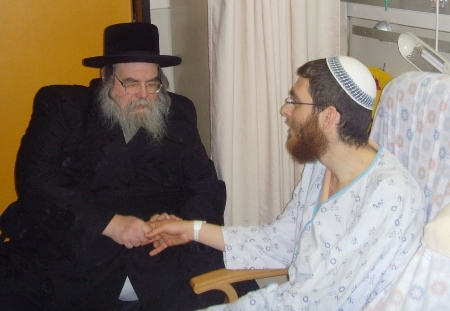
Jewish in JerusalemA few “Messianic Gentiles” dress frum but that really isn’t such a problem. It’s more likely to see certain non-Jews wearing tzitzit, either attached to a tallit katan or far more inappropriately, on their belt loops.

I don’t know if it’s a crime, a sin, or just embarrassing to be a Gentile and to deliberately create the impression that you’re Jewish, (even if that’s not your exact intension) but it sure does mess with people’s heads as far as who a Jew is and isn’t.

However, I have to be fair and say that the Messianic Jewish movement doesn’t appear to have a very firm set of standards as far as behaviors that represent “covenant signs” telling non-Jews in the Messianic/Hebrew Roots movement what to avoid (that is, if the non-Jews choose to show respect to Jewish people).

If such standards exist and I’ve just missed them, I’d appreciate it if someone could point me in the right direction. If they don’t exist, maybe it’s time someone got around to addressing this issue. If at least some folks are going to make an issue of Gentiles and Jewish covenant signs, then we should all be able to point our fingers to a set of standards that defines what we’re all talking about.

Comments?