All posts by James Pyles

James Pyles is a published Science Fiction, Fantasy, and Horror author as well as the Technical Writer for a large, diversified business in the Northwest. He currently has over 30 short stories published in various anthologies and periodicals and has just sold his first novella. He won the 2021 Helicon Short Story Award for his science fiction tale "The Three Billion Year Love" which appears in the Tuscany Bay Press Planetary Anthology "Mars."

I’m Younger Than That Now

When I was seventeen
It was a very good year
It was a very good year for small town girls
And soft summer nights
We’d hide from the lights
On the village green
When I was seventeen

“It Was a Very Good Year” (1961)
-composed by Ervin Drake

A self-ordained professor’s tongue, too serious to fool
Spouted out that liberty is just equality in school
Equality, I spoke the word as if a wedding vow
Ahh, but I was so much older then, I’m younger than that now

My Back Pages” (1964)
-composed by Bob Dylan

This is a counterpoint to this morning’s meditation, which had a distinctively forlorn tone and pessimistic outlook. Life can be like that for me sometimes. I suppose it can be like that for some of you on occasion. But something LeVar Burton said on twitter about 1968 made me think back. I actually “misremembered” the famous chorus to Dylan’s tune as, “I was so much younger then, I’m older than that now.”

When I looked up My Back Pages (and I’m probably remembering The Byrds’s cover of the song), I realized my mistake. Then the Drake song, made famous by Frank Sinatra, popped into my head.

That’s more like it. That’s what I was thinking. That’s what I was feeling. I was so much younger then, and it was a very good year.

But this is supposed to be optimistic, isn’t it?

I’m utterly convinced that the key to lifelong success is the regular exercise of a single emotional muscle: gratitude.

People who approach life with a sense of gratitude are constantly aware of what’s wonderful in their life. Because they enjoy the fruits of their successes, they seek out more success. And when things don’t go as planned, people who are grateful can put failure into perspective.

By contrast, people who lack gratitude are never truly happy. If they succeed at a task, they don’t enjoy it. For them, a string of successes is like trying to fill a bucket with a huge leak in the bottom. And failure invariably makes them bitter, angry, and discouraged.

Therefore, if you want to be successful, you need to feel more gratitude. Fortunately, gratitude, like most emotions, is like a muscle: The more you use it, the stronger and more resilient it becomes.

-Geoffrey James
“True Secret to Success (It’s Not What You Think)”
Inc.com

That reminds me of the very first meditation I wrote for this blog, exactly 14 months ago today.

“I gratefully thank You, living and existing King
for restoring my soul to me with compassion.
Abundant is your faithfulness.”

Blessing Upon Arising in the Morning

It’s the one Jewish blessing I still allow myself to recite and virtually the first coherent thought I have upon awakening each morning.

I’m grateful to wake up alive.

In his article, Geoffrey James calls gratitude the “secret to success.” He talks about making a list of everything that happened to you during the day that makes you grateful and writing it all down before going to bed. He says that the more you practice gratitude, the more it will become part of your “reprogramming.”

It’s funny, but I think the Jewish sages had that idea long before James wrote his wee article for Inc.com.

Of course, that’s how we learn just about anything, by practicing. I suppose that’s true of being grateful. I suppose that’s true about having a relationship with God. Like any relationship, it takes practice, patience, and lots of attention. You reap the rewards of whatever you put into it. If you practice too little, the rewards are very few.

Both “It Was a Very Good Year” and “My Back Pages” are retrospectives on life. The former song expands the person’s vision across an entire human lifespan while the latter is Dylan’s personal presentation of his disillusionment with the folk protest movement of the early 1960s.

I periodically become aware that there are more days behind me than there are ahead, but I take some comfort in my family, the next generation I see in my children, and the generation beyond that in my grandson.

And I take some comfort in God.

But it’s difficult not to look back and ponder all the youthful wonder and immature anguish, the carefree nights and days and the painful and terrible mistakes. Was I a better person then, or now? What have I learned. Was being seventeen really better? Am I younger or older than that now?

But however it’s all worked out, I haven’t forgotten to be grateful to God. I’m alive. I have a wife and three children. I have a grandson (and I can still hardly believe I’m a grandpa). I’m working. I live comfortably. I’m able to give something back to my community, which is a blessing. Life isn’t perfect, but God has been generous.

And I’m grateful. I should practice that more.

Yes, my guard stood hard when abstract threats
Too noble to neglect
Deceived me into thinking
I had something to protect
Good and bad, I define these terms
Quite clear, no doubt somehow
Ahh, but I was so much older then
I’m younger than that now

-Dylan

But now the days grow short
I’m in the autumn of the year
And now I think of my life as vintage wine
from fine old kegs
from the brim to the dregs
And it poured sweet and clear
It was a very good year

-Drake

How do I feel?

I feel older. But sometimes, when I’m grateful, I feel young.


Above All Else, God Needs To Feel Compassion

Fear is the opposite of genuine faith. Fear comes from a place of faithlessness. When we have real confidence in God, fear is driven out. For the person of faith, fear is actually irrational.

Thought for the Week
“Fear Not”
Commentary on Torah Portion Devarim
First Fruits of Zion (FFOZ)

There are times when moving forward is not enough. There are times when you can’t just change what you do, how you speak and how you think about things. Sometimes, you have to change who you are. You need to pick both feet off the ground and leap.

-Rabbi Tzvi Freeman
“The Quantum Leap”
Based on letters and talks of the Rebbe
Rabbi M. M. Schneerson
Chabad.org

And while the future’s there for anyone to change, still you know it’s seems it would be easier sometimes to change the past.

Jackson Browne
Fountain of Sorrow
from the album Late for the Sky (1974)

Uh-huh.

I keep thinking about the victims of the Aurora, Colorado theater shootings. I’m sure some of the people who were there, some of the wounded, some of those who died, were probably religious. Some of them probably had faith. Some of them probably loved God. Did those people have no fear in the dark, choking on whatever gas the shooter released into the air, hearing the gunshots, the screams of the victims, seeing the blood. Were they not afraid because they had faith?

People get hurt, we get sick, we’re afraid, we sometimes cry. Doesn’t God understand that? If the writer of the FFOZ commentary is right, then every time a person of God feels fear, they are experiencing faithlessness. They are experiencing a total, catastrophic failure in their faith, a failure as a disciple of the Master, a failure as a child of God, and a failure as a human being.

Nevermind that we’re wired to have all of these emotions that we experience, including the emotion of fear. If you take your small, sick child to the doctor and you are told your baby has leukemia, is it a sin to be afraid that your child will die? If you lose your job and realize that you have no way to support your family and will most likely end up putting your wife and children on the street because you failed, is it a sin to be afraid?

It would be wonderful to not feel fear. It would be wonderful to approach every difficult situation with ultimate confidence and self-assuredness. It would be wonderful to constantly experience the love, grace, and strength of God in all circumstances, no matter how dire, knowing that even if you should be hurt, suffer the most hideous and painful diseases, and even face the loss of everyone you have ever loved, that it would be OK because God is with you.

And you never ever felt afraid.

It would be wonderful, but how many people have ever pulled it off? How many people have that much faith, trust, and confidence in themselves let alone God, to never feel afraid?

I don’t know the answer, but I suspect that the number is extremely small.

And he came out and went, as was his custom, to the Mount of Olives, and the disciples followed him. And when he came to the place, he said to them, “Pray that you may not enter into temptation.” And he withdrew from them about a stone’s throw, and knelt down and prayed, saying, “Father, if you are willing, remove this cup from me. Nevertheless, not my will, but yours, be done.” And there appeared to him an angel from heaven, strengthening him. And being in an agony he prayed more earnestly; and his sweat became like great drops of blood falling down to the ground. –Luke 22:39-44 (ESV)

It’s impossible to really know what Jesus was feeling at that moment in time, but obviously he wasn’t facing his bloody, tortuous execution with calm, cool detachment. He accepted the cup set before him by the Father, but he still asked that it be taken away. He still was in agony, so much so, that “his sweat became like great drops of blood falling down to the ground.”

But the Bible says,

…fear not, for I am with you; be not dismayed, for I am your God; I will strengthen you, I will help you, I will uphold you with my righteous right hand. –Isaiah 41:10 (ESV)

PleadGod was addressing Israel through the prophet Isaiah. Did Israel feel no fear because God was with them? Did they feel no fear when faced with the barrier of the Reed Sea as the armies of Egypt descended upon them with murderous intent? Did they feel no fear as they faced giants and fortified cities when they first tried to cross over into Canaan? Did they feel no fear on the day when the Temple was destroyed, when Jerusalem was burned to the ground, when the Jewish people were sent into exile and scattered like loose change among the nations of the world for 2,000 years?

For you did not receive the spirit of slavery to fall back into fear, but you have received the Spirit of adoption as sons, by whom we cry, “Abba! Father!” –Romans 8:15 (ESV)

Yesterday, I wrote,

Maybe you’re thinking I’m being unreasonable. Maybe you’re thinking that I can’t be serious. Maybe you’re thinking that it would be too hard for you to help another person while facing a crisis of your own. And yet, God calls us to serve Him under all circumstances. Certainly we expect Him to serve us no matter what we’re going through and no matter what else is happening in the world.

You and I are only flesh and blood and bone. We’re weak. How can we stand up under the pressures of life and still be expected to help someone less fortunate than we are?

Some days the faith and trust is better and some days it’s worse. Some days I feel like I can take on whatever life and God dish out and some days I just want to hide in bed under the covers and have God make it all go away.

Someone recently commented on one of my blog posts, “I say, let the End come! Only He can fix this mess. We just keep messin’ it up!” I responded with encouragement. We can’t give up. We can’t just sit on our thumbs and do nothing and wait for Jesus to arrive on the bus from Heaven to repair our broken and dying world.

But discounting our weakness and criticizing the faithful for being faithless when we feel fear isn’t an answer I can accept. All flesh is grass (1 Peter 1:24). It is said that the spirit is willing but the body is weak (Matthew 26:41). I say that even the spirit is weak sometimes. For some people, it’s weak a lot of the time.

Some people say that fear is a liar and I suppose if a person allows fear to be the driving force in their life, then they will never really live. But many people have good reasons to feel afraid, either because they’re in a stressful or dangerous situation, or they’ve experienced enough of those situations that the future looks like a room full of tripwires and trapdoors.

But having said all that, the FFOZ commentary ends on this note:

It may not sound like one of the commandments of the Torah but it actually is a rule of life for the People of God. We are to live by faithful confidence in the strong hand of God. He who delivered Israel from Egypt and defeated the Amorites will also deliver the Canaanites into the hands of Israel. He who rescued our Master and Savior from the grave will also rescue us from every trouble and fear.

Yeshua says, “Are not two sparrows sold for a cent? And yet not one of them will fall to the ground apart from your Father. But the very hairs of your head are all numbered. So do not fear; you are more valuable than many sparrows.” (Matthew 10:29-31)

According to Rabbi Freeman, we have a Godly soul that strives to go higher each day and “she will transform that animal to yearn with a divine yearning.”

We have a Godly soul and a body of shredded and bleeding flesh. When you’re young, you have a certain amount of courage, even to the point of foolishness, because in most cases, nothing really bad has happened to you yet. After three or four decades, you know better. If you stick your hand in a fire, you’ll be burned. The chest pain you are feeling might not be “just indigestion.” The “near miss” on the freeway because an aggressive driver just had to pull in front of you came within an inch of a collision at 65 miles per hour.

I can’t give up. I can’t be safe. I cannot hide. God does not promise that I won’t ever suffer or die in pain. The Book of Job scares the heck out of me.

All I know is if God decides to slowly feed me into a running wood chipper feet first, an inch at a time, my only guarantee is that He will be with me. One translation of Job 13:15 says, “Though He slay me, I have no hope.” I suppose it’s more encouraging to rely on standard translations like, “yet I will wait for Him” or “yet will I hope in Him.”

I just wish some religious people wouldn’t be so hard on the rest of us (or is it only me?). Faith isn’t easy. Hope often fails. The commentary says,

When we feel frightened or worried, we must remember who our Father in Heaven is, and that He cares for us and watches over us.

Tell that to the people of Haiti who are still struggling. Tell that to the Christians in Japan post-tsunami. Tell that to every soldier, Marine, and sailor who has ever gone to war and still struggles with PTSD years and even decades later.

And tell that to the victims of the Aurora, Colorado movie theater massacre.

Are they just going to recover, bounce back, and feel all hunky-dory again as if nothing ever happened? Are those people weak when they hear a car backfire and run for cover? Do they all suffer from chronic faithlessness just because they get scared?

Don’t you have compassion? Haven’t you ever been afraid?

Giving Life

The Jews of Vitebsk, if you want to know the truth, at the time were known not to be generous givers to charity. When money needed to be raised for a worthy cause, it was no simple matter to extract hard currency out of them without applying a good deal of pressure. To their credit, however, it must be said that the Vitebskers could always be counted on to provide food for the hungry; indeed, the Talmud states that giving ready-to-eat food is greater than giving money to charity because it provides immediate relief, while the benefit of money is indirect.

One day a chassid from Vitebsk came to see the Rabbi Menachem Mendel of Lubavitch (the third Chabad Rebbe, 1789-1866). He told the Rebbe that his only son was about to be drafted into the Russian army. Previously, only-sons were exempted automatically, but this year there was a new, tough policy and their precious child was in danger. “Please, Rebbe,” he entreated, “help us, save us.”

Rabbi Menachem Mendel shook his head sadly: “I’m sorry, I cannot help you in this matter.”

-Rabbi Yerachmiel Tilles
“A Plate of Food”
Tales from the Past
Chabad.org

What does stinginess with money, a willingness to feed the hungry, and an only son of a chassid being drafted into the Russian army have in common? On the surface, not very much, but Rabbi Tilles’ commentary tells the whole tale.

But not quite all of it as you’ll see.

The chassid, after much begging and pleading, could not change the Rebbe’s answer, so he turned to another option, the Rebbe’s youngest son, with whom the chassid was good friends. The chassid beseeched the Rebbe’s son (and his eventual successor, Rabbi Shmuel 1834-1882; known as the Maharash), and the young Shmuel promised he would do what he could to change the Rebbe’s response. But when Shmuel approached his father with the matter, he was given the same answer that the Rebbe gave the chassid: “I cannot help him at all.”

Shortly thereafter, the Rabbi Menachem Mendel summoned his son to his study and asked him to bring a Midrash Tanchuma. The Rebbe leafed through it to the week’s reading of Mishpatim, and showed his son section 15 there, concerning the verse, “If money you will lend” (Exodus 22:24):

Says the Holy One, blessed be He: “A poor person was struggling for his life, to escape starvation, and you gave him a coin and saved his life. I promise that I will pay you back ‘a life for a life’: If tomorrow your son or daughter will be seriously ill or in any life-threatening situation, I will remember the good deed that you did… and I will repay you ‘a life for a life.’ “

Rabbi Shmuel was perplexed. What did his father have in mind in showing him this passage?

A few days later, the news reached Lubavitch that the chassid’s son had been released, and for no apparent reason. The Rebbe was visibly delighted by the report.

But there was a reason, at least according to Chassidic midrash (remember, we have no way of telling if this story is even remotely factual…but that’s not the point). There was something important in the lesson the Rebbe taught his son a few days earlier. What had the family of the draftee done to merit that their son be released from service and the restoration of his life? When questioned, neither parent could think of anything special. Then the boy’s mother thought of something.

“That very day, a poor person came to the house and asked us to give him something to eat. At first we told him that we were so worried about our son who was going to be drafted that day that we really couldn’t deal with him. But then he pleaded with us: it had been a long time since he had eaten anything at all and he was starving, and how could it be that a Jew did not have time or food for another Jew who was so hungry! We realized our mistake and served him a huge meal, from what we had prepared to be a special farewell meal for our son. None of us had the appetite to eat anyway, because we were so upset. Then…”

While this is a very inspiring tale, why should we pay any special attention to it? The story is like a thousand other stories of the Chassidim. What can it teach a Christian about kindness, charity, and giving life?

“When the Son of Man comes in his glory, and all the angels with him, then he will sit on his glorious throne. Before him will be gathered all the nations, and he will separate people one from another as a shepherd separates the sheep from the goats. And he will place the sheep on his right, but the goats on the left. Then the King will say to those on his right, ‘Come, you who are blessed by my Father, inherit the kingdom prepared for you from the foundation of the world. For I was hungry and you gave me food, I was thirsty and you gave me drink, I was a stranger and you welcomed me, I was naked and you clothed me, I was sick and you visited me, I was in prison and you came to me.’ Then the righteous will answer him, saying, ‘Lord, when did we see you hungry and feed you, or thirsty and give you drink? And when did we see you a stranger and welcome you, or naked and clothe you? And when did we see you sick or in prison and visit you?’ And the King will answer them, ‘Truly, I say to you, as you did it to one of the least of these my brothers, you did it to me.’” –Matthew 25:31-40 (ESV)

So consider the next time someone needs a helping hand from you, even when you are in distress yourself, even when you are distracted by your own problems, and even if your problems are serious, such as the impending loss of your only son. The gift of one small morsel of food (and if it’s a huge meal, so much the better) to a hungry man may make a tremendous difference, not only for the hungry man, but for you.

Turn away from evil and do good; seek peace and pursue it. –Psalm 34:14 (ESV)

Maybe you’re thinking I’m being unreasonable. Maybe you’re thinking that I can’t be serious. Maybe you’re thinking that it would be too hard for you to help another person while facing a crisis of your own. And yet, God calls us to serve Him under all circumstances. Certainly we expect Him to serve us no matter what we’re going through and no matter what else is happening in the world.

You and I are only flesh and blood and bone. We’re weak. How can we stand up under the pressures of life and still be expected to help someone less fortunate than we are? There are two ways to express the answer:

You have to keep moving forward. As long as you’re holding on to where you were yesterday, you’re standing still.

-Rabbi Tzvi Freeman
“Don’t Just Stand There”
Based on letters and talks of the Rebbe
Rabbi M. M. Schneerson
Chabad.org

Just keep swimming. Just keep swimming. Just keep swimming, swimming, swimming. What do we do? We swim, swim.

Dory

Do good. Seek peace. Keep swimming.

Modesty

Ever wondered why the ark in your synagogue has two coverings – a door and a curtain?

The first mention of the concept of the curtain is found in the Talmud. Today this curtain is called the parochet (Heb. פרוכת).

The ark, known as the aron kodesh (Heb. ארון קודש), is considered one of the holiest components of the synagogue; the actual Torah scrolls which are kept inside the ark are the holiest.

In the Holy Temple in Jerusalem there was a curtain separating the “Holy” chamber and the “Holy of Holies” chamber. “And you shall place the table on the outer side of the dividing curtain…”

The curtain in the Temple was not used to separate the rooms; there was a stone wall for that. The curtain, explains Rabbi Shlomo Yitzchaki, known as Rashi, was a sign of modesty and respect for the Holy Ark which was kept in the Holy of Holies.

The same is true for the ark in the synagogue. The Torahs are wrapped in individual coverings, the ark has a door, and we add an extra curtain as a sign of modesty and respect for the holy scrolls.

-Rabbi Dovid Zaklikowski
“Why is There a Curtain Covering the Ark in my Synagogue?”
Chabad.org

What I quoted above might be just an interesting, educational tidbit except for the following:

And behold, the curtain of the temple was torn in two, from top to bottom. And the earth shook, and the rocks were split. The tombs also were opened. And many bodies of the saints who had fallen asleep were raised, and coming out of the tombs after his resurrection they went into the holy city and appeared to many. When the centurion and those who were with him, keeping watch over Jesus, saw the earthquake and what took place, they were filled with awe and said, “Truly this was the Son of God!” –Matthew 27:51-54 (ESV)

For he himself is our peace, who has made us both one and has broken down in his flesh the dividing wall of hostility by abolishing the law of commandments expressed in ordinances, that he might create in himself one new man in place of the two, so making peace, and might reconcile us both to God in one body through the cross, thereby killing the hostility. –Ephesians 2:14-16 (ESV)

I’m really not bright enough or at least not sufficiently educated in theological issues to really address this issue, but it came up while I was reading so I thought I’d blog about it anyway.

In truth, I doubt there’s a way to connect the small article by Rabbi Zaklikowski to the New Testament verses I’ve referenced, but if nothing else, I guess I can illustrate how differently Judaism and Christianity view the parochet. It’s also important to remember, before I proceed, that Rabbi Zaklikowski’s commentary is midrash rather than established fact, relative to the “modesty” of the Torah scrolls. With all that said, let’s continue.

From Christianity’s point of view, the parochet represents something of a problem. It is both what separates man from God and what separates Jew from Gentile (specifically Gentile Christian). It is commonly believed that when Jesus died, the splitting of the parochet, which separated the Holy place from the Holy of Holies, indicated that through Christ’s blood, there was no longer any separation between man and God. To put it in Christian vernacular, “man could now boldly approach the Throne of God” without the intermediary of the Levitical Priesthood.

The second symbolic representation of the parochet was the separation of Judaism, which for thousands of years was the sole keeper of ethical monotheism, the Torah, the Shabbat, and access to the God of Abraham, from the rest of humanity who were not inheritors of the covenant of Sinai. Through Jesus, the separation was torn down and now all men, not just the Jews, could approach God. There was no need to access God through Judaism and the Jewish priests. The distinctions between Jew and Gentile were torn away and everyone became “one new man” before God.

Well, that’s how the Christians see it.

But looking at the parochet from Rabbi Zaklikowski’s perspective, it isn’t an undesirable barrier at all but rather, a protector and a sign of significance and special Holiness. Putting a veil between man and the most Holy place indicates that it is indeed the most Holy place; something not to be treated casually or as something common or ordinary.

This provides, or rather confirms something for me (and remember, this is all symbolism and parable, not concrete fact or Biblical truth). It has often bothered me how Christianity seems to treat Holy things as common. Jesus is a “good buddy.” God Almighty, Creator of the Universe, vast, infinite, omnipresent, omnipotent God, is actually a cute, cuddly cosmic teddy bear and anyone can just crawl up onto His lap and squeeze Him, and hold onto His furry, little tummy. I’ve even heard some women say that they occasionally imagine falling asleep in bed while being held in Christ’s arms.

Wow, really?

I can understand being hurt and sad and broken and needing access to a comforter beyond what we have access to within humanity; someone who knows us, understands us, sympathizes with us, and yet, has access to the Throne of God and can intercede for us with the Almighty, asking for mercy, comfort, and grace.

Since then we have a great high priest who has passed through the heavens, Jesus, the Son of God, let us hold fast our confession. For we do not have a high priest who is unable to sympathize with our weaknesses, but one who in every respect has been tempted as we are, yet without sin. Let us then with confidence draw near to the throne of grace, that we may receive mercy and find grace to help in time of need. –Hebrews 4:14-16 (ESV)

On the other hand, in order to serve our own wants and needs, we have reduced the Jewish Messiah King and the One God of eternity, the great and awesome Ein Sof, down to mere shadows and objects of personal convenience.

We don’t want Jesus to be separated from us by anything so we make him our neighbor, our buddy, our “lover” (I say that in a non-sexual way), and our BFF.

That isn’t normally how a disciple treats his Master or how a subject considers her King.

Maybe it wouldn’t hurt to put the parochet back up at some point so we can preserve our sense of respect and honor of God as is His due, and to show glory and majesty to the King who came once and who will come again in power.

But what about the separation between Christian and Jew? How will putting parochet back up affect the “one new man?”

I’ve discussed that subject, from one point of view or another, for the past several years. What is the Christian responsibility to the Jew in terms of encouraging Jewish Torah observance, supporting the restoration of national Israel and her redemption, and thus summoning the great and terrible day of the Lord’s return?

In order to have a role in that, there must be some sort of distinction between Christian and Jew, especially if Gentile Torah observance isn’t what’s required to initiate Israel’s national redemption and everything that will follow. To tear down the parochet, removes the mechanism by which the Messiah will return. How can we do that?

Then what am I saying? Am I dismissing scripture? Am I discounting the Gospel of Matthew and the letter of Paul to the Ephesians? Not at all. I am saying that these events may not mean what we’ve been taught they mean. They are two, isolated text strings that have been used as part of a long pattern of the church’s supersessionist theology but which, on an actual lived and spiritual level, may represent something other than what we imagine.

After all, when the parochet in the Temple was torn, do we think that it was never repaired, and remained rent until the final destruction of the Temple and the razing of Jerusalem decades later? And was Paul’s metaphorical language meant to literally mean the Temple’s parochet, or was something else removed, the hostility, which may simply have been the attitudes between Jew and non-Jew which we see Peter overcoming in Acts 10?

I can’t say for sure. Perhaps New Testament scholars have their own theories. All I’m suggesting is that we might want to treat God with a tad bit more awe and reverence than what we are accustomed to, and we might want to consider that the Christian role in redeeming Israel may require removing the barriers of ethnic and religious “hostility,” without removing ethnic and religious distinctions, so that we can work in complementary fashion to perform Tikkun Olam, to repair our broken world, and to make it ready for what God has planned to happen next.

Just a few thoughts to ponder on today’s “morning meditation.”


Standing Insecurely at the Threshold

Hashem, God, Master of Legions, hear my prayer; listen, O God of Jacob, Selah. Look upon our shield, O God, and gaze at Your anointed one’s face. For one day in Your courtyards is better than a thousand [elsewhere]; I prefer to stand exposed at the threshold of my God’s house than to dwell securely in the tents of wickedness.

Psalm 84:9-11 (Stone Edition Tanakh)

Almost a year ago, I wrote a “meditation” called A Christian at the Gates of the Temple of God. Not much has changed since I composed that last part of my “meaningful life” series. I always imagine that I’ve progressed in my life of faith more than I really have. Reviewing year old (and even older) blog posts shows me that I’m asking the same questions now that I’ve been asking for a long time.

The classic question is, “Where do I go from here?”

The generic answer is always “forward” but I sometimes wonder if instead of actually moving along the trail, I’m simply standing still, or to use a water-based metaphor, am I just treading water?

If so, then I don’t think I’m alone. I could state the obvious and say that many people in churches and synagogues are probably making no more spiritual progress than I am, but they have plenty of company to do it with, so I guess that means it’s “OK.” When you are a “free agent” or “unaffiliated,” the dynamic feels a bit different. When you’re alone, it gives the impression that lack of progress is somehow tied to lack of fellowship.

I suppose fingers could be wagged at me for the choices that I’ve made, but so be it.

I had coffee with a fellow the other day who reminded me a lot of myself. He too seems to be spinning his wheels in his life of faith. He too is unaffiliated. I realize that there are a number of people I’ve been acquainted with over the years who, for one reason or another, do not attend a congregation or faith group. Many have been “burned” by organized religion or some aspect of it and feel that they are safer when worshiping alone or just with their families.

I realize that a significant portion of this population is classified as “fringe,” “oddball,” or worse, and many of them really are rather “unusual” in their theological conceptualizations.

I don’t think I’m one of that crowd, but I’m sure a lot of Christians and Jews would disagree with me. I don’t think my coffee companion belongs to that group either, but again, when you don’t follow some denomination’s pre-programmed doctrine and dogma, it’s bound to look a little odd to an outside observer.

What spawned this particular “meditation” was my reading of Psalm 84 and particularly verse 11:

I prefer to stand exposed at the threshold of my God’s house than to dwell securely in the tents of wickedness.

According to the psalmist, his options were standing exposed at the threshold of God’s house or dwelling securely in the tents of wickedness. I don’t see my two choices as exactly those, but they come close. In writing A Christian at the Gates of the Temple of God, I envisioned myself at the threshold of the Temple of God; the actual Temple as it stood in Holy Jerusalem thousands of years ago. It might surprise you to hear that I sometimes imagine myself praying silently in the court of the Gentiles, off to one corner, in the back, in the shadows, beseeching Hashem, God of Jacob, “have mercy on an unworthy Gentile.”

OK, I’m a Christian, which means I have a relationship with Hashem under the Messianic covenant, but nothing about that removes the necessity for humility and submission when standing in the House of God. I read verse 11 and the image I just described came rushing back to me, along with my “Christian at the Gates” blog post. Then, I remembered this:

It will happen in the end of days: The mountain of the Temple of Hashem will be firmly established as the head of the mountains, and it will be exalted above the hills, and all the nations will stream to it. Many peoples will go and say, “Come, let us go up to the Mountain of Hashem, to the Temple of the God of Jacob, and He will teach us of His ways and we will walk in His paths.” –Isaiah 2:2-3 (Stone Edition Tanakh)

Actually, I find that vision rather intimidating. It’s one thing to imagine being a first century God-fearer standing alone and isolated in the court of the Gentiles in Herod’s Temple, and another thing entirely to be among a crowd of tens or even hundreds of thousands, making the pilgrimage to Jerusalem, climbing up to the restored Temple, actually anticipating the presence, no matter how distant, of the King of Kings, physically, majestically, in glory, standing before his people.

Who am I to stand in the presence of the Messiah King?

And imagining all that, I feel very small.

Only yesterday, I posted yet another illustration of Jesus as the Jewish King rather than the “warm and fuzzy,” blue-eyed, Christian “goy” Savior. Not that he isn’t the Savior, he just isn’t that cute and cuddly guy of uncertain European lineage (such as the image I’ve provided below) who we often see in the photos and paintings reproduced in some of our Bibles.

I’m writing this on Sunday morning and so it’s easy to picture the hundreds, the thousands, the millions of people, in my own little corner of the world and all over the world, sitting in church pews, listening to the sermon, listening to the “praise and worship team,” getting coffee, eating donuts, going to adult Sunday school, listening to a pre-programmed Bible study, everybody agreeing with everybody else.

OK, I’m being cynical. I’m also remembering my former church experience. Among many other states, it produced a state of security. Everybody (as long as they agreed with the program) belonged. But do I belong there or am I the guy standing at the threshold of some place where he probably doesn’t belong (at least not yet)? Am I the Christian standing exposed at the gates of the Jewish Temple, when I could be dwelling securely in the “tents” of the church?

No, I’m not comparing the church to the “tents of wickedness” but I am drawing a comparison of sorts. I really would rather stand, a mass of insecurity, isolated and alone, trembling with fear at the threshold of the Temple of God than seated comfortably in a pew or a folding chair at my neighborhood Christian church.

I’m not much of an adventurer or risk taker. I like adventure stories, but living out that kind of life would actually scare the daylights out of me.

On the other hand, that’s what I’m doing in my walk of faith, and that’s why I’m scared to death every day that I walk the path. I can’t dwell in the secure and safe and rather boring and unchallenging churches. Many, many true disciples of the Master find God within those walls, in the sermons, in the songs, in the Bible studies. But not me.

But for me, I find him within the Temple in Jerusalem, though it has yet to be restored, and I stand every morning, in the world of my imagination, in the court of the Gentiles, pleading before the God of Abraham, to look upon me and not turn away, invoking the name of my Master as his disciple.

Standing exposed at the threshold. May God grant me the courage to one day take the next step and to enter His House of Prayer.

Blowing Out a Candle

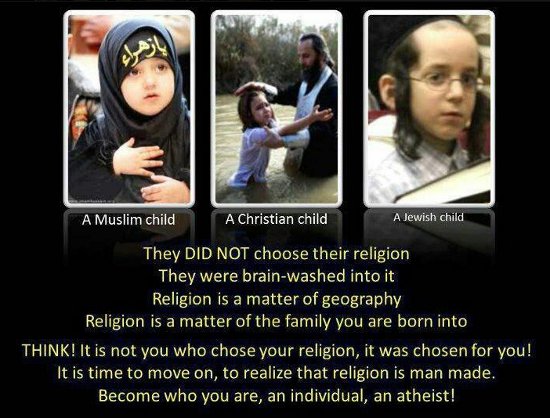
They DID NOT choose their religion. They were brain-washed into it. Religion is a matter of geography. Religion is a matter of the family you were born into.

THINK! It is not you who chose your religion, it was chosen for you! It is time to move on, to realize that religion is man made. Become who you are, an individual, an atheist!

From an image posted on Facebook
by Spread Logic and Reason

Disclaimer: This is a rant. This isn’t what I normally post here as a “meditation.” Frankly, I’m getting a little tired of being pushed around by a bunch of folks on the web who think they can take an image, manipulate it with some text, and use it to complain about how bad religion is. Today, I decided to push back.

I first saw this bit of Internet meme “shared” by a Facebook friend and a person I’ve known for many years. He’s a person I hold in high regard but we obviously have different viewpoints on religion. If I had seen this coming from almost anyone else, I would have ignored it, but I consider this person an actual friend, so naturally, it hurts.

Here’s my initial response to seeing this image:

I turn 58 tomorrow. I didn’t become a Christian until I was over 40. I used to be an atheist, primarily because the prevailing culture around me was atheist and it seemed to make sense at the time. Then I started thinking for myself. Why would I let the culture around me choose my religion and my identity for me? Why would I let an Internet meme choose my identity for me?

And what have I ever done to you that you should try to change my identity into what you think would be better for me? I’m not trying to change you.

Then I thought about it some more while doing my lawn, came back over lunch and expanded my answer:

It occurs to me that all cultures and people groups have their various values and customs that are passed on from one generation to another. Most liberal progressives don’t complain about cultural diversity, even if it radically differs from their own, because they recognize that people have the right to observe their native customs and certainly, in the vast majority of cases, liberal progressives and atheists don’t demand that other people groups who are not white, middle-class Americans, change their ways just because they are different than the white, middle-class American atheist’s ways.

Islam and Judaism are closely tied to national, ethnic, cultural, and racial identity. Why isn’t is considered racism, prejudice, and bigotry for you to demand that Jews and Arabs refrain from passing on their values and beliefs to their children? Are you (the general “you”…not naming anyone specifically) more equipped to tell the rest of the world to live your lifestyle? Don’t you pass on your values (atheism, progressive liberalism) to your children?

Why are you trying to control everyone else in the world?

To be fair, between my first comment and my second, my friend said:

Jim, if you had been born in Saudi Arabia and were atheist, assuming you survived to 40, the odds are more likely you would have become Muslim. This isn’t really about an Internet meme, but an historical fact. It exited loooooong before the Internet. 99% of people grow up believing what their parents did. Why did none of the natives in the Americas become Christian for 1500 year. That you decided to for a different belief system than your environment does not alter the facts. You are an exception.

I can see his point, but I think he (and a lot of people like him) are missing something. In making statements and posting photos such as the one I put at the top of this blog post, aren’t atheists trying to say that their viewpoint, lifestyle, and values system is superior to everyone else’s? I know that many religions, particularly Christianity, are accused of exactly the same thing and I know from personal experience (having once been an agnostic leaning toward atheism) that having to listen to a Christian evangelist can be really annoying.

But what about all that “diversity” stuff? If progressive liberalism and atheism supports generally being accepting of racial, cultural and ethnic diversity, then isn’t complaining about how different ethnic, cultural, and racial groups choose to raise their children and pass on their values a type of bigotry? While Christianity isn’t tied to a particular nationality, race, ethnicity, or culture, Islam and Judaism certainly are. How can the comments espoused by this group of people be seen as anything but prejudiced and even racist?

Yes, I’m coming on strong. Yes, today I’ve decided to feed the trolls. But it seems like everyone is supposed to have rights to this, that, and the other thing in this world…except religious people. Not only is this group of atheists guilty of the same acts they say religion commits: exclusivism and rejection of the values and lifestyles of other people groups, but they’re also guilty of what the rest of the world sees Americans as doing: attempting to spread our own values and lifestyle to the rest of the world and using our own cultural lens to judge the right and the wrong of other people, cultures, and nations.

How are these atheists any more morally correct than any religious person?

“Blowing out someone else’s candle does not make your’s burn any brighter.”

-Anonymous

Dear people who don’t like religion,

How does complaining about religious people make the world a better place? What do you gain by “going after” Muslims, Jews, and Christians? Do you plan on taking on Buddhists and Wiccans next? Has the Dalai Lama somehow offended you? If you really want to spend your time and energy being useful and helping others, please step away from the computer and actually do something for another human being. Volunteer at a homeless shelter. Give cans of food to the local food bank. Spend an hour picking up trash in the parking lot of your neighborhood park. Hold the door open at a public building such as the library for a disabled person or a single mother who is trying to manage five children. Heck, just smile at a stranger once in a while because it’s the right thing to do.

Don’t complain about me or people like me, saying we’re the problem. Go out into the world and be the solution. If you do that, the problems will take care of themselves.

Signed, a fellow human being, who has volunteered, donated, picked up trash, held doors open, and who smiles occasionally at strangers.

Thank you.