All posts by James Pyles

James Pyles is a published Science Fiction, Fantasy, and Horror author as well as the Technical Writer for a large, diversified business in the Northwest. He currently has over 30 short stories published in various anthologies and periodicals and has just sold his first novella. He won the 2021 Helicon Short Story Award for his science fiction tale "The Three Billion Year Love" which appears in the Tuscany Bay Press Planetary Anthology "Mars."

A Christian Regarding Judaism

Such autonomy was made possible by God’s readiness to limit His say in human decision making and to grant the Jewish community the right to decide for itself how it should understand the commandments that it had received from Him in the Torah. Human reason, employed in clarifying and elaborating the halakhah, was seen as sufficient for that, without any need for divine intervention. Human responsibility for the conditions of life, moreover, was not confined to the religious sphere in the narrow sense, but included mastering the sciences and establishing institutional frameworks for alleviating disease, poverty, illiteracy, and other social evils.

-Rabbi David Hartman
Chapter 10, “Two Competing Covenantal Paradigms”
A Living Covenant: The Innovative Spirit in Traditional Judaism

This may not seem like a typical description of a religious framework if you’re an atheist or an agnostic. Most atheists I interact with seem to believe that religion and science are mutually exclusive terms. Some atheists also seem to think that religion and the moral responsibility to alleviate “disease, poverty, illiteracy, and other social evils” are also incompatible concepts and practices.

If you’re a Christian, you may also take some exception to Rabbi Hartman, since he appears to be advocating for the idea that God gave human beings the ability to decide just how to apply the Word and Will of the Creator in the world. I mean, wasn’t all this stuff made absolute and set in granite the second God caused Moses to create the Pentateuch (Torah) and the other authors to write the rest of the Bible?

I ask that last question ironically.

I can’t even say what Rabbi Hartman is proposing represents the entirety of Jewish thought since, as we’ll see, there are differing opinions in Judaism on just about everything. That, by the way, is the point for today’s mediation, but we’ll get to it all by the by.

In this chapter of Rabbi Hartman’s book, he compares and contrasts the viewpoints of two of the great Jewish sages: Maimonides and Nahmanides. You can learn more about these two Jewish philosophical luminaries by clicking the links I’ve provided, but certainly studying the wisdom and writings of both of these gentlemen would not be a waste of your time or effort.

I won’t go into too many of the details Rabbi Hartman presents, but I do want to draw attention to one critical area of disagreement between Maimonides and Nahmanides that should resonate with some Christians:

Messianism in Maimonides is therefore simultaneously a heroic and a realistic principle of hope anchored in the eternal covenant of Sinai. It is important for him because it does not allow Judaism to become merely a private existential experience. Messianism counteracts the heresy of turning Judaism into a faith for isolated human individuals. It springs from the essential concern of Judaism with the sociopolitical drama of the community. It also expresses the dimension of Judaism that goes beyond the tribal and national framework, since it makes the Jewish community aware that Judaism’s fullest expression requires a changed world order if there is to be a reign of peace.

Nachmanides, on the other hand, uncompromisingly embraced the assumption that Maimonides resolutely sought to eliminate: in the messianic era human nature will be changed. It will be redeemed such that human freedom will no longer lead to sin…

Clearly for him, the messianic age will be characterized by a fundamental transformation of human nature. The problematics of human freedom will be overcome, as all will then yearn to live always in accordance with the will of God.

In reading this chapter from Rabbi Hartman’s book, I immediately found the perspective of Nahmanides very familiar because it seemed to echo the viewpoint of Christianity (and I’m sure Nahmanides never intended such a linkage). As least as I recall my own early days in the church, I was taught that in the Messianic Age, we would lose all desire to sin and would only long to please Jesus in a complete and perfect manner.
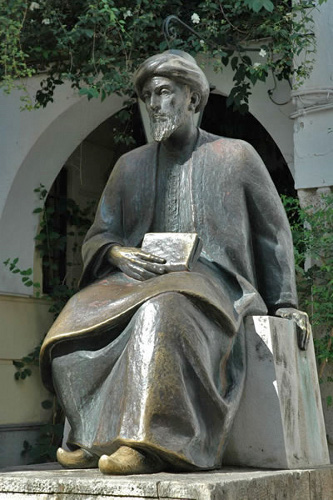
Maimonides, by comparison (at least as Rabbi Hartman presents him) believed that the Messianic era will be a time of social and political change. Israel will be the head of the nations and the Messiah will rule “with a rod of iron” such that the other nations of the world will obey his laws. Man will still have the ability to sin and perhaps even the desire, but the rule of King Messiah in Israel will be obeyed as God establishes His kingdom on Earth. Certainly Maimonides does not deny a supernatural reality, but understands that it works in concert with the natural mechanics of humanity and politics. For Nahmanides, the supernatural power of God simply overwhelms mankind and our very natures are changed such that it is His miraculous power alone that brings about His rule with no intervention by human institutions.

Why do I bring this up?

To throw a monkey wrench into the machine.

More accurately, to present the idea which may not occur to some Christians (or for that matter, atheists and everyone else), that there is more than one way Jews look at God, faith, Torah, halakhah, and the Messiah. Rabbi Hartman even confirms this:

To prevent misunderstandings, I must emphasize again that I am not claiming that Maimonides provides the only possible way whereby an observant Jew can participate in a return of the Jewish people to history such as has occurred in modern Israel.

Rabbi Hartman was talking specifically about the establishment of the modern state of Israel as part of the Messianic plan and the rather troublesome divide in Judaism as to whether Israel should even exist before his arrival (return) or not. I’m not competent to answer that question and, as I said before, my main point here is just to point out that Judaism isn’t a single, cohesive idea, concept, or religious movement. There are different focuses and perspectives in larger observant Judaism, many that contradict each other and occasionally seem wholly at war (sounds sort of like how different Christian denominations treat each other, don’t you think?).

Even though I am married to a Jewish wife, I am an outsider looking in. But if I can say that and live with a Jew every day, I can only imagine what it must be like for the traditional Christian with little knowledge of Judaism and Jews, beyond what is preached from the pulpit, to try to understand what it’s like on the other side of the fence. I think, as Christians, it’s important for us to make that attempt, though. We often “demonize” that which we don’t understand, and history has shown us that such “demonization” of the Jewish people has led to pogroms, exile, torture, and death.

I want to present this tiny slice of Judaism as an example that Jews are not a “type” or a “thing” or an object of any kind. They are a people. They are dynamic. Religious Judaism has many shades and colors and textures. It is even possible for Judaism to teach us a thing or two about our own Christianity. But in order for that to happen, we have to be willing to let ourselves become uncomfortable and to explore new territory.

I’m not talking about walking out of the church, far from it. I’m only suggesting that the next time you look at a Jewish person, try to see a person, a human being. If they are a religious Jewish person, try to see their faith, their relationship with God, their desire to serve Him, not just a collection of “dead” rules and regulations.

Judaism is alive. Jews are alive. It’s kind of cool, actually. It shows the rest of us that in spite of thousands of years of enmity between Jews and the rest of the world that ultimately led to the murder of six million Jewish souls, God kept His promise that the descendants of Jacob would always be a people before Him.

Jews will always be a people in the world and among us, the Gentile nations. If you love and laugh and hurt, so do they. Jesus commanded us to love our neighbors as ourselves (Matthew 22:39). Perhaps we should learn to do so with all of our neighbors, including our Jewish neighbors because of the ways of peace. If all people, religious and otherwise, could put that into practice as well, it would certainly be a plus.

Oh, I’m sure people who are more informed about the history of religious Judaism may point out my mistakes. But remember, I sometimes stick my neck out to try and make a point, and I don’t know everything (alas).

They Are All Our Children

In 1972 I was part of a group of young internationals who travelled to Israel to help defend our land and our people. Communication was rough; we were from South Africa, Britain, Australia, Poland, Argentina, America, France and Russia, and most of us could hardly speak or read Hebrew.

The IDF (Israeli Defense Force) designated me a Nahal soldier – a sort of part pioneer and part fighter farmer. Our base was located halfway between the yellow-bricked, fly-infested Egyptian town of El-Arish and the Suez Canal.

We tramped through sand and desert scrub, looking for any signs of landmines or intruders. I liked to be assigned to the watchtower. No one would bother me up there and I loved to look at the mountains and wonder which one was Mt. Sinai.

For the most part it was blessedly quiet. Our biggest excitement involved a Phantom jet roaring 100 feet above us heading to the Canal.

During basic training I obtained a small prayer shawl, tallit, and a prayer book in Hebrew and English. On Shabbat I would go off on my own to pray.

I wanted a set of tefillin, the black ritual boxes (containing the holy shema prayer) donned on weekdays…I wanted to feel the binding on my arm and the weight of the tefillin on my head. I wanted to be reminded that G‑d is above me. But at Nahal Yam there were no tefillin.

-Jerry Klinger
“Tefillin in the Sinai Desert?”
from the “First Person” series
Chabad.org

I suppose this could be just me quoting a random article because of my support of Israel and my attraction to Jewish religious and faith practices.

But it isn’t.

I recently read another story about the American Girl in the Bunker, a young Jewish woman from New York City to has volunteered to serve with the IDF among 85 combat soldiers on the border of Gaza and Sinai. She’s seen a little more “excitement” than Jerry Klinger did back in 1972:

Three days ago we were just minding our business when we heard a huge explosion that literally shook the ground. I know the floor moved because our coffee spilled.

I didn’t think it could be a rocket or bomb because the warning siren, the tzeva adom, had not sounded. We all ran out to see what the noise was all about, and in the distance, maybe 2 kilometers away, we could see the telltale plume of smoke.

Seconds later, the siren rang and we all ran to the nearest shelter. The shelter is windowless. The room is built to hold 30 people, but somehow we managed to squeeze 70 inside. Luckily there was air conditioning, but it leaked everywhere and no matter where we sat, our bodies were splattered. People were pushing themselves up against the bunker walls to make room for the latecomers. In this chaos, it was my job to get a head count of my whole unit and make sure everyone had made it.

After three hours, we were told by the head of the base’s intelligence that it was safe to leave. It wasn’t for long, though. BOOM! BOOM! BOOM! Three more rockets fell minutes later, this time even closer to us. The tzeva adom rang, but there was no time to find safety. Two seconds after the siren’s scream we felt the earth shake beneath our feet. We were totally vulnerable.

The nights are hell. I cannot sleep. I lie in bed, fully clothed, boots and helmet on, waiting to hear the alarm, waiting to dash out of the room to safety.

-Talia Lefkowitz, volunteer soldier with the Israeli Defense Force Paratroopers Brigade

My son David served in the Marine Corps for four years. On his deployment to Iraq, he was fired on by mortars on numerous occasions but wasn’t in a position to be able to fire back. I can’t imagine what the experience was like, but I can imagine what it’s like to have one of your children in that position, in harm’s way, in combat, at risk, where he could die.

And there was nothing I could do about it.

There was nothing I could do about it the day David told my wife and me that he was joining the Marines (though we tried very hard to talk him out of it). There was nothing we could do the day he left for boot camp. There was nothing we could do the day he graduated from boot camp, except be very proud of him. There was nothing we could do the day he left for Iraq, the day he left to go to war, the day I knew that I might never see him again.

Except pray that God would watch over him and bring our son safely home.

And He did.

Mostly.

Like a lot of veterans, David suffers from various injuries, not as a direct result of combat, but of the conditions he had to serve under. He has a body that seems much older than his almost 26 years (his birthday is just two days away as I write this). We work out together five days a week. I watch him as he tries to repair a damaged ankle, a damaged knee, a damaged back, the pain he can never escape.

He also struggles with numerous emotional issues as a result of what he’s seen and what he’s experienced. It’s not like his personality is different, but his personality is being forced to filter and manage what it was like when people were trying to kill him with mortars, when people trying were trying to kill him by hiding explosives under pieces of trash so he’d drive over it, making it (and him) blow up, when he had to watch people all the time to make sure they weren’t going to shoot him.

This isn’t movie combat like you see in films such as Saving Private Ryan or gaming combat like when you play Call of Duty. This is real life where real people are holding real guns, getting ready to shoot other real people, listening to explosions, feeling the real fear of what could happen to them, and waiting for the next “boom” and wondering if they will be hurt or killed.

But David came home. He came home more or less intact. He’s married to a loving, compassionate wife and has a wonderful, three-year old son. And he struggles everyday with the consequences of having served in combat zone as a United States Marine.

I talked to him recently about Israel and the IDF. He has a great admiration for the IDF and, as a Jew, he supports the nation of Israel. If things had been different, if he had been a little more mature in years gone by, a little more in tune with a plan, he probably would have done what Jerry Klinger did or what Talia Lefkowitz is doing.

Or what Shayna Detwiler is about to do.

I met Shayna at a conference I attended last May. In fact, she was the co-ordinator for the conference and the person who made sure that I had a room, transportation, and everything else I needed to make it possible for me to attend the conference.

And she’s only twenty years old.

I don’t know what to feel. I don’t really know her, but she seems like a nice person. She young, energetic, friendly, outgoing.

Did I mention that she’s young?

I’m not really old. Not like my father, who just turned 80 is old. But I’m older. I see younger people through the eyes of a father and grandfather. I sometimes look at younger people and try to remember what I was doing when I was their age.

But mostly, I look at people like Shayna and remember the day when David went off to war. I hoped for the best and planned for the worst. Thank God the worst never came, but war is war. You never walk away from it exactly the same person you were when you walked into it.

Jerry Klinger told us what he remembers about his experience with war and in many ways it is very uplifting (read the whole article to find out why). Talia Lefkowitz is the girl sandwiched into a bunker with 85 combat soldiers, listening to the explosions and wondering if the next one is for her. David Pyles is still telling me his stories, even though he’s been honorably discharged from the Marines for a few years now.

David is my son and I listen and I become retroactively scared when he tells me something I didn’t know before about what happened to him. I sometimes get scared when he tells me something that’s happening to him now, which might be a flashback to something that happened years ago, and yet it is also happening to him now.

Shayna has parents and grandparents who love her and are probably worrying about her right now. I can’t help them. I’d be worried, too. In fact, I am worried too, even though I barely know her.

But I don’t have to know her. I have a son who served in war but in the end, they are all our sons and daughters…our brothers, our sisters, our fathers, our mothers. When someone goes off to war, they are all our family, and they all belong to us.

And may God go with Shayna and with all of our young men and women. And may God bring them all home again so that we can continue loving them.

I am a New York City girl who came to Israel to defend the Jewish state. I am proud of my service and of all the remarkable young men I have met who risk their lives every day to keep this country safe. I am the girl in the bunker, and I can tell you that these rocket attacks are a big deal.

-Talia

They are all our children.

Randomly Covering Territory

Do you only believe when you can see with your eyes? When your prayers are answered and miracles carry you on their wings? Or do you also believe when circumstances fly in your face?

If it touches you to the core, if it is a belief you truly own, if it is as real to you as life itself, then it does not change.

And if it does not change, then you are bound up with the true essence of the One who does not change.

-Rabbi Tzvi Freeman
“Faith in the Dark”
Based on letters and talks of the Rebbe
Rabbi M. M. Schneerson
Chabad.org

I’ve said before that I don’t consider myself the “sharpest knife in the drawer.” In the world of faith, I think I have plenty of company, though. For instance, I don’t think most Christians consider the idea that there are two basic levels of knowledge in our religion (or probably most religions): the common worshiper’s view and the scholar’s view. For instance, New Testament scholar Larry Hurtado recently posted on his blog an article called An “Early High Christology”. I mean really. What in the world is high Christology and what’s the difference between high vs. low Christology?

I’ll let you click the links I provided since my discussion today isn’t focused on those topics. I’m just including them to illustrate that most people in the church don’t have the same view of God, Jesus, and the Bible as do theologians and Bible scholars. These people talk a different language than we do and conceptualize the Word of God in ways most of us can’t even imagine. I’m not even sure most of them could communicate their ideas and perspectives to a crowd of “regular Christians” at their local neighborhood church in any successful way.

Which is kind of a shame, because the information these people work with would almost assuredly challenge and perhaps even change the viewpoint and direction of most believers in most churches if we had access to it in a comprehensible way.

Well, they do publish popular books, some of them anyway, but most Christians don’t take advantage of that material (let alone anything more scholarly, such as a Ph.D Thesis). Most people who sit in the pew on Sunday are content to believe that they are being adequately “fed” by their local Pastor, who no doubt is doing a good job, but may feel constrained to offer only the “food” he or she believes the audience will comfortably tolerate.

I occasionally get “dinged” for including non-Biblical sources in my writings since they are, after all, non-Biblical and thus cannot carry the same weight of authority as the scriptures in the Bible. But I’m no Bible scholar and I do love a good metaphor, so I include things like Rabbinic midrash, Chassidic tales, and commentary about Kabbalah, largely for their cultural, metaphorical and symbolic meaning. I certainly can’t discuss them from the perspective of a Pastor, Rabbi, or someone else with an advanced education in Theology or Divinity.

That doesn’t keep me from being curious though, and curiosity often leads me down interesting if troublesome paths.

Here’s one such path:

Numbers 22-24: While the Numbers text itself is inconclusive, both rabbinic legend and the Apostolic Scriptures clearly paint Balaam as wicked through and through.

“The Error of Balaam”
Commentary on Torah Portion Balak
First Fruits of Zion

Um, what was that? The Torah was inconclusive about the nature and character of the “wizard” Balaam, but both the New Testament and midrashim agreed that he was evil? That seems like an odd combination. Of course, it’s not that the New Testament writers and the authors of midrash expected to agree with each other, but in this case, strangely enough, they did. Here’s the New Testament commentary on Balaam.

Forsaking the right way, they have gone astray. They have followed the way of Balaam, the son of Beor, who loved gain from wrongdoing, but was rebuked for his own transgression; a speechless donkey spoke with human voice and restrained the prophet’s madness. –2 Peter 2:15-16 (ESV)

But these people blaspheme all that they do not understand, and they are destroyed by all that they, like unreasoning animals, understand instinctively. Woe to them! For they walked in the way of Cain and abandoned themselves for the sake of gain to Balaam’s error and perished in Korah’s rebellion. –Jude 1:10-11 (ESV)

Admittedly, the opinions being rendered about Balaam in the New Testament text are rather brief. But what about the midrash?

Some say Balaam of Pethor (פתור) was called a money-changer (petor, פתור) because the kings of the nations rushed to him for counsel in the same way that people rush to a money-changer to change their currency. –Numbers Rabbah 20:7

This may not be the only Rabbinic commentary on Balaam, but it’s the only one I have access to due to my limited knowledge in this area.

Am I saying that we can compare the New Testament and Talmud, for example? Probably not, or at least, only very, very carefully, with lots of caveats attached (as a side note, can the New Testament and the later Rabbinic commentaries both be considered midrash?). On the other hand, there is just so much we don’t truly understand about the Bible, and there are so many other sources of information that we have access to that may provide additional perspective. We just need to be able to clearly delineate between the Bible and other information sources. We also need to remember that we don’t have to be so binary in our thinking that we always have to say, “Bible good! Everything else, bad!”

After pursuing my personal faith issues for the past few years, I’m slowly coming to the conclusion that the Bible doesn’t always tell us the “whole story.” Both Christian and Jewish scholars and sages have spent the past several thousand years trying to understand the mind of God by delving into the Word of God. They’ve produced an untold amount of commentary that their audiences judge to be of greater or lesser value in defining the faith. The fact that gentlemen like Larry Hurtado even exist as New Testament scholars tells us there is more to be learned about the New Testament than we already know or think we know. I’m sure the same is true for the rest of the Bible.

I’ve previously mentioned last Thursday’s conversation between me, my son, and two other believers that lead to quite an interesting theological discussion. One of the things I didn’t mention was that David asked me what the minimum amount of knowledge was that would still qualify a person as a believer in God and a disciple of the Master. I don’t recall the details of my answer, but I don’t doubt it’s a good deal less than what the scholars, sages, and experts possess.

I suppose we could limit ourselves to knowing just the basics.

And one of the scribes came up and heard them disputing with one another, and seeing that he answered them well, asked him, “Which commandment is the most important of all?” Jesus answered, “The most important is, ‘Hear, O Israel: The Lord our God, the Lord is one. And you shall love the Lord your God with all your heart and with all your soul and with all your mind and with all your strength.’ The second is this: ‘You shall love your neighbor as yourself.’ There is no other commandment greater than these.” –Mark 12:28-31 (ESV)

But people are curious creatures. We very rarely hold ourselves back to the basics, well, some of us, anyway. We want to know more and we push our limits. We push the limits of religious propriety, asking questions the church doesn’t want to answer. We push our intellectual limits, asking questions that have answers we may not have the ability to understand. We push the limits of what are considered viable information sources and methods of study and what are not, at least by those folks who are “in the know,” such as Hurtado or Timothy George.

But the alternative is to shut up, don’t ask questions, and do as we’re told. For some people, that’s the entire scope of their faith. For others, for people like me, that would be the end of my faith. It would die for lack of nourishment.

So I’ll probably keep asking questions, being rebuffed, offending people, entering areas that are “off limits” to mere mortals and those of us with a limited religious education (and IQ), and generally stubbing my toe every other step.

I feel like a person who is trapped in an endless, man-sized maze looking for the cheese. Problem is, the maze is completely blacked out. I can’t see a thing. So the only way to discover my path is to bump into a lot of walls as if I were a human Roomba. My path seems completely random. Hopefully, I’ll cover the necessary territory.

What else can I do?

You don’t need to move mountains.
You just need to know where to aim.
You can transform an entire family forever with one flickering Shabbat candle of one little girl.

-Rabbi Tzvi Freeman
“A Small Candle”
Based on letters and talks of the Rebbe
Rabbi M. M. Schneerson
Chabad.org

I recently read a very interesting blog post written by Jacob Fronczak called Every man is not a theologian which seems to give me a sort of “permission” not to pretend I know what a theologian knows. You might want to have a look and see what you think.

Speed

Our generation has changed an amazing amount from earlier generations. In earlier times the only people who ate quickly were bandits or people in an unusual rush for one reason or another. Nowadays, we are in the era of “fast” foods. Mealtime is not nearly as formal as it once was for the vast majority of people.

Not surprisingly, when someone first learns the halachos on today’s amud he gets a big surprise. “One who leaves one domain needs to recite a new blessing?” he wonders. “What if I have something in my mouth and as I am running I leave the first domain? Do I have to remove it from my mouth and make a new blessing?”

When someone asked a similar question to Rav Chaim Kanievsky, shlit”a, he ruled decisively. “Even a child who has a candy in his mouth and rushes out of the domain where he made the blessing must take it out of his mouth and make another.”

On a different occasion, Rav Chaim confided that such a case had actually happened to him. “When I was a child the Chazon Ish once noticed that I rushed out of the house with a candy in my mouth. When I came back in—with the candy still ensconced in my mouth—the Chazon Ish called me over to him. He explained the halachah of changing domain. ‘You need to take the candy out of your mouth and make a new berachah every time you leave a domain,’ the Chazon Ish explained.”

Mishna Berura Yomi Digest
Stories to Share
“Fast Foods”
Siman 178 Seif 1

First of all, I don’t do this. Secondly, I’m not telling you to do this. That’s not my point. My point is the speed at which time or rather, the events of our lives rush past us. It’s like standing on a commuter platform waiting for the train that will take you to work to stop, only to watch is pass by just inches from your nose at 70 miles per hour.

What the heck just happened?

Yes, we live in a streaming video, microwave dinner, high-speed Internet world where everything we want and need (or think we do) is delivered super-duper fast, and if it isn’t we want to know why.

I’ll try to keep this short since I’m sure this has all been said many times before and I’ll just sound like some old duffer longing for “the good ol’ days.”

Did God design us to run at such a high-speed? Are we supposed to rush around from this event to that from birth to death, never stopping to figure out what we’re supposed to be doing in-between?

I’m just like you. I wake up too early, hit the gym for an hour, wolf breakfast down my throat, speed off to work, often working through lunch, hit the road for the evening commute, grab dinner while reading the news on the web, write or edit something, pick up or drop off someone somewhere, maybe watch a little mindless entertainment, flop in bed, get too little sleep, start all over again.

The Digging with Darren blog just retweeted (on twitter) an older topic called Daily Disciples of a Disciple which in which the “tweet” contained the words, “Does your schedule make room for discipleship?”

What’s important to you? What will you slow down for so you can take your time, pay attention, and truly experience the moment?

I mean besides TV, video, gaming, or similar activities.

While the various Rabbinic rulings and judgments take a lot of harsh abuse in Christianity and sometimes in Messianic Judaism, in some cases, I can see the point of the Sages. It may seem rather tedious and unnecessary to recite a new blessing when you leave one domain for another, but even if you choose not to do so, it teaches a lesson. If you had to slow down between point A and point B, what would you pay attention to? Would slowing down for a few seconds carry its own value? Would you have a few moments to remember God and maybe even talk to Him?

A Creative Life

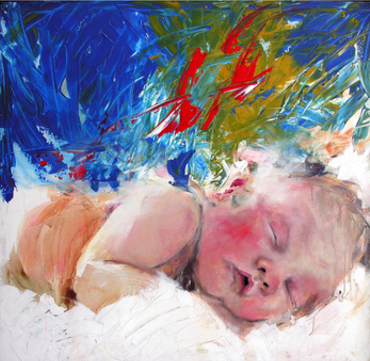
The Chazon Ish, zt”l, teaches how we should relate to a new baby. “The astounding miracles of matrimony, birth and raising a child open a person’s heart and eyes and his ears to see that nothing ‘just happens.’ This experience should awaken any thinking person’s ability to be emotionally moved.

“This is the meaning of the Midrash Tanchuma on the verse וילדה זכר And she birthed a male.’ The Midrash applies the verse, ‘ ואין צור כאלוקינו ’ to this. It explains there that the word צורcan be understood to refer to צייר which means one who fashions. In this context the verse is saying that there is none who can fashion like God does. A human makes a picture on the wall. Can it move? Can it breathe? Can it speak? God creates man who moves, breathes and speaks. An expert painter has many types of paint to create a picture. God can create a human from one drop.

“We see from here that one who sees a child should be filled with wonder. Studying a child should bring one to contemplate the works of God. Giving this any thought should lead one to the same conclusion as the Midrash: ‘There is צייר , no artist like God.”

Rav Yechiel Michel Stern pointed out the obvious question on this midrash: “It seems strange that our sages took the verse ‘ ואין צור כאלוקינו ’ out of the simple meaning. Usually the word צור literally rock, means forceful or powerful, and does not refer to an artist or fashioner.

“The Maharsha in Berachos answers this question. Since the verse tells us that there is no צור like God it implies that there are others which should be referred to as צור , but they cannot be compared to God. Clearly, here we are speaking not of the one and only Rock, but of a different meaning related to the root צור!”

Daf Yomi Digest
Stories Off the Daf
“The Ultimate Artist”
Niddah 41

In Rabbi Yaakov Menken’s commentary on last week’s Torah Portion Chukat, he addresses the mystery behind the sin that resulted in the death of Aaron and Moses being denied entry into the Land of Promise. For many, trying to comprehend what sin Aaron and Moses committed that was worth so terrible a price is extremely difficult. But we must remember that not only were Aaron and Moses born to accomplish a very high purpose, but we see that the more exalted a person’s holiness, the more is required of them. In other words, the higher you fly, the further you have to fall.

Precisely because the Bible is dealing with individuals on an exalted spiritual level, if it were to tell us merely what they did, we would be unable to perceive anything wrong. For those people, their behavior was no less a transgression than if a more common individual had committed a major sin such as murder, adultery or idolatry — and thus the Prophets use severe language, similar to HaShem’s own words that Moshe and Aharon “did not believe” in Him. Just like the anthropomorphic references to HaShem Himself, these passages use language which we can understand, so that we can learn from them, but are not intended to be taken literally at all.

Every human being is just that — human — and no one is perfect. Even as we are humbled by recognition of the heights reached by prophets and great scholars, we should never lose hope, or imagine that those who came close to G-d were truly angels, without inner struggles or difficulties. This is the lesson the Torah brings home to us when attributing unimaginable ‘sins’ to our forebears. And yet it is also incumbent upon us to realize that we could be, ourselves, so close to HaShem that our ‘sins’ would be something we could not even recognize today.

Perhaps one of the reasons why this event in the Bible is nearly impossible for most of us to understand is that the majority of us are not tzaddikim; exceptionally righteous ones. Our worldview does not operate at such an exalted level. In the same manner, this is most likely what made it difficult for Christ’s own disciples to understand him at times and, what continues to contribute to what we often refer to as “the difficult sayings of Jesus” as seen from the perspective of the 21st century believer.

I know most Christians like to think of Jesus as ultimately approachable, friendly, kind, and understandable, but in spite of 1 Corinthians 2:16, we may be forced to admit that the mind of the Messiah is beyond most of us. Even the sins of those lesser than the Messiah but still exalted Holy ones are difficult to comprehend. Hence the following from Rabbi Menken:

On Rosh HaShanah, there is a tradition to go to a body of water and “cast off” one’s sins, as it were, and ask that they be covered over like water covers and hides the fish who swim within it. Many Chassidim have a custom to take bread crumbs along and throw them in, to give physical expression to this idea.

It is said that after a particular Chassidic Rebbe threw crumbs into the water in accordance with this custom, one of his Chassidim bounded into the lake and began to retrieve them. When questioned, the Chassid explained: “what the Rebbe considers his ‘sins’ are Mitzvos where I’m concerned!”

For years, I couldn’t understand this story or its intended lesson. A transgression is a transgression! But then, I heard that the Chofetz Chaim, Rabbi Yisrael Mayer HaKohein Kagan (perhaps the greatest known Torah scholar of the last century) once repented on Yom Kippur for having wasted eight minutes from Torah study during the previous year.

Can we imagine wasting merely eight minutes in an entire year? I would be extremely happy to say that I had managed to waste no more than eight minutes on a given afternoon! Maybe, maybe I’ve spent a few hours without wasting eight minutes once in my life. Maybe.

It’s impossible to imagine being able to account for every moment of every day, save eight minutes (I would almost be relieved to be told that I had heard this story incorrectly). And this is what the Chassid was saying: for us, it would be a great Mitzvah! The sins of great people occur at such a level of precision, that _reaching_ that level, to be worthy of being judged at that level, would be a phenomenal achievement.

Previously, I momentarily seemed to disregard a passage from 1 Corinthians 2, but I’d like to revisit those words in the context of Paul’s epistle:

Now we have received not the spirit of the world, but the Spirit who is from God, that we might understand the things freely given us by God. And we impart this in words not taught by human wisdom but taught by the Spirit, interpreting spiritual truths to those who are spiritual.

The natural person does not accept the things of the Spirit of God, for they are folly to him, and he is not able to understand them because they are spiritually discerned. The spiritual person judges all things, but is himself to be judged by no one. “For who has understood the mind of the Lord so as to instruct him?” But we have the mind of Christ. –1 Corinthians 2:12-16 (ESV)

This part of Paul’s letter makes it seem like, with the guidance of the Holy Spirit, all believers and disciples of the Jewish Messiah should have an equal ability to comprehend the Word of God, as if we were Jesus Christ himself. But do we? If we did, you’d think that the endless myriad of questions I post on this blog wouldn’t exist or would just be rather moot. You’d think instead of the 35,000+ Christian denominations (and counting) that exist in the world, we’d have only one. You’d think that we would all have the identical understanding of God and the very same template for organizing the community of faith.

You’d think God would have finished writing the Word upon our hearts by now. But apparently, He hasn’t.

As we saw in the “Story Off the Daf” from which I quoted earlier, God can be considered a magnificent artist. He fashions each and every one of us miraculously and He has repeated His artistry in an endless progression from the beginning of Genesis until now. He is creating His “paintings” still, and will continue to do so until a point in time we cannot yet even begin to grasp.

And He has created us for many purposes, all of which serve His will. But all that being true, He gave us the gift of self-determination to the point where only a human being may actively and purposefully defy the will of God. In other words, we can take the incredibly wonderful work of art that was created by the hand of God and turn it into the moral equivalent of a velvet painting of Elvis (and I apologize to all of the fans of Elvis Presley and those of you who enjoy velvet paintings).

I can hardly accuse Aaron and Moses of such a sin against God. It is God who held them both responsible for how they chose to treat His “artwork”. And while you and I (or at least I) are not tzaddikim and we do not operate at the level of Aaron or Moses (and certainly not at the level of Christ), we have been created as God’s handiwork to serve a purpose and a goal. We are responsible for what we do with our lives. There are consequences for choosing not to live as we were designed to live.

The end of the lives of Aaron and Moses give us an idea of those consequences. We also have examples such as Nadab and Abihu.

Who are we and where do we come from? Do we have a purpose in life, or is everything we do random and meaningless? Is this all there is or is there something more?

We spend all our lives trying to answer questions like these. Even those of us who adhere to a specific religious tradition encounter great difficulties in answering what should be the simplest questions about our faith. Now we see that these questions and their answers aren’t just meaningless exercises in philosophy. They are what define us, not just as individuals, but as a species. If we are simply the most evolved animals on the planet, then it pretty much doesn’t matter what we do. Go ahead and destroy the physical environment and contribute to our extinction. It doesn’t matter. The planet will eventually recover and even if it doesn’t, so what? We will have exterminated ourselves, but the Universe goes on.

But what if we have been created by the “Master Artist” for a higher purpose? If there are consequences, for good or for bad, for the manner in which we live out our lives, then our every action does matter, our every decision does have an impact beyond that of the moment. Our words, behavior, and feelings are all part of a greater design that contributes to the infinite tapestry of Creation. Each individual life is personally important as an artistic act of God and it matters to Him how things are going for us each and every day.

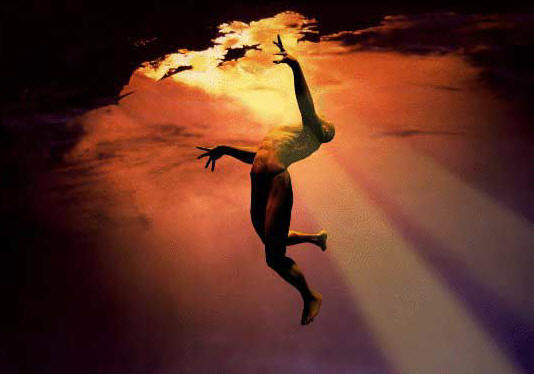
Just recently, I compared a life of faith to a bird in endless flight. Given the example of Aaron and Moses, we can see how “dangerous” it is to fly as high as they did, because with one subtle failure, they lost their wings and fell back to earth in disgrace. And yet the wonder and majesty that they beheld, especially Moses who spoke to our infinite “Artist” as one might speak to a dear and close friend…isn’t that worth even so great a risk? Isn’t soaring through space, nearing the court of the Mighty One, tasting the excitement, the freedom, the glory of approaching even the tiniest thread of the hem of the living God worth our time, our effort, even our very lives?

The Artist with His brush, puts the finishing touches on His latest painting and looks upon it with satisfaction. The painting, moments away from birth, stares back at the Creator and smiles with gratitude and love.

Then, as a child might send a paper airplane aloft with a single flick of the wrist, we are sent up into the Heavens and born into our lives. May we fly with the wings of an angel and live with the soul of His Image.

Why can’t He provide simple, clear directions and let us just follow His Divine plan? Why does He place these challenges before us, forcing us to make our own decisions, to chisel out our own paths?

Because He desires a home in our world
—not a home manufactured in heaven and transported downward to earth,
but a home made in our world
out of worldly materials,
chosen, designed and constructed
by citizens of our world.

-Rabbi Tzvi Freeman
“Made On Earth”
Based on letters and talks of the Rebbe
Rabbi M. M. Schneerson
Chabad.org

Balancing Flight

These days, my son David and I go to the gym together at about five every weekday morning to work out. This morning, I was on one of the aerobic machines. The last five minutes of a workout, I go into a cooldown mode trying to get my heart rate back down to something more or less reasonable. Often, I’ll close my eyes and imagine that I’m running alone on a path that’s climbing to the crest of a hill. It’s dark, but I can see the light of a new sunrise beckoning ahead of me. The light gets brighter as I near the top. It’s almost as if I can see the breath of God intermingling with my own as we approach each other. I jog toward the crest of the hill but never quite reach it before the timer on my machine gets to zero.

But in the last seconds of my fatal descent from the heavens, I manage to pull back up, avoiding a fiery disaster, and with my wings fully extended and my engines roaring with new life, I begin to climb.

-James Pyles
Climb!

I suppose it’s narcissistic for me to quote myself in order to start another blog post, but I couldn’t think of anything else that fit. OK, how about this one?

I’ve heard that there’s a kind of bird without legs that can only fly and fly, and sleep in the wind when it is tired. The bird only lands once in its life… that’s when it dies.

-Yuddy (played by Leslie Cheung)
from the film Days of Being Wild (1990)
original title, “A Fei jingjyhun”

I’ve never seen this film and probably never will, but when I Googled what I was thinking about, the above-quoted piece of dialog came up. Interestingly enough, I first heard this idea in High School. A fellow in my Creative Writing class (yeah, I was interested in writing even back then) wrote a poem (I think…it’s been forty years) about a bird without legs that was perpetually in flight. Sadly, that’s all I can remember.

But it’s enough.

I had a conversation like this with Boaz Michael at the FFOZ Shavuot Conference last month in Hudson, Wisconsin. During one of his presentations, he was talking about FFOZ being able to “land the plane,” which meant being able to get past the chaos of how various people and groups reacted to their shift away from the One Law theology. The idea was to be able to move on and focus on the primary mission and goals of FFOZ. This includes being able to reach out to the church in an effort to promote a more pro-Jewish message, and reaching out to normative Judaism to promote the Jewish Messiah.

At some point during the conference, I had several opportunities to sit down with Boaz and discuss various topics. One of the things I said is that the plane would never land because there will always be challenges.

I think that’s true of us personally in the realm of faith, too. Once we are introduced to God and realize that we must strive to approach Him, we take flight. But its only when we are in the air that we realize we can never land again. There is no turning back. There is no true sense of rest or peace.

I know that sounds strange, especially to anyone who has a bumper sticker on their vehicle that says, “No Jesus, No Peace; Know Jesus, Know Peace.” But really. You live in a world that is completely hostile to the discipline of religion in general and a Christian faith specifically (I think only Jews and, in some circles, Muslims are more reviled). Once we leave the ground, there are only two options: flight and death.

Sounds pretty grim.

When I say “death,” I don’t mean (necessarily) actually dying but if we choose to leave the faith, we die in terms of being spiritually dead. We no longer have a sense of God. Our relationship with Him is severed. We’ve gotten a divorce.

But considering flight, what a glorious thing it is. Imagine being able to fly without the aid of some sort of machine. Imagine simply extending your arms, raising your head, and realizing that your feet have left the ground. Up, up, up you go. The air is cold and crisp but you don’t feel chilled. Instead, you are invigorated, excited, thrilled. You are sharing the skies with God, seeking Him, soaring up to Him, as a bird might climb high above the clouds to seek out the Sun.

Now imagine that flying is something like running. Eventually all of that flapping will make you tired, just like running a marathon will exhaust you (not that I’ve ever run a marathon). Sooner or later you will want to land, to rest.

And you can’t.

You’re committed. It doesn’t matter how tired you get. It doesn’t matter if you’re exhausted. It doesn’t matter that your wings feel like they’re made of lead and sometimes, you feel as if you don’t care anymore. You just want to rest. Even if you fall. Even if you crash. It’s like Yuddy said:

I’ve heard that there’s a kind of bird without legs that can only fly and fly, and sleep in the wind when it is tired. The bird only lands once in its life… that’s when it dies.

So you can glide. Find a sustaining wind, a jet stream, a thermal and let them do the work. Just hold your wings out and let them catch the air and feel yourself suspended between Heaven and Earth; between life and death.

Isn’t that were we all are right now?

Bette Midler sings the Jeff Silbar and Larry Henley song Wind Beneath My Wings (no, I won’t inflict the YouTube videos on you) and the song ends with:

Fly, fly, fly high against the sky,
So high I can almost touch the sky.
Thank you, thank you,
Thank God for you, the wind beneath my wings.

That last line should probably say, “Thank God, You are the wind beneath my wings.” Without God, how could we sustain such an existence.

We all want to enter into His rest. We all long for the Messiah’s return for just that reason. The character Yuddy said cynically, “I used to think there was a kind of bird that, once born, would keep flying until death. The fact is that the bird hasn’t gone anywhere. It was dead from the beginning,” but if that were true, then faith is in vain. The atheists say that, and they say they are more alive than we are. There are more than a few believers who have been unable to find that updraft to support them, and exhausted and flightless, have collapsed back to earth like a latter-day Icarus, not because they flew too close to the Sun, but because they flew too long with leaden wings. They never found their source or they lost the will to keep seeking out that great imagination.

Now let me tell you a little secret. My wings get tired, too. It isn’t always easy to find a convenient wind to keep me aloft. Sometimes I doze and drift and wake up to find myself in a spiraling descent. I rouse my wings and push and lift and climb.

But sometimes it’s a close call.

Somewhere between Heaven and Earth are the forces that balance flight and falling. I know that God would not have called me into the sky if He only intended me to lose my ability to fly, but like that first generation of Israelites who were called out of Egypt, I sometimes doubt and complain. Like them, I sometimes feel as if God really did call me into the Heavens just to break my wings and send me plummeting back into the mud and tears. Like them, sometimes my faith is shaken. Like them, I fear defeat.

Today, if you hear his voice,
do not harden your hearts, as at Meribah,
as on the day at Massah in the wilderness,
when your fathers put me to the test
and put me to the proof, though they had seen my work.
For forty years I loathed that generation
and said, “They are a people who go astray in their heart,
and they have not known my ways.”
Therefore I swore in my wrath,
“They shall not enter my rest.” –Psalm 95:7-11 (ESV)

What a horrible thought that, after all of this effort, after tiring days and sleepless nights, no rest, no sanctuary, no oasis, constantly encountering resistance and opposition, that when it’s all over, I will not enter into His rest anyway.

So desperately terrified of a flight that never ends even after I have collapsed into shredded bone and flesh, I look around for some sign of another thermal. I try to find a way to let the wind lift me so I can rest my wings. I strive to look for the courage and strength to make it one more day in the air. I hope that God will show me, not just the ponderous effort of flying, but the glory of infinitely ascending across the skies.

Because sometimes, that’s all I have left.

Each journey the soul travels takes her higher.

There are journeys that are painful, because there is struggle. Struggle to wrestle out of one place to reach another, struggle to discern the good from the bad and put each in place, struggle to face ugliness and replace it with beauty. But in each of these, a sense of purpose overwhelms the pain and brings its own joy.

Then there are journeys that seem to have no purpose. Where nothing appears to be accomplished, all seems futile. There is no medicine to wash away the pain.

But every journey the soul travels takes her higher. It is only that in some, the destination is a place so distant, so lofty, she could never have imagined. Until she arrives.

-Rabbi Tzvi Freeman
“Unimaginable Journeys”
Based on letters and talks of the Rebbe
Rabbi M. M. Schneerson
Chabad.org

I hope, I pray, I plead that every day is a journey that takes me higher. But the destination is so far away and the effort to reach it is so great. Yet I dare not consider the possibility of falling. I must climb. I must soar. I must fly.

May God, by His grace and mercy, give me the strength. May He grant it to us all.