All posts by James Pyles

James Pyles is a published Science Fiction, Fantasy, and Horror author as well as the Technical Writer for a large, diversified business in the Northwest. He currently has over 30 short stories published in various anthologies and periodicals and has just sold his first novella. He won the 2021 Helicon Short Story Award for his science fiction tale "The Three Billion Year Love" which appears in the Tuscany Bay Press Planetary Anthology "Mars."

Review of Loving God When You Don’t Love the Church, Part Seven (The Final Review)

When He made the world, He made two ways to repair each thing: With harshness or with compassion. With a slap or with a caress. With darkness or with light.

“And G‑d looked at the light and saw that it was good.” Darkness and harsh words may be necessary. But He never called them good.

Even if you could correct another person with harsh words, the One Above receives no pleasure from it. When He sees his creatures heal one another with caring and with kindness, that is when He shines His smile upon us.

—cited from Kedushas Levi on Shabbos Vayechi, 5751
-Rabbi Tzvi Freeman
Based on the Letters and Talks of the Rebbe, Rabbi M.M. Schneerson
Chabad.org

Continued from Part Six of this review.

Since the overall theme of Pastor Chris Jackson’s book (not to mention one of Boaz Michael’s books) is healing, I thought the above-quoted statement of Rabbi Freeman’s was an appropriate way to start out this final review.

Beginning with Chapter 18: The 21st Century Christian, Pastor Jackson writes:

Do what the occasion requires! This statement comes from the Bible, from the passage when the prophet Samuel gave this command to the newly anointed King Saul (see 1 Samuel 10:7).

The occasion of the 21st century requires a specific response. It requires a specific breed of Christians. The day and age in which we live requires a specific type of church.

The good news is that God has known all along what the specific challenges of each era would be, and He has strategically placed believers in those eras to respond to them.

Jackson also briefly cited Esther 4:14 and other sources, all to say that each of us, you and me, were born and live in this time for a very specific purpose.

That purpose, Jackson says, is to summon revival, which he discussed in a previous chapter. Quoting Romans 8:19-22, Jackson says creation is longing and groaning as if in childbirth.

Of course he means all this starts with the American church and ripples outward, which is Biblically unsustainable. However, it’s his “hook” to engage his reader, to engage us (or them). What he misses (and how would he ever see it?) is that our purpose as believing Gentiles is to encourage Jewish return to Torah observance, to making Aliyah, all in preparation for the return of Messiah and the rise of Israel to the head of the nations.

We can’t simply coexist with the ideologies of our day. We can’t peacefully allow our nation to be overrun and destroyed by demonic strategies.

See what I mean? Oh, I’m not saying that we shouldn’t pray for our country. We are encouraged to do so in the Bible. But America is not the center of all things. We haven’t replaced Israel. New York, Los Angeles, or Seattle haven’t replaced Jerusalem as the city where the Almighty has placed His Name.

But then Jackson asks an interesting question:

What are some of the specific messages that you were meant to carry?

The response I have in my notes is You have no idea.
The other question, which comes at the end of this chapter is:

Do you believe that God has strategically placed you in this hour of church history?

church-and-crossI don’t know that I’m even part of “church history” or “the Church,” at least as Jackson defines those terms. We search all our lives in an attempt to find purpose and meaning in the world and in God’s plan of redemption. Who is to say for what reason you or I exist at this moment in time?

Moving on to Chapter 19: The 21st Century Church, Jackson continues:

I would like to include a chapter here that slightly detours from specifically discussing you and me as individual believers and instead focuses briefly on the bigger picture of the Church. As we move past the hurts we received in church and resolve to take our place again in God’s plan for His Body, it’s important to recognize what that plan is so we can identify what our role in it might be.

Staying with his focus on the American church, Jackson believes that Christianity has a highly critical role in the history of America right now. Quoting Pastor Jack Hayford of The Church On The Way in Van Nuys, California, Jackson writes:

I perceive “an hour” has arrived. It is an hour of citywide impacting that is beginning to occur in New Testament ways, because New Testament vitality and spiritual penetration is taking place.

I have no idea what that’s supposed to mean, even in the larger context of the original quote. Sometimes, Christian Pastors word things rather oddly, at least from my point of view.

Somehow to Jackson, it means “The church is not irrelevant!” I suppose a lot of atheists would disagree with him, especially given certain events that have saturated mainstream media lately.

In order to describe the church the 21st century needs, he goes through a list of churches we read about in the Apostolic Scriptures, such as those congregations as Ephesus, Colossae, Thessalonica, and Antioch. He also mentioned “other New Testament churches, like the one at Jerusalem.” Really, I was astonished (and so would be James and the Council of Apostles and Elders) that he conceives of the faithful first century Jewish disciples in the Holy City as “a church.” Many of the original communities Paul established in the galut were more synagogues, particularly the ekklesia in Antioch, but modern Christians can’t help revising history to make them “churches.”

I was just as surprised that he cited Numbers 23 and Balaam’s words “How shall I curse whom God has not cursed,” applying them to the Church when clearly Balaam was describing Israel. Has Jackson replaced Israel with the Church? It would seem so.

I know he’s trying to build up his Christian readers and building up the Christian Church in order to convince his audience that it is an institution of destiny and that to be part of that destiny, they must return to their congregations, but in order to do so, he has to bend the meaning of scripture beyond any reasonable bounds.

Throughout the rest of the chapter, Jackson reinvents the “Church” at Antioch to look more like a 21st century Evangelical church. This serves his own perspective and probably the majority of his readers, but I don’t think it serves the Bible or God’s true intent in his redemptive plan for Israel and then the world.

Moving on to Chapter 20: The Life of a Puzzle Piece, we read:

Did you know that you and I are living inside a puzzle box?

jigsaw puzzle boxYes, I’ve always suspected as much. Actually, Jackson means a jigsaw puzzle box, with each of us representing one of the pieces. We all have to fit together (he cites 1 Corinthians 1:10 here) in order to see the big picture.

Jackson relates what he calls “The Parable of the Puzzle Piece” to get his point across. From the point of view of the individual puzzle piece, we can’t see the big picture. The puzzle is actually the body of Christ or the unified Christian Church. If we aren’t part of the entire puzzle, then life has no meaning and makes no sense.

Well, that’s not entirely true, since plenty of atheists find meaning, purpose, and direction in life, and there are Christians who aren’t actively part of a local church that have other means of fellowship, and of course, as Jackson says, rely on their relationship with Jesus to help make sense of their lives.

However, returning to the puzzle piece metaphor, he states that although an individual piece can’t see the big picture, it is absolutely essential in order to complete the big picture. If you’ve ever assembled a jigsaw puzzle only to discover that one or more pieces are missing, it can really be annoying.

This is Jackson’s way of saying that each and every individual Christian is important and matters to God. Just like he said earlier that each Christian should be considered God’s favorite.

But each piece only contains a fraction of the whole and will never “fulfill its destiny” if it isn’t correctly put together with the rest of the pieces.

It’s pretty obvious where Jackson is going with all this, but at one point he adds:

Sometimes it takes several attempts for the piece to find its fit.

In other words, if your first church experience doesn’t work out, try, try again. Cute.

Oh, and a puzzle piece usually fits only in one single spot. Trying to fit a puzzle piece in a gap where it doesn’t fit won’t work out well and the piece will end of being mangled if forced.

Be patient, he says. Your place might not become available until other puzzle pieces are put together.

Although he doesn’t quote 1 Corinthians 12, he does say “Don’t get jealous of any other pieces–we’re all equally important.” Equally important but not identical. Each piece is uniquely shaped and will only fit in one location within the puzzle. This might be a message describing the differing roles of Jews and Gentiles in the Messianic movement.

One of his end of chapter questions is:

Do you know that you are crucial for God’s big picture plan?

Even accepting this, as Jackson said before, the individual puzzle piece can’t see the big picture and therefore is unlikely to know where it fits or what it contributes.

Chapter 21: Old People starts out:

Recently, a number of young adults in our church hosted a very special banquet to honor the senior citizens in our congregation. We wanted to treat them to a night of honor and esteem that would send a clear message that we loved and needed them in our church.

This reminded me of the following commandment from the Torah:

‘You shall rise up before the grayheaded and honor the aged, and you shall revere your God; I am the Lord.’

Leviticus 19:32 (NASB)

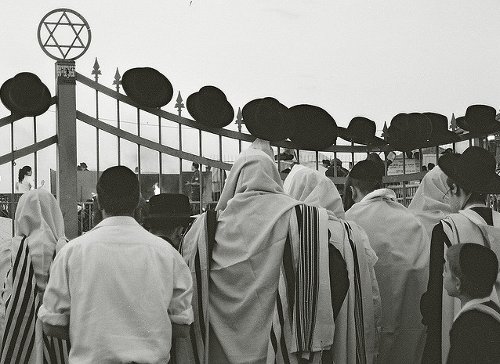
older jewish man prayingBut Jackson was simply leveraging the concept of “the wisdom of the aged” to what he imagines an older might say to a younger one. Advice like “I’m not better than you” and “It’s all about relationship” (his favorite theme). The advice is largely just restating points he made earlier in his book about being transparent, Christianity’s evangelical mission, and “God will come through.”

Chapter 22: The Abundant Life begins:

I think the book of Ecclesiastes is probably one of the most overlooked and underrated books of the Bible…

Well, in the traditional church, that’s probably true.

On the other hand, Jackson also says:

…and then moving on to something easier, like the book of Psalms or the gospel of John…

The Gospel of John may seem deceptively easy, but being that it’s the most mystic of the four gospels, I’d have to say that anyone thinking it’s “easy” hasn’t read it in sufficient depth.

Going back to Ecclesiastes, Jackson attempts to distill some Christian principles from Solomon’s wisdom such as “The perspective that this life is only a pilgrimage–a journey toward eternity” and “Enjoyment of life’s simple pleasures.”

The bottom line of this next-to-the-last-chapter of Jackson’s book is in one of his end of chapter questions:

Do you ever consider the fact that this life here on earth is merely the dress rehearsal for your eternal life in heaven with Jesus? How does this change your attitude and perspective?

I assume this is meant to put a life in church community into some sort of positive context with the realization that our earthly life is a test. How we perform on the test determines how or if we share a life “in heaven with Jesus.”

I tend to prefer a more Jewish interpretation of being alive, that what we do is important, not primarily because we will merit a place in the world to come, but because what we do summons or inhibits the return of Messiah. Tikkun Olam (Repairing the World) matters because the world matters to God. In fact, it’s to our world that Messiah will return, and it is here, not in Heaven, where we will reside in the Messianic Kingdom.

Last chapter, Chapter 23: Sleeping With Bathsheba…Again.

So, now what? We’ve looked at the good, the bad, and the ugly of church life, and we’ve recognized that, for all of its very human shortcomings, the Church is still the Bride and the Body of Christ. He is still committed as ever to building it into a force that will overthrow hell in every region of society.

Jackson might almost be writing in a foreign language as far as I’m concerned. No, I understand what he’s saying, but it’s just such a different point of view on the purpose and glory of Messiah from the one I hold.

Jackson goes on to say that “we are the Church” and as such, we can’t remove ourselves from church, anymore than we could remove our heart or our lungs and remain alive. In this case, he means spiritual life, of course.

I’m like you-I’m finished with religion that helps only the ultra-disciplined but offers no life for hurting, desperate people.

I know he’s speaking to his target audience, but this is just another slam against ancient and modern Judaism…”religion but no life”. Jackson believes, based on the current “cultural maelstrom,” that we’re “entering the age of the Church,” that the Church is God’s instrument to bring a fallen world back from the brink of disaster. that there will be a great revival in this country (U.S.A), and that we all can be a part of it if we’re a part of the Church (meaning a part of a local church).

leaving churchJackson actually brings up a point (you probably know what it is based on the chapter’s title) that I sometimes think about. After David’s sin with Bathsheba, David remains married to her and indeed, she becomes the mother of Solomon, the heir to the Davidic throne and ancestor of Messiah.

If those events were to happen today, let’s say with a President instead of a King, most of us would be appalled and call for this President’s immediate impeachment and imprisonment.

But in this case, Jackson is talking about second chances:

Perhaps there’s a Bathsheba waiting for you. Perhaps there are relationships in your church that ended in pain, and you’ve vowed never to return to them.

In other words, reconsider your decision.

And that’s it. The end of the book. Since this is a pretty long blog post, I’ll save my final conclusions for another time.


Review of Loving God When You Don’t Love the Church, Part Six

Do you think of yourself as a leader?

-Pastor Chris Jackson
from Chapter 13: A Leader Who Lost His Cutting Edge
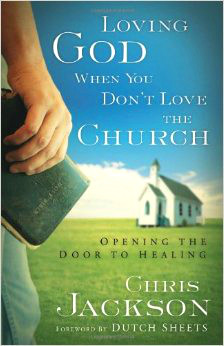
Loving God When You Don’t Love the Church: Opening the Door to Healing

Continued from Part Five of my review series.

I need to find a way to accelerate this review process or it’ll take as many blog posts to finish as Jackson’s book has chapters. Okay, here goes.

According to Pastor Jackson, we are all leaders in the sense that anyone with the indwelling of the Holy Spirit will “rise to the top,” so to speak. That said, rising to the top in our homes, our jobs, and our relationships, as he says, is easier said than done. It’s possible for anyone to lose their “spiritual edge,” as Jackson puts it, including Pastors.

The cure for “spiritual dullness” (and I can relate) is to remember that “the Christian journey is not a sprint, it’s a marathon.” True enough. Any of us can temporarily pull ourselves up by our bootstraps, but for the long haul, we need the faithfulness of God to see us through.

Like most Christians, Jackson says we need to believe in God, but he also says we must experience Him. This goes back to advice I’ve been given in the past about not focusing so much on Judaism or Christianity, but pursuing the presence of God. Jews do that through prayer and the mitzvot and there are Christian equivalents, though Christianity considers itself more of a “relationship” than a “doing” religion.

Jackson asks a telling question:

When was the last time you took the day off of work just to be with Jesus?

If this Pastor had a Jewish appreciation of the Shabbat, he wouldn’t have to ask that question, at least not in that way. He might ask instead, “When was the last time you truly observed Shabbos?” With Easter behind us and now in the midst of the Week of Unleavened Bread, special days of Holiness should be on everyone’s mind, and hopefully, in everyone’s experience.

End of Chapter questions included “Have you lost the edge in any area of your life” and “Are you convinced that you can get it back?”

Good questions.

Moving on to Chapter 14: Mimicking God, Jackson spoke of a small-group meeting he had recently attended where the meeting began:

He opened his Bible to Ephesians 5:1 and read, “Be imitators of God.” After that, he closed his Bible, looked everyone in the room in the eye and said three words: “Now…let’s wrestle.”

Jackson continued, “Some truths must be wrestled with.” I agree, and in fact, I believe that many more truths must be wrestled with than most religious people are willing to engage, particularly in the Church.

While Jackson describes Ephesians 5:1 as a “wrestling verse,” he states that wrestling ends in verse 2: “and walk in love.”

The word “walk” is a great word with a profound meaning. In the Bible it means ” to regulate one’s lifestyle.”

WalkingAgain, Judaism anticipated his response with the concept and application of halachah. Jackson’s “halachah,” if you will, is summarized with the word love. That’s true as far as it goes, but it’s out of this love for God and our neighbor (see Matthew 22:36-40) that we must respond behaviorally. Walking in love isn’t metaphorical, feel-good language, it’s a call to action.

I’m convinced that the primary search of mankind is not for doctrine, religious truth or strategies for successful living; it is for love. It is for acceptance. It is for belonging…

Then why are these things so difficult to find in religious community?

When people in the world see Christians who bear one another’s burdens, who are quick to forgive, who fail to judge and criticize, who are quick to repent and ask forgiveness and who reach out with accepting arms of love, they will feel like they’ve come home. They will realize that they have truly encountered Jesus in our churches.

While I can see his point that living out the teachings of the Master is the best way to communicate the truth of his faithfulness, Jackson seems to have moved from attempting to heal the wounded Christian who is estranged from the Church, to matters of what Christians call “The Great Commission” (Matthew 28:18-20). What’s the connection?

Or is Jackson speaking to the person who not only left the church but left the faith?

The Lord not only wants to heal you from your hurtful experiences in church, but He wants to make you one of his saints.

I’m never really sure what being a “saint” means in this context. Is it equivalent to the Jewish concept of a tzadik, a holy, righteous person who is close to God?

From here, Jackson encourages his readers to consider how children relate to God with that innocent faith that never questions anything. We should be more transparent than performance-oriented, don’t worry so much about “coloring inside the lines” (rules), and instead, becoming “prayer warriors”. We should also consider ourselves God’s “favorite,” as if the world were created only for our sakes individually (and that last part is actually a very Jewish concept).

The chapter seemed to focus on how much God loves each of us as a way of healing our hurts and getting us to reunite with church. By realizing that we are loved by God, we should reflect that love, both to people outside the Church and to other Christians.

Jackson continues with this theme in Chapter 15: Becoming Someone’s Angel. I’ve sometimes said that we should be the answer to someone’s prayer. Instead of waiting for God to intervene supernaturally in some situation, if we see a need and we have the ability to fill it, we should fill it. I think Jackson would agree with this.

Jackson seems filled with his own boundless enthusiasm for the work of the Church, so much so that he said:

I believe the United States is due for a third Great Awakening and that the other nations of the earth can also be transformed by a visitation from Him.

Church splitI believe no such thing, and in fact, based on the ethical and moral nosedive that many churches and all of secular western culture is in right now, I believe that in the end, except for a small remnant, the nations in general and most churches in particular, will turn against Jewish people, Judaism, and national Israel. The churches may call that “a Great Awakening” but based on how I read the Bible, it will actually be rebellion against God.

Like many American Christians, Jackson sees America as the central nation in God’s field of vision. But the Bible says that the centrality of Israel is the lynchpin in God’s redemptive plan for the rest of the world. If Jackson doesn’t see this as well, he’s in for a big surprise when the Messiah returns.

Jackson does rightly say that “most answered prayers come in the form of other people,” but he misses the big, big picture.

He did go on to say something to which I can relate:

One Sunday morning I was so discouraged that I didn’t think I could cut it as a pastor. I didn’t even want to be in church.

I used to have quite a number of Sunday mornings in church where I felt exactly like that, not that I had to worry about being a Pastor, of course. My answer was to stop going to church. My Sundays seem more productive and liberating now.

Jackson then told a story that I think illustrates some of my points well. He mentioned how he had visited a church friend, and older woman who was laid up with an injury, to pray with her. As they were praying, he heard a noise from the bathroom and discovered another woman cleaning the toilet. As it turns out, this other church friend had been coming over pretty much every day cooking and cleaning, as well as praying with the injured woman and keeping her company.

I suddenly felt a little sheepish and realized that this young lady’s cooking, cleaning and other practical help was far more a demonstration of the heart of God than any quick prayer.

I completely agree. I think it’s examples like this young woman, this living, breathing answer to prayer, that trump all of the “religious arguments” we have in the blogosphere, from the pulpit, or anywhere else. Churches and synagogues that preach this sort of message and follow it up with continued action are better than all of the theological and doctrinal pontifications we stack up against each other.

Then in Chapter 16: Ten Times Better, Jackson says:

One of the most significant problems with Christians–with me–is that we so frequently surrender the image of God in us. Rather than living in our glory as the Creator’s image-bearers, we live from our lover, natural selves.

And living like that, Jackson wonders if non-believers ask:

Is that what it means to be a Christian?

alone at churchI’m sure many people who surf into our blogs and read the comments sections ask that same question about Christians, Messianics, and Hebrew Roots people as well.

Jackson makes another good point:

…a major reason that people are leaving the Church today by the thousands is that there is frequently no real discernible difference between Christians and the world.

So many churches, in an attempt to “fit in” with the current culture, “adjust” their Biblical morals and ethics to fit the larger, politically correct and progressive mindset of the world around us. How can the Church be imitators of God if it’s too busy taking its cues from CNN and MSNBC?

For the Church as well as the individual believer, how we live out our faith is a matter of choice. Who are we trying to please, people or God?

None of this is why I left church, but I can agree with a lot of what Jackson is saying. True, he’s speaking from his own Hashkafah, but it’s not as if I can’t relate at all with his worldview, at least the broad strokes of it.

It goes back to what I said before. Don’t seek Judaism and don’t seek Christianity, but seek an experience with God. I might add, then walk on the path He sets before you, even if it leads to some pretty uncomfortable places.

I still don’t think that means back into church, or at least not the church I left. My problem is that I can only see a few steps ahead at a time, so beyond that, I proceed forward trusting that God won’t lead me over a cliff.

Moving on to Chapter 17: Christianity Doesn’t Make Sense Without It, Jackson says:

The Christian religion is a lifelong quest to know our loving Creator and become more and more like Him.

In that, it is indistinguishable from my understanding of Judaism, although exactly how that task is accomplished can look quite a bit different between the two religions. For instance, Jackson asked:

How can I know God more? How can I be more like Him? How can I prosper financially and thus bless my family?

That last question seems distinctly Christian. In Pirkei Avot 4:1, we learn:

Who is rich? He who is satisfied with his lot

That doesn’t preclude ambition and achievement, only that we need not constantly feel that we must have more just because somebody else has or become some television commercial says so. I sincerely hope Pastor Jackson doesn’t subscribe to any form of Prosperity Theology, which seems like a total scam.

Jackson wants to “experience the abundant life” he says Jesus promised him? Really? Does that really mean financial abundance? Is that what the Master meant in John 10:10?

Gateway to EdenJackson goes on to compare Genesis 1:1 with John 1:1 and says “John 1:1 details the real beginning of the story.”

I’m sure from his point of view, that probably seems true, but most Christians read the Bible from the Gospels or from Paul backward rather than from Genesis forward. That unfortunately leads to the false conclusion that “the Church” is the center of God’s plan rather than Israel. And focusing on John 1:1, Jackson says:

If any project, process or expedition gets too far away from its original design, it is destined to fail.

Unfortunately, from my perspective, that describes the Christian Church and the divergent path it has taken across history since the days when the Apostle Paul was sent to be an emissary of the Messiah to the Gentiles.

Jackson goes on to state how Matthew 28:19 “set the course of the Church throughout the ages” based on good, solid principles.”

He compares this with:

Jesus said of the Pharisees that they searched the Scriptures in pursuit of life, but they couldn’t find it. They could not find true life because their religion had become divorced from mission.

In other words, he presents a traditionally Christian discounting of the Pharisees and by extension, all of post-Biblical Judaism. From Jackson’s point of view, 100% of the Church’s mission is evangelizing:

On days when I share my faith with an unsaved person, I’m on top of the world.

And…

I exist to manifest the glory of God.

What about the young woman who was manifesting the glory of God by cooking for a disabled woman and cleaning her toilet?

…and I think I blessed the people who were in attendance. Of course, they were just like me…

I think this is the book’s central message about community, whether Jackson intended it to be or not. Particularly in the church, but most likely in any other human community, we thrive if we are in a group made up of people just like us.

But I’m not just like them.

Life makes no sense…until we return to the sanctuary of God. Christianity makes no sense…until we return to the place of mission.

Up to JerusalemAssuming Jackson isn’t being metaphorical, it seems he’s replaced the Holy Temple in Jerusalem with the Great Commission. This isn’t far-fetched from the Church’s point of view if he believes that the body of Christ is the Temple and that we are all stones that together make up the Temple. He won’t be able to see that we can metaphorically and spiritually be a “temple” and yet there can also be a Heavenly Temple as well as a future Temple on Earth in the coming Messianic Age.

These chapters continue to convince me that, as I said above, I’m not like them.

And further, as I quoted Boaz Michael saying in my previous blog post:

Most religious arguments involve bitter clashes over “what we believe” (theology) and “what we do” (praxis). If we do not share the same hashkafah informing our theology and praxis, this type of debate will be pointless and irresolvable.

And…

For example, many Christians operate under the hashkafah which assumes that the authority of the New Testament has replaced the authority of the Old Testament. This paradigm holds it as self-evident that any conditions established in the Old Testament remain operative only if restated in the New Testament. So long as that paradigm remains firmly in place, there is no point in arguing…

I made it through five chapters today. Only six more to go.

I’ll continue my review in a bit.

Of Dissonance and Hashkafah

Hashkafah is a great Hebrew word without an exact English equivalent. Your hashkafah is your worldview. The term is often used when referring to one’s personal worldview as regards to religion and halachah (Jewish law). It’s the lens through which you view things. It’s how you understand a system. It’s your paradigm of thought. It dictates the way you think about things, and therefore impacts the conclusions you will reach. It’s your ideology and the reason behind your ideology.

-Boaz Michael
“Hashkafah,” p.7
from the Director’s Letter for Issue 119/Spring 2015 of
Messiah Journal

I learned something new today. I learned that my blog is all about discussing my hashkafah, “the lens through which I view things” including my “paradigm of thought” and my “ideology and the reason behind my ideology.”

I’ve said this before but it bears repeating. I’m not writing because I think I’m smarter than other people and that I am delivering my learned pronouncements from some virtual ivory tower. I’m writing to explain what I’ve been learning and how it affects the development of my hashkafah.

Actually, Boaz said so much more in his letter that I found quite useful, which is why I’m sharing this with you. Here’s another useful idea:

A person’s hashkafah (worldview or paradigm) is like the DNA that determines both appearances and actions as a fully formed body. If one’s outward appearance is inconsistent with his hashkafah, it will lead to cognitive dissonance and a crisis of faith.

-ibid (emph. mine)

And that’s what I’ve been experiencing, both in my previous attempt to integrate into a local church and, ironically enough, in my encounters with Messianic Judaism.

For instance, for Shauvot 2012, I attended First Fruits of Zion’s Shavuot Conference at Beth Immanuel Sabbath Fellowship in Wisconsin and I had a blast. I made connections with new people and deepened relationships with old friends.

But the following year, I had started going to church and as a result, I was encountering some of that “cognitive dissonance” Boaz talks about. At the Shavuot conference in 2013, I was confused and conflicted as to who I was and what I was supposed to be doing. I eventually settled in, but not before behaving in such a way that damaged a number of friendships.

The dissonance worked both ways, and not only made it unlikely for me to be invited to attend future Messianic conferences, but ultimately ended up with me leaving church as well.

How do you resolve the dissonance between being attracted to a Messianic Jewish study and practice paradigm and yet not being Jewish?

jackson's bookThis is the reason I’ve been reviewing Pastor Chris Jackson’s book Loving God When You Don’t Love the Church: Opening the Door to Healing. I’m using my review series as the lens through which to look at whether there’s any likelihood of me returning to fellowship or if I should even try. Since Boaz’s letter speaks to what’s going on behind that concern, I consider examining it here part of that investigation.

Here’s what’s at the core of not only my difficulties with the church but with just about every single religious argument we have in the blogosphere:

Most religious arguments involve bitter clashes over “what we believe” (theology) and “what we do” (praxis). If we do not share the same hashkafah informing our theology and praxis, this type of debate will be pointless and irresolvable.

-ibid

That, in a nutshell, describes the vast majority of the religious arguments that happen in the comments sections of my blog and many other religious blogs, especially in the Messianic Jewish and Hebrew Roots spaces.

Although I doubt Boaz intended to, he described exactly what happened between me and the head Pastor of the church I used to attend:

For example, many Christians operate under the hashkafah which assumes that the authority of the New Testament has replaced the authority of the Old Testament. This paradigm holds it as self-evident that any conditions established in the Old Testament remain operative only if restated in the New Testament. So long as that paradigm remains firmly in place, there is no point in arguing…

-ibid, p.8

It took two years to get to this point, but Pastor and I finally arrived on the shores of “there is no point in arguing.”

Boaz, spent much of his letter describing his perspective on the hashkafah of various related movements such as Christianity, One Law, Missionary and Post-Missionary Messianic Judaism, and then what he calls Messianic Judaism for the Nations, which is First Fruits of Zion’s (FFOZ) perspective.

I won’t go into all of that here (I may in a future blog post), but for the sake of matters of dissonance and fellowship (or lack thereof), I’ll focus on the portions of Boaz’s letter I consider relevant. He restated the hashkafah of Messianic Judaism from his previous letter in issue 117 thus:

The practice of Judaism coupled with the realization that Yeshua of Nazareth is the Messiah, the New Testament is true, and the kingdom is at hand.

Boaz Michael
Boaz Michael

My immediate question was how that’s supposed to work for someone who isn’t Jewish. Boaz answers that question subsequently, but does Boaz’s answer work for me? We’ll see by the by.

I do want to mention something regarding Boaz’s hashkafah for Post-Missionary Messianic Judaism since Derek Leman said something similar recently.

Post-Missionary Messianic Judaism is interested in practicing Judaism and maintaining Jewish identity, because Torah is seen as covenantally binding on all Jews. It has an interest in restoring the faith and practice of first-century believers for Messianic Jews, but not for Gentiles. Under this vision for Messianic Judaism, Gentile believers belong in Gentile Christianity identifying as Christians and Messianic Jews belong in Messianic synagogues identifying as Jews.

-ibid, p.10 (emph. mine)

It’s important to remember that Boaz distinguishes his personal (and FFOZ’s official) hashkafah from this Post-Missionary description, but it’s equally important to realize that there is significant overlap. So what does this mean for the so-called “Messianic Gentile?” What is FFOZ’s hashkafah for Messianic Judaism for the Nations?

The practice of Messianic Judaism by both Messianic Jews and Messianic Gentiles for the sake of continuity with the New Testament and the coming kingdom.

He further defines this view of Messianic Judaism as “the Judaism of the Messianic Era.” As far as that goes, I agree with him, and I’ve said more than once that when Messiah returns, as such, there will be no such entity as “the Church.” There will only be Messianic Judaism as it applies to Jews and to the people of the nations.

Relative to the rest of the Judaism in our world, Boaz states:

Our hashkafah acknowledges Jewish authority. We do not believe the New Testament stripped the Jewish people of the biblical and God-given authority to transmit, interpret, and apply the Torah. Although the rest of the Jewish world may be enemies regarding the gospel, they are nonetheless beloved for the sake of the fathers (Romans 11:28).

morning prayerIn other words, God did not abandon the Jewish people or Judaism nearly two-thousand years ago all for sake of the Gentile Christian Church. He didn’t change horses in mid-stream, and He didn’t jump from Plan A to Plan B in Acts 2 or anywhere else in the Bible, or for that matter, in post-Biblical times. God is with the disciples of Yeshua (Jesus) and God is also with His people Israel, the Jewish people, all of them, for the sake of His promises in the Torah and the Prophets as well as the aforementioned Romans 11:28.

As far as Messianic Jews and Messianic Gentiles, Boaz says:

Our hashkafah distinguishes between Jews and Gentiles and their respective obligations to the Torah. Since we accept the authority of the apostles, who also made that distinction clear, we maintain distinction. We advocate the integrity of Jewish identity as defined by Jewish tradition, with all its associated prerogatives, privileges, responsibilities, and obligations. We advocate the integrity of Messianic Gentile identity with its own prerogatives, privileges, responsibilities, and obligations as defined by the New Testament. Although Messianic Jews and Messianic Gentiles are two distinct groups, they share one religion.

While I wholeheartedly agree with all of that, I still asked myself where the Gentile praxis is defined specifically. It seems to vary from one Messianic group to the next, and my personal response was to give up all (or almost all) practice that could even tangentially be considered Jewish (I will still occasionally use a siddur).

I’m writing this on Saturday afternoon (I’m not much of a Sabbath-keeper anymore). Last night, my family and I had a very pleasant, low-key, and quite yummy Passover seder. I’m still getting full noshing on left-over matzah ball soup, and matzah and hummus.

This morning, my wife (who is Jewish) went to shul at the local Chabad, and I believe she’ll be attending the second seder night there as well (which means she won’t be home until very late). One of the obligations I believe we “Messianic Gentiles” have is encouraging and supporting Jewish Torah observance. To that end, I’m delighted she can partake of Jewish community as a Jew. I wish the same for all Jews, Messianic or otherwise.

Now if only someone would write and publish the definitive guide to Messianic Gentile praxis within the context of “Messianic Judaism for the Nations.”

I would encourage you to see our various works in our Mayim Chayim series: Mezuzah, Tzitzit, Tefillin, etc.

-ibid, p.12

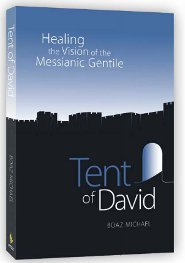
Tent of DavidApparently there is a praxis for Messianic Gentiles, and after a few minutes and a quick Google search, I remembered that in past years, FFOZ had published a series of small booklets about different aspects of Jewish practice as applied to non-Jews. Toby Janicki wrote about Gentiles and Tefillin in this 2007 blog post. However, a quick search of the FFOZ online store front didn’t yield any positive results, so I can’t point you to where to purchase them. I remember possessing at least some of these booklets in the past, but either I loaned them to interested parties who never returned them, or they didn’t survive one of my wife’s “reducing clutter” projects.

Now as I said, so far, I agree with Boaz on most or all of the points he makes in his letter. But in terms of my own situation and especially the last two-and-a-half years of my personal history, here’s the kicker:

I should point out that I do not believe that Gentile believers need to leave their churches and join a Messianic synagogue or Sabbatarian group in order to be part of Messianic Judaism. As I advocate in my book Tent of David, I feel the best place for most Messianic Gentiles, at this point in history, is to remain in their respective churches, supporting the local church’s efforts for the kingdom and becoming an ambassador within that church for this message of restoration. Yes, it may be lonely, one may face theological opposition in the form of subtle anti-Semitism and not-so-subtle replacement theology, but disciples of the suffering servant should expect to suffer a little bit. If we greet only those who greet us and love only those who love us, what reward will we get?

-ibid

Now let’s compare that paragraph to two of Boaz’s previous statements:

Most religious arguments involve bitter clashes over “what we believe” (theology) and “what we do” (praxis). If we do not share the same hashkafah informing our theology and praxis, this type of debate will be pointless and irresolvable.

And…

For example, many Christians operate under the hashkafah which assumes that the authority of the New Testament has replaced the authority of the Old Testament. This paradigm holds it as self-evident that any conditions established in the Old Testament remain operative only if restated in the New Testament. So long as that paradigm remains firmly in place, there is no point in arguing…

I think Boaz’s suggestion works with some Messianic Gentiles in some churches under certain circumstances. I don’t believe it can be universally applied to all Messianic Gentiles in all churches under all circumstances. Of course, that’s not what I think Boaz is suggesting, but still, we must acknowledge that in terms of the “Tent of David” ideal, one size does not fit all.

Don’t worry. It’s not like I’m pounding on the doors of some Messianic Jewish community demanding to be let in. Far from it. As I’ve said many times before, my current family situation would prohibit such a thing, even if the perfect Messianic shul was just down the street from my house.

As far as church goes, I went in with the idea of being an ambassador and left to avoid being a nudnik (pest), at least any more than I’d already become.

To be fair, Boaz also said:

At the same time, I believe that the Messianic synagogue should function as a daughter of the holy Temple: “A house of prayer for all nations.” What would it look like if Messianic Judaism was to open its doors to the many Gentiles who come flocking to Messianic Judaism seeking leadership, direction, and spiritual guidance? What if Messianic Jews took up our role as the head, and not the tail, and we began to lead and shepherd our Master’s flocks? What might that look like?

alone-desertGiven the goal of maintaining Jewish identity and distinctiveness, all of that is easier said than done. Boaz says “Messianic Judaism is the Judaism of the Messianic Era–practiced today.” Well, sort of. There’s still so much we don’t know about exactly how Messiah will consider Jewish vs. Gentile devotees. It would be nice to believe there’s a way to smooth out all of the rough edges between Jews and Gentiles sharing Jewish community in Messiah, but I can only have faith that this is something Messiah will accomplish when he returns.

What’s the bottom line for me? Like my reviews of Pastor Jackson’s book, while I can see what both of these authors mean, and I can see it working for others, I don’t see a personal application. I’ve said before that I was willing simply to surrender the idea that I must be in community at all. I have limited social needs, so it’s pretty easy for me to be self-contained and to progress forward as an individual. Relative to my faith, it’s what I do at home anyway. It was only the concerns of a friend that had me return to this topic and take another look.

I’ve finished reading Pastor Jackson’s book and I’ll continue my reviews soon.

Final Note: I realize that every time I mention Boaz Michael and First Fruits of Zion, those people who have “issues” with him and his organization tend to make a number of rather “uncomplimentary” remarks in the comments section of my blog. I insist that you stick to the actual issues I’m discussing, that is the hashkafah of Messianic Judaism for the nations as contrasted with Post-Missionary Messianic Judaism and with Christianity as applied to my personal situation. If you can’t comment within the bounds of decorum and avoid committing lashon hara, then consider not commenting at all. Thank you.

The Bread of Faith; The Bread of Healing

At the first seder my father would be brief, (In his explanations of the Haggada, etc.) in order to eat the afikoman before midnight. On the second night, however, he would expound at length; he began the seder before 9 p.m. and ended at about 3 or 4 in the morning, dwelling at length on the explanation of the Haggada.

The Alter Rebbe declared: The matza of the first evening of Pesach is called the Food of Faith; the matza of the second evening is called the Food of Healing. When healing brings faith (“Thank you, G-d, for healing me”) then clearly there has been illness. When faith brings healing, there is no illness to start with.

-Compiled and arranged by the Lubavitcher Rebbe, Rabbi Menachem Mendel Schneerson, of righteous memory, in 5703 (1943) from the talks and letters of the sixth Chabad Rebbe, Rabbi Yosef Yitzchak Schneersohn, of righteous memory.
Chabad.org

As I write this, it is still Friday morning. I have to admit, I’m a little nervous. I haven’t had a chance to practice with the Haggadah yet and given my work schedule, I doubt I’ll have the time after I get home before the seder begins.

Of course, there will just be four of us, but still, it’s important that the telling go smoothly.

In deference to the holiness of Pesach, I’m publishing this immediately after I write it, since the next opportunity won’t be until Monday the 6th.

I know I posted this in a comment my previous blog post but I want to draw more attention to these words:

Just before Purim, a non-Jewish woman asked me about the holiday. After I explained a little bit about Haman and his plan, she asked, “so Hitler wasn’t the first?” They really have no idea.

We read in the Haggadah, “for not only one has risen against us to destroy us, but in every generation they rise against us to destroy us, and the Holy One, Blessed be He, saves us from their hands.”

-Rabbi Yaakov Menken
“Not Just Once”
Project Genesis

Dry BonesAlso, on twitter, cartoonist Yaakov Kirschen (@drybonescartoon) wrote something quite similar:

Happy Passover! Hag Sameah! “In every generation they rise up to destroy us”, and this generation is no exception!

I just finished reading an article written by Sally Quinn called From Passover to Easter: Why I’m Grateful to be Jewish, Christian, and Alive. The subtitle is “Passover with friends. Easter with family. It’s almost enough to make you believe in God.”

I’m a little different. Passover with Family. Easter with no one. And the imminent threat of Israel’s annihilation intensifies my faith that God will save and preserve His Holy Nation and His eternal and beloved Jewish people…people like my wife and children.

The Alter Rebbe declared: The matza of the first evening of Pesach is called the Food of Faith; the matza of the second evening is called the Food of Healing. When healing brings faith (“Thank you, G-d, for healing me”) then clearly there has been illness. When faith brings healing, there is no illness to start with.

Faith and then healing or healing then faith?

In her article, Quinn attempts to reconcile Passover and Easter, but I’m not so sure that’s even possible. I’ve heard it said that after every Passion Play there is a Pogrom. I once naively believed that was a thing of the past, but now I fear it’s not. Is it any coincidence that the U.S./Iran Nuclear Deal was sealed yesterday during Holy Week (Maundy Thursday), a deal that Al Jazerra chastises Israel for condemning?

One person commented on the Al Jazerra news story:

The Iranian People are a good people… Not like the Zionist..,, Thieves, deception kings and down right liars.

I think that sums up the attitude of their readers, their reporters, their supporters, and, Heaven help us, perhaps President Obama and Secretary of State Kerry as well.

I’ll admit to needing some healing just now. But before I can be healed, there must be faith. Passover is the story of Jewish survival in the face of overwhelming odds. At the Reed Sea, when Israel saw the Egyptians pursuing them, they were terrified (Exodus 14:10). I must remind myself of what Moses said, for it applies to every moment of Israel’s existence:

Moses answered the people, “Do not be afraid. Stand firm and you will see the deliverance the Lord will bring you today. The Egyptians you see today you will never see again. The Lord will fight for you; you need only to be still.”

Exodus 14:13-14 (NASB)

PassoverIn Israel, the start of seder night is fast approaching. Here in Idaho, it should begin around 7:15 p.m. with candle lighting being at almost eight.

Easter is the story about the resurrection, the risen Messiah, who came to take away the sins of the world. What Christianity totally misses is that the hope and good news of Messiah isn’t just the promise of personal salvation, but of national rescue and restoration of all of national Israel as it is said:

For I do not want you, brethren, to be uninformed of this mystery—so that you will not be wise in your own estimation—that a partial hardening has happened to Israel until the fullness of the Gentiles has come in; and so all Israel will be saved; just as it is written,

“The Deliverer will come from Zion,
He will remove ungodliness from Jacob.”
“This is My covenant with them,
When I take away their sins.”

Romans 11:25-27

The reason there is any meaning in Easter at all is because of what Messiah will do for his people Israel. It is my hope in the faithfulness of Messiah that Israel will not be destroyed.

But for me, faithfulness and healing is depicted more clearly in the Passover. Rabbi Menken finished his essay this way:

As the Haggadah tells us, this is the same ancient, irrational, murderous prejudice that has existed since Esav sent his son to murder Yaakov — and since Lavan, Yaakov’s father-in-law, plotted to destroy him. And that is the message of the Haggadah: keep the faith. Do what Jews have done since the beginning of our history, and “the Holy One, Blessed be He, saves us from their hands.”

G-d took the Jewish People out of Egypt to be His, to be close to Him and promote His vision for the world. On Passover we relive that departure from Egypt, the liberation from bondage. We break free from human limits to belong only to G-d. We know that the plans to destroy us today will not succeed, as they have failed in every generation. The Holy One, Blessed be He, saves us from their hands!

Rabbi Tzvi Freeman at Chabad.org said something similar:

We are limited by the very fact that we have human form. There is no freedom in following our whim, or even our most reasoned decisions. As a prisoner cannot undo his own shackles, so we remain enslaved to our own limited selves.

And so Moses was told, “When you take the people out from Egypt, you shall all serve G‑d on this mountain.”

What makes us free? Simple deeds done each day, as agents of the One who is absolutely free.

in chainsI’m only human. I’m very limited. I cannot free myself and am a slave to my human nature.

Except that in serving God, I can be free. That’s why Hashem, Master of Legions took His people Israel to Sinai and gave them His Torah.

The Passover Seder is a service of the heart, a service to God in obedience to the commandments. And while I, a non-Jew, am not commanded to observe the Pesach seder, as the head of a Jewish family, the duty falls to me. In the shadow of nuclear genocide, reciting the haggadah reminds me of the faith of a nation, reminds me that I must also be faithful, and reminds me of the faithfulness of Messiah.

May the Almighty heal my faith and my heart. May He continually save and fight for His nation Israel and His Jewish people.

Chag Samach Pesach! Next Year in Jerusalem!

Next Year in Jerusalem

With Pesach beginning this Friday, April 3rd at sundown, I thought I’d interrupt my reviews of Pastor Chris Jackson‘s book Loving God When You Don’t Love the Church, and say something about how I’m experiencing the approach of Passover and Easter this year.

Last year, I called the association of Easter and Passover a collision, although I did urge Hebrew Roots and Messianic people not to throw Christianity under a bus for celebrating Easter as their most Holy day.

However, this year, I’m getting nervous. No, I’m not feeling anxiety about Passover or even Easter, but about how the status of the state of Israel is changing. A few days ago, The Jewish Press published an op-ed piece called “Obama Declares War on Israel”. Unfortunately, they’re not wrong. American President Barack Obama’s negative attitude toward Benjamin Netanyahu and his recent victory in winning the election in Israel, coupled with Obama’s disastrous policies toward a near-nuclear Iran, indicate that the relationship between the U.S. and Israel is at its weakest point ever.

We are about to join the ranks of those nations who are enemies of Israel, and we know from scripture that all the nations that will go up against Israel in war will be defeated by God, and their survivors will be compelled to pay homage to Israel and her King.

On a much smaller scale, I read a story about some comedian named Trevor Noah, who is taking over Jon Stewart’s job as host of “The Daily Show”, making a number of anti-Semitic and anti-Israel “tweets” on twitter.

Here’s two of his more vitriolic tweets:

Almost bumped a Jewish kid crossing the road. He didn’t look b4 crossing but I still would hav felt so bad in my german car!

South Africans know how to recycle like Israel knows how to be peaceful.

Fortunately, according to the story, he suffered a strong and immediate backlash for his comments. However, his tweet in response was hardly repentant:

To reduce my views to a handful of jokes that didn’t land is not a true reflection of my character, nor my evolution as a comedian.

So far, I don’t find him particularly funny.

I’m just listing two examples of a much wider body of information indicating how the world is continually turning away from the nation of Israel and is being willing to victimize Jewish people up to and including murder. Even American Vice President Joe Biden publicly admitted that Jews in this country can only rely on Israel and not on the U.S. As anti-Semitism continues to rise in our nation, are we going to start looking like Europe in how we treat our Jewish citizens?

It may not be too soon for American and European Jews to start making Aliyah. That gives the statement “Next Year in Jerusalem,” which we say at the conclusion of every Seder, a new and poignant meaning.

burning star of davidIt’s not just President Obama who has declared war on Israel and the Jewish people, it’s the entire world.

Yesterday, Derek Leman posted (or re-posted) a blog called Passover, Resurrection, Constantine which is a fabulous history of how Easter came to be in the Christian religious calendar.

In the second century, the congregations of Yeshua-believers were dissociating themselves from Jewish origins. Ignatius of Antioch famously said, “It is monstrous to talk of Christ and practice Judaism” (Letter to the Magnesians 10:3). The Jews had been in two wars with Rome (66-70 and 130-132 CE). Yeshua-believers, who had originally been seen as a sect of Judaism, had originally been protected under Roman law — free from obligation to show devotions to Roman gods and Caesars under the Jewish exemption — by being regarded as Jews and proselytes to Judaism. Now being Jewish carried with it the worst social stigma possible in Roman society.

But a controversy arose between the main congregations and some Asian bishops (the Roman province of Asia, in modern Turkey). Specifically Polycrates, claiming to be keeping up the practice handed down to him from Polycarp, kept a fast (vigil) until the 14th day of the month (apparently the Jewish month, Nisan) and then held a feast (likely a Passover Seder). But the other congregations at this point held a vigil on Saturday followed by a feast on Easter Sunday. The people in this dispute like Polycrates, who kept their feast on the 14th day, were called Quartodecimanists (http://en.wikipedia.org/wiki/Quartodecimanism).

They were some of the last hold-outs, Yeshua-followers who kept some of the Jewish customs of the early believers. There would be philo-Semitic (Jewish friendly) Christians well into the fifth century (as Chrysostom preached sermons against them). But in the second century such friendliness with Judaism was already well on its way to being considered a departure from true faith.

I think we still suffer under the legacy of those days and, even in the secular world, Jews and Judaism have historically endured the disfavor and displeasure of the people of the nations (to put it mildly).

Recently, the Sojourning with Jews blog posted a missive called One New Man-ity challenging the traditional Christian belief that God’s “Old Testament” particularity toward Israel was replaced by a “New Testament” universalism that exchanged the Jewish people for the Church. As a non-Jewish wife married to a Jewish husband, she defines the Gentile role in relation to the Jewish people thus:

God also says He will discipline His people and that they will be scattered out of the land and suffer terribly from the nations for a very long time. They will “dwell many days without king or prince, without sacrifice or pillar….” But “Afterward the children of Israel shall return and seek the Lord their God, and David their king, and they shall come in fear to the Lord and to his goodness in the latter days.” Hosea 3:4-5. Other places say He will rescue Jacob from “hands that were too strong for him.” I juxtapose that with Jesus saying his followers are to love and care for even the least of his brothers and so, I see that I have a calling of my own and the overarching purpose is to love God, and my neighbor as myself.

According to the historical record, if all Christians had understood this, there would have been more to stand in-between the Jews, and the nations that repeatedly sought their blood.

As far as I’m concerned, she is definitely “preaching to the choir.”

Passover and the Week of Unleavened Bread commemorates the liberation of the Israelites from under the harsh slavery of Egypt and God, through Moses, leading His nation to Sinai to establish them as the head of the nations, giving them His Torah.

In his commentary on Passover this year, Rabbi Kalman Packouz says:

People think they are free when they throw off the yoke of the Torah. However, unless one has the revealed wisdom of the Torah, he is at risk at becoming a “slave” to the fads and fashion of his society. Slavery is non-thinking action, rote behavior, following the impulse desires of the body. Our job on Pesach is to come out of slavery into true freedom and to develop a closer relationship with the Almighty!

passoverWhat has kept the Jewish people free and united them as a people for over 3,500 years when an entire world continually tries to destroy them, is cleaving to God’s Torah and maintaining their Covenant distinctiveness from the nations around them.

Passover, for the Jewish people, is a time to celebrate freedom, not just from slavery and tyranny, but from the spectre of annihilation, assimilation, and dissolution.

Several days ago, my wife and I were discussing the sad state of America and how our President seems all too willing to throw Israel to Iranian wolves. In a fit of pique, she said she’d consider giving up on the U.S. and making Aliyah.

A momentary surge of joy welled up in me at the thought, but I realize she wasn’t making a serious suggestion. According to my spouse, Israel is looking for younger families to make Aliyah, not a couple approaching retirement.

But this made me realize that while I would hate leaving my children, my grandchildren, and my parents behind, it’s more important to me to support the Jewish nation and the Land of Promise than to tolerate my own country, which seems to be in a moral and ethical nosedive destined to crash and burn at the conscience of the King.

The weight of anti-Israeli and anti-Semitic hate weighs heavily upon my shoulders as I contemplate this year’s seder, just a day away as you read this (and as I consider Easter as well). But if I have faith in God at all, then I know what He has promised Israel, to be the head of all the nations, to be a Land of everlasting peace and prosperity, will come to pass. And not all the Barack Obamas, Trevor Noahs, or anyone else can stop Him from ushering in the Messianic Era and blessing the Jewish nation of Israel.

At my family Seder tomorrow night, when we all declare “Next Year in Jerusalem,” may that “next year” come soon. May it come soon for all Jews living in the diaspora and for all those who love them.

Freedom is the responsibility to fill our lives with meaning.

-Rabbi Shimon Apisdorf

Review of Loving God When You Don’t Love the Church, Part Five

“They didn’t want to talk about it.”

“They said there’s really no point in meeting to discuss it.”

“I guess it’s best if we just move on.”

-Pastor Chris Jackson
from Chapter 9: Your Pastor
Loving God When You Don’t Love the Church: Opening the Door to Healing (Kindle Edition)

Continued from Part Four of this review.

Pastor Jackson attributes the above quoted statements to “hurting church members who failed in their attempts to discuss their grievances with the church’s leadership.” Jackson further states that people typically don’t experience conflict with other church members but “with the leadership of the church.”

I suppose that’s what happened to me. My relationship with the church’s head Pastor reached a tipping point when, in a sermon, he discounted the foundations of my understanding of the Bible, calling it a “misuse of the Law.” He also laid that at the feet of more normative Judaism as well as Seventh Day Adventists, so it wasn’t solely aimed at me.

As far as airing my grievances, I did that. I made the mistake of doing so on my blog instead of phoning or meeting with the Pastor, and that just made a difficult situation even worse. I left the church not because I had been kicked out, and not because I was so offended, I left in a huff, but because I was incompatible with church and particularly with the church leadership. I don’t think anyone was sorry to see me go.

The next highlight I have in this chapter is Jackson citing the film adaptation of C.S. Lewis’s The Lion, the Witch and the Wardrobe in which the fox says of Aslan:

“He’s everything we hoped he would be.”

Jackson continues:

Unfortunately, the opposite of this sentiment is sometimes true in church.

We all have expectations of those around us. If people were truly unpredictable, our lives would be chaos. We couldn’t make plans with anyone. We have to have some sort of grasp of how our families and friends and the leaders and people in our houses of worship will react under certain circumstances.

I think a Pastor and church leadership have a certain expectation of what a person believes and stands for if they voluntarily attend their church week after week. If we choose a church or other sort of congregation, we probably do so because we expect that the leaders and members of the church think, believe, teach, and act in a certain way. It would be tough to drop a Messianic Gentile like me in the midst of a Fundamentalist Baptist church in Southwestern Idaho.

Oops.

But since this is a chapter on Pastors, let me be quick to say that none of my leaving church was the leadership’s fault. They were behaving and teaching as was expected by the vast majority of the people attending that church. I was the square peg vainly attempting to fit into a round hole, or conversely, trying to convince the round pegs to at least consider the benefits of thinking and studying like square pegs.

Ah, this next point is important:

What do good spiritual leaders look like? Spiritual leaders are very important for our spiritual growth and maturity so it’s important for us to know what to look for in one. I’m very selective and protective about the people I let speak to my wife…

wolf in sheep's clothingWhat I’m about to say wasn’t exactly Jackson’s point, but it relates. One of a Pastor’s jobs is to protect the flock from wolves. In spite of the fact that Randy spent nearly two years meeting with me individually and attempting to convince me of the correctness of his “sound doctrine,” in the end, I was a rogue wolf in the fold.

After a number of discussions with a young man in the Sunday school class we attended, I suggested he borrow my audio CDs of D. Thomas Lancaster’s sermon series What About the New Covenant. He did. He listened to them. He seemed at least confused if not shocked. He asked to keep them a while longer so he could listen to the lessons again.

And when the Pastor found out about it, he was pretty unhappy with me. Based on our reading and discussing Lancaster’s book The Holy Epistle to the Galatians together, Pastor came to the realization that he disagreed with Lancaster on just about everything. So my lending one of his flock CDs containing Lancaster’s teachings (even though Pastor had never listened to those sermons) exposed that particular “sheep” to “danger.”

As much as I disagree with his opinions on Lancaster, Pastor’s doing his job. He’s protecting the flock.

Jackson, in describing the ideal Pastor says, “First of all, he loves you.” Yes, the Pastor loves his flock and out of that love (just as Jackson loves his wife), he’s protective and will defend them.

Jackson’s point in mentioning this love is that it’s healing. A hurting believer having the Pastor notice and love them will help heal that hurt. But going back to what I said earlier, the basic theology and doctrine of Pastor and church goer must be what the other expects and desires.

Jackson also describes the ideal Pastor as transparent. He must be approachable and human rather than someone who dwells on high in an ivory tower dispensing holy decrees. Yes, Pastor was approachable and probably as transparent as a human being can be and still have healthy boundaries. I wouldn’t say he was nonjudgmental, as Jackson would have us believe of ideal Pastors. Not that he beat people over the head with his Bible, but he definitely had a firm sense of right and wrong doctrine, and he stuck to his guns.

An ideal Pastor, according to Jackson, “sees the greatness in you.” I think Pastor saw potential in me, but doing anything about it was contingent upon being convinced of his “sound doctrine” so that I’d be safe within the fold. So although Jackson says the ideal Pastor is not controlling, it’s tough to exercise your role as protective shepherd without maintaining control of who has access to them and under what conditions.

This next statement I thought was a bit over the top:

When he speaks, it is as if God Himself was speaking to you.

I think Jackson means the ideal Pastor is “Christ-like” in his love, compassion, and understanding of the people in his flock, not that he’s all-seeing, all-knowing, and commands one hundred percent of everyone’s respect and obedience.

That said:

…there is no human leader who can fully provide all that we need as growing disciples of Jesus. We need Him.

“Him,” in this context, is God.

John MacArthur
Rev. John MacArthur

And so Jackson urges his readers to realize that Pastors are also human, what he calls “tools of destiny,” and he wants us to know that someday, some of us may be in church leadership, which will further help us understand the responsibilities faced by our Pastors. Jackson also said that, given this, he urges reconciliation with church leaders when there’s a problem, and outlines the steps for his readers. Ultimately, it’s a call to forgive leaders who may have hurt us. Just for giggles, I included a photo of John MacArthur because to me, he exemplifies the sort of Pastor who generates a lot of “hurt” among people. But that’s just my opinion. What do you do when a well-known and influential Pastor has the ability to potentially hurt thousands?

The only end of chapter question I have highlighted is:

Are you looking for them (church leaders) to provide something that can only come from Jesus?

At this stage in the game, I don’t think I’m looking for a church Pastor to provide anything at all. How can they when my presence in almost any church (at least if I opened my mouth) would be a monkey wrench in the machinery?

In Chapter 11: The Cup of Misunderstanding (sounds like a little-known additional cup at a Passover seder), Jackson speaks of this metaphorical cup containing something that tastes bitter, tastes like injustice, and “those who drink it must do so alone.” He also says that this cup is usually received by “innocent people,” and is particularly harsh when “delivered to you by a brother or sister in Christ.”

Jackson compares being misunderstood and judged by someone in the church to the pain of betrayal suffered by Christ at the crucifixion.

I felt the comparison was a bit much. After all, human misunderstandings aren’t confined to the church, they happen in every human corporate venue, from the family to the workplace.

Jackson says this pain is intensified if the person you are trying to reconcile with makes it abundantly clear they have no intention of mending fences.

Someone once said, “You must embrace the cross if you would carry it with dignity.” The same is true of this cup.

I think what Jackson is saying is that being misunderstood, judged, and cut loose requires the Christian to be “Christ-like,” to bear the burden and the pain as Jesus did on the cross. Sounds pretty dramatic, but then, human conflict can elicit a lot of drama.

One of the end of chapter questions is:

Do you have a friend who can stand with you in your struggle?

In spite of my friend’s concerns about me and the issues Jackson addresses in his book, I don’t know that I’m really struggling, at least in relation to community or my lack thereof.

Jackson asks: “Are you passing the test? As you do, you’ll begin to look more like Him.” If the test is forgiving the Pastor, first of all, I doubt he thinks he needs my forgiveness. Nevertheless, I have forgiven him. After all, he’s only doing what he believes is right, and within his church’s context, it is the right thing to do.

In Chapter 12: Death by Religion, Jackson discusses watching an infomercial for Chuck Norris’s Total Gym product. The bottom line is that in spite of the seemingly fantastic claims made in the marketing of this all-in-one piece of exercise equipment, Jackson says if used as indicated, and if you eat a proper diet, the claims are all true.

Please forgive this sacrilegious comment, but I’ve noticed that in some ways, the Church is a lot like that infomercial–we’re touting a product that really works.

And by that he means:

A life devoted to His service is the only way to ensure our eternal salvation and to experience the life we were created to live.

norris and brinkleyBut while a very fit Chuck Norris and Christie Brinkley sell their product on TV, Jackson says, by comparison, those Christians promoting a better life through Jesus are more like “a flabby, middle-aged guy who thinks he looks good in spandex.”

In other words, many believers promoting a better life through Christ don’t look or act like they’re participating in that life. They look like they’re participating in a marathon dining session at McDonald’s.

We’re selling relationship, but what they see is religion…and religion is killing our sales pitch.

I’ve mentioned this artificial split between these concepts in a previous blog post. It’s really the traditional Christian rant against their misconception of Judaism:

Religion breeds death because it is limited to man’s ability to comply with its codes and regulations.

If Jackson had my understanding of the New Covenant, he’d (hopefully) understand why his opinion is completely out of the ball park.

But I don’t have time or space to go into all that again in this rather lengthy series of book reviews.

Religion is easier to control than a relationship.

You may have noticed that Jackson has shifted his emphasis from the individual’s relationship with other Christians in church or their relationship with the Pastor and church leadership, and is now focusing on the person’s relationship with Christ.

…after all, we’re all under grace and God doesn’t get ticked if we skip a day of devotions.

I’m not sure what God does or doesn’t think about an individual being hit and miss on living a life of holiness, not that any one of us is perfect at it.

Jackson then proceeds to bash the Pharisees, even though (he probably doesn’t see this) Jesus lived a life consistent with the basic tenets of Pharisaism, and as a matter of fact, so did Paul.

In describing “religious systems,” he says they operate like “spiritual frat houses”. They have their secret handshakes, inside jokes, matching jackets, and the like. Yes, I’ve experienced cliques in church. People who were ‘in’ and people who were ‘out’, though to be fair, I didn’t experience them at the last church I attended (at least for the most part).

However, Jackson could have been describing how some people experience certain individuals and congregations involved in the Hebrew Roots and the Messianic Jewish movements.

I’ve mentioned before Derek Leman’s blog post Gentiles Who Feel Left Out which addresses this matter. If you feel you are “in”, then being in contributes to your sense of identity, according to Jackson. You may, again, as Jackson says, experience a sense of being among the elite by being in.

This next point is important:

Spiritual fraternities do not welcome different opinions or viewpoints.

I’ve experienced that in spades, but I think that a lot of religious communities are like this, based on a mutually accepted sense of “rightness” of their doctrine. Anything that contradicts their doctrine is automatically wrong. These congregations state, using Jackson’s words:

We want your input and opinions–as long as they agree with ours.

This goes back to what I said before about expectations within the group. Jackson also says such “frat houses” are full of cliques, difficult to fit into (again, I know what that’s like), and Jackson says the only way to combat this is to “make sure that our hearts are free from religion.”

And yet, I could probably speak to Jackson for less than an hour and elicit a very protective and “religious” (as he defines it) response from him, just by disagreeing with how he interprets the Bible’s message of the good news. Actually, all he’d have to do is read my reviews of his book.

Only two of the end of chapter questions seemed relevant:

Are you managing a religion or living in a relationship?

Has your religious experience become a duty or a delight?

passover-artConvincing Jackson of the beauty of the mitzvot, particularly with Passover and the family seder coming up in a few days, all the preparations, all of the ceremony, and the retelling of the Exodus, would be a lost cause if I were to make the attempt. I suspect all he’d see is “religion,” missing how the seder brings a Jewish family closer to God.

Of course, I wonder how he’s managing the “relationship” of the upcoming Easter Sunday service at his church, which usually involves a multi-media presentation and tons and tons of preparation and ceremony?

So far, having reviewed about half of Jackson’s book in a fair amount detail, I have two preliminary conclusions. The first is that I don’t think he’s speaking to my situation. The second is that my opinion of my being incompatible with “church” is being re-enforced. I find it impossible to review his book as related to my current status of being apart from “community” without being critical of his theology and doctrine.

I just can’t seem to put our obvious differences aside and simply listen to what he has to say on a human level. This is my fault. I have a friend who tells me I need to be more patient and to speak out less.

Probably true.

One last story.

I had coffee with my friend last Sunday. On the drive home, he mentioned that his congregation had a guest speaker from Africa on the previous Shabbat. Among other things, this speaker talked about lions and how they hunt only the sick, the weak, the old, and those who wander off and are alone.

Not-so-subtle point received, my friend. *grin*