All posts by James Pyles

James Pyles is a published Science Fiction, Fantasy, and Horror author as well as the Technical Writer for a large, diversified business in the Northwest. He currently has over 30 short stories published in various anthologies and periodicals and has just sold his first novella. He won the 2021 Helicon Short Story Award for his science fiction tale "The Three Billion Year Love" which appears in the Tuscany Bay Press Planetary Anthology "Mars."

If You Could Personally Witness Just One Event in the Bible…

Have you ever read a passage of the Bible and thought, Oh, I wish I were there! I have. I have longed to be the third dude on the road to Emmaus, listening to Yeshua expound on the Messiah’s role.

And beginning with Moses and all the Prophets, he explained to them what was said in all the Scriptures concerning himself. (Lk. 23:7)

Being present on Shavuot (Pentecost) when the Holy Spirit birthed a revival in Jerusalem would have been amazing. Many would, no doubt, choose to witness the parting of the Red Sea or the crucifixion of Yeshua. As for me, I would choose something in the future. I have always been intrigued by the prophets in the eleventh chapter of Revelation. These two witness appear sometime during the Great Tribulation and proceed to prophesy for three and a half years.

-Ron Cantor
“The Cantor Comment: Fire-Breathing Prophets!”
maozblog.com

Actually, I share in Cantor’s first wish. I’ve always been slightly annoyed that Luke didn’t include what Jesus actually said when he “explained to them what was said in all the Scriptures concerning himself.” I want to know. Certain parts of my life would go a whole lot easier if we just had a detailed “map” of how Jesus saw the various portions of the Torah and the Prophets which referred to him.

Alas, such is not to be.

I was considering leaving a comment on the blog with Cantor’s article, but his story really didn’t seem to be asking the question I wanted to answer. I wanted to answer the question, If you could personally witness just one event that occurred in the Bible, which one would it be?

Here’s mine:

From it Moses and Aaron and his sons washed their hands and their feet. When they entered the tent of meeting, and when they approached the altar, they washed, just as the Lord had commanded Moses. He erected the court all around the tabernacle and the altar, and hung up the veil for the gateway of the court. Thus Moses finished the work. Then the cloud covered the tent of meeting, and the glory of the Lord filled the tabernacle. Moses was not able to enter the tent of meeting because the cloud had settled on it, and the glory of the Lord filled the tabernacle. Throughout all their journeys whenever the cloud was taken up from over the tabernacle, the sons of Israel would set out; but if the cloud was not taken up, then they did not set out until the day when it was taken up. For throughout all their journeys, the cloud of the Lord was on the tabernacle by day, and there was fire in it by night, in the sight of all the house of Israel.

Exodus 40:31-38 (NASB)

I haven’t literally dreamed of being there, but if it were possible, it would be my fervent wish. Imagine the scene. Moses has just finished erecting the Tabernacle. Millions of people are surrounding the structure, waiting in hushed anticipation, expecting a miracle, expecting God.

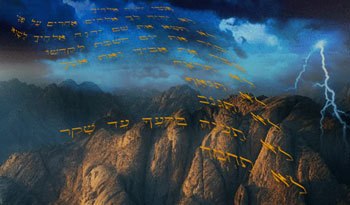
Torah at SinaiThen, something appears from the sky and begins its descent toward the Tabernacle. It probably looks like a big cloud, but it would be familiar to any one who had been in the company of the Israelites and who had been present at Sinai for the giving of the Torah.

The Torah text doesn’t describe it this way, but I imagine this event happens at night. The cloud is slightly illuminated from within, but when it enters the tent, the darkened structure bursts into magnificent, blazing light. Millions of people cry out as one, praising God and glorifying His Name.

This probably isn’t the typical scene most Christians would want to attend. Most believers would likely choose an event from the New Testament, being present at the Olivet Discourse, witnessing the resurrection or the ascension, perhaps accompanying Paul on one of his journeys, but for me, nothing describes the desire of God to dwell among His people quite like the end of the book of Exodus.

Now I turn it over to you. If you could be present during any event that happened in the Bible, what would it be and why?

What is Faith?

What is real? How do you define ‘real’? If you’re talking about what you can feel, what you can smell, what you can taste and see, then ‘real’ is simply electrical signals interpreted by your brain.

-Morpheus played by Laurence Fishburne
from The Matrix (1999)

I thought about this quote as I was driving home this evening (as I write this) and wondering what happened between Monday and now. On Monday evening and into Tuesday morning, and even as far as this morning, something carried over from a new or rejuvenated sense of faith and spirituality. Then, as I was driving home, it was like a balloon popped and I could feel myself sinking back into my previous template, which is at a depth where contact with God is like a faint echo struggling to make its way through the cold deeps of a twilight ocean.

What’s stronger, something new or something old? Answer: something old. Something new is exciting in the moment, but what’s old, like old habits, have a much greater and firmer foothold on your life or, in this case mine.

To paraphrase Morpheus, “What is faith? How do you define ‘faith’? If you’re talking about what you can feel emotionally, what you experience in response to stimulating books on faith, on hearing rousing music with impassioned lyrics, then ‘faith’ is simply electrical signals interpreted by your brain.”

That’s a horrible realization and it was even more horrible that such a thought reminded me John MacArthur speaks against a faith based on sensation and experience. Of course, he goes in the opposite direction and believes in a faith based almost exclusively on the intellect and his version of Bible study, making him not unlike some Rabbis in some traditional corners of Judaism.

You’re a great one for logic. I’m a great one for rushing in where angels fear to tread. We are both extremists. Reality has brought us somewhere in-between.

-Captain James Kirk (William Shatner)
from Star Trek VI: The Undiscovered Country (1991)

Apparently the 1990s were very good for movie quotes.

coastKirk and Spock seem to be polar opposites: an emotionalist always looking for his next adventure, and a logical rationalist, always seeking the calm of study, knowledge, and wisdom. But as Kirk pointed out, both of them are extremists. Reality (what is “real?”) is somewhere in the middle.

And so we arrive at attempting to define the essential elements of a life of faith. Certainly not just a stimulating book about a faithful man of God who could perform healing miracles, or music and lyrics that touch the emotions and hopefully the soul. Certainly not just the enthralling study of the Bible, of interesting commentaries, of Talmud and midrash.

Reality is somewhere in the middle because human beings are emotional and intellectual beings. Too much of either side of the equation leaves our faith woefully off-balance, and us teetering on the edge of plummeting into one abyss or another.

A little over two weeks ago, I wrote a blog post quoting First Fruits of Zion (FFOZ) Founder and President Boaz Michael saying that faith is a platform supported by three legs: the Spirit of the Lord, the Torah of Moses, and the Gospel of the Messianic Kingdom.

In 1 Corinthians 13:12-13, the apostle Paul speaks of another three “legs:” faith, hope, and love. It seems we are not complete as devotees of the God of Israel and disciples of Messiah unless we not only value multiple elements in a living faith, but we allow those elements to exist in balance relative to one another. Depending too much on any one “leg” for support, will likely find us about to fall in the opposite direction.

I’ve heard it said that it takes six-weeks to either make a new habit or break an old one. I’m sure that’s overly simplistic, but if you are trying to break an old, unwanted but familiar and relatively comfortable habit, six weeks can seem like a long time. After the initial excitement at any resolution, after a few days pass, the old and familiar assert their influence.

I suppose I could immerse myself in inspirational books and music, but that’s just swinging in another extreme direction and it won’t last. What I think will last is establishing a balance, realizing that there will be moments of disappointment and let down, moments when things will seem dry and uninteresting, and that those moments do not have to stand in the way of a new or renewed sense of the presence of God.

Some habits are good. Continuing to read and to study the Bible is good. Listening to faith-based music is good. Set times of prayer and “davening” from the Siddur is good. Reaching out to God, not only when He seems close, but when He seems far away is good.

Most people who are religious I think organize their activities into the holy and the secular. It’s holy to go to church and secular to go to work. It’s holy to sing a hymn and secular to sing a rock song from the ’60s. It’s holy to pray, and it’s secular to wish.

Leonard CohenThat’s the problem. From God’s point of view, we are all His creations and thus we all share some small part of the Divine. As people of faith, the awareness of that state should be present in us…in me. There really are no times or circumstances or tasks where God is not present. It’s just a matter of whether or not I chose to be aware of the presence during those times I deem “secular”

A momentary pause in the music doesn’t mean the song has ended. The end of a paragraph or chapter doesn’t mean the book is done. And the realization that I won’t always “feel” that God is near doesn’t mean God isn’t near. Faith is continuing to act faithfully even if the physical and spiritual world seems silent and empty.

Faith isn’t a feeling and it isn’t a thought. Faith is a habit or at least it’s supported by habits…praying, singing, reading the Bible, pondering God’s wondrous acts and wisdom, opening your cognition and emotions to God, even if He should choose not to fill them.

And even though it all went wrong
I’ll stand before the Lord of Song
With nothing on my tongue but Hallelujah!

-Leonard Cohen, “Hallelujah”

Faith is that moment when all is silent and void and yet there is still nothing on my tongue but Hallelujah.

Sermon Review of the Holy Epistle to the Hebrews: Fire on the Mountain

On the third day when it was morning, there was thunder and lightning and a heavy cloud on the mountain, and the sound of the shofar was very powerful, and the entire people that was in the camp shuddered. Moses brought the people forth from the camp toward God, and they stood at the bottom of the mountain. All of Mount Sinai was smoking because HASHEM had descended upon it in the fire; its smoke ascended like the smoke of a furnace, and the entire mountain shuddered exceedingly. The sound of the shofar grew continually much stronger; Moses would speak and God would respond to him with a voice.

Exodus 19:16-19 (Stone Edition Chumash)

Sermon One: Fire on the Mountain
from the Holy Epistle to the Hebrews sermon series

I’ve wanted to review D. Thomas Lancaster’s lecture series on Hebrews for a while now, and since I have just finished my reviews of the First Fruits of Zion (FFOZ) television series A Promise of What is to Come, I thought Hebrews, a particularly troublesome epistle for me, would be a worthy project.

Two interesting things happened to encourage me to start this project. The first was the sermon at church Sunday before last. The guest speaker (Pastor is out of town for a few weeks) taught on Hebrews 1:1-3. I took copious notes and disagreed with about half of what the person was saying. I almost wrote a blog post about it, but decided that I didn’t need to blog about every single experience I have, and certainly not about every single sermon I have issues with.

The next interesting thing was going over last week’s Torah reading, which was Torah Portion Yitro (Exodus 18:1-20:23), a part of which I quoted from above because it factors in to Lancaster’s first lesson on Hebrews.

Lancaster begins his first sermon, “Fire on the Mountain” in the Holy Epistle to the Hebrews series by announcing that the traditional Torah readings of the Book of Genesis had just ended (as he made the recording) and the Torah reading cycle was entering the Book of Exodus. Lancaster then briefly summarized the first twenty chapters or so of Exodus for his congregation and I began to think I’d clicked on the wrong audio file in attempting to access the start of his Hebrews sermons.

But there’s a connection between Exodus and Hebrews.

For you have not come to a mountain that can be touched and to a blazing fire, and to darkness and gloom and whirlwind, and to the blast of a trumpet and the sound of words which sound was such that those who heard begged that no further word be spoken to them. For they could not bear the command, “If even a beast touches the mountain, it will be stoned.” And so terrible was the sight, that Moses said, “I am full of fear and trembling.” But you have come to Mount Zion and to the city of the living God, the heavenly Jerusalem, and to myriads of angels, to the general assembly and church of the firstborn who are enrolled in heaven, and to God, the Judge of all, and to the spirits of the righteous made perfect, and to Jesus, the mediator of a new covenant, and to the sprinkled blood, which speaks better than the blood of Abel.

Hebrews 12:18-24 (NASB)

Lancaster takes his audience through a short and somewhat loose history of the introduction of the Epistle to the Hebrews and its canonization. The Eastern Church adopted the anonymously written letter almost immediately upon receiving it, but the Western (Roman) Church took its sweet time, not canonizing the epistle until the Fourth Century…three hundred years after it arrived on the scene.

Mount SinaiThe letter was so “Jewish,” so “Rabbinic” that a lot of people didn’t know what to make of it. It came with the title “To the Hebrews,” but what does that mean exactly? It could have been added later and may only reflect the opinion of some translator or interpreter as to the intended audience.

Lancaster then compared his experience with Hebrews to his experience with Paul’s Epistle to the Galatians, since both Galatians and Hebrews are typically used by the Church as “proof texts” that the Law is dead and has been replaced by grace. In other words, those two letters are the biggest guns in the traditional Church arsenal used to shoot down Judaism and replace it with Christianity.

To illustrate this, Lancaster described some of his personal history, especially related to Galatians, starting with being a “Pastor’s kid” attending Sunday school classes taught by his oldest brother David. Lancaster thought he knew Galatians pretty well growing up, but about twenty years ago, when attending a congregation that he called back then “the Messianic Jewish heresy,” he was prompted to re-read Galatians and all of his beliefs about what Paul was saying in that letter suddenly weren’t quite so clear.

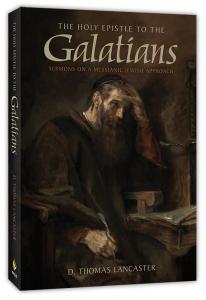
I won’t go through the entire story, which culminated with yet another sermon series of Lancaster’s that eventually became the book The Holy Epistle to the Galatians, but twenty years ago, so disturbed by how the “Messianic Jewish heresy” was describing the continuance of Torah rather than its abrupt death at the hands of Paul, Lancaster called his brother David to get some guidance. Guidance arrived but not in the form Lancaster was expecting. Lancaster quotes his brother as saying about the continuation of the authority of Torah:

Maybe it’s not what we always teach, but that’s the way it’s supposed to be.

But what’s all that got to do with the Book of Hebrews?

Lancaster set the stage for the further study of the epistle (or any Biblical document, really), but that’s not the emphasis of this thirty minute teaching. The emphasis in the first sermon was on the Kal Va-chomer argument or a comparison of two items from the “lighter” or somewhat less significant, to the “heavier” or more significant.

Jesus used this particular method on more than one occasion:

Or what man is there among you who, when his son asks for a loaf, will give him a stone? Or if he asks for a fish, he will not give him a snake, will he? If you then, being evil, know how to give good gifts to your children, how much more will your Father who is in heaven give what is good to those who ask Him! (emph. mine)

Matthew 7:9-11 (NASB)

Galatians by D.T. LancasterLancaster gave a few other examples, both from the Gospel and Talmud of such an argument, including the Parable of the Widow and the Unjust Judge (Luke 18:1-8), which only implies the Kal Va-chomer argument (and seeing that the argument can be implicit rather than explicit is important because a reading of Hebrews 12:18-24 also indicates the Kal Va-chomer argument is somewhat implicit), but the point is that such an argument is not alien to Judaism in general and the teachings of the Master (and apostles) in particular.

Notice something important, though. Lancaster says that in the latter situation in the above example, the generosity of our (good and perfect) Father in heaven, when compared to the earlier situation, generosity of earthly (evil) fathers, the latter does not undo the former. That is, the fact that God is good, perfect, and generous does not invalidate, replace, or cancel the generosity or the status of our human fathers.

Another point to pay attention to is that the first situation, the generosity of imperfect but giving earthly fathers, must be true and have value in order for the second situation, the generosity of the good and perfect Father in Heaven, to be even more true.

Now let’s revisit Hebrews 12:18-24 which compares Mount Sinai and the Torah to Mount Zion and the Messiah. Paraphrasing, and these are my words trying to capture Lancaster’s message:

If you thought it was incredible, awesome, terrifying, and the greatest revelation of God to humanity when God appeared to the ancient Israelites and gave them the Torah at Sinai, how much more so will it be incredible, awesome, terrifying, and an even greater revelation of God to humanity when you confront Mount Zion, the city of the living God, the heavenly Jerusalem, and His myriads of angels?

But the latter doesn’t invalidate the authority, truth, and value of the former, it is just bigger, badder, has more authority, is more true, and has more value.

If the latter invalidated the former, the Kal Va-chomer argument would fall apart and neither situation could be true.

One verse later, the anonymous writer of the letter to the Hebrews uses the same method again:

See to it that you do not refuse Him who is speaking. For if those did not escape when they refused him who warned them on earth, much less will we escape who turn away from Him who warns from heaven.

Hebrews 12:25 (NASB)

If those who received the Torah at Sinai couldn’t escape the consequences of ignoring God, how much less will you escape the consequences of “Him who warns from heaven.”

Lancaster offered other examples of these arguments as presented by Jesus, but I think you get the point. Lancaster is saying that, like the traditional, majority Christian interpretation of Galatians, we have it all wrong about how we understand Hebrews. It took a rather pointed and shocking revelation from his brother David for Lancaster to decide to re-evaluate Galatians from a fresh perspective, setting aside Christian tradition, and interpreting the letter from its original, first century Jewish viewpoint.

Setting aside the traditional Christian interpretation and taking a fresh look at old epistles is one point that Mark Nanos makes about the Galatians letter in his book The Irony of Galatians: Paul’s Letter in First-Century Context. This is the point that Lancaster is making about how we should treat the book of Hebrews, too. It’s the focus of this lecture series, which I imagine will actually start at Chapter 1, verse 1 in the next recording. I’m looking forward to it.

What Did I Learn?

d_thomas_lancasterI learned to shift my perspective when looking at the book of Hebrews, at least Hebrews 12:18-25. As I mentioned above, Hebrews has been a big problem for me. I had been so exposed to the traditional Christian interpretation of this letter, that I couldn’t see any way around its anti-Jewish, anti-Judaism, anti-Torah message, which stood in such opposition to everything else I understand in the Bible. Now Lancaster has given me a basic tool with which to shift that understanding, a new lens with which to look at the text.

The website of Beth Immanuel Sabbath Fellowship, the congregation where Lancaster teaches, contains all of the audio recordings of the Holy Epistle to the Hebrews series (thirty-seven as I write this). Believe it or not, I only listed the highlights of Lancaster’s first sermon. You can listen to “Fire on the Mountain” and the other recordings of his Hebrews teachings on that page at your convenience.

I’ll review the second sermon, “A Word of Exhortation” next week.

Hallelujah!

Beloved of the soul, Compassionate Father, draw Your servant to Your Will; then Your servant will hurry like a hart to bow before Your majesty; to him Your friendship will be sweeter than the dripping of the honeycomb and any taste.

Majestic, Beautiful, Radiance of the universe, my soul pines for your love. Please, O God, heal her now by showing her the pleasantness of Your radiance; then she will be strengthened and healed, and eternal gladness will be hers.

Yedid Nefesh, as quoted from the Siddur

Recently, a friend of mine leant me his copy of a book called Smith Wigglesworth: Apostle of Faith, written by Stanley Howard Frodsham. It’s a short biography of an early Pentecostal evangelist and faith healer who operated in the early to mid-twentieth century.

In reading this book, you’d think that Wigglesworth was a walking, talking, healing vendor. It seems that whoever he encountered in any circumstance, even among crowds of thousands and tens of thousands, he could heal just about anyone of anything with a mere touch. Some of the stories are beyond fantastic, such as a man who had no feet being touched by Wigglesworth and then told to go to a shoe store and buy a pair of shoes. It wasn’t until this man put his stumps into a pair of shoes that his feet miraculously grew back in a few seconds.

I have to admit, while reading the book (I consumed most of it in a single setting), I wasn’t feeling too good and I was reflecting on my own various (though minor) physical discomforts, and wishing that one such person did exist who, through a mighty apprehension of faith, could heal any human deformity, discomfort, and disease.

But it wasn’t the “healing miracles” that impressed me. Assuming that his biographer was accurate and truthful. What I admired about Wigglesworth was his faith and dedication to God. According to the book, he wasn’t in it for the money and never amassed great wealth in the manner you see many televangelists do today. In fact, he tended to (but not always) shun the rich who wanted his healing and gravitate to the poor and the desperate. Of course, Wigglesworth grew up in poverty and hardship and it’s likely he identified with those he helped.

Supposedly, the only book he read was the Bible, which while laudable also seems extreme (as an avid reader, I rather believe that books are good, depending on the material). He also said that while feelings were unreliable, a simple believing faith in God and daily devotional reading of the Bible was necessary. Not exactly the picture you get of Pentecostals from some of their critics.

My friend leant me this book, which was a gift to him from one of his daughters, before he’d even read it himself, because of my recent blog post on healing faith. I think he’s trying to tell me that I’ve limited the “gifts of the spirit,” and if I’m to believe everything written about Wigglesworth, I must be doing so in the extreme.

white-pigeon-kotelBut as I continued reading, while I didn’t always subscribe to the various miraculous claims attributed to Wigglesworth, his love of God and unswerving faith and devotion to the Lord of Heaven did touch me. In the world of the blogosphere, it’s easy to get into your head and forget your soul, as if faith and a life dedicated to God were a mere intellectual exercise, an academic pursuit.

While men like John MacArthur may seek to purge any sort of emotional attachment one might have to God from the realm of the Christian faithful, I don’t think we can truly experience faith as an intellectual pursuit alone. I was reading my morning prayers, which today included Yedid Nefesh, and was particularly taken by the passion of this song. It speaks of a man who longs for God as a deer might pant for water, nearly dying of thirst, begging for even a drop of what returns life, not just to the body but to the soul.

How can someone turn to God, broken in spirit, humbled before Majesty, covered in iniquity, and not feel anything? How can we turn to God at all if we don’t believe He is the lover of our souls?

That’s what impressed me about Wigglesworth.

Although, I wouldn’t give Frodsham’s book as high praise as I find on Amazon, I can see what the other readers are attracted to. While it would be of great benefit today if such healing miracles were available to us through one faithful man of God, it’s not, in my opinion, Wigglesworth’s most defining characteristic, nor the focus of what we should desire.

In fact, I just read a story of a Jewish man who drew ever closer to God in faithfulness, even when he was not cured.

I said in my previous blog post that it is the healing of the sick and injured spirit we should seek above all else. The healing miracles of Jesus and the apostles were used to bring the sick of heart to faith by healing their bodies. Wigglesworth seemed to do something similar, but it is faith, belief, devotion, love and duty to God that is important…for Wigglesworth just didn’t have a believing faith, he acted for the benefit of countless others, that is the crux of who we are as disciples of the Master.

While I was reading, my wife was doing some paperwork and listening to an Israeli Jewish singer named Liel Kolet. Kolet was singing Leonard Cohen’s signature chart “Hallelujah”, which I found myself (softly) singing to myself as I was driving to do an errand later last evening. When I got back home after talking to God, I visited YouTube and listened to Kolet’s interpretation of the song, but found Cohen’s to have more heart. The words weren’t exactly what I was thinking about or feeling, but somewhere between the lyrics and the music, I found my faith rejuvenated.

I can thank Wigglesworth, Frodsham, Leonard Cohen, and especially my friend Tom for that.

I did my best, it wasn’t much
I couldn’t feel, so I tried to touch
I’ve told the truth, I didn’t come to fool you
And even though it all went wrong
I’ll stand before the Lord of Song
With nothing on my tongue but Hallelujah!

Hallelujah!

For Now We See Through A Bible Darkly

John MacArthurWhen Jesus came, everything changed, everything changed.… He didn’t just want to clean up the people’s attitudes as they gave their sacrifices, He obliterated the sacrificial system because He brought an end to Judaism with all its ceremonies, all its rituals, all its sacrifices, all of its external trappings, the Temple, the Holy of Holies, all of it.

-Pastor John MacArthur
“Understanding the Sabbath,” September 20, 2009, posted on the Grace to You blog.
As quoted in Lois Tverberg’s blog post Test Your “Jesus Theories” in the Book of Acts

One of the folks who commented on a recent blog post of mine mentioned that Messianic Jewish/Hebrew Roots blogger Judah Himango had written a particularly illuminating article recently, based on Tverberg’s November 2013 commentary. I finished reading Judah’s write-up, suitably impressed, and clicked the link to his source material.

I really thought I was done with John MacArthur after my final series of reviews on First Fruits of Zion’s (FFOZ) book Gifts of the Spirit. But seeing that Tverberg had quoted MacArthur on her blog, I had to find the original sermon and see the quote in context.

It didn’t make me happy.

As you can probably tell from the above-quoted paragraph, in one fell swoop, MacArthur kills the Torah, the Temple, and Judaism (if not the Jewish people) and summarily replaces them with Gentile Christianity in a lecture I could characterize as one of the more noteworthy flowers in the garden of supersessionism.

I was still going to resist writing about all of this. After all, Judah covered the issues brought up by Tverberg’s blog and expanded on them in a way that would make anything else I had to say on the subject redundant. And I’m sure most cessationists and anyone else who thinks John MacArthur is “the cat’s meow” probably believes by now that I have nothing better to do with my time than to endlessly bash MacArthur, using my blog as a blunt instrument.

I wouldn’t have even put my fingers on the keyboard over all of this if I hadn’t read the following:

In 1982:

“The Bible clearly teaches, starting in the tenth chapter of Genesis and going all the way through, that God has put differences among people on the earth to keep the earth divided.”

– Bob Jones III, defending Bob Jones University’s policy banning interracial dating/marriage. The policy was changed in 2000.

In 1823:

“The right of holding slaves is clearly established by the Holy Scriptures, both by precept and example.”

– Rev. Richard Furman, first president of the South Carolina State Baptist Convention.

In the 16th Century:

“People gave ear to an upstart astrologer who strove to show that the earth revolves, not the heavens or the firmament, the sun and the moon. This fool…wishes to reverse the entire science of astronomy; but sacred Scripture tells us that Joshua commanded the sun to stand still, and not the earth.”

– Martin Luther in “Table Talk” on a heliocentric solar system.

Rachel Held EvansI took these quotes (there are plenty more where they came from) from an article called “The Bible was ‘clear’ …” by Rachel Held Evans.

Here’s part of the commentary summarizing these quotes of various religious, social, political, and scientific opinions, all based on scripture (emph. below is Evans’):

Of course, for every Christian who appealed to Scripture to oppose abolition, integration, women’s suffrage, and the acceptance of a heliocentric solar system, there were Christians who appealed to Scripture to support those things too.

But these quotes should serve as a humbling reminder that rhetorical claims to the Bible’s clarity on a subject do not automatically make it so. One need not discount the inspiration and authority of Scripture to hold one’s interpretations of Scripture with an open hand.

We like to characterize the people in the quotes above as having used Scripture to their own advantage. But I find it both frightening and humbling to note that, often, the way we make the distinction between those who loved Scripture and those who used Scripture is hindsight.

So maybe let’s use that phrase—“the Bible is clear”— a bit more sparingly.

Now let’s compare that to how MacArthur summed up his 2009 sermon on “Understanding the Sabbath”:

Father, we thank You for a wonderful day. We thank You for the consistency of Your truth. We thank You for the Word which opens up our understanding to all things. We’re so unendingly thrilled at the glorious truth of Scripture that comes clear and unmistakable to us. (emph. mine)

I know that MacArthur is big proponent of sola scriptura and the sufficiency of the Bible and, based on that, he believes that any and all conclusions at which he arrives must be air tight and iron clad because after all, it’s not him, it’s what scripture says, right?

But as Rachel Held Evans so aptly illustrated, lots and lots of people have depended on sola scriptura and the sufficiency of the Bible over the long centuries of Church history, and in many cases (such as the “fact” that the Bible supports everything in the heavens orbiting Earth), they were wrong. They were also doing what so many of us in the body of faith do today: use the Bible to support whatever theological, social, political, scientific, or other important ax we have to grind, and after we sharpen the ax, we use it to chop down whoever or whatever we stand in opposition against.

Coffee and BibleNo, I’m not saying that we can’t rely on the Bible, but I am saying that given a good enough reason, we can all go off half-cocked and make the Bible say whatever we want it to say. To be fair, most of us are unconscious to our own process and as such, we actually believe we are being unbiased, unprejudicial, non-bigoted, and completely objective.

More’s the pity.

It’s one thing to constantly investigate yourself and your opinions to verify and re-verify that what you believe isn’t too heavily colored by whatever filters you happen to be wearing over your eyes (and we all wear some), and it’s another thing to be so sure that you aren’t wearing any filters at all, that any of your opinions, because they’re “based on the Bible” must be the truth because “the Bible is clear” on the subject.

Usually, “the Bible is clear” when we “discover” it says something that exactly maps to some long-held belief that provides us comfort and confirms our own identity and convictions. We don’t like it when the Bible contradicts us and says something clearly that we don’t want to be true. Maybe that’s the real litmus test of Biblical interpretation, when we let what the Bible says show us what we need to believe rather than the other way around.

Prologue to the Irony of Galatians

The Irony of GalatiansFinally, I want to acknowledge the victims of certain interpretations of Paul’s voice, especially those who have suffered the Shoah. Their suffering cannot be separated from the prejudices resulting from those interpretations any more than it can be wholly attributed to them. To them I dedicate the effort represented in this book.

-Mark D. Nanos
from the Acknowledgments, pg ix
The Irony of Galatians: Paul’s Letter in First-Century Context

Such a strange way to end a series of acknowledgments for a book. The author usually thanks his/her publisher, editor, spouse, and whoever else contributed to or who were sometimes inconvenienced by the author’s writing of the book. Occasionally, religious people will thank God, their congregation, and so forth, in addition to the “usual suspects.” Having written a few books myself (though not in the religious studies space), I know the author’s side of composing acknowledgments.

That said, I normally blow past the acknowledgment page quickly when I get a new book in my hands, but something told me to slow down a bit before getting to the “meat” of the content. What we have here is a suggestion that the traditional way Paul has been understood by Christian interpreters has, in some manner or fashion, contributed to the injury of the Jewish people, including the most glaring injury in recent history, the Holocaust. There have been two injustices committed by the “consensus view” of Paul which includes his letter to the Galatians: a gross misunderstanding of Paul himself and his missives to various First Century churches, and as a result of that misunderstanding, a terrible injustice to Jewish people across the last nearly two-thousand years of history.

That’s a heavy burden to place upon collective Christianity, but it’s not a burden that is undeserved, nor is it one that cannot be lightened. What is needed is a fresh reading of Paul from a First Century Jewish context.

While Nanos states in the book’s Prologue that he attempts to make no direct comparison between the Paul of Galatians and how Nanos depicted Paul in his previous book The Mystery of Romans, I don’t doubt that I’ll be making the comparison anyway, considering my several recent reviews of that work. After all, we are talking about the same human being, and unless Paul received a “personality transplant” between writing one letter and the next, he should be transmitting the same basic understanding of the role of Jews and Gentiles in the Jewish religious stream once known as “the Way.

Because the prevailing interpretations have probed Paul’s text without sufficient appreciation of the powerful role of ironic inversion at work, at the formal as well as functional level, the interpretation of the apostle’s scathing rhetoric has exaggerated and, regardless of other plans, continues to accentuate the differences that are imagined to separate Christian and Jewish identity, behavior, and even intentions toward God and neighbor. The legacy of this perception of the Jewish other has proven often tragic for the Jewish people, at least in a world that has been often dominated by those who look to Paul to shape reality, and for others, as a foil to justify their twisted construal of what is right.

-Nanos, Prologue, pg 2

This reads more like an indictment than, as Nanos puts it, a project that “represents a revised and expanded version of (his) Ph.D. dissertation…in 2000.” There’s a sense that Nanos has more invested in this project than simply a serious and scholarly re-investigation into the traditional interpretation of Paul relative to ancient and modern Christian and Jewish relationships and identities.

No interpretation is independent of context, that realized or assumed for the original author and audience, and that of the interpreter him-or herself. I am a product of many factors, not the least the long shadow of the Holocaust, which claimed so many Jewish people, my people, as well as exposure to critical tools now available to the interpreter.

ibid, pg 4

PaulNanos goes on in the Prologue to compare the “Consensus View” which he states has “not changed that significantly in the history of Christian interpretation” to his perspective which he calls “The Irony of Galatians,” characterizing Paul’s letter as an “ironic rebuke”. He challenges the consensus view of Paul as Law-free and in opposition to Jewish Law (Torah) and religiously obedient Jews, which is an interpretation of Paul’s message in Galatians that has been “undeniably colored by the interpreter’s understanding” rather than “producing a disinterested portrait” of the subjects of the letter, “considering their identity, motives, messages, or methods on their own terms.”

Of course, we have to consider that Nanos, in partially attributing Shoah and the murder of six million of his people to the traditional interpretation of Paul renders him less than completely objective, but then again as Nanos has already alluded, no one fails to bring something to the table when interpreting the Bible. In the book’s Prologue, Nanos leaves it up to the reader to determine if he has “constructed a probable context for interpretation of Paul’s voice…”

I know a fellow who is quite an erudite scholar and it is his opinion that more often than not, a book’s prologue may contain enough of the contents of the book itself to tell the entire story, sort of how some movie trailers give away most or all of the story of the films they are advertising. This may also be true of Nanos’ “Irony,” but not having cracked even the first page of the first chapter yet (as I write this), I’ll have to wait and see.

On the other hand, Nanos does reveal that he considers the “influencers” to also be Galatians and Jews who have a certain responsibility to initiate the Gentiles in the Galatian synagogues into their entry into Judaism. If these influencers were like those Jewish people we encounter in Acts 15:1-2, we may be seeing a heavy bias in the non-believing and believing Jewish communities in the days of Paul toward the proselyte ritual as the only means by which a Gentile may enter “the Way.” That makes Paul’s Galatian letter, according to Nanos, an “ironic rebuke” to the Gentile readers and an intra and inter-Jewish communal dispute between Paul and the Jewish influencers.

As I read in Nanos’ “Romans” book, he continues to depict Paul as Torah-observant, which only makes sense, given that Paul wrote that a Gentile being circumcised and converting to Judaism is obligated to the full yoke of Torah (Galatians 5:3). Being Jewish then, by definition, would mean that Paul considered himself as obligated to said “full yoke” of Torah in the same manner as his fellow believing and unbelieving Jews.

Paul is himself an example of status and observance, and his message in this letter does not abrogate the identity or observance of Torah for Jewish people (i.e. Israelites) in the least but is instead predicated upon their continued validity for himself and other Jewish members of this movement.

-Nanos, pg 9

The remainder of the prologue covered a summary of each of the three parts of the book and what the reader can expect to discover. What remains are the detailed arguments presented by the author, which I have yet to experience.

For the “Romans” book, I reviewed the material almost chapter by chapter in some cases, and I have a tendency to write book reviews in parts, often before I’ve completed my reading of the entire work. I don’t know if I’ll do that here since such an analysis takes a fair amount of time. On the other hand, it’s difficult in just a few sentences, to impart complex ideas and descriptions accurately when presented in a “book-length” form. Also, as much as I report for the sake of my audience, I write these blogs to process my own experience as I encounter new thoughts and concepts, so the level of detail in which I engage is sometimes more for me, the writer and learner, than it is for you the reader. Of course, my benefit is also your benefit as long as you don’t mind having to consume the output of my internal dialogue.

Mark NanosSince I’ve liberated myself from having to produce daily morning meditations, I can’t say when the next installment of my review on “Irony” will be written, but know, compulsive blogger that I am, that it will appear before too long. Galatians is one of my Biblical “pet peeves” along with the traditional Christian interpretation of Paul as either suffering from multiple personality disorder or as a liar and hypocrite.

I’m searching for an interpretation of Paul’s letters that renders him sane, internally consistent, consistent relative to his personal history as an observant Jewish Pharisee, and as a living expression of generations of Torah-observant Jews who came before him, worshiping the God of his fathers, obeying the Torah, and honoring the Temple, all within the context of a zealous faith in the Jewish Messiah. No other Paul makes sense, and a Paul (as the Christian consensus view defines him) who is mentally ill, a duplicitous liar, or a two-faced hypocrite makes the apostle completely disingenuous and an unreliable author of the majority of the canonized New Testament.

So much for the Christian faith if the consensus view is true.

I can only take Paul seriously if I can find another way to hear his voice. I believe I have found that sane and reliable Pauline voice. Now I want to see how that voice speaks in Paul’s letter to the Galatians.