Category Archives: Uncategorized

What’s Important Now?

When you try to help others and they don’t listen to you, you have a choice. You can say “it’s impossible to help them” and blame them for not being more open. Or you can view the situation as your own lack of proficiency at influencing and motivating others.

A blame-free attitude is the best path to choose. This can motivate you to develop your skills and talents on how to persuade, influence, and motivate. It could be that what you said is exactly what this person needs. As you enhance your presentation skills, in the future you will influence others to follow your beneficial suggestions.

-Rabbi Zelig Pliskin
“Develop your Motivational Skills”
Daily Lift #570
Aish.com

Oh my! This could be applied to every blogger who has ever tried to convince (often in vain) an audience why their point of view is correct and why his/her audience should change their minds and adopt the blogger’s perspective/belief/faith/whatever.

Really, how many blogs and how many comments on those blogs are specifically dedicated to the blogger blaming the audience (or at least those people in the audience who disagree with him/her) for being blockheaded, stubborn, ignorant, and “impossible to help?”

More than I can count, I’m sure.

So what should we do with this piece of advice? Should we redouble our efforts as bloggers, assume that our presentation skills are lacking somehow, and focus on how better to “influence others to follow our beneficial suggestions” in future blog posts?

Is Rabbi Pliskin’s advice here the answer?

A person who feels joy when performing mitzvahs will forget all his suffering and misfortunes. In comparison to becoming closer to the Almighty, of what import is pettiness and trivialities?

A person who experiences joy in doing good deeds will feel greater joy than a person who finds a large sum of money. Why should a person expend his efforts trying to find happiness in areas where the basis is transient and ultimately meaningless, when he has a far better alternative?

I suspect it is the answer, if we were to take Rabbi Pliskin seriously and actually apply his suggestion to our lives in a consistent manner. Unfortunately, we who continue to participate in the blogosphere, either as active bloggers or the observers who don’t blog but who frequently comment on the blogs of others, take ourselves way too seriously (me included). This is true in spite of the fact that there are probably well over 181 million blogs in the world right now. As far as U.S. bloggers are concerned, our “right” to have our say and express our opinion seems to have reached crazy, chaotic, out-of-control proportions, thanks to cheap, high-speed Internet access and the ability to create a blog for absolutely no cost in just a few minutes.

So what’s the answer, what’s the answer, what’s the answer?

I’d like to say “turn it all off,” but I know how difficult that would be in my own case, so I can hardly make that suggestion to others. But Rabbi Noah Weinberg, of blessed memory, makes that exact suggestion, at least in part.

Imagine someone calling you an idiot. Or that you’re stuck in traffic. Or that the boss is hassling you.

When this happens, you can become angry and caught up in the pettiness of life.

The remedy? Take a moment to go outside and walk under the stars. When you witness the vastness of the universe, it puts things into perspective. When you come back inside, you won’t be starry-eyed. You’ll be energized. You’ll say, I’m sorry. Let’s forget it and move on.

Awe helps release you from the limits of the body. You are suddenly in a world of different dimensions, transported into the eternity of beauty, power, majesty. You’ve got an expanded perspective. It’s no longer me versus you. We’re all one. So why be aggravated?

Awe carries us beyond ourselves. In times of war and tragedy – as well as prosperity and joy – people get “bigger.” They treat each other nicer. Pettiness is forgotten.

Anytime you’re in a rut, blast yourself out. Take a walk under the stars. This will unleash the power. You cannot be bored or petty when you are in awe.

The ultimate source of awe is, of course, God. Since we often can’t directly experience God, we usually must “settle” for experiencing the reminders of Him that He has left for us; that is, His universe, His creation.

It’s ironic that when we compare ourselves to the vastness of God and His Glory, we feel very small, and humbled, and yet at the same time, grateful and even exhilarated. We don’t feel jealous that God is so big and we are so tiny. We don’t resent God for being omnipotent while we are so powerless.

And yet let another human being or another group of people claim some heritage, some experience, some relationship that we ourselves don’t have access to, and suddenly we’re deeply envious, hurt, and outraged. We feel victimized. We feel as if our “rights” have been violated. Why can’t we have the same access to what “those people” claim is uniquely theirs?

Yes, of course I’m talking about the current (and seemingly endless) debate between certain corners of Christianity which can be thought of as “Hebrew Roots” or more specifically “One Law” and the various Judaisms, including “Messianic Judaism.”  The struggle is fueled by those who find in the Bible the justification for “One Law” Christians to have the “right” to everything that God granted Israel as a perpetual gift at Sinai, which is the heritage of every Jew on earth today. Naturally, when Jewish people hear such rhetoric, they tend to “push back.”

I suppose this too is an “issue” that we people who were born and raised in the West and specifically in the U.S. have to deal with, since “our rights” are all we tend to think about (or is that “our entitlements?”) relative to what other people have that we want.

But what should we have learned by now as people of faith? What did Jesus teach? To claim our rights? To take what wasn’t given to us? What did he teach that we seem to be forgetting?

“When the Son of Man comes in his glory, and all the angels with him, then he will sit on his glorious throne. Before him will be gathered all the nations, and he will separate people one from another as a shepherd separates the sheep from the goats. And he will place the sheep on his right, but the goats on the left. Then the King will say to those on his right, ‘Come, you who are blessed by my Father, inherit the kingdom prepared for you from the foundation of the world. For I was hungry and you gave me food, I was thirsty and you gave me drink, I was a stranger and you welcomed me, I was naked and you clothed me, I was sick and you visited me, I was in prison and you came to me.’ Then the righteous will answer him, saying, ‘Lord, when did we see you hungry and feed you, or thirsty and give you drink? And when did we see you a stranger and welcome you, or naked and clothe you? And when did we see you sick or in prison and visit you?’ And the King will answer them, ‘Truly, I say to you, as you did it to one of the least of these my brothers, you did it to me.’ –Matthew 25:31-40 (ESV)

Did Jesus “teach Torah?” Absolutely! What else would a Second Temple period itinerant Rabbi teach to the “lost sheep of Israel?” Did he expect his disciples to take his teachings and pass them on through imitation and active “preaching?” Absolutely! That’s what disciples do. Do we see Jesus overtly teaching Jewish covenant signs and identity markers to his Jewish audience? Not as such, since each Jew in Roman-occupied “Palestine” would have been raised from birth to know all these things. In other words, for a Jew in that place at that time,  knowing how to tie tzitzit would have been a “no-brainer.”

So what did he teach and what did he expect his Jewish disciples to pass on to the disciples from the nations? (Matthew 28:18-20) What were his most important commandments?

A new commandment I give to you, that you love one another: just as I have loved you, you also are to love one another. –John 13:34 (ESV)

Jesus replied: “‘Love the Lord your God with all your heart and with all your soul and with all your mind.’ This is the first and greatest commandment. And the second is like it: ‘Love your neighbor as yourself.’ All the Law and the Prophets hang on these two commandments.” –Matthew 22:37-40 (ESV)

That takes us right back to what Rabbi Pliskin said earlier:

A person who feels joy when performing mitzvahs will forget all his suffering and misfortunes. In comparison to becoming closer to the Almighty, of what import is pettiness and trivialities?
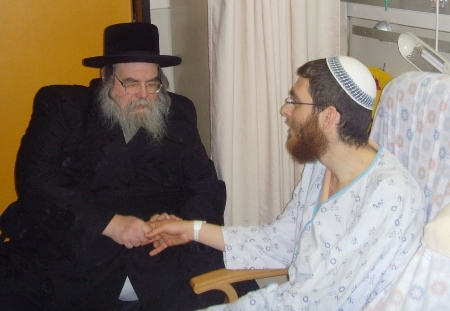
It’s pointless to fuss and argue over God and His special relationship with the Jewish people. After all, God gave the nations of the world the most precious gift possible; the life of His one and only son, the unique one, the Messiah, who died so that our sins could be forgiven and who lived so that we could have eternal life with the Father as His own sons and daughters.

The next time someone says something outrageous about religion (or anything else) on the Internet and you want to fight back and stand up for your rights, step away from the keyboard. Go outside. Experience the awesomeness of a thunderstorm or the magnificence of the starry, starry night. Perform a mitzvah such as visiting a sick friend in the hospital or donating a few canned goods to your local food bank. Retire into a quiet place and pray, turning your heart away from your own small concerns or hurt feelings and turning your spirit toward God.

After you have done that, ask yourself, “What’s important now?”

Do I need to take my own advice? Yes. Fortunately, Shabbat is coming up. When sundown approaches, I can put away the Internet and return my heart and spirit more fully to the God of all creation, may His Name be blessed eternally and without end.

Taking the Next Step

“You shall love your God” means that you should make the Divine Name beloved.

Yoma 86a

Rabbi Shimon ben Shatach once bought a donkey and found a gem in the carrying case which came with it. The rabbis congratulated him on the windfall with which he had been blessed. “No,” said Rabbi Shimon, “I bought a donkey, but I didn’t buy a diamond.” He proceeded to return the diamond to the donkey’s owner, an Arab, who remarked, “Blessed be the God of Shimon ben Shatach.”

A non-Jew once approached Rabbi Safra and offered him a sum of money to purchase an item. Since Rabbi Safra was in the midst of prayer at the time, he could not respond to the man, who interpreted the silence as a rejection of his offer and therefore told him that he would increase the price. When Rabbi Safra again did not respond, the man continued to raise his offer. When Rabbi Safra finished, he explained that he had been unable to interrupt his prayer, but had heard the initial amount offered and had silently consented to it in his heart. Therefore, the man could have the item for that first price. Here too, the astounded customer praised the God of Israel.

We have so many opportunities to demonstrate the beauty of the Torah’s ethics. We accomplish three mitzvos by doing so: (1) practicing honesty, (2) kiddush Hashem (sanctifying the Divine Name), and (3) making the Divine Name beloved, according to the above Talmudic interpretation of the Scripture.

Today I shall…

try to act in a manner that will make the Divine Name beloved and respected.

-Rabbi Abraham J. Twerski
“Growing Each Day, Elul 15”
Aish.com

Easier said than done.

Yeah, kind of shocking that I should say that, isn’t it? It’s easier to say that I shall love my God and make the Divine Name beloved than to actually live out those words on a day-to-day, moment-to-moment basis.

Intention is wonderful, but real life and human nature tends to get in the way much of the time. That’s why we aren’t all tzaddikim (Righteous Ones), for only a truly righteous person who is close to God can maintain a consistent lifestyle of graciousness, humility, and kindness. The rest of us tend to get tripped up time and again by our emotions, our faults, and our bad habits.

We also get tripped up by our ambitions and most of us, in planning ahead (which isn’t necessarily a bad thing), tend to keep our eyes on the end goal at the expense of looking where we’re placing our foot and what (or who) we may be stepping on.

This one a long time have I watched. All his life has he looked away… to the future, to the horizon. Never his mind on where he was. Hmm? What he was doing.

Yoda

A man came to the town of Krasny, Russia, and publicized he would balance himself on a rope tied on both sides of a river. Rabbi Chaim Krasner, a disciple of the Baal Shem Tov, brought some of his students to watch the man perform. Rabbi Chaim’s students, noticing how their teacher concentrated deeply on the man, asked why it caught his interest.

“I was contemplating how this person puts his life in danger to walk across the rope. If he would think about how much money he will receive for his act, he would surely slip and fall. The only way he can keep his balance is to free his mind from every other thought, and concentrate completely on each step. If his mind would wander for even a moment, he would fall into the river. That is the level of concentration we too must master.”

-Rabbi Zelig Pliskin
“Concentrate on your Next Step, Daily List #567”
Aish.com

Whether you prefer to rely on Yoda or Rabbi Chaim Krasner, the essential message is the same. While we have always been taught to keep our eyes on the goal, which for Christians is the person of Jesus our Lord, we must still be mindful of each step we take in order to walk a straight path to that goal. The tightrope walker wants to make it to the other end of the rope, but if he doesn’t concentrate on where he’s placing his feet each step of the way, even with his eyes on the goal, he’ll never make it.

I’ve talked before about how we can twist a particular religious or educational practice into an excuse to be hurtful and denigrating of others. And as we saw in the testing of our Master in the desert, even the Adversary can use Scripture to accomplish an evil purpose.

The ends do not justify the means. If they did, then it would be appropriate to murder an abortion doctor in order to prevent the killing of unborn children. God does not sanction the breaking of His own laws in order for us to create the illusion that we’re serving Him. It’s not just the goal that’s important, it is what we do with every moment of our lives to achieve the goal. If we feel we need to hurt another human being in order to get to where we think God wants us to be, we’ve already failed.

From my father’s guiding instructions: Keep away – to the ultimate degree – from a campaign of attack. Not because we lack the means of prevailing or because of timorousness, but because we must consecrate all our strength exclusively to strengthening our own structure, the edifice of Torah and mitzvot performed in holiness and purity. To this we must devote ourselves utterly, with actual mesirat nefesh, (self-sacrifice) not merely with potential mesirat nefesh.

“Today’s Day”
Tuesday, Elul 14, 5703
Compiled by the Lubavitcher Rebbe
Translated by Yitschak Meir Kagan
Chabad.org

Keep your eyes on the goal but be aware of where you’re stepping. Concentrate, not on repelling the perceived “attacks” of others, but on strengthening your own morality and spirituality. Rely on God so that you can learn to be reliable to others. Seek peace with God so that you can be a source of peace to everyone around you. Behave in a manner, even toward your “enemies,” that honors the Name of God so that you too can be considered honorable.

To do otherwise desecrates the Divine Name, ruins your reputation with others, and leads to your own downfall.

What Are The Jewish Covenant Signs?

Question:

I have a few Jewish friends who wear kippahs and sometimes when I’m hanging out with them I feel out of place. Even though I am not Jewish, would there be any problem with me wearing a kippah, too?

The Aish Rabbi Replies:

Well, on one hand, the Pope wears a kippah.

But on the other hand, a non-Jew should not wear a kippah, since that might deceive others into thinking that he is Jewish.

In practice, non-Jews will sometimes wear a kippah while attending a Jewish religious function (many world leaders have been photographed at the Western Wall wearing a kippah), but in general a non-Jew should not wear one, due to the confusion it may cause.

However, since the idea of a kippah is to have the head covered as a reminder of God, you could certainly use some other head covering, like a cap, to serve that purpose.

from Ask the Rabbi
“Kippah for a Non-Jew”
Aish.com

At last spring’s First Fruits of Zion Shavuot Conference during a question and answer session, a gentlemen in the audience said that he sometimes will visit churches wearing a kippah and tallit gadol as a “witness” to the Christians of the permanency of the Torah mitzvot. The person in question isn’t Jewish and when asked at church, will admit he is not Jewish but that, in his opinion, the mitzvot pertaining to wearing tzitzit and many others, apply equally to the Christian as to the Jew based on our discipleship under the Jewish Messiah King.

The reaction from the speaker at the event (I can’t recall who was speaking at that particular moment) was that this behavior introduces a great deal of identity confusion if Christians start dressing like Jews just to make a point. Reading the “Ask the Rabbi” topic I quoted above reminded me of that interaction and confirmed that Messianic Judaism and more traditional Judaism share the same perspective on Gentiles wearing Jewish “sign” markers.

I’ve often heard various Jews in the Messianic movement object to Gentiles wearing tzitzit, keeping Shabbat, and (apparently) observing the kashrut laws, as violating the “sign markers” that specifically identify Jewish people and their covenant relationship with God. The “pushback” I’ve read from One Law proponents and some others in the Hebrew Roots movement is that there’s a great deal of confusion about what Torah mitzvot is and isn’t permitted Gentile Christians, so how can anyone be held accountable to what may or may not be permitted?

From a more traditional Jewish perspective, I suppose the matter is more clear-cut, but in terms of the Messianic Jewish view on the matter, things seem a tad more indistinct. Some more “hard-line” folks in Messianic Judaism seem to believe that Gentile Christians should stay in their (our) churches and behave in no way whatsoever that resembles a Jew. Others, such as the fine folks at First Fruits of Zion (FFOZ), state that many and even perhaps most of the mitzvot are permitted a Gentile, but the vast majority of them are not actual covenant obligations for us.

Opinions seem to vary widely and that’s where the confusion comes in. If you are a Gentile Christian but are attracted to the beauty and wonder of the Torah mitzvot, and you want to express a high level of respect toward Jews and Judaism, what is allowed and what is not permitted?

My personal response, and out of respect for my Jewish wife, was to put away just about everything, my kippah, my tallit, my tefillin, and to abstain from reciting virtually all of the Hebrew prayers (I still keep a siddur on my nightstand, however).

But if I wanted to explore what a Gentile might be allowed that normally is considered “Jewish,” then where are the boundaries and limits, or are they clearly defined at all?

In my search, (which has been rather brief so far) I actually didn’t find much.

In general, a brit refers to a covenant–a pledge of obligation between two parties which is sometimes accompanied by a token signifying the brit. Historically, there have been three signs that point out the three major covenants between God and people.

The first is Shabbat, which was given to serve as a sign of creation: “The Israelite people shall keep the Sabbath, observing the Sabbath throughout the ages as a covenant for all time: it shall be a sign for all time between Me and the people of Israel” (Exodus 31:16-17).

The second is the rainbow, which was given to symbolize the renewal of mankind after the Noah flood: “God further said, `This is the sign that I set for the covenant between Me and you, and every living creature with you, for all ages to come. I have set My bow in the clouds, and it shall serve as a sign of the covenant between Me and the earth. When I bring clouds over the earth, and the bow appears in the clouds, I will remember My covenant between Me and you and every living creature among all flesh, so that the waters shall never again become a flood to destroy all flesh’ ” (Genesis 9:12-15).

And the last is [circumcision], which was established as the sign signifying the beginning of the Hebrew nation: “Such shall be the cove­nant between Me and you and your offspring to follow which you shall keep: every male among you shall be circumcised. You shall circumcise the flesh of your foreskin, and that shall be the sign of the covenant between Me and you” (Genesis 17:10-11).

Circumcision came to be regarded as the unique sign of our covenant and gradually emerged as a physical symbol of a child’s joining the com­munity of Israel.

-by Rabbi Michael Strassfeld & Sharon M. Strassfeld
“Three Biblical Signs of Covenant”
Aish.com

Really? Just three? Surely that can’t be it.

The Rainbow, circumcision, and Shabbat.

First off, the sign of the Rainbow that God presented to Noah applies to all of humanity, not just the Jewish people so that leaves only two that are specifically Jewish: circumcision, or the brit milah, and Shabbat.

This is my covenant, which you shall keep, between me and you and your offspring after you: Every male among you shall be circumcised. You shall be circumcised in the flesh of your foreskins, and it shall be a sign of the covenant between me and you. –Genesis 17:10-11 (ESV)

Therefore the people of Israel shall keep the Sabbath, observing the Sabbath throughout their generations, as a covenant forever. It is a sign forever between me and the people of Israel that in six days the Lord made heaven and earth, and on the seventh day he rested and was refreshed.’”-Exodus 31:16-17 (ESV)

That would seem to leave the field wide open for Gentiles to observe Torah mitzvot that are not signs of the covenant between God and the Jewish people.

But is it really that simple? Of course, not.

As the Aish Rabbi pointed out, even wearing something as simple as a kippah, which is not overtly commanded in the Torah, can create “identity confusion” as far as Jews, Christians, and everyone else are concerned.

Jewish in JerusalemA few “Messianic Gentiles” dress frum but that really isn’t such a problem. It’s more likely to see certain non-Jews wearing tzitzit, either attached to a tallit katan or far more inappropriately, on their belt loops.

I don’t know if it’s a crime, a sin, or just embarrassing to be a Gentile and to deliberately create the impression that you’re Jewish, (even if that’s not your exact intension) but it sure does mess with people’s heads as far as who a Jew is and isn’t.

However, I have to be fair and say that the Messianic Jewish movement doesn’t appear to have a very firm set of standards as far as behaviors that represent “covenant signs” telling non-Jews in the Messianic/Hebrew Roots movement what to avoid (that is, if the non-Jews choose to show respect to Jewish people).

If such standards exist and I’ve just missed them, I’d appreciate it if someone could point me in the right direction. If they don’t exist, maybe it’s time someone got around to addressing this issue. If at least some folks are going to make an issue of Gentiles and Jewish covenant signs, then we should all be able to point our fingers to a set of standards that defines what we’re all talking about.

Comments?

In Your Prayers

PrayingMoshe was going to die before entering Eretz Yisroel. Yet, his tefillos were answered, and he was given permission to view the holy land, and to see a vision of the land and the history of the Jewish people. When this consent was granted, the verse seems to use a double expression. First, Moshe was told “lift up your eyes”. This directive was followed with the instructions “and see”, which apparently is the obvious purpose of his having lifted up his eyes.

One of the objectives of tefillah is for a person to arrive at an understanding that “the ways of Hashem are correct”, and that everything Hashem does is for the best. This appreciation is realized when one’s prayers are directed toward building a relationship with Hashem, a devotion based upon trust. When a person seeks out Hashem, he arrives at a state of (Tehillim 34:11): “those who seek Hashem will not lack any good.” Finally, through prayer a person achieves the ability “to see – וראה ” and to feel a sense of tranquility and satisfaction in his heart to truly accept all that Hashem does as perfect.

When Moshe ascended to the mountain and looked across at Eretz Yisroel, this might have seemed as if his prayers were not fulfilled, contrary to what the Gemara says. Yet, at this point, Moshe’s degree of perception of the will of Hashem was complete. He now felt totally accepting of the decree for him not to enter the land, and he perceived how this was for the best. He was now satisfied that there could be no better answer to his prayers other than to obey the command for him to remain on the east side of the Jordan, and not to enter the land.

גדולה תפילה שהרי משה נענה … שנאמר עלה ראש הפסגה
“Davening – Lift your eyes and see”
Daf Yomi Digest
Distinctive Insight
Berachos 32

What I’m going to say has been said before, I’m sure. In fact, I’m sure that at some point, I said all this before, too. And yet, to read this “insight” on Berachos 32 and to consider the life and impending death of Moses is just to precious and important not to share.

I can’t even begin to imagine the heartbreak Moses must have experienced at being allowed to view the entire Land of Israel, and yet knowing that instead of being allowed to lead his people into the Land, he was going to die. He was going to have to let Joshua take over his work. Most of all, he was going to have to trust God in a way that he never had before.

Think about it.

All of the times when God was about to wipe out the Children of Israel, Moses was there to intervene on their behalf. When tens of thousands were dying of a plague or poisonous snake bites, Moses prayed. When the Children of Israel were at war and losing a battle, Moses prayed. The Children of Israel survived down to the last man, woman, and child because Moses was there to protect them, even from God.

And now he is looking across the expanse of the Land of promise and he knows that whatever happens after this point, he won’t be there to protect his people anymore.

What a bitter day it must have been for him.

And yet, according to the Midrash, Moses was able to finally arrive at a sort of peace about everything. After all, what choice did he have? But then, what choice to we have?

I’ve talked about trusting God before and I’m sure I mentioned that it isn’t easy. It isn’t easy when you desperately need a job and you are trusting God to provide sufficiently for your family until you find suitable employment. It isn’t easy to watch your wife undergo yet another round of chemotherapy, never knowing what the outcome will be and if the tumors will shrink or grow. It isn’t easy living a life that presents only the illusion of control over every critical detail, and realizing that an invisible and almost always silent God is the one who opens His hand and provides for your every need.

But when Moses looked over the Land of Israel for the first and last time, knowing his lifespan was measured only in minutes, he understood and was “satisfied that there could be no better answer to his prayers other than to obey the command for him to remain on the east side of the Jordan, and not to enter the land.” If only that sense of satisfaction and grace could be experienced by the rest of us.

A person who learns to pray properly can understand what the words of the Chazon Ish in “Emunah Ubitochon”:

“When a person merits becoming aware of the reality of the Almighty’s existence, he will experience limitless joy. His soul is enveloped in sanctity, and it is as though the soul has left the body and floats in the upper Heavens. When a person transcends to this level, an entirely new world is open to him. It is possible for a person to be momentarily like a celestial being, [while at the same time] in this world. All of the pleasures of this world are as nothing compared to the intense pleasure of a person cleaving to his Creator.”

Rabbi Zelig Pliskin
“Cleave to the Almighty in Prayer, Daily Lift #565”
Aish.com

Journey to Reconciliation, Part 1

Had the Hebrew roots movement started off on a different trajectory, there would never have been a need for me to say this. To most Christians, saying that “the Church is good” will sound ridiculous in its self-evidence. Yet the Hebrew roots movement’s rhetoric against Christianity and the church as been escalating for years and shows no signs of abating. For someone who is just learning about the movement, this rhetoric is often an immediate turn off – and rightly so. There is nothing anti-Christian or anti-church about the authentic core message of the Jewishness of Jesus.

-Boaz Michael,
President and Founder of First Fruits of Zion (FFOZ)
from an early manuscript his forthcoming book “Tent of David”

I had only been a Christian for a few years when I was introduced to the Hebrew Roots movement. I probably wouldn’t have entered the movement at all if not for my wife’s involvement (which she has long since exited). I was just finally getting comfortable in my church. I was just beginning to feel like I was fitting in. I was more at ease about participating in discussions in Sunday school. I had been asked to be one of the ushers during services. I was making friends. I felt like I belonged.

But through a long string of circumstances (not unlike the long string of circumstances that resulted in me becoming a Christian after the age of forty), I started attending a “Messianic Jewish” congregation. This was in the late 1990s and frankly, I didn’t know Messianic Judaism or Hebrew Roots (related concepts, but not the same thing) from anything else. But it was new and exciting and they said and taught such amazing things about Jesus, or rather “Yeshua” as he’s referred to in Hebrew. Everyone was nice (just like at church) and it was a small enough venue to where I could meet and get to know everyone fairly quickly.

But among the things I learned about was that our hands are stained with blood. More to the point (and I’m borrowing that phrase from Michael Brown’s somewhat famous book on the topic), the church is stained with blood; Jewish blood.

I won’t take this opportunity to recount to you the long and troubling history of the Christian church, especially in how it treated the Jewish people, the pogroms, the inquisitions, the spreading of the vast net of supersessionism across the world, the frightening twists of such a theology that in part, made the Holocaust possible. Others have chronicled all of this information exacting detail. I have no need to do so here.

But back then, I had no idea.

I began to realize that although I maintained my faith in Jesus, the method of my introduction to the Jewish Messiah occurred in a place that was actively opposed to his being Jewish. It was actively opposed to the Jewish people. It taught that the Jews were no longer the chosen ones of God and that they had been replaced by the Gentile Christians. How could I possibly stand for that? My wife and three children are Jewish.

It was a horrible realization.

So I went to a “congregation” and not a church. I was a “Messianic Gentile,” not a Christian. I only called the Jewish Messiah “Yeshua,” never Jesus. I wore a kippah when I went to worship and donned a tallit gadol when I entered into prayer. I haltingly prayed in very bad Hebrew using photocopied pages of a transliteration of the prayers. I only read the Apostolic scriptures (never calling it the “New Testament”) using David H. Stern’s The Complete Jewish Bible. I read the Tanakh, not the “Old Testament.”

My departure from my old church wasn’t clean. We still attended both congregations. My kids were very well-integrated into the church’s youth group and it would have been difficult to just abruptly detach them from the relationships they had there. I started to talk to my Christian friends about Yeshua, and the Torah, and Moshe, and how Paul was really “Rabbi Shaul” who taught the Gentile disciples to obey Torah.

I was treated politely but the distance began to grow between me and the people who I had just started to feel comfortable around. It didn’t help that the church was going through an upheaval at the time. The board had dismissed the Pastor for not “growing” the church to their ambitions (I still remember Pastor Jerry very fondly) and they hired a dynamic (but not nearly as personable) Pastor who had a degree in “church growth” or something like that. I disagreed with their methods and their reasoning and the rift between me and the church I had come to faith in expanded, finally to the breaking point.

This did nothing but add to the rather negative impression of Christianity I was learning from the Hebrew Roots congregation I was also attending.

I want to make it clear at this point that no one in the Hebrew Roots congregation was hostile or aggressive in terms of Christians, Christianity, or “the church.” They were (and are) all people of good will and faith who sincerely believed everything they were saying. But part of what they were saying is that traditional Christianity had gone astray and was leading many innocent people down the wrong path. The only hope was to leave the church and to form Hebrew Roots congregations that were more in keeping with Torah and the teachings of Yeshua, our Master.

I learned a great deal about Yeshua, Torah, Moshe, and my responsibilities to the mitzvot of God from FFOZ’s Torah Club as it existed back in those days (a lot has changed since then).

I won’t try to describe everything that’s happened in the last twelve years or so. Suffice it to say, I’ve changed quite a bit. I’ve spent a long decade plus investigating, examining, and growing in my faith. At this point in my life, just a few years shy of sixty, I realize how very little I really understand.

Christianity is slowly changing. I know several Pastors of Christian churches who have realized that the replacement theology that has typically been represented and taught in churches is not a sustainable doctrine. They are, much like Anglican priest Andrew White, realizing that we cannot be Christians without knowing that the root of our faith resides in the Jewish people and in Judaism. But that doesn’t mean we have to abandon our churches and our Sunday schools and “reinvent” our faith by creating new congregations which borrow from Jewish religious practices, customs, and identity markers.

I don’t disdain the people in my former Hebrew Roots congregation. I still am friends with them, though we don’t often see each other. I continue to believe that they are pursuing their faith, the Messiah, and the God of Israel in an honest, sincere, and holy manner. The congregation as I left it and as it was every day I attended, never spoke against the church or against Christians. For virtually its entire existence, the congregation met in rooms rented from local churches. One church, which occasionally loaned us the use of their youth building for no cost, felt that helping us was their outreach to the Jewish people (though we had virtually no one attending who was halachically Jewish). All of our High Holiday and other festival celebrations took place in churches. Many Christians, including several Pastors, attended our Passover seders each year.

The church was good to us.

The church is good.

As I’m sure you’re aware, I not only write frequently on topics involving Hebrew Roots and Messianic Judaism, but I visit and occasionally comment on related blogs. I don’t comment on all of them because sadly, some are rather uncomfortable with my opinions and beliefs and some actively speak against the church, Christianity, and Christians. While not all Hebrew Roots congregations (as I’ve mentioned) are characterized by a specific rejection of Christianity, the movement as a whole (and the movement is diverse in the extreme, ranging from highly organized congregations, to fragmented Bible studies and small family living room worship groups) has an identity based on a sense of being victimized by the church.

In my time in the Hebrew Roots movement, I’ve met many people who felt betrayed by their churches and their Pastors. They were (and probably still are) angry and hurt, and their outlook on Christianity is fueled primarily by their emotions and in some cases, by what their Hebrew Roots congregational leaders are teaching to reenforce those feelings.

Again, I want to be extremely careful and say that many, many Hebrew Roots groups are not like this at all, but many, many more are, and the wedge separating Hebrew Roots believers and the traditional church of Jesus Christ is getting wider every day.

Ironically, this doesn’t mean that the relationship between Hebrew Roots as a whole and the traditional Jewish synagogue is getting any closer. Having ties in both the local Reform and Chabad groups, I can tell you that it’s much more likely for a traditional Christian to visit and be accepted in a Shabbat service or Hebrew class than it is someone from the Hebrew Roots movement, especially if the Hebrew Roots person begins “explaining” to the Rabbis what they’re doing wrong, criticizing the Talmud, or otherwise appearing to denigrate (even without meaning to) how Jews practice and understand Judaism.

So where is Hebrew Roots today and what exactly went wrong?

I haven’t sent out questionnaires or performed a scientific survey of the entire Hebrew Roots movement as it currently exists, but based on everything I’ve said so far (and over a decade of experience within the movement, including contact with dozens of congregations), I’d have to say that Hebrew Roots is wholly isolating itself both from Christianity and from Judaism.

Startling, I know. I’m sure I’ll get some “pushback” for saying that.

Again, this isn’t absolutely true of each and every Hebrew Roots congregation, but the movement as a whole, including all of the highly diverse and mixed groups, families, and individuals involved, is drifting further away from unity with both its “Hebrew” root and its “Apostolic” root.

How can this be fixed?

There are two basic populations in Hebrew Roots. The first population, and in fact, the vast, vast majority population, is Gentile Christian. That is, people who are not Jewish who came into Hebrew Roots from the church. Only a tiny minority could be considered authentically Jewish, according to accepted halachah, by having a Jewish mother. Most of the “Jewish” members may have a Jewish grandparent or more distant relative and by virtue of that relationship, consider themselves Jewish, but they were never raised in a Jewish home, never had a traditional Jewish education, and otherwise, never experienced anything “Jewish” until entering the movement.

(I should say at this point that the Hebrew Roots movement has been around long enough to where there are young adults who have been raised in Hebrew Roots, so their background, family experience, and education comes from that source…but that’s not the same as being raised by two Jewish parents who are observant in any form of religious Judism).

How this can be fixed depends on who you are, where you come from, and what you are willing to tolerate. To prevent this blog post from growing beyond all reasonable bounds, I’ll continue this presentation in tomorrow’s “morning meditation.”

There’s hope. There’s a way out of this mess, I promise you. The path leads to our being able to serve God, both Jew and Christian alike. There is a resolution between the church and the synagogue and between Christianity and true Messianic Judaism.

That’s the journey we will continue tomorrow with Part 2.


Answering God

Many of us believe we will have an opportunity after our stint upon this earth to stand before a great mahogany desk in the sky and demand of G‑d, “If You are so kind and omniscient, why were You silent?” And then G‑d will show us the view as He sees things, and all will be answered.

Perhaps. Perhaps not. Perhaps at the end of all things, at the core of all wisdom, at the very essence of all being lies not an answer, but a question. Perhaps many questions. And who knows, perhaps this question is one of them.

Perhaps G‑d will simply counter our question with yet another and ask, “So what did you do to answer this question?”

And if we will say, “I did nothing, because I saw you did nothing,” then He will say, “So this that you asked, was it a question? Or was it just another answer?”

For that is the only bad question: the one that is not a question at all, but merely an inexpensive excuse to shrug our shoulders and scurry back to our holes, to do nothing.

-Rabbi Tzvi Freeman
“Is There Such a Thing as a Bad Question?” (And when do you get to ask it?)
from “The Freeman Files”
Chabad.org

I probably write a pretty strange blog, especially in the “religious space.” Most religious blogs are all about giving answers to tough (or not so tough) questions on theology, doctrine, history, Bible translations, and so on.

I don’t do any of that. The idea of being the “Bible answer man” just repels me if, for no other reason, than because we aren’t so sure of our answers. Watching just the Christian religion and all the opinions, denominations, sects, and cults out there should be enough to convince even the most casual observer that we’re all madly dancing on the head of a pin anyway. What the heck to we know?

OK, it’s probably not that bad, but even I, a self-avowed Christian (albeit an unusual one), get disgusted with all the confusion and chaos within my own faith at times. What disgusts me even more than the chaos, is the amazing audacity of some folks out there who seem absolutely sure they have all of the answers all of the time. On top of that, they plan to build churches, schools, Jerusalem councils, and whatnot on the foundation of their opinions, and then they turn around and trash anyone who doesn’t agree with their set of arbitrary absolutes.

I sound like a very strange Christian right now, don’t I?

But as Rabbi Freeman points out, if we expect God to lay it all out for us before we can do anything about anything, all we’ll end up doing is “scurrying back to our holes” and hiding in the dark.

I must admit there are times when that sounds terrifically appealing.

But no, I can’t.

No, really. One of my favorite bloggers, Asher closed up his Lev Echad blog and walked away from it all. His motives are his own and I’m sure they aren’t the same as mine, (when I’m tempted to throw in the towel) but he seems to have ended his stint on the blogosphere as an act of faith.

Look through the history of the Jewish people (especially Israel) and there is a simple conclusion that can be drawn: God is orchestrating events. Even when it’s difficult to understand certain events, we can still control our reaction to them. In fact, Jewish tradition has it that the Final Redemption will occur when we realize that we can only rely on God. If we but take our incredible history to heart, it shouldn’t be all that difficult to come to that conclusion.

I admired Asher’s writing because he had no ax to grind, no agenda (hidden or otherwise), no theological complaint to harangue the rest of us with. He just wanted (and probably still wants) to promote unity between one Jew and another.

As for me, I’m still working on that whole “be at peace” thing.

Feel intense empowerment as you have the strength to remain silent when silence is the wisest course of action. Your silence will not be passive, but an active silence that comes from self-mastery. As you remain silent, hear an inner cheer. Your silence requires as much skill as any Olympic athlete. It is a victory that deserves a standing ovation. Hear an inner voice saying, “I’m proud of your self-mastery to remain silent.” Your silence is the mark of a champion!

-Rabbi Zelig Pliskin
“Have the Strength to Remain Silent, Daily Lift #563”
Aish.com

I’ve been reviewing this past week’s “meditations” and even in my most benign missives, I find that I couldn’t help making a few comments on those people and movements (though, not by name) who I feel also “struggle” with walking out the path that Jesus meant for us to follow. Frankly, it’s tough not to want to push back when so much of what people are saying “out there” is designed to sting you.

But if I were to truly look at Asher as an example and to take Rabbi Pliskin’s advice, I’d delete this blog, my Facebook and twitter accounts, and shut down my online presence completely. I don’t doubt that a few people would be glad that I did.

Is there a point to these “morning meditations” or are they just the random ramblings of a mind that needs to be busy with other things? Am I saying anything unique or just parroting the quotes of people wiser than I am?

Yesterday, you were inspired. Today, that is all gone. And so, you are depressed.

But this is the way the system works: Everything begins with inspiration. Then the inspirations steps aside—to make room for you to do something with it. For fire to become deeds.

-Rabbi Tzvi Freeman
“Runaway Inspiration”
Based on letters and talks of the Rebbe
Rabbi M. M. Schneerson
Chabad.org

As I continue to wrestle with these questions and find no absolute conclusions, the only answer I can come up with is temporary. We were each given an individual voice with which to speak. How we view the world we live in and our place in it is different for each of us. No two of us walks quite the same path and all individuals have their own special vision. Those of us who blog, express that vision in words and the occasional picture. Others paint, or pray, or teach, or give to charity, or build houses for the homeless, or serve food to the hungry, or realize it’s more important to be kind than clever, or…

You get the idea.

Many paths, many people, One God.

But remember, One God means He is Lord of all. We aren’t. With over 181 million blogs in existence around the world, how can any one blogger claim to be so important? Many voices and each one is unique, but none of us is special.

Humility eliminates many of life’s problems. A humble person will not be bothered by life’s circumstances and will not envy what anyone else has. He will not become angry nor quarrel with others.

It is very pleasant to be in the presence of a humble person, therefore people will invariably like him. All of his interactions with other people will be serene and tranquil. Fortunate is the person who has acquired this attribute.

Today, imagine that a miracle has occurred and you suddenly have total humility. In what way does this enable you to free yourself from any anxiety you frequently experience?

-Rabbi Zelig Pliskin
“Humility Eliminates Many Problems, Daily Lift #564”
Aish.com

Many voices, One God. Many questions, no answers. But it’s not the answers that drive me but the questions. It’s not certainty of purpose that compels me to write the next blog and then the next one, it’s the puzzle of humanity and the mystery of God.

It’s Friday. Shabbat will arrive at the end of a tiny march of hours. If total humility is a miracle, then so is total peace. But for a small span of time, I will still my voice and cease my questions. Then I will listen. May it be His will to speak.

But if He asks me a question, how will I answer God? How would you?