Category Archives: Uncategorized

Giving Life

The Jews of Vitebsk, if you want to know the truth, at the time were known not to be generous givers to charity. When money needed to be raised for a worthy cause, it was no simple matter to extract hard currency out of them without applying a good deal of pressure. To their credit, however, it must be said that the Vitebskers could always be counted on to provide food for the hungry; indeed, the Talmud states that giving ready-to-eat food is greater than giving money to charity because it provides immediate relief, while the benefit of money is indirect.

One day a chassid from Vitebsk came to see the Rabbi Menachem Mendel of Lubavitch (the third Chabad Rebbe, 1789-1866). He told the Rebbe that his only son was about to be drafted into the Russian army. Previously, only-sons were exempted automatically, but this year there was a new, tough policy and their precious child was in danger. “Please, Rebbe,” he entreated, “help us, save us.”

Rabbi Menachem Mendel shook his head sadly: “I’m sorry, I cannot help you in this matter.”

-Rabbi Yerachmiel Tilles
“A Plate of Food”
Tales from the Past
Chabad.org

What does stinginess with money, a willingness to feed the hungry, and an only son of a chassid being drafted into the Russian army have in common? On the surface, not very much, but Rabbi Tilles’ commentary tells the whole tale.

But not quite all of it as you’ll see.

The chassid, after much begging and pleading, could not change the Rebbe’s answer, so he turned to another option, the Rebbe’s youngest son, with whom the chassid was good friends. The chassid beseeched the Rebbe’s son (and his eventual successor, Rabbi Shmuel 1834-1882; known as the Maharash), and the young Shmuel promised he would do what he could to change the Rebbe’s response. But when Shmuel approached his father with the matter, he was given the same answer that the Rebbe gave the chassid: “I cannot help him at all.”

Shortly thereafter, the Rabbi Menachem Mendel summoned his son to his study and asked him to bring a Midrash Tanchuma. The Rebbe leafed through it to the week’s reading of Mishpatim, and showed his son section 15 there, concerning the verse, “If money you will lend” (Exodus 22:24):

Says the Holy One, blessed be He: “A poor person was struggling for his life, to escape starvation, and you gave him a coin and saved his life. I promise that I will pay you back ‘a life for a life’: If tomorrow your son or daughter will be seriously ill or in any life-threatening situation, I will remember the good deed that you did… and I will repay you ‘a life for a life.’ “

Rabbi Shmuel was perplexed. What did his father have in mind in showing him this passage?

A few days later, the news reached Lubavitch that the chassid’s son had been released, and for no apparent reason. The Rebbe was visibly delighted by the report.

But there was a reason, at least according to Chassidic midrash (remember, we have no way of telling if this story is even remotely factual…but that’s not the point). There was something important in the lesson the Rebbe taught his son a few days earlier. What had the family of the draftee done to merit that their son be released from service and the restoration of his life? When questioned, neither parent could think of anything special. Then the boy’s mother thought of something.

“That very day, a poor person came to the house and asked us to give him something to eat. At first we told him that we were so worried about our son who was going to be drafted that day that we really couldn’t deal with him. But then he pleaded with us: it had been a long time since he had eaten anything at all and he was starving, and how could it be that a Jew did not have time or food for another Jew who was so hungry! We realized our mistake and served him a huge meal, from what we had prepared to be a special farewell meal for our son. None of us had the appetite to eat anyway, because we were so upset. Then…”

While this is a very inspiring tale, why should we pay any special attention to it? The story is like a thousand other stories of the Chassidim. What can it teach a Christian about kindness, charity, and giving life?

“When the Son of Man comes in his glory, and all the angels with him, then he will sit on his glorious throne. Before him will be gathered all the nations, and he will separate people one from another as a shepherd separates the sheep from the goats. And he will place the sheep on his right, but the goats on the left. Then the King will say to those on his right, ‘Come, you who are blessed by my Father, inherit the kingdom prepared for you from the foundation of the world. For I was hungry and you gave me food, I was thirsty and you gave me drink, I was a stranger and you welcomed me, I was naked and you clothed me, I was sick and you visited me, I was in prison and you came to me.’ Then the righteous will answer him, saying, ‘Lord, when did we see you hungry and feed you, or thirsty and give you drink? And when did we see you a stranger and welcome you, or naked and clothe you? And when did we see you sick or in prison and visit you?’ And the King will answer them, ‘Truly, I say to you, as you did it to one of the least of these my brothers, you did it to me.’” –Matthew 25:31-40 (ESV)

So consider the next time someone needs a helping hand from you, even when you are in distress yourself, even when you are distracted by your own problems, and even if your problems are serious, such as the impending loss of your only son. The gift of one small morsel of food (and if it’s a huge meal, so much the better) to a hungry man may make a tremendous difference, not only for the hungry man, but for you.

Turn away from evil and do good; seek peace and pursue it. –Psalm 34:14 (ESV)

Maybe you’re thinking I’m being unreasonable. Maybe you’re thinking that I can’t be serious. Maybe you’re thinking that it would be too hard for you to help another person while facing a crisis of your own. And yet, God calls us to serve Him under all circumstances. Certainly we expect Him to serve us no matter what we’re going through and no matter what else is happening in the world.

You and I are only flesh and blood and bone. We’re weak. How can we stand up under the pressures of life and still be expected to help someone less fortunate than we are? There are two ways to express the answer:

You have to keep moving forward. As long as you’re holding on to where you were yesterday, you’re standing still.

-Rabbi Tzvi Freeman
“Don’t Just Stand There”
Based on letters and talks of the Rebbe
Rabbi M. M. Schneerson
Chabad.org

Just keep swimming. Just keep swimming. Just keep swimming, swimming, swimming. What do we do? We swim, swim.

Dory

Do good. Seek peace. Keep swimming.

Modesty

Ever wondered why the ark in your synagogue has two coverings – a door and a curtain?

The first mention of the concept of the curtain is found in the Talmud. Today this curtain is called the parochet (Heb. פרוכת).

The ark, known as the aron kodesh (Heb. ארון קודש), is considered one of the holiest components of the synagogue; the actual Torah scrolls which are kept inside the ark are the holiest.

In the Holy Temple in Jerusalem there was a curtain separating the “Holy” chamber and the “Holy of Holies” chamber. “And you shall place the table on the outer side of the dividing curtain…”

The curtain in the Temple was not used to separate the rooms; there was a stone wall for that. The curtain, explains Rabbi Shlomo Yitzchaki, known as Rashi, was a sign of modesty and respect for the Holy Ark which was kept in the Holy of Holies.

The same is true for the ark in the synagogue. The Torahs are wrapped in individual coverings, the ark has a door, and we add an extra curtain as a sign of modesty and respect for the holy scrolls.

-Rabbi Dovid Zaklikowski
“Why is There a Curtain Covering the Ark in my Synagogue?”
Chabad.org

What I quoted above might be just an interesting, educational tidbit except for the following:

And behold, the curtain of the temple was torn in two, from top to bottom. And the earth shook, and the rocks were split. The tombs also were opened. And many bodies of the saints who had fallen asleep were raised, and coming out of the tombs after his resurrection they went into the holy city and appeared to many. When the centurion and those who were with him, keeping watch over Jesus, saw the earthquake and what took place, they were filled with awe and said, “Truly this was the Son of God!” –Matthew 27:51-54 (ESV)

For he himself is our peace, who has made us both one and has broken down in his flesh the dividing wall of hostility by abolishing the law of commandments expressed in ordinances, that he might create in himself one new man in place of the two, so making peace, and might reconcile us both to God in one body through the cross, thereby killing the hostility. –Ephesians 2:14-16 (ESV)

I’m really not bright enough or at least not sufficiently educated in theological issues to really address this issue, but it came up while I was reading so I thought I’d blog about it anyway.

In truth, I doubt there’s a way to connect the small article by Rabbi Zaklikowski to the New Testament verses I’ve referenced, but if nothing else, I guess I can illustrate how differently Judaism and Christianity view the parochet. It’s also important to remember, before I proceed, that Rabbi Zaklikowski’s commentary is midrash rather than established fact, relative to the “modesty” of the Torah scrolls. With all that said, let’s continue.

From Christianity’s point of view, the parochet represents something of a problem. It is both what separates man from God and what separates Jew from Gentile (specifically Gentile Christian). It is commonly believed that when Jesus died, the splitting of the parochet, which separated the Holy place from the Holy of Holies, indicated that through Christ’s blood, there was no longer any separation between man and God. To put it in Christian vernacular, “man could now boldly approach the Throne of God” without the intermediary of the Levitical Priesthood.

The second symbolic representation of the parochet was the separation of Judaism, which for thousands of years was the sole keeper of ethical monotheism, the Torah, the Shabbat, and access to the God of Abraham, from the rest of humanity who were not inheritors of the covenant of Sinai. Through Jesus, the separation was torn down and now all men, not just the Jews, could approach God. There was no need to access God through Judaism and the Jewish priests. The distinctions between Jew and Gentile were torn away and everyone became “one new man” before God.

Well, that’s how the Christians see it.

But looking at the parochet from Rabbi Zaklikowski’s perspective, it isn’t an undesirable barrier at all but rather, a protector and a sign of significance and special Holiness. Putting a veil between man and the most Holy place indicates that it is indeed the most Holy place; something not to be treated casually or as something common or ordinary.

This provides, or rather confirms something for me (and remember, this is all symbolism and parable, not concrete fact or Biblical truth). It has often bothered me how Christianity seems to treat Holy things as common. Jesus is a “good buddy.” God Almighty, Creator of the Universe, vast, infinite, omnipresent, omnipotent God, is actually a cute, cuddly cosmic teddy bear and anyone can just crawl up onto His lap and squeeze Him, and hold onto His furry, little tummy. I’ve even heard some women say that they occasionally imagine falling asleep in bed while being held in Christ’s arms.

Wow, really?

I can understand being hurt and sad and broken and needing access to a comforter beyond what we have access to within humanity; someone who knows us, understands us, sympathizes with us, and yet, has access to the Throne of God and can intercede for us with the Almighty, asking for mercy, comfort, and grace.

Since then we have a great high priest who has passed through the heavens, Jesus, the Son of God, let us hold fast our confession. For we do not have a high priest who is unable to sympathize with our weaknesses, but one who in every respect has been tempted as we are, yet without sin. Let us then with confidence draw near to the throne of grace, that we may receive mercy and find grace to help in time of need. –Hebrews 4:14-16 (ESV)

On the other hand, in order to serve our own wants and needs, we have reduced the Jewish Messiah King and the One God of eternity, the great and awesome Ein Sof, down to mere shadows and objects of personal convenience.

We don’t want Jesus to be separated from us by anything so we make him our neighbor, our buddy, our “lover” (I say that in a non-sexual way), and our BFF.

That isn’t normally how a disciple treats his Master or how a subject considers her King.

Maybe it wouldn’t hurt to put the parochet back up at some point so we can preserve our sense of respect and honor of God as is His due, and to show glory and majesty to the King who came once and who will come again in power.

But what about the separation between Christian and Jew? How will putting parochet back up affect the “one new man?”

I’ve discussed that subject, from one point of view or another, for the past several years. What is the Christian responsibility to the Jew in terms of encouraging Jewish Torah observance, supporting the restoration of national Israel and her redemption, and thus summoning the great and terrible day of the Lord’s return?

In order to have a role in that, there must be some sort of distinction between Christian and Jew, especially if Gentile Torah observance isn’t what’s required to initiate Israel’s national redemption and everything that will follow. To tear down the parochet, removes the mechanism by which the Messiah will return. How can we do that?

Then what am I saying? Am I dismissing scripture? Am I discounting the Gospel of Matthew and the letter of Paul to the Ephesians? Not at all. I am saying that these events may not mean what we’ve been taught they mean. They are two, isolated text strings that have been used as part of a long pattern of the church’s supersessionist theology but which, on an actual lived and spiritual level, may represent something other than what we imagine.

After all, when the parochet in the Temple was torn, do we think that it was never repaired, and remained rent until the final destruction of the Temple and the razing of Jerusalem decades later? And was Paul’s metaphorical language meant to literally mean the Temple’s parochet, or was something else removed, the hostility, which may simply have been the attitudes between Jew and non-Jew which we see Peter overcoming in Acts 10?

I can’t say for sure. Perhaps New Testament scholars have their own theories. All I’m suggesting is that we might want to treat God with a tad bit more awe and reverence than what we are accustomed to, and we might want to consider that the Christian role in redeeming Israel may require removing the barriers of ethnic and religious “hostility,” without removing ethnic and religious distinctions, so that we can work in complementary fashion to perform Tikkun Olam, to repair our broken world, and to make it ready for what God has planned to happen next.

Just a few thoughts to ponder on today’s “morning meditation.”


Standing Insecurely at the Threshold

Hashem, God, Master of Legions, hear my prayer; listen, O God of Jacob, Selah. Look upon our shield, O God, and gaze at Your anointed one’s face. For one day in Your courtyards is better than a thousand [elsewhere]; I prefer to stand exposed at the threshold of my God’s house than to dwell securely in the tents of wickedness.

Psalm 84:9-11 (Stone Edition Tanakh)

Almost a year ago, I wrote a “meditation” called A Christian at the Gates of the Temple of God. Not much has changed since I composed that last part of my “meaningful life” series. I always imagine that I’ve progressed in my life of faith more than I really have. Reviewing year old (and even older) blog posts shows me that I’m asking the same questions now that I’ve been asking for a long time.

The classic question is, “Where do I go from here?”

The generic answer is always “forward” but I sometimes wonder if instead of actually moving along the trail, I’m simply standing still, or to use a water-based metaphor, am I just treading water?

If so, then I don’t think I’m alone. I could state the obvious and say that many people in churches and synagogues are probably making no more spiritual progress than I am, but they have plenty of company to do it with, so I guess that means it’s “OK.” When you are a “free agent” or “unaffiliated,” the dynamic feels a bit different. When you’re alone, it gives the impression that lack of progress is somehow tied to lack of fellowship.

I suppose fingers could be wagged at me for the choices that I’ve made, but so be it.

I had coffee with a fellow the other day who reminded me a lot of myself. He too seems to be spinning his wheels in his life of faith. He too is unaffiliated. I realize that there are a number of people I’ve been acquainted with over the years who, for one reason or another, do not attend a congregation or faith group. Many have been “burned” by organized religion or some aspect of it and feel that they are safer when worshiping alone or just with their families.

I realize that a significant portion of this population is classified as “fringe,” “oddball,” or worse, and many of them really are rather “unusual” in their theological conceptualizations.

I don’t think I’m one of that crowd, but I’m sure a lot of Christians and Jews would disagree with me. I don’t think my coffee companion belongs to that group either, but again, when you don’t follow some denomination’s pre-programmed doctrine and dogma, it’s bound to look a little odd to an outside observer.

What spawned this particular “meditation” was my reading of Psalm 84 and particularly verse 11:

I prefer to stand exposed at the threshold of my God’s house than to dwell securely in the tents of wickedness.

According to the psalmist, his options were standing exposed at the threshold of God’s house or dwelling securely in the tents of wickedness. I don’t see my two choices as exactly those, but they come close. In writing A Christian at the Gates of the Temple of God, I envisioned myself at the threshold of the Temple of God; the actual Temple as it stood in Holy Jerusalem thousands of years ago. It might surprise you to hear that I sometimes imagine myself praying silently in the court of the Gentiles, off to one corner, in the back, in the shadows, beseeching Hashem, God of Jacob, “have mercy on an unworthy Gentile.”

OK, I’m a Christian, which means I have a relationship with Hashem under the Messianic covenant, but nothing about that removes the necessity for humility and submission when standing in the House of God. I read verse 11 and the image I just described came rushing back to me, along with my “Christian at the Gates” blog post. Then, I remembered this:

It will happen in the end of days: The mountain of the Temple of Hashem will be firmly established as the head of the mountains, and it will be exalted above the hills, and all the nations will stream to it. Many peoples will go and say, “Come, let us go up to the Mountain of Hashem, to the Temple of the God of Jacob, and He will teach us of His ways and we will walk in His paths.” –Isaiah 2:2-3 (Stone Edition Tanakh)

Actually, I find that vision rather intimidating. It’s one thing to imagine being a first century God-fearer standing alone and isolated in the court of the Gentiles in Herod’s Temple, and another thing entirely to be among a crowd of tens or even hundreds of thousands, making the pilgrimage to Jerusalem, climbing up to the restored Temple, actually anticipating the presence, no matter how distant, of the King of Kings, physically, majestically, in glory, standing before his people.

Who am I to stand in the presence of the Messiah King?

And imagining all that, I feel very small.

Only yesterday, I posted yet another illustration of Jesus as the Jewish King rather than the “warm and fuzzy,” blue-eyed, Christian “goy” Savior. Not that he isn’t the Savior, he just isn’t that cute and cuddly guy of uncertain European lineage (such as the image I’ve provided below) who we often see in the photos and paintings reproduced in some of our Bibles.

I’m writing this on Sunday morning and so it’s easy to picture the hundreds, the thousands, the millions of people, in my own little corner of the world and all over the world, sitting in church pews, listening to the sermon, listening to the “praise and worship team,” getting coffee, eating donuts, going to adult Sunday school, listening to a pre-programmed Bible study, everybody agreeing with everybody else.

OK, I’m being cynical. I’m also remembering my former church experience. Among many other states, it produced a state of security. Everybody (as long as they agreed with the program) belonged. But do I belong there or am I the guy standing at the threshold of some place where he probably doesn’t belong (at least not yet)? Am I the Christian standing exposed at the gates of the Jewish Temple, when I could be dwelling securely in the “tents” of the church?

No, I’m not comparing the church to the “tents of wickedness” but I am drawing a comparison of sorts. I really would rather stand, a mass of insecurity, isolated and alone, trembling with fear at the threshold of the Temple of God than seated comfortably in a pew or a folding chair at my neighborhood Christian church.

I’m not much of an adventurer or risk taker. I like adventure stories, but living out that kind of life would actually scare the daylights out of me.

On the other hand, that’s what I’m doing in my walk of faith, and that’s why I’m scared to death every day that I walk the path. I can’t dwell in the secure and safe and rather boring and unchallenging churches. Many, many true disciples of the Master find God within those walls, in the sermons, in the songs, in the Bible studies. But not me.

But for me, I find him within the Temple in Jerusalem, though it has yet to be restored, and I stand every morning, in the world of my imagination, in the court of the Gentiles, pleading before the God of Abraham, to look upon me and not turn away, invoking the name of my Master as his disciple.

Standing exposed at the threshold. May God grant me the courage to one day take the next step and to enter His House of Prayer.

Blowing Out a Candle

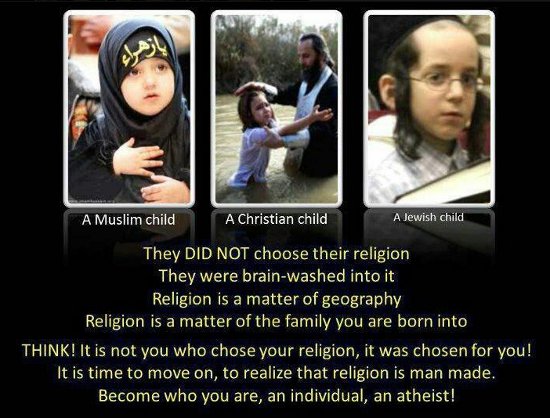
They DID NOT choose their religion. They were brain-washed into it. Religion is a matter of geography. Religion is a matter of the family you were born into.

THINK! It is not you who chose your religion, it was chosen for you! It is time to move on, to realize that religion is man made. Become who you are, an individual, an atheist!

From an image posted on Facebook
by Spread Logic and Reason

Disclaimer: This is a rant. This isn’t what I normally post here as a “meditation.” Frankly, I’m getting a little tired of being pushed around by a bunch of folks on the web who think they can take an image, manipulate it with some text, and use it to complain about how bad religion is. Today, I decided to push back.

I first saw this bit of Internet meme “shared” by a Facebook friend and a person I’ve known for many years. He’s a person I hold in high regard but we obviously have different viewpoints on religion. If I had seen this coming from almost anyone else, I would have ignored it, but I consider this person an actual friend, so naturally, it hurts.

Here’s my initial response to seeing this image:

I turn 58 tomorrow. I didn’t become a Christian until I was over 40. I used to be an atheist, primarily because the prevailing culture around me was atheist and it seemed to make sense at the time. Then I started thinking for myself. Why would I let the culture around me choose my religion and my identity for me? Why would I let an Internet meme choose my identity for me?

And what have I ever done to you that you should try to change my identity into what you think would be better for me? I’m not trying to change you.

Then I thought about it some more while doing my lawn, came back over lunch and expanded my answer:

It occurs to me that all cultures and people groups have their various values and customs that are passed on from one generation to another. Most liberal progressives don’t complain about cultural diversity, even if it radically differs from their own, because they recognize that people have the right to observe their native customs and certainly, in the vast majority of cases, liberal progressives and atheists don’t demand that other people groups who are not white, middle-class Americans, change their ways just because they are different than the white, middle-class American atheist’s ways.

Islam and Judaism are closely tied to national, ethnic, cultural, and racial identity. Why isn’t is considered racism, prejudice, and bigotry for you to demand that Jews and Arabs refrain from passing on their values and beliefs to their children? Are you (the general “you”…not naming anyone specifically) more equipped to tell the rest of the world to live your lifestyle? Don’t you pass on your values (atheism, progressive liberalism) to your children?

Why are you trying to control everyone else in the world?

To be fair, between my first comment and my second, my friend said:

Jim, if you had been born in Saudi Arabia and were atheist, assuming you survived to 40, the odds are more likely you would have become Muslim. This isn’t really about an Internet meme, but an historical fact. It exited loooooong before the Internet. 99% of people grow up believing what their parents did. Why did none of the natives in the Americas become Christian for 1500 year. That you decided to for a different belief system than your environment does not alter the facts. You are an exception.

I can see his point, but I think he (and a lot of people like him) are missing something. In making statements and posting photos such as the one I put at the top of this blog post, aren’t atheists trying to say that their viewpoint, lifestyle, and values system is superior to everyone else’s? I know that many religions, particularly Christianity, are accused of exactly the same thing and I know from personal experience (having once been an agnostic leaning toward atheism) that having to listen to a Christian evangelist can be really annoying.

But what about all that “diversity” stuff? If progressive liberalism and atheism supports generally being accepting of racial, cultural and ethnic diversity, then isn’t complaining about how different ethnic, cultural, and racial groups choose to raise their children and pass on their values a type of bigotry? While Christianity isn’t tied to a particular nationality, race, ethnicity, or culture, Islam and Judaism certainly are. How can the comments espoused by this group of people be seen as anything but prejudiced and even racist?

Yes, I’m coming on strong. Yes, today I’ve decided to feed the trolls. But it seems like everyone is supposed to have rights to this, that, and the other thing in this world…except religious people. Not only is this group of atheists guilty of the same acts they say religion commits: exclusivism and rejection of the values and lifestyles of other people groups, but they’re also guilty of what the rest of the world sees Americans as doing: attempting to spread our own values and lifestyle to the rest of the world and using our own cultural lens to judge the right and the wrong of other people, cultures, and nations.

How are these atheists any more morally correct than any religious person?

“Blowing out someone else’s candle does not make your’s burn any brighter.”

-Anonymous

Dear people who don’t like religion,

How does complaining about religious people make the world a better place? What do you gain by “going after” Muslims, Jews, and Christians? Do you plan on taking on Buddhists and Wiccans next? Has the Dalai Lama somehow offended you? If you really want to spend your time and energy being useful and helping others, please step away from the computer and actually do something for another human being. Volunteer at a homeless shelter. Give cans of food to the local food bank. Spend an hour picking up trash in the parking lot of your neighborhood park. Hold the door open at a public building such as the library for a disabled person or a single mother who is trying to manage five children. Heck, just smile at a stranger once in a while because it’s the right thing to do.

Don’t complain about me or people like me, saying we’re the problem. Go out into the world and be the solution. If you do that, the problems will take care of themselves.

Signed, a fellow human being, who has volunteered, donated, picked up trash, held doors open, and who smiles occasionally at strangers.

Thank you.

Cherishing Her Yiddisher Neshamah

Tonica Marlow stood looking down into the main hall of the synagogue. She couldn’t take her eyes off the rabbi or the Torah scroll he held in his hand as he faced the congregation. What am I doing here? she kept asking herself. So many times she had promised herself never to come here again, and yet here she was again, dressed in a brown wool habit, her hair covered with a brown scarf.

“Shema Yisroel Ado-nai Elo-heinu Ado-nai Echad,” the rabbi’s voice rang across the synagogue, and the congregants repeated after him. Tonica, too, found herself mouthing the words, though she knew not what they meant. She didn’t understand why her feet kept carrying her back here; but the more she came, the more she longed to hear those precious words again.

Her mother had been born a Jew, that much she knew. But then she’d converted, abandoning her Jewish faith at age 25 and marrying a gentile. Tonica, the youngest of five children, had been raised as a non-Jew. Nonetheless, the question cried out from her very soul: Who am I? It gave her no rest, the question; it tormented her, robbed her of her peace of mind.

Tonica watched as the rabbi lovingly replaced the Torah scroll into a wooden sculptured cabinet and drew the dark blue curtain over it. Then she hurried back to the theological college where she was studying to become a minister.

But she’d tarried too long; she was late for her responsibilities. The principal summoned her to his office. “Where were you?” he demanded.

“Why, I just popped into the synagogue for a few minutes,” she said.

“What?” the principal yelled. “I’m telling you, child, you are a gentile. I forbid you to go there.”

-Mirish Kiszner
“I’m Telling You, Child, You Are a Gentile
A spiritual journey: from Tonica Marlow to Tova Mordechai”
Chabad.org

I got an email announcing a beta version of the new Chabad.org website, so naturally, I clicked on the link. That’s where I found Tova’s story. I started reading it because of the provocative title (“I’m telling you child, you are a gentile”) and continued reading because it reminded me of my wife’s journey…with some differences.

Of course, my wife wasn’t studying for the ministry when she became connected to her Judaism but at the time, we were going to a church. She didn’t go to Israel for years afterwards and never lived with an Orthodox family, but the same “connectedness” was there, the same absolute “need” to be a part of the Jewish community was there for my wife as it was for Tova.

Maybe if she had started that journey at 25 instead of 45, things would have been different.

But she didn’t and they aren’t and here we are.

Tova’s story, at least as it’s rendered in this article, is very light on the details regarding her husband. If she was a Christian and studying for the ministry and she had married a Gentile, chances are that he was (and is?) a Christian, too.

I wonder what happened to him? What happened to their five children? They all live in Israel now. But who are they?

Of course, I could just buy Tova’s book, To Play with Fire, which is the chronicle of her journey from Christianity and return to Judaism. As I write these words, I realize that I probably will.

But what will it tell me about my life?

Probably not as much as I hope.

intermarriageI suppose this is a continuation my previous “meditation,” Opting Out of Yiddishkeit. It contains the same themes: identity, Judaism, intermarriage, interfaith, connectedness, and “just what the heck does God want from me, anyway?”

I was talking to my son this morning after our workout at the gym. He was asking how my Thursday afternoon “coffee meeting” went. I had taken him to one such meeting a few weeks ago with interesting results. Since the men I meet with are all believers, I think my Jewish wife thought I was trying to turn our Jewish son (though he’s not observant in the slightest right now) into a Christian.

That would not sit well with her.

I told him that his mother would be very happy if he’d start going to synagogue again, and asked how his wife would take it, since she (his wife, not mine) is seriously considering returning to church. He tells me that it would be fine with her, but then I brought up my grandson. At only age three, how confusing would it be to have his parents going in different directions?

But that brings me back to my own family and my own situation and the answers just aren’t getting any clearer. Some people would say that Messianic Judaism is the answer as the nexus of Christianity and Judaism, but it doesn’t really work that way. Why?

Sid (played by John Leguizamo): Then why are you trying so hard to convince her she’s a mammoth?
Manfred (played by Ray Romano): Because that’s what she is! I don’t care if she thinks she’s a possum. You can’t be two things.

-from Ice Age 2: The Meltdown (2006)

You can’t be two things. I don’t mean that you can’t be Jewish and have a deep, abiding, and real faith in Yeshua HaMashiach (Jesus the Christ). I mean that your identity, your culture, the very fabric of who you are, right down to the DNA level is either Gentile or Jewish. Just like Tova discovered; just like my wife discovered, you’re either one or the other. You can’t be both.

Most “Messianic Jewish” congregations aren’t all that Jewish, at least as far as I know. There are very few that have a completely Jewish synagogue identity and practice. Many, probably most, employ some aspects of a Jewish synagogue service, but largely, their identity as individuals and as a group are Gentiles who come from a strong, traditional, Christian background.

There’s nothing wrong with that, but then using the term “Jewish” becomes a misnomer. They may be a group who acknowledges the Jewishness of Jesus as the Messiah, who loves Israel, who honors the Shabbat and believes that the Torah continues to be alive and strong and incredibly present in the lives of the Jewish people today, but they aren’t Jewish.

Beth Immanuel Shabbat Fellowship is probably the Messianic congregation I’ve attended that has come closest to achieving a true Jewish synagogue identity, but I suspect that the majority of the members and the staff are still non-Jewish. Again, there’s nothing wrong with that, but what if you’re Jewish and you not only want, but you absolutely need to worship with Jews, be around Jews, and belong to a Jewish community?

I suppose like Tova, you stop being Christian and move from being Tonica Marlow to being Tova Mordechai. Or you move from being Lin to being Yaffa (my wife’s given and Hebrew names). Or, like my friend Gene, you maintain your Messianic faith, but you regularly worship with an Orthodox Jewish community.

None of this is at all easy.

I check the statistics for this blog and frankly, personal explorations such as this one just don’t capture a lot of reader interest. I don’t know why, since the stats only provide raw numbers without the attendant human motivation.

However, one of the “meditations” I wrote seems to be getting some attention recently: Fearfully in the Hands of God. Near the end of the blog post, I wrote this:

I know this sounds dismal and depressing, especially on the day when the vast majority of the Christian world is celebrating the birth of the King of Kings, but lest we imagine that God is obligated to grant us a perfect, stress free existence, the counterpoint is that we are but dust and ashes; we are grass that is growing today, and tomorrow, is withered and thrown into the fire. In the end, we can try to live healthy lives, lives of faith, devotion, charity, and study; we try take care of ourselves and others, but still, no one knows the hour of his own death.

In those moments of hideous uncertainty or in that final ”moment of truth”, we can only summon whatever trust in God we may possess and cry out to Him for His infinite mercy. If he should turn the hand of sickness and death away, we rejoice, and if not, we are with Him.

When a Christian cries out to God, we just cry out. But a Jew does something different.

Tova relates that some years ago her mother was lying on the operating table before undergoing life-threatening surgery. From the depths of her mother’s soul, a desperate cry shot forth, “Shema Yisroel Ado-nai Elo-heinu Ado-nai Echad.”

The Shema is the first prayer taught to children and it is the prayer at is on the lips of any Jew who is afraid they’re about to die. In some way we non-Jews don’t understand, it is a special conduit between a Jew and God.

Most Christians are baffled why Jews don’t convert to Christianity. Those Jews who come to faith in Jesus but express that faith within a Jewish Messianic context are thought by non-Messianic Jews to have converted to Christianity. Christians generally don’t think so and either publicly or privately, wish those “Messianic Jews” would stop “denying the power of Christ’s death on the cross” (as Pastor Tim Keller might say), and actually come to a “true faith” in Jesus Christ; that is, convert to Christianity.

But as you, my readers, already know…it’s not that simple.

And it’s not right. It’s not right to finish the job that the Holocaust started. It’s not right to cooperate with terrorists who are hurting and murdering Jews to his very day. It’s not right to try to reduce the Jewish population of the world to zero.

Most Christians and even most atheists would say that it’s a sin and a crime to commit genocide, to try to eradicate an entire race, population, or nation. “Ethnic cleansing” is considered barbaric and monstrous by every one except the barbaric monsters who are committing those acts…except when it happens to Jews. Then the world, including most of the Christian world, just doesn’t give a damn.

That’s why I have to support my Jewish wife being Jewish. That’s why I have to support my son returning to davening with a siddur and praying the Shema (though he’s not very close to this point at the moment). And that’s why Christian Tonica became Jewish Tova and currently “lives in Tzfas (Safed), Israel, with her husband and five children.”

I’m sure each interfaith marriage is different. I don’t doubt that each one has its challenges and even its heartaches. I do know that I have my own journey to travel, both as an individual of faith and as a Christian husband married to a Jewish wife. I know that journey is not as simple as converting to Judaism or simply abandoning Christianity for atheism, just for the ways of peace.

I keep asking the question, where do I go from here? I keep answering the question, I don’t know. Except I do know, albeit in an extremely limited sense. I keep going forward, day by day, moment by moment. Yesterday afternoon, I had coffee with a friend and then I went home. I made hamburgers and talked to my wife about her day. My daughter came home and we talked with her for a bit. Then I read for a while and went to bed.

Life is normal. Being married to the girl with the Jewish soul is not really fraught it anguish and troubles all of the time, at least not on the surface. Somewhere beneath the surface of the blue crystal waves, God waits and He’s doing stuff I can’t see. So I walk or I sail or I swim as best I can in the direction I think God wants me to go.

And maybe God has a few surprises left for me on this path I’ve chosen (or did He choose it for me?). I hope they are surprises I can take.

There is an easy path to fulfill the Torah as it is meant to be fulfilled. Not by forcing yourself, nor by convincing yourself, but by achieving awareness:

A constant awareness that all you see and hear, the wind against your face, the pulse of your own heart, the stars in the heavens and the earth beneath your feet, all things of this cosmos and beyond . . .

. . . all are but the outer garments of an inner consciousness, a projection of His will and thoughts. Nothing more than His words to us, within which He is concealed.

And the Master of that consciousness speaks to you and asks you to join Him in the mystic union of deed and study.

In such a state of mind, could you possibly choose otherwise?

-Rabbi Tzvi Freeman
“Natural Response”
Based on letters and talks of the Rebbe
Rabbi M. M. Schneerson
Chabad.org

It’s probably too much to ask that they be surprises that make me happy.

The Broken Starfish

Do good with all your ego. Say, “I need to make this happen.” Say, “I have to see this done.”

Not only is this “I” permissible, it is crucial to getting things done.

So what is forbidden? To believe the “I” belongs to you.

-Rabbi Tzvi Freeman
“The Kosher Ego”
Based on letters and talks of the Rebbe
Rabbi M. M. Schneerson
Chabad.org

“If your contribution has been vital there will always be somebody to pick up where you left off, and that will be your claim to immortality.”

-Walter Gropius, German architect

On the surface, the quote from Walter Gropius I posted above sounds great. But then, you have to ask yourself if every single human being who ever lived and who ever will live actually ends up making a vital contribution to something. I mean after all, some of us are pretty ordinary. I mean, I know I contribute something, but can I really consider anything I do as vital?

I guess that depends on who you ask. I certainly haven’t cured cancer or accomplished world peace. I haven’t developed safe nuclear fusion power or even built the better mousetrap. I haven’t done anything that would significantly contribute to improving the world as a whole.

In fact, depending on who you ask, my life has taken away from the well-being world. Certainly being male, religious, and conservative automatically makes me a villain in some people’s eyes. If you value youth, diversity of ethnicity (non-caucasian), and “flexible” sexual orientation (anything but straight), then I’m a failure there as well. In fact, as far as the mainstream western culture is concerned, I’m pretty much a flop.

So I haven’t contributed to the betterment of the world as a whole, nor do I belong to any of the groups or “types” of people who are considered positive contributors in the progressive social and cultural values system.

If my culture were my ultimate judge, I’d be in big trouble right now.

Of course, my life hasn’t been a complete waste of time and resources, but you have to look on a very local scale. My family has depended on me bringing in an income to support them for decades.

Oh, but sometimes I’ve been unemployed, so I failed that one.

My wife and children have depended on me to be a sane, calm, organized, and supportive husband and father for thirty years.

Oh, but sometimes I’ve failed at that, too (more often then I’d care to admit).

Gee, what else?

Sorry, it’s hard to get past those first two, but I’m sure there’s a lot more.

Thankfully, I’m gainfully employed at the moment and manage to do some “side work” writing (no, not blogs, alas), so we aren’t starving. My kids are all grown and whatever contribution I’ve made as a father, for good or for ill, is set in cement. As the saying goes, “you can’t unring a bell.”

So what’s left?

According to Yerachmiel Tilles, you can actually learn how to be in exile, but only if it’s absolutely necessary.

“I live in the city of Pest, near which I own several villages, fields and vineyards. Once a large sum of money was stolen from me, and I did not know who the thief was. We had a maid—an orphan—and since we suspected that this was her doing, we took her along to the local authorities. The police there beat her in order to induce her to confess, but she insisted she had stolen nothing, so they sent her home to us. But the harsh treatment that she had endured left its mark. For some days she languished in bed, and then died.

“Two weeks later the thief was found. I was stricken by terror. I had suspected an innocent person, and through my doing, this orphan had met her death!

According to Christianity, Jesus atoned for everyone’s sins, so there should be no guilt among Christians. The blood has been washed from our hands. We are clean; pure and unsullied, white as driven snow.

For the Jewish man from the city of Pest, it wasn’t so simple. Through an act of injustice, he had caused, however inadvertently, the death of an innocent person, an orphan and a servant. He couldn’t just walk away from that and Rabbi Meir of Premishlan felt the same way.

‘Choose one of these three,’ he said. ‘Either you die, though you will be granted a place in the World to Come; or you will be ill and bedridden for three years, while the suffering you undergo will cleanse you of your sins; or for three years you will wander about as a vagabond, as the law prescribes for an unwitting manslaughterer.’

After initially refusing to choose, the man became ill and was near to death. Apparently Rabbi Meir had made the choice for him. Only by pleading for the Rabbi’s prayers was he spared, along with agreeing to walk away from his home, his family, his wealth, everything, for a span of three years.

“If you are hungry, ask no man for money or for food. But if people offer you something out of compassion, you may accept it.”

I suppose Christianity would consider this a fool’s errand and a misguided attempt to atone for a debt that can never be repaid. You can’t return a life, and even living like a homeless person for three years won’t bring that life back.

But let’s for a moment assume this story isn’t literally true. Let’s take a look at it from the point of view of a parable. What does it teach us?

“But then I heard that in Sanz, not too far from here, there lives a tzaddik known as the Divrei Chaim. In fact, I’m heading in that direction now, in the hope that he will guide me. And that is why I will not accept your donation, thank you, because at the moment I am not setting out on another leg of my trek as an exile; I am on my way to visit Rabbi Chaim of Sanz.”

The innkeeper was so curious to know what the end of the story would be that he set out with his ragged guest and escorted him directly to the rebbe’s house in Sanz. The vagabond did not even manage to put his question to Reb Chaim, when the tzaddik said: “Return to your home, traveling by way of Premishlan. Find the grave of Reb Meir, and tell him that the rebbe of Sanz says that two years of exile are enough for you, for you observed them with true self-sacrifice.”

Maybe all this was just an attempt on the now deceased Rabbi’s part to assuage the guilt of this wealthy merchant and maybe it worked. On the other hand, what did he learn about being helpless, weak, poor, homeless, and defenseless? Maybe his wandering didn’t atone for a thing, but it could have taught him a much greater sense of mercy and justice. After this experience, will he ever carelessly be cruel to someone who is in his power again?

Who knows? I hope not.

I once heard it said that, “If there are self-made purgatories, then we all have to live in them. Mine can be no worse than someone else’s.” If the Rebbe of Premishlan did not provide for this man’s “penitence,” the merchant surely would have created one of his own. In fact, the illness he suffered soon after the servant’s death may have been of his own (unconscious) doing. It’s funny what guilt and shame will do to you…and what you’ll do to yourself.

That takes care of the merchant from Pest. But what about other failures? Where do I go from here?

Do I accept the gift of Jesus Christ and blow off all of the disappointments I have committed in my lifetime as well as the consequences they created (some of which continue to wield power today), or do I, in my own way, “wander in exile?”

Here’s one possible answer, according to Rabbi Freeman:

In every hardship, search for the spark of good and cling to it. The greater the hardship, the more wondrous the good it bears.

If you cannot find that spark, rejoice that wonder beyond your comprehension has befallen you.

Once you have unveiled and liberated the spark of good, it will rise to overcome its guise of darkness. It may perhaps even transform the darkness fully to light.

I once heard a story about a starfish. Supposedly, if you cut off the arm of a starfish, it will eventually grow back. There was a man who was very cruel. He lived by the seashore and everyday, as he went about his business, he passed an area near the beach with shallow pools of water. In one of those pools, there lived a starfish.

The starfish was very beautiful, illuminating its environment with subtle reds and oranges. The cruel man did not like beauty and hurt the starfish by using a knife he carried with him to cut off one of the starfish’s arms.

By the by the arm grew back, just as it was before. This made the cruel man angry and he cut off the same arm again.

And it grew back.

And he cut it off.

And it grew back.

And this happened over and over again. Eventually, the man noticed something. Each time the arm grew back, it was a little different, a little shorter, a little more twisted and withered. The more he cut it off and the more it grew back, the more deformed and hideous the arm became.

Finally, the man didn’t need to cut the arm off the starfish anymore. It was now as injured and crippled as he was.

Rabbi Freeman says that even in the darkest circumstances, there is some spark of divine goodness. Even if you cannot find the spark, that too is a miracle, for you have a wonderful mystery laid at your feet.

But if I cannot find the spark, then it cannot “rise to overcome its guise of darkness.”

I cannot wander the world for three years as a beggar and it wouldn’t do any good if I could. Assuming God has indeed forgiven me and that the life of the Messiah has atoned for my wrong deeds, then in God’s eyes I may appear clean, but what do you do when your soul, like the arm of the starfish, is malformed and crippled?

Leonardo da Vinci once said, “Where the spirit does not work with the hand there is no art.” My hands work reasonably well, but what about the “twisted” spirit? There is no art. The sparks remain dark. But in spite of everything I’ve just said, I still can’t stop trying. It’s not like I’m even refusing to give up. I wish I could. I wish I could lay down and rest. But I just can’t.

I just read something Michoel Ogince said:

Imagine: How would the world look if we could see the Divine sparks that animate every physical creation?

Those sparks are supposed to be there (if you are willing to accept a bit of Kabbalah for a moment) in all things, including people. They’re just hidden in the mundane, waiting to be set free and to return to their divine source, that eternal flame; waiting to return to God.

If Walter Gropius is right, everyone who has made a vital contribution to something will have someone to come after them and to pick up the work when their time is done. If not, then whatever you did ends with you.

If the various motivational writers, speakers, and bloggers are right, everything everyone does at some point or another is significant and that on some level, all people are worthy, whether they believe so or not. The trick then, is actually learning to believe it, not so much about other people, but about yourself.

I once wrote something, probably inspired by Rabbi Freeman or another Chabad Rabbi, that said if you treat someone as if they are the person they are supposed to be, as if they have already done great things, as if they are already close to God and have peace and kindness in their hearts, and you keep at it long enough, eventually they will become that person. I suppose it’s the starfish story in reverse. You can injure someone long enough until they become distorted and their spirit mirrors their long torture, or you can treat someone with kindness, mercy, respect, and even honor long enough, and their injuries will heal, if not in body, then certainly in spirit.

But for all the wonderful storytelling, parables, and tales of the Chasidim, how does that ever cross over from the realm of fantasy and mystical wishful thinking into a real and practical life?

That’s my secret…I’m always angry.

Bruce Banner (played by Mark Ruffalo)
The Avengers (2012)