Category Archives: Uncategorized

Understanding the Infinite Scroll

One year there was a drought and the price for food rose exorbitantly. In Frankfurt, some Jews literally could not put bread on their table. Rav Avraham Avish, the Av Beis Din of Frankfurt, zt”l, literally gave every penny he owned to help the destitute during that year. One student wondered how this could be halachically permitted. “Didn’t we learn that it is forbidden to give over twenty percent of one’s property to charity?” he asked.

Rav Avraham Avish rejected this claim out of hand. “Although you have learned you still do not grasp how to understand a sugya in depth. It is true that in general one who gives over a fifth of his property to tzedakah violates a rabbinic prohibition, but that is irrelevant in a year where there is no food and people are endangered. To save a life, we even desecrate Shabbos which is much more stringent than any rabbinic decree!”

Daf Yomi Digest
Stories Off the Daf
“Not more than a Fifth”
Arachin 28

For the Christians reading this, and perhaps for some Jews, the meaning of my quote “off the Daf” today may not seem very relevant, but I posted it above for a single, important reason. There’s a sentence that teaches us something we need to constantly keep in the forefront of our thoughts:

Although you have learned you still do not grasp how to understand a sugya in depth.

It means that you can be smart and even well educated, and still not be able to look at something in the way that’s necessary or in sufficient depth to be able to understand it. We see this all the time in the various sciences, especially as we examine the history of scientific discoveries and knowledge. First the Earth is flat and now it’s round. First the Earth is the center of the universe, and all heavenly bodies revolve around us, now Earth revolves around a mediocre star off to one side of our huge galaxy. First you cure a fever by applying leeches to drain bodily fluids, now you give the person antibiotics to cure their infection.

As we investigate our world, we learn, but at each point in our journey of discovery across the long stretch of history, we thought we knew exactly what we were doing and what was going on. We couldn’t have possibly imagined that the world wasn’t flat or that applying blood-sucking parasites to our bodies really wouldn’t cure a fever or other types of ailments.

And although a student of Rav Avraham Avish understood that the general principle is to give only up to one-fifth of your income to charity to avoid bankrupting yourself and failing to support the needs of your own family, he still didn’t understand the underlying foundation behind the principle that would allow the Rav to contribute his very last dime to starving people, and still not violate halacha.

But what’s all that got to do with us?

Has it ever occurred to you that you could be wrong?

It probably has, especially on those occasions when you were sure you were correct in some matter of judgment, or thought you could spell the word “Mediterranean” without looking it up. OK, we’re human and we can make mistakes. It happens to the best of us and most people have learned to admit it.

Almost.

The conversation in my extra meditation from yesterday turned into a mini-debate on the letter to the Hebrews found in the New Testament. Since this letter has always been a bit of a puzzle to me, I’ve found that I’ve been at sort of a loss as to how to respond to the traditional supersessionist interpretation of it. Fortunately, many people have responded to me, both in blog comments and via email, to suggest different references, and even have sent me information to help illuminate my path in this particular direction. One such piece of illumination is as follows:

Unique among all the scholars I consulted, Charles P. Anderson sees Hebrews in a Jewish communal context. It is as if all the other commentators have been wearing sunglasses, and only he is wearing clear lenses. All the others see the recipients of Hebrews as Christian individuals of Jewish background rather than as a group of Jews who see themselves in the context of their community with each other, with the wider Jewish world, and with their people throughout time. His perspective is in my view the right one, his argument convincing and illuminating. Throughout my research on Hebrews I was longing to find someone who saw things this way. Finally, toward the end of my research, I found Anderson’s brief chapter.

Charles P. Anderson is Associate Professor of Religious Studies, University of British Columbia, Vancouver, British Columbia, Canada. I am reproducing here a large body of quotations from his article ” Who are the Heirs of the New Age in the Epistle to the Hebrews?” Especially when read against the background of common assumptions concerning the Letter to the Hebrews, his perspective stands out as something fresh, and to me, thrilling. I would hope that all who read his article and these quotations from it would be moved to say, “Why didn’t I see this before?” The answer to that question is “Because of the Christian exegetical tradition.”

-from a paper presented by Stuart Dauermann
commenting on Charles P. Anderson’s article
“Who are the Heirs of the New Age in the Epistle to the Hebrews?”
Carl Kinbar was kind enough to send me a PDF of the appendix to Dauerman’s paper which includes the above-quoted statement. This is the point I’m trying to drive home, both about understanding Hebrews and understanding the broader Biblical context.

It’s not that easy.

We may think it is easy because we’ve got hundreds and hundreds of years of traditional Christian interpretations to fall back on, and we’ve concluded that the correct way of understanding Hebrews is to say (gasp) that the Law of Moses was replaced by the Grace of Christ.

Period.

But like anyone who gets into a particular habit that may once have been helpful, we have to ask ourselves if the “habit” of our traditional way of understanding Hebrews (or any part of the Bible) really the best way we’ve got right now?

That’s a tough one. It’s difficult for me to say there is one and only one correct way for to understand the Biblical text. True, from God’s point of view, there probably is one correct, objective understanding, but we are mere humans and don’t enjoy God’s infinite wisdom and vision. It’s also possible that at least some parts of the Bible were never intended to mean the same things to all populations across all generations. After all, the Jews don’t keep slaves any more, so are the laws in the Torah about slavery still “eternal truths?”

This is what bothers me a little about blog posts that are titled Reading Acts 15:21 Correctly. While Derek Leman no doubt believes how he interprets this passage in the New Testament is the correct interpretation (and I don’t necessarily disagree with him), it’s obvious from reading the different comments in response to his blog post, that not everyone sees the same thing in that single verse of the Bible. If we can disagree about a the meaning of a single sentence in the Bible, how much more do we all disagree on the letters of Paul and the product of our dear letter writer to the Hebrews? How can any one person say, “this is what such-and-thus means in the Bible, forever and ever?”

Adding to this puzzle is the concept in Judaism that the Bible can only be interpreted correctly using accepted tradition. Sure, as the Daf above explains, there are endless ways to “dig deeper” into the text, but you don’t just “shoot from the hip” as far as understanding Biblical or Rabbinic halacha is concerned. I suppose Christians could say the same thing about their (our) standard interpretive traditions, but we have a problem (technically, so does traditional Judaism, but I’ll set that part aside for another time). Our problem is that our entire perspective on interpreting the Bible completely ignores the viewpoint and mindset of the original writers, who were first century Jews, steeped in “the hashkafah of the Tanakh.” Without said-viewpoint based on a first century Jewish worldview, it is likely we may have missed a step or two over the past 2,000 years in terms of New Testament scholarship.

The deal is, we who call ourselves Christians might need to stop and consider for a moment what we believe about the Jews and why. If our perspective on Jews and Judaism includes the necessity to declare Jews, Judaism, and the Torah of Sinai obsolete, and results in us believing that Jews who continue to worship and live within a classical Jewish framework are being rebellious and sinful, we should think about the possibility of a reasonable alternate explanation. The explanation should be one that would make sense to our first century writers and scholars and should not require that God abrogate His promise that the Hebrews would be a “peculiar people” before Him forever.

I say “reasonable” because there are just billions of “pop” theologies out there on the web that “tickle the ears” but have little substance or validity (although they can weave a multi-layered tapestry of mashed up Biblical cross-connections confused enough to “cross a Rabbi’s eyes”). They’re like cotton candy for the brain; tastes really sweet and initially invigorating, but containing zero nutritional value. However, as my little snippet from the paper written by Stuart Dauermann shows, solid Biblical research, although unconventional from a traditional Christian viewpoint, exists and provides a valid and compelling alternate interpretation to understanding the New Testament text, including the Book of Hebrews.

Obviously, I’m in no position to present that alternate interpretation of Hebrews in any detail at the moment, but I just wanted to show that it exists and should be seriously considered by any Christian who has an honest desire to place truth and a correct understanding of the intent of God and the Apostolic writers ahead of our old, comfortable, Gentile-friendly theologies. I’ll be writing on this topic again in the months that follow.

Oh, in case you were curious how our “Story Off the Daf” ends up, here’s the rest. It’s also an interesting “test” in terms of determining the identity of the Messiah.

In Yemen nine centuries ago, life was especially hard due to harsh decrees. In the middle of these challenges to the community one man secretly claimed to be Moshiach, soon to bring the longawaited redemption. Although many Jews were convinced, others were unsure and put the matter to the Rambam, zt”l. The Rambam sent students to test this man and discern if he could possibly be Moshiach. When they returned they began to tell the Rambam everything that they had observed. “This man disburses every cent he has on charity.”

The moment the Rambam heard this he immediately interjected that this man cannot be Moshiach. “It is clear that a person who violates our sages’ command not to give more than a fifth to charity is not our redeemer. Although it is permitted to give more to redeem one’s sins, Moshiach should not have any sins to redeem!”

I’ll wrap this up by quoting from Rabbi Tzvi Freeman’s interpretation of the Lubavitcher Rebbe, which illustrates an additional challenge we encounter in understanding the Word of God.

This Torah we were given is not of the world, nor is it something extraneous to it. Rather, it is the hidden essence, the primal thought from which all the cosmos and each thing within it extends. It is not about the world, it is the world—the world as its Creator sees it and knows it to be.

The sages of the Talmud told us that the Torah is the blueprint G-d used to design His creation. There is not a thing that cannot be found there. Even more, they told us, G-d and His Torah are one, for His thoughts are not outside of Him as our thoughts are.

But He took that infinite wisdom and condensed it a thousandfold, a billionfold, and more, into finite, earthly terms that we could grasp—yet without losing a drop of its purity, its intimate bond with Him. Then He put it into our hands to learn, to explore and to extend.

So now, when our mind grasps a thought of Torah, thoroughly, with utter clarity, we grasp that inner wisdom. And at the time we are completely absorbed in the process of thought, comprehension and application, our self and being is absorbed in that infinite wisdom which is the essence of all things. We have grasped it, and it grasps us. In truth, we become that essence.
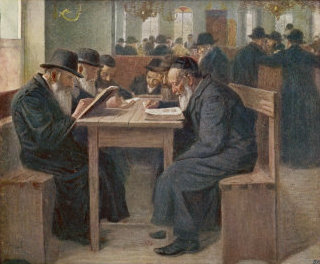
studying-talmudThis is a very mystical understanding of the “life” of the Torah and how in Chasidic Judaism, it transcends the physical scroll and exists as both the blueprint of the Universe and the means of its creation. Since we in Christianity understand that “the Word became flesh” (John 1:14) and that through the living Word, “things were made through him, and without him was not any thing made that was made,” (John 1:3) we also have a mystical understanding of the Bible, the Messiah, and creation, so perhaps the simple text on paper we see when we read our Bible and try to interpret it is not so simple after all. More than that, perhaps we cannot allow ourselves to limit that Word or that Messiah to what our Christian tradition says it all means, even if it makes us uncomfortable and stretches our understanding.

To drink “new wine,” we must prepare “new wine skins.”

Good Shabbos.

Yitro: Servants of the Lessons of Peace

And so the explanation of why the Exodus is given as the reason for G-d becoming the G-d of the Jewish people is obvious – G-d’s liberation of the Jews from slavery is what made it possible for Him to give us His Torah and mitzvos on Sinai.

Moreover, the fact that G-d took the Jews out of Egypt in order for them to serve Him was already mentioned several times in the Torah; in none of those places did Rashi find it necessary to explain that this “is sufficient reason for you to be subservient to Me.” What difficulty is there in this particular verse?

The difficulty which Rashi addresses is related to this very issue: Since the Jews were already well aware that the ultimate goal of the Exodus was the receipt of the Torah and submission to G-d, what was the need to mention yet again that G-d’s declaration: “I am G-d your L-rd” is the consequence of His being the One “who brought you out of the land of Egypt”?

Rashi therefore explains that “who brought you out of the land of Egypt” is neither a reason nor an explanation for “I am G-d your L-rd.,” Rather, it is a wholly distinct matter – “Taking you out of Egypt is sufficient reason for you to be subservient to Me.”

“I am G-d your L-rd” implies the acceptance of G-d’s reign. The Jews accepted G-d as their king and ruler, and thereby obligated themselves to obey all His commands. G-d then added an additional matter – merely accepting G-d as king does not suffice; Jews must be wholly subservient to Him.

Accepting a king’s dominion does not preclude the possibility of a private life; it only means doing what the king commands and avoiding those things which the king prohibits. However, being “subservient to Me” means a Jew has no personal freedom; all his actions and possessions are subservient to G-d.

Performing Torah and mitzvos is unlike heeding the commands of a flesh-and-blood king, since it is done in a state of complete subservience. Every moment of a Jew’s life involves some aspect of Torah and mitzvos.

Commentary on Torah Portion Yitro
Based on Likkutei Sichos Vol. XXVI pp. 124-128
and the teachings of the Lubavitcher Rebbe
Rabbi Menachem M. Schneerson
Chabad.org

On the third day, as morning dawned, there was thunder, and lightning, and a dense cloud upon the mountain, and a very loud blast of the horn; and all the people who were in the camp trembled. Moses led the people out of the camp toward God, and they took their places at the foot of the mountain.

Now Mount Sinai was all in smoke, for the Lord had come down upon it in fire; the smoke rose like the smoke of a kiln, and the whole mountain trembled violently. The blare of the horn grew louder and louder. As Moses spoke, God answered him in thunder. The Lord came down upon Mount Sinai, on the top of the mountain, and the Lord called Moses to the top of the mountain and Moses went up. The Lord said to Moses, “Go down, warn the people not to break through to the Lord to gaze, lest many of them perish. The priests also, who come near the Lord, must stay pure, lest the Lord break out against them.” But Moses said to the Lord, “The people cannot come up to Mount Sinai, for You warned us saying, ‘Set bounds about the mountain and sanctify it.'” So the Lord said to him, “Go down, and come back together with Aaron; but let not the priests or the people break through to come up to the Lord, lest He break out against them.” And Moses went down to the people and spoke to them.

God spoke all these words, saying…Exodus 19:16-20:1 (JPS Tanakh)

I cannot even imagine what it must have been like to stand at the foot of Mount Sinai and to be a part of this amazing, awesome, terrifying, wonderful experience of standing in the physical presence of the manifestation of God. Just to glimpse it from afar would have been an honor beyond imagination. This was and is truly the pivotal moment in all of Jewish history: the giving of the Torah. Nothing else would so uniquely define the Jews as a people and as the chosen nation of God. No other people have any experience that could compare to this pinnacle moment in the history of Israel. Or do we? I’ll get to that.

In the Chabad commentary I quoted from above, we see that there is an interesting comparison between serving a human King and serving the King of the Universe. As the Rabbis point out, serving an earthly King entails only obeying the specific orders of your monarch. Except for rare individuals, a subject of a King would still have a private life and individual pursuits that were apart from the King’s commands and laws.

This is not so when serving the King of Kings.

The Torah defines every single aspect of a Jew’s life, how he prays, how he works, how he eats, how he is to treat his wife, his neighbors, his animals, everything…every little detail. When the Children of Israel said, “All that the Lord has spoken we will do,” (Exodus 19:8), they were pledging their very lives to God down to the tiniest action and thought. Yes, I know someone out there is going to tell me that according to the record in the Tanakh, the Hebrews were not always very successful in obeying God, but what’s important is the amazing scope of the promise, of the commandments, of having a God who so cared for you and your people that we was involved in every aspect of your existence, not just what you did in synagogue on Shabbat (or church on Sunday). You gave everything you were, are, and ever will be to God.

But when the Pharisees heard that he had silenced the Sadducees, they gathered together. And one of them, a lawyer, asked him a question to test him. “Teacher, which is the great commandment in the Law?” And he said to him, “You shall love the Lord your God with all your heart and with all your soul and with all your mind. This is the great and first commandment. And a second is like it: You shall love your neighbor as yourself. On these two commandments depend all the Law and the Prophets.” –Matthew 22:34-40 (ESV)

We see here that the Son of God, Jesus, the Messiah, God’s Lamb, demanded nothing less of his disciples as well, but that’s to be expected.

But that brings me to an interesting question. Every Jew who has ever lived can point to Sinai and say, “that’s where we began…that’s who we are as a people forever.” In fact, each Jew is to behave not just as an inheritor of the Sinai covenant, but as if he or she had personally stood at the foot of Mount Sinai and accepted the Torah!

Where do we Christians find such a moment in our lives? Do we have a “Sinai?”

When the day of the festival of Shavuot arrived, they were all together in one place. And suddenly there came from heaven a sound like a mighty rushing wind, and it filled the entire house where they were sitting. And divided tongues as of fire appeared to them and rested on each one of them. And they were all filled with the Holy Spirit and began to speak in other tongues as the Spirit gave them utterance. –Acts 2:1-4 (ESV)

Note: I substituted “day of the festival of Shavuot” for the actual text which reads “day of Pentecost” to preserve the perspective of the Jewish Apostles.

Since Pentecost and Shavuot are essentially parallel occurrences, it’s not surprising that the empowering of the Holy Spirit came upon the Jewish Apostles on the same day as the anniversary of the Sinai event.

I have to admit to being somewhat let down. Christians are not encouraged to consider the Pentecost experience as literally their own (I suppose because Christians see salvation as an individual “accomplishment” rather than becoming part of the “body of Christ” and the “commonwealth of Israel”), as if they (we) were “all together in one place” with the Apostles as the “mighty rushing wind…filled the entire house where they were sitting.” We are to consider (sort of) the moment when we accepted Jesus Christ as Lord and Savior of our lives as the moment when we have out Acts 2 experience, although no Christian I have ever met has described that moment in terms of “tongues of fire” appearing from heaven and resting upon them. Some people have described being able to suddenly “speak in tongues”, but I do know a person who, at an altar call at a local church some years ago, was encouraged by the Elder with him to “make something up” if the ability to speak in an “angelic language” didn’t manifest itself in him.

So much for majesty and awe.

For that matter, we don’t really know how Peter could tell that “the Holy Spirit fell on all who heard the word” while he was visiting the Roman God-fearer Cornelius in the Centurion’s home? (Acts 10:44)

However, this is as close to a “Sinai event” as we who are the non-Jewish disciples of the Master can achieve in the modern era. I don’t know what it means or doesn’t mean and maybe I’m reading too much into it, but I don’t think things have been explained to us very well. I don’t think we’ve been told that one of the responsibilities we have in common with our Jewish brothers and sisters is the command to surrender our entire lives, every action, every word, every thought, to God, our King.

It’s not like we should be ignorant of this responsibility, since it’s all over the New Testament.

We destroy arguments and every lofty opinion raised against the knowledge of God, and take every thought captive to obey Christ… –2 Corinthians 10:5 (ESV)

Not many of you should become teachers, my brothers, for you know that we who teach will be judged with greater strictness. For we all stumble in many ways. And if anyone does not stumble in what he says, he is a perfect man, able also to bridle his whole body. If we put bits into the mouths of horses so that they obey us, we guide their whole bodies as well. Look at the ships also: though they are so large and are driven by strong winds, they are guided by a very small rudder wherever the will of the pilot directs. So also the tongue is a small member, yet it boasts of great things. –James 3:1-5 (ESV)

If we look at the words of the Master as recorded by Matthew and add the letters from Paul and James, we see that we too must surrender all that we are to God in everything, including our words and our very thoughts. How like the covenant at Sinai in this one very important dimension in the lives of we Christians.

Christianity prizes Grace over the commandments of the Law, but we tend to miss the fact that we have serious responsibilities and that freedom from sin doesn’t mean we can literally do whatever we want with our lives, pursuing the same matters in practically the same way as the secular people around us. We must be more in our actions, which we aren’t always taught matter as much as faith and having a “warm and fuzzy” feeling inside for Jesus. We are servants. With almost no exceptions, the original Jewish Apostles suffered for a long time and eventually died terrible deaths as the commitment to the Messiah required. This is the lesson they learned, not just as disciples of the Master, but as Jews who, like all of their people, personally stood at the foot of Sinai as the fire and the thunder and the sound of the great shofar sounded, and before their King declared, “All that the Lord has spoken we will do!”

Can there be peace between the people who stood at Sinai and we who inherit the Spirit of Pentecost? We are disciples of the Master, but where is the unity? Where is peace?

Peace refers to harmony between opposites. In an ultimate sense, it refers to a resolution of the dichotomy between the physical and the spiritual, the forward movement enabling a world in which G-d’s presence is not outwardly evident to recognize and be permeated by the truth of His Being.

Moreover, true peace involves more than the mere negation of opposition. The intent is that forces which were previously at odds should recognize a common ground and join together in positive activity. Similarly, the peace which the Torah fosters does not merely involve a revelation of G-dliness so great that the material world is forced to acknowledge it. Instead, the Torah’s intent is to bring about an awareness of G-d within the context of the world itself.

There is G-dliness in every element of existence. At every moment Creation is being renewed; were G-d’s creative energy to be lacking, the world would return to absolute nothingness. The Torah allows us to appreciate this inner G-dliness, and enables us to live in harmony with it.

-Rabbi Eli Touger
In the Garden of the Torah
“Ripples of Inner Movement”
Adapted from
Likkutei Sichos, Vol. XI, p. 74ff; Vol. XV, p. 379ff;
Vol. XVI, p. 198; Sichos Shabbos Pashas Yisro, 5751
Chabad.org

The portion of the Torah event we who are grafted in may take away with us, is that there is a path to peace, not only between Christian and Jew, but for all of mankind. We aren’t there yet. There is not even peace between all Christians or between all Jews. But someday, “they shall sit every man under his vine and under his fig tree, and no one shall make them afraid, for the mouth of the LORD of hosts has spoken.” (Micah 4:4 [ESV]).

Good Shabbos.

Counting Down

Torah at SinaiOn the sixth day of the third month (Sivan), seven weeks after the Exodus, the entire nation of Israel assembles at the foot of Mount Sinai. G-d descends on the mountain amidst thunder, lightning, billows of smoke and the blast of the shofar, and summons Moses to ascend.

G-d proclaims the Ten Commandments, commanding the people of Israel to believe in G-d, not to worship idols or take G-d’s name in vain, to keep the Shabbat, honor their parents, not to murder, not to commit adultery, not to steal, and not to bear false witness or covet another’s property. The people cry out to Moses that the revelation is too intense for them to bear, begging him to receive the Torah from G-d and convey it to them.

The Parashah in a Nutshell
Yitro in Nutshell
Exodus 18:1–20:23
Chabad.org

Starting the second night of Pesach, we begin counting seven weeks, 49 days, until the holiday of Shavuos. This counting is called Sefiras Ha’Omer, The Counting of the Omer. (For more information on Sefiras Ha’Omer, see I:16, I:18)

-Rabbi Yehudah Prero
“The Counting of the Omer – A Count of Anticipation”
YomTov, Vol. IV, # 7
Torah.org

We see the events of the Torah reflected in current Jewish practice. According to the commandments (Ex. 12:16, Ex. 23:14, Lev. 23:7) the Jewish people commemorate the Passover every year in order to remember the Passover in Egypt and the great exodus of the Israelites from slavery to freedom. Then comes the Omer count, whereby Jews are commanded to count the Omer for 49 days in anticipation of the festival of Shavuot, which commemorates the giving of the Torah at Sinai. The events we see displayed with such grandeur and majesty before us when we read the Torah portions that relate these times, are part of the lived experience of every religious Jew and any Gentile who is attached to the Jewish community for various reasons.

But there’s one other event that we Christians must consider.

And when evening had come, since it was the day of Preparation, that is, the day before the Sabbath, Joseph of Arimathea, a respected member of the council, who was also himself looking for the kingdom of God, took courage and went to Pilate and asked for the body of Jesus. Pilate was surprised to hear that he should have already died. And summoning the centurion, he asked him whether he was already dead. And when he learned from the centurion that he was dead, he granted the corpse to Joseph. And Joseph bought a linen shroud, and taking him down, wrapped him in the linen shroud and laid him in a tomb that had been cut out of the rock. And he rolled a stone against the entrance of the tomb. Mary Magdalene and Mary the mother of Joses saw where he was laid. –Mark 15:42-47 (ESV)

According to the Gospel of Mark, Jesus was crucified on the same day as all of the representatives of the Jewish families in Israel were presenting their Passover lambs for sacrifice at the Temple in Jerusalem, in obedience to the commandment. He should have died right before sunset; right before the eating of the Passover lamb by each Jewish family, again, in obedience to the commandment.

But not all of the Gospel versions of the death of Jesus line up chronologically and we cannot be sure of the exact date. Was the “Last Supper” a true Passover seder or some other meal that occurred the evening before? We don’t know. We do know that Jesus died at about the time of the Passover, and we are fond of referring to Jesus as our “Passover lamb”. And three days later, Jesus rose from the tomb and he was with his people again for forty days. And then he ascended.

In the first book, O Theophilus, I have dealt with all that Jesus began to do and teach, until the day when he was taken up, after he had given commands through the Holy Spirit to the apostles whom he had chosen. He presented himself alive to them after his suffering by many proofs, appearing to them during forty days and speaking about the kingdom of God…And when he had said these things, as they were looking on, he was lifted up, and a cloud took him out of their sight. –Acts 1:1-3, 9 (ESV)

It would be nice if things lined up neatly but forty days does not equal the forty-nine day count of the Omer. Maybe this is one of the reasons why Christians don’t also “count the Omer” from the day of the crucifixion, which the church calls “Good Friday” to the day of the giving of the Holy Spirit, which Christians call “Pentecost”, but which also was the day of the festival of Shavuot commemorating the Sinai event.

So the Bible and our celebrations don’t line up into nice, neat, perfectly ordered events and holidays. I also understand that, during the schism between Gentile Christianity and Jewish Messianism, most or all of the Jewish connections to the Christian faith were summarily erased, along with the Jewishness of Jesus. Christians were not taught to count the Omer and in fact, were likely forbidden to perform any celebration of their faith that even vaguely resembled the worship of the Jews.

But wouldn’t it be great if, after the return of the Messiah, the Jews and the Gentiles counted the Omer together, in commemoration of the Passover and the gift of the Messiah to humanity? For just as death passed over the obedient Israelites in Egypt, so has eternal death passed over all who are faithful and obedient to Jesus, the lamb of God, who gave his life for the sake of the world and yet lives. And the giving of the Torah and the giving of the Holy Spirit nourishes all of the Master’s disciples, in accordance to our covenant relationship with God.

But for this tearing down of the wall of enmity to happen, we Christians must not be careless or dismissive of the things that God has created for the Jews and for the good of everyone.

As a young boy, Rabbi Yosef Yitzchak (the sixth Lubavitcher Rebbe) would go with his father on walks through the woods. One time, as they talked, the boy absent-mindedly plucked a leaf off a tree and began to shred it between his fingers. His father saw what his son was doing, but he went on talking. He spoke about the Baal Shem Tov, who taught how every leaf that blows in the wind—moving to the right and then to the left, how and when it falls and where it falls to—every motion for the duration of its existence is under the detailed supervision of the Almighty.

That concern the Creator has for each thing, his father explained, is the divine spark that sustains its existence. Everything is with Divine purpose, everything is of concern to the ultimate goal of the entire cosmos.

”Now,” the father gently chided, “look how you mistreated so absent-mindedly the Almighty’s creation.”

”He formed it with purpose and gave it a Divine spark! It has its own self and its own life! Now tell me, how is the ‘I am’ of the leaf any less than your own ‘I am’?”

-Rabbi Tzvi Freeman
“Purpose of a Leaf”
Based on letters and talks of the Rebbe
Rabbi M. M. Schneerson
Chabad.org

Do not shred a “leaf” too quickly, for you may not correctly understand why God created and sustained it. So it is with the Jewish people. So it is with counting the Omer. So it will be one day when a few, and then many, and then all of Israel sees the Divine spark, the “I am” in the Messiah; in Jesus of Nazareth.

The Inaccessible Interface

the-joy-of-torahTorah is the interface between the Infinite and creation. On the outside, it speaks the language of humankind. On the inside, it is depth without end.

Grasp either end and you have nothing.

Grasp both and you have G-d Himself.

-Rabbi Tzvi Freeman
“Interface”
Based on letters and talks of the Rebbe
Rabbi M. M. Schneerson of blessed memory
Chabad.org

In yesterday’s morning meditation, I suggested that the Torah functioned as a ketubah or “marriage contract” between God and the Children of Israel. This brings up many “uncomfortable” ideas if we consider that God is still “married” to the Jewish people and that the church is the “bride of Christ.”

But I’m not going to talk about that today.

I’ve previously said that religion and ritual serve as an interface between people and God. Human beings cannot directly access God, at least not most of the time, so we have a set of conditions, or faith statements, or in the case of the Jews, mitzvot that allow us to have some sort of connection to God based on what we do to worship Him. According to Rabbi Freeman, the Torah is an interface specific to the Jewish people and their interaction with the Creator. The Torah is considered to be made up of 613 individual commandments and has a sort of mystic life of its own, since the sages say it existed before creation and it was used to make the universe. This makes Torah more than a document and it becomes a sort of “force” or even a “personality.” In certain theological circles, we sometimes call Jesus “our living Torah” since nothing was made without him and he is “the Word made flesh” who once upon a time lived among his people.

But if the Torah is an interface allowing Jews access to God, what does that make Jesus? An interface allowing everyone to access God?

That could be a little confusing if the Torah is supposed to be only for the Jews but Messiah is for everyone. Or is it that Messiah is for the Jews and Jesus is for everyone? It depends on who you ask. If you believe that God doesn’t intend on abandoning anyone based on ethnicity or the exclusivity of the Sinai relationship, then somehow, He has to reconcile “the rest of us” to Him. Christianity has no problem with this part, but they experience difficulty in allowing Jews to keep their original Abrahamic and Mosaic interfaces, demanding that the Jewish people “ashcan” what they have that is special to them, and substitute it with a “one size fits all” interface. It’s sort of like asking people who habitually use a Mac to switch to a Windows PC. Just try it and see the reaction you get.

I’m not saying there’s anything wrong with Windows when compared to a Mac (although Mac users might have a comment or two on the subject), but they are different interfaces. They present a different user experience to Mac and Windows people, even as they both allow the two different user types to perform the same tasks (writing documents, surfing the web, sending emails, and so on). Maybe that’s how we can look at the two separate interfaces used by Jews and Christians.

Or we can continue to push at each other and then push back and then push again. This happens particularly between Christians and some parts of the Messianic Jewish world (including those parts that aren’t really “Jewish” such as One Law, Two House, and Hebrew Roots). Each group says they have a better interface than all the other groups, and some people in the debate may secretly suspect that the other group’s interface works better, resulting in jealousy and a “put up your dukes” response.

So much for peace and unity within the body of Christ. I guess that’s why I’m inspired (if I’m inspired by very much anymore) by some of the Rabbinic tales.

On today’s amud we find the halachos regarding replacing the sefer Torah to the aron hakodesh.

During his last years, the Tchebiner Rav lived in Shaarei Chessed. At that time, there was a certain very broken, lonely man who would collect tzedakah in the neighborhood shuls. This person was well known—if not well liked—by all on account of his bizarre dress and strange behavior. He had his own unusual way to sing when the Torah was being replaced into the aron kodesh. Since his voice was cracked and he could not hold a tune, this was very annoying to the other people in shul. Nevertheless, if there was a chosson, he would always belt out his tune, often accompanied by bored children who immediately flocked to him and did their utmost to “help him along.”

Once, when this man was collecting in the Tchebiner Rav’s minyan, the Tchebiner Rav gave him a princely donation before they had replaced the Torah into the ark. “I am not giving you this merely as a gift,” he proclaimed. “I give this to you on condition that you make the minyan happy with your unique tune.”

The man was thrilled to his core and began to sing his special tune. But this time, since the Rav had asked for it, everyone joined him and it was actually a fitting way to replace the Torah. The broken man was overjoyed at his triumph and would tell everyone he knew about the admiration for him that the Tchebiner Rav had for him. Not only had he given him a big sum of money, he had even asked for his special nigun!

Mishna Berura Yomi Digest
Stories to Share
“How to Empathize”
Siman 148, Seif 1-4

Here, even the “oddball” in the community is given honors in spite of how most of the community doesn’t really understand him. I suppose that the church has many such heartwarming stories, but my experience with organized religion…anyone’s organized religion lately…is that even well-meaning oddballs aren’t particularly tolerated, and you either need to blend in or get out.

For the Christian, Jesus is the interface that allows us to access God. You can be an oddball and still God loves you. He even sent His only begotten Son for you…even if you’re a oddball. Jesus is the interface that provides access to God

People and religious congregations, as an interface for access to community however, are another matter.

Is God Remarried?

Our Sages identify the festival of Shavuot with the Revelation; it was at this time that the Torah was given to the people of Israel at Sinai. In our prayers, we therefore refer to Shavuot as “the season of the giving of the Torah zman matan Toratenu.” This is the source of the joy of this festival.

And Moshe brought the people out towards God from the camp, and they stood at the bottom of the mountain (Shemot 19:17).

-Rabbi Avraham Fischer
Torah Insights
“Second Day of Shavuot”
OU.org

The Talmud describes Shavuot, the day marking the giving of the Torah, as the wedding day between the Almighty and the Jewish people. The nation standing at the foot of Mount Sinai represents the couple standing under the canopy, while God’s giving the Torah to the nation represents the groom placing the ring on his bride’s finger.

What exactly is the parallel between the wedding and the giving of the Law?

Shavuot, too, marks a total commitment; the commitment between God and the Jewish people. The nation’s declaration of “Na’asaeh V’Nishma,” — “We will do and we will understand,” was a promise to follow the law under all circumstances, just as the bride pledges her faithfulness to her beloved under all circumstances. And in the same manner as the groom who accepts upon himself to love and cherish his bride forever, God committed himself not to forsake the Jewish people for all times.

-Rabbi Ephraim Nisenbaum
“Renewing your nuptial vows this Shavuot”
Aish.com

I know this is an old argument, but I don’t think it’s ever been answered, at least to my satisfaction, which is why I’ve turned it into a “meditation”. Let’s see where it leads.

According to Jewish wisdom, the giving of the Torah at Sinai to the Children of Israel is compared to a wedding ceremony between the Israelites and God. The Torah then, is compared to a ketubah or “wedding contract” which traditionally outlines the rights and responsibilities of each marriage partner. More specifically, the ketubah is “a one-way contract that formalizes the various requirements by Halakha (Jewish law) of a Jewish husband vis à vis his wife.” Applied to the Sinai event, this places the greater responsibility on fulfilling the contract on the husband; on God. Yet we see in Exodus 20 and beyond a rather lengthy set of conditions in the Torah that require compliance by the bride; by Israel.

History and the writings of the Prophets shows us that Israel was not always faithful and describes God, the “jealous husband” who responds to His bride’s infidelity by rejecting Israel.

For they have committed adultery, and blood is on their hands. With their idols they have committed adultery, and they have even offered up to them for food the children whom they had borne to me. Moreover, this they have done to me: they have defiled my sanctuary on the same day and profaned my Sabbaths. –Ezekiel 23:37-38

God tried, on numerous occasions, to “reason” with His “straying” wife, but to no avail.

“Come now, let us reason together, says the LORD:
though your sins are like scarlet,
they shall be as white as snow;
though they are red like crimson,
they shall become like wool.
If you are willing and obedient,
you shall eat the good of the land;
but if you refuse and rebel,
you shall be eaten by the sword;
for the mouth of the LORD has spoken.” –Isaiah 1:18-20

So did God “divorce” Israel because she had repeatedly violated the “marriage covenant” of Torah between them? It would appear so. From a traditional Christian viewpoint, God then “remarried” the Christian church through the (apparently) much less demanding “ketubah” of the Messianic covenant.

Matthew 9:15, Mark 2:19 and Luke 5:34 all speak of Jesus as the “bridegroom” and describe his Jewish followers as the bride:

And Jesus said to them, “Can the wedding guests mourn as long as the bridegroom is with them? The days will come when the bridegroom is taken away from them, and then they will fast. –Matthew 9:15

While it’s interesting that no where in the New Testament does it explicitly say that the Christian church is the “bride of Christ,” there are a number of “marriage metaphors” that can be found which allude to this conclusion. About the closest we come to illustrating that the church is “married” to Jesus is here.

Wives, submit to your own husbands, as to the Lord. For the husband is the head of the wife even as Christ is the head of the church, his body, and is himself its Savior. Now as the church submits to Christ, so also wives should submit in everything to their husbands.

Husbands, love your wives, as Christ loved the church and gave himself up for her, that he might sanctify her, having cleansed her by the washing of water with the word, so that he might present the church to himself in splendor, without spot or wrinkle or any such thing, that she might be holy and without blemish. In the same way husbands should love their wives as their own bodies. He who loves his wife loves himself. For no one ever hated his own flesh, but nourishes and cherishes it, just as Christ does the church, because we are members of his body. “Therefore a man shall leave his father and mother and hold fast to his wife, and the two shall become one flesh.” This mystery is profound, and I am saying that it refers to Christ and the church. However, let each one of you love his wife as himself, and let the wife see that she respects her husband. –Ephesians 5:22-33

But if we say that God divorced Israel and married the church, then we are saying a couple of things. We are saying that the church does not contain anything of Israel, since Israel and God are completely divorced, and we are saying that God has been married twice. He’s working on His second marriage. But did God really divorce Israel?

For his anger is but for a moment, and his favor is for a lifetime. Weeping may tarry for the night, but joy comes with the morning. –Psalm 30:5

“Fear not, for you will not be ashamed;
be not confounded, for you will not be disgraced;
for you will forget the shame of your youth,
and the reproach of your widowhood you will remember no more.
For your Maker is your husband,
the LORD of hosts is his name;
and the Holy One of Israel is your Redeemer,
the God of the whole earth he is called.
For the LORD has called you
like a wife deserted and grieved in spirit,
like a wife of youth when she is cast off,
says your God.
For a brief moment I deserted you,
but with great compassion I will gather you.
In overflowing anger for a moment
I hid my face from you,
but with everlasting love I will have compassion on you,”
says the LORD, your Redeemer. –Isaiah 54:4-8

That certainly sounds like any “divorce” between God and Israel was “for a brief moment” but then that God returned to Israel “with everlasting love.”

OK, so no permanent divorce between God and Israel, and they are still married as they were at Sinai, and Shavuot is still considered their “wedding anniversary.” But where does that leave the “bride of Christ”; the church? If God didn’t divorce Israel so He could marry the Christian church, then does He have two brides? Is God a “bigamist?”

I know a supersessionist point of view would be quick to dispose of the body of the first wife and have the second move in to the “marriage bed”, taking possession of the first wife’s clothes, shoes, linens, and everything else she used to own, but then how does Judaism see this? Jews do not consider themselves “divorced” from God and Judaism sees Christianity as a “wannabe” bride with no actual claim to God. God married Israel, temporarily abandoned her to teach her a lesson about faithlessness, and then returned to her and remains bonded to her.

ShekhinahIf God didn’t replace Israel with the church and God doesn’t have two wives, is there a third alternative? I suppose we could use the “one new man” argument (Ephesians 2:15) to say there is only one “Israel” and thus only one wife, but that means we have to “fuse” Israel and the church into one new element and destroy any distinctiveness between Jews and Gentiles. Is that the only answer? In Galatians 3:28, Paul said there was “neither Jew nor Greek” but he also said there was neither “male nor female”. We know for a fact that men and women didn’t stop being literally different from each other and that the “male nor female” part refers to equality in access to God and God’s love, so can we apply the same thought to the “sameness” and “differentness” between Jew and Gentile?

In other words, is there a way to see Jews and Gentiles together as a single “bride” and still see them as two distinct covenant groups?

I don’t know. The language is ambiguous. I am not writing this “meditation” to provide answers. I’m just asking questions. If you think you’ve got answers, ones that will address all of the inconsistencies and brain puzzles the Bible seems to be throwing at this issue, I’d like to hear them.

Grounded Prayers

The Chozeh of Lublin, zt”l, writes that prayer—even when it is thoughtless or lackluster—always has value. “In Arachin 23 we find that according to Beis Shammai— which is the way that things will be in the ultimate future—if something is declared hekdesh mistakenly, it is nevertheless consecrated. This alludes to the person who prays without any kavanah, whose mouth intones certain words but whose thoughts have boarded a very different train of thought. While prayer is compared to a sacrifice, this can be considered like sanctifying a sacrifice accidentally. In the future world, hekdesh declared erroneously is still holy. Despite its lack of perfection, it will still be precious when it is finally elevated on high.”

Nevertheless, prayers that are intoned without proper focus can sometimes take a very long time to ascend. The Baal Shem Tov, zt”l, once entered a shul with his disciples and immediately left. When asked why he refused to pray there, he gave a very strange explanation. “That shul is full of prayers.”

When he noticed that those with him were very confused by this reply he explained. “A shul should not be filled with Torah and tefilah, since these should ascend on high. It is only if the prayers were said in a very inferior manner that they remain below waiting for someone to elevate them.

On another occasion the Baal Shem Tov said, “Today I elevated prayers that have waited below for eighty years!”

The Tiferes Shlomo, zt”l, uses this story to explain another statement on today’s daf. “This is the deeper meaning of the statement of our sages that one who elevates his property is allowed to keep his tefillin. The word for tefillin…can also refer to prayers. The tefillos of one who sanctifies his property— meaning, one who nullifies himself and stops thinking about business during prayer—are elevated. This person who works to nullify himself as well as he can will be elevated.”

Daf Yomi Digest
Stories Off the Daf
“Accidental Hekdesh”
Arachin 23

I’ve talked about kavanah before. I’ve talked about what we bring to prayer and our struggles in prayer before. Yet this is something that I think is a common problem for many Christians and Jews. It’s difficult to disengage from our daily lives and to focus on being alone with God. Often, during prayer, I find that my thoughts have wandered and I am not so much praying to God as conducting an inventory the recent events in my life. I wonder if this is why the Master instructed his disciples to pray such a short prayer (Matthew 6:5-15). I can’t imagine there’d be much time in “the Lord’s prayer” to lose oneself in thought. But that’s just my opinion, of course.

However, we see from the Daf of Arachin 23 that perhaps even those prayers that are rooted in the mundane still have value and worth to God. I know this probably won’t make much sense to the Christians reading this “morning meditation” since Christianity doesn’t have such an elaborate set of thoughts and ideas woven around the concept of praying to God. For most people in the church, you pray in the name of Jesus, your prayer is heard by God, and that is that. In Judaism, the individual has a much more active and responsible role in prayer as part of the intricate and sometimes delicate relationship between a Jew and his Creator. I think that’s what attracts me to Jewish worship and study; the requirement that a person must be fully engaged and that what you do in worship and even in prayer matters. You’re not allowed to go on “automatic pilot” and expect that it doesn’t make a difference.

Are prayers grounded on earth when the proper kavanah is not attached and did men such as the Baal Shem Tov have the ability to release those prayers to Heaven after their lengthy “waiting period” in our realm? My tendency is to say “no”, but since the experience is subjective and completely mystical, there’s no way for me to know for sure. And yet, I find I don’t have to take a Hasidic Tale at face value and consider it a literal event in order to find value in its telling. Perhaps this story of the Baal Shem Tov and of synagogues already filled with “unascended” prayers can tell us something about our own prayers.

PleadI believe that God is aware of us in a very detailed and exquisite manner. I believe He is with us all of the time, not just with the human race as a whole and not even just with Christians or Jews as people groups and religious congregations as a whole, but with each and every one of us as individuals. How that works, I cannot say, but I believe it is true. God attended individually to such people as Noah, Abraham, Moses, and Peter (and of course to Jesus, but that goes without saying). Why can’t He attend to you and me? That’s why we pray, isn’t it…so that God will hear us…you and me…as individuals?

We see in the Daf that while any prayer has value, the prayer that is directed with kavanah has greater value and it ascends to God. What this tale teaches me is that prayer is not only a mitzvah but a discipline. It isn’t just sitting around with a cup of coffee at the kitchen table “talking” to God, although that has value too, but it is a personal struggle with God as (and I’ve said this before) Jacob struggled with the angel (Genesis 32:22-32). If you enter a wrestling match or any “martial” encounter with another person and you are not completely focused on the “fight”, you will end up with your opponent handing your head to you. You will be battered and knocked to the mat with nothing but your bruises to show for the effort. While it is true that Jacob also came away from such an encounter with an injury, he also received a blessing. But he had to be fulling involved with the angel as we must be fully involved with God in prayer.

Prayer is a comfort and a mitzvah but it is also a discipline. Prayer can come in many forms including liturgical, spontaneous, and even hitbodeut. Prayer can even be a violent encounter with God but that encounter can show us so much, and in our encounter, our prayers can soar to the heights of Heaven. Or, if we let it, prayer can be passive and rote and leave a puddle of thoughts and feelings on the ground like the remains of yesterday’s rain. If we want our “rain” to ascend, we must provide the kavanah and give our prayer wings.